Cambridge IGCSE Business Studies 0450 — 2019 May/June Paper 2 · Variant 2
0450/22/M/J/19 · 80 marks · ≈90 min
The question paper and its mark scheme, free to read here and free to download. This is Cambridge’s own paper, exactly as it was sat.
Question paper12 pages



Mark scheme14 pages
Answers below. Sit the paper first if you are practising.
Paper as text
Question paper, page 1
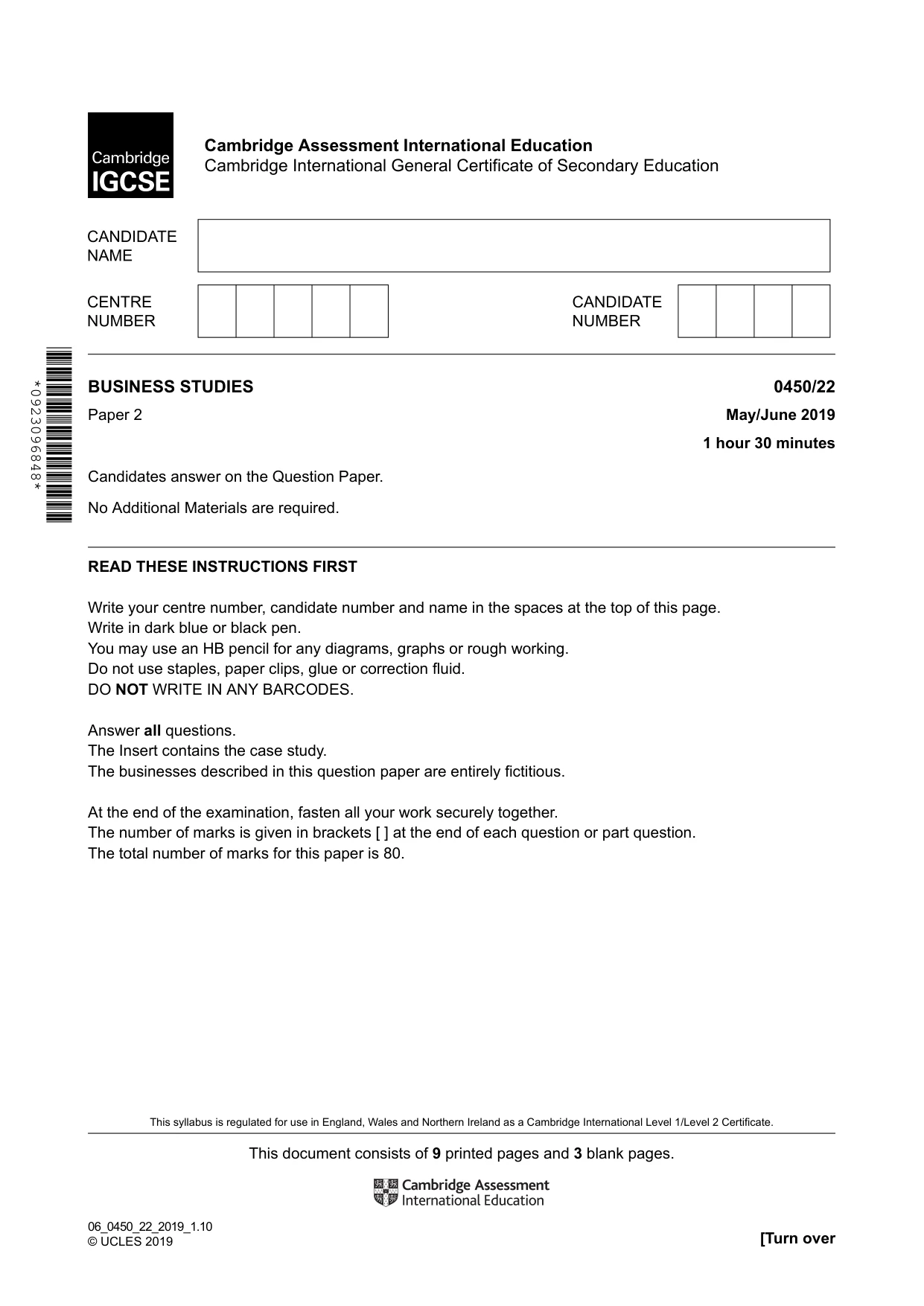
Cambridge Assessment International Education Cambridge International General Certificate of Secondary Education 0450/22 May/June 2019 1 hour 30 minutes BUSINESS STUDIES Paper 2 Candidates answer on the Question Paper. No Additional Materials are required. READ THESE INSTRUCTIONS FIRST Write your centre number, candidate number and name in the spaces at the top of this page. Write in dark blue or black pen. You may use an HB pencil for any diagrams, graphs or rough working. Do not use staples, paper clips, glue or correction fluid. DO NOT WRITE IN ANY BARCODES. Answer all questions. The Insert contains the case study. The businesses described in this question paper are entirely fictitious. At the end of the examination, fasten all your work securely together. The number of marks is given in brackets [ ] at the end of each question or part question. The total number of marks for this paper is 80. This syllabus is regulated for use in England, Wales and Northern Ireland as a Cambridge International Level 1/Level 2 Certificate. This document consists of 9 printed pages and 3 blank pages. [Turn over 06_0450_22_2019_1.10 © UCLES 2019 *0923096848*
Question paper, page 2
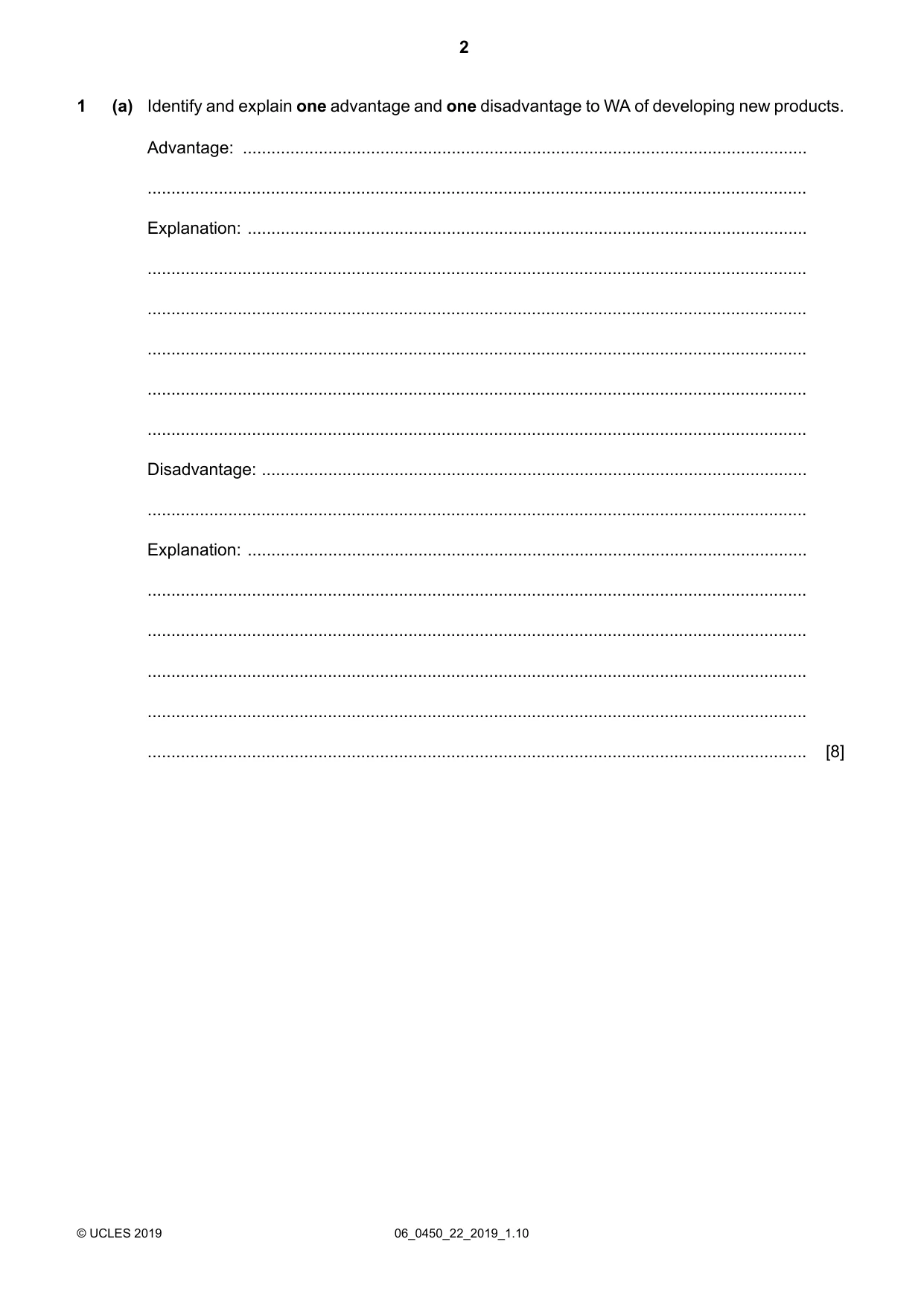
Identify and explain one advantage and one disadvantage to WA of developing new products. (a) 1 Advantage: … … Explanation: … … … … … … Disadvantage: … … Explanation: … … … … … … [8] 06_0450_22_2019_1.10 © UCLES 2019 2
Question paper, page 3
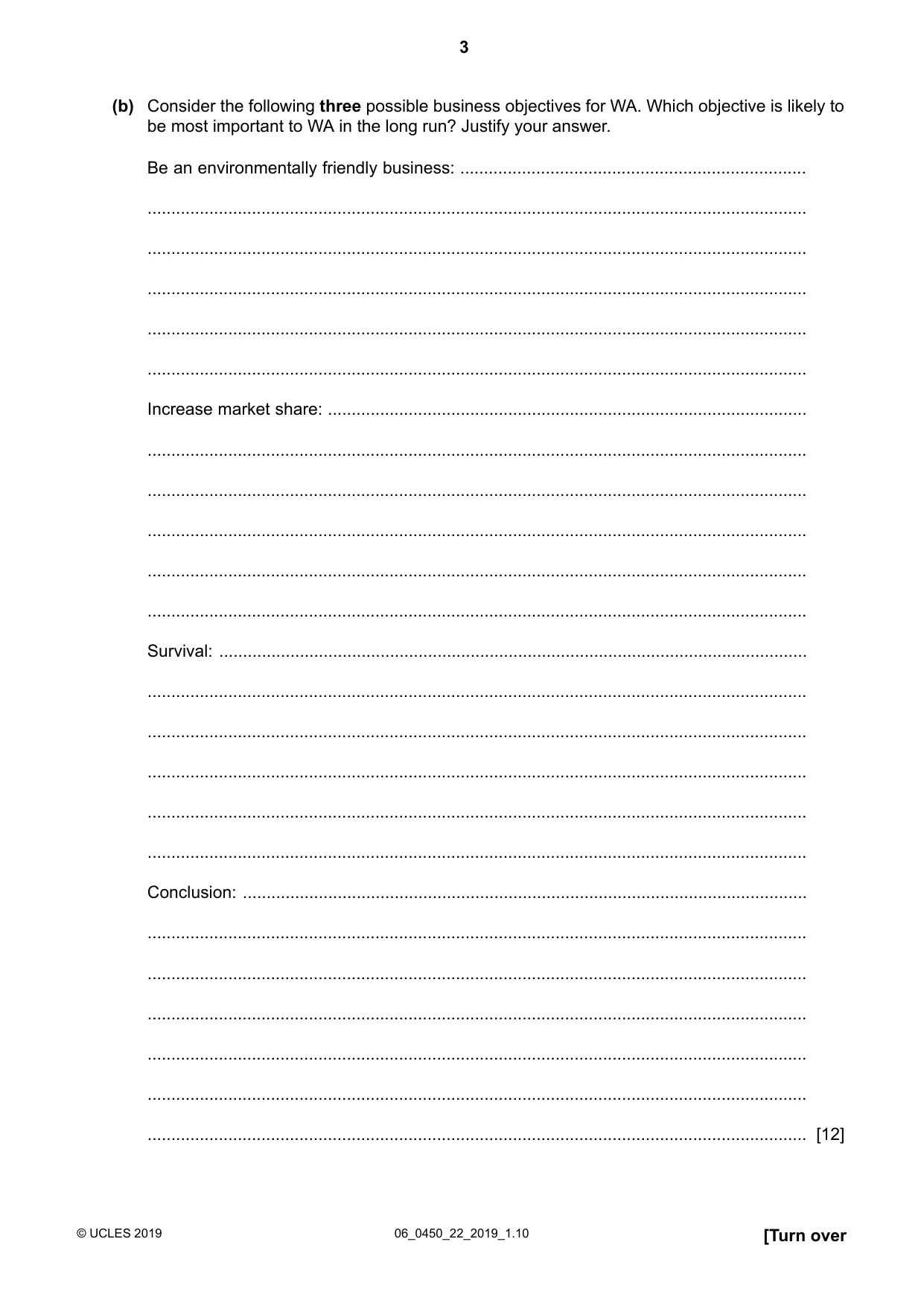
Consider the following three possible business objectives for WA. Which objective is likely to be most important to WA in the long run? Justify your answer. (b) Be an environmentally friendly business: … … … … … … Increase market share: … … … … … … Survival: … … … … … … Conclusion: … … … … … … … [12] [Turn over 06_0450_22_2019_1.10 © UCLES 2019 3
Question paper, page 4
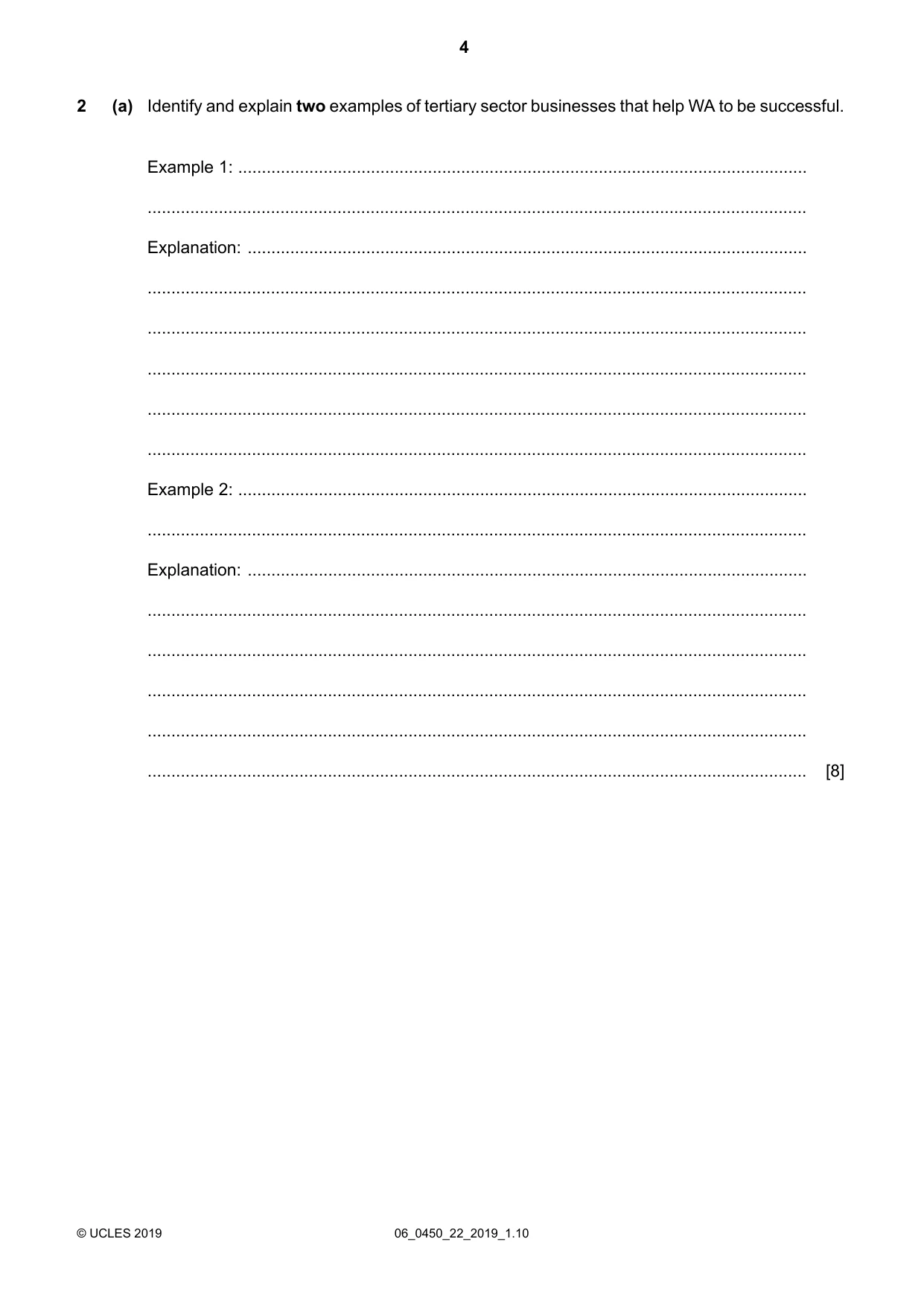
Identify and explain two examples of tertiary sector businesses that help WA to be successful. (a) 2 Example 1: … … Explanation: … … … … … … Example 2: … … Explanation: … … … … … … [8] 06_0450_22_2019_1.10 © UCLES 2019 4
Question paper, page 5
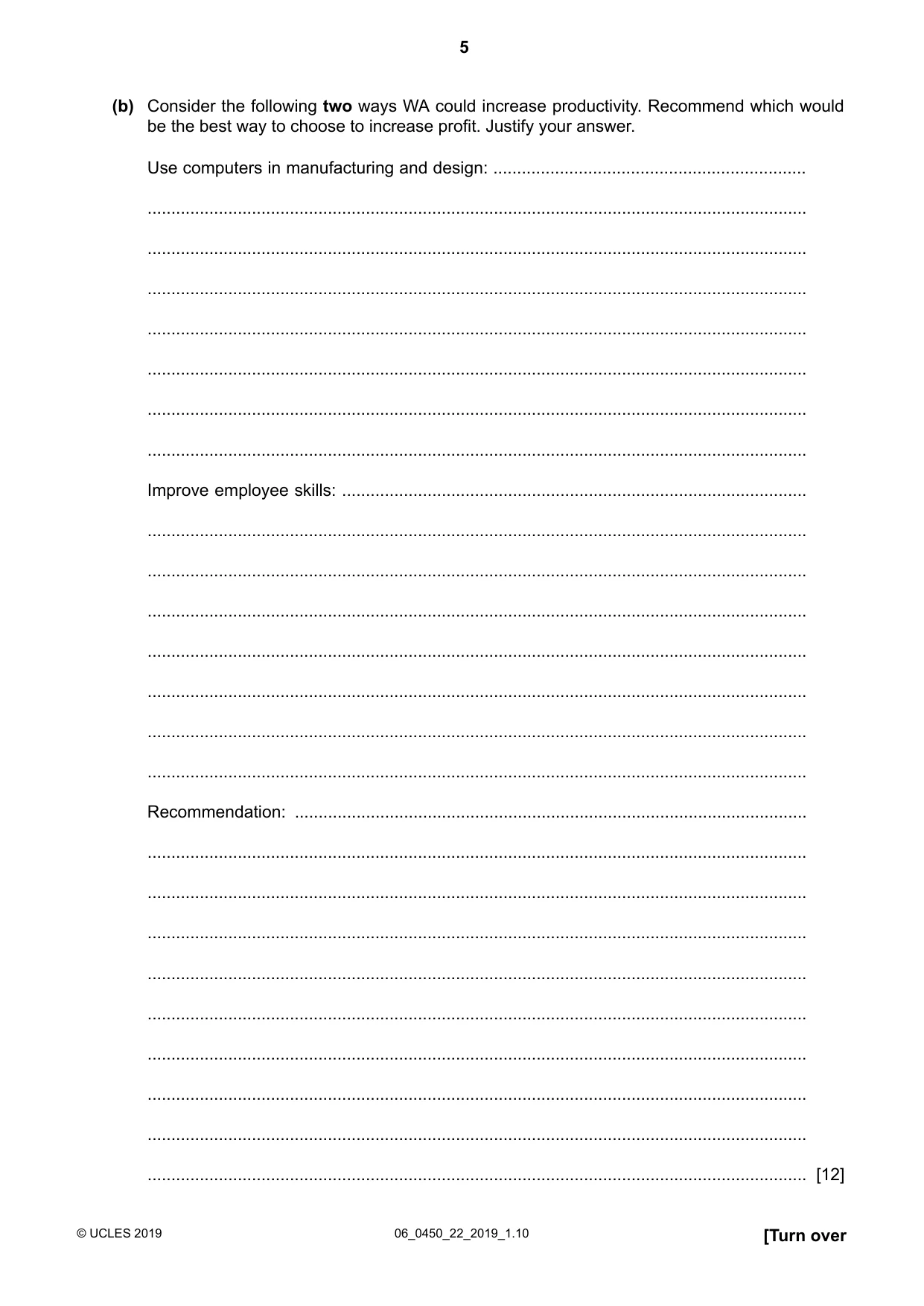
Consider the following two ways WA could increase productivity. Recommend which would be the best way to choose to increase profit. Justify your answer. (b) Use computers in manufacturing and design: … … … … … … … … Improve employee skills: … … … … … … … … Recommendation: … … … … … … … … … … [12] [Turn over 06_0450_22_2019_1.10 © UCLES 2019 5
Question paper, page 6
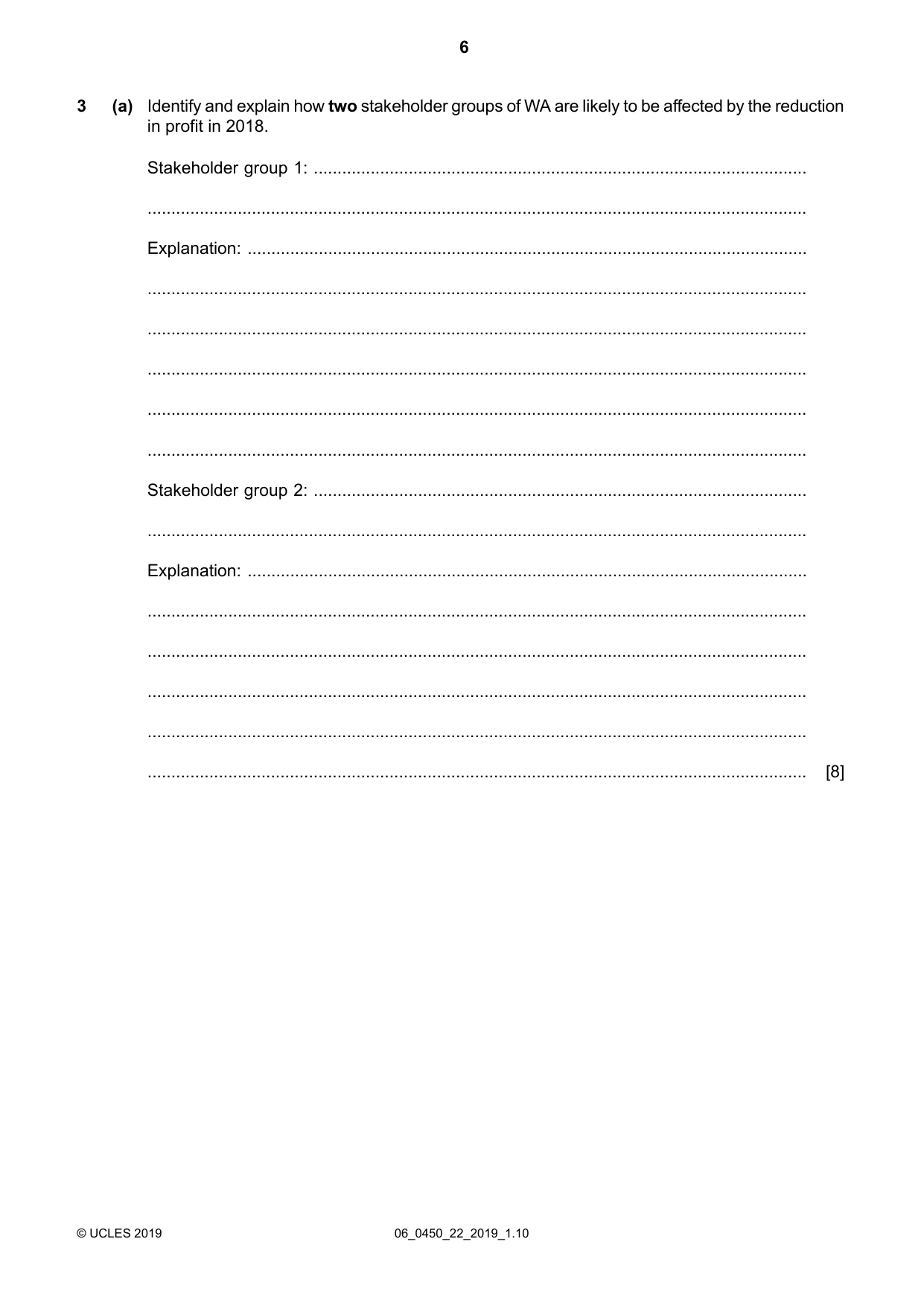
Identify and explain how two stakeholder groups of WA are likely to be affected by the reduction in profit in 2018. (a) 3 Stakeholder group 1: … … Explanation: … … … … … … Stakeholder group 2: … … Explanation: … … … … … … [8] 06_0450_22_2019_1.10 © UCLES 2019 6
Question paper, page 7
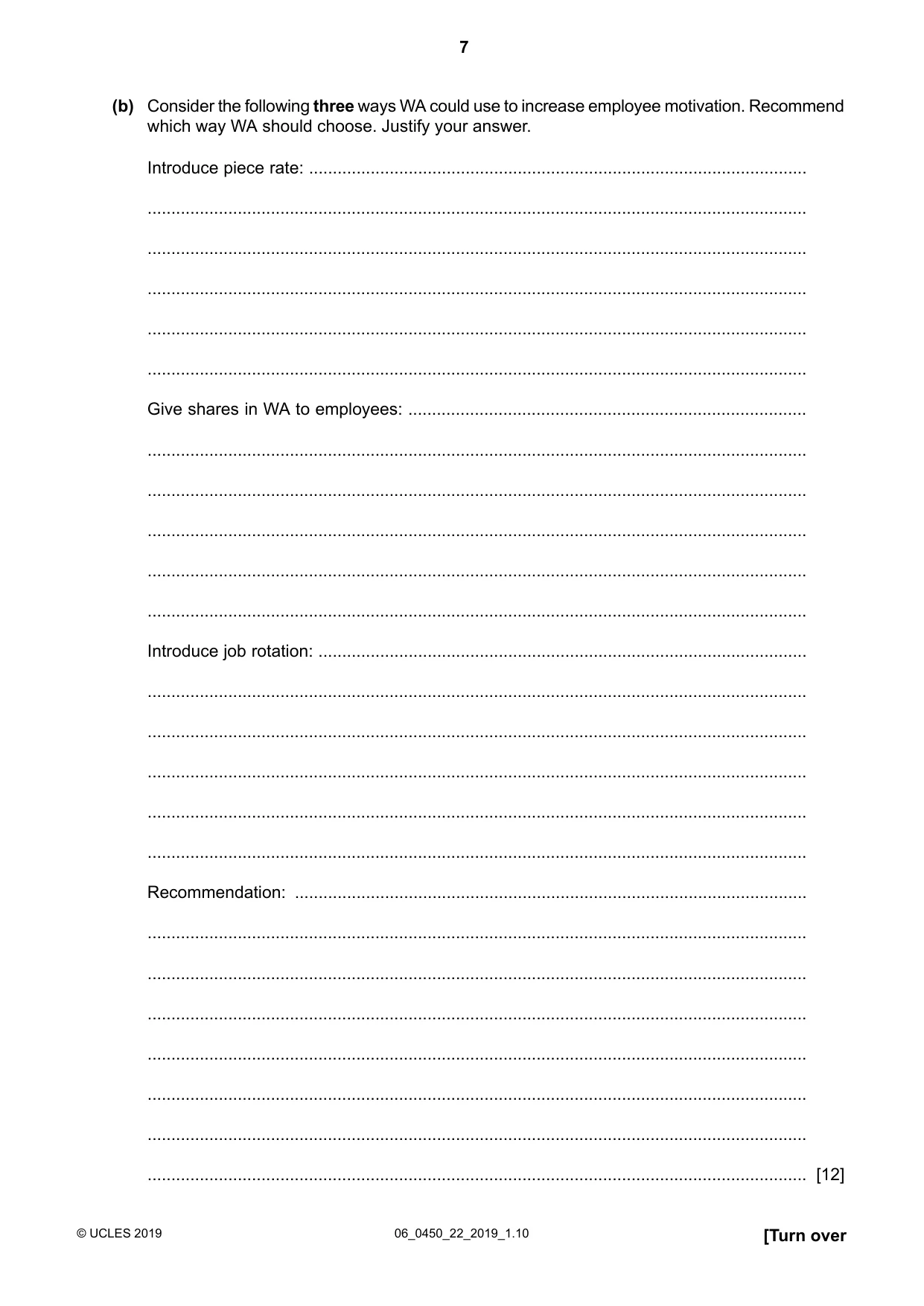
Consider the following three ways WA could use to increase employee motivation. Recommend which way WA should choose. Justify your answer. (b) Introduce piece rate: … … … … … … Give shares in WA to employees: … … … … … … Introduce job rotation: … … … … … … Recommendation: … … … … … … … … [12] [Turn over 06_0450_22_2019_1.10 © UCLES 2019 7
Question paper, page 8
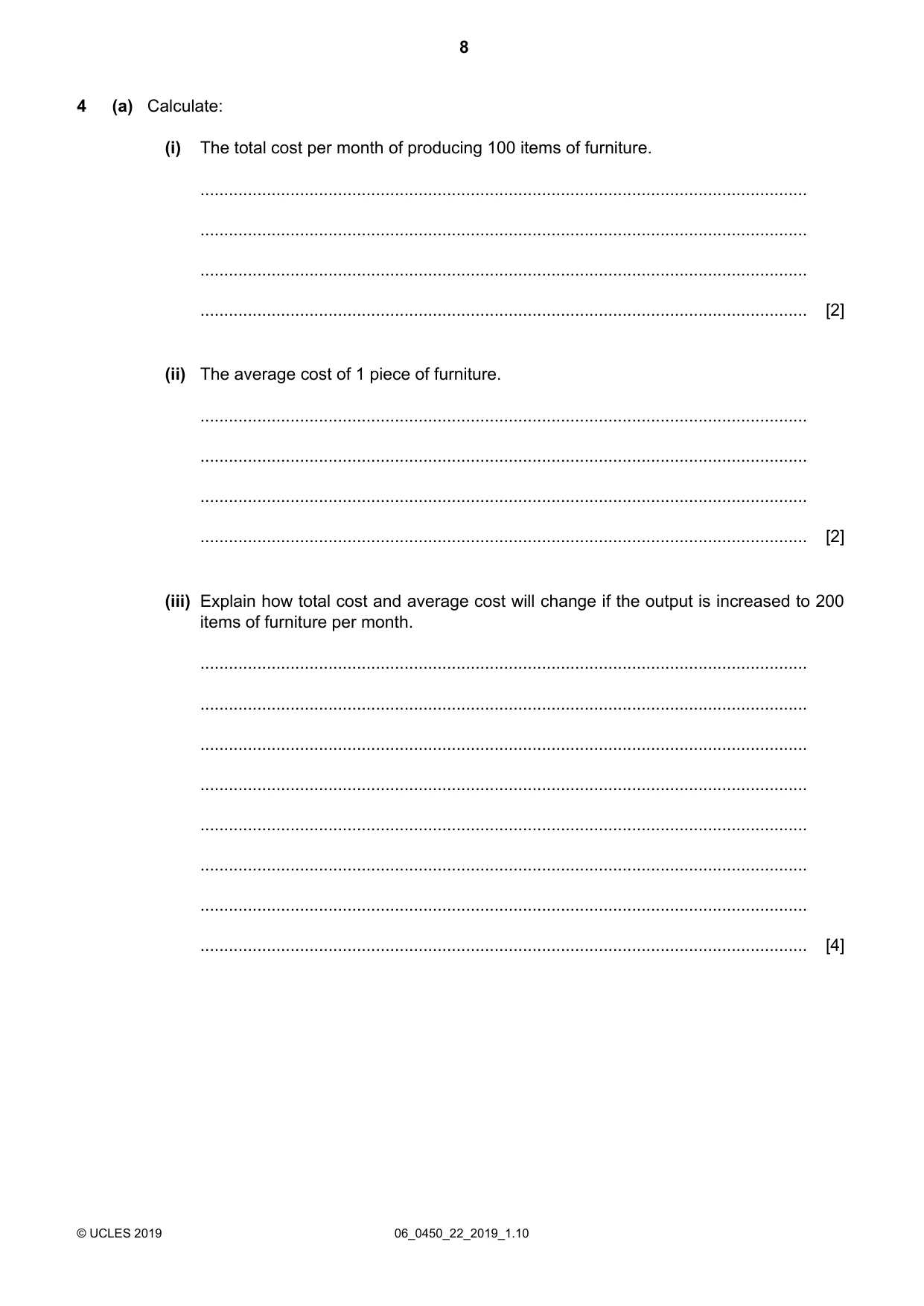
Calculate: (a) 4 The total cost per month of producing 100 items of furniture. (i) … … … … [2] The average cost of 1 piece of furniture. (ii) … … … … [2] Explain how total cost and average cost will change if the output is increased to 200 items of furniture per month. (iii) … … … … … … … … [4] 06_0450_22_2019_1.10 © UCLES 2019 8
Question paper, page 9
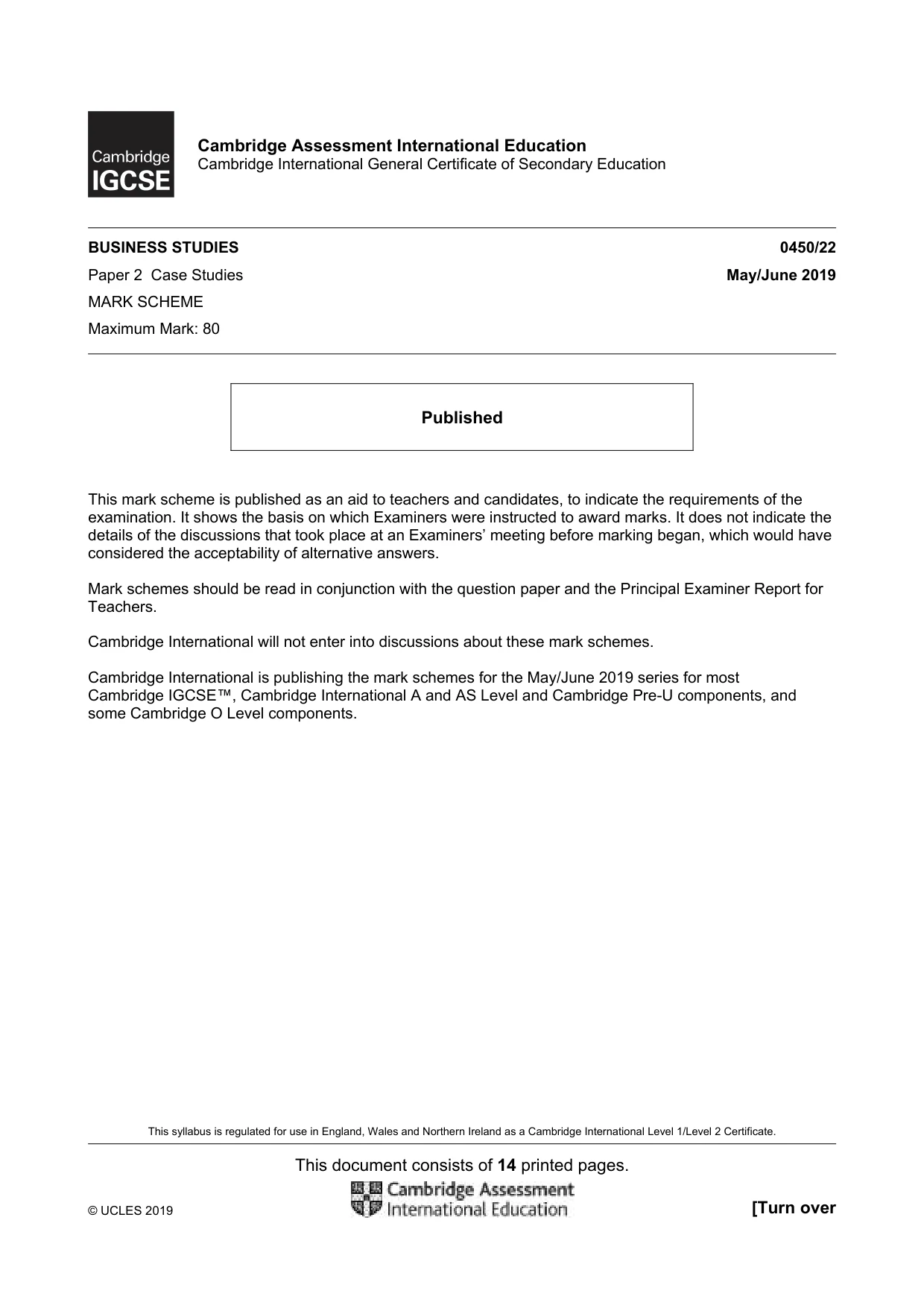
Consider how the following three changes might affect WA. Which change is likely to have the biggest effect on WA? Justify your answer. (b) Introduction of new cost to businesses of $50 per tonne for removing waste: … … … … … … Increase in legal minimum wage by 5%: … … … … … … Increase in tax on incomes: … … … … … … Conclusion: … … … … … … … … [12] 06_0450_22_2019_1.10 © UCLES 2019 9
Question paper, page 10
BLANK PAGE 06_0450_22_2019_1.10 © UCLES 2019 10
Question paper, page 11
BLANK PAGE 06_0450_22_2019_1.10 © UCLES 2019 11
Question paper, page 12
BLANK PAGE Permission to reproduce items where third-party owned material protected by copyright is included has been sought and cleared where possible. Every reasonable effort has been made by the publisher (UCLES) to trace copyright holders, but if any items requiring clearance have unwittingly been included, the publisher will be pleased to make amends at the earliest possible opportunity. To avoid the issue of disclosure of answer-related information to candidates, all copyright acknowledgements are reproduced online in the Cambridge Assessment International Education Copyright Acknowledgements Booklet. This is produced for each series of examinations and is freely available to download at www.cambridgeinternational.org after the live examination series. Cambridge Assessment International Education is part of the Cambridge Assessment Group. Cambridge Assessment is the brand name of the University of Cambridge Local Examinations Syndicate (UCLES), which itself is a department of the University of Cambridge. 06_0450_22_2019_1.10 © UCLES 2019 12
Mark scheme, page 1
This syllabus is regulated for use in England, Wales and Northern Ireland as a Cambridge International Level 1/Level 2 Certificate. This document consists of 14 printed pages. © UCLES 2019 [Turn over Cambridge Assessment International Education Cambridge International General Certificate of Secondary Education BUSINESS STUDIES 0450/22 Paper 2 Case Studies May/June 2019 MARK SCHEME Maximum Mark: 80 Published This mark scheme is published as an aid to teachers and candidates, to indicate the requirements of the examination. It shows the basis on which Examiners were instructed to award marks. It does not indicate the details of the discussions that took place at an Examiners’ meeting before marking began, which would have considered the acceptability of alternative answers. Mark schemes should be read in conjunction with the question paper and the Principal Examiner Report for Teachers. Cambridge International will not enter into discussions about these mark schemes. Cambridge International is publishing the mark schemes for the May/June 2019 series for most Cambridge IGCSE™, Cambridge International A and AS Level and Cambridge Pre-U components, and some Cambridge O Level components.
Mark scheme, page 2
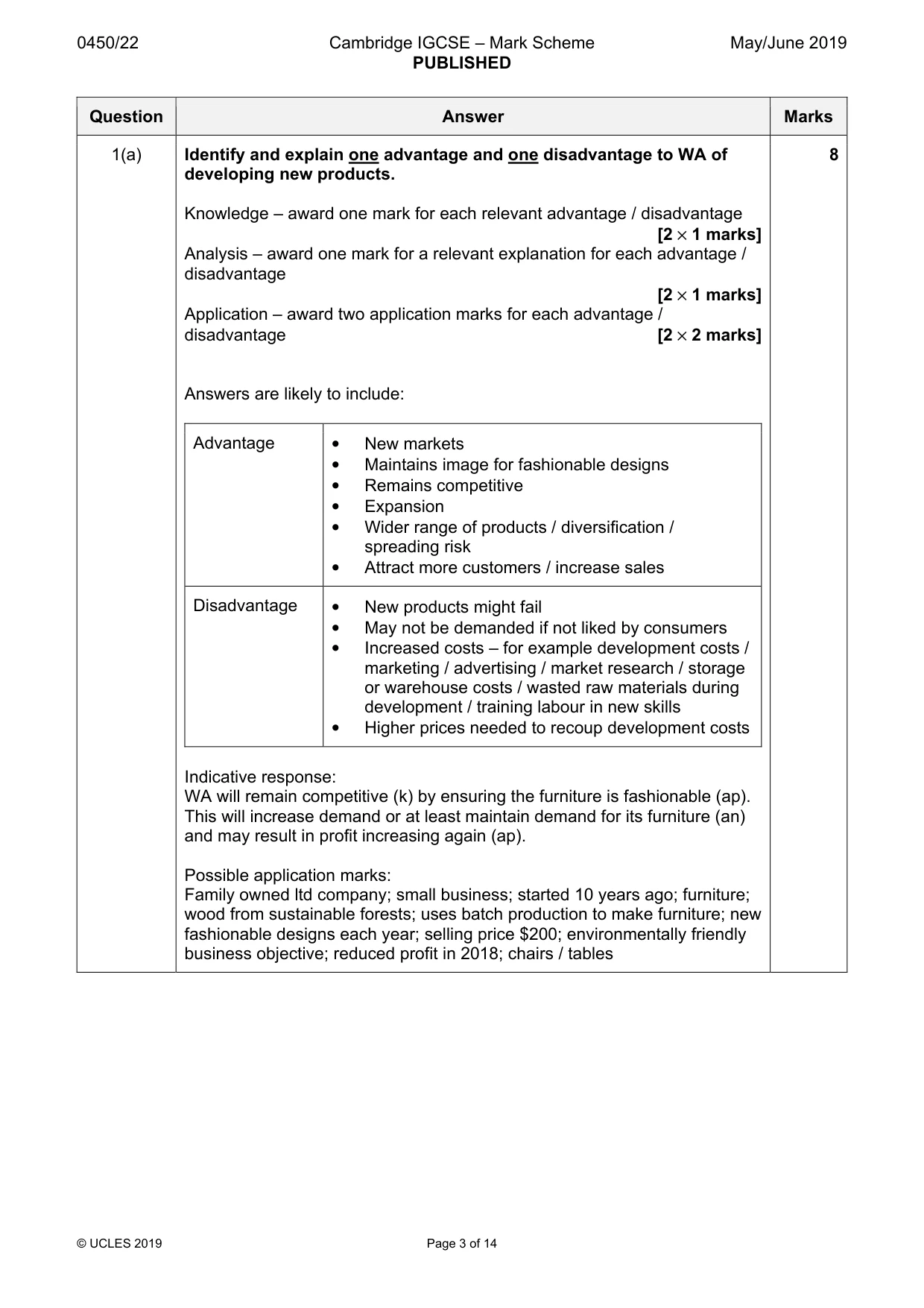
0450/22 Cambridge IGCSE – Mark Scheme PUBLISHED May/June 2019 © UCLES 2019 Page 2 of 14 Generic Marking Principles These general marking principles must be applied by all examiners when marking candidate answers. They should be applied alongside the specific content of the mark scheme or generic level descriptors for a question. Each question paper and mark scheme will also comply with these marking principles. GENERIC MARKING PRINCIPLE 1: Marks must be awarded in line with: • the specific content of the mark scheme or the generic level descriptors for the question • the specific skills defined in the mark scheme or in the generic level descriptors for the question • the standard of response required by a candidate as exemplified by the standardisation scripts. GENERIC MARKING PRINCIPLE 2: Marks awarded are always whole marks (not half marks, or other fractions). GENERIC MARKING PRINCIPLE 3: Marks must be awarded positively: • marks are awarded for correct/valid answers, as defined in the mark scheme. However, credit is given for valid answers which go beyond the scope of the syllabus and mark scheme, referring to your Team Leader as appropriate • marks are awarded when candidates clearly demonstrate what they know and can do • marks are not deducted for errors • marks are not deducted for omissions • answers should only be judged on the quality of spelling, punctuation and grammar when these features are specifically assessed by the question as indicated by the mark scheme. The meaning, however, should be unambiguous. GENERIC MARKING PRINCIPLE 4: Rules must be applied consistently e.g. in situations where candidates have not followed instructions or in the application of generic level descriptors. GENERIC MARKING PRINCIPLE 5: Marks should be awarded using the full range of marks defined in the mark scheme for the question (however; the use of the full mark range may be limited according to the quality of the candidate responses seen). GENERIC MARKING PRINCIPLE 6: Marks awarded are based solely on the requirements as defined in the mark scheme. Marks should not be awarded with grade thresholds or grade descriptors in mind.
Mark scheme, page 3
0450/22 Cambridge IGCSE – Mark Scheme PUBLISHED May/June 2019 © UCLES 2019 Page 3 of 14 Question Answer Marks 1(a) Identify and explain one advantage and one disadvantage to WA of developing new products. Knowledge – award one mark for each relevant advantage / disadvantage [2 × 1 marks] Analysis – award one mark for a relevant explanation for each advantage / disadvantage [2 × 1 marks] Application – award two application marks for each advantage / disadvantage [2 × 2 marks] Answers are likely to include: Advantage • New markets • Maintains image for fashionable designs • Remains competitive • Expansion • Wider range of products / diversification / spreading risk • Attract more customers / increase sales Disadvantage • New products might fail • May not be demanded if not liked by consumers • Increased costs – for example development costs / marketing / advertising / market research / storage or warehouse costs / wasted raw materials during development / training labour in new skills • Higher prices needed to recoup development costs Indicative response: WA will remain competitive (k) by ensuring the furniture is fashionable (ap). This will increase demand or at least maintain demand for its furniture (an) and may result in profit increasing again (ap). Possible application marks: Family owned ltd company; small business; started 10 years ago; furniture; wood from sustainable forests; uses batch production to make furniture; new fashionable designs each year; selling price $200; environmentally friendly business objective; reduced profit in 2018; chairs / tables 8
Mark scheme, page 4
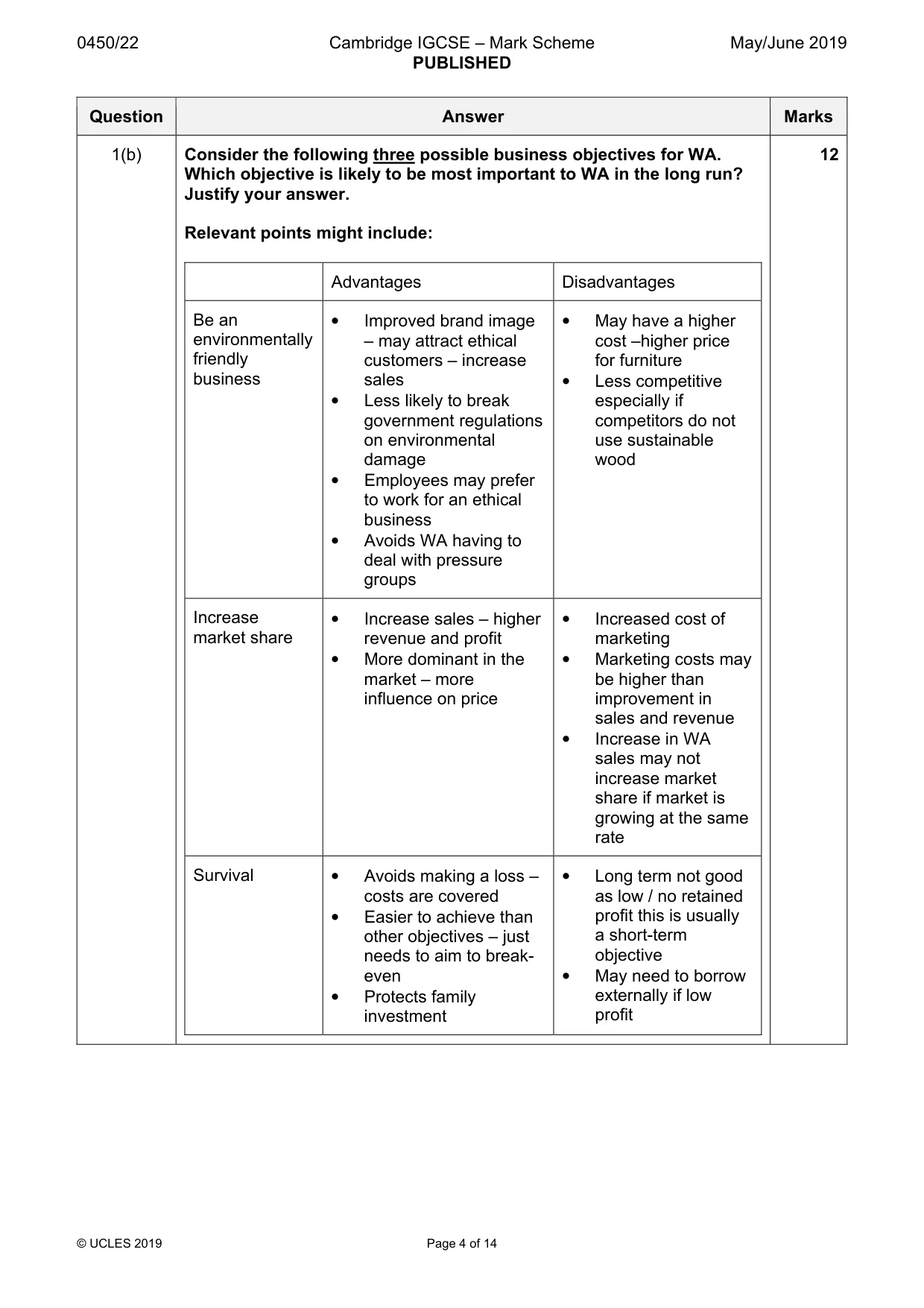
0450/22 Cambridge IGCSE – Mark Scheme PUBLISHED May/June 2019 © UCLES 2019 Page 4 of 14 Question Answer Marks 1(b) Consider the following three possible business objectives for WA. Which objective is likely to be most important to WA in the long run? Justify your answer. Relevant points might include: Advantages Disadvantages Be an environmentally friendly business • Improved brand image – may attract ethical customers – increase sales • Less likely to break government regulations on environmental damage • Employees may prefer to work for an ethical business • Avoids WA having to deal with pressure groups • May have a higher cost –higher price for furniture • Less competitive especially if competitors do not use sustainable wood Increase market share • Increase sales – higher revenue and profit • More dominant in the market – more influence on price • Increased cost of marketing • Marketing costs may be higher than improvement in sales and revenue • Increase in WA sales may not increase market share if market is growing at the same rate Survival • Avoids making a loss – costs are covered • Easier to achieve than other objectives – just needs to aim to break- even • Protects family investment • Long term not good as low / no retained profit this is usually a short-term objective • May need to borrow externally if low profit 12
Mark scheme, page 5
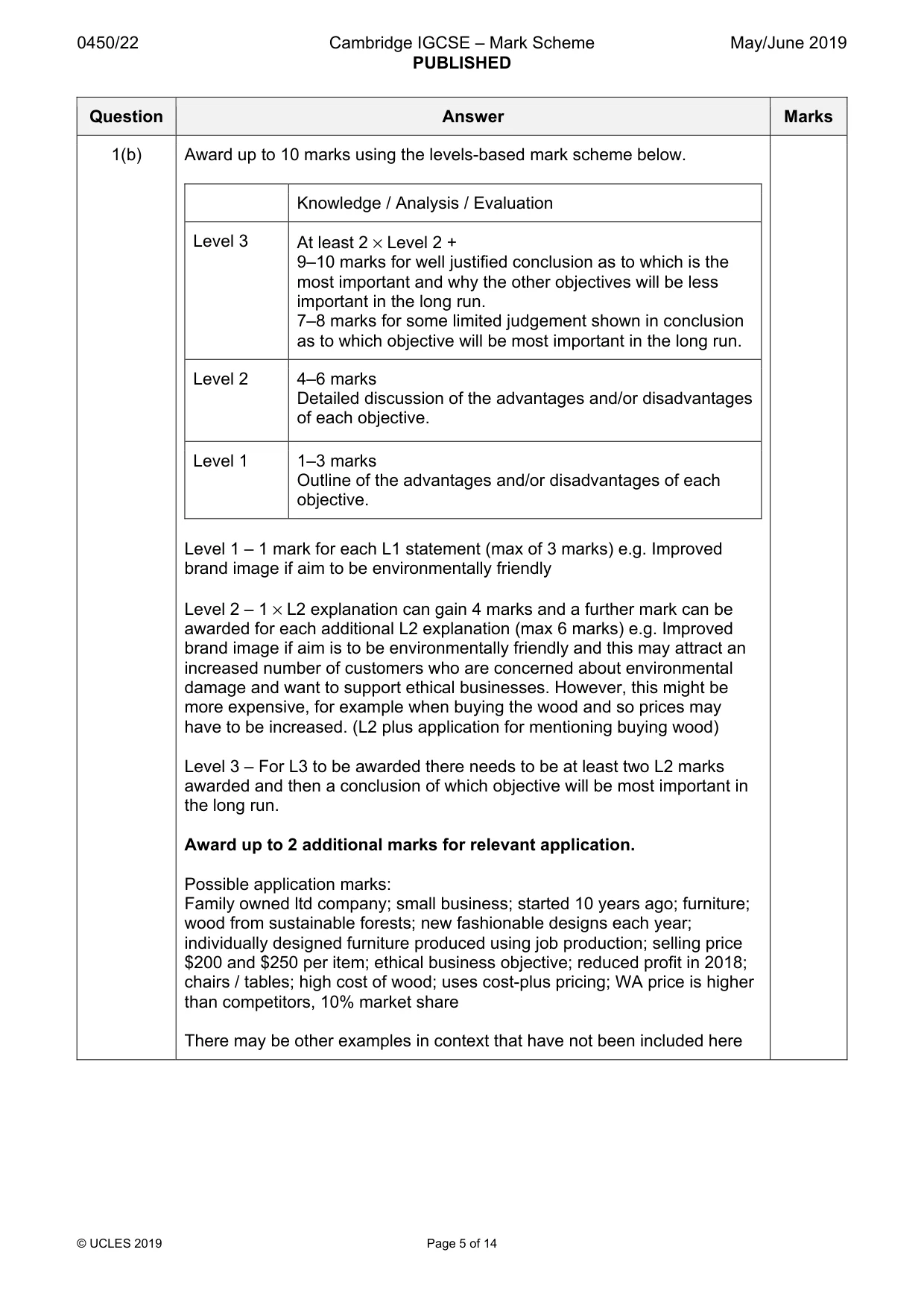
0450/22 Cambridge IGCSE – Mark Scheme PUBLISHED May/June 2019 © UCLES 2019 Page 5 of 14 Question Answer Marks 1(b) Award up to 10 marks using the levels-based mark scheme below. Knowledge / Analysis / Evaluation Level 3 At least 2 × Level 2 + 9–10 marks for well justified conclusion as to which is the most important and why the other objectives will be less important in the long run. 7–8 marks for some limited judgement shown in conclusion as to which objective will be most important in the long run. Level 2 4–6 marks Detailed discussion of the advantages and/or disadvantages of each objective. Level 1 1–3 marks Outline of the advantages and/or disadvantages of each objective. Level 1 – 1 mark for each L1 statement (max of 3 marks) e.g. Improved brand image if aim to be environmentally friendly Level 2 – 1 × L2 explanation can gain 4 marks and a further mark can be awarded for each additional L2 explanation (max 6 marks) e.g. Improved brand image if aim is to be environmentally friendly and this may attract an increased number of customers who are concerned about environmental damage and want to support ethical businesses. However, this might be more expensive, for example when buying the wood and so prices may have to be increased. (L2 plus application for mentioning buying wood) Level 3 – For L3 to be awarded there needs to be at least two L2 marks awarded and then a conclusion of which objective will be most important in the long run. Award up to 2 additional marks for relevant application. Possible application marks: Family owned ltd company; small business; started 10 years ago; furniture; wood from sustainable forests; new fashionable designs each year; individually designed furniture produced using job production; selling price $200 and $250 per item; ethical business objective; reduced profit in 2018; chairs / tables; high cost of wood; uses cost-plus pricing; WA price is higher than competitors, 10% market share There may be other examples in context that have not been included here
Mark scheme, page 6
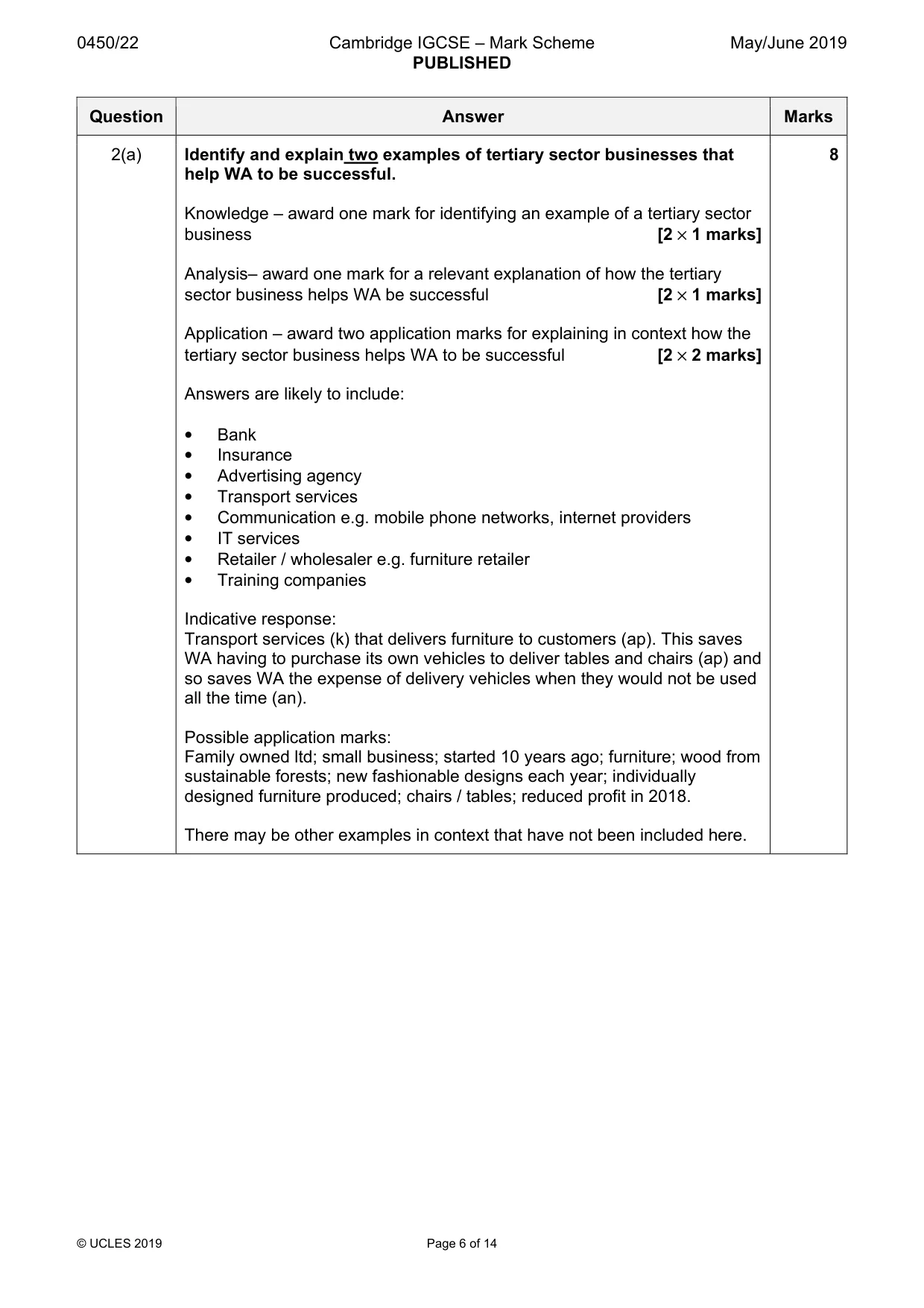
0450/22 Cambridge IGCSE – Mark Scheme PUBLISHED May/June 2019 © UCLES 2019 Page 6 of 14 Question Answer Marks 2(a) Identify and explain two examples of tertiary sector businesses that help WA to be successful. Knowledge – award one mark for identifying an example of a tertiary sector business [2 × 1 marks] Analysis– award one mark for a relevant explanation of how the tertiary sector business helps WA be successful [2 × 1 marks] Application – award two application marks for explaining in context how the tertiary sector business helps WA to be successful [2 × 2 marks] Answers are likely to include: • Bank • Insurance • Advertising agency • Transport services • Communication e.g. mobile phone networks, internet providers • IT services • Retailer / wholesaler e.g. furniture retailer • Training companies Indicative response: Transport services (k) that delivers furniture to customers (ap). This saves WA having to purchase its own vehicles to deliver tables and chairs (ap) and so saves WA the expense of delivery vehicles when they would not be used all the time (an). Possible application marks: Family owned ltd; small business; started 10 years ago; furniture; wood from sustainable forests; new fashionable designs each year; individually designed furniture produced; chairs / tables; reduced profit in 2018. There may be other examples in context that have not been included here. 8
Mark scheme, page 7
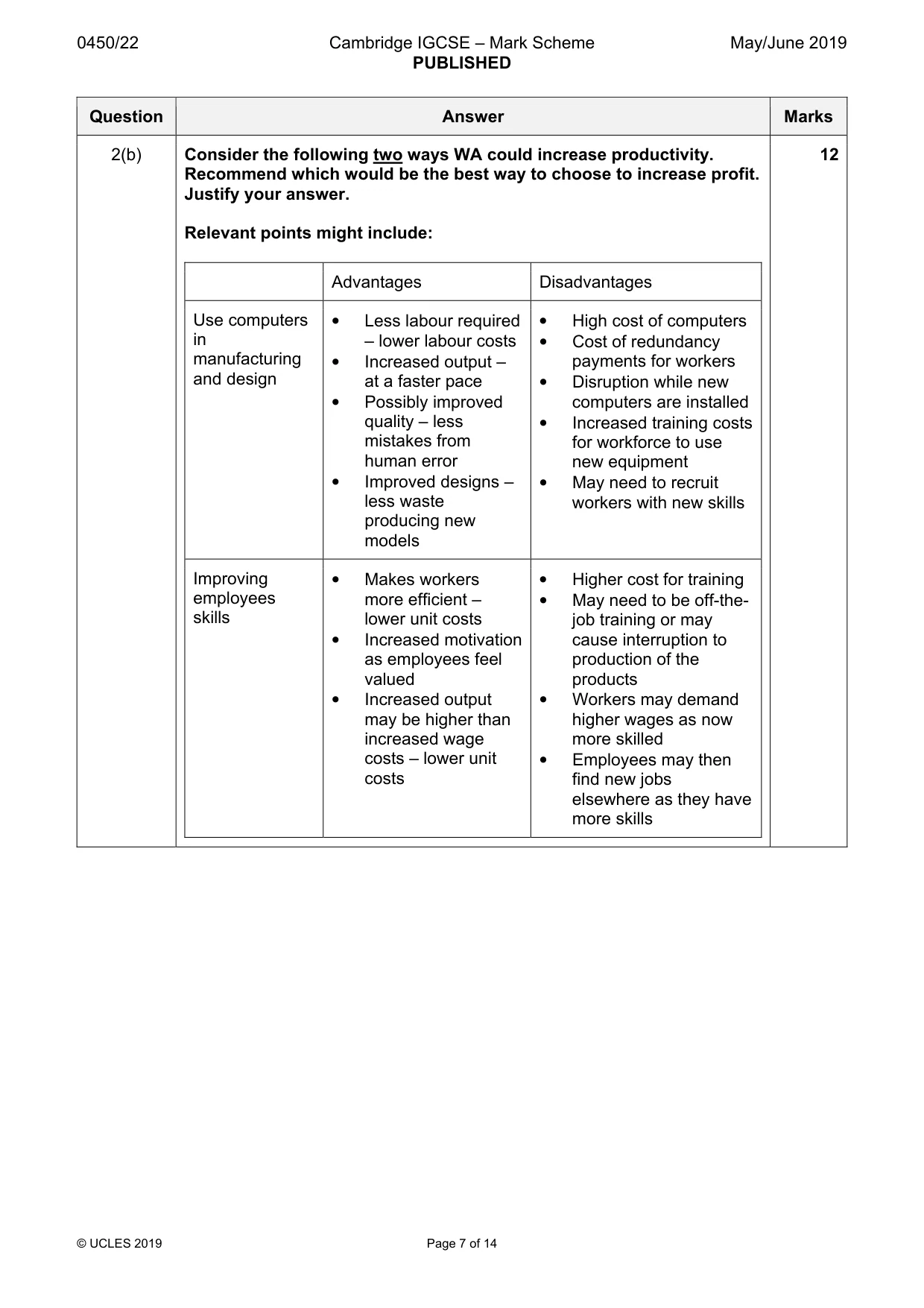
0450/22 Cambridge IGCSE – Mark Scheme PUBLISHED May/June 2019 © UCLES 2019 Page 7 of 14 Question Answer Marks 2(b) Consider the following two ways WA could increase productivity. Recommend which would be the best way to choose to increase profit. Justify your answer. Relevant points might include: Advantages Disadvantages Use computers in manufacturing and design • Less labour required – lower labour costs • Increased output – at a faster pace • Possibly improved quality – less mistakes from human error • Improved designs – less waste producing new models • High cost of computers • Cost of redundancy payments for workers • Disruption while new computers are installed • Increased training costs for workforce to use new equipment • May need to recruit workers with new skills Improving employees skills • Makes workers more efficient – lower unit costs • Increased motivation as employees feel valued • Increased output may be higher than increased wage costs – lower unit costs • Higher cost for training • May need to be off-the- job training or may cause interruption to production of the products • Workers may demand higher wages as now more skilled • Employees may then find new jobs elsewhere as they have more skills 12
Mark scheme, page 8
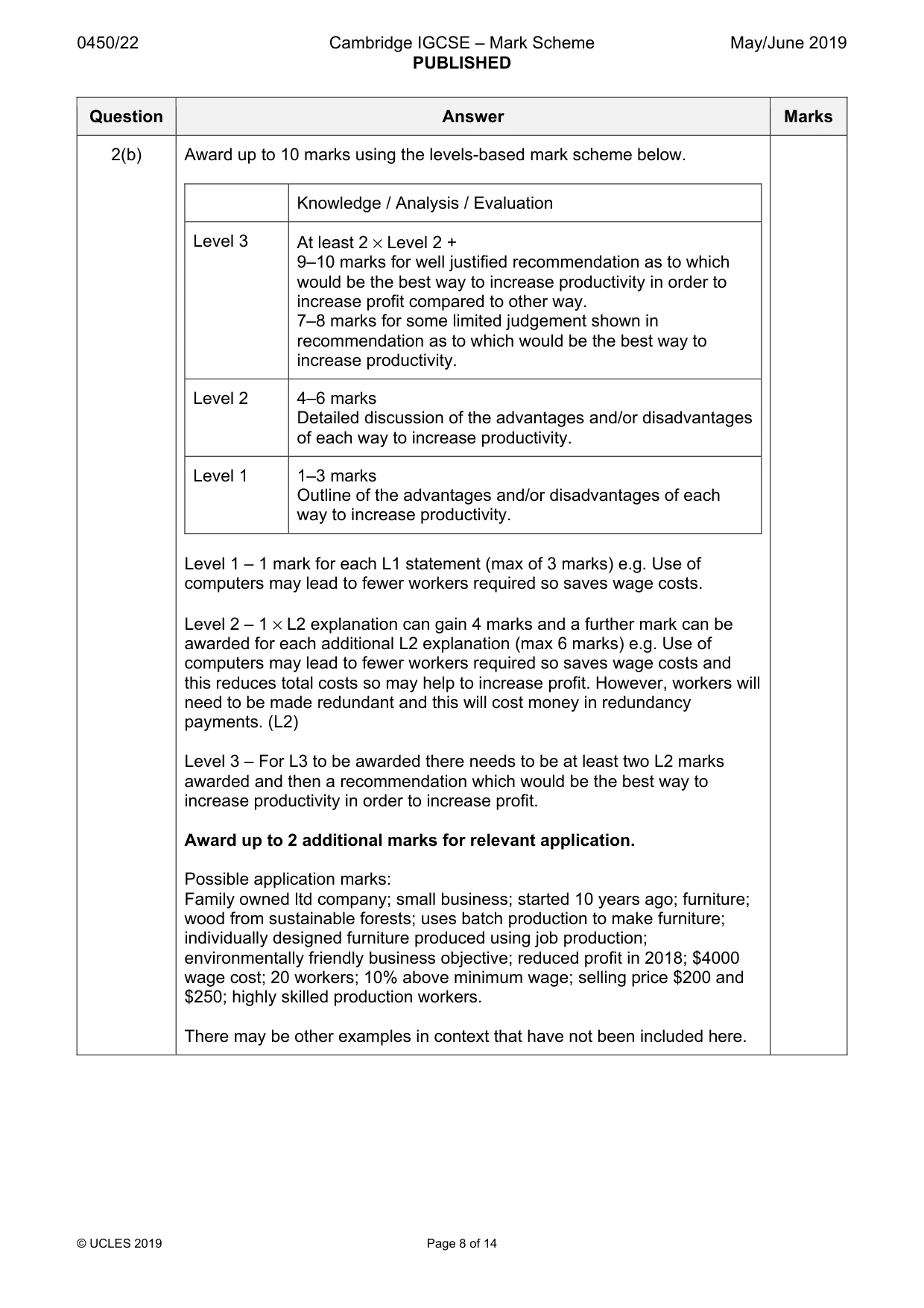
0450/22 Cambridge IGCSE – Mark Scheme PUBLISHED May/June 2019 © UCLES 2019 Page 8 of 14 Question Answer Marks 2(b) Award up to 10 marks using the levels-based mark scheme below. Knowledge / Analysis / Evaluation Level 3 At least 2 × Level 2 + 9–10 marks for well justified recommendation as to which would be the best way to increase productivity in order to increase profit compared to other way. 7–8 marks for some limited judgement shown in recommendation as to which would be the best way to increase productivity. Level 2 4–6 marks Detailed discussion of the advantages and/or disadvantages of each way to increase productivity. Level 1 1–3 marks Outline of the advantages and/or disadvantages of each way to increase productivity. Level 1 – 1 mark for each L1 statement (max of 3 marks) e.g. Use of computers may lead to fewer workers required so saves wage costs. Level 2 – 1 × L2 explanation can gain 4 marks and a further mark can be awarded for each additional L2 explanation (max 6 marks) e.g. Use of computers may lead to fewer workers required so saves wage costs and this reduces total costs so may help to increase profit. However, workers will need to be made redundant and this will cost money in redundancy payments. (L2) Level 3 – For L3 to be awarded there needs to be at least two L2 marks awarded and then a recommendation which would be the best way to increase productivity in order to increase profit. Award up to 2 additional marks for relevant application. Possible application marks: Family owned ltd company; small business; started 10 years ago; furniture; wood from sustainable forests; uses batch production to make furniture; individually designed furniture produced using job production; environmentally friendly business objective; reduced profit in 2018; $4000 wage cost; 20 workers; 10% above minimum wage; selling price $200 and $250; highly skilled production workers. There may be other examples in context that have not been included here.
Mark scheme, page 9
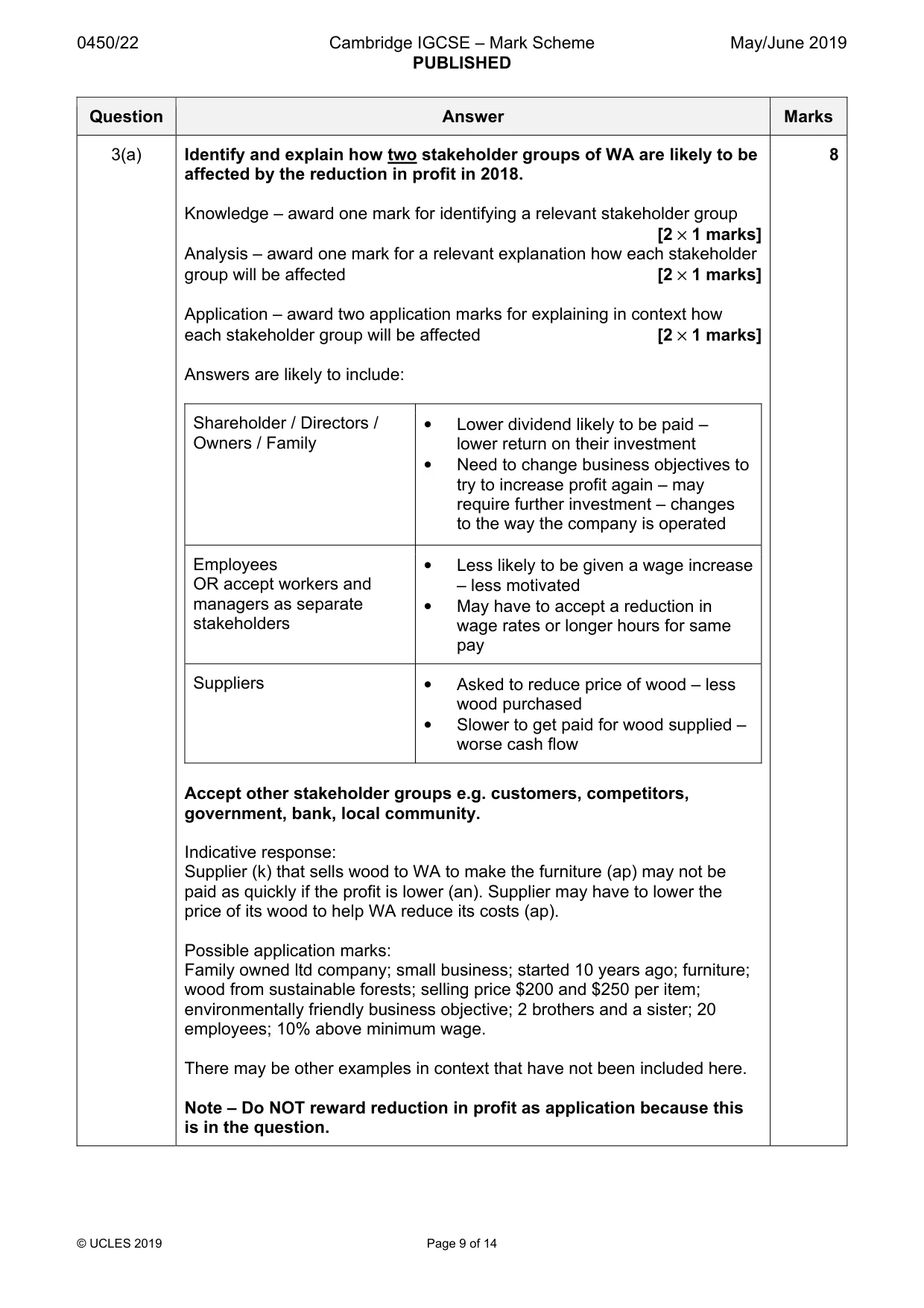
0450/22 Cambridge IGCSE – Mark Scheme PUBLISHED May/June 2019 © UCLES 2019 Page 9 of 14 Question Answer Marks 3(a) Identify and explain how two stakeholder groups of WA are likely to be affected by the reduction in profit in 2018. Knowledge – award one mark for identifying a relevant stakeholder group [2 × 1 marks] Analysis – award one mark for a relevant explanation how each stakeholder group will be affected [2 × 1 marks] Application – award two application marks for explaining in context how each stakeholder group will be affected [2 × 1 marks] Answers are likely to include: Shareholder / Directors / Owners / Family • Lower dividend likely to be paid – lower return on their investment • Need to change business objectives to try to increase profit again – may require further investment – changes to the way the company is operated Employees OR accept workers and managers as separate stakeholders • Less likely to be given a wage increase – less motivated • May have to accept a reduction in wage rates or longer hours for same pay Suppliers • Asked to reduce price of wood – less wood purchased • Slower to get paid for wood supplied – worse cash flow Accept other stakeholder groups e.g. customers, competitors, government, bank, local community. Indicative response: Supplier (k) that sells wood to WA to make the furniture (ap) may not be paid as quickly if the profit is lower (an). Supplier may have to lower the price of its wood to help WA reduce its costs (ap). Possible application marks: Family owned ltd company; small business; started 10 years ago; furniture; wood from sustainable forests; selling price $200 and $250 per item; environmentally friendly business objective; 2 brothers and a sister; 20 employees; 10% above minimum wage. There may be other examples in context that have not been included here. Note – Do NOT reward reduction in profit as application because this is in the question. 8
Mark scheme, page 10
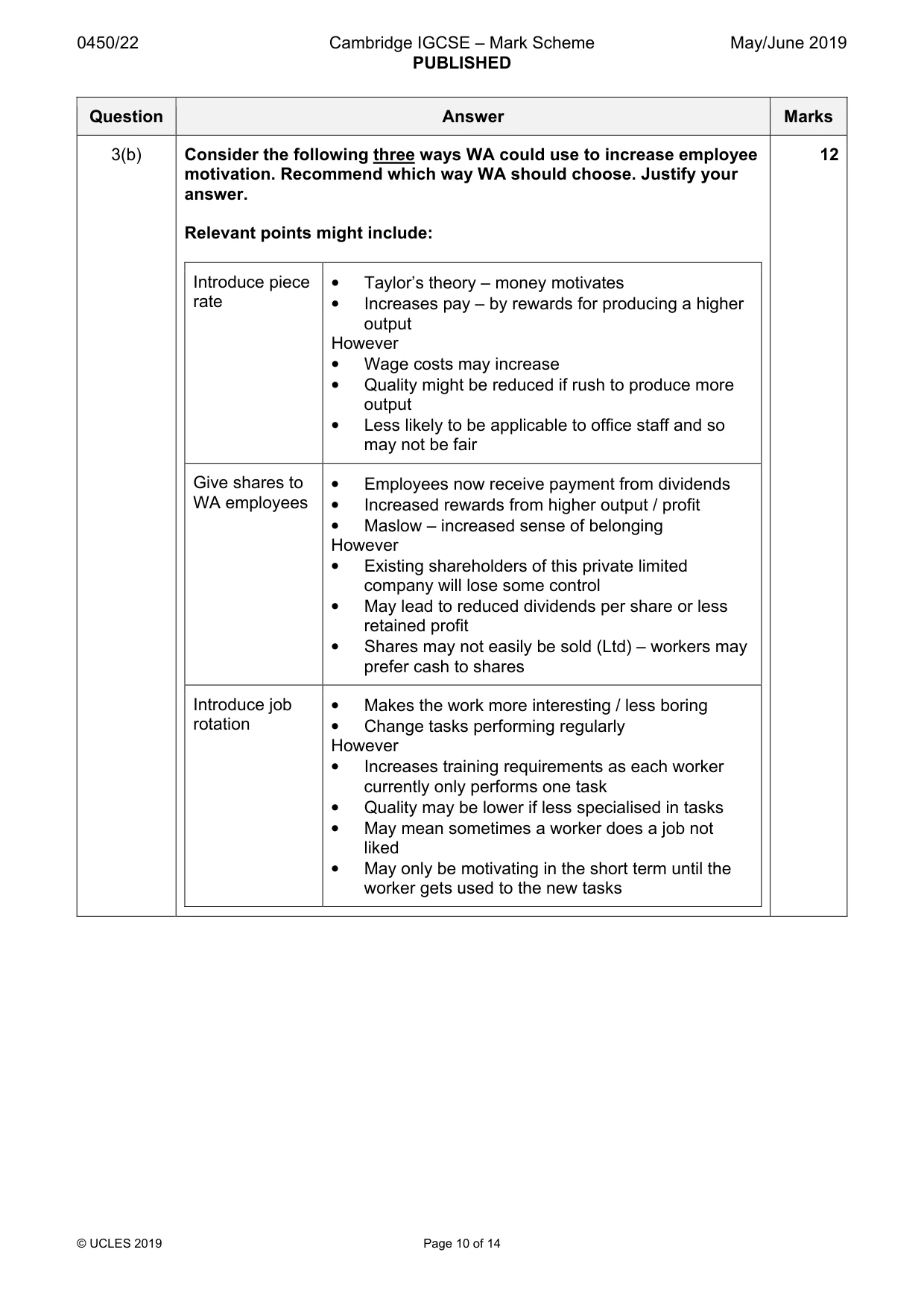
0450/22 Cambridge IGCSE – Mark Scheme PUBLISHED May/June 2019 © UCLES 2019 Page 10 of 14 Question Answer Marks 3(b) Consider the following three ways WA could use to increase employee motivation. Recommend which way WA should choose. Justify your answer. Relevant points might include: Introduce piece rate • Taylor’s theory – money motivates • Increases pay – by rewards for producing a higher output However • Wage costs may increase • Quality might be reduced if rush to produce more output • Less likely to be applicable to office staff and so may not be fair Give shares to WA employees • Employees now receive payment from dividends • Increased rewards from higher output / profit • Maslow – increased sense of belonging However • Existing shareholders of this private limited company will lose some control • May lead to reduced dividends per share or less retained profit • Shares may not easily be sold (Ltd) – workers may prefer cash to shares Introduce job rotation • Makes the work more interesting / less boring • Change tasks performing regularly However • Increases training requirements as each worker currently only performs one task • Quality may be lower if less specialised in tasks • May mean sometimes a worker does a job not liked • May only be motivating in the short term until the worker gets used to the new tasks 12
Mark scheme, page 11
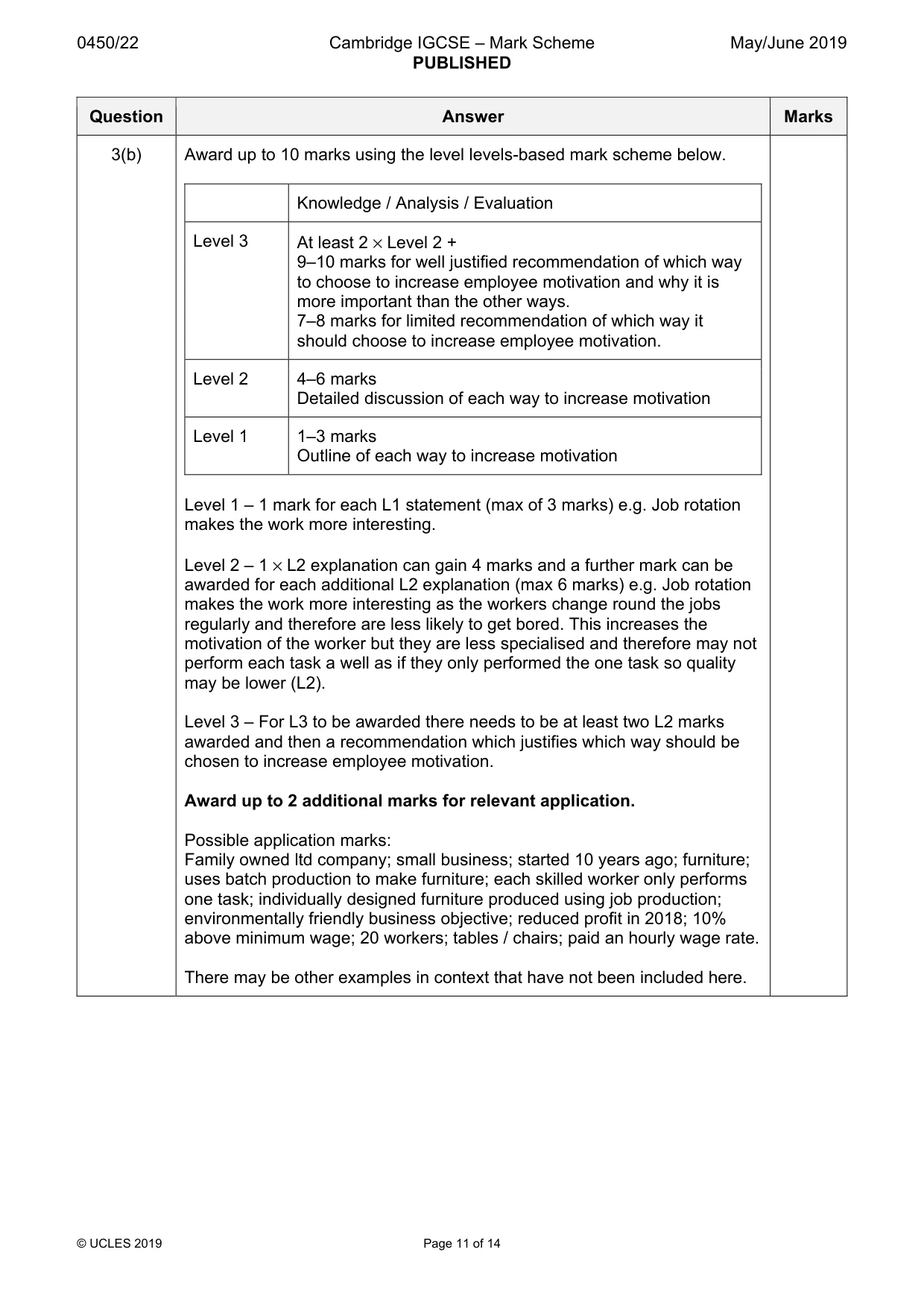
0450/22 Cambridge IGCSE – Mark Scheme PUBLISHED May/June 2019 © UCLES 2019 Page 11 of 14 Question Answer Marks 3(b) Award up to 10 marks using the level levels-based mark scheme below. Knowledge / Analysis / Evaluation Level 3 At least 2 × Level 2 + 9–10 marks for well justified recommendation of which way to choose to increase employee motivation and why it is more important than the other ways. 7–8 marks for limited recommendation of which way it should choose to increase employee motivation. Level 2 4–6 marks Detailed discussion of each way to increase motivation Level 1 1–3 marks Outline of each way to increase motivation Level 1 – 1 mark for each L1 statement (max of 3 marks) e.g. Job rotation makes the work more interesting. Level 2 – 1 × L2 explanation can gain 4 marks and a further mark can be awarded for each additional L2 explanation (max 6 marks) e.g. Job rotation makes the work more interesting as the workers change round the jobs regularly and therefore are less likely to get bored. This increases the motivation of the worker but they are less specialised and therefore may not perform each task a well as if they only performed the one task so quality may be lower (L2). Level 3 – For L3 to be awarded there needs to be at least two L2 marks awarded and then a recommendation which justifies which way should be chosen to increase employee motivation. Award up to 2 additional marks for relevant application. Possible application marks: Family owned ltd company; small business; started 10 years ago; furniture; uses batch production to make furniture; each skilled worker only performs one task; individually designed furniture produced using job production; environmentally friendly business objective; reduced profit in 2018; 10% above minimum wage; 20 workers; tables / chairs; paid an hourly wage rate. There may be other examples in context that have not been included here.
Mark scheme, page 12
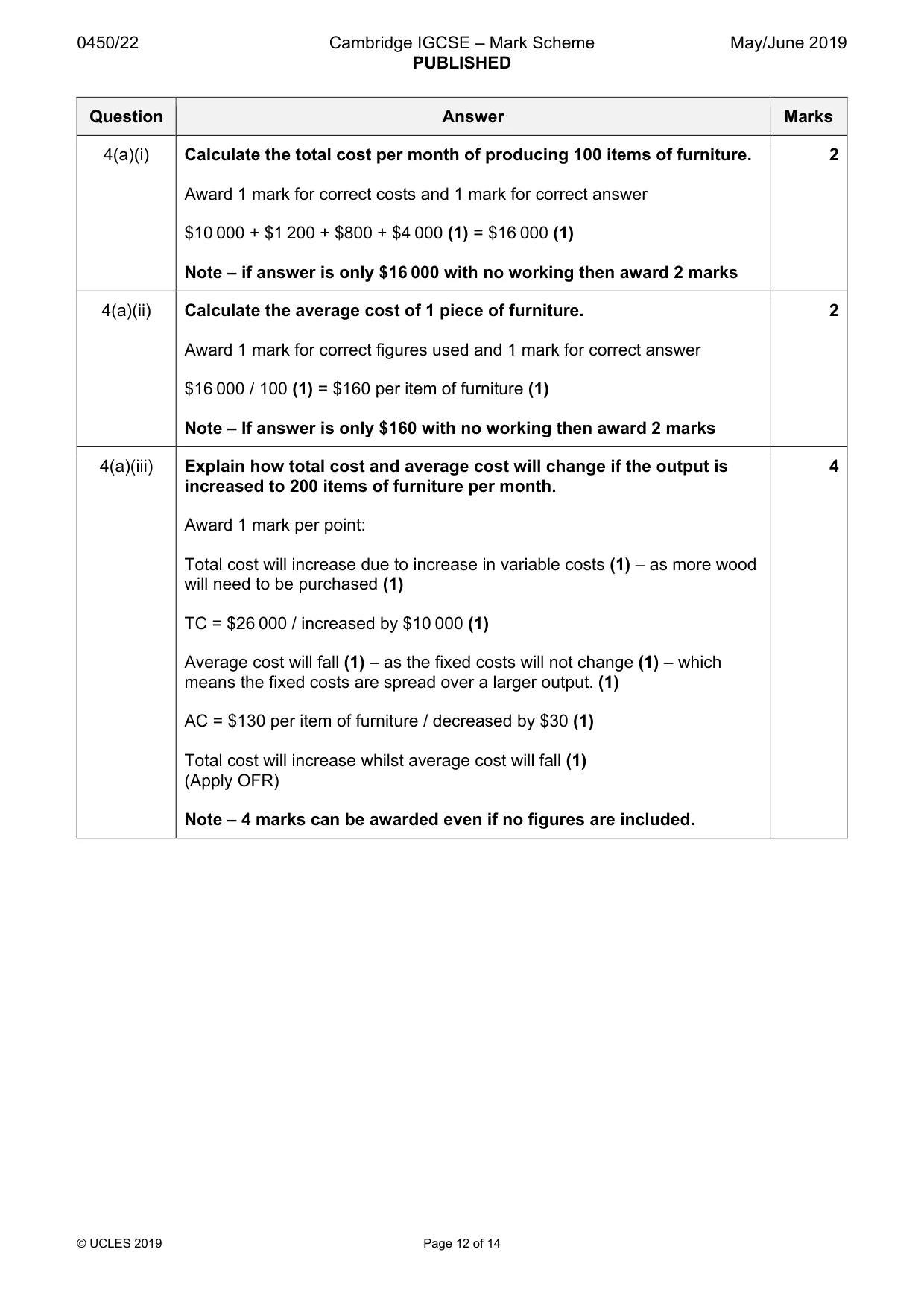
0450/22 Cambridge IGCSE – Mark Scheme PUBLISHED May/June 2019 © UCLES 2019 Page 12 of 14 Question Answer Marks 4(a)(i) Calculate the total cost per month of producing 100 items of furniture. Award 1 mark for correct costs and 1 mark for correct answer $10 000 + $1 200 + $800 + $4 000 (1) = $16 000 (1) Note – if answer is only $16 000 with no working then award 2 marks 2 4(a)(ii) Calculate the average cost of 1 piece of furniture. Award 1 mark for correct figures used and 1 mark for correct answer $16 000 / 100 (1) = $160 per item of furniture (1) Note – If answer is only $160 with no working then award 2 marks 2 4(a)(iii) Explain how total cost and average cost will change if the output is increased to 200 items of furniture per month. Award 1 mark per point: Total cost will increase due to increase in variable costs (1) – as more wood will need to be purchased (1) TC = $26 000 / increased by $10 000 (1) Average cost will fall (1) – as the fixed costs will not change (1) – which means the fixed costs are spread over a larger output. (1) AC = $130 per item of furniture / decreased by $30 (1) Total cost will increase whilst average cost will fall (1) (Apply OFR) Note – 4 marks can be awarded even if no figures are included. 4
Mark scheme, page 13
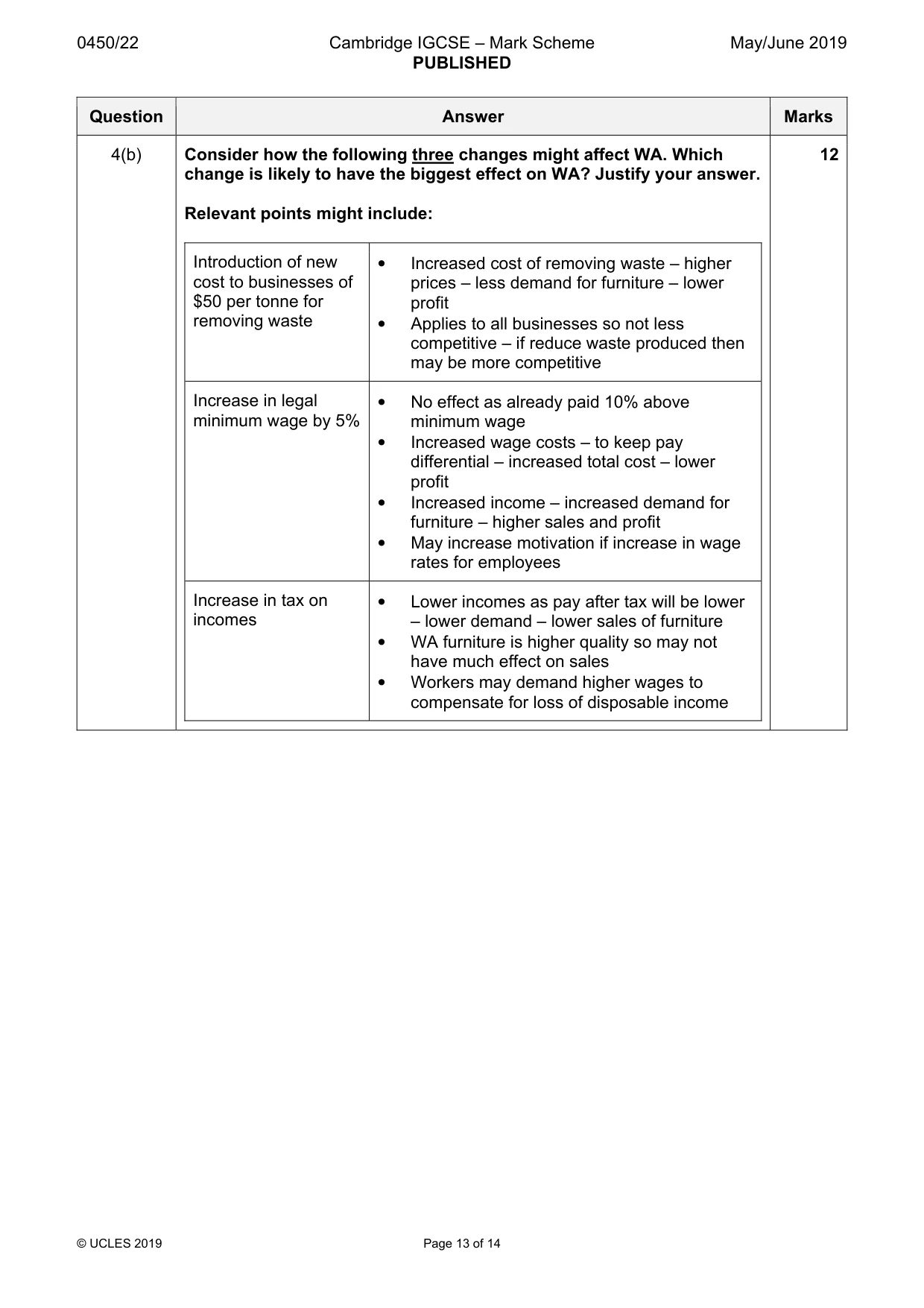
0450/22 Cambridge IGCSE – Mark Scheme PUBLISHED May/June 2019 © UCLES 2019 Page 13 of 14 Question Answer Marks 4(b) Consider how the following three changes might affect WA. Which change is likely to have the biggest effect on WA? Justify your answer. Relevant points might include: Introduction of new cost to businesses of $50 per tonne for removing waste • Increased cost of removing waste – higher prices – less demand for furniture – lower profit • Applies to all businesses so not less competitive – if reduce waste produced then may be more competitive Increase in legal minimum wage by 5% • No effect as already paid 10% above minimum wage • Increased wage costs – to keep pay differential – increased total cost – lower profit • Increased income – increased demand for furniture – higher sales and profit • May increase motivation if increase in wage rates for employees Increase in tax on incomes • Lower incomes as pay after tax will be lower – lower demand – lower sales of furniture • WA furniture is higher quality so may not have much effect on sales • Workers may demand higher wages to compensate for loss of disposable income 12
Mark scheme, page 14
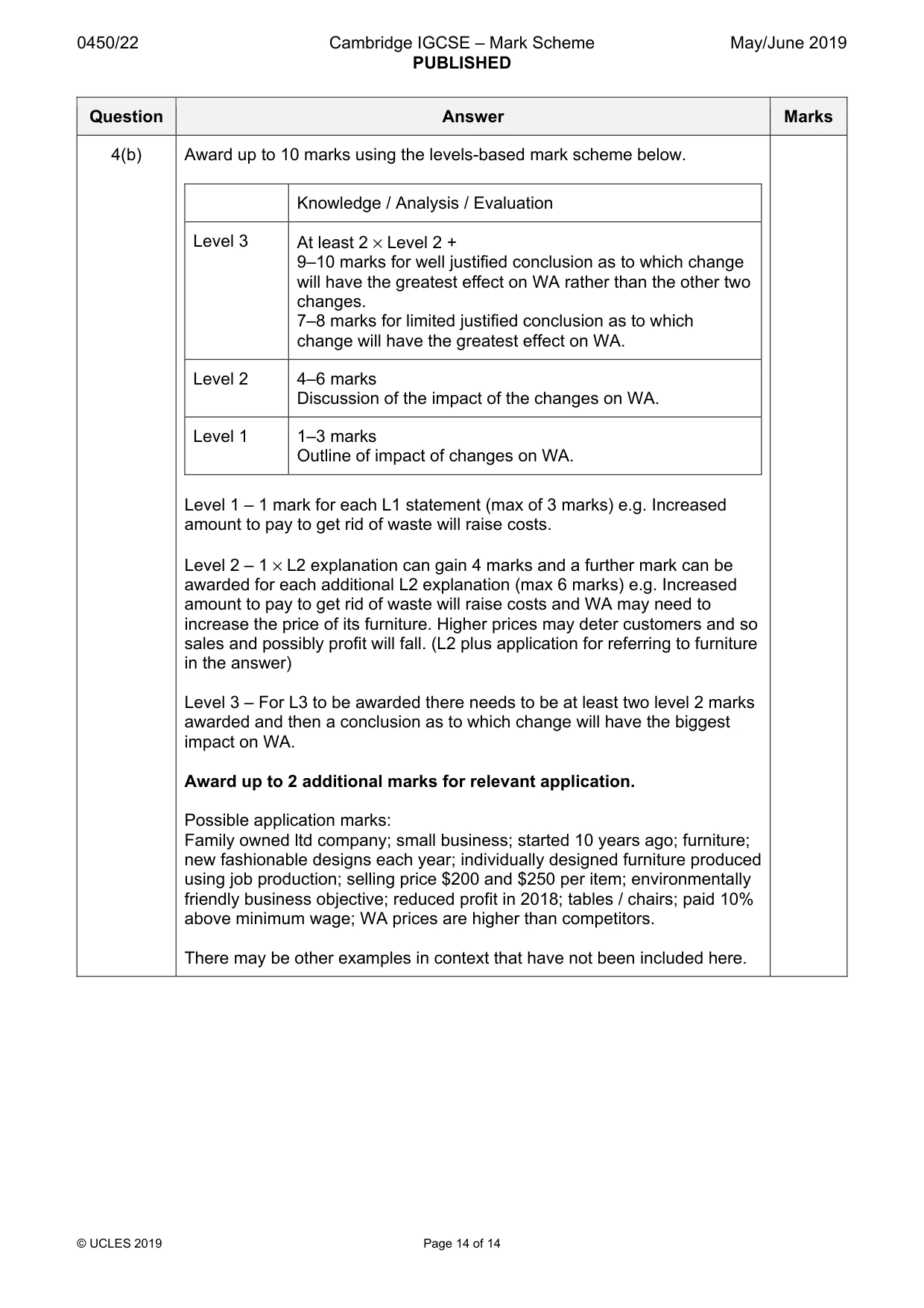
0450/22 Cambridge IGCSE – Mark Scheme PUBLISHED May/June 2019 © UCLES 2019 Page 14 of 14 Question Answer Marks 4(b) Award up to 10 marks using the levels-based mark scheme below. Knowledge / Analysis / Evaluation Level 3 At least 2 × Level 2 + 9–10 marks for well justified conclusion as to which change will have the greatest effect on WA rather than the other two changes. 7–8 marks for limited justified conclusion as to which change will have the greatest effect on WA. Level 2 4–6 marks Discussion of the impact of the changes on WA. Level 1 1–3 marks Outline of impact of changes on WA. Level 1 – 1 mark for each L1 statement (max of 3 marks) e.g. Increased amount to pay to get rid of waste will raise costs. Level 2 – 1 × L2 explanation can gain 4 marks and a further mark can be awarded for each additional L2 explanation (max 6 marks) e.g. Increased amount to pay to get rid of waste will raise costs and WA may need to increase the price of its furniture. Higher prices may deter customers and so sales and possibly profit will fall. (L2 plus application for referring to furniture in the answer) Level 3 – For L3 to be awarded there needs to be at least two level 2 marks awarded and then a conclusion as to which change will have the biggest impact on WA. Award up to 2 additional marks for relevant application. Possible application marks: Family owned ltd company; small business; started 10 years ago; furniture; new fashionable designs each year; individually designed furniture produced using job production; selling price $200 and $250 per item; environmentally friendly business objective; reduced profit in 2018; tables / chairs; paid 10% above minimum wage; WA prices are higher than competitors. There may be other examples in context that have not been included here.
What you needed in this session
Cambridge’s own grade thresholds for 2019 May/June, Paper 2 · Variant 2. A higher threshold means an easier paper — the bar moves with how the cohort did.