Cambridge IGCSE Business Studies 0450 — 2019 May/June Paper 1 · Variant 3
0450/13/M/J/19 · 80 marks · ≈90 min
The question paper and its mark scheme, free to read here and free to download. This is Cambridge’s own paper, exactly as it was sat.
Question paper12 pages

Mark scheme15 pages
Answers below. Sit the paper first if you are practising.
Paper as text
Question paper, page 1
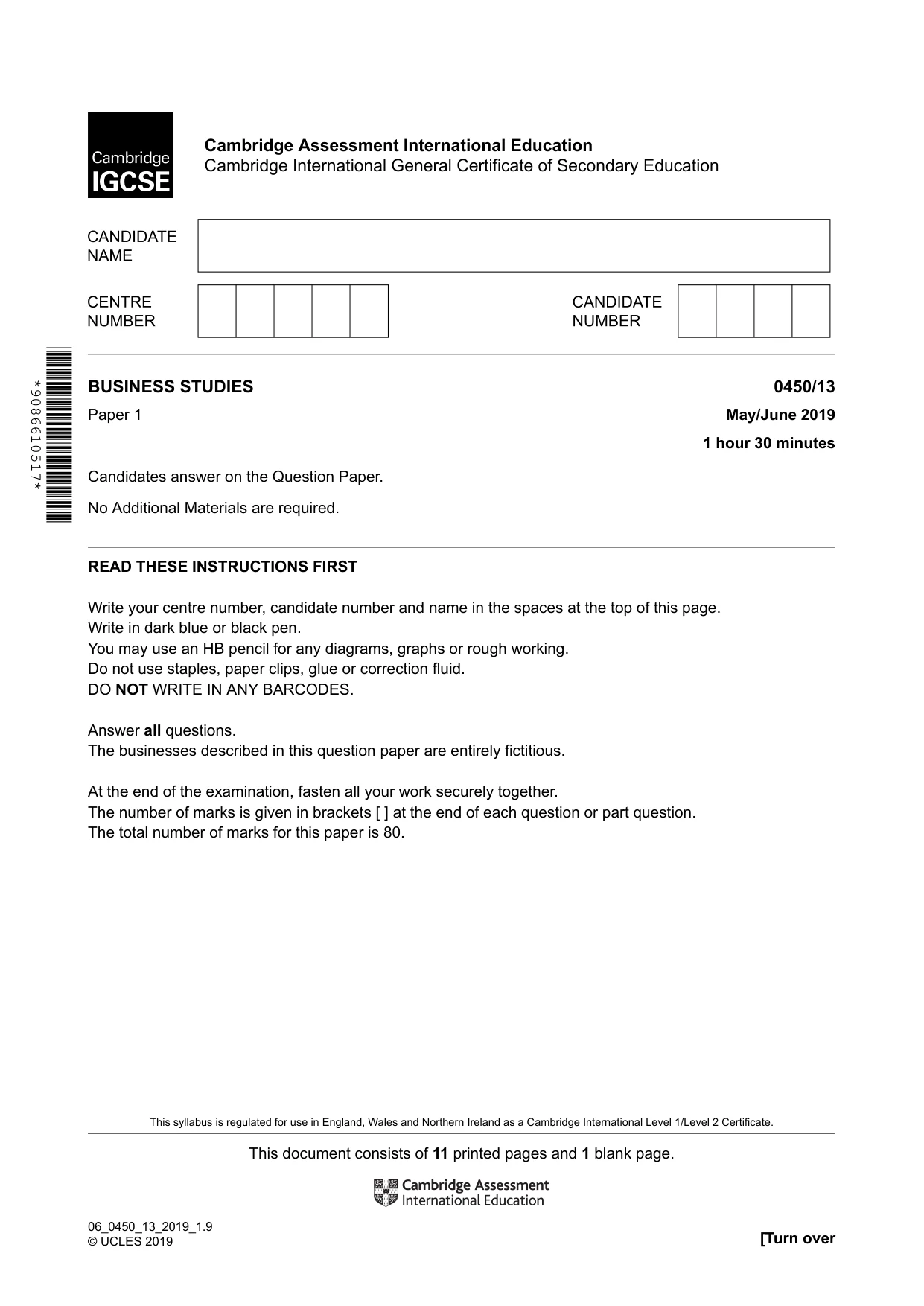
Cambridge Assessment International Education Cambridge International General Certificate of Secondary Education 0450/13 May/June 2019 1 hour 30 minutes BUSINESS STUDIES Paper 1 Candidates answer on the Question Paper. No Additional Materials are required. READ THESE INSTRUCTIONS FIRST Write your centre number, candidate number and name in the spaces at the top of this page. Write in dark blue or black pen. You may use an HB pencil for any diagrams, graphs or rough working. Do not use staples, paper clips, glue or correction fluid. DO NOT WRITE IN ANY BARCODES. Answer all questions. The businesses described in this question paper are entirely fictitious. At the end of the examination, fasten all your work securely together. The number of marks is given in brackets [ ] at the end of each question or part question. The total number of marks for this paper is 80. This syllabus is regulated for use in England, Wales and Northern Ireland as a Cambridge International Level 1/Level 2 Certificate. This document consists of 11 printed pages and 1 blank page. [Turn over 06_0450_13_2019_1.9 © UCLES 2019 *9086610517*
Question paper, page 2
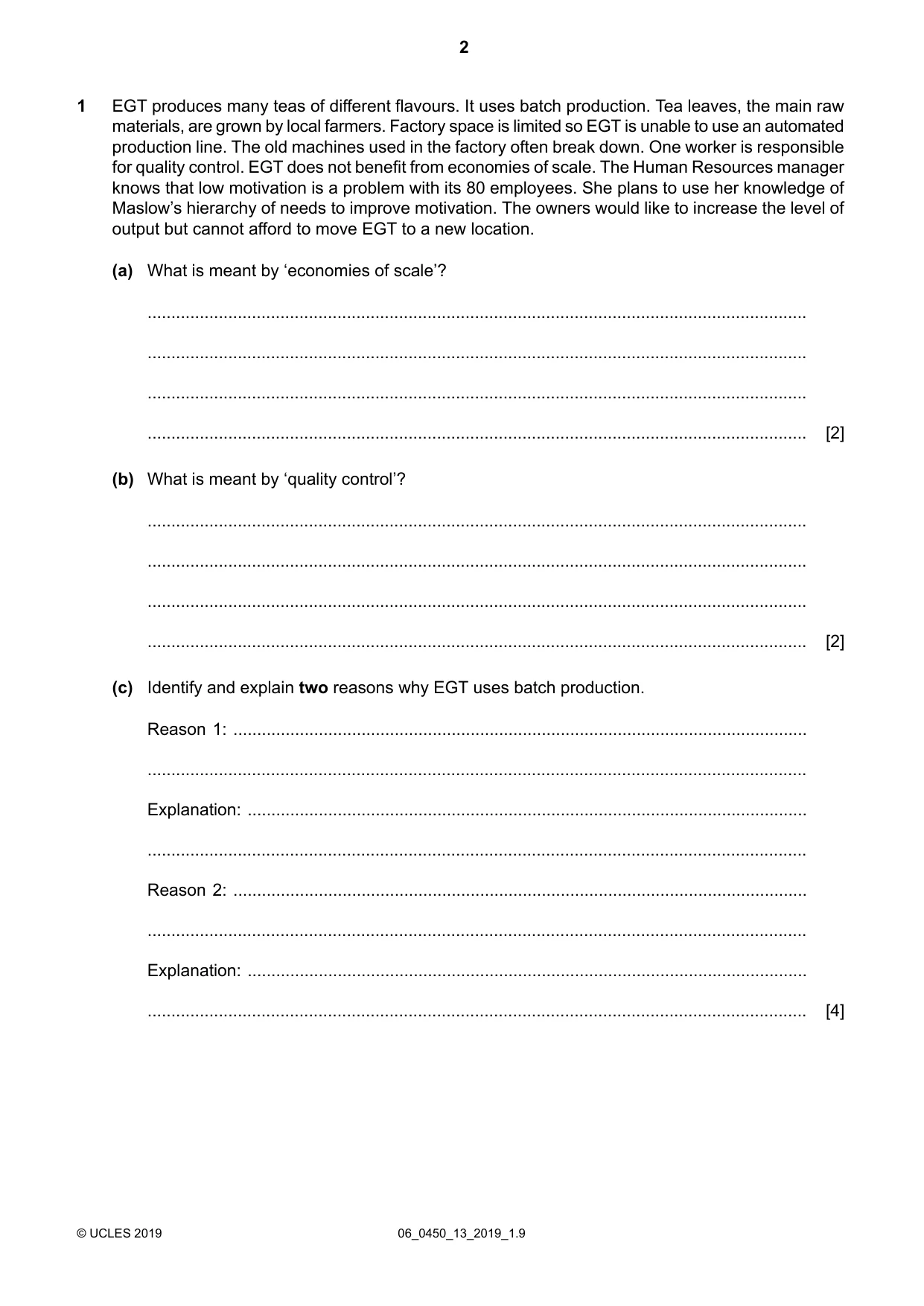
EGT produces many teas of different flavours. It uses batch production. Tea leaves, the main raw materials, are grown by local farmers. Factory space is limited so EGT is unable to use an automated 1 production line. The old machines used in the factory often break down. One worker is responsible for quality control. EGT does not benefit from economies of scale. The Human Resources manager knows that low motivation is a problem with its 80 employees. She plans to use her knowledge of Maslow’s hierarchy of needs to improve motivation. The owners would like to increase the level of output but cannot afford to move EGT to a new location. What is meant by ‘economies of scale’? (a) … … … … [2] What is meant by ‘quality control’? (b) … … … … [2] Identify and explain two reasons why EGT uses batch production. (c) Reason 1: … … Explanation: … … Reason 2: … … Explanation: … … [4] 06_0450_13_2019_1.9 © UCLES 2019 2
Question paper, page 3
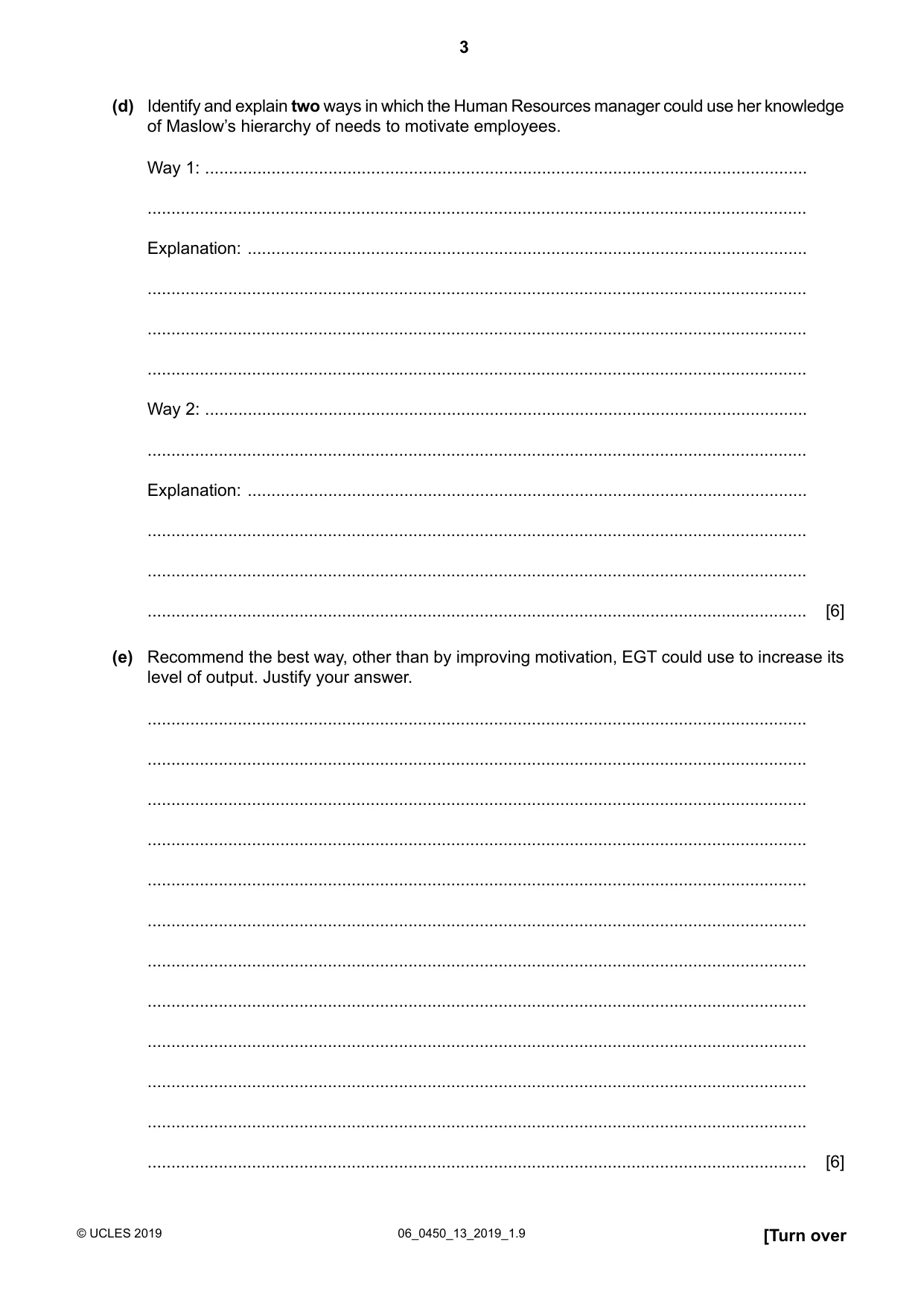
Identify and explain two ways in which the Human Resources manager could use her knowledge of Maslow’s hierarchy of needs to motivate employees. (d) Way 1: … … Explanation: … … … … Way 2: … … Explanation: … … … … [6] Recommend the best way, other than by improving motivation, EGT could use to increase its level of output. Justify your answer. (e) … … … … … … … … … … … … [6] [Turn over 06_0450_13_2019_1.9 © UCLES 2019 3
Question paper, page 4
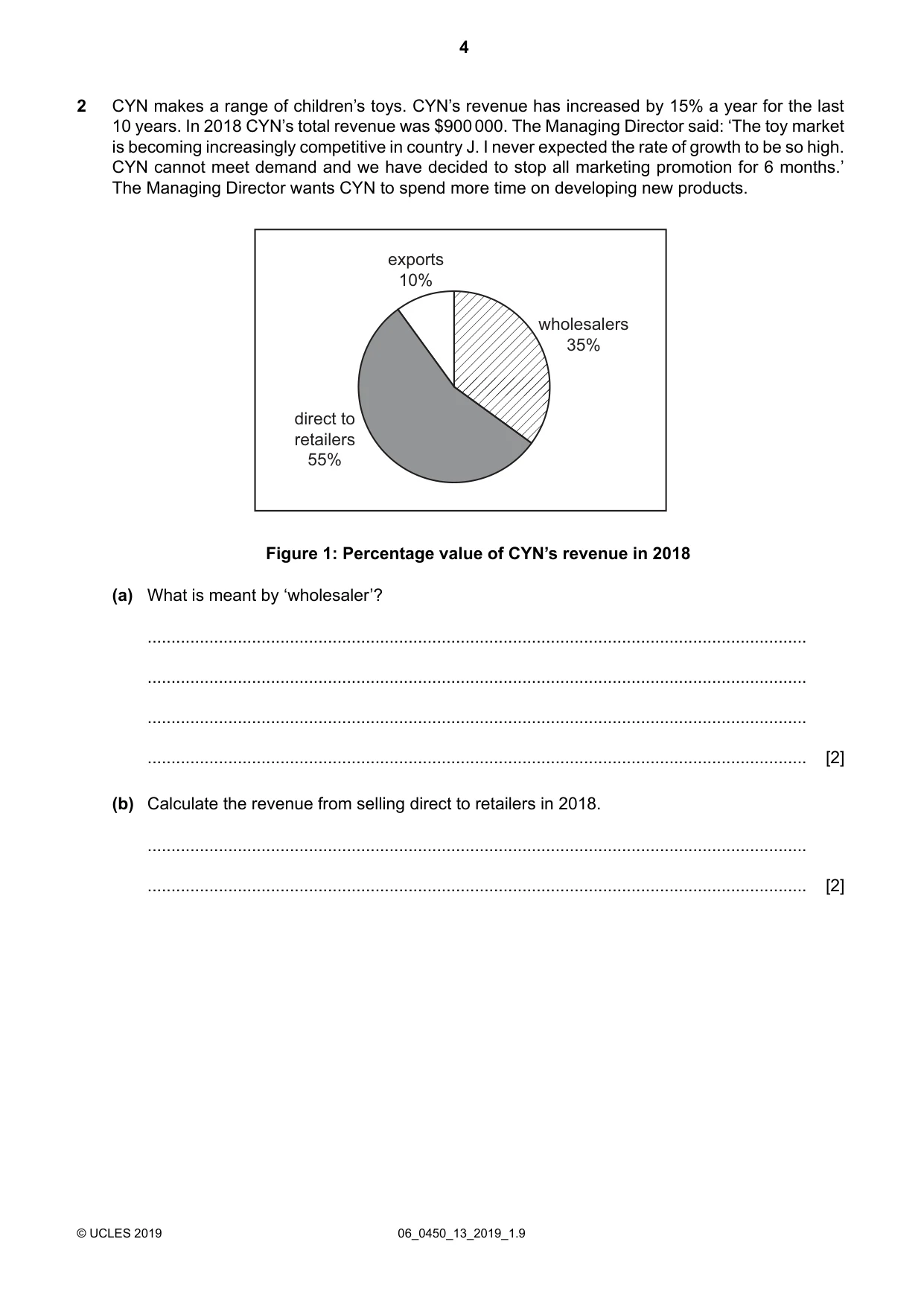
CYN makes a range of children’s toys. CYN’s revenue has increased by 15% a year for the last 10 years. In 2018 CYN’s total revenue was $900000. The Managing Director said: ‘The toy market 2 is becoming increasingly competitive in country J. I never expected the rate of growth to be so high. CYN cannot meet demand and we have decided to stop all marketing promotion for 6 months.’ The Managing Director wants CYN to spend more time on developing new products. wholesalers 35% direct to retailers 55% exports 10% Figure 1: Percentage value of CYN’s revenue in 2018 What is meant by ‘wholesaler’? (a) … … … … [2] Calculate the revenue from selling direct to retailers in 2018. (b) … … [2] 06_0450_13_2019_1.9 © UCLES 2019 4
Question paper, page 5
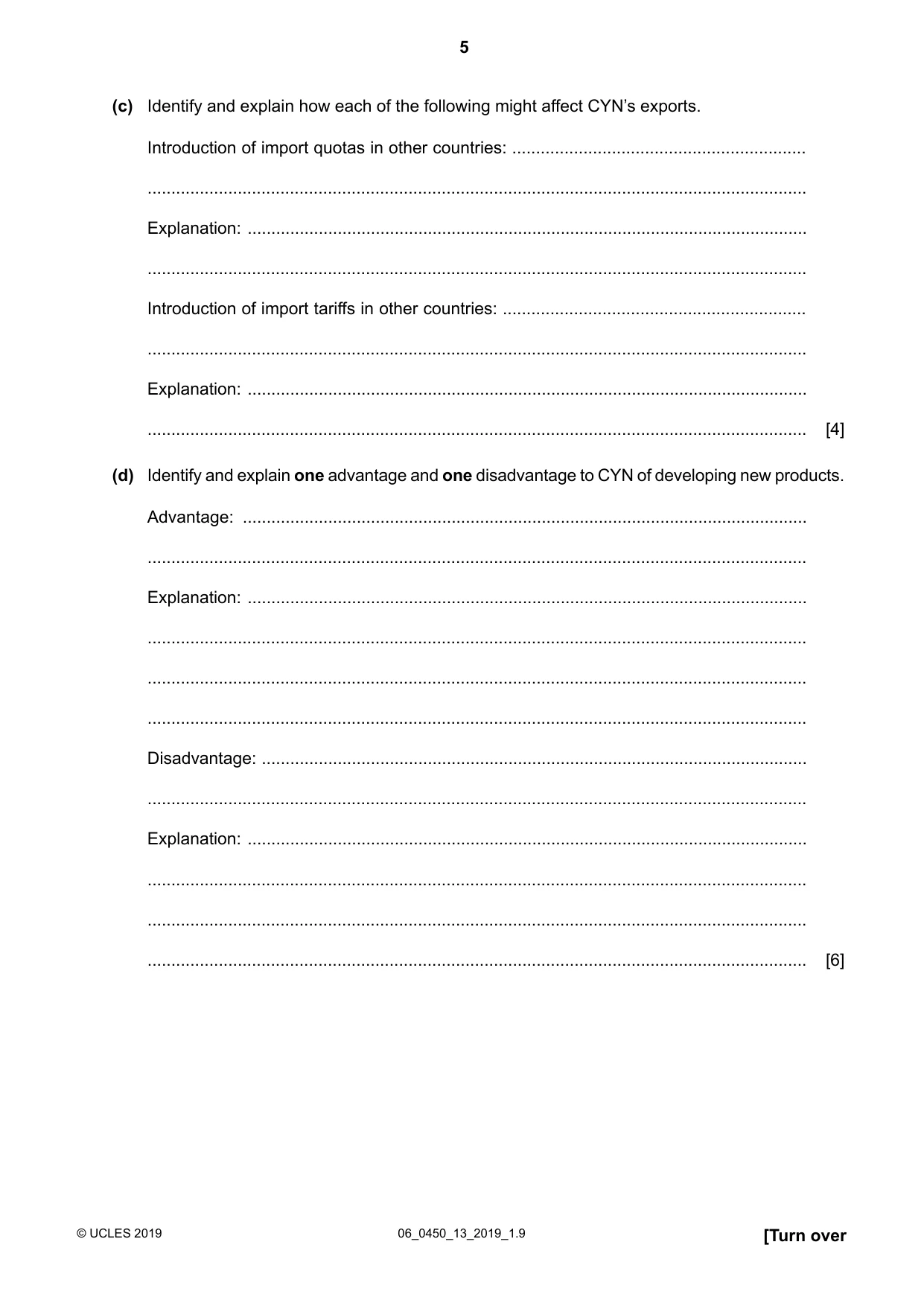
Identify and explain how each of the following might affect CYN’s exports. (c) Introduction of import quotas in other countries: … … Explanation: … … Introduction of import tariffs in other countries: … … Explanation: … … [4] Identify and explain one advantage and one disadvantage to CYN of developing new products. (d) Advantage: … … Explanation: … … … … Disadvantage: … … Explanation: … … … … [6] [Turn over 06_0450_13_2019_1.9 © UCLES 2019 5
Question paper, page 6
CYN has decided to stop all marketing promotion for 6 months. Do you agree with this decision? Justify your answer. (e) … … … … … … … … … … … … [6] 06_0450_13_2019_1.9 © UCLES 2019 6
Question paper, page 7
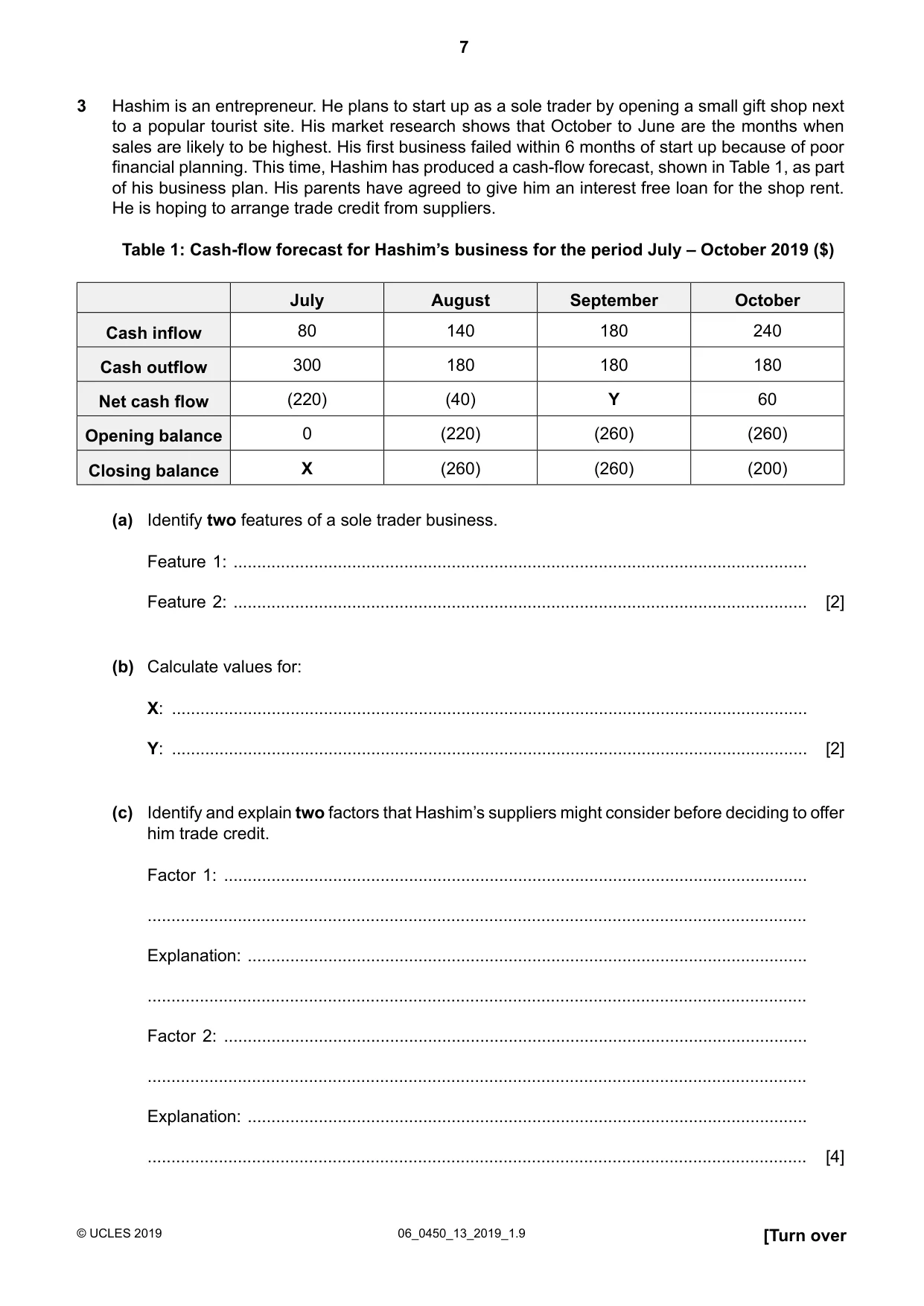
Hashim is an entrepreneur. He plans to start up as a sole trader by opening a small gift shop next to a popular tourist site. His market research shows that October to June are the months when 3 sales are likely to be highest. His first business failed within 6 months of start up because of poor financial planning. This time, Hashim has produced a cash-flow forecast, shown in Table 1, as part of his business plan. His parents have agreed to give him an interest free loan for the shop rent. He is hoping to arrange trade credit from suppliers. Table 1: Cash-flow forecast for Hashim’s business for the period July – October 2019 ($) October September August July 240 180 140 80 Cash inflow 180 180 180 300 Cash outflow 60 Y (40) (220) Net cash flow (260) (260) (220) 0 Opening balance (200) (260) (260) X Closing balance Identify two features of a sole trader business. (a) Feature 1: … Feature 2: … [2] Calculate values for: (b) X: … Y: … [2] Identify and explain two factors that Hashim’s suppliers might consider before deciding to offer him trade credit. (c) Factor 1: … … Explanation: … … Factor 2: … … Explanation: … … [4] [Turn over 06_0450_13_2019_1.9 © UCLES 2019 7
Question paper, page 8
Identify and explain two ways in which a business plan might help Hashim’s new business to be successful. (d) Way 1: … … Explanation: … … … … Way 2: … … Explanation: … … … … [6] Do you think Hashim should start the new business? Justify your answer using the information in Table 1. (e) … … … … … … … … … … … … [6] 06_0450_13_2019_1.9 © UCLES 2019 8
Question paper, page 9
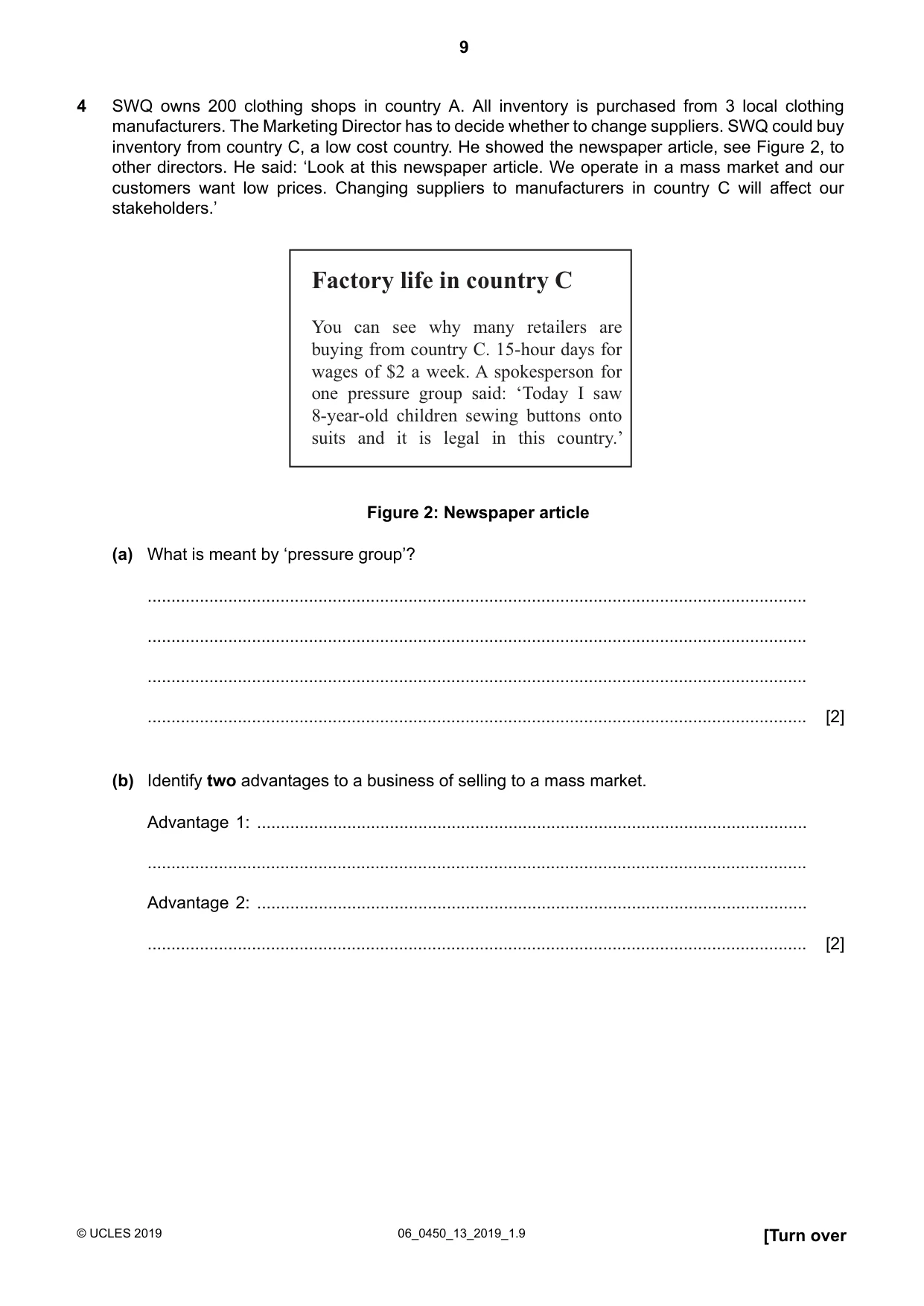
SWQ owns 200 clothing shops in country A. All inventory is purchased from 3 local clothing manufacturers. The Marketing Director has to decide whether to change suppliers. SWQ could buy 4 inventory from country C, a low cost country. He showed the newspaper article, see Figure 2, to other directors. He said: ‘Look at this newspaper article. We operate in a mass market and our customers want low prices. Changing suppliers to manufacturers in country C will affect our stakeholders.’ Factory life in country C You can see why many retailers are buying from country C. 15-hour days for wages of $2 a week. A spokesperson for one pressure group said: ‘Today I saw 8-year-old children sewing buttons onto suits and it is legal in this country.’ Figure 2: Newspaper article What is meant by ‘pressure group’? (a) … … … … [2] Identify two advantages to a business of selling to a mass market. (b) Advantage 1: … … Advantage 2: … … [2] [Turn over 06_0450_13_2019_1.9 © UCLES 2019 9
Question paper, page 10
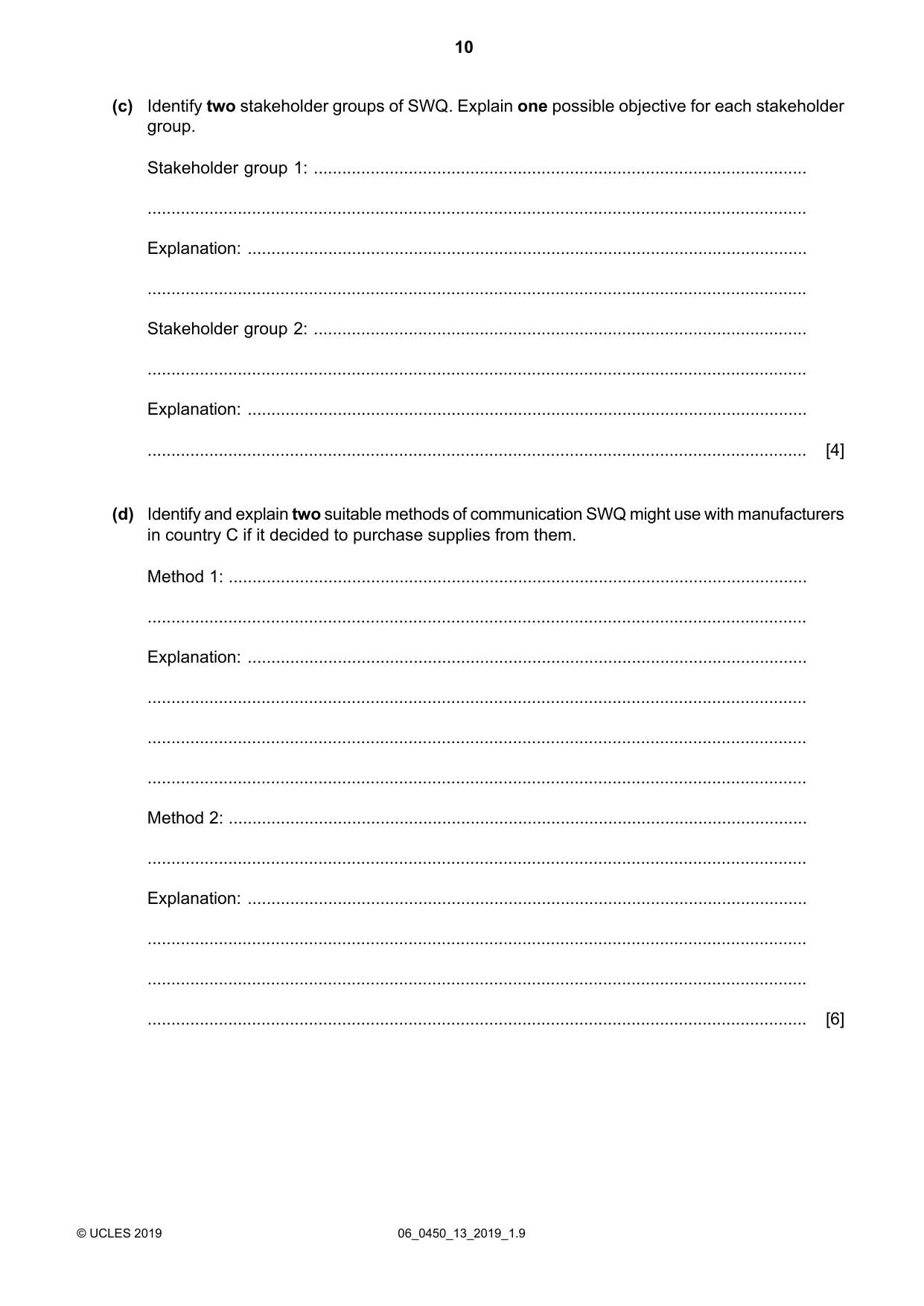
Identify two stakeholder groups of SWQ. Explain one possible objective for each stakeholder group. (c) Stakeholder group 1: … … Explanation: … … Stakeholder group 2: … … Explanation: … … [4] Identify and explain two suitable methods of communication SWQ might use with manufacturers in country C if it decided to purchase supplies from them. (d) Method 1: … … Explanation: … … … … Method 2: … … Explanation: … … … … [6] 06_0450_13_2019_1.9 © UCLES 2019 10
Question paper, page 11
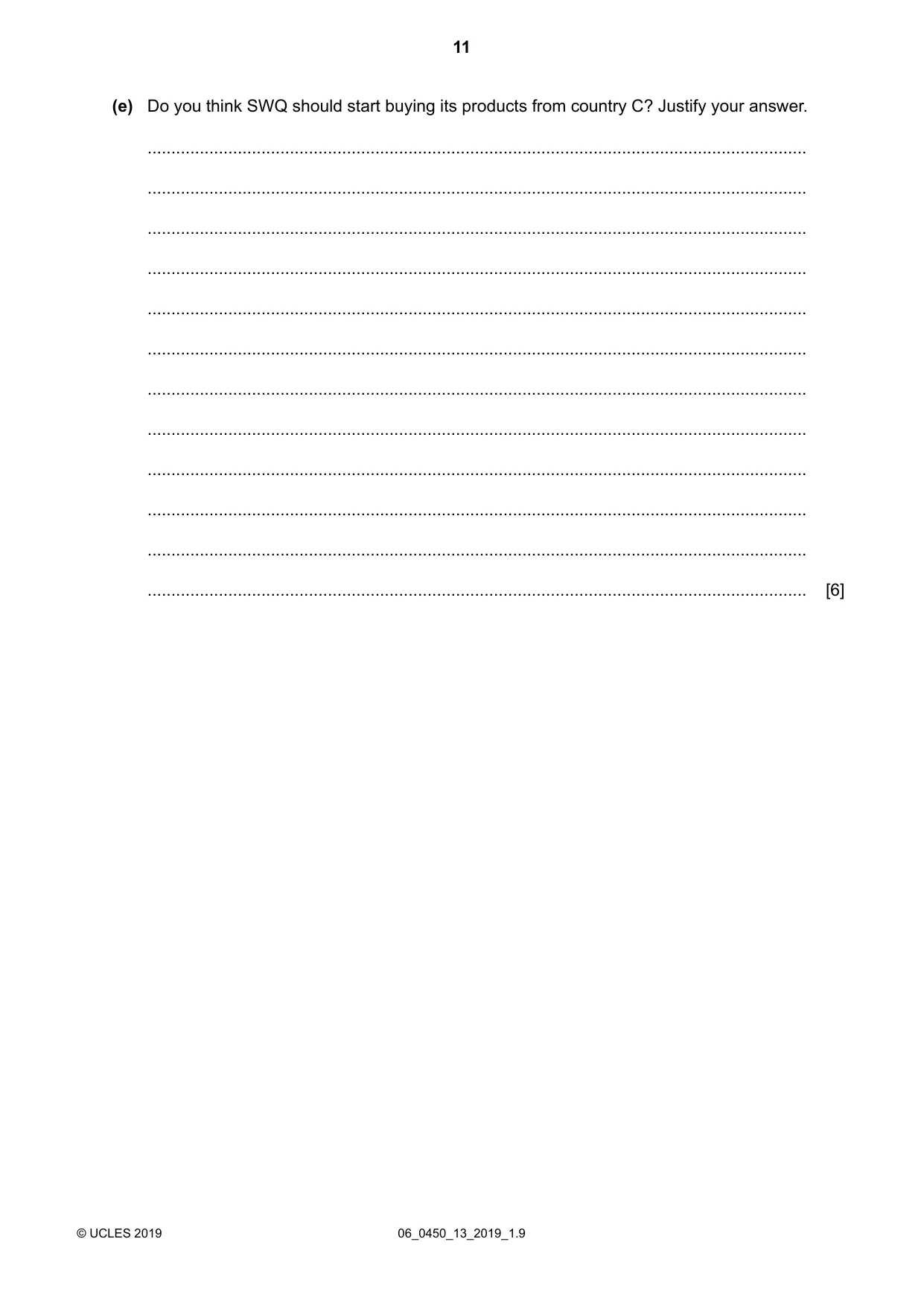
Do you think SWQ should start buying its products from country C? Justify your answer. (e) … … … … … … … … … … … … [6] 06_0450_13_2019_1.9 © UCLES 2019 11
Question paper, page 12
BLANK PAGE Permission to reproduce items where third-party owned material protected by copyright is included has been sought and cleared where possible. Every reasonable effort has been made by the publisher (UCLES) to trace copyright holders, but if any items requiring clearance have unwittingly been included, the publisher will be pleased to make amends at the earliest possible opportunity. To avoid the issue of disclosure of answer-related information to candidates, all copyright acknowledgements are reproduced online in the Cambridge Assessment International Education Copyright Acknowledgements Booklet. This is produced for each series of examinations and is freely available to download at www.cambridgeinternational.org after the live examination series. Cambridge Assessment International Education is part of the Cambridge Assessment Group. Cambridge Assessment is the brand name of the University of Cambridge Local Examinations Syndicate (UCLES), which itself is a department of the University of Cambridge. 06_0450_13_2019_1.9 © UCLES 2019 12
Mark scheme, page 1
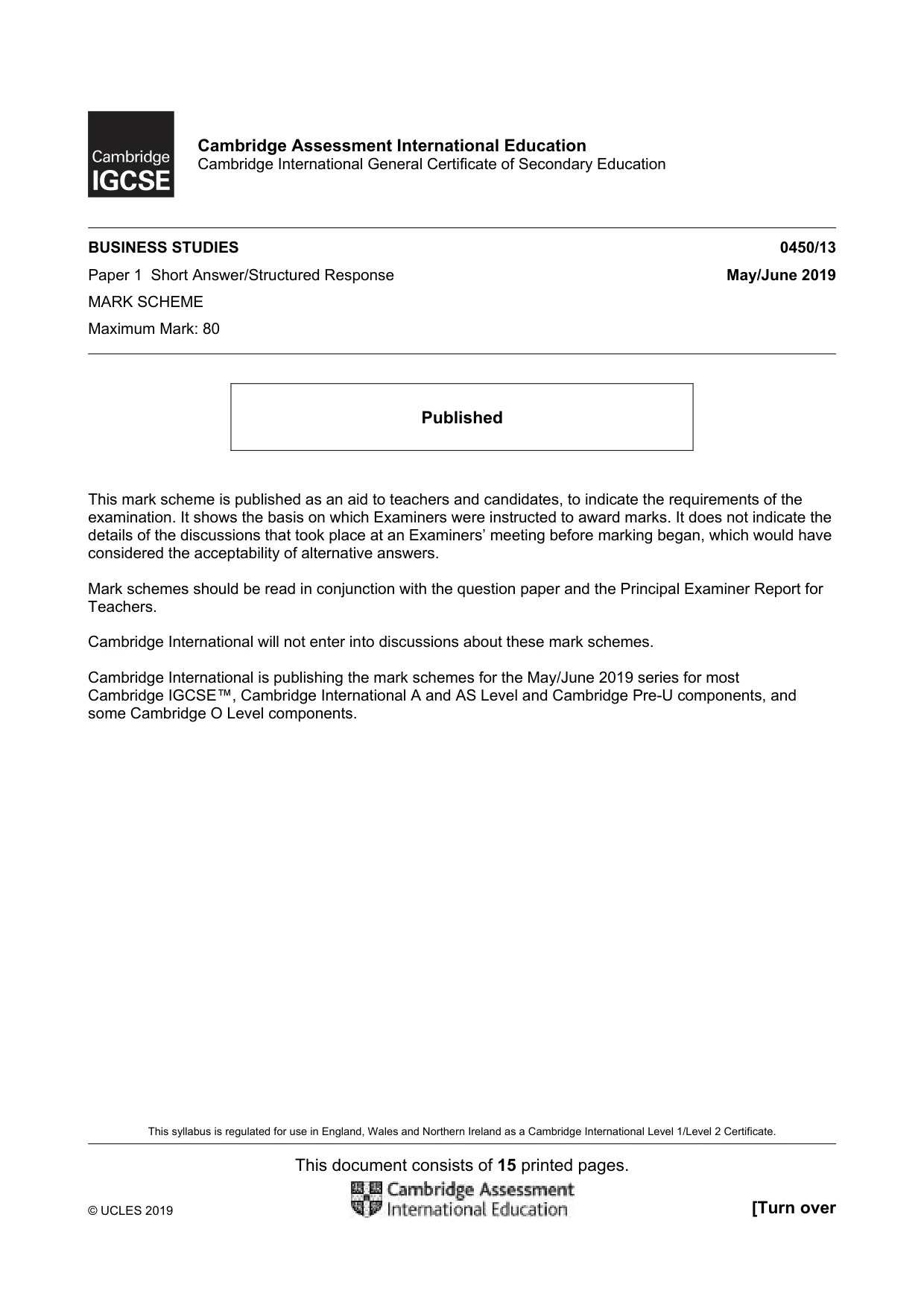
This syllabus is regulated for use in England, Wales and Northern Ireland as a Cambridge International Level 1/Level 2 Certificate. This document consists of 15 printed pages. © UCLES 2019 [Turn over Cambridge Assessment International Education Cambridge International General Certificate of Secondary Education BUSINESS STUDIES 0450/13 Paper 1 Short Answer/Structured Response May/June 2019 MARK SCHEME Maximum Mark: 80 Published This mark scheme is published as an aid to teachers and candidates, to indicate the requirements of the examination. It shows the basis on which Examiners were instructed to award marks. It does not indicate the details of the discussions that took place at an Examiners’ meeting before marking began, which would have considered the acceptability of alternative answers. Mark schemes should be read in conjunction with the question paper and the Principal Examiner Report for Teachers. Cambridge International will not enter into discussions about these mark schemes. Cambridge International is publishing the mark schemes for the May/June 2019 series for most Cambridge IGCSE™, Cambridge International A and AS Level and Cambridge Pre-U components, and some Cambridge O Level components.
Mark scheme, page 2
0450/13 Cambridge IGCSE – Mark Scheme PUBLISHED May/June 2019 © UCLES 2019 Page 2 of 15 Generic Marking Principles These general marking principles must be applied by all examiners when marking candidate answers. They should be applied alongside the specific content of the mark scheme or generic level descriptors for a question. Each question paper and mark scheme will also comply with these marking principles. GENERIC MARKING PRINCIPLE 1: Marks must be awarded in line with: • the specific content of the mark scheme or the generic level descriptors for the question • the specific skills defined in the mark scheme or in the generic level descriptors for the question • the standard of response required by a candidate as exemplified by the standardisation scripts. GENERIC MARKING PRINCIPLE 2: Marks awarded are always whole marks (not half marks, or other fractions). GENERIC MARKING PRINCIPLE 3: Marks must be awarded positively: • marks are awarded for correct/valid answers, as defined in the mark scheme. However, credit is given for valid answers which go beyond the scope of the syllabus and mark scheme, referring to your Team Leader as appropriate • marks are awarded when candidates clearly demonstrate what they know and can do • marks are not deducted for errors • marks are not deducted for omissions • answers should only be judged on the quality of spelling, punctuation and grammar when these features are specifically assessed by the question as indicated by the mark scheme. The meaning, however, should be unambiguous. GENERIC MARKING PRINCIPLE 4: Rules must be applied consistently e.g. in situations where candidates have not followed instructions or in the application of generic level descriptors.
Mark scheme, page 3
0450/13 Cambridge IGCSE – Mark Scheme PUBLISHED May/June 2019 © UCLES 2019 Page 3 of 15 GENERIC MARKING PRINCIPLE 5: Marks should be awarded using the full range of marks defined in the mark scheme for the question (however; the use of the full mark range may be limited according to the quality of the candidate responses seen). GENERIC MARKING PRINCIPLE 6: Marks awarded are based solely on the requirements as defined in the mark scheme. Marks should not be awarded with grade thresholds or grade descriptors in mind.
Mark scheme, page 4
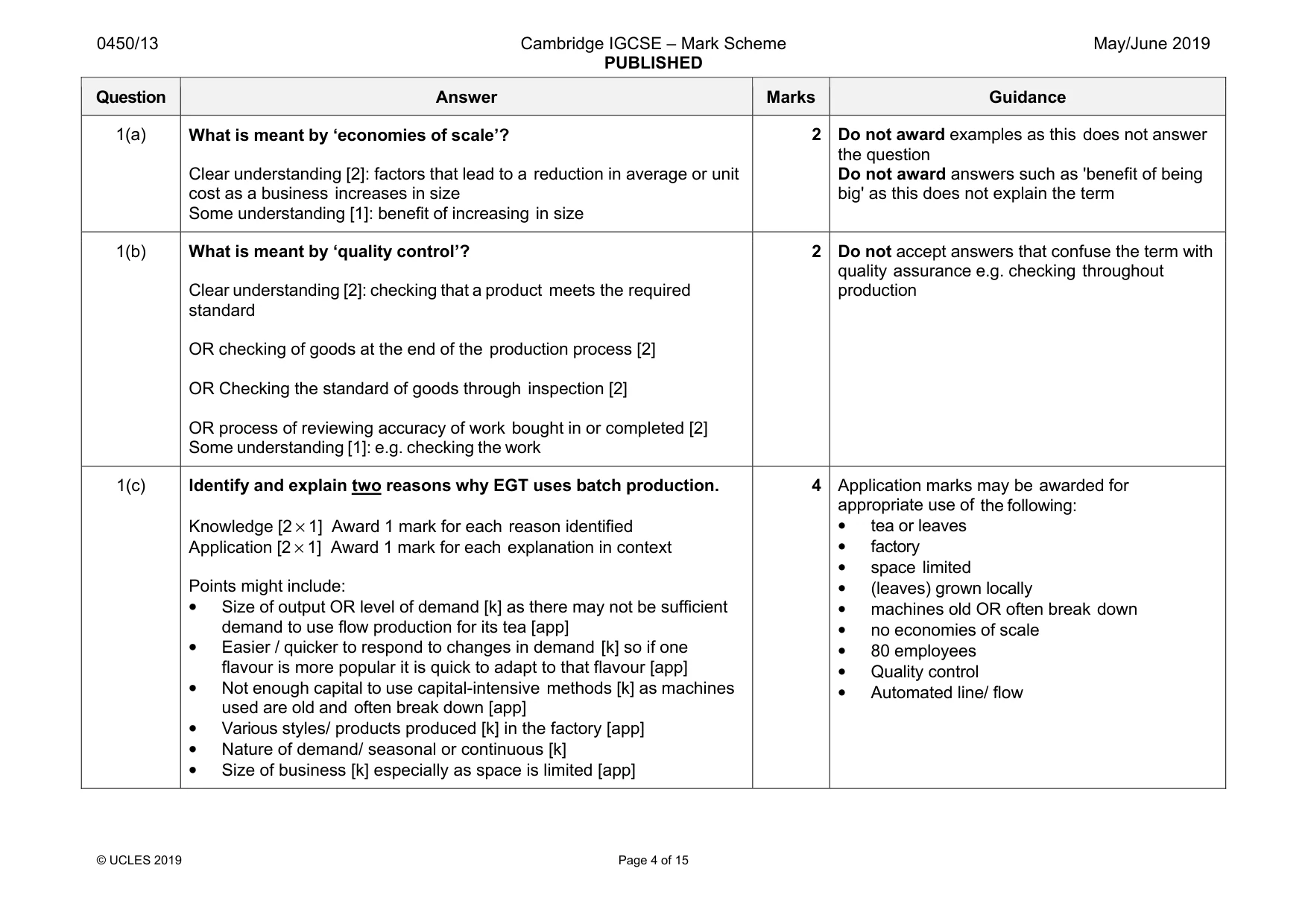
0450/13 Cambridge IGCSE – Mark Scheme PUBLISHED May/June 2019 © UCLES 2019 Page 4 of 15 Question Answer Marks Guidance 1(a) What is meant by ‘economies of scale’? Clear understanding [2]: factors that lead to a reduction in average or unit cost as a business increases in size Some understanding [1]: benefit of increasing in size 2 Do not award examples as this does not answer the question Do not award answers such as 'benefit of being big' as this does not explain the term 1(b) What is meant by ‘quality control’? Clear understanding [2]: checking that a product meets the required standard OR checking of goods at the end of the production process [2] OR Checking the standard of goods through inspection [2] OR process of reviewing accuracy of work bought in or completed [2] Some understanding [1]: e.g. checking the work 2 Do not accept answers that confuse the term with quality assurance e.g. checking throughout production 1(c) Identify and explain two reasons why EGT uses batch production. Knowledge [2 × 1] Award 1 mark for each reason identified Application [2 × 1] Award 1 mark for each explanation in context Points might include: • Size of output OR level of demand [k] as there may not be sufficient demand to use flow production for its tea [app] • Easier / quicker to respond to changes in demand [k] so if one flavour is more popular it is quick to adapt to that flavour [app] • Not enough capital to use capital-intensive methods [k] as machines used are old and often break down [app] • Various styles/ products produced [k] in the factory [app] • Nature of demand/ seasonal or continuous [k] • Size of business [k] especially as space is limited [app] 4 Application marks may be awarded for appropriate use of the following: • tea or leaves • factory • space limited • (leaves) grown locally • machines old OR often break down • no economies of scale • 80 employees • Quality control • Automated line/ flow
Mark scheme, page 5
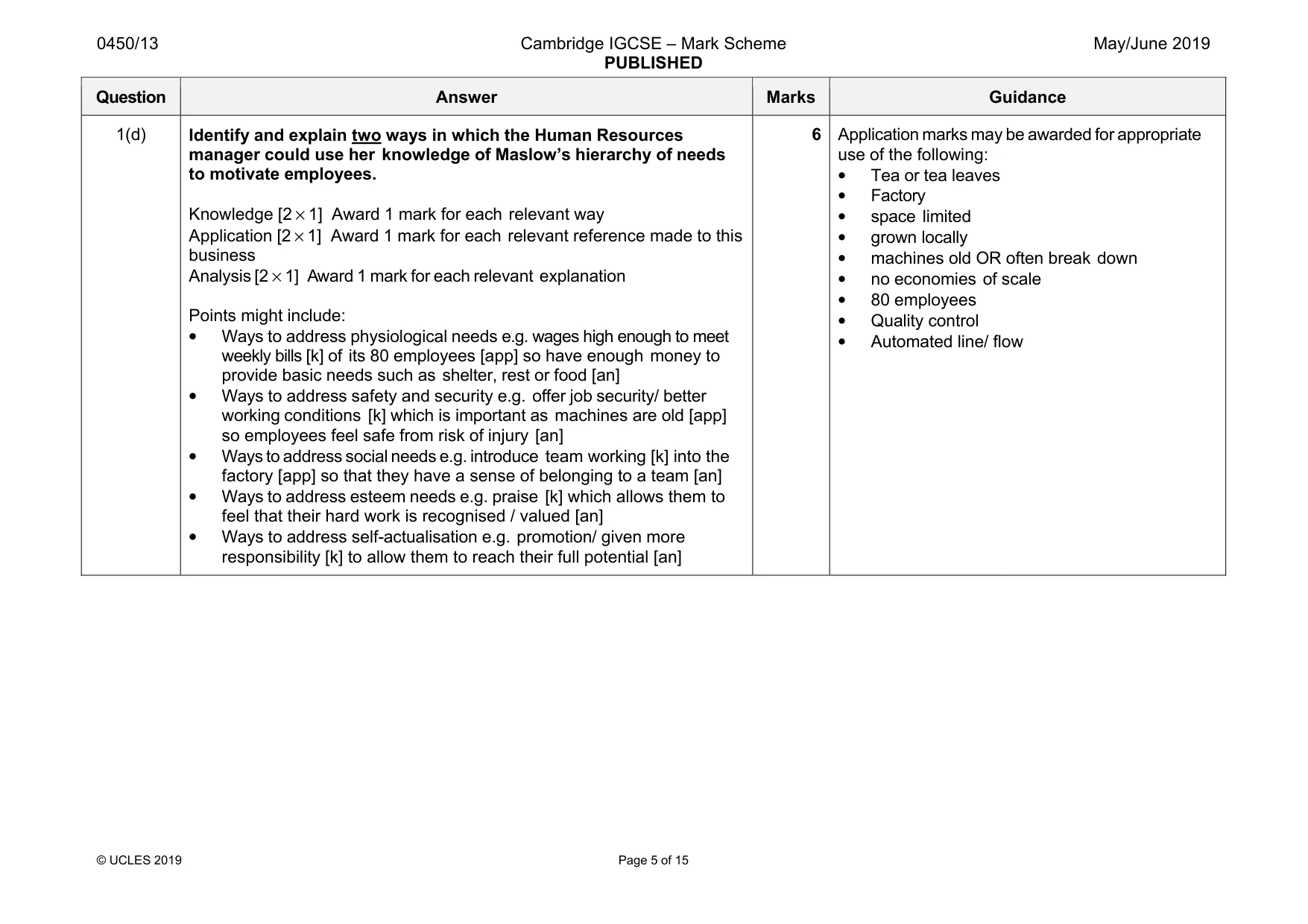
0450/13 Cambridge IGCSE – Mark Scheme PUBLISHED May/June 2019 © UCLES 2019 Page 5 of 15 Question Answer Marks Guidance 1(d) Identify and explain two ways in which the Human Resources manager could use her knowledge of Maslow’s hierarchy of needs to motivate employees. Knowledge [2 × 1] Award 1 mark for each relevant way Application [2 × 1] Award 1 mark for each relevant reference made to this business Analysis [2 × 1] Award 1 mark for each relevant explanation Points might include: • Ways to address physiological needs e.g. wages high enough to meet weekly bills [k] of its 80 employees [app] so have enough money to provide basic needs such as shelter, rest or food [an] • Ways to address safety and security e.g. offer job security/ better working conditions [k] which is important as machines are old [app] so employees feel safe from risk of injury [an] • Ways to address social needs e.g. introduce team working [k] into the factory [app] so that they have a sense of belonging to a team [an] • Ways to address esteem needs e.g. praise [k] which allows them to feel that their hard work is recognised / valued [an] • Ways to address self-actualisation e.g. promotion/ given more responsibility [k] to allow them to reach their full potential [an] 6 Application marks may be awarded for appropriate use of the following: • Tea or tea leaves • Factory • space limited • grown locally • machines old OR often break down • no economies of scale • 80 employees • Quality control • Automated line/ flow
Mark scheme, page 6
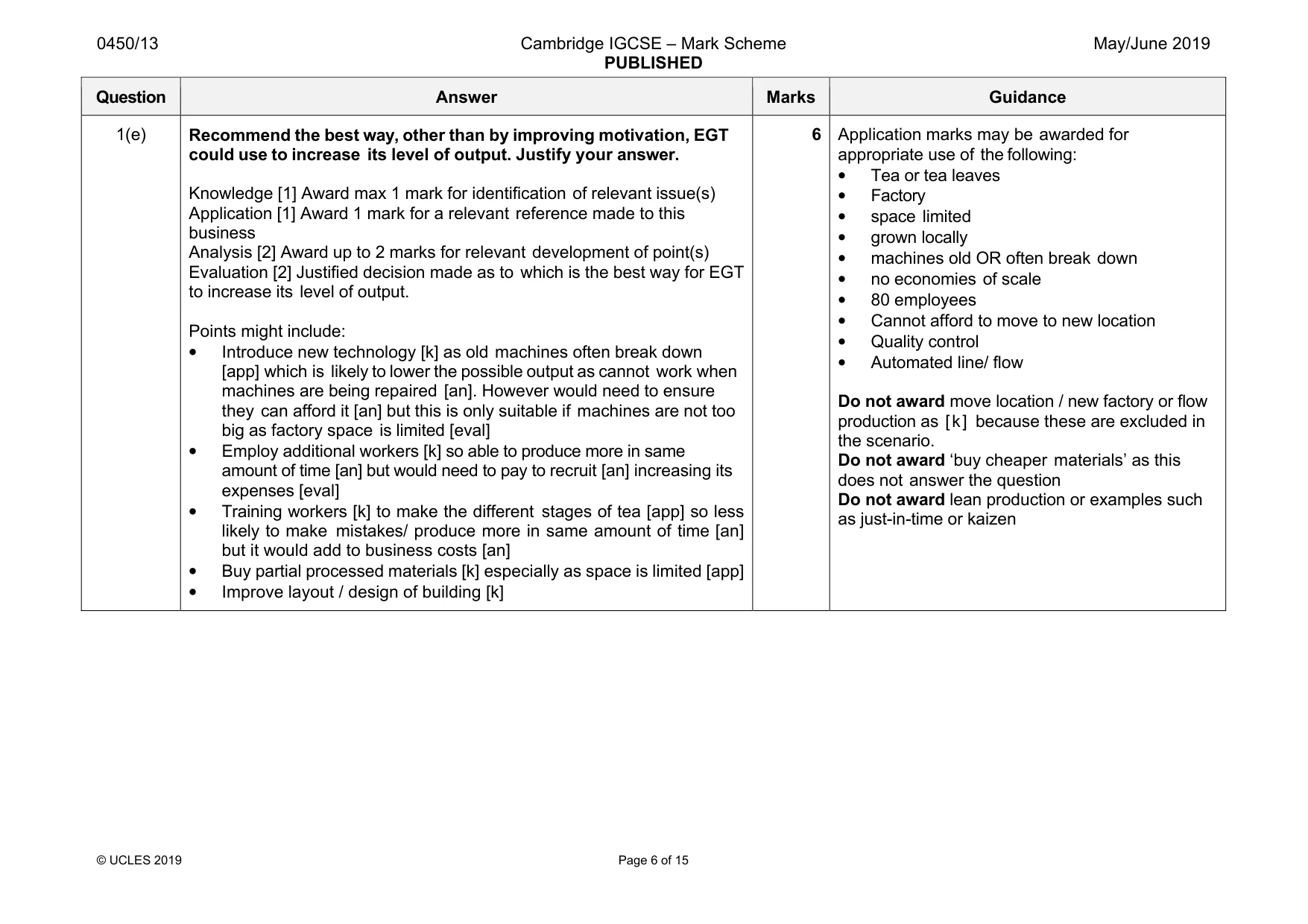
0450/13 Cambridge IGCSE – Mark Scheme PUBLISHED May/June 2019 © UCLES 2019 Page 6 of 15 Question Answer Marks Guidance 1(e) Recommend the best way, other than by improving motivation, EGT could use to increase its level of output. Justify your answer. Knowledge [1] Award max 1 mark for identification of relevant issue(s) Application [1] Award 1 mark for a relevant reference made to this business Analysis [2] Award up to 2 marks for relevant development of point(s) Evaluation [2] Justified decision made as to which is the best way for EGT to increase its level of output. Points might include: • Introduce new technology [k] as old machines often break down [app] which is likely to lower the possible output as cannot work when machines are being repaired [an]. However would need to ensure they can afford it [an] but this is only suitable if machines are not too big as factory space is limited [eval] • Employ additional workers [k] so able to produce more in same amount of time [an] but would need to pay to recruit [an] increasing its expenses [eval] • Training workers [k] to make the different stages of tea [app] so less likely to make mistakes/ produce more in same amount of time [an] but it would add to business costs [an] • Buy partial processed materials [k] especially as space is limited [app] • Improve layout / design of building [k] 6 Application marks may be awarded for appropriate use of the following: • Tea or tea leaves • Factory • space limited • grown locally • machines old OR often break down • no economies of scale • 80 employees • Cannot afford to move to new location • Quality control • Automated line/ flow Do not award move location / new factory or flow production as [k] because these are excluded in the scenario. Do not award ‘buy cheaper materials’ as this does not answer the question Do not award lean production or examples such as just-in-time or kaizen
Mark scheme, page 7
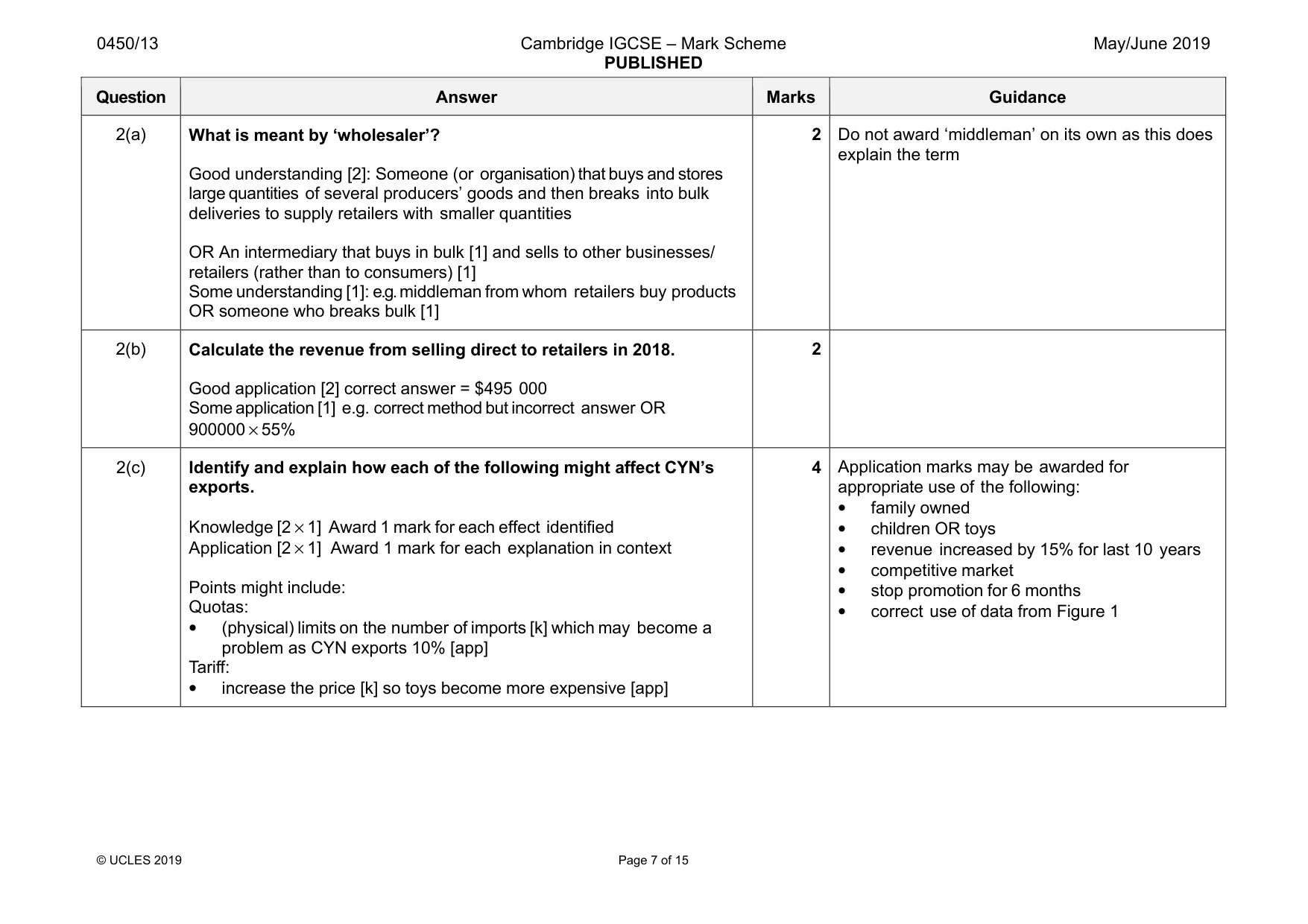
0450/13 Cambridge IGCSE – Mark Scheme PUBLISHED May/June 2019 © UCLES 2019 Page 7 of 15 Question Answer Marks Guidance 2(a) What is meant by ‘wholesaler’? Good understanding [2]: Someone (or organisation) that buys and stores large quantities of several producers’ goods and then breaks into bulk deliveries to supply retailers with smaller quantities OR An intermediary that buys in bulk [1] and sells to other businesses/ retailers (rather than to consumers) [1] Some understanding [1]: e.g. middleman from whom retailers buy products OR someone who breaks bulk [1] 2 Do not award ‘middleman’ on its own as this does explain the term 2(b) Calculate the revenue from selling direct to retailers in 2018. Good application [2] correct answer = $495 000 Some application [1] e.g. correct method but incorrect answer OR 900000 × 55% 2 2(c) Identify and explain how each of the following might affect CYN’s exports. Knowledge [2 × 1] Award 1 mark for each effect identified Application [2 × 1] Award 1 mark for each explanation in context Points might include: Quotas: • (physical) limits on the number of imports [k] which may become a problem as CYN exports 10% [app] Tariff: • increase the price [k] so toys become more expensive [app] 4 Application marks may be awarded for appropriate use of the following: • family owned • children OR toys • revenue increased by 15% for last 10 years • competitive market • stop promotion for 6 months • correct use of data from Figure 1
Mark scheme, page 8
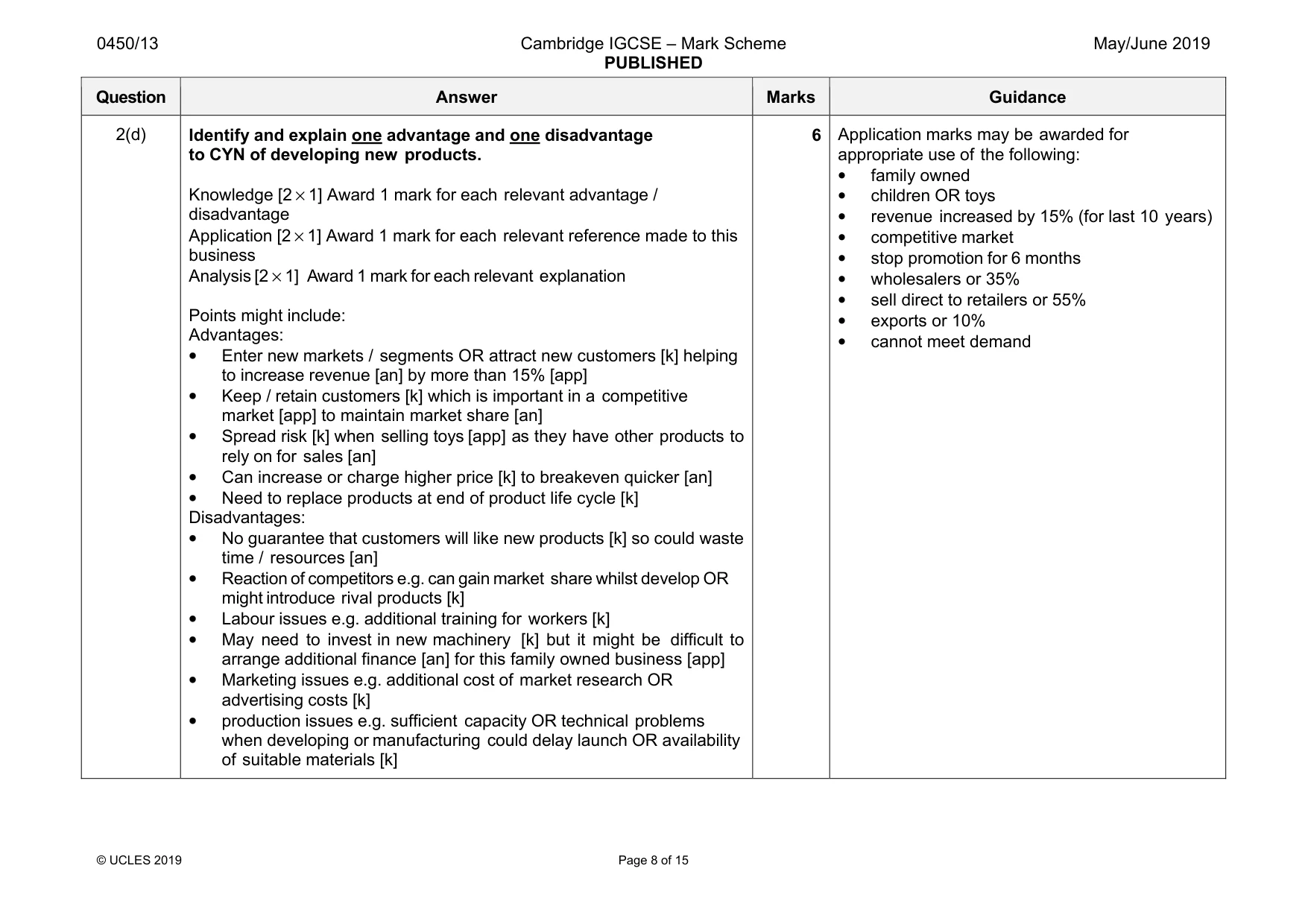
0450/13 Cambridge IGCSE – Mark Scheme PUBLISHED May/June 2019 © UCLES 2019 Page 8 of 15 Question Answer Marks Guidance 2(d) Identify and explain one advantage and one disadvantage to CYN of developing new products. Knowledge [2 × 1] Award 1 mark for each relevant advantage / disadvantage Application [2 × 1] Award 1 mark for each relevant reference made to this business Analysis [2 × 1] Award 1 mark for each relevant explanation Points might include: Advantages: • Enter new markets / segments OR attract new customers [k] helping to increase revenue [an] by more than 15% [app] • Keep / retain customers [k] which is important in a competitive market [app] to maintain market share [an] • Spread risk [k] when selling toys [app] as they have other products to rely on for sales [an] • Can increase or charge higher price [k] to breakeven quicker [an] • Need to replace products at end of product life cycle [k] Disadvantages: • No guarantee that customers will like new products [k] so could waste time / resources [an] • Reaction of competitors e.g. can gain market share whilst develop OR might introduce rival products [k] • Labour issues e.g. additional training for workers [k] • May need to invest in new machinery [k] but it might be difficult to arrange additional finance [an] for this family owned business [app] • Marketing issues e.g. additional cost of market research OR advertising costs [k] • production issues e.g. sufficient capacity OR technical problems when developing or manufacturing could delay launch OR availability of suitable materials [k] 6 Application marks may be awarded for appropriate use of the following: • family owned • children OR toys • revenue increased by 15% (for last 10 years) • competitive market • stop promotion for 6 months • wholesalers or 35% • sell direct to retailers or 55% • exports or 10% • cannot meet demand
Mark scheme, page 9
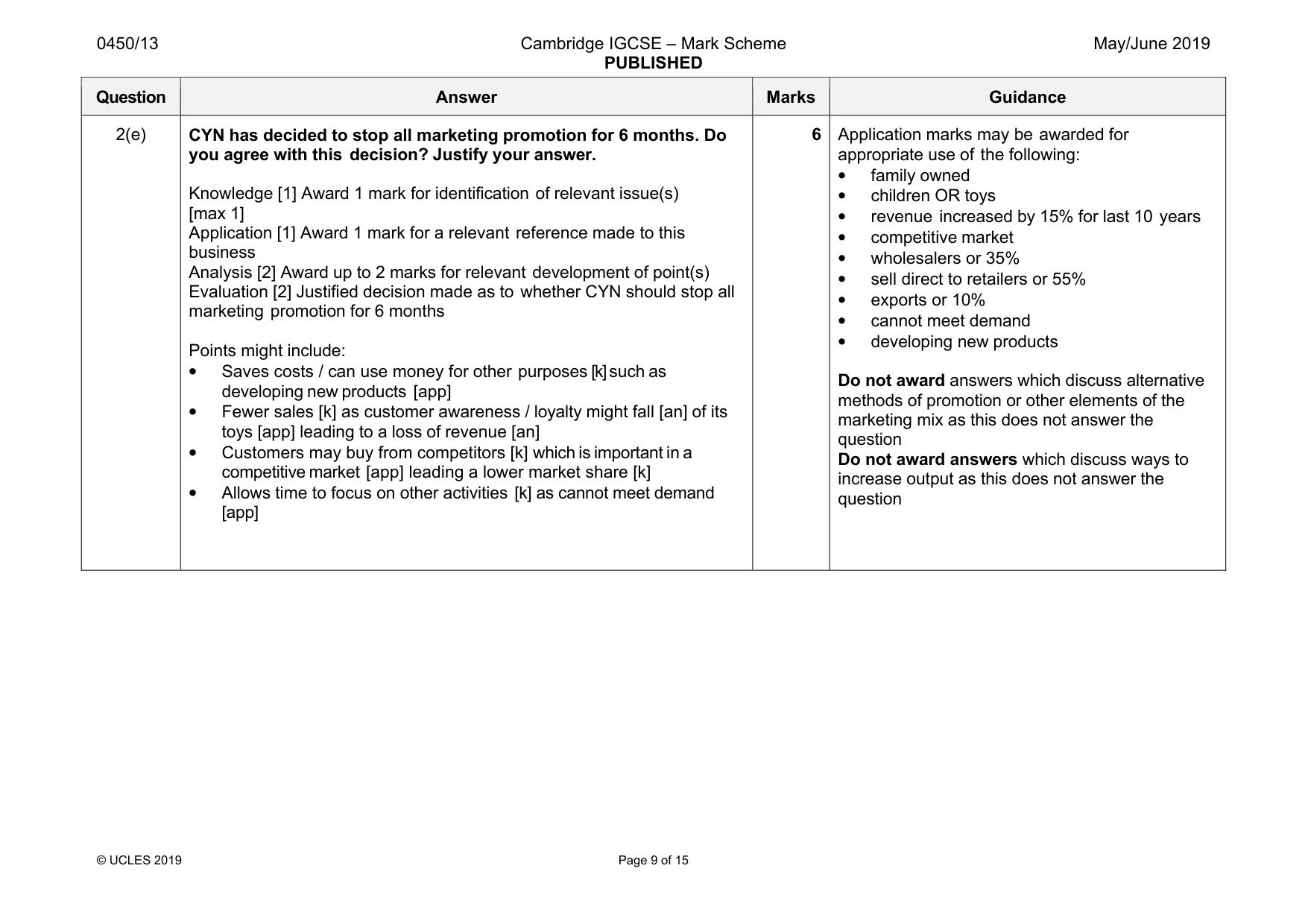
0450/13 Cambridge IGCSE – Mark Scheme PUBLISHED May/June 2019 © UCLES 2019 Page 9 of 15 Question Answer Marks Guidance 2(e) CYN has decided to stop all marketing promotion for 6 months. Do you agree with this decision? Justify your answer. Knowledge [1] Award 1 mark for identification of relevant issue(s) [max 1] Application [1] Award 1 mark for a relevant reference made to this business Analysis [2] Award up to 2 marks for relevant development of point(s) Evaluation [2] Justified decision made as to whether CYN should stop all marketing promotion for 6 months Points might include: • Saves costs / can use money for other purposes [k] such as developing new products [app] • Fewer sales [k] as customer awareness / loyalty might fall [an] of its toys [app] leading to a loss of revenue [an] • Customers may buy from competitors [k] which is important in a competitive market [app] leading a lower market share [k] • Allows time to focus on other activities [k] as cannot meet demand [app] 6 Application marks may be awarded for appropriate use of the following: • family owned • children OR toys • revenue increased by 15% for last 10 years • competitive market • wholesalers or 35% • sell direct to retailers or 55% • exports or 10% • cannot meet demand • developing new products Do not award answers which discuss alternative methods of promotion or other elements of the marketing mix as this does not answer the question Do not award answers which discuss ways to increase output as this does not answer the question
Mark scheme, page 10
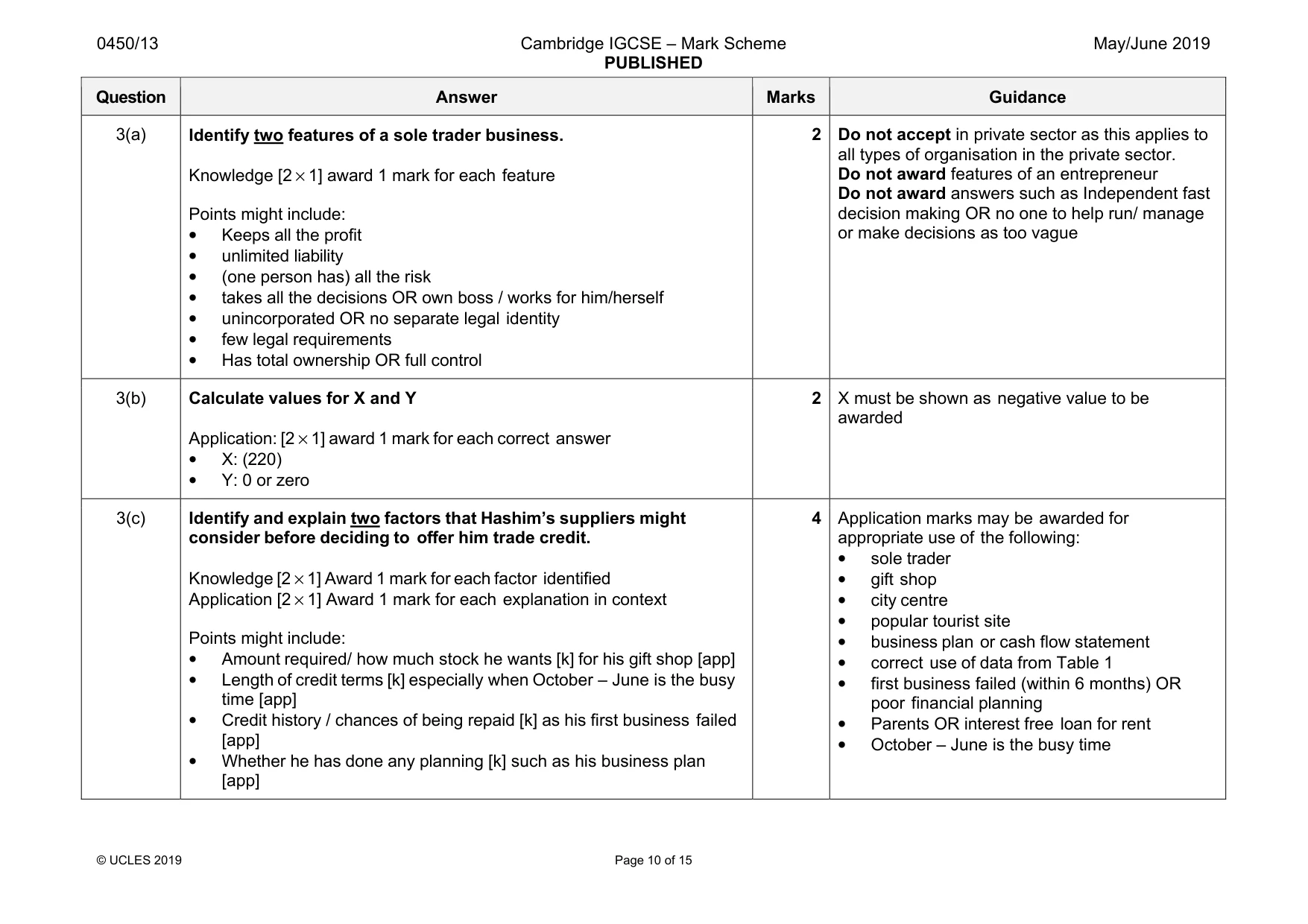
0450/13 Cambridge IGCSE – Mark Scheme PUBLISHED May/June 2019 © UCLES 2019 Page 10 of 15 Question Answer Marks Guidance 3(a) Identify two features of a sole trader business. Knowledge [2 × 1] award 1 mark for each feature Points might include: • Keeps all the profit • unlimited liability • (one person has) all the risk • takes all the decisions OR own boss / works for him/herself • unincorporated OR no separate legal identity • few legal requirements • Has total ownership OR full control 2 Do not accept in private sector as this applies to all types of organisation in the private sector. Do not award features of an entrepreneur Do not award answers such as Independent fast decision making OR no one to help run/ manage or make decisions as too vague 3(b) Calculate values for X and Y Application: [2 × 1] award 1 mark for each correct answer • X: (220) • Y: 0 or zero 2 X must be shown as negative value to be awarded 3(c) Identify and explain two factors that Hashim’s suppliers might consider before deciding to offer him trade credit. Knowledge [2 × 1] Award 1 mark for each factor identified Application [2 × 1] Award 1 mark for each explanation in context Points might include: • Amount required/ how much stock he wants [k] for his gift shop [app] • Length of credit terms [k] especially when October – June is the busy time [app] • Credit history / chances of being repaid [k] as his first business failed [app] • Whether he has done any planning [k] such as his business plan [app] 4 Application marks may be awarded for appropriate use of the following: • sole trader • gift shop • city centre • popular tourist site • business plan or cash flow statement • correct use of data from Table 1 • first business failed (within 6 months) OR poor financial planning • Parents OR interest free loan for rent • October – June is the busy time
Mark scheme, page 11
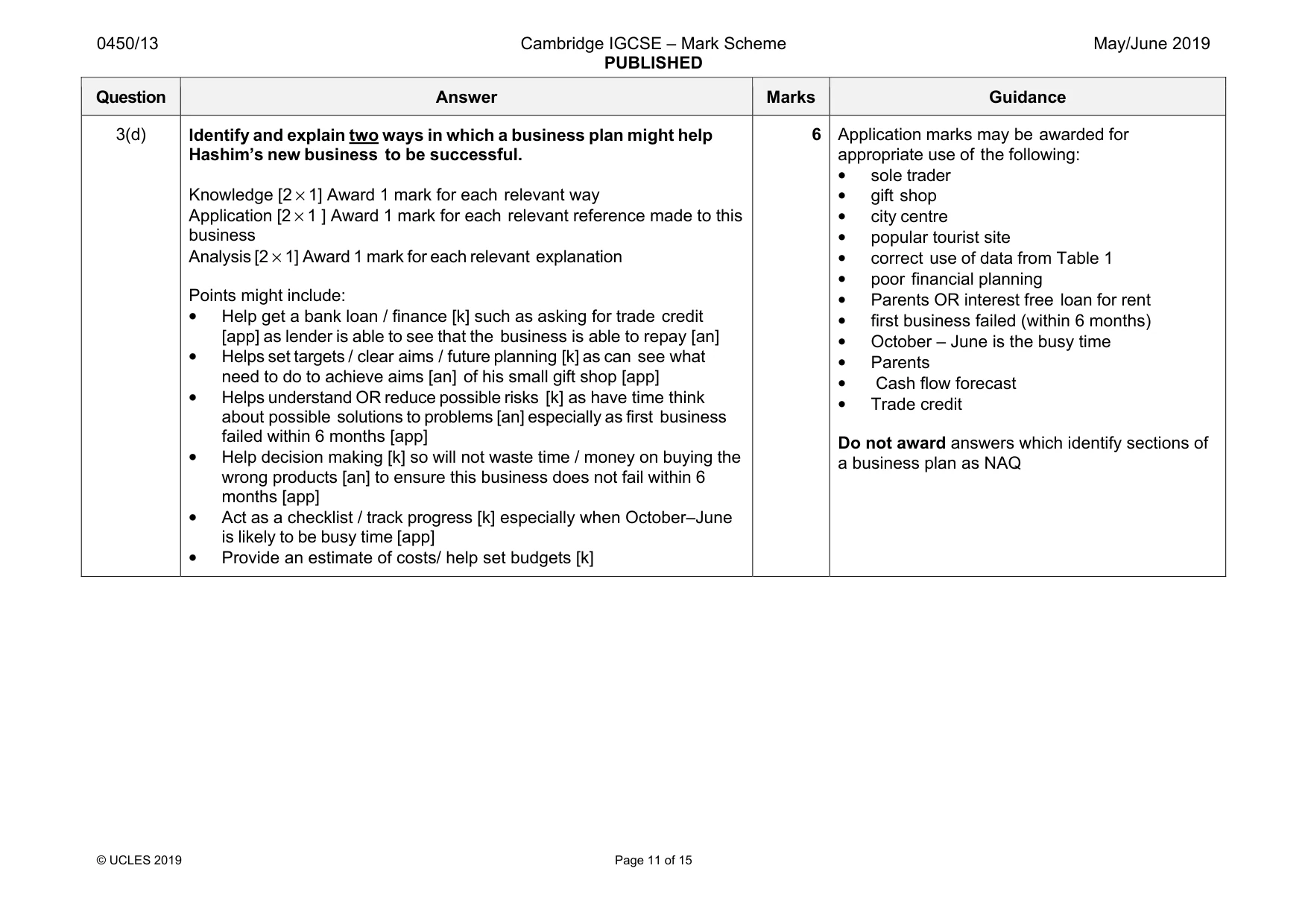
0450/13 Cambridge IGCSE – Mark Scheme PUBLISHED May/June 2019 © UCLES 2019 Page 11 of 15 Question Answer Marks Guidance 3(d) Identify and explain two ways in which a business plan might help Hashim’s new business to be successful. Knowledge [2 × 1] Award 1 mark for each relevant way Application [2 × 1 ] Award 1 mark for each relevant reference made to this business Analysis [2 × 1] Award 1 mark for each relevant explanation Points might include: • Help get a bank loan / finance [k] such as asking for trade credit [app] as lender is able to see that the business is able to repay [an] • Helps set targets / clear aims / future planning [k] as can see what need to do to achieve aims [an] of his small gift shop [app] • Helps understand OR reduce possible risks [k] as have time think about possible solutions to problems [an] especially as first business failed within 6 months [app] • Help decision making [k] so will not waste time / money on buying the wrong products [an] to ensure this business does not fail within 6 months [app] • Act as a checklist / track progress [k] especially when October–June is likely to be busy time [app] • Provide an estimate of costs/ help set budgets [k] 6 Application marks may be awarded for appropriate use of the following: • sole trader • gift shop • city centre • popular tourist site • correct use of data from Table 1 • poor financial planning • Parents OR interest free loan for rent • first business failed (within 6 months) • October – June is the busy time • Parents • Cash flow forecast • Trade credit Do not award answers which identify sections of a business plan as NAQ
Mark scheme, page 12
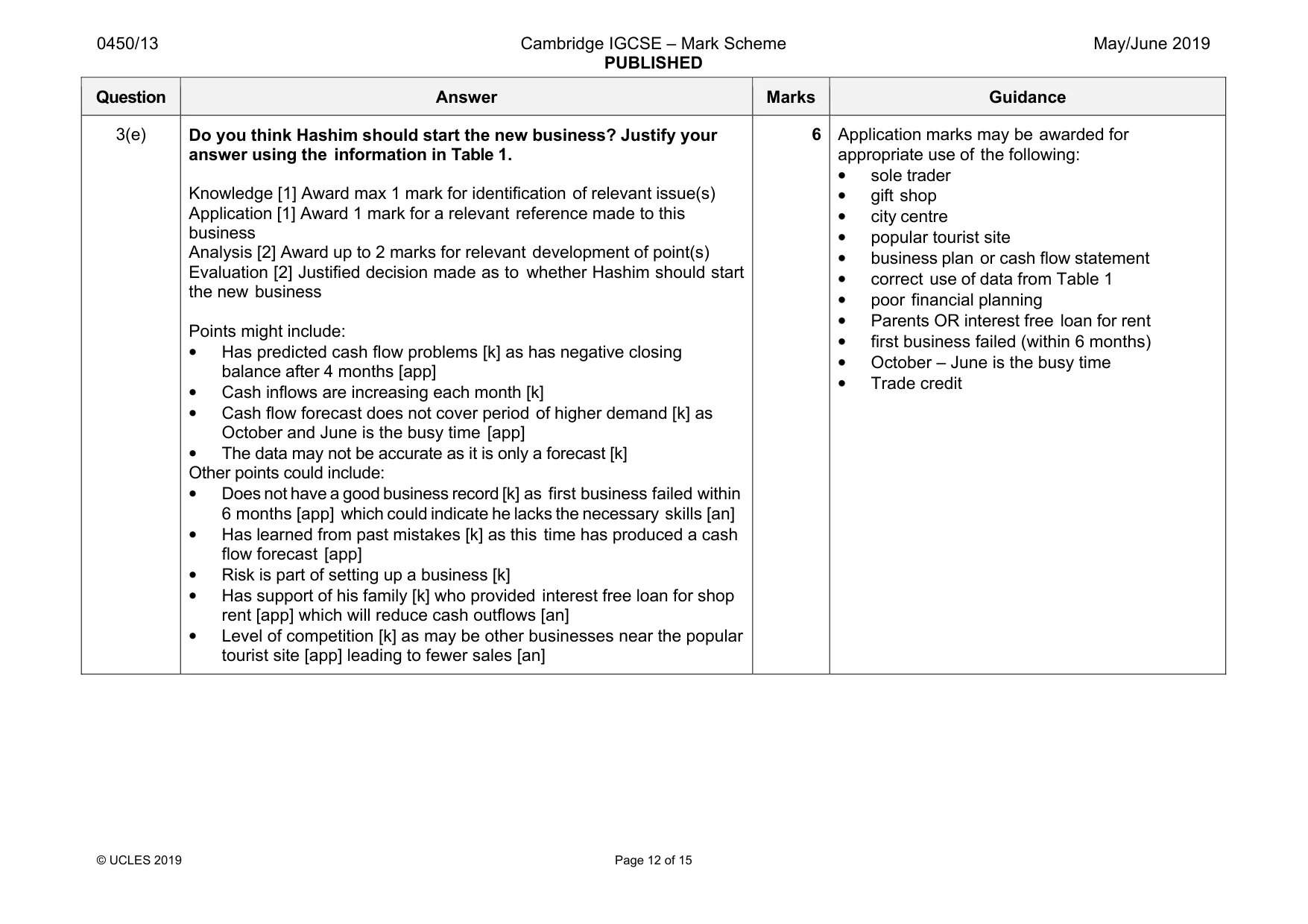
0450/13 Cambridge IGCSE – Mark Scheme PUBLISHED May/June 2019 © UCLES 2019 Page 12 of 15 Question Answer Marks Guidance 3(e) Do you think Hashim should start the new business? Justify your answer using the information in Table 1. Knowledge [1] Award max 1 mark for identification of relevant issue(s) Application [1] Award 1 mark for a relevant reference made to this business Analysis [2] Award up to 2 marks for relevant development of point(s) Evaluation [2] Justified decision made as to whether Hashim should start the new business Points might include: • Has predicted cash flow problems [k] as has negative closing balance after 4 months [app] • Cash inflows are increasing each month [k] • Cash flow forecast does not cover period of higher demand [k] as October and June is the busy time [app] • The data may not be accurate as it is only a forecast [k] Other points could include: • Does not have a good business record [k] as first business failed within 6 months [app] which could indicate he lacks the necessary skills [an] • Has learned from past mistakes [k] as this time has produced a cash flow forecast [app] • Risk is part of setting up a business [k] • Has support of his family [k] who provided interest free loan for shop rent [app] which will reduce cash outflows [an] • Level of competition [k] as may be other businesses near the popular tourist site [app] leading to fewer sales [an] 6 Application marks may be awarded for appropriate use of the following: • sole trader • gift shop • city centre • popular tourist site • business plan or cash flow statement • correct use of data from Table 1 • poor financial planning • Parents OR interest free loan for rent • first business failed (within 6 months) • October – June is the busy time • Trade credit
Mark scheme, page 13
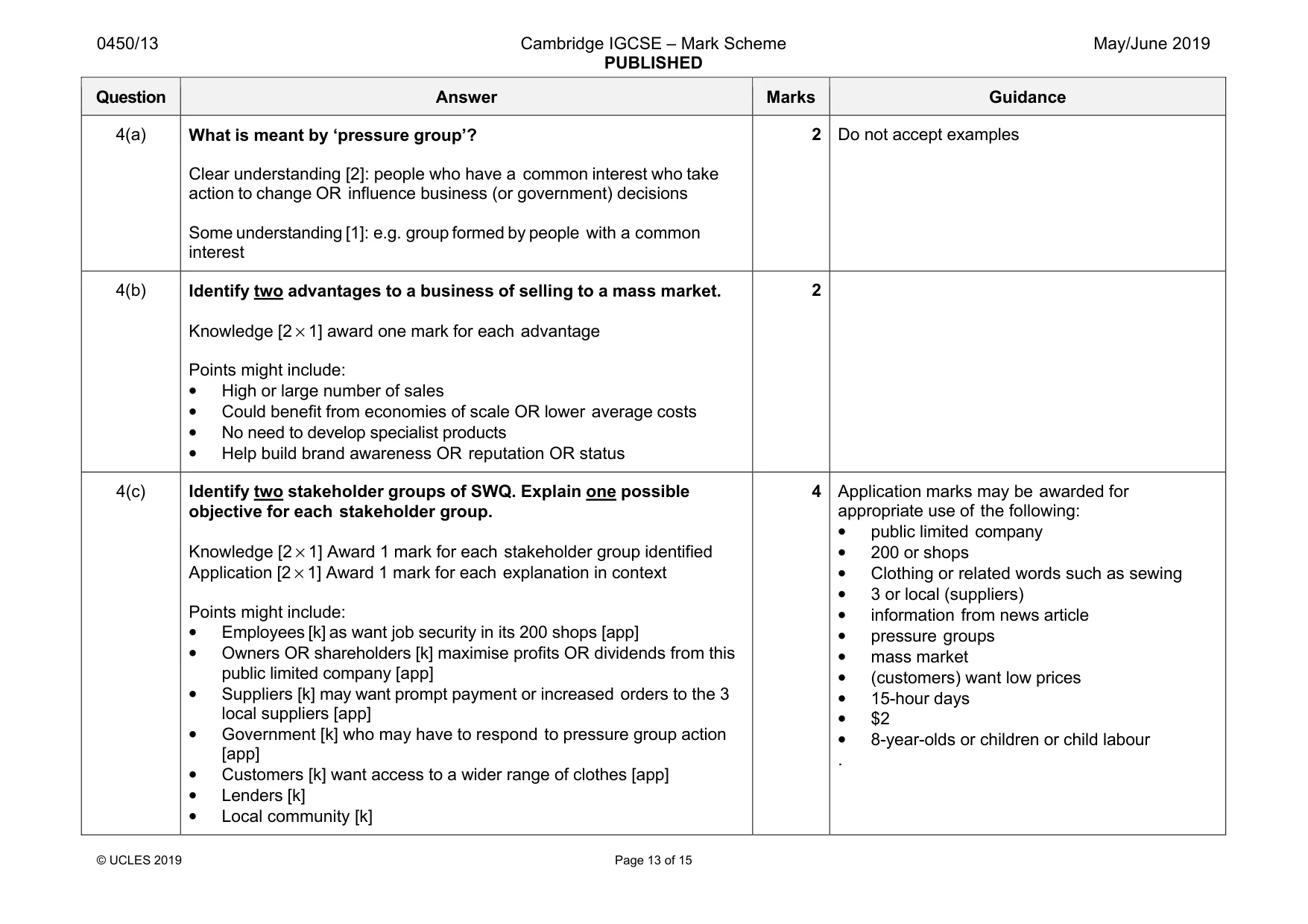
0450/13 Cambridge IGCSE – Mark Scheme PUBLISHED May/June 2019 © UCLES 2019 Page 13 of 15 Question Answer Marks Guidance 4(a) What is meant by ‘pressure group’? Clear understanding [2]: people who have a common interest who take action to change OR influence business (or government) decisions Some understanding [1]: e.g. group formed by people with a common interest 2 Do not accept examples 4(b) Identify two advantages to a business of selling to a mass market. Knowledge [2 × 1] award one mark for each advantage Points might include: • High or large number of sales • Could benefit from economies of scale OR lower average costs • No need to develop specialist products • Help build brand awareness OR reputation OR status 2 4(c) Identify two stakeholder groups of SWQ. Explain one possible objective for each stakeholder group. Knowledge [2 × 1] Award 1 mark for each stakeholder group identified Application [2 × 1] Award 1 mark for each explanation in context Points might include: • Employees [k] as want job security in its 200 shops [app] • Owners OR shareholders [k] maximise profits OR dividends from this public limited company [app] • Suppliers [k] may want prompt payment or increased orders to the 3 local suppliers [app] • Government [k] who may have to respond to pressure group action [app] • Customers [k] want access to a wider range of clothes [app] • Lenders [k] • Local community [k] 4 Application marks may be awarded for appropriate use of the following: • public limited company • 200 or shops • Clothing or related words such as sewing • 3 or local (suppliers) • information from news article • pressure groups • mass market • (customers) want low prices • 15-hour days • $2 • 8-year-olds or children or child labour .
Mark scheme, page 14
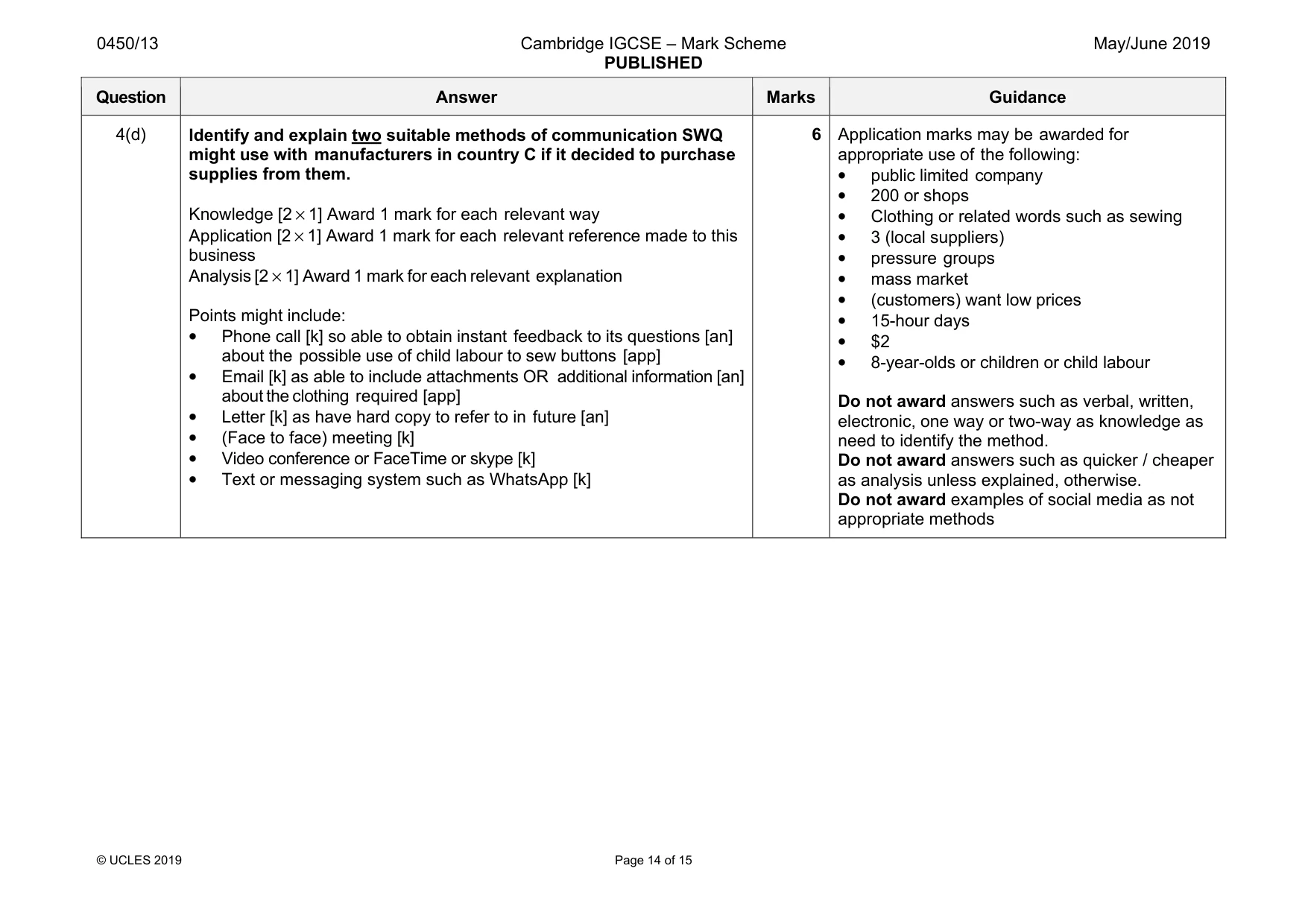
0450/13 Cambridge IGCSE – Mark Scheme PUBLISHED May/June 2019 © UCLES 2019 Page 14 of 15 Question Answer Marks Guidance 4(d) Identify and explain two suitable methods of communication SWQ might use with manufacturers in country C if it decided to purchase supplies from them. Knowledge [2 × 1] Award 1 mark for each relevant way Application [2 × 1] Award 1 mark for each relevant reference made to this business Analysis [2 × 1] Award 1 mark for each relevant explanation Points might include: • Phone call [k] so able to obtain instant feedback to its questions [an] about the possible use of child labour to sew buttons [app] • Email [k] as able to include attachments OR additional information [an] about the clothing required [app] • Letter [k] as have hard copy to refer to in future [an] • (Face to face) meeting [k] • Video conference or FaceTime or skype [k] • Text or messaging system such as WhatsApp [k] 6 Application marks may be awarded for appropriate use of the following: • public limited company • 200 or shops • Clothing or related words such as sewing • 3 (local suppliers) • pressure groups • mass market • (customers) want low prices • 15-hour days • $2 • 8-year-olds or children or child labour Do not award answers such as verbal, written, electronic, one way or two-way as knowledge as need to identify the method. Do not award answers such as quicker / cheaper as analysis unless explained, otherwise. Do not award examples of social media as not appropriate methods
Mark scheme, page 15
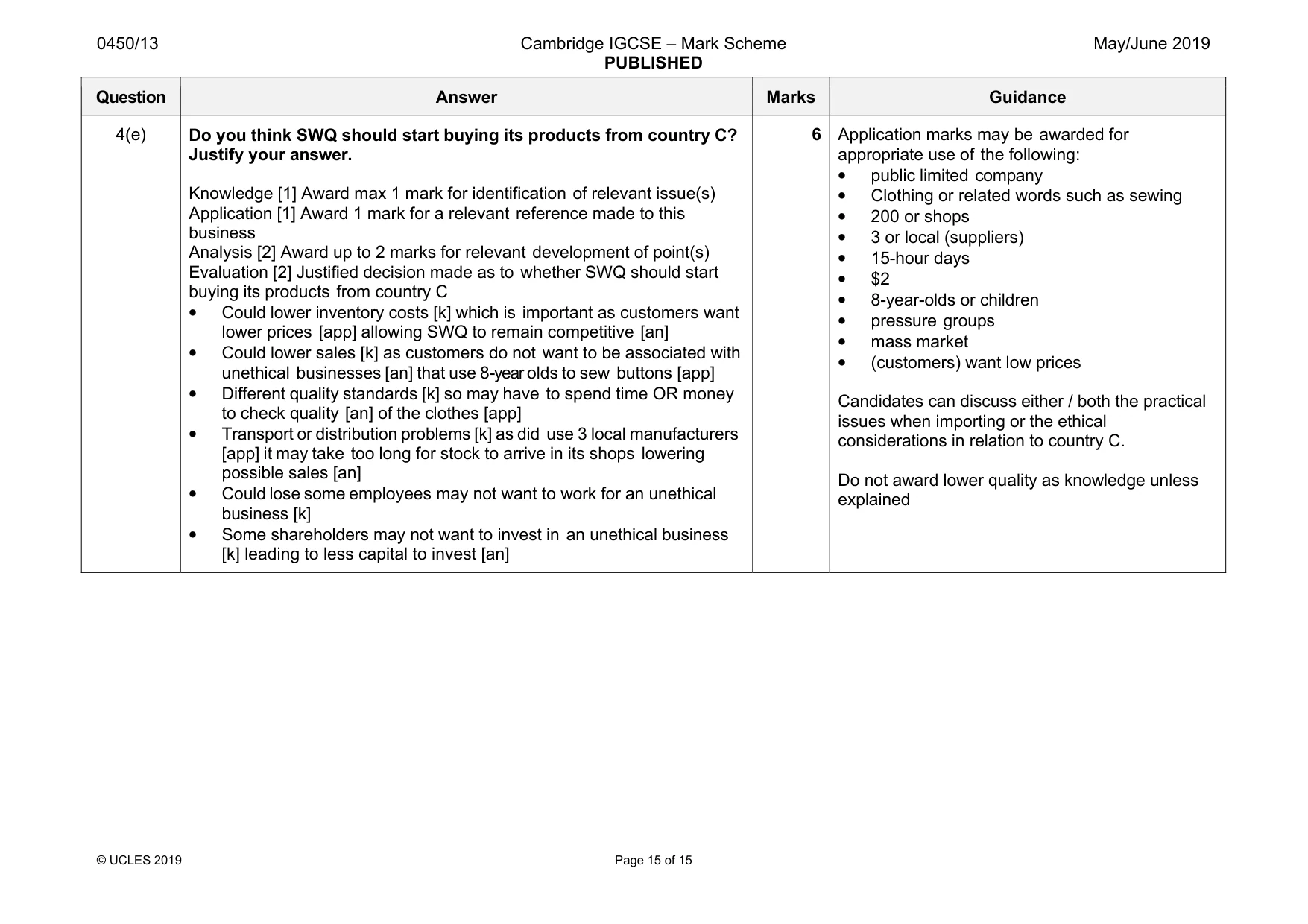
0450/13 Cambridge IGCSE – Mark Scheme PUBLISHED May/June 2019 © UCLES 2019 Page 15 of 15 Question Answer Marks Guidance 4(e) Do you think SWQ should start buying its products from country C? Justify your answer. Knowledge [1] Award max 1 mark for identification of relevant issue(s) Application [1] Award 1 mark for a relevant reference made to this business Analysis [2] Award up to 2 marks for relevant development of point(s) Evaluation [2] Justified decision made as to whether SWQ should start buying its products from country C • Could lower inventory costs [k] which is important as customers want lower prices [app] allowing SWQ to remain competitive [an] • Could lower sales [k] as customers do not want to be associated with unethical businesses [an] that use 8-year olds to sew buttons [app] • Different quality standards [k] so may have to spend time OR money to check quality [an] of the clothes [app] • Transport or distribution problems [k] as did use 3 local manufacturers [app] it may take too long for stock to arrive in its shops lowering possible sales [an] • Could lose some employees may not want to work for an unethical business [k] • Some shareholders may not want to invest in an unethical business [k] leading to less capital to invest [an] 6 Application marks may be awarded for appropriate use of the following: • public limited company • Clothing or related words such as sewing • 200 or shops • 3 or local (suppliers) • 15-hour days • $2 • 8-year-olds or children • pressure groups • mass market • (customers) want low prices Candidates can discuss either / both the practical issues when importing or the ethical considerations in relation to country C. Do not award lower quality as knowledge unless explained
What you needed in this session
Cambridge’s own grade thresholds for 2019 May/June, Paper 1 · Variant 3. A higher threshold means an easier paper — the bar moves with how the cohort did.