Cambridge IGCSE Business Studies 0450 — 2019 May/June Paper 1 · Variant 1
0450/11/M/J/19 · 80 marks · ≈90 min
The question paper and its mark scheme, free to read here and free to download. This is Cambridge’s own paper, exactly as it was sat.
Question paper12 pages



Mark scheme17 pages
Answers below. Sit the paper first if you are practising.
Paper as text
Question paper, page 1
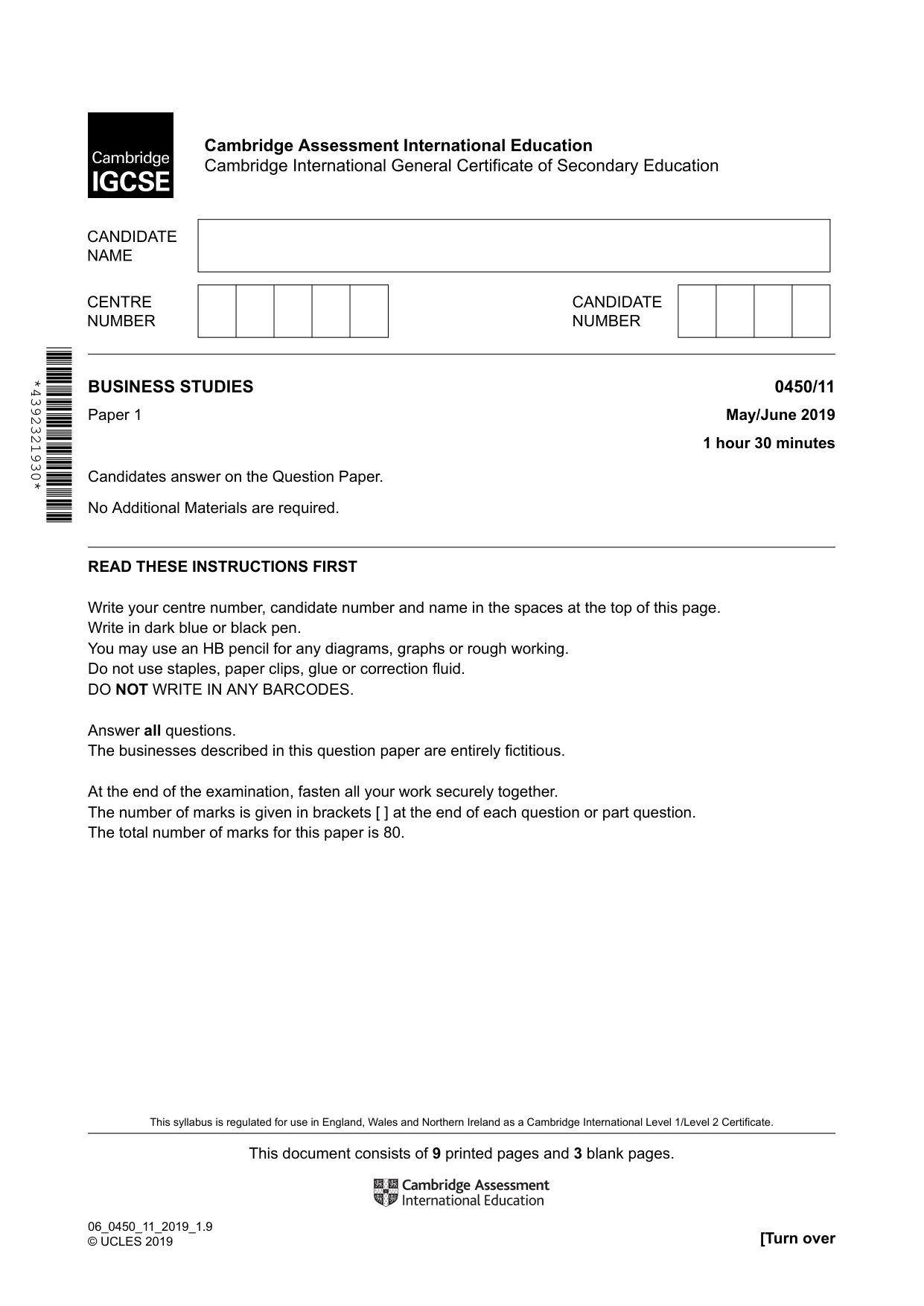
Cambridge Assessment International Education Cambridge International General Certificate of Secondary Education 0450/11 May/June 2019 1 hour 30 minutes BUSINESS STUDIES Paper 1 Candidates answer on the Question Paper. No Additional Materials are required. READ THESE INSTRUCTIONS FIRST Write your centre number, candidate number and name in the spaces at the top of this page. Write in dark blue or black pen. You may use an HB pencil for any diagrams, graphs or rough working. Do not use staples, paper clips, glue or correction fluid. DO NOT WRITE IN ANY BARCODES. Answer all questions. The businesses described in this question paper are entirely fictitious. At the end of the examination, fasten all your work securely together. The number of marks is given in brackets [ ] at the end of each question or part question. The total number of marks for this paper is 80. This syllabus is regulated for use in England, Wales and Northern Ireland as a Cambridge International Level 1/Level 2 Certificate. This document consists of 9 printed pages and 3 blank pages. [Turn over 06_0450_11_2019_1.9 © UCLES 2019 *4392321930*
Question paper, page 2
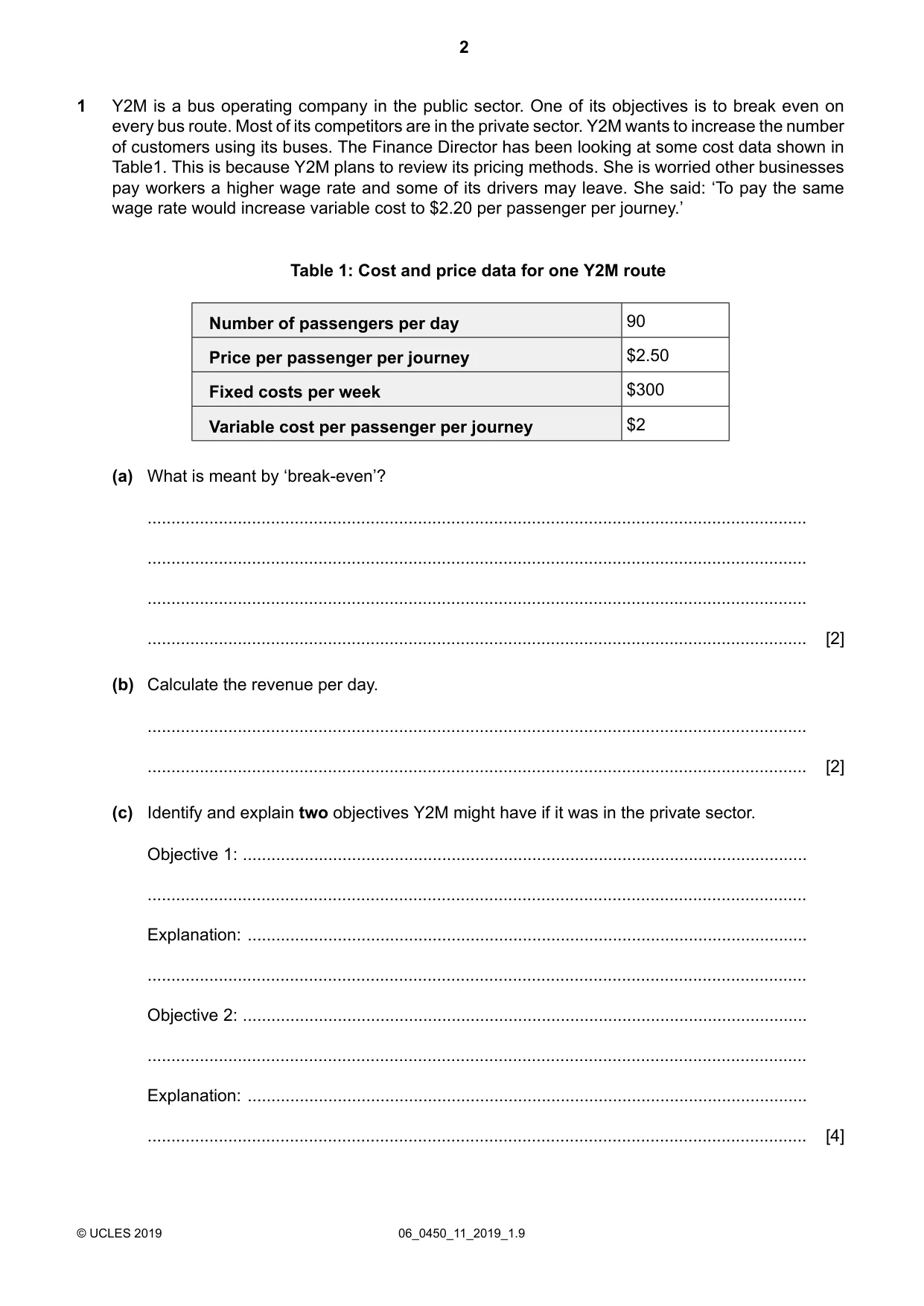
Y2M is a bus operating company in the public sector. One of its objectives is to break even on every bus route. Most of its competitors are in the private sector. Y2M wants to increase the number 1 of customers using its buses. The Finance Director has been looking at some cost data shown in Table1. This is because Y2M plans to review its pricing methods. She is worried other businesses pay workers a higher wage rate and some of its drivers may leave. She said: ‘To pay the same wage rate would increase variable cost to $2.20 per passenger per journey.’ Table 1: Cost and price data for one Y2M route 90 Number of passengers per day $2.50 Price per passenger per journey $300 Fixed costs per week $2 Variable cost per passenger per journey What is meant by ‘break-even’? (a) … … … … [2] Calculate the revenue per day. (b) … … [2] Identify and explain two objectives Y2M might have if it was in the private sector. (c) Objective 1: … … Explanation: … … Objective 2: … … Explanation: … … [4] 06_0450_11_2019_1.9 © UCLES 2019 2
Question paper, page 3
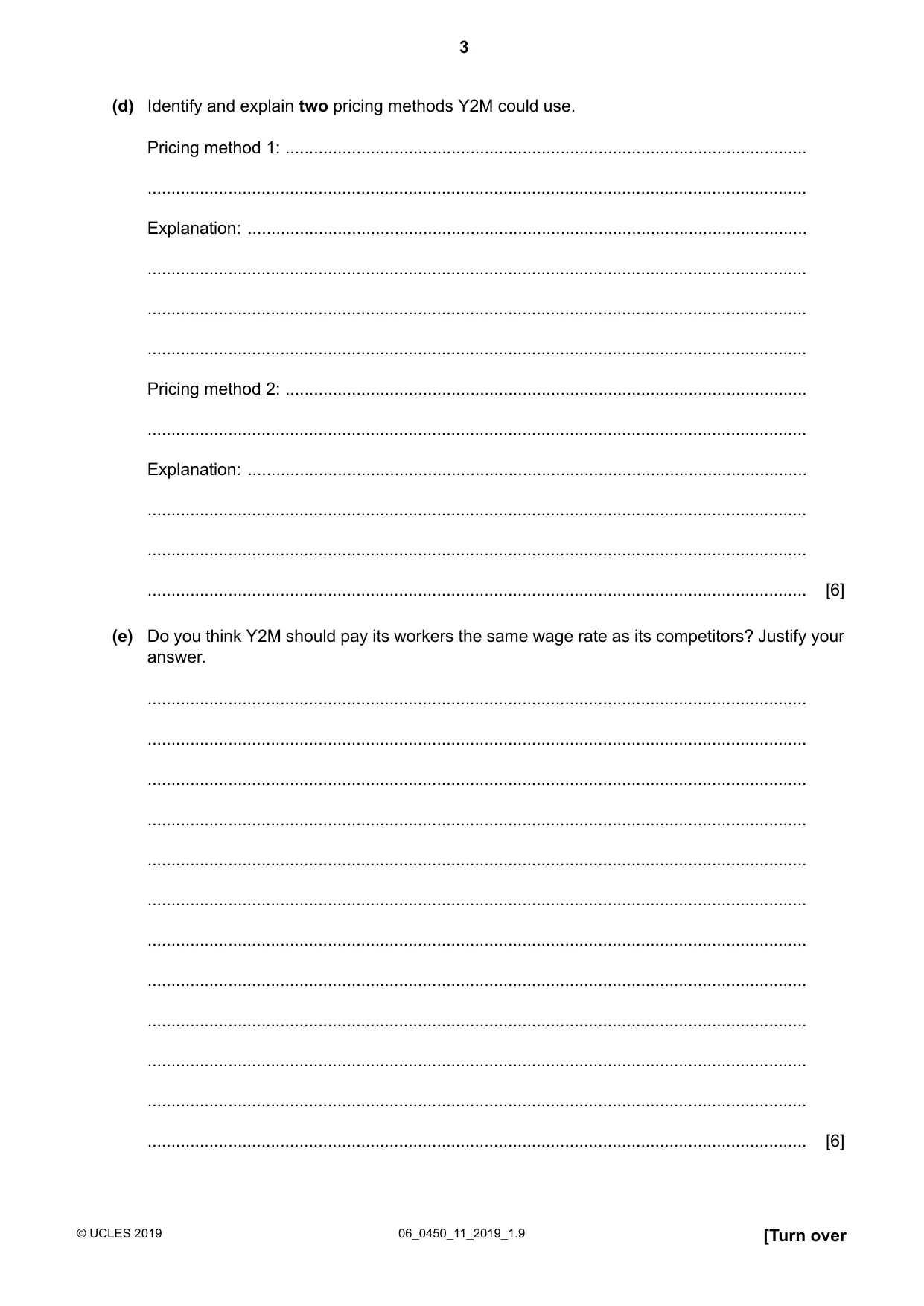
Identify and explain two pricing methods Y2M could use. (d) Pricing method 1: … … Explanation: … … … … Pricing method 2: … … Explanation: … … … … [6] Do you think Y2M should pay its workers the same wage rate as its competitors? Justify your answer. (e) … … … … … … … … … … … … [6] [Turn over 06_0450_11_2019_1.9 © UCLES 2019 3
Question paper, page 4
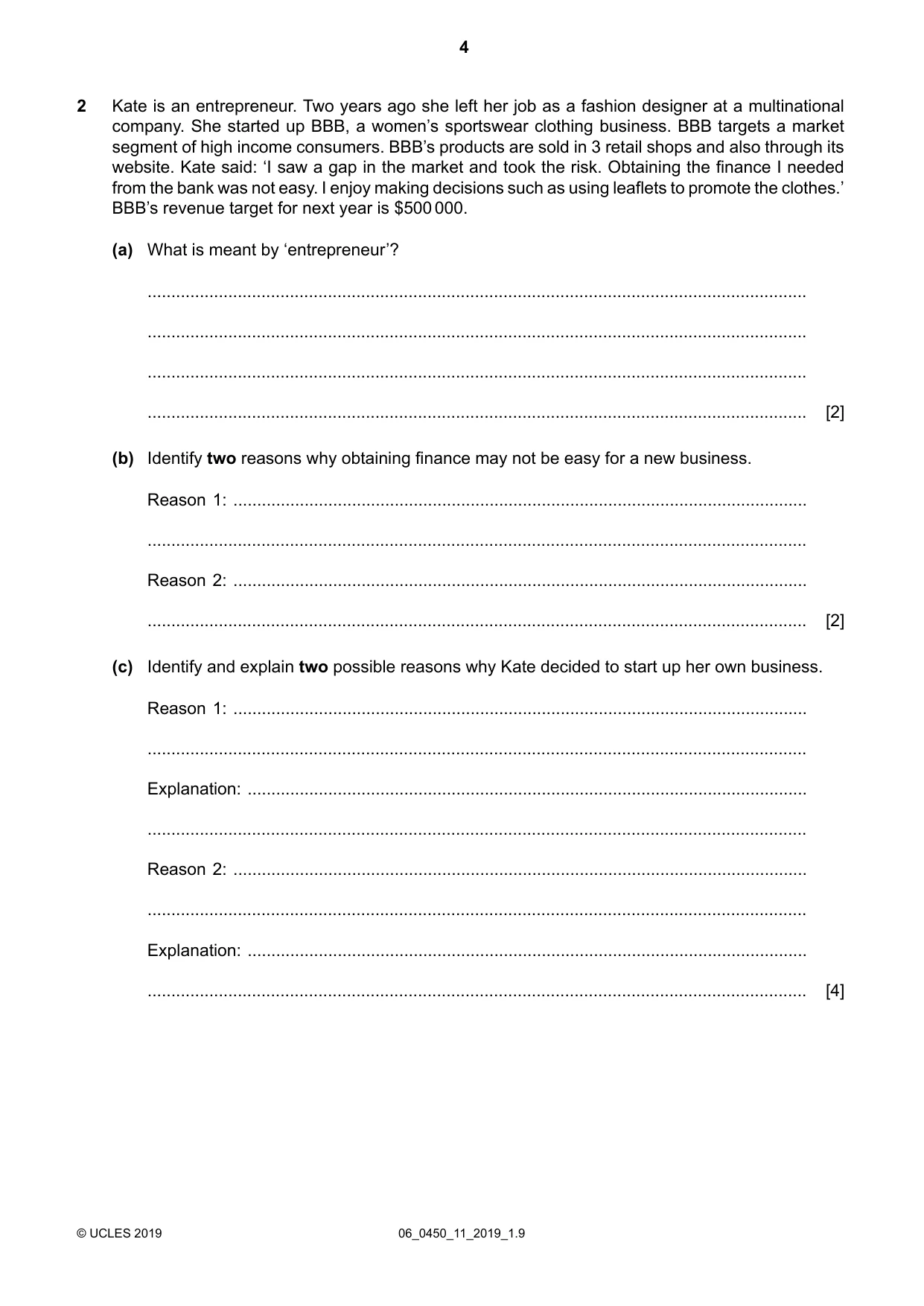
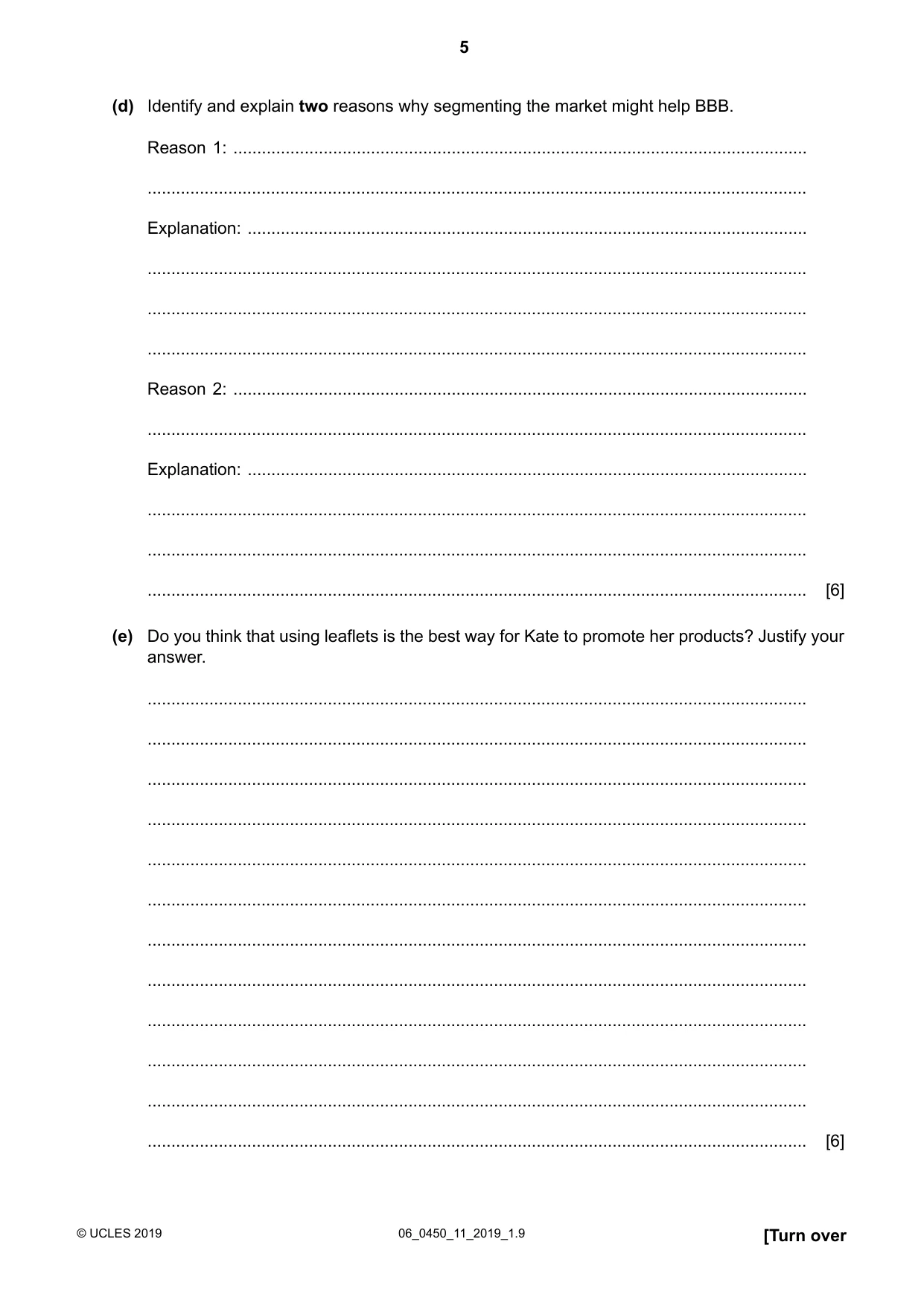
Kate is an entrepreneur. Two years ago she left her job as a fashion designer at a multinational company. She started up BBB, a women’s sportswear clothing business. BBB targets a market 2 segment of high income consumers. BBB’s products are sold in 3 retail shops and also through its website. Kate said: ‘I saw a gap in the market and took the risk. Obtaining the finance I needed from the bank was not easy. I enjoy making decisions such as using leaflets to promote the clothes.’ BBB’s revenue target for next year is $500000. What is meant by ‘entrepreneur’? (a) … … … … [2] Identify two reasons why obtaining finance may not be easy for a new business. (b) Reason 1: … … Reason 2: … … [2] Identify and explain two possible reasons why Kate decided to start up her own business. (c) Reason 1: … … Explanation: … … Reason 2: … … Explanation: … … [4] 06_0450_11_2019_1.9 © UCLES 2019 4
Question paper, page 5
Identify and explain two reasons why segmenting the market might help BBB. (d) Reason 1: … … Explanation: … … … … Reason 2: … … Explanation: … … … … [6] Do you think that using leaflets is the best way for Kate to promote her products? Justify your answer. (e) … … … … … … … … … … … … [6] [Turn over 06_0450_11_2019_1.9 © UCLES 2019 5
Question paper, page 6
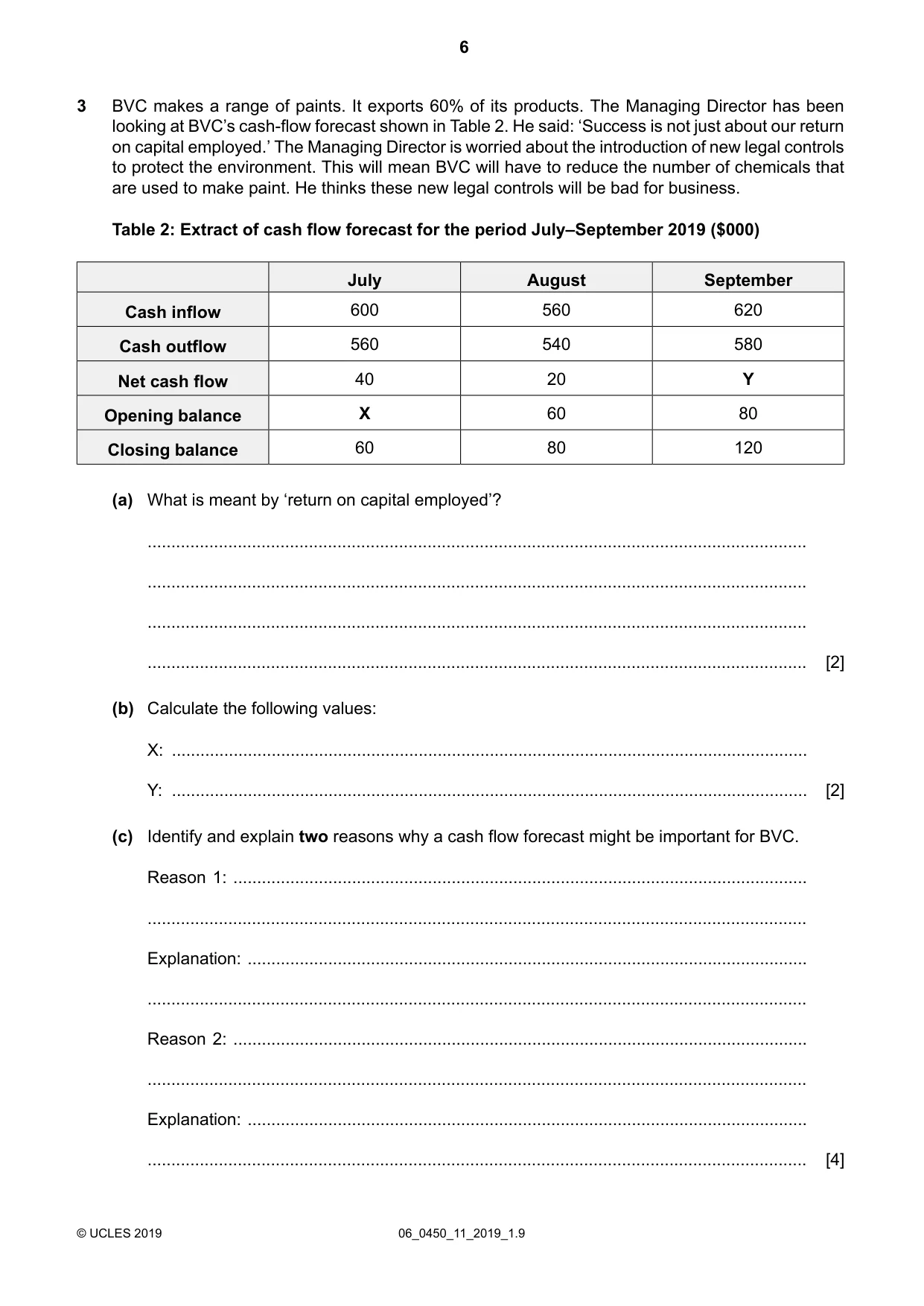
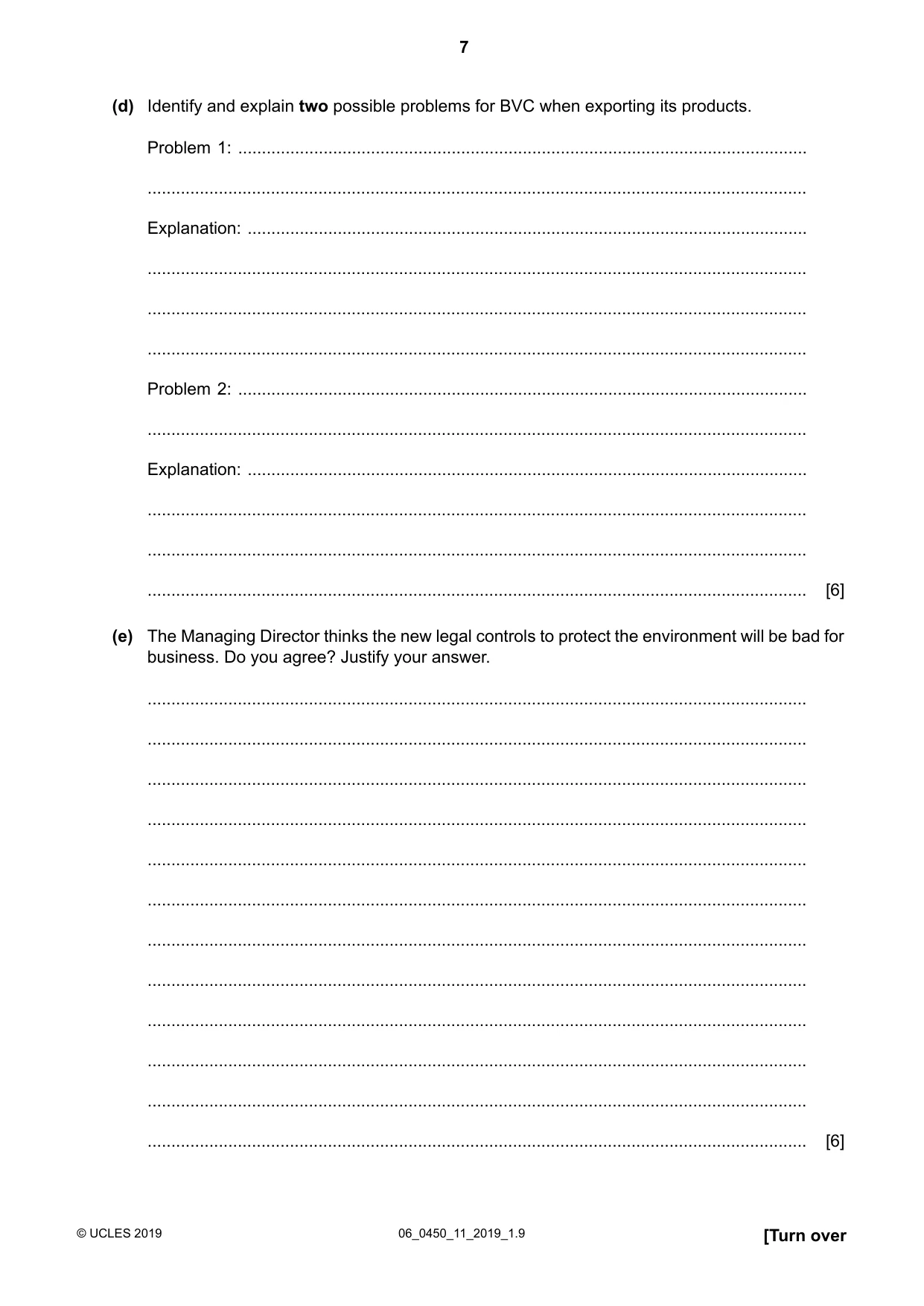
BVC makes a range of paints. It exports 60% of its products. The Managing Director has been looking at BVC’s cash-flow forecast shown in Table 2. He said: ‘Success is not just about our return 3 on capital employed.’ The Managing Director is worried about the introduction of new legal controls to protect the environment. This will mean BVC will have to reduce the number of chemicals that are used to make paint. He thinks these new legal controls will be bad for business. Table 2: Extract of cash flow forecast for the period July–September 2019 ($000) September August July 620 560 600 Cash inflow 580 540 560 Cash outflow Y 20 40 Net cash flow 80 60 X Opening balance 120 80 60 Closing balance What is meant by ‘return on capital employed’? (a) … … … … [2] Calculate the following values: (b) X: … Y: … [2] Identify and explain two reasons why a cash flow forecast might be important for BVC. (c) Reason 1: … … Explanation: … … Reason 2: … … Explanation: … … [4] 06_0450_11_2019_1.9 © UCLES 2019 6
Question paper, page 7
Identify and explain two possible problems for BVC when exporting its products. (d) Problem 1: … … Explanation: … … … … Problem 2: … … Explanation: … … … … [6] The Managing Director thinks the new legal controls to protect the environment will be bad for business. Do you agree? Justify your answer. (e) … … … … … … … … … … … … [6] [Turn over 06_0450_11_2019_1.9 © UCLES 2019 7
Question paper, page 8
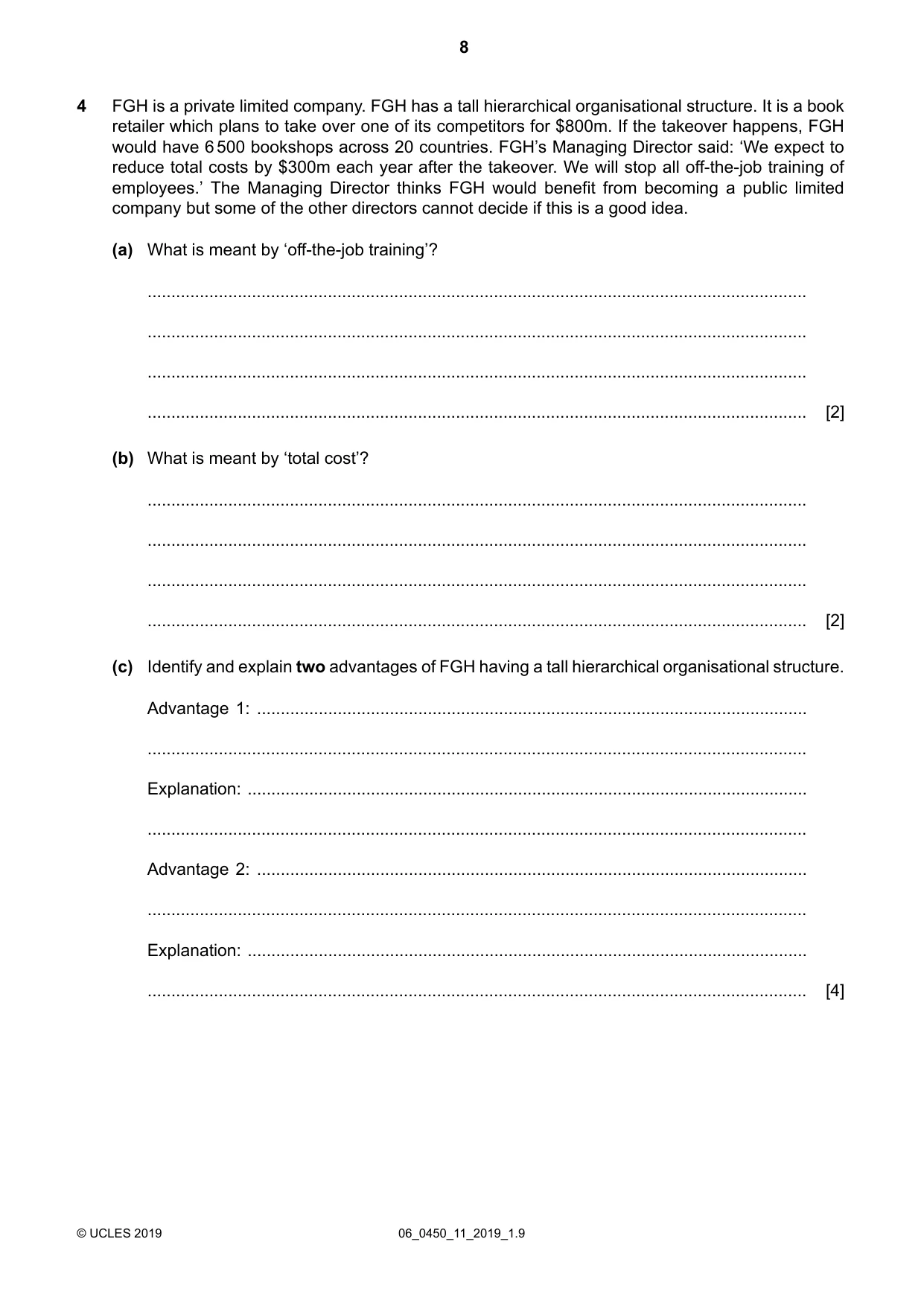
FGH is a private limited company. FGH has a tall hierarchical organisational structure. It is a book retailer which plans to take over one of its competitors for $800m. If the takeover happens, FGH 4 would have 6500 bookshops across 20 countries. FGH’s Managing Director said: ‘We expect to reduce total costs by $300m each year after the takeover. We will stop all off-the-job training of employees.’ The Managing Director thinks FGH would benefit from becoming a public limited company but some of the other directors cannot decide if this is a good idea. What is meant by ‘off-the-job training’? (a) … … … … [2] What is meant by ‘total cost’? (b) … … … … [2] Identify and explain two advantages of FGH having a tall hierarchical organisational structure. (c) Advantage 1: … … Explanation: … … Advantage 2: … … Explanation: … … [4] 06_0450_11_2019_1.9 © UCLES 2019 8
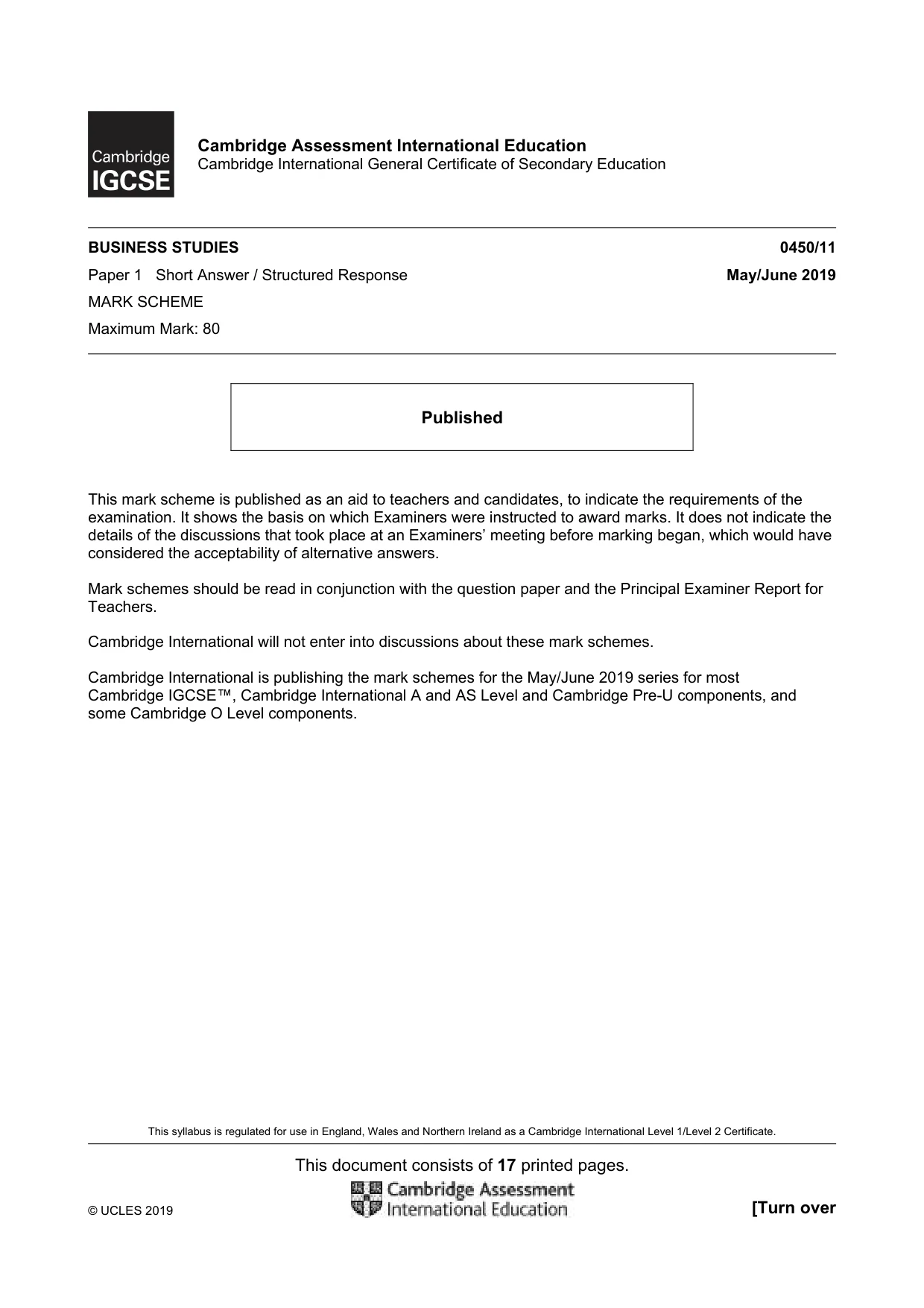
Question paper, page 9
Identify and explain one advantage and one disadvantage to FGH of becoming a public limited company. (d) Advantage: … … Explanation: … … … … Disadvantage: … … Explanation: … … … … [6] Do you think FGH should take over the other business? Justify your answer. (e) … … … … … … … … … … … … [6] 06_0450_11_2019_1.9 © UCLES 2019 9
Question paper, page 10
BLANK PAGE 06_0450_11_2019_1.9 © UCLES 2019 10
Question paper, page 11
BLANK PAGE 06_0450_11_2019_1.9 © UCLES 2019 11
Question paper, page 12
BLANK PAGE Permission to reproduce items where third-party owned material protected by copyright is included has been sought and cleared where possible. Every reasonable effort has been made by the publisher (UCLES) to trace copyright holders, but if any items requiring clearance have unwittingly been included, the publisher will be pleased to make amends at the earliest possible opportunity. To avoid the issue of disclosure of answer-related information to candidates, all copyright acknowledgements are reproduced online in the Cambridge Assessment International Education Copyright Acknowledgements Booklet. This is produced for each series of examinations and is freely available to download at www.cambridgeinternational.org after the live examination series. Cambridge Assessment International Education is part of the Cambridge Assessment Group. Cambridge Assessment is the brand name of the University of Cambridge Local Examinations Syndicate (UCLES), which itself is a department of the University of Cambridge. 06_0450_11_2019_1.9 © UCLES 2019 12
Mark scheme, page 1
This syllabus is regulated for use in England, Wales and Northern Ireland as a Cambridge International Level 1/Level 2 Certificate. This document consists of 17 printed pages. © UCLES 2019 [Turn over Cambridge Assessment International Education Cambridge International General Certificate of Secondary Education BUSINESS STUDIES 0450/11 Paper 1 Short Answer / Structured Response May/June 2019 MARK SCHEME Maximum Mark: 80 Published This mark scheme is published as an aid to teachers and candidates, to indicate the requirements of the examination. It shows the basis on which Examiners were instructed to award marks. It does not indicate the details of the discussions that took place at an Examiners’ meeting before marking began, which would have considered the acceptability of alternative answers. Mark schemes should be read in conjunction with the question paper and the Principal Examiner Report for Teachers. Cambridge International will not enter into discussions about these mark schemes. Cambridge International is publishing the mark schemes for the May/June 2019 series for most Cambridge IGCSE™, Cambridge International A and AS Level and Cambridge Pre-U components, and some Cambridge O Level components.
Mark scheme, page 2
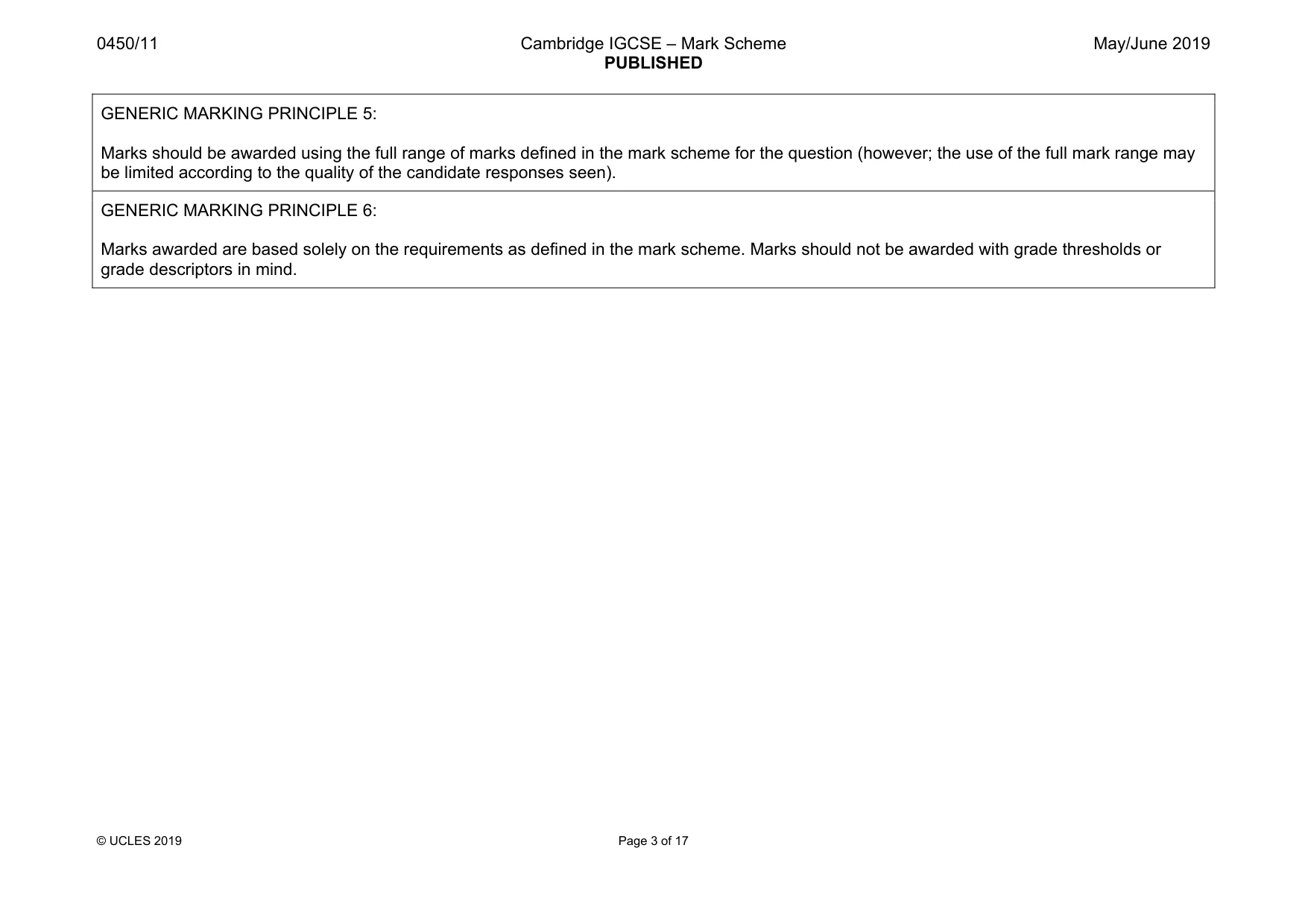
0450/11 Cambridge IGCSE – Mark Scheme PUBLISHED May/June 2019 © UCLES 2019 Page 2 of 17 Generic Marking Principles These general marking principles must be applied by all examiners when marking candidate answers. They should be applied alongside the specific content of the mark scheme or generic level descriptors for a question. Each question paper and mark scheme will also comply with these marking principles. GENERIC MARKING PRINCIPLE 1: Marks must be awarded in line with: • the specific content of the mark scheme or the generic level descriptors for the question • the specific skills defined in the mark scheme or in the generic level descriptors for the question • the standard of response required by a candidate as exemplified by the standardisation scripts. GENERIC MARKING PRINCIPLE 2: Marks awarded are always whole marks (not half marks, or other fractions). GENERIC MARKING PRINCIPLE 3: Marks must be awarded positively: • marks are awarded for correct/valid answers, as defined in the mark scheme. However, credit is given for valid answers which go beyond the scope of the syllabus and mark scheme, referring to your Team Leader as appropriate • marks are awarded when candidates clearly demonstrate what they know and can do • marks are not deducted for errors • marks are not deducted for omissions • answers should only be judged on the quality of spelling, punctuation and grammar when these features are specifically assessed by the question as indicated by the mark scheme. The meaning, however, should be unambiguous. GENERIC MARKING PRINCIPLE 4: Rules must be applied consistently e.g. in situations where candidates have not followed instructions or in the application of generic level descriptors.
Mark scheme, page 3
0450/11 Cambridge IGCSE – Mark Scheme PUBLISHED May/June 2019 © UCLES 2019 Page 3 of 17 GENERIC MARKING PRINCIPLE 5: Marks should be awarded using the full range of marks defined in the mark scheme for the question (however; the use of the full mark range may be limited according to the quality of the candidate responses seen). GENERIC MARKING PRINCIPLE 6: Marks awarded are based solely on the requirements as defined in the mark scheme. Marks should not be awarded with grade thresholds or grade descriptors in mind.
Mark scheme, page 4
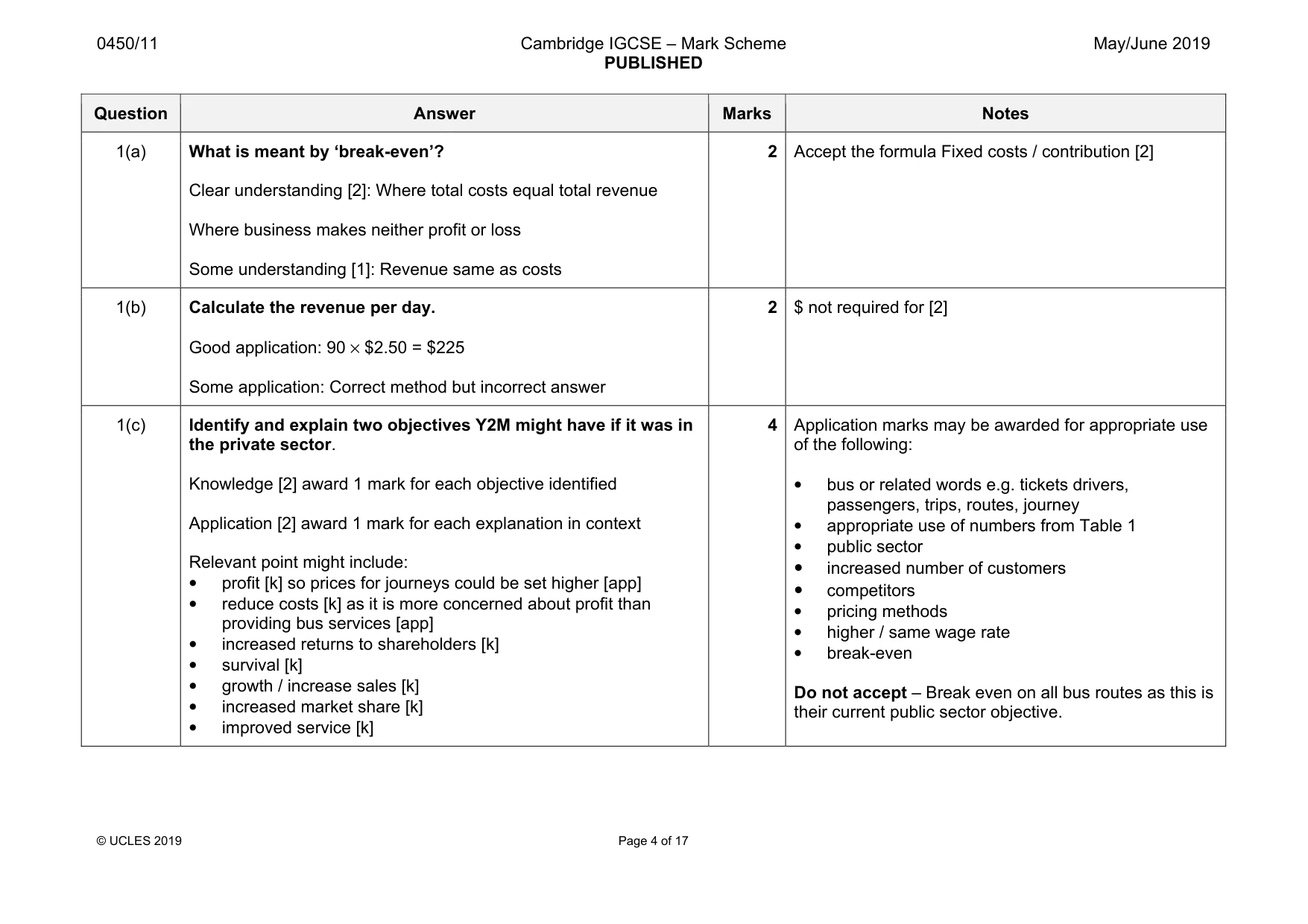
0450/11 Cambridge IGCSE – Mark Scheme PUBLISHED May/June 2019 © UCLES 2019 Page 4 of 17 Question Answer Marks Notes 1(a) What is meant by ‘break-even’? Clear understanding [2]: Where total costs equal total revenue Where business makes neither profit or loss Some understanding [1]: Revenue same as costs 2 Accept the formula Fixed costs / contribution [2] 1(b) Calculate the revenue per day. Good application: 90 × $2.50 = $225 Some application: Correct method but incorrect answer 2 $ not required for [2] 1(c) Identify and explain two objectives Y2M might have if it was in the private sector. Knowledge [2] award 1 mark for each objective identified Application [2] award 1 mark for each explanation in context Relevant point might include: • profit [k] so prices for journeys could be set higher [app] • reduce costs [k] as it is more concerned about profit than providing bus services [app] • increased returns to shareholders [k] • survival [k] • growth / increase sales [k] • increased market share [k] • improved service [k] 4 Application marks may be awarded for appropriate use of the following: • bus or related words e.g. tickets drivers, passengers, trips, routes, journey • appropriate use of numbers from Table 1 • public sector • increased number of customers • competitors • pricing methods • higher / same wage rate • break-even Do not accept – Break even on all bus routes as this is their current public sector objective.
Mark scheme, page 5
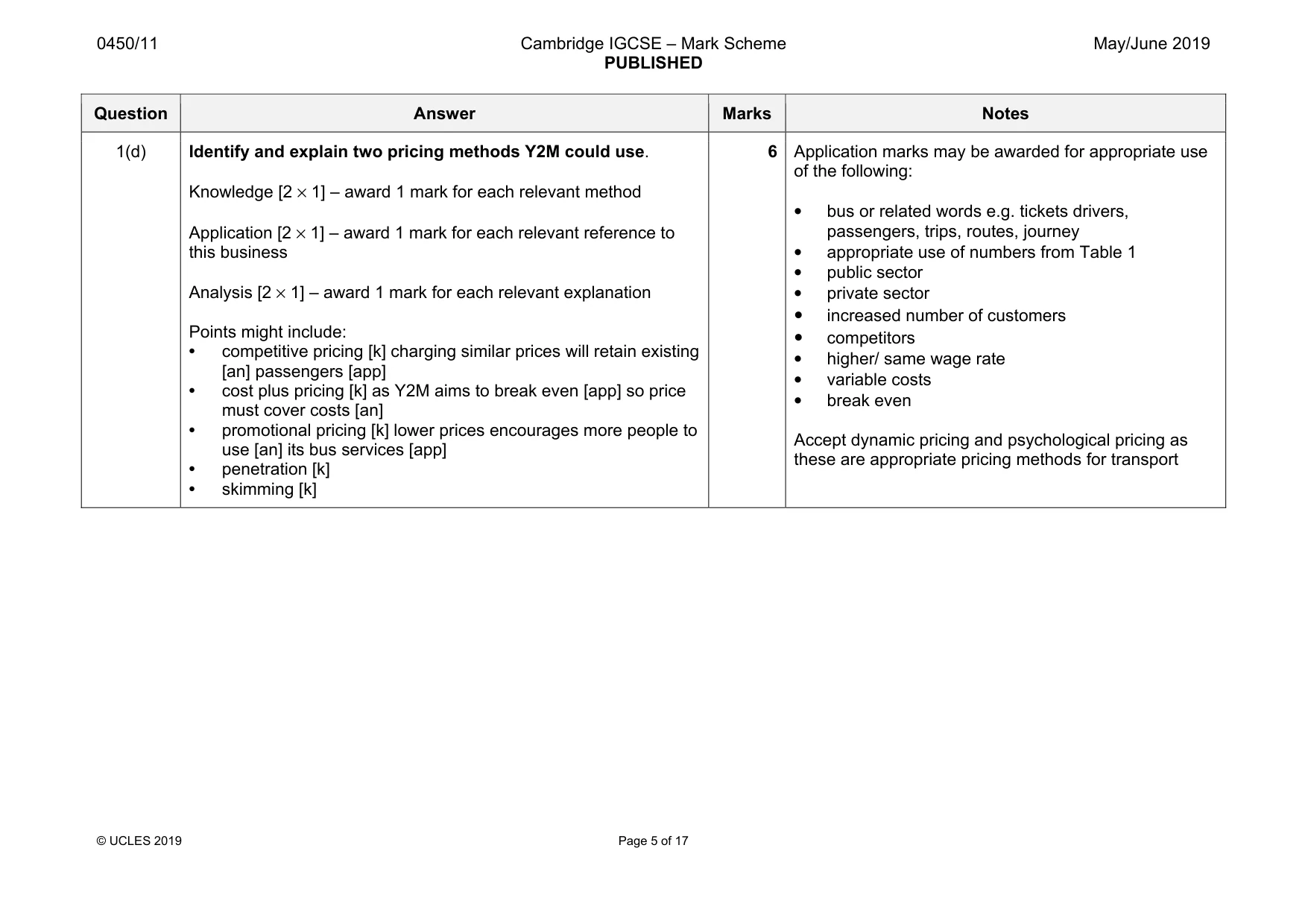
0450/11 Cambridge IGCSE – Mark Scheme PUBLISHED May/June 2019 © UCLES 2019 Page 5 of 17 Question Answer Marks Notes 1(d) Identify and explain two pricing methods Y2M could use. Knowledge [2 × 1] – award 1 mark for each relevant method Application [2 × 1] – award 1 mark for each relevant reference to this business Analysis [2 × 1] – award 1 mark for each relevant explanation Points might include: • competitive pricing [k] charging similar prices will retain existing [an] passengers [app] • cost plus pricing [k] as Y2M aims to break even [app] so price must cover costs [an] • promotional pricing [k] lower prices encourages more people to use [an] its bus services [app] • penetration [k] • skimming [k] 6 Application marks may be awarded for appropriate use of the following: • bus or related words e.g. tickets drivers, passengers, trips, routes, journey • appropriate use of numbers from Table 1 • public sector • private sector • increased number of customers • competitors • higher/ same wage rate • variable costs • break even Accept dynamic pricing and psychological pricing as these are appropriate pricing methods for transport
Mark scheme, page 6
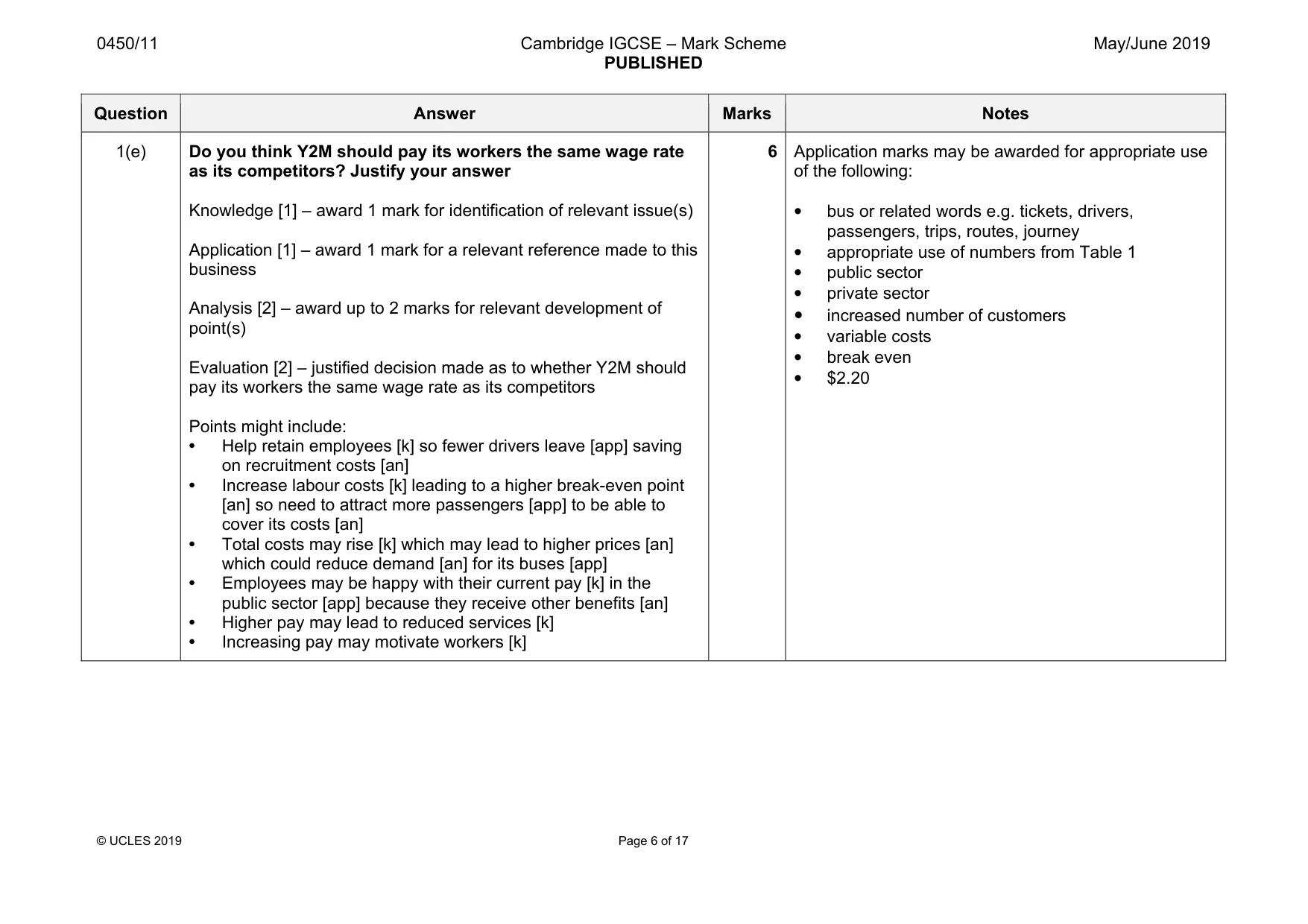
0450/11 Cambridge IGCSE – Mark Scheme PUBLISHED May/June 2019 © UCLES 2019 Page 6 of 17 Question Answer Marks Notes 1(e) Do you think Y2M should pay its workers the same wage rate as its competitors? Justify your answer Knowledge [1] – award 1 mark for identification of relevant issue(s) Application [1] – award 1 mark for a relevant reference made to this business Analysis [2] – award up to 2 marks for relevant development of point(s) Evaluation [2] – justified decision made as to whether Y2M should pay its workers the same wage rate as its competitors Points might include: • Help retain employees [k] so fewer drivers leave [app] saving on recruitment costs [an] • Increase labour costs [k] leading to a higher break-even point [an] so need to attract more passengers [app] to be able to cover its costs [an] • Total costs may rise [k] which may lead to higher prices [an] which could reduce demand [an] for its buses [app] • Employees may be happy with their current pay [k] in the public sector [app] because they receive other benefits [an] • Higher pay may lead to reduced services [k] • Increasing pay may motivate workers [k] 6 Application marks may be awarded for appropriate use of the following: • bus or related words e.g. tickets, drivers, passengers, trips, routes, journey • appropriate use of numbers from Table 1 • public sector • private sector • increased number of customers • variable costs • break even • $2.20
Mark scheme, page 7
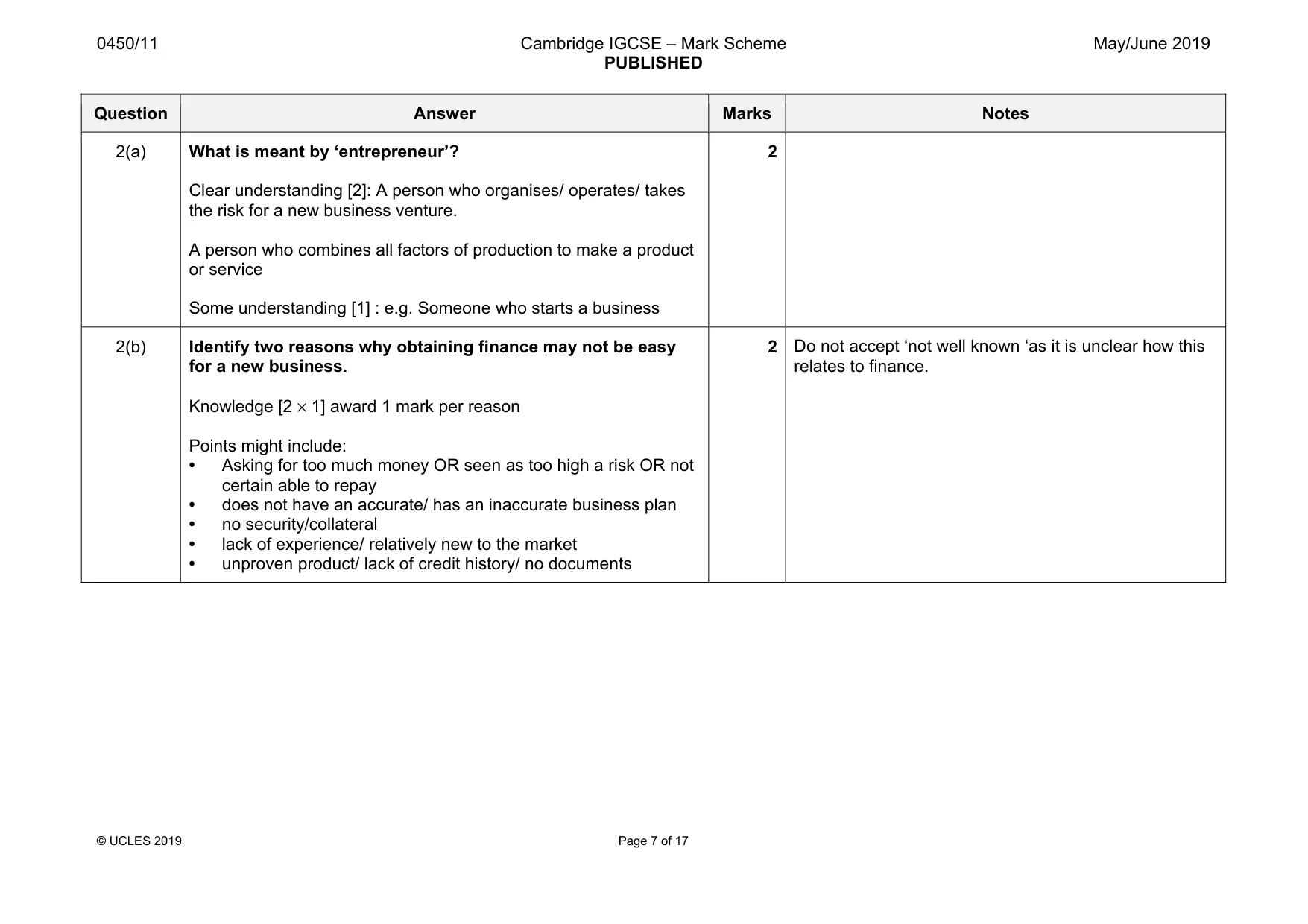
0450/11 Cambridge IGCSE – Mark Scheme PUBLISHED May/June 2019 © UCLES 2019 Page 7 of 17 Question Answer Marks Notes 2(a) What is meant by ‘entrepreneur’? Clear understanding [2]: A person who organises/ operates/ takes the risk for a new business venture. A person who combines all factors of production to make a product or service Some understanding [1] : e.g. Someone who starts a business 2 2(b) Identify two reasons why obtaining finance may not be easy for a new business. Knowledge [2 × 1] award 1 mark per reason Points might include: • Asking for too much money OR seen as too high a risk OR not certain able to repay • does not have an accurate/ has an inaccurate business plan • no security/collateral • lack of experience/ relatively new to the market • unproven product/ lack of credit history/ no documents 2 Do not accept ‘not well known ‘as it is unclear how this relates to finance.
Mark scheme, page 8
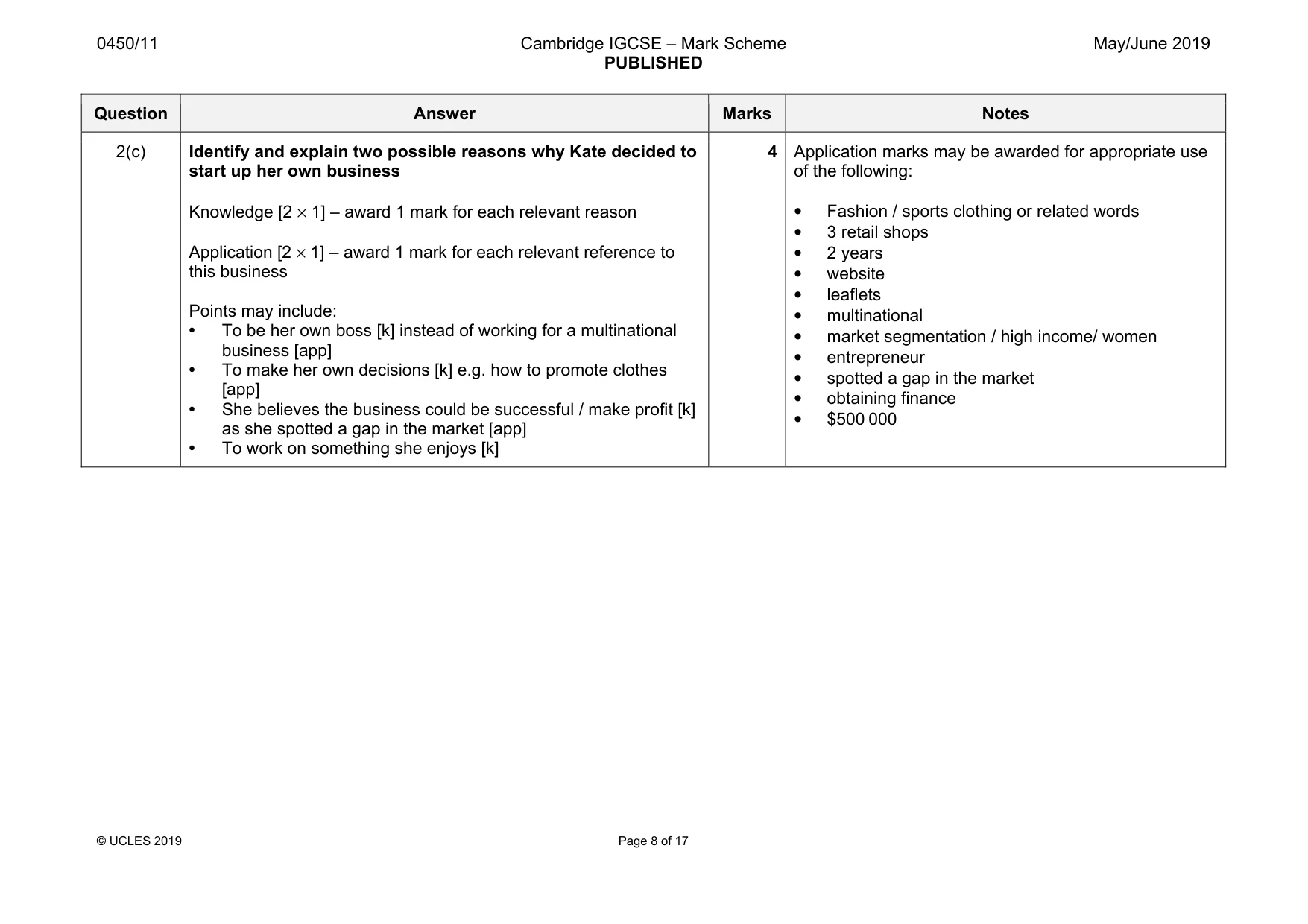
0450/11 Cambridge IGCSE – Mark Scheme PUBLISHED May/June 2019 © UCLES 2019 Page 8 of 17 Question Answer Marks Notes 2(c) Identify and explain two possible reasons why Kate decided to start up her own business Knowledge [2 × 1] – award 1 mark for each relevant reason Application [2 × 1] – award 1 mark for each relevant reference to this business Points may include: • To be her own boss [k] instead of working for a multinational business [app] • To make her own decisions [k] e.g. how to promote clothes [app] • She believes the business could be successful / make profit [k] as she spotted a gap in the market [app] • To work on something she enjoys [k] 4 Application marks may be awarded for appropriate use of the following: • Fashion / sports clothing or related words • 3 retail shops • 2 years • website • leaflets • multinational • market segmentation / high income/ women • entrepreneur • spotted a gap in the market • obtaining finance • $500 000
Mark scheme, page 9
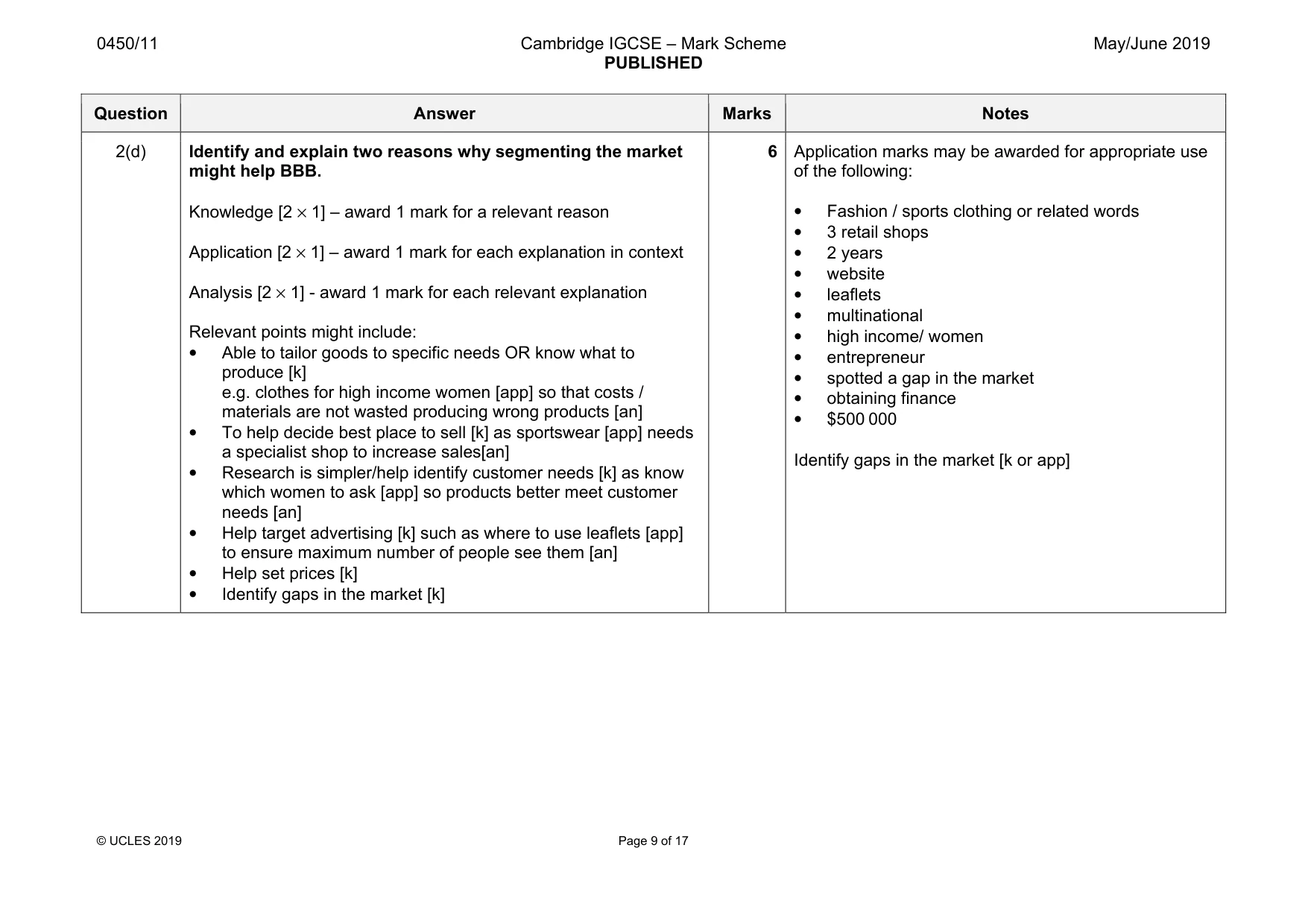
0450/11 Cambridge IGCSE – Mark Scheme PUBLISHED May/June 2019 © UCLES 2019 Page 9 of 17 Question Answer Marks Notes 2(d) Identify and explain two reasons why segmenting the market might help BBB. Knowledge [2 × 1] – award 1 mark for a relevant reason Application [2 × 1] – award 1 mark for each explanation in context Analysis [2 × 1] - award 1 mark for each relevant explanation Relevant points might include: • Able to tailor goods to specific needs OR know what to produce [k] e.g. clothes for high income women [app] so that costs / materials are not wasted producing wrong products [an] • To help decide best place to sell [k] as sportswear [app] needs a specialist shop to increase sales[an] • Research is simpler/help identify customer needs [k] as know which women to ask [app] so products better meet customer needs [an] • Help target advertising [k] such as where to use leaflets [app] to ensure maximum number of people see them [an] • Help set prices [k] • Identify gaps in the market [k] 6 Application marks may be awarded for appropriate use of the following: • Fashion / sports clothing or related words • 3 retail shops • 2 years • website • leaflets • multinational • high income/ women • entrepreneur • spotted a gap in the market • obtaining finance • $500 000 Identify gaps in the market [k or app]
Mark scheme, page 10
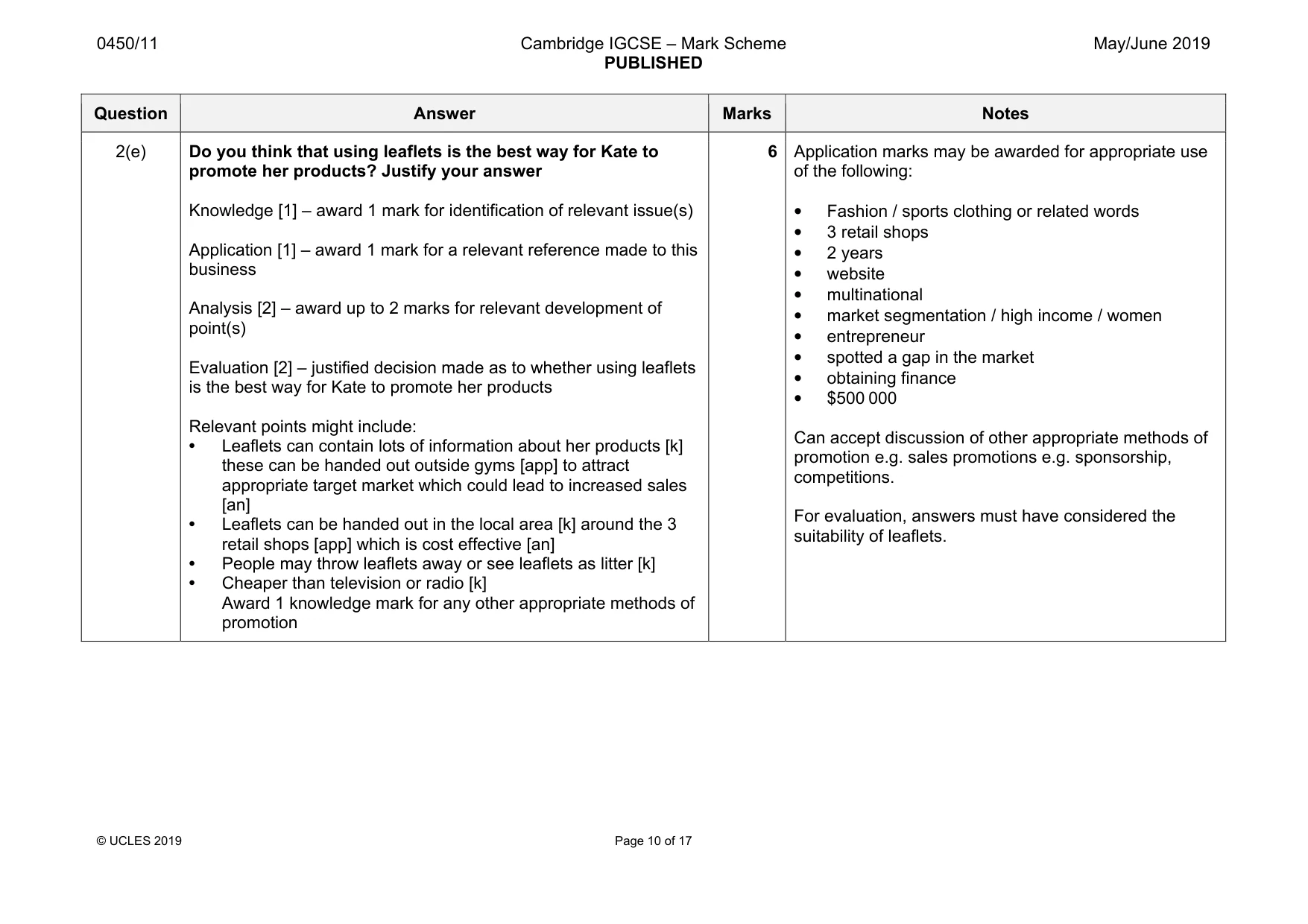
0450/11 Cambridge IGCSE – Mark Scheme PUBLISHED May/June 2019 © UCLES 2019 Page 10 of 17 Question Answer Marks Notes 2(e) Do you think that using leaflets is the best way for Kate to promote her products? Justify your answer Knowledge [1] – award 1 mark for identification of relevant issue(s) Application [1] – award 1 mark for a relevant reference made to this business Analysis [2] – award up to 2 marks for relevant development of point(s) Evaluation [2] – justified decision made as to whether using leaflets is the best way for Kate to promote her products Relevant points might include: • Leaflets can contain lots of information about her products [k] these can be handed out outside gyms [app] to attract appropriate target market which could lead to increased sales [an] • Leaflets can be handed out in the local area [k] around the 3 retail shops [app] which is cost effective [an] • People may throw leaflets away or see leaflets as litter [k] • Cheaper than television or radio [k] Award 1 knowledge mark for any other appropriate methods of promotion 6 Application marks may be awarded for appropriate use of the following: • Fashion / sports clothing or related words • 3 retail shops • 2 years • website • multinational • market segmentation / high income / women • entrepreneur • spotted a gap in the market • obtaining finance • $500 000 Can accept discussion of other appropriate methods of promotion e.g. sales promotions e.g. sponsorship, competitions. For evaluation, answers must have considered the suitability of leaflets.
Mark scheme, page 11
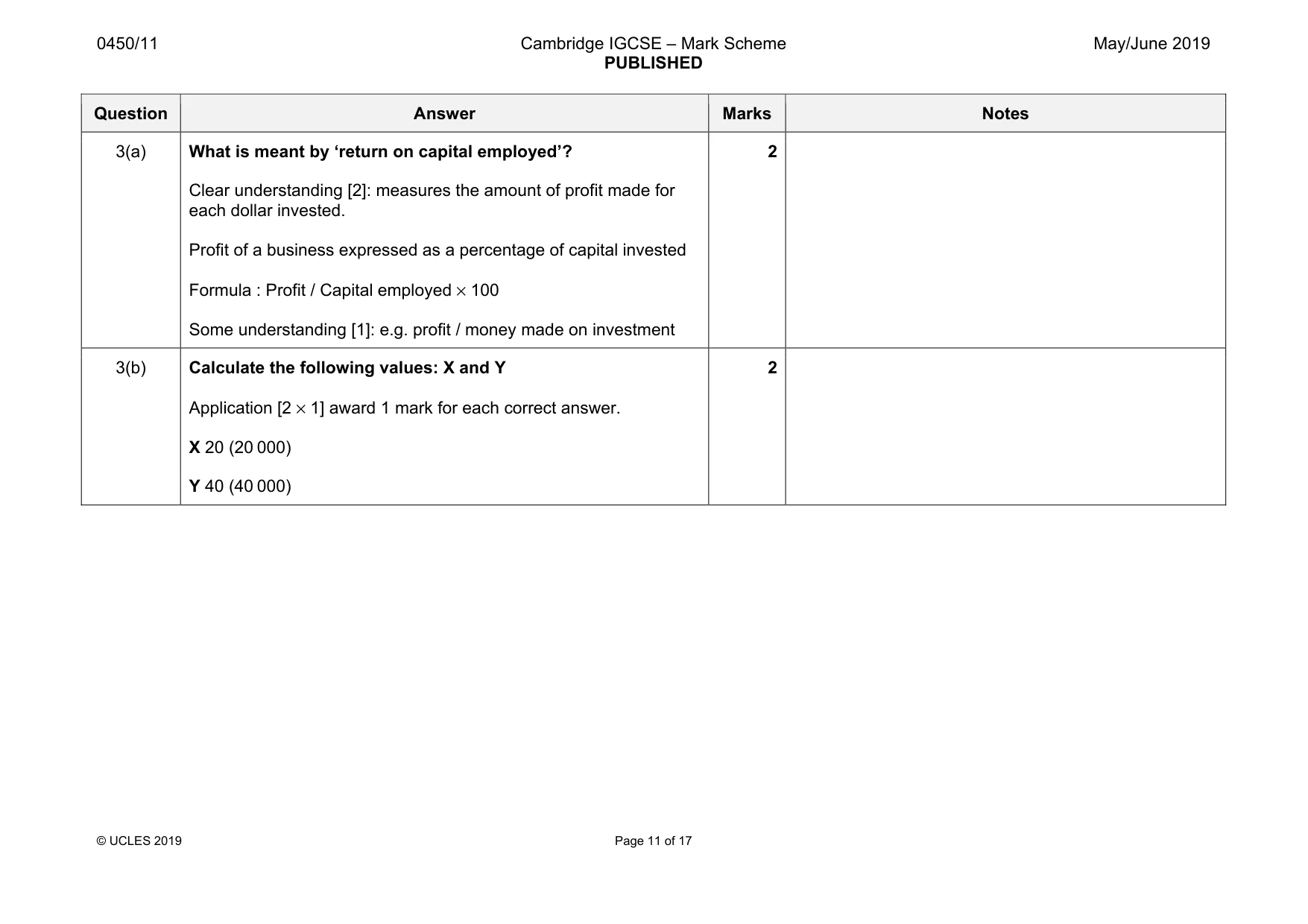
0450/11 Cambridge IGCSE – Mark Scheme PUBLISHED May/June 2019 © UCLES 2019 Page 11 of 17 Question Answer Marks Notes 3(a) What is meant by ‘return on capital employed’? Clear understanding [2]: measures the amount of profit made for each dollar invested. Profit of a business expressed as a percentage of capital invested Formula : Profit / Capital employed × 100 Some understanding [1]: e.g. profit / money made on investment 2 3(b) Calculate the following values: X and Y Application [2 × 1] award 1 mark for each correct answer. X 20 (20 000) Y 40 (40 000) 2
Mark scheme, page 12
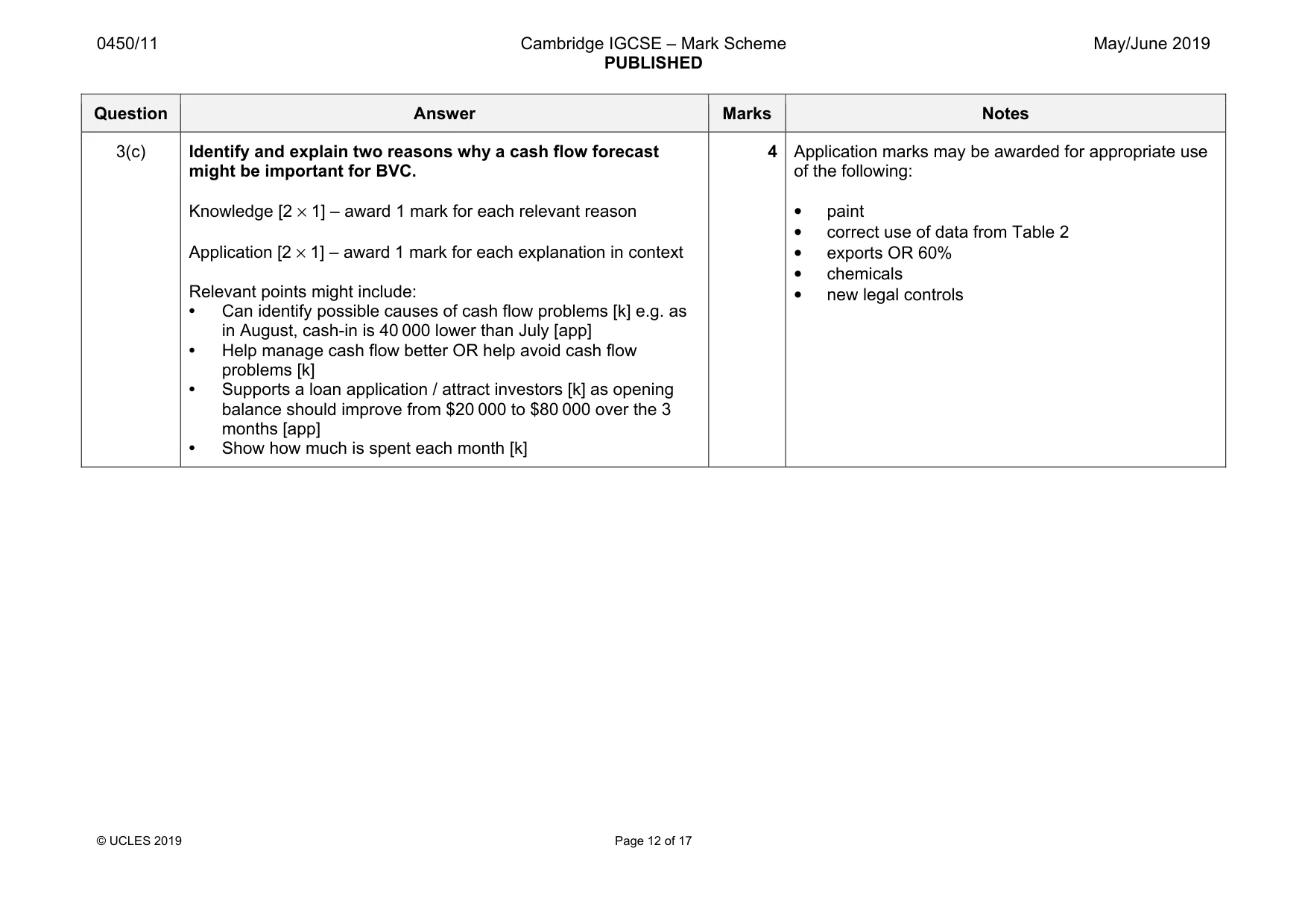
0450/11 Cambridge IGCSE – Mark Scheme PUBLISHED May/June 2019 © UCLES 2019 Page 12 of 17 Question Answer Marks Notes 3(c) Identify and explain two reasons why a cash flow forecast might be important for BVC. Knowledge [2 × 1] – award 1 mark for each relevant reason Application [2 × 1] – award 1 mark for each explanation in context Relevant points might include: • Can identify possible causes of cash flow problems [k] e.g. as in August, cash-in is 40 000 lower than July [app] • Help manage cash flow better OR help avoid cash flow problems [k] • Supports a loan application / attract investors [k] as opening balance should improve from $20 000 to $80 000 over the 3 months [app] • Show how much is spent each month [k] 4 Application marks may be awarded for appropriate use of the following: • paint • correct use of data from Table 2 • exports OR 60% • chemicals • new legal controls
Mark scheme, page 13
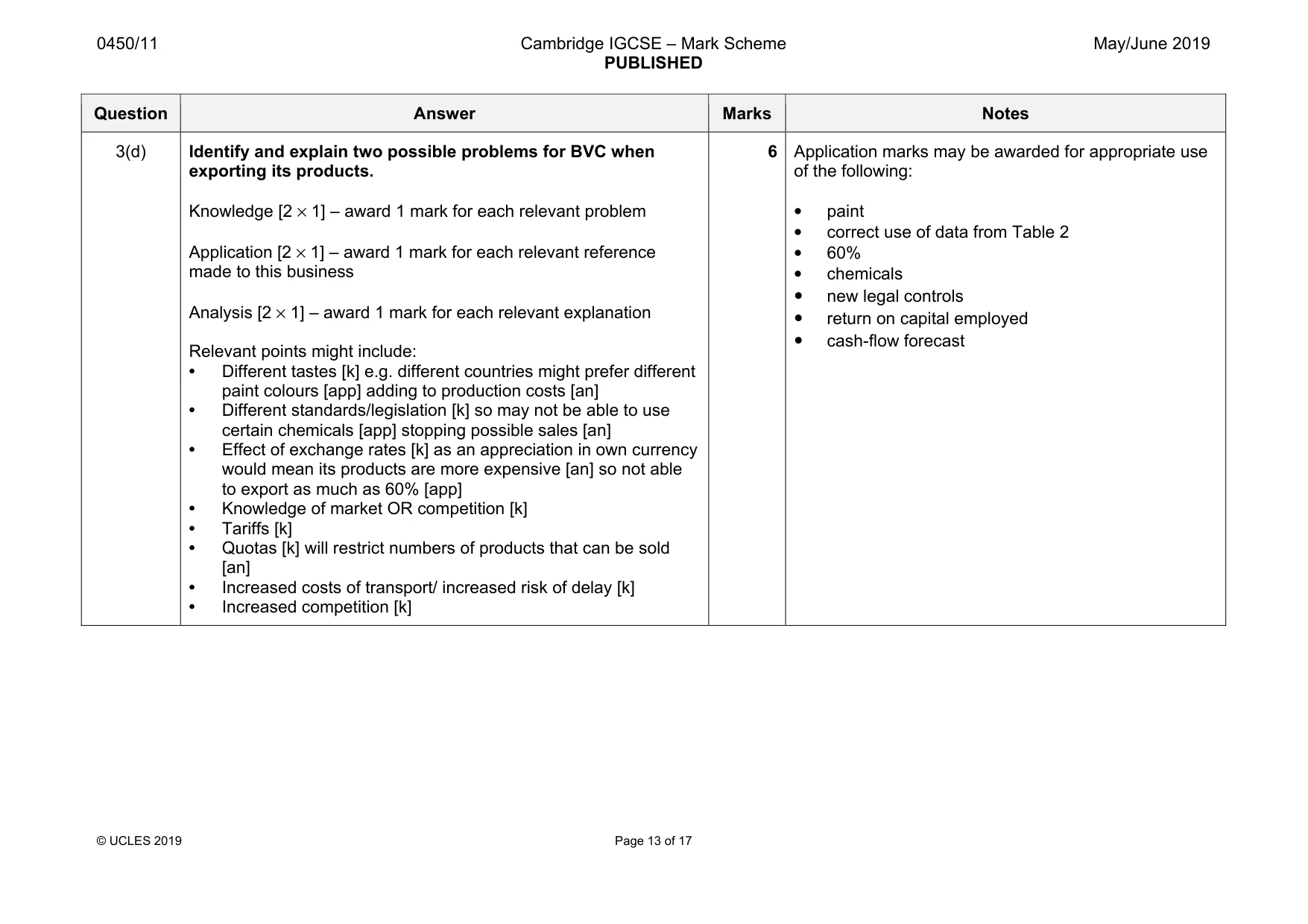
0450/11 Cambridge IGCSE – Mark Scheme PUBLISHED May/June 2019 © UCLES 2019 Page 13 of 17 Question Answer Marks Notes 3(d) Identify and explain two possible problems for BVC when exporting its products. Knowledge [2 × 1] – award 1 mark for each relevant problem Application [2 × 1] – award 1 mark for each relevant reference made to this business Analysis [2 × 1] – award 1 mark for each relevant explanation Relevant points might include: • Different tastes [k] e.g. different countries might prefer different paint colours [app] adding to production costs [an] • Different standards/legislation [k] so may not be able to use certain chemicals [app] stopping possible sales [an] • Effect of exchange rates [k] as an appreciation in own currency would mean its products are more expensive [an] so not able to export as much as 60% [app] • Knowledge of market OR competition [k] • Tariffs [k] • Quotas [k] will restrict numbers of products that can be sold [an] • Increased costs of transport/ increased risk of delay [k] • Increased competition [k] 6 Application marks may be awarded for appropriate use of the following: • paint • correct use of data from Table 2 • 60% • chemicals • new legal controls • return on capital employed • cash-flow forecast
Mark scheme, page 14
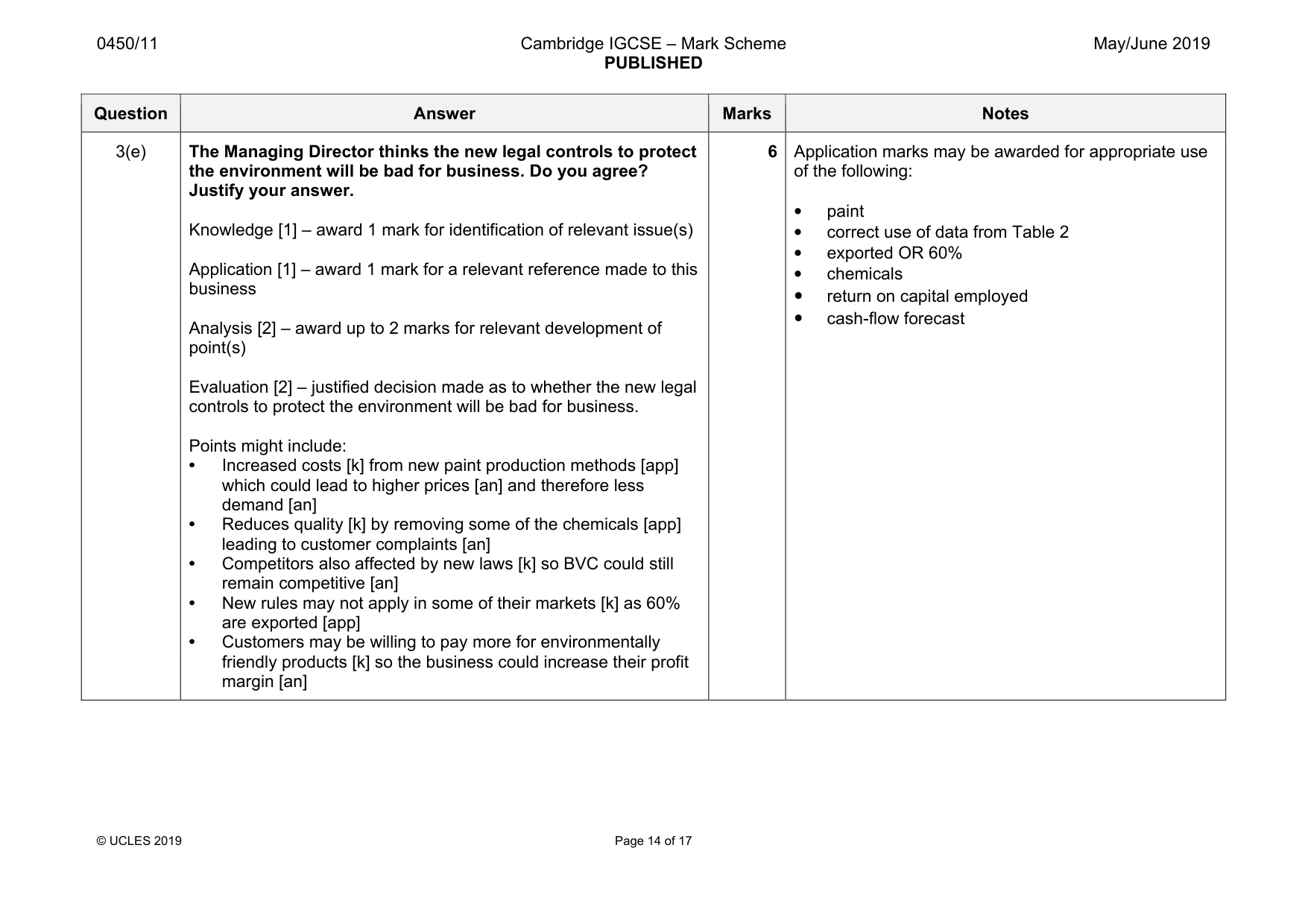
0450/11 Cambridge IGCSE – Mark Scheme PUBLISHED May/June 2019 © UCLES 2019 Page 14 of 17 Question Answer Marks Notes 3(e) The Managing Director thinks the new legal controls to protect the environment will be bad for business. Do you agree? Justify your answer. Knowledge [1] – award 1 mark for identification of relevant issue(s) Application [1] – award 1 mark for a relevant reference made to this business Analysis [2] – award up to 2 marks for relevant development of point(s) Evaluation [2] – justified decision made as to whether the new legal controls to protect the environment will be bad for business. Points might include: • Increased costs [k] from new paint production methods [app] which could lead to higher prices [an] and therefore less demand [an] • Reduces quality [k] by removing some of the chemicals [app] leading to customer complaints [an] • Competitors also affected by new laws [k] so BVC could still remain competitive [an] • New rules may not apply in some of their markets [k] as 60% are exported [app] • Customers may be willing to pay more for environmentally friendly products [k] so the business could increase their profit margin [an] 6 Application marks may be awarded for appropriate use of the following: • paint • correct use of data from Table 2 • exported OR 60% • chemicals • return on capital employed • cash-flow forecast
Mark scheme, page 15
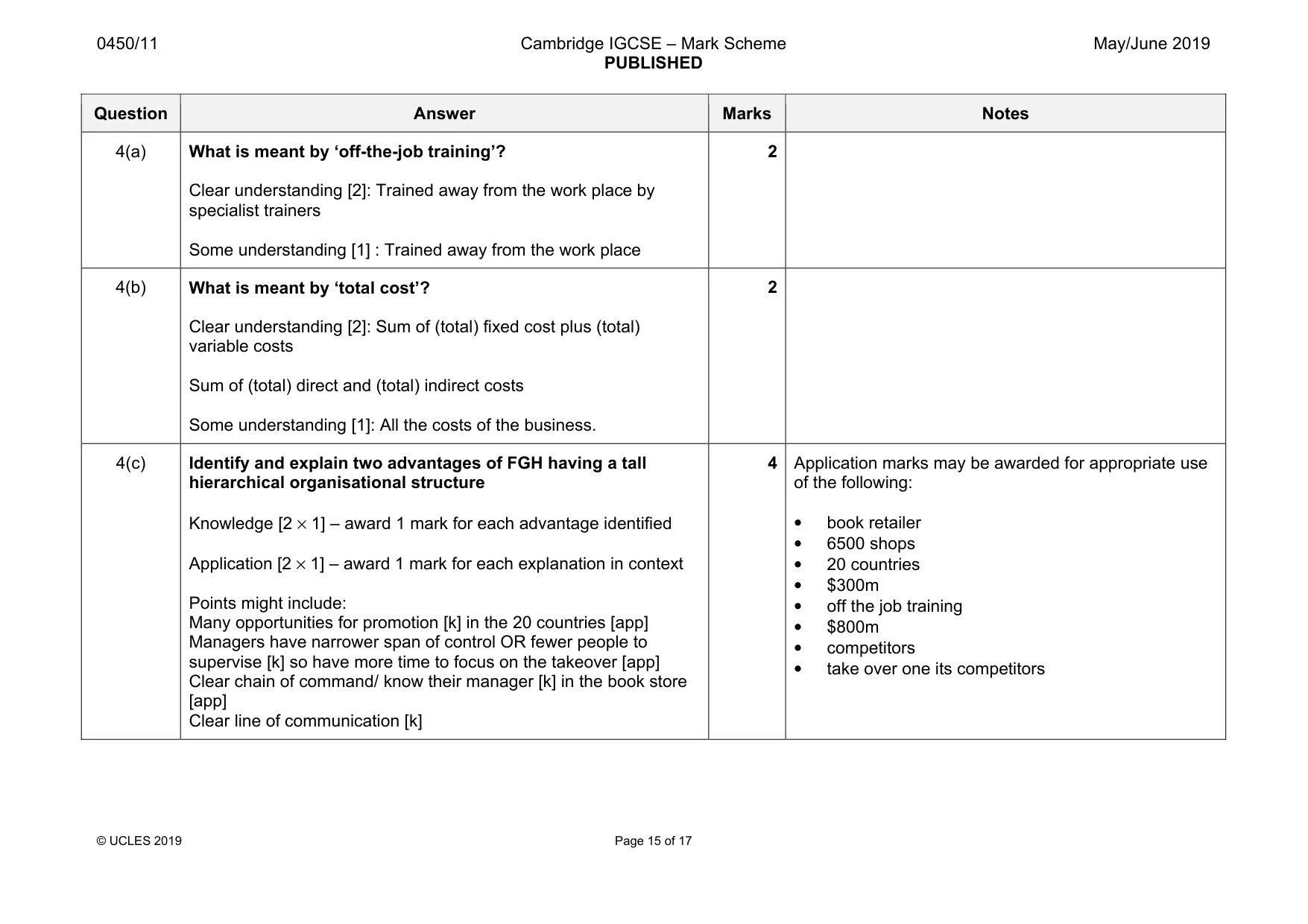
0450/11 Cambridge IGCSE – Mark Scheme PUBLISHED May/June 2019 © UCLES 2019 Page 15 of 17 Question Answer Marks Notes 4(a) What is meant by ‘off-the-job training’? Clear understanding [2]: Trained away from the work place by specialist trainers Some understanding [1] : Trained away from the work place 2 4(b) What is meant by ‘total cost’? Clear understanding [2]: Sum of (total) fixed cost plus (total) variable costs Sum of (total) direct and (total) indirect costs Some understanding [1]: All the costs of the business. 2 4(c) Identify and explain two advantages of FGH having a tall hierarchical organisational structure Knowledge [2 × 1] – award 1 mark for each advantage identified Application [2 × 1] – award 1 mark for each explanation in context Points might include: Many opportunities for promotion [k] in the 20 countries [app] Managers have narrower span of control OR fewer people to supervise [k] so have more time to focus on the takeover [app] Clear chain of command/ know their manager [k] in the book store [app] Clear line of communication [k] 4 Application marks may be awarded for appropriate use of the following: • book retailer • 6500 shops • 20 countries • $300m • off the job training • $800m • competitors • take over one its competitors
Mark scheme, page 16
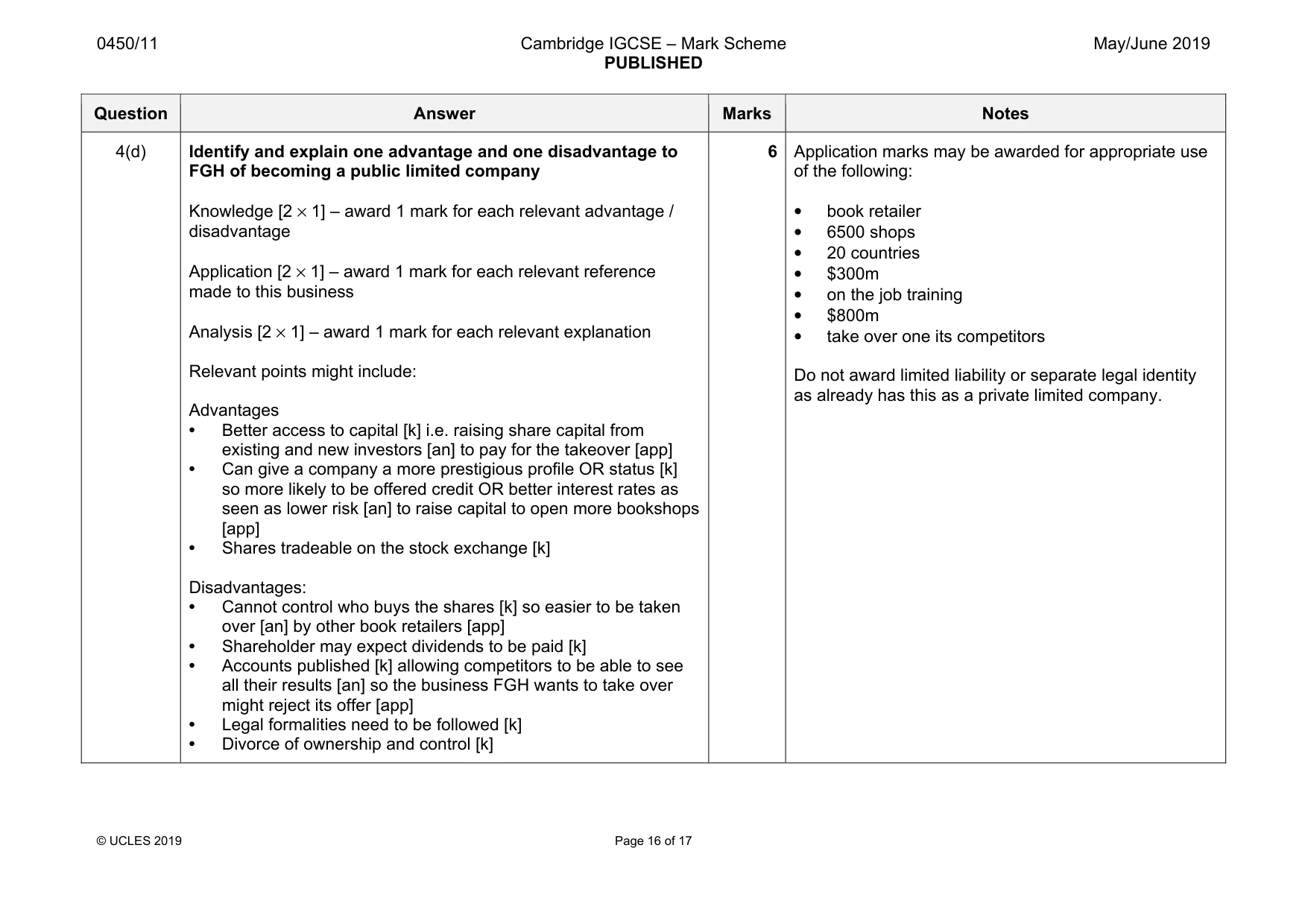
0450/11 Cambridge IGCSE – Mark Scheme PUBLISHED May/June 2019 © UCLES 2019 Page 16 of 17 Question Answer Marks Notes 4(d) Identify and explain one advantage and one disadvantage to FGH of becoming a public limited company Knowledge [2 × 1] – award 1 mark for each relevant advantage / disadvantage Application [2 × 1] – award 1 mark for each relevant reference made to this business Analysis [2 × 1] – award 1 mark for each relevant explanation Relevant points might include: Advantages • Better access to capital [k] i.e. raising share capital from existing and new investors [an] to pay for the takeover [app] • Can give a company a more prestigious profile OR status [k] so more likely to be offered credit OR better interest rates as seen as lower risk [an] to raise capital to open more bookshops [app] • Shares tradeable on the stock exchange [k] Disadvantages: • Cannot control who buys the shares [k] so easier to be taken over [an] by other book retailers [app] • Shareholder may expect dividends to be paid [k] • Accounts published [k] allowing competitors to be able to see all their results [an] so the business FGH wants to take over might reject its offer [app] • Legal formalities need to be followed [k] • Divorce of ownership and control [k] 6 Application marks may be awarded for appropriate use of the following: • book retailer • 6500 shops • 20 countries • $300m • on the job training • $800m • take over one its competitors Do not award limited liability or separate legal identity as already has this as a private limited company.
Mark scheme, page 17
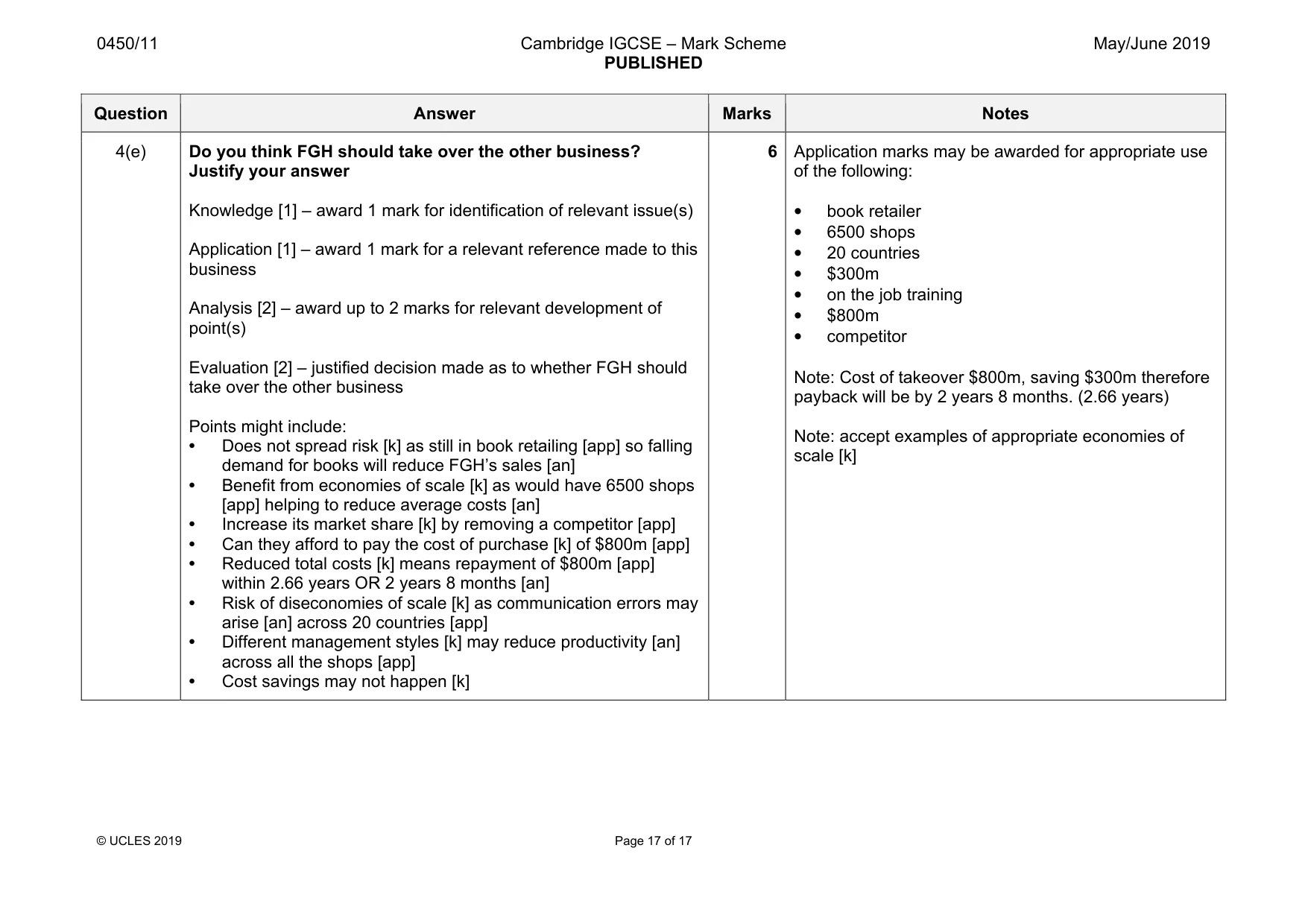
0450/11 Cambridge IGCSE – Mark Scheme PUBLISHED May/June 2019 © UCLES 2019 Page 17 of 17 Question Answer Marks Notes 4(e) Do you think FGH should take over the other business? Justify your answer Knowledge [1] – award 1 mark for identification of relevant issue(s) Application [1] – award 1 mark for a relevant reference made to this business Analysis [2] – award up to 2 marks for relevant development of point(s) Evaluation [2] – justified decision made as to whether FGH should take over the other business Points might include: • Does not spread risk [k] as still in book retailing [app] so falling demand for books will reduce FGH’s sales [an] • Benefit from economies of scale [k] as would have 6500 shops [app] helping to reduce average costs [an] • Increase its market share [k] by removing a competitor [app] • Can they afford to pay the cost of purchase [k] of $800m [app] • Reduced total costs [k] means repayment of $800m [app] within 2.66 years OR 2 years 8 months [an] • Risk of diseconomies of scale [k] as communication errors may arise [an] across 20 countries [app] • Different management styles [k] may reduce productivity [an] across all the shops [app] • Cost savings may not happen [k] 6 Application marks may be awarded for appropriate use of the following: • book retailer • 6500 shops • 20 countries • $300m • on the job training • $800m • competitor Note: Cost of takeover $800m, saving $300m therefore payback will be by 2 years 8 months. (2.66 years) Note: accept examples of appropriate economies of scale [k]
What you needed in this session
Cambridge’s own grade thresholds for 2019 May/June, Paper 1 · Variant 1. A higher threshold means an easier paper — the bar moves with how the cohort did.