Cambridge IGCSE Business Studies 0450 — 2016 Oct/Nov Paper 1 · Variant 2
0450/12/O/N/16 · 80 marks · ≈90 min
The question paper and its mark scheme, free to read here and free to download. This is Cambridge’s own paper, exactly as it was sat.
Question paper12 pages


Mark scheme12 pages
Answers below. Sit the paper first if you are practising.
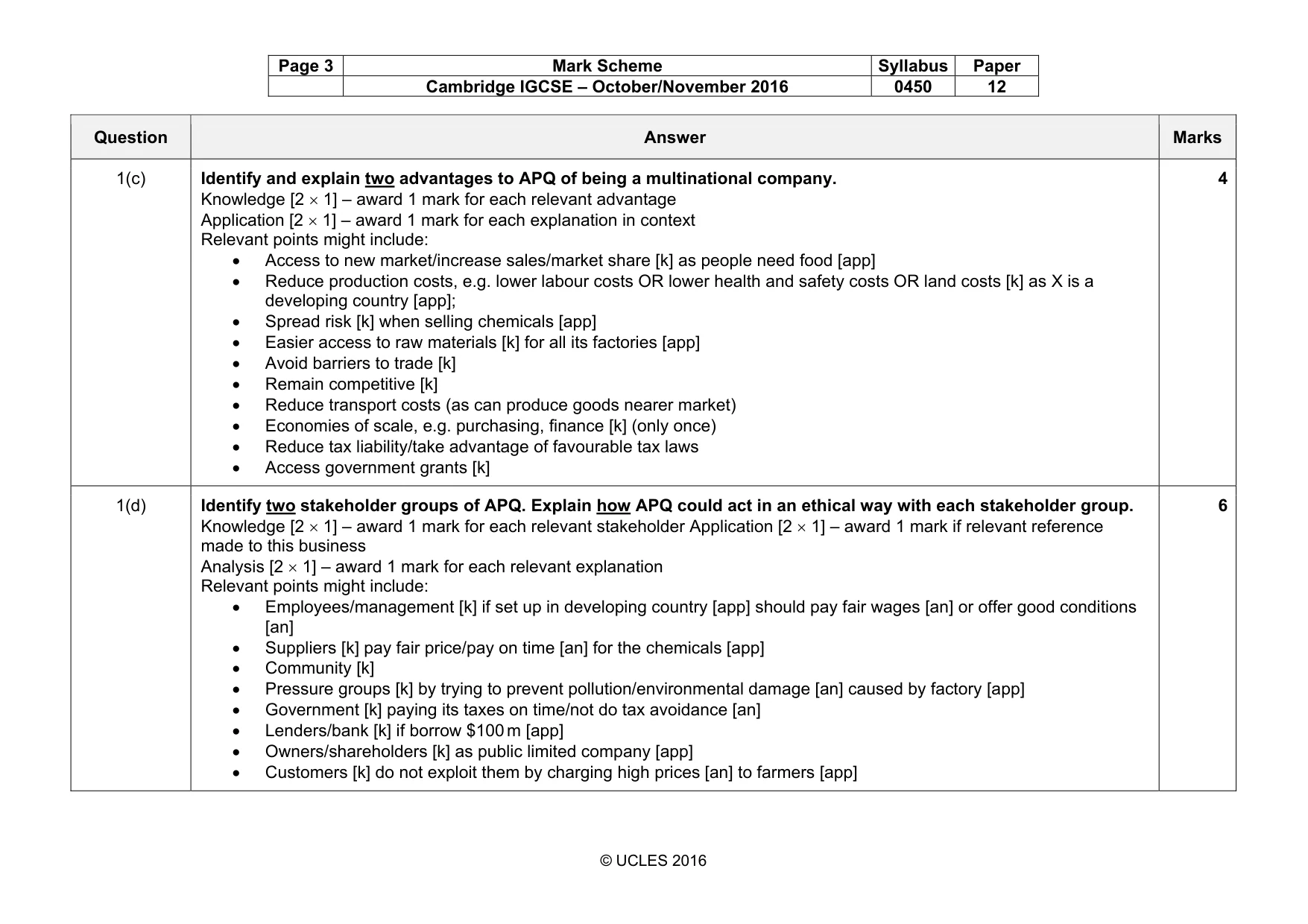
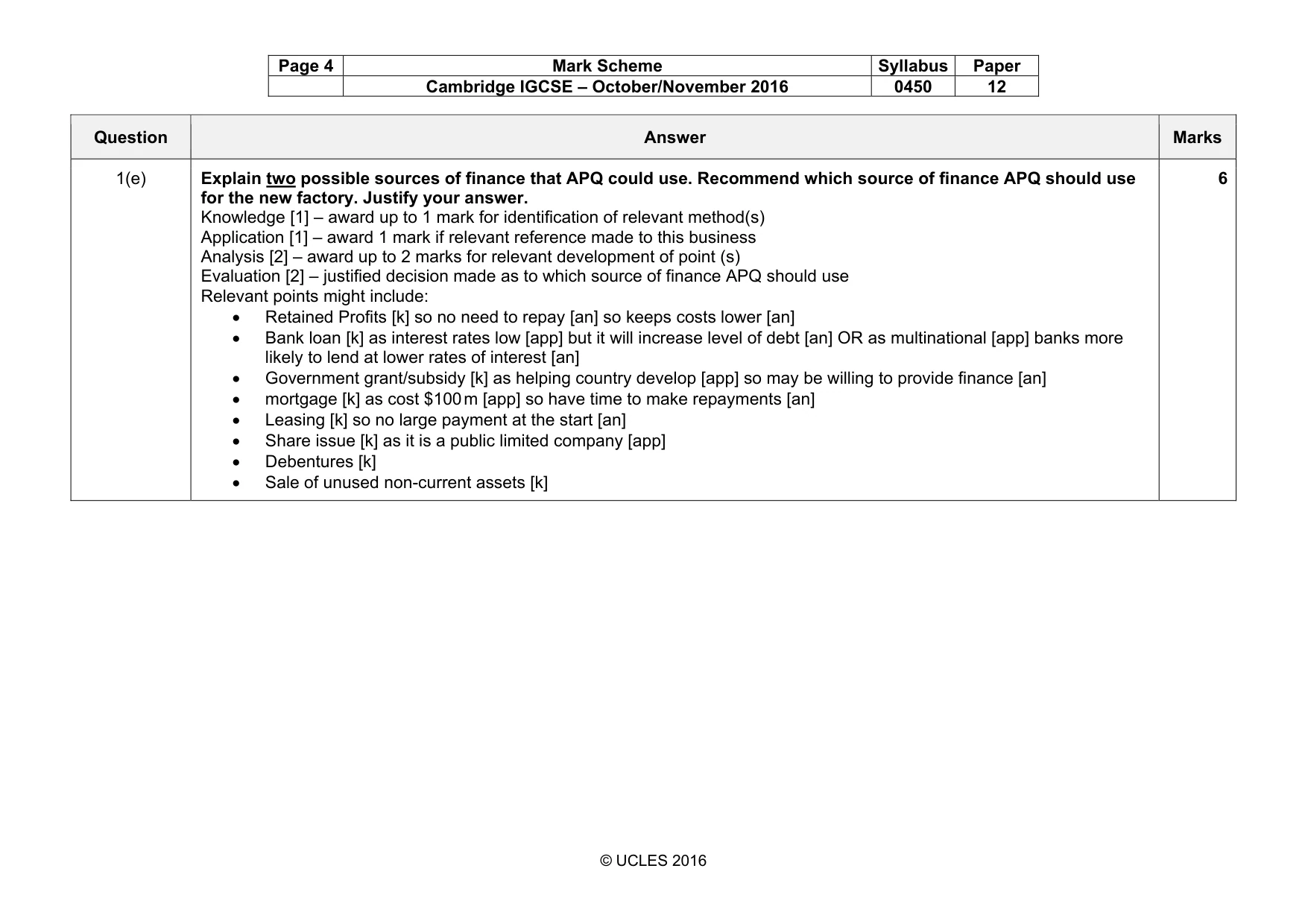
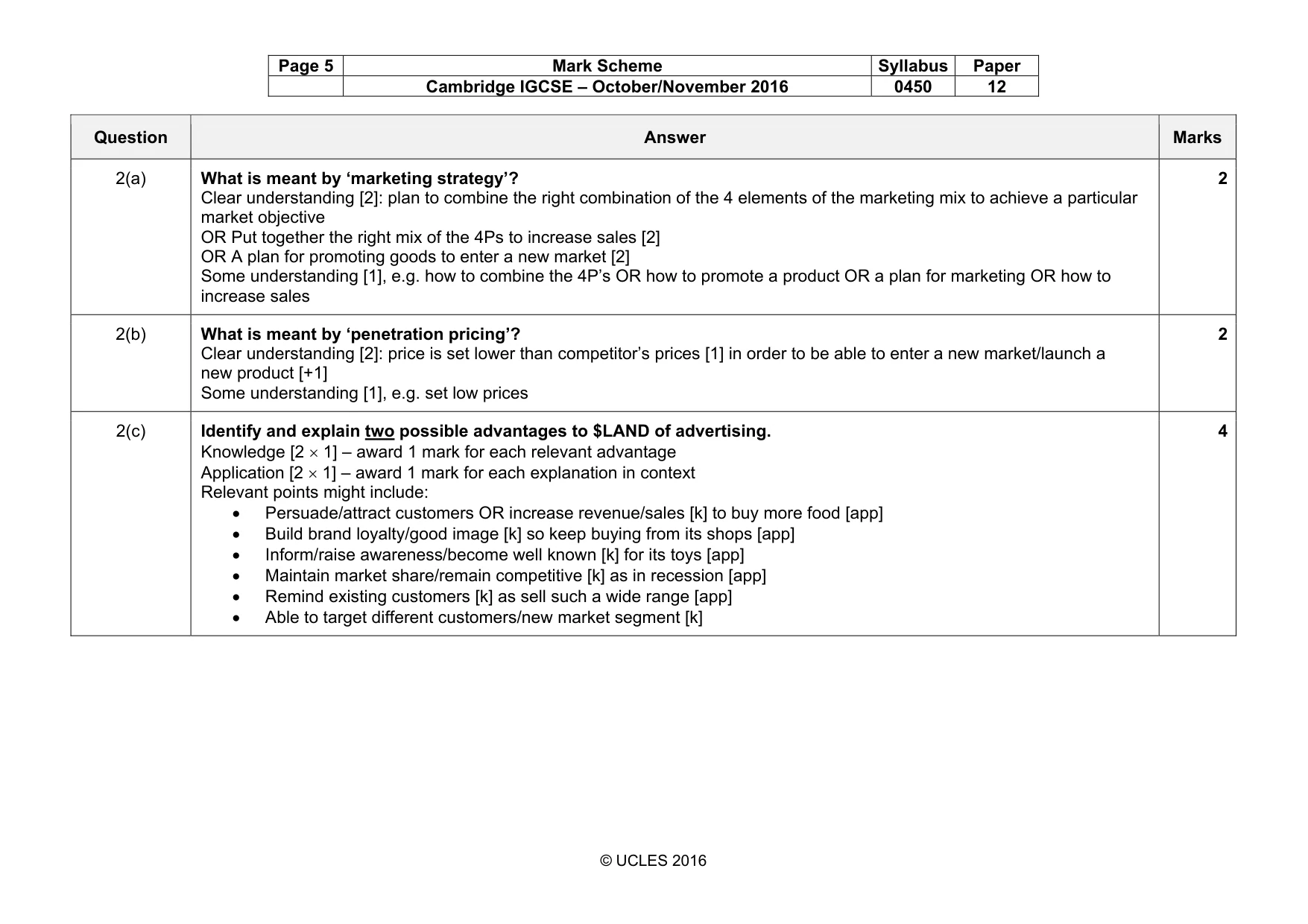
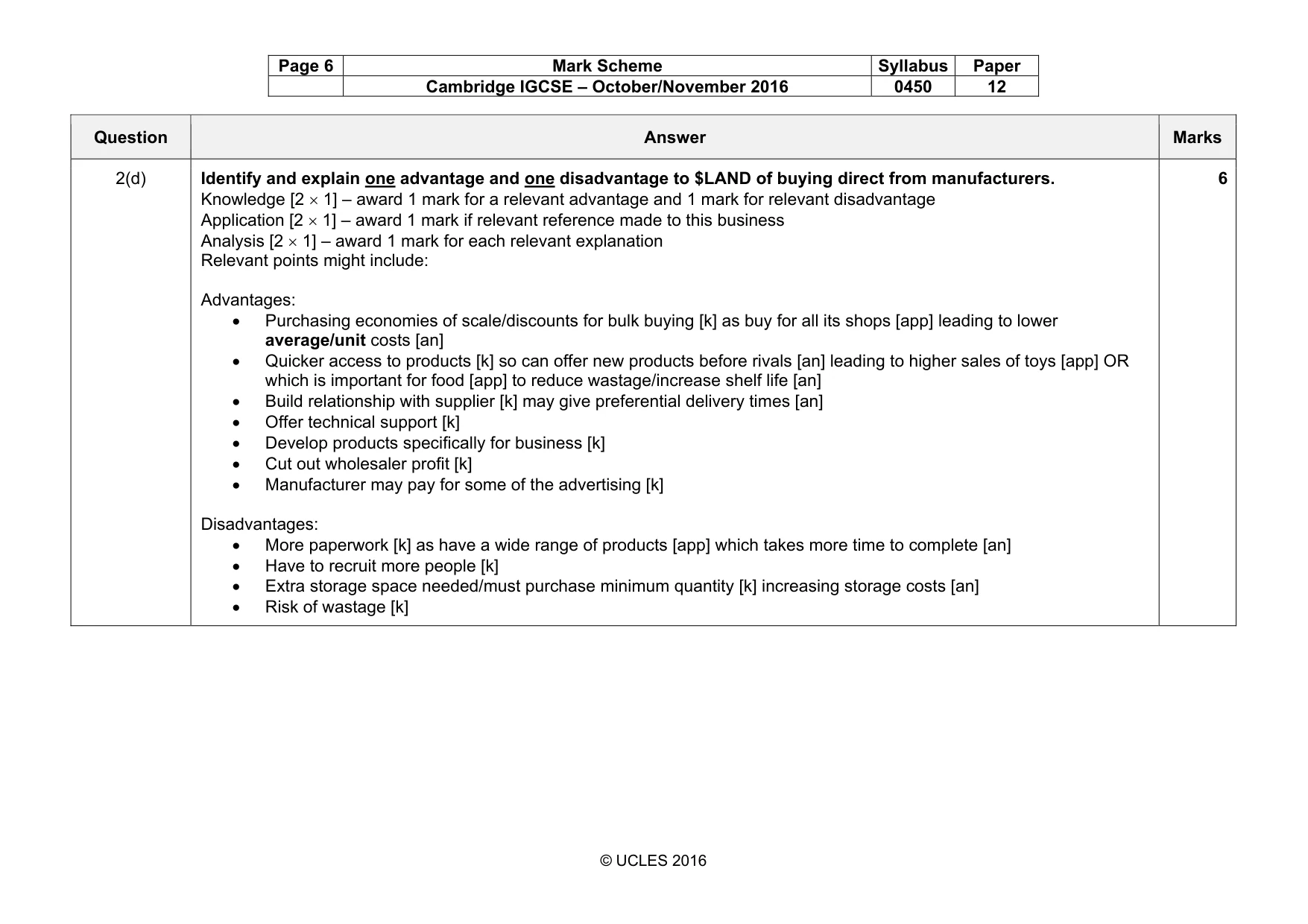
Paper as text
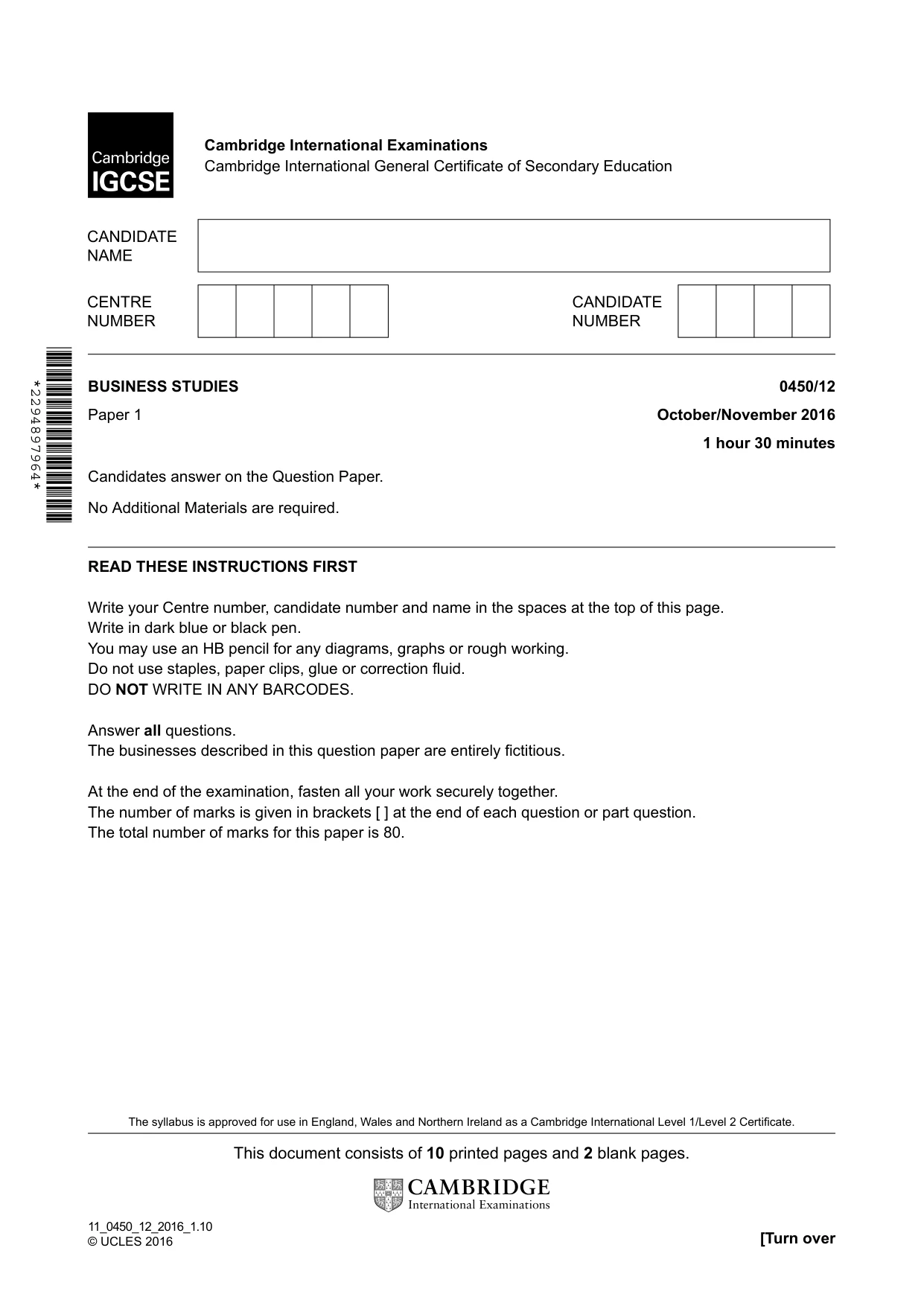
Question paper, page 1
Cambridge International Examinations Cambridge International General Certificate of Secondary Education 0450/12 October/November 2016 1 hour 30 minutes BUSINESS STUDIES Paper 1 Candidates answer on the Question Paper. No Additional Materials are required. READ THESE INSTRUCTIONS FIRST Write your Centre number, candidate number and name in the spaces at the top of this page. Write in dark blue or black pen. You may use an HB pencil for any diagrams, graphs or rough working. Do not use staples, paper clips, glue or correction fluid. DO NOT WRITE IN ANY BARCODES. Answer all questions. The businesses described in this question paper are entirely fictitious. At the end of the examination, fasten all your work securely together. The number of marks is given in brackets [ ] at the end of each question or part question. The total number of marks for this paper is 80. The syllabus is approved for use in England, Wales and Northern Ireland as a Cambridge International Level 1/Level 2 Certificate. This document consists of 10 printed pages and 2 blank pages. [Turn over 11_0450_12_2016_1.10 © UCLES 2016 *2294897964*
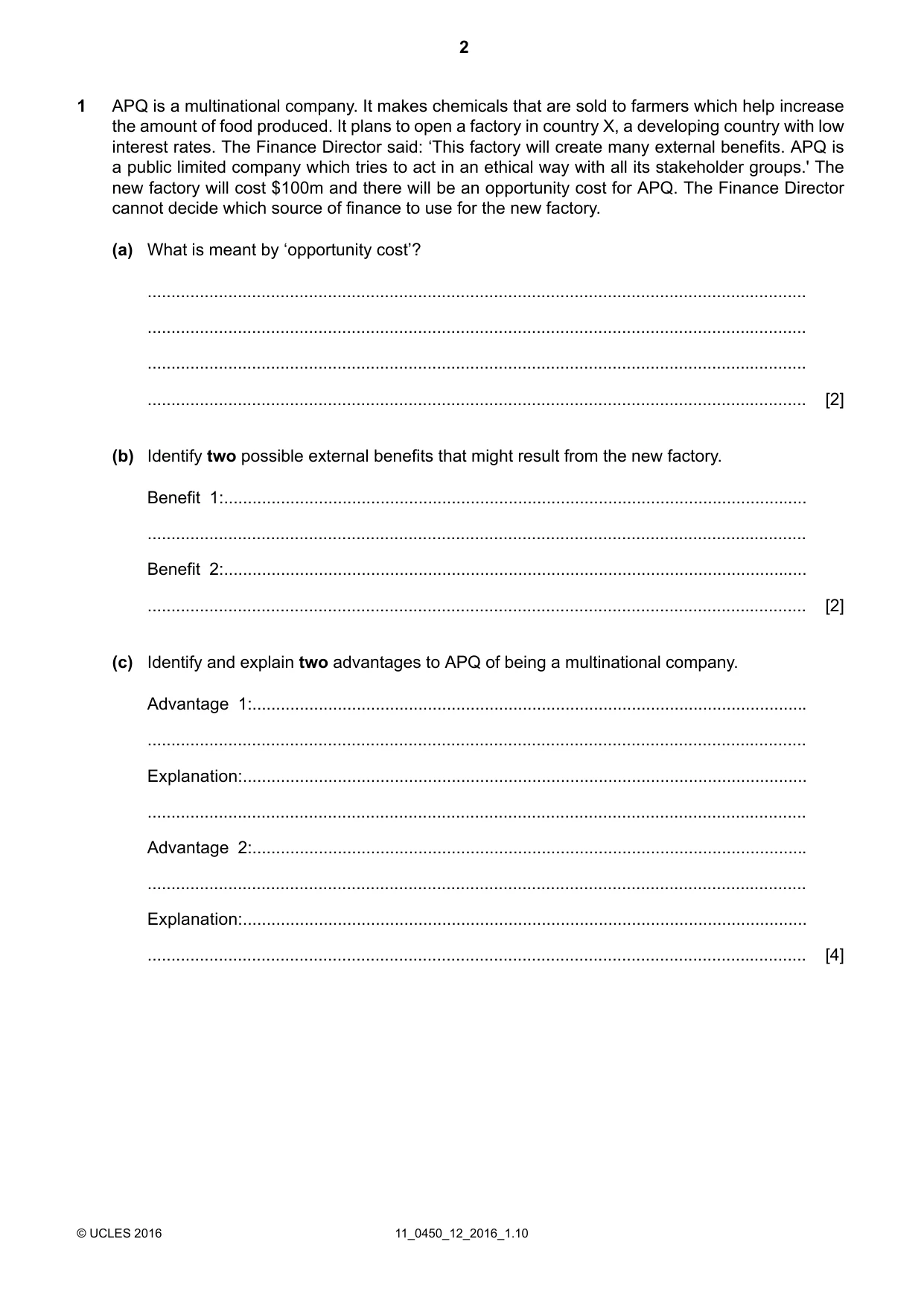
Question paper, page 2
APQ is a multinational company. It makes chemicals that are sold to farmers which help increase the amount of food produced. It plans to open a factory in country X, a developing country with low 1 interest rates. The Finance Director said: ‘This factory will create many external benefits. APQ is a public limited company which tries to act in an ethical way with all its stakeholder groups.' The new factory will cost $100m and there will be an opportunity cost for APQ. The Finance Director cannot decide which source of finance to use for the new factory. What is meant by ‘opportunity cost’? (a) … … … … [2] Identify two possible external benefits that might result from the new factory. (b) Benefit 1:… … Benefit 2:… … [2] Identify and explain two advantages to APQ of being a multinational company. (c) Advantage 1:… … Explanation:… … Advantage 2:… … Explanation:… … [4] 11_0450_12_2016_1.10 © UCLES 2016 2
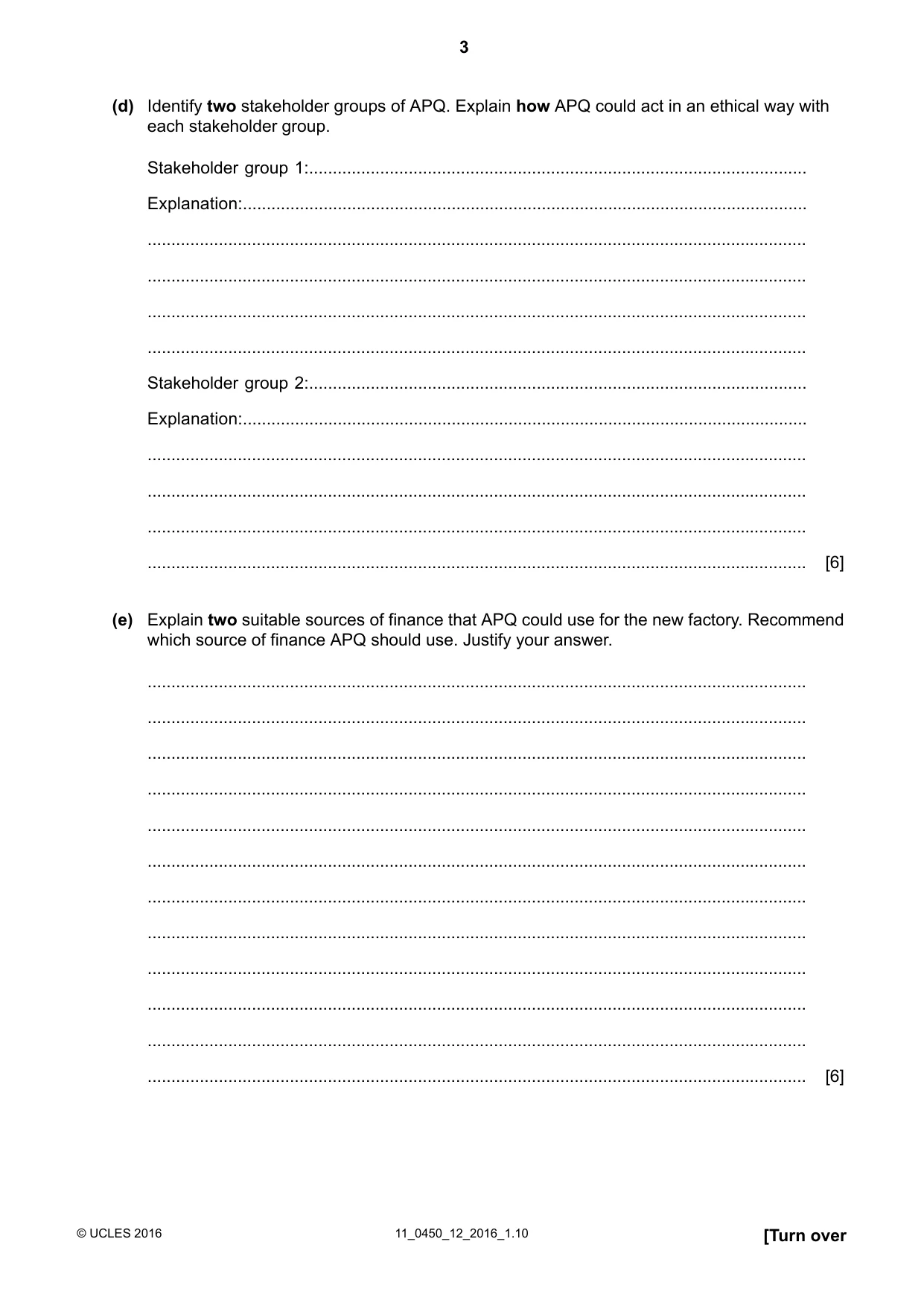
Question paper, page 3
Identify two stakeholder groups of APQ. Explain how APQ could act in an ethical way with each stakeholder group. (d) Stakeholder group 1:… Explanation:… … … … … Stakeholder group 2:… Explanation:… … … … … [6] Explain two suitable sources of finance that APQ could use for the new factory. Recommend which source of finance APQ should use. Justify your answer. (e) … … … … … … … … … … … … [6] [Turn over 11_0450_12_2016_1.10 © UCLES 2016 3
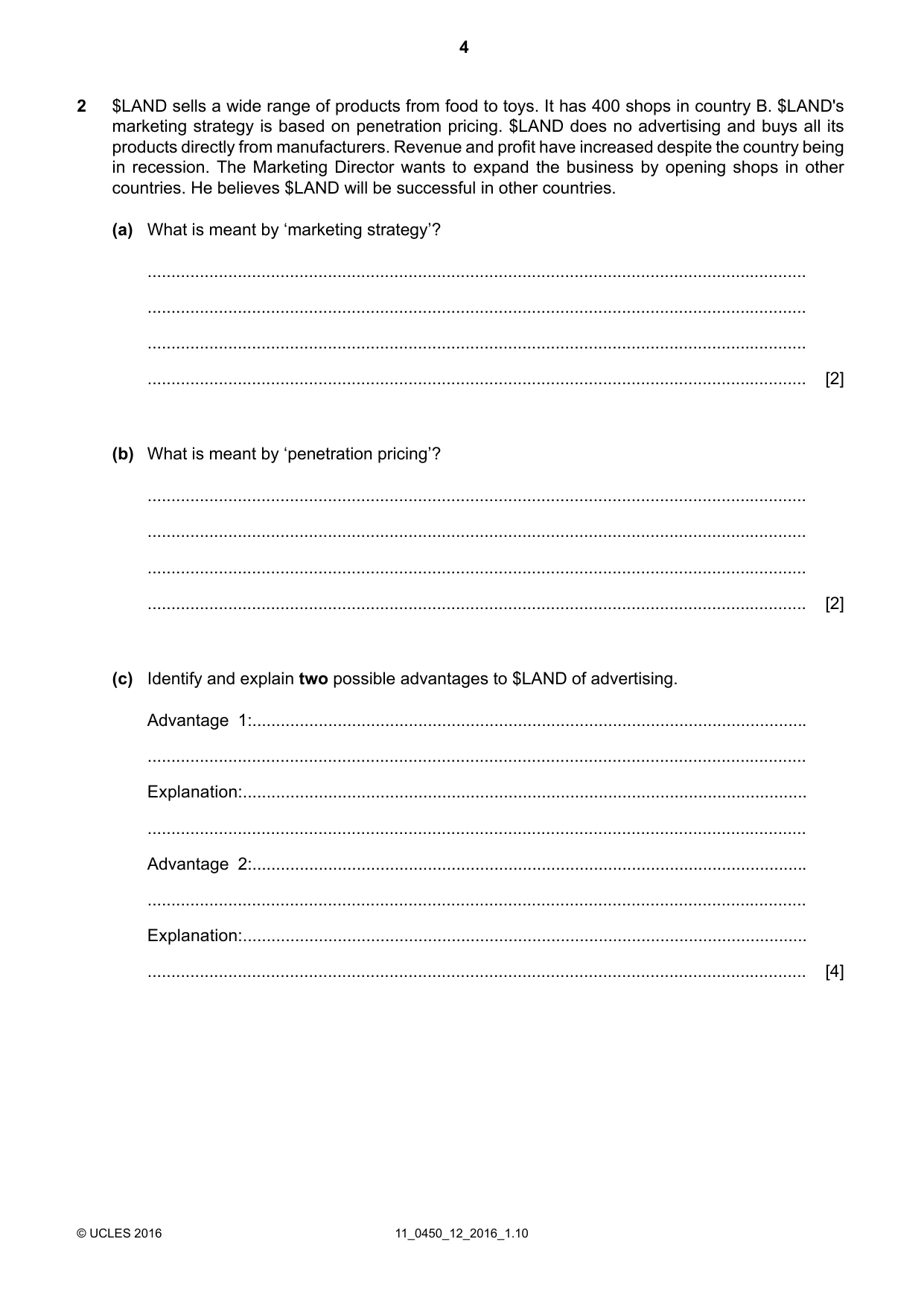
Question paper, page 4
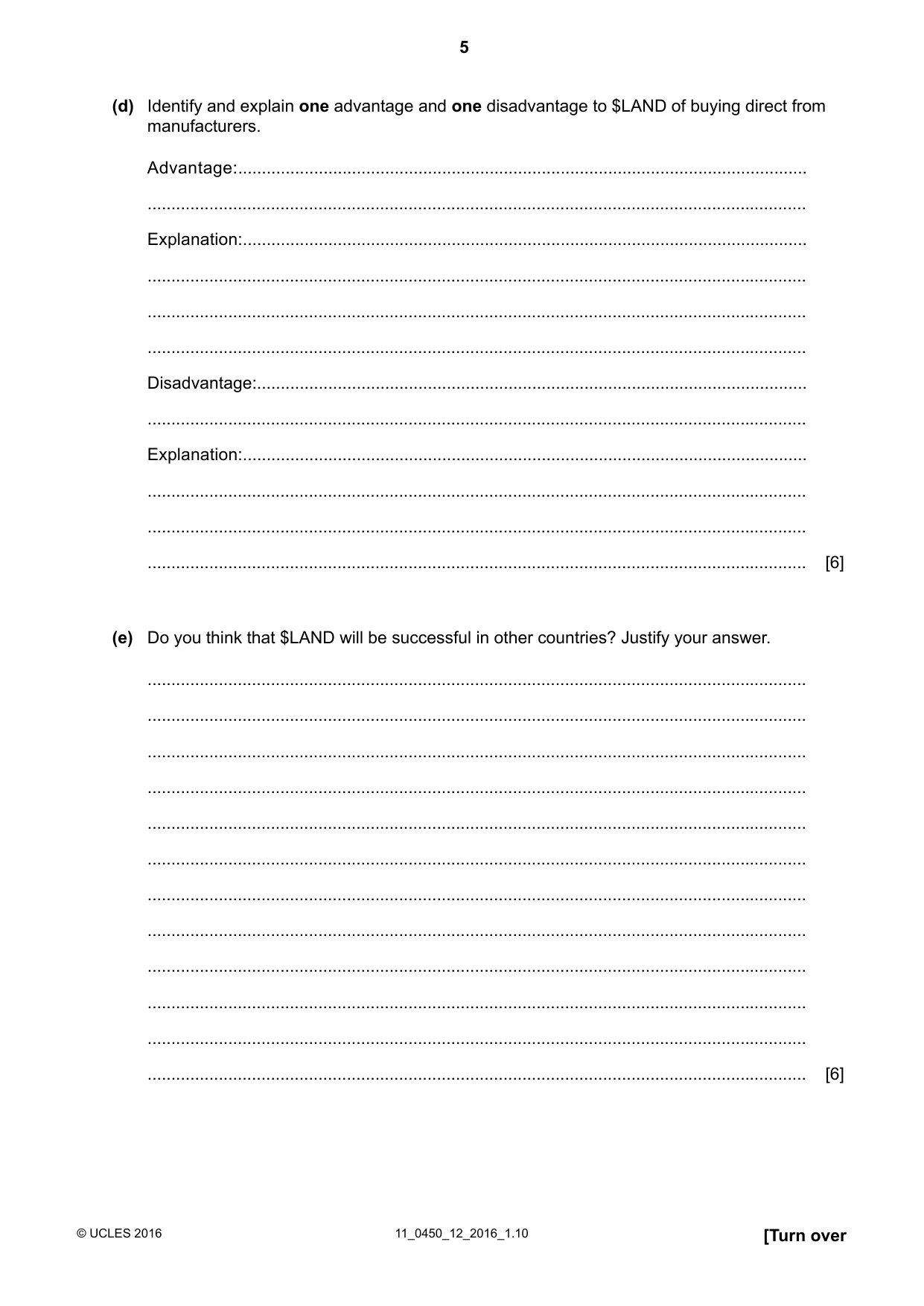
$LAND sells a wide range of products from food to toys. It has 400 shops in country B. $LAND's marketing strategy is based on penetration pricing. $LAND does no advertising and buys all its 2 products directly from manufacturers. Revenue and profit have increased despite the country being in recession. The Marketing Director wants to expand the business by opening shops in other countries. He believes $LAND will be successful in other countries. What is meant by ‘marketing strategy’? (a) … … … … [2] What is meant by ‘penetration pricing’? (b) … … … … [2] Identify and explain two possible advantages to $LAND of advertising. (c) Advantage 1:… … Explanation:… … Advantage 2:… … Explanation:… … [4] 11_0450_12_2016_1.10 © UCLES 2016 4
Question paper, page 5
Identify and explain one advantage and one disadvantage to $LAND of buying direct from manufacturers. (d) Advantage:… … Explanation:… … … … Disadvantage:… … Explanation:… … … … [6] Do you think that $LAND will be successful in other countries? Justify your answer. (e) … … … … … … … … … … … … [6] [Turn over 11_0450_12_2016_1.10 © UCLES 2016 5
Question paper, page 6
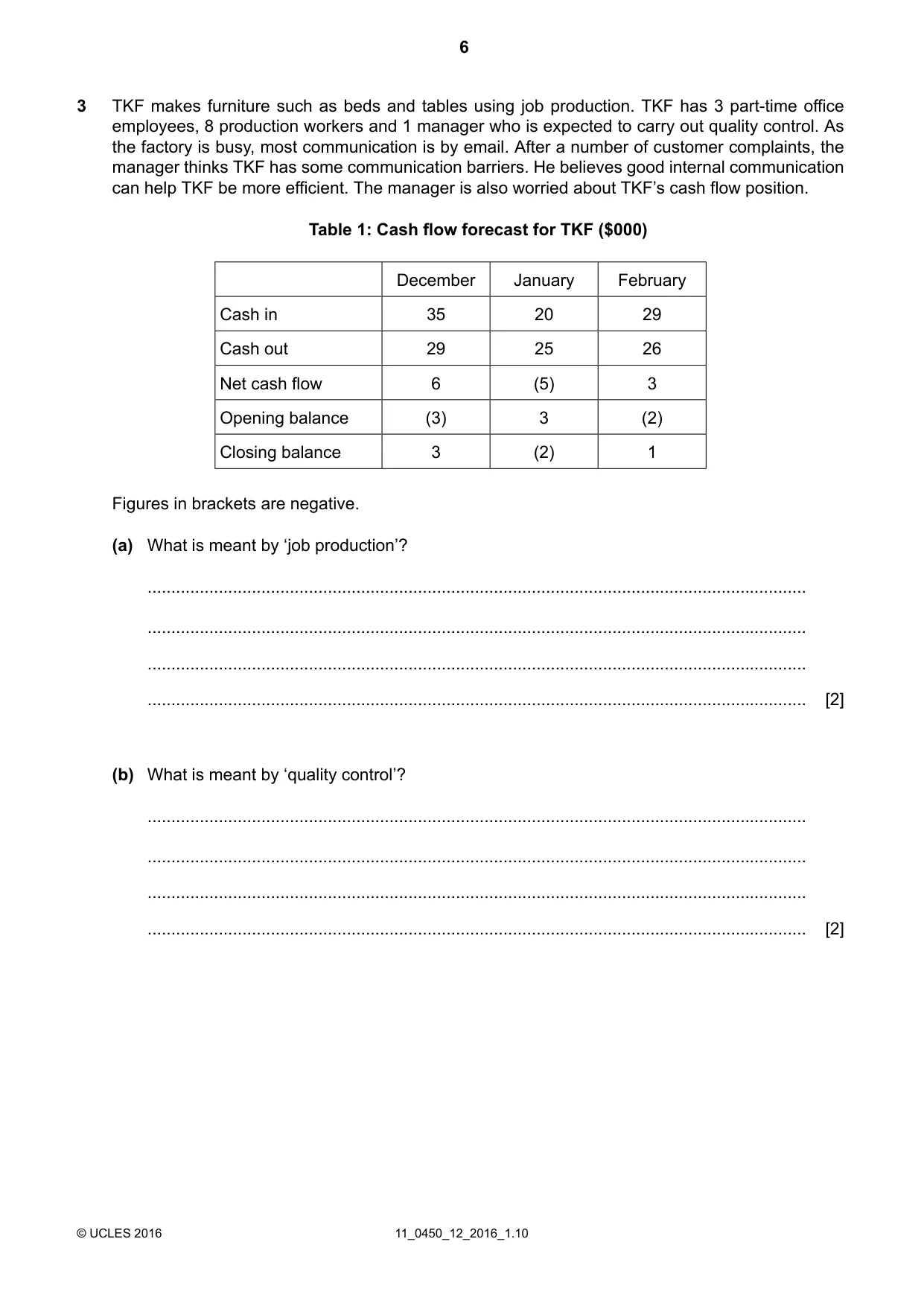
TKF makes furniture such as beds and tables using job production. TKF has 3 part-time office employees, 8 production workers and 1 manager who is expected to carry out quality control. As 3 the factory is busy, most communication is by email. After a number of customer complaints, the manager thinks TKF has some communication barriers. He believes good internal communication can help TKF be more efficient. The manager is also worried about TKF’s cash flow position. Table 1: Cash flow forecast for TKF ($000) February January December 29 20 35 Cash in 26 25 29 Cash out 3 (5) 6 Net cash flow (2) 3 (3) Opening balance 1 (2) 3 Closing balance Figures in brackets are negative. What is meant by ‘job production’? (a) … … … … [2] What is meant by ‘quality control’? (b) … … … … [2] 11_0450_12_2016_1.10 © UCLES 2016 6
Question paper, page 7
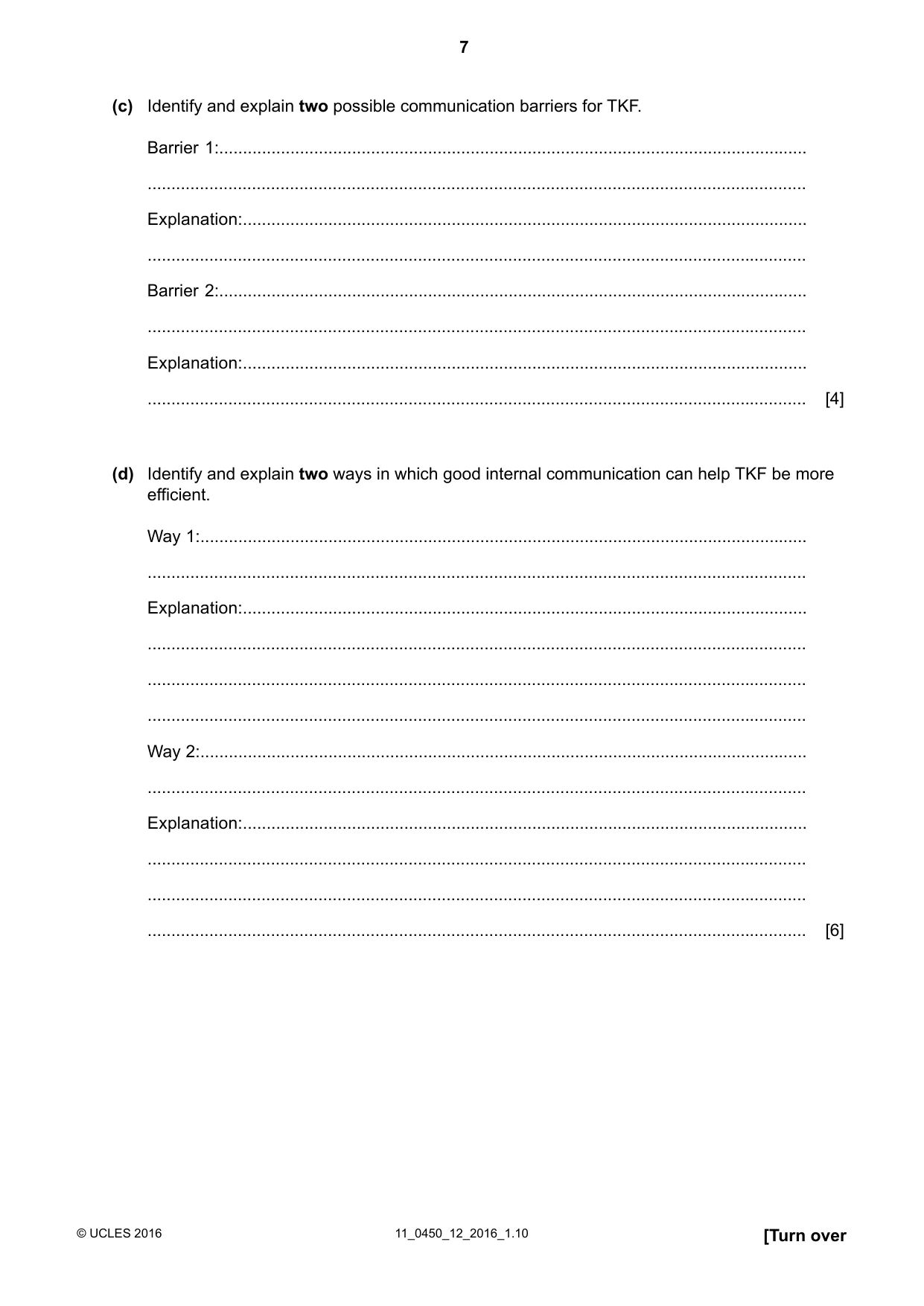
Identify and explain two possible communication barriers for TKF. (c) Barrier 1:… … Explanation:… … Barrier 2:… … Explanation:… … [4] Identify and explain two ways in which good internal communication can help TKF be more efficient. (d) Way 1:… … Explanation:… … … … Way 2:… … Explanation:… … … … [6] [Turn over 11_0450_12_2016_1.10 © UCLES 2016 7
Question paper, page 8
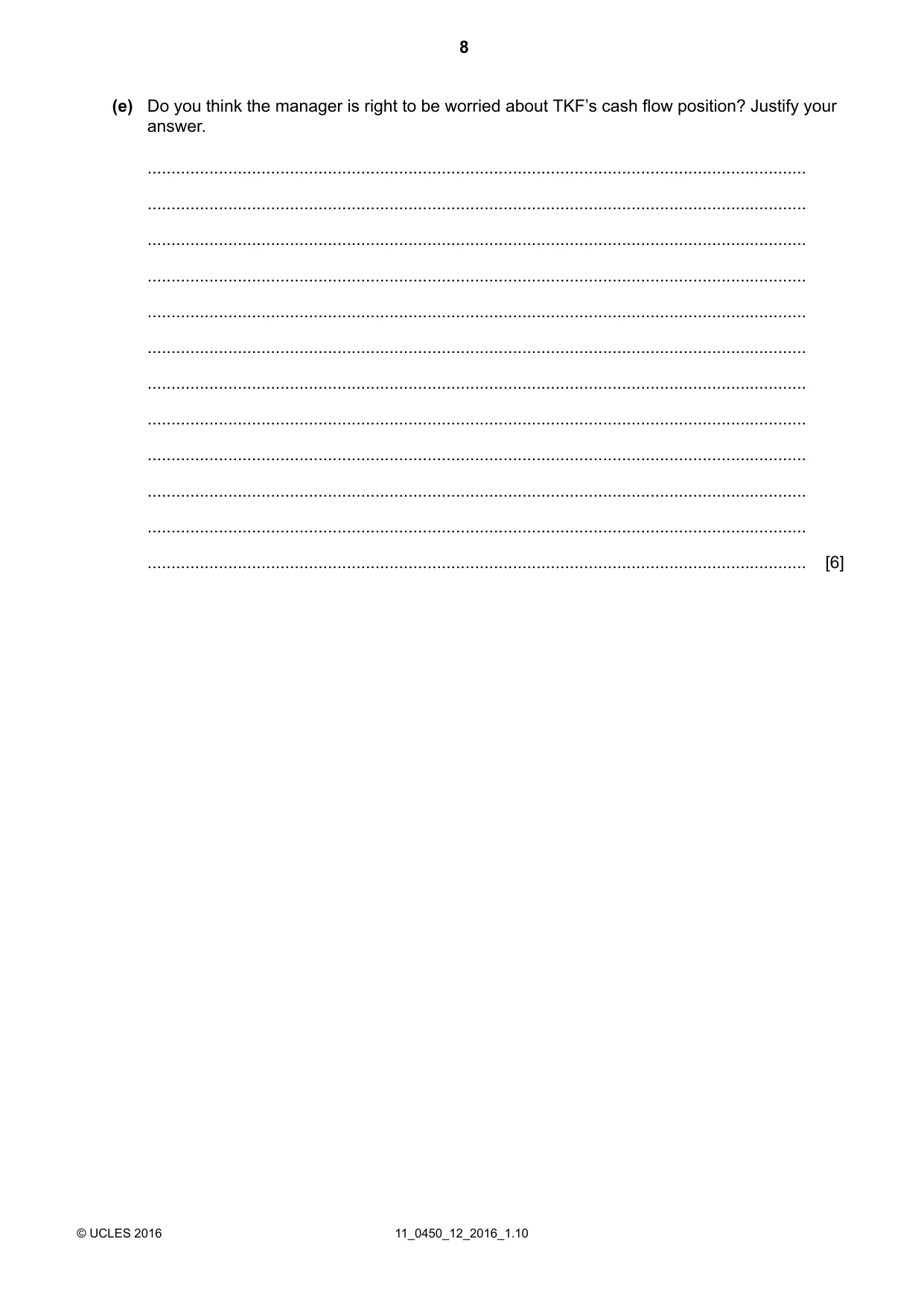
Do you think the manager is right to be worried about TKF’s cash flow position? Justify your answer. (e) … … … … … … … … … … … … [6] 11_0450_12_2016_1.10 © UCLES 2016 8
Question paper, page 9
BLANK PAGE [Turn over 11_0450_12_2016_1.10 © UCLES 2016 9
Question paper, page 10
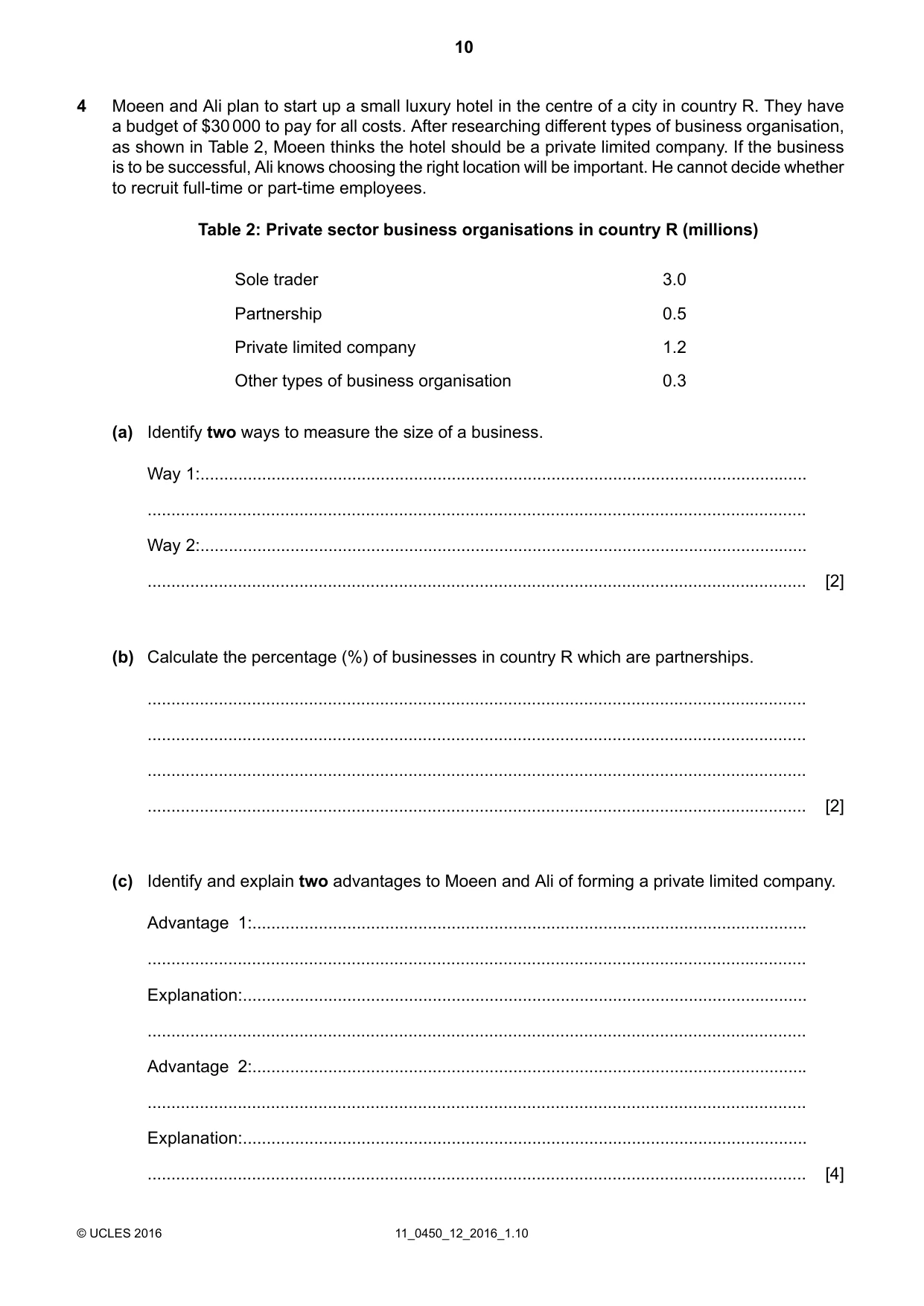
Moeen and Ali plan to start up a small luxury hotel in the centre of a city in country R. They have a budget of $30000 to pay for all costs. After researching different types of business organisation, 4 as shown in Table 2, Moeen thinks the hotel should be a private limited company. If the business is to be successful, Ali knows choosing the right location will be important. He cannot decide whether to recruit full-time or part-time employees. Table 2: Private sector business organisations in country R (millions) 3.0 Sole trader 0.5 Partnership 1.2 Private limited company 0.3 Other types of business organisation Identify two ways to measure the size of a business. (a) Way 1:… … Way 2:… … [2] Calculate the percentage (%) of businesses in country R which are partnerships. (b) … … … … [2] Identify and explain two advantages to Moeen and Ali of forming a private limited company. (c) Advantage 1:… … Explanation:… … Advantage 2:… … Explanation:… … [4] 11_0450_12_2016_1.10 © UCLES 2016 10
Question paper, page 11
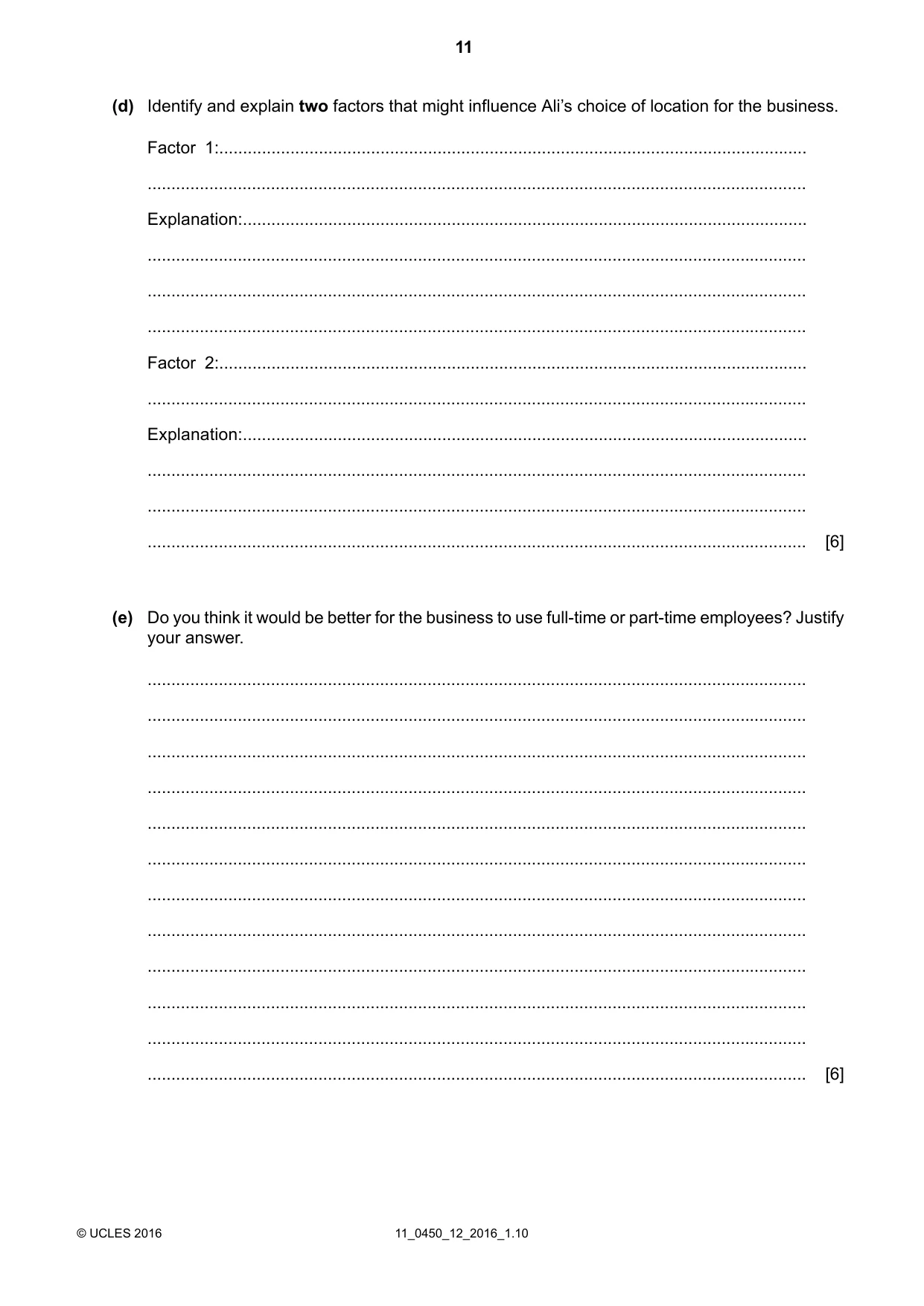
Identify and explain two factors that might influence Ali’s choice of location for the business. (d) Factor 1:… … Explanation:… … … … Factor 2:… … Explanation:… … … … [6] Do you think it would be better for the business to use full-time or part-time employees? Justify your answer. (e) … … … … … … … … … … … … [6] 11_0450_12_2016_1.10 © UCLES 2016 11
Question paper, page 12
BLANK PAGE Permission to reproduce items where third-party owned material protected by copyright is included has been sought and cleared where possible. Every reasonable effort has been made by the publisher (UCLES) to trace copyright holders, but if any items requiring clearance have unwittingly been included, the publisher will be pleased to make amends at the earliest possible opportunity. To avoid the issue of disclosure of answer-related information to candidates, all copyright acknowledgements are reproduced online in the Cambridge International Examinations Copyright Acknowledgements Booklet. This is produced for each series of examinations and is freely available to download at www.cie.org.uk after the live examination series. Cambridge International Examinations is part of the Cambridge Assessment Group. Cambridge Assessment is the brand name of University of Cambridge Local Examinations Syndicate (UCLES), which is itself a department of the University of Cambridge. 11_0450_12_2016_1.10 © UCLES 2016 12
Mark scheme, page 1
® IGCSE is the registered trademark of Cambridge International Examinations. This syllabus is approved for use in England, Wales and Northern Ireland as a Cambridge International Level 1/Level 2 Certificate. This document consists of 12 printed pages. © UCLES 2016 [Turn over Cambridge International Examinations Cambridge International General Certificate of Secondary Education BUSINESS STUDIES 0450/12 Paper 1 Short Answer/Structured Response October/November 2016 MARK SCHEME Maximum Mark: 80 Published This mark scheme is published as an aid to teachers and candidates, to indicate the requirements of the examination. It shows the basis on which Examiners were instructed to award marks. It does not indicate the details of the discussions that took place at an Examiners’ meeting before marking began, which would have considered the acceptability of alternative answers. Mark schemes should be read in conjunction with the question paper and the Principal Examiner Report for Teachers. Cambridge will not enter into discussions about these mark schemes. Cambridge is publishing the mark schemes for the October/November 2016 series for most Cambridge IGCSE®, Cambridge International A and AS Level components and some Cambridge O Level components.
Mark scheme, page 2
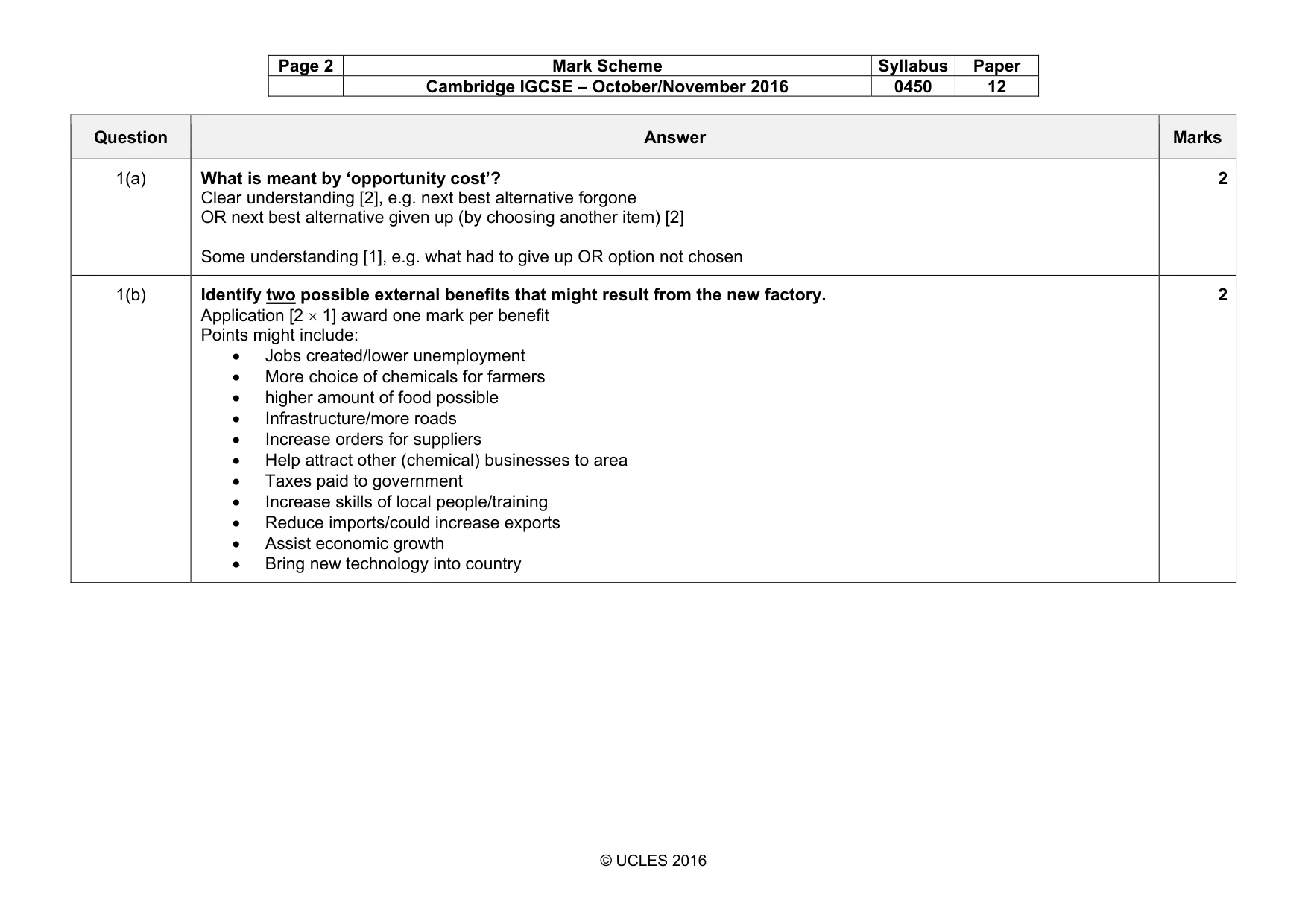
Page 2 Mark Scheme Syllabus Paper Cambridge IGCSE – October/November 2016 0450 12 © UCLES 2016 Question Answer Marks 1(a) What is meant by ‘opportunity cost’? Clear understanding [2], e.g. next best alternative forgone OR next best alternative given up (by choosing another item) [2] Some understanding [1], e.g. what had to give up OR option not chosen 2 1(b) Identify two possible external benefits that might result from the new factory. Application [2 × 1] award one mark per benefit Points might include: • Jobs created/lower unemployment • More choice of chemicals for farmers • higher amount of food possible • Infrastructure/more roads • Increase orders for suppliers • Help attract other (chemical) businesses to area • Taxes paid to government • Increase skills of local people/training • Reduce imports/could increase exports • Assist economic growth • Bring new technology into country 2
Mark scheme, page 3
Page 3 Mark Scheme Syllabus Paper Cambridge IGCSE – October/November 2016 0450 12 © UCLES 2016 Question Answer Marks 1(c) Identify and explain two advantages to APQ of being a multinational company. Knowledge [2 × 1] – award 1 mark for each relevant advantage Application [2 × 1] – award 1 mark for each explanation in context Relevant points might include: • Access to new market/increase sales/market share [k] as people need food [app] • Reduce production costs, e.g. lower labour costs OR lower health and safety costs OR land costs [k] as X is a developing country [app]; • Spread risk [k] when selling chemicals [app] • Easier access to raw materials [k] for all its factories [app] • Avoid barriers to trade [k] • Remain competitive [k] • Reduce transport costs (as can produce goods nearer market) • Economies of scale, e.g. purchasing, finance [k] (only once) • Reduce tax liability/take advantage of favourable tax laws • Access government grants [k] 4 1(d) Identify two stakeholder groups of APQ. Explain how APQ could act in an ethical way with each stakeholder group. Knowledge [2 × 1] – award 1 mark for each relevant stakeholder Application [2 × 1] – award 1 mark if relevant reference made to this business Analysis [2 × 1] – award 1 mark for each relevant explanation Relevant points might include: • Employees/management [k] if set up in developing country [app] should pay fair wages [an] or offer good conditions [an] • Suppliers [k] pay fair price/pay on time [an] for the chemicals [app] • Community [k] • Pressure groups [k] by trying to prevent pollution/environmental damage [an] caused by factory [app] • Government [k] paying its taxes on time/not do tax avoidance [an] • Lenders/bank [k] if borrow $100 m [app] • Owners/shareholders [k] as public limited company [app] • Customers [k] do not exploit them by charging high prices [an] to farmers [app] 6
Mark scheme, page 4
Page 4 Mark Scheme Syllabus Paper Cambridge IGCSE – October/November 2016 0450 12 © UCLES 2016 Question Answer Marks 1(e) Explain two possible sources of finance that APQ could use. Recommend which source of finance APQ should use for the new factory. Justify your answer. Knowledge [1] – award up to 1 mark for identification of relevant method(s) Application [1] – award 1 mark if relevant reference made to this business Analysis [2] – award up to 2 marks for relevant development of point (s) Evaluation [2] – justified decision made as to which source of finance APQ should use Relevant points might include: • Retained Profits [k] so no need to repay [an] so keeps costs lower [an] • Bank loan [k] as interest rates low [app] but it will increase level of debt [an] OR as multinational [app] banks more likely to lend at lower rates of interest [an] • Government grant/subsidy [k] as helping country develop [app] so may be willing to provide finance [an] • mortgage [k] as cost $100 m [app] so have time to make repayments [an] • Leasing [k] so no large payment at the start [an] • Share issue [k] as it is a public limited company [app] • Debentures [k] • Sale of unused non-current assets [k] 6
Mark scheme, page 5
Page 5 Mark Scheme Syllabus Paper Cambridge IGCSE – October/November 2016 0450 12 © UCLES 2016 Question Answer Marks 2(a) What is meant by ‘marketing strategy’? Clear understanding [2]: plan to combine the right combination of the 4 elements of the marketing mix to achieve a particular market objective OR Put together the right mix of the 4Ps to increase sales [2] OR A plan for promoting goods to enter a new market [2] Some understanding [1], e.g. how to combine the 4P’s OR how to promote a product OR a plan for marketing OR how to increase sales 2 2(b) What is meant by ‘penetration pricing’? Clear understanding [2]: price is set lower than competitor’s prices [1] in order to be able to enter a new market/launch a new product [+1] Some understanding [1], e.g. set low prices 2 2(c) Identify and explain two possible advantages to $LAND of advertising. Knowledge [2 × 1] – award 1 mark for each relevant advantage Application [2 × 1] – award 1 mark for each explanation in context Relevant points might include: • Persuade/attract customers OR increase revenue/sales [k] to buy more food [app] • Build brand loyalty/good image [k] so keep buying from its shops [app] • Inform/raise awareness/become well known [k] for its toys [app] • Maintain market share/remain competitive [k] as in recession [app] • Remind existing customers [k] as sell such a wide range [app] • Able to target different customers/new market segment [k] 4
Mark scheme, page 6
Page 6 Mark Scheme Syllabus Paper Cambridge IGCSE – October/November 2016 0450 12 © UCLES 2016 Question Answer Marks 2(d) Identify and explain one advantage and one disadvantage to $LAND of buying direct from manufacturers. Knowledge [2 × 1] – award 1 mark for a relevant advantage and 1 mark for relevant disadvantage Application [2 × 1] – award 1 mark if relevant reference made to this business Analysis [2 × 1] – award 1 mark for each relevant explanation Relevant points might include: Advantages: • Purchasing economies of scale/discounts for bulk buying [k] as buy for all its shops [app] leading to lower average/unit costs [an] • Quicker access to products [k] so can offer new products before rivals [an] leading to higher sales of toys [app] OR which is important for food [app] to reduce wastage/increase shelf life [an] • Build relationship with supplier [k] may give preferential delivery times [an] • Offer technical support [k] • Develop products specifically for business [k] • Cut out wholesaler profit [k] • Manufacturer may pay for some of the advertising [k] Disadvantages: • More paperwork [k] as have a wide range of products [app] which takes more time to complete [an] • Have to recruit more people [k] • Extra storage space needed/must purchase minimum quantity [k] increasing storage costs [an] • Risk of wastage [k] 6
Mark scheme, page 7
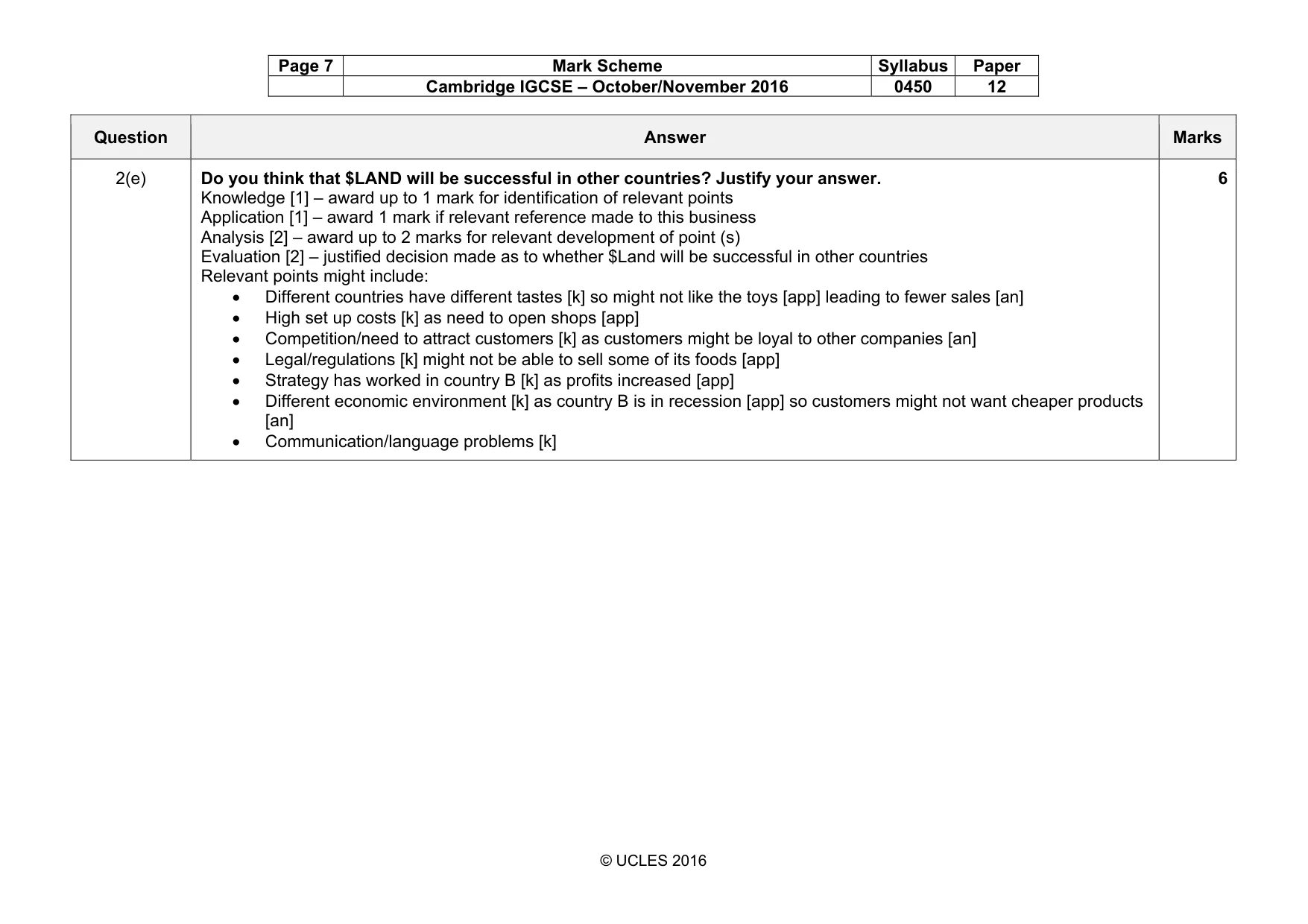
Page 7 Mark Scheme Syllabus Paper Cambridge IGCSE – October/November 2016 0450 12 © UCLES 2016 Question Answer Marks 2(e) Do you think that $LAND will be successful in other countries? Justify your answer. Knowledge [1] – award up to 1 mark for identification of relevant points Application [1] – award 1 mark if relevant reference made to this business Analysis [2] – award up to 2 marks for relevant development of point (s) Evaluation [2] – justified decision made as to whether $Land will be successful in other countries Relevant points might include: • Different countries have different tastes [k] so might not like the toys [app] leading to fewer sales [an] • High set up costs [k] as need to open shops [app] • Competition/need to attract customers [k] as customers might be loyal to other companies [an] • Legal/regulations [k] might not be able to sell some of its foods [app] • Strategy has worked in country B [k] as profits increased [app] • Different economic environment [k] as country B is in recession [app] so customers might not want cheaper products [an] • Communication/language problems [k] 6
Mark scheme, page 8
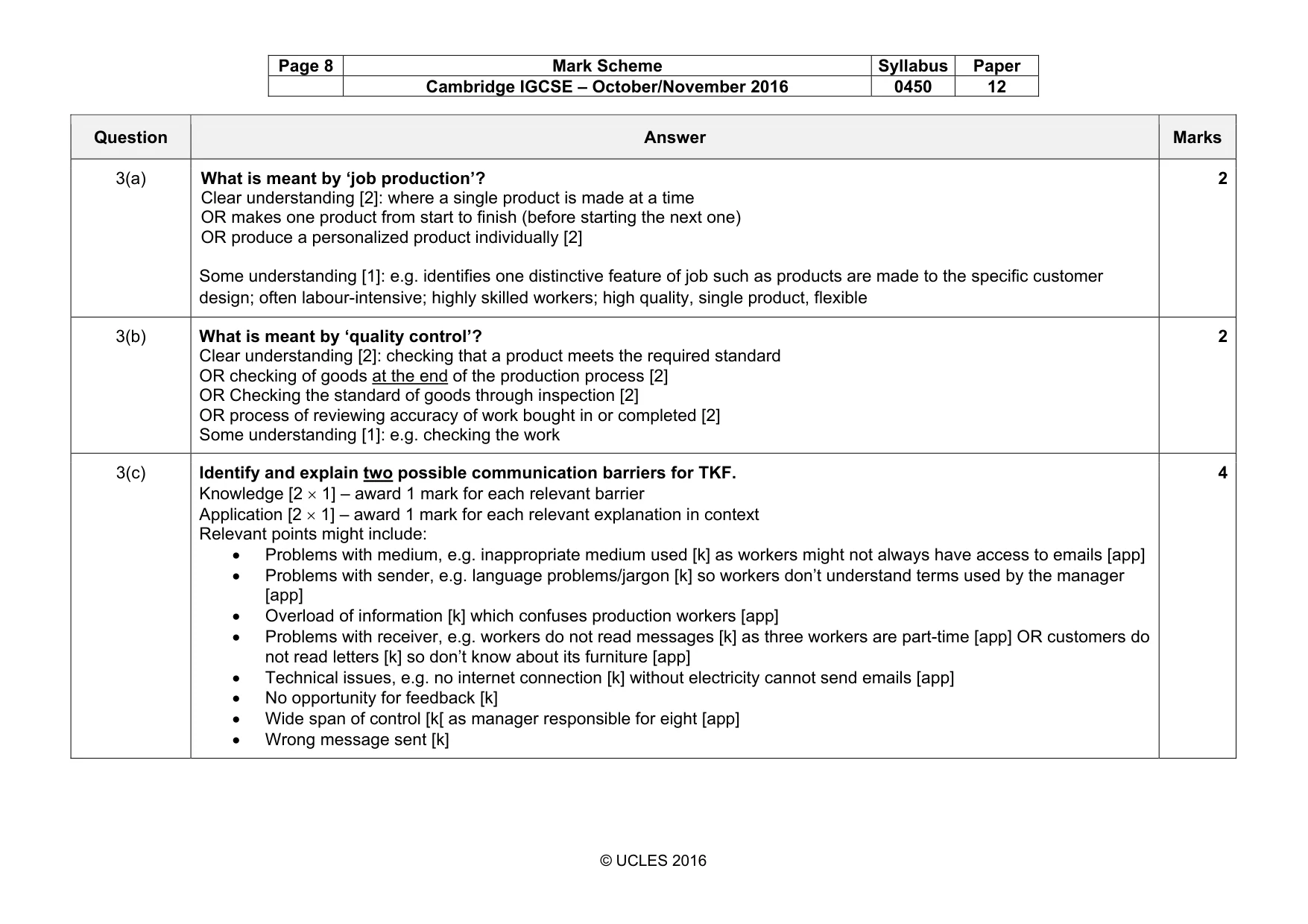
Page 8 Mark Scheme Syllabus Paper Cambridge IGCSE – October/November 2016 0450 12 © UCLES 2016 Question Answer Marks 3(a) What is meant by ‘job production’? Clear understanding [2]: where a single product is made at a time OR makes one product from start to finish (before starting the next one) OR produce a personalized product individually [2] Some understanding [1]: e.g. identifies one distinctive feature of job such as products are made to the specific customer design; often labour-intensive; highly skilled workers; high quality, single product, flexible 2 3(b) What is meant by ‘quality control’? Clear understanding [2]: checking that a product meets the required standard OR checking of goods at the end of the production process [2] OR Checking the standard of goods through inspection [2] OR process of reviewing accuracy of work bought in or completed [2] Some understanding [1]: e.g. checking the work 2 3(c) Identify and explain two possible communication barriers for TKF. Knowledge [2 × 1] – award 1 mark for each relevant barrier Application [2 × 1] – award 1 mark for each relevant explanation in context Relevant points might include: • Problems with medium, e.g. inappropriate medium used [k] as workers might not always have access to emails [app] • Problems with sender, e.g. language problems/jargon [k] so workers don’t understand terms used by the manager [app] • Overload of information [k] which confuses production workers [app] • Problems with receiver, e.g. workers do not read messages [k] as three workers are part-time [app] OR customers do not read letters [k] so don’t know about its furniture [app] • Technical issues, e.g. no internet connection [k] without electricity cannot send emails [app] • No opportunity for feedback [k] • Wide span of control [k[ as manager responsible for eight [app] • Wrong message sent [k] 4
Mark scheme, page 9
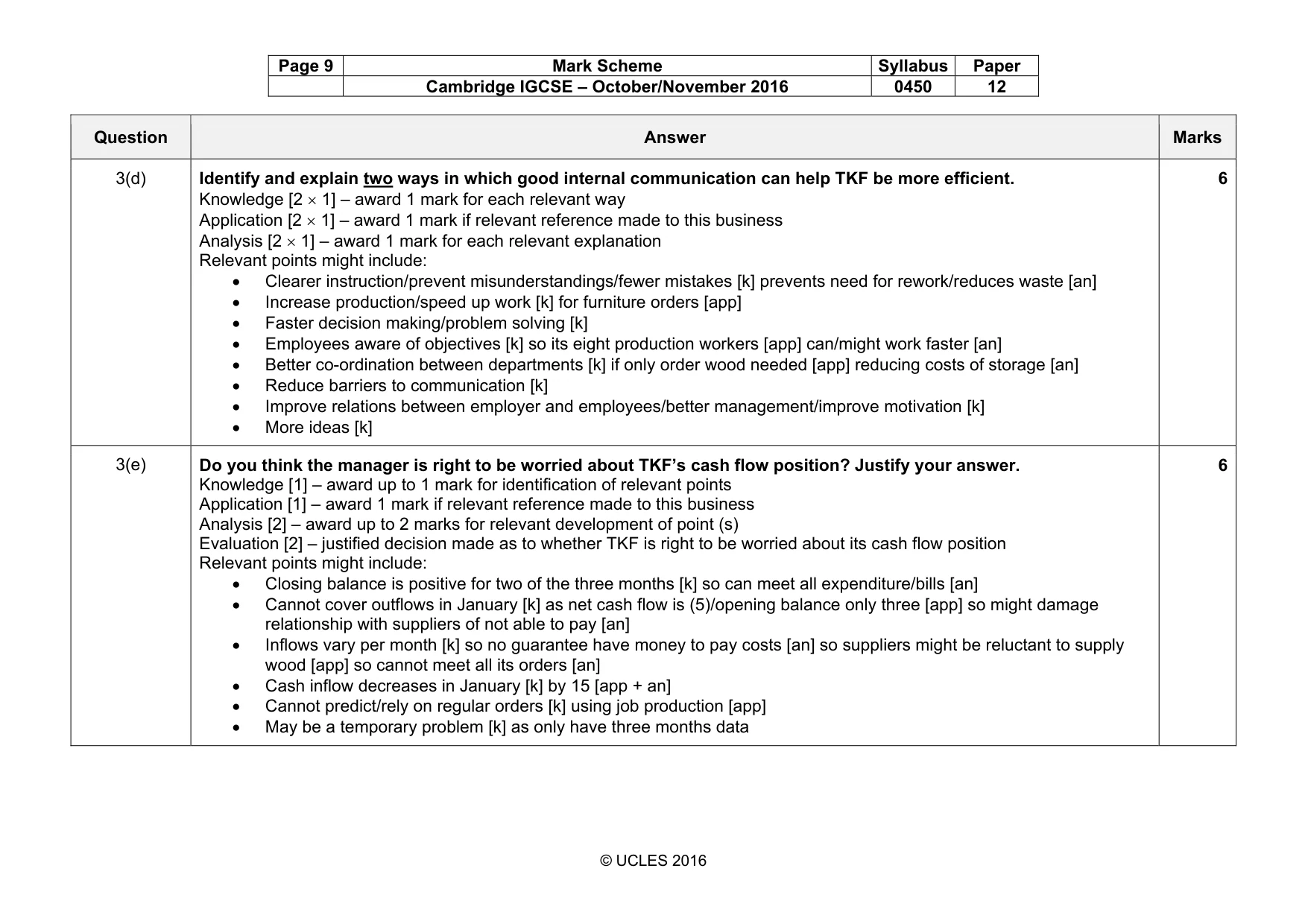
Page 9 Mark Scheme Syllabus Paper Cambridge IGCSE – October/November 2016 0450 12 © UCLES 2016 Question Answer Marks 3(d) Identify and explain two ways in which good internal communication can help TKF be more efficient. Knowledge [2 × 1] – award 1 mark for each relevant way Application [2 × 1] – award 1 mark if relevant reference made to this business Analysis [2 × 1] – award 1 mark for each relevant explanation Relevant points might include: • Clearer instruction/prevent misunderstandings/fewer mistakes [k] prevents need for rework/reduces waste [an] • Increase production/speed up work [k] for furniture orders [app] • Faster decision making/problem solving [k] • Employees aware of objectives [k] so its eight production workers [app] can/might work faster [an] • Better co-ordination between departments [k] if only order wood needed [app] reducing costs of storage [an] • Reduce barriers to communication [k] • Improve relations between employer and employees/better management/improve motivation [k] • More ideas [k] 6 3(e) Do you think the manager is right to be worried about TKF’s cash flow position? Justify your answer. Knowledge [1] – award up to 1 mark for identification of relevant points Application [1] – award 1 mark if relevant reference made to this business Analysis [2] – award up to 2 marks for relevant development of point (s) Evaluation [2] – justified decision made as to whether TKF is right to be worried about its cash flow position Relevant points might include: • Closing balance is positive for two of the three months [k] so can meet all expenditure/bills [an] • Cannot cover outflows in January [k] as net cash flow is (5)/opening balance only three [app] so might damage relationship with suppliers of not able to pay [an] • Inflows vary per month [k] so no guarantee have money to pay costs [an] so suppliers might be reluctant to supply wood [app] so cannot meet all its orders [an] • Cash inflow decreases in January [k] by 15 [app + an] • Cannot predict/rely on regular orders [k] using job production [app] • May be a temporary problem [k] as only have three months data 6
Mark scheme, page 10
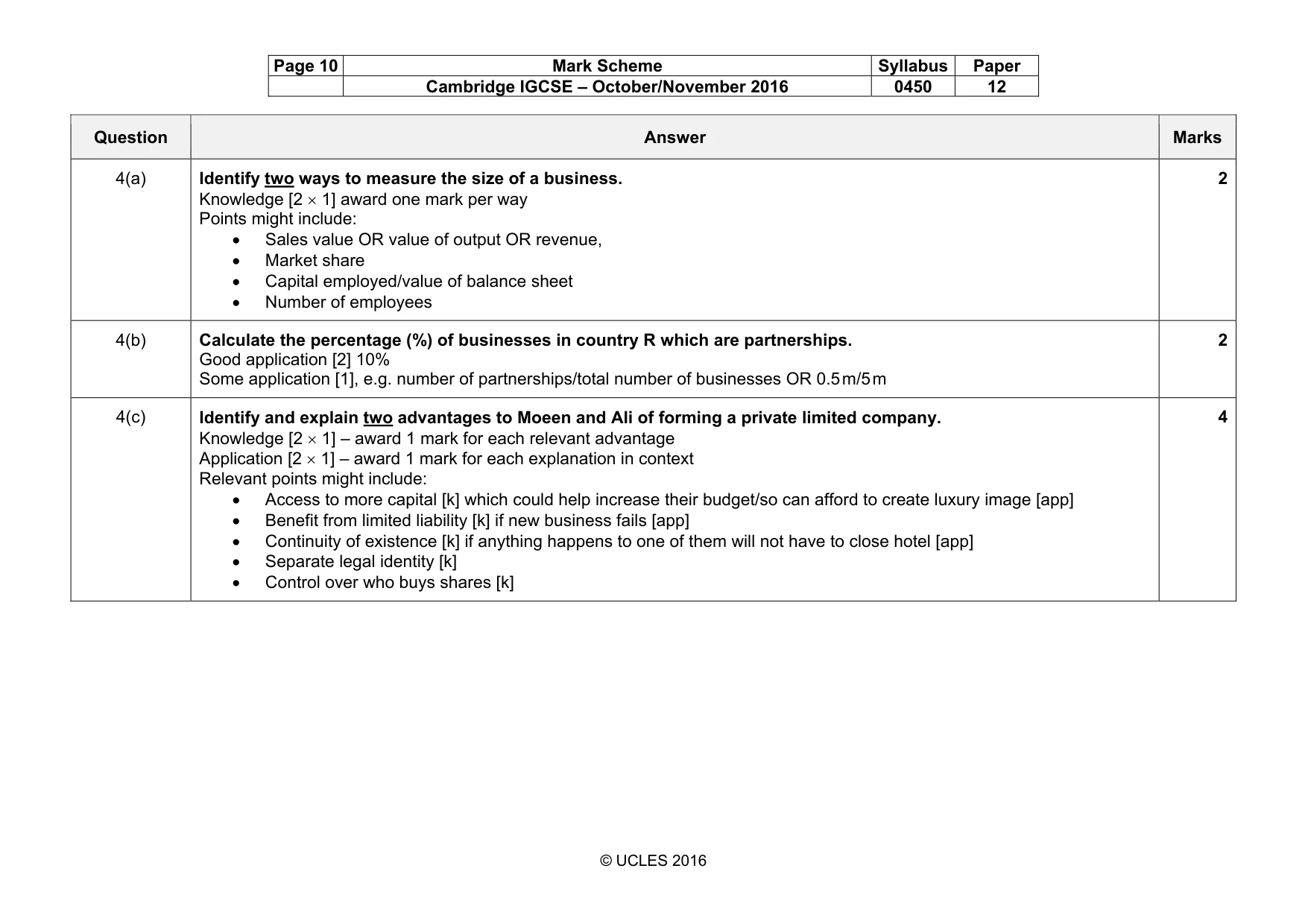
Page 10 Mark Scheme Syllabus Paper Cambridge IGCSE – October/November 2016 0450 12 © UCLES 2016 Question Answer Marks 4(a) Identify two ways to measure the size of a business. Knowledge [2 × 1] award one mark per way Points might include: • Sales value OR value of output OR revenue, • Market share • Capital employed/value of balance sheet • Number of employees 2 4(b) Calculate the percentage (%) of businesses in country R which are partnerships. Good application [2] 10% Some application [1], e.g. number of partnerships/total number of businesses OR 0.5 m/5 m 2 4(c) Identify and explain two advantages to Moeen and Ali of forming a private limited company. Knowledge [2 × 1] – award 1 mark for each relevant advantage Application [2 × 1] – award 1 mark for each explanation in context Relevant points might include: • Access to more capital [k] which could help increase their budget/so can afford to create luxury image [app] • Benefit from limited liability [k] if new business fails [app] • Continuity of existence [k] if anything happens to one of them will not have to close hotel [app] • Separate legal identity [k] • Control over who buys shares [k] 4
Mark scheme, page 11
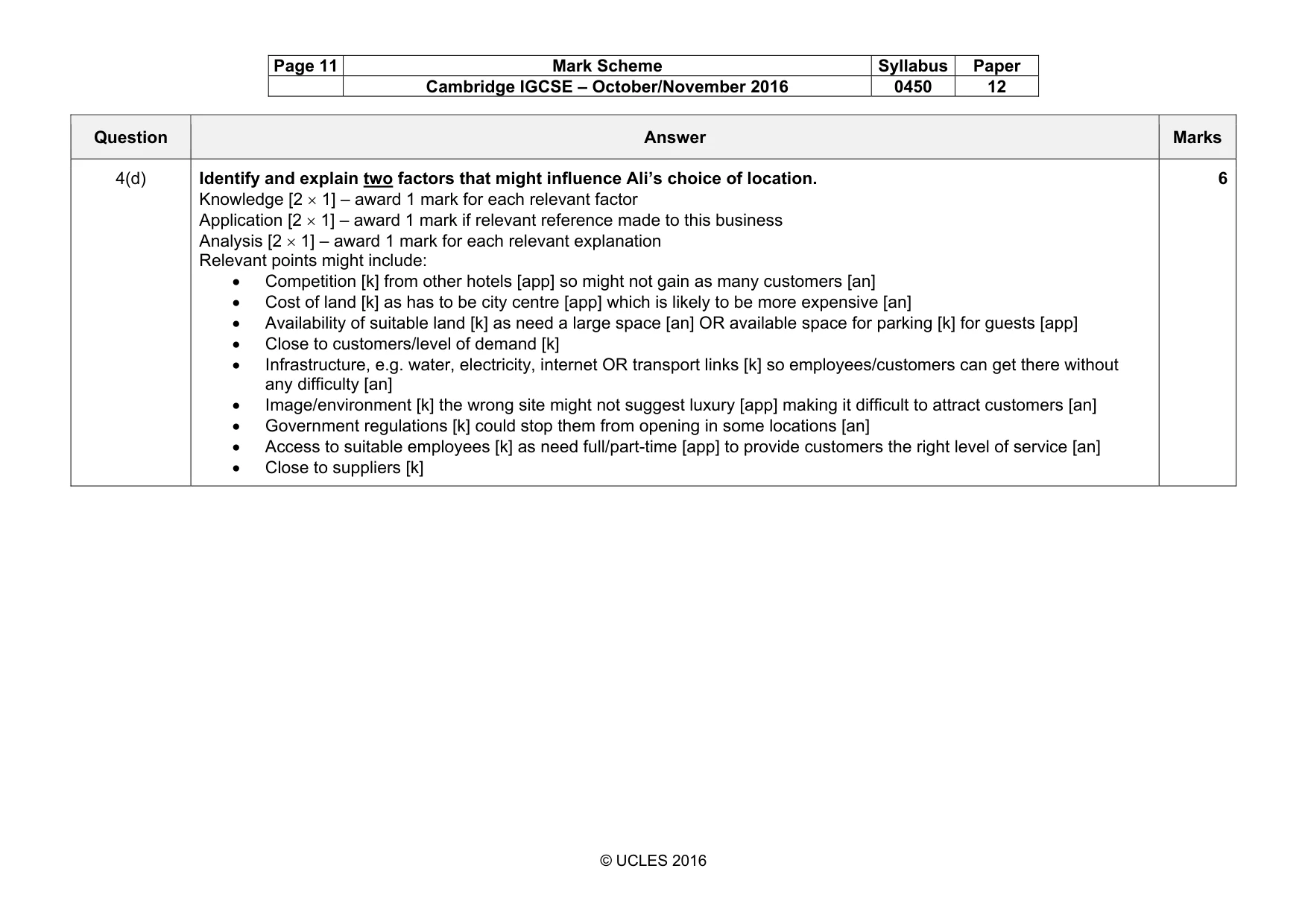
Page 11 Mark Scheme Syllabus Paper Cambridge IGCSE – October/November 2016 0450 12 © UCLES 2016 Question Answer Marks 4(d) Identify and explain two factors that might influence Ali’s choice of location. Knowledge [2 × 1] – award 1 mark for each relevant factor Application [2 × 1] – award 1 mark if relevant reference made to this business Analysis [2 × 1] – award 1 mark for each relevant explanation Relevant points might include: • Competition [k] from other hotels [app] so might not gain as many customers [an] • Cost of land [k] as has to be city centre [app] which is likely to be more expensive [an] • Availability of suitable land [k] as need a large space [an] OR available space for parking [k] for guests [app] • Close to customers/level of demand [k] • Infrastructure, e.g. water, electricity, internet OR transport links [k] so employees/customers can get there without any difficulty [an] • Image/environment [k] the wrong site might not suggest luxury [app] making it difficult to attract customers [an] • Government regulations [k] could stop them from opening in some locations [an] • Access to suitable employees [k] as need full/part-time [app] to provide customers the right level of service [an] • Close to suppliers [k] 6
Mark scheme, page 12
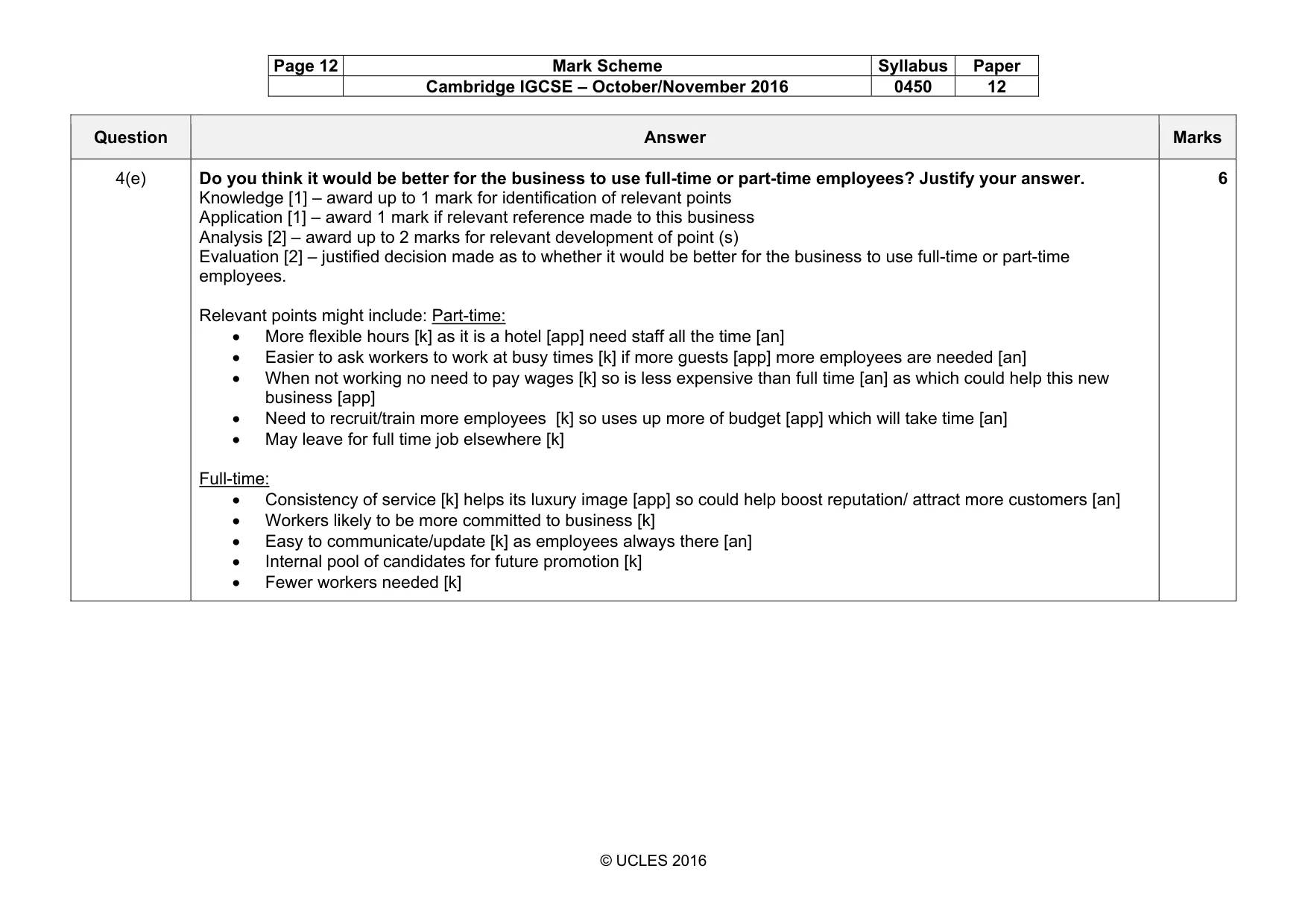
Page 12 Mark Scheme Syllabus Paper Cambridge IGCSE – October/November 2016 0450 12 © UCLES 2016 Question Answer Marks 4(e) Do you think it would be better for the business to use full-time or part-time employees? Justify your answer. Knowledge [1] – award up to 1 mark for identification of relevant points Application [1] – award 1 mark if relevant reference made to this business Analysis [2] – award up to 2 marks for relevant development of point (s) Evaluation [2] – justified decision made as to whether it would be better for the business to use full-time or part-time employees. Relevant points might include: Part-time: • More flexible hours [k] as it is a hotel [app] need staff all the time [an] • Easier to ask workers to work at busy times [k] if more guests [app] more employees are needed [an] • When not working no need to pay wages [k] so is less expensive than full time [an] as which could help this new business [app] • Need to recruit/train more employees [k] so uses up more of budget [app] which will take time [an] • May leave for full time job elsewhere [k] Full-time: • Consistency of service [k] helps its luxury image [app] so could help boost reputation/ attract more customers [an] • Workers likely to be more committed to business [k] • Easy to communicate/update [k] as employees always there [an] • Internal pool of candidates for future promotion [k] • Fewer workers needed [k] 6
What you needed in this session
Cambridge’s own grade thresholds for 2016 Oct/Nov, Paper 1 · Variant 2. A higher threshold means an easier paper — the bar moves with how the cohort did.