Cambridge IGCSE Business Studies 0450 — 2016 May/June Paper 1 · Variant 3
0450/13/M/J/16 · 80 marks · ≈90 min
The question paper and its mark scheme, free to read here and free to download. This is Cambridge’s own paper, exactly as it was sat.
Question paper12 pages



Mark scheme13 pages
Answers below. Sit the paper first if you are practising.
Paper as text
Question paper, page 1
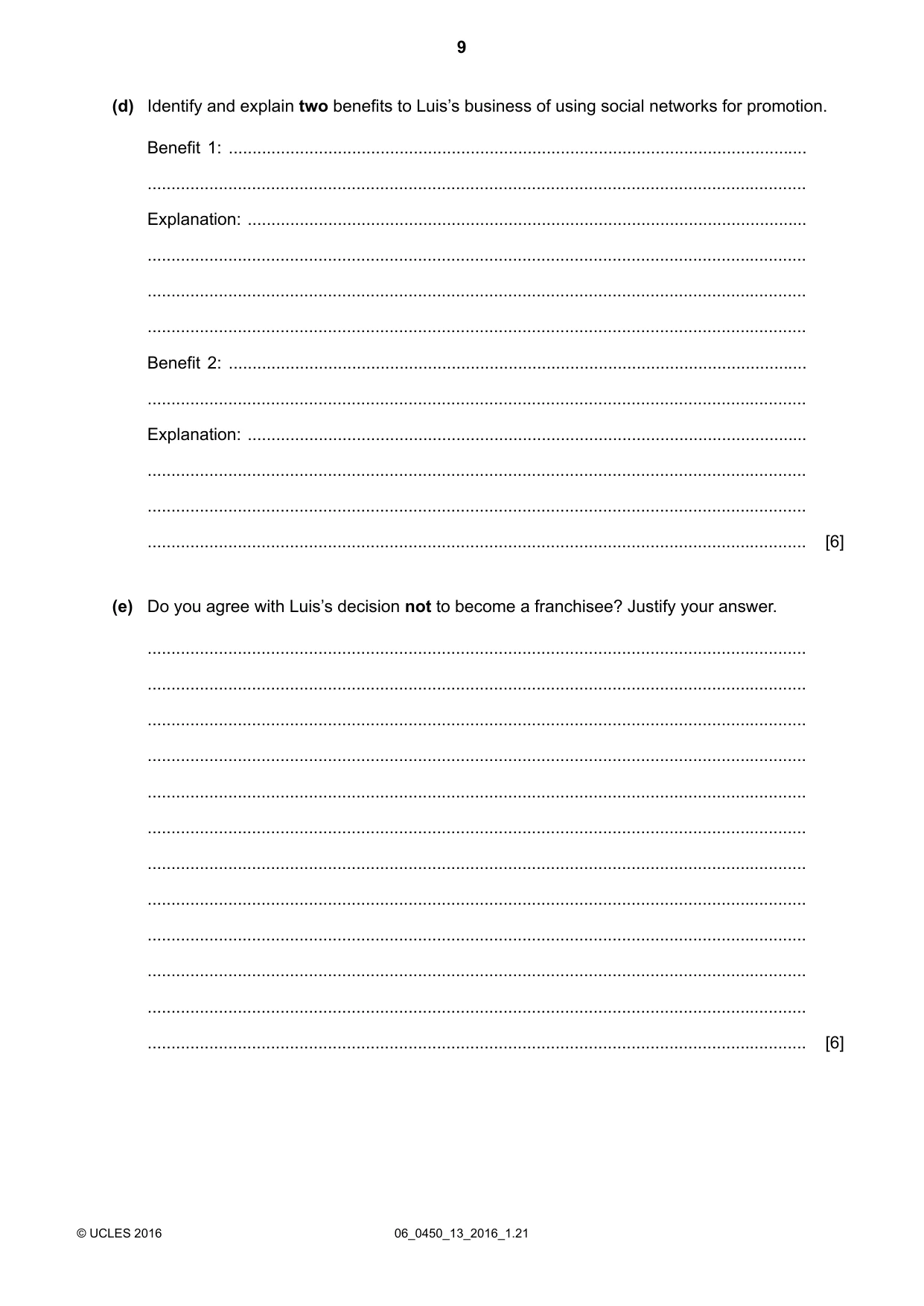
Cambridge International Examinations Cambridge International General Certificate of Secondary Education 0450/13 May/June 2016 1 hour 30 minutes BUSINESS STUDIES Paper 1 Candidates answer on the Question Paper. No Additional Materials are required. READ THESE INSTRUCTIONS FIRST Write your Centre number, candidate number and name in the spaces at the top of this page. Write in dark blue or black pen. You may use an HB pencil for any diagrams, graphs or rough working. Do not use staples, paper clips, glue or correction fluid. DO NOT WRITE IN ANY BARCODES. Answer all questions. The businesses described in this question paper are entirely fictitious. At the end of the examination, fasten all your work securely together. The number of marks is given in brackets [ ] at the end of each question or part question. The total number of marks for this paper is 80. The syllabus is approved for use in England, Wales and Northern Ireland as a Cambridge International Level 1/Level 2 Certificate. This document consists of 9 printed pages and 3 blank pages. [Turn over 06_0450_13_2016_1.21 © UCLES 2016 *0759858583*
Question paper, page 2
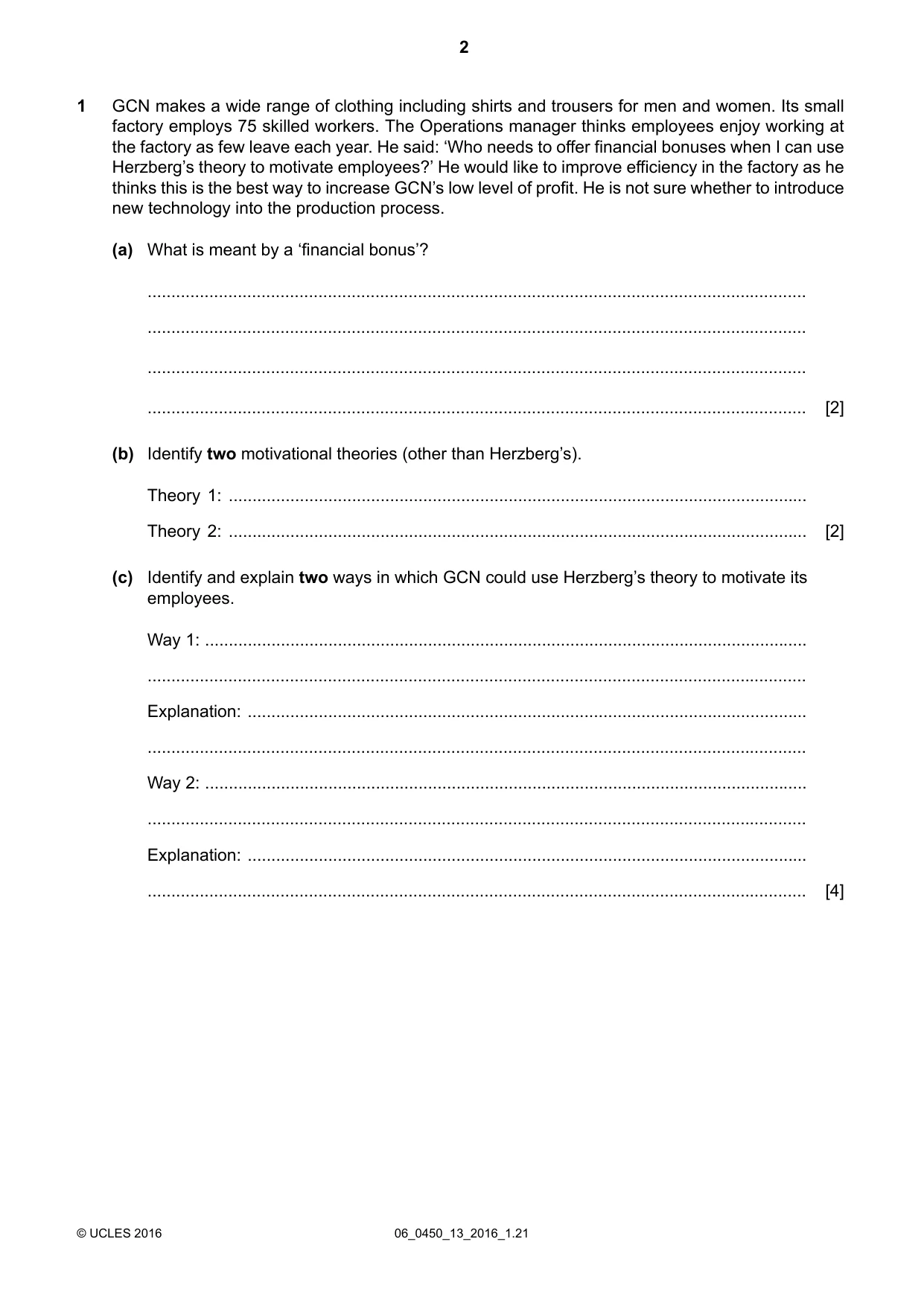
GCN makes a wide range of clothing including shirts and trousers for men and women. Its small factory employs 75 skilled workers. The Operations manager thinks employees enjoy working at 1 the factory as few leave each year. He said: ‘Who needs to offer financial bonuses when I can use Herzberg’s theory to motivate employees?’ He would like to improve efficiency in the factory as he thinks this is the best way to increase GCN’s low level of profit. He is not sure whether to introduce new technology into the production process. What is meant by a ‘financial bonus’? (a) … … … … [2] Identify two motivational theories (other than Herzberg’s). (b) Theory 1: … Theory 2: … [2] Identify and explain two ways in which GCN could use Herzberg’s theory to motivate its employees. (c) Way 1: … … Explanation: … … Way 2: … … Explanation: … … [4] 06_0450_13_2016_1.21 © UCLES 2016 2
Question paper, page 3
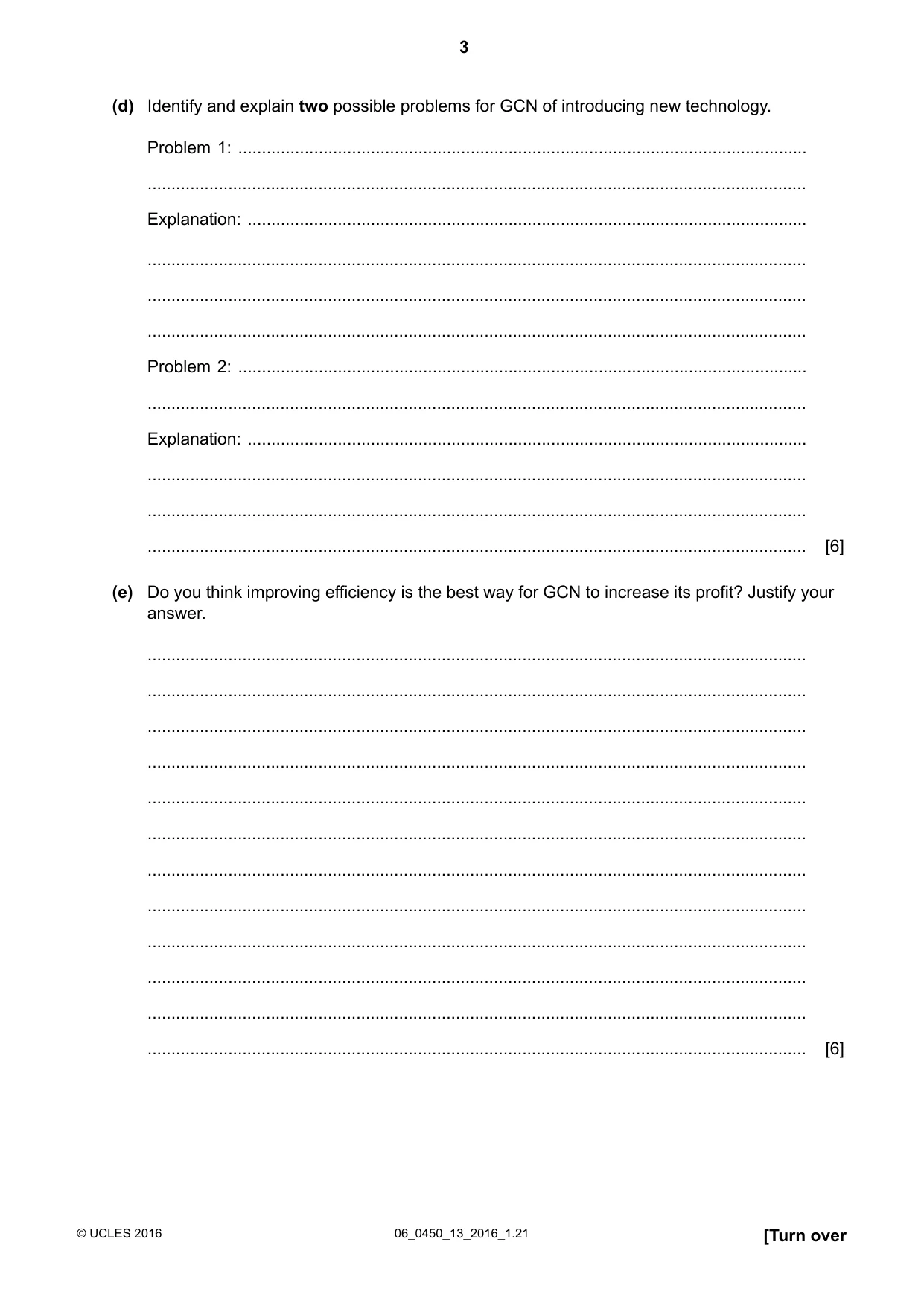
Identify and explain two possible problems for GCN of introducing new technology. (d) Problem 1: … … Explanation: … … … … Problem 2: … … Explanation: … … … … [6] Do you think improving efficiency is the best way for GCN to increase its profit? Justify your answer. (e) … … … … … … … … … … … … [6] [Turn over 06_0450_13_2016_1.21 © UCLES 2016 3
Question paper, page 4
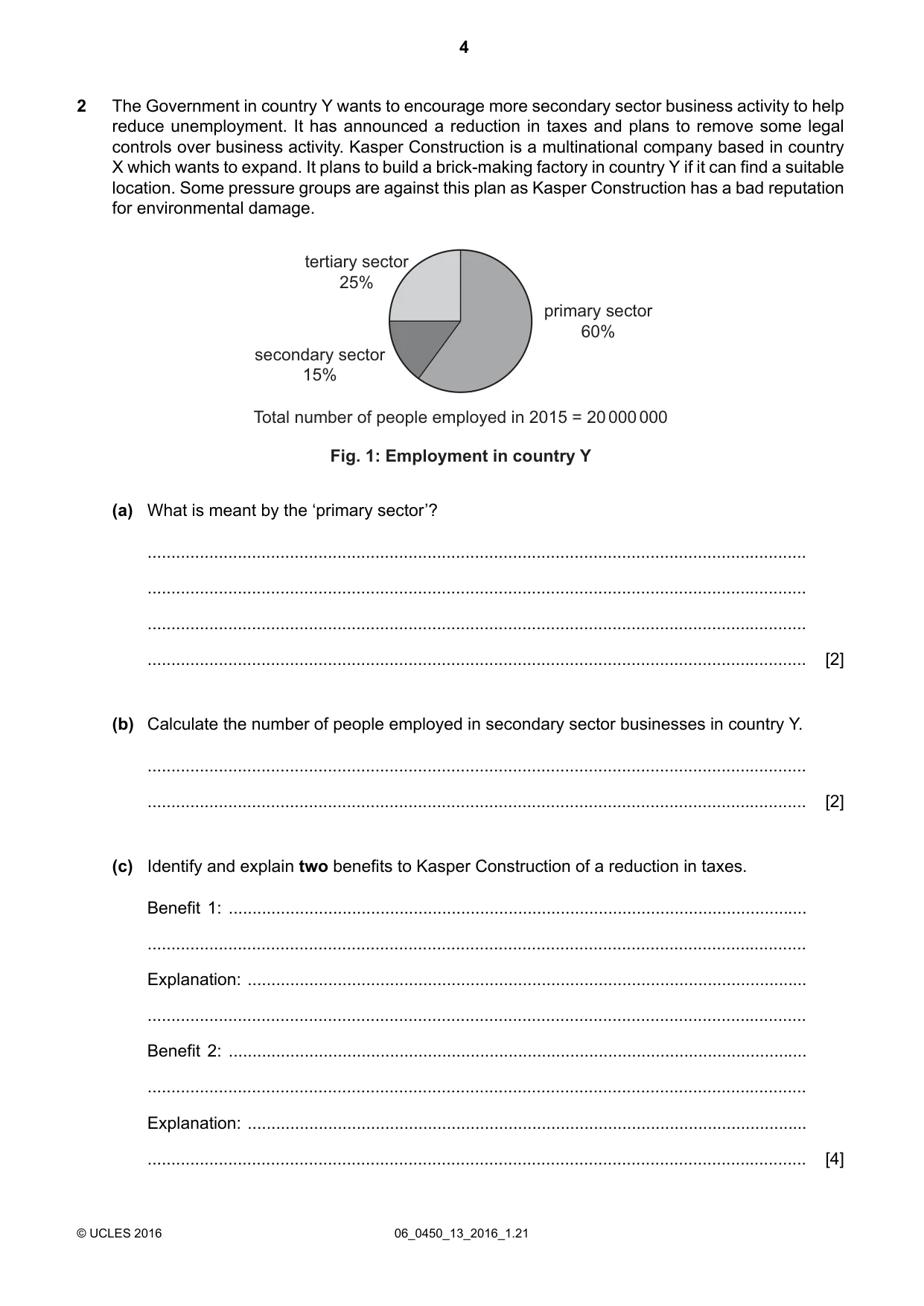
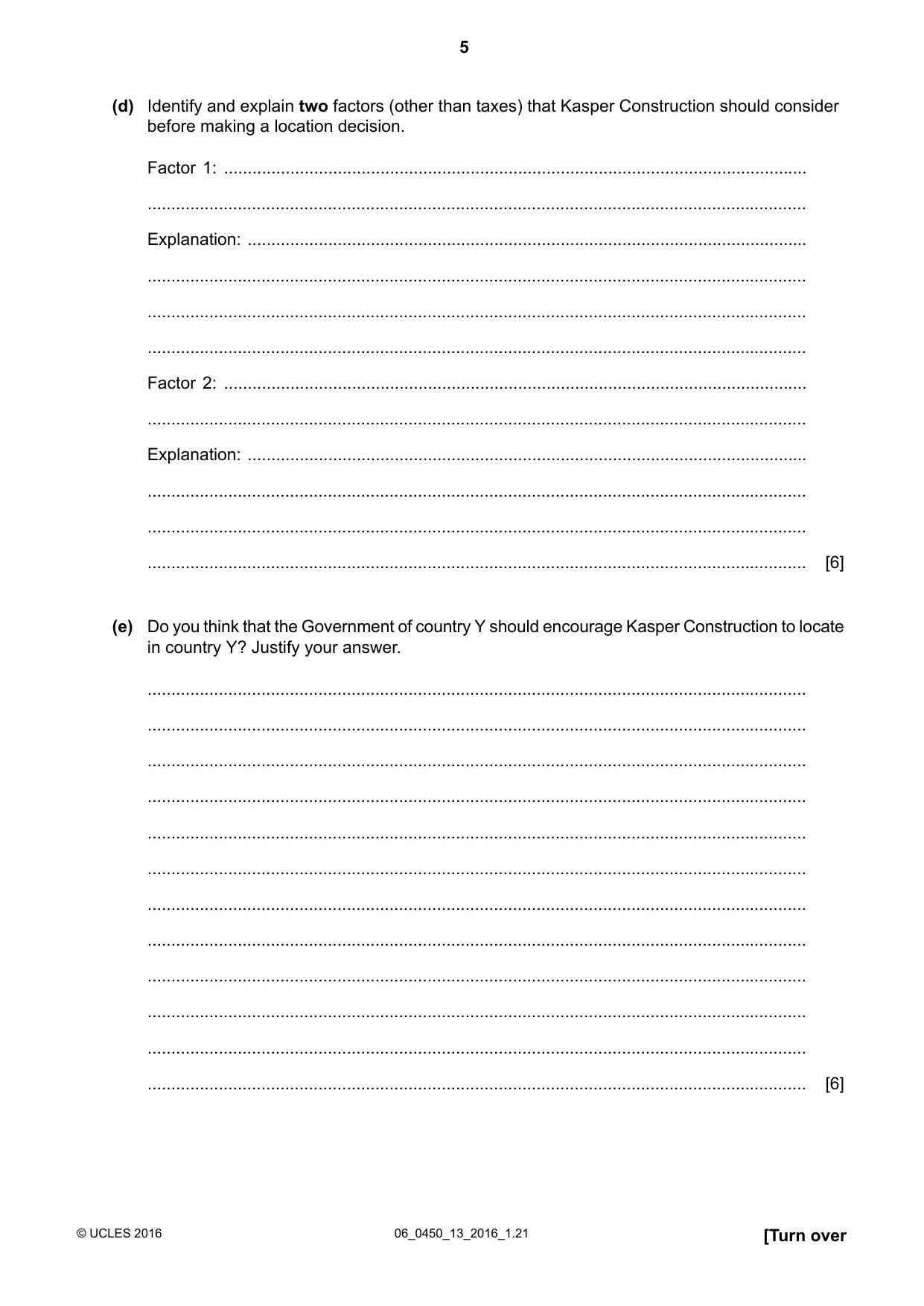
The Government in country Y wants to encourage more secondary sector business activity to help reduce unemployment. It has announced a reduction in taxes and plans to remove some legal 2 controls over business activity. Kasper Construction is a multinational company based in country X which wants to expand. It plans to build a brick-making factory in country Y if it can find a suitable location. Some pressure groups are against this plan as Kasper Construction has a bad reputation for environmental damage. Fig. 1: Employment in country Y Total number of people employed in 2015 = 20 000 000 primary sector 60% tertiary sector 25% secondary sector 15% What is meant by the ‘primary sector’? (a) … … … … [2] Calculate the number of people employed in secondary sector businesses in country Y. (b) … … [2] Identify and explain two benefits to Kasper Construction of a reduction in taxes. (c) Benefit 1: … … Explanation: … … Benefit 2: … … Explanation: … … [4] 06_0450_13_2016_1.21 © UCLES 2016 4
Question paper, page 5
Identify and explain two factors (other than taxes) that Kasper Construction should consider before making a location decision. (d) Factor 1: … … Explanation: … … … … Factor 2: … … Explanation: … … … … [6] Do you think that the Government of country Y should encourage Kasper Construction to locate in country Y? Justify your answer. (e) … … … … … … … … … … … … [6] [Turn over 06_0450_13_2016_1.21 © UCLES 2016 5
Question paper, page 6
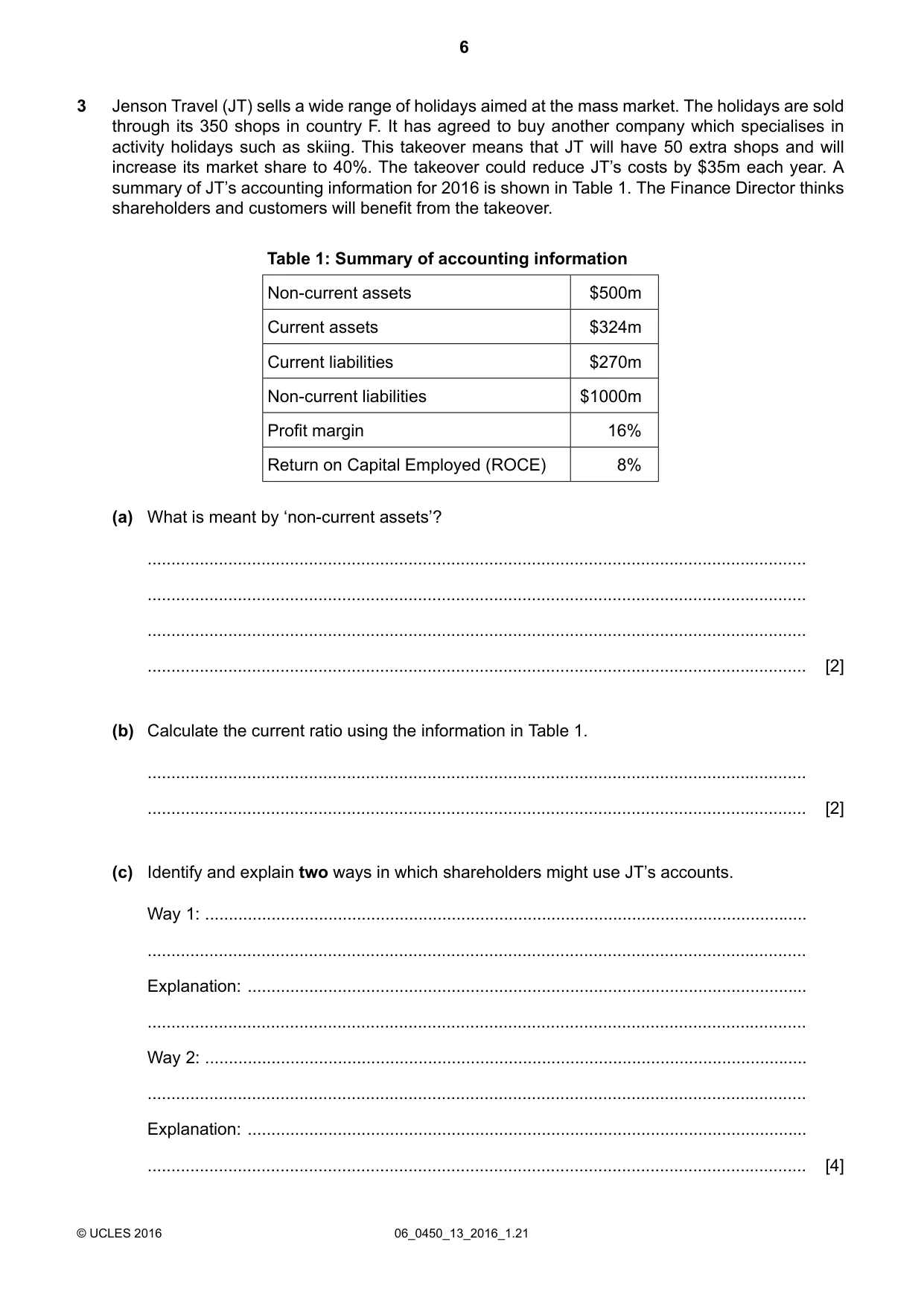
Jenson Travel (JT) sells a wide range of holidays aimed at the mass market. The holidays are sold through its 350 shops in country F. It has agreed to buy another company which specialises in 3 activity holidays such as skiing. This takeover means that JT will have 50 extra shops and will increase its market share to 40%. The takeover could reduce JT’s costs by $35m each year. A summary of JT’s accounting information for 2016 is shown in Table 1. The Finance Director thinks shareholders and customers will benefit from the takeover. Table 1: Summary of accounting information $500m Non-current assets $324m Current assets $270m Current liabilities $1000m Non-current liabilities 16% Profit margin 8% Return on Capital Employed (ROCE) What is meant by ‘non-current assets’? (a) … … … … [2] Calculate the current ratio using the information in Table 1. (b) … … [2] Identify and explain two ways in which shareholders might use JT’s accounts. (c) Way 1: … … Explanation: … … Way 2: … … Explanation: … … [4] 06_0450_13_2016_1.21 © UCLES 2016 6
Question paper, page 7
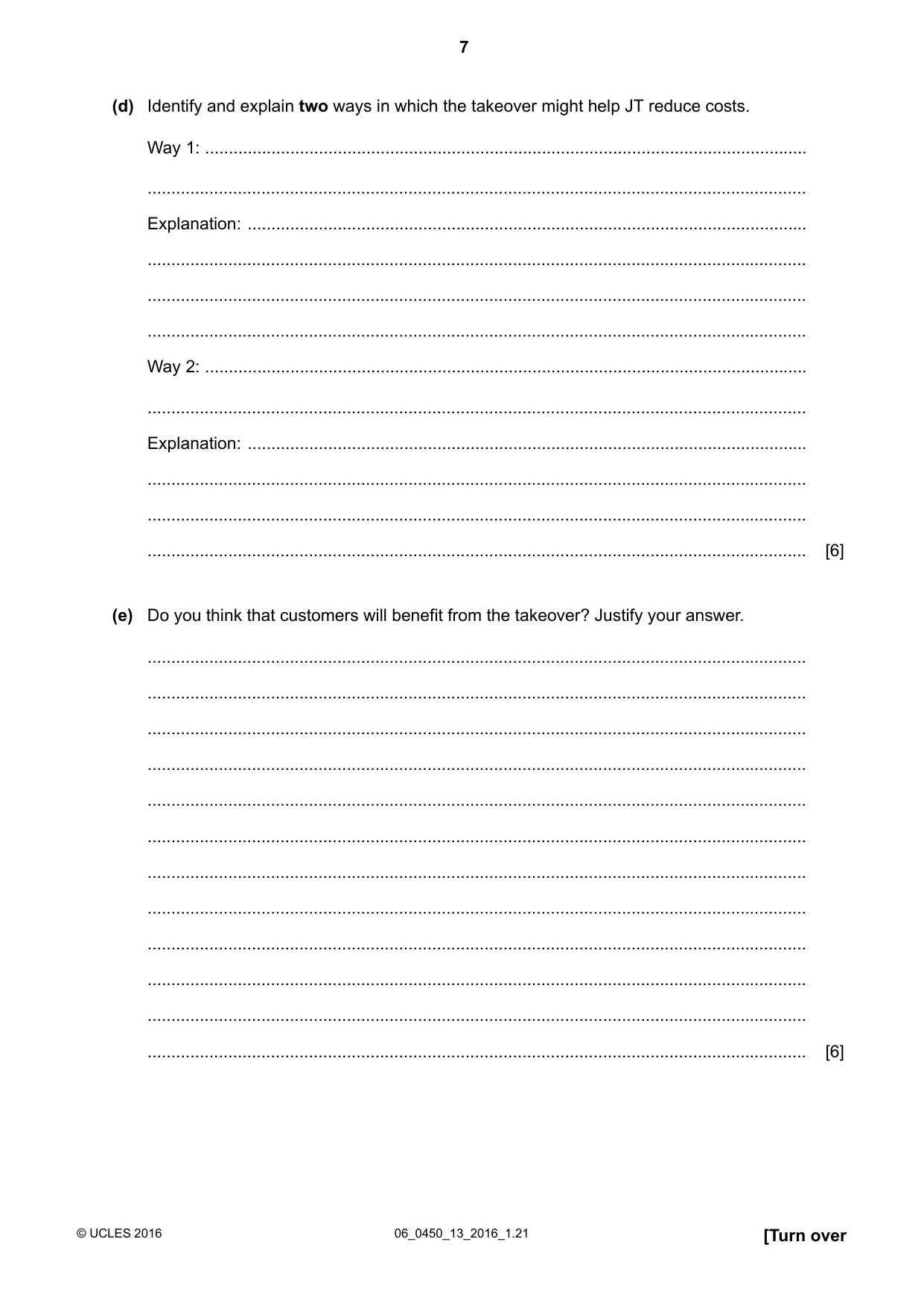
Identify and explain two ways in which the takeover might help JT reduce costs. (d) Way 1: … … Explanation: … … … … Way 2: … … Explanation: … … … … [6] Do you think that customers will benefit from the takeover? Justify your answer. (e) … … … … … … … … … … … … [6] [Turn over 06_0450_13_2016_1.21 © UCLES 2016 7
Question paper, page 8
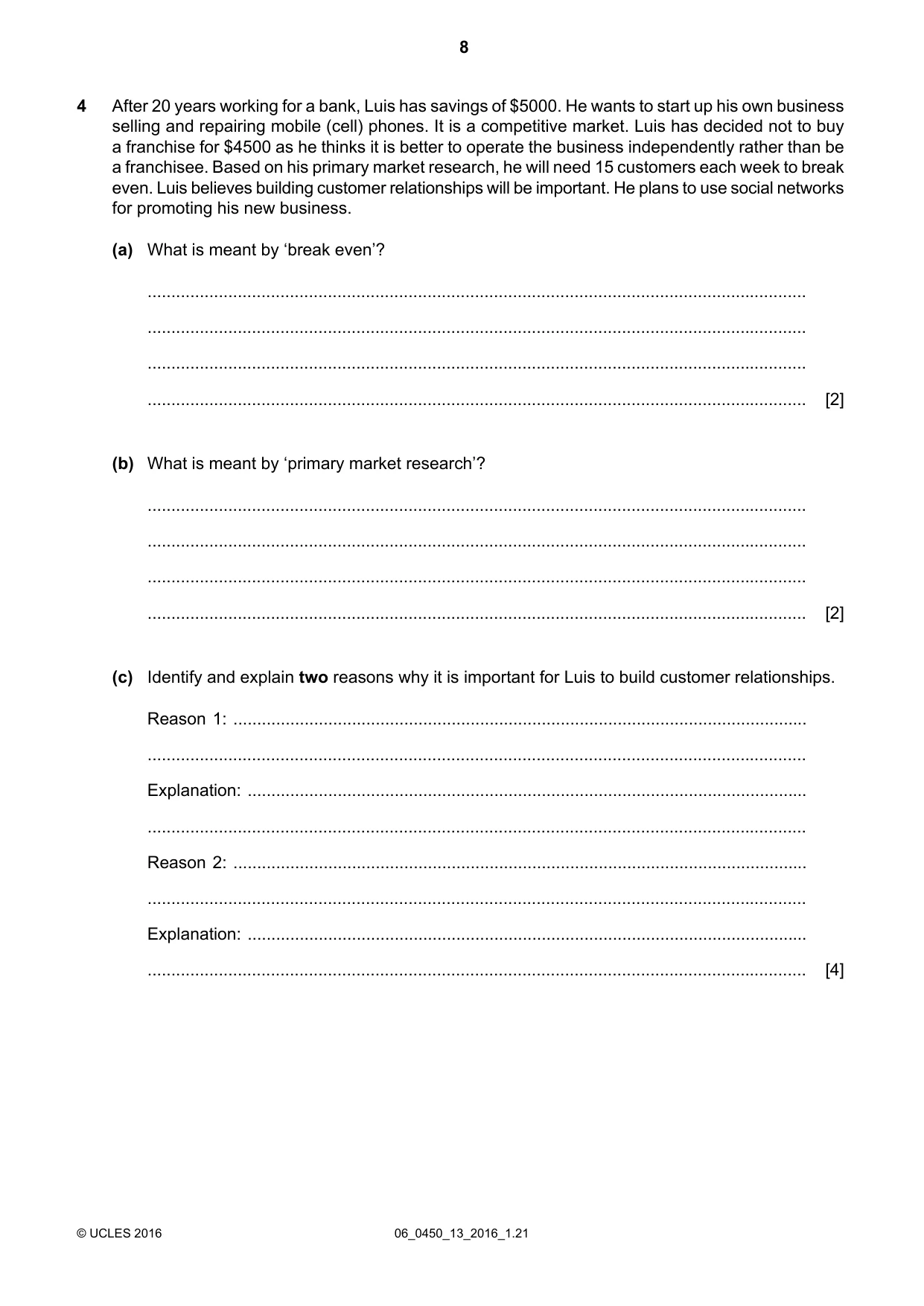
After 20 years working for a bank, Luis has savings of $5000. He wants to start up his own business selling and repairing mobile (cell) phones. It is a competitive market. Luis has decided not to buy 4 a franchise for $4500 as he thinks it is better to operate the business independently rather than be a franchisee. Based on his primary market research, he will need 15 customers each week to break even. Luis believes building customer relationships will be important. He plans to use social networks for promoting his new business. What is meant by ‘break even’? (a) … … … … [2] What is meant by ‘primary market research’? (b) … … … … [2] Identify and explain two reasons why it is important for Luis to build customer relationships. (c) Reason 1: … … Explanation: … … Reason 2: … … Explanation: … … [4] 06_0450_13_2016_1.21 © UCLES 2016 8
Question paper, page 9
Identify and explain two benefits to Luis’s business of using social networks for promotion. (d) Benefit 1: … … Explanation: … … … … Benefit 2: … … Explanation: … … … … [6] Do you agree with Luis’s decision not to become a franchisee? Justify your answer. (e) … … … … … … … … … … … … [6] 06_0450_13_2016_1.21 © UCLES 2016 9
Question paper, page 10
BLANK PAGE 06_0450_13_2016_1.21 © UCLES 2016 10
Question paper, page 11
BLANK PAGE 06_0450_13_2016_1.21 © UCLES 2016 11
Question paper, page 12
BLANK PAGE Permission to reproduce items where third-party owned material protected by copyright is included has been sought and cleared where possible. Every reasonable effort has been made by the publisher (UCLES) to trace copyright holders, but if any items requiring clearance have unwittingly been included, the publisher will be pleased to make amends at the earliest possible opportunity. To avoid the issue of disclosure of answer-related information to candidates, all copyright acknowledgements are reproduced online in the Cambridge International Examinations Copyright Acknowledgements Booklet. This is produced for each series of examinations and is freely available to download at www.cie.org.ukafter the live examination series. Cambridge International Examinations is part of the Cambridge Assessment Group. Cambridge Assessment is the brand name of University of Cambridge Local Examinations Syndicate (UCLES), which is itself a department of the University of Cambridge. 06_0450_13_2016_1.21 © UCLES 2016 12
Mark scheme, page 1
® IGCSE is the registered trademark of Cambridge International Examinations. This syllabus is approved for use in England, Wales and Northern Ireland as a Cambridge International Level 1/Level 2 Certificate. This document consists of 13 printed pages. © UCLES 2016 [Turn over Cambridge International Examinations Cambridge International General Certificate of Secondary Education BUSINESS STUDIES 0450/13 Paper 1 Short Answer/Structured Response May/June 2016 MARK SCHEME Maximum Mark: 80 Published This mark scheme is published as an aid to teachers and candidates, to indicate the requirements of the examination. It shows the basis on which Examiners were instructed to award marks. It does not indicate the details of the discussions that took place at an Examiners’ meeting before marking began, which would have considered the acceptability of alternative answers. Mark schemes should be read in conjunction with the question paper and the Principal Examiner Report for Teachers. Cambridge will not enter into discussions about these mark schemes. Cambridge is publishing the mark schemes for the May/June 2016 series for most Cambridge IGCSE®, Cambridge International A and AS Level components and some Cambridge O Level components.
Mark scheme, page 2
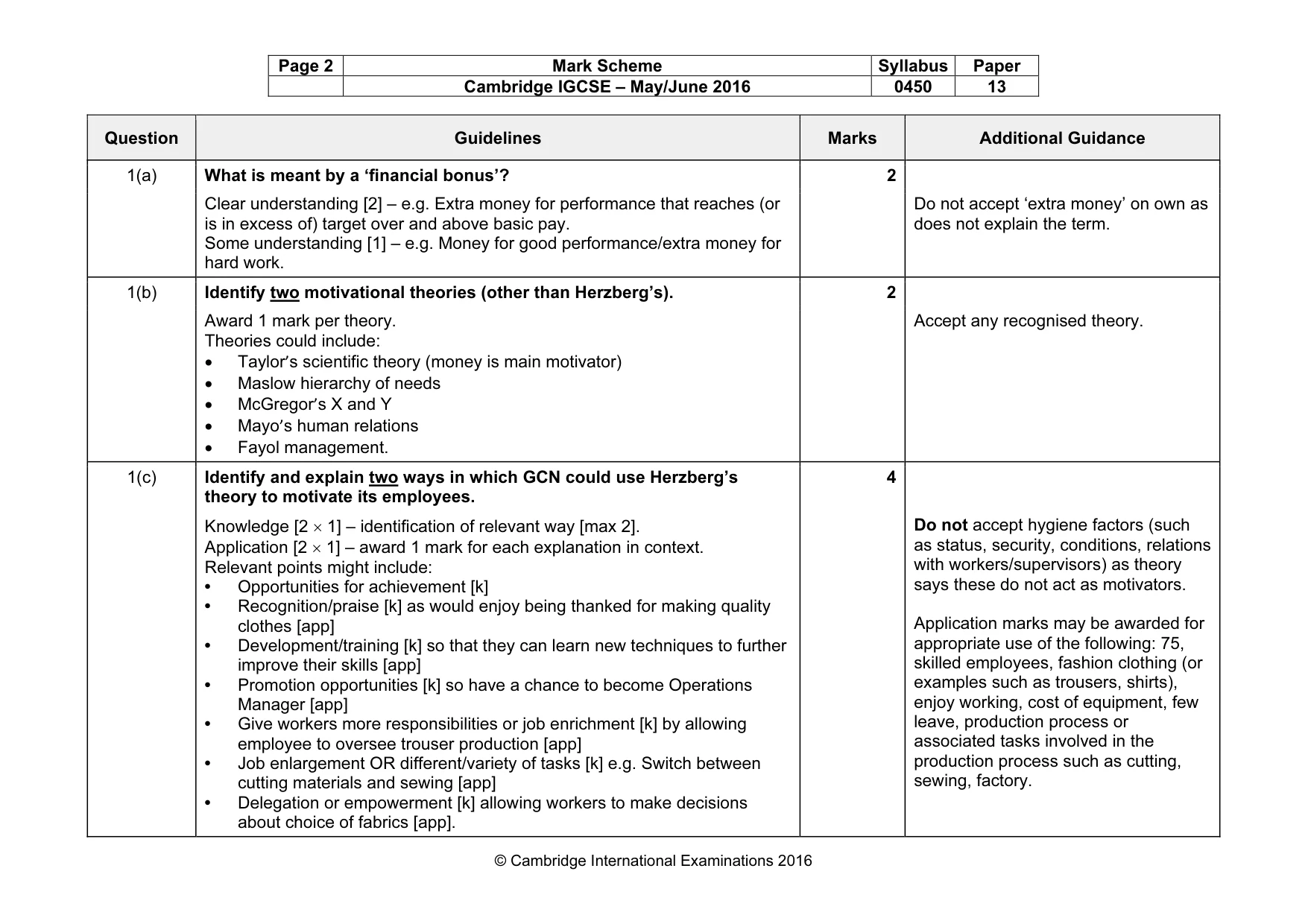
Page 2 Mark Scheme Syllabus Paper Cambridge IGCSE – May/June 2016 0450 13 © Cambridge International Examinations 2016 Question Guidelines Marks Additional Guidance 1(a) What is meant by a ‘financial bonus’? 2 Clear understanding [2] – e.g. Extra money for performance that reaches (or is in excess of) target over and above basic pay. Some understanding [1] – e.g. Money for good performance/extra money for hard work. Do not accept ‘extra money’ on own as does not explain the term. 1(b) Identify two motivational theories (other than Herzberg’s). 2 Award 1 mark per theory. Theories could include: • Taylor’s scientific theory (money is main motivator) • Maslow hierarchy of needs • McGregor’s X and Y • Mayo’s human relations • Fayol management. Accept any recognised theory. 1(c) Identify and explain two ways in which GCN could use Herzberg’s theory to motivate its employees. 4 Knowledge [2 × 1] – identification of relevant way [max 2]. Application [2 × 1] – award 1 mark for each explanation in context. Relevant points might include: • Opportunities for achievement [k] • Recognition/praise [k] as would enjoy being thanked for making quality clothes [app] • Development/training [k] so that they can learn new techniques to further improve their skills [app] • Promotion opportunities [k] so have a chance to become Operations Manager [app] • Give workers more responsibilities or job enrichment [k] by allowing employee to oversee trouser production [app] • Job enlargement OR different/variety of tasks [k] e.g. Switch between cutting materials and sewing [app] • Delegation or empowerment [k] allowing workers to make decisions about choice of fabrics [app]. Do not accept hygiene factors (such as status, security, conditions, relations with workers/supervisors) as theory says these do not act as motivators. Application marks may be awarded for appropriate use of the following: 75, skilled employees, fashion clothing (or examples such as trousers, shirts), enjoy working, cost of equipment, few leave, production process or associated tasks involved in the production process such as cutting, sewing, factory.
Mark scheme, page 3
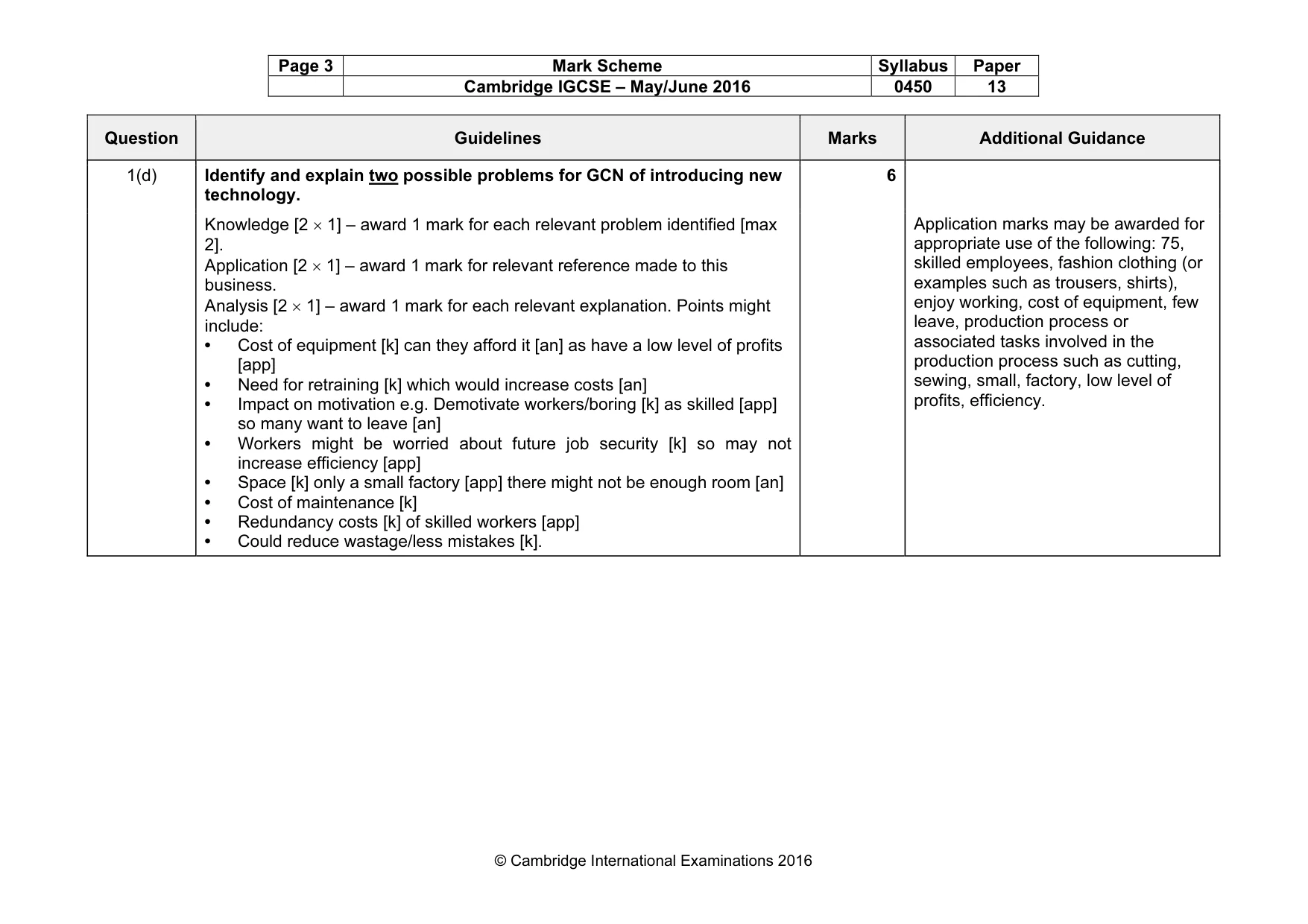
Page 3 Mark Scheme Syllabus Paper Cambridge IGCSE – May/June 2016 0450 13 © Cambridge International Examinations 2016 Question Guidelines Marks Additional Guidance 1(d) Identify and explain two possible problems for GCN of introducing new technology. 6 Knowledge [2 × 1] – award 1 mark for each relevant problem identified [max 2]. Application [2 × 1] – award 1 mark for relevant reference made to this business. Analysis [2 × 1] – award 1 mark for each relevant explanation. Points might include: • Cost of equipment [k] can they afford it [an] as have a low level of profits [app] • Need for retraining [k] which would increase costs [an] • Impact on motivation e.g. Demotivate workers/boring [k] as skilled [app] so many want to leave [an] • Workers might be worried about future job security [k] so may not increase efficiency [app] • Space [k] only a small factory [app] there might not be enough room [an] • Cost of maintenance [k] • Redundancy costs [k] of skilled workers [app] • Could reduce wastage/less mistakes [k]. Application marks may be awarded for appropriate use of the following: 75, skilled employees, fashion clothing (or examples such as trousers, shirts), enjoy working, cost of equipment, few leave, production process or associated tasks involved in the production process such as cutting, sewing, small, factory, low level of profits, efficiency.
Mark scheme, page 4
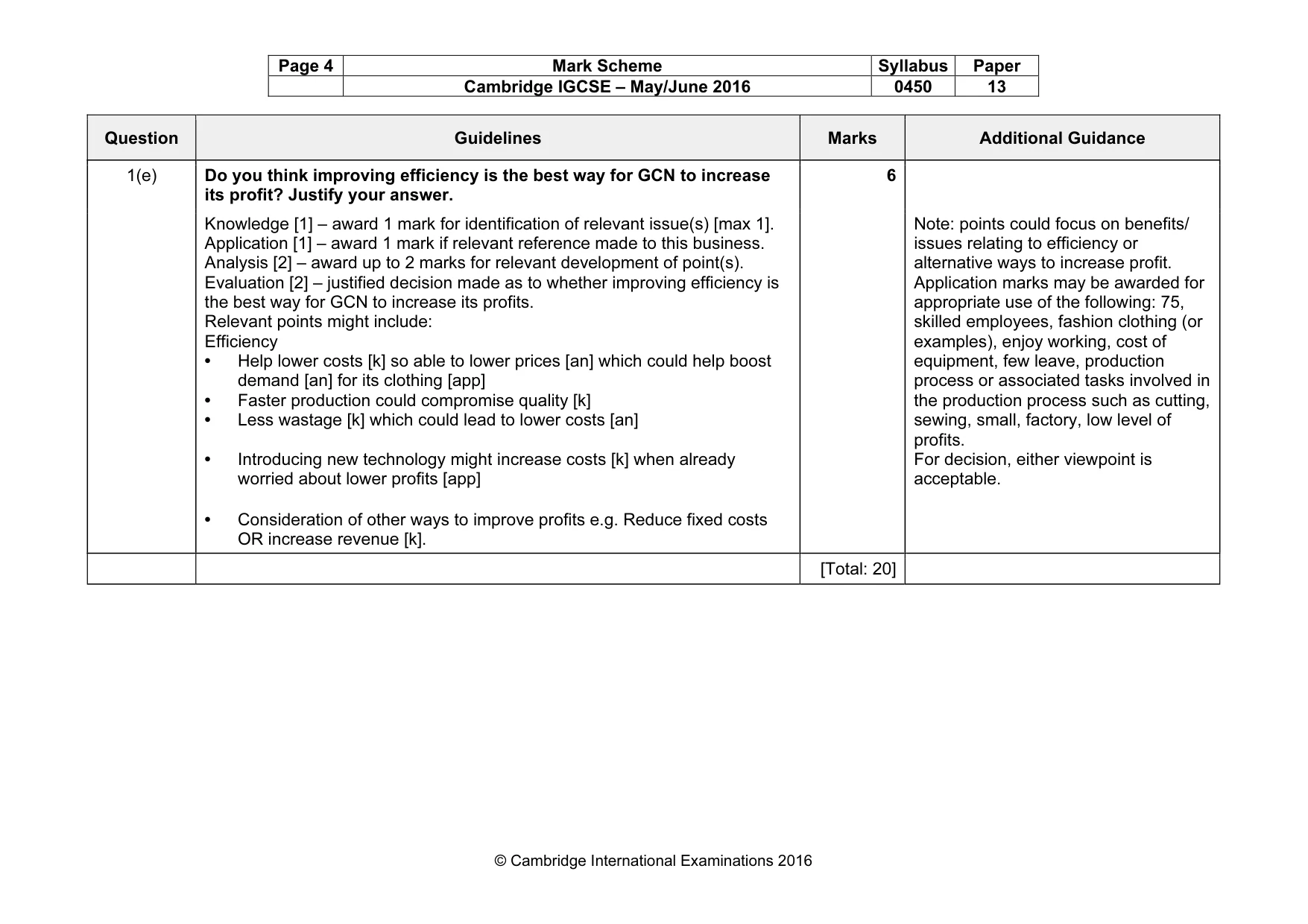
Page 4 Mark Scheme Syllabus Paper Cambridge IGCSE – May/June 2016 0450 13 © Cambridge International Examinations 2016 Question Guidelines Marks Additional Guidance 1(e) Do you think improving efficiency is the best way for GCN to increase its profit? Justify your answer. 6 Knowledge [1] – award 1 mark for identification of relevant issue(s) [max 1]. Application [1] – award 1 mark if relevant reference made to this business. Analysis [2] – award up to 2 marks for relevant development of point(s). Evaluation [2] – justified decision made as to whether improving efficiency is the best way for GCN to increase its profits. Relevant points might include: Efficiency • Help lower costs [k] so able to lower prices [an] which could help boost demand [an] for its clothing [app] • Faster production could compromise quality [k] • Less wastage [k] which could lead to lower costs [an] • Introducing new technology might increase costs [k] when already worried about lower profits [app] • Consideration of other ways to improve profits e.g. Reduce fixed costs OR increase revenue [k]. Note: points could focus on benefits/ issues relating to efficiency or alternative ways to increase profit. Application marks may be awarded for appropriate use of the following: 75, skilled employees, fashion clothing (or examples), enjoy working, cost of equipment, few leave, production process or associated tasks involved in the production process such as cutting, sewing, small, factory, low level of profits. For decision, either viewpoint is acceptable. [Total: 20]
Mark scheme, page 5
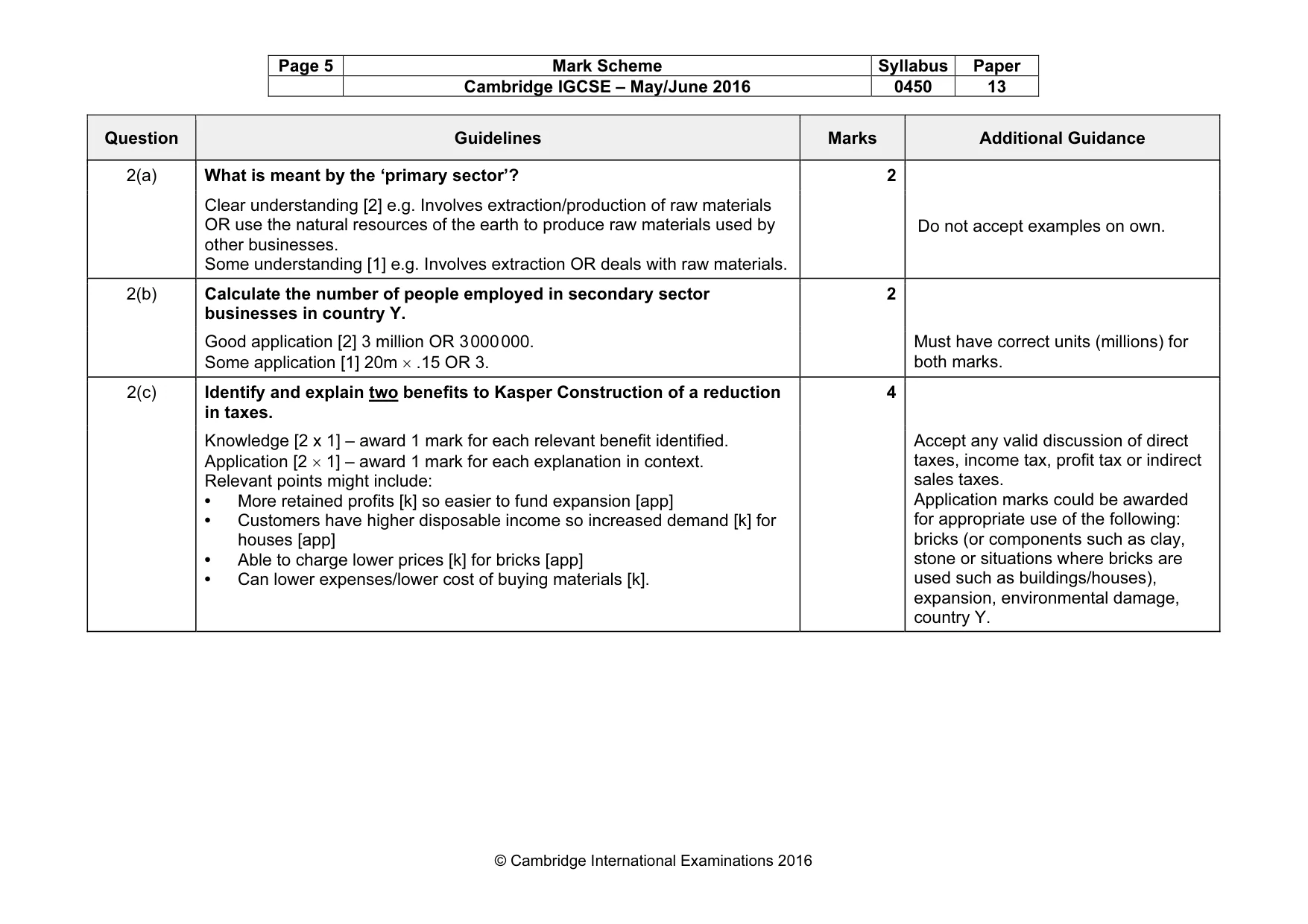
Page 5 Mark Scheme Syllabus Paper Cambridge IGCSE – May/June 2016 0450 13 © Cambridge International Examinations 2016 Question Guidelines Marks Additional Guidance 2(a) What is meant by the ‘primary sector’? 2 Clear understanding [2] e.g. Involves extraction/production of raw materials OR use the natural resources of the earth to produce raw materials used by other businesses. Some understanding [1] e.g. Involves extraction OR deals with raw materials. Do not accept examples on own. 2(b) Calculate the number of people employed in secondary sector businesses in country Y. 2 Good application [2] 3 million OR 3 000 000. Some application [1] 20m × .15 OR 3. Must have correct units (millions) for both marks. 2(c) Identify and explain two benefits to Kasper Construction of a reduction in taxes. 4 Knowledge [2 x 1] – award 1 mark for each relevant benefit identified. Application [2 × 1] – award 1 mark for each explanation in context. Relevant points might include: • More retained profits [k] so easier to fund expansion [app] • Customers have higher disposable income so increased demand [k] for houses [app] • Able to charge lower prices [k] for bricks [app] • Can lower expenses/lower cost of buying materials [k]. Accept any valid discussion of direct taxes, income tax, profit tax or indirect sales taxes. Application marks could be awarded for appropriate use of the following: bricks (or components such as clay, stone or situations where bricks are used such as buildings/houses), expansion, environmental damage, country Y.
Mark scheme, page 6
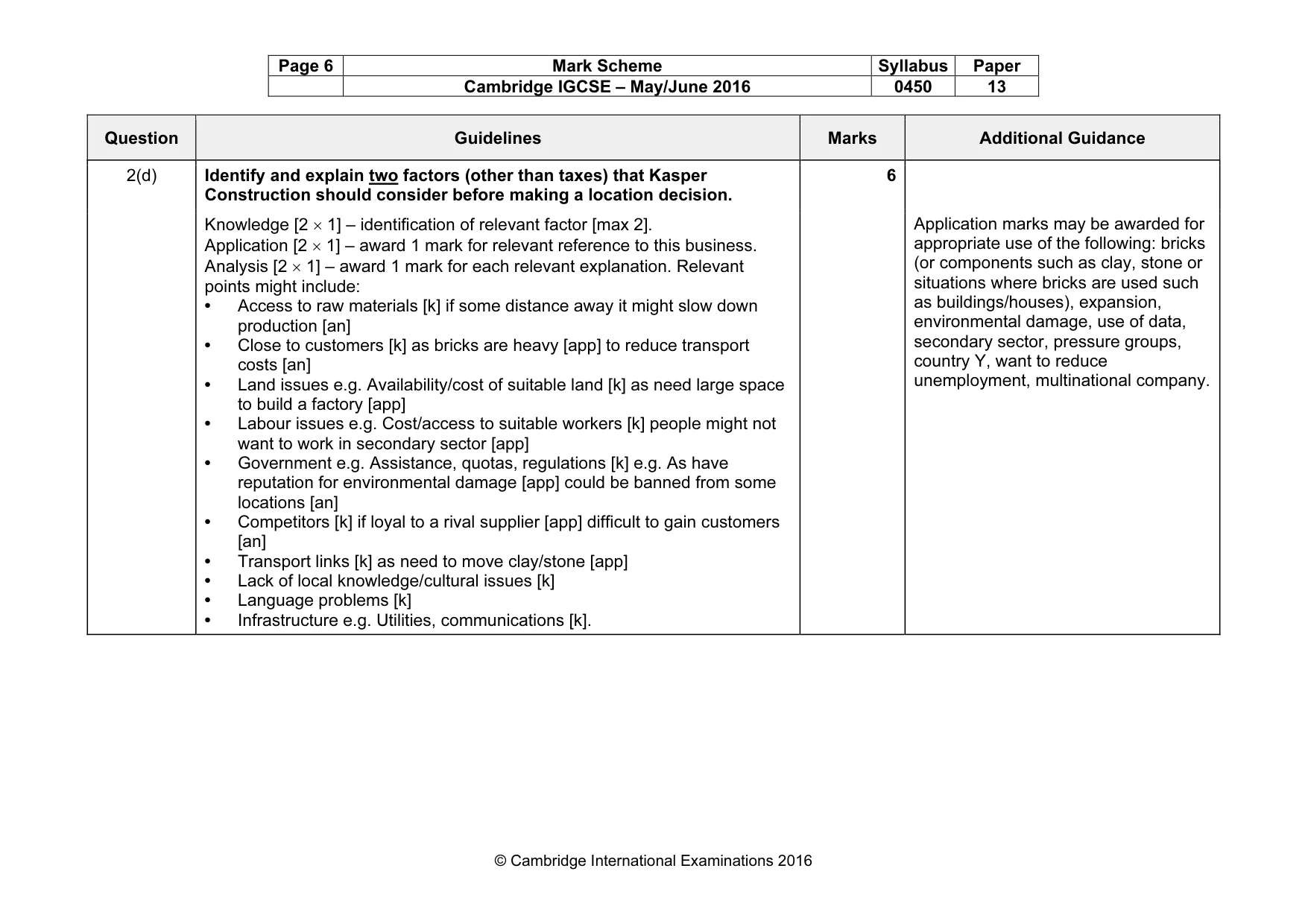
Page 6 Mark Scheme Syllabus Paper Cambridge IGCSE – May/June 2016 0450 13 © Cambridge International Examinations 2016 Question Guidelines Marks Additional Guidance 2(d) Identify and explain two factors (other than taxes) that Kasper Construction should consider before making a location decision. 6 Knowledge [2 × 1] – identification of relevant factor [max 2]. Application [2 × 1] – award 1 mark for relevant reference to this business. Analysis [2 × 1] – award 1 mark for each relevant explanation. Relevant points might include: • Access to raw materials [k] if some distance away it might slow down production [an] • Close to customers [k] as bricks are heavy [app] to reduce transport costs [an] • Land issues e.g. Availability/cost of suitable land [k] as need large space to build a factory [app] • Labour issues e.g. Cost/access to suitable workers [k] people might not want to work in secondary sector [app] • Government e.g. Assistance, quotas, regulations [k] e.g. As have reputation for environmental damage [app] could be banned from some locations [an] • Competitors [k] if loyal to a rival supplier [app] difficult to gain customers [an] • Transport links [k] as need to move clay/stone [app] • Lack of local knowledge/cultural issues [k] • Language problems [k] • Infrastructure e.g. Utilities, communications [k]. Application marks may be awarded for appropriate use of the following: bricks (or components such as clay, stone or situations where bricks are used such as buildings/houses), expansion, environmental damage, use of data, secondary sector, pressure groups, country Y, want to reduce unemployment, multinational company.
Mark scheme, page 7
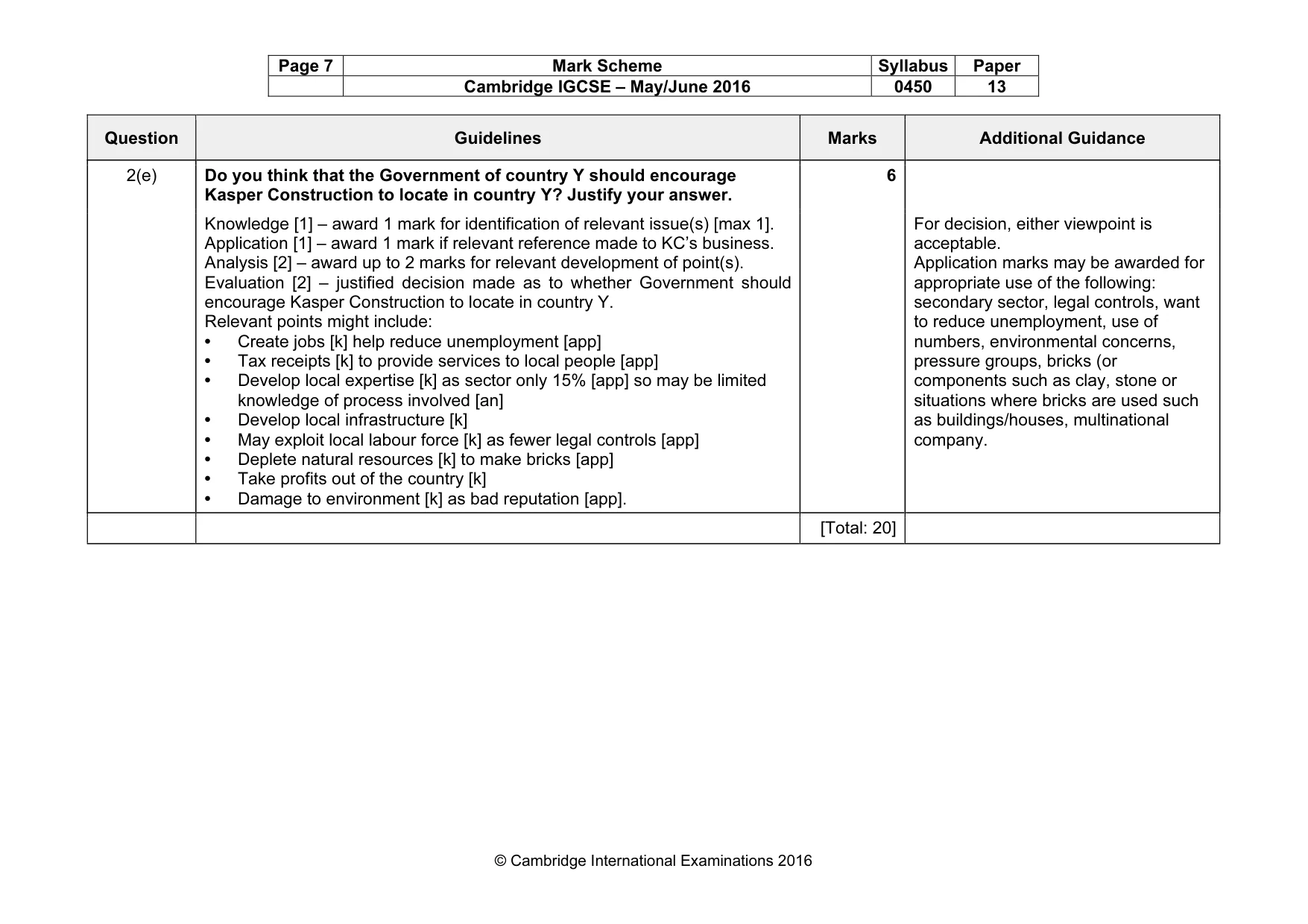
Page 7 Mark Scheme Syllabus Paper Cambridge IGCSE – May/June 2016 0450 13 © Cambridge International Examinations 2016 Question Guidelines Marks Additional Guidance 2(e) Do you think that the Government of country Y should encourage Kasper Construction to locate in country Y? Justify your answer. 6 Knowledge [1] – award 1 mark for identification of relevant issue(s) [max 1]. Application [1] – award 1 mark if relevant reference made to KC’s business. Analysis [2] – award up to 2 marks for relevant development of point(s). Evaluation [2] – justified decision made as to whether Government should encourage Kasper Construction to locate in country Y. Relevant points might include: • Create jobs [k] help reduce unemployment [app] • Tax receipts [k] to provide services to local people [app] • Develop local expertise [k] as sector only 15% [app] so may be limited knowledge of process involved [an] • Develop local infrastructure [k] • May exploit local labour force [k] as fewer legal controls [app] • Deplete natural resources [k] to make bricks [app] • Take profits out of the country [k] • Damage to environment [k] as bad reputation [app]. For decision, either viewpoint is acceptable. Application marks may be awarded for appropriate use of the following: secondary sector, legal controls, want to reduce unemployment, use of numbers, environmental concerns, pressure groups, bricks (or components such as clay, stone or situations where bricks are used such as buildings/houses, multinational company. [Total: 20]
Mark scheme, page 8
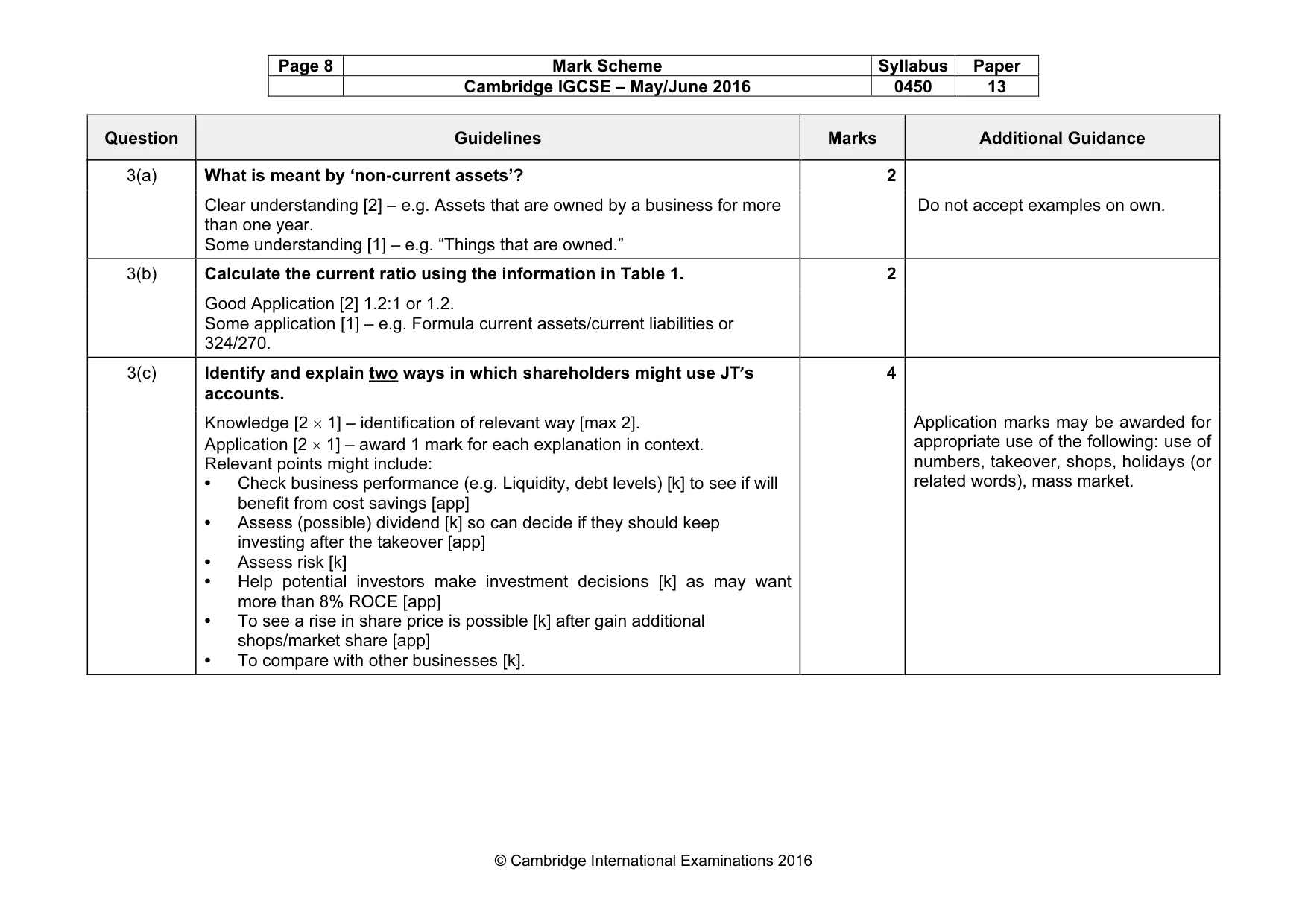
Page 8 Mark Scheme Syllabus Paper Cambridge IGCSE – May/June 2016 0450 13 © Cambridge International Examinations 2016 Question Guidelines Marks Additional Guidance 3(a) What is meant by ‘non-current assets’? 2 Clear understanding [2] – e.g. Assets that are owned by a business for more than one year. Some understanding [1] – e.g. “Things that are owned.” Do not accept examples on own. 3(b) Calculate the current ratio using the information in Table 1. 2 Good Application [2] 1.2:1 or 1.2. Some application [1] – e.g. Formula current assets/current liabilities or 324/270. 3(c) Identify and explain two ways in which shareholders might use JT’s accounts. 4 Knowledge [2 × 1] – identification of relevant way [max 2]. Application [2 × 1] – award 1 mark for each explanation in context. Relevant points might include: • Check business performance (e.g. Liquidity, debt levels) [k] to see if will benefit from cost savings [app] • Assess (possible) dividend [k] so can decide if they should keep investing after the takeover [app] • Assess risk [k] • Help potential investors make investment decisions [k] as may want more than 8% ROCE [app] • To see a rise in share price is possible [k] after gain additional shops/market share [app] • To compare with other businesses [k]. Application marks may be awarded for appropriate use of the following: use of numbers, takeover, shops, holidays (or related words), mass market.
Mark scheme, page 9
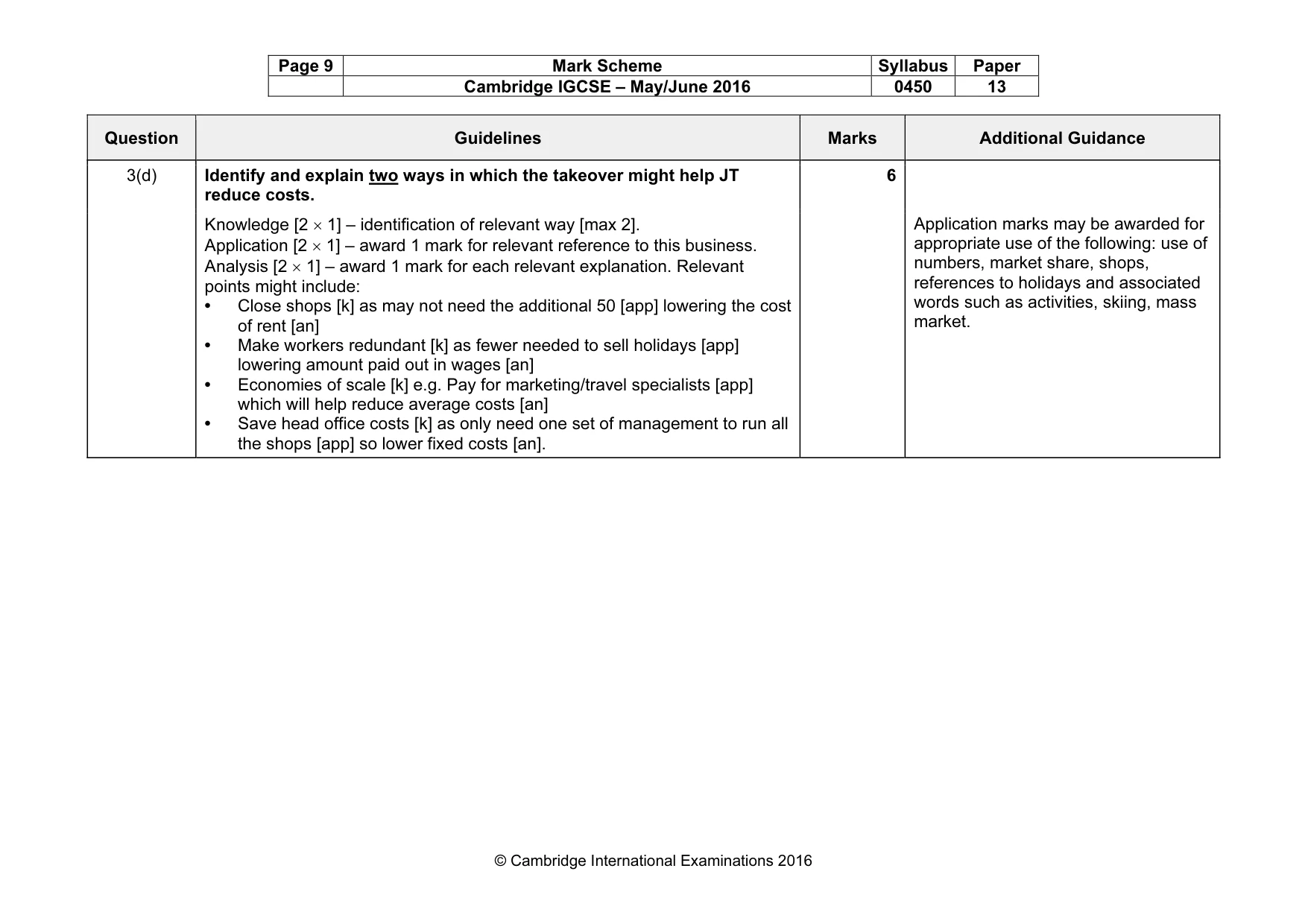
Page 9 Mark Scheme Syllabus Paper Cambridge IGCSE – May/June 2016 0450 13 © Cambridge International Examinations 2016 Question Guidelines Marks Additional Guidance 3(d) Identify and explain two ways in which the takeover might help JT reduce costs. 6 Knowledge [2 × 1] – identification of relevant way [max 2]. Application [2 × 1] – award 1 mark for relevant reference to this business. Analysis [2 × 1] – award 1 mark for each relevant explanation. Relevant points might include: • Close shops [k] as may not need the additional 50 [app] lowering the cost of rent [an] • Make workers redundant [k] as fewer needed to sell holidays [app] lowering amount paid out in wages [an] • Economies of scale [k] e.g. Pay for marketing/travel specialists [app] which will help reduce average costs [an] • Save head office costs [k] as only need one set of management to run all the shops [app] so lower fixed costs [an]. Application marks may be awarded for appropriate use of the following: use of numbers, market share, shops, references to holidays and associated words such as activities, skiing, mass market.
Mark scheme, page 10
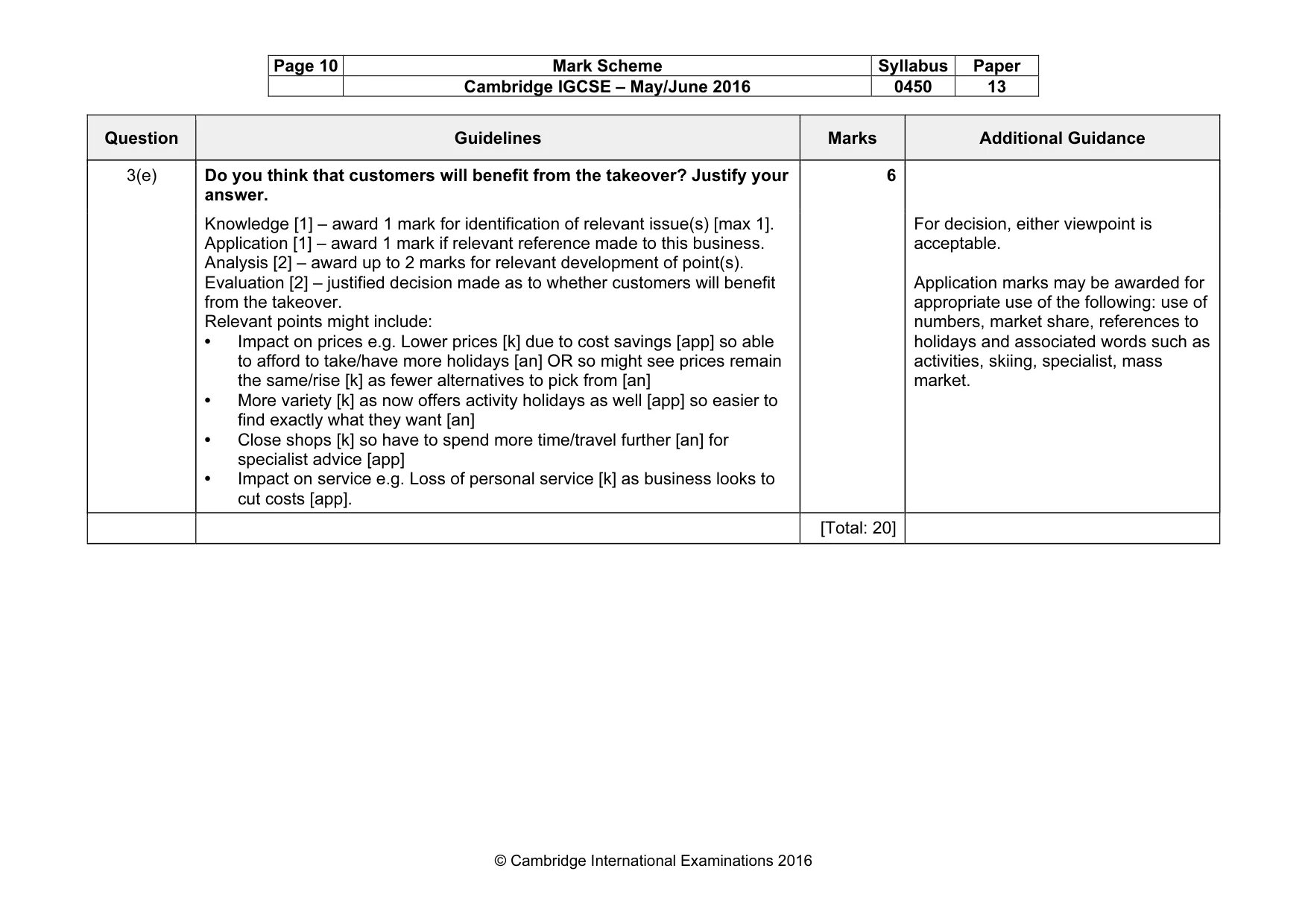
Page 10 Mark Scheme Syllabus Paper Cambridge IGCSE – May/June 2016 0450 13 © Cambridge International Examinations 2016 Question Guidelines Marks Additional Guidance 3(e) Do you think that customers will benefit from the takeover? Justify your answer. 6 Knowledge [1] – award 1 mark for identification of relevant issue(s) [max 1]. Application [1] – award 1 mark if relevant reference made to this business. Analysis [2] – award up to 2 marks for relevant development of point(s). Evaluation [2] – justified decision made as to whether customers will benefit from the takeover. Relevant points might include: • Impact on prices e.g. Lower prices [k] due to cost savings [app] so able to afford to take/have more holidays [an] OR so might see prices remain the same/rise [k] as fewer alternatives to pick from [an] • More variety [k] as now offers activity holidays as well [app] so easier to find exactly what they want [an] • Close shops [k] so have to spend more time/travel further [an] for specialist advice [app] • Impact on service e.g. Loss of personal service [k] as business looks to cut costs [app]. For decision, either viewpoint is acceptable. Application marks may be awarded for appropriate use of the following: use of numbers, market share, references to holidays and associated words such as activities, skiing, specialist, mass market. [Total: 20]
Mark scheme, page 11
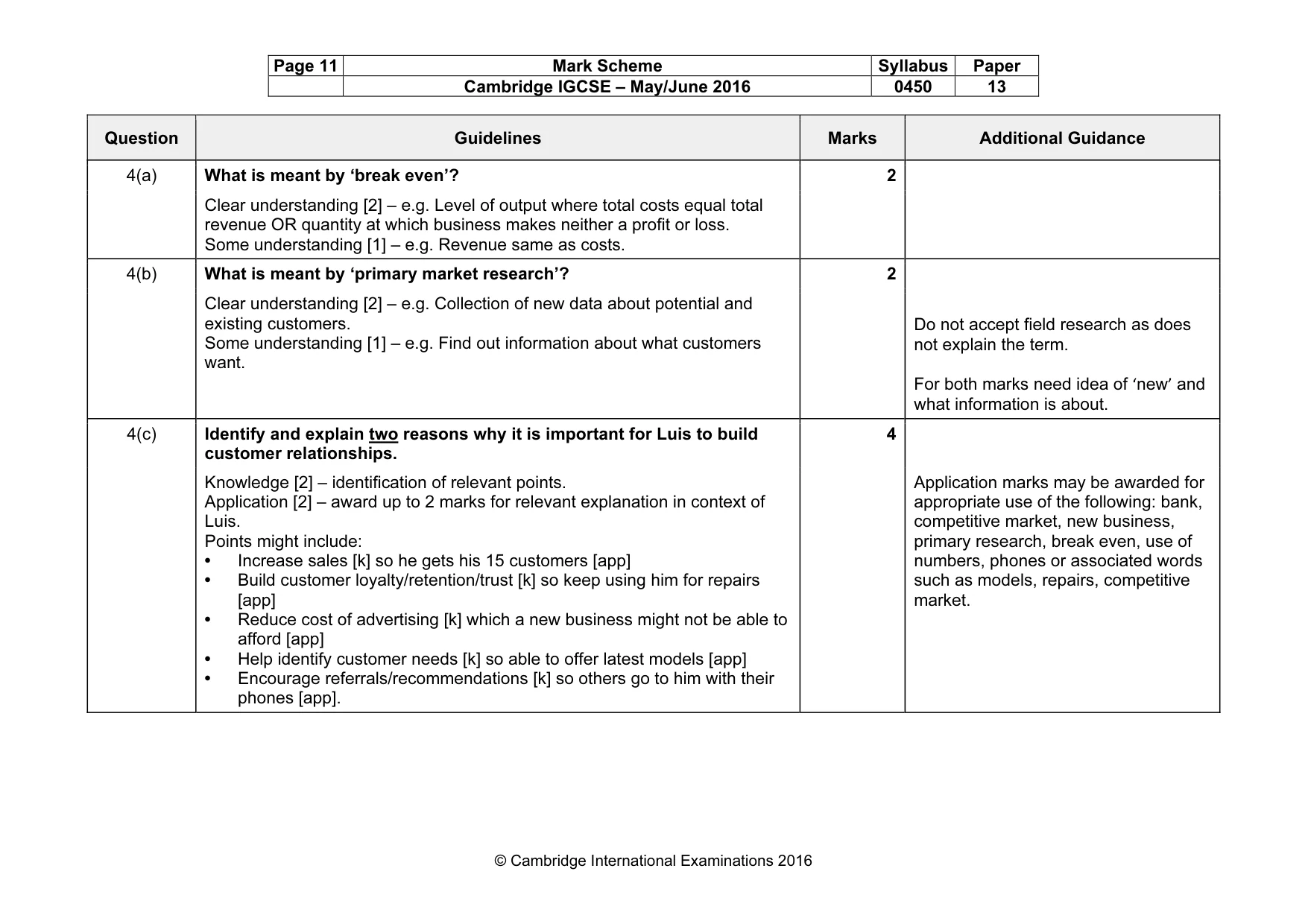
Page 11 Mark Scheme Syllabus Paper Cambridge IGCSE – May/June 2016 0450 13 © Cambridge International Examinations 2016 Question Guidelines Marks Additional Guidance 4(a) What is meant by ‘break even’? 2 Clear understanding [2] – e.g. Level of output where total costs equal total revenue OR quantity at which business makes neither a profit or loss. Some understanding [1] – e.g. Revenue same as costs. 4(b) What is meant by ‘primary market research’? 2 Clear understanding [2] – e.g. Collection of new data about potential and existing customers. Some understanding [1] – e.g. Find out information about what customers want. Do not accept field research as does not explain the term. For both marks need idea of ‘new’ and what information is about. 4(c) Identify and explain two reasons why it is important for Luis to build customer relationships. 4 Knowledge [2] – identification of relevant points. Application [2] – award up to 2 marks for relevant explanation in context of Luis. Points might include: • Increase sales [k] so he gets his 15 customers [app] • Build customer loyalty/retention/trust [k] so keep using him for repairs [app] • Reduce cost of advertising [k] which a new business might not be able to afford [app] • Help identify customer needs [k] so able to offer latest models [app] • Encourage referrals/recommendations [k] so others go to him with their phones [app]. Application marks may be awarded for appropriate use of the following: bank, competitive market, new business, primary research, break even, use of numbers, phones or associated words such as models, repairs, competitive market.
Mark scheme, page 12
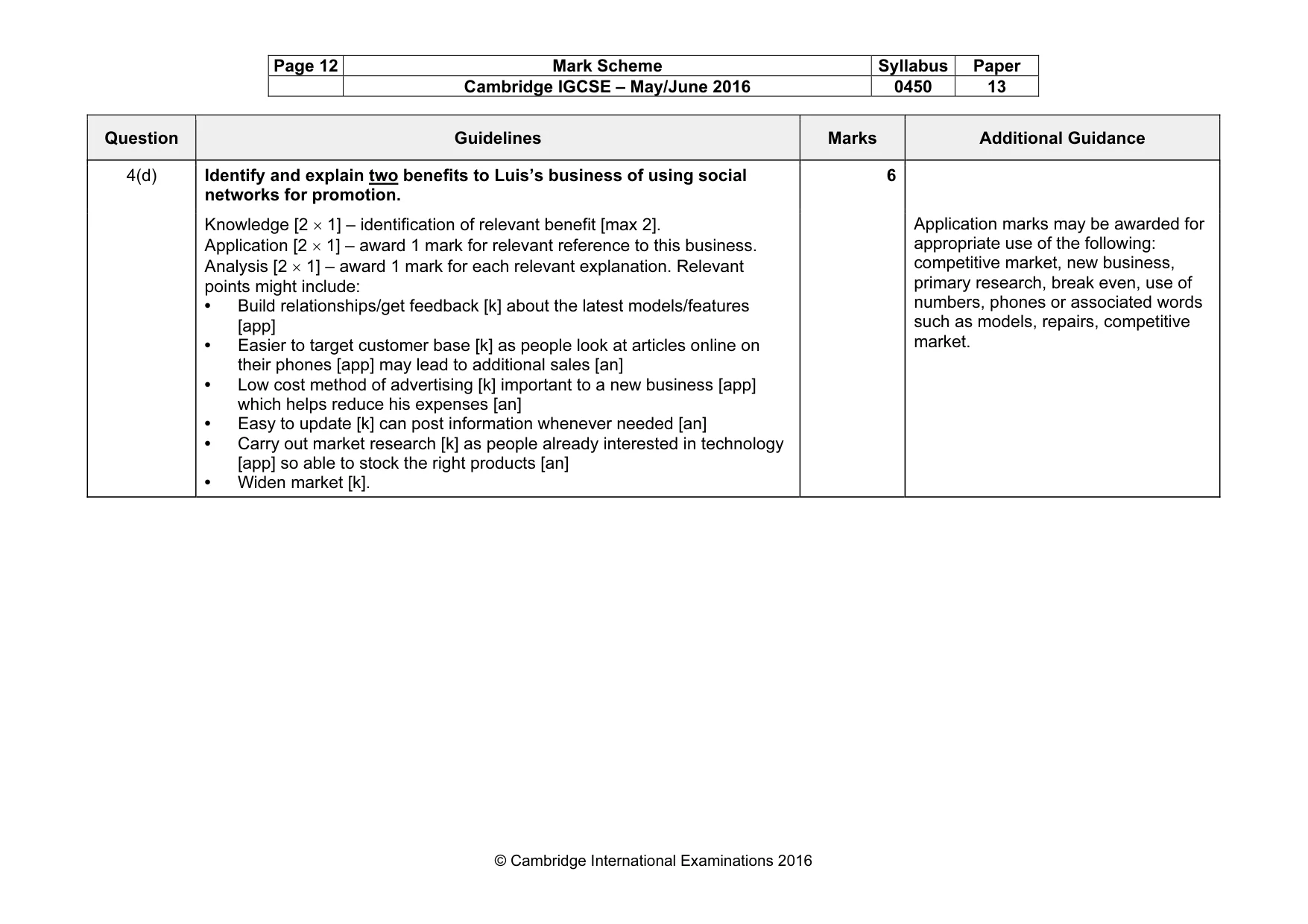
Page 12 Mark Scheme Syllabus Paper Cambridge IGCSE – May/June 2016 0450 13 © Cambridge International Examinations 2016 Question Guidelines Marks Additional Guidance 4(d) Identify and explain two benefits to Luis’s business of using social networks for promotion. 6 Knowledge [2 × 1] – identification of relevant benefit [max 2]. Application [2 × 1] – award 1 mark for relevant reference to this business. Analysis [2 × 1] – award 1 mark for each relevant explanation. Relevant points might include: • Build relationships/get feedback [k] about the latest models/features [app] • Easier to target customer base [k] as people look at articles online on their phones [app] may lead to additional sales [an] • Low cost method of advertising [k] important to a new business [app] which helps reduce his expenses [an] • Easy to update [k] can post information whenever needed [an] • Carry out market research [k] as people already interested in technology [app] so able to stock the right products [an] • Widen market [k]. Application marks may be awarded for appropriate use of the following: competitive market, new business, primary research, break even, use of numbers, phones or associated words such as models, repairs, competitive market.
Mark scheme, page 13
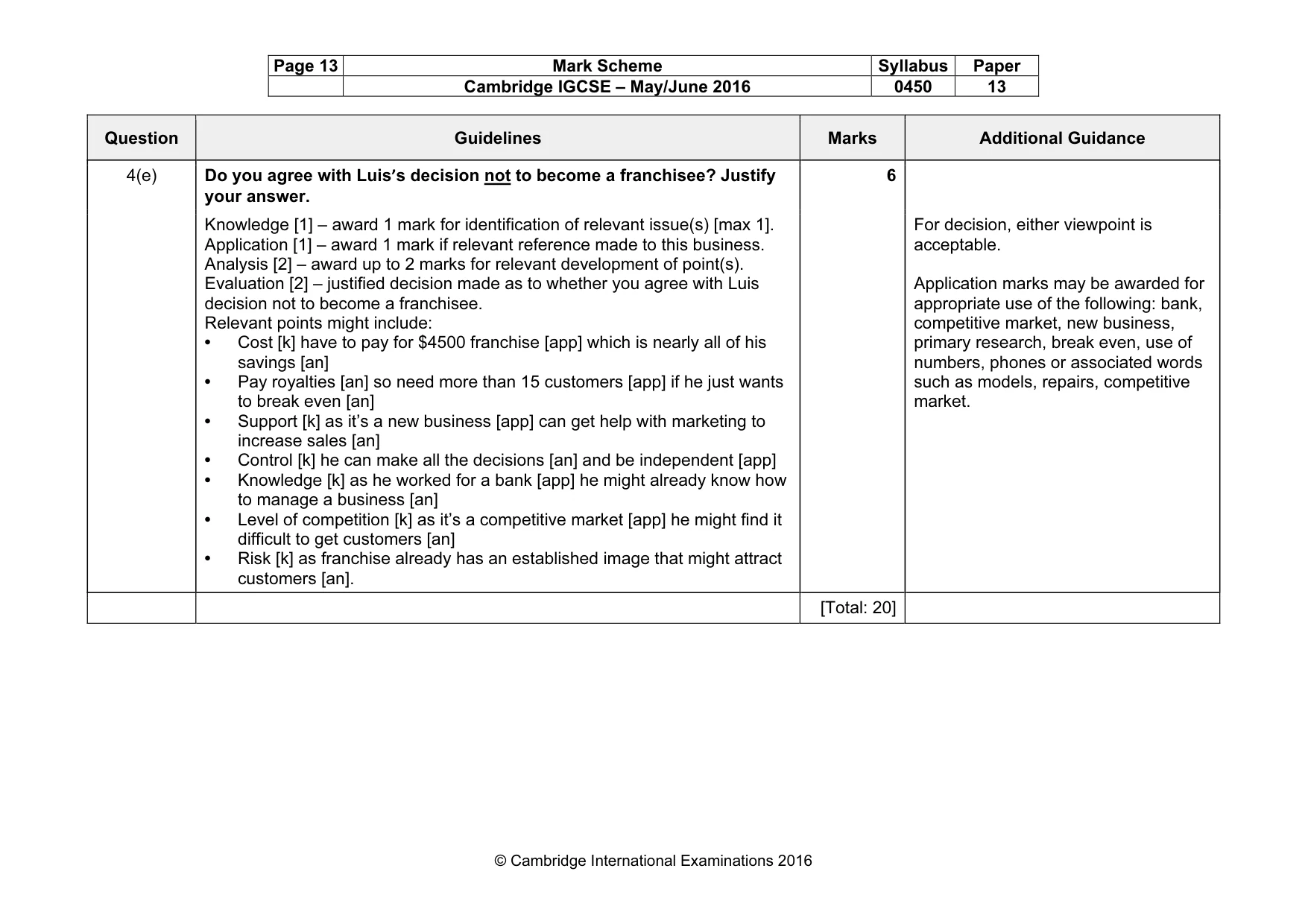
Page 13 Mark Scheme Syllabus Paper Cambridge IGCSE – May/June 2016 0450 13 © Cambridge International Examinations 2016 Question Guidelines Marks Additional Guidance 4(e) Do you agree with Luis’s decision not to become a franchisee? Justify your answer. 6 Knowledge [1] – award 1 mark for identification of relevant issue(s) [max 1]. Application [1] – award 1 mark if relevant reference made to this business. Analysis [2] – award up to 2 marks for relevant development of point(s). Evaluation [2] – justified decision made as to whether you agree with Luis decision not to become a franchisee. Relevant points might include: • Cost [k] have to pay for $4500 franchise [app] which is nearly all of his savings [an] • Pay royalties [an] so need more than 15 customers [app] if he just wants to break even [an] • Support [k] as it’s a new business [app] can get help with marketing to increase sales [an] • Control [k] he can make all the decisions [an] and be independent [app] • Knowledge [k] as he worked for a bank [app] he might already know how to manage a business [an] • Level of competition [k] as it’s a competitive market [app] he might find it difficult to get customers [an] • Risk [k] as franchise already has an established image that might attract customers [an]. For decision, either viewpoint is acceptable. Application marks may be awarded for appropriate use of the following: bank, competitive market, new business, primary research, break even, use of numbers, phones or associated words such as models, repairs, competitive market. [Total: 20]
What you needed in this session
Cambridge’s own grade thresholds for 2016 May/June, Paper 1 · Variant 3. A higher threshold means an easier paper — the bar moves with how the cohort did.