Cambridge IGCSE Business Studies 0450 — 2016 May/June Paper 1 · Variant 1
0450/11/M/J/16 · 80 marks · ≈90 min
The question paper and its mark scheme, free to read here and free to download. This is Cambridge’s own paper, exactly as it was sat.
Question paper12 pages



Mark scheme11 pages
Answers below. Sit the paper first if you are practising.
Paper as text
Question paper, page 1
Cambridge International Examinations Cambridge International General Certificate of Secondary Education 0450/11 May/June 2016 1 hour 30 minutes BUSINESS STUDIES Paper 1 Candidates answer on the Question Paper. No Additional Materials are required. READ THESE INSTRUCTIONS FIRST Write your Centre number, candidate number and name in the spaces at the top of this page. Write in dark blue or black pen. You may use an HB pencil for any diagrams, graphs or rough working. Do not use staples, paper clips, glue or correction fluid. DO NOT WRITE IN ANY BARCODES. Answer all questions. The businesses described in this question paper are entirely fictitious. At the end of the examination, fasten all your work securely together. The number of marks is given in brackets [ ] at the end of each question or part question. The total number of marks for this paper is 80. The syllabus is approved for use in England, Wales and Northern Ireland as a Cambridge International Level 1/Level 2 Certificate. This document consists of 9 printed pages and 3 blank pages. [Turn over 06_0450_11_2016_1.24 © UCLES 2016 *6739072195*
Question paper, page 2
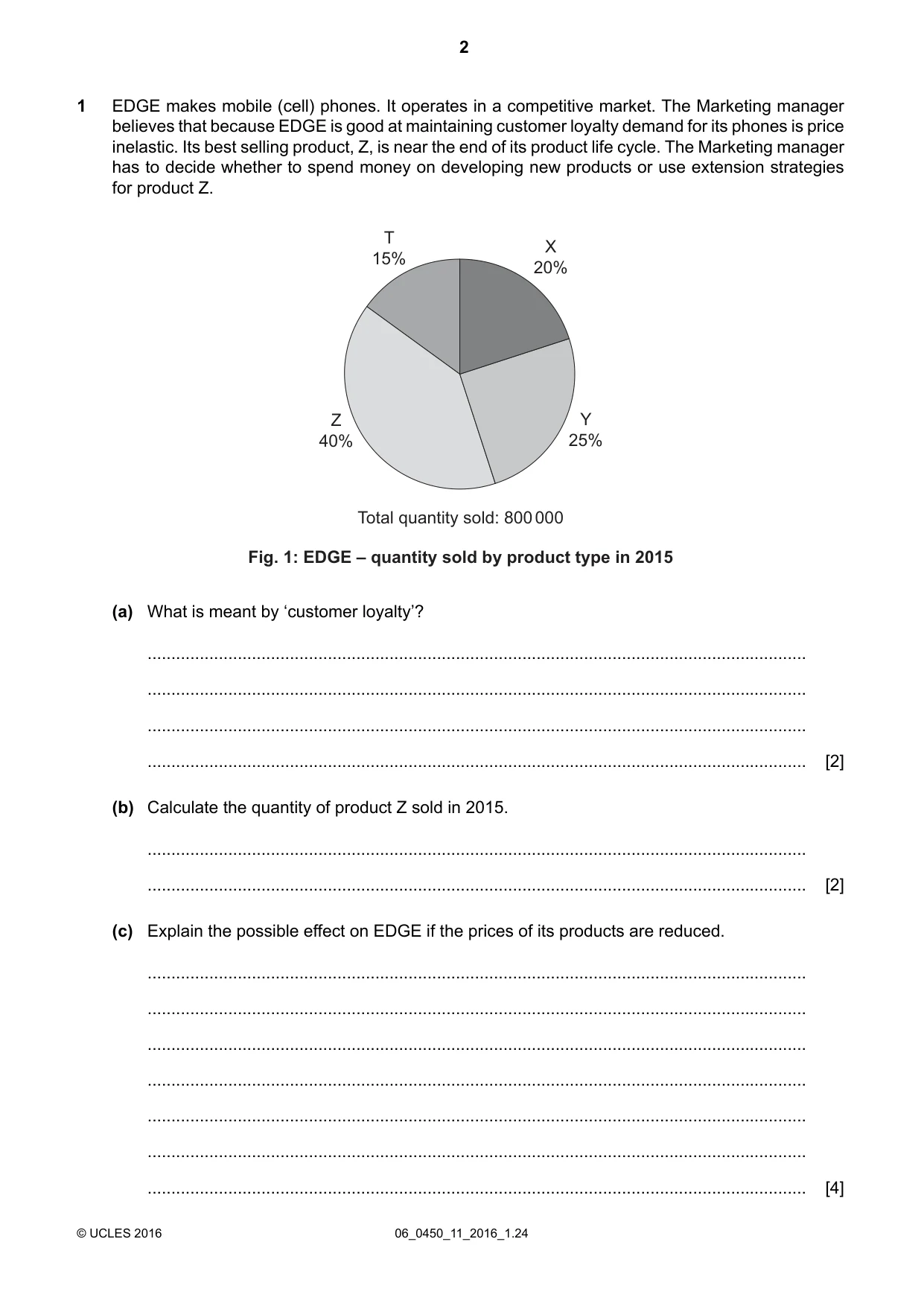
EDGE makes mobile (cell) phones. It operates in a competitive market. The Marketing manager believes that because EDGE is good at maintaining customer loyalty demand for its phones is price 1 inelastic. Its best selling product, Z, is near the end of its product life cycle. The Marketing manager has to decide whether to spend money on developing new products or use extension strategies for product Z. X 20% Y 25% Z 40% T 15% Total quantity sold: 800 000 Fig. 1: EDGE – quantity sold by product type in 2015 What is meant by ‘customer loyalty’? (a) … … … … [2] Calculate the quantity of product Z sold in 2015. (b) … … [2] Explain the possible effect on EDGE if the prices of its products are reduced. (c) … … … … … … … [4] 06_0450_11_2016_1.24 © UCLES 2016 2
Question paper, page 3
Identify and explain two advantages to EDGE of developing new products. (d) Advantage 1: … … Explanation: … … … … Advantage 2: … … Explanation: … … … … [6] Explain two extension strategies that EDGE could use for product Z. Recommend which one of the two strategies it should choose. Justify your answer. (e) … … … … … … … … … … … … [6] [Turn over 06_0450_11_2016_1.24 © UCLES 2016 3
Question paper, page 4
Bushall is a farm. This primary sector business grows award-winning fruits such as pineapples and bananas. Bushall has 10 full-time and 50 part-time employees. All part-time job vacancies are 2 advertised on its website. The Government has introduced legal controls for employment including a minimum wage of $8.50 per hour and a limit on the number of hours an employee can work each week. The farm manager has said to Bushall’s owners: ‘Taylor’s theory of motivation might not work. Our team of employees enjoy what they do. These laws are not good for our employees or our business!’ Identify two examples (other than farming) of business activity in the primary sector. (a) Example 1: … Example 2: … [2] Identify two ways (other than its website) that Bushall could use to advertise job vacancies. (b) Way 1: … Way 2: … [2] Identify and explain two possible reasons why ‘Taylor’s theory of motivation might not work’ at Bushall. (c) Reason 1: … … Explanation: … … Reason 2: … … Explanation: … … [4] 06_0450_11_2016_1.24 © UCLES 2016 4
Question paper, page 5
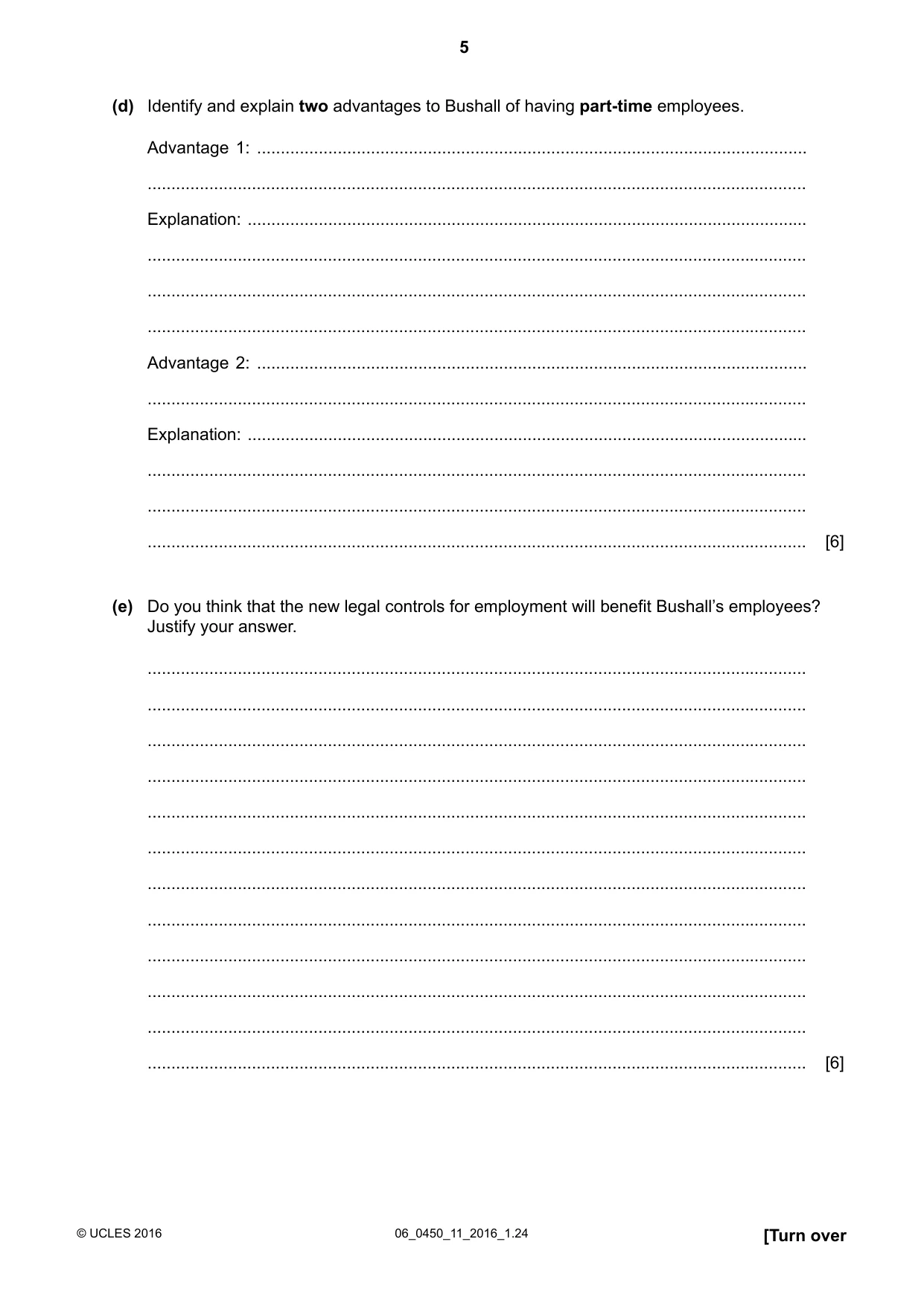
Identify and explain two advantages to Bushall of having part-time employees. (d) Advantage 1: … … Explanation: … … … … Advantage 2: … … Explanation: … … … … [6] Do you think that the new legal controls for employment will benefit Bushall’s employees? Justify your answer. (e) … … … … … … … … … … … … [6] [Turn over 06_0450_11_2016_1.24 © UCLES 2016 5
Question paper, page 6
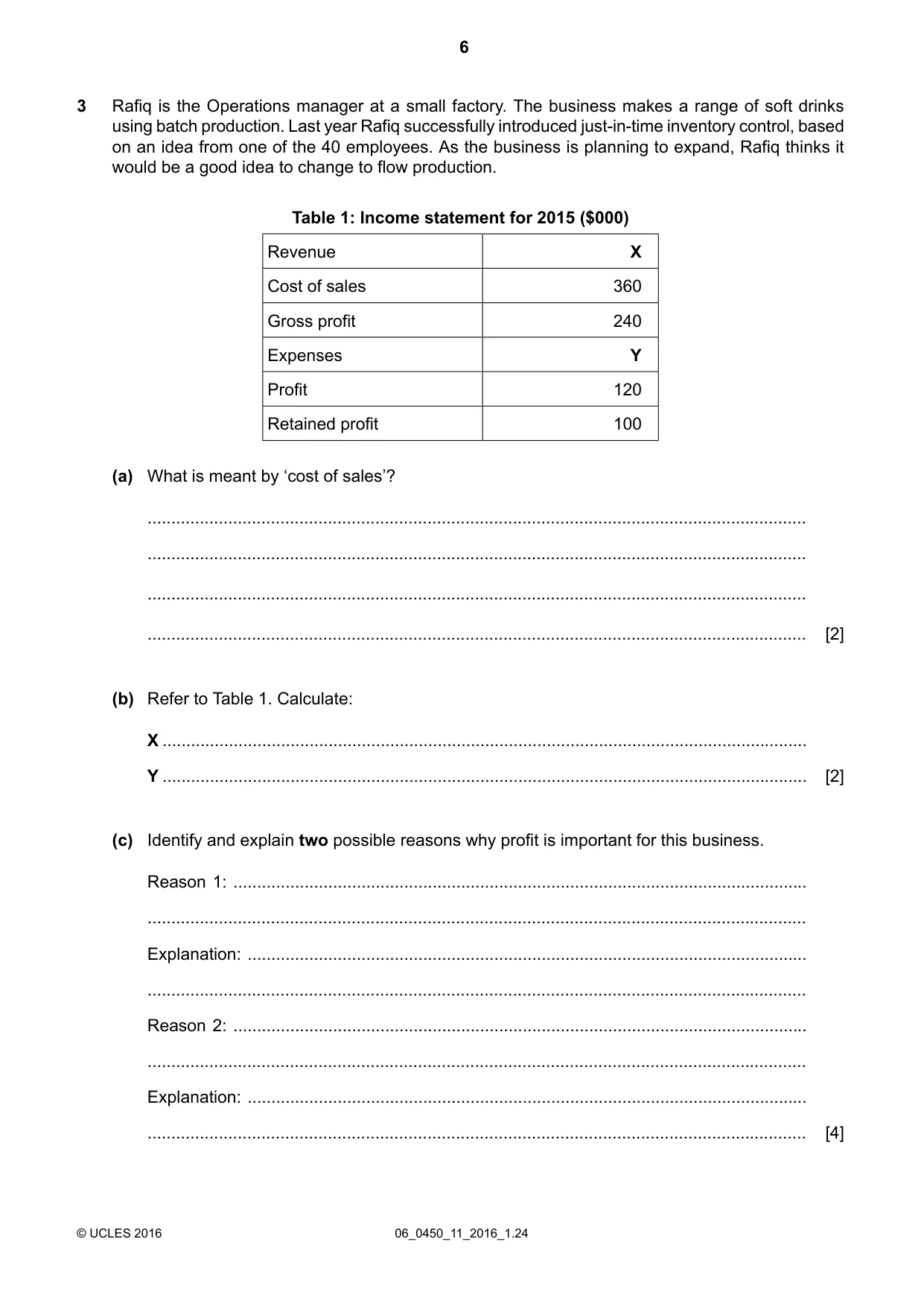
Rafiq is the Operations manager at a small factory. The business makes a range of soft drinks using batch production. Last year Rafiq successfully introduced just-in-time inventory control, based 3 on an idea from one of the 40 employees. As the business is planning to expand, Rafiq thinks it would be a good idea to change to flow production. Table 1: Income statement for 2015 ($000) X Revenue 360 Cost of sales 240 Gross profit Y Expenses 120 Profit 100 Retained profit What is meant by ‘cost of sales’? (a) … … … … [2] Refer to Table 1. Calculate: (b) X … Y … [2] Identify and explain two possible reasons why profit is important for this business. (c) Reason 1: … … Explanation: … … Reason 2: … … Explanation: … … [4] 06_0450_11_2016_1.24 © UCLES 2016 6
Question paper, page 7
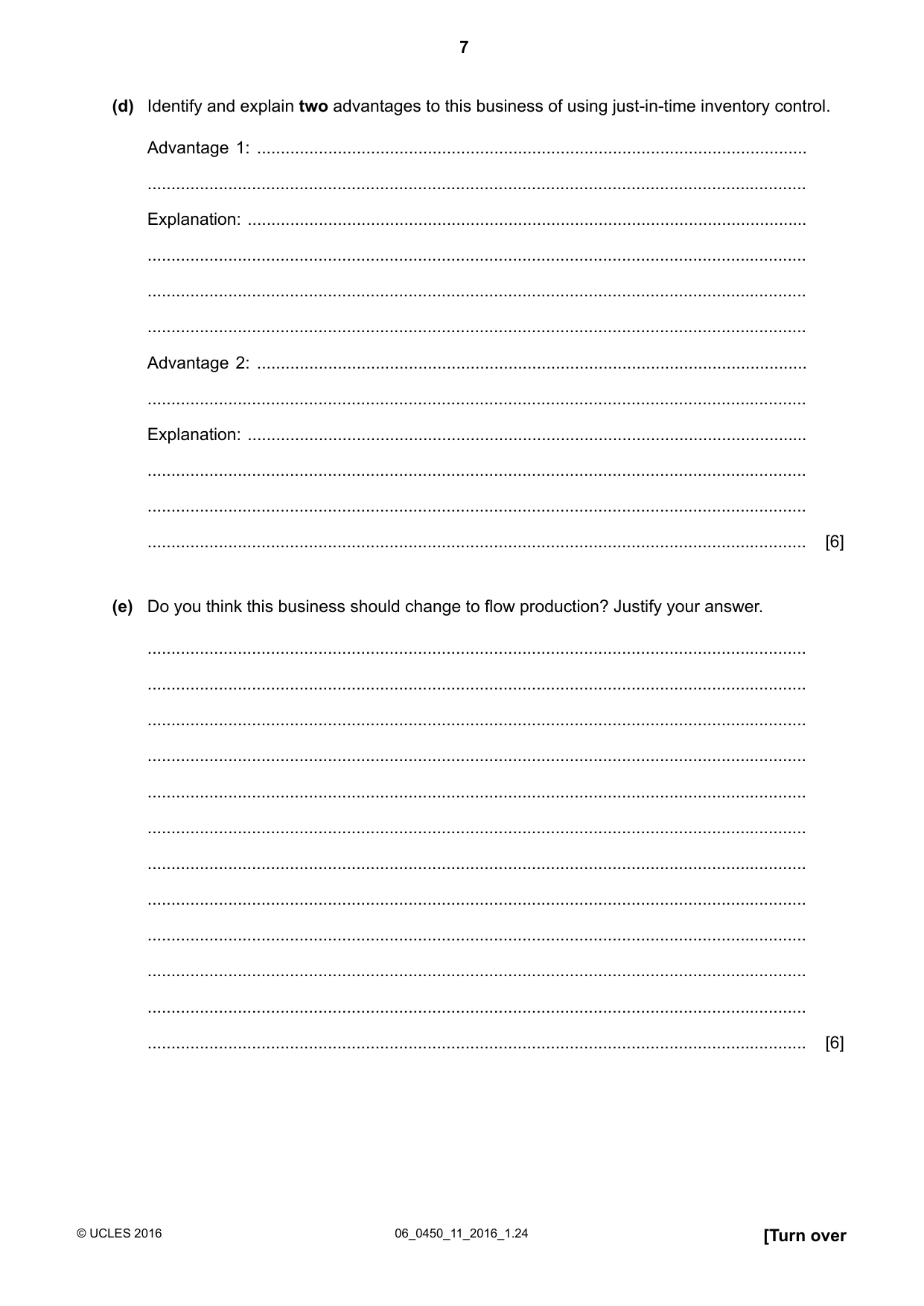
Identify and explain two advantages to this business of using just-in-time inventory control. (d) Advantage 1: … … Explanation: … … … … Advantage 2: … … Explanation: … … … … [6] Do you think this business should change to flow production? Justify your answer. (e) … … … … … … … … … … … … [6] [Turn over 06_0450_11_2016_1.24 © UCLES 2016 7
Question paper, page 8
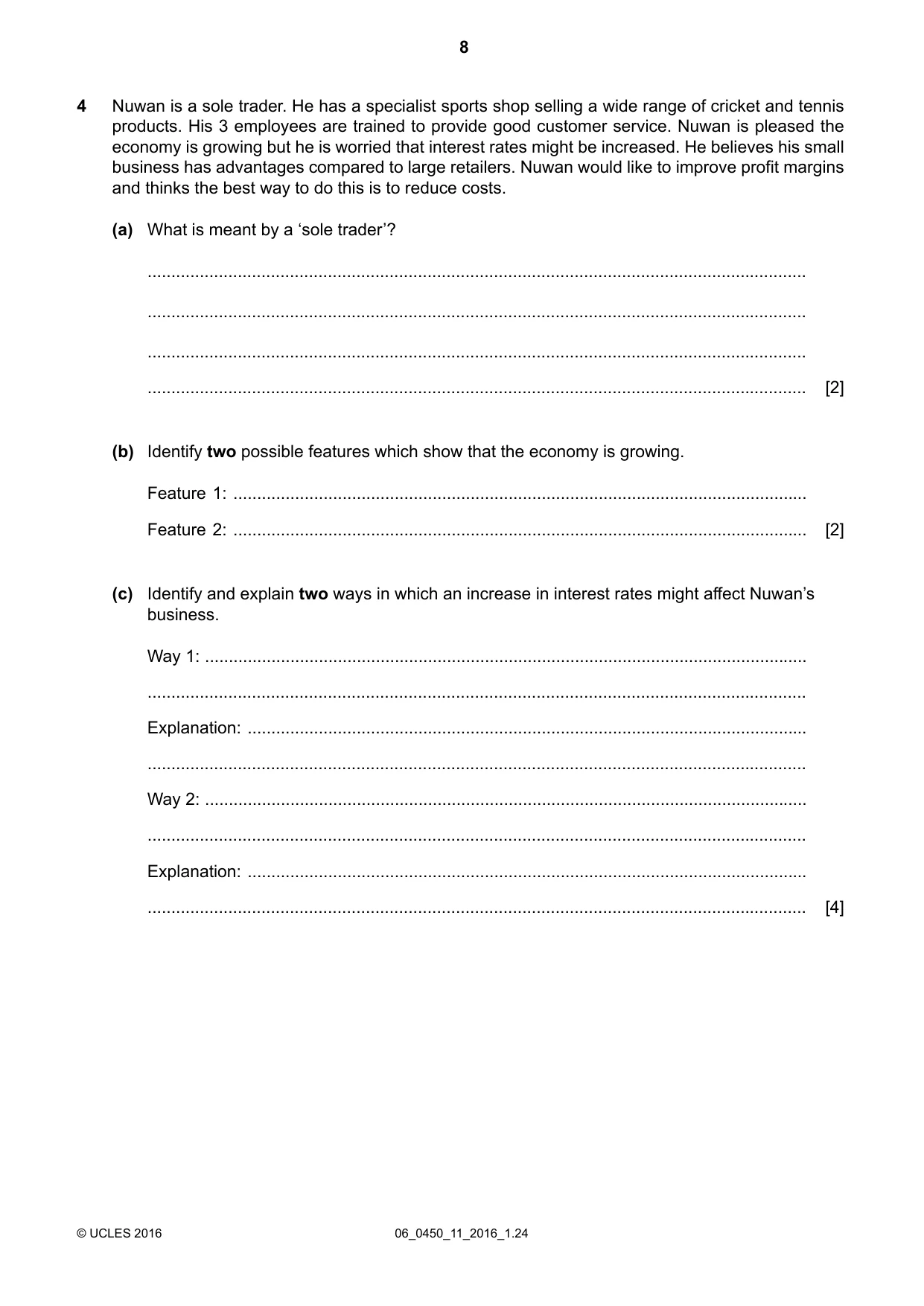
Nuwan is a sole trader. He has a specialist sports shop selling a wide range of cricket and tennis products. His 3 employees are trained to provide good customer service. Nuwan is pleased the 4 economy is growing but he is worried that interest rates might be increased. He believes his small business has advantages compared to large retailers. Nuwan would like to improve profit margins and thinks the best way to do this is to reduce costs. What is meant by a ‘sole trader’? (a) … … … … [2] Identify two possible features which show that the economy is growing. (b) Feature 1: … Feature 2: … [2] Identify and explain two ways in which an increase in interest rates might affect Nuwan’s business. (c) Way 1: … … Explanation: … … Way 2: … … Explanation: … … [4] 06_0450_11_2016_1.24 © UCLES 2016 8
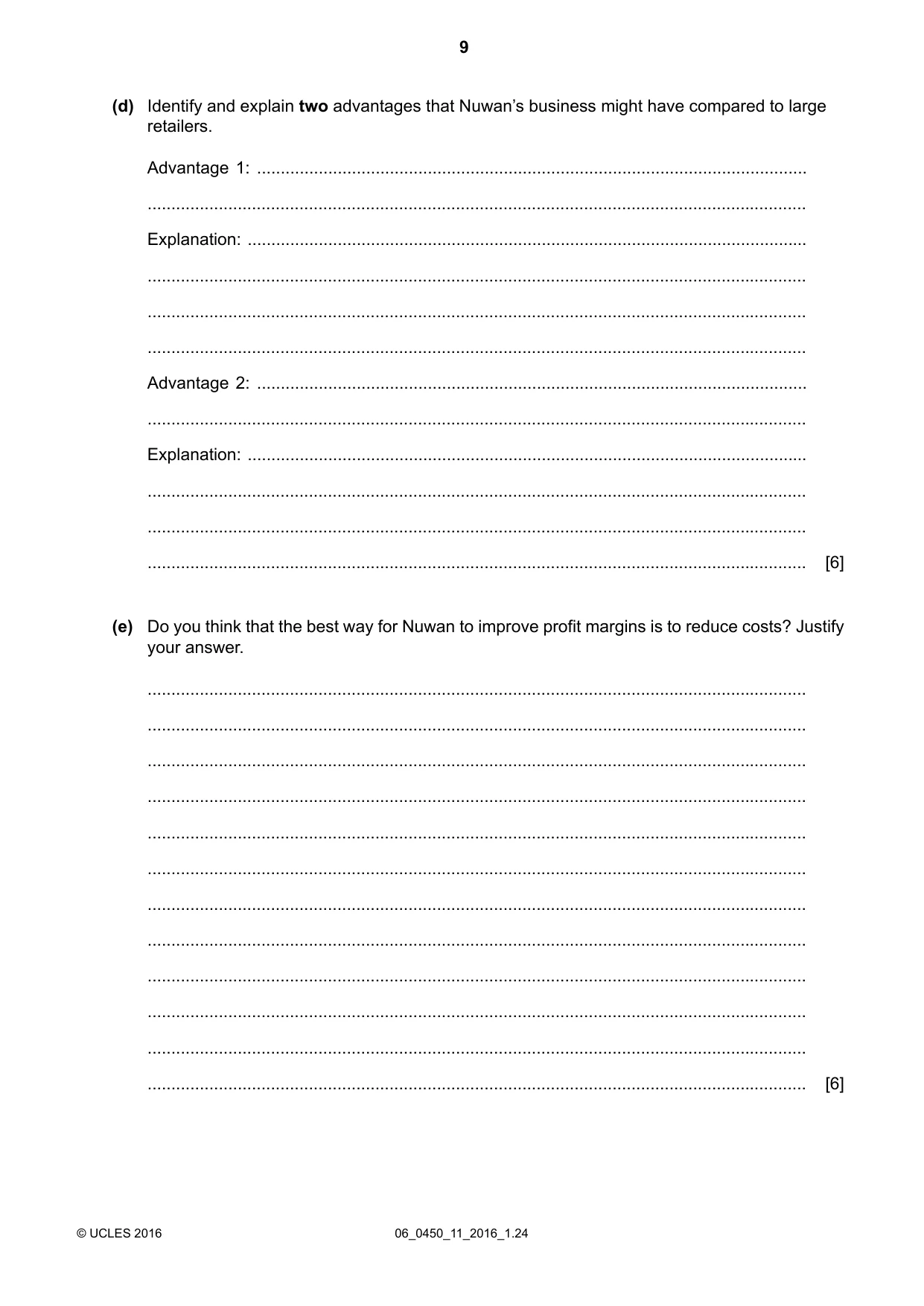
Question paper, page 9
Identify and explain two advantages that Nuwan’s business might have compared to large retailers. (d) Advantage 1: … … Explanation: … … … … Advantage 2: … … Explanation: … … … … [6] Do you think that the best way for Nuwan to improve profit margins is to reduce costs? Justify your answer. (e) … … … … … … … … … … … … [6] 06_0450_11_2016_1.24 © UCLES 2016 9
Question paper, page 10
BLANK PAGE 06_0450_11_2016_1.24 © UCLES 2016 10
Question paper, page 11
BLANK PAGE 06_0450_11_2016_1.24 © UCLES 2016 11
Question paper, page 12
BLANK PAGE Permission to reproduce items where third-party owned material protected by copyright is included has been sought and cleared where possible. Every reasonable effort has been made by the publisher (UCLES) to trace copyright holders, but if any items requiring clearance have unwittingly been included, the publisher will be pleased to make amends at the earliest possible opportunity. To avoid the issue of disclosure of answer-related information to candidates, all copyright acknowledgements are reproduced online in the Cambridge International Examinations Copyright Acknowledgements Booklet. This is produced for each series of examinations and is freely available to download at www.cie.org.uk after the live examination series. Cambridge International Examinations is part of the Cambridge Assessment Group. Cambridge Assessment is the brand name of University of Cambridge Local Examinations Syndicate (UCLES), which is itself a department of the University of Cambridge. 06_0450_11_2016_1.24 © UCLES 2016 12
Mark scheme, page 1
® IGCSE is the registered trademark of Cambridge International Examinations. This syllabus is approved for use in England, Wales and Northern Ireland as a Cambridge International Level 1/Level 2 Certificate. This document consists of 11 printed pages. © UCLES 2016 [Turn over Cambridge International Examinations Cambridge International General Certificate of Secondary Education BUSINESS STUDIES 0450/11 Paper 1 Short Answer/Structured Response May/June 2016 MARK SCHEME Maximum Mark: 80 Published This mark scheme is published as an aid to teachers and candidates, to indicate the requirements of the examination. It shows the basis on which Examiners were instructed to award marks. It does not indicate the details of the discussions that took place at an Examiners’ meeting before marking began, which would have considered the acceptability of alternative answers. Mark schemes should be read in conjunction with the question paper and the Principal Examiner Report for Teachers. Cambridge will not enter into discussions about these mark schemes. Cambridge is publishing the mark schemes for the May/June 2016 series for most Cambridge IGCSE®, Cambridge International A and AS Level components and some Cambridge O Level components.
Mark scheme, page 2
Page 2 Mark Scheme Syllabus Paper Cambridge IGCSE – May/June 2016 0450 11 © Cambridge International Examinations 2016 Question Guidelines Marks Additional Guidance 1(a) What is meant by ‘customer loyalty’? 2 Clear understanding [2] e.g. A customer who returns and buys multiple times. Customer keeps buying the same brand no matter what the price. Some understanding [1] e.g. Buy from you rather than the competitors, customer returns, customer keeps buying. Brand loyalty alone [0] 1(b) Calculate the quantity of product Z sold in 2015. 2 Good application [2] 320 000 Some application [1] method e.g. 800 000 * 40% 1(c) Explain the possible effect on EDGE if the prices of its products are reduced. 4 Knowledge [2] – identification of relevant points. Application [2] – award up to 2 marks for relevant explanation in context of EDGE. Relevant points might include: • Lower revenue [k] as demand is price inelastic [app] the additional revenue will not make up for the reduction in price of phones [app] • Could attract more customers [k] increasing sales beyond 800 000 [app] • Damage their image [k] leading to a reduction in customer loyalty [app] • Profit margin will fall [k]. Note: Candidates can identify and develop 2 points or offer an extended development of one point. Application marks may be awarded for appropriate use of the following: use of numbers, phones, price inelastic, customer/brand loyalty, competitive market, extension of product Z, product life cycle.
Mark scheme, page 3
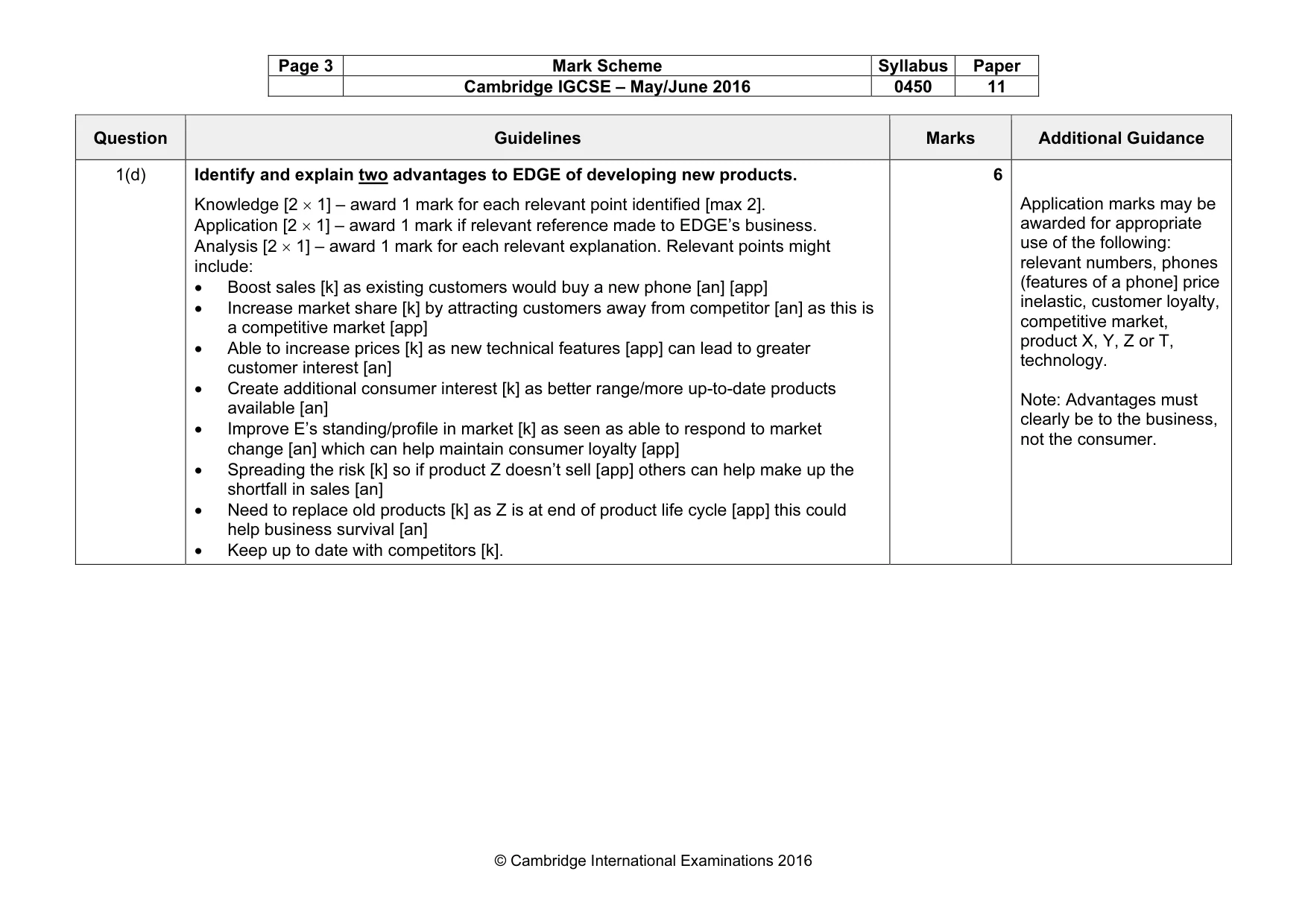
Page 3 Mark Scheme Syllabus Paper Cambridge IGCSE – May/June 2016 0450 11 © Cambridge International Examinations 2016 Question Guidelines Marks Additional Guidance 1(d) Identify and explain two advantages to EDGE of developing new products. 6 Knowledge [2 × 1] – award 1 mark for each relevant point identified [max 2]. Application [2 × 1] – award 1 mark if relevant reference made to EDGE’s business. Analysis [2 × 1] – award 1 mark for each relevant explanation. Relevant points might include: • Boost sales [k] as existing customers would buy a new phone [an] [app] • Increase market share [k] by attracting customers away from competitor [an] as this is a competitive market [app] • Able to increase prices [k] as new technical features [app] can lead to greater customer interest [an] • Create additional consumer interest [k] as better range/more up-to-date products available [an] • Improve E’s standing/profile in market [k] as seen as able to respond to market change [an] which can help maintain consumer loyalty [app] • Spreading the risk [k] so if product Z doesn’t sell [app] others can help make up the shortfall in sales [an] • Need to replace old products [k] as Z is at end of product life cycle [app] this could help business survival [an] • Keep up to date with competitors [k]. Application marks may be awarded for appropriate use of the following: relevant numbers, phones (features of a phone] price inelastic, customer loyalty, competitive market, product X, Y, Z or T, technology. Note: Advantages must clearly be to the business, not the consumer.
Mark scheme, page 4
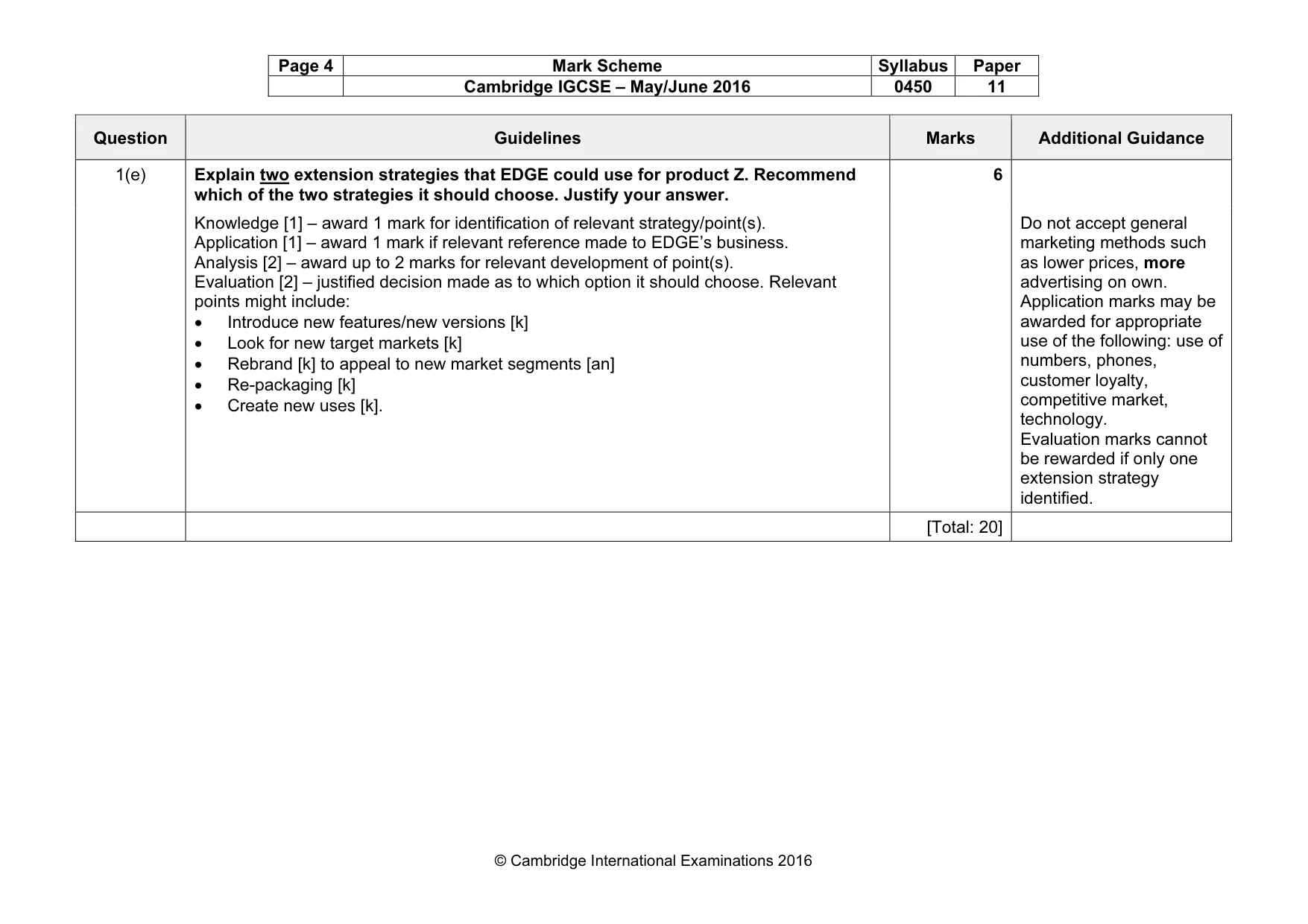
Page 4 Mark Scheme Syllabus Paper Cambridge IGCSE – May/June 2016 0450 11 © Cambridge International Examinations 2016 Question Guidelines Marks Additional Guidance 1(e) Explain two extension strategies that EDGE could use for product Z. Recommend which of the two strategies it should choose. Justify your answer. 6 Knowledge [1] – award 1 mark for identification of relevant strategy/point(s). Application [1] – award 1 mark if relevant reference made to EDGE’s business. Analysis [2] – award up to 2 marks for relevant development of point(s). Evaluation [2] – justified decision made as to which option it should choose. Relevant points might include: • Introduce new features/new versions [k] • Look for new target markets [k] • Rebrand [k] to appeal to new market segments [an] • Re-packaging [k] • Create new uses [k]. Do not accept general marketing methods such as lower prices, more advertising on own. Application marks may be awarded for appropriate use of the following: use of numbers, phones, customer loyalty, competitive market, technology. Evaluation marks cannot be rewarded if only one extension strategy identified. [Total: 20]
Mark scheme, page 5
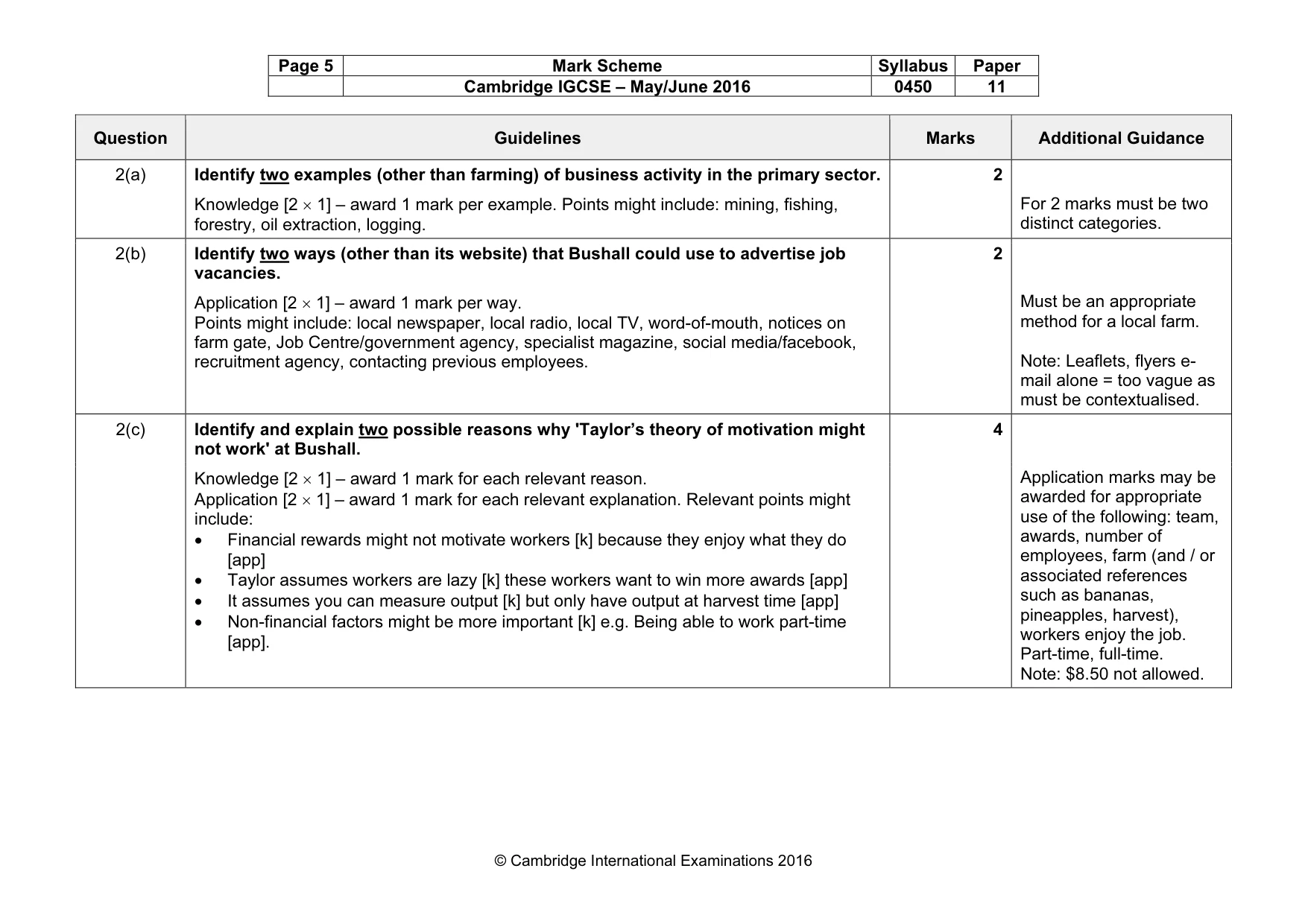
Page 5 Mark Scheme Syllabus Paper Cambridge IGCSE – May/June 2016 0450 11 © Cambridge International Examinations 2016 Question Guidelines Marks Additional Guidance 2(a) Identify two examples (other than farming) of business activity in the primary sector. 2 Knowledge [2 × 1] – award 1 mark per example. Points might include: mining, fishing, forestry, oil extraction, logging. For 2 marks must be two distinct categories. 2(b) Identify two ways (other than its website) that Bushall could use to advertise job vacancies. 2 Application [2 × 1] – award 1 mark per way. Points might include: local newspaper, local radio, local TV, word-of-mouth, notices on farm gate, Job Centre/government agency, specialist magazine, social media/facebook, recruitment agency, contacting previous employees. Must be an appropriate method for a local farm. Note: Leaflets, flyers e- mail alone = too vague as must be contextualised. 2(c) Identify and explain two possible reasons why 'Taylor’s theory of motivation might not work' at Bushall. 4 Knowledge [2 × 1] – award 1 mark for each relevant reason. Application [2 × 1] – award 1 mark for each relevant explanation. Relevant points might include: • Financial rewards might not motivate workers [k] because they enjoy what they do [app] • Taylor assumes workers are lazy [k] these workers want to win more awards [app] • It assumes you can measure output [k] but only have output at harvest time [app] • Non-financial factors might be more important [k] e.g. Being able to work part-time [app]. Application marks may be awarded for appropriate use of the following: team, awards, number of employees, farm (and / or associated references such as bananas, pineapples, harvest), workers enjoy the job. Part-time, full-time. Note: $8.50 not allowed.
Mark scheme, page 6
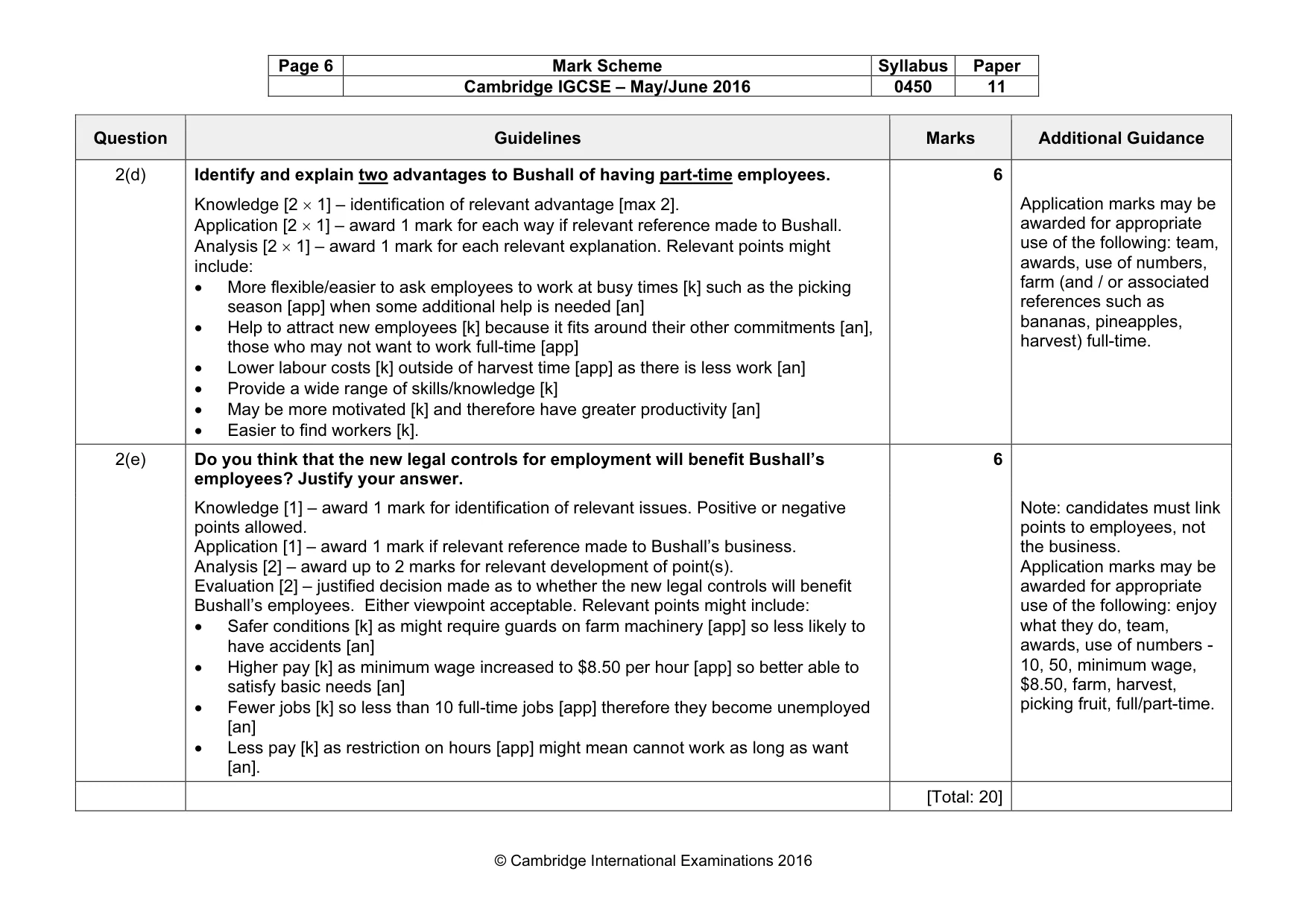
Page 6 Mark Scheme Syllabus Paper Cambridge IGCSE – May/June 2016 0450 11 © Cambridge International Examinations 2016 Question Guidelines Marks Additional Guidance 2(d) Identify and explain two advantages to Bushall of having part-time employees. 6 Knowledge [2 × 1] – identification of relevant advantage [max 2]. Application [2 × 1] – award 1 mark for each way if relevant reference made to Bushall. Analysis [2 × 1] – award 1 mark for each relevant explanation. Relevant points might include: • More flexible/easier to ask employees to work at busy times [k] such as the picking season [app] when some additional help is needed [an] • Help to attract new employees [k] because it fits around their other commitments [an], those who may not want to work full-time [app] • Lower labour costs [k] outside of harvest time [app] as there is less work [an] • Provide a wide range of skills/knowledge [k] • May be more motivated [k] and therefore have greater productivity [an] • Easier to find workers [k]. Application marks may be awarded for appropriate use of the following: team, awards, use of numbers, farm (and / or associated references such as bananas, pineapples, harvest) full-time. 2(e) Do you think that the new legal controls for employment will benefit Bushall’s employees? Justify your answer. 6 Knowledge [1] – award 1 mark for identification of relevant issues. Positive or negative points allowed. Application [1] – award 1 mark if relevant reference made to Bushall’s business. Analysis [2] – award up to 2 marks for relevant development of point(s). Evaluation [2] – justified decision made as to whether the new legal controls will benefit Bushall’s employees. Either viewpoint acceptable. Relevant points might include: • Safer conditions [k] as might require guards on farm machinery [app] so less likely to have accidents [an] • Higher pay [k] as minimum wage increased to $8.50 per hour [app] so better able to satisfy basic needs [an] • Fewer jobs [k] so less than 10 full-time jobs [app] therefore they become unemployed [an] • Less pay [k] as restriction on hours [app] might mean cannot work as long as want [an]. Note: candidates must link points to employees, not the business. Application marks may be awarded for appropriate use of the following: enjoy what they do, team, awards, use of numbers - 10, 50, minimum wage, $8.50, farm, harvest, picking fruit, full/part-time. [Total: 20]
Mark scheme, page 7
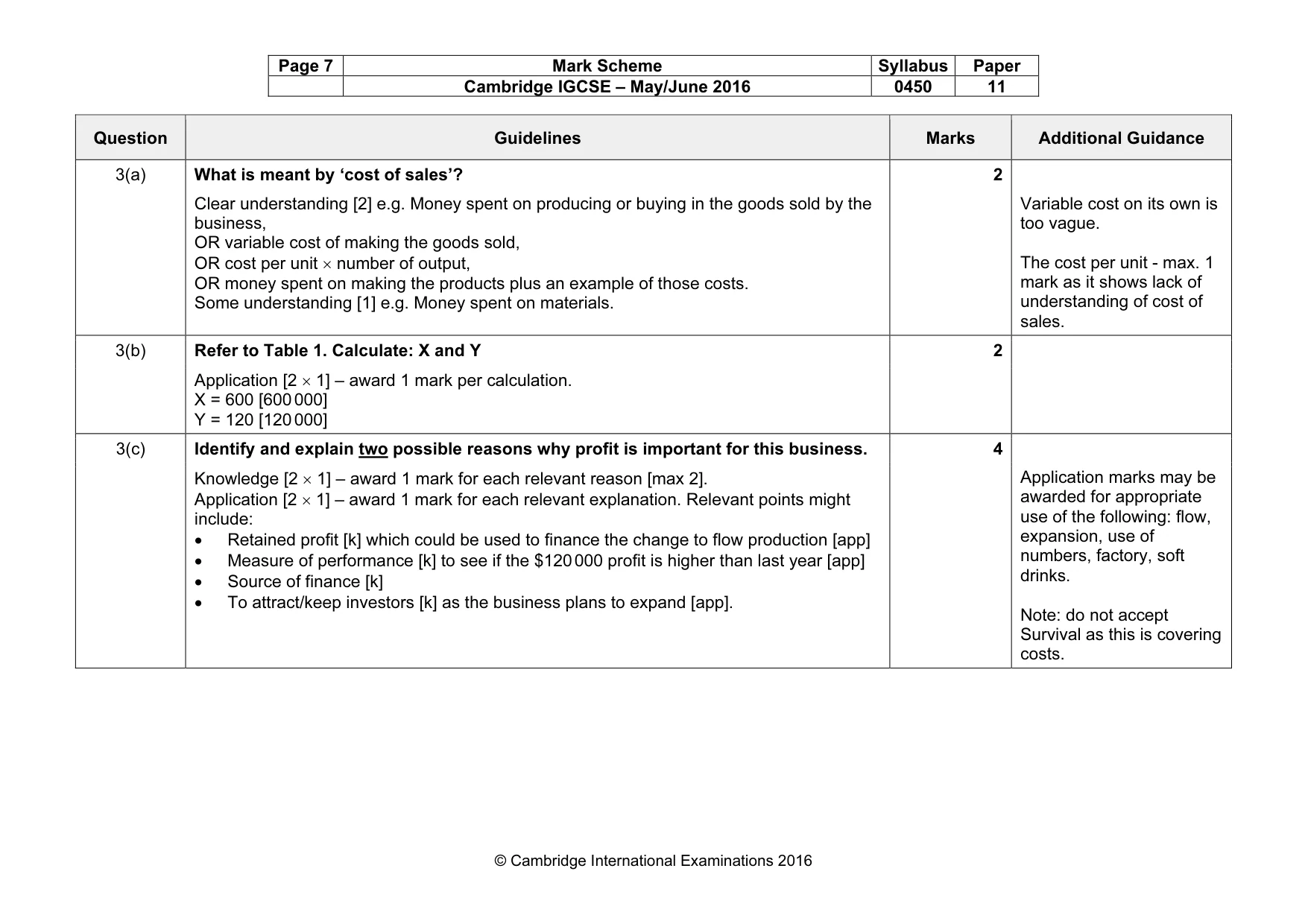
Page 7 Mark Scheme Syllabus Paper Cambridge IGCSE – May/June 2016 0450 11 © Cambridge International Examinations 2016 Question Guidelines Marks Additional Guidance 3(a) What is meant by ‘cost of sales’? 2 Clear understanding [2] e.g. Money spent on producing or buying in the goods sold by the business, OR variable cost of making the goods sold, OR cost per unit × number of output, OR money spent on making the products plus an example of those costs. Some understanding [1] e.g. Money spent on materials. Variable cost on its own is too vague. The cost per unit - max. 1 mark as it shows lack of understanding of cost of sales. 3(b) Refer to Table 1. Calculate: X and Y 2 Application [2 × 1] – award 1 mark per calculation. X = 600 [600 000] Y = 120 [120 000] 3(c) Identify and explain two possible reasons why profit is important for this business. 4 Knowledge [2 × 1] – award 1 mark for each relevant reason [max 2]. Application [2 × 1] – award 1 mark for each relevant explanation. Relevant points might include: • Retained profit [k] which could be used to finance the change to flow production [app] • Measure of performance [k] to see if the $120 000 profit is higher than last year [app] • Source of finance [k] • To attract/keep investors [k] as the business plans to expand [app]. Application marks may be awarded for appropriate use of the following: flow, expansion, use of numbers, factory, soft drinks. Note: do not accept Survival as this is covering costs.
Mark scheme, page 8
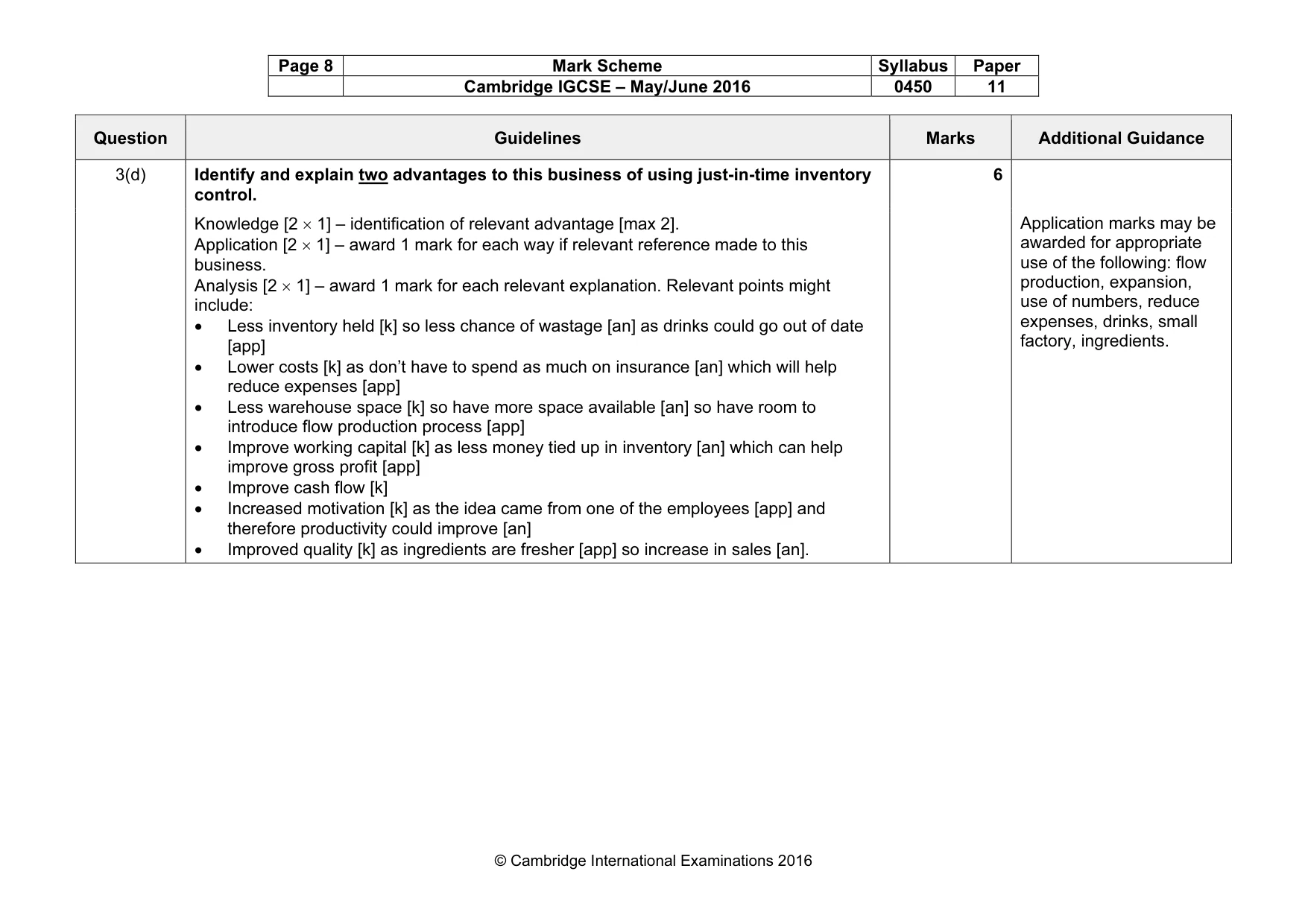
Page 8 Mark Scheme Syllabus Paper Cambridge IGCSE – May/June 2016 0450 11 © Cambridge International Examinations 2016 Question Guidelines Marks Additional Guidance 3(d) Identify and explain two advantages to this business of using just-in-time inventory control. 6 Knowledge [2 × 1] – identification of relevant advantage [max 2]. Application [2 × 1] – award 1 mark for each way if relevant reference made to this business. Analysis [2 × 1] – award 1 mark for each relevant explanation. Relevant points might include: • Less inventory held [k] so less chance of wastage [an] as drinks could go out of date [app] • Lower costs [k] as don’t have to spend as much on insurance [an] which will help reduce expenses [app] • Less warehouse space [k] so have more space available [an] so have room to introduce flow production process [app] • Improve working capital [k] as less money tied up in inventory [an] which can help improve gross profit [app] • Improve cash flow [k] • Increased motivation [k] as the idea came from one of the employees [app] and therefore productivity could improve [an] • Improved quality [k] as ingredients are fresher [app] so increase in sales [an]. Application marks may be awarded for appropriate use of the following: flow production, expansion, use of numbers, reduce expenses, drinks, small factory, ingredients.
Mark scheme, page 9
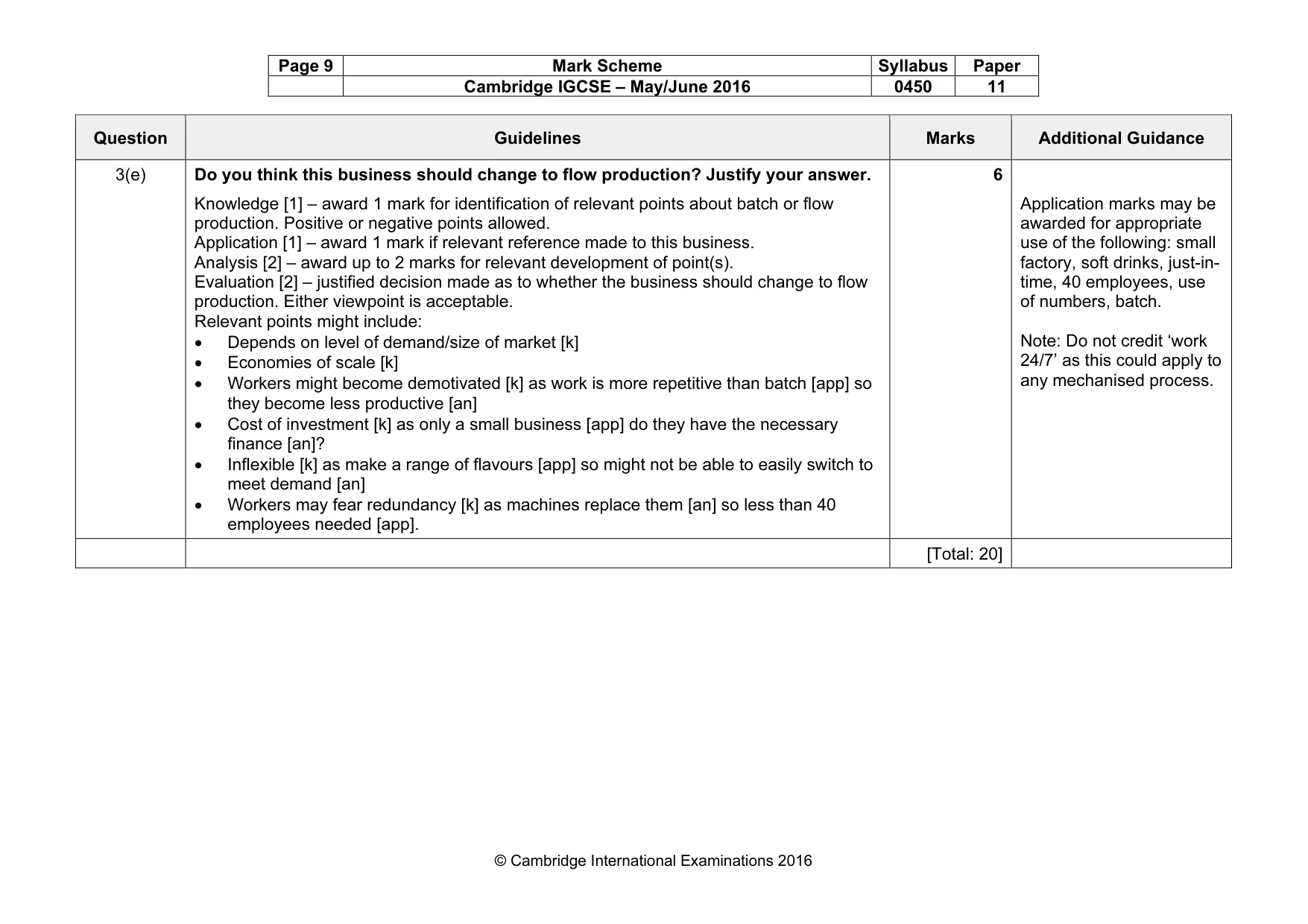
Page 9 Mark Scheme Syllabus Paper Cambridge IGCSE – May/June 2016 0450 11 © Cambridge International Examinations 2016 Question Guidelines Marks Additional Guidance 3(e) Do you think this business should change to flow production? Justify your answer. 6 Knowledge [1] – award 1 mark for identification of relevant points about batch or flow production. Positive or negative points allowed. Application [1] – award 1 mark if relevant reference made to this business. Analysis [2] – award up to 2 marks for relevant development of point(s). Evaluation [2] – justified decision made as to whether the business should change to flow production. Either viewpoint is acceptable. Relevant points might include: • Depends on level of demand/size of market [k] • Economies of scale [k] • Workers might become demotivated [k] as work is more repetitive than batch [app] so they become less productive [an] • Cost of investment [k] as only a small business [app] do they have the necessary finance [an]? • Inflexible [k] as make a range of flavours [app] so might not be able to easily switch to meet demand [an] • Workers may fear redundancy [k] as machines replace them [an] so less than 40 employees needed [app]. Application marks may be awarded for appropriate use of the following: small factory, soft drinks, just-in- time, 40 employees, use of numbers, batch. Note: Do not credit ‘work 24/7’ as this could apply to any mechanised process. [Total: 20]
Mark scheme, page 10
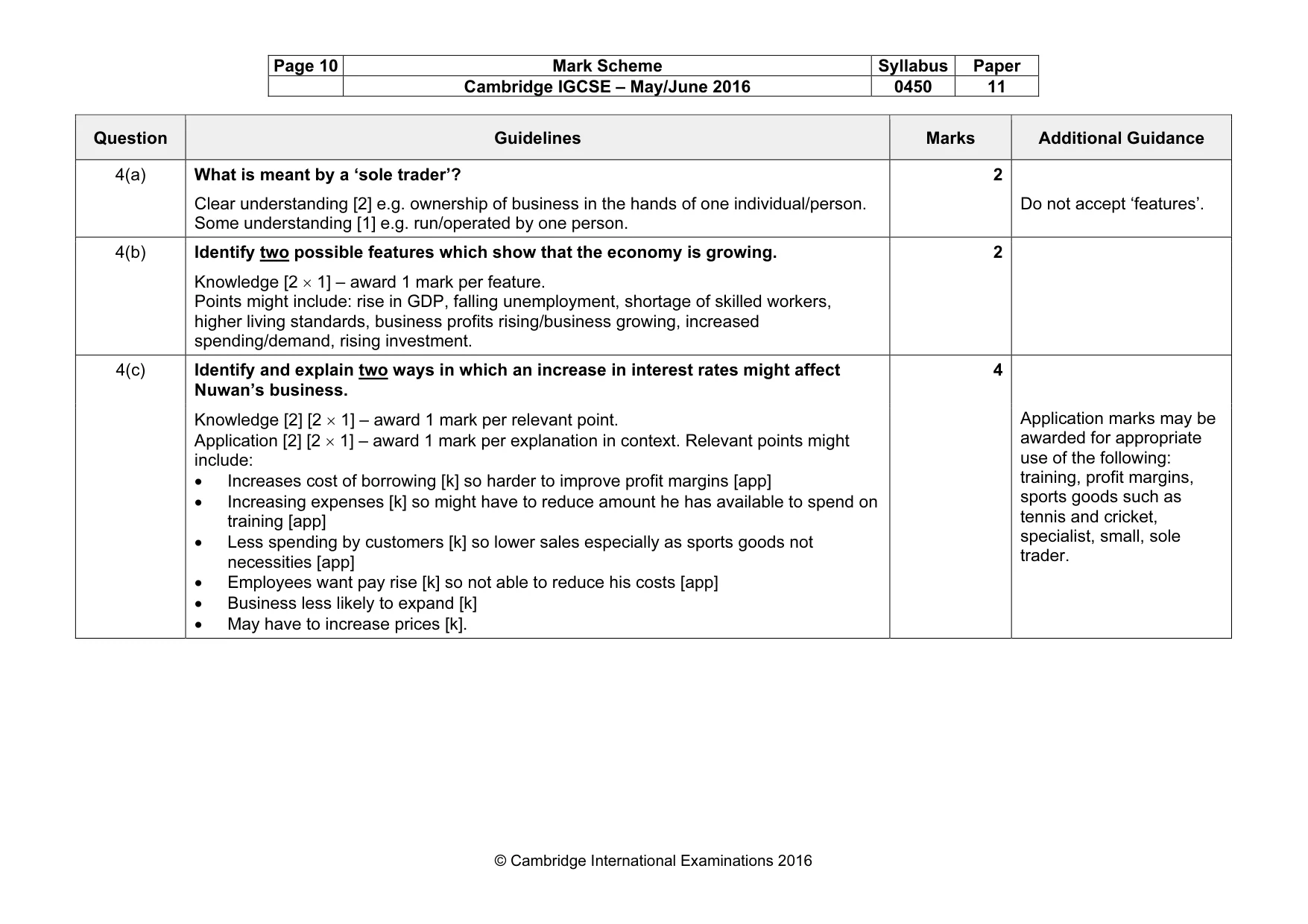
Page 10 Mark Scheme Syllabus Paper Cambridge IGCSE – May/June 2016 0450 11 © Cambridge International Examinations 2016 Question Guidelines Marks Additional Guidance 4(a) What is meant by a ‘sole trader’? 2 Clear understanding [2] e.g. ownership of business in the hands of one individual/person. Some understanding [1] e.g. run/operated by one person. Do not accept ‘features’. 4(b) Identify two possible features which show that the economy is growing. 2 Knowledge [2 × 1] – award 1 mark per feature. Points might include: rise in GDP, falling unemployment, shortage of skilled workers, higher living standards, business profits rising/business growing, increased spending/demand, rising investment. 4(c) Identify and explain two ways in which an increase in interest rates might affect Nuwan’s business. 4 Knowledge [2] [2 × 1] – award 1 mark per relevant point. Application [2] [2 × 1] – award 1 mark per explanation in context. Relevant points might include: • Increases cost of borrowing [k] so harder to improve profit margins [app] • Increasing expenses [k] so might have to reduce amount he has available to spend on training [app] • Less spending by customers [k] so lower sales especially as sports goods not necessities [app] • Employees want pay rise [k] so not able to reduce his costs [app] • Business less likely to expand [k] • May have to increase prices [k]. Application marks may be awarded for appropriate use of the following: training, profit margins, sports goods such as tennis and cricket, specialist, small, sole trader.
Mark scheme, page 11
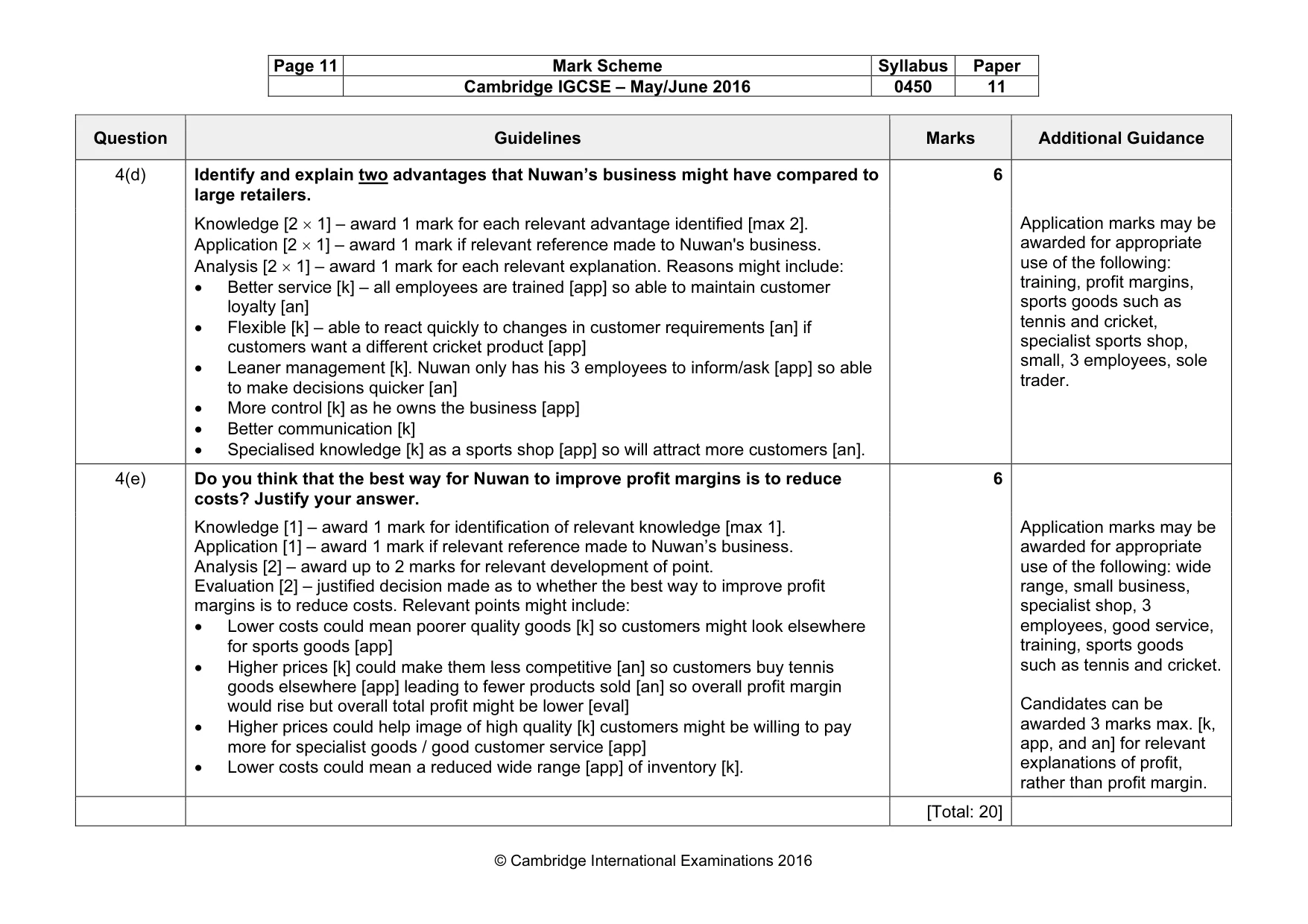
Page 11 Mark Scheme Syllabus Paper Cambridge IGCSE – May/June 2016 0450 11 © Cambridge International Examinations 2016 Question Guidelines Marks Additional Guidance 4(d) Identify and explain two advantages that Nuwan’s business might have compared to large retailers. 6 Knowledge [2 × 1] – award 1 mark for each relevant advantage identified [max 2]. Application [2 × 1] – award 1 mark if relevant reference made to Nuwan's business. Analysis [2 × 1] – award 1 mark for each relevant explanation. Reasons might include: • Better service [k] – all employees are trained [app] so able to maintain customer loyalty [an] • Flexible [k] – able to react quickly to changes in customer requirements [an] if customers want a different cricket product [app] • Leaner management [k]. Nuwan only has his 3 employees to inform/ask [app] so able to make decisions quicker [an] • More control [k] as he owns the business [app] • Better communication [k] • Specialised knowledge [k] as a sports shop [app] so will attract more customers [an]. Application marks may be awarded for appropriate use of the following: training, profit margins, sports goods such as tennis and cricket, specialist sports shop, small, 3 employees, sole trader. 4(e) Do you think that the best way for Nuwan to improve profit margins is to reduce costs? Justify your answer. 6 Knowledge [1] – award 1 mark for identification of relevant knowledge [max 1]. Application [1] – award 1 mark if relevant reference made to Nuwan’s business. Analysis [2] – award up to 2 marks for relevant development of point. Evaluation [2] – justified decision made as to whether the best way to improve profit margins is to reduce costs. Relevant points might include: • Lower costs could mean poorer quality goods [k] so customers might look elsewhere for sports goods [app] • Higher prices [k] could make them less competitive [an] so customers buy tennis goods elsewhere [app] leading to fewer products sold [an] so overall profit margin would rise but overall total profit might be lower [eval] • Higher prices could help image of high quality [k] customers might be willing to pay more for specialist goods / good customer service [app] • Lower costs could mean a reduced wide range [app] of inventory [k]. Application marks may be awarded for appropriate use of the following: wide range, small business, specialist shop, 3 employees, good service, training, sports goods such as tennis and cricket. Candidates can be awarded 3 marks max. [k, app, and an] for relevant explanations of profit, rather than profit margin. [Total: 20]
What you needed in this session
Cambridge’s own grade thresholds for 2016 May/June, Paper 1 · Variant 1. A higher threshold means an easier paper — the bar moves with how the cohort did.