Cambridge IGCSE Business Studies 0450 — 2016 Feb/March Paper 1 · Variant 2
0450/12/F/M/16 · 80 marks · ≈90 min
The question paper and its mark scheme, free to read here and free to download. This is Cambridge’s own paper, exactly as it was sat.
Question paper12 pages



Mark scheme9 pages
Answers below. Sit the paper first if you are practising.
Paper as text
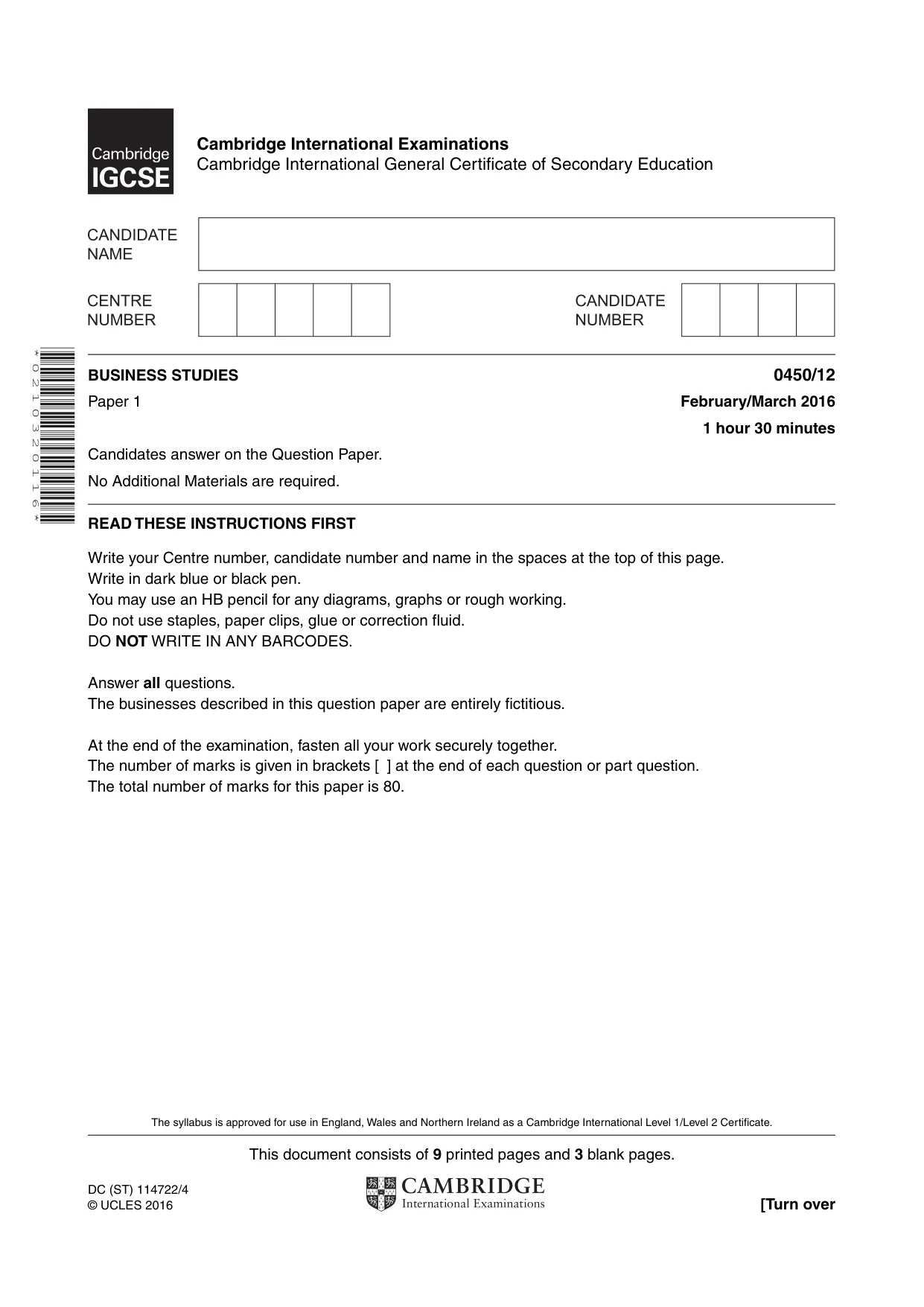
Question paper, page 1
This document consists of 9 printed pages and 3 blank pages. DC (ST) 114722/4 © UCLES 2016 [Turn over Cambridge International Examinations Cambridge International General Certificate of Secondary Education * 0 2 1 0 3 2 0 1 1 6 * BUSINESS STUDIES 0450/12 Paper 1 February/March 2016 1 hour 30 minutes Candidates answer on the Question Paper. No Additional Materials are required. READ THESE INSTRUCTIONS FIRST Write your Centre number, candidate number and name in the spaces at the top of this page. Write in dark blue or black pen. You may use an HB pencil for any diagrams, graphs or rough working. Do not use staples, paper clips, glue or correction fluid. DO NOT WRITE IN ANY BARCODES. Answer all questions. The businesses described in this question paper are entirely fictitious. At the end of the examination, fasten all your work securely together. The number of marks is given in brackets [ ] at the end of each question or part question. The total number of marks for this paper is 80. The syllabus is approved for use in England, Wales and Northern Ireland as a Cambridge International Level 1/Level 2 Certificate.
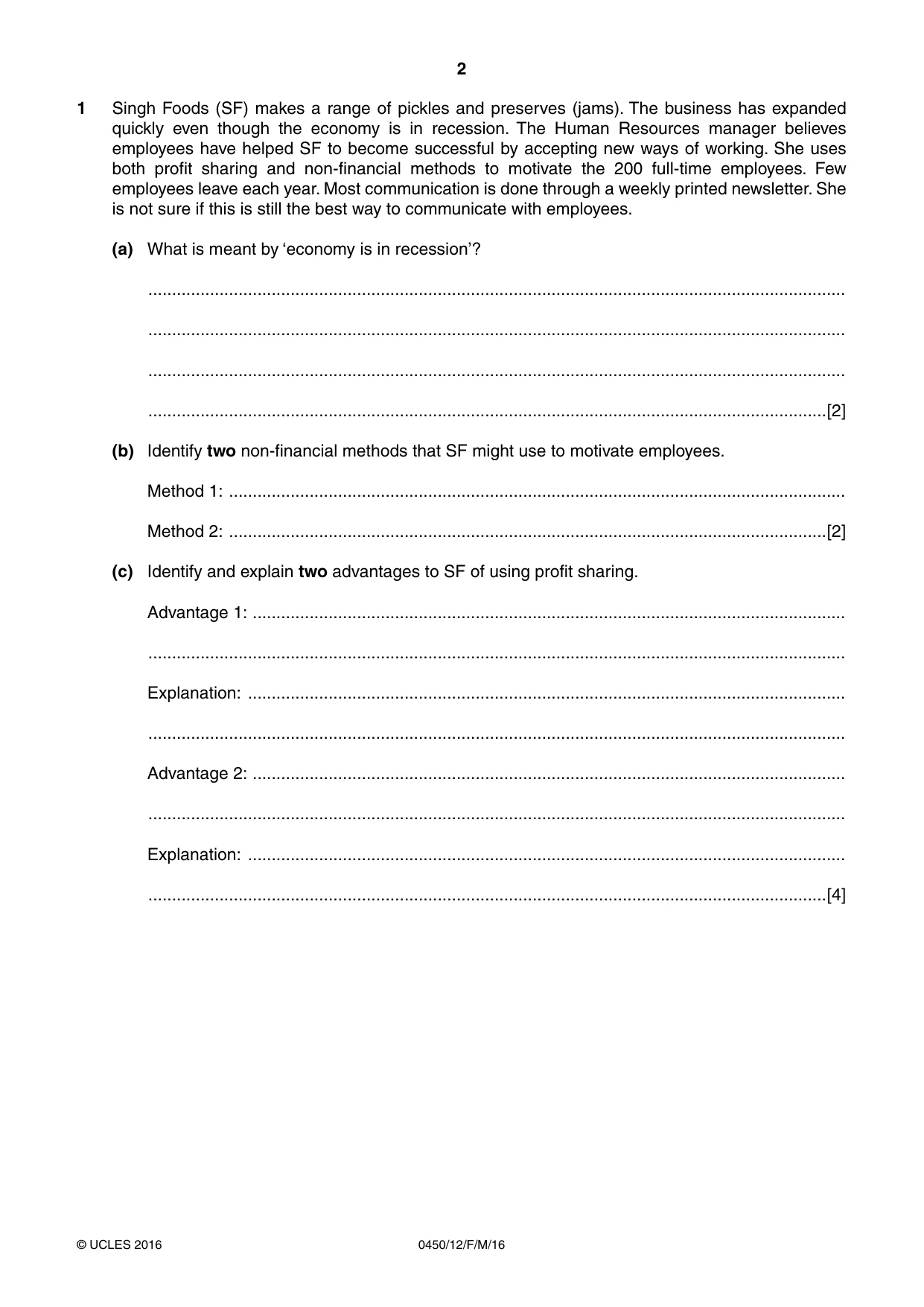
Question paper, page 2
2 0450/12/F/M/16 © UCLES 2016 1 Singh Foods (SF) makes a range of pickles and preserves (jams). The business has expanded quickly even though the economy is in recession. The Human Resources manager believes employees have helped SF to become successful by accepting new ways of working. She uses both profit sharing and non-financial methods to motivate the 200 full-time employees. Few employees leave each year. Most communication is done through a weekly printed newsletter. She is not sure if this is still the best way to communicate with employees. (a) What is meant by ‘economy is in recession’? … … … …[2] (b) Identify two non-financial methods that SF might use to motivate employees. Method 1: … Method 2: …[2] (c) Identify and explain two advantages to SF of using profit sharing. Advantage 1: … … Explanation: … … Advantage 2: … … Explanation: … …[4]
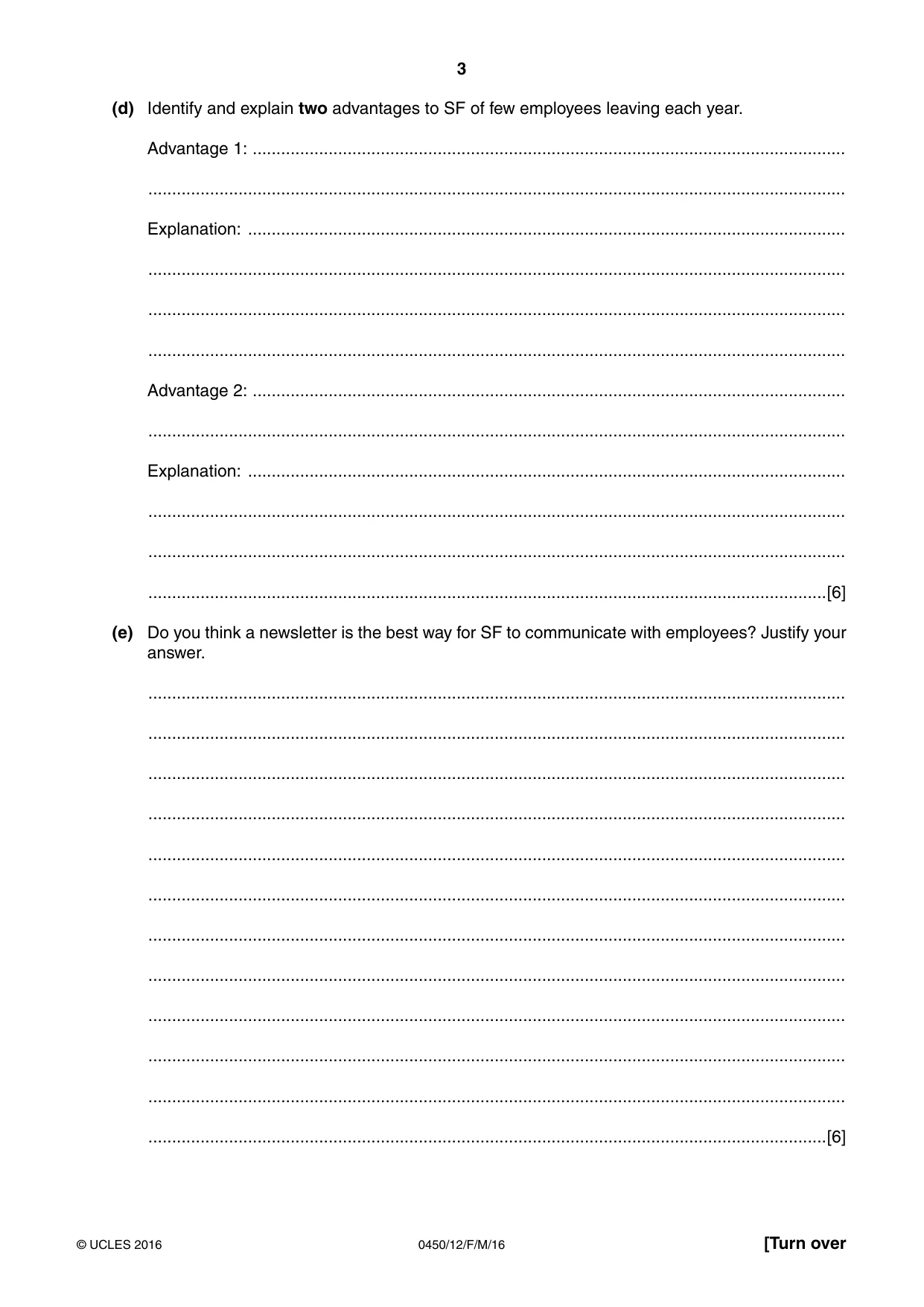
Question paper, page 3
3 0450/12/F/M/16 © UCLES 2016 [Turn over (d) Identify and explain two advantages to SF of few employees leaving each year. Advantage 1: … … Explanation: … … … … Advantage 2: … … Explanation: … … … …[6] (e) Do you think a newsletter is the best way for SF to communicate with employees? Justify your answer. … … … … … … … … … … … …[6]
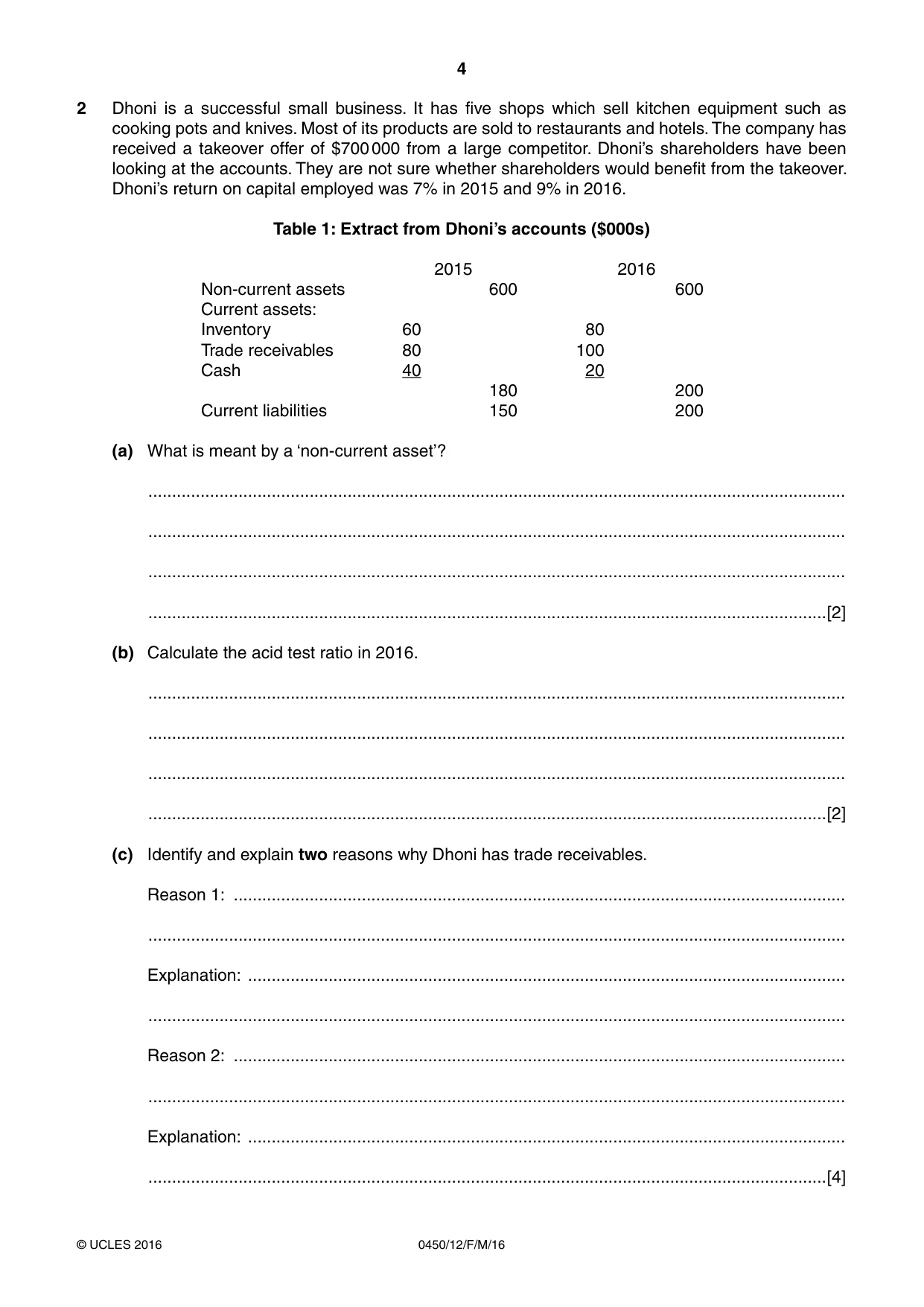
Question paper, page 4
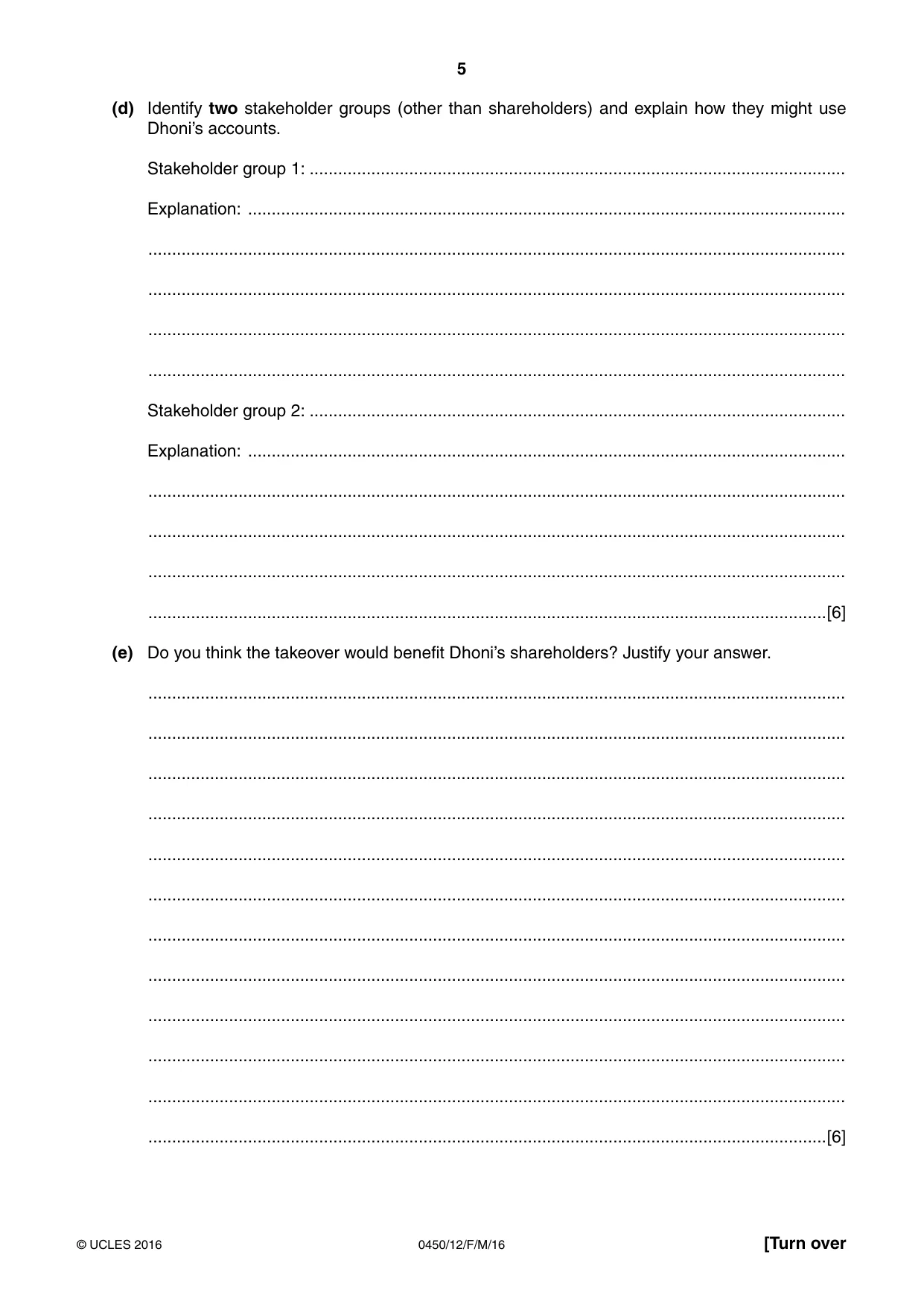
4 0450/12/F/M/16 © UCLES 2016 2 Dhoni is a successful small business. It has five shops which sell kitchen equipment such as cooking pots and knives. Most of its products are sold to restaurants and hotels. The company has received a takeover offer of $700 000 from a large competitor. Dhoni’s shareholders have been looking at the accounts. They are not sure whether shareholders would benefit from the takeover. Dhoni’s return on capital employed was 7% in 2015 and 9% in 2016. Table 1: Extract from Dhoni’s accounts ($000s) 2015 2016 Non-current assets 600 600 Current assets: Inventory 60 80 Trade receivables 80 100 Cash 40 20 180 200 Current liabilities 150 200 (a) What is meant by a ‘non-current asset’? … … … …[2] (b) Calculate the acid test ratio in 2016. … … … …[2] (c) Identify and explain two reasons why Dhoni has trade receivables. Reason 1: … … Explanation: … … Reason 2: … … Explanation: … …[4]
Question paper, page 5
5 0450/12/F/M/16 © UCLES 2016 [Turn over (d) Identify two stakeholder groups (other than shareholders) and explain how they might use Dhoni’s accounts. Stakeholder group 1: … Explanation: … … … … … Stakeholder group 2: … Explanation: … … … … …[6] (e) Do you think the takeover would benefit Dhoni’s shareholders? Justify your answer. … … … … … … … … … … … …[6]
Question paper, page 6
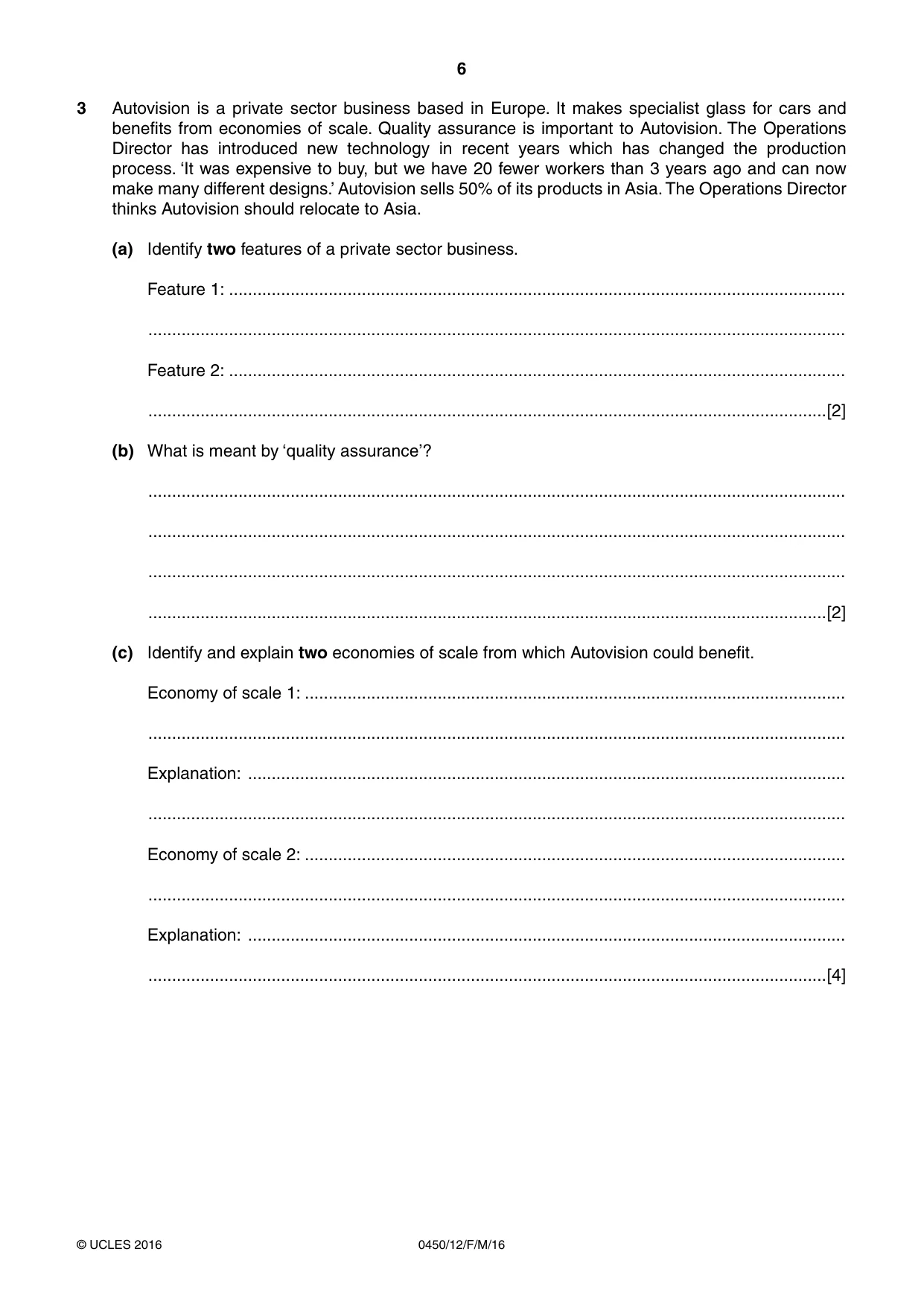
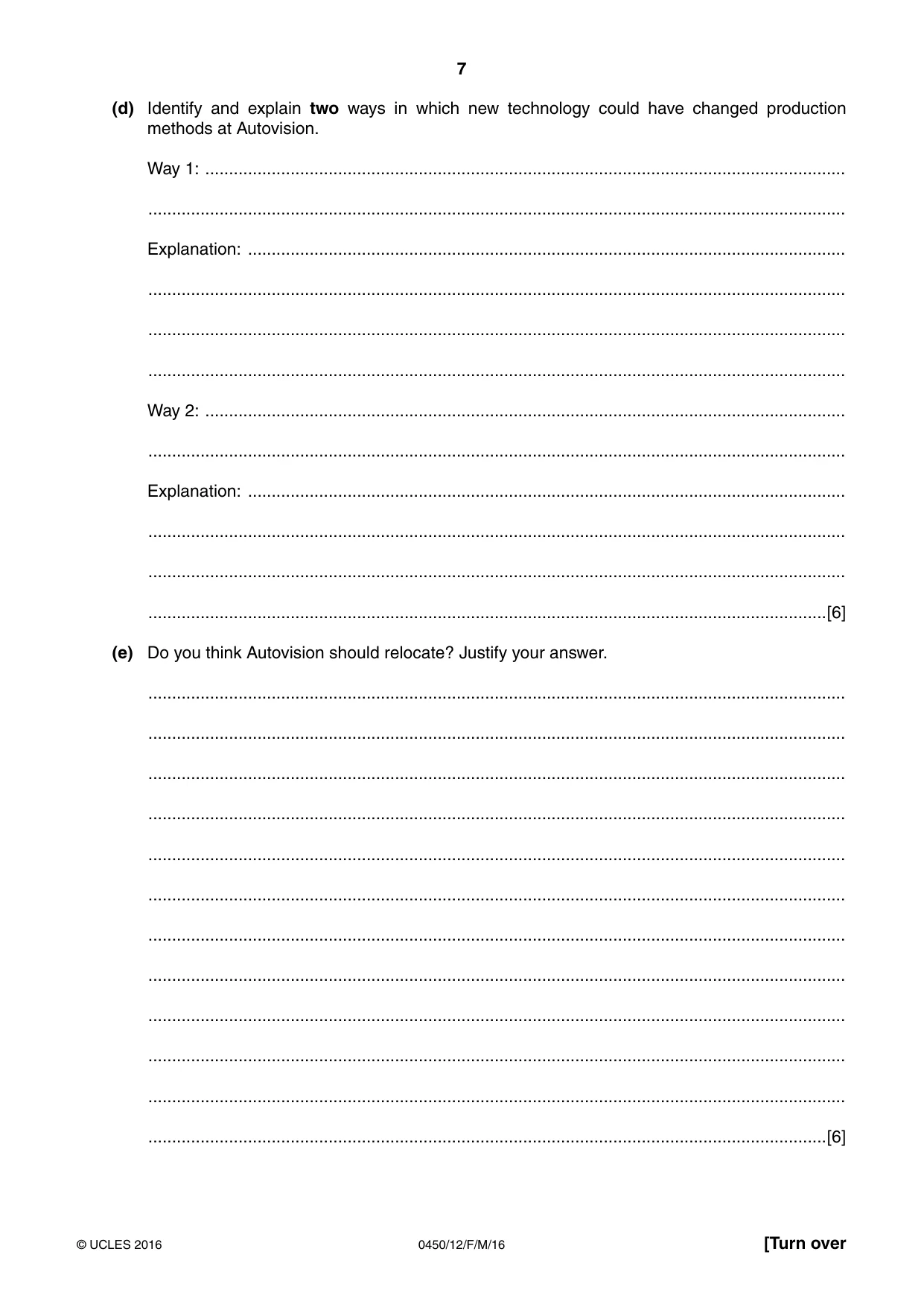
6 0450/12/F/M/16 © UCLES 2016 3 Autovision is a private sector business based in Europe. It makes specialist glass for cars and benefits from economies of scale. Quality assurance is important to Autovision. The Operations Director has introduced new technology in recent years which has changed the production process. ‘It was expensive to buy, but we have 20 fewer workers than 3 years ago and can now make many different designs.’ Autovision sells 50% of its products in Asia. The Operations Director thinks Autovision should relocate to Asia. (a) Identify two features of a private sector business. Feature 1: … … Feature 2: … …[2] (b) What is meant by ‘quality assurance’? … … … …[2] (c) Identify and explain two economies of scale from which Autovision could benefit. Economy of scale 1: … … Explanation: … … Economy of scale 2: … … Explanation: … …[4]
Question paper, page 7
7 0450/12/F/M/16 © UCLES 2016 [Turn over (d) Identify and explain two ways in which new technology could have changed production methods at Autovision. Way 1: … … Explanation: … … … … Way 2: … … Explanation: … … … …[6] (e) Do you think Autovision should relocate? Justify your answer. … … … … … … … … … … … …[6]
Question paper, page 8
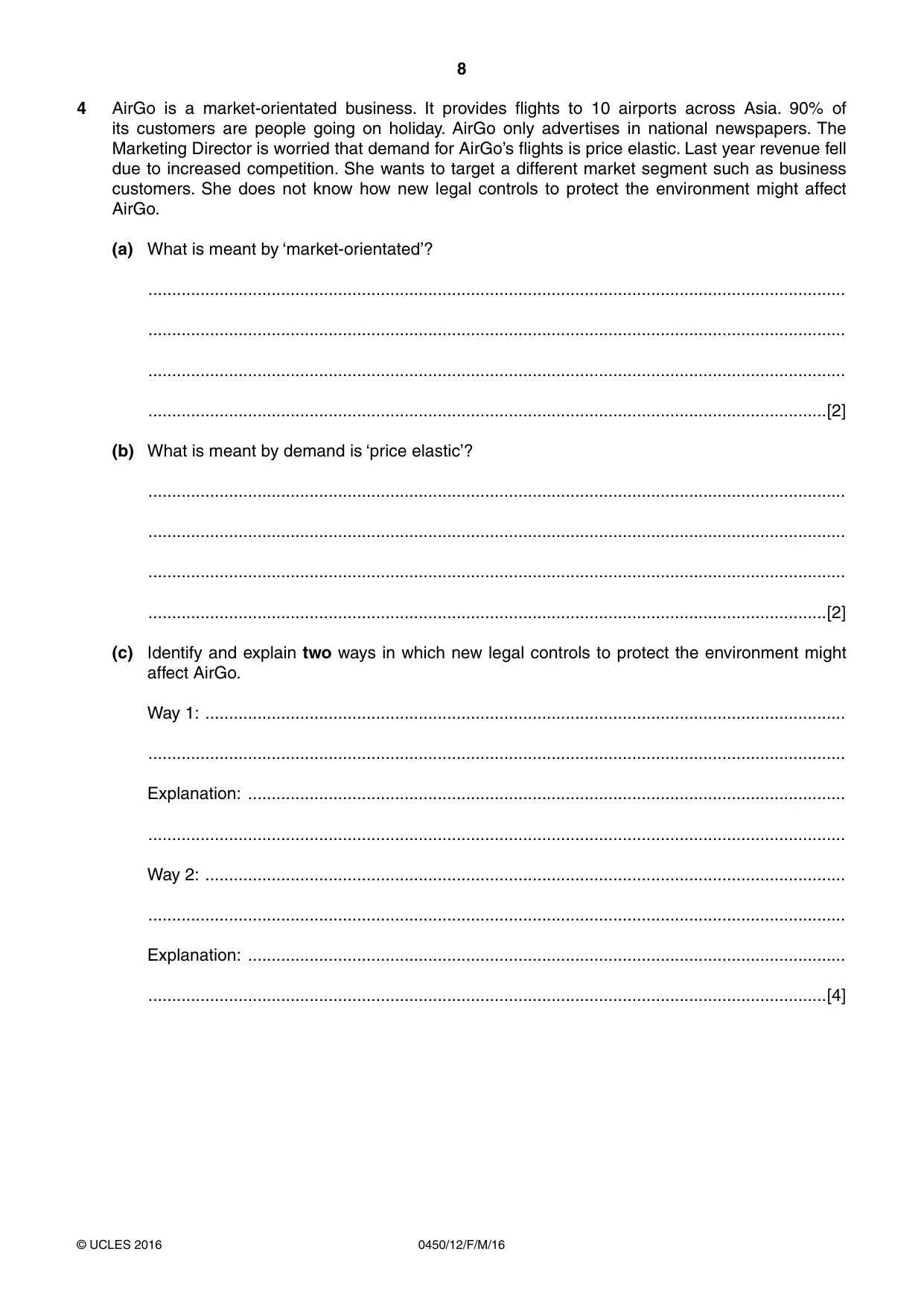
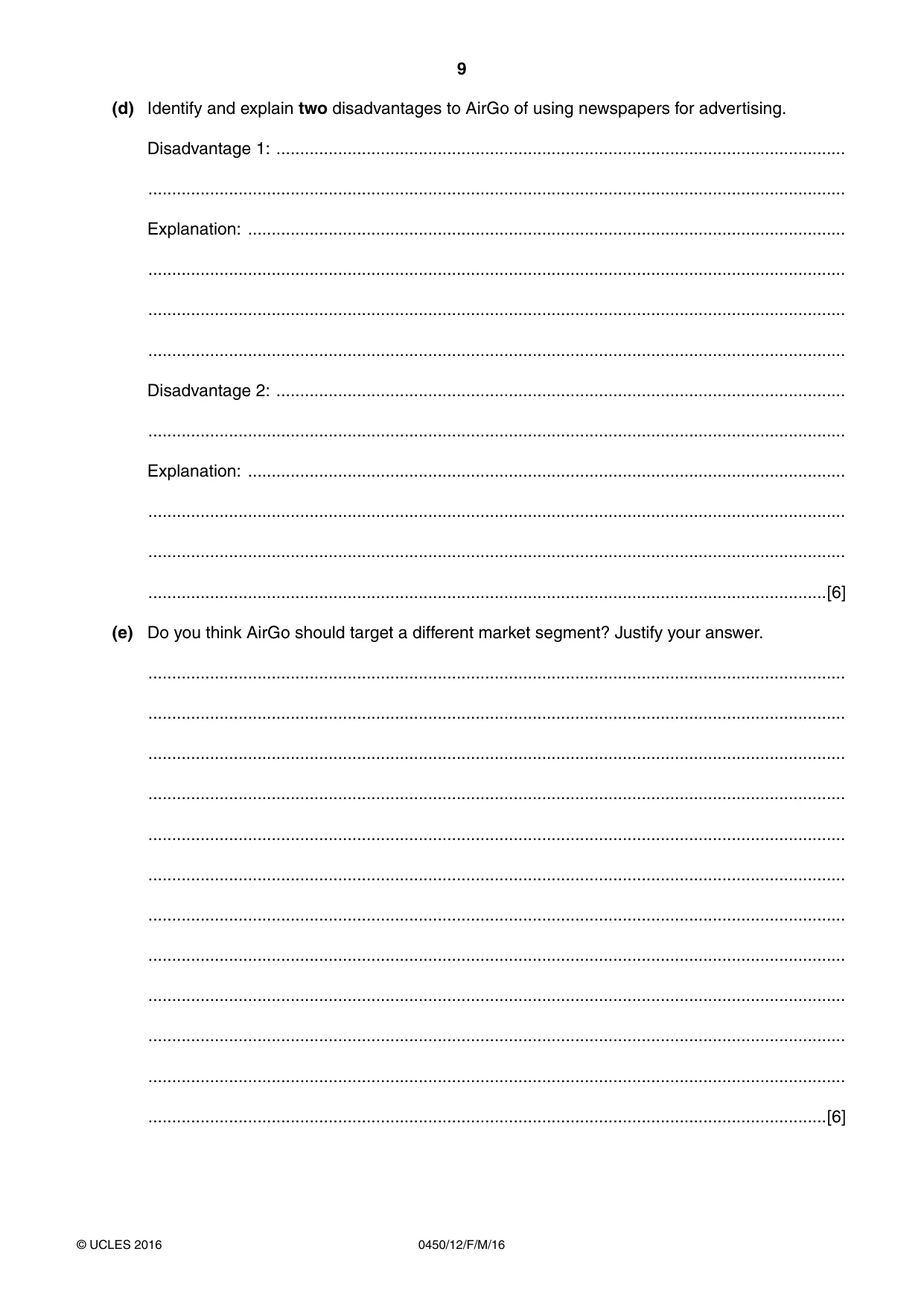
8 0450/12/F/M/16 © UCLES 2016 4 AirGo is a market-orientated business. It provides flights to 10 airports across Asia. 90% of its customers are people going on holiday. AirGo only advertises in national newspapers. The Marketing Director is worried that demand for AirGo’s flights is price elastic. Last year revenue fell due to increased competition. She wants to target a different market segment such as business customers. She does not know how new legal controls to protect the environment might affect AirGo. (a) What is meant by ‘market-orientated’? … … … …[2] (b) What is meant by demand is ‘price elastic’? … … … …[2] (c) Identify and explain two ways in which new legal controls to protect the environment might affect AirGo. Way 1: … … Explanation: … … Way 2: … … Explanation: … …[4]
Question paper, page 9
9 0450/12/F/M/16 © UCLES 2016 (d) Identify and explain two disadvantages to AirGo of using newspapers for advertising. Disadvantage 1: … … Explanation: … … … … Disadvantage 2: … … Explanation: … … … …[6] (e) Do you think AirGo should target a different market segment? Justify your answer. … … … … … … … … … … … …[6]
Question paper, page 10
10 0450/12/F/M/16 © UCLES 2016 BLANK PAGE
Question paper, page 11
11 0450/12/F/M/16 © UCLES 2016 BLANK PAGE
Question paper, page 12
12 0450/12/F/M/16 © UCLES 2016 Permission to reproduce items where third-party owned material protected by copyright is included has been sought and cleared where possible. Every reasonable effort has been made by the publisher (UCLES) to trace copyright holders, but if any items requiring clearance have unwittingly been included, the publisher will be pleased to make amends at the earliest possible opportunity. To avoid the issue of disclosure of answer-related information to candidates, all copyright acknowledgements are reproduced online in the Cambridge International Examinations Copyright Acknowledgements Booklet. This is produced for each series of examinations and is freely available to download at www.cie.org.uk after the live examination series. Cambridge International Examinations is part of the Cambridge Assessment Group. Cambridge Assessment is the brand name of University of Cambridge Local Examinations Syndicate (UCLES), which is itself a department of the University of Cambridge. BLANK PAGE
Mark scheme, page 1
® IGCSE is the registered trademark of Cambridge International Examinations. CAMBRIDGE INTERNATIONAL EXAMINATIONS Cambridge International General Certificate of Secondary Education MARK SCHEME for the March 2016 series 0450 BUSINESS STUDIES 0450/12 Paper 1 (Short Answer/Structured Response), maximum raw mark 80 This mark scheme is published as an aid to teachers and candidates, to indicate the requirements of the examination. It shows the basis on which Examiners were instructed to award marks. It does not indicate the details of the discussions that took place at an Examiners’ meeting before marking began, which would have considered the acceptability of alternative answers. Mark schemes should be read in conjunction with the question paper and the Principal Examiner Report for Teachers. Cambridge will not enter into discussions about these mark schemes. Cambridge is publishing the mark schemes for the March 2016 series for most Cambridge IGCSE® and Cambridge International A and AS Level components.
Mark scheme, page 2
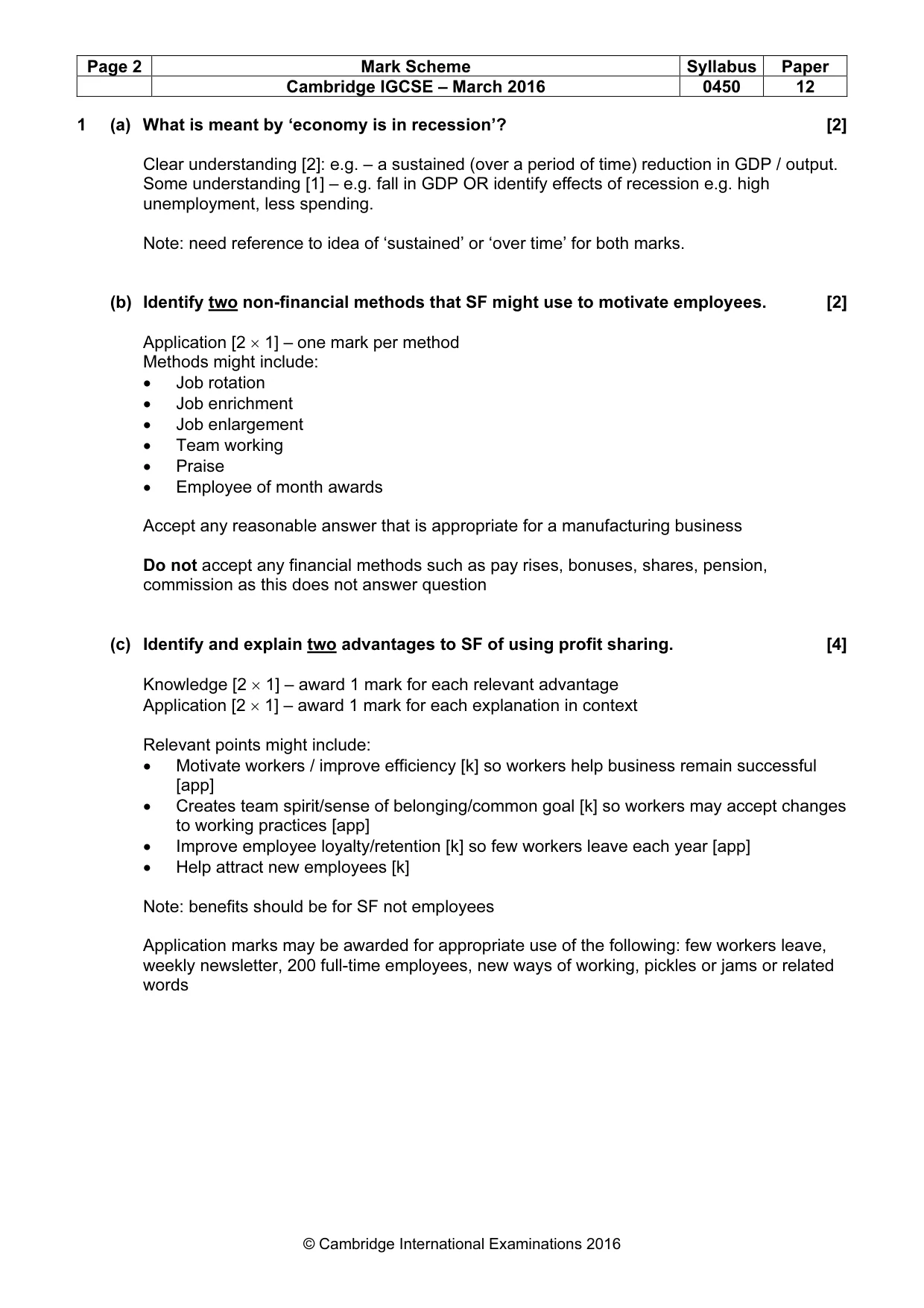
Page 2 Mark Scheme Syllabus Paper Cambridge IGCSE – March 2016 0450 12 © Cambridge International Examinations 2016 1 (a) What is meant by ‘economy is in recession’? [2] Clear understanding [2]: e.g. – a sustained (over a period of time) reduction in GDP / output. Some understanding [1] – e.g. fall in GDP OR identify effects of recession e.g. high unemployment, less spending. Note: need reference to idea of ‘sustained’ or ‘over time’ for both marks. (b) Identify two non-financial methods that SF might use to motivate employees. [2] Application [2 × 1] – one mark per method Methods might include: • Job rotation • Job enrichment • Job enlargement • Team working • Praise • Employee of month awards Accept any reasonable answer that is appropriate for a manufacturing business Do not accept any financial methods such as pay rises, bonuses, shares, pension, commission as this does not answer question (c) Identify and explain two advantages to SF of using profit sharing. [4] Knowledge [2 × 1] – award 1 mark for each relevant advantage Application [2 × 1] – award 1 mark for each explanation in context Relevant points might include: • Motivate workers / improve efficiency [k] so workers help business remain successful [app] • Creates team spirit/sense of belonging/common goal [k] so workers may accept changes to working practices [app] • Improve employee loyalty/retention [k] so few workers leave each year [app] • Help attract new employees [k] Note: benefits should be for SF not employees Application marks may be awarded for appropriate use of the following: few workers leave, weekly newsletter, 200 full-time employees, new ways of working, pickles or jams or related words
Mark scheme, page 3
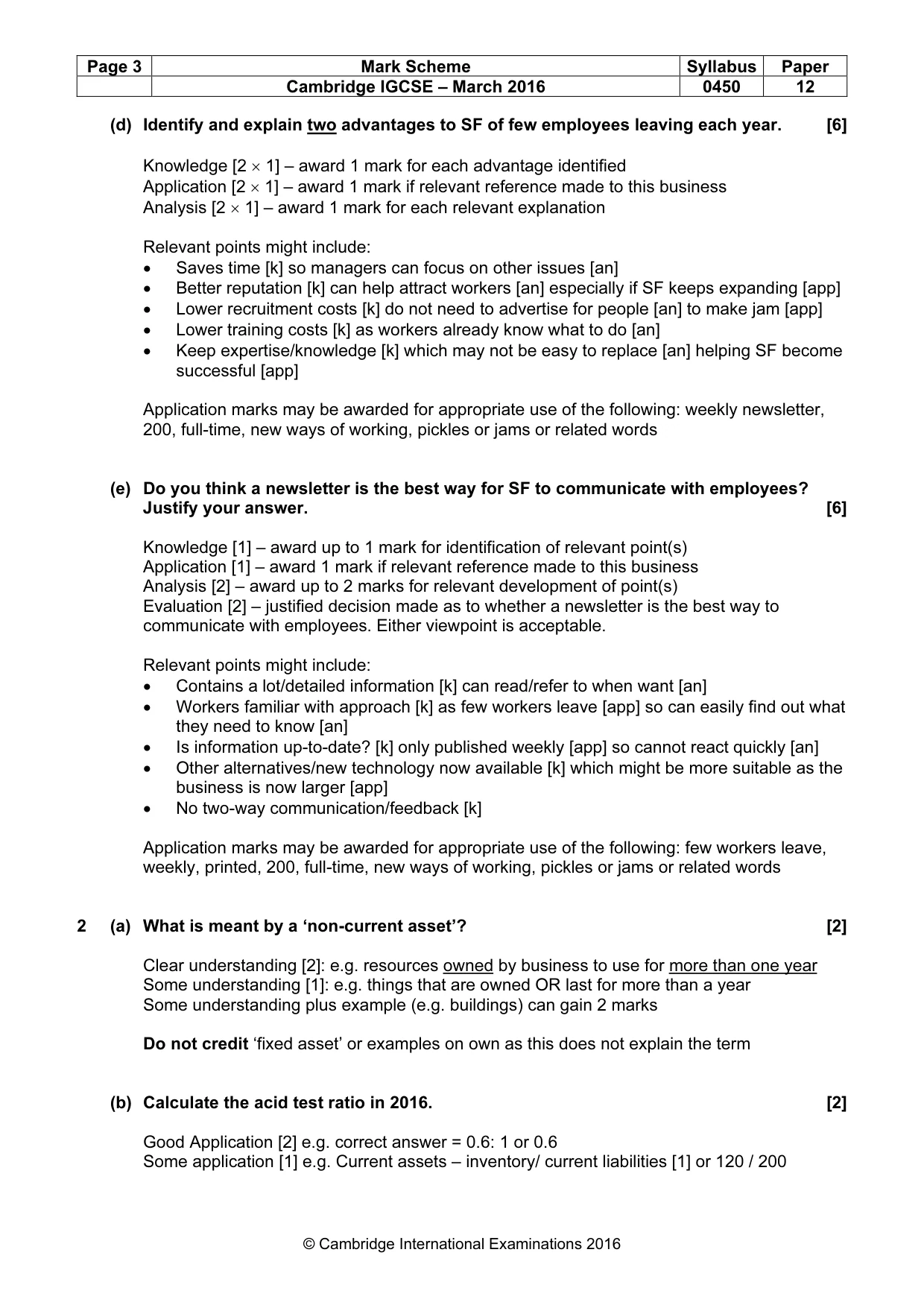
Page 3 Mark Scheme Syllabus Paper Cambridge IGCSE – March 2016 0450 12 © Cambridge International Examinations 2016 (d) Identify and explain two advantages to SF of few employees leaving each year. [6] Knowledge [2 × 1] – award 1 mark for each advantage identified Application [2 × 1] – award 1 mark if relevant reference made to this business Analysis [2 × 1] – award 1 mark for each relevant explanation Relevant points might include: • Saves time [k] so managers can focus on other issues [an] • Better reputation [k] can help attract workers [an] especially if SF keeps expanding [app] • Lower recruitment costs [k] do not need to advertise for people [an] to make jam [app] • Lower training costs [k] as workers already know what to do [an] • Keep expertise/knowledge [k] which may not be easy to replace [an] helping SF become successful [app] Application marks may be awarded for appropriate use of the following: weekly newsletter, 200, full-time, new ways of working, pickles or jams or related words (e) Do you think a newsletter is the best way for SF to communicate with employees? Justify your answer. [6] Knowledge [1] – award up to 1 mark for identification of relevant point(s) Application [1] – award 1 mark if relevant reference made to this business Analysis [2] – award up to 2 marks for relevant development of point(s) Evaluation [2] – justified decision made as to whether a newsletter is the best way to communicate with employees. Either viewpoint is acceptable. Relevant points might include: • Contains a lot/detailed information [k] can read/refer to when want [an] • Workers familiar with approach [k] as few workers leave [app] so can easily find out what they need to know [an] • Is information up-to-date? [k] only published weekly [app] so cannot react quickly [an] • Other alternatives/new technology now available [k] which might be more suitable as the business is now larger [app] • No two-way communication/feedback [k] Application marks may be awarded for appropriate use of the following: few workers leave, weekly, printed, 200, full-time, new ways of working, pickles or jams or related words 2 (a) What is meant by a ‘non-current asset’? [2] Clear understanding [2]: e.g. resources owned by business to use for more than one year Some understanding [1]: e.g. things that are owned OR last for more than a year Some understanding plus example (e.g. buildings) can gain 2 marks Do not credit ‘fixed asset’ or examples on own as this does not explain the term (b) Calculate the acid test ratio in 2016. [2] Good Application [2] e.g. correct answer = 0.6: 1 or 0.6 Some application [1] e.g. Current assets – inventory/ current liabilities [1] or 120 / 200
Mark scheme, page 4
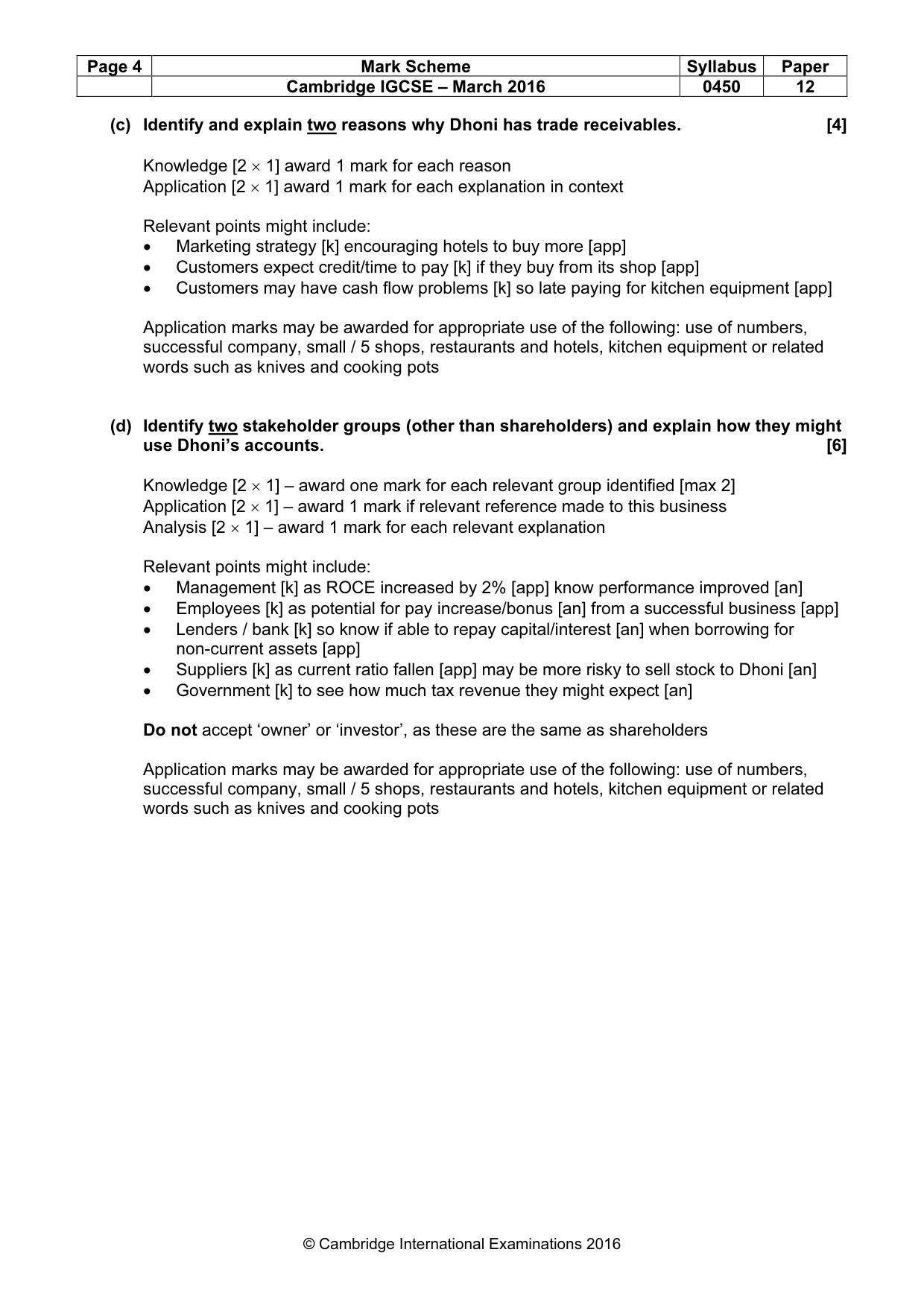
Page 4 Mark Scheme Syllabus Paper Cambridge IGCSE – March 2016 0450 12 © Cambridge International Examinations 2016 (c) Identify and explain two reasons why Dhoni has trade receivables. [4] Knowledge [2 × 1] award 1 mark for each reason Application [2 × 1] award 1 mark for each explanation in context Relevant points might include: • Marketing strategy [k] encouraging hotels to buy more [app] • Customers expect credit/time to pay [k] if they buy from its shop [app] • Customers may have cash flow problems [k] so late paying for kitchen equipment [app] Application marks may be awarded for appropriate use of the following: use of numbers, successful company, small / 5 shops, restaurants and hotels, kitchen equipment or related words such as knives and cooking pots (d) Identify two stakeholder groups (other than shareholders) and explain how they might use Dhoni’s accounts. [6] Knowledge [2 × 1] – award one mark for each relevant group identified [max 2] Application [2 × 1] – award 1 mark if relevant reference made to this business Analysis [2 × 1] – award 1 mark for each relevant explanation Relevant points might include: • Management [k] as ROCE increased by 2% [app] know performance improved [an] • Employees [k] as potential for pay increase/bonus [an] from a successful business [app] • Lenders / bank [k] so know if able to repay capital/interest [an] when borrowing for non-current assets [app] • Suppliers [k] as current ratio fallen [app] may be more risky to sell stock to Dhoni [an] • Government [k] to see how much tax revenue they might expect [an] Do not accept ‘owner’ or ‘investor’, as these are the same as shareholders Application marks may be awarded for appropriate use of the following: use of numbers, successful company, small / 5 shops, restaurants and hotels, kitchen equipment or related words such as knives and cooking pots
Mark scheme, page 5
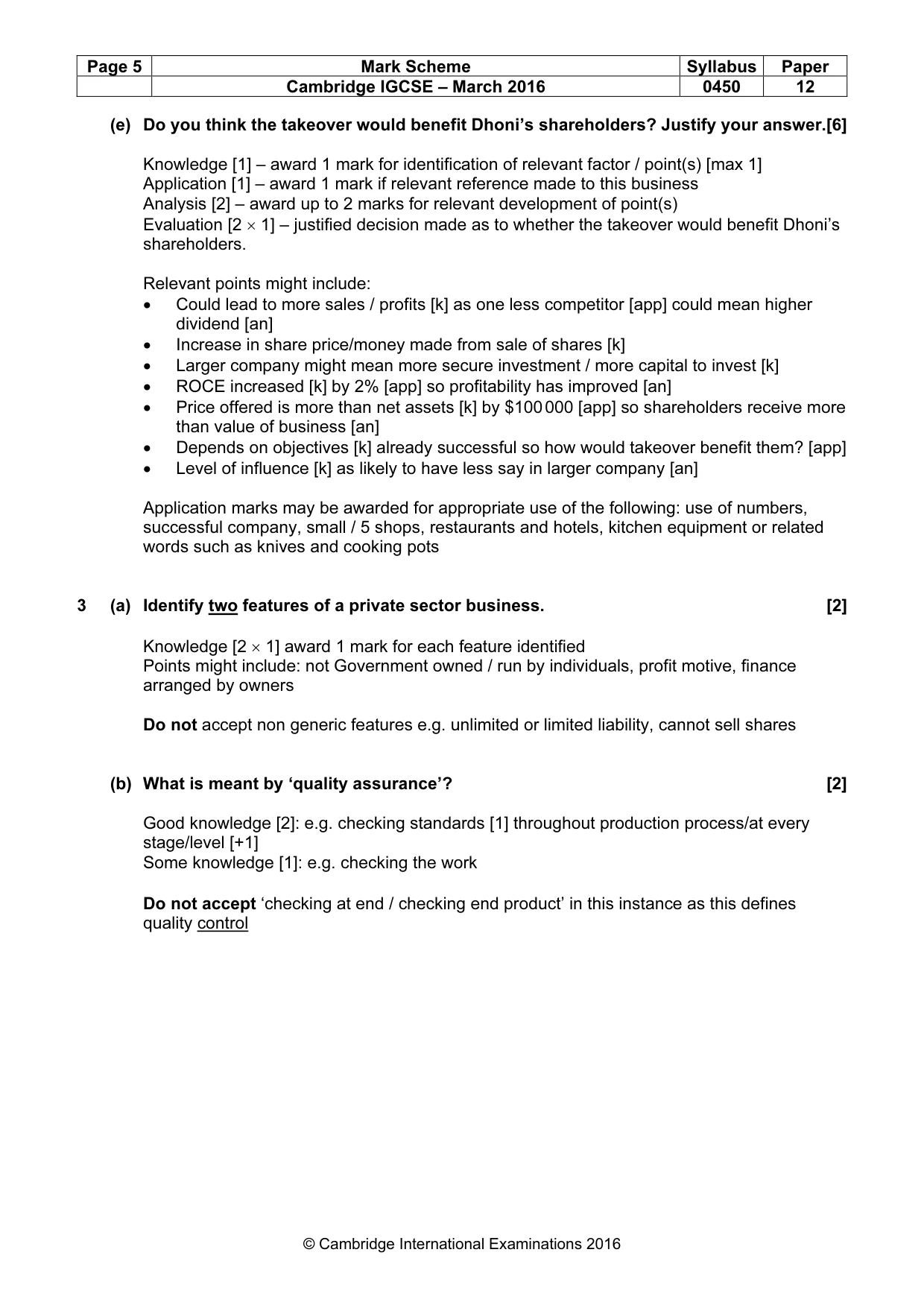
Page 5 Mark Scheme Syllabus Paper Cambridge IGCSE – March 2016 0450 12 © Cambridge International Examinations 2016 (e) Do you think the takeover would benefit Dhoni’s shareholders? Justify your answer. [6] Knowledge [1] – award 1 mark for identification of relevant factor / point(s) [max 1] Application [1] – award 1 mark if relevant reference made to this business Analysis [2] – award up to 2 marks for relevant development of point(s) Evaluation [2 × 1] – justified decision made as to whether the takeover would benefit Dhoni’s shareholders. Relevant points might include: • Could lead to more sales / profits [k] as one less competitor [app] could mean higher dividend [an] • Increase in share price/money made from sale of shares [k] • Larger company might mean more secure investment / more capital to invest [k] • ROCE increased [k] by 2% [app] so profitability has improved [an] • Price offered is more than net assets [k] by $100 000 [app] so shareholders receive more than value of business [an] • Depends on objectives [k] already successful so how would takeover benefit them? [app] • Level of influence [k] as likely to have less say in larger company [an] Application marks may be awarded for appropriate use of the following: use of numbers, successful company, small / 5 shops, restaurants and hotels, kitchen equipment or related words such as knives and cooking pots 3 (a) Identify two features of a private sector business. [2] Knowledge [2 × 1] award 1 mark for each feature identified Points might include: not Government owned / run by individuals, profit motive, finance arranged by owners Do not accept non generic features e.g. unlimited or limited liability, cannot sell shares (b) What is meant by ‘quality assurance’? [2] Good knowledge [2]: e.g. checking standards [1] throughout production process/at every stage/level [+1] Some knowledge [1]: e.g. checking the work Do not accept ‘checking at end / checking end product’ in this instance as this defines quality control
Mark scheme, page 6
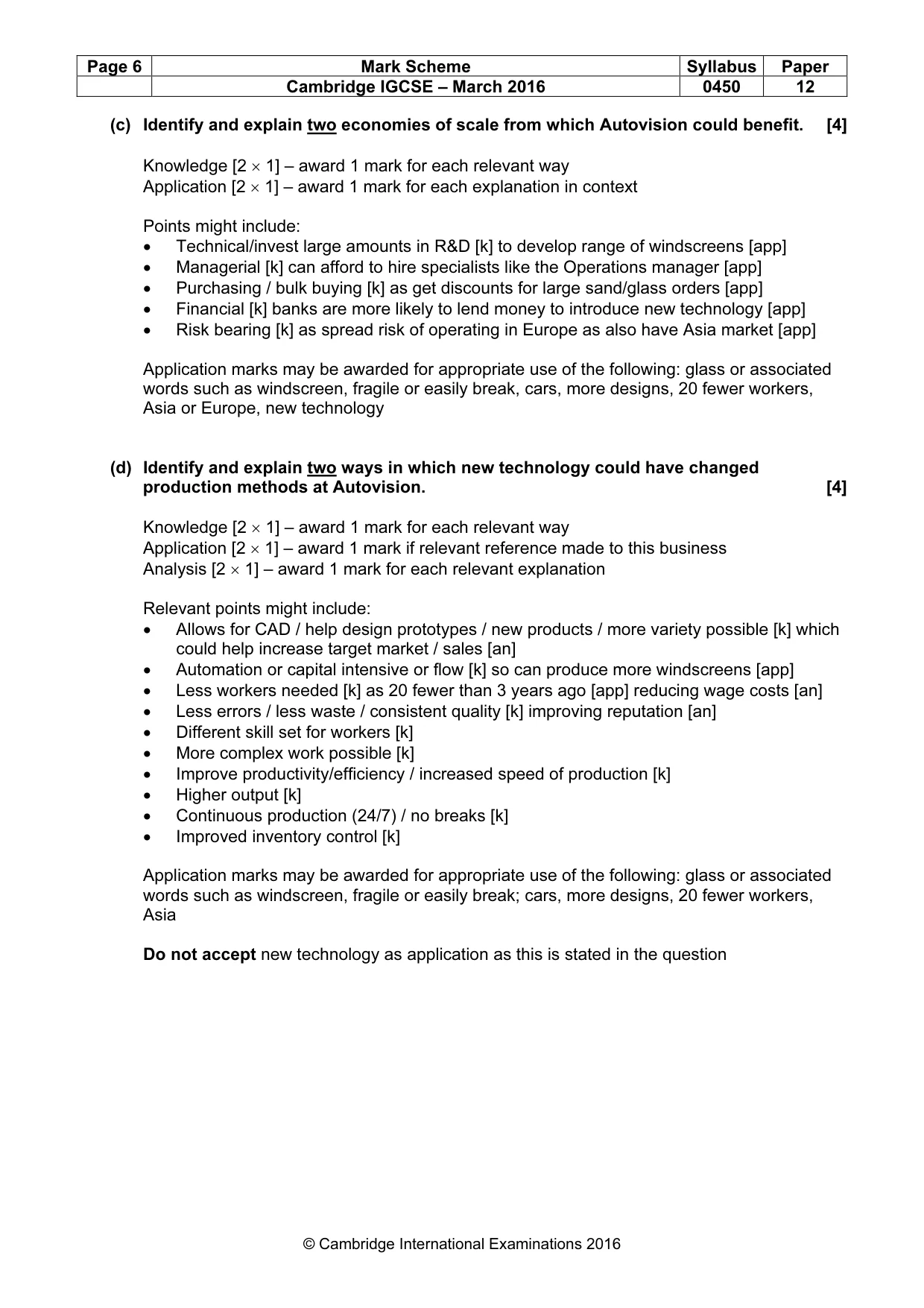
Page 6 Mark Scheme Syllabus Paper Cambridge IGCSE – March 2016 0450 12 © Cambridge International Examinations 2016 (c) Identify and explain two economies of scale from which Autovision could benefit. [4] Knowledge [2 × 1] – award 1 mark for each relevant way Application [2 × 1] – award 1 mark for each explanation in context Points might include: • Technical/invest large amounts in R&D [k] to develop range of windscreens [app] • Managerial [k] can afford to hire specialists like the Operations manager [app] • Purchasing / bulk buying [k] as get discounts for large sand/glass orders [app] • Financial [k] banks are more likely to lend money to introduce new technology [app] • Risk bearing [k] as spread risk of operating in Europe as also have Asia market [app] Application marks may be awarded for appropriate use of the following: glass or associated words such as windscreen, fragile or easily break, cars, more designs, 20 fewer workers, Asia or Europe, new technology (d) Identify and explain two ways in which new technology could have changed production methods at Autovision. [4] Knowledge [2 × 1] – award 1 mark for each relevant way Application [2 × 1] – award 1 mark if relevant reference made to this business Analysis [2 × 1] – award 1 mark for each relevant explanation Relevant points might include: • Allows for CAD / help design prototypes / new products / more variety possible [k] which could help increase target market / sales [an] • Automation or capital intensive or flow [k] so can produce more windscreens [app] • Less workers needed [k] as 20 fewer than 3 years ago [app] reducing wage costs [an] • Less errors / less waste / consistent quality [k] improving reputation [an] • Different skill set for workers [k] • More complex work possible [k] • Improve productivity/efficiency / increased speed of production [k] • Higher output [k] • Continuous production (24/7) / no breaks [k] • Improved inventory control [k] Application marks may be awarded for appropriate use of the following: glass or associated words such as windscreen, fragile or easily break; cars, more designs, 20 fewer workers, Asia Do not accept new technology as application as this is stated in the question
Mark scheme, page 7
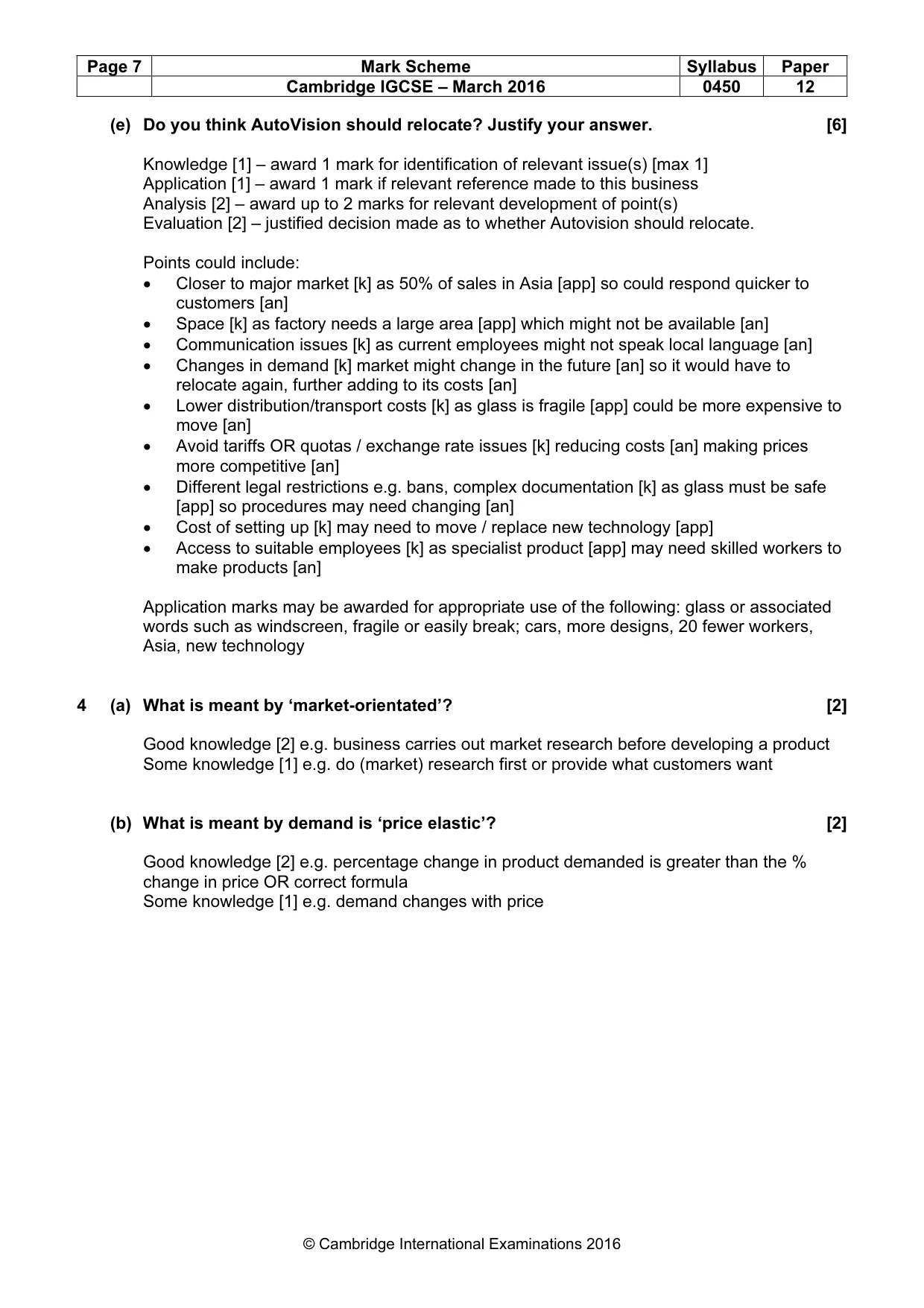
Page 7 Mark Scheme Syllabus Paper Cambridge IGCSE – March 2016 0450 12 © Cambridge International Examinations 2016 (e) Do you think AutoVision should relocate? Justify your answer. [6] Knowledge [1] – award 1 mark for identification of relevant issue(s) [max 1] Application [1] – award 1 mark if relevant reference made to this business Analysis [2] – award up to 2 marks for relevant development of point(s) Evaluation [2] – justified decision made as to whether Autovision should relocate. Points could include: • Closer to major market [k] as 50% of sales in Asia [app] so could respond quicker to customers [an] • Space [k] as factory needs a large area [app] which might not be available [an] • Communication issues [k] as current employees might not speak local language [an] • Changes in demand [k] market might change in the future [an] so it would have to relocate again, further adding to its costs [an] • Lower distribution/transport costs [k] as glass is fragile [app] could be more expensive to move [an] • Avoid tariffs OR quotas / exchange rate issues [k] reducing costs [an] making prices more competitive [an] • Different legal restrictions e.g. bans, complex documentation [k] as glass must be safe [app] so procedures may need changing [an] • Cost of setting up [k] may need to move / replace new technology [app] • Access to suitable employees [k] as specialist product [app] may need skilled workers to make products [an] Application marks may be awarded for appropriate use of the following: glass or associated words such as windscreen, fragile or easily break; cars, more designs, 20 fewer workers, Asia, new technology 4 (a) What is meant by ‘market-orientated’? [2] Good knowledge [2] e.g. business carries out market research before developing a product Some knowledge [1] e.g. do (market) research first or provide what customers want (b) What is meant by demand is ‘price elastic’? [2] Good knowledge [2] e.g. percentage change in product demanded is greater than the % change in price OR correct formula Some knowledge [1] e.g. demand changes with price
Mark scheme, page 8
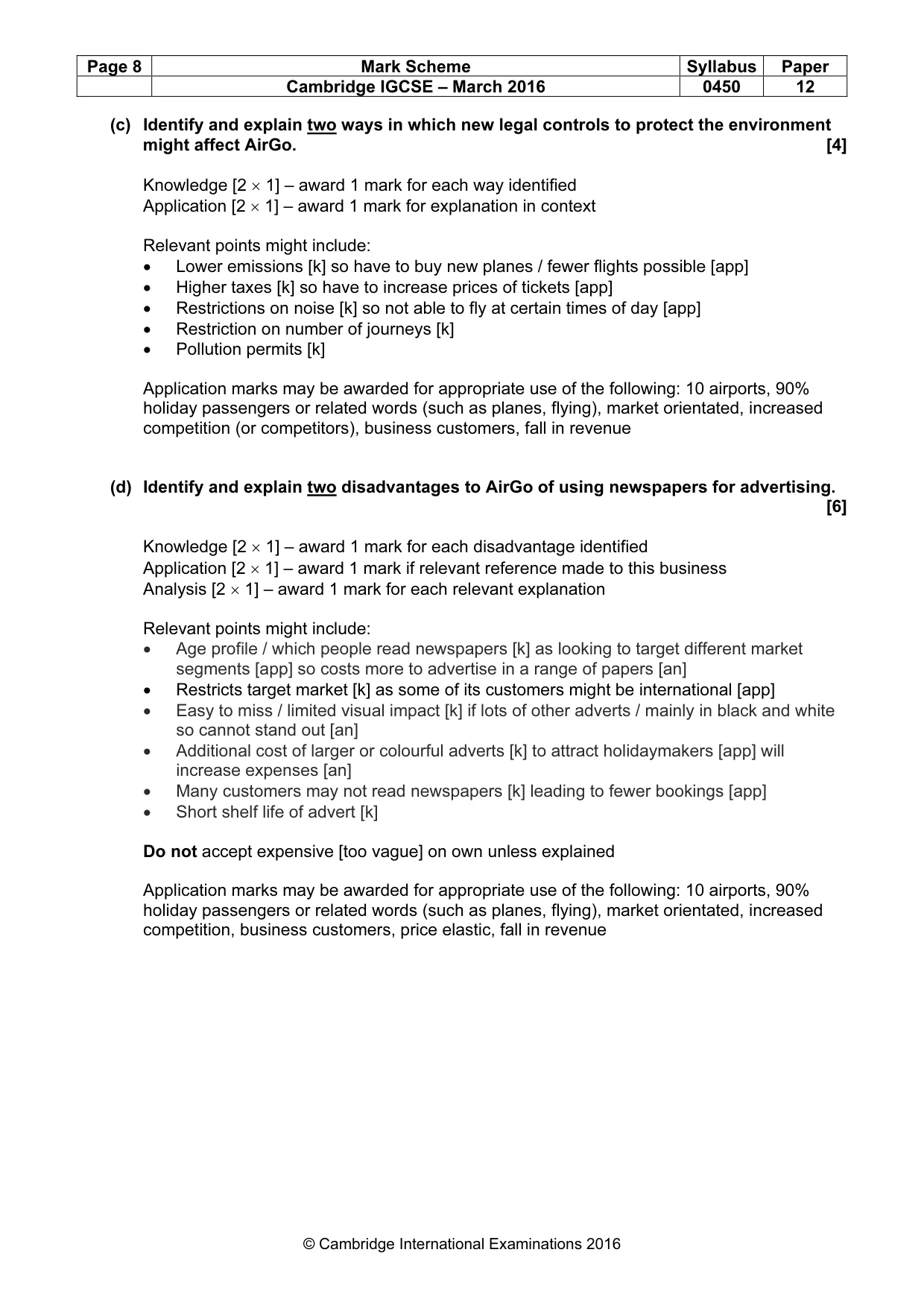
Page 8 Mark Scheme Syllabus Paper Cambridge IGCSE – March 2016 0450 12 © Cambridge International Examinations 2016 (c) Identify and explain two ways in which new legal controls to protect the environment might affect AirGo. [4] Knowledge [2 × 1] – award 1 mark for each way identified Application [2 × 1] – award 1 mark for explanation in context Relevant points might include: • Lower emissions [k] so have to buy new planes / fewer flights possible [app] • Higher taxes [k] so have to increase prices of tickets [app] • Restrictions on noise [k] so not able to fly at certain times of day [app] • Restriction on number of journeys [k] • Pollution permits [k] Application marks may be awarded for appropriate use of the following: 10 airports, 90% holiday passengers or related words (such as planes, flying), market orientated, increased competition (or competitors), business customers, fall in revenue (d) Identify and explain two disadvantages to AirGo of using newspapers for advertising. [6] Knowledge [2 × 1] – award 1 mark for each disadvantage identified Application [2 × 1] – award 1 mark if relevant reference made to this business Analysis [2 × 1] – award 1 mark for each relevant explanation Relevant points might include: • Age profile / which people read newspapers [k] as looking to target different market segments [app] so costs more to advertise in a range of papers [an] • Restricts target market [k] as some of its customers might be international [app] • Easy to miss / limited visual impact [k] if lots of other adverts / mainly in black and white so cannot stand out [an] • Additional cost of larger or colourful adverts [k] to attract holidaymakers [app] will increase expenses [an] • Many customers may not read newspapers [k] leading to fewer bookings [app] • Short shelf life of advert [k] Do not accept expensive [too vague] on own unless explained Application marks may be awarded for appropriate use of the following: 10 airports, 90% holiday passengers or related words (such as planes, flying), market orientated, increased competition, business customers, price elastic, fall in revenue
Mark scheme, page 9
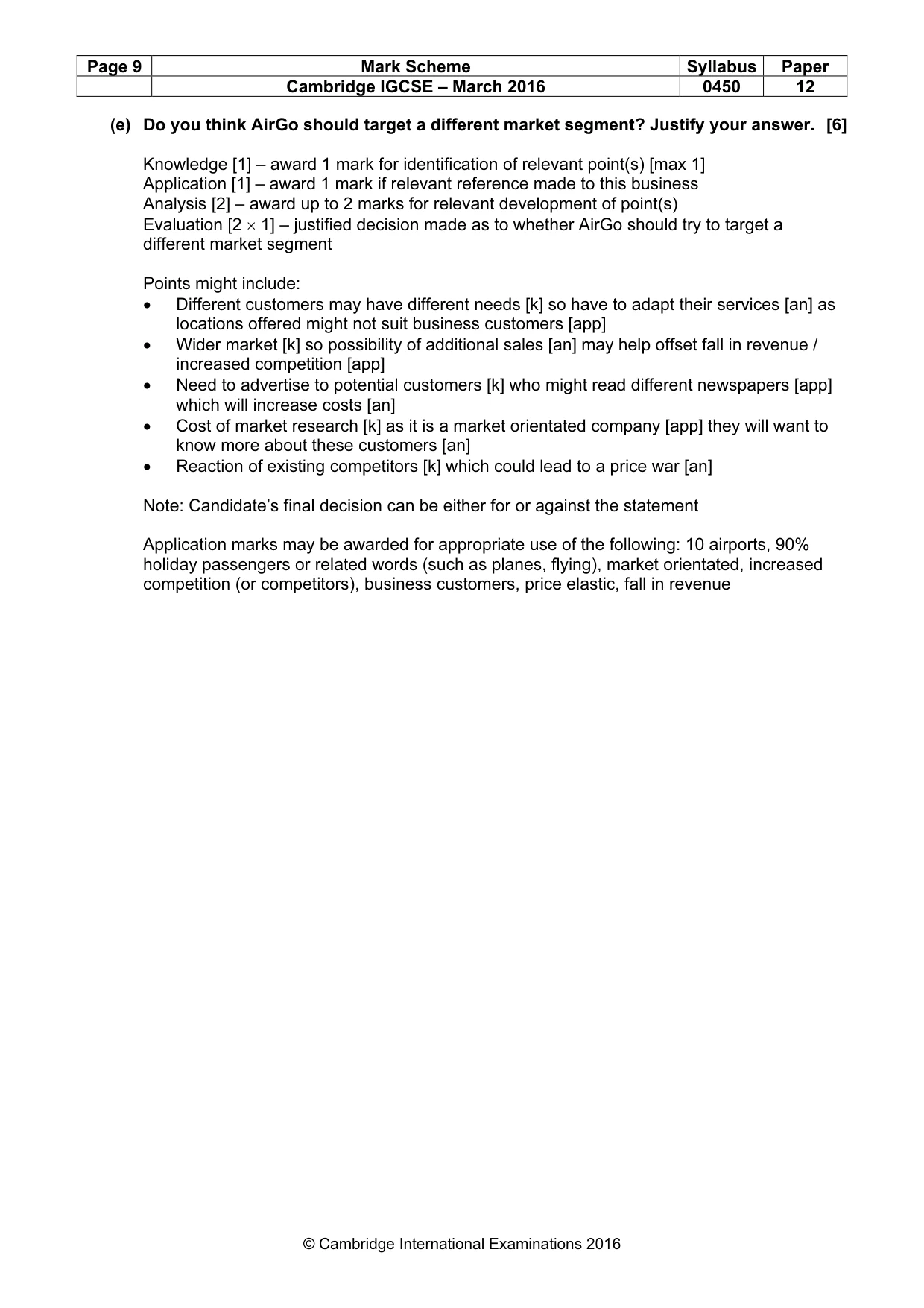
Page 9 Mark Scheme Syllabus Paper Cambridge IGCSE – March 2016 0450 12 © Cambridge International Examinations 2016 (e) Do you think AirGo should target a different market segment? Justify your answer. [6] Knowledge [1] – award 1 mark for identification of relevant point(s) [max 1] Application [1] – award 1 mark if relevant reference made to this business Analysis [2] – award up to 2 marks for relevant development of point(s) Evaluation [2 × 1] – justified decision made as to whether AirGo should try to target a different market segment Points might include: • Different customers may have different needs [k] so have to adapt their services [an] as locations offered might not suit business customers [app] • Wider market [k] so possibility of additional sales [an] may help offset fall in revenue / increased competition [app] • Need to advertise to potential customers [k] who might read different newspapers [app] which will increase costs [an] • Cost of market research [k] as it is a market orientated company [app] they will want to know more about these customers [an] • Reaction of existing competitors [k] which could lead to a price war [an] Note: Candidate’s final decision can be either for or against the statement Application marks may be awarded for appropriate use of the following: 10 airports, 90% holiday passengers or related words (such as planes, flying), market orientated, increased competition (or competitors), business customers, price elastic, fall in revenue
What you needed in this session
Cambridge’s own grade thresholds for 2016 Feb/March, Paper 1 · Variant 2. A higher threshold means an easier paper — the bar moves with how the cohort did.