Cambridge IGCSE Business Studies 0450 — 2015 Oct/Nov Paper 1 · Variant 2
0450/12/O/N/15 · 80 marks · ≈90 min
The question paper and its mark scheme, free to read here and free to download. This is Cambridge’s own paper, exactly as it was sat.
Question paper12 pages



Mark scheme11 pages
Answers below. Sit the paper first if you are practising.
Paper as text
Question paper, page 1
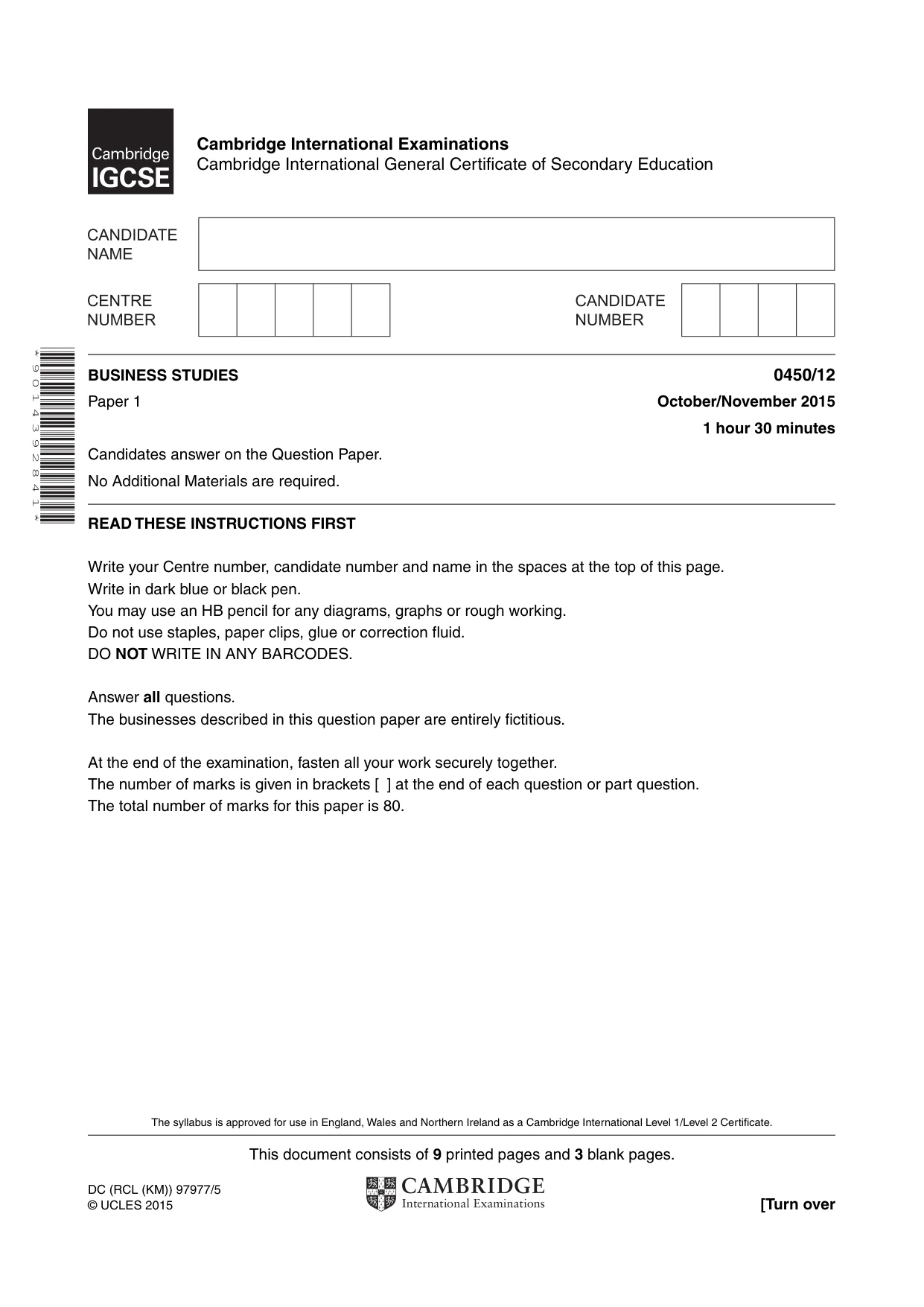
This document consists of 9 printed pages and 3 blank pages. DC (RCL (KM)) 97977/5 © UCLES 2015 [Turn over Cambridge International Examinations Cambridge International General Certificate of Secondary Education * 9 0 1 4 3 9 2 8 4 1 * BUSINESS STUDIES 0450/12 Paper 1 October/November 2015 1 hour 30 minutes Candidates answer on the Question Paper. No Additional Materials are required. READ THESE INSTRUCTIONS FIRST Write your Centre number, candidate number and name in the spaces at the top of this page. Write in dark blue or black pen. You may use an HB pencil for any diagrams, graphs or rough working. Do not use staples, paper clips, glue or correction fluid. DO NOT WRITE IN ANY BARCODES. Answer all questions. The businesses described in this question paper are entirely fictitious. At the end of the examination, fasten all your work securely together. The number of marks is given in brackets [ ] at the end of each question or part question. The total number of marks for this paper is 80. The syllabus is approved for use in England, Wales and Northern Ireland as a Cambridge International Level 1/Level 2 Certificate.
Question paper, page 2
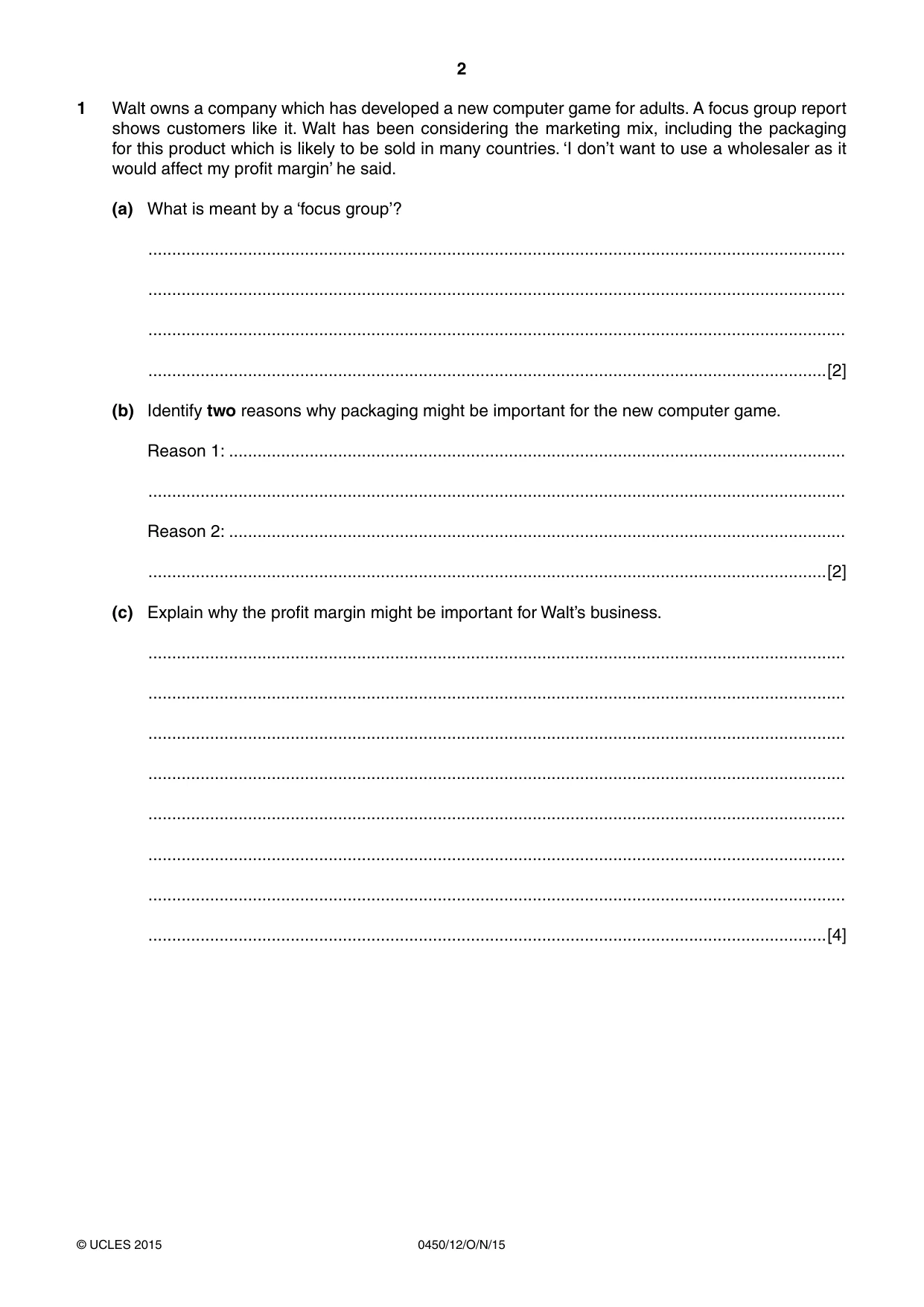
2 0450/12/O/N/15 © UCLES 2015 1 Walt owns a company which has developed a new computer game for adults. A focus group report shows customers like it. Walt has been considering the marketing mix, including the packaging for this product which is likely to be sold in many countries. ‘I don’t want to use a wholesaler as it would affect my profit margin’ he said. (a) What is meant by a ‘focus group’? … … … …[2] (b) Identify two reasons why packaging might be important for the new computer game. Reason 1: … … Reason 2: … …[2] (c) Explain why the profit margin might be important for Walt’s business. … … … … … … … …[4]
Question paper, page 3
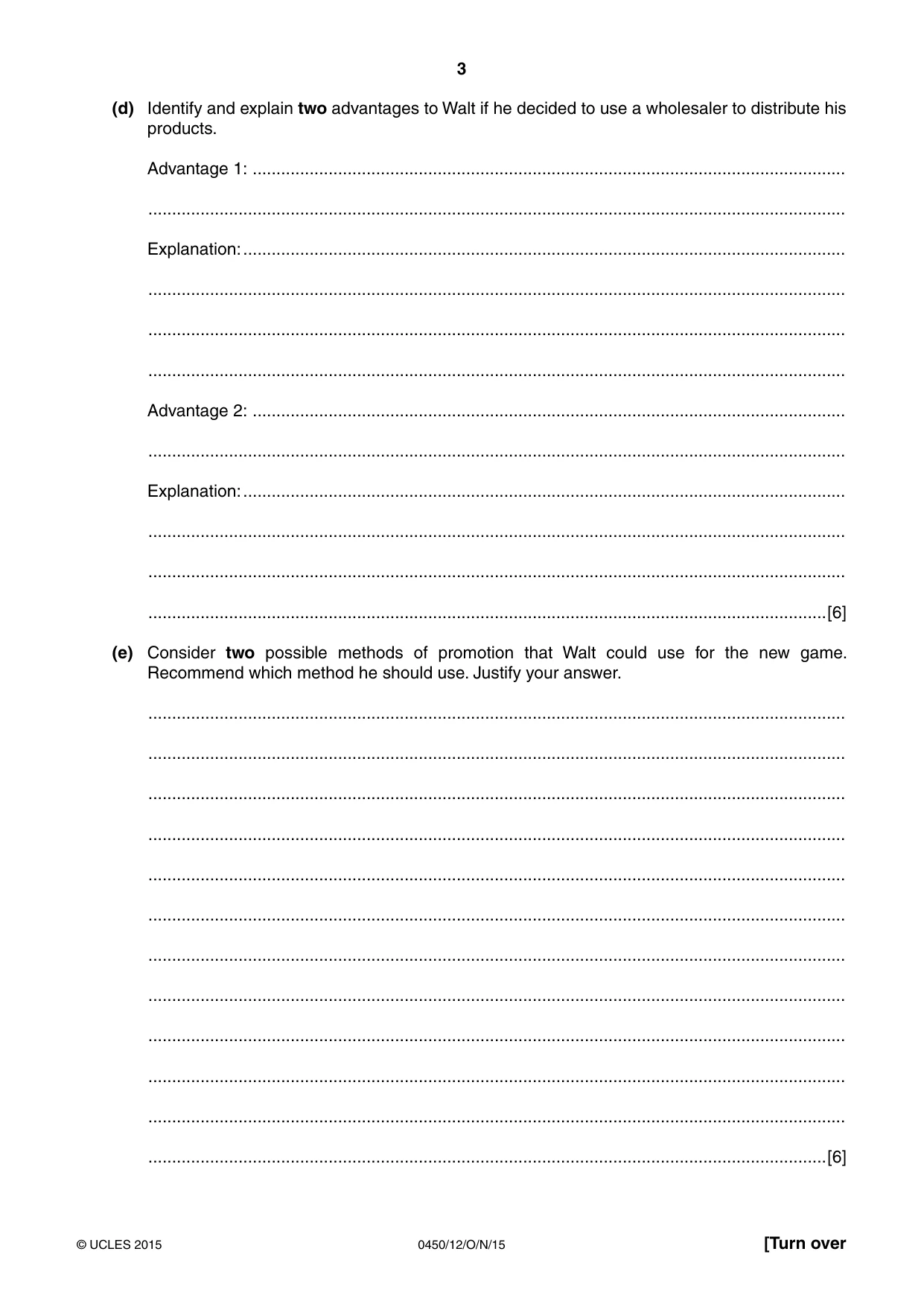
3 0450/12/O/N/15 © UCLES 2015 [Turn over (d) Identify and explain two advantages to Walt if he decided to use a wholesaler to distribute his products. Advantage 1: … … Explanation: … … … … Advantage 2: … … Explanation: … … … …[6] (e) Consider two possible methods of promotion that Walt could use for the new game. Recommend which method he should use. Justify your answer. … … … … … … … … … … … …[6]
Question paper, page 4
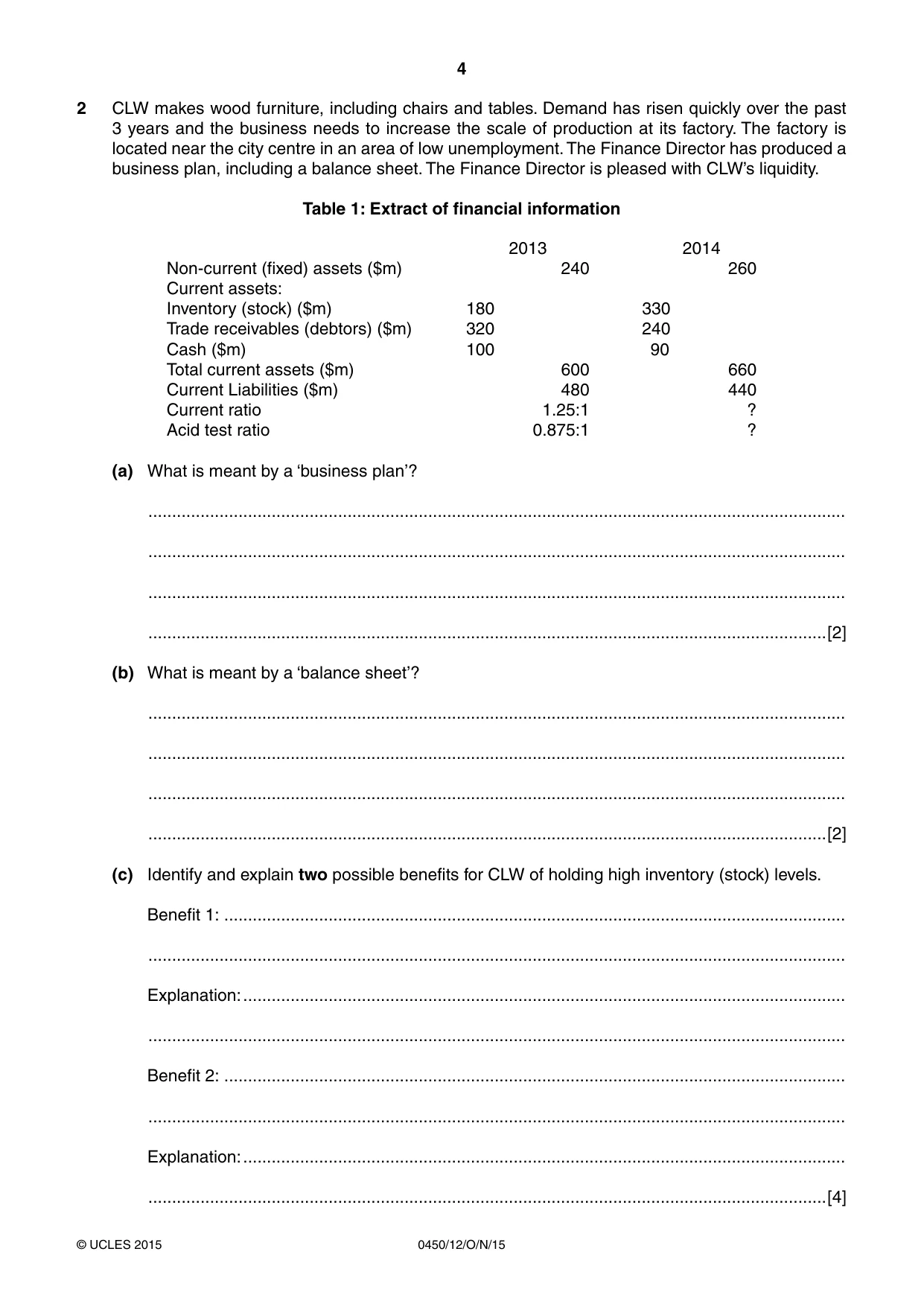
4 0450/12/O/N/15 © UCLES 2015 2 CLW makes wood furniture, including chairs and tables. Demand has risen quickly over the past 3 years and the business needs to increase the scale of production at its factory. The factory is located near the city centre in an area of low unemployment. The Finance Director has produced a business plan, including a balance sheet. The Finance Director is pleased with CLW’s liquidity. Table 1: Extract of financial information 2013 2014 Non-current (fixed) assets ($m) 240 260 Current assets: Inventory (stock) ($m) 180 330 Trade receivables (debtors) ($m) 320 24 0 Cash ($m) 100 90 Total current assets ($m) 600 660 Current Liabilities ($m) 480 440 Current ratio 1.25:1 ? Acid test ratio 0.875:1 ? (a) What is meant by a ‘business plan’? … … … …[2] (b) What is meant by a ‘balance sheet’? … … … …[2] (c) Identify and explain two possible benefits for CLW of holding high inventory (stock) levels. Benefit 1: … … Explanation: … … Benefit 2: … … Explanation: … …[4]
Question paper, page 5
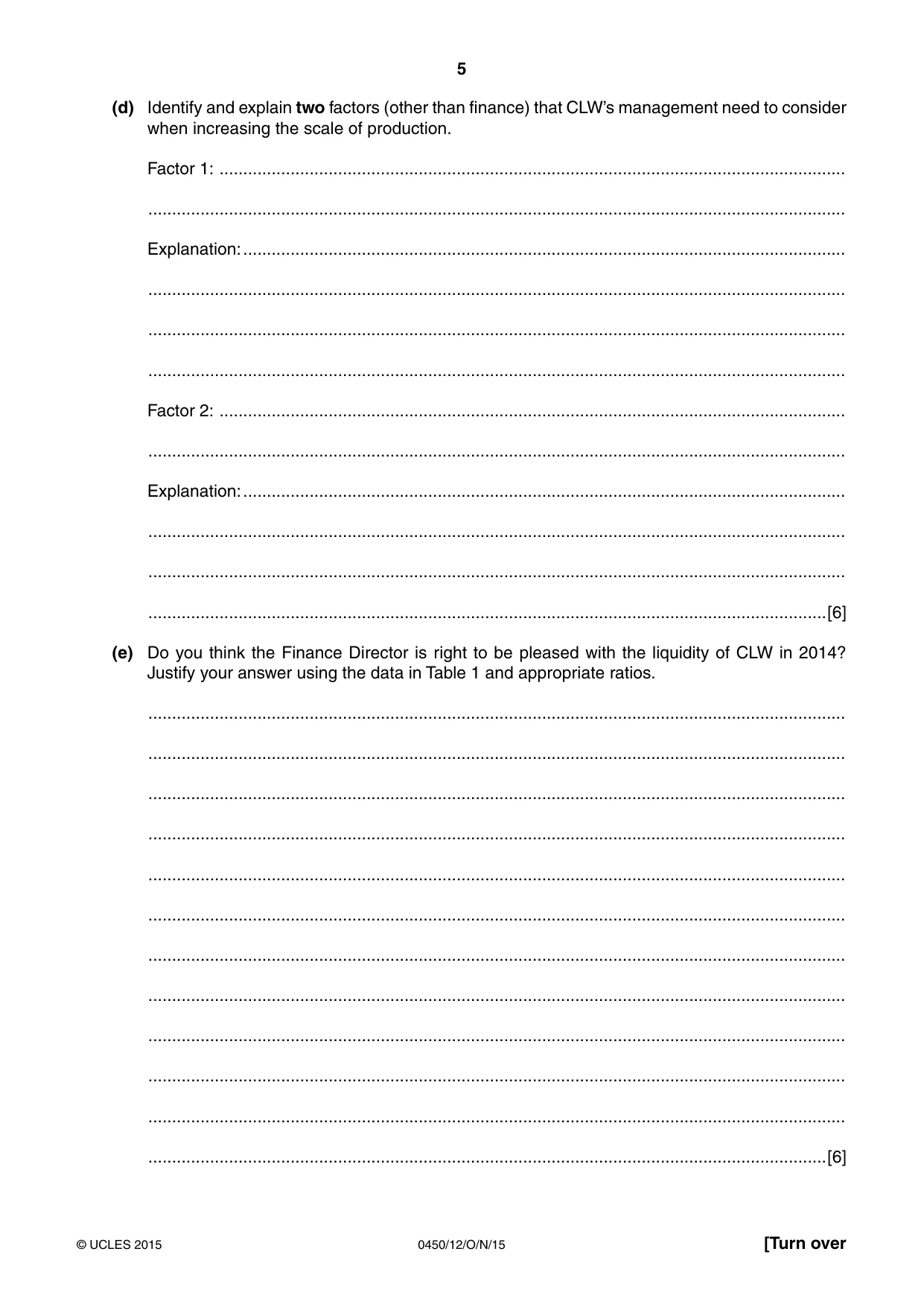
5 0450/12/O/N/15 © UCLES 2015 [Turn over (d) Identify and explain two factors (other than finance) that CLW’s management need to consider when increasing the scale of production. Factor 1: … … Explanation: … … … … Factor 2: … … Explanation: … … … …[6] (e) Do you think the Finance Director is right to be pleased with the liquidity of CLW in 2014? Justify your answer using the data in Table 1 and appropriate ratios. … … … … … … … … … … … …[6]
Question paper, page 6
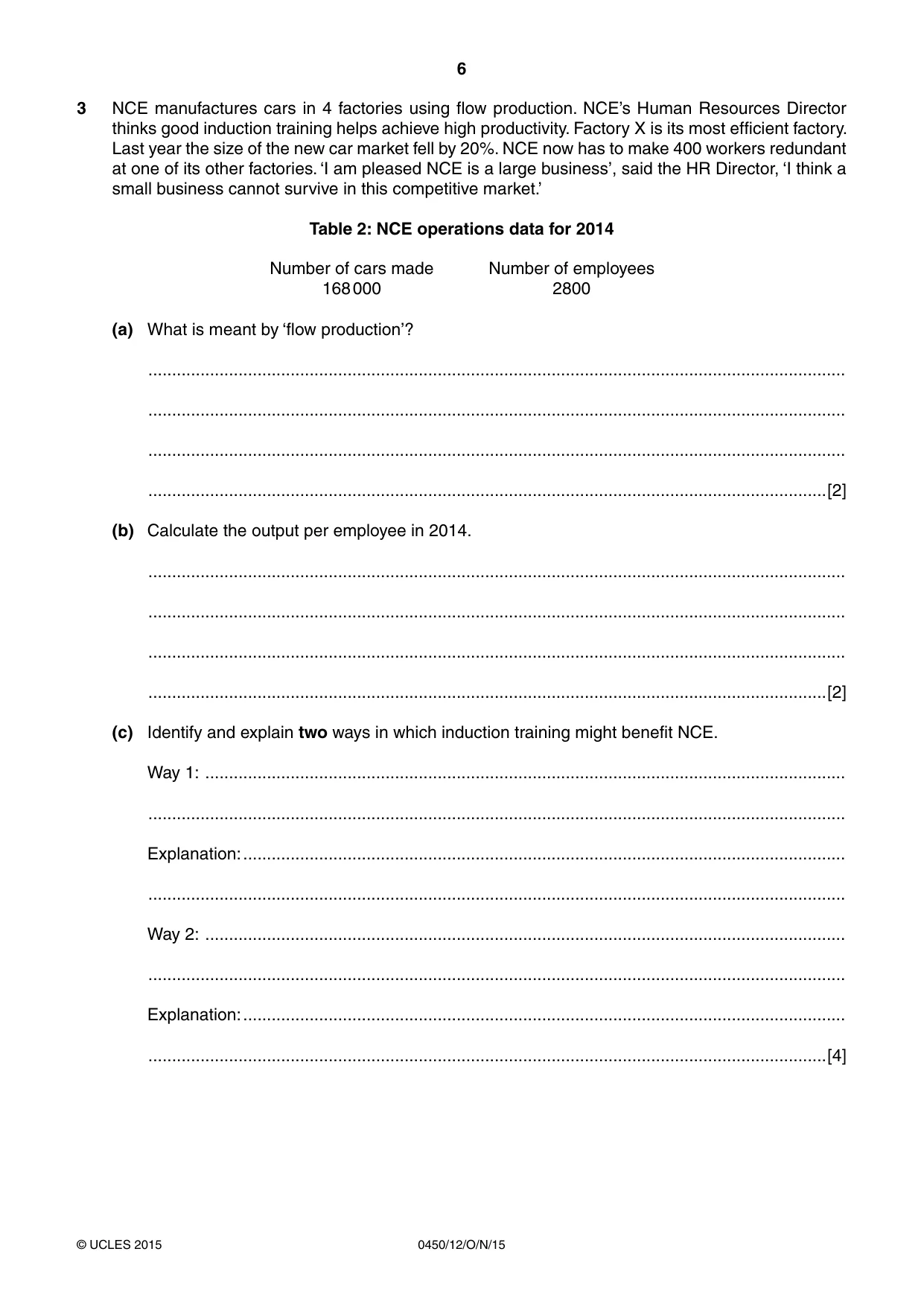
6 0450/12/O/N/15 © UCLES 2015 3 NCE manufactures cars in 4 factories using flow production. NCE’s Human Resources Director thinks good induction training helps achieve high productivity. Factory X is its most efficient factory. Last year the size of the new car market fell by 20%. NCE now has to make 400 workers redundant at one of its other factories. ‘I am pleased NCE is a large business’, said the HR Director, ‘I think a small business cannot survive in this competitive market.’ Table 2: NCE operations data for 2014 Number of cars made Number of employees 168 000 2800 (a) What is meant by ‘flow production’? … … … …[2] (b) Calculate the output per employee in 2014. … … … …[2] (c) Identify and explain two ways in which induction training might benefit NCE. Way 1: … … Explanation: … … Way 2: … … Explanation: … …[4]
Question paper, page 7
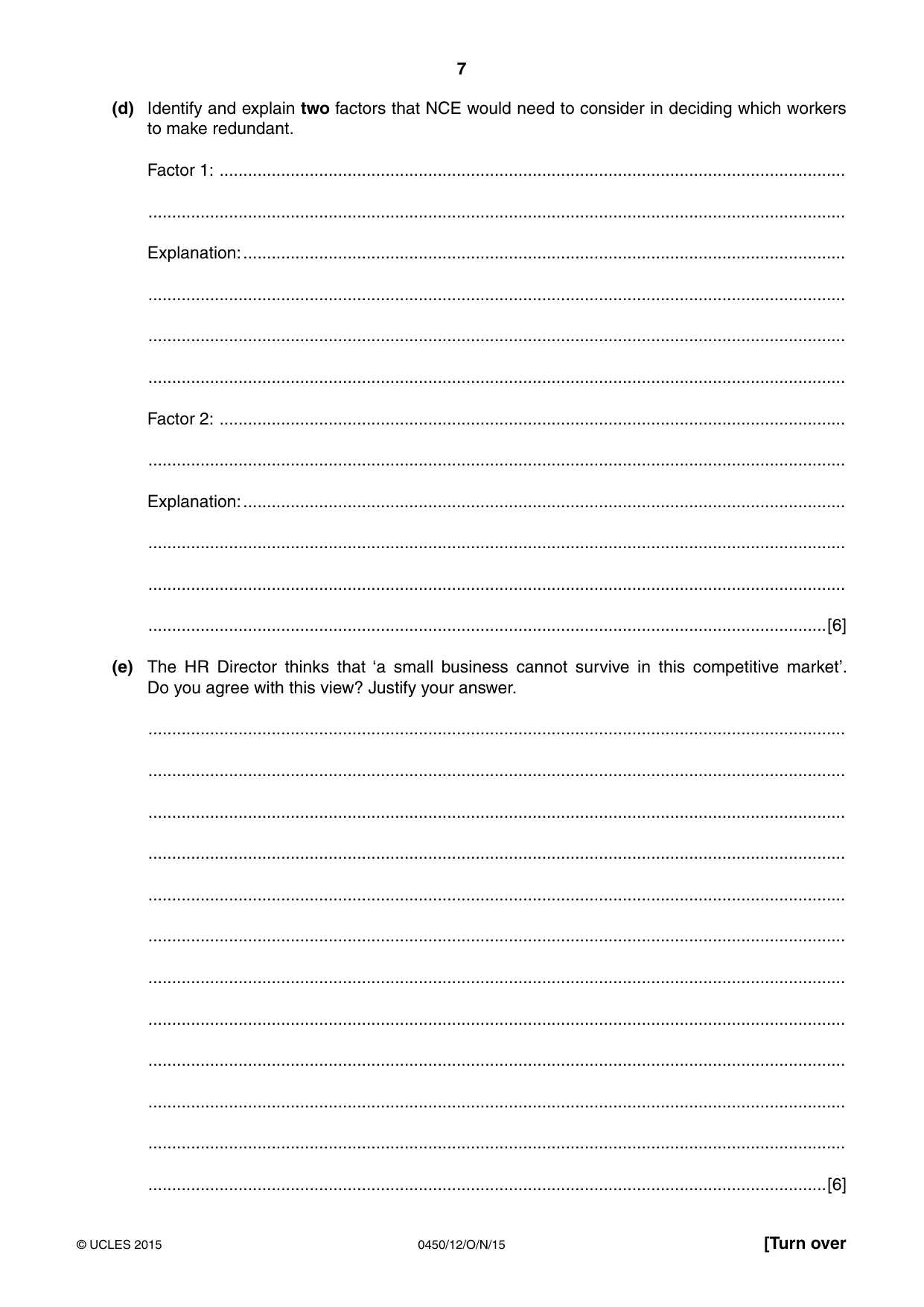
7 0450/12/O/N/15 © UCLES 2015 [Turn over (d) Identify and explain two factors that NCE would need to consider in deciding which workers to make redundant. Factor 1: … … Explanation: … … … … Factor 2: … … Explanation: … … … …[6] (e) The HR Director thinks that ‘a small business cannot survive in this competitive market’. Do you agree with this view? Justify your answer. … … … … … … … … … … … …[6]
Question paper, page 8
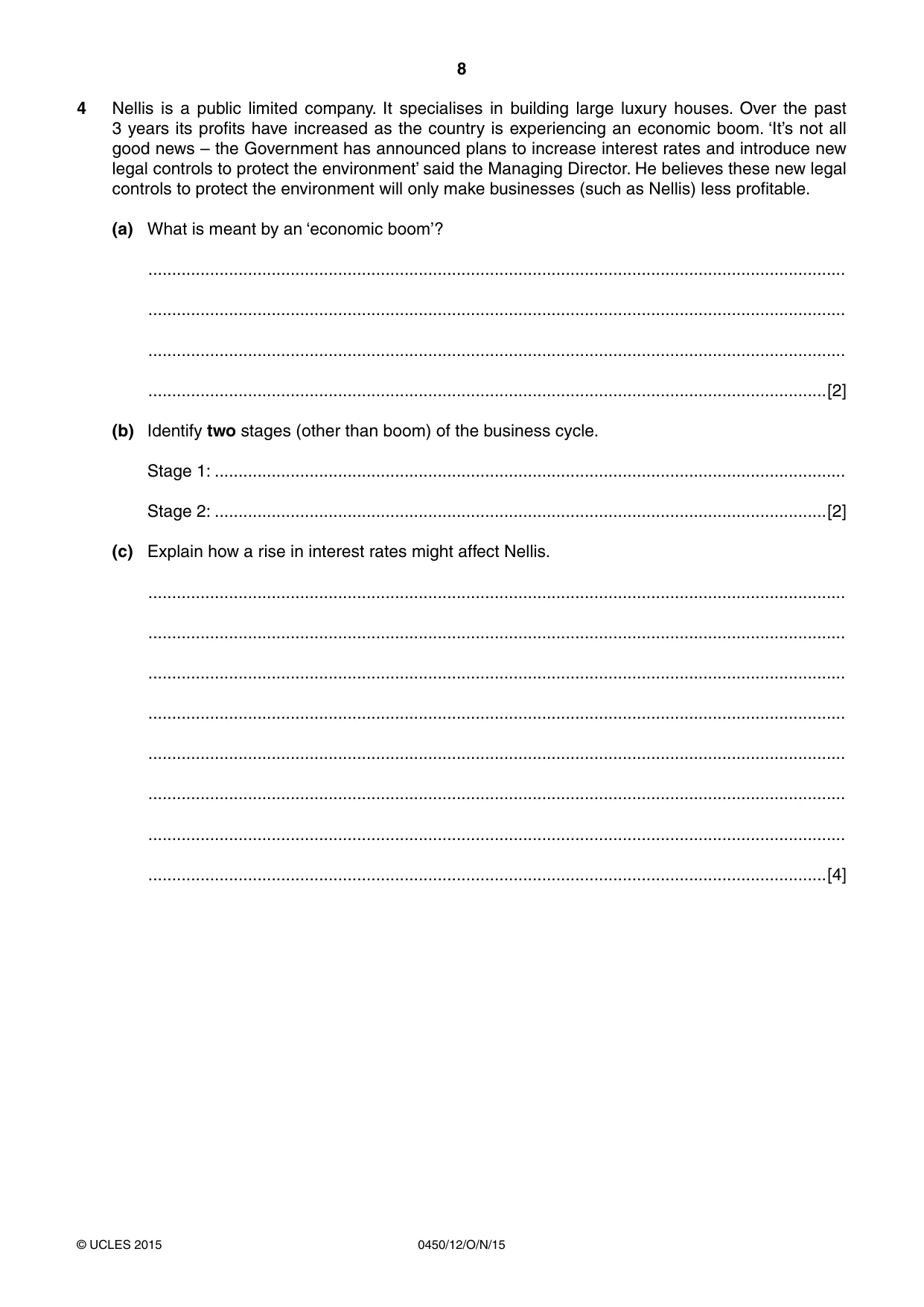
8 0450/12/O/N/15 © UCLES 2015 4 Nellis is a public limited company. It specialises in building large luxury houses. Over the past 3 years its profits have increased as the country is experiencing an economic boom. ‘It’s not all good news – the Government has announced plans to increase interest rates and introduce new legal controls to protect the environment’ said the Managing Director. He believes these new legal controls to protect the environment will only make businesses (such as Nellis) less profitable. (a) What is meant by an ‘economic boom’? … … … …[2] (b) Identify two stages (other than boom) of the business cycle. Stage 1: … Stage 2: …[2] (c) Explain how a rise in interest rates might affect Nellis. … … … … … … … …[4]
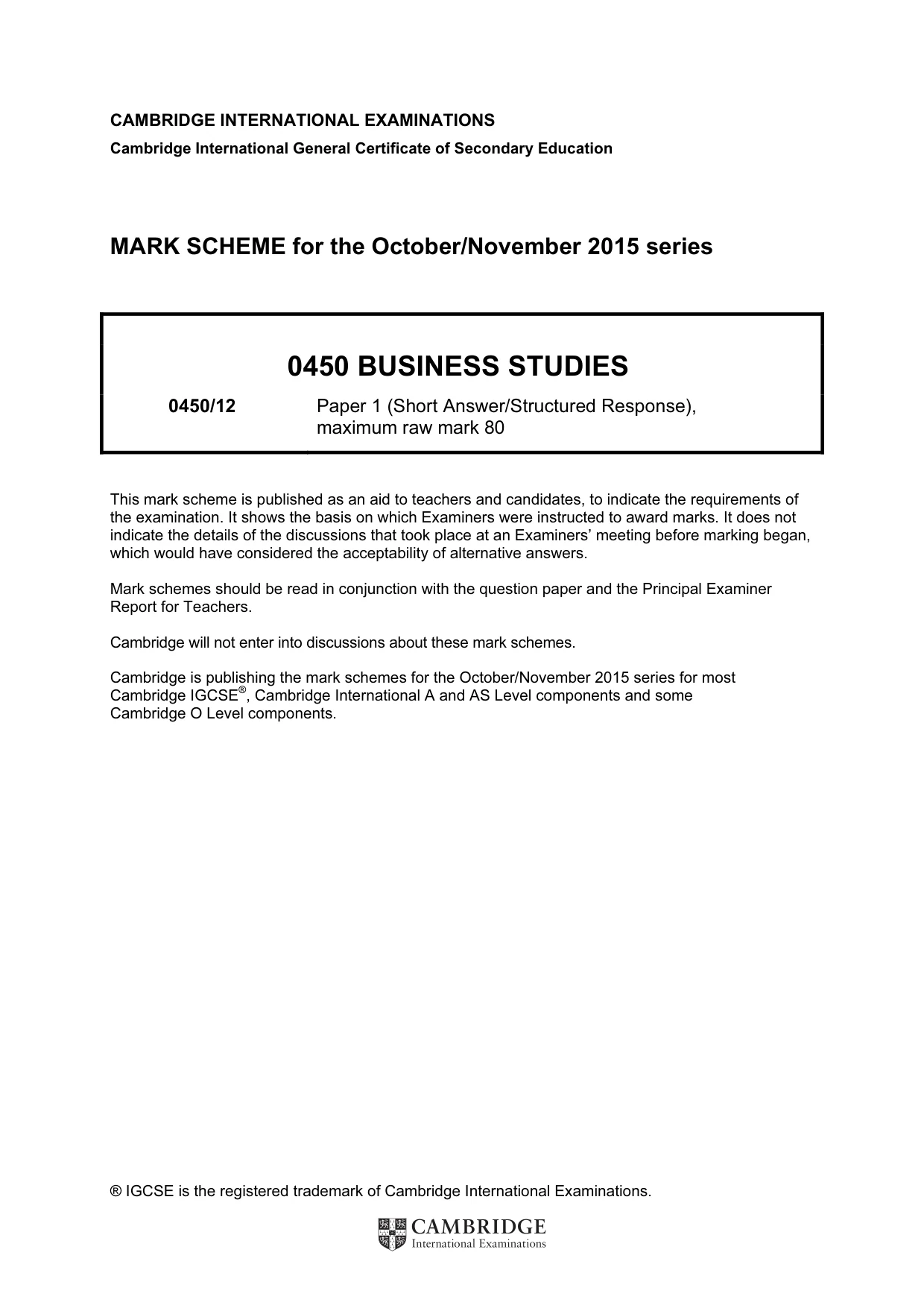
Question paper, page 9
9 0450/12/O/N/15 © UCLES 2015 (d) Identify two stakeholder groups. Explain why each group is important to this business. Stakeholder group 1: … Explanation: … … … … … Stakeholder group 2: … Explanation: … … … … …[6] (e) The Managing Director believes that the new legal controls to protect the environment will only make businesses (such as Nellis) less profitable. Do you agree? Justify your answer. … … … … … … … … … … … …[6]
Question paper, page 10
10 0450/12/O/N/15 © UCLES 2015 BLANK PAGE
Question paper, page 11
11 0450/12/O/N/15 © UCLES 2015 BLANK PAGE
Question paper, page 12
12 0450/12/O/N/15 © UCLES 2015 Permission to reproduce items where third-party owned material protected by copyright is included has been sought and cleared where possible. Every reasonable effort has been made by the publisher (UCLES) to trace copyright holders, but if any items requiring clearance have unwittingly been included, the publisher will be pleased to make amends at the earliest possible opportunity. To avoid the issue of disclosure of answer-related information to candidates, all copyright acknowledgements are reproduced online in the Cambridge International Examinations Copyright Acknowledgements Booklet. This is produced for each series of examinations and is freely available to download at www.cie.org.uk after the live examination series. Cambridge International Examinations is part of the Cambridge Assessment Group. Cambridge Assessment is the brand name of University of Cambridge Local Examinations Syndicate (UCLES), which is itself a department of the University of Cambridge. BLANK PAGE
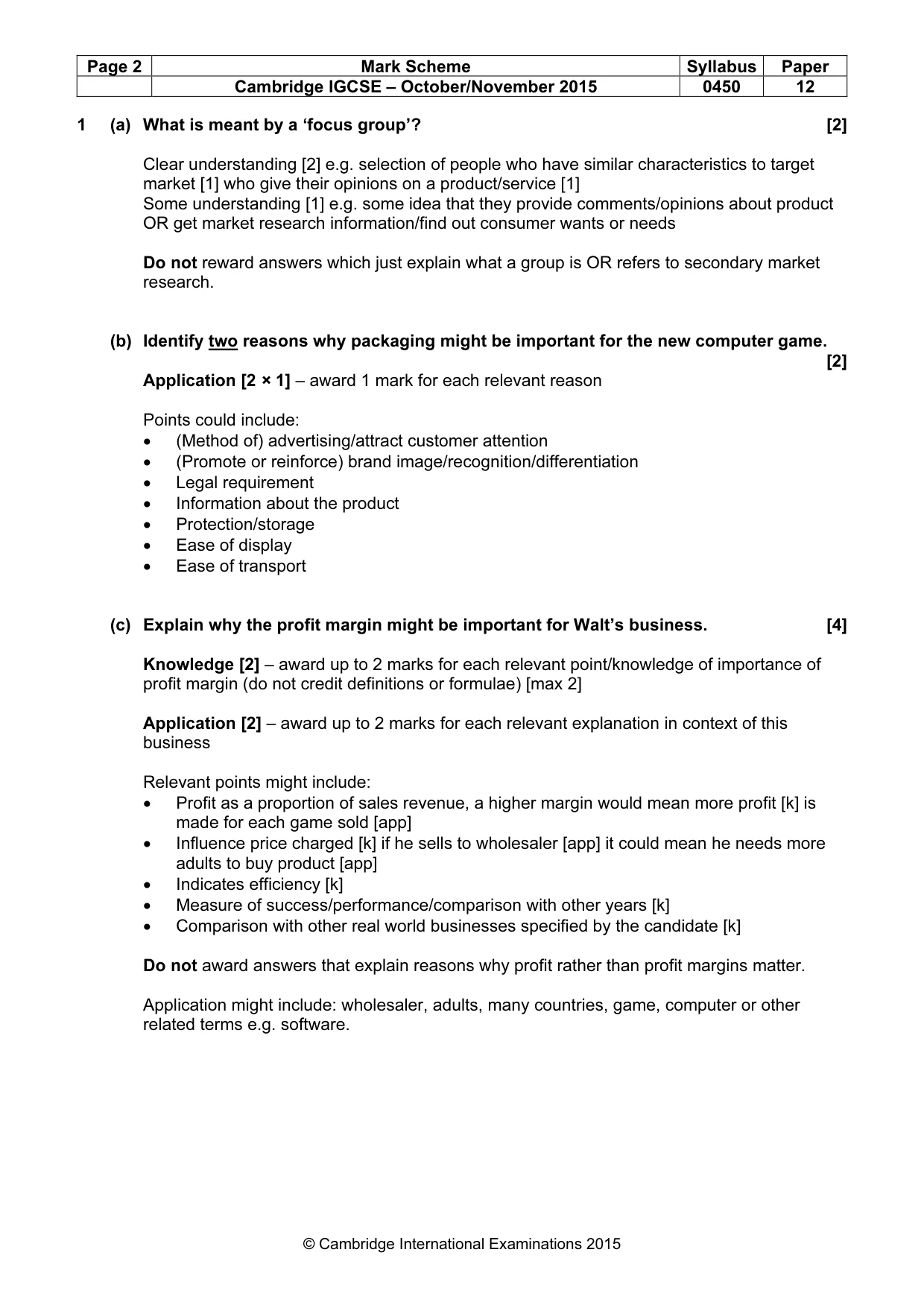
Mark scheme, page 1
® IGCSE is the registered trademark of Cambridge International Examinations. CAMBRIDGE INTERNATIONAL EXAMINATIONS Cambridge International General Certificate of Secondary Education MARK SCHEME for the October/November 2015 series 0450 BUSINESS STUDIES 0450/12 Paper 1 (Short Answer/Structured Response), maximum raw mark 80 This mark scheme is published as an aid to teachers and candidates, to indicate the requirements of the examination. It shows the basis on which Examiners were instructed to award marks. It does not indicate the details of the discussions that took place at an Examiners’ meeting before marking began, which would have considered the acceptability of alternative answers. Mark schemes should be read in conjunction with the question paper and the Principal Examiner Report for Teachers. Cambridge will not enter into discussions about these mark schemes. Cambridge is publishing the mark schemes for the October/November 2015 series for most Cambridge IGCSE®, Cambridge International A and AS Level components and some Cambridge O Level components.
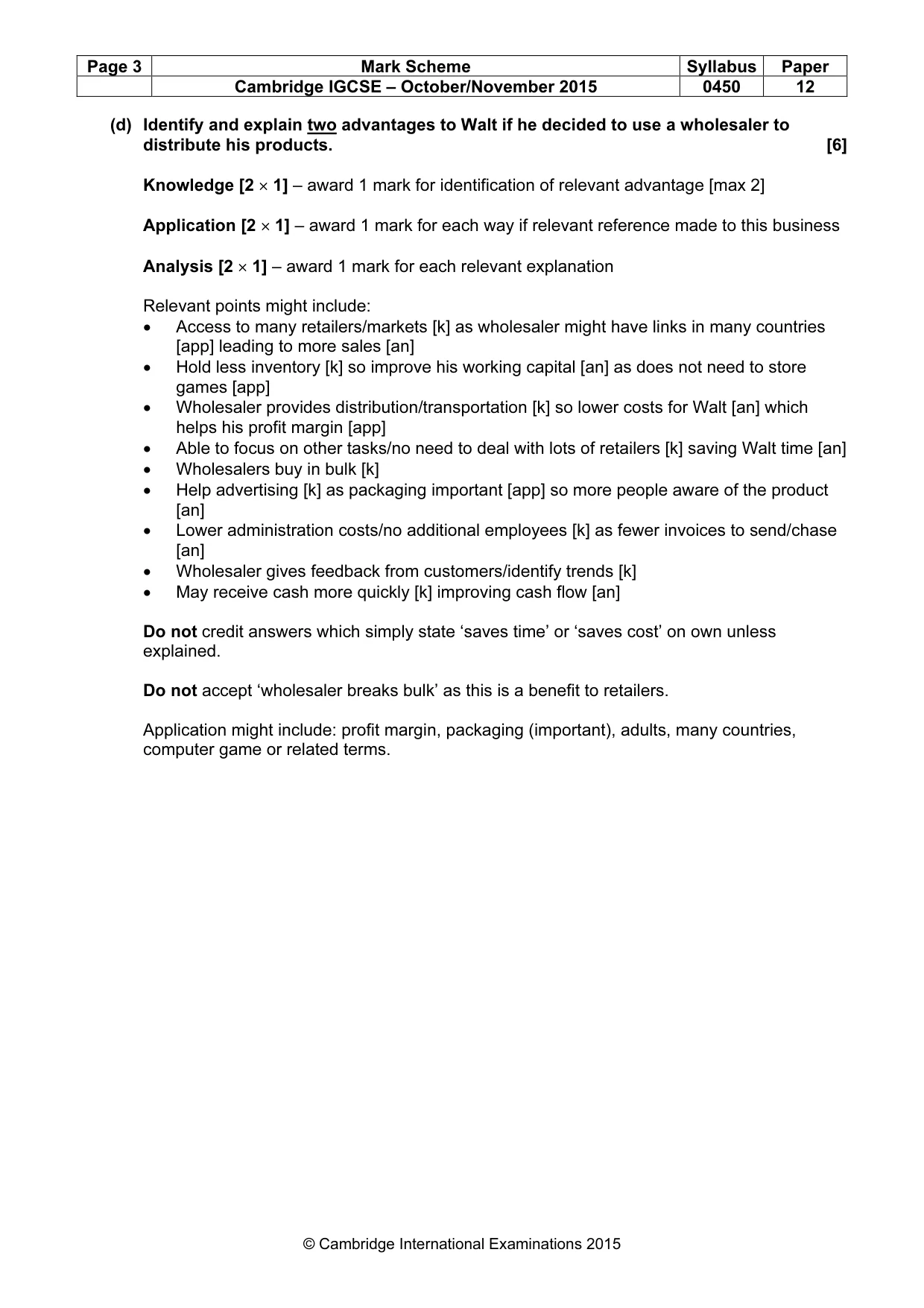
Mark scheme, page 2
Page 2 Mark Scheme Syllabus Paper Cambridge IGCSE – October/November 2015 0450 12 © Cambridge International Examinations 2015 1 (a) What is meant by a ‘focus group’? [2] Clear understanding [2] e.g. selection of people who have similar characteristics to target market [1] who give their opinions on a product/service [1] Some understanding [1] e.g. some idea that they provide comments/opinions about product OR get market research information/find out consumer wants or needs Do not reward answers which just explain what a group is OR refers to secondary market research. (b) Identify two reasons why packaging might be important for the new computer game. [2] Application [2 × 1] – award 1 mark for each relevant reason Points could include: • (Method of) advertising/attract customer attention • (Promote or reinforce) brand image/recognition/differentiation • Legal requirement • Information about the product • Protection/storage • Ease of display • Ease of transport (c) Explain why the profit margin might be important for Walt’s business. [4] Knowledge [2] – award up to 2 marks for each relevant point/knowledge of importance of profit margin (do not credit definitions or formulae) [max 2] Application [2] – award up to 2 marks for each relevant explanation in context of this business Relevant points might include: • Profit as a proportion of sales revenue, a higher margin would mean more profit [k] is made for each game sold [app] • Influence price charged [k] if he sells to wholesaler [app] it could mean he needs more adults to buy product [app] • Indicates efficiency [k] • Measure of success/performance/comparison with other years [k] • Comparison with other real world businesses specified by the candidate [k] Do not award answers that explain reasons why profit rather than profit margins matter. Application might include: wholesaler, adults, many countries, game, computer or other related terms e.g. software.
Mark scheme, page 3
Page 3 Mark Scheme Syllabus Paper Cambridge IGCSE – October/November 2015 0450 12 © Cambridge International Examinations 2015 (d) Identify and explain two advantages to Walt if he decided to use a wholesaler to distribute his products. [6] Knowledge [2 × 1] – award 1 mark for identification of relevant advantage [max 2] Application [2 × 1] – award 1 mark for each way if relevant reference made to this business Analysis [2 × 1] – award 1 mark for each relevant explanation Relevant points might include: • Access to many retailers/markets [k] as wholesaler might have links in many countries [app] leading to more sales [an] • Hold less inventory [k] so improve his working capital [an] as does not need to store games [app] • Wholesaler provides distribution/transportation [k] so lower costs for Walt [an] which helps his profit margin [app] • Able to focus on other tasks/no need to deal with lots of retailers [k] saving Walt time [an] • Wholesalers buy in bulk [k] • Help advertising [k] as packaging important [app] so more people aware of the product [an] • Lower administration costs/no additional employees [k] as fewer invoices to send/chase [an] • Wholesaler gives feedback from customers/identify trends [k] • May receive cash more quickly [k] improving cash flow [an] Do not credit answers which simply state ‘saves time’ or ‘saves cost’ on own unless explained. Do not accept ‘wholesaler breaks bulk’ as this is a benefit to retailers. Application might include: profit margin, packaging (important), adults, many countries, computer game or related terms.
Mark scheme, page 4
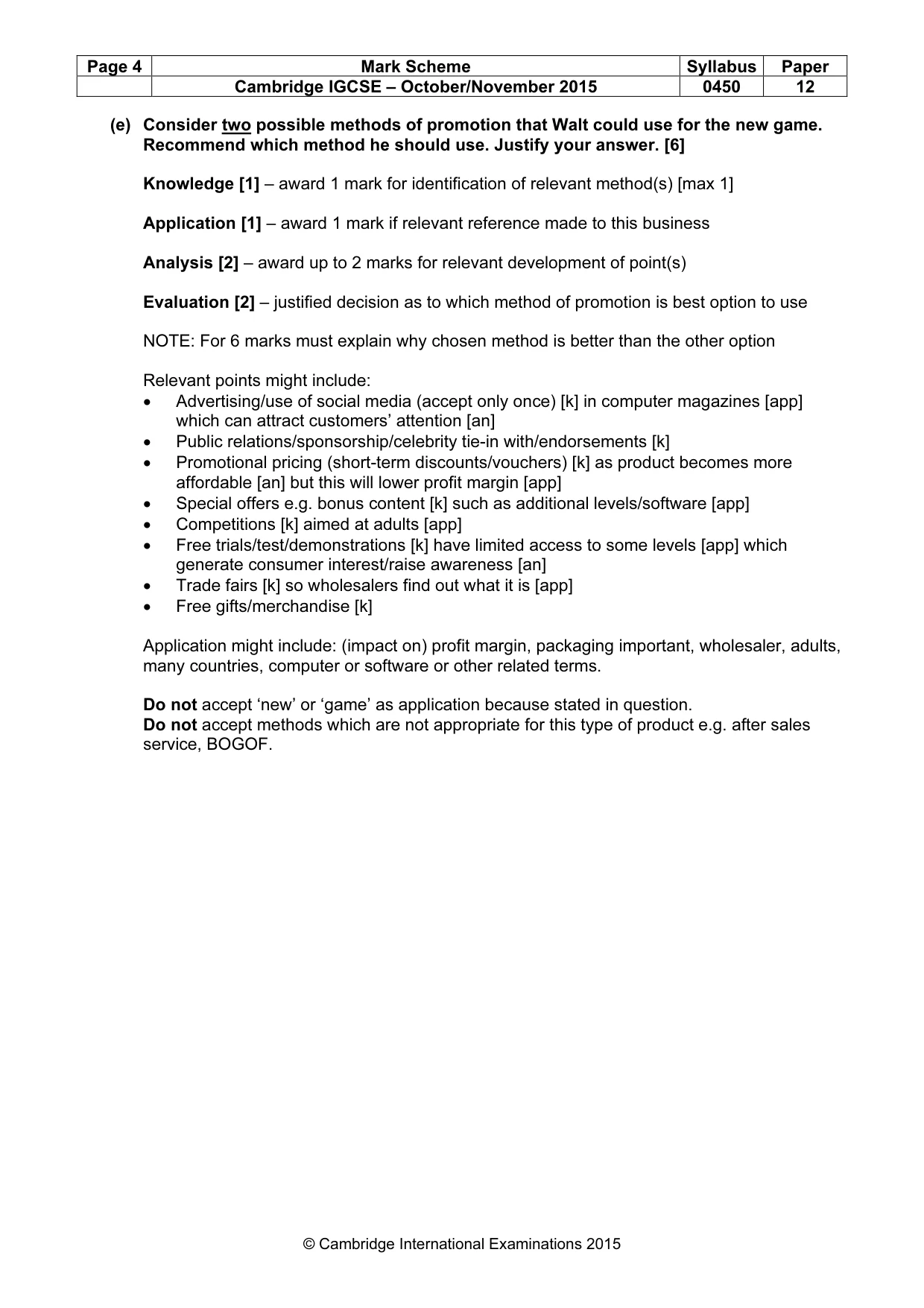
Page 4 Mark Scheme Syllabus Paper Cambridge IGCSE – October/November 2015 0450 12 © Cambridge International Examinations 2015 (e) Consider two possible methods of promotion that Walt could use for the new game. Recommend which method he should use. Justify your answer. [6] Knowledge [1] – award 1 mark for identification of relevant method(s) [max 1] Application [1] – award 1 mark if relevant reference made to this business Analysis [2] – award up to 2 marks for relevant development of point(s) Evaluation [2] – justified decision as to which method of promotion is best option to use NOTE: For 6 marks must explain why chosen method is better than the other option Relevant points might include: • Advertising/use of social media (accept only once) [k] in computer magazines [app] which can attract customers’ attention [an] • Public relations/sponsorship/celebrity tie-in with/endorsements [k] • Promotional pricing (short-term discounts/vouchers) [k] as product becomes more affordable [an] but this will lower profit margin [app] • Special offers e.g. bonus content [k] such as additional levels/software [app] • Competitions [k] aimed at adults [app] • Free trials/test/demonstrations [k] have limited access to some levels [app] which generate consumer interest/raise awareness [an] • Trade fairs [k] so wholesalers find out what it is [app] • Free gifts/merchandise [k] Application might include: (impact on) profit margin, packaging important, wholesaler, adults, many countries, computer or software or other related terms. Do not accept ‘new’ or ‘game’ as application because stated in question. Do not accept methods which are not appropriate for this type of product e.g. after sales service, BOGOF.
Mark scheme, page 5
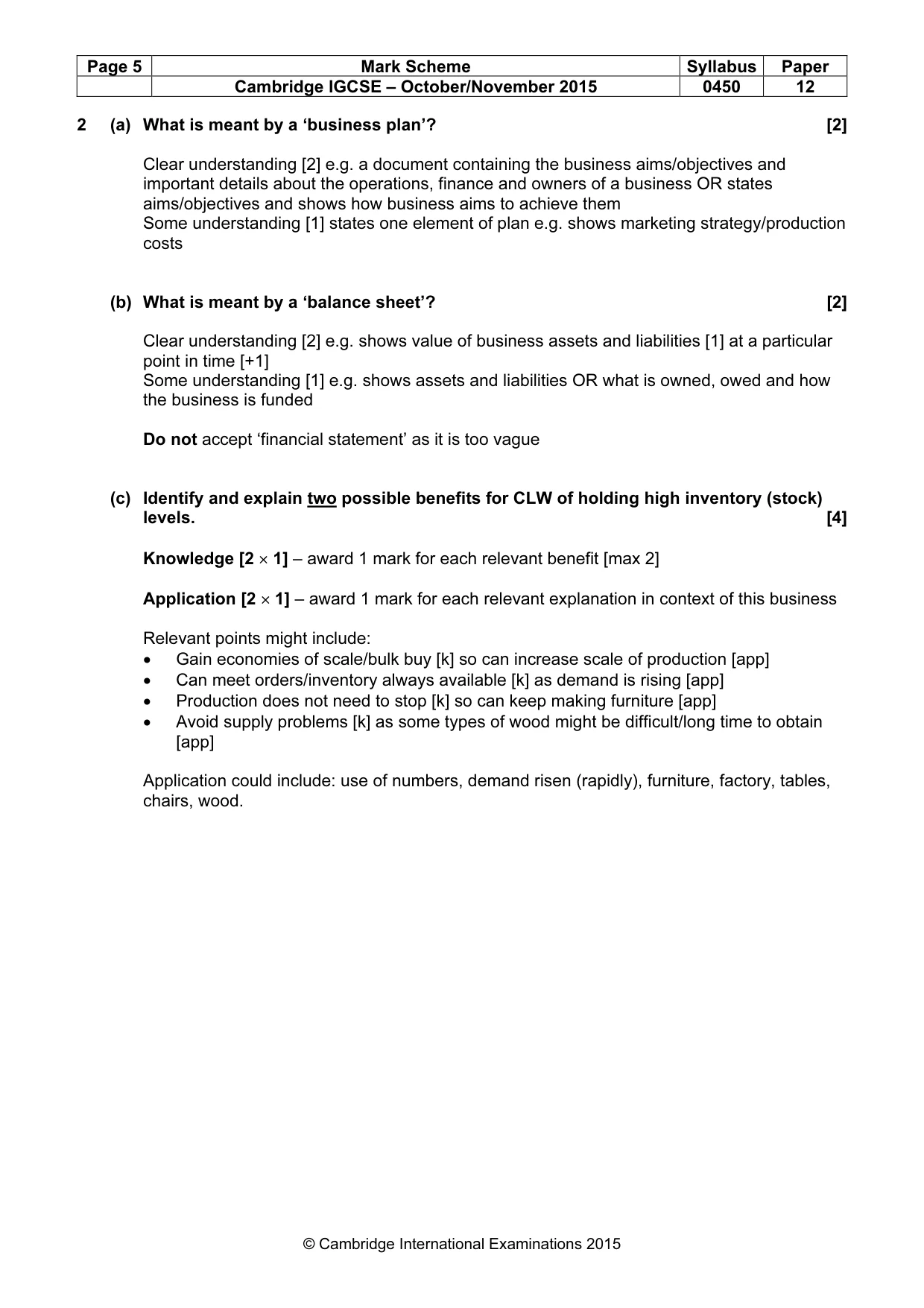
Page 5 Mark Scheme Syllabus Paper Cambridge IGCSE – October/November 2015 0450 12 © Cambridge International Examinations 2015 2 (a) What is meant by a ‘business plan’? [2] Clear understanding [2] e.g. a document containing the business aims/objectives and important details about the operations, finance and owners of a business OR states aims/objectives and shows how business aims to achieve them Some understanding [1] states one element of plan e.g. shows marketing strategy/production costs (b) What is meant by a ‘balance sheet’? [2] Clear understanding [2] e.g. shows value of business assets and liabilities [1] at a particular point in time [+1] Some understanding [1] e.g. shows assets and liabilities OR what is owned, owed and how the business is funded Do not accept ‘financial statement’ as it is too vague (c) Identify and explain two possible benefits for CLW of holding high inventory (stock) levels. [4] Knowledge [2 × 1] – award 1 mark for each relevant benefit [max 2] Application [2 × 1] – award 1 mark for each relevant explanation in context of this business Relevant points might include: • Gain economies of scale/bulk buy [k] so can increase scale of production [app] • Can meet orders/inventory always available [k] as demand is rising [app] • Production does not need to stop [k] so can keep making furniture [app] • Avoid supply problems [k] as some types of wood might be difficult/long time to obtain [app] Application could include: use of numbers, demand risen (rapidly), furniture, factory, tables, chairs, wood.
Mark scheme, page 6
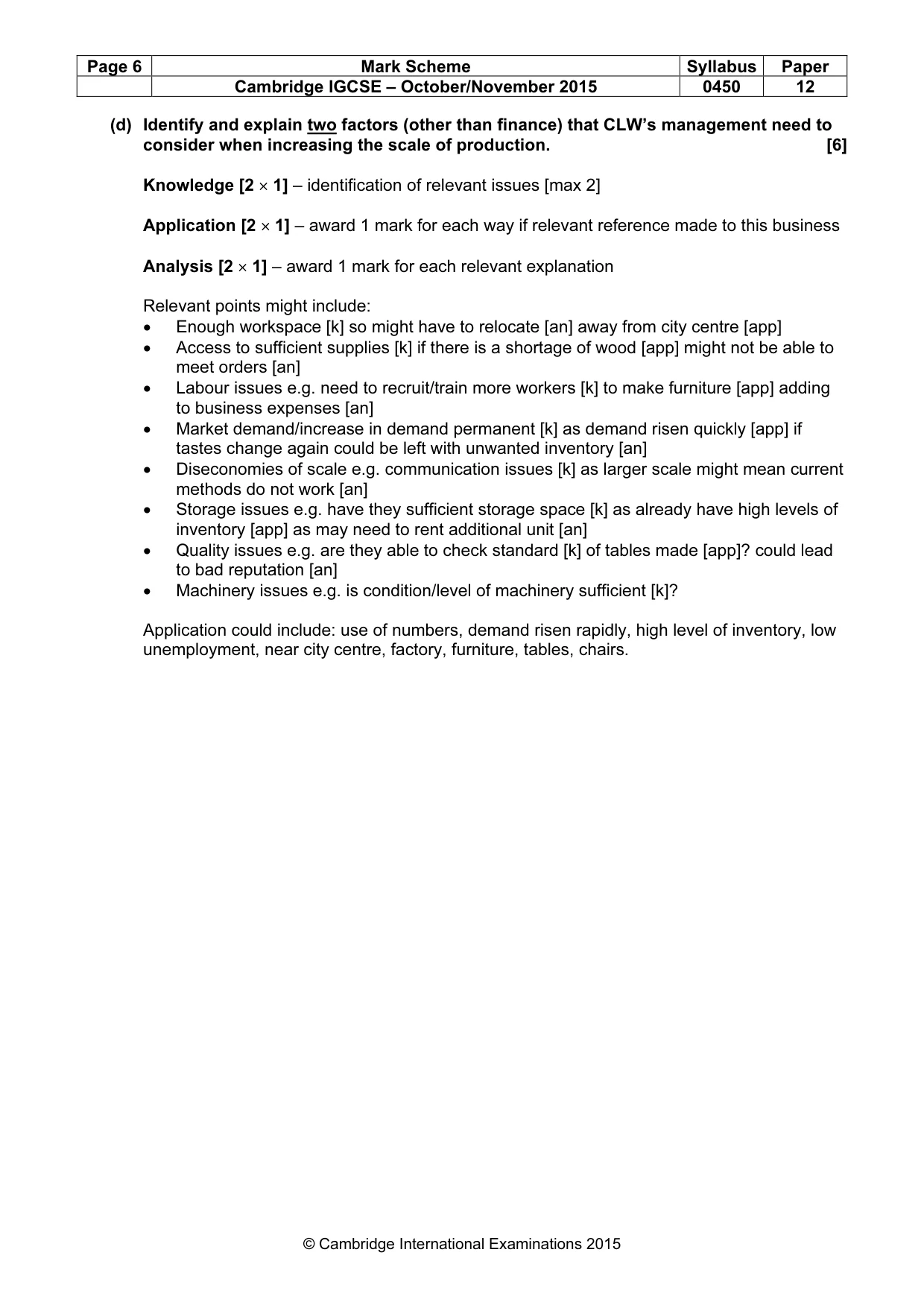
Page 6 Mark Scheme Syllabus Paper Cambridge IGCSE – October/November 2015 0450 12 © Cambridge International Examinations 2015 (d) Identify and explain two factors (other than finance) that CLW’s management need to consider when increasing the scale of production. [6] Knowledge [2 × 1] – identification of relevant issues [max 2] Application [2 × 1] – award 1 mark for each way if relevant reference made to this business Analysis [2 × 1] – award 1 mark for each relevant explanation Relevant points might include: • Enough workspace [k] so might have to relocate [an] away from city centre [app] • Access to sufficient supplies [k] if there is a shortage of wood [app] might not be able to meet orders [an] • Labour issues e.g. need to recruit/train more workers [k] to make furniture [app] adding to business expenses [an] • Market demand/increase in demand permanent [k] as demand risen quickly [app] if tastes change again could be left with unwanted inventory [an] • Diseconomies of scale e.g. communication issues [k] as larger scale might mean current methods do not work [an] • Storage issues e.g. have they sufficient storage space [k] as already have high levels of inventory [app] as may need to rent additional unit [an] • Quality issues e.g. are they able to check standard [k] of tables made [app]? could lead to bad reputation [an] • Machinery issues e.g. is condition/level of machinery sufficient [k]? Application could include: use of numbers, demand risen rapidly, high level of inventory, low unemployment, near city centre, factory, furniture, tables, chairs.
Mark scheme, page 7
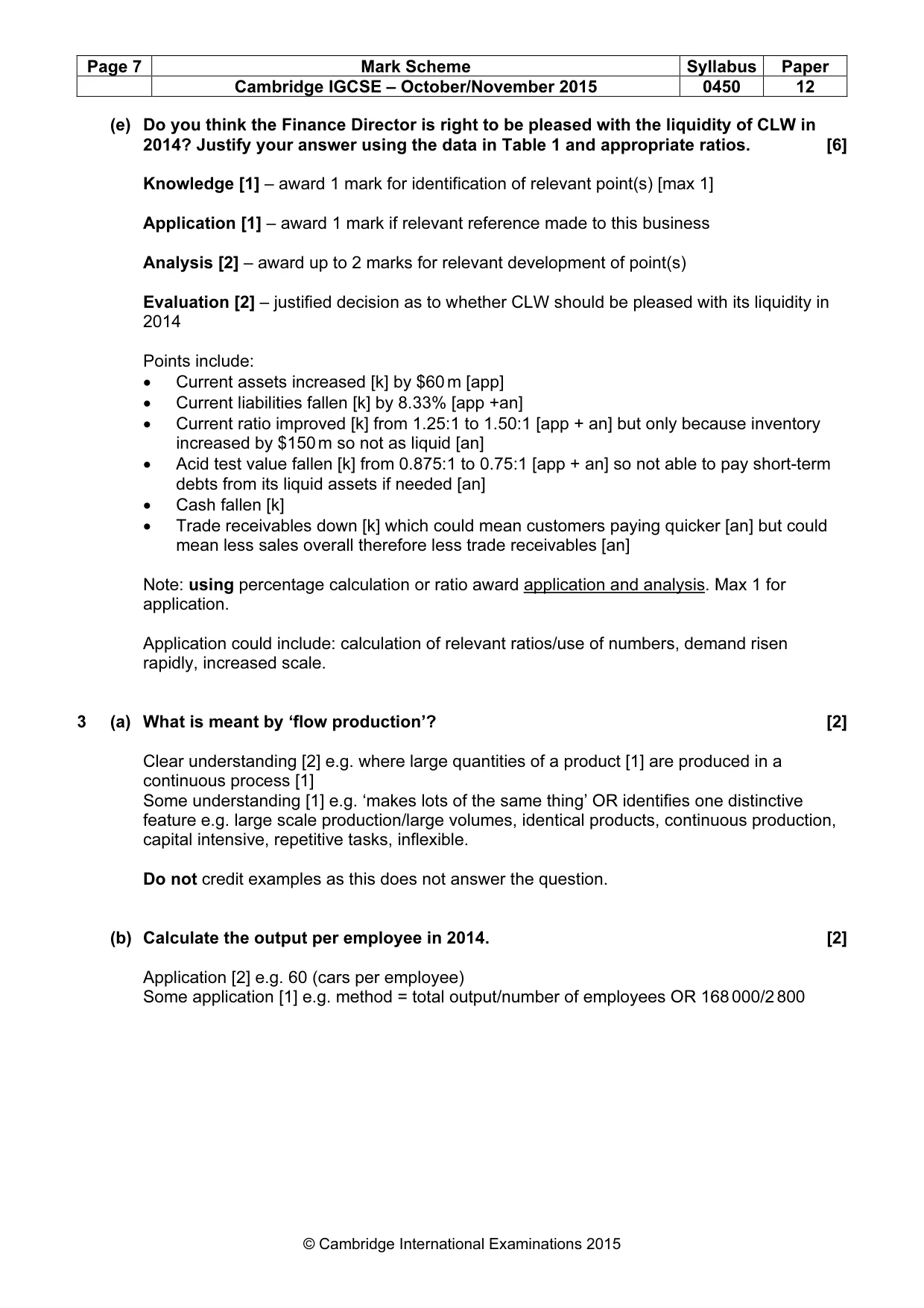
Page 7 Mark Scheme Syllabus Paper Cambridge IGCSE – October/November 2015 0450 12 © Cambridge International Examinations 2015 (e) Do you think the Finance Director is right to be pleased with the liquidity of CLW in 2014? Justify your answer using the data in Table 1 and appropriate ratios. [6] Knowledge [1] – award 1 mark for identification of relevant point(s) [max 1] Application [1] – award 1 mark if relevant reference made to this business Analysis [2] – award up to 2 marks for relevant development of point(s) Evaluation [2] – justified decision as to whether CLW should be pleased with its liquidity in 2014 Points include: • Current assets increased [k] by $60 m [app] • Current liabilities fallen [k] by 8.33% [app +an] • Current ratio improved [k] from 1.25:1 to 1.50:1 [app + an] but only because inventory increased by $150 m so not as liquid [an] • Acid test value fallen [k] from 0.875:1 to 0.75:1 [app + an] so not able to pay short-term debts from its liquid assets if needed [an] • Cash fallen [k] • Trade receivables down [k] which could mean customers paying quicker [an] but could mean less sales overall therefore less trade receivables [an] Note: using percentage calculation or ratio award application and analysis. Max 1 for application. Application could include: calculation of relevant ratios/use of numbers, demand risen rapidly, increased scale. 3 (a) What is meant by ‘flow production’? [2] Clear understanding [2] e.g. where large quantities of a product [1] are produced in a continuous process [1] Some understanding [1] e.g. ‘makes lots of the same thing’ OR identifies one distinctive feature e.g. large scale production/large volumes, identical products, continuous production, capital intensive, repetitive tasks, inflexible. Do not credit examples as this does not answer the question. (b) Calculate the output per employee in 2014. [2] Application [2] e.g. 60 (cars per employee) Some application [1] e.g. method = total output/number of employees OR 168 000/2 800
Mark scheme, page 8
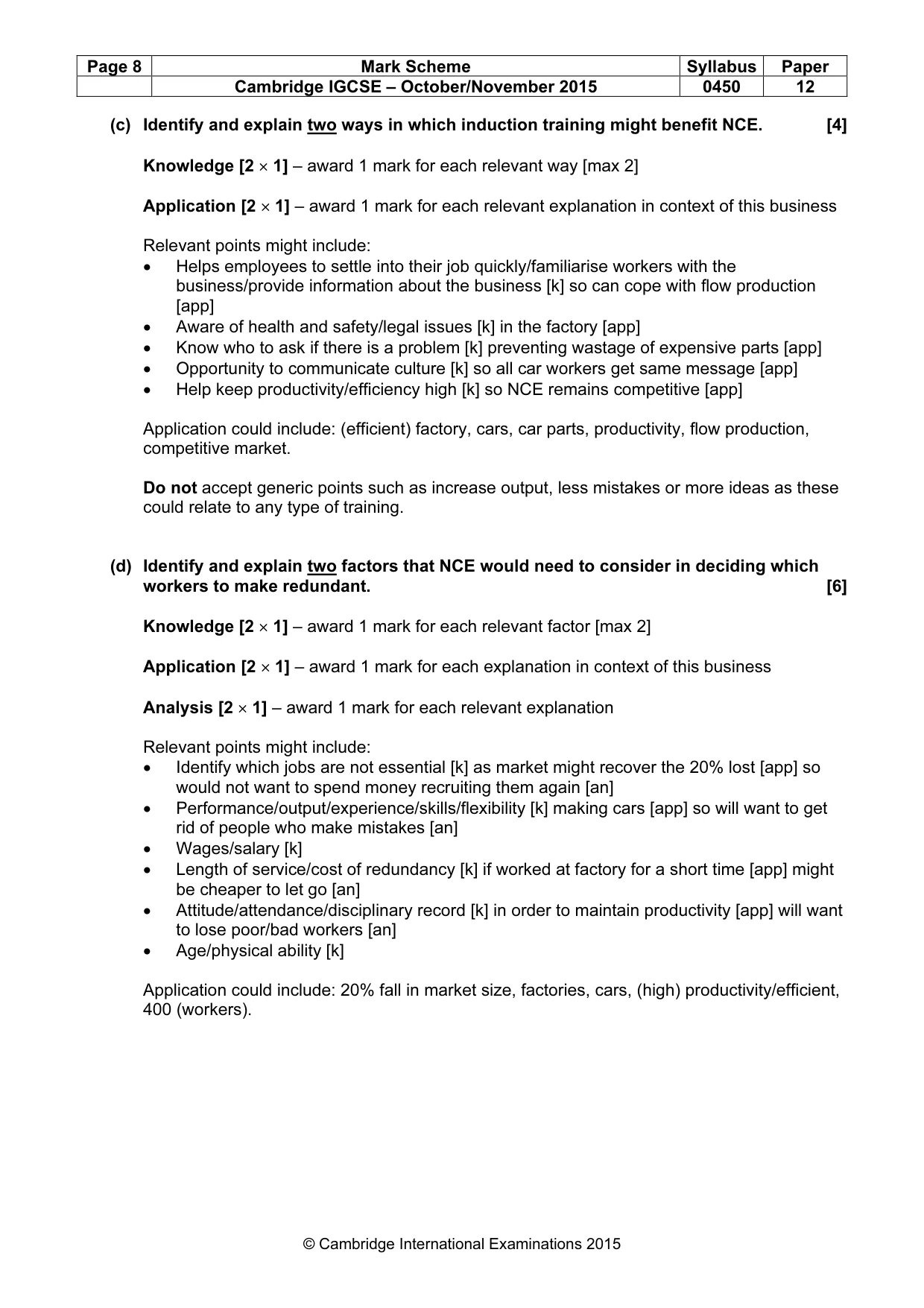
Page 8 Mark Scheme Syllabus Paper Cambridge IGCSE – October/November 2015 0450 12 © Cambridge International Examinations 2015 (c) Identify and explain two ways in which induction training might benefit NCE. [4] Knowledge [2 × 1] – award 1 mark for each relevant way [max 2] Application [2 × 1] – award 1 mark for each relevant explanation in context of this business Relevant points might include: • Helps employees to settle into their job quickly/familiarise workers with the business/provide information about the business [k] so can cope with flow production [app] • Aware of health and safety/legal issues [k] in the factory [app] • Know who to ask if there is a problem [k] preventing wastage of expensive parts [app] • Opportunity to communicate culture [k] so all car workers get same message [app] • Help keep productivity/efficiency high [k] so NCE remains competitive [app] Application could include: (efficient) factory, cars, car parts, productivity, flow production, competitive market. Do not accept generic points such as increase output, less mistakes or more ideas as these could relate to any type of training. (d) Identify and explain two factors that NCE would need to consider in deciding which workers to make redundant. [6] Knowledge [2 × 1] – award 1 mark for each relevant factor [max 2] Application [2 × 1] – award 1 mark for each explanation in context of this business Analysis [2 × 1] – award 1 mark for each relevant explanation Relevant points might include: • Identify which jobs are not essential [k] as market might recover the 20% lost [app] so would not want to spend money recruiting them again [an] • Performance/output/experience/skills/flexibility [k] making cars [app] so will want to get rid of people who make mistakes [an] • Wages/salary [k] • Length of service/cost of redundancy [k] if worked at factory for a short time [app] might be cheaper to let go [an] • Attitude/attendance/disciplinary record [k] in order to maintain productivity [app] will want to lose poor/bad workers [an] • Age/physical ability [k] Application could include: 20% fall in market size, factories, cars, (high) productivity/efficient, 400 (workers).
Mark scheme, page 9
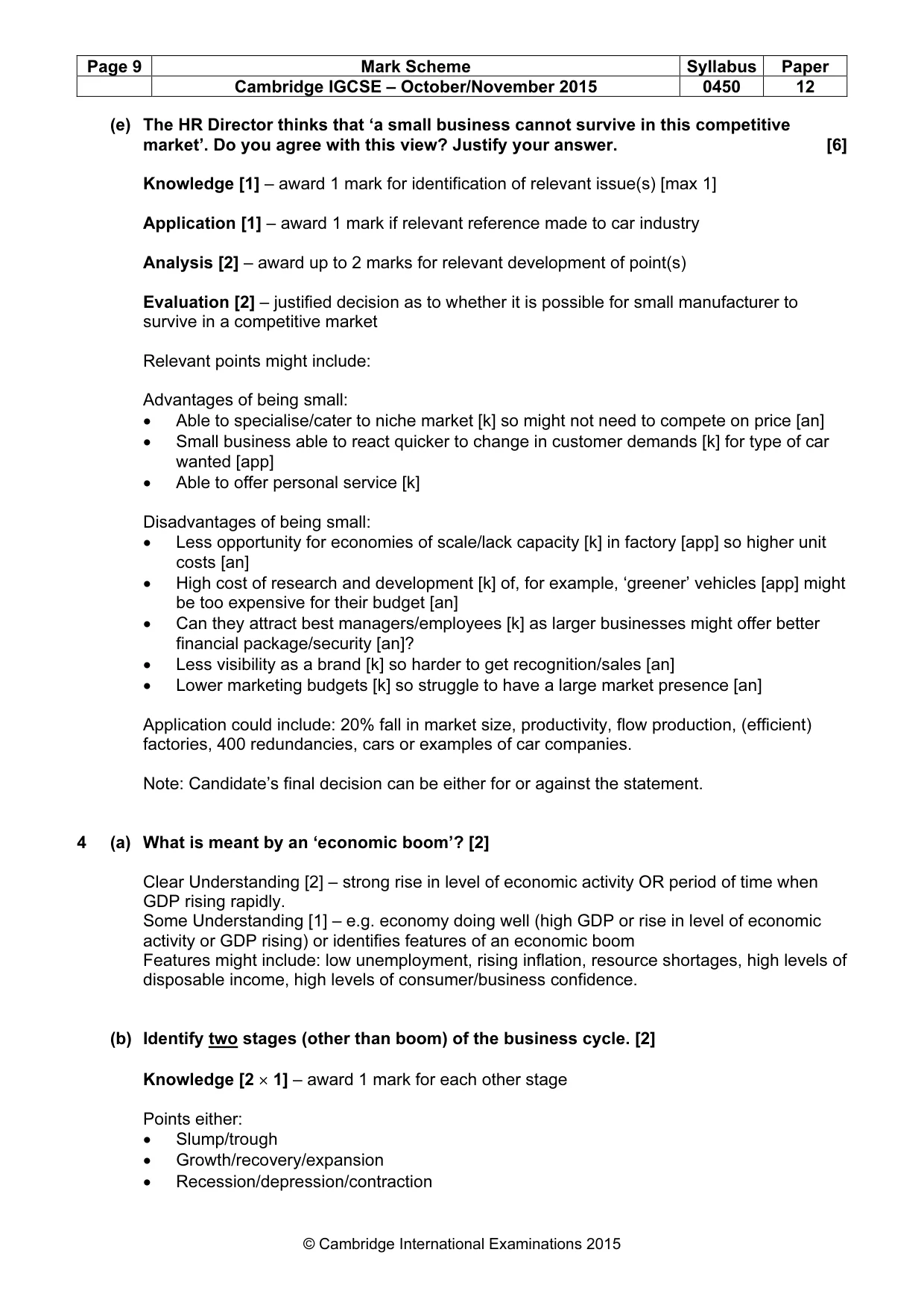
Page 9 Mark Scheme Syllabus Paper Cambridge IGCSE – October/November 2015 0450 12 © Cambridge International Examinations 2015 (e) The HR Director thinks that ‘a small business cannot survive in this competitive market’. Do you agree with this view? Justify your answer. [6] Knowledge [1] – award 1 mark for identification of relevant issue(s) [max 1] Application [1] – award 1 mark if relevant reference made to car industry Analysis [2] – award up to 2 marks for relevant development of point(s) Evaluation [2] – justified decision as to whether it is possible for small manufacturer to survive in a competitive market Relevant points might include: Advantages of being small: • Able to specialise/cater to niche market [k] so might not need to compete on price [an] • Small business able to react quicker to change in customer demands [k] for type of car wanted [app] • Able to offer personal service [k] Disadvantages of being small: • Less opportunity for economies of scale/lack capacity [k] in factory [app] so higher unit costs [an] • High cost of research and development [k] of, for example, ‘greener’ vehicles [app] might be too expensive for their budget [an] • Can they attract best managers/employees [k] as larger businesses might offer better financial package/security [an]? • Less visibility as a brand [k] so harder to get recognition/sales [an] • Lower marketing budgets [k] so struggle to have a large market presence [an] Application could include: 20% fall in market size, productivity, flow production, (efficient) factories, 400 redundancies, cars or examples of car companies. Note: Candidate’s final decision can be either for or against the statement. 4 (a) What is meant by an ‘economic boom’? [2] Clear Understanding [2] – strong rise in level of economic activity OR period of time when GDP rising rapidly. Some Understanding [1] – e.g. economy doing well (high GDP or rise in level of economic activity or GDP rising) or identifies features of an economic boom Features might include: low unemployment, rising inflation, resource shortages, high levels of disposable income, high levels of consumer/business confidence. (b) Identify two stages (other than boom) of the business cycle. [2] Knowledge [2 × 1] – award 1 mark for each other stage Points either: • Slump/trough • Growth/recovery/expansion • Recession/depression/contraction
Mark scheme, page 10
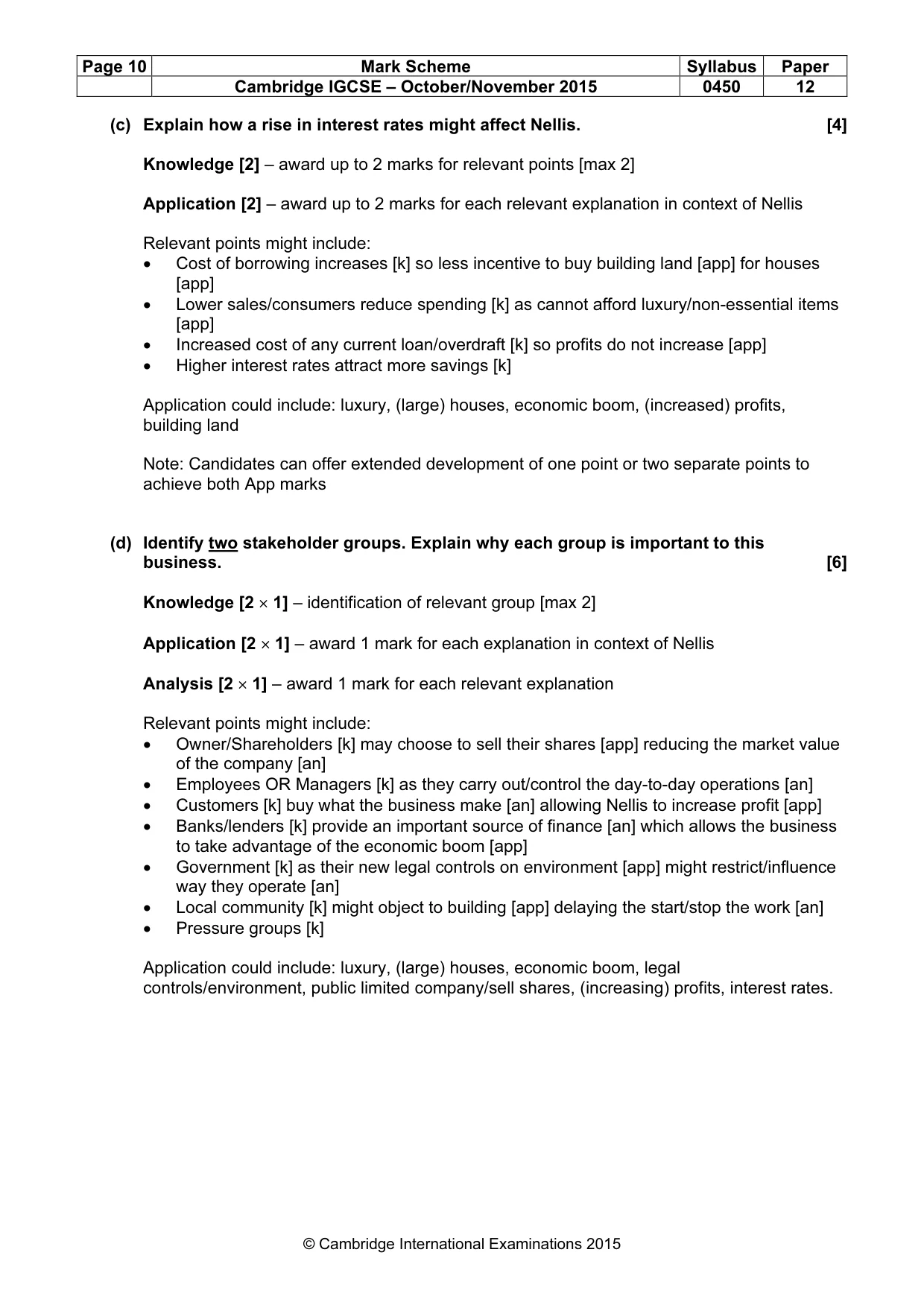
Page 10 Mark Scheme Syllabus Paper Cambridge IGCSE – October/November 2015 0450 12 © Cambridge International Examinations 2015 (c) Explain how a rise in interest rates might affect Nellis. [4] Knowledge [2] – award up to 2 marks for relevant points [max 2] Application [2] – award up to 2 marks for each relevant explanation in context of Nellis Relevant points might include: • Cost of borrowing increases [k] so less incentive to buy building land [app] for houses [app] • Lower sales/consumers reduce spending [k] as cannot afford luxury/non-essential items [app] • Increased cost of any current loan/overdraft [k] so profits do not increase [app] • Higher interest rates attract more savings [k] Application could include: luxury, (large) houses, economic boom, (increased) profits, building land Note: Candidates can offer extended development of one point or two separate points to achieve both App marks (d) Identify two stakeholder groups. Explain why each group is important to this business. [6] Knowledge [2 × 1] – identification of relevant group [max 2] Application [2 × 1] – award 1 mark for each explanation in context of Nellis Analysis [2 × 1] – award 1 mark for each relevant explanation Relevant points might include: • Owner/Shareholders [k] may choose to sell their shares [app] reducing the market value of the company [an] • Employees OR Managers [k] as they carry out/control the day-to-day operations [an] • Customers [k] buy what the business make [an] allowing Nellis to increase profit [app] • Banks/lenders [k] provide an important source of finance [an] which allows the business to take advantage of the economic boom [app] • Government [k] as their new legal controls on environment [app] might restrict/influence way they operate [an] • Local community [k] might object to building [app] delaying the start/stop the work [an] • Pressure groups [k] Application could include: luxury, (large) houses, economic boom, legal controls/environment, public limited company/sell shares, (increasing) profits, interest rates.
Mark scheme, page 11
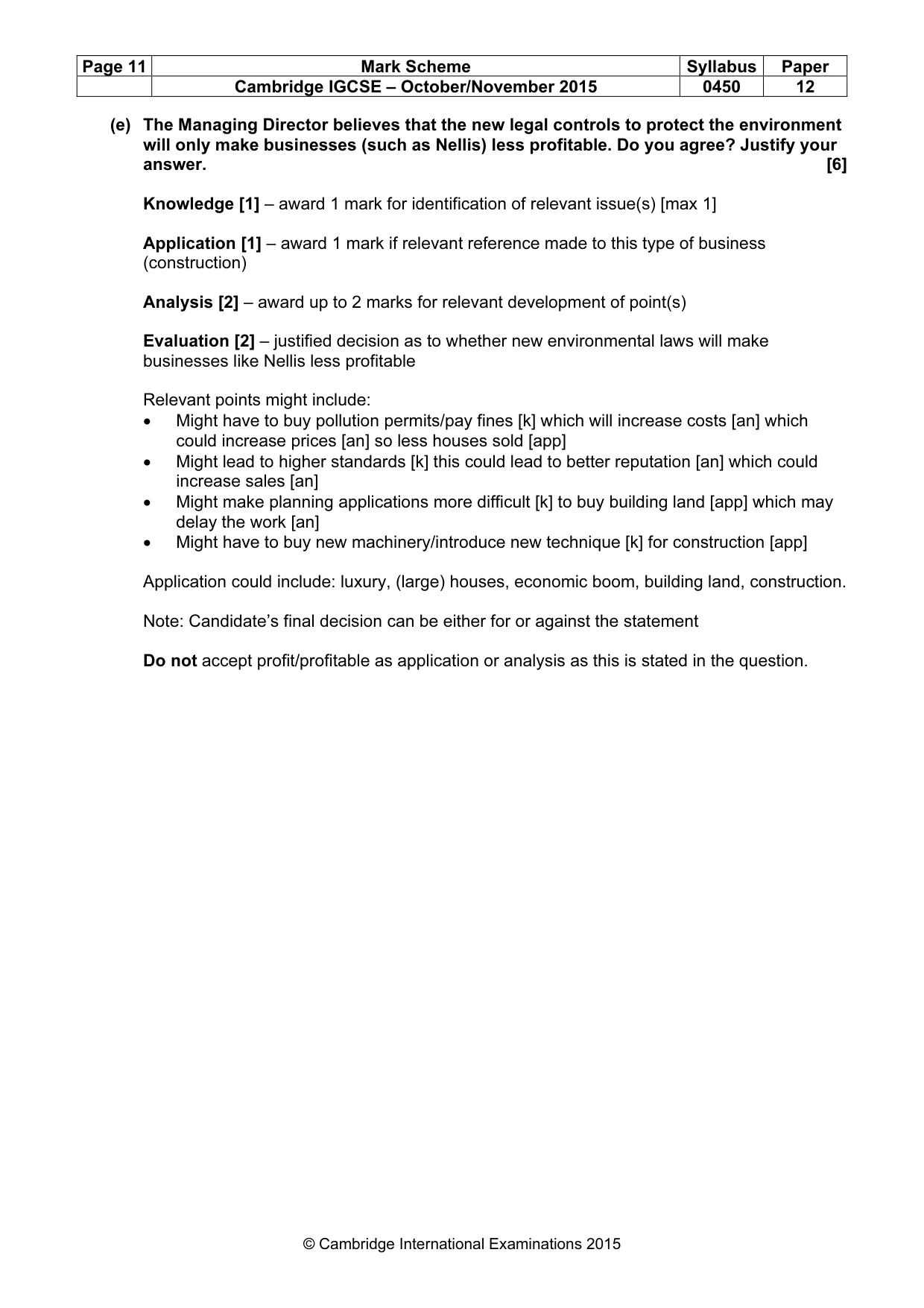
Page 11 Mark Scheme Syllabus Paper Cambridge IGCSE – October/November 2015 0450 12 © Cambridge International Examinations 2015 (e) The Managing Director believes that the new legal controls to protect the environment will only make businesses (such as Nellis) less profitable. Do you agree? Justify your answer. [6] Knowledge [1] – award 1 mark for identification of relevant issue(s) [max 1] Application [1] – award 1 mark if relevant reference made to this type of business (construction) Analysis [2] – award up to 2 marks for relevant development of point(s) Evaluation [2] – justified decision as to whether new environmental laws will make businesses like Nellis less profitable Relevant points might include: • Might have to buy pollution permits/pay fines [k] which will increase costs [an] which could increase prices [an] so less houses sold [app] • Might lead to higher standards [k] this could lead to better reputation [an] which could increase sales [an] • Might make planning applications more difficult [k] to buy building land [app] which may delay the work [an] • Might have to buy new machinery/introduce new technique [k] for construction [app] Application could include: luxury, (large) houses, economic boom, building land, construction. Note: Candidate’s final decision can be either for or against the statement Do not accept profit/profitable as application or analysis as this is stated in the question.
What you needed in this session
Cambridge’s own grade thresholds for 2015 Oct/Nov, Paper 1 · Variant 2. A higher threshold means an easier paper — the bar moves with how the cohort did.