Cambridge IGCSE Business Studies 0450 — 2015 Feb/March Paper 1 · Variant 2
0450/12/F/M/15
The question paper and its mark scheme, free to read here and free to download. This is Cambridge’s own paper, exactly as it was sat.
Question paper12 pages

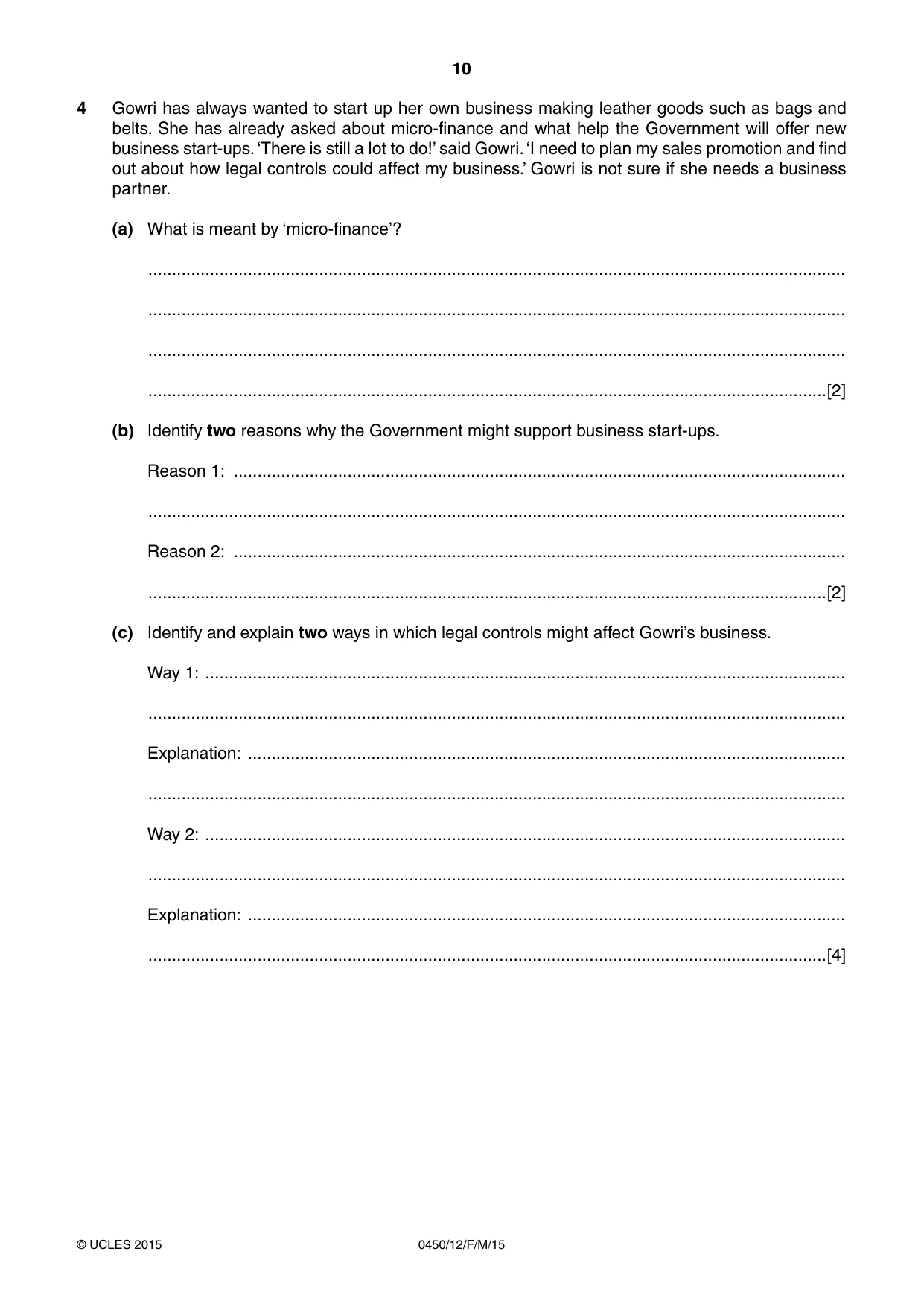

Mark scheme9 pages
Answers below. Sit the paper first if you are practising.
Paper as text
Question paper, page 1
This document consists of 10 printed pages and 2 blank pages. DC (ST/FD) 97473/4 © UCLES 2015 [Turn over Cambridge International Examinations Cambridge International General Certificate of Secondary Education * 4 3 8 4 1 9 6 2 3 8 * BUSINESS STUDIES 0450/12 Paper 1 February/March 2015 1 hour 30 minutes Candidates answer on the Question Paper. No Additional Materials are required. READ THESE INSTRUCTIONS FIRST Write your Centre number, candidate number and name in the spaces at the top of this page. Write in dark blue or black pen. You may use an HB pencil for any diagrams, graphs or rough working. Do not use staples, paper clips, glue or correction fluid. DO NOT WRITE IN ANY BARCODES. Answer all questions. The businesses described in this question paper are entirely fictitious. At the end of the examination, fasten all your work securely together. The number of marks is given in brackets [ ] at the end of each question or part question. The total number of marks for this paper is 80. The syllabus is approved for use in England, Wales and Northern Ireland as a Cambridge International Level 1/Level 2 Certificate.
Question paper, page 2
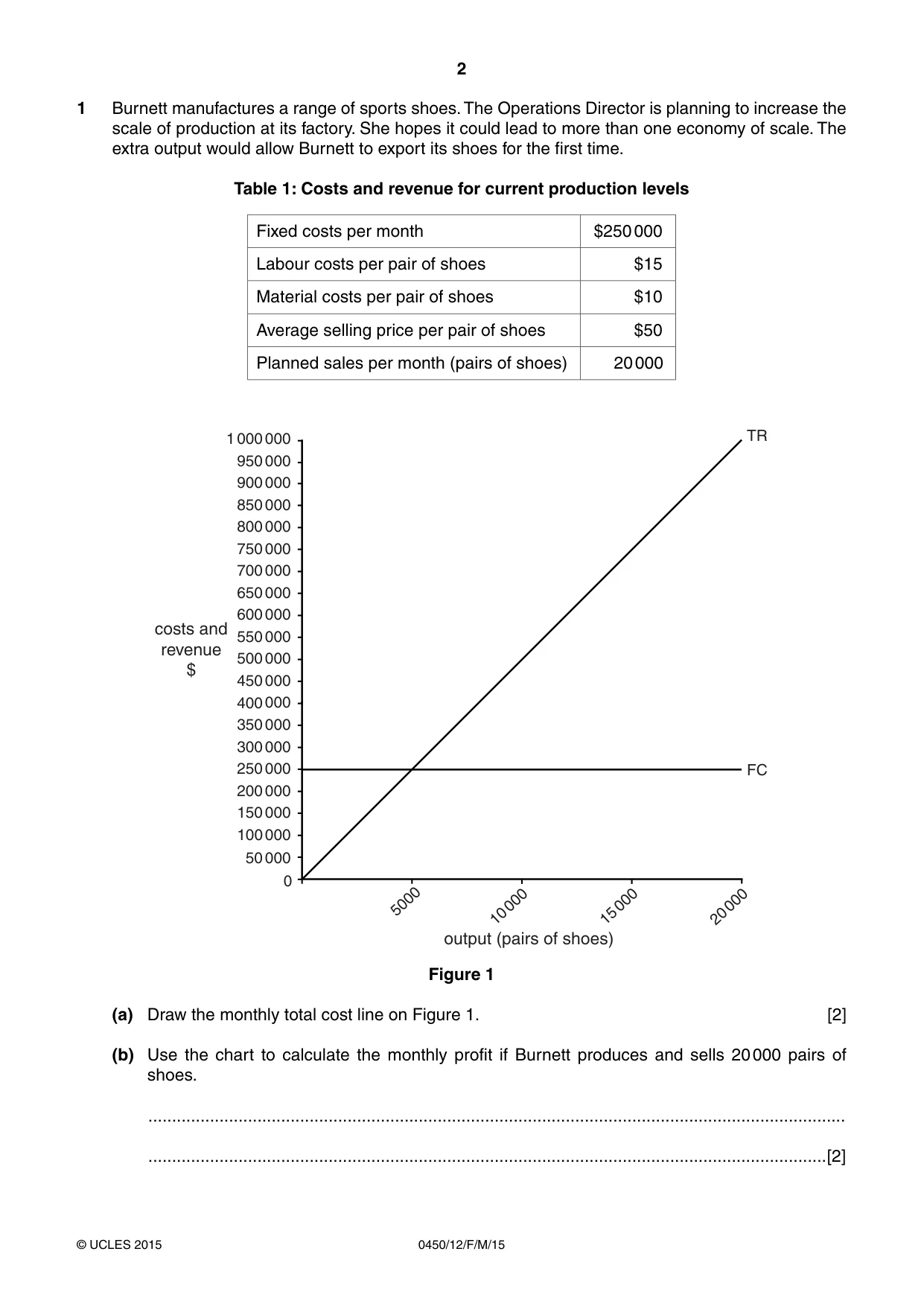
2 0450/12/F/M/15 © UCLES 2015 1 Burnett manufactures a range of sports shoes. The Operations Director is planning to increase the scale of production at its factory. She hopes it could lead to more than one economy of scale. The extra output would allow Burnett to export its shoes for the first time. Table 1: Costs and revenue for current production levels Fixed costs per month $250 000 Labour costs per pair of shoes $15 Material costs per pair of shoes $10 Average selling price per pair of shoes $50 Planned sales per month (pairs of shoes) 20 000 20 000 15 000 10 000 5000 TR FC 100 000 150 000 200 000 250 000 300 000 350 000 400 000 450 000 500 000 550 000 600 000 650 000 700 000 750 000 800 000 850 000 900 000 950 000 1 000 000 50 000 0 output (pairs of shoes) costs and revenue $ Figure 1 (a) Draw the monthly total cost line on Figure 1. [2] (b) Use the chart to calculate the monthly profit if Burnett produces and sells 20 000 pairs of shoes. … …[2]
Question paper, page 3
3 0450/12/F/M/15 © UCLES 2015 [Turn over (c) Identify and explain two possible economies of scale that Burnett could benefit from. 1: … Explanation: … … … 2: … Explanation: … … …[4] (d) Identify and explain two ways in which break-even charts can be useful to the Operations Director of Burnett. Way 1: … … Explanation: … … … … Way 2: … … Explanation: … … … …[6]
Question paper, page 4
4 0450/12/F/M/15 © UCLES 2015 (e) Which do you think are the two most important factors for Burnett to consider when deciding whether to export its products? Justify your choices. … … … … … … … … … … … …[6]
Question paper, page 5
5 0450/12/F/M/15 © UCLES 2015 [Turn over BLANK PAGE
Question paper, page 6
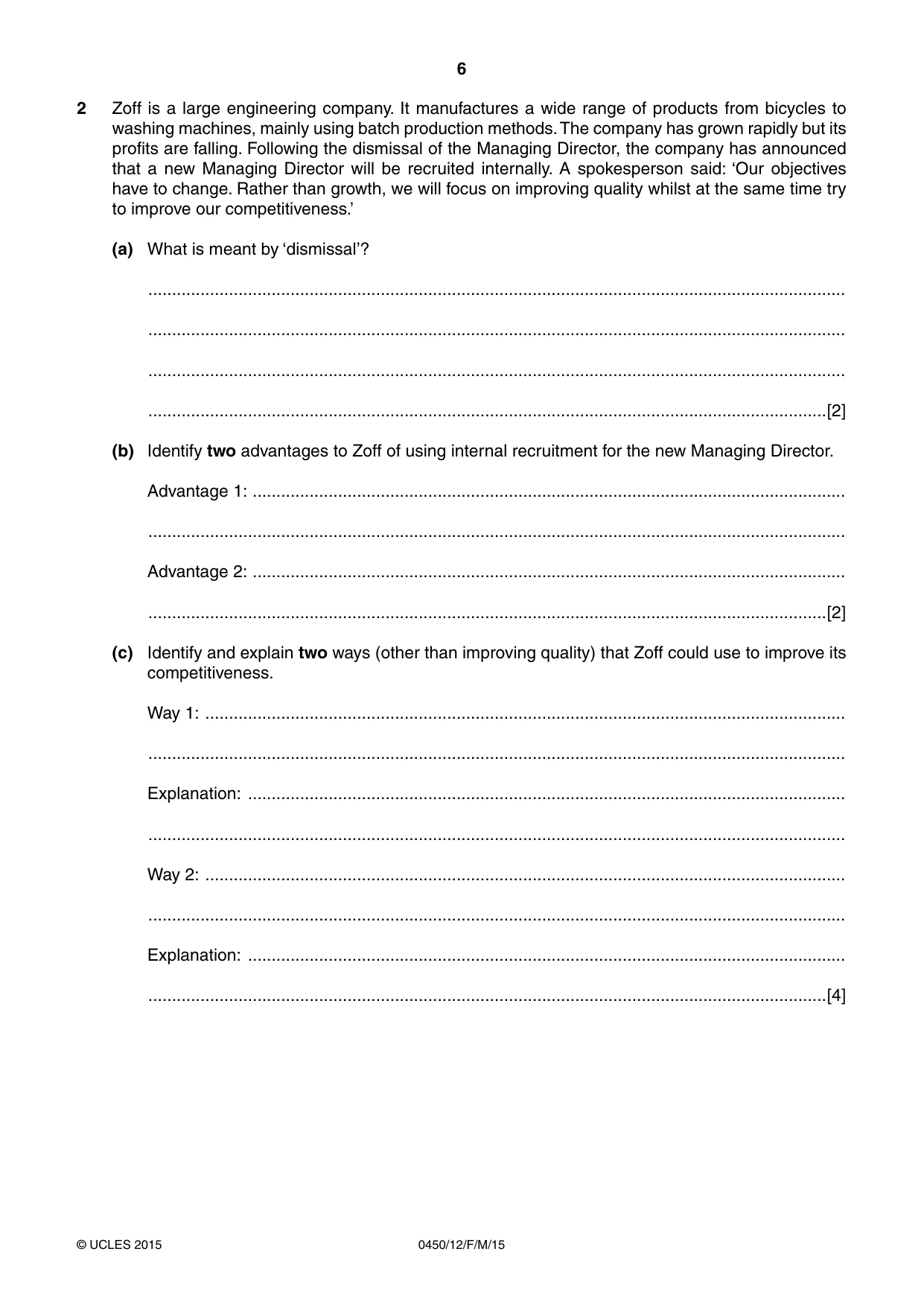
6 0450/12/F/M/15 © UCLES 2015 2 Zoff is a large engineering company. It manufactures a wide range of products from bicycles to washing machines, mainly using batch production methods. The company has grown rapidly but its profits are falling. Following the dismissal of the Managing Director, the company has announced that a new Managing Director will be recruited internally. A spokesperson said: ‘Our objectives have to change. Rather than growth, we will focus on improving quality whilst at the same time try to improve our competitiveness.’ (a) What is meant by ‘dismissal’? … … … …[2] (b) Identify two advantages to Zoff of using internal recruitment for the new Managing Director. Advantage 1: … … Advantage 2: … …[2] (c) Identify and explain two ways (other than improving quality) that Zoff could use to improve its competitiveness. Way 1: … … Explanation: … … Way 2: … … Explanation: … …[4]
Question paper, page 7
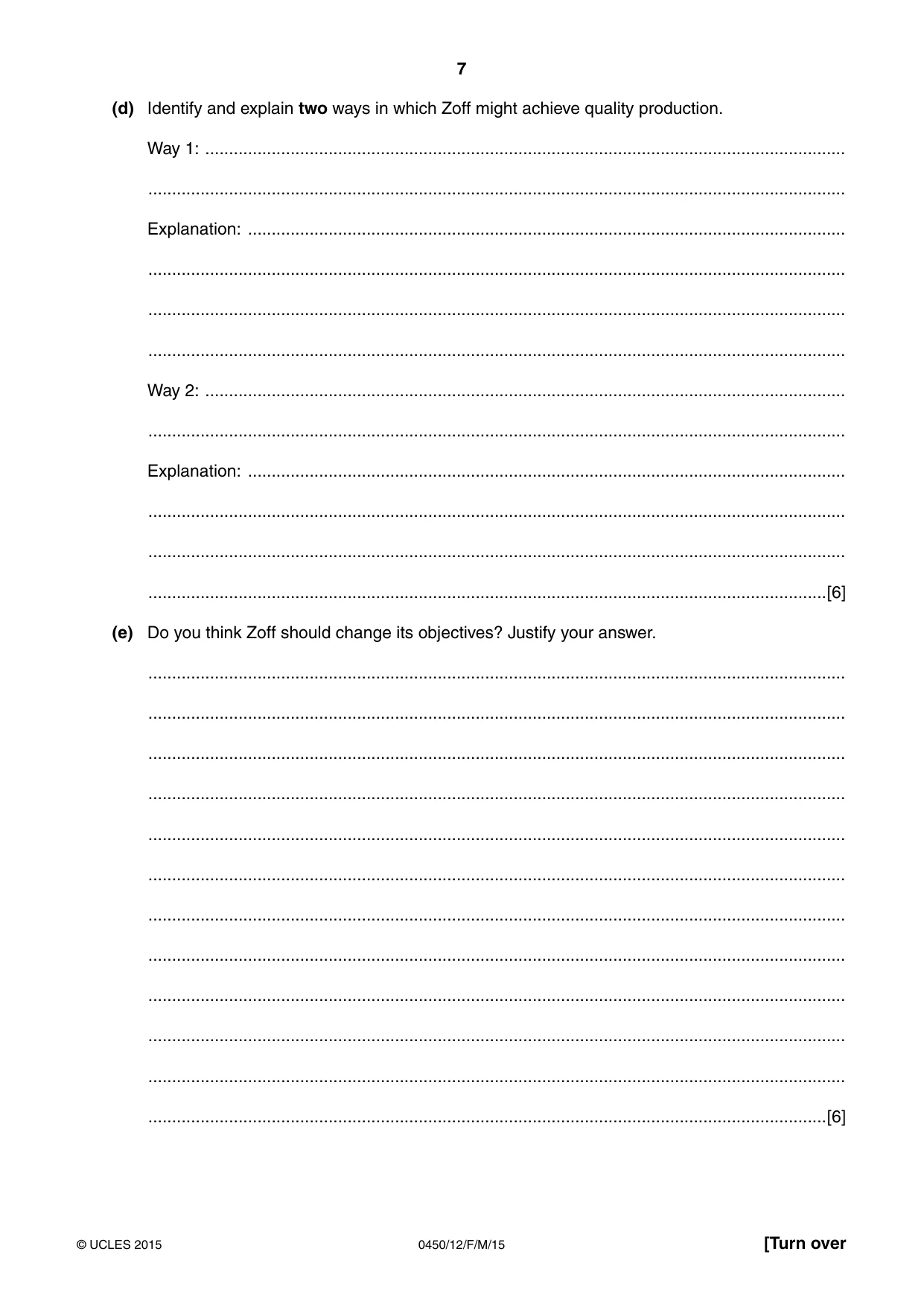
7 0450/12/F/M/15 © UCLES 2015 [Turn over (d) Identify and explain two ways in which Zoff might achieve quality production. Way 1: … … Explanation: … … … … Way 2: … … Explanation: … … … …[6] (e) Do you think Zoff should change its objectives? Justify your answer. … … … … … … … … … … … …[6]
Question paper, page 8
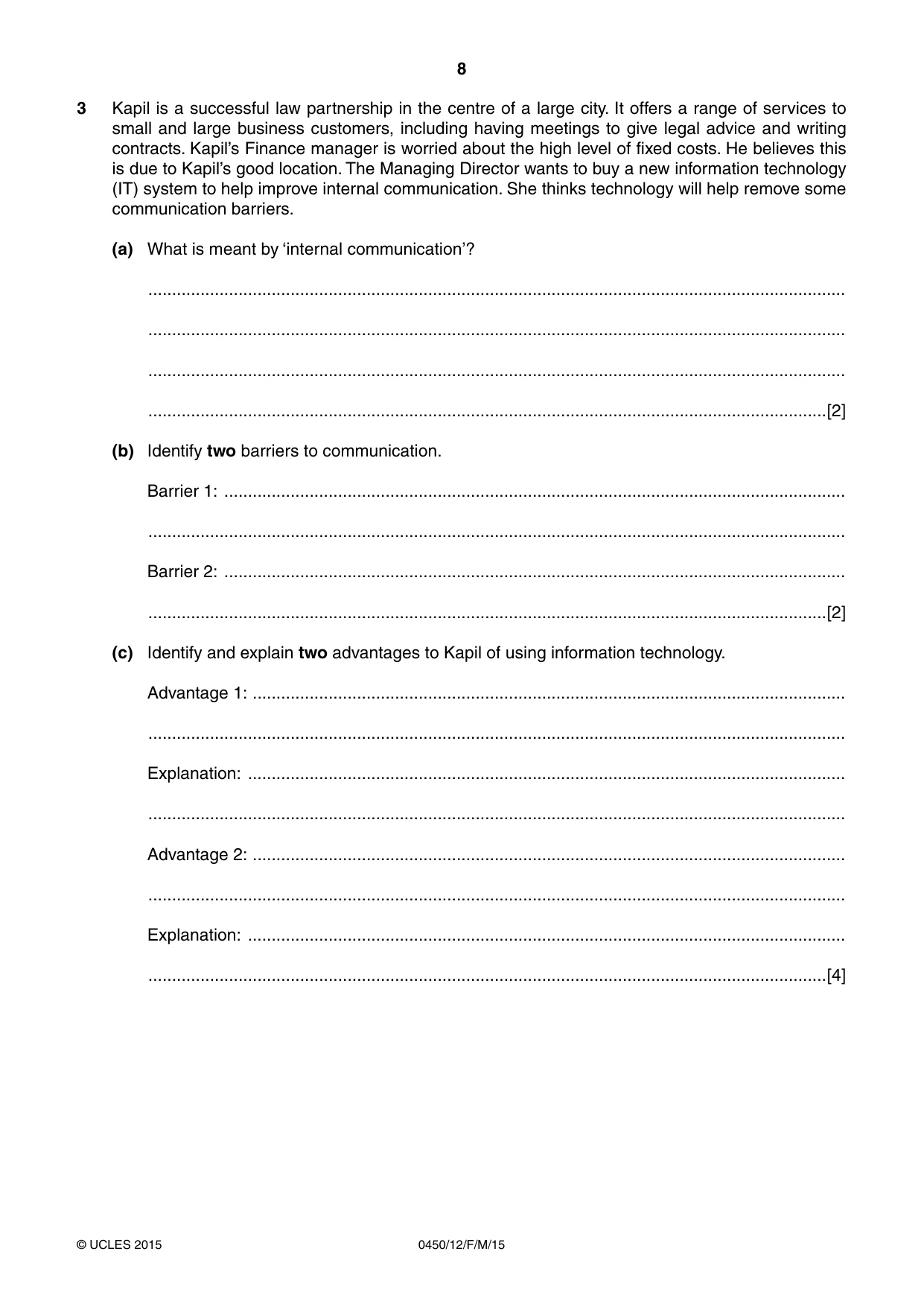
8 0450/12/F/M/15 © UCLES 2015 3 Kapil is a successful law partnership in the centre of a large city. It offers a range of services to small and large business customers, including having meetings to give legal advice and writing contracts. Kapil’s Finance manager is worried about the high level of fixed costs. He believes this is due to Kapil’s good location. The Managing Director wants to buy a new information technology (IT) system to help improve internal communication. She thinks technology will help remove some communication barriers. (a) What is meant by ‘internal communication’? … … … …[2] (b) Identify two barriers to communication. Barrier 1: … … Barrier 2: … …[2] (c) Identify and explain two advantages to Kapil of using information technology. Advantage 1: … … Explanation: … … Advantage 2: … … Explanation: … …[4]
Question paper, page 9
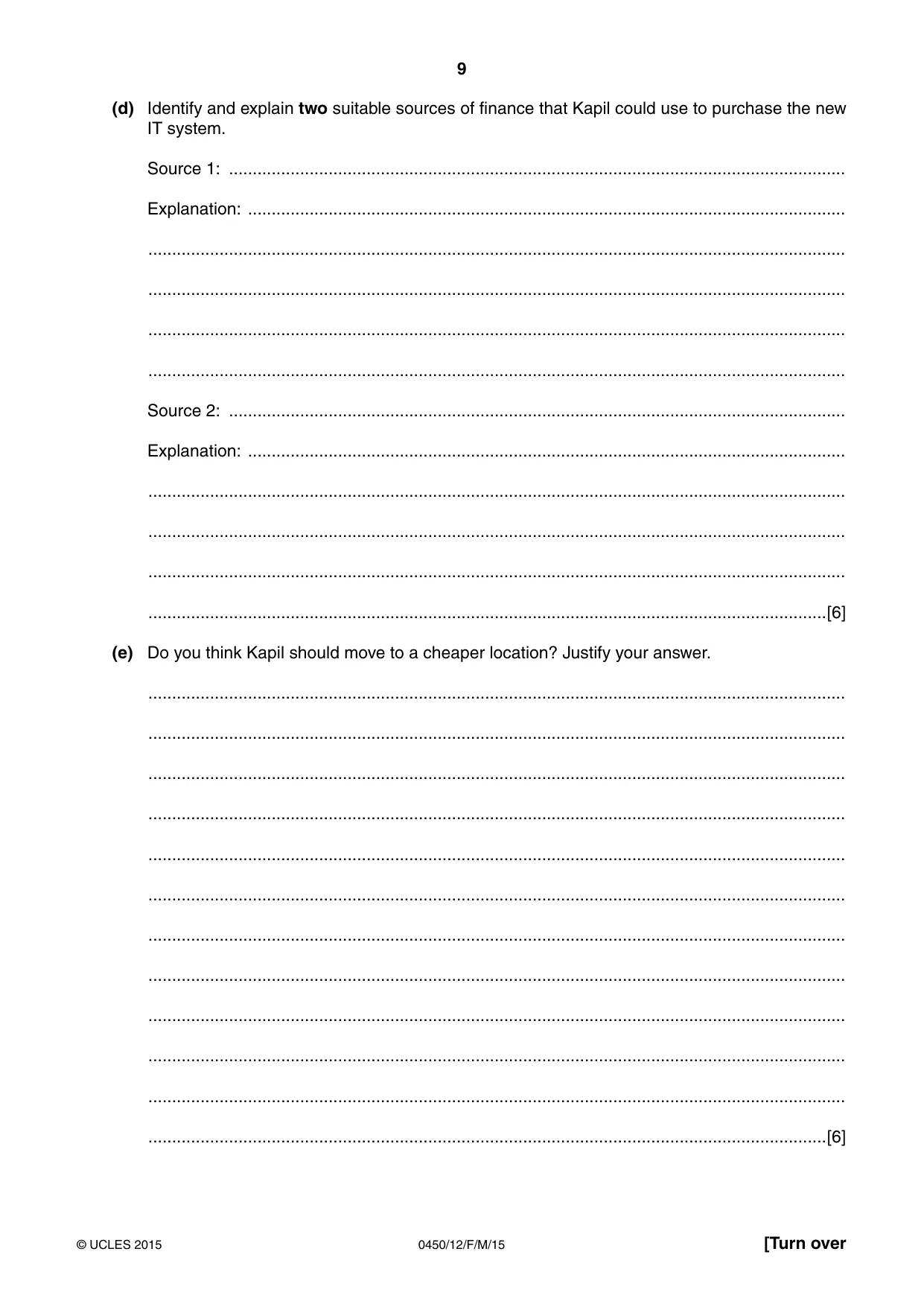
9 0450/12/F/M/15 © UCLES 2015 [Turn over (d) Identify and explain two suitable sources of finance that Kapil could use to purchase the new IT system. Source 1: … Explanation: … … … … … Source 2: … Explanation: … … … … …[6] (e) Do you think Kapil should move to a cheaper location? Justify your answer. … … … … … … … … … … … …[6]
Question paper, page 10
10 0450/12/F/M/15 © UCLES 2015 4 Gowri has always wanted to start up her own business making leather goods such as bags and belts. She has already asked about micro-finance and what help the Government will offer new business start-ups. ‘There is still a lot to do!’ said Gowri. ‘I need to plan my sales promotion and find out about how legal controls could affect my business.’ Gowri is not sure if she needs a business partner. (a) What is meant by ‘micro-finance’? … … … …[2] (b) Identify two reasons why the Government might support business start-ups. Reason 1: … … Reason 2: … …[2] (c) Identify and explain two ways in which legal controls might affect Gowri’s business. Way 1: … … Explanation: … … Way 2: … … Explanation: … …[4]
Question paper, page 11
11 0450/12/F/M/15 © UCLES 2015 (d) Identify and explain two factors (other than legal controls) that Gowri needs to consider when deciding on which method of promotion to use for her products. Factor 1: … … Explanation: … … … … Factor 2: … … Explanation: … … … …[6] (e) Do you think it would be better for Gowri to have a business partner rather than be a sole trader? Justify your answer. … … … … … … … … … … … …[6]
Question paper, page 12
12 0450/12/F/M/15 © UCLES 2015 Permission to reproduce items where third-party owned material protected by copyright is included has been sought and cleared where possible. Every reasonable effort has been made by the publisher (UCLES) to trace copyright holders, but if any items requiring clearance have unwittingly been included, the publisher will be pleased to make amends at the earliest possible opportunity. To avoid the issue of disclosure of answer-related information to candidates, all copyright acknowledgements are reproduced online in the Cambridge International Examinations Copyright Acknowledgements Booklet. This is produced for each series of examinations and is freely available to download at www.cie.org.uk after the live examination series. Cambridge International Examinations is part of the Cambridge Assessment Group. Cambridge Assessment is the brand name of University of Cambridge Local Examinations Syndicate (UCLES), which is itself a department of the University of Cambridge. BLANK PAGE
Mark scheme, page 1
® IGCSE is the registered trademark of Cambridge International Examinations. CAMBRIDGE INTERNATIONAL EXAMINATIONS Cambridge International General Certificate of Secondary Education MARK SCHEME for the March 2015 series 0450 BUSINESS STUDIES 0450/12 Paper 1 (Short Answer/Structured Response), maximum raw mark 80 This mark scheme is published as an aid to teachers and candidates, to indicate the requirements of the examination. It shows the basis on which Examiners were instructed to award marks. It does not indicate the details of the discussions that took place at an Examiners’ meeting before marking began, which would have considered the acceptability of alternative answers. Mark schemes should be read in conjunction with the question paper and the Principal Examiner Report for Teachers. Cambridge will not enter into discussions about these mark schemes. Cambridge is publishing the mark schemes for the March 2015 series for most Cambridge IGCSE® components.
Mark scheme, page 2
Page 2 Mark Scheme Syllabus Paper Cambridge IGCSE – March 2015 0450 12 © Cambridge International Examinations 2015 General Marking Guidance This mark scheme includes a summary of appropriate content for answering each question. It should be emphasised, however, that this material is for illustrative purposes and is not intended to provide a definitive guide to acceptable answers. It is quite possible that among the scripts there will be some candidate answers that are not covered directly by the content of this mark scheme. In such cases, professional judgement should be exercised in assessing the merits of the answer and the senior examiners should be consulted if further guidance is required. Examples of possible answers are also included in this mark scheme. Again, it should be emphasised that this is for illustrative purposes and the examples chosen represent only some of the many possible responses that would merit reward. Application marks are not awarded for the name of the business or person from the case material. Application is by answering in the context of the case or by using the information in the case to help answer the question.
Mark scheme, page 3
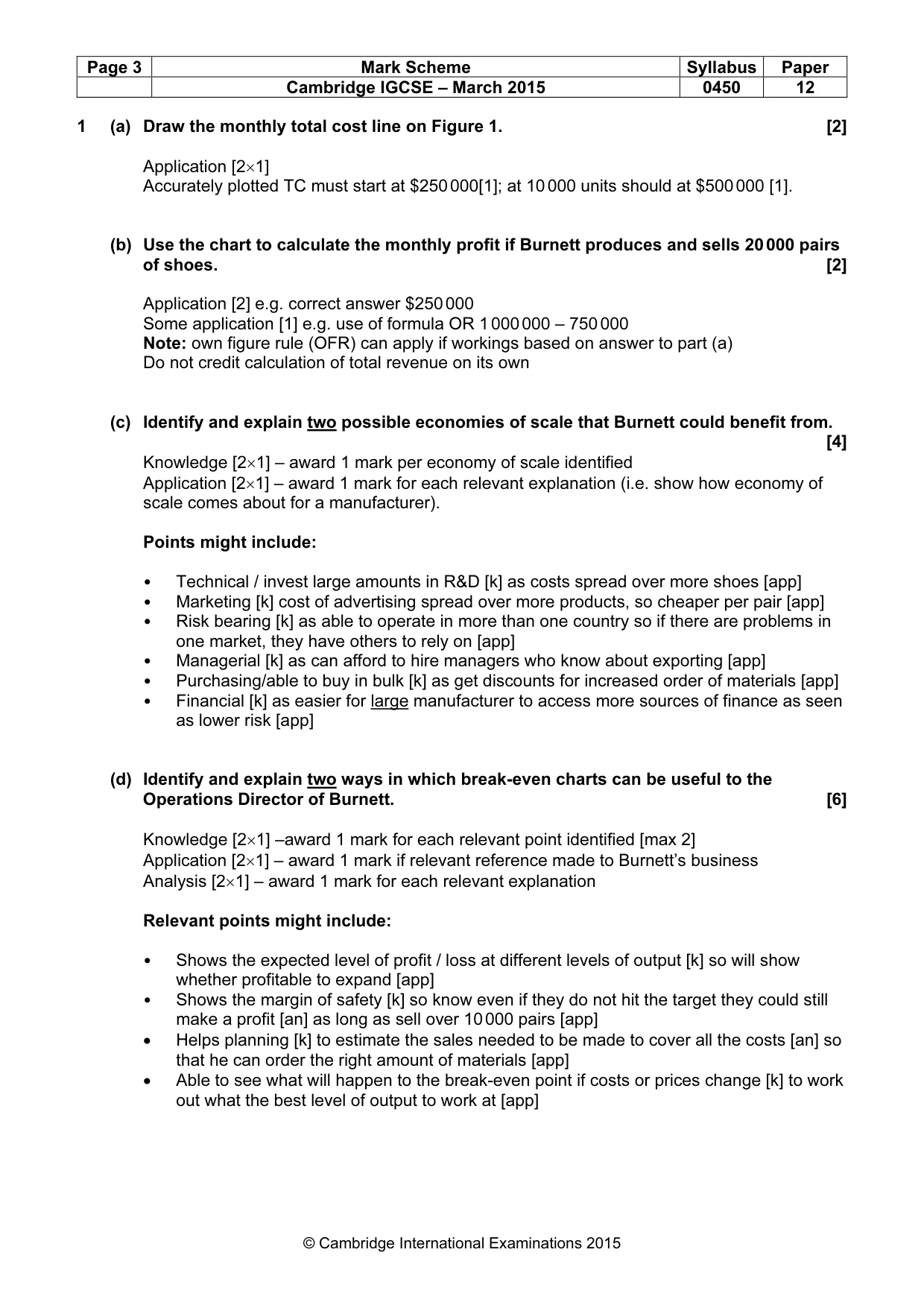
Page 3 Mark Scheme Syllabus Paper Cambridge IGCSE – March 2015 0450 12 © Cambridge International Examinations 2015 1 (a) Draw the monthly total cost line on Figure 1. [2] Application [2×1] Accurately plotted TC must start at $250 000[1]; at 10 000 units should at $500 000 [1]. (b) Use the chart to calculate the monthly profit if Burnett produces and sells 20 000 pairs of shoes. [2] Application [2] e.g. correct answer $250 000 Some application [1] e.g. use of formula OR 1 000 000 – 750 000 Note: own figure rule (OFR) can apply if workings based on answer to part (a) Do not credit calculation of total revenue on its own (c) Identify and explain two possible economies of scale that Burnett could benefit from. [4] Knowledge [2×1] – award 1 mark per economy of scale identified Application [2×1] – award 1 mark for each relevant explanation (i.e. show how economy of scale comes about for a manufacturer). Points might include: • Technical / invest large amounts in R&D [k] as costs spread over more shoes [app] • Marketing [k] cost of advertising spread over more products, so cheaper per pair [app] • Risk bearing [k] as able to operate in more than one country so if there are problems in one market, they have others to rely on [app] • Managerial [k] as can afford to hire managers who know about exporting [app] • Purchasing/able to buy in bulk [k] as get discounts for increased order of materials [app] • Financial [k] as easier for large manufacturer to access more sources of finance as seen as lower risk [app] (d) Identify and explain two ways in which break-even charts can be useful to the Operations Director of Burnett. [6] Knowledge [2×1] –award 1 mark for each relevant point identified [max 2] Application [2×1] – award 1 mark if relevant reference made to Burnett’s business Analysis [2×1] – award 1 mark for each relevant explanation Relevant points might include: • Shows the expected level of profit / loss at different levels of output [k] so will show whether profitable to expand [app] • Shows the margin of safety [k] so know even if they do not hit the target they could still make a profit [an] as long as sell over 10 000 pairs [app] • Helps planning [k] to estimate the sales needed to be made to cover all the costs [an] so that he can order the right amount of materials [app] • Able to see what will happen to the break-even point if costs or prices change [k] to work out what the best level of output to work at [app]
Mark scheme, page 4
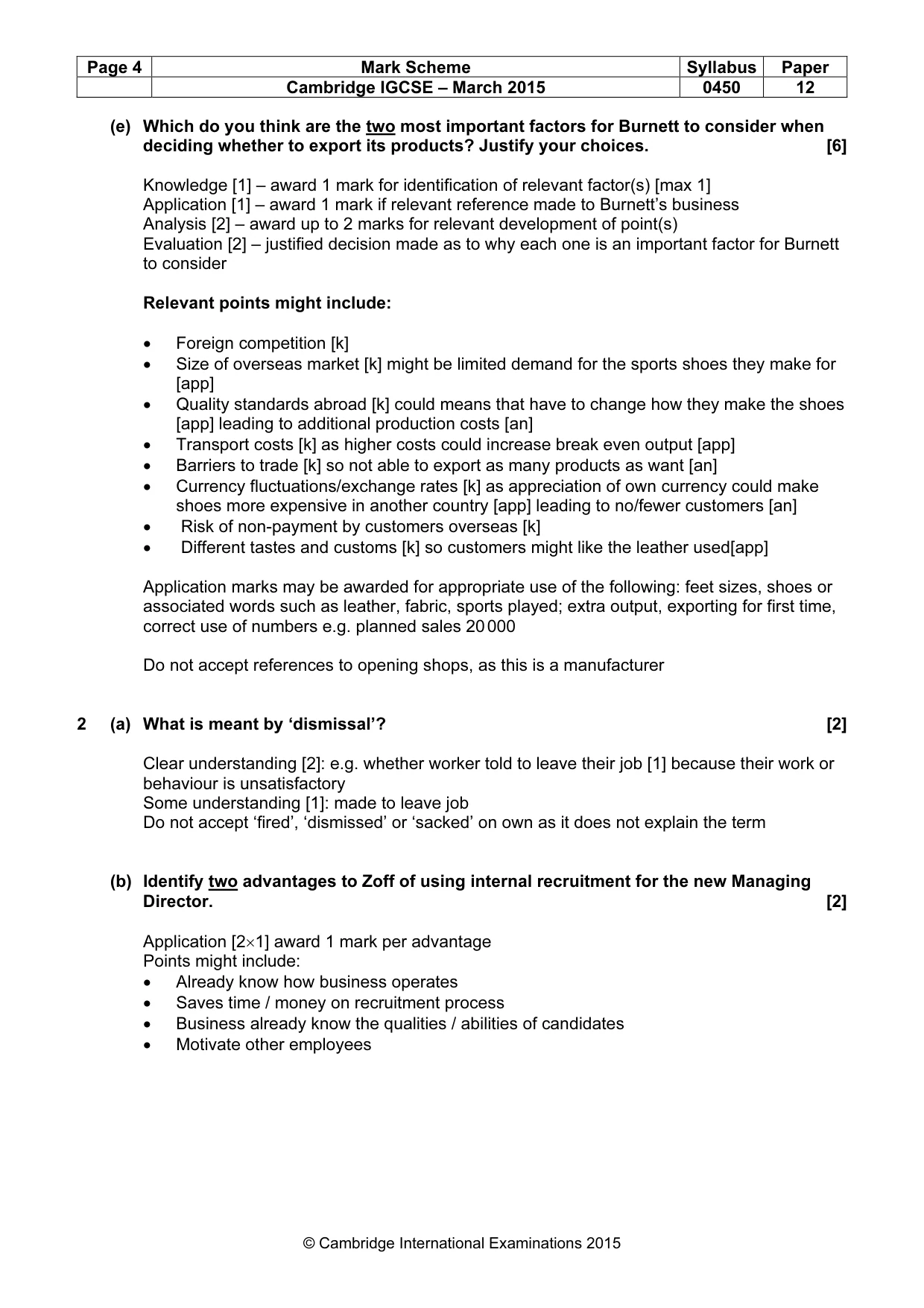
Page 4 Mark Scheme Syllabus Paper Cambridge IGCSE – March 2015 0450 12 © Cambridge International Examinations 2015 (e) Which do you think are the two most important factors for Burnett to consider when deciding whether to export its products? Justify your choices. [6] Knowledge [1] – award 1 mark for identification of relevant factor(s) [max 1] Application [1] – award 1 mark if relevant reference made to Burnett’s business Analysis [2] – award up to 2 marks for relevant development of point(s) Evaluation [2] – justified decision made as to why each one is an important factor for Burnett to consider Relevant points might include: • Foreign competition [k] • Size of overseas market [k] might be limited demand for the sports shoes they make for [app] • Quality standards abroad [k] could means that have to change how they make the shoes [app] leading to additional production costs [an] • Transport costs [k] as higher costs could increase break even output [app] • Barriers to trade [k] so not able to export as many products as want [an] • Currency fluctuations/exchange rates [k] as appreciation of own currency could make shoes more expensive in another country [app] leading to no/fewer customers [an] • Risk of non-payment by customers overseas [k] • Different tastes and customs [k] so customers might like the leather used[app] Application marks may be awarded for appropriate use of the following: feet sizes, shoes or associated words such as leather, fabric, sports played; extra output, exporting for first time, correct use of numbers e.g. planned sales 20 000 Do not accept references to opening shops, as this is a manufacturer 2 (a) What is meant by ‘dismissal’? [2] Clear understanding [2]: e.g. whether worker told to leave their job [1] because their work or behaviour is unsatisfactory Some understanding [1]: made to leave job Do not accept ‘fired’, ‘dismissed’ or ‘sacked’ on own as it does not explain the term (b) Identify two advantages to Zoff of using internal recruitment for the new Managing Director. [2] Application [2×1] award 1 mark per advantage Points might include: • Already know how business operates • Saves time / money on recruitment process • Business already know the qualities / abilities of candidates • Motivate other employees
Mark scheme, page 5
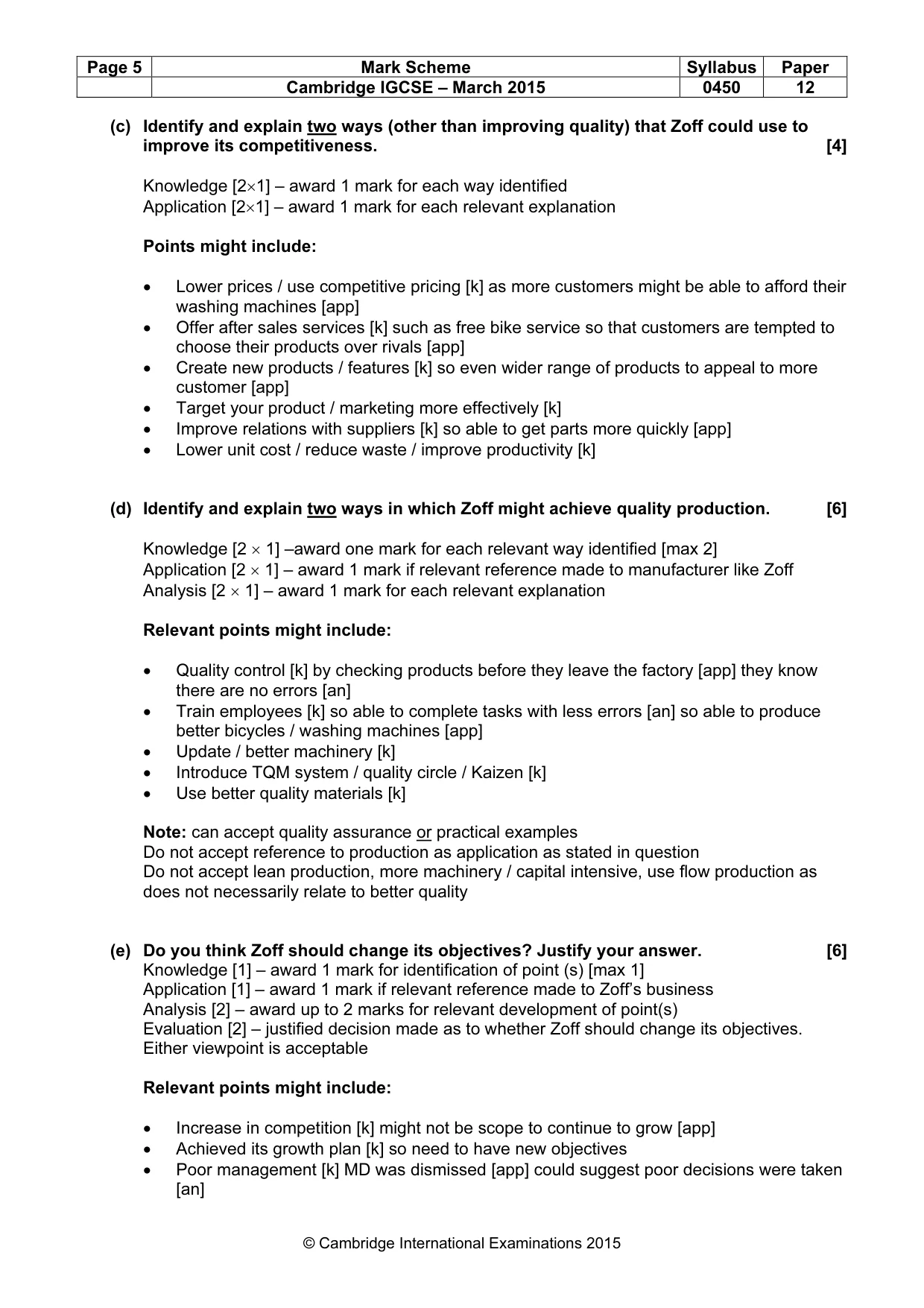
Page 5 Mark Scheme Syllabus Paper Cambridge IGCSE – March 2015 0450 12 © Cambridge International Examinations 2015 (c) Identify and explain two ways (other than improving quality) that Zoff could use to improve its competitiveness. [4] Knowledge [2×1] – award 1 mark for each way identified Application [2×1] – award 1 mark for each relevant explanation Points might include: • Lower prices / use competitive pricing [k] as more customers might be able to afford their washing machines [app] • Offer after sales services [k] such as free bike service so that customers are tempted to choose their products over rivals [app] • Create new products / features [k] so even wider range of products to appeal to more customer [app] • Target your product / marketing more effectively [k] • Improve relations with suppliers [k] so able to get parts more quickly [app] • Lower unit cost / reduce waste / improve productivity [k] (d) Identify and explain two ways in which Zoff might achieve quality production. [6] Knowledge [2 × 1] –award one mark for each relevant way identified [max 2] Application [2 × 1] – award 1 mark if relevant reference made to manufacturer like Zoff Analysis [2 × 1] – award 1 mark for each relevant explanation Relevant points might include: • Quality control [k] by checking products before they leave the factory [app] they know there are no errors [an] • Train employees [k] so able to complete tasks with less errors [an] so able to produce better bicycles / washing machines [app] • Update / better machinery [k] • Introduce TQM system / quality circle / Kaizen [k] • Use better quality materials [k] Note: can accept quality assurance or practical examples Do not accept reference to production as application as stated in question Do not accept lean production, more machinery / capital intensive, use flow production as does not necessarily relate to better quality (e) Do you think Zoff should change its objectives? Justify your answer. [6] Knowledge [1] – award 1 mark for identification of point (s) [max 1] Application [1] – award 1 mark if relevant reference made to Zoff’s business Analysis [2] – award up to 2 marks for relevant development of point(s) Evaluation [2] – justified decision made as to whether Zoff should change its objectives. Either viewpoint is acceptable Relevant points might include: • Increase in competition [k] might not be scope to continue to grow [app] • Achieved its growth plan [k] so need to have new objectives • Poor management [k] MD was dismissed [app] could suggest poor decisions were taken [an]
Mark scheme, page 6
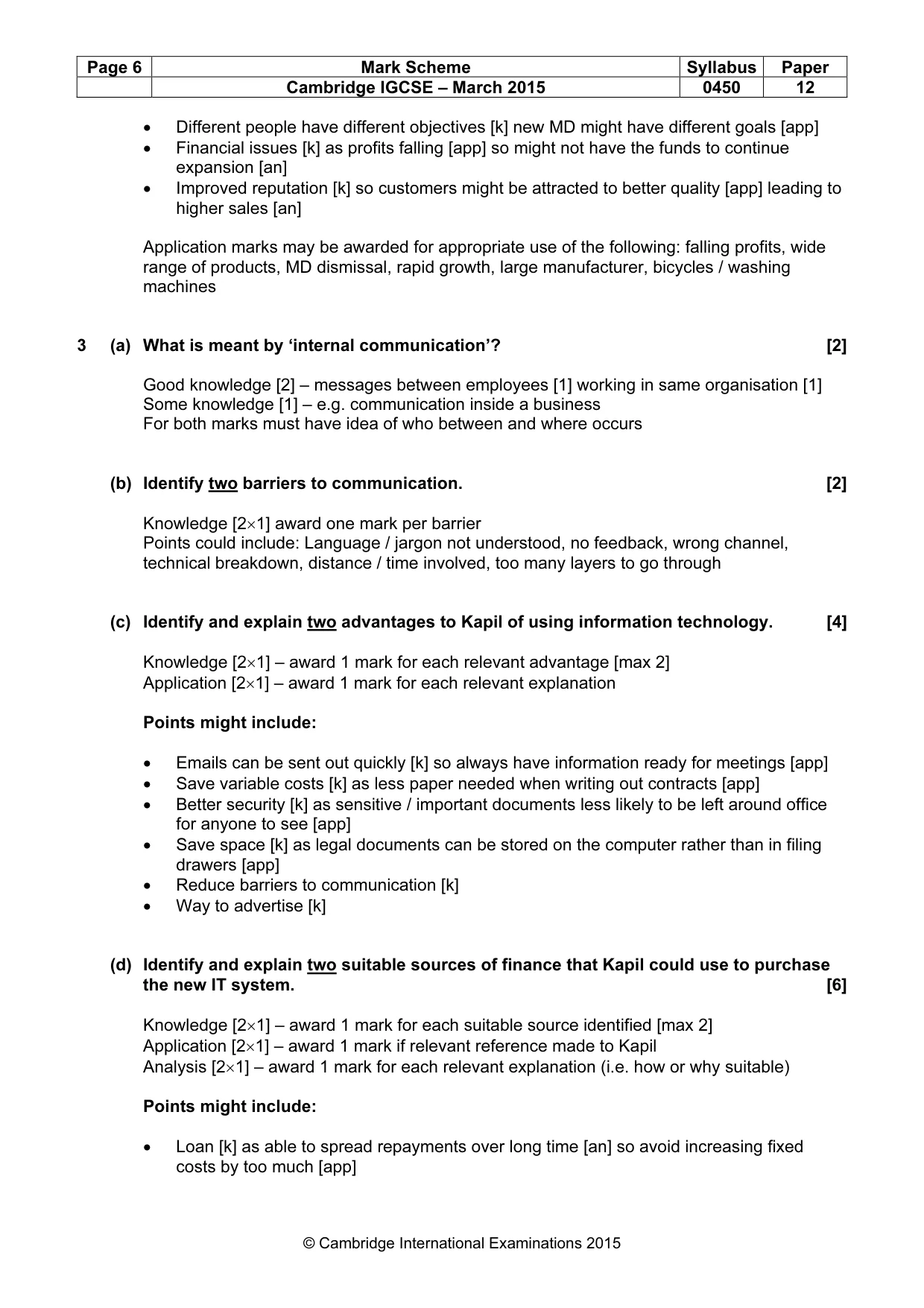
Page 6 Mark Scheme Syllabus Paper Cambridge IGCSE – March 2015 0450 12 © Cambridge International Examinations 2015 • Different people have different objectives [k] new MD might have different goals [app] • Financial issues [k] as profits falling [app] so might not have the funds to continue expansion [an] • Improved reputation [k] so customers might be attracted to better quality [app] leading to higher sales [an] Application marks may be awarded for appropriate use of the following: falling profits, wide range of products, MD dismissal, rapid growth, large manufacturer, bicycles / washing machines 3 (a) What is meant by ‘internal communication’? [2] Good knowledge [2] – messages between employees [1] working in same organisation [1] Some knowledge [1] – e.g. communication inside a business For both marks must have idea of who between and where occurs (b) Identify two barriers to communication. [2] Knowledge [2×1] award one mark per barrier Points could include: Language / jargon not understood, no feedback, wrong channel, technical breakdown, distance / time involved, too many layers to go through (c) Identify and explain two advantages to Kapil of using information technology. [4] Knowledge [2×1] – award 1 mark for each relevant advantage [max 2] Application [2×1] – award 1 mark for each relevant explanation Points might include: • Emails can be sent out quickly [k] so always have information ready for meetings [app] • Save variable costs [k] as less paper needed when writing out contracts [app] • Better security [k] as sensitive / important documents less likely to be left around office for anyone to see [app] • Save space [k] as legal documents can be stored on the computer rather than in filing drawers [app] • Reduce barriers to communication [k] • Way to advertise [k] (d) Identify and explain two suitable sources of finance that Kapil could use to purchase the new IT system. [6] Knowledge [2×1] – award 1 mark for each suitable source identified [max 2] Application [2×1] – award 1 mark if relevant reference made to Kapil Analysis [2×1] – award 1 mark for each relevant explanation (i.e. how or why suitable) Points might include: • Loan [k] as able to spread repayments over long time [an] so avoid increasing fixed costs by too much [app]
Mark scheme, page 7
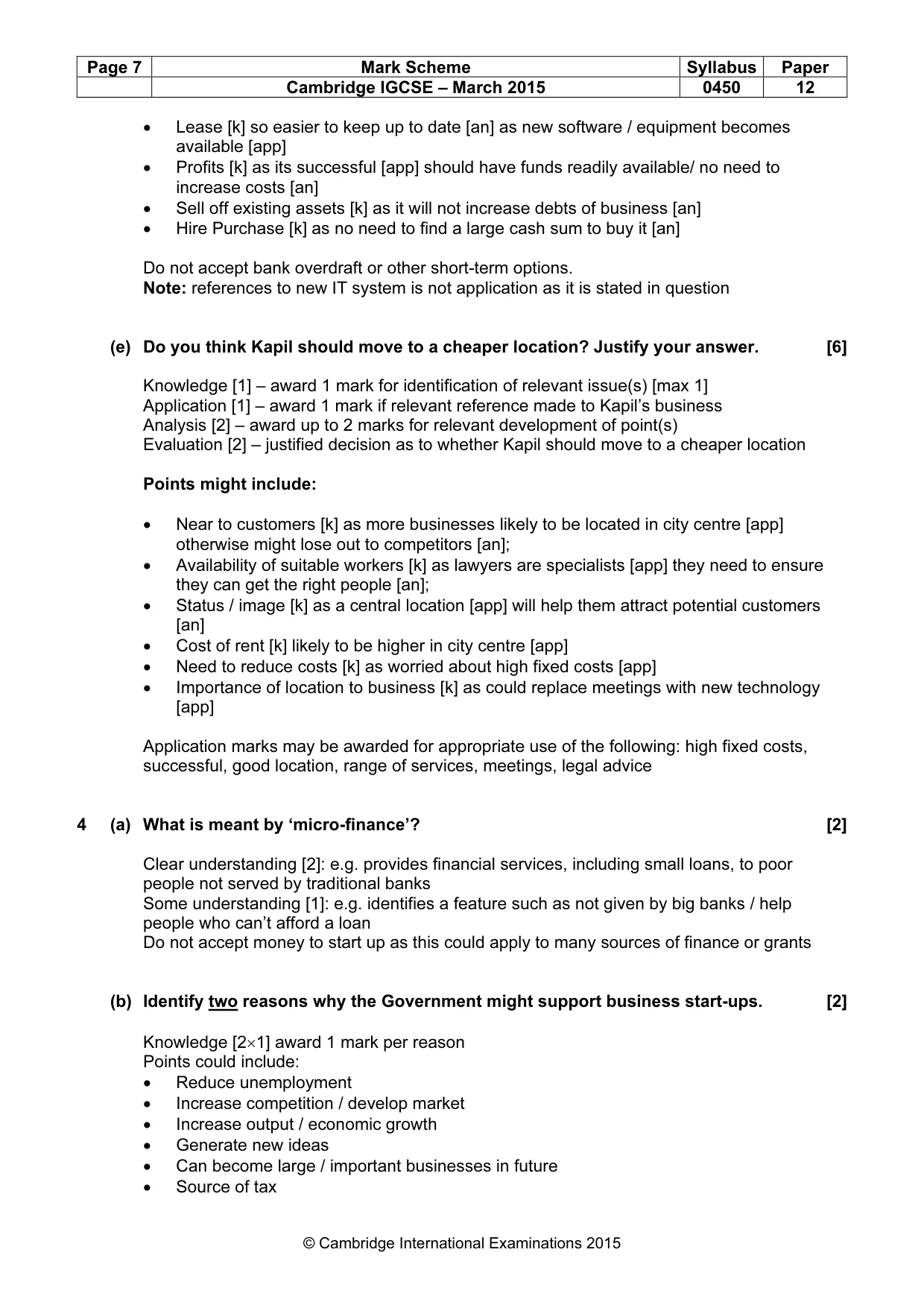
Page 7 Mark Scheme Syllabus Paper Cambridge IGCSE – March 2015 0450 12 © Cambridge International Examinations 2015 • Lease [k] so easier to keep up to date [an] as new software / equipment becomes available [app] • Profits [k] as its successful [app] should have funds readily available/ no need to increase costs [an] • Sell off existing assets [k] as it will not increase debts of business [an] • Hire Purchase [k] as no need to find a large cash sum to buy it [an] Do not accept bank overdraft or other short-term options. Note: references to new IT system is not application as it is stated in question (e) Do you think Kapil should move to a cheaper location? Justify your answer. [6] Knowledge [1] – award 1 mark for identification of relevant issue(s) [max 1] Application [1] – award 1 mark if relevant reference made to Kapil’s business Analysis [2] – award up to 2 marks for relevant development of point(s) Evaluation [2] – justified decision as to whether Kapil should move to a cheaper location Points might include: • Near to customers [k] as more businesses likely to be located in city centre [app] otherwise might lose out to competitors [an]; • Availability of suitable workers [k] as lawyers are specialists [app] they need to ensure they can get the right people [an]; • Status / image [k] as a central location [app] will help them attract potential customers [an] • Cost of rent [k] likely to be higher in city centre [app] • Need to reduce costs [k] as worried about high fixed costs [app] • Importance of location to business [k] as could replace meetings with new technology [app] Application marks may be awarded for appropriate use of the following: high fixed costs, successful, good location, range of services, meetings, legal advice 4 (a) What is meant by ‘micro-finance’? [2] Clear understanding [2]: e.g. provides financial services, including small loans, to poor people not served by traditional banks Some understanding [1]: e.g. identifies a feature such as not given by big banks / help people who can’t afford a loan Do not accept money to start up as this could apply to many sources of finance or grants (b) Identify two reasons why the Government might support business start-ups. [2] Knowledge [2×1] award 1 mark per reason Points could include: • Reduce unemployment • Increase competition / develop market • Increase output / economic growth • Generate new ideas • Can become large / important businesses in future • Source of tax
Mark scheme, page 8
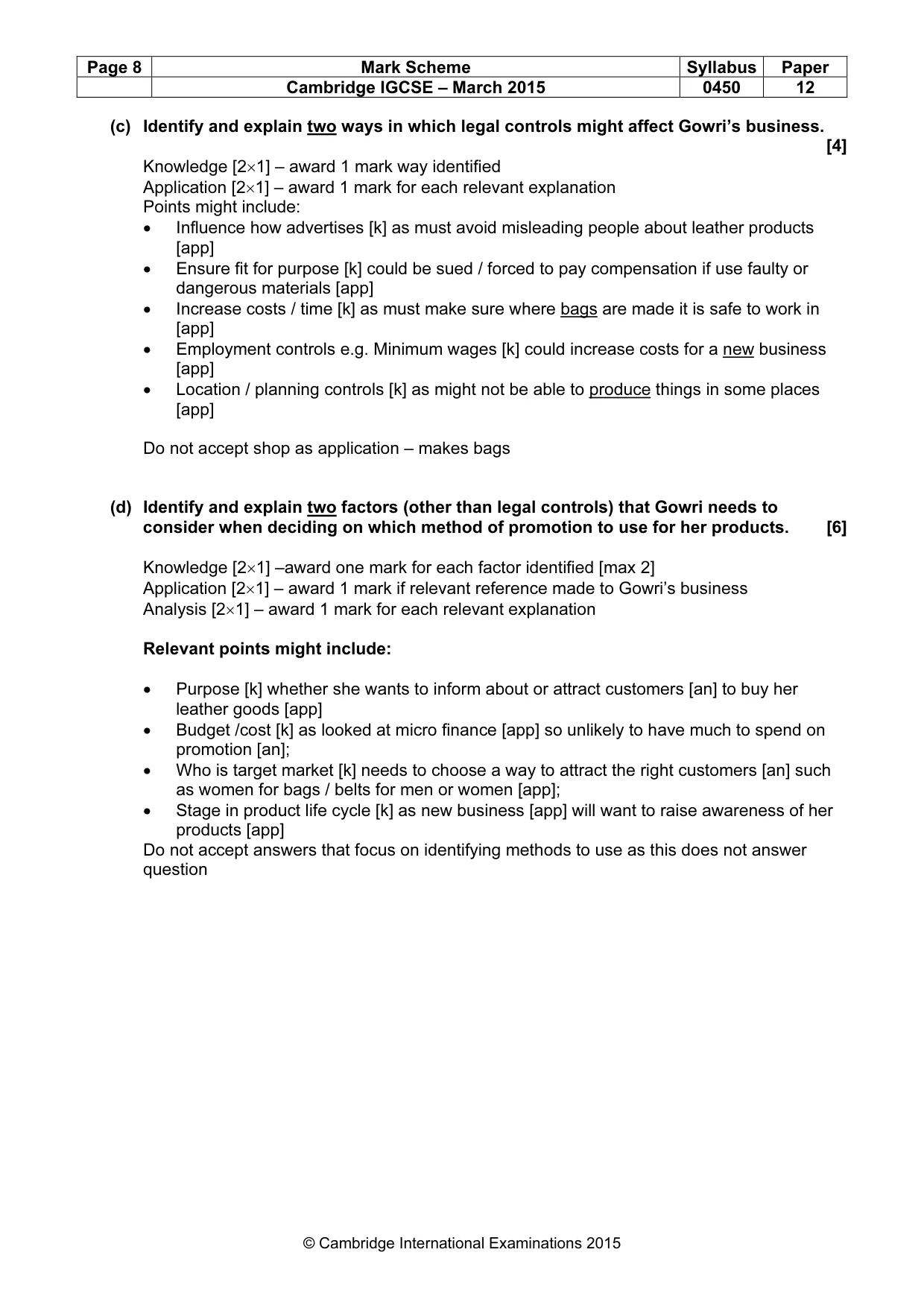
Page 8 Mark Scheme Syllabus Paper Cambridge IGCSE – March 2015 0450 12 © Cambridge International Examinations 2015 (c) Identify and explain two ways in which legal controls might affect Gowri’s business. [4] Knowledge [2×1] – award 1 mark way identified Application [2×1] – award 1 mark for each relevant explanation Points might include: • Influence how advertises [k] as must avoid misleading people about leather products [app] • Ensure fit for purpose [k] could be sued / forced to pay compensation if use faulty or dangerous materials [app] • Increase costs / time [k] as must make sure where bags are made it is safe to work in [app] • Employment controls e.g. Minimum wages [k] could increase costs for a new business [app] • Location / planning controls [k] as might not be able to produce things in some places [app] Do not accept shop as application – makes bags (d) Identify and explain two factors (other than legal controls) that Gowri needs to consider when deciding on which method of promotion to use for her products. [6] Knowledge [2×1] –award one mark for each factor identified [max 2] Application [2×1] – award 1 mark if relevant reference made to Gowri’s business Analysis [2×1] – award 1 mark for each relevant explanation Relevant points might include: • Purpose [k] whether she wants to inform about or attract customers [an] to buy her leather goods [app] • Budget /cost [k] as looked at micro finance [app] so unlikely to have much to spend on promotion [an]; • Who is target market [k] needs to choose a way to attract the right customers [an] such as women for bags / belts for men or women [app]; • Stage in product life cycle [k] as new business [app] will want to raise awareness of her products [app] Do not accept answers that focus on identifying methods to use as this does not answer question
Mark scheme, page 9
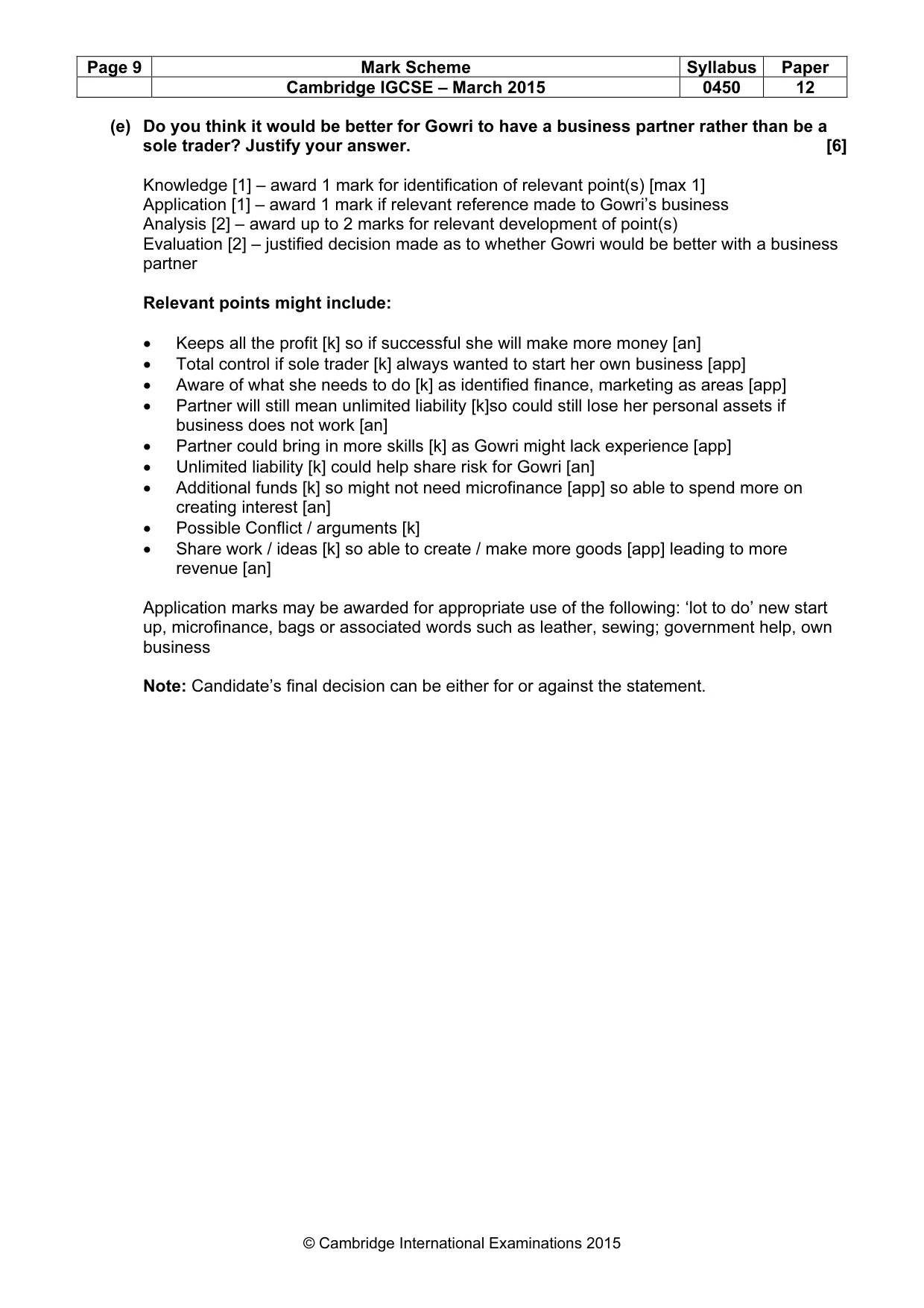
Page 9 Mark Scheme Syllabus Paper Cambridge IGCSE – March 2015 0450 12 © Cambridge International Examinations 2015 (e) Do you think it would be better for Gowri to have a business partner rather than be a sole trader? Justify your answer. [6] Knowledge [1] – award 1 mark for identification of relevant point(s) [max 1] Application [1] – award 1 mark if relevant reference made to Gowri’s business Analysis [2] – award up to 2 marks for relevant development of point(s) Evaluation [2] – justified decision made as to whether Gowri would be better with a business partner Relevant points might include: • Keeps all the profit [k] so if successful she will make more money [an] • Total control if sole trader [k] always wanted to start her own business [app] • Aware of what she needs to do [k] as identified finance, marketing as areas [app] • Partner will still mean unlimited liability [k]so could still lose her personal assets if business does not work [an] • Partner could bring in more skills [k] as Gowri might lack experience [app] • Unlimited liability [k] could help share risk for Gowri [an] • Additional funds [k] so might not need microfinance [app] so able to spend more on creating interest [an] • Possible Conflict / arguments [k] • Share work / ideas [k] so able to create / make more goods [app] leading to more revenue [an] Application marks may be awarded for appropriate use of the following: ‘lot to do’ new start up, microfinance, bags or associated words such as leather, sewing; government help, own business Note: Candidate’s final decision can be either for or against the statement.