Cambridge IGCSE Business Studies 0450 — 2014 May/June Paper 2 · Variant 1
0450/21/M/J/14 · 100 marks · ≈113 min
The question paper and its mark scheme, free to read here and free to download. This is Cambridge’s own paper, exactly as it was sat.
Question paper12 pages
Mark scheme13 pages
Answers below. Sit the paper first if you are practising.
Paper as text
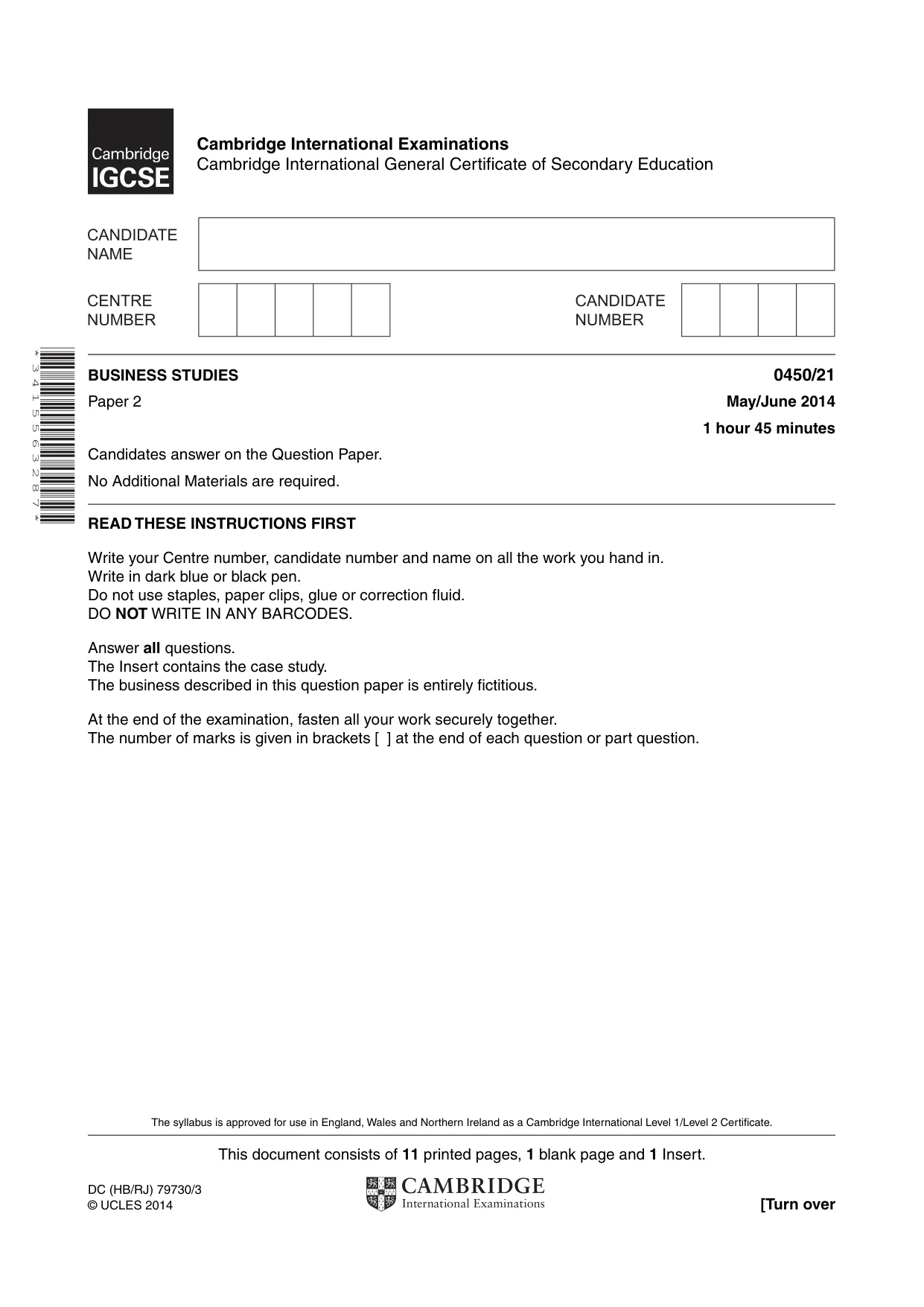
Question paper, page 1
This document consists of 11 printed pages, 1 blank page and 1 Insert. DC (HB/RJ) 79730/3 © UCLES 2014 [Turn over Cambridge International Examinations Cambridge International General Certificate of Secondary Education * 3 4 1 5 5 6 3 2 8 7 * BUSINESS STUDIES 0450/21 Paper 2 May/June 2014 1 hour 45 minutes Candidates answer on the Question Paper. No Additional Materials are required. READ THESE INSTRUCTIONS FIRST Write your Centre number, candidate number and name on all the work you hand in. Write in dark blue or black pen. Do not use staples, paper clips, glue or correction fluid. DO NOT WRITE IN ANY BARCODES. Answer all questions. The Insert contains the case study. The business described in this question paper is entirely fictitious. At the end of the examination, fasten all your work securely together. The number of marks is given in brackets [ ] at the end of each question or part question. The syllabus is approved for use in England, Wales and Northern Ireland as a Cambridge International Level 1/Level 2 Certificate.
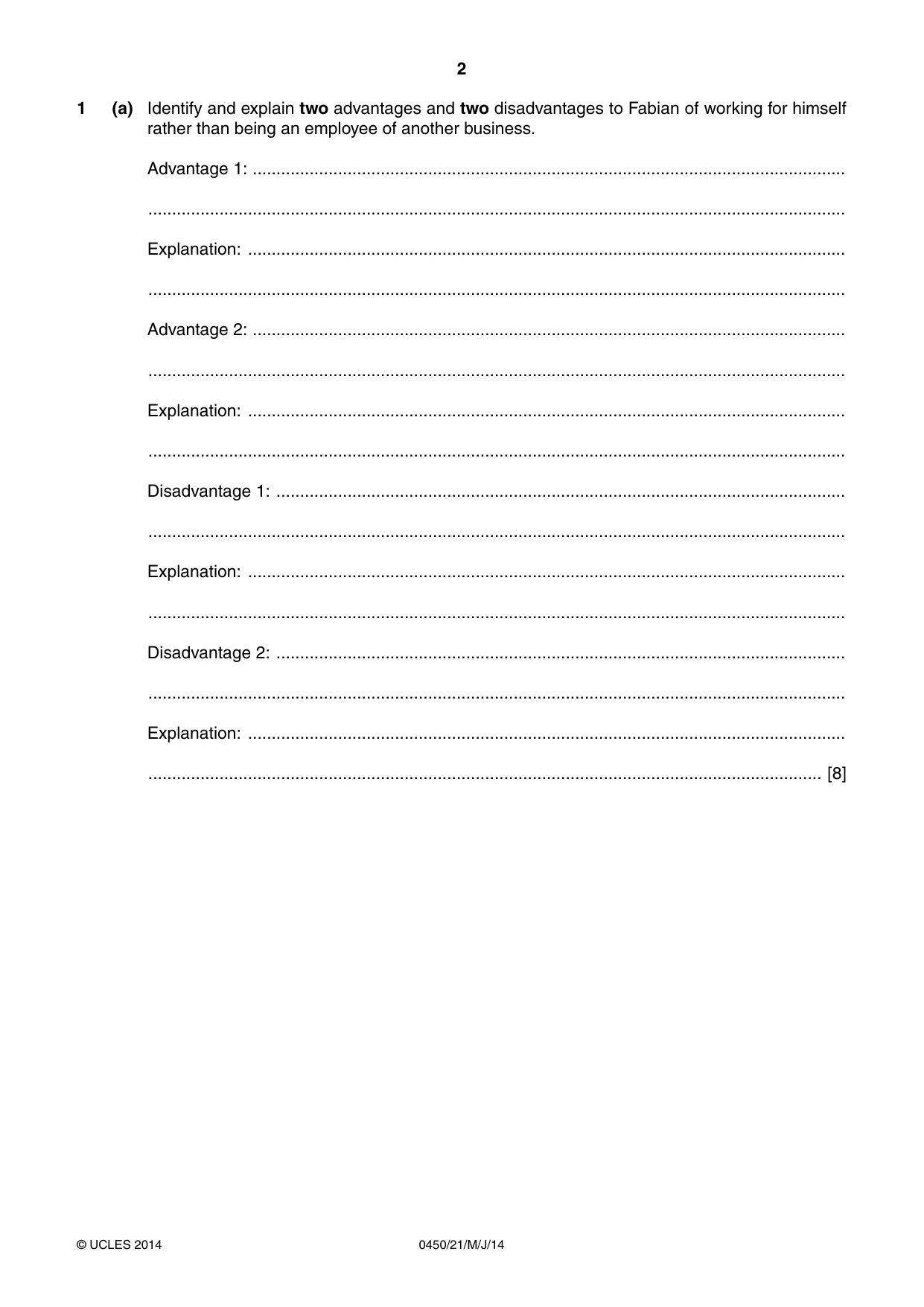
Question paper, page 2
2 0450/21/M/J/14 © UCLES 2014 1 (a) Identify and explain two advantages and two disadvantages to Fabian of working for himself rather than being an employee of another business. Advantage 1: … … Explanation: … … Advantage 2: … … Explanation: … … Disadvantage 1: … … Explanation: … … Disadvantage 2: … … Explanation: … … [8]
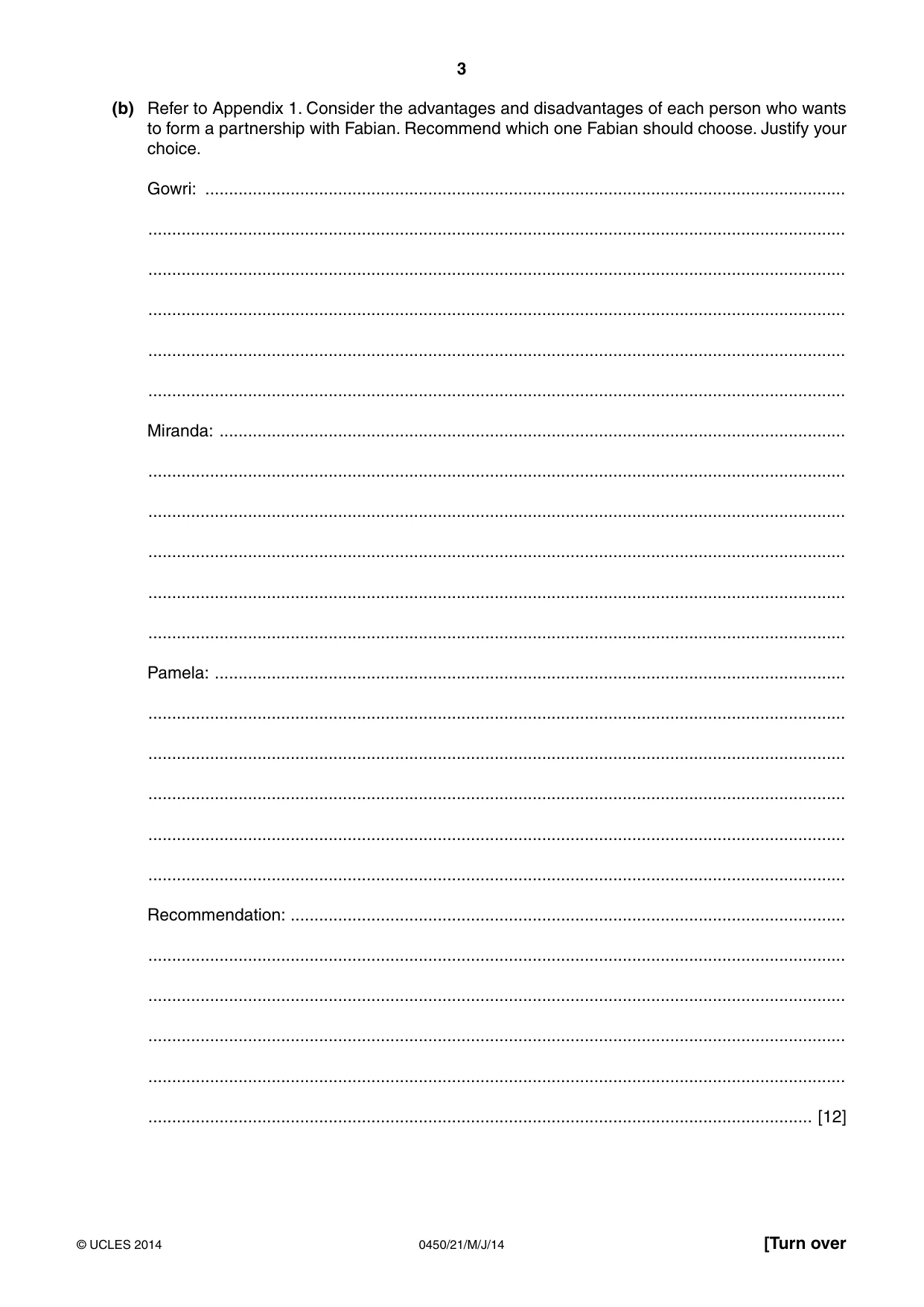
Question paper, page 3
3 0450/21/M/J/14 © UCLES 2014 [Turn over (b) Refer to Appendix 1. Consider the advantages and disadvantages of each person who wants to form a partnership with Fabian. Recommend which one Fabian should choose. Justify your choice. Gowri: … … … … … … Miranda: … … … … … … Pamela: … … … … … … Recommendation: … … … … … … [12]
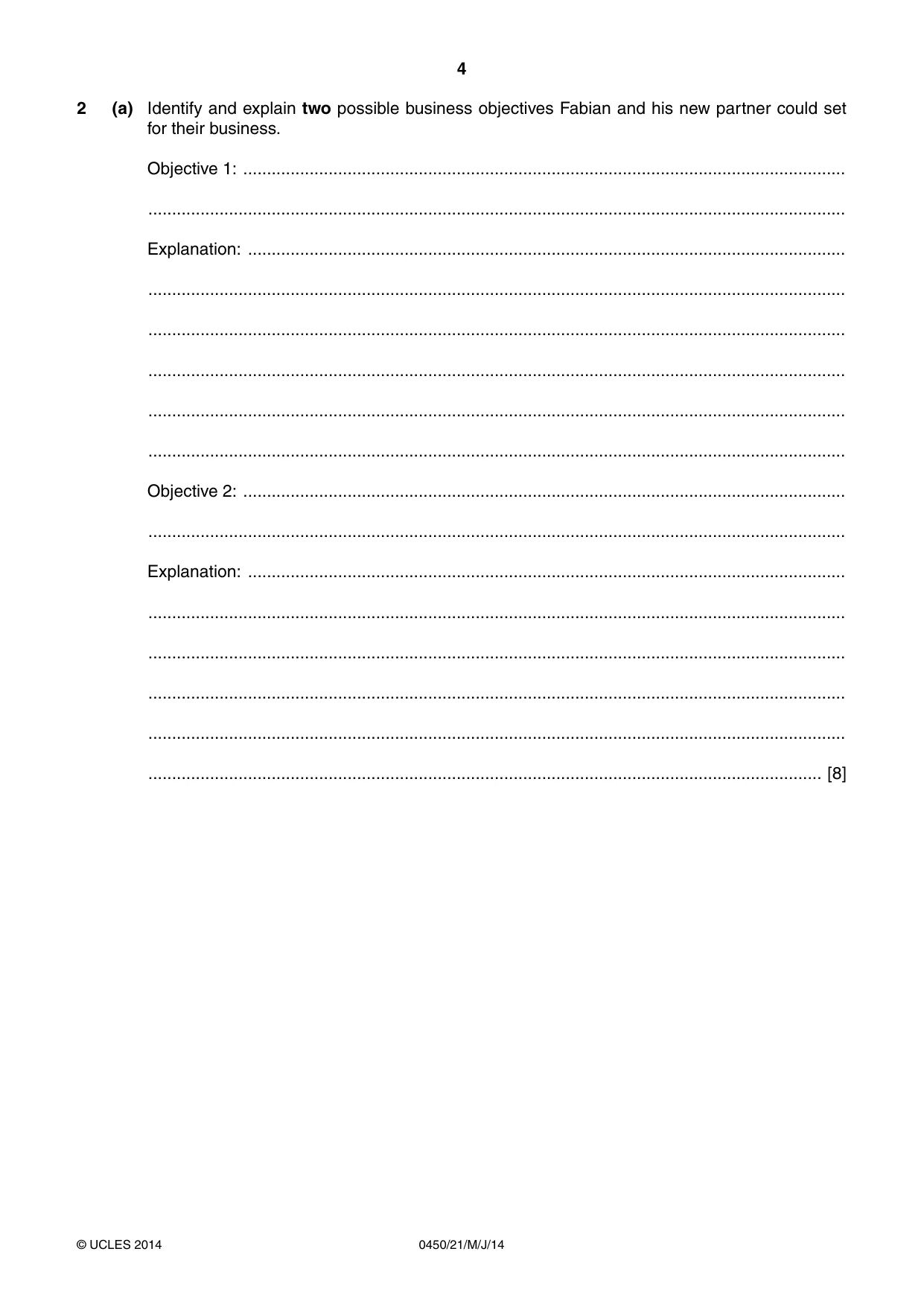
Question paper, page 4
4 0450/21/M/J/14 © UCLES 2014 2 (a) Identify and explain two possible business objectives Fabian and his new partner could set for their business. Objective 1: … … Explanation: … … … … … … Objective 2: … … Explanation: … … … … … … [8]
Question paper, page 5
5 0450/21/M/J/14 © UCLES 2014 [Turn over (b) Consider the advantages and disadvantages of Option A and Option B. Recommend which is the best option for Fabian to choose. Justify your answer using profitability ratios. Option A: … … … … … … … … Option B: … … … … … … … … Recommendation: … … … … … … … … [12]
Question paper, page 6
6 0450/21/M/J/14 © UCLES 2014 3 (a) Refer to Appendix 2. Identify and explain four factors Fabian should consider when deciding which sources of finance to use for his new business. Factor 1: … … Explanation: … … Factor 2: … … Explanation: … … Factor 3: … … Explanation: … … Factor 4: … … Explanation: … … [8]
Question paper, page 7
7 0450/21/M/J/14 © UCLES 2014 [Turn over (b) Explain to Fabian why each of the following documents will be important to managing his new business. Choose which is likely to be the most useful. Justify your choice. Profit/Loss account: … … … … … … Cash flow forecast: … … … … … … Break-even chart: … … … … … … Conclusion: … … … … … … [12]
Question paper, page 8
8 0450/21/M/J/14 © UCLES 2014 4 (a) Fabian will use job production when completing each order for flowers. Identify and explain two benefits of using job production for Fabian Flowers. Benefit 1: … … Explanation: … … … … … … Benefit 2: … … Explanation: … … … … … … [8]
Question paper, page 9
9 0450/21/M/J/14 © UCLES 2014 [Turn over (b) Assume Fabian chooses Option B (retail customers). He must decide on a pricing strategy to use. Consider the advantages and disadvantages of the following three pricing strategies. Recommend which one he should choose. Justify your answer. Cost-plus pricing: … … … … … … Competitive pricing: … … … … … … Penetration pricing: … … … … … … Recommendation: … … … … … … [12]
Question paper, page 10
10 0450/21/M/J/14 © UCLES 2014 5 (a) Identify and explain one advantage and one disadvantage to Fabian Flowers of having a website for the shop. Advantage: … … Explanation: … … … … … … Disadvantage: … … Explanation: … … … … … … [8]
Question paper, page 11
11 0450/21/M/J/14 © UCLES 2014 (b) Fabian needs to decide where to buy supplies of flowers for the shop. Consider the advantages and disadvantages of each of the three alternative sources of supply outlined in Appendix 3. Recommend which supplier Fabian should choose to buy his flowers from. Justify your answer. Import flowers from country X: … … … … … … Purchase flowers from a flower wholesaler: … … … … … … Buy from local flower growers: … … … … … … Recommendation: … … … … … … [12]
Question paper, page 12
12 0450/21/M/J/14 © UCLES 2014 Permission to reproduce items where third-party owned material protected by copyright is included has been sought and cleared where possible. Every reasonable effort has been made by the publisher (UCLES) to trace copyright holders, but if any items requiring clearance have unwittingly been included, the publisher will be pleased to make amends at the earliest possible opportunity. Cambridge International Examinations is part of the Cambridge Assessment Group. Cambridge Assessment is the brand name of University of Cambridge Local Examinations Syndicate (UCLES), which is itself a department of the University of Cambridge. BLANK PAGE
Mark scheme, page 1
CAMBRIDGE INTERNATIONAL EXAMINATIONS International General Certificate of Secondary Education MARK SCHEME for the May/June 2014 series 0450 BUSINESS STUDIES 0450/21 Paper 2 (Case Study), maximum raw mark 100 This mark scheme is published as an aid to teachers and candidates, to indicate the requirements of the examination. It shows the basis on which Examiners were instructed to award marks. It does not indicate the details of the discussions that took place at an Examiners’ meeting before marking began, which would have considered the acceptability of alternative answers. Mark schemes should be read in conjunction with the question paper and the Principal Examiner Report for Teachers. Cambridge will not enter into discussions about these mark schemes. Cambridge is publishing the mark schemes for the May/June 2014 series for most IGCSE, GCE Advanced Level and Advanced Subsidiary Level components and some Ordinary Level components.
Mark scheme, page 2
Page 2 Mark Scheme Syllabus Paper IGCSE – May/June 2014 0450 21 © Cambridge International Examinations 2014 General Marking Guidance • Marking should be positive: marks should not be subtracted for errors or inaccuracies. • When examiners are in doubt regarding the application of the mark scheme to a candidate’s response, the team leader must be consulted. • Crossed out work should be marked UNLESS the candidate has replaced it with an alternative response. • Errors that are carried forward (e.g. when an incorrect numerical answer to one part of a question is used as the starting point for a calculation in the next part of the question) should not be compounded - use the ‘own figure rule’. • Poor spelling, handwriting or grammar should not be penalised as long as the answer makes sense. • Answers that are not written on the answer lines should be marked. • Scoris annotations to be used for part (b) questions are – ‘L1’, ‘L2’ and ‘L3’ should be used to indicate the level being awarded to a response. ‘App' should be used to indicate where the application marks are being awarded. Annotations for part (a) questions should be green ticks to indicate where credit is being given and ‘App’ to indicate application marks. • A blank space, dash, question mark and a response that bears no relation to the question constitutes a ‘no response’. This mark scheme includes a summary of appropriate content for answering each question. It should be emphasised, however, that this material is for illustrative purposes and is not intended to provide a definitive guide to acceptable answers. It is quite possible that among the scripts there will be some candidate answers that are not covered directly by the content of this mark scheme. In such cases, professional judgement should be exercised in assessing the merits of the answer and the senior examiners should be consulted if further guidance is required. Examples of possible answers are also included in this mark scheme. Again, it should be emphasised that this is for illustrative purposes and the examples chosen represent only some of the many possible responses that would merit reward. Application marks are not awarded for the name of the business or person from the case material. Application is by answering in the context of the case or by using the information in the case to help answer the question.
Mark scheme, page 3
Page 3 Mark Scheme Syllabus Paper IGCSE – May/June 2014 0450 21 © Cambridge International Examinations 2014 1 (a) Identify and explain two advantages and two disadvantages to Fabian of working for himself rather than being an employee of another business. [8] Content: Advantages: • Make own decisions • Choose own work hours • Keep any profits made • Taking more responsibility • More power • Less worried about being unemployed • High level of motivation Disadvantages: • Not a regular wage • May not be able to take holidays • No one to help him • Limited capital • More worry about business failure • More risk of losing personal possessions • No experience of management/flower business • More administration to carry out The marks available for this question are as follows: 4 marks for knowledge; 4 marks for application. 1 mark for each advantage/disadvantage identified plus 1 explanation mark for each advantage/disadvantage. (2 marks × 2 advantages + 2 marks × 2 disadvantages) Advantage: Can work the hours Fabian chooses (1 knowledge mark). Explanation: Can work the hours Fabian chooses as he works for himself and he could work early in the morning if he chooses and take time off later in the day (1 explanation mark).
Mark scheme, page 4
Page 4 Mark Scheme Syllabus Paper IGCSE – May/June 2014 0450 21 © Cambridge International Examinations 2014 (b) Refer to Appendix 1. Consider the advantages and disadvantages of each person who wants to form a partnership with Fabian. Recommend which one Fabian should choose. Justify your choice. [12] Content: Gowri – experience of running her own business/quite young/large amount of money to invest/young family/no experience in flower arranging. Miranda – experience of shop work/well qualified/no family commitments/little money to invest. Pamela – enthusiastic about learning the requirements for the job/has some skills in flower arranging/large amount of capital to invest/no family commitments/older person so more experience with people/no formal qualifications in flower arranging. Level 1 – 1 mark for each statement E.g. Miranda has experience of working in a shop and so she would know how to serve customers in the flower shop (1 mark). Level 2 – 5 marks for the first level 2 answer and then one extra mark for each additional level 2 answer up to maximum of 8 marks. E.g. Miranda has experience of working in a shop and so she would know how to serve customers in the flower shop. She could also have experience of how to run a shop but she would not know how to do the accounts or ordering of flowers and so she could not help Fabian with this. 5 marks for level 2 answer plus one application mark for mentioning ordering of flowers. Level 3 – Detailed discussion of at least two level 2 answers and then a conclusion at the end which justifies who is the best person to choose compared to the other people. Possible application marks: anything from Appendix 1; flowers; flower shop; part-time employees; hotels and restaurants; flower arrangements; new business. There may be other examples in context which have not been included here. Application Knowledge/Analysis/ Evaluation Level 3 9–10 marks At least 2 × Level 2 + Well justified recommendation as to the best person to choose compared to at least one other person. Level 2 2 marks Well applied to case. At least two examples of reference to, or use of, the case. 5–8 marks Good discussion of advantages/disadvantages of each person. OR balanced argument. Some limited judgement shown in recommendation about the best person to choose. Level 1 1 mark Limited application to the case. At least one example of reference to, or use of, case. 1–4 marks Outline of advantages/disadvantages of each person.
Mark scheme, page 5
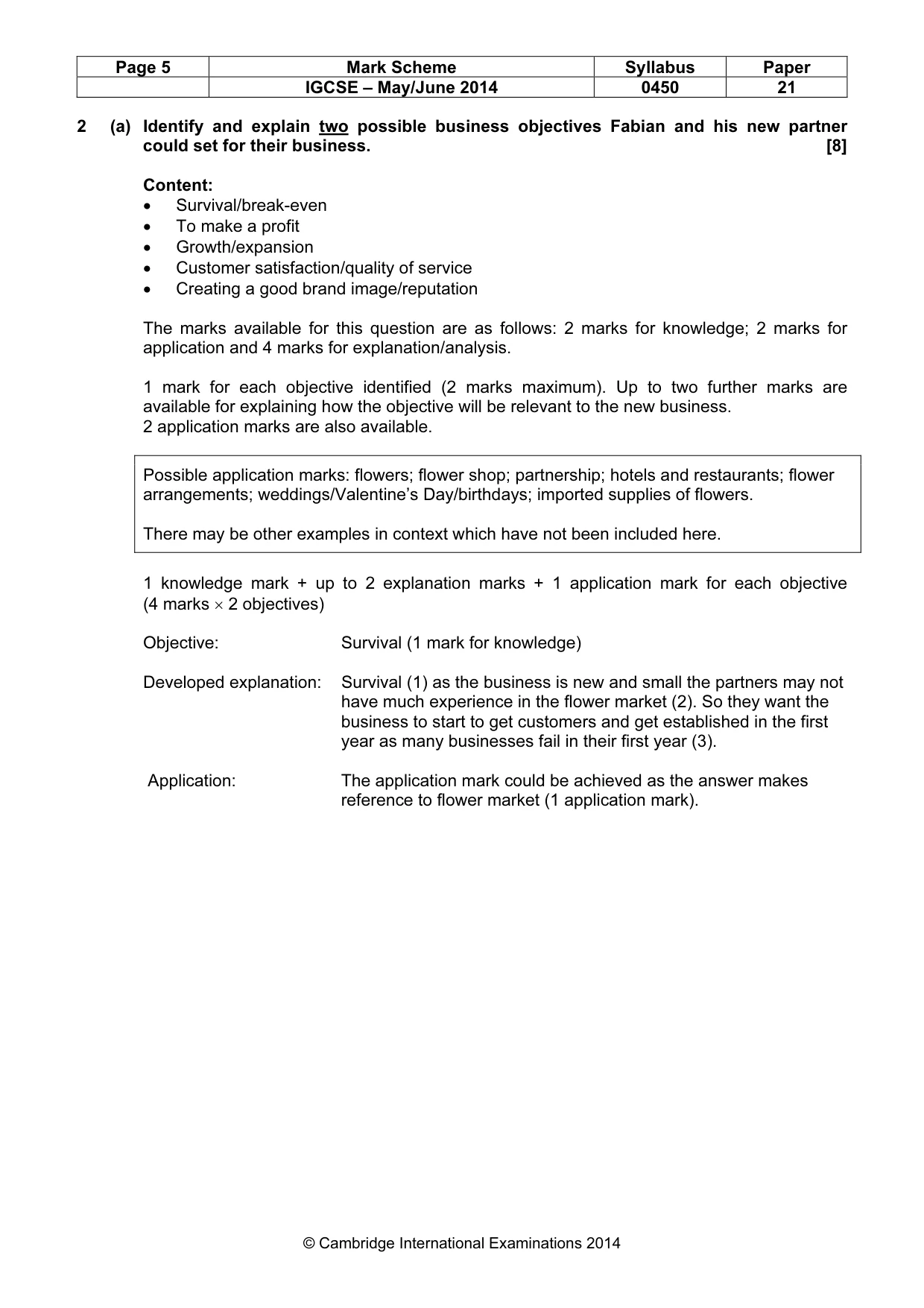
Page 5 Mark Scheme Syllabus Paper IGCSE – May/June 2014 0450 21 © Cambridge International Examinations 2014 2 (a) Identify and explain two possible business objectives Fabian and his new partner could set for their business. [8] Content: • Survival/break-even • To make a profit • Growth/expansion • Customer satisfaction/quality of service • Creating a good brand image/reputation The marks available for this question are as follows: 2 marks for knowledge; 2 marks for application and 4 marks for explanation/analysis. 1 mark for each objective identified (2 marks maximum). Up to two further marks are available for explaining how the objective will be relevant to the new business. 2 application marks are also available. Possible application marks: flowers; flower shop; partnership; hotels and restaurants; flower arrangements; weddings/Valentine’s Day/birthdays; imported supplies of flowers. There may be other examples in context which have not been included here. 1 knowledge mark + up to 2 explanation marks + 1 application mark for each objective (4 marks × 2 objectives) Objective: Survival (1 mark for knowledge) Developed explanation: Survival (1) as the business is new and small the partners may not have much experience in the flower market (2). So they want the business to start to get customers and get established in the first year as many businesses fail in their first year (3). Application: The application mark could be achieved as the answer makes reference to flower market (1 application mark).
Mark scheme, page 6
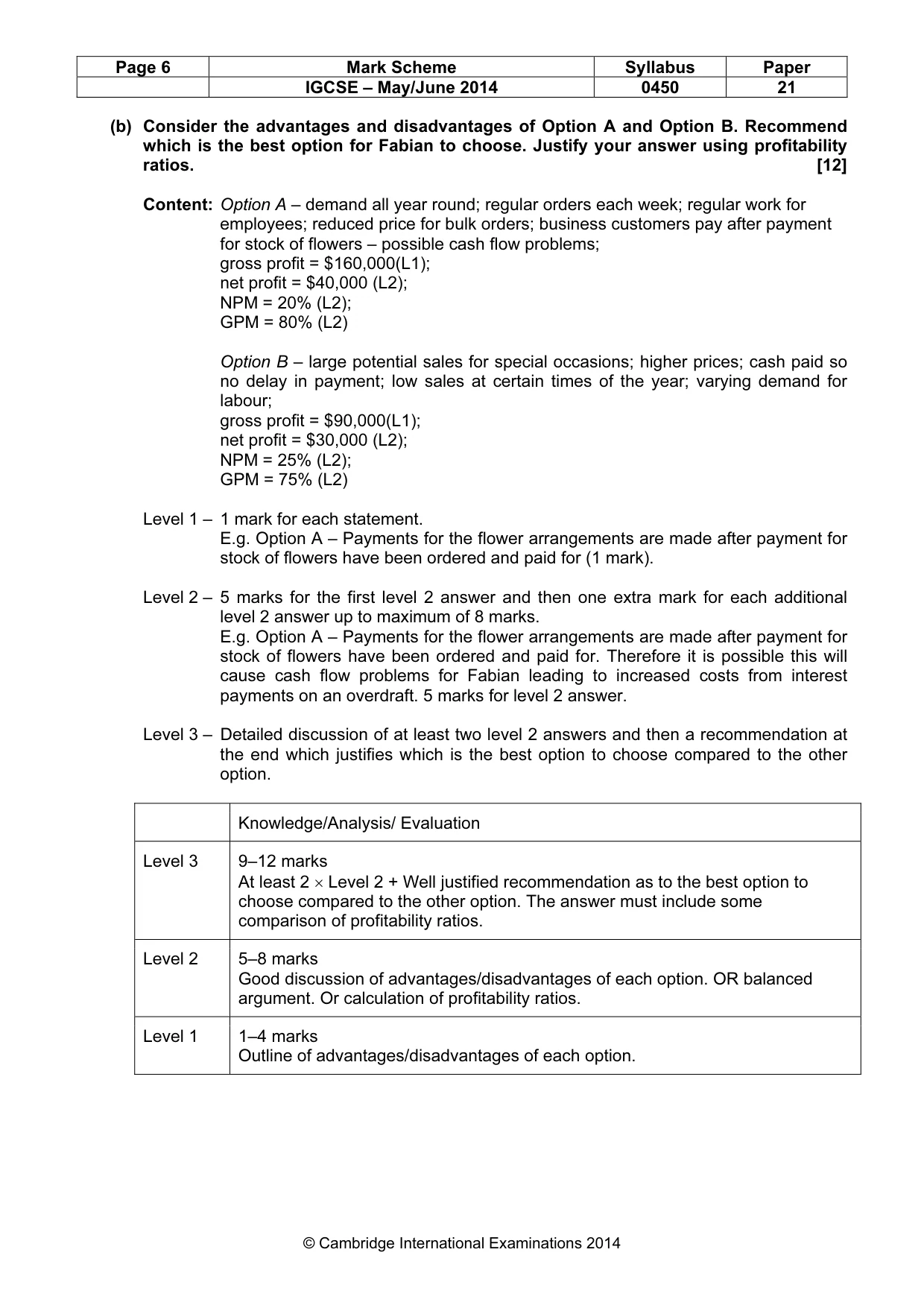
Page 6 Mark Scheme Syllabus Paper IGCSE – May/June 2014 0450 21 © Cambridge International Examinations 2014 (b) Consider the advantages and disadvantages of Option A and Option B. Recommend which is the best option for Fabian to choose. Justify your answer using profitability ratios. [12] Content: Option A – demand all year round; regular orders each week; regular work for employees; reduced price for bulk orders; business customers pay after payment for stock of flowers – possible cash flow problems; gross profit = $160,000(L1); net profit = $40,000 (L2); NPM = 20% (L2); GPM = 80% (L2) Option B – large potential sales for special occasions; higher prices; cash paid so no delay in payment; low sales at certain times of the year; varying demand for labour; gross profit = $90,000(L1); net profit = $30,000 (L2); NPM = 25% (L2); GPM = 75% (L2) Level 1 – 1 mark for each statement. E.g. Option A – Payments for the flower arrangements are made after payment for stock of flowers have been ordered and paid for (1 mark). Level 2 – 5 marks for the first level 2 answer and then one extra mark for each additional level 2 answer up to maximum of 8 marks. E.g. Option A – Payments for the flower arrangements are made after payment for stock of flowers have been ordered and paid for. Therefore it is possible this will cause cash flow problems for Fabian leading to increased costs from interest payments on an overdraft. 5 marks for level 2 answer. Level 3 – Detailed discussion of at least two level 2 answers and then a recommendation at the end which justifies which is the best option to choose compared to the other option. Knowledge/Analysis/ Evaluation Level 3 9–12 marks At least 2 × Level 2 + Well justified recommendation as to the best option to choose compared to the other option. The answer must include some comparison of profitability ratios. Level 2 5–8 marks Good discussion of advantages/disadvantages of each option. OR balanced argument. Or calculation of profitability ratios. Level 1 1–4 marks Outline of advantages/disadvantages of each option.
Mark scheme, page 7
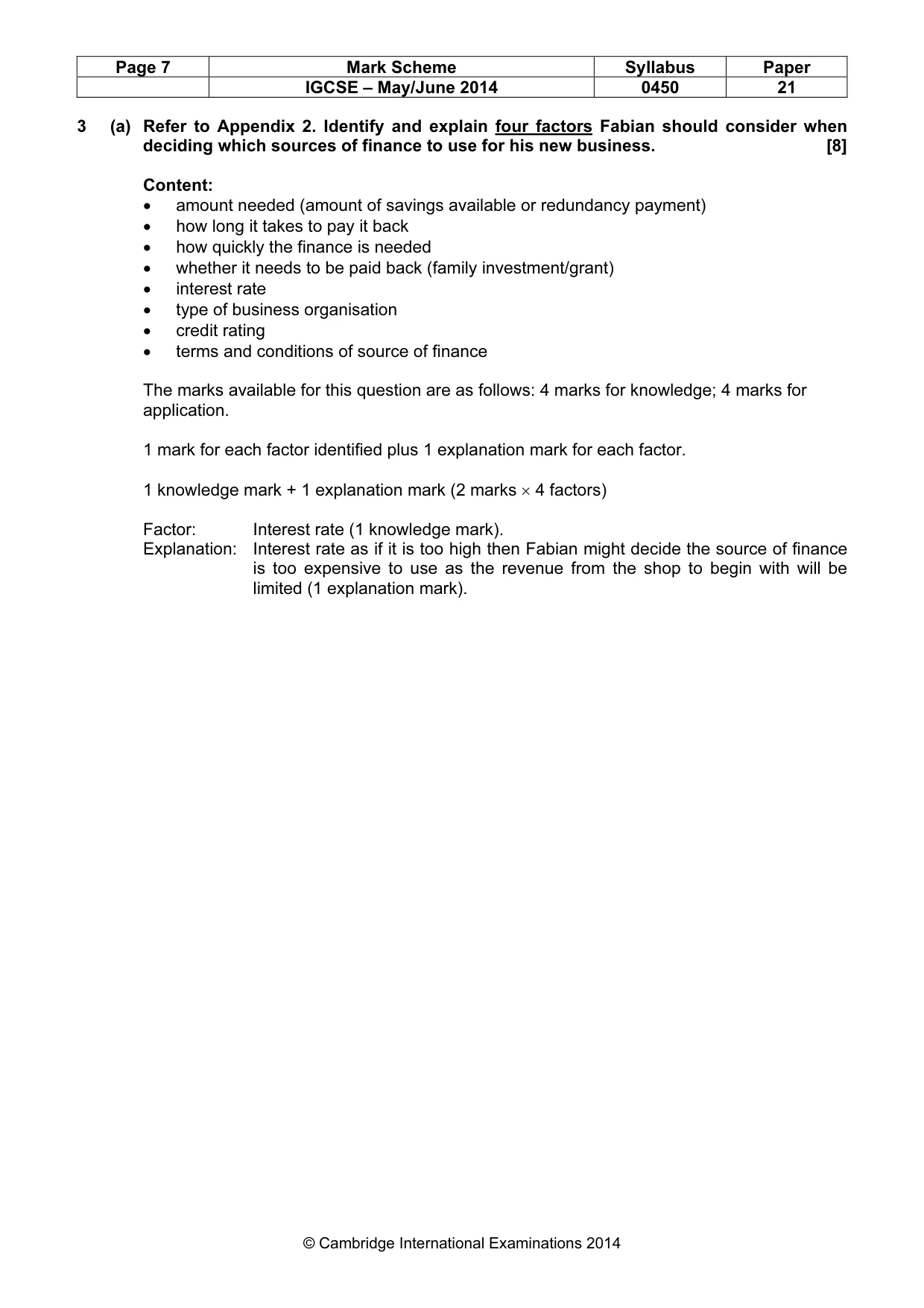
Page 7 Mark Scheme Syllabus Paper IGCSE – May/June 2014 0450 21 © Cambridge International Examinations 2014 3 (a) Refer to Appendix 2. Identify and explain four factors Fabian should consider when deciding which sources of finance to use for his new business. [8] Content: • amount needed (amount of savings available or redundancy payment) • how long it takes to pay it back • how quickly the finance is needed • whether it needs to be paid back (family investment/grant) • interest rate • type of business organisation • credit rating • terms and conditions of source of finance The marks available for this question are as follows: 4 marks for knowledge; 4 marks for application. 1 mark for each factor identified plus 1 explanation mark for each factor. 1 knowledge mark + 1 explanation mark (2 marks × 4 factors) Factor: Interest rate (1 knowledge mark). Explanation: Interest rate as if it is too high then Fabian might decide the source of finance is too expensive to use as the revenue from the shop to begin with will be limited (1 explanation mark).
Mark scheme, page 8
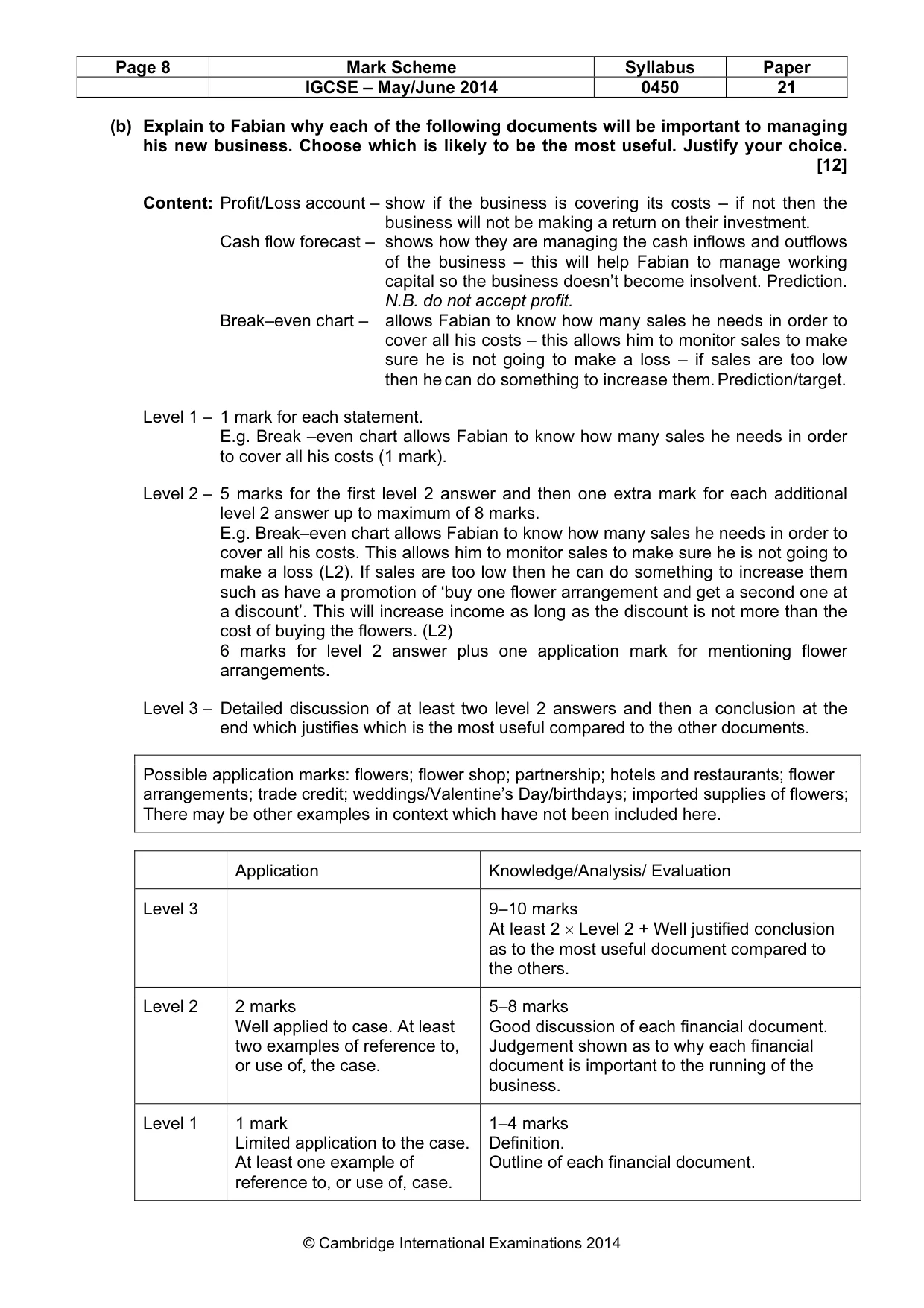
Page 8 Mark Scheme Syllabus Paper IGCSE – May/June 2014 0450 21 © Cambridge International Examinations 2014 (b) Explain to Fabian why each of the following documents will be important to managing his new business. Choose which is likely to be the most useful. Justify your choice. [12] Content: Profit/Loss account – show if the business is covering its costs – if not then the business will not be making a return on their investment. Cash flow forecast – shows how they are managing the cash inflows and outflows of the business – this will help Fabian to manage working capital so the business doesn’t become insolvent. Prediction. N.B. do not accept profit. Break–even chart – allows Fabian to know how many sales he needs in order to cover all his costs – this allows him to monitor sales to make sure he is not going to make a loss – if sales are too low then he can do something to increase them. Prediction/target. Level 1 – 1 mark for each statement. E.g. Break –even chart allows Fabian to know how many sales he needs in order to cover all his costs (1 mark). Level 2 – 5 marks for the first level 2 answer and then one extra mark for each additional level 2 answer up to maximum of 8 marks. E.g. Break–even chart allows Fabian to know how many sales he needs in order to cover all his costs. This allows him to monitor sales to make sure he is not going to make a loss (L2). If sales are too low then he can do something to increase them such as have a promotion of ‘buy one flower arrangement and get a second one at a discount’. This will increase income as long as the discount is not more than the cost of buying the flowers. (L2) 6 marks for level 2 answer plus one application mark for mentioning flower arrangements. Level 3 – Detailed discussion of at least two level 2 answers and then a conclusion at the end which justifies which is the most useful compared to the other documents. Possible application marks: flowers; flower shop; partnership; hotels and restaurants; flower arrangements; trade credit; weddings/Valentine’s Day/birthdays; imported supplies of flowers; There may be other examples in context which have not been included here. Application Knowledge/Analysis/ Evaluation Level 3 9–10 marks At least 2 × Level 2 + Well justified conclusion as to the most useful document compared to the others. Level 2 2 marks Well applied to case. At least two examples of reference to, or use of, the case. 5–8 marks Good discussion of each financial document. Judgement shown as to why each financial document is important to the running of the business. Level 1 1 mark Limited application to the case. At least one example of reference to, or use of, case. 1–4 marks Definition. Outline of each financial document.
Mark scheme, page 9
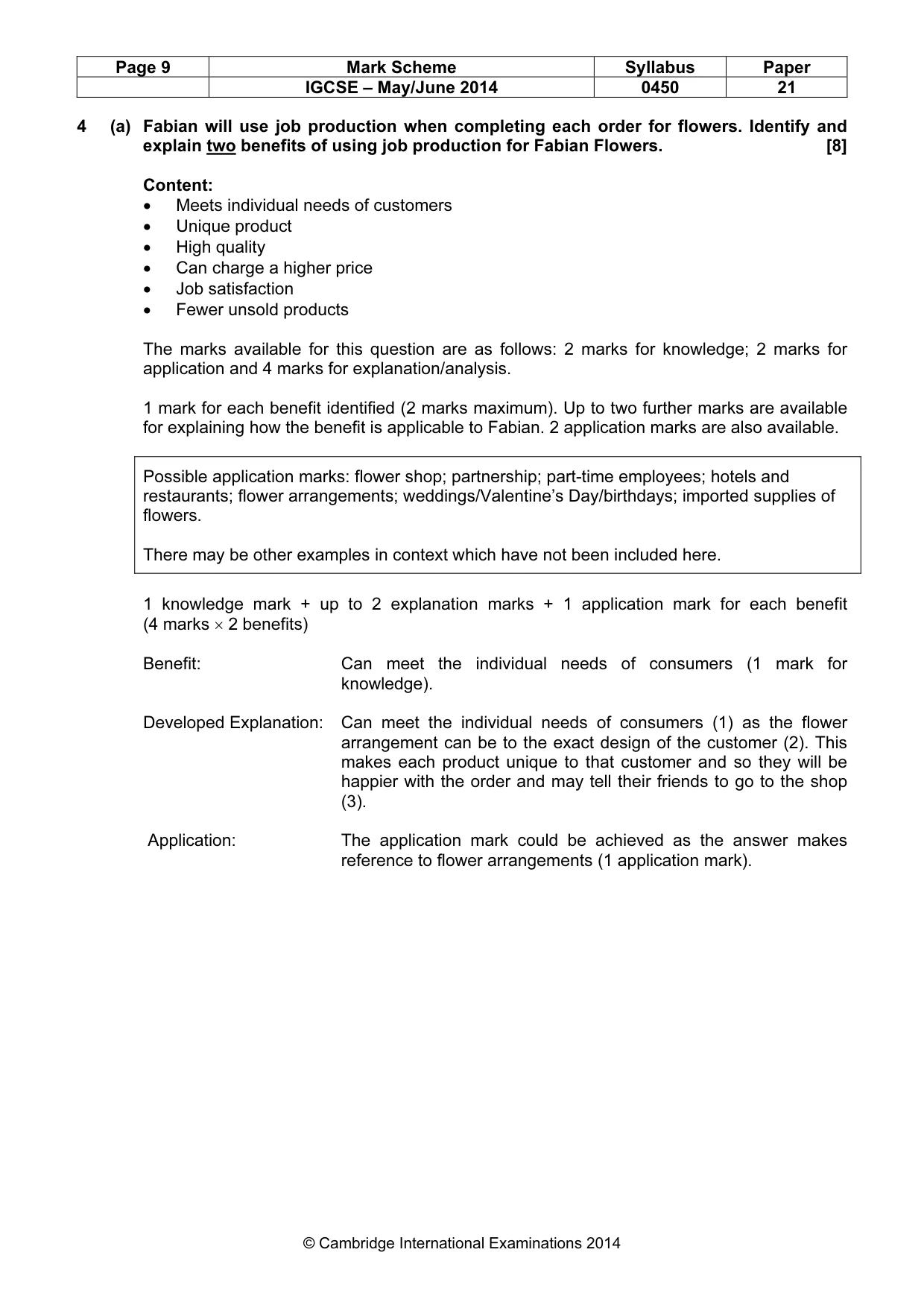
Page 9 Mark Scheme Syllabus Paper IGCSE – May/June 2014 0450 21 © Cambridge International Examinations 2014 4 (a) Fabian will use job production when completing each order for flowers. Identify and explain two benefits of using job production for Fabian Flowers. [8] Content: • Meets individual needs of customers • Unique product • High quality • Can charge a higher price • Job satisfaction • Fewer unsold products The marks available for this question are as follows: 2 marks for knowledge; 2 marks for application and 4 marks for explanation/analysis. 1 mark for each benefit identified (2 marks maximum). Up to two further marks are available for explaining how the benefit is applicable to Fabian. 2 application marks are also available. Possible application marks: flower shop; partnership; part-time employees; hotels and restaurants; flower arrangements; weddings/Valentine’s Day/birthdays; imported supplies of flowers. There may be other examples in context which have not been included here. 1 knowledge mark + up to 2 explanation marks + 1 application mark for each benefit (4 marks × 2 benefits) Benefit: Can meet the individual needs of consumers (1 mark for knowledge). Developed Explanation: Can meet the individual needs of consumers (1) as the flower arrangement can be to the exact design of the customer (2). This makes each product unique to that customer and so they will be happier with the order and may tell their friends to go to the shop (3). Application: The application mark could be achieved as the answer makes reference to flower arrangements (1 application mark).
Mark scheme, page 10
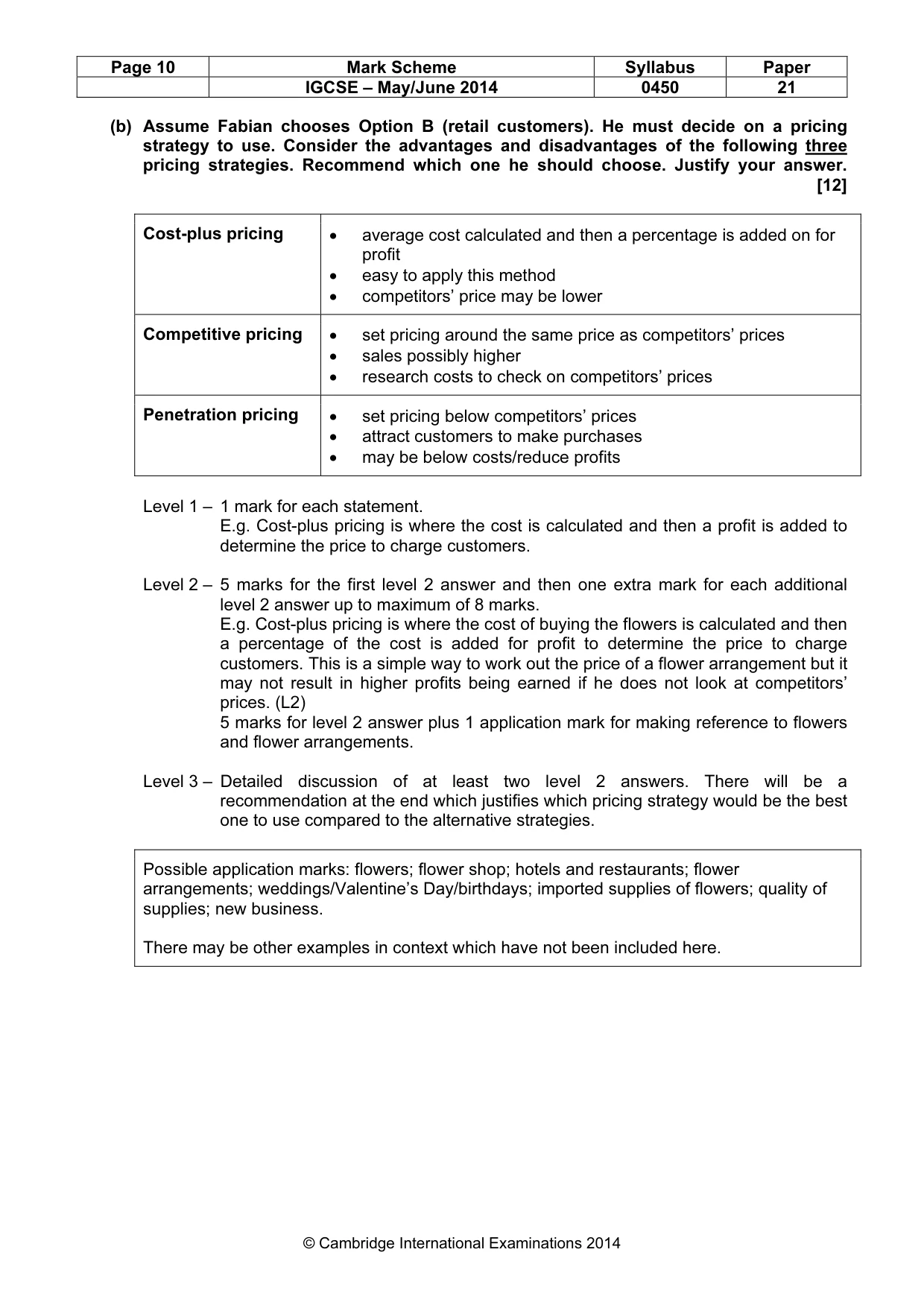
Page 10 Mark Scheme Syllabus Paper IGCSE – May/June 2014 0450 21 © Cambridge International Examinations 2014 (b) Assume Fabian chooses Option B (retail customers). He must decide on a pricing strategy to use. Consider the advantages and disadvantages of the following three pricing strategies. Recommend which one he should choose. Justify your answer. [12] Cost-plus pricing • average cost calculated and then a percentage is added on for profit • easy to apply this method • competitors’ price may be lower Competitive pricing • set pricing around the same price as competitors’ prices • sales possibly higher • research costs to check on competitors’ prices Penetration pricing • set pricing below competitors’ prices • attract customers to make purchases • may be below costs/reduce profits Level 1 – 1 mark for each statement. E.g. Cost-plus pricing is where the cost is calculated and then a profit is added to determine the price to charge customers. Level 2 – 5 marks for the first level 2 answer and then one extra mark for each additional level 2 answer up to maximum of 8 marks. E.g. Cost-plus pricing is where the cost of buying the flowers is calculated and then a percentage of the cost is added for profit to determine the price to charge customers. This is a simple way to work out the price of a flower arrangement but it may not result in higher profits being earned if he does not look at competitors’ prices. (L2) 5 marks for level 2 answer plus 1 application mark for making reference to flowers and flower arrangements. Level 3 – Detailed discussion of at least two level 2 answers. There will be a recommendation at the end which justifies which pricing strategy would be the best one to use compared to the alternative strategies. Possible application marks: flowers; flower shop; hotels and restaurants; flower arrangements; weddings/Valentine’s Day/birthdays; imported supplies of flowers; quality of supplies; new business. There may be other examples in context which have not been included here.
Mark scheme, page 11
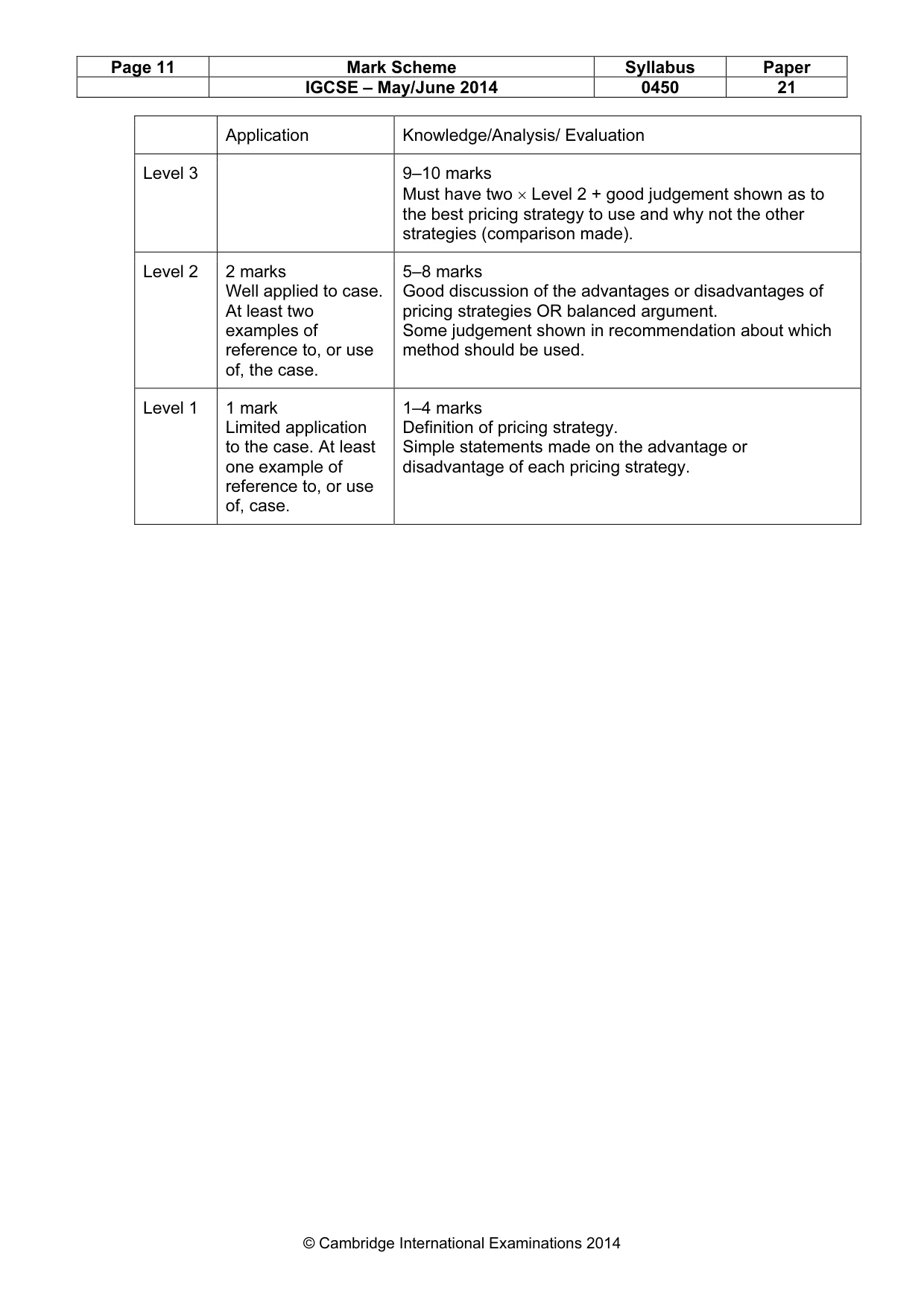
Page 11 Mark Scheme Syllabus Paper IGCSE – May/June 2014 0450 21 © Cambridge International Examinations 2014 Application Knowledge/Analysis/ Evaluation Level 3 9–10 marks Must have two × Level 2 + good judgement shown as to the best pricing strategy to use and why not the other strategies (comparison made). Level 2 2 marks Well applied to case. At least two examples of reference to, or use of, the case. 5–8 marks Good discussion of the advantages or disadvantages of pricing strategies OR balanced argument. Some judgement shown in recommendation about which method should be used. Level 1 1 mark Limited application to the case. At least one example of reference to, or use of, case. 1–4 marks Definition of pricing strategy. Simple statements made on the advantage or disadvantage of each pricing strategy.
Mark scheme, page 12
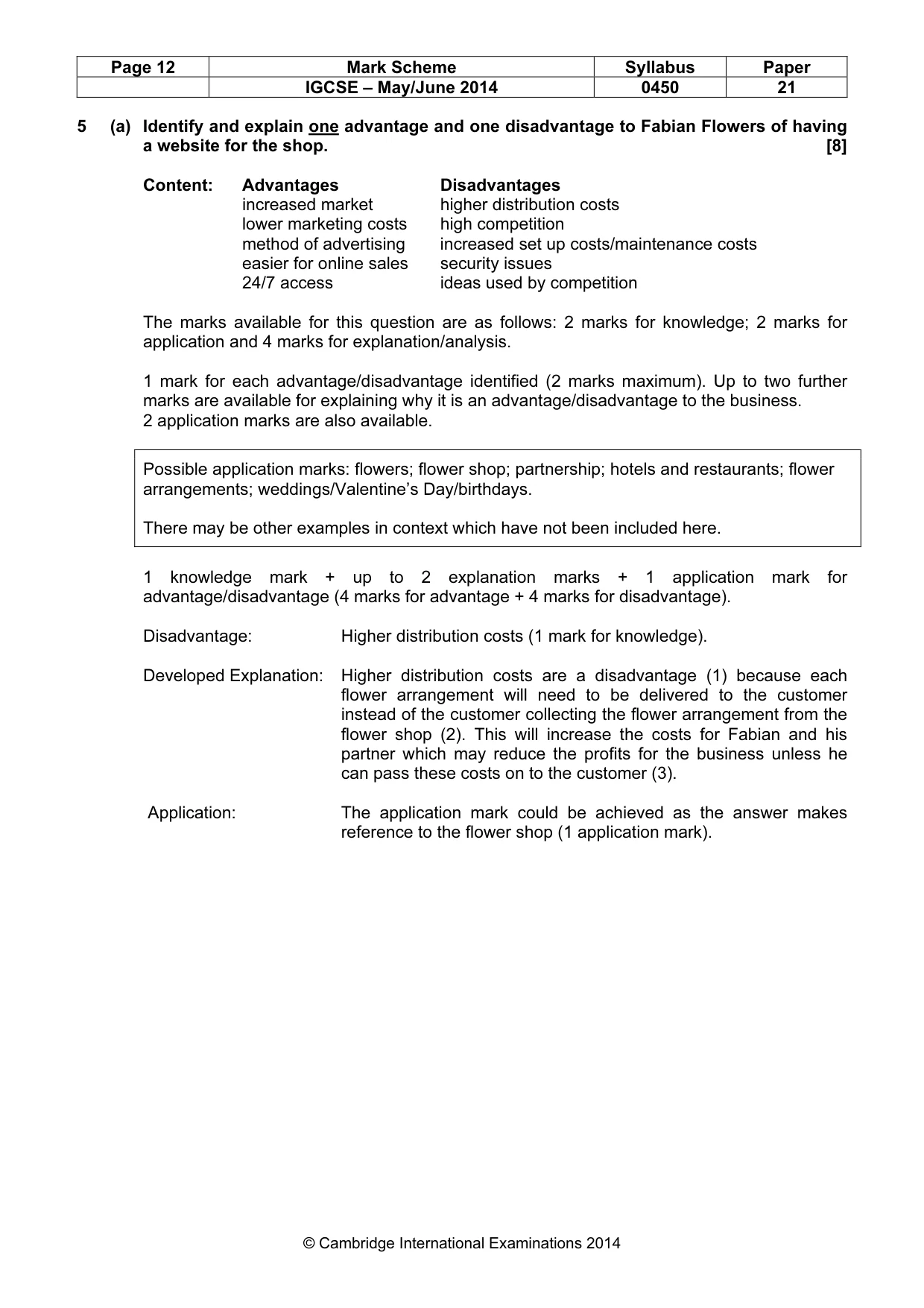
Page 12 Mark Scheme Syllabus Paper IGCSE – May/June 2014 0450 21 © Cambridge International Examinations 2014 5 (a) Identify and explain one advantage and one disadvantage to Fabian Flowers of having a website for the shop. [8] Content: Advantages Disadvantages increased market higher distribution costs lower marketing costs high competition method of advertising increased set up costs/maintenance costs easier for online sales security issues 24/7 access ideas used by competition The marks available for this question are as follows: 2 marks for knowledge; 2 marks for application and 4 marks for explanation/analysis. 1 mark for each advantage/disadvantage identified (2 marks maximum). Up to two further marks are available for explaining why it is an advantage/disadvantage to the business. 2 application marks are also available. Possible application marks: flowers; flower shop; partnership; hotels and restaurants; flower arrangements; weddings/Valentine’s Day/birthdays. There may be other examples in context which have not been included here. 1 knowledge mark + up to 2 explanation marks + 1 application mark for advantage/disadvantage (4 marks for advantage + 4 marks for disadvantage). Disadvantage: Higher distribution costs (1 mark for knowledge). Developed Explanation: Higher distribution costs are a disadvantage (1) because each flower arrangement will need to be delivered to the customer instead of the customer collecting the flower arrangement from the flower shop (2). This will increase the costs for Fabian and his partner which may reduce the profits for the business unless he can pass these costs on to the customer (3). Application: The application mark could be achieved as the answer makes reference to the flower shop (1 application mark).
Mark scheme, page 13
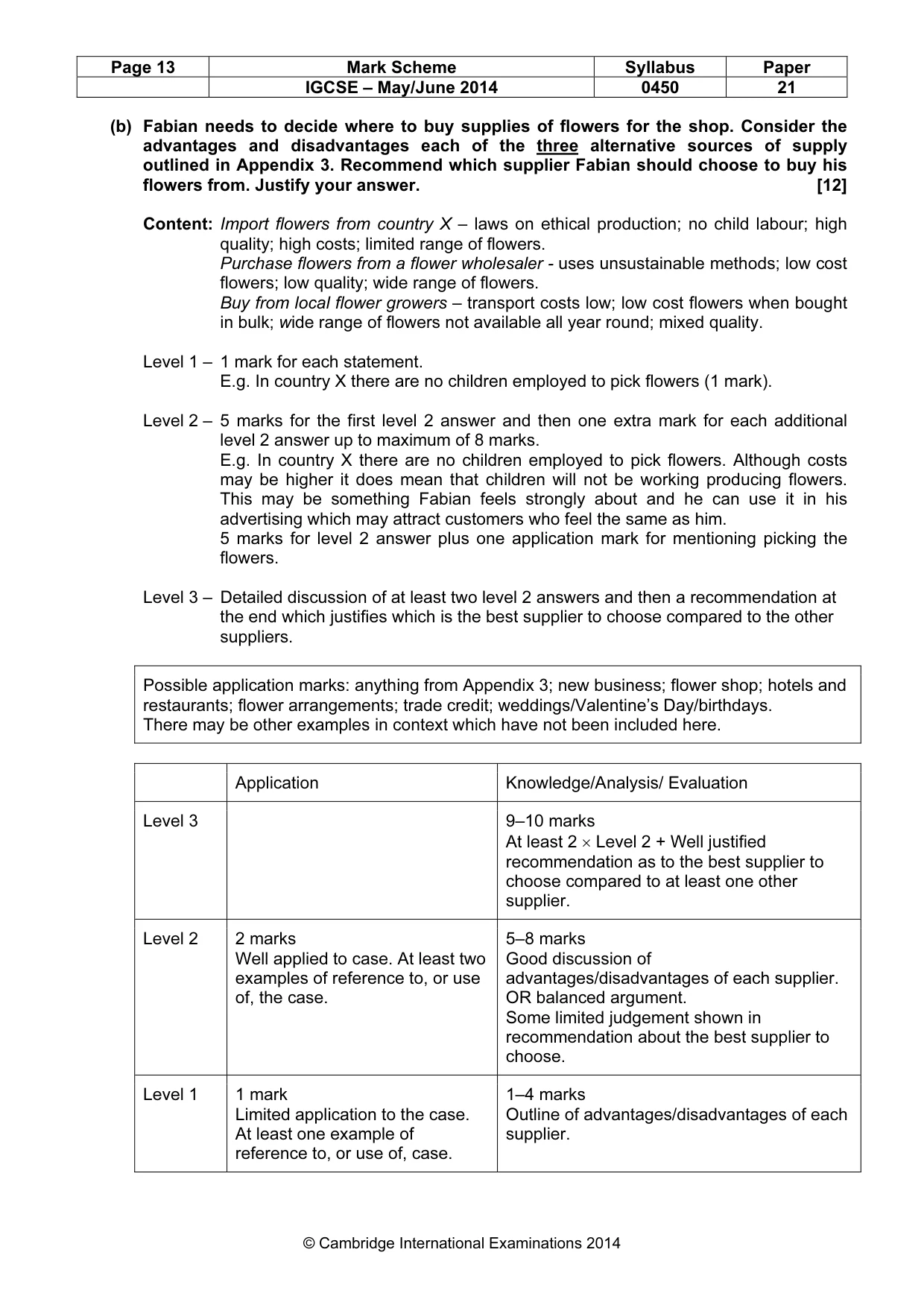
Page 13 Mark Scheme Syllabus Paper IGCSE – May/June 2014 0450 21 © Cambridge International Examinations 2014 (b) Fabian needs to decide where to buy supplies of flowers for the shop. Consider the advantages and disadvantages each of the three alternative sources of supply outlined in Appendix 3. Recommend which supplier Fabian should choose to buy his flowers from. Justify your answer. [12] Content: Import flowers from country X – laws on ethical production; no child labour; high quality; high costs; limited range of flowers. Purchase flowers from a flower wholesaler - uses unsustainable methods; low cost flowers; low quality; wide range of flowers. Buy from local flower growers – transport costs low; low cost flowers when bought in bulk; wide range of flowers not available all year round; mixed quality. Level 1 – 1 mark for each statement. E.g. In country X there are no children employed to pick flowers (1 mark). Level 2 – 5 marks for the first level 2 answer and then one extra mark for each additional level 2 answer up to maximum of 8 marks. E.g. In country X there are no children employed to pick flowers. Although costs may be higher it does mean that children will not be working producing flowers. This may be something Fabian feels strongly about and he can use it in his advertising which may attract customers who feel the same as him. 5 marks for level 2 answer plus one application mark for mentioning picking the flowers. Level 3 – Detailed discussion of at least two level 2 answers and then a recommendation at the end which justifies which is the best supplier to choose compared to the other suppliers. Possible application marks: anything from Appendix 3; new business; flower shop; hotels and restaurants; flower arrangements; trade credit; weddings/Valentine’s Day/birthdays. There may be other examples in context which have not been included here. Application Knowledge/Analysis/ Evaluation Level 3 9–10 marks At least 2 × Level 2 + Well justified recommendation as to the best supplier to choose compared to at least one other supplier. Level 2 2 marks Well applied to case. At least two examples of reference to, or use of, the case. 5–8 marks Good discussion of advantages/disadvantages of each supplier. OR balanced argument. Some limited judgement shown in recommendation about the best supplier to choose. Level 1 1 mark Limited application to the case. At least one example of reference to, or use of, case. 1–4 marks Outline of advantages/disadvantages of each supplier.
What you needed in this session
Cambridge’s own grade thresholds for 2014 May/June, Paper 2 · Variant 1. A higher threshold means an easier paper — the bar moves with how the cohort did.