Cambridge IGCSE Business Studies 0450 — 2013 May/June Paper 2 · Variant 3
0450/23/M/J/13 · 100 marks · ≈113 min
The question paper and its mark scheme, free to read here and free to download. This is Cambridge’s own paper, exactly as it was sat.
Question paper12 pages

Mark scheme11 pages
Answers below. Sit the paper first if you are practising.
Paper as text
Question paper, page 1
This document consists of 11 printed pages, 1 blank page and 1 Insert. DC (SJF) 63103/2 © UCLES 2013 [Turn over UNIVERSITY OF CAMBRIDGE INTERNATIONAL EXAMINATIONS International General Certificate of Secondary Education * 9 6 6 2 3 7 3 3 4 5 * BUSINESS STUDIES 0450/23 Paper 2 May/June 2013 1 hour 45 minutes Candidates answer on the Question Paper. No Additional Materials are required. READ THESE INSTRUCTIONS FIRST Write your Centre number, candidate number and name on all the work you hand in. Write in dark blue or black pen. Do not use staples, paper clips, highlighters, glue or correction fluid. DO NOT WRITE IN ANY BARCODES. Answer all questions. The Insert contains the case study. The business described in this question paper is entirely fictitious. At the end of the examination, fasten all your work securely together. The number of marks is given in brackets [ ] at the end of each question or part question.
Question paper, page 2
2 0450/23/M/J/13 © UCLES 2013 For Examiner’s Use 1 (a) Country X has a mixed economy. Identify and explain four ways the Government can affect a business in this type of economy. Way 1: … Explanation: … … … Way 2: … Explanation: … … … Way 3: … Explanation: … … … Way 4: … Explanation: … … …[8]
Question paper, page 3
3 0450/23/M/J/13 © UCLES 2013 [Turn over For Examiner’s Use (b) Consider three ways Pete could increase sales revenue. Which way would you recommend? Justify your answer. Way 1: … … … … … … Way 2: … … … … … … Way 3: … … … … … … Recommendation: … … … … … …[12]
Question paper, page 4
4 0450/23/M/J/13 © UCLES 2013 For Examiner’s Use 2 (a) PP plans to open a factory in country Z. Identify and explain four problems it might have when locating a factory in another country, such as country Z. Problem 1: … Explanation: … … … Problem 2: … Explanation: … … … Problem 3: … Explanation: … … … Problem 4: … Explanation: … … …[8]
Question paper, page 5
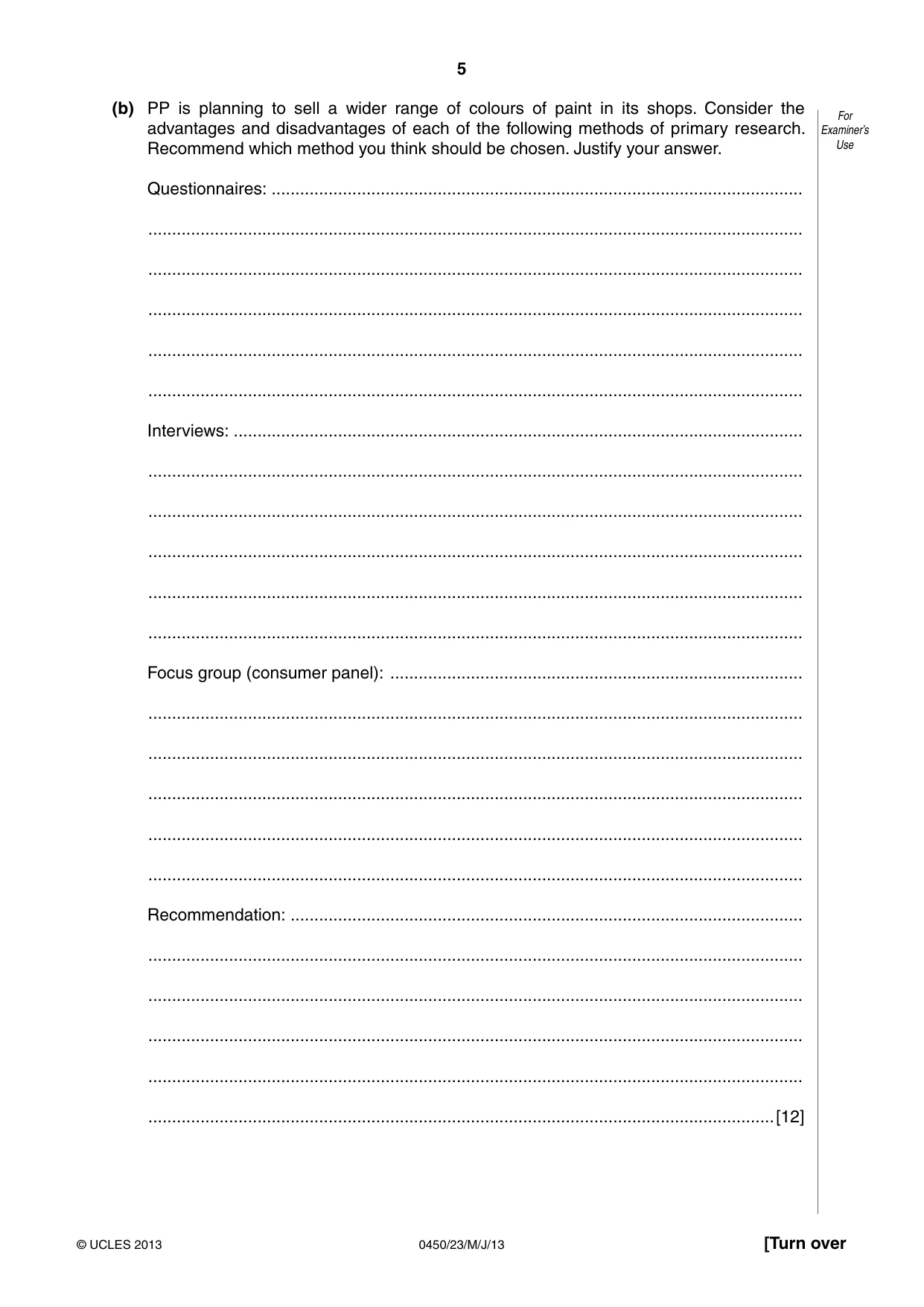
5 0450/23/M/J/13 © UCLES 2013 [Turn over For Examiner’s Use (b) PP is planning to sell a wider range of colours of paint in its shops. Consider the advantages and disadvantages of each of the following methods of primary research. Recommend which method you think should be chosen. Justify your answer. Questionnaires: … … … … … … Interviews: … … … … … … Focus group (consumer panel): … … … … … … Recommendation: … … … … … …[12]
Question paper, page 6
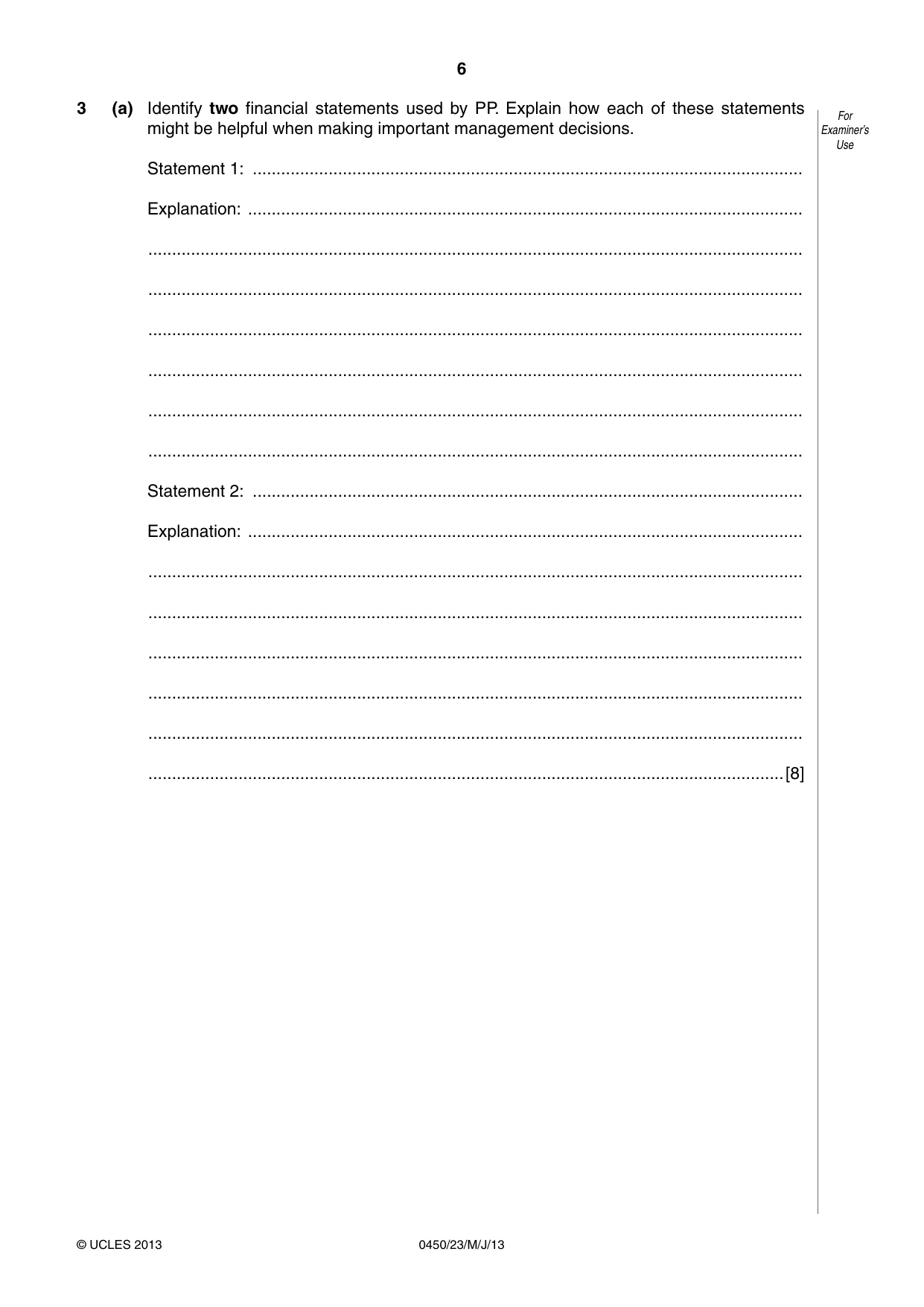
6 0450/23/M/J/13 © UCLES 2013 For Examiner’s Use 3 (a) Identify two financial statements used by PP. Explain how each of these statements might be helpful when making important management decisions. Statement 1: … Explanation: … … … … … … … Statement 2: … Explanation: … … … … … … …[8]
Question paper, page 7
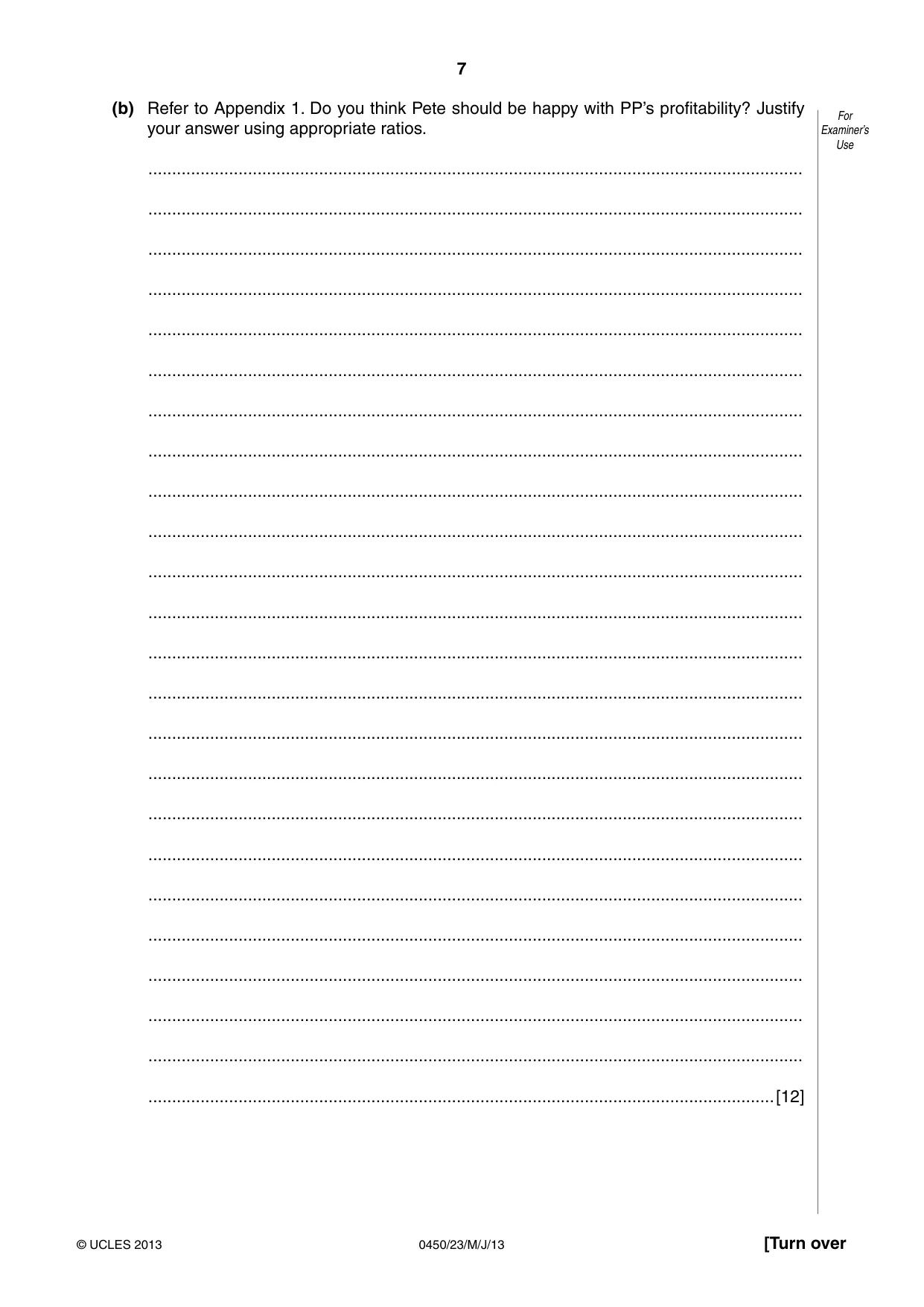
7 0450/23/M/J/13 © UCLES 2013 [Turn over For Examiner’s Use (b) Refer to Appendix 1. Do you think Pete should be happy with PP’s profitability? Justify your answer using appropriate ratios. … … … … … … … … … … … … … … … … … … … … … … … …[12]
Question paper, page 8
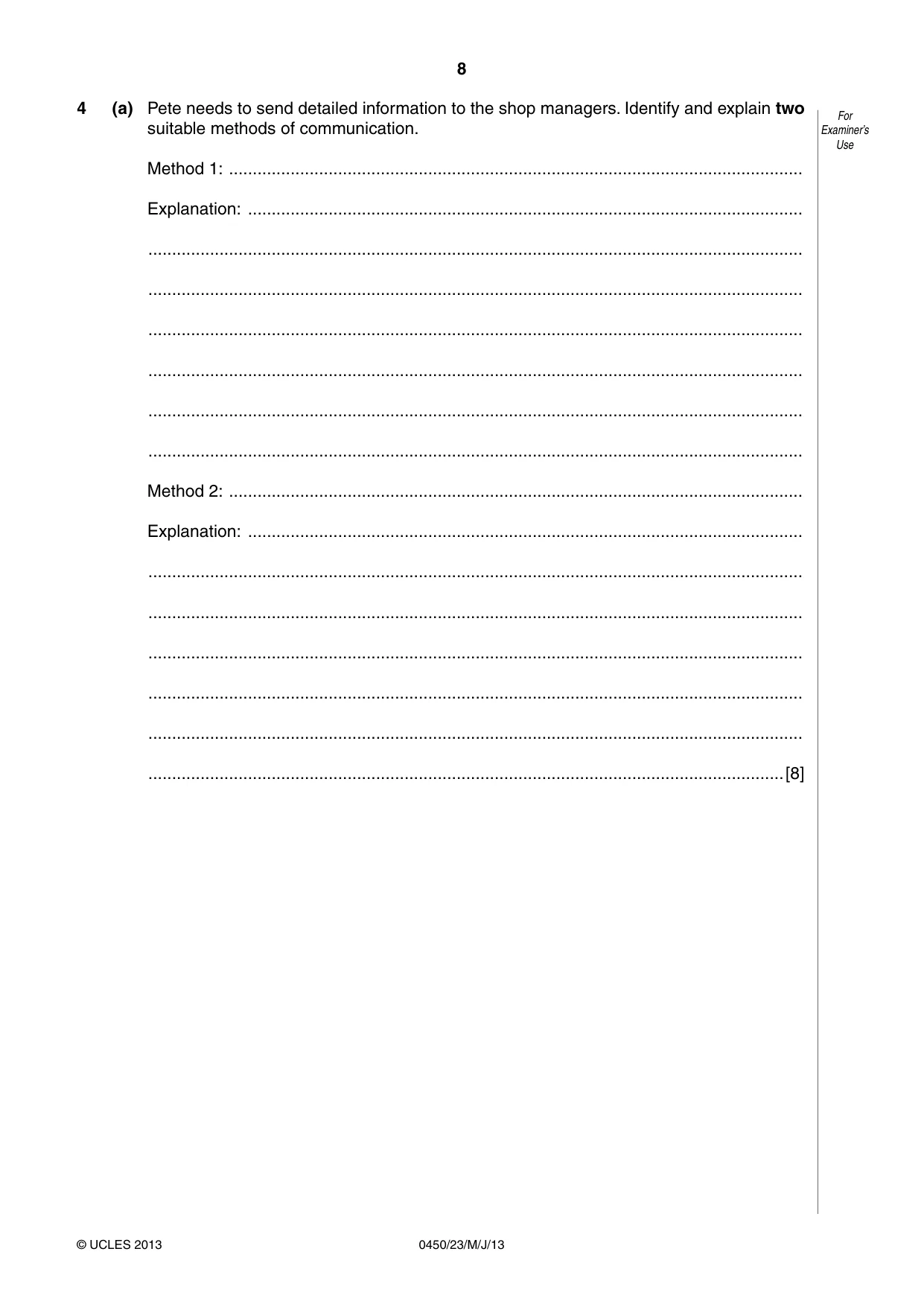
8 0450/23/M/J/13 © UCLES 2013 For Examiner’s Use 4 (a) Pete needs to send detailed information to the shop managers. Identify and explain two suitable methods of communication. Method 1: … Explanation: … … … … … … … Method 2: … Explanation: … … … … … … …[8]
Question paper, page 9
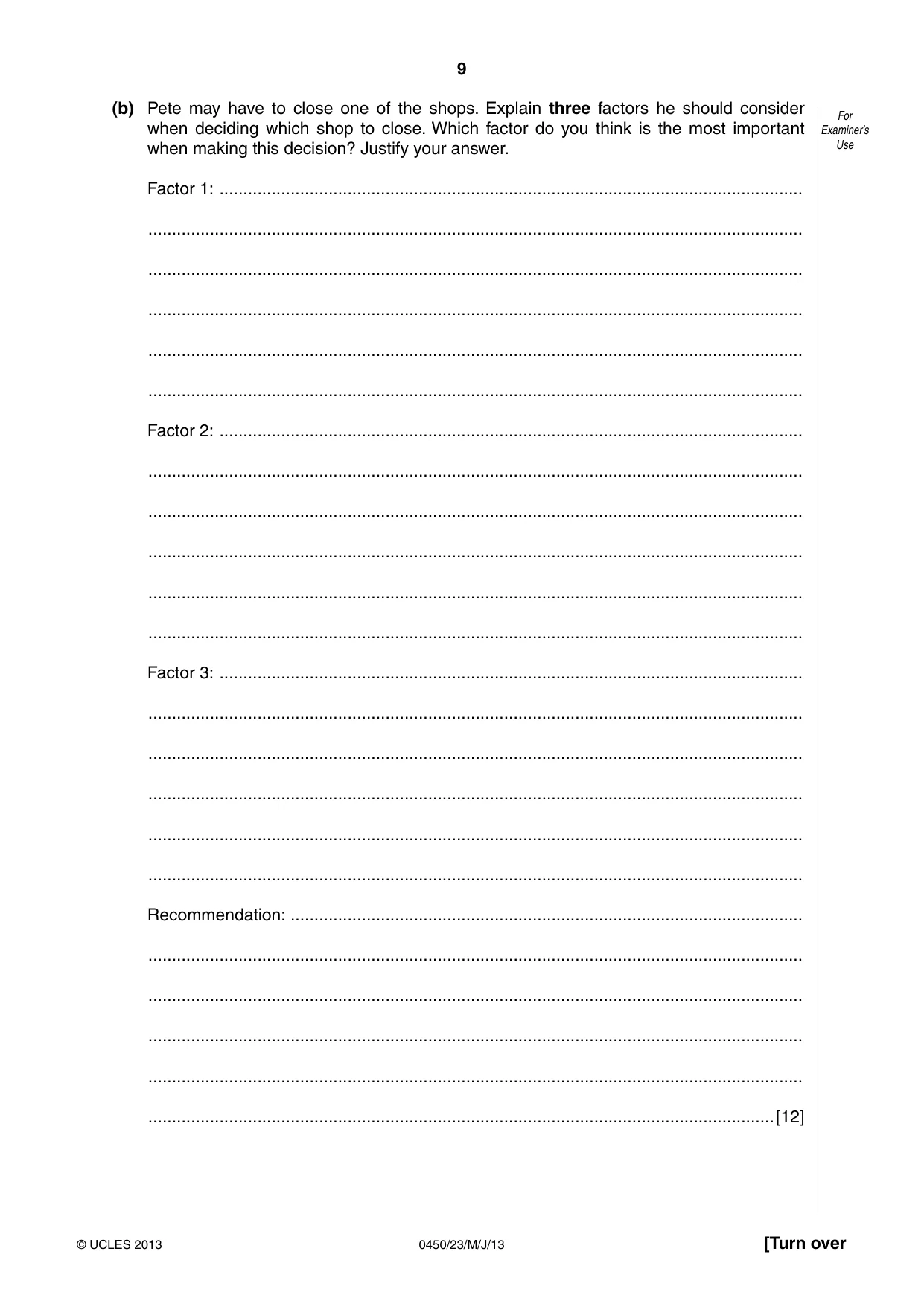
9 0450/23/M/J/13 © UCLES 2013 [Turn over For Examiner’s Use (b) Pete may have to close one of the shops. Explain three factors he should consider when deciding which shop to close. Which factor do you think is the most important when making this decision? Justify your answer. Factor 1: … … … … … … Factor 2: … … … … … … Factor 3: … … … … … … Recommendation: … … … … … …[12]
Question paper, page 10
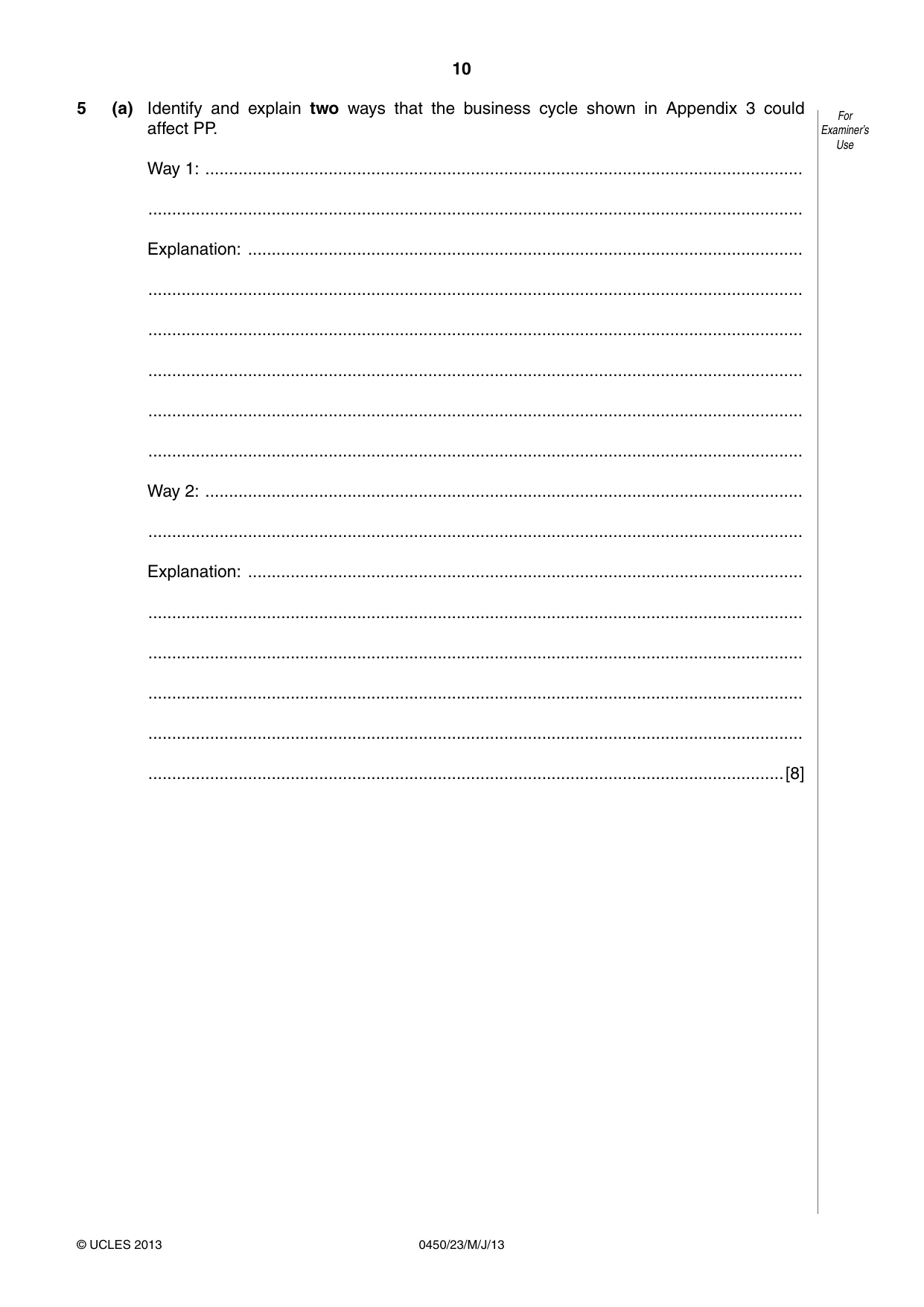
10 0450/23/M/J/13 © UCLES 2013 For Examiner’s Use 5 (a) Identify and explain two ways that the business cycle shown in Appendix 3 could affect PP. Way 1: … … Explanation: … … … … … … Way 2: … … Explanation: … … … … … …[8]
Question paper, page 11
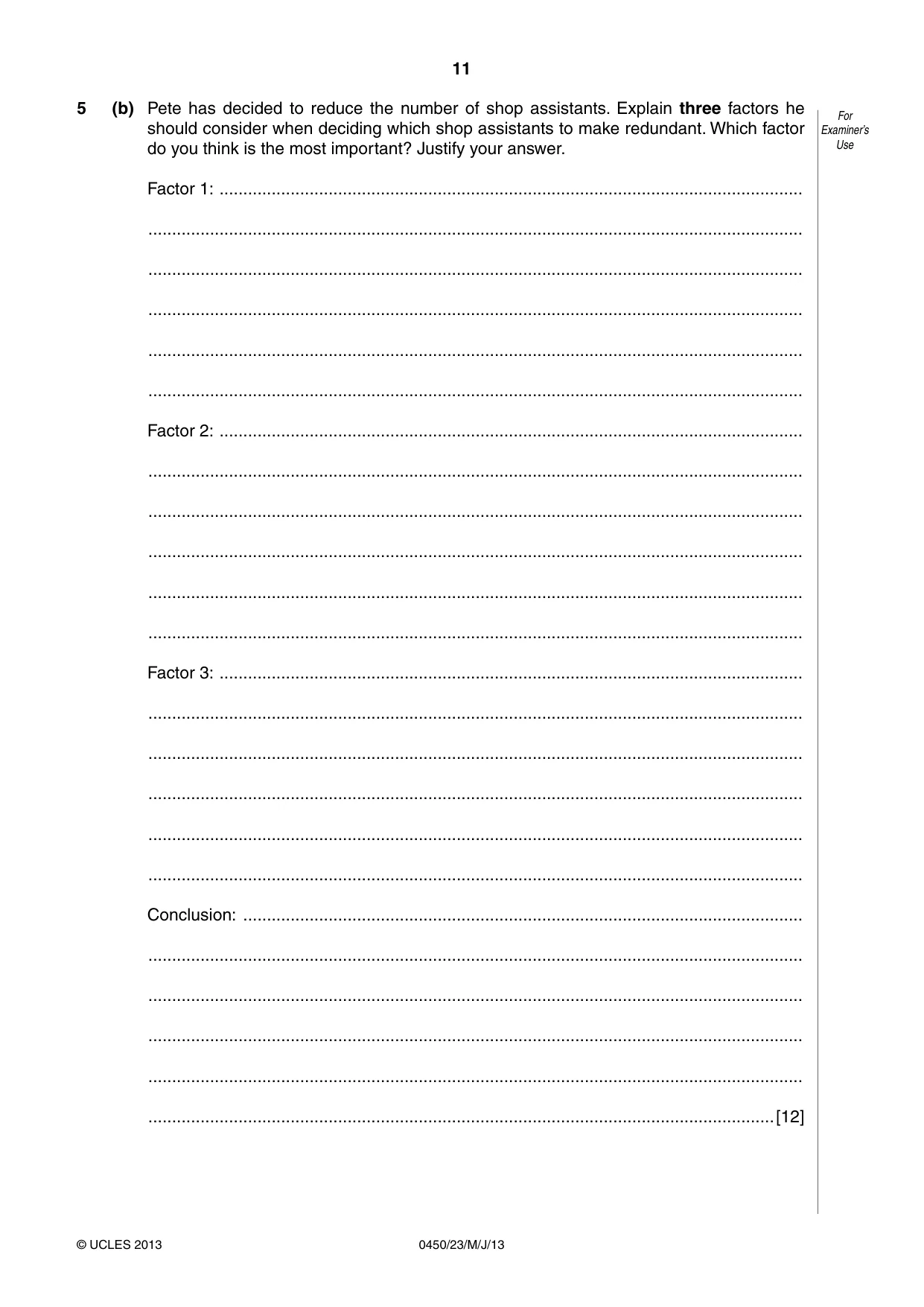
11 0450/23/M/J/13 © UCLES 2013 For Examiner’s Use 5 (b) Pete has decided to reduce the number of shop assistants. Explain three factors he should consider when deciding which shop assistants to make redundant. Which factor do you think is the most important? Justify your answer. Factor 1: … … … … … … Factor 2: … … … … … … Factor 3: … … … … … … Conclusion: … … … … … …[12]
Question paper, page 12
12 0450/23/M/J/13 © UCLES 2013 BLANK PAGE Permission to reproduce items where third-party owned material protected by copyright is included has been sought and cleared where possible. Every reasonable effort has been made by the publisher (UCLES) to trace copyright holders, but if any items requiring clearance have unwittingly been included, the publisher will be pleased to make amends at the earliest possible opportunity. University of Cambridge International Examinations is part of the Cambridge Assessment Group. Cambridge Assessment is the brand name of University of Cambridge Local Examinations Syndicate (UCLES), which is itself a department of the University of Cambridge.
Mark scheme, page 1
CAMBRIDGE INTERNATIONAL EXAMINATIONS International General Certificate of Secondary Education MARK SCHEME for the May/June 2013 series 0450 BUSINESS STUDIES 0450/23 Paper 2 (Case Study), maximum raw mark 100 This mark scheme is published as an aid to teachers and candidates, to indicate the requirements of the examination. It shows the basis on which Examiners were instructed to award marks. It does not indicate the details of the discussions that took place at an Examiners’ meeting before marking began, which would have considered the acceptability of alternative answers. Mark schemes should be read in conjunction with the question paper and the Principal Examiner Report for Teachers. Cambridge will not enter into discussions about these mark schemes. Cambridge is publishing the mark schemes for the May/June 2013 series for most IGCSE, GCE Advanced Level and Advanced Subsidiary Level components and some Ordinary Level components.
Mark scheme, page 2
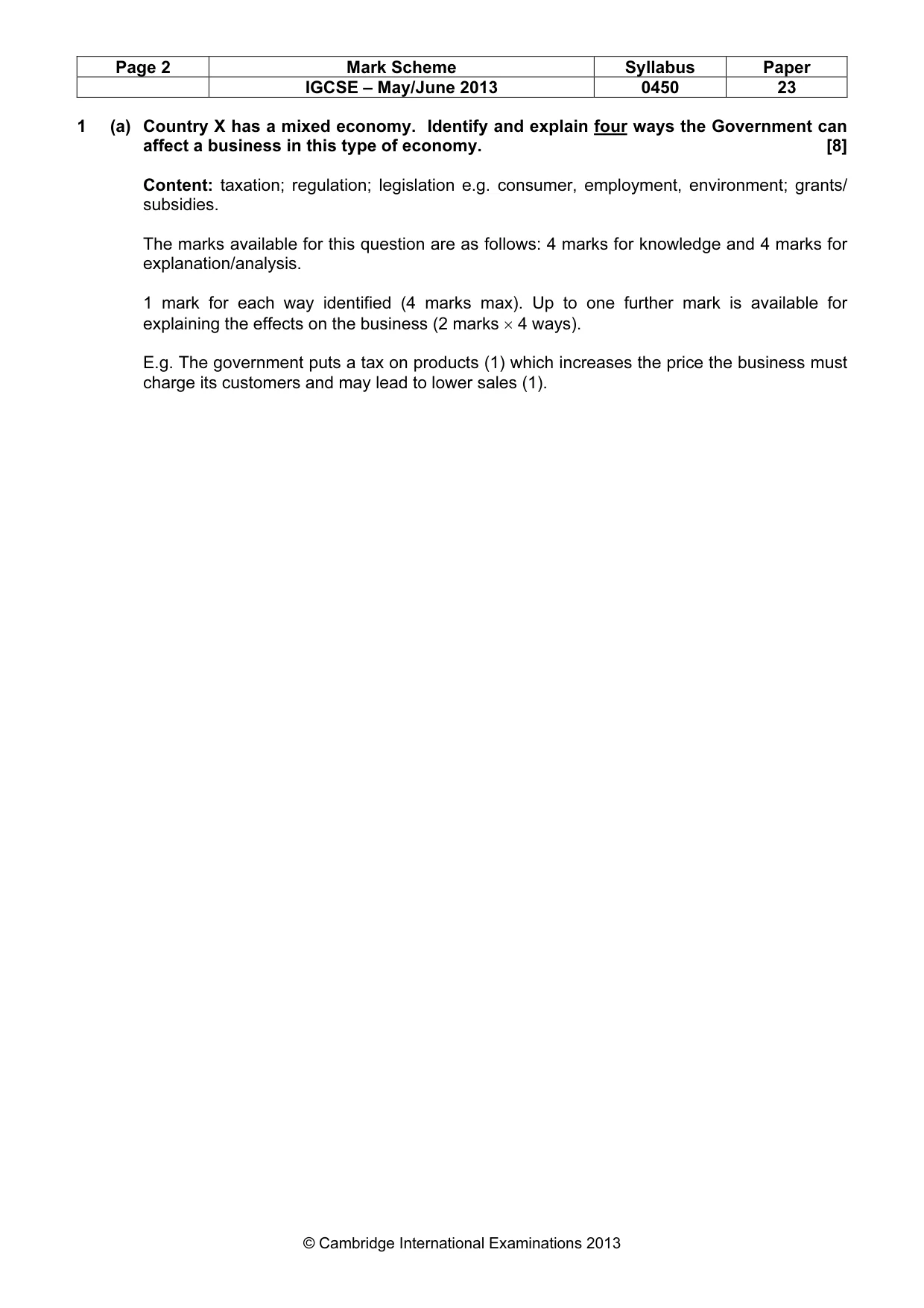
Page 2 Mark Scheme Syllabus Paper IGCSE – May/June 2013 0450 23 © Cambridge International Examinations 2013 1 (a) Country X has a mixed economy. Identify and explain four ways the Government can affect a business in this type of economy. [8] Content: taxation; regulation; legislation e.g. consumer, employment, environment; grants/ subsidies. The marks available for this question are as follows: 4 marks for knowledge and 4 marks for explanation/analysis. 1 mark for each way identified (4 marks max). Up to one further mark is available for explaining the effects on the business (2 marks × 4 ways). E.g. The government puts a tax on products (1) which increases the price the business must charge its customers and may lead to lower sales (1).
Mark scheme, page 3
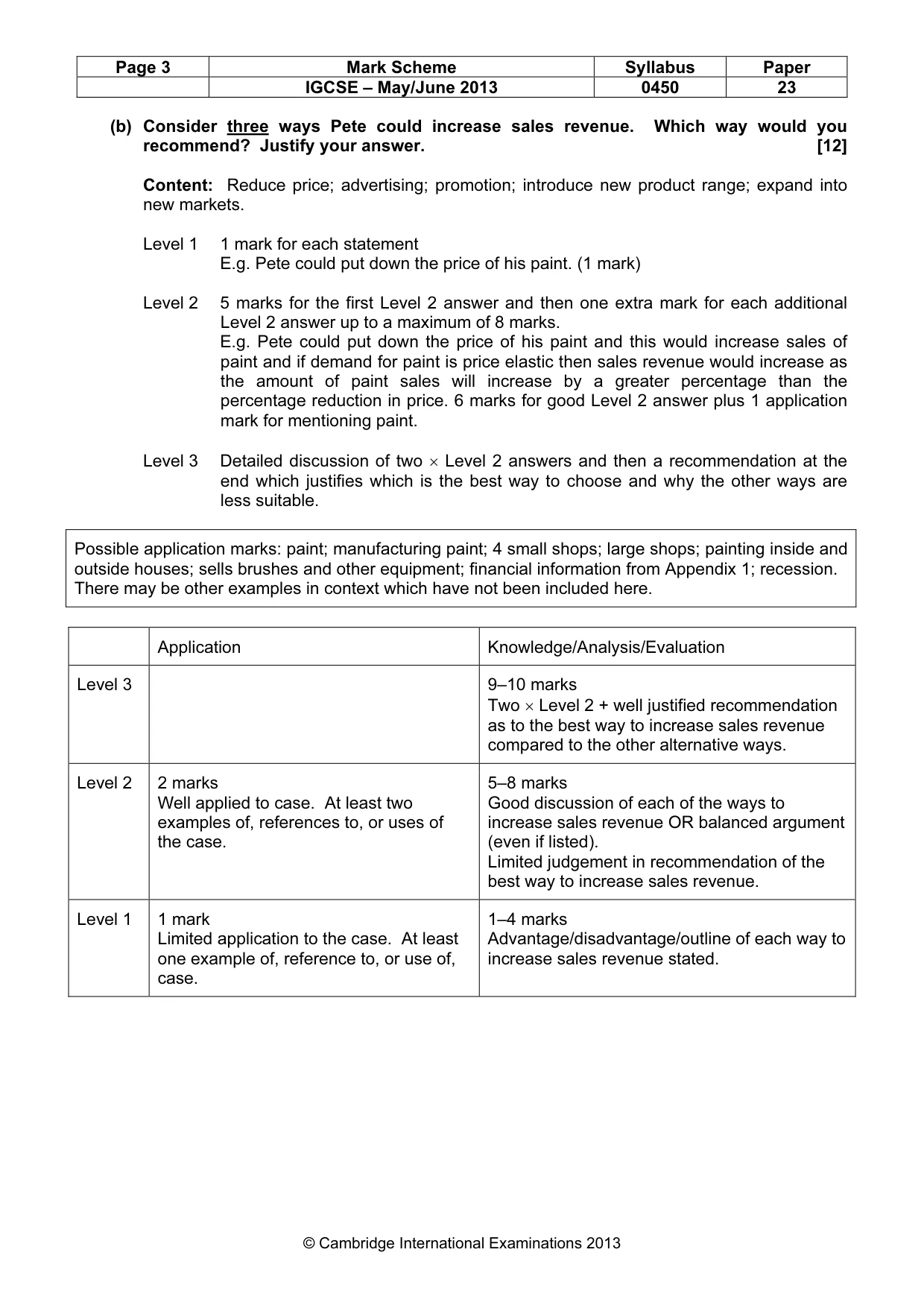
Page 3 Mark Scheme Syllabus Paper IGCSE – May/June 2013 0450 23 © Cambridge International Examinations 2013 (b) Consider three ways Pete could increase sales revenue. Which way would you recommend? Justify your answer. [12] Content: Reduce price; advertising; promotion; introduce new product range; expand into new markets. Level 1 1 mark for each statement E.g. Pete could put down the price of his paint. (1 mark) Level 2 5 marks for the first Level 2 answer and then one extra mark for each additional Level 2 answer up to a maximum of 8 marks. E.g. Pete could put down the price of his paint and this would increase sales of paint and if demand for paint is price elastic then sales revenue would increase as the amount of paint sales will increase by a greater percentage than the percentage reduction in price. 6 marks for good Level 2 answer plus 1 application mark for mentioning paint. Level 3 Detailed discussion of two × Level 2 answers and then a recommendation at the end which justifies which is the best way to choose and why the other ways are less suitable. Possible application marks: paint; manufacturing paint; 4 small shops; large shops; painting inside and outside houses; sells brushes and other equipment; financial information from Appendix 1; recession. There may be other examples in context which have not been included here. Application Knowledge/Analysis/Evaluation Level 3 9–10 marks Two × Level 2 + well justified recommendation as to the best way to increase sales revenue compared to the other alternative ways. Level 2 2 marks Well applied to case. At least two examples of, references to, or uses of the case. 5–8 marks Good discussion of each of the ways to increase sales revenue OR balanced argument (even if listed). Limited judgement in recommendation of the best way to increase sales revenue. Level 1 1 mark Limited application to the case. At least one example of, reference to, or use of, case. 1–4 marks Advantage/disadvantage/outline of each way to increase sales revenue stated.
Mark scheme, page 4
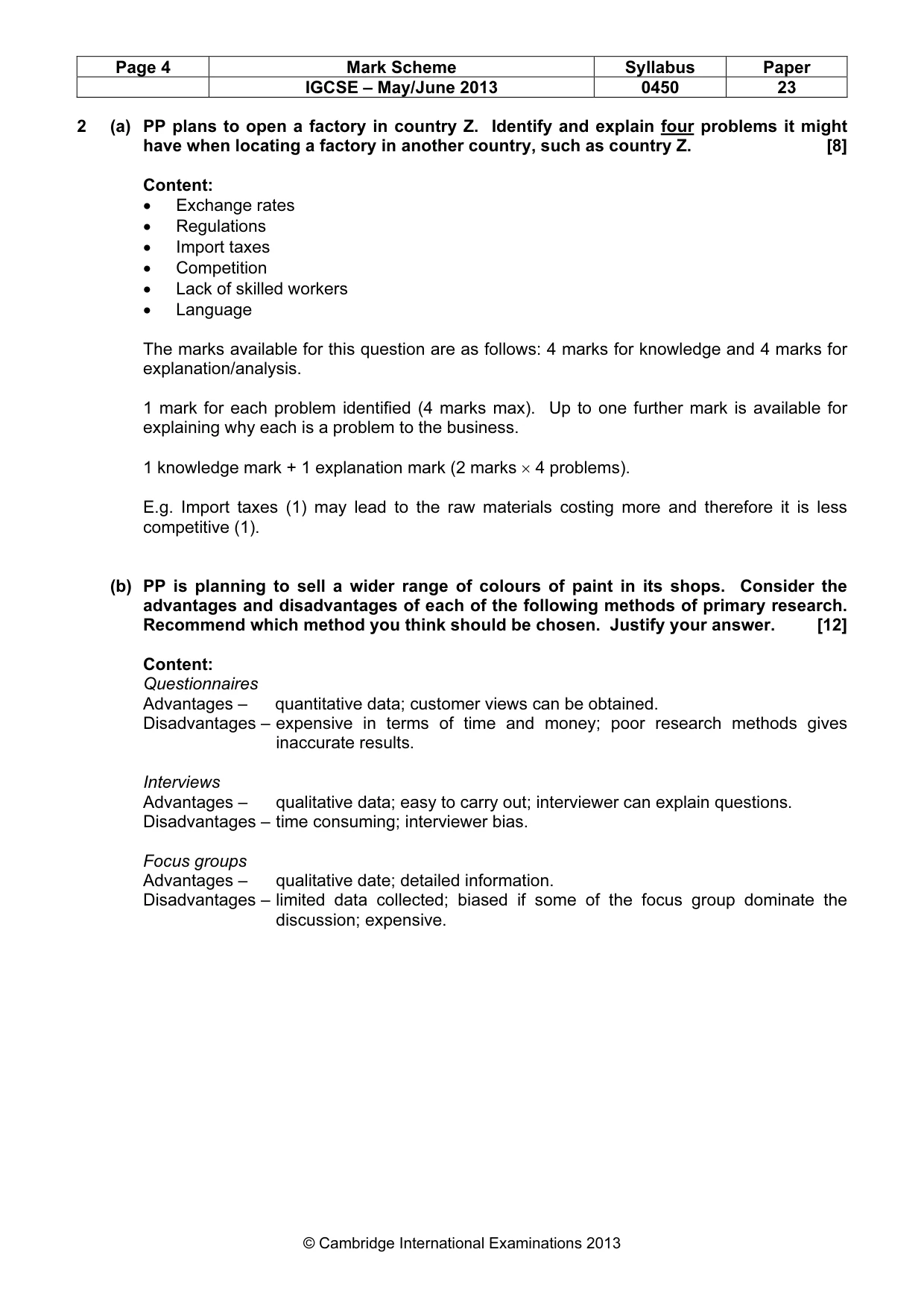
Page 4 Mark Scheme Syllabus Paper IGCSE – May/June 2013 0450 23 © Cambridge International Examinations 2013 2 (a) PP plans to open a factory in country Z. Identify and explain four problems it might have when locating a factory in another country, such as country Z. [8] Content: • Exchange rates • Regulations • Import taxes • Competition • Lack of skilled workers • Language The marks available for this question are as follows: 4 marks for knowledge and 4 marks for explanation/analysis. 1 mark for each problem identified (4 marks max). Up to one further mark is available for explaining why each is a problem to the business. 1 knowledge mark + 1 explanation mark (2 marks × 4 problems). E.g. Import taxes (1) may lead to the raw materials costing more and therefore it is less competitive (1). (b) PP is planning to sell a wider range of colours of paint in its shops. Consider the advantages and disadvantages of each of the following methods of primary research. Recommend which method you think should be chosen. Justify your answer. [12] Content: Questionnaires Advantages – quantitative data; customer views can be obtained. Disadvantages – expensive in terms of time and money; poor research methods gives inaccurate results. Interviews Advantages – qualitative data; easy to carry out; interviewer can explain questions. Disadvantages – time consuming; interviewer bias. Focus groups Advantages – qualitative date; detailed information. Disadvantages – limited data collected; biased if some of the focus group dominate the discussion; expensive.
Mark scheme, page 5
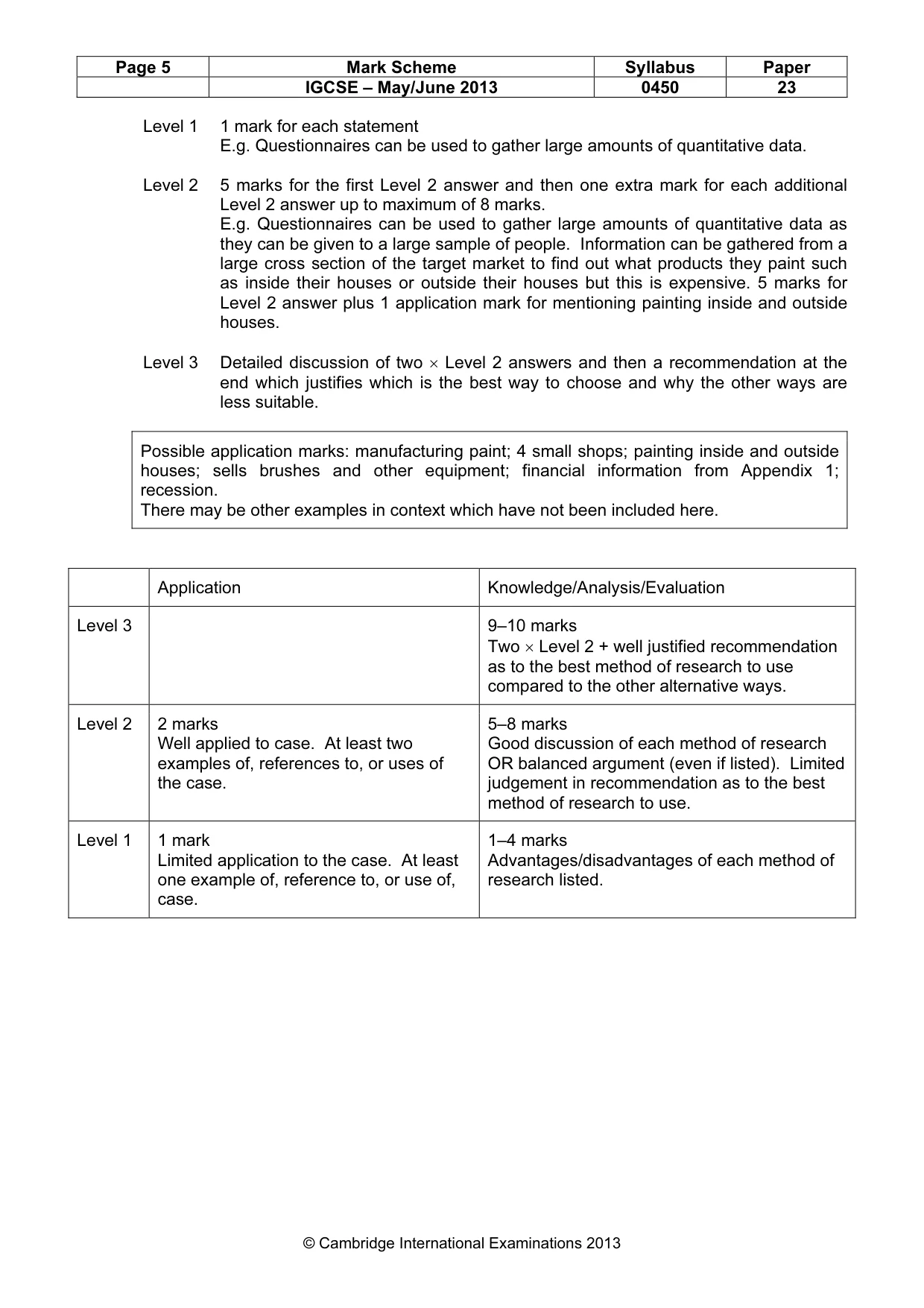
Page 5 Mark Scheme Syllabus Paper IGCSE – May/June 2013 0450 23 © Cambridge International Examinations 2013 Level 1 1 mark for each statement E.g. Questionnaires can be used to gather large amounts of quantitative data. Level 2 5 marks for the first Level 2 answer and then one extra mark for each additional Level 2 answer up to maximum of 8 marks. E.g. Questionnaires can be used to gather large amounts of quantitative data as they can be given to a large sample of people. Information can be gathered from a large cross section of the target market to find out what products they paint such as inside their houses or outside their houses but this is expensive. 5 marks for Level 2 answer plus 1 application mark for mentioning painting inside and outside houses. Level 3 Detailed discussion of two × Level 2 answers and then a recommendation at the end which justifies which is the best way to choose and why the other ways are less suitable. Possible application marks: manufacturing paint; 4 small shops; painting inside and outside houses; sells brushes and other equipment; financial information from Appendix 1; recession. There may be other examples in context which have not been included here. Application Knowledge/Analysis/Evaluation Level 3 9–10 marks Two × Level 2 + well justified recommendation as to the best method of research to use compared to the other alternative ways. Level 2 2 marks Well applied to case. At least two examples of, references to, or uses of the case. 5–8 marks Good discussion of each method of research OR balanced argument (even if listed). Limited judgement in recommendation as to the best method of research to use. Level 1 1 mark Limited application to the case. At least one example of, reference to, or use of, case. 1–4 marks Advantages/disadvantages of each method of research listed.
Mark scheme, page 6
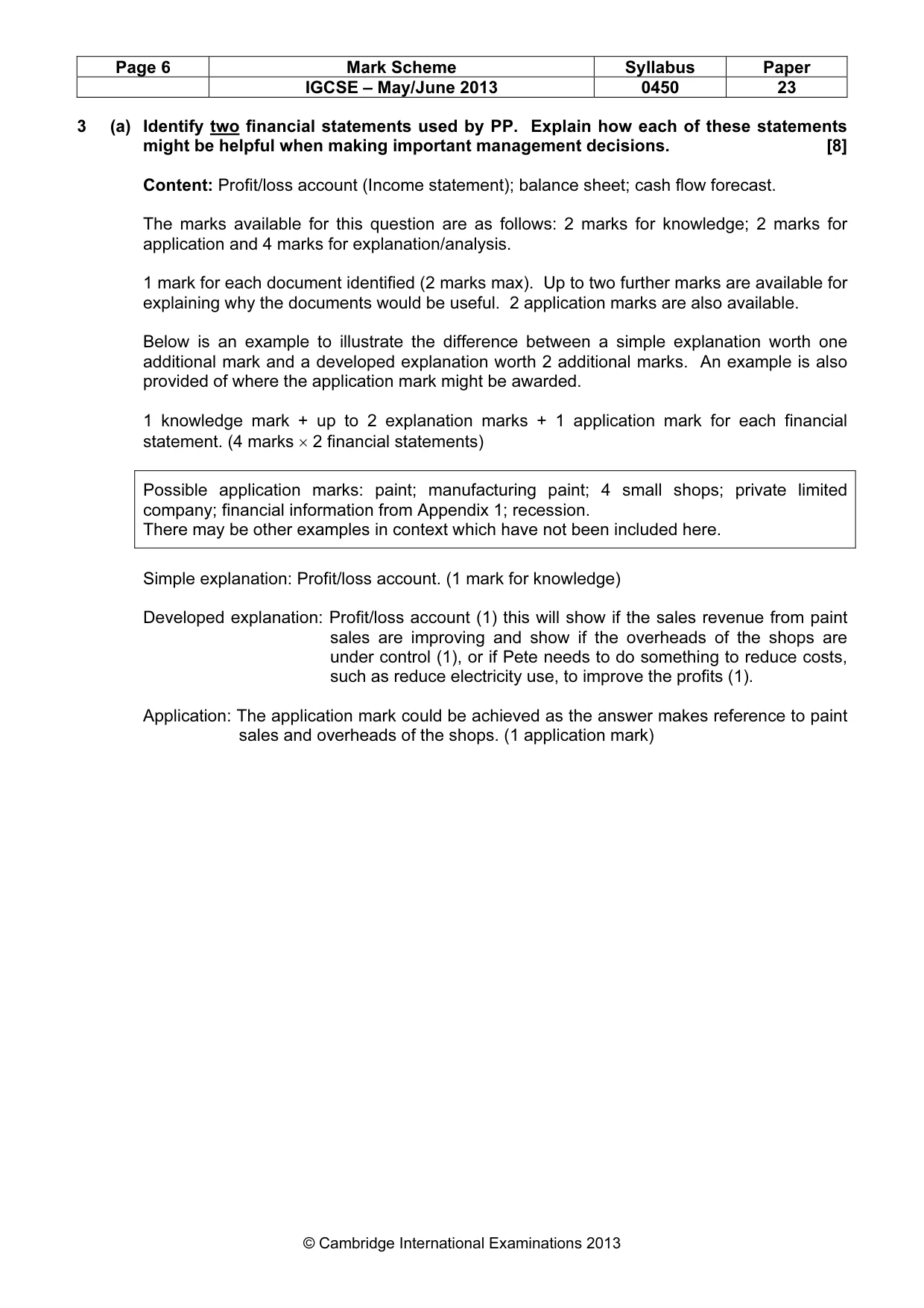
Page 6 Mark Scheme Syllabus Paper IGCSE – May/June 2013 0450 23 © Cambridge International Examinations 2013 3 (a) Identify two financial statements used by PP. Explain how each of these statements might be helpful when making important management decisions. [8] Content: Profit/loss account (Income statement); balance sheet; cash flow forecast. The marks available for this question are as follows: 2 marks for knowledge; 2 marks for application and 4 marks for explanation/analysis. 1 mark for each document identified (2 marks max). Up to two further marks are available for explaining why the documents would be useful. 2 application marks are also available. Below is an example to illustrate the difference between a simple explanation worth one additional mark and a developed explanation worth 2 additional marks. An example is also provided of where the application mark might be awarded. 1 knowledge mark + up to 2 explanation marks + 1 application mark for each financial statement. (4 marks × 2 financial statements) Possible application marks: paint; manufacturing paint; 4 small shops; private limited company; financial information from Appendix 1; recession. There may be other examples in context which have not been included here. Simple explanation: Profit/loss account. (1 mark for knowledge) Developed explanation: Profit/loss account (1) this will show if the sales revenue from paint sales are improving and show if the overheads of the shops are under control (1), or if Pete needs to do something to reduce costs, such as reduce electricity use, to improve the profits (1). Application: The application mark could be achieved as the answer makes reference to paint sales and overheads of the shops. (1 application mark)
Mark scheme, page 7
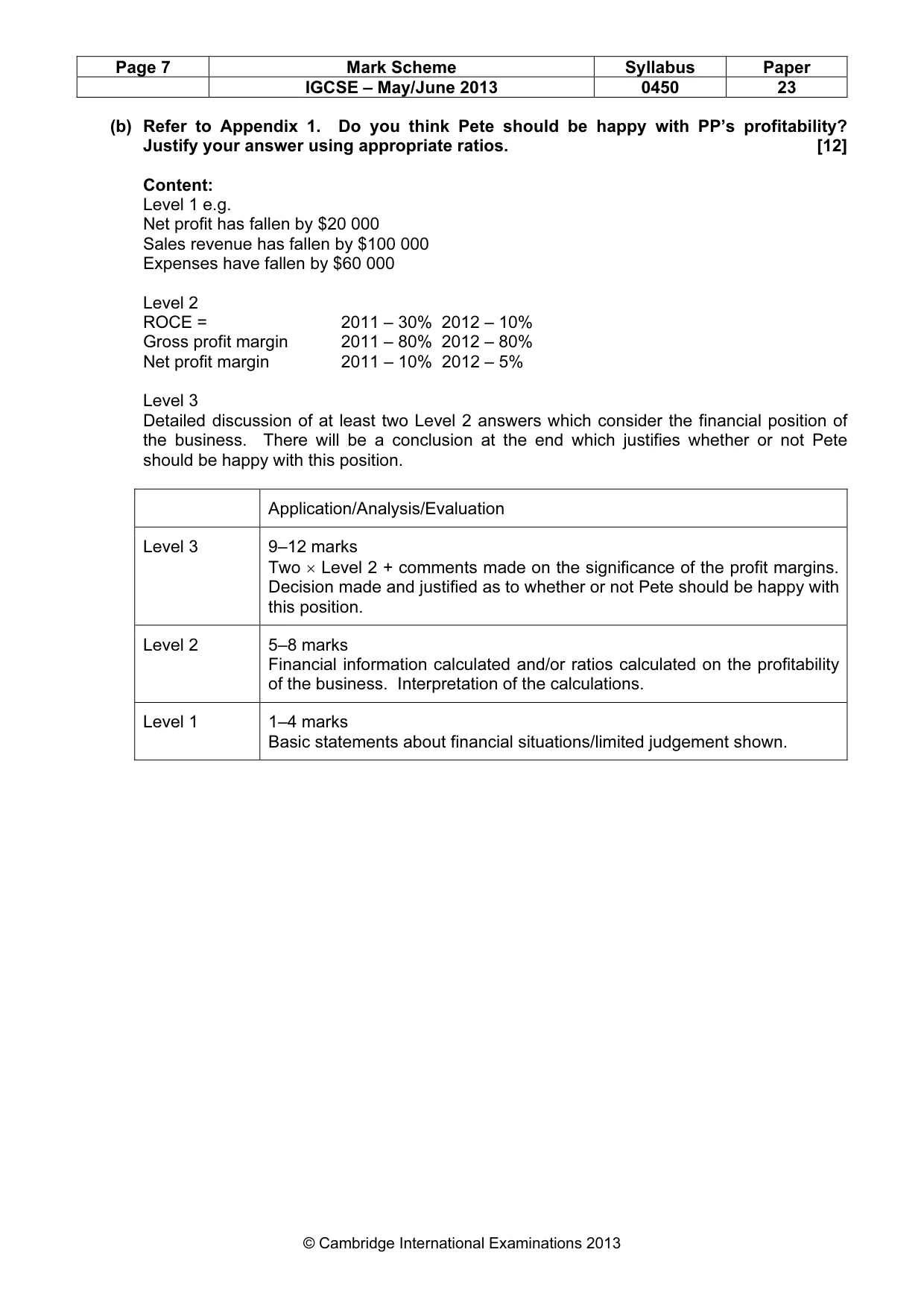
Page 7 Mark Scheme Syllabus Paper IGCSE – May/June 2013 0450 23 © Cambridge International Examinations 2013 (b) Refer to Appendix 1. Do you think Pete should be happy with PP’s profitability? Justify your answer using appropriate ratios. [12] Content: Level 1 e.g. Net profit has fallen by $20 000 Sales revenue has fallen by $100 000 Expenses have fallen by $60 000 Level 2 ROCE = 2011 – 30% 2012 – 10% Gross profit margin 2011 – 80% 2012 – 80% Net profit margin 2011 – 10% 2012 – 5% Level 3 Detailed discussion of at least two Level 2 answers which consider the financial position of the business. There will be a conclusion at the end which justifies whether or not Pete should be happy with this position. Application/Analysis/Evaluation Level 3 9–12 marks Two × Level 2 + comments made on the significance of the profit margins. Decision made and justified as to whether or not Pete should be happy with this position. Level 2 5–8 marks Financial information calculated and/or ratios calculated on the profitability of the business. Interpretation of the calculations. Level 1 1–4 marks Basic statements about financial situations/limited judgement shown.
Mark scheme, page 8
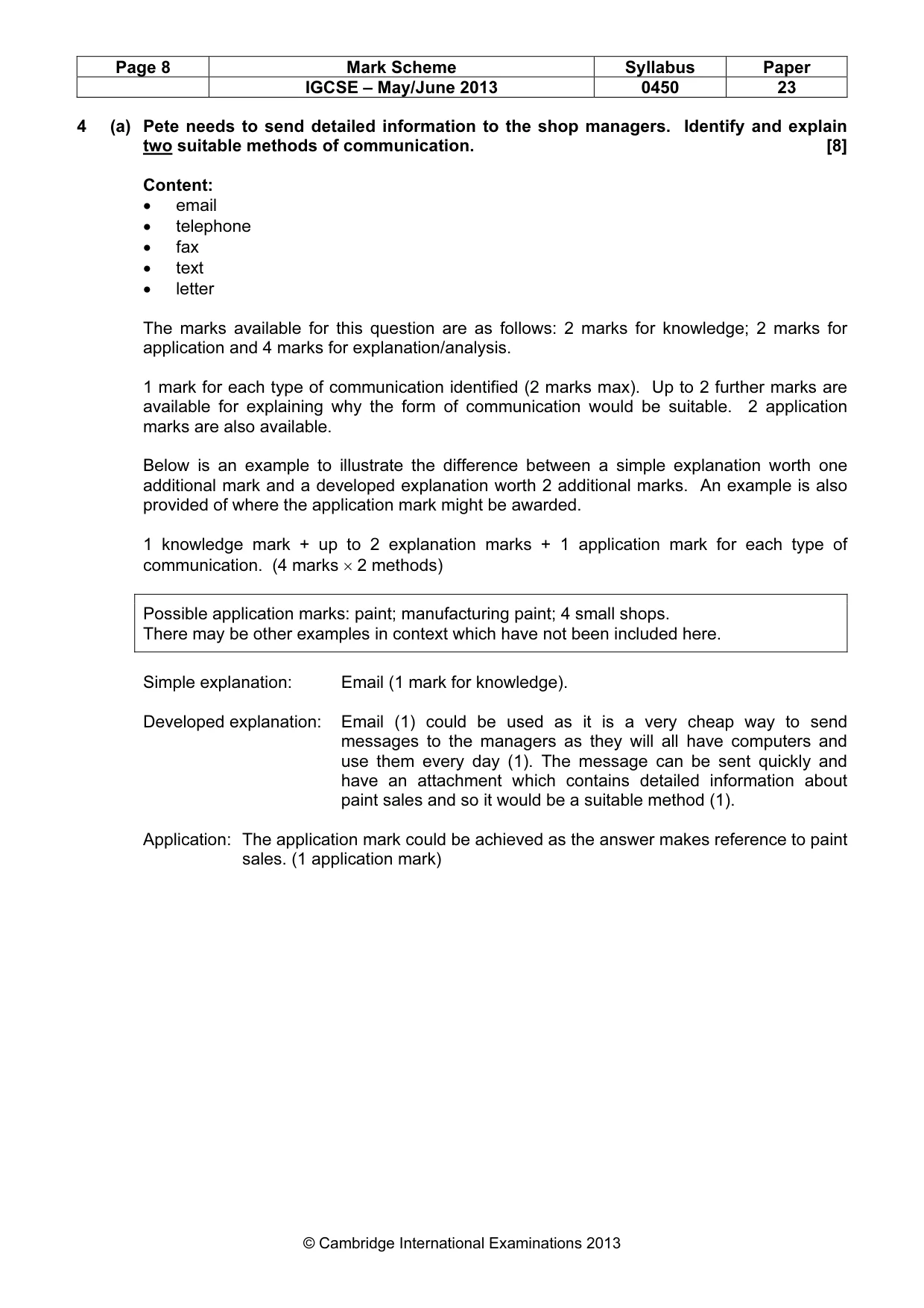
Page 8 Mark Scheme Syllabus Paper IGCSE – May/June 2013 0450 23 © Cambridge International Examinations 2013 4 (a) Pete needs to send detailed information to the shop managers. Identify and explain two suitable methods of communication. [8] Content: • email • telephone • fax • text • letter The marks available for this question are as follows: 2 marks for knowledge; 2 marks for application and 4 marks for explanation/analysis. 1 mark for each type of communication identified (2 marks max). Up to 2 further marks are available for explaining why the form of communication would be suitable. 2 application marks are also available. Below is an example to illustrate the difference between a simple explanation worth one additional mark and a developed explanation worth 2 additional marks. An example is also provided of where the application mark might be awarded. 1 knowledge mark + up to 2 explanation marks + 1 application mark for each type of communication. (4 marks × 2 methods) Possible application marks: paint; manufacturing paint; 4 small shops. There may be other examples in context which have not been included here. Simple explanation: Email (1 mark for knowledge). Developed explanation: Email (1) could be used as it is a very cheap way to send messages to the managers as they will all have computers and use them every day (1). The message can be sent quickly and have an attachment which contains detailed information about paint sales and so it would be a suitable method (1). Application: The application mark could be achieved as the answer makes reference to paint sales. (1 application mark)
Mark scheme, page 9
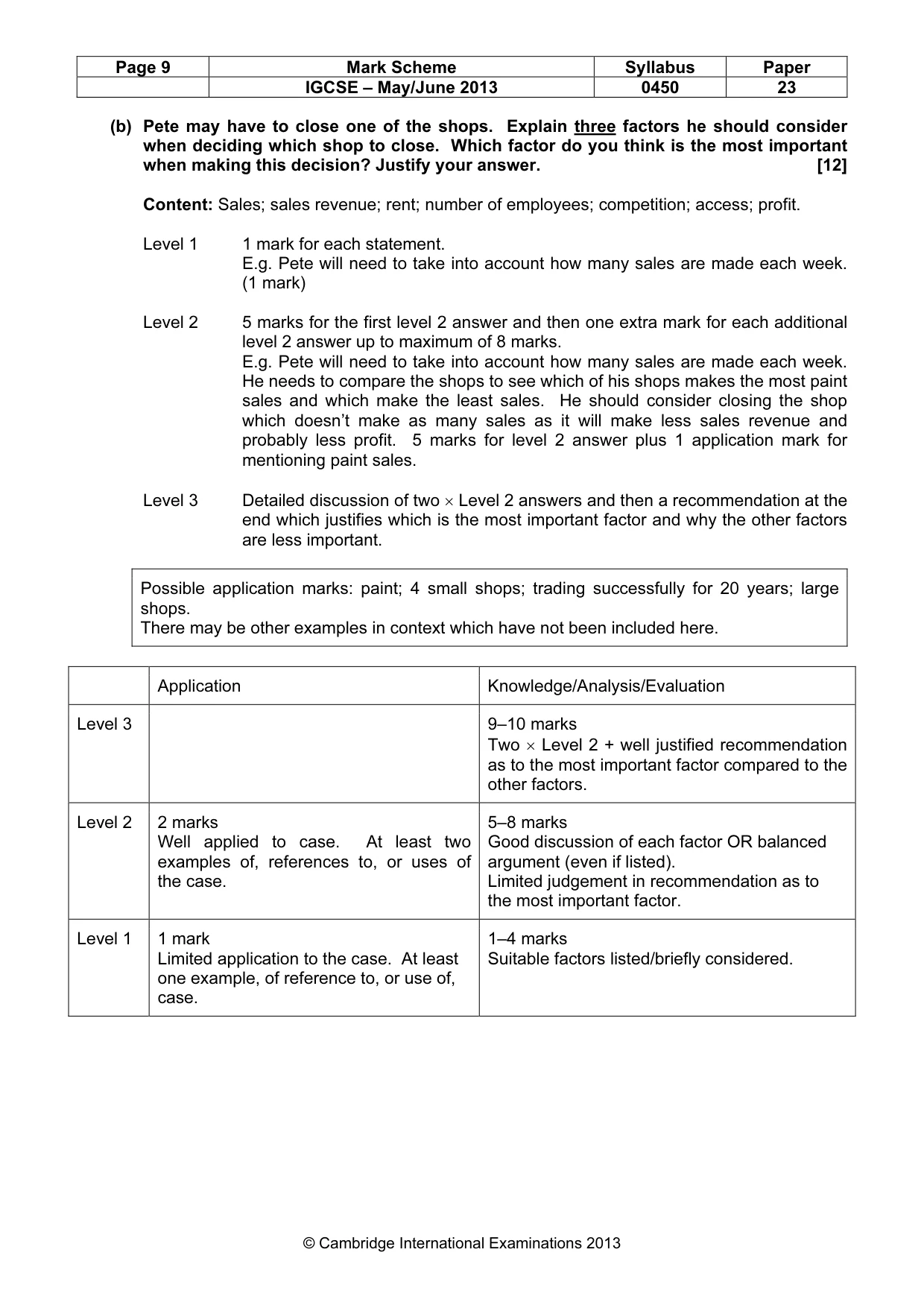
Page 9 Mark Scheme Syllabus Paper IGCSE – May/June 2013 0450 23 © Cambridge International Examinations 2013 (b) Pete may have to close one of the shops. Explain three factors he should consider when deciding which shop to close. Which factor do you think is the most important when making this decision? Justify your answer. [12] Content: Sales; sales revenue; rent; number of employees; competition; access; profit. Level 1 1 mark for each statement. E.g. Pete will need to take into account how many sales are made each week. (1 mark) Level 2 5 marks for the first level 2 answer and then one extra mark for each additional level 2 answer up to maximum of 8 marks. E.g. Pete will need to take into account how many sales are made each week. He needs to compare the shops to see which of his shops makes the most paint sales and which make the least sales. He should consider closing the shop which doesn’t make as many sales as it will make less sales revenue and probably less profit. 5 marks for level 2 answer plus 1 application mark for mentioning paint sales. Level 3 Detailed discussion of two × Level 2 answers and then a recommendation at the end which justifies which is the most important factor and why the other factors are less important. Possible application marks: paint; 4 small shops; trading successfully for 20 years; large shops. There may be other examples in context which have not been included here. Application Knowledge/Analysis/Evaluation Level 3 9–10 marks Two × Level 2 + well justified recommendation as to the most important factor compared to the other factors. Level 2 2 marks Well applied to case. At least two examples of, references to, or uses of the case. 5–8 marks Good discussion of each factor OR balanced argument (even if listed). Limited judgement in recommendation as to the most important factor. Level 1 1 mark Limited application to the case. At least one example, of reference to, or use of, case. 1–4 marks Suitable factors listed/briefly considered.
Mark scheme, page 10
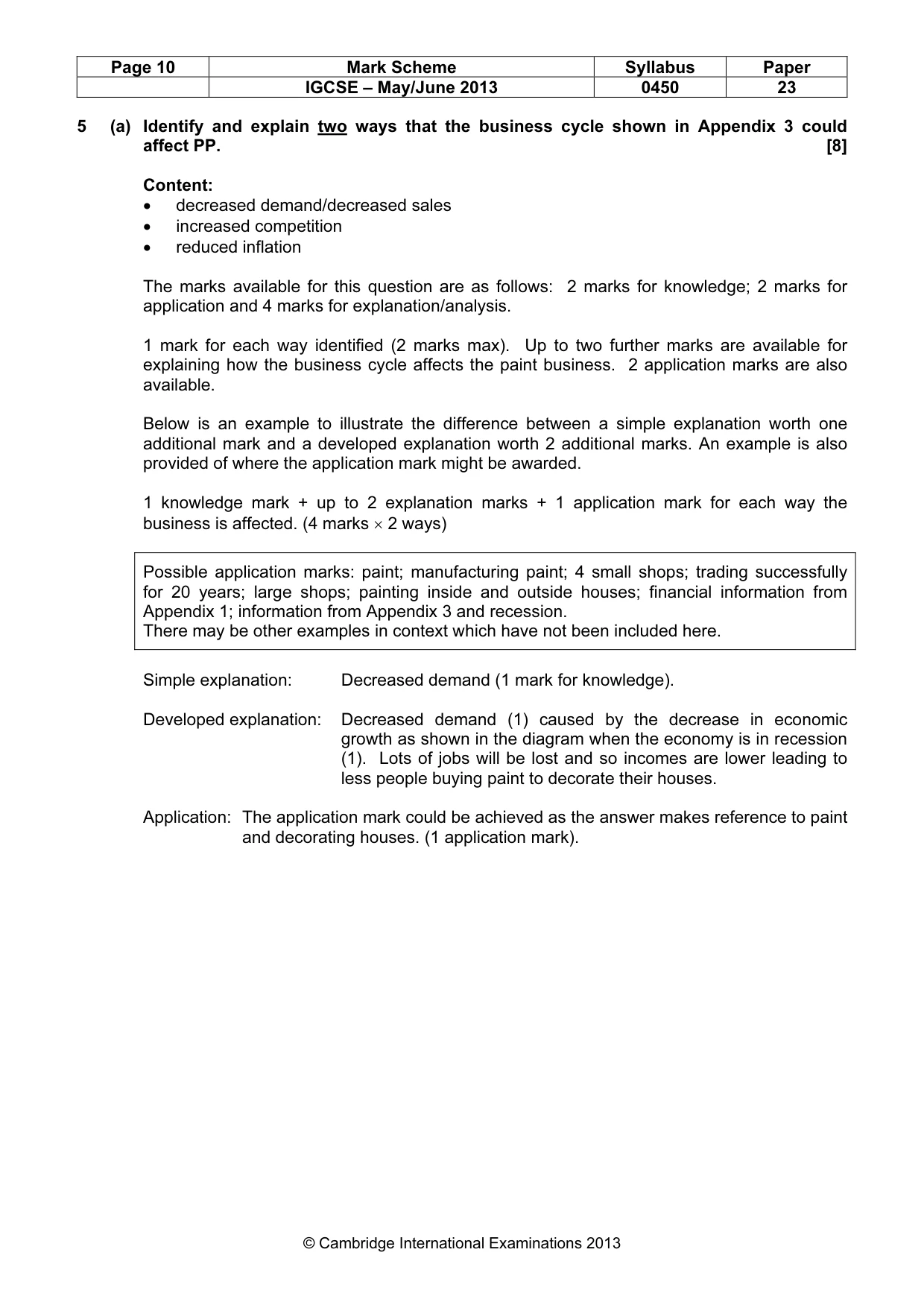
Page 10 Mark Scheme Syllabus Paper IGCSE – May/June 2013 0450 23 © Cambridge International Examinations 2013 5 (a) Identify and explain two ways that the business cycle shown in Appendix 3 could affect PP. [8] Content: • decreased demand/decreased sales • increased competition • reduced inflation The marks available for this question are as follows: 2 marks for knowledge; 2 marks for application and 4 marks for explanation/analysis. 1 mark for each way identified (2 marks max). Up to two further marks are available for explaining how the business cycle affects the paint business. 2 application marks are also available. Below is an example to illustrate the difference between a simple explanation worth one additional mark and a developed explanation worth 2 additional marks. An example is also provided of where the application mark might be awarded. 1 knowledge mark + up to 2 explanation marks + 1 application mark for each way the business is affected. (4 marks × 2 ways) Possible application marks: paint; manufacturing paint; 4 small shops; trading successfully for 20 years; large shops; painting inside and outside houses; financial information from Appendix 1; information from Appendix 3 and recession. There may be other examples in context which have not been included here. Simple explanation: Decreased demand (1 mark for knowledge). Developed explanation: Decreased demand (1) caused by the decrease in economic growth as shown in the diagram when the economy is in recession (1). Lots of jobs will be lost and so incomes are lower leading to less people buying paint to decorate their houses. Application: The application mark could be achieved as the answer makes reference to paint and decorating houses. (1 application mark).
Mark scheme, page 11
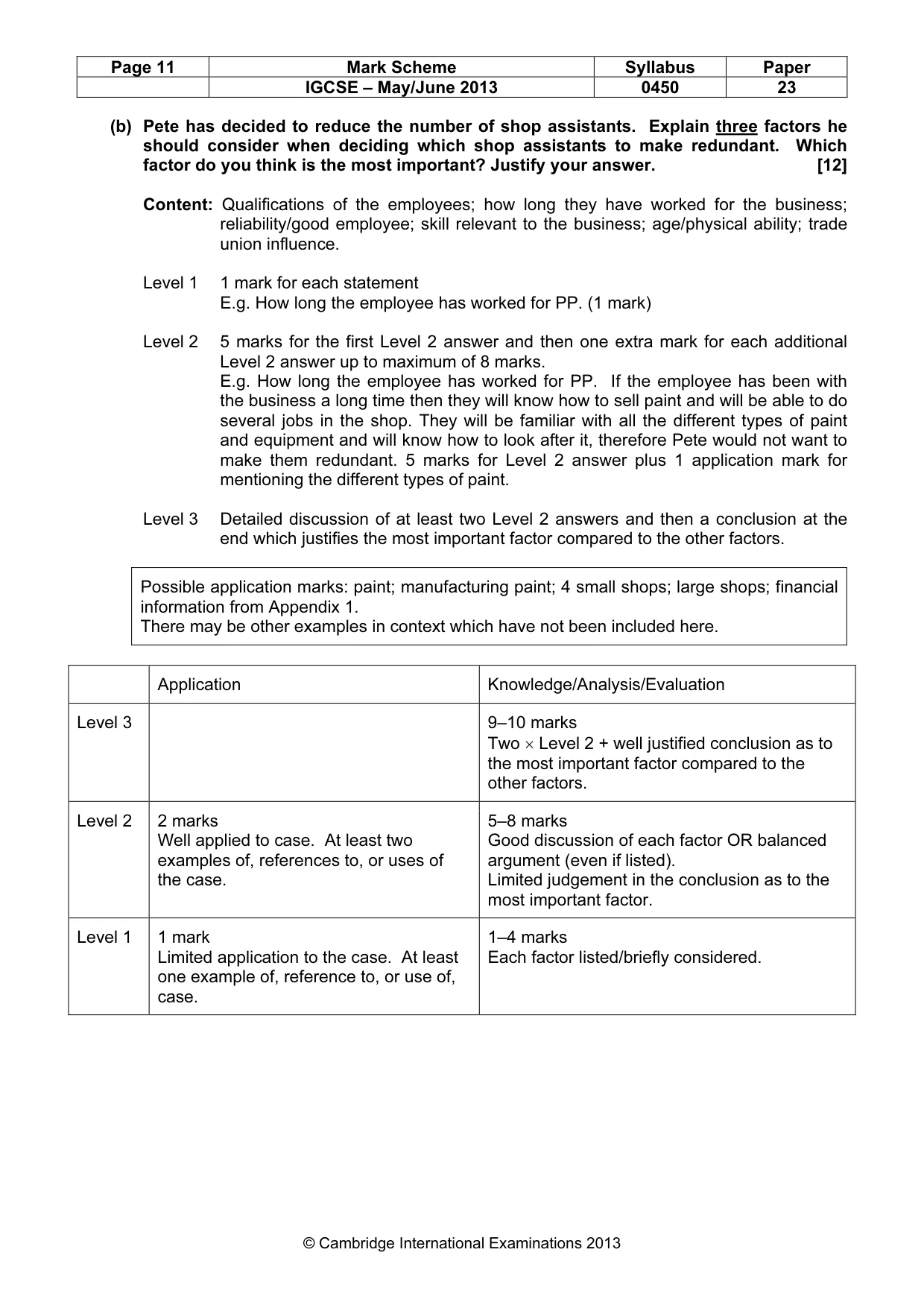
Page 11 Mark Scheme Syllabus Paper IGCSE – May/June 2013 0450 23 © Cambridge International Examinations 2013 (b) Pete has decided to reduce the number of shop assistants. Explain three factors he should consider when deciding which shop assistants to make redundant. Which factor do you think is the most important? Justify your answer. [12] Content: Qualifications of the employees; how long they have worked for the business; reliability/good employee; skill relevant to the business; age/physical ability; trade union influence. Level 1 1 mark for each statement E.g. How long the employee has worked for PP. (1 mark) Level 2 5 marks for the first Level 2 answer and then one extra mark for each additional Level 2 answer up to maximum of 8 marks. E.g. How long the employee has worked for PP. If the employee has been with the business a long time then they will know how to sell paint and will be able to do several jobs in the shop. They will be familiar with all the different types of paint and equipment and will know how to look after it, therefore Pete would not want to make them redundant. 5 marks for Level 2 answer plus 1 application mark for mentioning the different types of paint. Level 3 Detailed discussion of at least two Level 2 answers and then a conclusion at the end which justifies the most important factor compared to the other factors. Possible application marks: paint; manufacturing paint; 4 small shops; large shops; financial information from Appendix 1. There may be other examples in context which have not been included here. Application Knowledge/Analysis/Evaluation Level 3 9–10 marks Two × Level 2 + well justified conclusion as to the most important factor compared to the other factors. Level 2 2 marks Well applied to case. At least two examples of, references to, or uses of the case. 5–8 marks Good discussion of each factor OR balanced argument (even if listed). Limited judgement in the conclusion as to the most important factor. Level 1 1 mark Limited application to the case. At least one example of, reference to, or use of, case. 1–4 marks Each factor listed/briefly considered.
What you needed in this session
Cambridge’s own grade thresholds for 2013 May/June, Paper 2 · Variant 3. A higher threshold means an easier paper — the bar moves with how the cohort did.