Cambridge IGCSE Business Studies 0450 — 2013 May/June Paper 2 · Variant 2
0450/22/M/J/13 · 100 marks · ≈113 min
The question paper and its mark scheme, free to read here and free to download. This is Cambridge’s own paper, exactly as it was sat.
Question paper12 pages

Mark scheme10 pages
Answers below. Sit the paper first if you are practising.
Paper as text
Question paper, page 1
This document consists of 11 printed pages, 1 blank page and 1 Insert. DC (SJF) 63105/2 © UCLES 2013 [Turn over UNIVERSITY OF CAMBRIDGE INTERNATIONAL EXAMINATIONS International General Certificate of Secondary Education * 9 0 1 7 0 3 3 7 0 8 * BUSINESS STUDIES 0450/22 Paper 2 May/June 2013 1 hour 45 minutes Candidates answer on the Question Paper. No Additional Materials are required. READ THESE INSTRUCTIONS FIRST Write your Centre number, candidate number and name on all the work you hand in. Write in dark blue or black pen. Do not use staples, paper clips, highlighters, glue or correction fluid. DO NOT WRITE IN ANY BARCODES. Answer all questions. The Insert contains the case study. The business described in this question paper is entirely fictitious. At the end of the examination, fasten all your work securely together. The number of marks is given in brackets [ ] at the end of each question or part question.
Question paper, page 2
2 0450/22/M/J/13 © UCLES 2013 For Examiner’s Use 1 (a) Identify two stakeholders of TWP and explain why each stakeholder is interested in the business. Stakeholder 1: … Explanation: … … … … … … … Stakeholder 2: … Explanation: … … … … … … …[8]
Question paper, page 3
3 0450/22/M/J/13 © UCLES 2013 [Turn over For Examiner’s Use (b) Consider the possible advantages and disadvantages of importing wood rather than buying locally produced wood. Recommend whether TWP should continue to import wood or whether it should change to buying locally produced wood. Justify your answer. Import wood: … … … … … … … … Buy locally produced wood: … … … … … … … … Recommendation: … … … … … … … …[12]
Question paper, page 4
4 0450/22/M/J/13 © UCLES 2013 For Examiner’s Use 2 (a) Identify and explain two reasons why the business objectives of growth and increased profits are important to TWP. Reason 1: … … Explanation: … … … … … … Reason 2: … … Explanation: … … … … … …[8]
Question paper, page 5
5 0450/22/M/J/13 © UCLES 2013 [Turn over For Examiner’s Use (b) TWP wants to start selling directly to customers who build or repair their own houses. Consider the advantages and disadvantages of three methods of promotion it could use. Recommend the best method to use. Justify your answer. Method 1: … … … … … … Method 2: … … … … … … Method 3: … … … … … … Recommendation: … … … … … …[12]
Question paper, page 6
6 0450/22/M/J/13 © UCLES 2013 For Examiner’s Use 3 (a) TWP has taken out a bank loan and arranged an overdraft. Identify and explain two differences between a bank loan and an overdraft. Difference 1: … … Explanation: … … … … … … Difference 2: … … Explanation: … … … … … …[8]
Question paper, page 7
7 0450/22/M/J/13 © UCLES 2013 [Turn over For Examiner’s Use (b) Refer to Appendix 1. Do you think Tibalt should be pleased with the profitability of the business? Justify your answer by calculating the gross profit margin and the net profit margin for both years. … … … … … … … … … … … … … … … … … … … … … … … …[12]
Question paper, page 8
8 0450/22/M/J/13 © UCLES 2013 For Examiner’s Use 4 (a) Tibalt wants to motivate his employees. Identify and explain four ways he could use to motivate his employees. Way 1: … Explanation: … … … Way 2: … Explanation: … … … Way 3: … Explanation: … … … Way 4: … Explanation: … … …[8]
Question paper, page 9
9 0450/22/M/J/13 © UCLES 2013 [Turn over For Examiner’s Use (b) Consider the advantages and disadvantages of both job production and batch production for TWP. Recommend which production method he should use when producing products to a design provided by the customer. Justify your answer. Job production: … … … … … … … … Batch production: … … … … … … … … Recommendation: … … … … … … … …[12]
Question paper, page 10
10 0450/22/M/J/13 © UCLES 2013 For Examiner’s Use 5 (a) The Government in country X supports sustainable development. Identify and explain two reasons why Governments pass laws to protect the environment. Reason 1: … … Explanation: … … … … … … Reason 2: … … Explanation: … … … … … …[8]
Question paper, page 11
11 0450/22/M/J/13 © UCLES 2013 For Examiner’s Use (b) Consider the advantages and disadvantages of each of the options below. Do you think Tibalt should take over another business or open a new factory? Justify your answer. Option 1 – Take over another wood product manufacturer: … … … … … … … … Option 2 – Open a new TWP factory: … … … … … … … … Recommendation: … … … … … … … …[12]
Question paper, page 12
12 0450/22/M/J/13 © UCLES 2013 BLANK PAGE Permission to reproduce items where third-party owned material protected by copyright is included has been sought and cleared where possible. Every reasonable effort has been made by the publisher (UCLES) to trace copyright holders, but if any items requiring clearance have unwittingly been included, the publisher will be pleased to make amends at the earliest possible opportunity. University of Cambridge International Examinations is part of the Cambridge Assessment Group. Cambridge Assessment is the brand name of University of Cambridge Local Examinations Syndicate (UCLES), which is itself a department of the University of Cambridge.
Mark scheme, page 1
CAMBRIDGE INTERNATIONAL EXAMINATIONS International General Certificate of Secondary Education MARK SCHEME for the May/June 2013 series 0450 BUSINESS STUDIES 0450/22 Paper 2 (Case Study), maximum raw mark 100 This mark scheme is published as an aid to teachers and candidates, to indicate the requirements of the examination. It shows the basis on which Examiners were instructed to award marks. It does not indicate the details of the discussions that took place at an Examiners’ meeting before marking began, which would have considered the acceptability of alternative answers. Mark schemes should be read in conjunction with the question paper and the Principal Examiner Report for Teachers. Cambridge will not enter into discussions about these mark schemes. Cambridge is publishing the mark schemes for the May/June 2013 series for most IGCSE, GCE Advanced Level and Advanced Subsidiary Level components and some Ordinary Level components.
Mark scheme, page 2
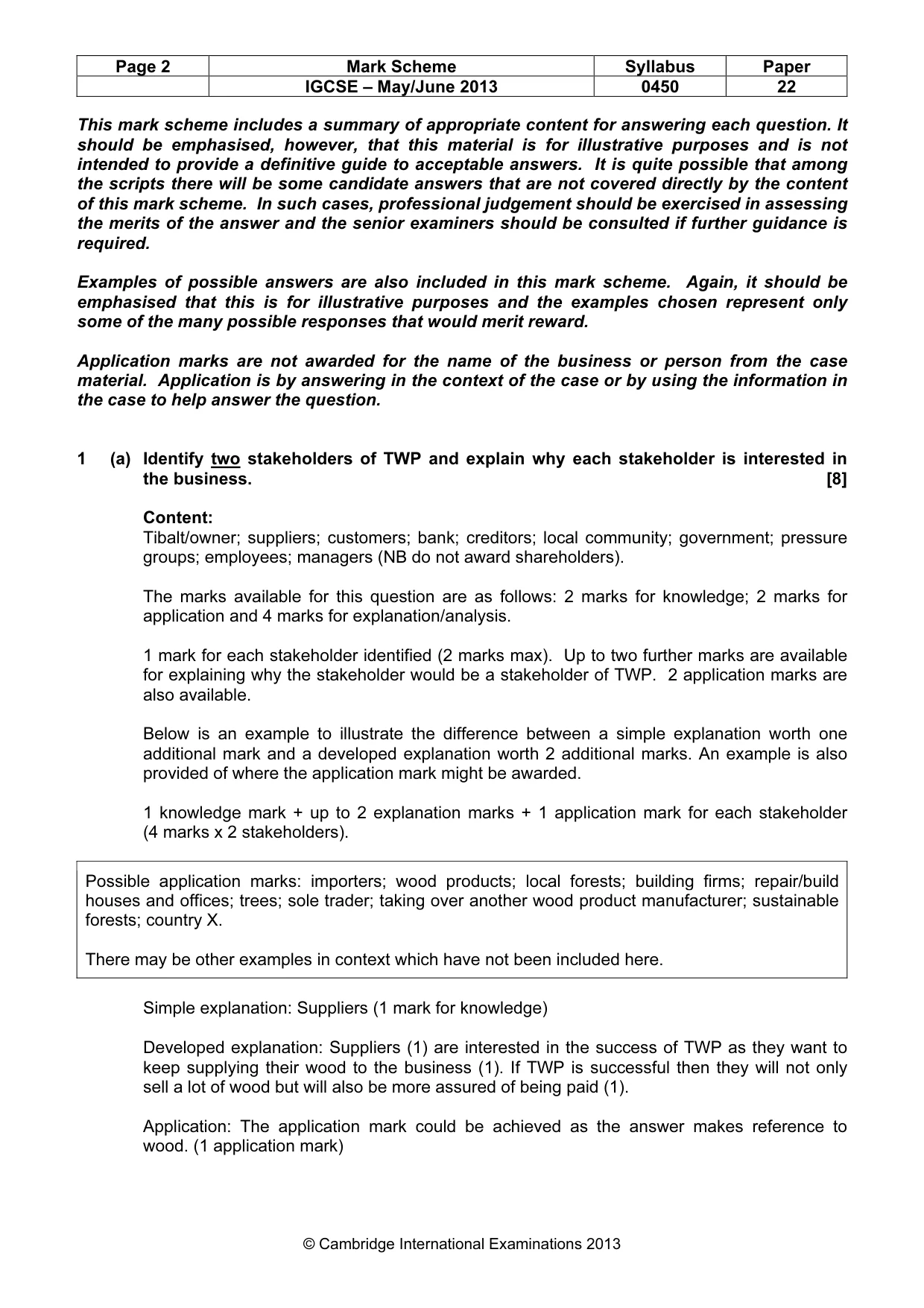
Page 2 Mark Scheme Syllabus Paper IGCSE – May/June 2013 0450 22 © Cambridge International Examinations 2013 This mark scheme includes a summary of appropriate content for answering each question. It should be emphasised, however, that this material is for illustrative purposes and is not intended to provide a definitive guide to acceptable answers. It is quite possible that among the scripts there will be some candidate answers that are not covered directly by the content of this mark scheme. In such cases, professional judgement should be exercised in assessing the merits of the answer and the senior examiners should be consulted if further guidance is required. Examples of possible answers are also included in this mark scheme. Again, it should be emphasised that this is for illustrative purposes and the examples chosen represent only some of the many possible responses that would merit reward. Application marks are not awarded for the name of the business or person from the case material. Application is by answering in the context of the case or by using the information in the case to help answer the question. 1 (a) Identify two stakeholders of TWP and explain why each stakeholder is interested in the business. [8] Content: Tibalt/owner; suppliers; customers; bank; creditors; local community; government; pressure groups; employees; managers (NB do not award shareholders). The marks available for this question are as follows: 2 marks for knowledge; 2 marks for application and 4 marks for explanation/analysis. 1 mark for each stakeholder identified (2 marks max). Up to two further marks are available for explaining why the stakeholder would be a stakeholder of TWP. 2 application marks are also available. Below is an example to illustrate the difference between a simple explanation worth one additional mark and a developed explanation worth 2 additional marks. An example is also provided of where the application mark might be awarded. 1 knowledge mark + up to 2 explanation marks + 1 application mark for each stakeholder (4 marks x 2 stakeholders). Possible application marks: importers; wood products; local forests; building firms; repair/build houses and offices; trees; sole trader; taking over another wood product manufacturer; sustainable forests; country X. There may be other examples in context which have not been included here. Simple explanation: Suppliers (1 mark for knowledge) Developed explanation: Suppliers (1) are interested in the success of TWP as they want to keep supplying their wood to the business (1). If TWP is successful then they will not only sell a lot of wood but will also be more assured of being paid (1). Application: The application mark could be achieved as the answer makes reference to wood. (1 application mark)
Mark scheme, page 3
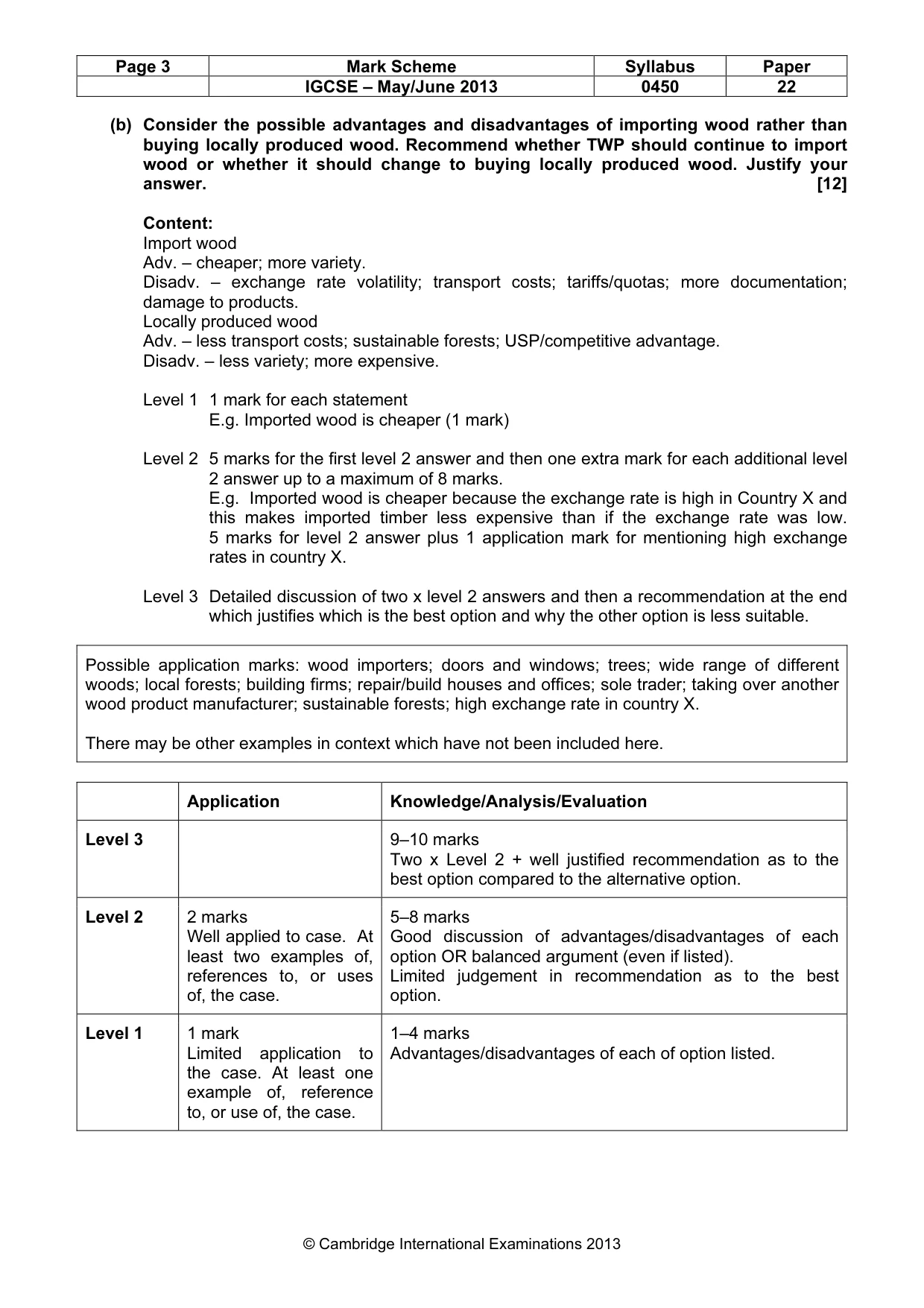
Page 3 Mark Scheme Syllabus Paper IGCSE – May/June 2013 0450 22 © Cambridge International Examinations 2013 (b) Consider the possible advantages and disadvantages of importing wood rather than buying locally produced wood. Recommend whether TWP should continue to import wood or whether it should change to buying locally produced wood. Justify your answer. [12] Content: Import wood Adv. – cheaper; more variety. Disadv. – exchange rate volatility; transport costs; tariffs/quotas; more documentation; damage to products. Locally produced wood Adv. – less transport costs; sustainable forests; USP/competitive advantage. Disadv. – less variety; more expensive. Level 1 1 mark for each statement E.g. Imported wood is cheaper (1 mark) Level 2 5 marks for the first level 2 answer and then one extra mark for each additional level 2 answer up to a maximum of 8 marks. E.g. Imported wood is cheaper because the exchange rate is high in Country X and this makes imported timber less expensive than if the exchange rate was low. 5 marks for level 2 answer plus 1 application mark for mentioning high exchange rates in country X. Level 3 Detailed discussion of two x level 2 answers and then a recommendation at the end which justifies which is the best option and why the other option is less suitable. Possible application marks: wood importers; doors and windows; trees; wide range of different woods; local forests; building firms; repair/build houses and offices; sole trader; taking over another wood product manufacturer; sustainable forests; high exchange rate in country X. There may be other examples in context which have not been included here. Application Knowledge/Analysis/Evaluation Level 3 9–10 marks Two x Level 2 + well justified recommendation as to the best option compared to the alternative option. Level 2 2 marks Well applied to case. At least two examples of, references to, or uses of, the case. 5–8 marks Good discussion of advantages/disadvantages of each option OR balanced argument (even if listed). Limited judgement in recommendation as to the best option. Level 1 1 mark Limited application to the case. At least one example of, reference to, or use of, the case. 1–4 marks Advantages/disadvantages of each of option listed.
Mark scheme, page 4
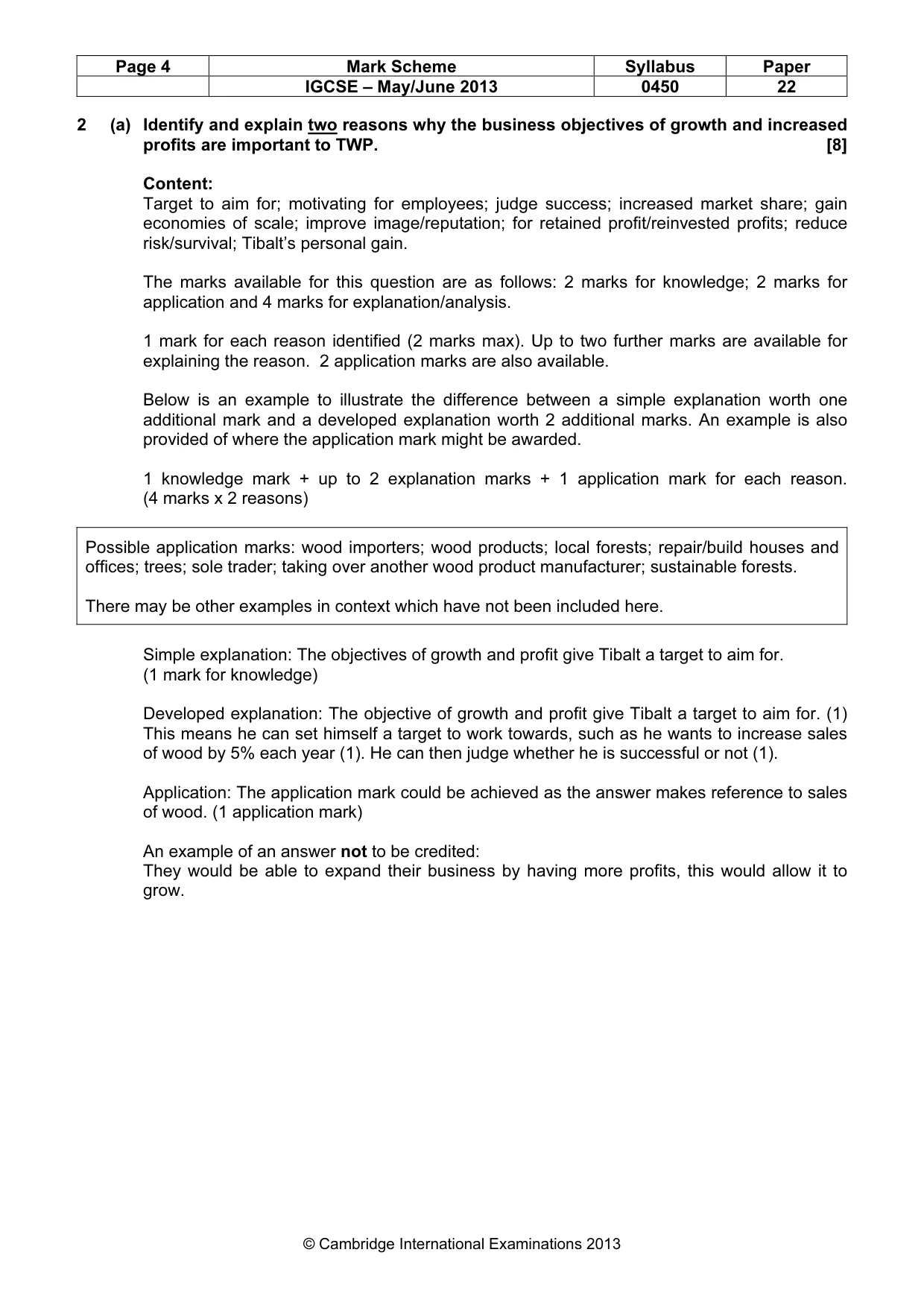
Page 4 Mark Scheme Syllabus Paper IGCSE – May/June 2013 0450 22 © Cambridge International Examinations 2013 2 (a) Identify and explain two reasons why the business objectives of growth and increased profits are important to TWP. [8] Content: Target to aim for; motivating for employees; judge success; increased market share; gain economies of scale; improve image/reputation; for retained profit/reinvested profits; reduce risk/survival; Tibalt’s personal gain. The marks available for this question are as follows: 2 marks for knowledge; 2 marks for application and 4 marks for explanation/analysis. 1 mark for each reason identified (2 marks max). Up to two further marks are available for explaining the reason. 2 application marks are also available. Below is an example to illustrate the difference between a simple explanation worth one additional mark and a developed explanation worth 2 additional marks. An example is also provided of where the application mark might be awarded. 1 knowledge mark + up to 2 explanation marks + 1 application mark for each reason. (4 marks x 2 reasons) Possible application marks: wood importers; wood products; local forests; repair/build houses and offices; trees; sole trader; taking over another wood product manufacturer; sustainable forests. There may be other examples in context which have not been included here. Simple explanation: The objectives of growth and profit give Tibalt a target to aim for. (1 mark for knowledge) Developed explanation: The objective of growth and profit give Tibalt a target to aim for. (1) This means he can set himself a target to work towards, such as he wants to increase sales of wood by 5% each year (1). He can then judge whether he is successful or not (1). Application: The application mark could be achieved as the answer makes reference to sales of wood. (1 application mark) An example of an answer not to be credited: They would be able to expand their business by having more profits, this would allow it to grow.
Mark scheme, page 5
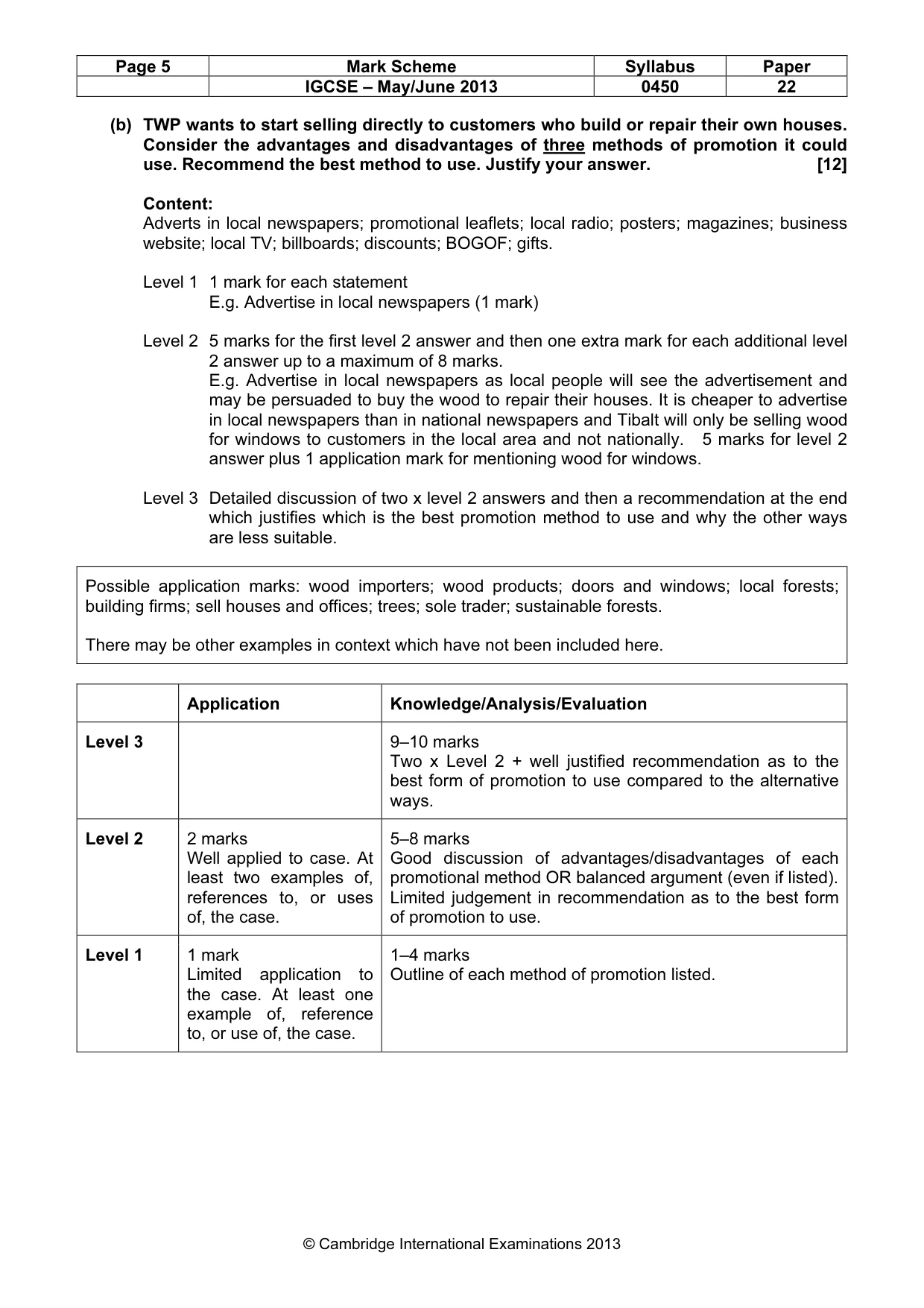
Page 5 Mark Scheme Syllabus Paper IGCSE – May/June 2013 0450 22 © Cambridge International Examinations 2013 (b) TWP wants to start selling directly to customers who build or repair their own houses. Consider the advantages and disadvantages of three methods of promotion it could use. Recommend the best method to use. Justify your answer. [12] Content: Adverts in local newspapers; promotional leaflets; local radio; posters; magazines; business website; local TV; billboards; discounts; BOGOF; gifts. Level 1 1 mark for each statement E.g. Advertise in local newspapers (1 mark) Level 2 5 marks for the first level 2 answer and then one extra mark for each additional level 2 answer up to a maximum of 8 marks. E.g. Advertise in local newspapers as local people will see the advertisement and may be persuaded to buy the wood to repair their houses. It is cheaper to advertise in local newspapers than in national newspapers and Tibalt will only be selling wood for windows to customers in the local area and not nationally. 5 marks for level 2 answer plus 1 application mark for mentioning wood for windows. Level 3 Detailed discussion of two x level 2 answers and then a recommendation at the end which justifies which is the best promotion method to use and why the other ways are less suitable. Possible application marks: wood importers; wood products; doors and windows; local forests; building firms; sell houses and offices; trees; sole trader; sustainable forests. There may be other examples in context which have not been included here. Application Knowledge/Analysis/Evaluation Level 3 9–10 marks Two x Level 2 + well justified recommendation as to the best form of promotion to use compared to the alternative ways. Level 2 2 marks Well applied to case. At least two examples of, references to, or uses of, the case. 5–8 marks Good discussion of advantages/disadvantages of each promotional method OR balanced argument (even if listed). Limited judgement in recommendation as to the best form of promotion to use. Level 1 1 mark Limited application to the case. At least one example of, reference to, or use of, the case. 1–4 marks Outline of each method of promotion listed.
Mark scheme, page 6
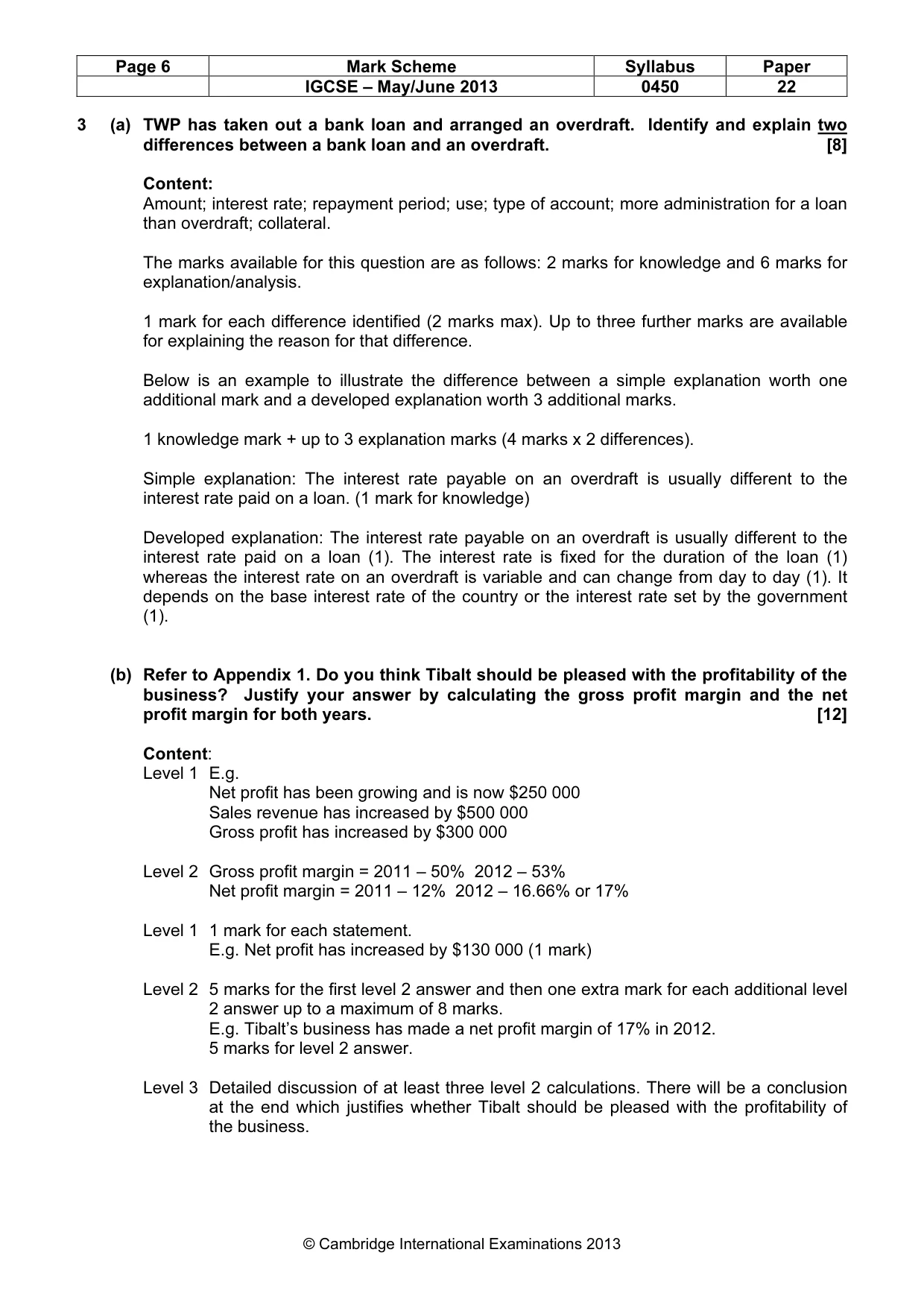
Page 6 Mark Scheme Syllabus Paper IGCSE – May/June 2013 0450 22 © Cambridge International Examinations 2013 3 (a) TWP has taken out a bank loan and arranged an overdraft. Identify and explain two differences between a bank loan and an overdraft. [8] Content: Amount; interest rate; repayment period; use; type of account; more administration for a loan than overdraft; collateral. The marks available for this question are as follows: 2 marks for knowledge and 6 marks for explanation/analysis. 1 mark for each difference identified (2 marks max). Up to three further marks are available for explaining the reason for that difference. Below is an example to illustrate the difference between a simple explanation worth one additional mark and a developed explanation worth 3 additional marks. 1 knowledge mark + up to 3 explanation marks (4 marks x 2 differences). Simple explanation: The interest rate payable on an overdraft is usually different to the interest rate paid on a loan. (1 mark for knowledge) Developed explanation: The interest rate payable on an overdraft is usually different to the interest rate paid on a loan (1). The interest rate is fixed for the duration of the loan (1) whereas the interest rate on an overdraft is variable and can change from day to day (1). It depends on the base interest rate of the country or the interest rate set by the government (1). (b) Refer to Appendix 1. Do you think Tibalt should be pleased with the profitability of the business? Justify your answer by calculating the gross profit margin and the net profit margin for both years. [12] Content: Level 1 E.g. Net profit has been growing and is now $250 000 Sales revenue has increased by $500 000 Gross profit has increased by $300 000 Level 2 Gross profit margin = 2011 – 50% 2012 – 53% Net profit margin = 2011 – 12% 2012 – 16.66% or 17% Level 1 1 mark for each statement. E.g. Net profit has increased by $130 000 (1 mark) Level 2 5 marks for the first level 2 answer and then one extra mark for each additional level 2 answer up to a maximum of 8 marks. E.g. Tibalt’s business has made a net profit margin of 17% in 2012. 5 marks for level 2 answer. Level 3 Detailed discussion of at least three level 2 calculations. There will be a conclusion at the end which justifies whether Tibalt should be pleased with the profitability of the business.
Mark scheme, page 7
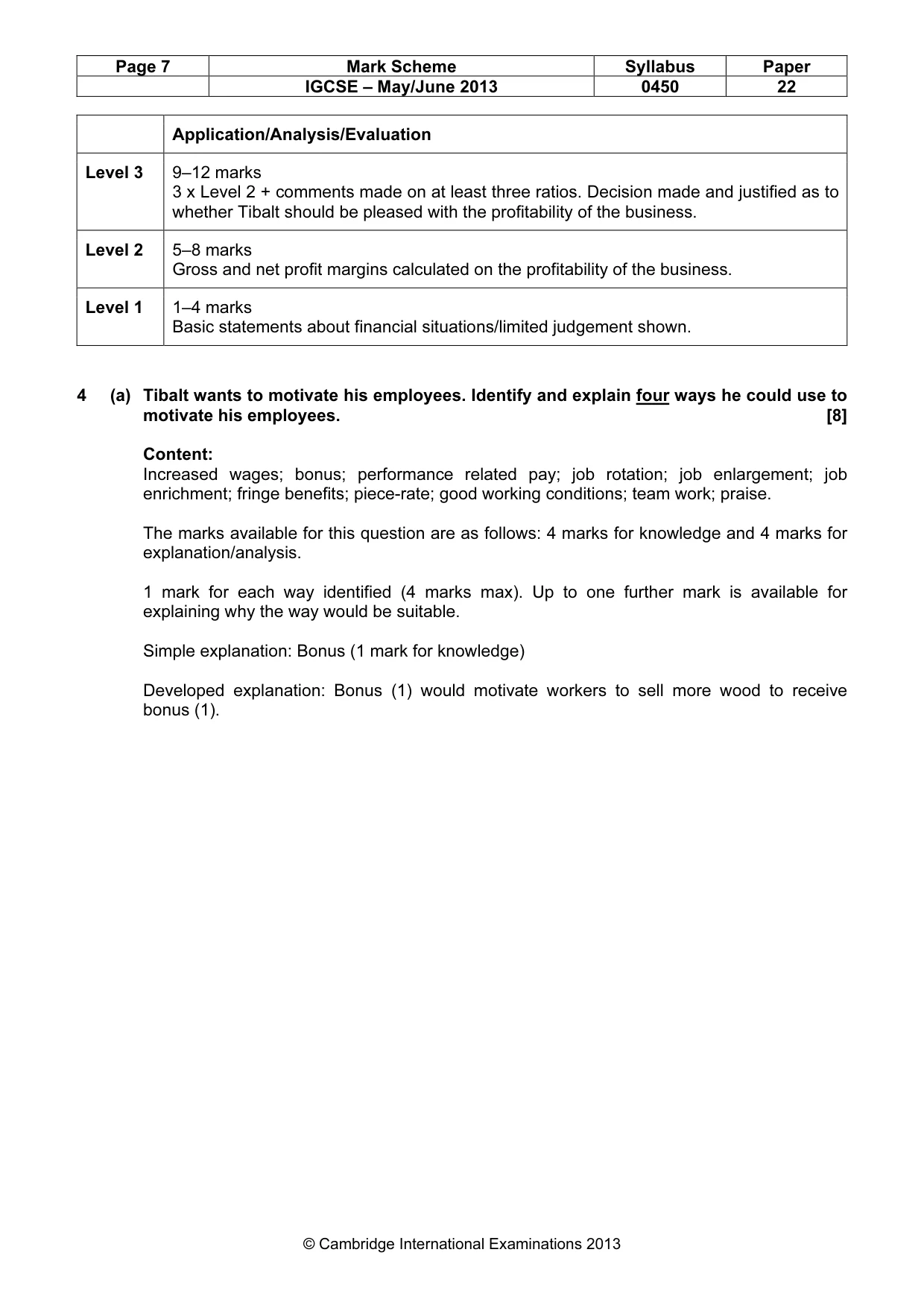
Page 7 Mark Scheme Syllabus Paper IGCSE – May/June 2013 0450 22 © Cambridge International Examinations 2013 Application/Analysis/Evaluation Level 3 9–12 marks 3 x Level 2 + comments made on at least three ratios. Decision made and justified as to whether Tibalt should be pleased with the profitability of the business. Level 2 5–8 marks Gross and net profit margins calculated on the profitability of the business. Level 1 1–4 marks Basic statements about financial situations/limited judgement shown. 4 (a) Tibalt wants to motivate his employees. Identify and explain four ways he could use to motivate his employees. [8] Content: Increased wages; bonus; performance related pay; job rotation; job enlargement; job enrichment; fringe benefits; piece-rate; good working conditions; team work; praise. The marks available for this question are as follows: 4 marks for knowledge and 4 marks for explanation/analysis. 1 mark for each way identified (4 marks max). Up to one further mark is available for explaining why the way would be suitable. Simple explanation: Bonus (1 mark for knowledge) Developed explanation: Bonus (1) would motivate workers to sell more wood to receive bonus (1).
Mark scheme, page 8
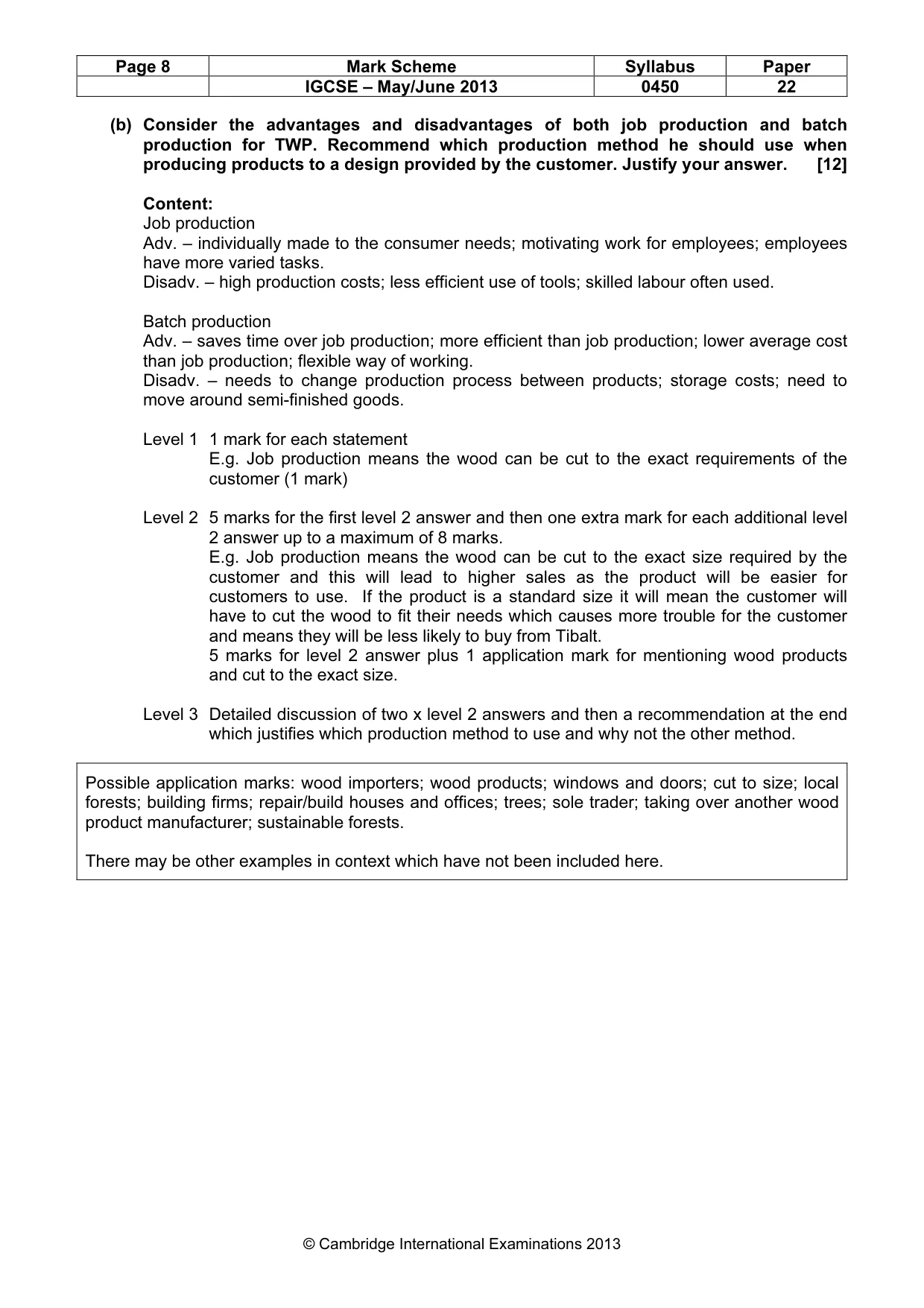
Page 8 Mark Scheme Syllabus Paper IGCSE – May/June 2013 0450 22 © Cambridge International Examinations 2013 (b) Consider the advantages and disadvantages of both job production and batch production for TWP. Recommend which production method he should use when producing products to a design provided by the customer. Justify your answer. [12] Content: Job production Adv. – individually made to the consumer needs; motivating work for employees; employees have more varied tasks. Disadv. – high production costs; less efficient use of tools; skilled labour often used. Batch production Adv. – saves time over job production; more efficient than job production; lower average cost than job production; flexible way of working. Disadv. – needs to change production process between products; storage costs; need to move around semi-finished goods. Level 1 1 mark for each statement E.g. Job production means the wood can be cut to the exact requirements of the customer (1 mark) Level 2 5 marks for the first level 2 answer and then one extra mark for each additional level 2 answer up to a maximum of 8 marks. E.g. Job production means the wood can be cut to the exact size required by the customer and this will lead to higher sales as the product will be easier for customers to use. If the product is a standard size it will mean the customer will have to cut the wood to fit their needs which causes more trouble for the customer and means they will be less likely to buy from Tibalt. 5 marks for level 2 answer plus 1 application mark for mentioning wood products and cut to the exact size. Level 3 Detailed discussion of two x level 2 answers and then a recommendation at the end which justifies which production method to use and why not the other method. Possible application marks: wood importers; wood products; windows and doors; cut to size; local forests; building firms; repair/build houses and offices; trees; sole trader; taking over another wood product manufacturer; sustainable forests. There may be other examples in context which have not been included here.
Mark scheme, page 9
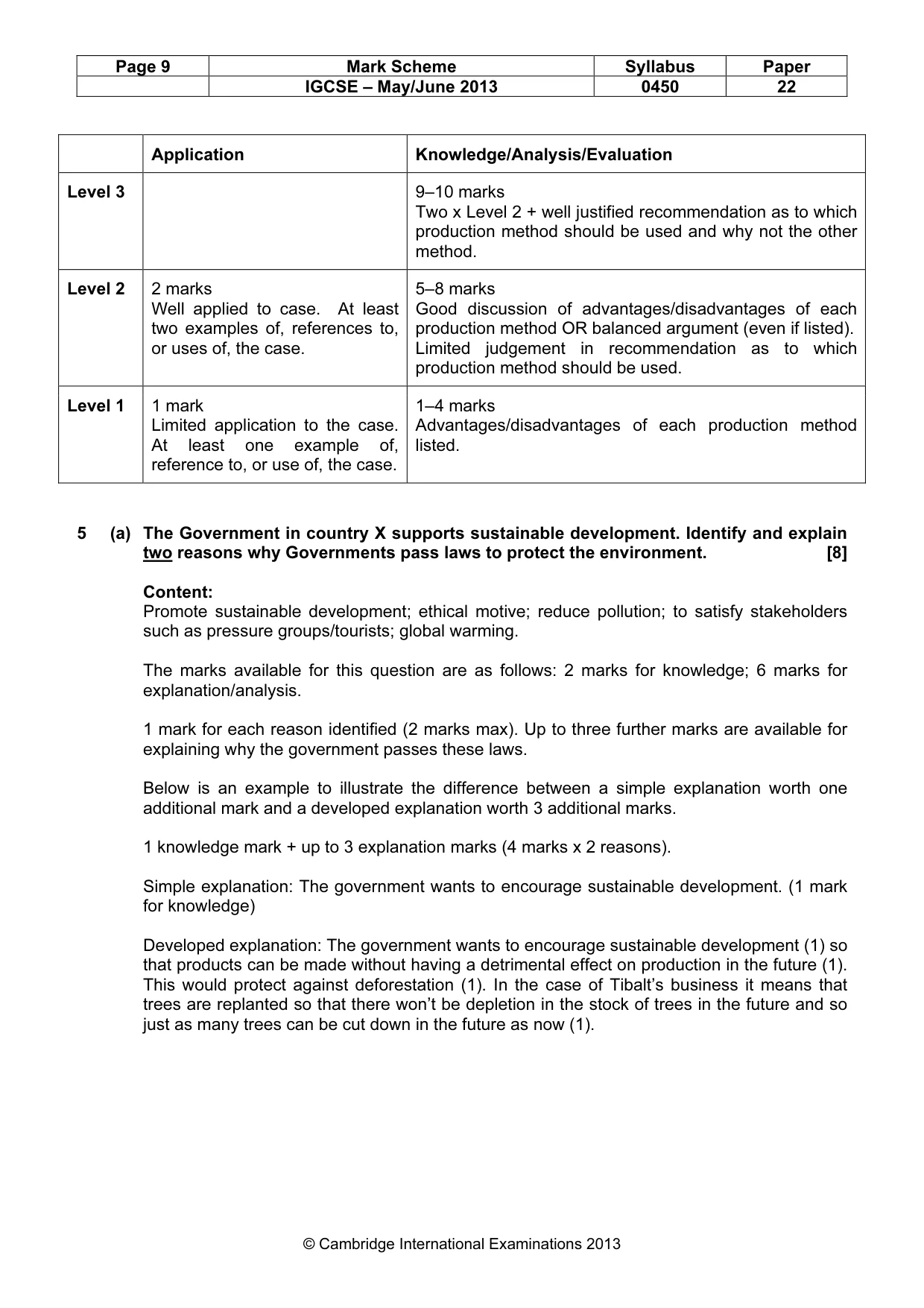
Page 9 Mark Scheme Syllabus Paper IGCSE – May/June 2013 0450 22 © Cambridge International Examinations 2013 Application Knowledge/Analysis/Evaluation Level 3 9–10 marks Two x Level 2 + well justified recommendation as to which production method should be used and why not the other method. Level 2 2 marks Well applied to case. At least two examples of, references to, or uses of, the case. 5–8 marks Good discussion of advantages/disadvantages of each production method OR balanced argument (even if listed). Limited judgement in recommendation as to which production method should be used. Level 1 1 mark Limited application to the case. At least one example of, reference to, or use of, the case. 1–4 marks Advantages/disadvantages of each production method listed. 5 (a) The Government in country X supports sustainable development. Identify and explain two reasons why Governments pass laws to protect the environment. [8] Content: Promote sustainable development; ethical motive; reduce pollution; to satisfy stakeholders such as pressure groups/tourists; global warming. The marks available for this question are as follows: 2 marks for knowledge; 6 marks for explanation/analysis. 1 mark for each reason identified (2 marks max). Up to three further marks are available for explaining why the government passes these laws. Below is an example to illustrate the difference between a simple explanation worth one additional mark and a developed explanation worth 3 additional marks. 1 knowledge mark + up to 3 explanation marks (4 marks x 2 reasons). Simple explanation: The government wants to encourage sustainable development. (1 mark for knowledge) Developed explanation: The government wants to encourage sustainable development (1) so that products can be made without having a detrimental effect on production in the future (1). This would protect against deforestation (1). In the case of Tibalt’s business it means that trees are replanted so that there won’t be depletion in the stock of trees in the future and so just as many trees can be cut down in the future as now (1).
Mark scheme, page 10
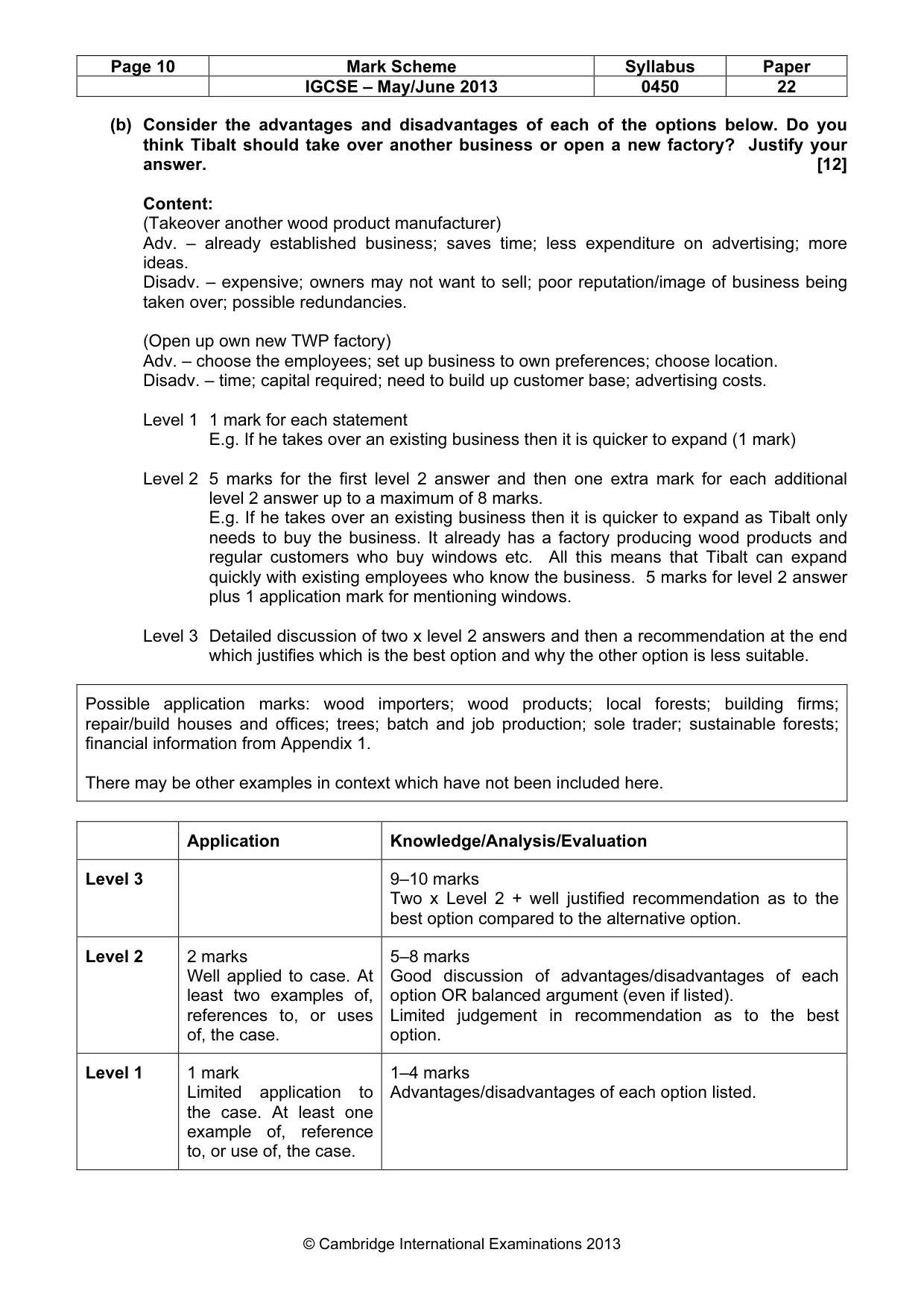
Page 10 Mark Scheme Syllabus Paper IGCSE – May/June 2013 0450 22 © Cambridge International Examinations 2013 (b) Consider the advantages and disadvantages of each of the options below. Do you think Tibalt should take over another business or open a new factory? Justify your answer. [12] Content: (Takeover another wood product manufacturer) Adv. – already established business; saves time; less expenditure on advertising; more ideas. Disadv. – expensive; owners may not want to sell; poor reputation/image of business being taken over; possible redundancies. (Open up own new TWP factory) Adv. – choose the employees; set up business to own preferences; choose location. Disadv. – time; capital required; need to build up customer base; advertising costs. Level 1 1 mark for each statement E.g. If he takes over an existing business then it is quicker to expand (1 mark) Level 2 5 marks for the first level 2 answer and then one extra mark for each additional level 2 answer up to a maximum of 8 marks. E.g. If he takes over an existing business then it is quicker to expand as Tibalt only needs to buy the business. It already has a factory producing wood products and regular customers who buy windows etc. All this means that Tibalt can expand quickly with existing employees who know the business. 5 marks for level 2 answer plus 1 application mark for mentioning windows. Level 3 Detailed discussion of two x level 2 answers and then a recommendation at the end which justifies which is the best option and why the other option is less suitable. Possible application marks: wood importers; wood products; local forests; building firms; repair/build houses and offices; trees; batch and job production; sole trader; sustainable forests; financial information from Appendix 1. There may be other examples in context which have not been included here. Application Knowledge/Analysis/Evaluation Level 3 9–10 marks Two x Level 2 + well justified recommendation as to the best option compared to the alternative option. Level 2 2 marks Well applied to case. At least two examples of, references to, or uses of, the case. 5–8 marks Good discussion of advantages/disadvantages of each option OR balanced argument (even if listed). Limited judgement in recommendation as to the best option. Level 1 1 mark Limited application to the case. At least one example of, reference to, or use of, the case. 1–4 marks Advantages/disadvantages of each option listed.
What you needed in this session
Cambridge’s own grade thresholds for 2013 May/June, Paper 2 · Variant 2. A higher threshold means an easier paper — the bar moves with how the cohort did.