Cambridge IGCSE Business Studies 0450 — 2012 Oct/Nov Paper 1 · Variant 2
0450/12/O/N/12 · 100 marks · ≈113 min
The question paper and its mark scheme, free to read here and free to download. This is Cambridge’s own paper, exactly as it was sat.
Question paper12 pages

Mark scheme10 pages
Answers below. Sit the paper first if you are practising.
Paper as text
Question paper, page 1
This document consists of 11 printed pages and 1 blank page. DC (LEO/SW) 49285/1 © UCLES 2012 [Turn over UNIVERSITY OF CAMBRIDGE INTERNATIONAL EXAMINATIONS International General Certificate of Secondary Education * 8 8 6 2 3 9 8 7 2 5 * BUSINESS STUDIES 0450/12 Paper 1 October/November 2012 1 hour 45 minutes Candidates answer on the Question Paper. No Additional Materials are required. READ THESE INSTRUCTIONS FIRST Write your Centre number, candidate number and name on all the work you hand in. Write in dark blue or black pen. Do not use staples, paper clips, highlighters, glue or correction fluid. DO NOT WRITE IN ANY BARCODES. Answer all questions. The businesses described in this question paper are entirely fictitious. At the end of the examination, fasten all your work securely together. The number of marks is given in brackets [ ] at the end of each question or part question. For Examiner’s Use 1 2 3 4 5 Total
Question paper, page 2
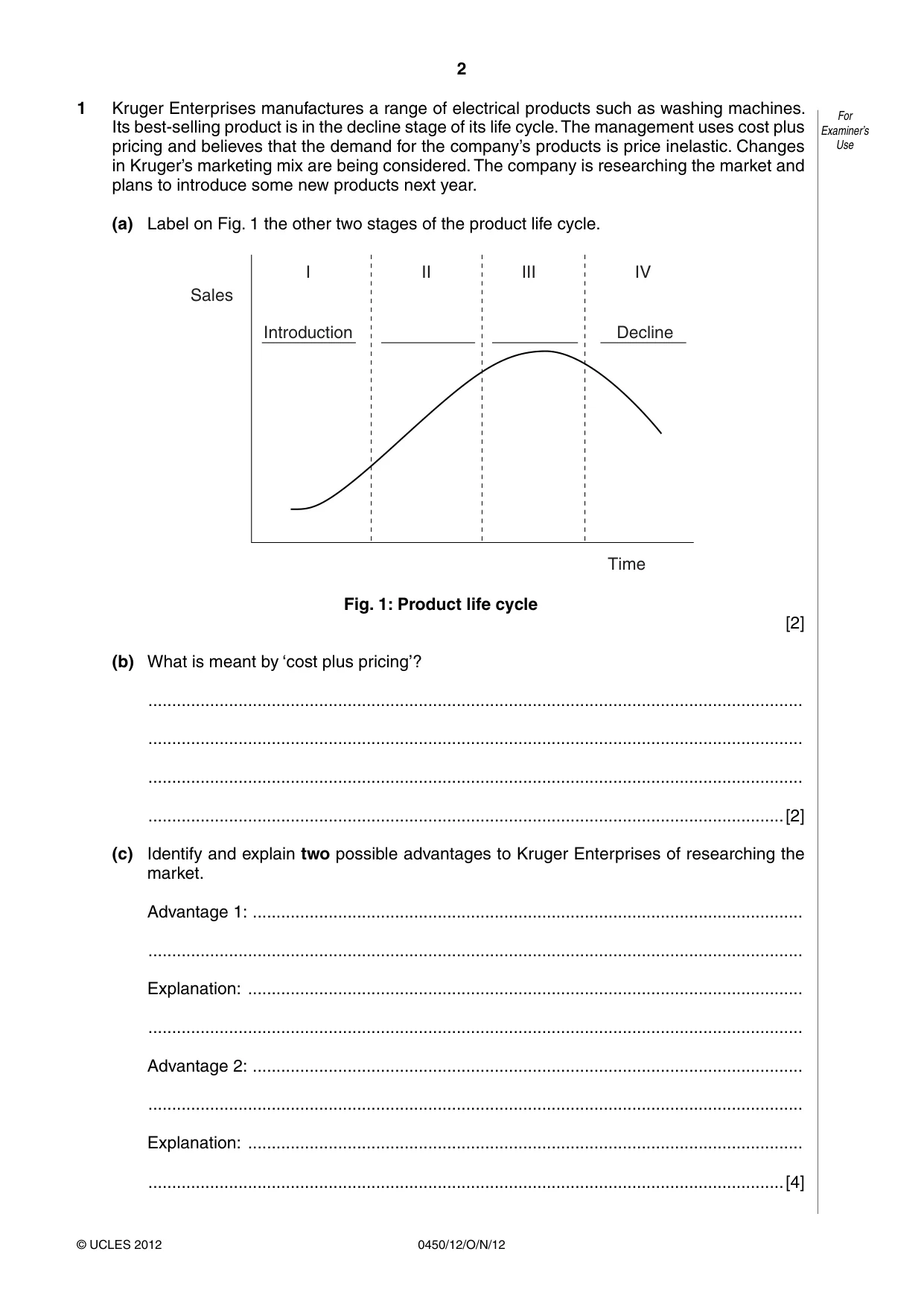
2 0450/12/O/N/12 © UCLES 2012 For Examiner’s Use 1 Kruger Enterprises manufactures a range of electrical products such as washing machines. Its best-selling product is in the decline stage of its life cycle. The management uses cost plus pricing and believes that the demand for the company’s products is price inelastic. Changes in Kruger’s marketing mix are being considered. The company is researching the market and plans to introduce some new products next year. (a) Label on Fig. 1 the other two stages of the product life cycle. Time Sales Introduction I II III IV Decline Fig. 1: Product life cycle [2] (b) What is meant by ‘cost plus pricing’? … … … …[2] (c) Identify and explain two possible advantages to Kruger Enterprises of researching the market. Advantage 1: … … Explanation: … … Advantage 2: … … Explanation: … …[4]
Question paper, page 3
3 0450/12/O/N/12 © UCLES 2012 [Turn over For Examiner’s Use (d) Identify and explain three benefits to Kruger Enterprises of introducing new products. Benefit 1: … … Explanation: … … Benefit 2: … … Explanation: … … Benefit 3: … … Explanation: … …[6] (e) Do you think reducing the price of its washing machines will increase the sales turnover of Kruger Enterprises? Justify your answer. … … … … … … … … … … … …[6]
Question paper, page 4
4 0450/12/O/N/12 © UCLES 2012 For Examiner’s Use 2 Just4U manufactures motor car parts. The production methods are capital intensive. The management believes that the company benefits from economies of scale. However, problems with the workers in the factory have led to poor quality production. Despite this, the Managing Director believes that the company must continue to grow if it is to achieve its objectives. The business is planning a takeover of a competitor. (a) What is meant by ‘capital intensive’? … … … …[2] (b) Identify two objectives that a business like Just4U might have. Objective 1: … … Objective 2: … …[2] (c) Identify and explain two economies of scale from which Just4U could benefit. Economy of scale 1: … … Explanation: … … Economy of scale 2: … … Explanation: … …[4]
Question paper, page 5
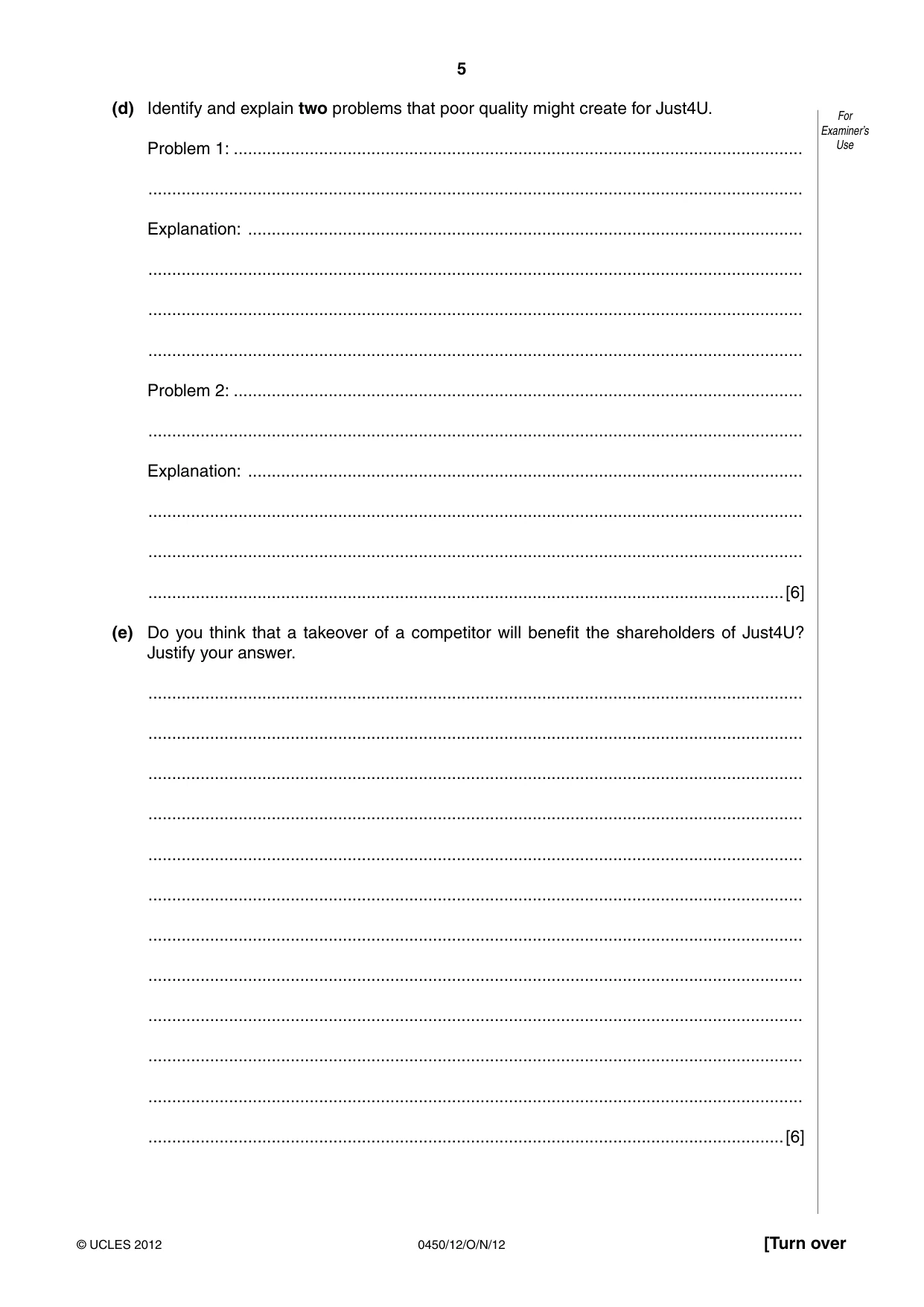
5 0450/12/O/N/12 © UCLES 2012 [Turn over For Examiner’s Use (d) Identify and explain two problems that poor quality might create for Just4U. Problem 1: … … Explanation: … … … … Problem 2: … … Explanation: … … … …[6] (e) Do you think that a takeover of a competitor will benefit the shareholders of Just4U? Justify your answer. … … … … … … … … … … … …[6]
Question paper, page 6
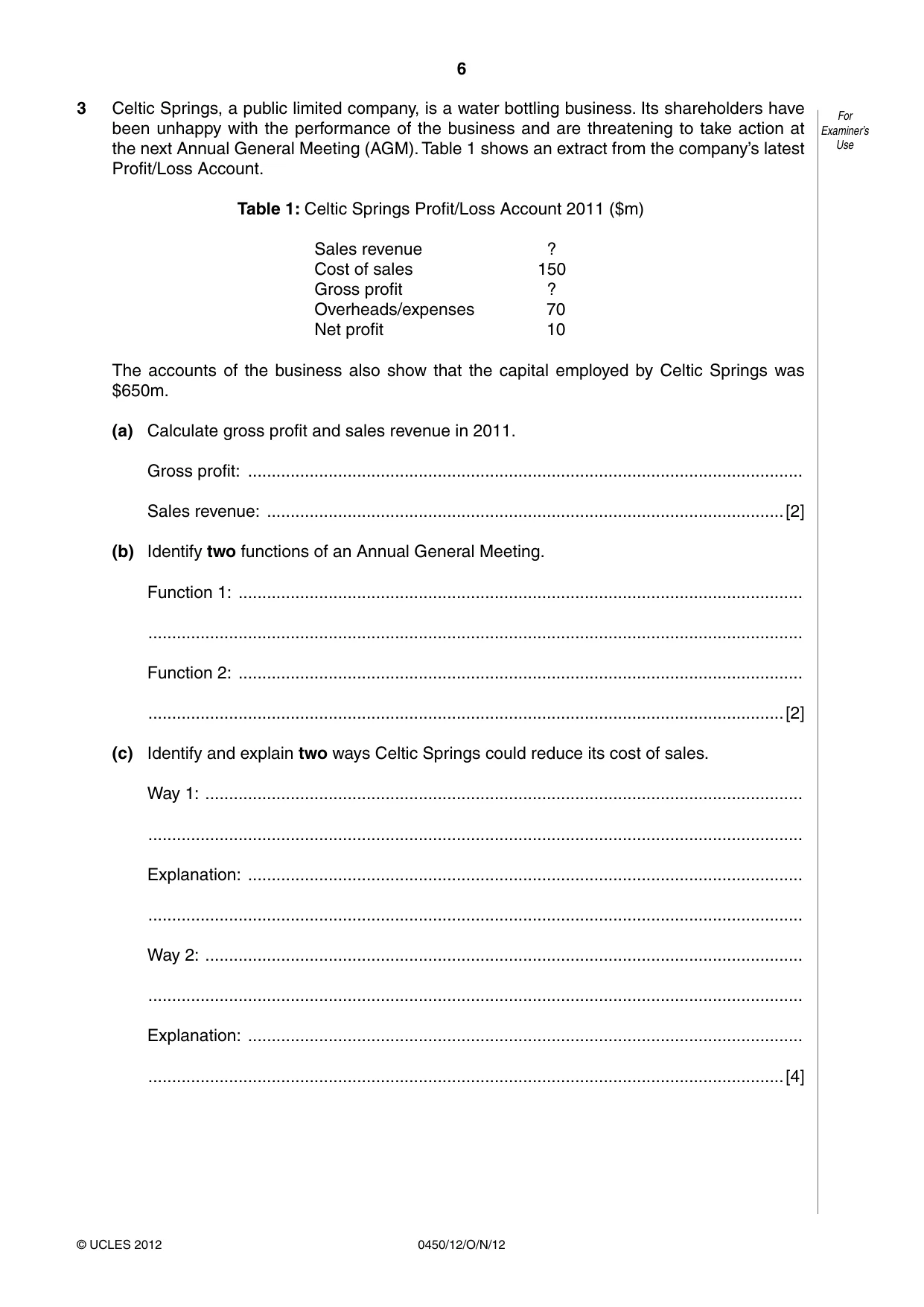
6 0450/12/O/N/12 © UCLES 2012 For Examiner’s Use 3 Celtic Springs, a public limited company, is a water bottling business. Its shareholders have been unhappy with the performance of the business and are threatening to take action at the next Annual General Meeting (AGM). Table 1 shows an extract from the company’s latest Profit/Loss Account. Table 1: Celtic Springs Profit/Loss Account 2011 ($m) Sales revenue ? Cost of sales 150 Gross profit ? Overheads/expenses 70 Net profit 10 The accounts of the business also show that the capital employed by Celtic Springs was $650m. (a) Calculate gross profit and sales revenue in 2011. Gross profit: … Sales revenue: …[2] (b) Identify two functions of an Annual General Meeting. Function 1: … … Function 2: … …[2] (c) Identify and explain two ways Celtic Springs could reduce its cost of sales. Way 1: … … Explanation: … … Way 2: … … Explanation: … …[4]
Question paper, page 7
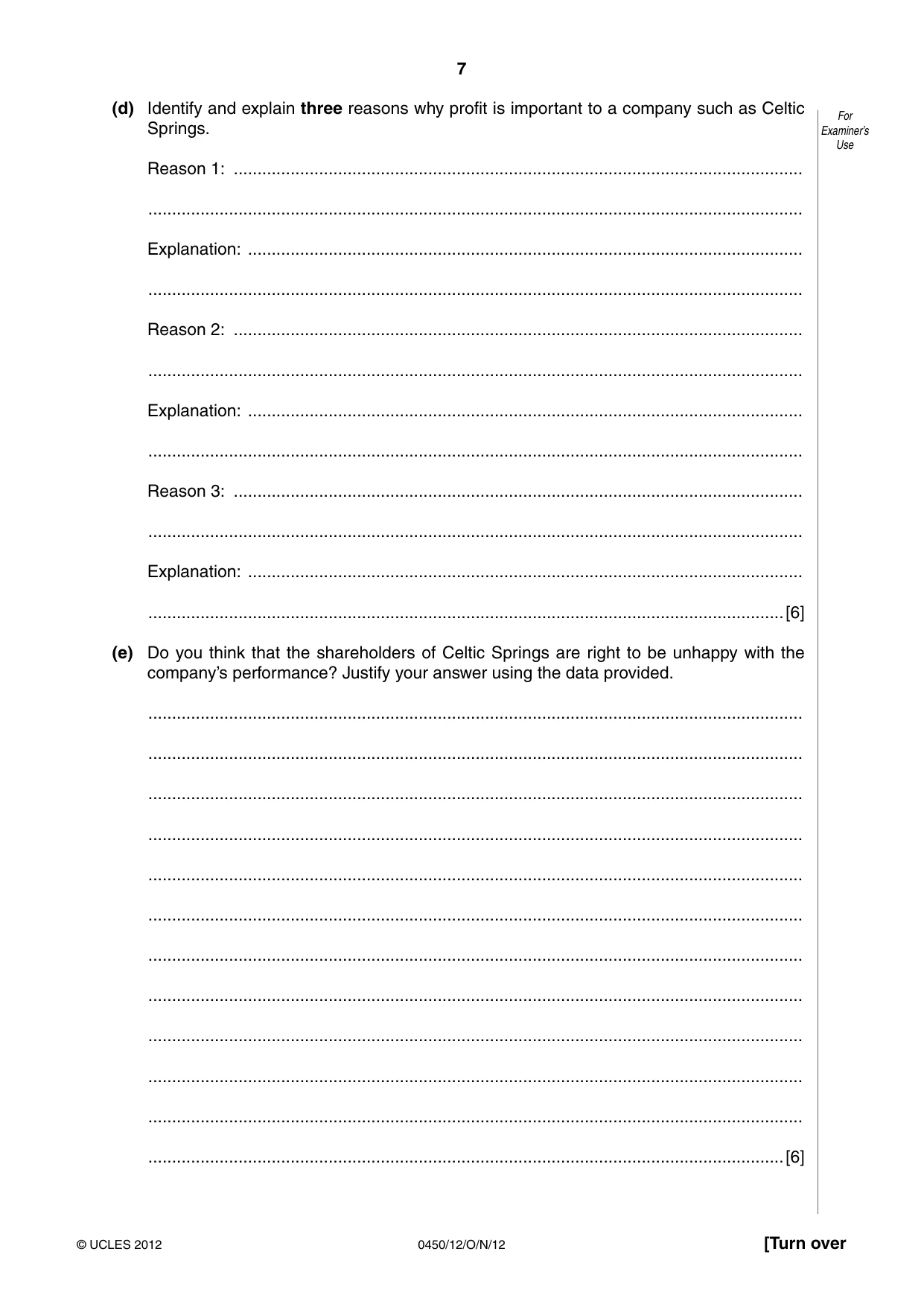
7 0450/12/O/N/12 © UCLES 2012 [Turn over For Examiner’s Use (d) Identify and explain three reasons why profit is important to a company such as Celtic Springs. Reason 1: … … Explanation: … … Reason 2: … … Explanation: … … Reason 3: … … Explanation: … …[6] (e) Do you think that the shareholders of Celtic Springs are right to be unhappy with the company’s performance? Justify your answer using the data provided. … … … … … … … … … … … …[6]
Question paper, page 8
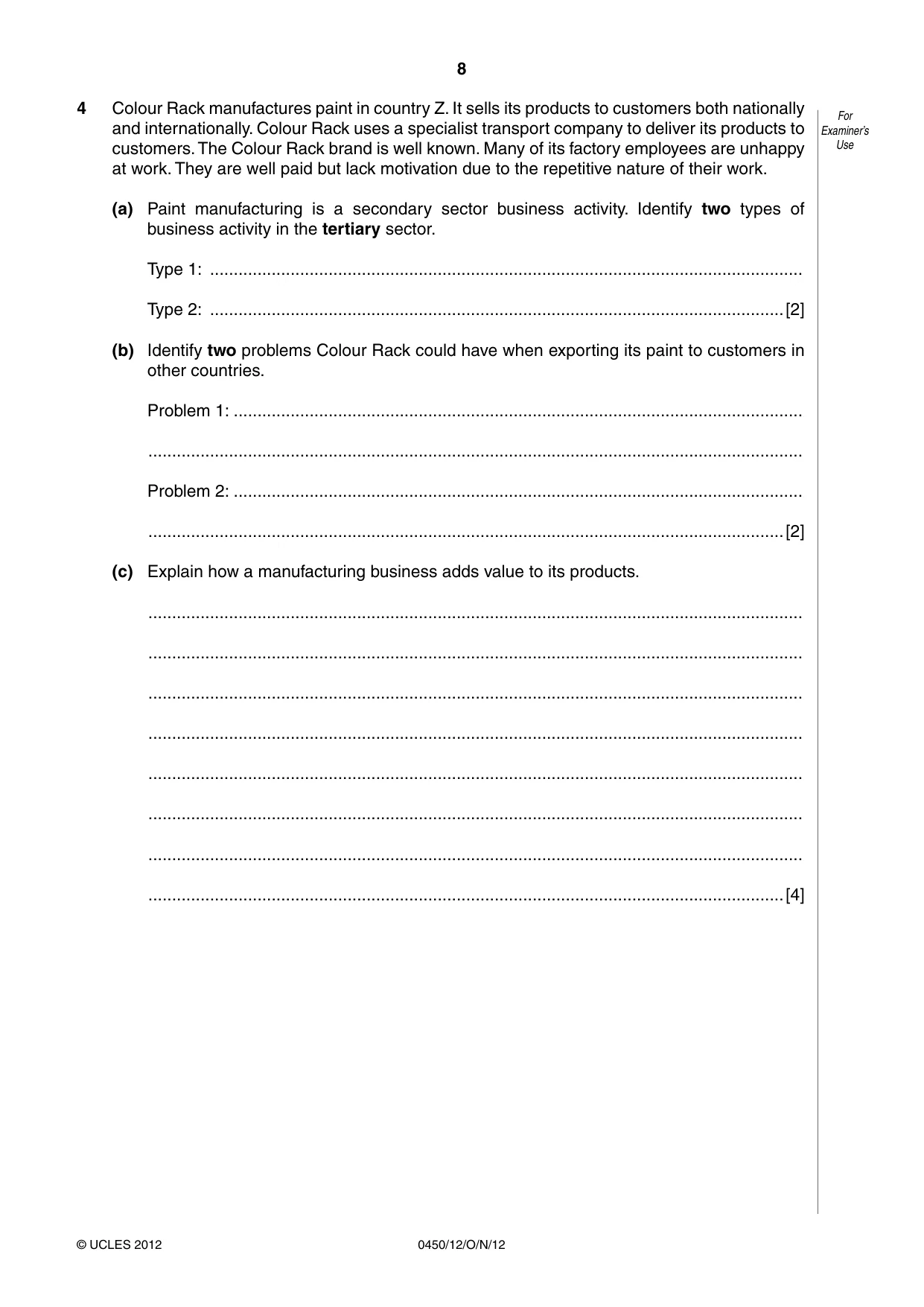
8 0450/12/O/N/12 © UCLES 2012 For Examiner’s Use 4 Colour Rack manufactures paint in country Z. It sells its products to customers both nationally and internationally. Colour Rack uses a specialist transport company to deliver its products to customers. The Colour Rack brand is well known. Many of its factory employees are unhappy at work. They are well paid but lack motivation due to the repetitive nature of their work. (a) Paint manufacturing is a secondary sector business activity. Identify two types of business activity in the tertiary sector. Type 1: … Type 2: …[2] (b) Identify two problems Colour Rack could have when exporting its paint to customers in other countries. Problem 1: … … Problem 2: … …[2] (c) Explain how a manufacturing business adds value to its products. … … … … … … … …[4]
Question paper, page 9
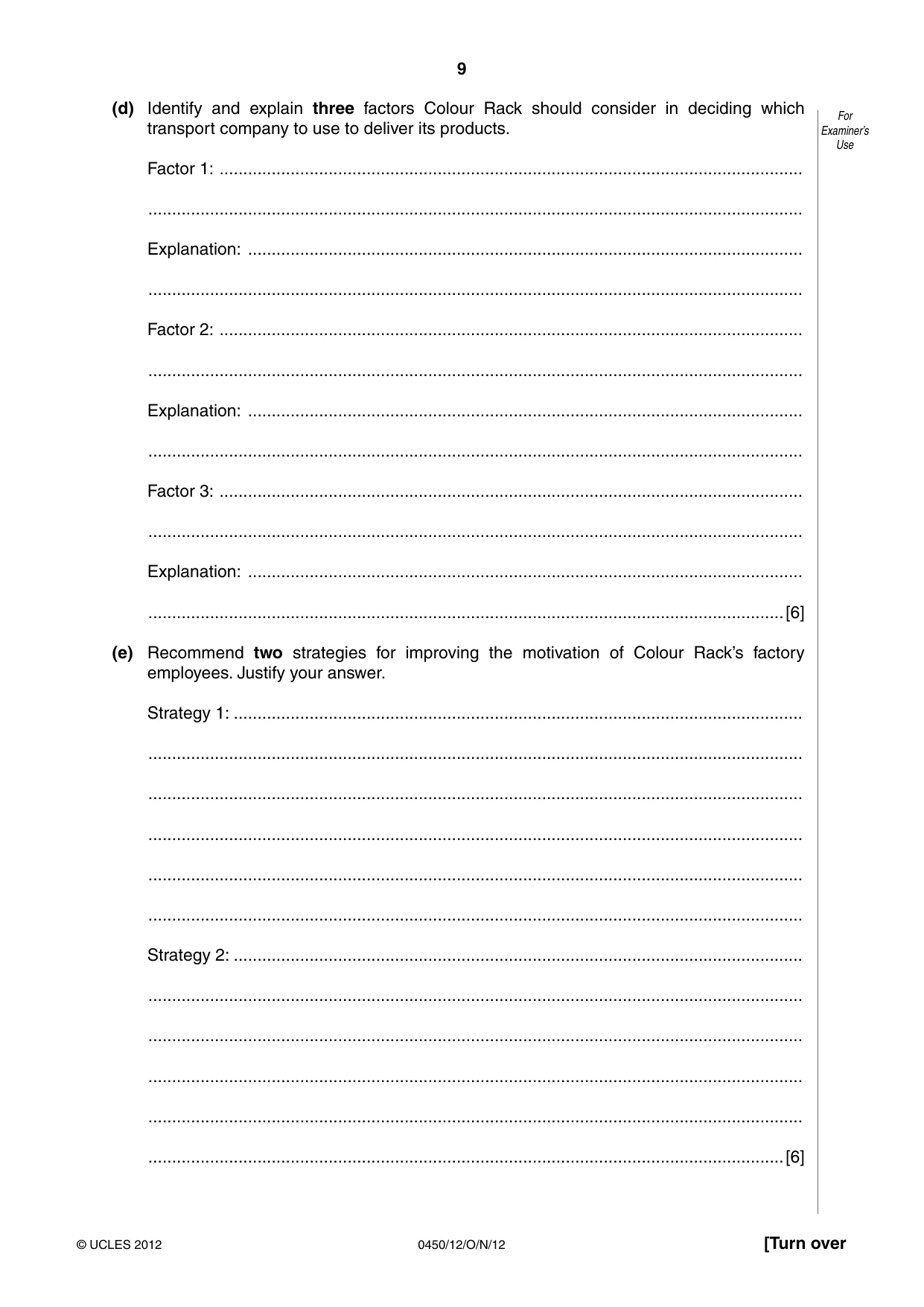
9 0450/12/O/N/12 © UCLES 2012 [Turn over For Examiner’s Use (d) Identify and explain three factors Colour Rack should consider in deciding which transport company to use to deliver its products. Factor 1: … … Explanation: … … Factor 2: … … Explanation: … … Factor 3: … … Explanation: … …[6] (e) Recommend two strategies for improving the motivation of Colour Rack’s factory employees. Justify your answer. Strategy 1: … … … … … … Strategy 2: … … … … … …[6]
Question paper, page 10
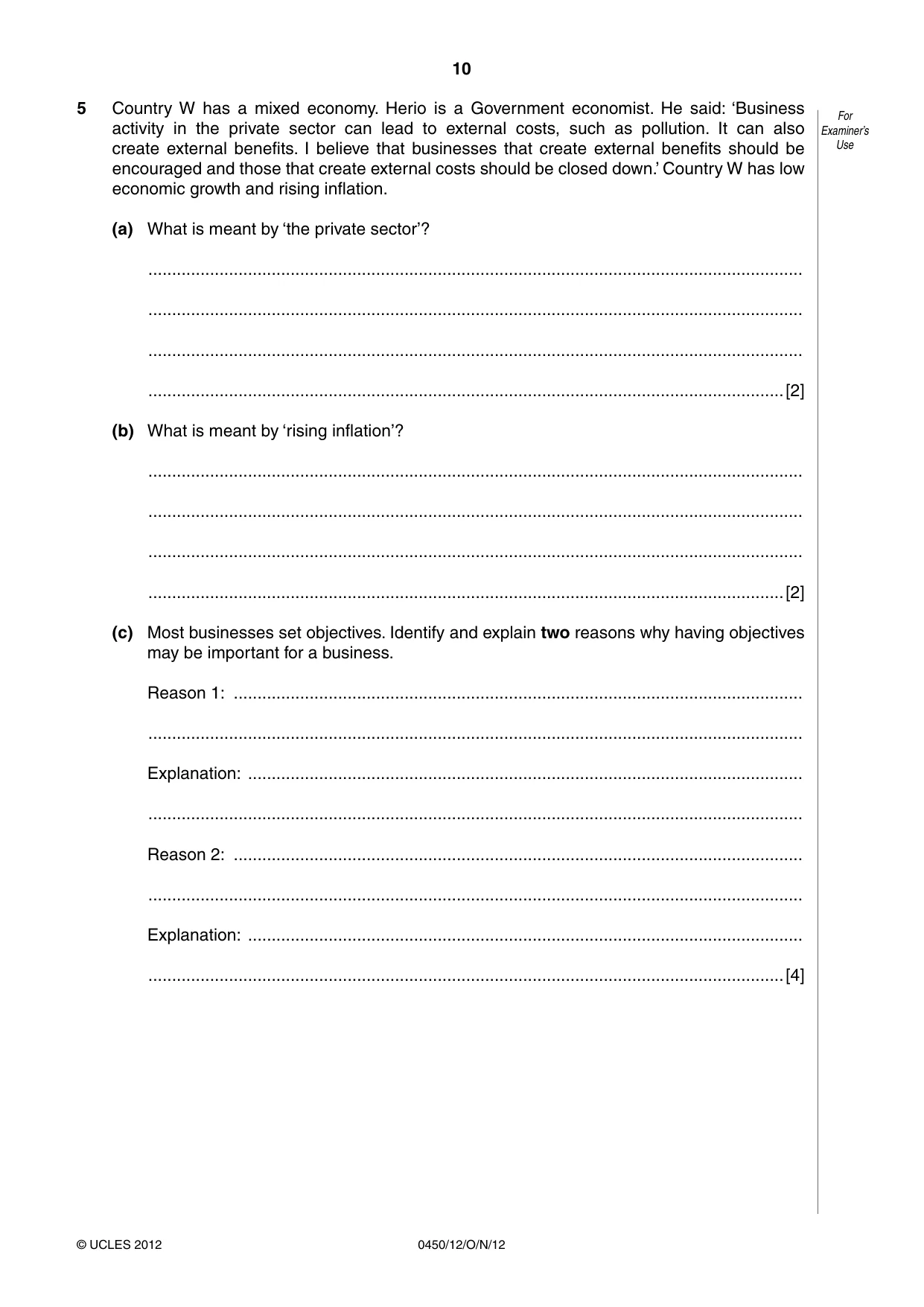
10 0450/12/O/N/12 © UCLES 2012 For Examiner’s Use 5 Country W has a mixed economy. Herio is a Government economist. He said: ‘Business activity in the private sector can lead to external costs, such as pollution. It can also create external benefits. I believe that businesses that create external benefits should be encouraged and those that create external costs should be closed down.’ Country W has low economic growth and rising inflation. (a) What is meant by ‘the private sector’? … … … …[2] (b) What is meant by ‘rising inflation’? … … … …[2] (c) Most businesses set objectives. Identify and explain two reasons why having objectives may be important for a business. Reason 1: … … Explanation: … … Reason 2: … … Explanation: … …[4]
Question paper, page 11
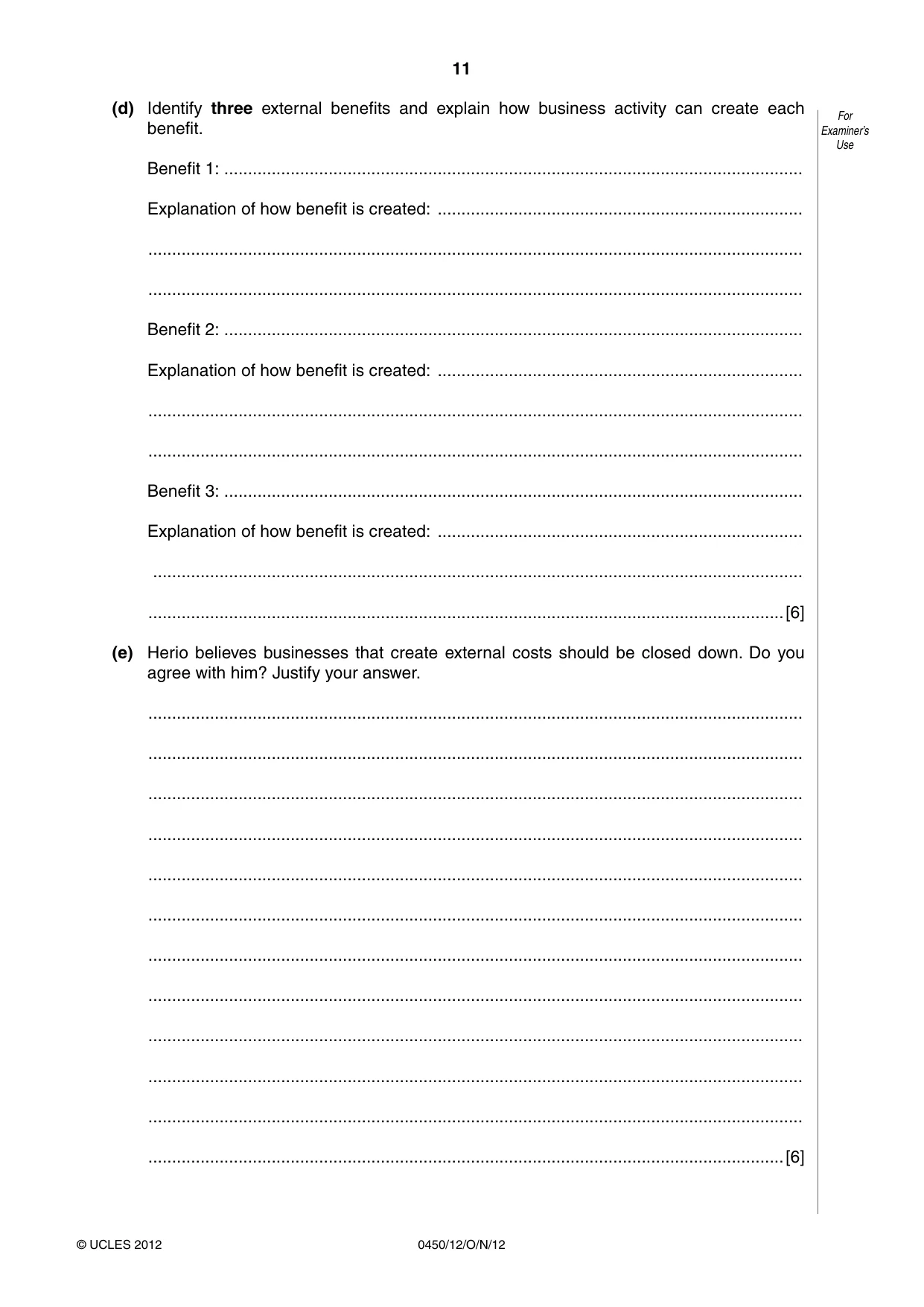
11 0450/12/O/N/12 © UCLES 2012 For Examiner’s Use (d) Identify three external benefits and explain how business activity can create each benefit. Benefit 1: … Explanation of how benefit is created: … … … Benefit 2: … Explanation of how benefit is created: … … … Benefit 3: … Explanation of how benefit is created: … … …[6] (e) Herio believes businesses that create external costs should be closed down. Do you agree with him? Justify your answer. … … … … … … … … … … … …[6]
Question paper, page 12
12 0450/12/O/N/12 © UCLES 2012 Permission to reproduce items where third-party owned material protected by copyright is included has been sought and cleared where possible. Every reasonable effort has been made by the publisher (UCLES) to trace copyright holders, but if any items requiring clearance have unwittingly been included, the publisher will be pleased to make amends at the earliest possible opportunity. University of Cambridge International Examinations is part of the Cambridge Assessment Group. Cambridge Assessment is the brand name of University of Cambridge Local Examinations Syndicate (UCLES), which is itself a department of the University of Cambridge. BLANK PAGE
Mark scheme, page 1
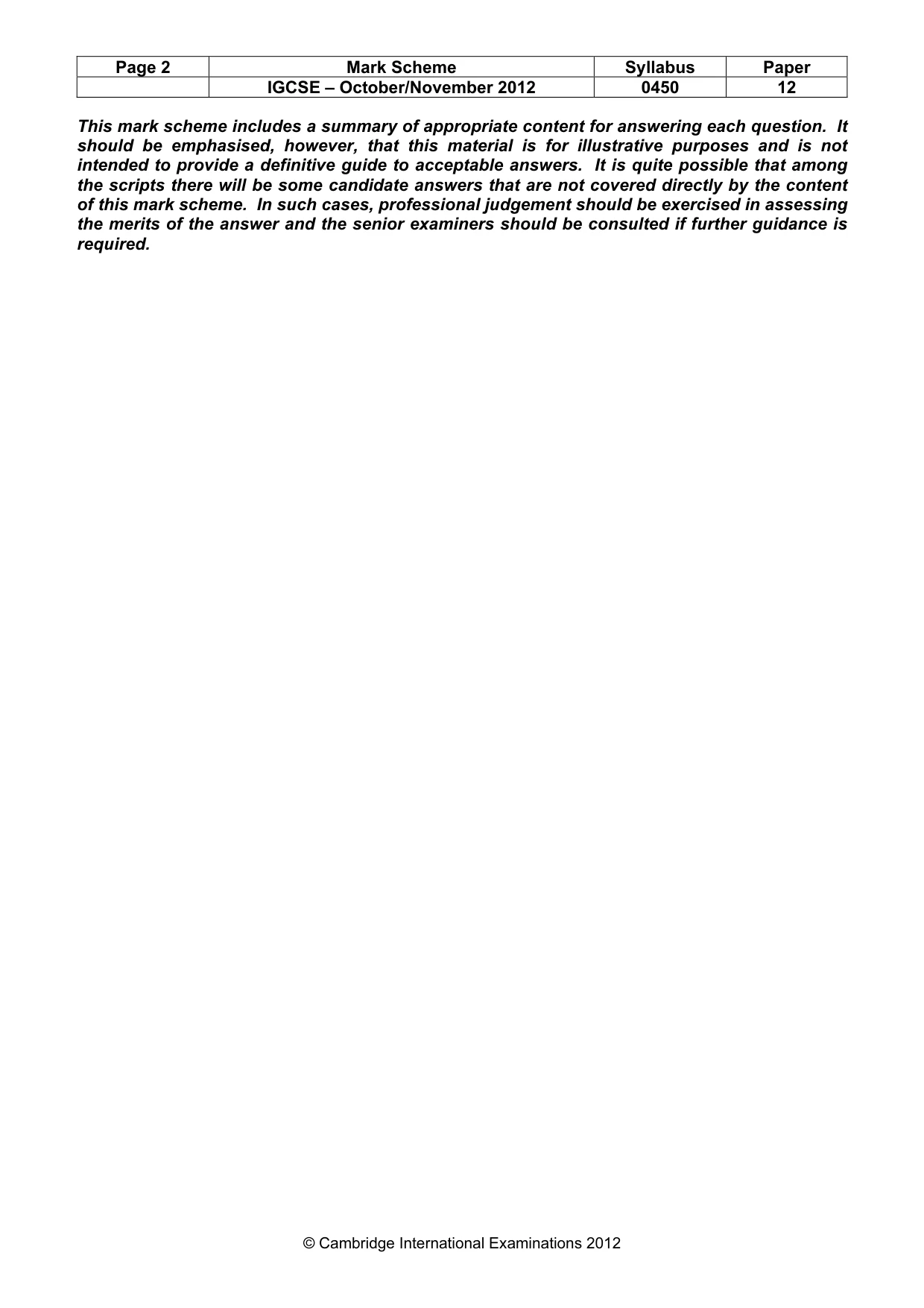
CAMBRIDGE INTERNATIONAL EXAMINATIONS International General Certificate of Secondary Education MARK SCHEME for the October/November 2012 series 0450 BUSINESS STUDIES 0450/12 Paper 1 (Short Answer/Structured Response), maximum raw mark 100 This mark scheme is published as an aid to teachers and candidates, to indicate the requirements of the examination. It shows the basis on which Examiners were instructed to award marks. It does not indicate the details of the discussions that took place at an Examiners’ meeting before marking began, which would have considered the acceptability of alternative answers. Mark schemes should be read in conjunction with the question paper and the Principal Examiner Report for Teachers. Cambridge will not enter into discussions about these mark schemes. Cambridge is publishing the mark schemes for the October/November 2012 series for most IGCSE, GCE Advanced Level and Advanced Subsidiary Level components and some Ordinary Level components.
Mark scheme, page 2
Page 2 Mark Scheme Syllabus Paper IGCSE – October/November 2012 0450 12 © Cambridge International Examinations 2012 This mark scheme includes a summary of appropriate content for answering each question. It should be emphasised, however, that this material is for illustrative purposes and is not intended to provide a definitive guide to acceptable answers. It is quite possible that among the scripts there will be some candidate answers that are not covered directly by the content of this mark scheme. In such cases, professional judgement should be exercised in assessing the merits of the answer and the senior examiners should be consulted if further guidance is required.
Mark scheme, page 3
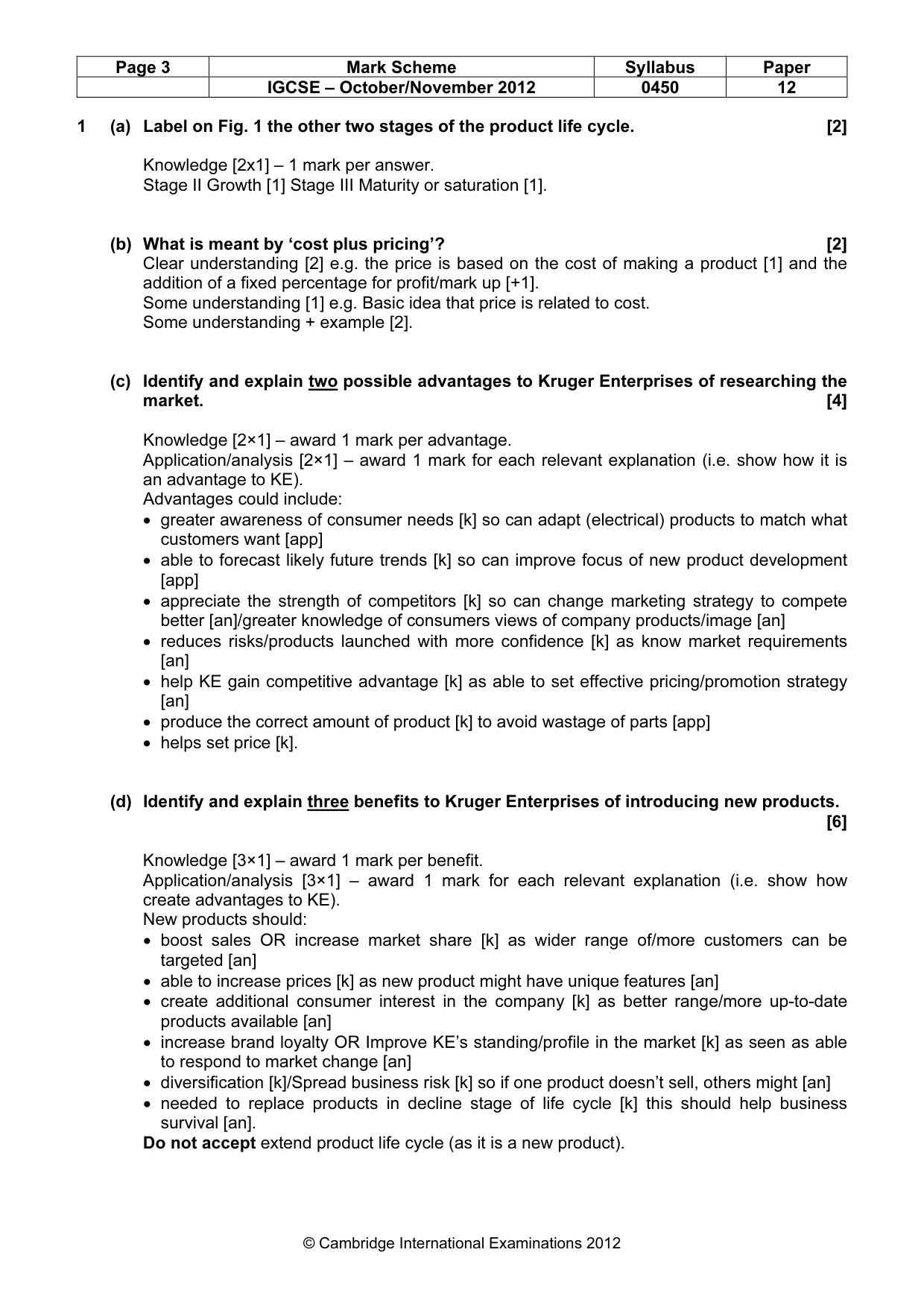
Page 3 Mark Scheme Syllabus Paper IGCSE – October/November 2012 0450 12 © Cambridge International Examinations 2012 1 (a) Label on Fig. 1 the other two stages of the product life cycle. [2] Knowledge [2x1] – 1 mark per answer. Stage II Growth [1] Stage III Maturity or saturation [1]. (b) What is meant by ‘cost plus pricing’? [2] Clear understanding [2] e.g. the price is based on the cost of making a product [1] and the addition of a fixed percentage for profit/mark up [+1]. Some understanding [1] e.g. Basic idea that price is related to cost. Some understanding + example [2]. (c) Identify and explain two possible advantages to Kruger Enterprises of researching the market. [4] Knowledge [2×1] – award 1 mark per advantage. Application/analysis [2×1] – award 1 mark for each relevant explanation (i.e. show how it is an advantage to KE). Advantages could include: • greater awareness of consumer needs [k] so can adapt (electrical) products to match what customers want [app] • able to forecast likely future trends [k] so can improve focus of new product development [app] • appreciate the strength of competitors [k] so can change marketing strategy to compete better [an]/greater knowledge of consumers views of company products/image [an] • reduces risks/products launched with more confidence [k] as know market requirements [an] • help KE gain competitive advantage [k] as able to set effective pricing/promotion strategy [an] • produce the correct amount of product [k] to avoid wastage of parts [app] • helps set price [k]. (d) Identify and explain three benefits to Kruger Enterprises of introducing new products. [6] Knowledge [3×1] – award 1 mark per benefit. Application/analysis [3×1] – award 1 mark for each relevant explanation (i.e. show how create advantages to KE). New products should: • boost sales OR increase market share [k] as wider range of/more customers can be targeted [an] • able to increase prices [k] as new product might have unique features [an] • create additional consumer interest in the company [k] as better range/more up-to-date products available [an] • increase brand loyalty OR Improve KE’s standing/profile in the market [k] as seen as able to respond to market change [an] • diversification [k]/Spread business risk [k] so if one product doesn’t sell, others might [an] • needed to replace products in decline stage of life cycle [k] this should help business survival [an]. Do not accept extend product life cycle (as it is a new product).
Mark scheme, page 4
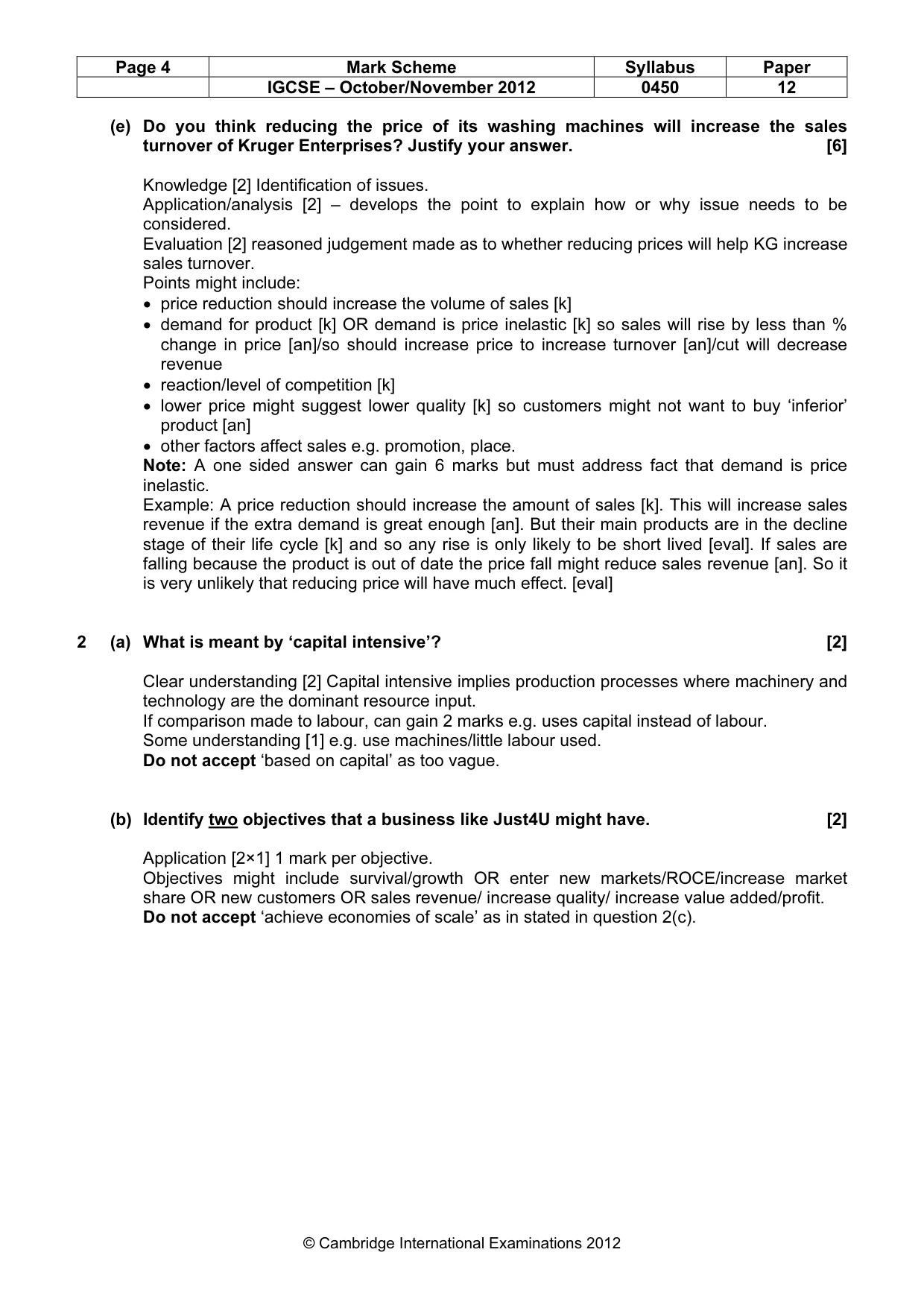
Page 4 Mark Scheme Syllabus Paper IGCSE – October/November 2012 0450 12 © Cambridge International Examinations 2012 (e) Do you think reducing the price of its washing machines will increase the sales turnover of Kruger Enterprises? Justify your answer. [6] Knowledge [2] Identification of issues. Application/analysis [2] – develops the point to explain how or why issue needs to be considered. Evaluation [2] reasoned judgement made as to whether reducing prices will help KG increase sales turnover. Points might include: • price reduction should increase the volume of sales [k] • demand for product [k] OR demand is price inelastic [k] so sales will rise by less than % change in price [an]/so should increase price to increase turnover [an]/cut will decrease revenue • reaction/level of competition [k] • lower price might suggest lower quality [k] so customers might not want to buy ‘inferior’ product [an] • other factors affect sales e.g. promotion, place. Note: A one sided answer can gain 6 marks but must address fact that demand is price inelastic. Example: A price reduction should increase the amount of sales [k]. This will increase sales revenue if the extra demand is great enough [an]. But their main products are in the decline stage of their life cycle [k] and so any rise is only likely to be short lived [eval]. If sales are falling because the product is out of date the price fall might reduce sales revenue [an]. So it is very unlikely that reducing price will have much effect. [eval] 2 (a) What is meant by ‘capital intensive’? [2] Clear understanding [2] Capital intensive implies production processes where machinery and technology are the dominant resource input. If comparison made to labour, can gain 2 marks e.g. uses capital instead of labour. Some understanding [1] e.g. use machines/little labour used. Do not accept ‘based on capital’ as too vague. (b) Identify two objectives that a business like Just4U might have. [2] Application [2×1] 1 mark per objective. Objectives might include survival/growth OR enter new markets/ROCE/increase market share OR new customers OR sales revenue/ increase quality/ increase value added/profit. Do not accept ‘achieve economies of scale’ as in stated in question 2(c).
Mark scheme, page 5
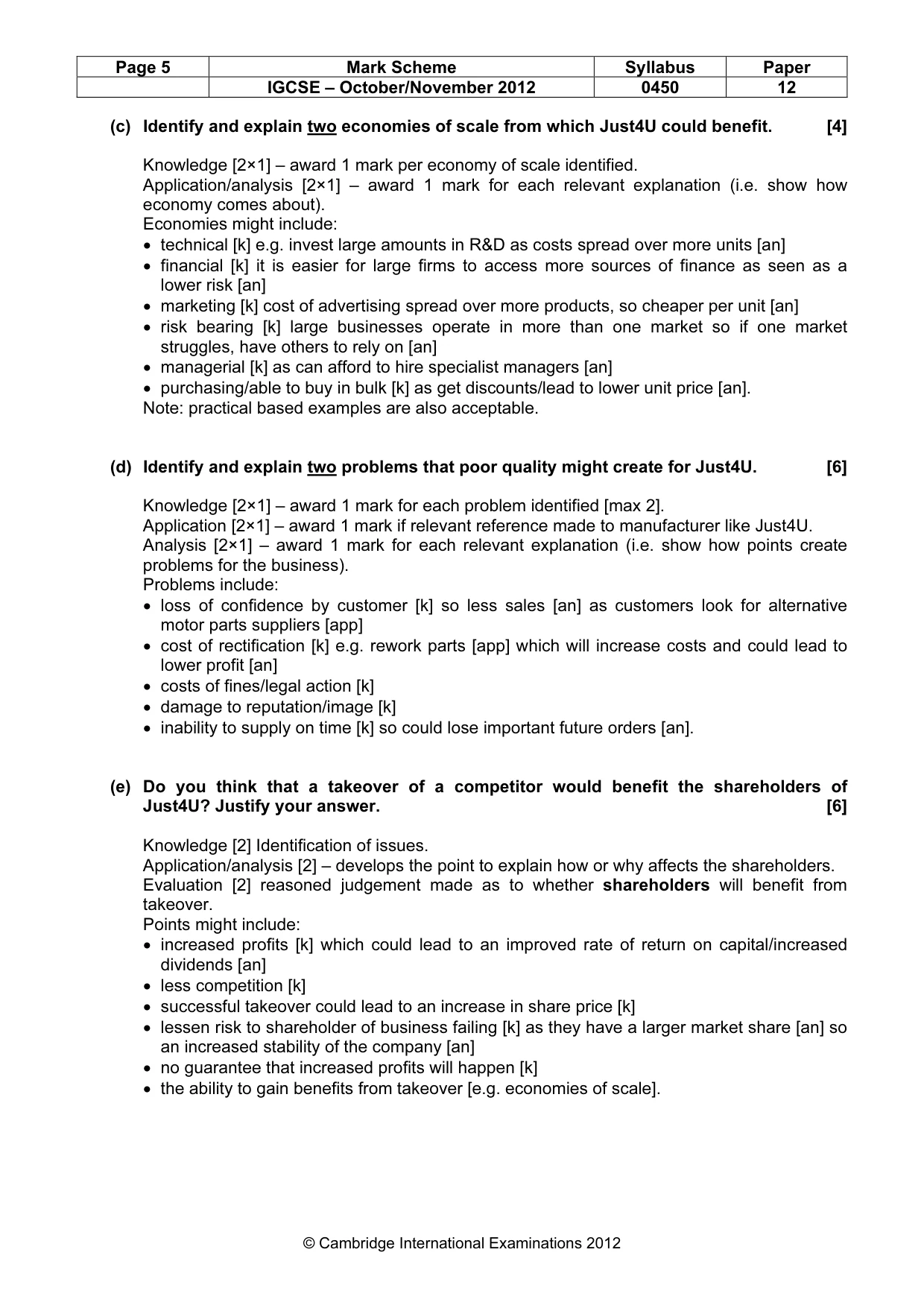
Page 5 Mark Scheme Syllabus Paper IGCSE – October/November 2012 0450 12 © Cambridge International Examinations 2012 (c) Identify and explain two economies of scale from which Just4U could benefit. [4] Knowledge [2×1] – award 1 mark per economy of scale identified. Application/analysis [2×1] – award 1 mark for each relevant explanation (i.e. show how economy comes about). Economies might include: • technical [k] e.g. invest large amounts in R&D as costs spread over more units [an] • financial [k] it is easier for large firms to access more sources of finance as seen as a lower risk [an] • marketing [k] cost of advertising spread over more products, so cheaper per unit [an] • risk bearing [k] large businesses operate in more than one market so if one market struggles, have others to rely on [an] • managerial [k] as can afford to hire specialist managers [an] • purchasing/able to buy in bulk [k] as get discounts/lead to lower unit price [an]. Note: practical based examples are also acceptable. (d) Identify and explain two problems that poor quality might create for Just4U. [6] Knowledge [2×1] – award 1 mark for each problem identified [max 2]. Application [2×1] – award 1 mark if relevant reference made to manufacturer like Just4U. Analysis [2×1] – award 1 mark for each relevant explanation (i.e. show how points create problems for the business). Problems include: • loss of confidence by customer [k] so less sales [an] as customers look for alternative motor parts suppliers [app] • cost of rectification [k] e.g. rework parts [app] which will increase costs and could lead to lower profit [an] • costs of fines/legal action [k] • damage to reputation/image [k] • inability to supply on time [k] so could lose important future orders [an]. (e) Do you think that a takeover of a competitor would benefit the shareholders of Just4U? Justify your answer. [6] Knowledge [2] Identification of issues. Application/analysis [2] – develops the point to explain how or why affects the shareholders. Evaluation [2] reasoned judgement made as to whether shareholders will benefit from takeover. Points might include: • increased profits [k] which could lead to an improved rate of return on capital/increased dividends [an] • less competition [k] • successful takeover could lead to an increase in share price [k] • lessen risk to shareholder of business failing [k] as they have a larger market share [an] so an increased stability of the company [an] • no guarantee that increased profits will happen [k] • the ability to gain benefits from takeover [e.g. economies of scale].
Mark scheme, page 6
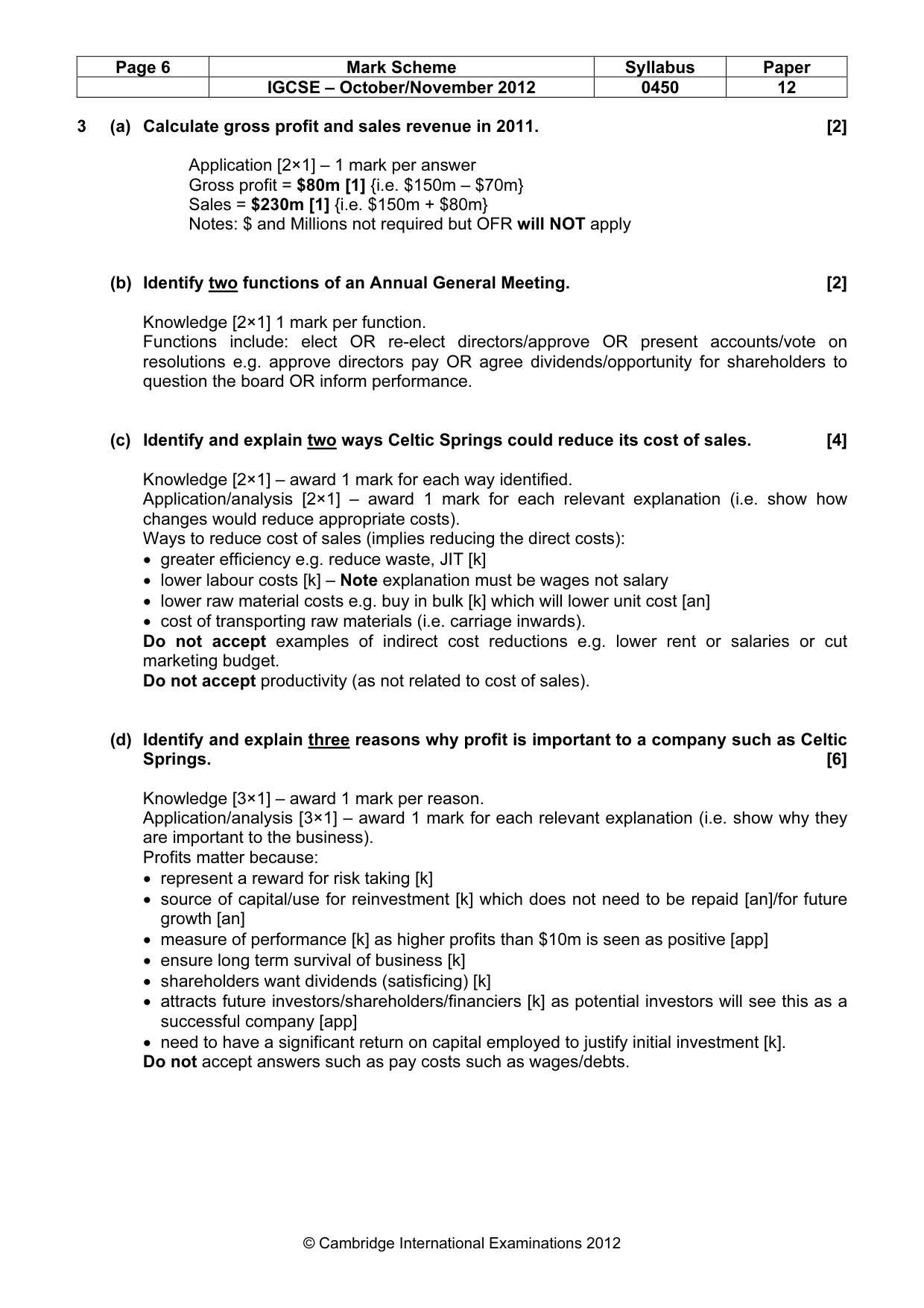
Page 6 Mark Scheme Syllabus Paper IGCSE – October/November 2012 0450 12 © Cambridge International Examinations 2012 3 (a) Calculate gross profit and sales revenue in 2011. [2] Application [2×1] – 1 mark per answer Gross profit = $80m [1] {i.e. $150m – $70m} Sales = $230m [1] {i.e. $150m + $80m} Notes: $ and Millions not required but OFR will NOT apply (b) Identify two functions of an Annual General Meeting. [2] Knowledge [2×1] 1 mark per function. Functions include: elect OR re-elect directors/approve OR present accounts/vote on resolutions e.g. approve directors pay OR agree dividends/opportunity for shareholders to question the board OR inform performance. (c) Identify and explain two ways Celtic Springs could reduce its cost of sales. [4] Knowledge [2×1] – award 1 mark for each way identified. Application/analysis [2×1] – award 1 mark for each relevant explanation (i.e. show how changes would reduce appropriate costs). Ways to reduce cost of sales (implies reducing the direct costs): • greater efficiency e.g. reduce waste, JIT [k] • lower labour costs [k] – Note explanation must be wages not salary • lower raw material costs e.g. buy in bulk [k] which will lower unit cost [an] • cost of transporting raw materials (i.e. carriage inwards). Do not accept examples of indirect cost reductions e.g. lower rent or salaries or cut marketing budget. Do not accept productivity (as not related to cost of sales). (d) Identify and explain three reasons why profit is important to a company such as Celtic Springs. [6] Knowledge [3×1] – award 1 mark per reason. Application/analysis [3×1] – award 1 mark for each relevant explanation (i.e. show why they are important to the business). Profits matter because: • represent a reward for risk taking [k] • source of capital/use for reinvestment [k] which does not need to be repaid [an]/for future growth [an] • measure of performance [k] as higher profits than $10m is seen as positive [app] • ensure long term survival of business [k] • shareholders want dividends (satisficing) [k] • attracts future investors/shareholders/financiers [k] as potential investors will see this as a successful company [app] • need to have a significant return on capital employed to justify initial investment [k]. Do not accept answers such as pay costs such as wages/debts.
Mark scheme, page 7
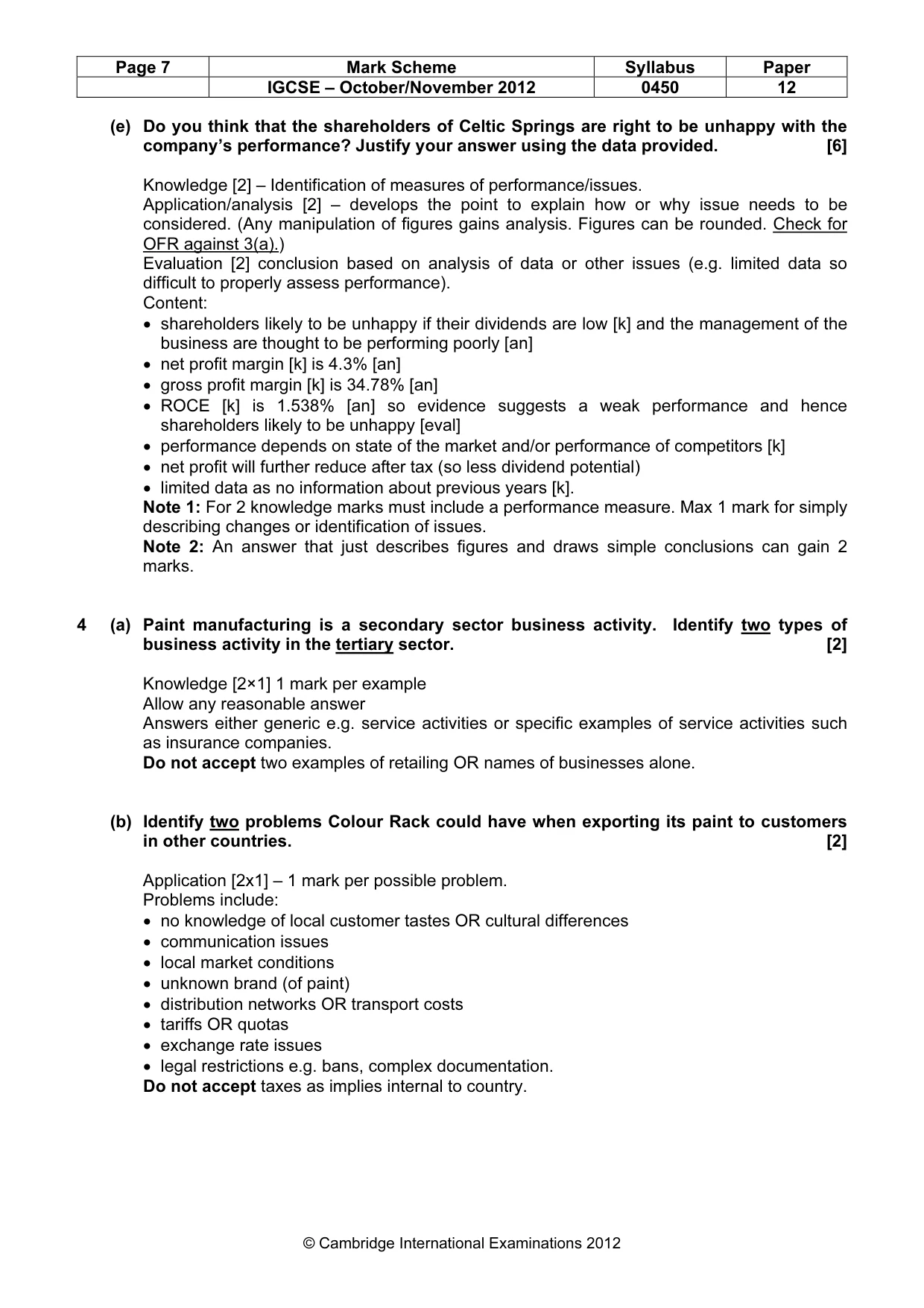
Page 7 Mark Scheme Syllabus Paper IGCSE – October/November 2012 0450 12 © Cambridge International Examinations 2012 (e) Do you think that the shareholders of Celtic Springs are right to be unhappy with the company’s performance? Justify your answer using the data provided. [6] Knowledge [2] – Identification of measures of performance/issues. Application/analysis [2] – develops the point to explain how or why issue needs to be considered. (Any manipulation of figures gains analysis. Figures can be rounded. Check for OFR against 3(a).) Evaluation [2] conclusion based on analysis of data or other issues (e.g. limited data so difficult to properly assess performance). Content: • shareholders likely to be unhappy if their dividends are low [k] and the management of the business are thought to be performing poorly [an] • net profit margin [k] is 4.3% [an] • gross profit margin [k] is 34.78% [an] • ROCE [k] is 1.538% [an] so evidence suggests a weak performance and hence shareholders likely to be unhappy [eval] • performance depends on state of the market and/or performance of competitors [k] • net profit will further reduce after tax (so less dividend potential) • limited data as no information about previous years [k]. Note 1: For 2 knowledge marks must include a performance measure. Max 1 mark for simply describing changes or identification of issues. Note 2: An answer that just describes figures and draws simple conclusions can gain 2 marks. 4 (a) Paint manufacturing is a secondary sector business activity. Identify two types of business activity in the tertiary sector. [2] Knowledge [2×1] 1 mark per example Allow any reasonable answer Answers either generic e.g. service activities or specific examples of service activities such as insurance companies. Do not accept two examples of retailing OR names of businesses alone. (b) Identify two problems Colour Rack could have when exporting its paint to customers in other countries. [2] Application [2x1] – 1 mark per possible problem. Problems include: • no knowledge of local customer tastes OR cultural differences • communication issues • local market conditions • unknown brand (of paint) • distribution networks OR transport costs • tariffs OR quotas • exchange rate issues • legal restrictions e.g. bans, complex documentation. Do not accept taxes as implies internal to country.
Mark scheme, page 8
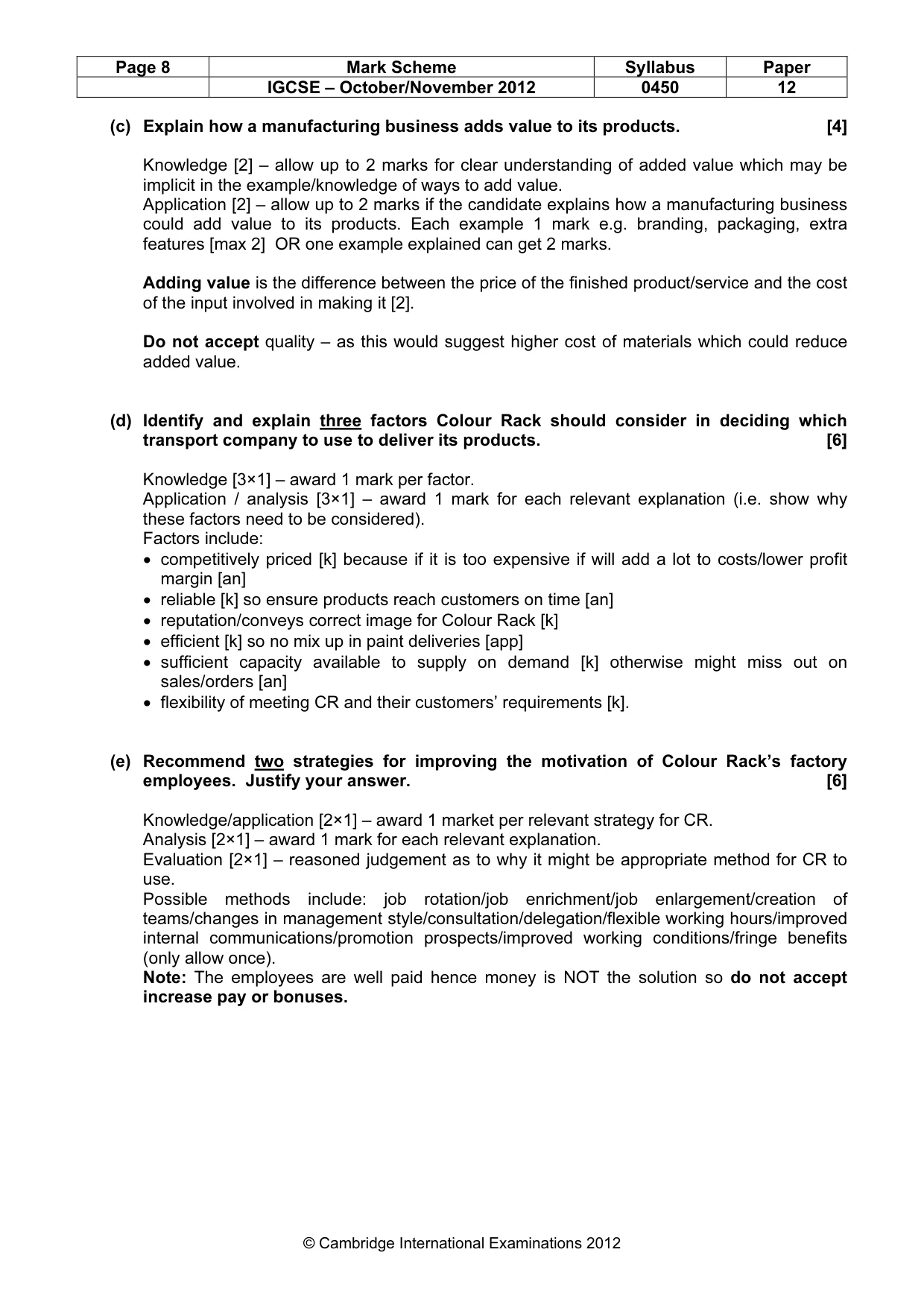
Page 8 Mark Scheme Syllabus Paper IGCSE – October/November 2012 0450 12 © Cambridge International Examinations 2012 (c) Explain how a manufacturing business adds value to its products. [4] Knowledge [2] – allow up to 2 marks for clear understanding of added value which may be implicit in the example/knowledge of ways to add value. Application [2] – allow up to 2 marks if the candidate explains how a manufacturing business could add value to its products. Each example 1 mark e.g. branding, packaging, extra features [max 2] OR one example explained can get 2 marks. Adding value is the difference between the price of the finished product/service and the cost of the input involved in making it [2]. Do not accept quality – as this would suggest higher cost of materials which could reduce added value. (d) Identify and explain three factors Colour Rack should consider in deciding which transport company to use to deliver its products. [6] Knowledge [3×1] – award 1 mark per factor. Application / analysis [3×1] – award 1 mark for each relevant explanation (i.e. show why these factors need to be considered). Factors include: • competitively priced [k] because if it is too expensive if will add a lot to costs/lower profit margin [an] • reliable [k] so ensure products reach customers on time [an] • reputation/conveys correct image for Colour Rack [k] • efficient [k] so no mix up in paint deliveries [app] • sufficient capacity available to supply on demand [k] otherwise might miss out on sales/orders [an] • flexibility of meeting CR and their customers’ requirements [k]. (e) Recommend two strategies for improving the motivation of Colour Rack’s factory employees. Justify your answer. [6] Knowledge/application [2×1] – award 1 market per relevant strategy for CR. Analysis [2×1] – award 1 mark for each relevant explanation. Evaluation [2×1] – reasoned judgement as to why it might be appropriate method for CR to use. Possible methods include: job rotation/job enrichment/job enlargement/creation of teams/changes in management style/consultation/delegation/flexible working hours/improved internal communications/promotion prospects/improved working conditions/fringe benefits (only allow once). Note: The employees are well paid hence money is NOT the solution so do not accept increase pay or bonuses.
Mark scheme, page 9
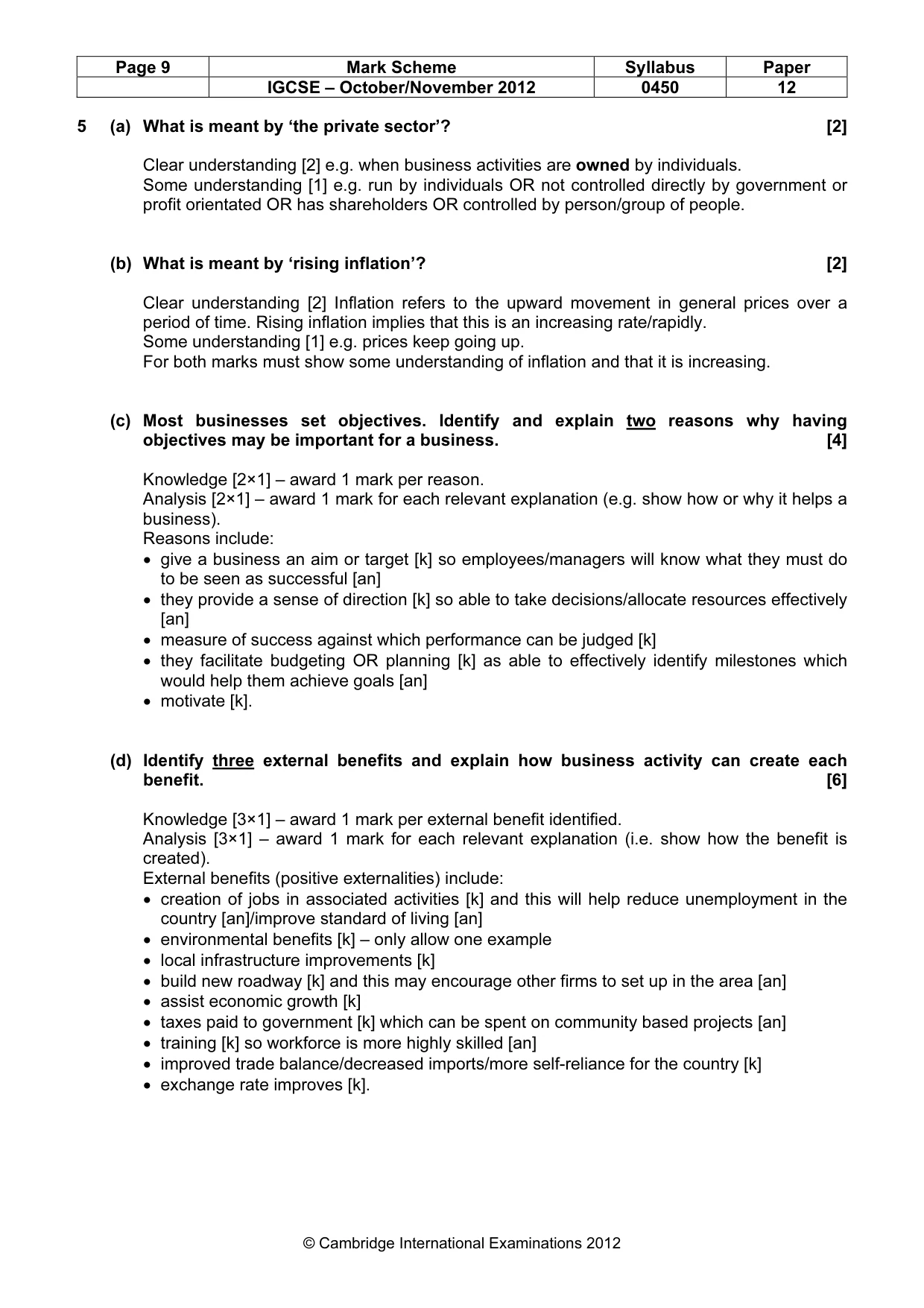
Page 9 Mark Scheme Syllabus Paper IGCSE – October/November 2012 0450 12 © Cambridge International Examinations 2012 5 (a) What is meant by ‘the private sector’? [2] Clear understanding [2] e.g. when business activities are owned by individuals. Some understanding [1] e.g. run by individuals OR not controlled directly by government or profit orientated OR has shareholders OR controlled by person/group of people. (b) What is meant by ‘rising inflation’? [2] Clear understanding [2] Inflation refers to the upward movement in general prices over a period of time. Rising inflation implies that this is an increasing rate/rapidly. Some understanding [1] e.g. prices keep going up. For both marks must show some understanding of inflation and that it is increasing. (c) Most businesses set objectives. Identify and explain two reasons why having objectives may be important for a business. [4] Knowledge [2×1] – award 1 mark per reason. Analysis [2×1] – award 1 mark for each relevant explanation (e.g. show how or why it helps a business). Reasons include: • give a business an aim or target [k] so employees/managers will know what they must do to be seen as successful [an] • they provide a sense of direction [k] so able to take decisions/allocate resources effectively [an] • measure of success against which performance can be judged [k] • they facilitate budgeting OR planning [k] as able to effectively identify milestones which would help them achieve goals [an] • motivate [k]. (d) Identify three external benefits and explain how business activity can create each benefit. [6] Knowledge [3×1] – award 1 mark per external benefit identified. Analysis [3×1] – award 1 mark for each relevant explanation (i.e. show how the benefit is created). External benefits (positive externalities) include: • creation of jobs in associated activities [k] and this will help reduce unemployment in the country [an]/improve standard of living [an] • environmental benefits [k] – only allow one example • local infrastructure improvements [k] • build new roadway [k] and this may encourage other firms to set up in the area [an] • assist economic growth [k] • taxes paid to government [k] which can be spent on community based projects [an] • training [k] so workforce is more highly skilled [an] • improved trade balance/decreased imports/more self-reliance for the country [k] • exchange rate improves [k].
Mark scheme, page 10
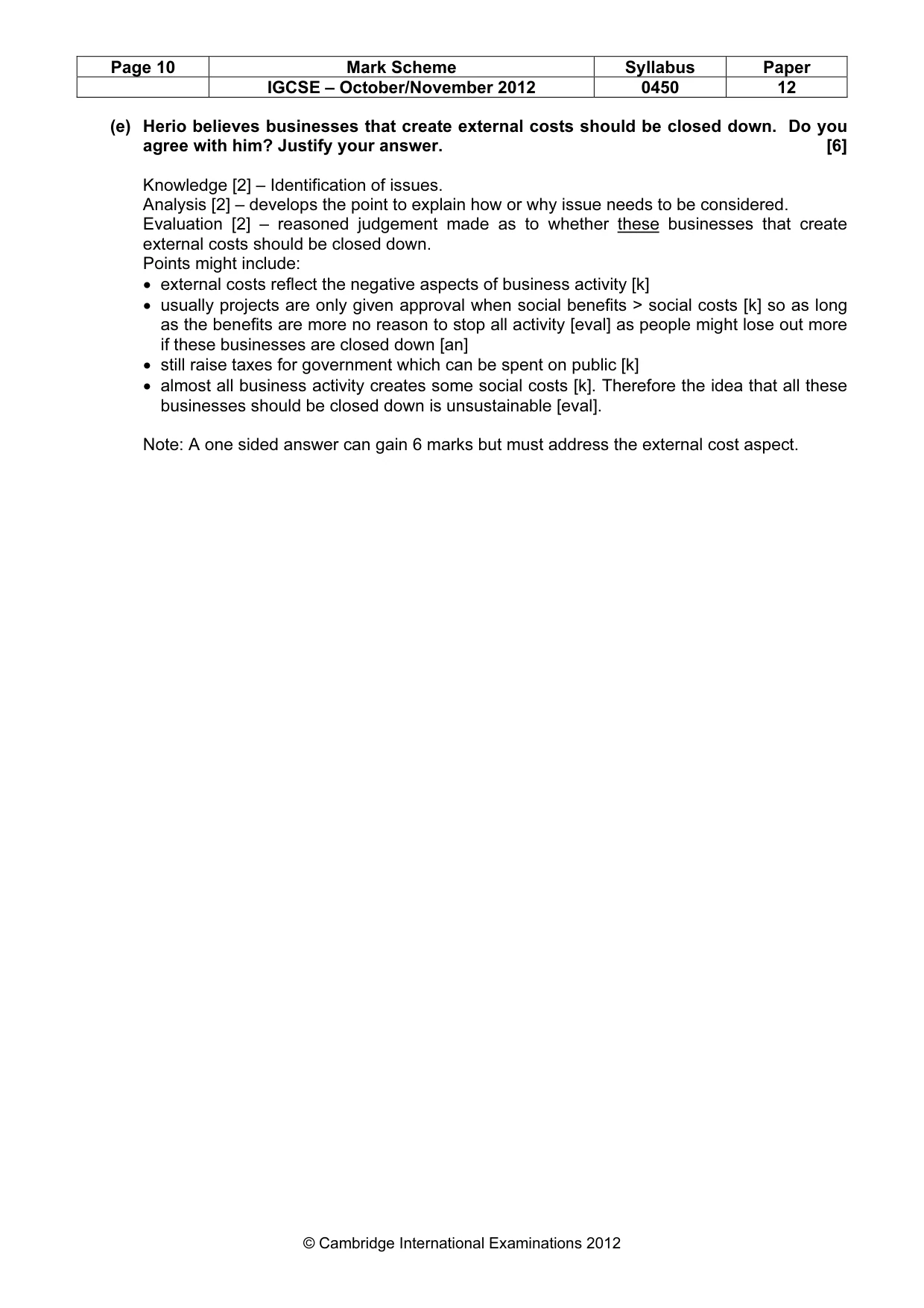
Page 10 Mark Scheme Syllabus Paper IGCSE – October/November 2012 0450 12 © Cambridge International Examinations 2012 (e) Herio believes businesses that create external costs should be closed down. Do you agree with him? Justify your answer. [6] Knowledge [2] – Identification of issues. Analysis [2] – develops the point to explain how or why issue needs to be considered. Evaluation [2] – reasoned judgement made as to whether these businesses that create external costs should be closed down. Points might include: • external costs reflect the negative aspects of business activity [k] • usually projects are only given approval when social benefits > social costs [k] so as long as the benefits are more no reason to stop all activity [eval] as people might lose out more if these businesses are closed down [an] • still raise taxes for government which can be spent on public [k] • almost all business activity creates some social costs [k]. Therefore the idea that all these businesses should be closed down is unsustainable [eval]. Note: A one sided answer can gain 6 marks but must address the external cost aspect.
What you needed in this session
Cambridge’s own grade thresholds for 2012 Oct/Nov, Paper 1 · Variant 2. A higher threshold means an easier paper — the bar moves with how the cohort did.