Cambridge IGCSE Business Studies 0450 — 2011 Oct/Nov Paper 1 · Variant 3
0450/13/O/N/11 · 100 marks · ≈113 min
The question paper and its mark scheme, free to read here and free to download. This is Cambridge’s own paper, exactly as it was sat.
Question paper12 pages

Mark scheme9 pages
Answers below. Sit the paper first if you are practising.
Paper as text
Question paper, page 1
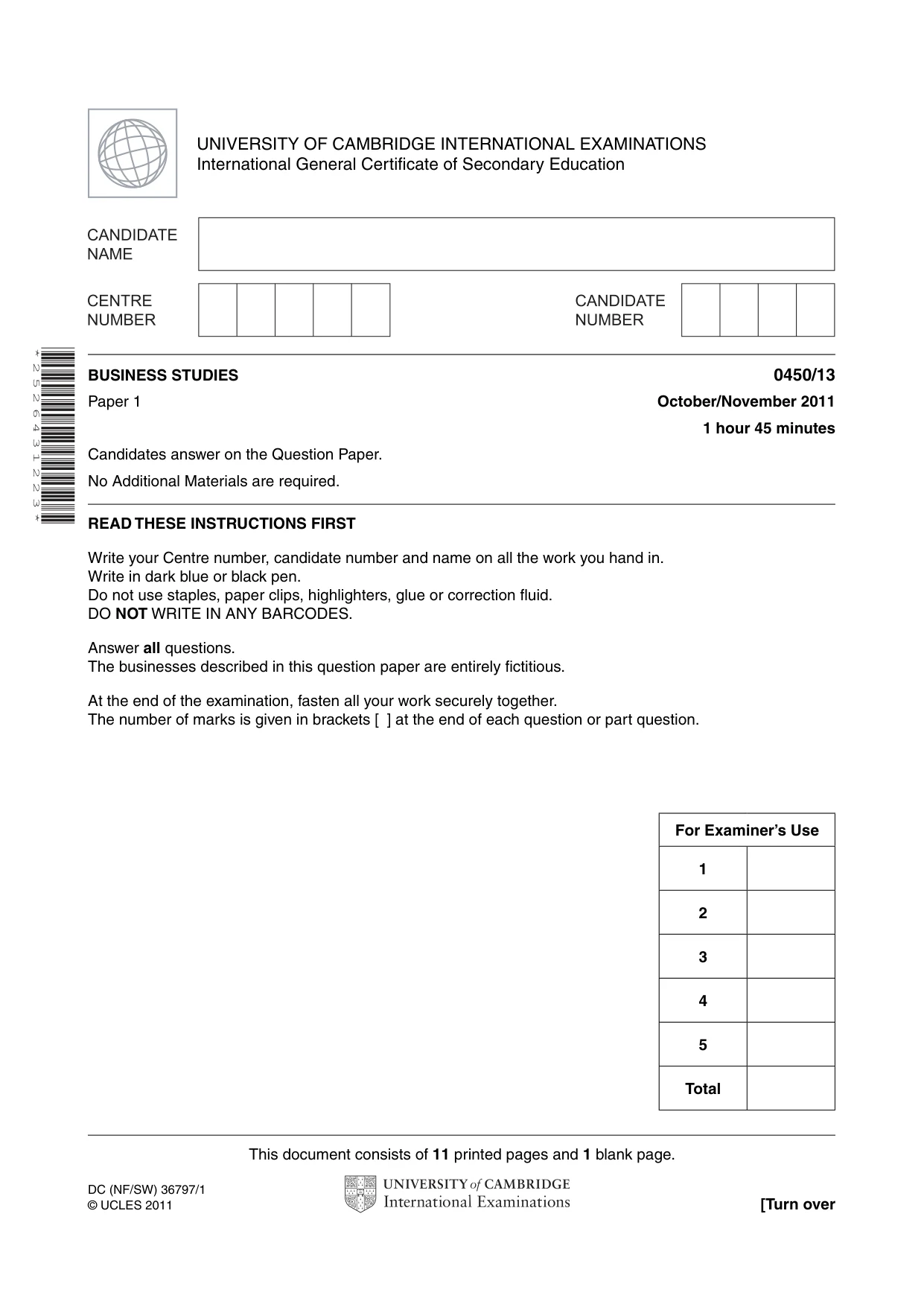
This document consists of 11 printed pages and 1 blank page. DC (NF/SW) 36797/1 © UCLES 2011 [Turn over UNIVERSITY OF CAMBRIDGE INTERNATIONAL EXAMINATIONS International General Certificate of Secondary Education * 2 5 2 6 4 3 1 2 2 3 * BUSINESS STUDIES 0450/13 Paper 1 October/November 2011 1 hour 45 minutes Candidates answer on the Question Paper. No Additional Materials are required. READ THESE INSTRUCTIONS FIRST Write your Centre number, candidate number and name on all the work you hand in. Write in dark blue or black pen. Do not use staples, paper clips, highlighters, glue or correction fluid. DO NOT WRITE IN ANY BARCODES. Answer all questions. The businesses described in this question paper are entirely fictitious. At the end of the examination, fasten all your work securely together. The number of marks is given in brackets [ ] at the end of each question or part question. For Examiner’s Use 1 2 3 4 5 Total
Question paper, page 2
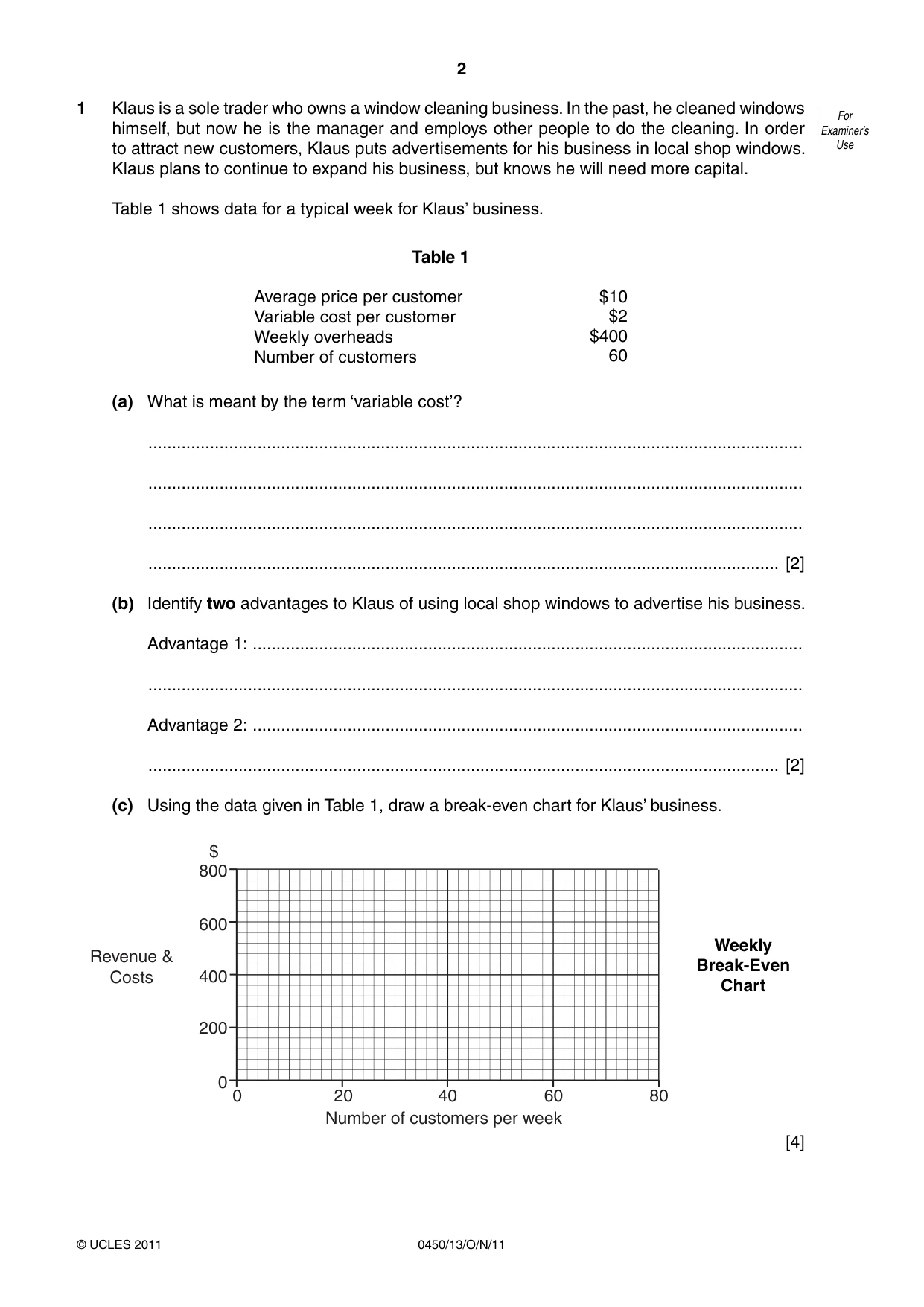
2 0450/13/O/N/11 © UCLES 2011 For Examiner’s Use 1 Klaus is a sole trader who owns a window cleaning business. In the past, he cleaned windows himself, but now he is the manager and employs other people to do the cleaning. In order to attract new customers, Klaus puts advertisements for his business in local shop windows. Klaus plans to continue to expand his business, but knows he will need more capital. Table 1 shows data for a typical week for Klaus’ business. Table 1 Average price per customer Variable cost per customer Weekly overheads Number of customers $10 $2 $400 60 (a) What is meant by the term ‘variable cost’? … … … … [2] (b) Identify two advantages to Klaus of using local shop windows to advertise his business. Advantage 1: … … Advantage 2: … … [2] (c) Using the data given in Table 1, draw a break-even chart for Klaus’ business. 20 0 40 60 80 800 600 400 200 0 Revenue & Costs $ Number of customers per week Weekly Break-Even Chart [4]
Question paper, page 3
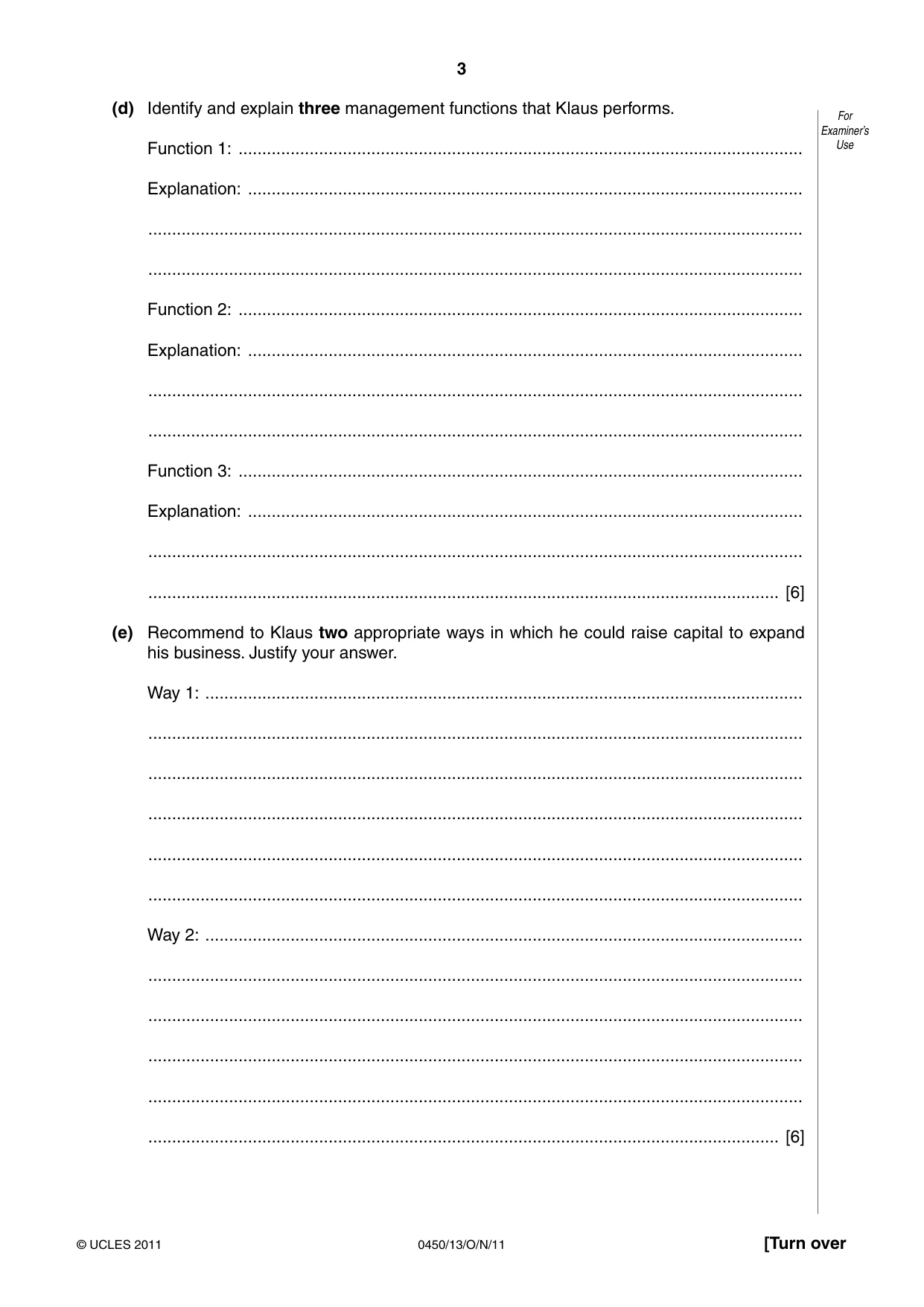
3 0450/13/O/N/11 © UCLES 2011 [Turn over For Examiner’s Use (d) Identify and explain three management functions that Klaus performs. Function 1: … Explanation: … … … Function 2: … Explanation: … … … Function 3: … Explanation: … … … [6] (e) Recommend to Klaus two appropriate ways in which he could raise capital to expand his business. Justify your answer. Way 1: … … … … … … Way 2: … … … … … … [6]
Question paper, page 4
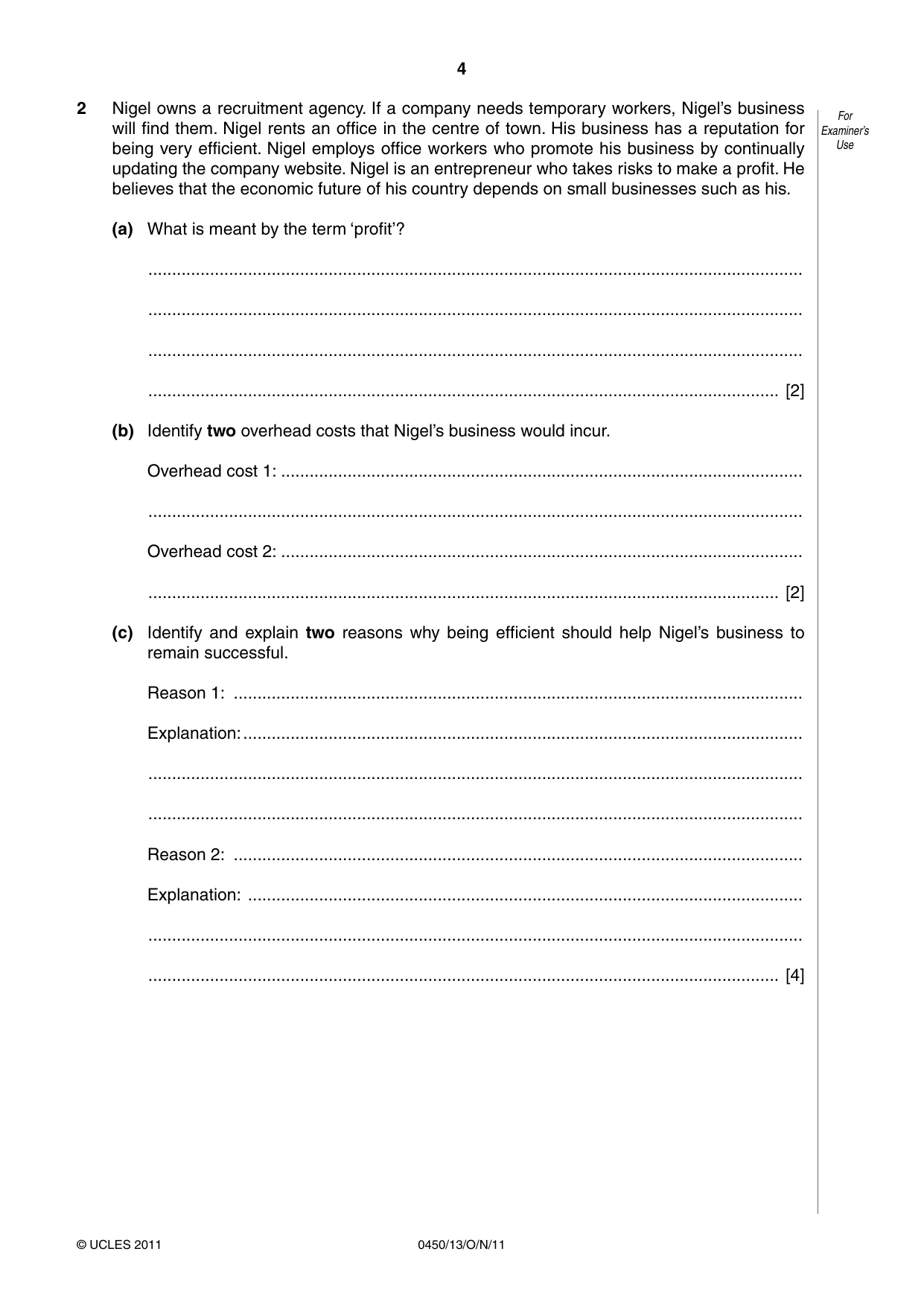
4 0450/13/O/N/11 © UCLES 2011 For Examiner’s Use 2 Nigel owns a recruitment agency. If a company needs temporary workers, Nigel’s business will find them. Nigel rents an office in the centre of town. His business has a reputation for being very efficient. Nigel employs office workers who promote his business by continually updating the company website. Nigel is an entrepreneur who takes risks to make a profit. He believes that the economic future of his country depends on small businesses such as his. (a) What is meant by the term ‘profit’? … … … … [2] (b) Identify two overhead costs that Nigel’s business would incur. Overhead cost 1: … … Overhead cost 2: … … [2] (c) Identify and explain two reasons why being efficient should help Nigel’s business to remain successful. Reason 1: … Explanation: … … … Reason 2: … Explanation: … … … [4]
Question paper, page 5
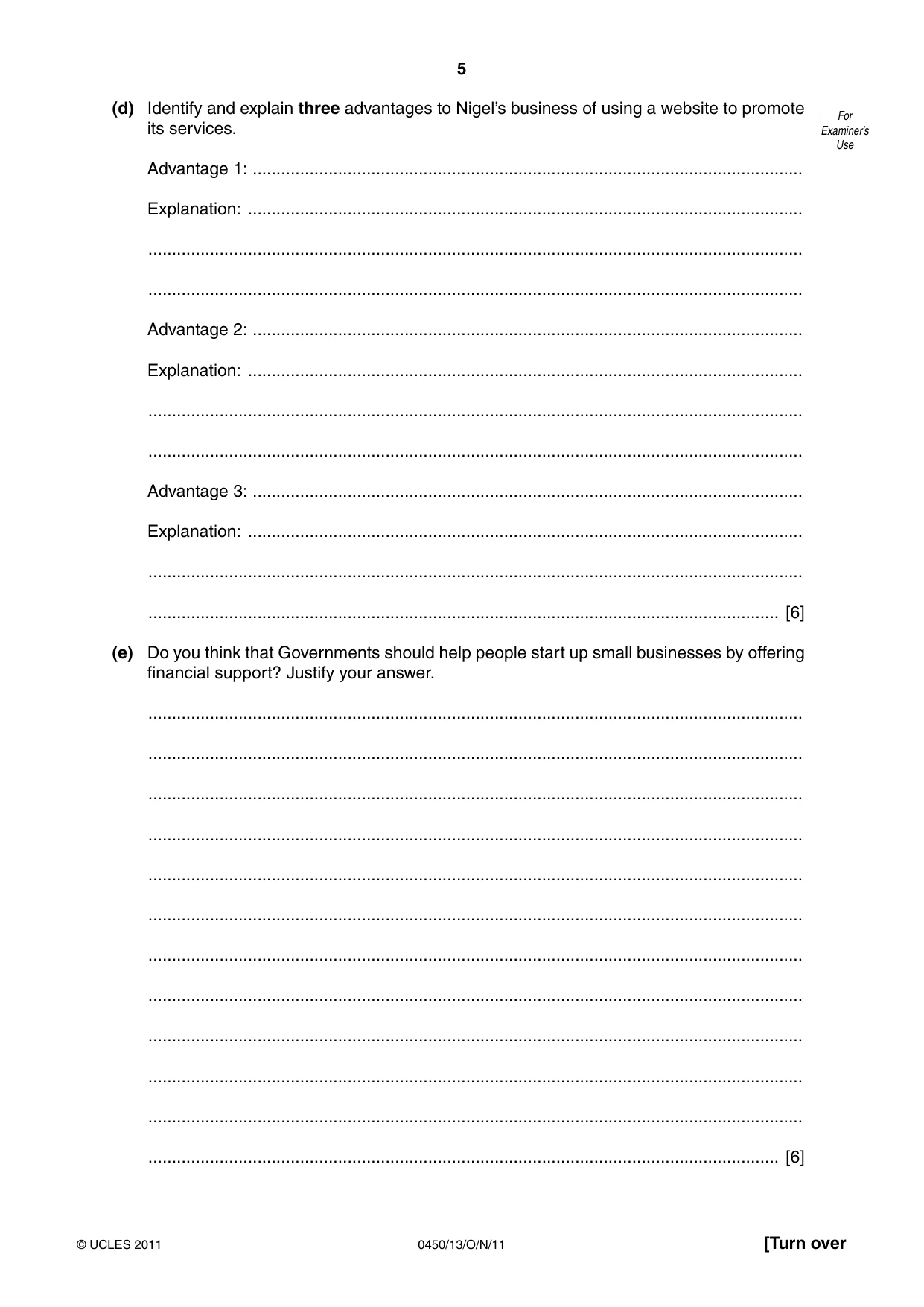
5 0450/13/O/N/11 © UCLES 2011 [Turn over For Examiner’s Use (d) Identify and explain three advantages to Nigel’s business of using a website to promote its services. Advantage 1: … Explanation: … … … Advantage 2: … Explanation: … … … Advantage 3: … Explanation: … … … [6] (e) Do you think that Governments should help people start up small businesses by offering financial support? Justify your answer. … … … … … … … … … … … … [6]
Question paper, page 6
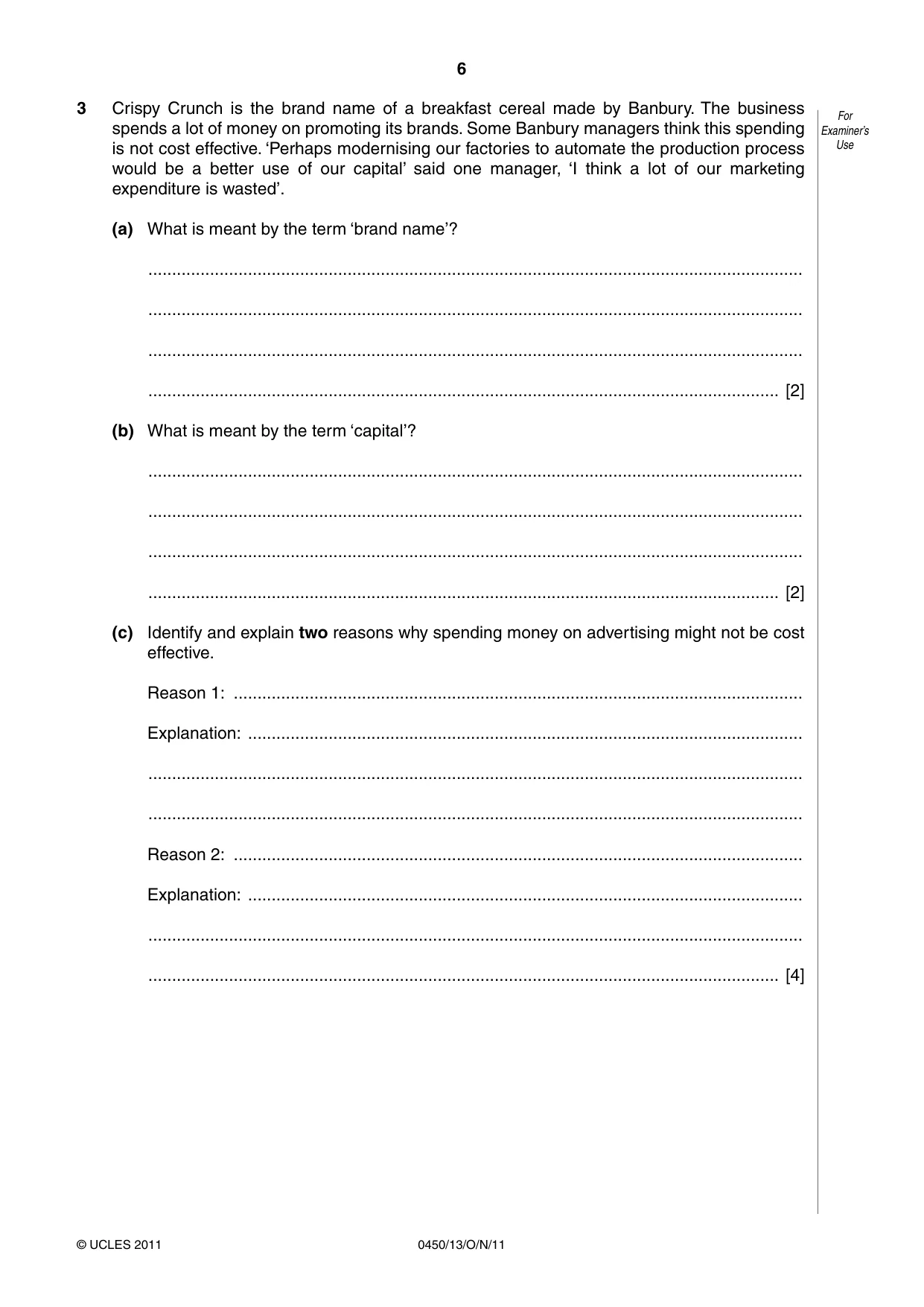
6 0450/13/O/N/11 © UCLES 2011 For Examiner’s Use 3 Crispy Crunch is the brand name of a breakfast cereal made by Banbury. The business spends a lot of money on promoting its brands. Some Banbury managers think this spending is not cost effective. ‘Perhaps modernising our factories to automate the production process would be a better use of our capital’ said one manager, ‘I think a lot of our marketing expenditure is wasted’. (a) What is meant by the term ‘brand name’? … … … … [2] (b) What is meant by the term ‘capital’? … … … … [2] (c) Identify and explain two reasons why spending money on advertising might not be cost effective. Reason 1: … Explanation: … … … Reason 2: … Explanation: … … … [4]
Question paper, page 7
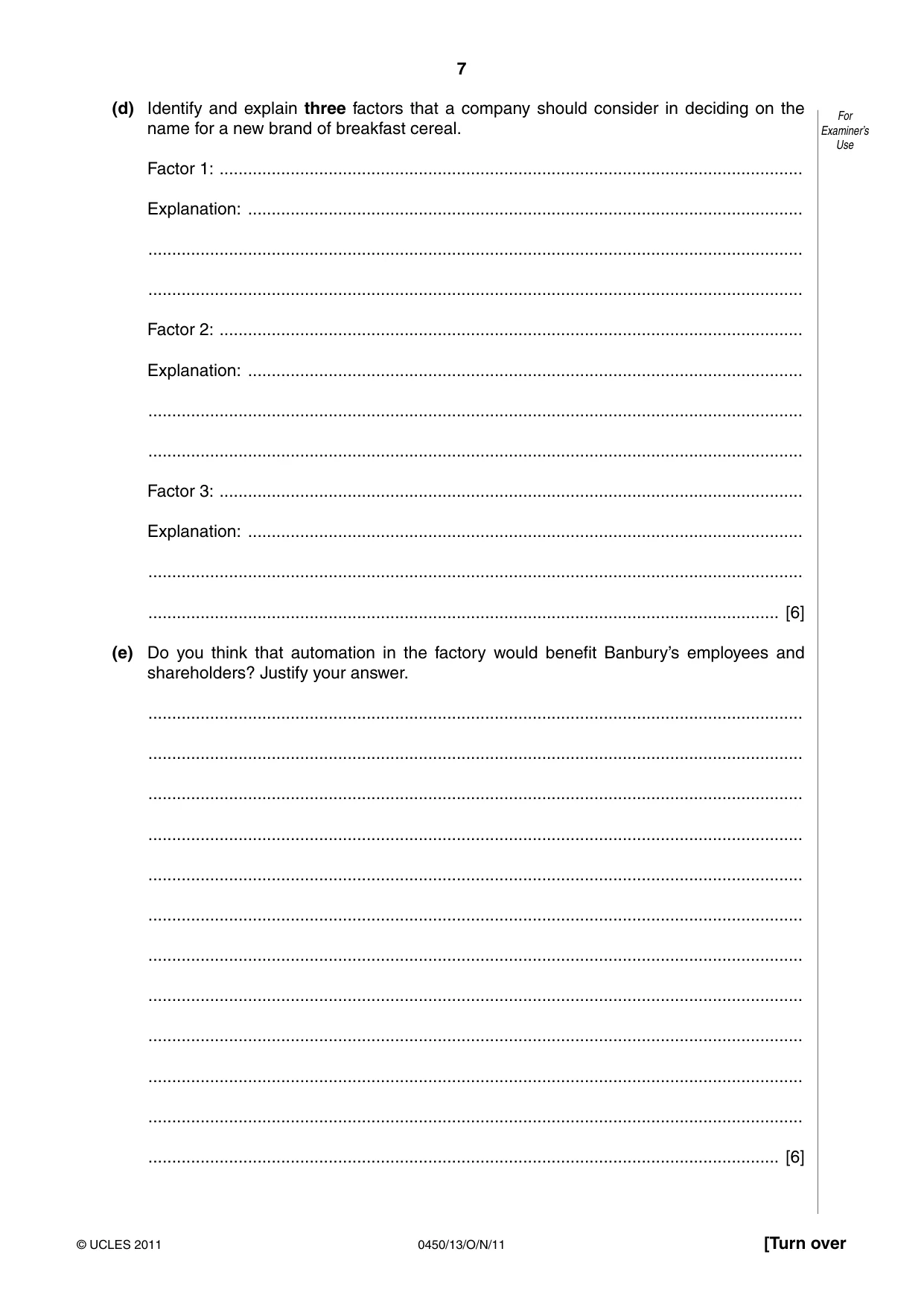
7 0450/13/O/N/11 © UCLES 2011 [Turn over For Examiner’s Use (d) Identify and explain three factors that a company should consider in deciding on the name for a new brand of breakfast cereal. Factor 1: … Explanation: … … … Factor 2: … Explanation: … … … Factor 3: … Explanation: … … … [6] (e) Do you think that automation in the factory would benefit Banbury’s employees and shareholders? Justify your answer. … … … … … … … … … … … … [6]
Question paper, page 8
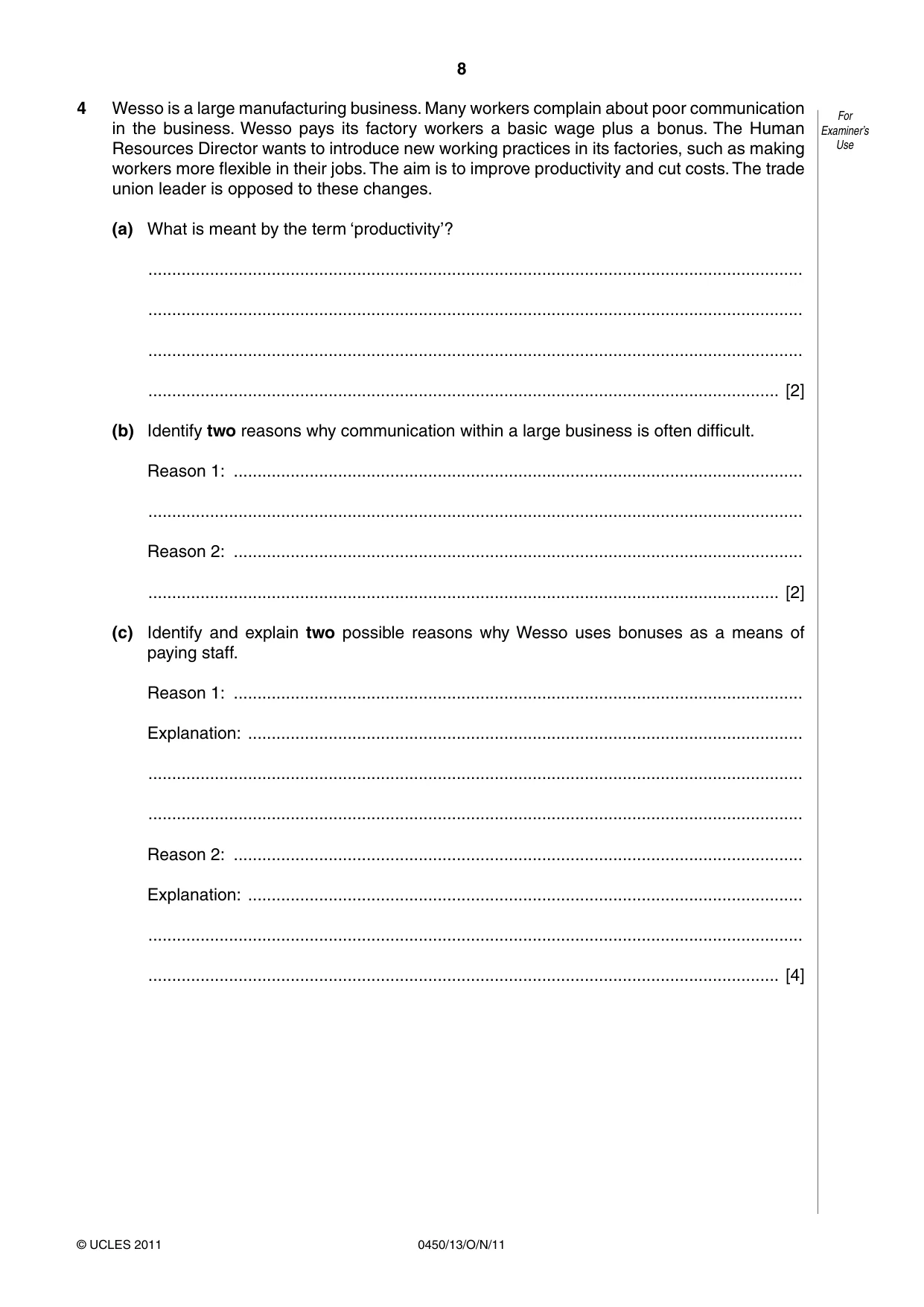
8 0450/13/O/N/11 © UCLES 2011 For Examiner’s Use 4 Wesso is a large manufacturing business. Many workers complain about poor communication in the business. Wesso pays its factory workers a basic wage plus a bonus. The Human Resources Director wants to introduce new working practices in its factories, such as making workers more flexible in their jobs. The aim is to improve productivity and cut costs. The trade union leader is opposed to these changes. (a) What is meant by the term ‘productivity’? … … … … [2] (b) Identify two reasons why communication within a large business is often difficult. Reason 1: … … Reason 2: … … [2] (c) Identify and explain two possible reasons why Wesso uses bonuses as a means of paying staff. Reason 1: … Explanation: … … … Reason 2: … Explanation: … … … [4]
Question paper, page 9
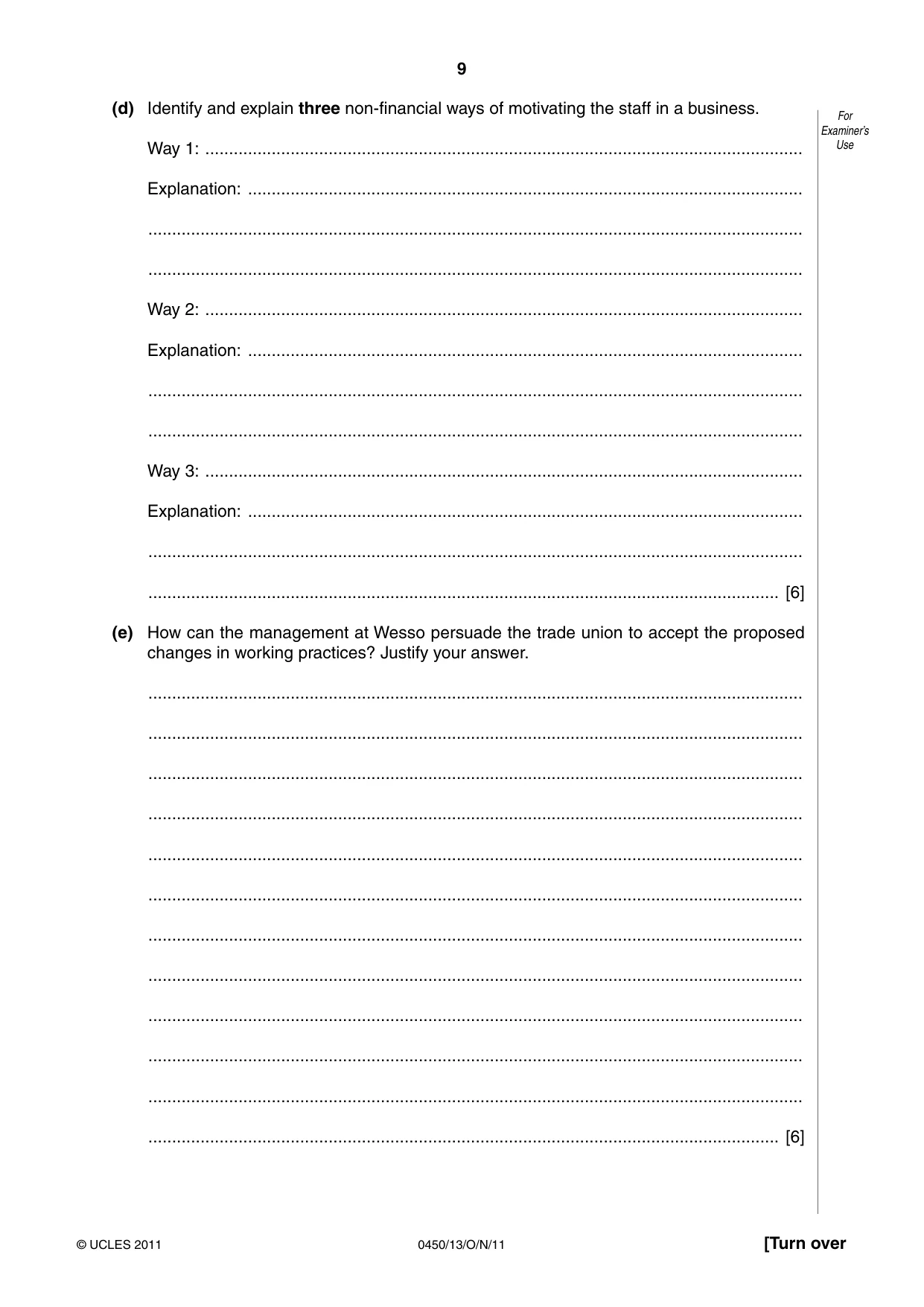
9 0450/13/O/N/11 © UCLES 2011 [Turn over For Examiner’s Use (d) Identify and explain three non-financial ways of motivating the staff in a business. Way 1: … Explanation: … … … Way 2: … Explanation: … … … Way 3: … Explanation: … … … [6] (e) How can the management at Wesso persuade the trade union to accept the proposed changes in working practices? Justify your answer. … … … … … … … … … … … … [6]
Question paper, page 10
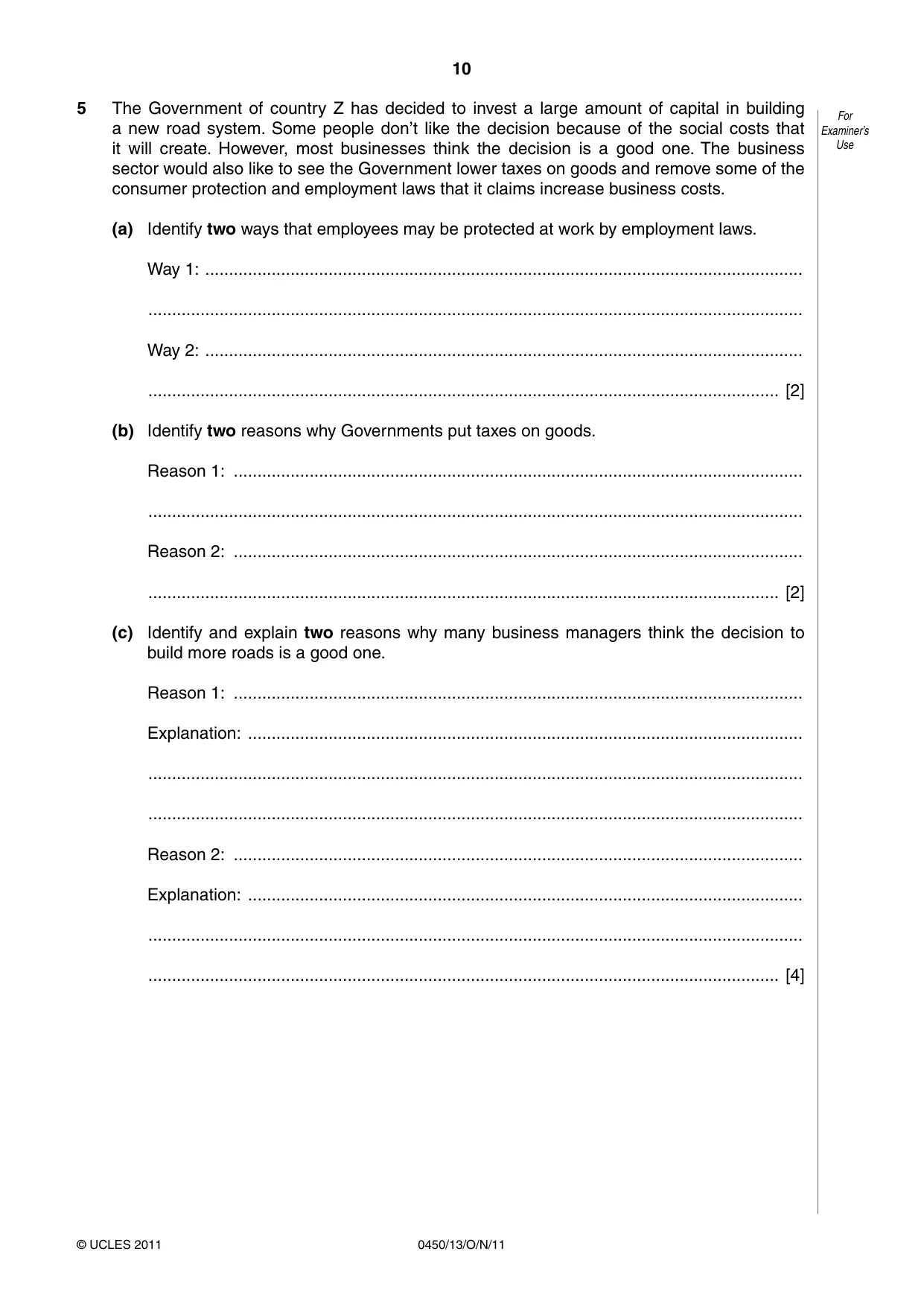
10 0450/13/O/N/11 © UCLES 2011 For Examiner’s Use 5 The Government of country Z has decided to invest a large amount of capital in building a new road system. Some people don’t like the decision because of the social costs that it will create. However, most businesses think the decision is a good one. The business sector would also like to see the Government lower taxes on goods and remove some of the consumer protection and employment laws that it claims increase business costs. (a) Identify two ways that employees may be protected at work by employment laws. Way 1: … … Way 2: … … [2] (b) Identify two reasons why Governments put taxes on goods. Reason 1: … … Reason 2: … … [2] (c) Identify and explain two reasons why many business managers think the decision to build more roads is a good one. Reason 1: … Explanation: … … … Reason 2: … Explanation: … … … [4]
Question paper, page 11
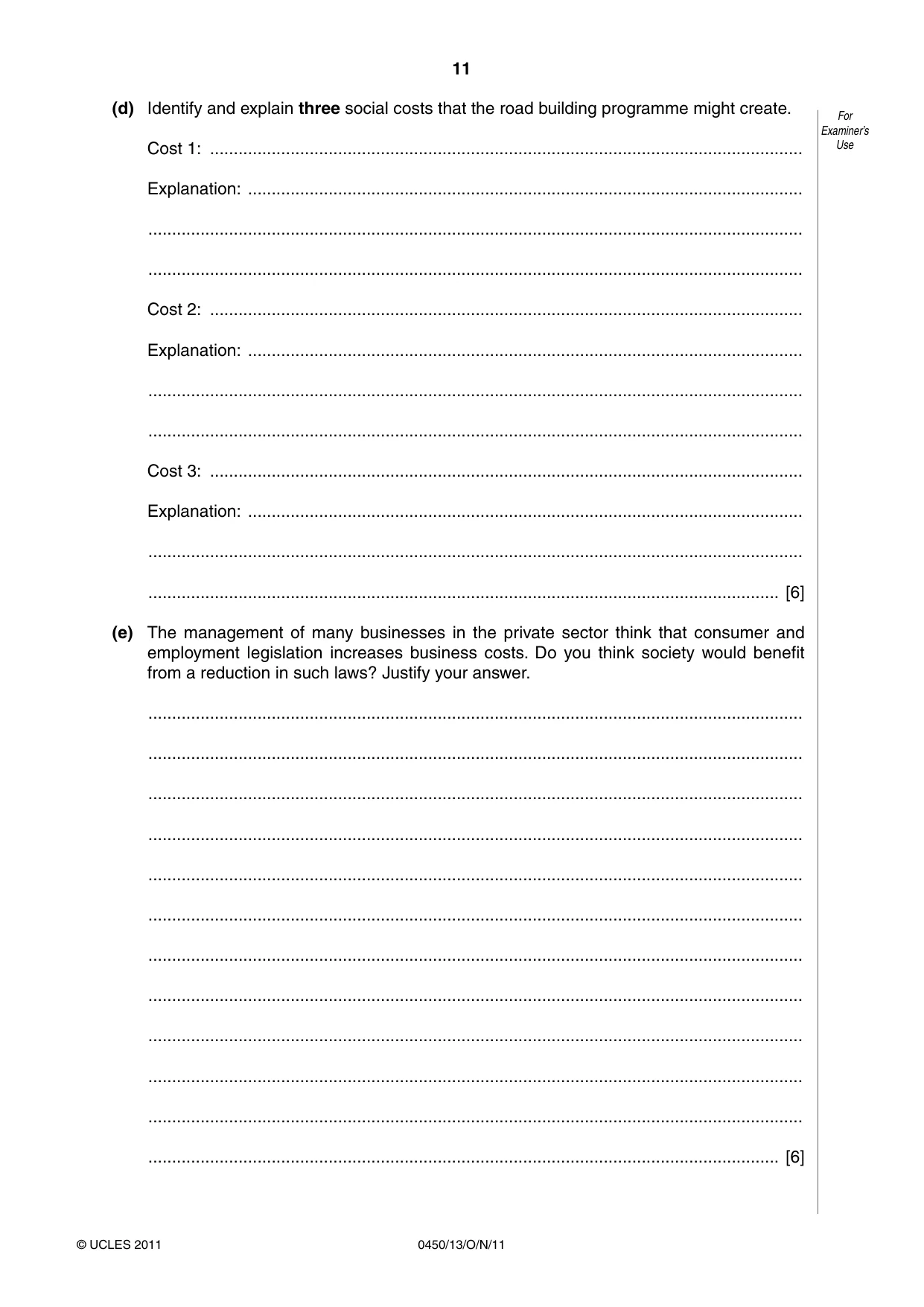
11 0450/13/O/N/11 © UCLES 2011 For Examiner’s Use (d) Identify and explain three social costs that the road building programme might create. Cost 1: … Explanation: … … … Cost 2: … Explanation: … … … Cost 3: … Explanation: … … … [6] (e) The management of many businesses in the private sector think that consumer and employment legislation increases business costs. Do you think society would benefit from a reduction in such laws? Justify your answer. … … … … … … … … … … … … [6]
Question paper, page 12
12 0450/13/O/N/11 © UCLES 2011 Permission to reproduce items where third-party owned material protected by copyright is included has been sought and cleared where possible. Every reasonable effort has been made by the publisher (UCLES) to trace copyright holders, but if any items requiring clearance have unwittingly been included, the publisher will be pleased to make amends at the earliest possible opportunity. University of Cambridge International Examinations is part of the Cambridge Assessment Group. Cambridge Assessment is the brand name of University of Cambridge Local Examinations Syndicate (UCLES), which is itself a department of the University of Cambridge. BLANK PAGE
Mark scheme, page 1
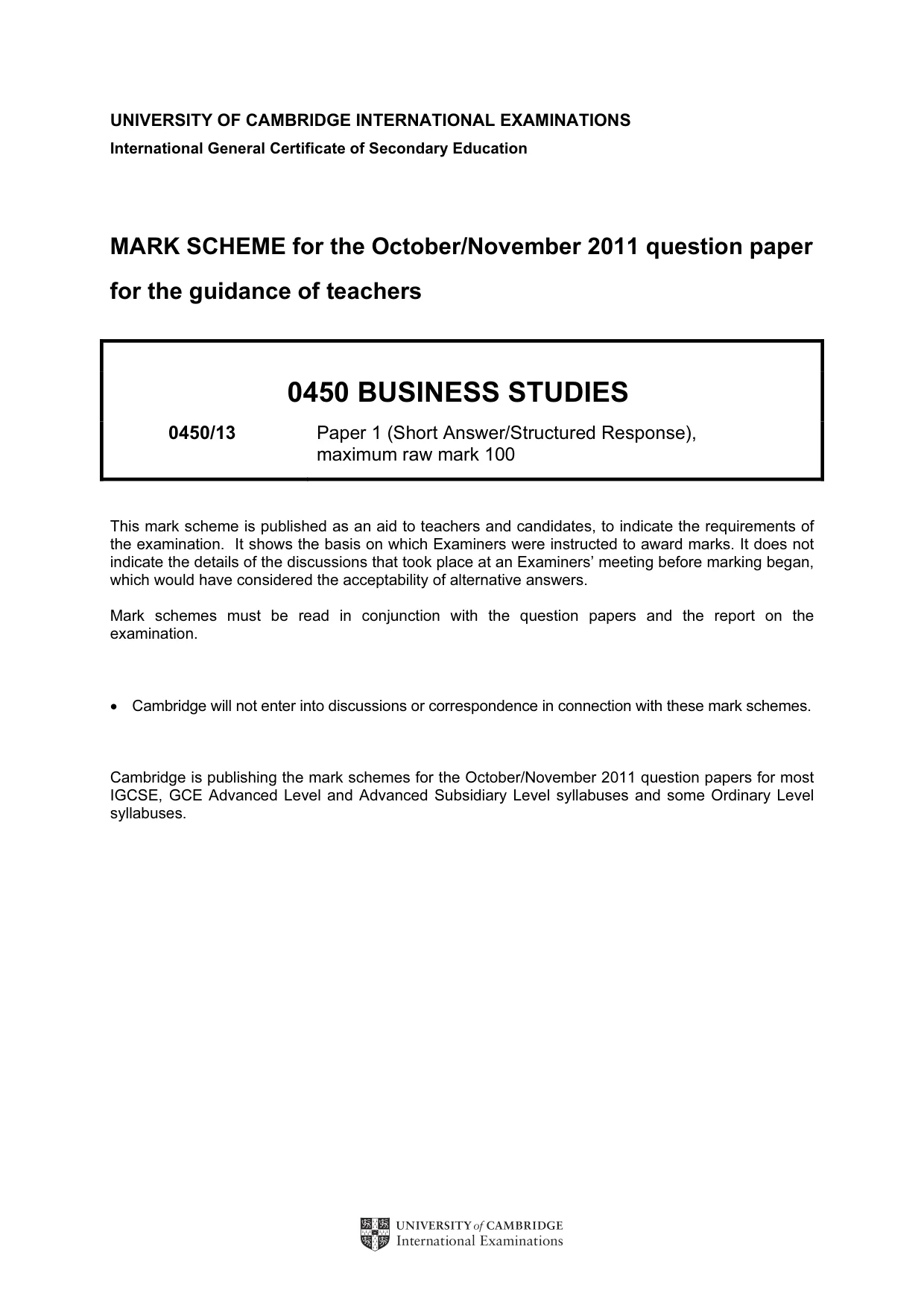
UNIVERSITY OF CAMBRIDGE INTERNATIONAL EXAMINATIONS International General Certificate of Secondary Education MARK SCHEME for the October/November 2011 question paper for the guidance of teachers 0450 BUSINESS STUDIES 0450/13 Paper 1 (Short Answer/Structured Response), maximum raw mark 100 This mark scheme is published as an aid to teachers and candidates, to indicate the requirements of the examination. It shows the basis on which Examiners were instructed to award marks. It does not indicate the details of the discussions that took place at an Examiners’ meeting before marking began, which would have considered the acceptability of alternative answers. Mark schemes must be read in conjunction with the question papers and the report on the examination. • Cambridge will not enter into discussions or correspondence in connection with these mark schemes. Cambridge is publishing the mark schemes for the October/November 2011 question papers for most IGCSE, GCE Advanced Level and Advanced Subsidiary Level syllabuses and some Ordinary Level syllabuses.
Mark scheme, page 2
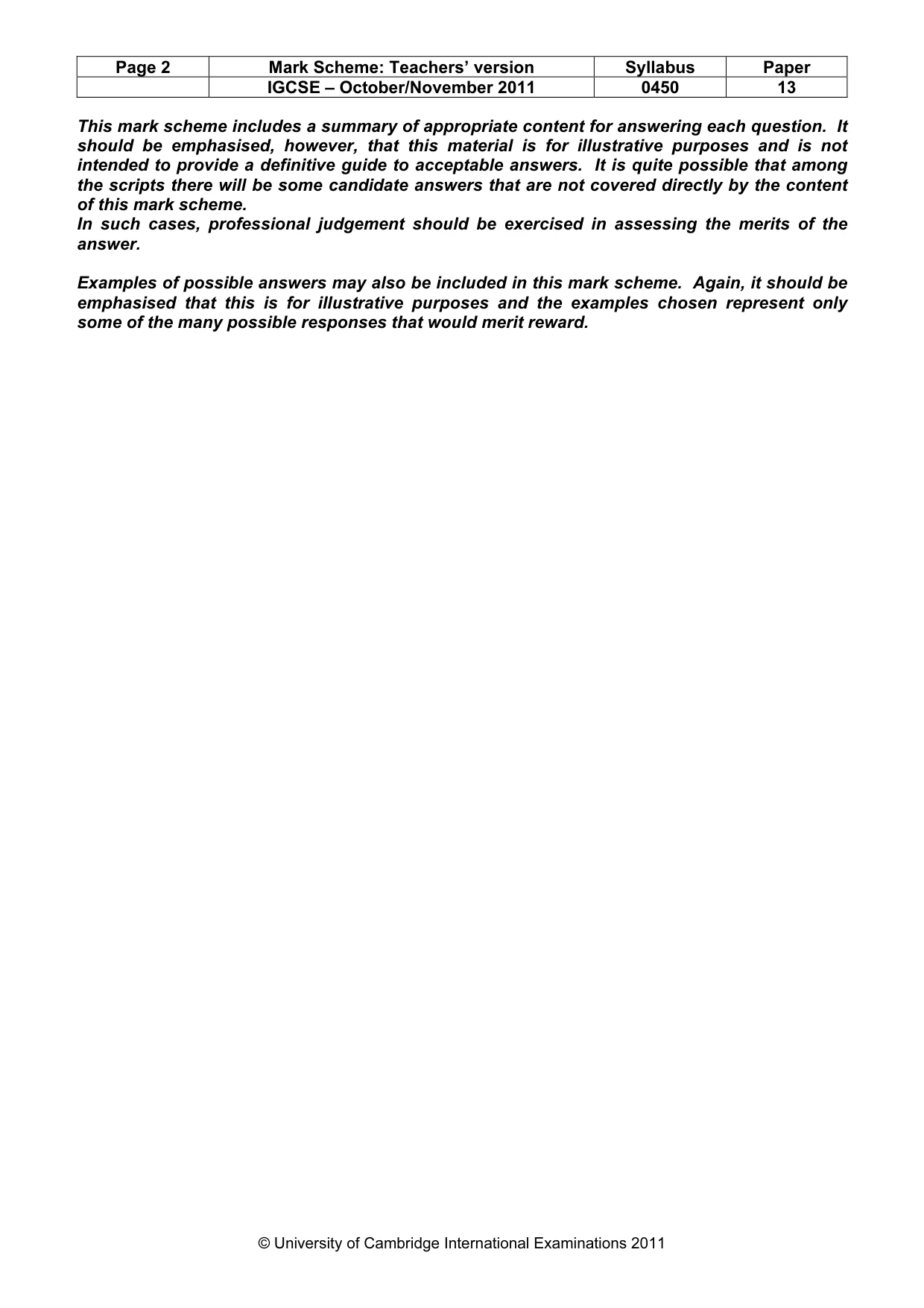
Page 2 Mark Scheme: Teachers’ version Syllabus Paper IGCSE – October/November 2011 0450 13 © University of Cambridge International Examinations 2011 This mark scheme includes a summary of appropriate content for answering each question. It should be emphasised, however, that this material is for illustrative purposes and is not intended to provide a definitive guide to acceptable answers. It is quite possible that among the scripts there will be some candidate answers that are not covered directly by the content of this mark scheme. In such cases, professional judgement should be exercised in assessing the merits of the answer. Examples of possible answers may also be included in this mark scheme. Again, it should be emphasised that this is for illustrative purposes and the examples chosen represent only some of the many possible responses that would merit reward.
Mark scheme, page 3
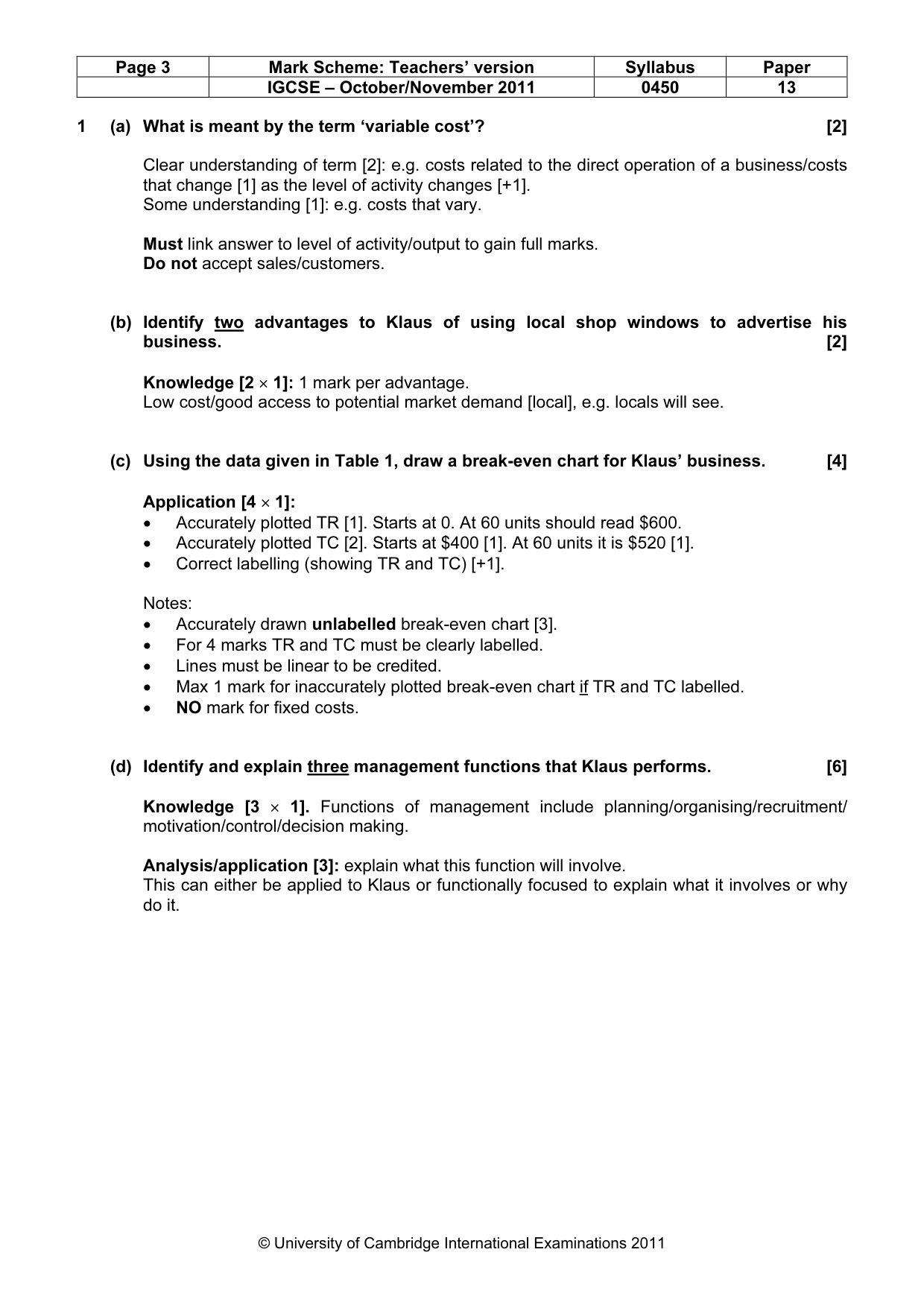
Page 3 Mark Scheme: Teachers’ version Syllabus Paper IGCSE – October/November 2011 0450 13 © University of Cambridge International Examinations 2011 1 (a) What is meant by the term ‘variable cost’? [2] Clear understanding of term [2]: e.g. costs related to the direct operation of a business/costs that change [1] as the level of activity changes [+1]. Some understanding [1]: e.g. costs that vary. Must link answer to level of activity/output to gain full marks. Do not accept sales/customers. (b) Identify two advantages to Klaus of using local shop windows to advertise his business. [2] Knowledge [2 × 1]: 1 mark per advantage. Low cost/good access to potential market demand [local], e.g. locals will see. (c) Using the data given in Table 1, draw a break-even chart for Klaus’ business. [4] Application [4 × 1]: • Accurately plotted TR [1]. Starts at 0. At 60 units should read $600. • Accurately plotted TC [2]. Starts at $400 [1]. At 60 units it is $520 [1]. • Correct labelling (showing TR and TC) [+1]. Notes: • Accurately drawn unlabelled break-even chart [3]. • For 4 marks TR and TC must be clearly labelled. • Lines must be linear to be credited. • Max 1 mark for inaccurately plotted break-even chart if TR and TC labelled. • NO mark for fixed costs. (d) Identify and explain three management functions that Klaus performs. [6] Knowledge [3 × 1]. Functions of management include planning/organising/recruitment/ motivation/control/decision making. Analysis/application [3]: explain what this function will involve. This can either be applied to Klaus or functionally focused to explain what it involves or why do it.
Mark scheme, page 4
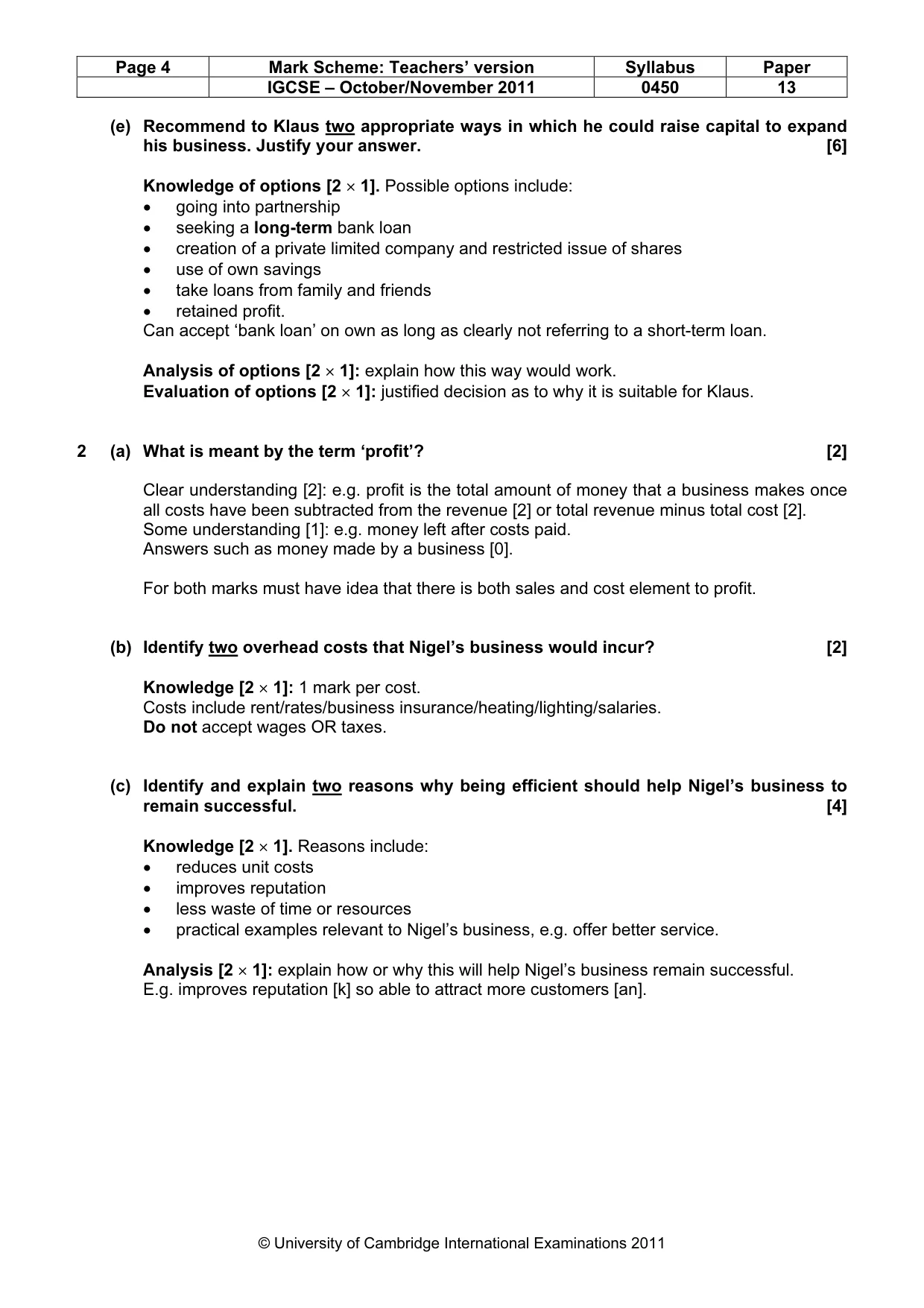
Page 4 Mark Scheme: Teachers’ version Syllabus Paper IGCSE – October/November 2011 0450 13 © University of Cambridge International Examinations 2011 (e) Recommend to Klaus two appropriate ways in which he could raise capital to expand his business. Justify your answer. [6] Knowledge of options [2 × 1]. Possible options include: • going into partnership • seeking a long-term bank loan • creation of a private limited company and restricted issue of shares • use of own savings • take loans from family and friends • retained profit. Can accept ‘bank loan’ on own as long as clearly not referring to a short-term loan. Analysis of options [2 × 1]: explain how this way would work. Evaluation of options [2 × 1]: justified decision as to why it is suitable for Klaus. 2 (a) What is meant by the term ‘profit’? [2] Clear understanding [2]: e.g. profit is the total amount of money that a business makes once all costs have been subtracted from the revenue [2] or total revenue minus total cost [2]. Some understanding [1]: e.g. money left after costs paid. Answers such as money made by a business [0]. For both marks must have idea that there is both sales and cost element to profit. (b) Identify two overhead costs that Nigel’s business would incur? [2] Knowledge [2 × 1]: 1 mark per cost. Costs include rent/rates/business insurance/heating/lighting/salaries. Do not accept wages OR taxes. (c) Identify and explain two reasons why being efficient should help Nigel’s business to remain successful. [4] Knowledge [2 × 1]. Reasons include: • reduces unit costs • improves reputation • less waste of time or resources • practical examples relevant to Nigel’s business, e.g. offer better service. Analysis [2 × 1]: explain how or why this will help Nigel’s business remain successful. E.g. improves reputation [k] so able to attract more customers [an].
Mark scheme, page 5
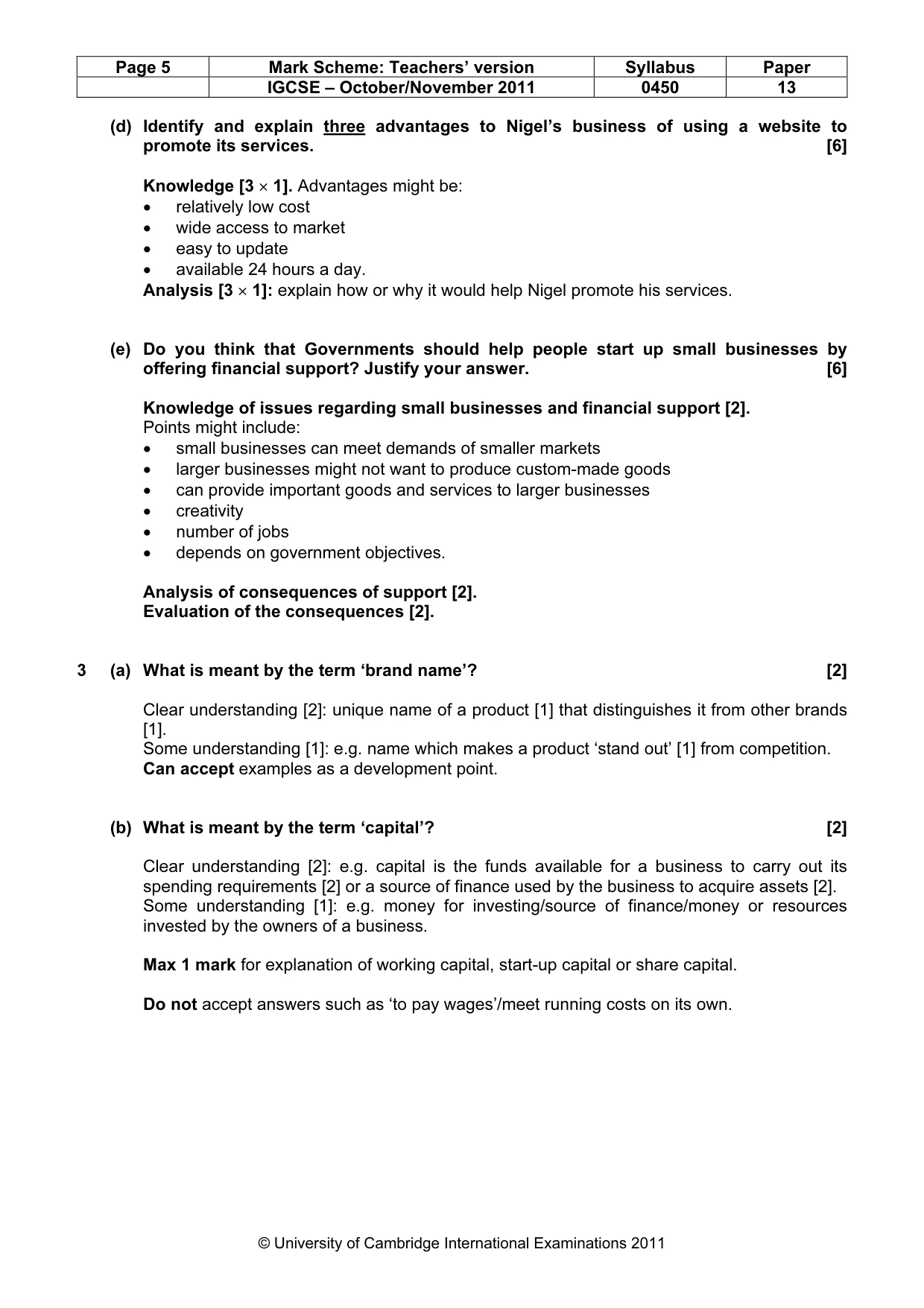
Page 5 Mark Scheme: Teachers’ version Syllabus Paper IGCSE – October/November 2011 0450 13 © University of Cambridge International Examinations 2011 (d) Identify and explain three advantages to Nigel’s business of using a website to promote its services. [6] Knowledge [3 × 1]. Advantages might be: • relatively low cost • wide access to market • easy to update • available 24 hours a day. Analysis [3 × 1]: explain how or why it would help Nigel promote his services. (e) Do you think that Governments should help people start up small businesses by offering financial support? Justify your answer. [6] Knowledge of issues regarding small businesses and financial support [2]. Points might include: • small businesses can meet demands of smaller markets • larger businesses might not want to produce custom-made goods • can provide important goods and services to larger businesses • creativity • number of jobs • depends on government objectives. Analysis of consequences of support [2]. Evaluation of the consequences [2]. 3 (a) What is meant by the term ‘brand name’? [2] Clear understanding [2]: unique name of a product [1] that distinguishes it from other brands [1]. Some understanding [1]: e.g. name which makes a product ‘stand out’ [1] from competition. Can accept examples as a development point. (b) What is meant by the term ‘capital’? [2] Clear understanding [2]: e.g. capital is the funds available for a business to carry out its spending requirements [2] or a source of finance used by the business to acquire assets [2]. Some understanding [1]: e.g. money for investing/source of finance/money or resources invested by the owners of a business. Max 1 mark for explanation of working capital, start-up capital or share capital. Do not accept answers such as ‘to pay wages’/meet running costs on its own.
Mark scheme, page 6
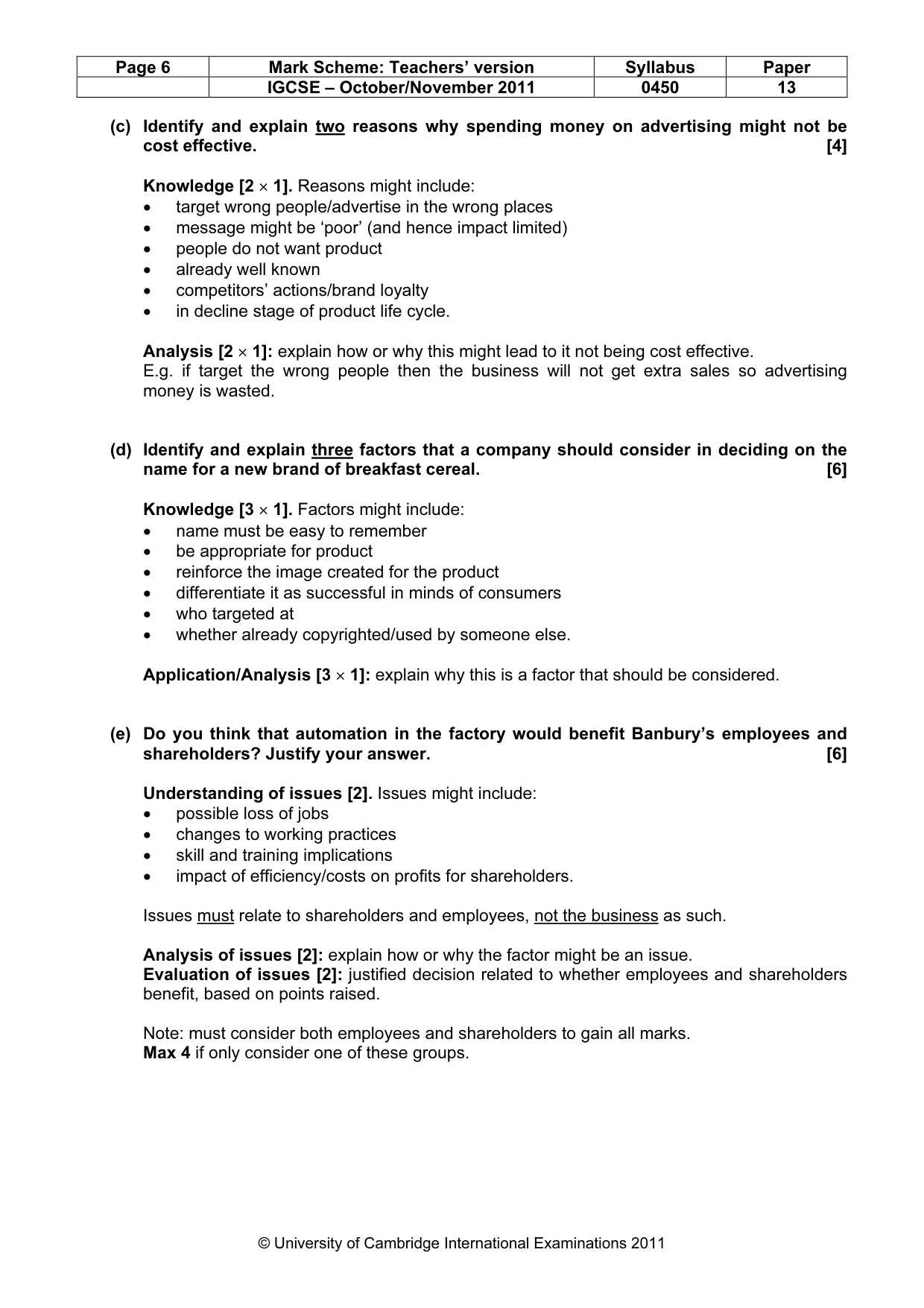
Page 6 Mark Scheme: Teachers’ version Syllabus Paper IGCSE – October/November 2011 0450 13 © University of Cambridge International Examinations 2011 (c) Identify and explain two reasons why spending money on advertising might not be cost effective. [4] Knowledge [2 × 1]. Reasons might include: • target wrong people/advertise in the wrong places • message might be ‘poor’ (and hence impact limited) • people do not want product • already well known • competitors’ actions/brand loyalty • in decline stage of product life cycle. Analysis [2 × 1]: explain how or why this might lead to it not being cost effective. E.g. if target the wrong people then the business will not get extra sales so advertising money is wasted. (d) Identify and explain three factors that a company should consider in deciding on the name for a new brand of breakfast cereal. [6] Knowledge [3 × 1]. Factors might include: • name must be easy to remember • be appropriate for product • reinforce the image created for the product • differentiate it as successful in minds of consumers • who targeted at • whether already copyrighted/used by someone else. Application/Analysis [3 × 1]: explain why this is a factor that should be considered. (e) Do you think that automation in the factory would benefit Banbury’s employees and shareholders? Justify your answer. [6] Understanding of issues [2]. Issues might include: • possible loss of jobs • changes to working practices • skill and training implications • impact of efficiency/costs on profits for shareholders. Issues must relate to shareholders and employees, not the business as such. Analysis of issues [2]: explain how or why the factor might be an issue. Evaluation of issues [2]: justified decision related to whether employees and shareholders benefit, based on points raised. Note: must consider both employees and shareholders to gain all marks. Max 4 if only consider one of these groups.
Mark scheme, page 7
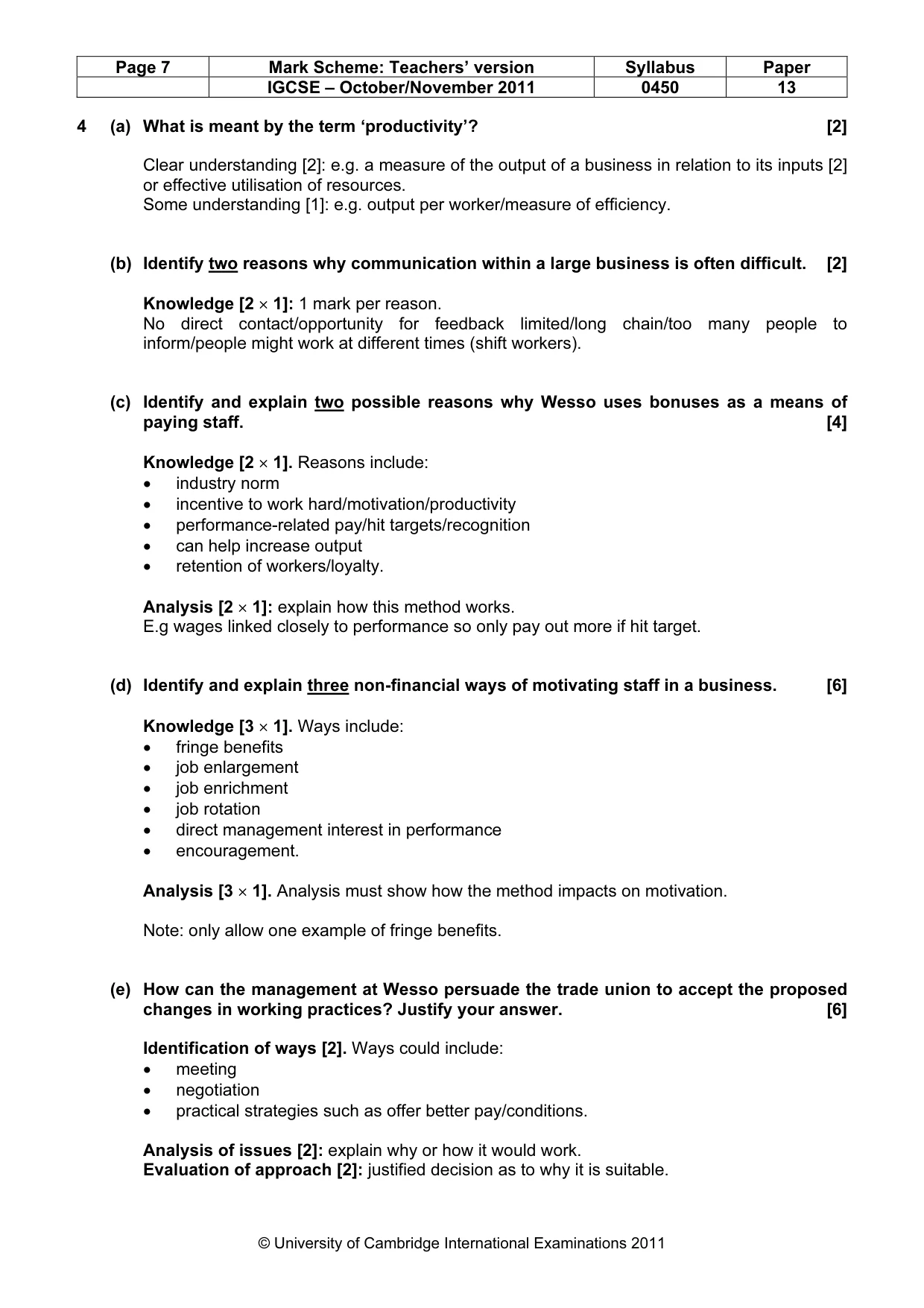
Page 7 Mark Scheme: Teachers’ version Syllabus Paper IGCSE – October/November 2011 0450 13 © University of Cambridge International Examinations 2011 4 (a) What is meant by the term ‘productivity’? [2] Clear understanding [2]: e.g. a measure of the output of a business in relation to its inputs [2] or effective utilisation of resources. Some understanding [1]: e.g. output per worker/measure of efficiency. (b) Identify two reasons why communication within a large business is often difficult. [2] Knowledge [2 × 1]: 1 mark per reason. No direct contact/opportunity for feedback limited/long chain/too many people to inform/people might work at different times (shift workers). (c) Identify and explain two possible reasons why Wesso uses bonuses as a means of paying staff. [4] Knowledge [2 × 1]. Reasons include: • industry norm • incentive to work hard/motivation/productivity • performance-related pay/hit targets/recognition • can help increase output • retention of workers/loyalty. Analysis [2 × 1]: explain how this method works. E.g wages linked closely to performance so only pay out more if hit target. (d) Identify and explain three non-financial ways of motivating staff in a business. [6] Knowledge [3 × 1]. Ways include: • fringe benefits • job enlargement • job enrichment • job rotation • direct management interest in performance • encouragement. Analysis [3 × 1]. Analysis must show how the method impacts on motivation. Note: only allow one example of fringe benefits. (e) How can the management at Wesso persuade the trade union to accept the proposed changes in working practices? Justify your answer. [6] Identification of ways [2]. Ways could include: • meeting • negotiation • practical strategies such as offer better pay/conditions. Analysis of issues [2]: explain why or how it would work. Evaluation of approach [2]: justified decision as to why it is suitable.
Mark scheme, page 8
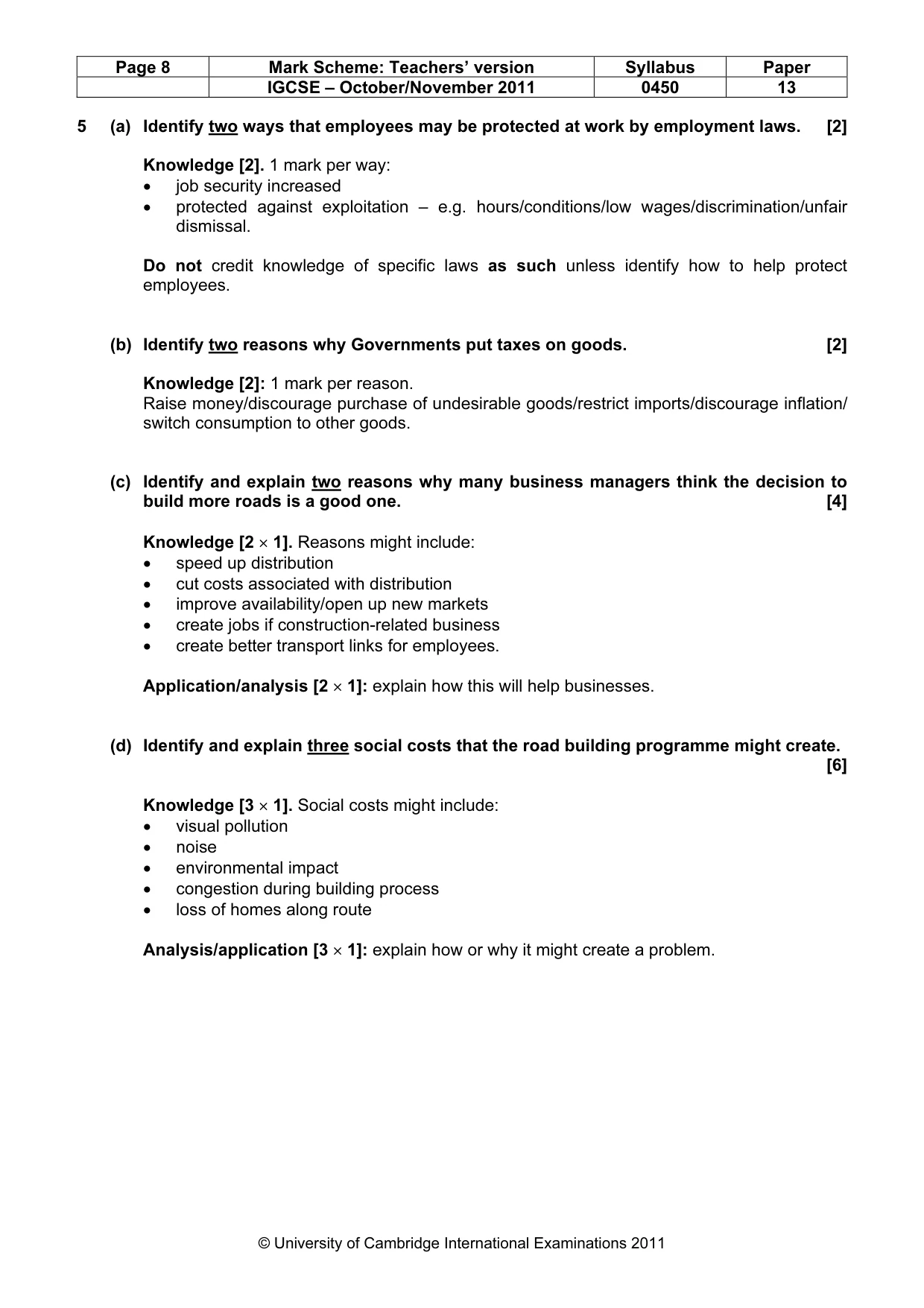
Page 8 Mark Scheme: Teachers’ version Syllabus Paper IGCSE – October/November 2011 0450 13 © University of Cambridge International Examinations 2011 5 (a) Identify two ways that employees may be protected at work by employment laws. [2] Knowledge [2]. 1 mark per way: • job security increased • protected against exploitation – e.g. hours/conditions/low wages/discrimination/unfair dismissal. Do not credit knowledge of specific laws as such unless identify how to help protect employees. (b) Identify two reasons why Governments put taxes on goods. [2] Knowledge [2]: 1 mark per reason. Raise money/discourage purchase of undesirable goods/restrict imports/discourage inflation/ switch consumption to other goods. (c) Identify and explain two reasons why many business managers think the decision to build more roads is a good one. [4] Knowledge [2 × 1]. Reasons might include: • speed up distribution • cut costs associated with distribution • improve availability/open up new markets • create jobs if construction-related business • create better transport links for employees. Application/analysis [2 × 1]: explain how this will help businesses. (d) Identify and explain three social costs that the road building programme might create. [6] Knowledge [3 × 1]. Social costs might include: • visual pollution • noise • environmental impact • congestion during building process • loss of homes along route Analysis/application [3 × 1]: explain how or why it might create a problem.
Mark scheme, page 9
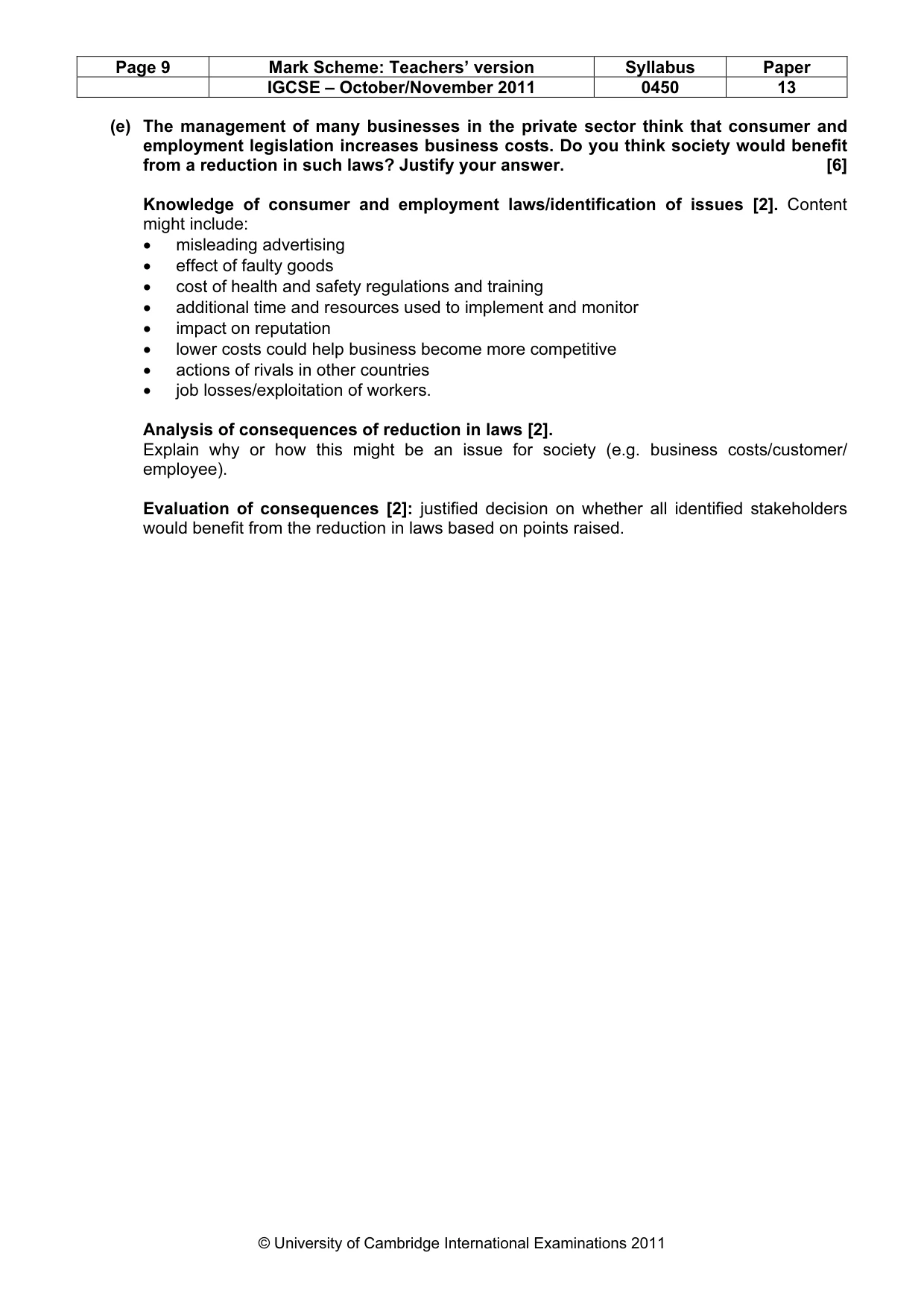
Page 9 Mark Scheme: Teachers’ version Syllabus Paper IGCSE – October/November 2011 0450 13 © University of Cambridge International Examinations 2011 (e) The management of many businesses in the private sector think that consumer and employment legislation increases business costs. Do you think society would benefit from a reduction in such laws? Justify your answer. [6] Knowledge of consumer and employment laws/identification of issues [2]. Content might include: • misleading advertising • effect of faulty goods • cost of health and safety regulations and training • additional time and resources used to implement and monitor • impact on reputation • lower costs could help business become more competitive • actions of rivals in other countries • job losses/exploitation of workers. Analysis of consequences of reduction in laws [2]. Explain why or how this might be an issue for society (e.g. business costs/customer/ employee). Evaluation of consequences [2]: justified decision on whether all identified stakeholders would benefit from the reduction in laws based on points raised.
What you needed in this session
Cambridge’s own grade thresholds for 2011 Oct/Nov, Paper 1 · Variant 3. A higher threshold means an easier paper — the bar moves with how the cohort did.