Cambridge IGCSE Business Studies 0450 — 2011 Oct/Nov Paper 1 · Variant 1
0450/11/O/N/11 · 100 marks · ≈113 min
The question paper and its mark scheme, free to read here and free to download. This is Cambridge’s own paper, exactly as it was sat.
Question paper12 pages

Mark scheme10 pages
Answers below. Sit the paper first if you are practising.
Paper as text
Question paper, page 1
This document consists of 11 printed pages and 1 blank page. DC (NF/SW) 36795/3 © UCLES 2011 [Turn over UNIVERSITY OF CAMBRIDGE INTERNATIONAL EXAMINATIONS International General Certificate of Secondary Education * 5 7 1 0 6 7 4 3 7 7 * BUSINESS STUDIES 0450/11 Paper 1 October/November 2011 1 hour 45 minutes Candidates answer on the Question Paper. No Additional Materials are required. READ THESE INSTRUCTIONS FIRST Write your Centre number, candidate number and name on all the work you hand in. Write in dark blue or black pen. Do not use staples, paper clips, highlighters, glue or correction fluid. DO NOT WRITE IN ANY BARCODES. Answer all questions. The businesses described in this paper are entirely fictitious. At the end of the examination, fasten all your work securely together. The number of marks is given in brackets [ ] at the end of each question or part question. For Examiner’s Use 1 2 3 4 5 Total
Question paper, page 2
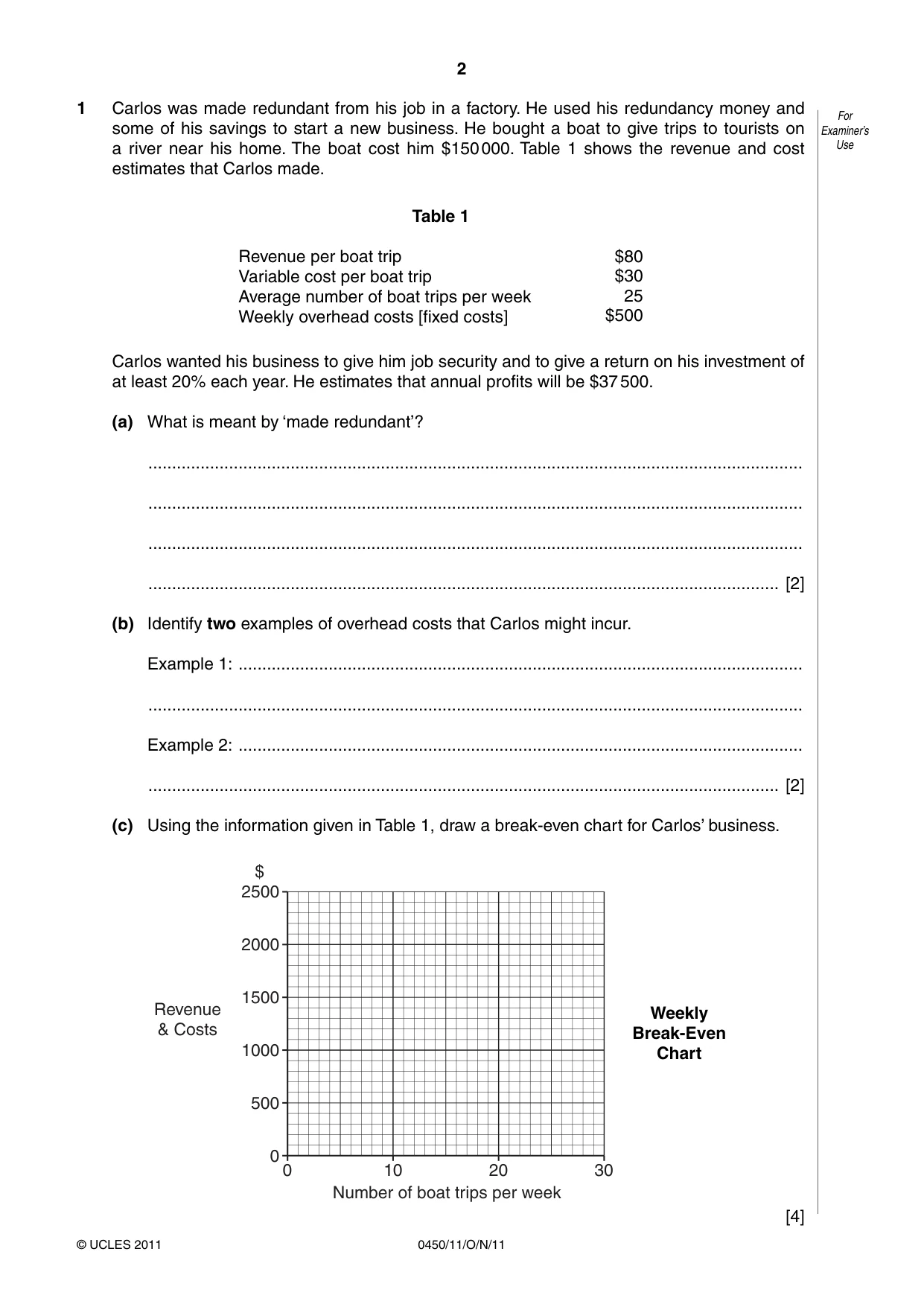
2 0450/11/O/N/11 © UCLES 2011 For Examiner’s Use 1 Carlos was made redundant from his job in a factory. He used his redundancy money and some of his savings to start a new business. He bought a boat to give trips to tourists on a river near his home. The boat cost him $150 000. Table 1 shows the revenue and cost estimates that Carlos made. Table 1 Revenue per boat trip Variable cost per boat trip Average number of boat trips per week Weekly overhead costs [fixed costs] $80 $30 25 $500 Carlos wanted his business to give him job security and to give a return on his investment of at least 20% each year. He estimates that annual profits will be $37 500. (a) What is meant by ‘made redundant’? … … … … [2] (b) Identify two examples of overhead costs that Carlos might incur. Example 1: … … Example 2: … … [2] (c) Using the information given in Table 1, draw a break-even chart for Carlos’ business. 0 500 10 0 20 Number of boat trips per week Revenue & Costs $ 30 1000 1500 2000 2500 Weekly Break-Even Chart [4]
Question paper, page 3
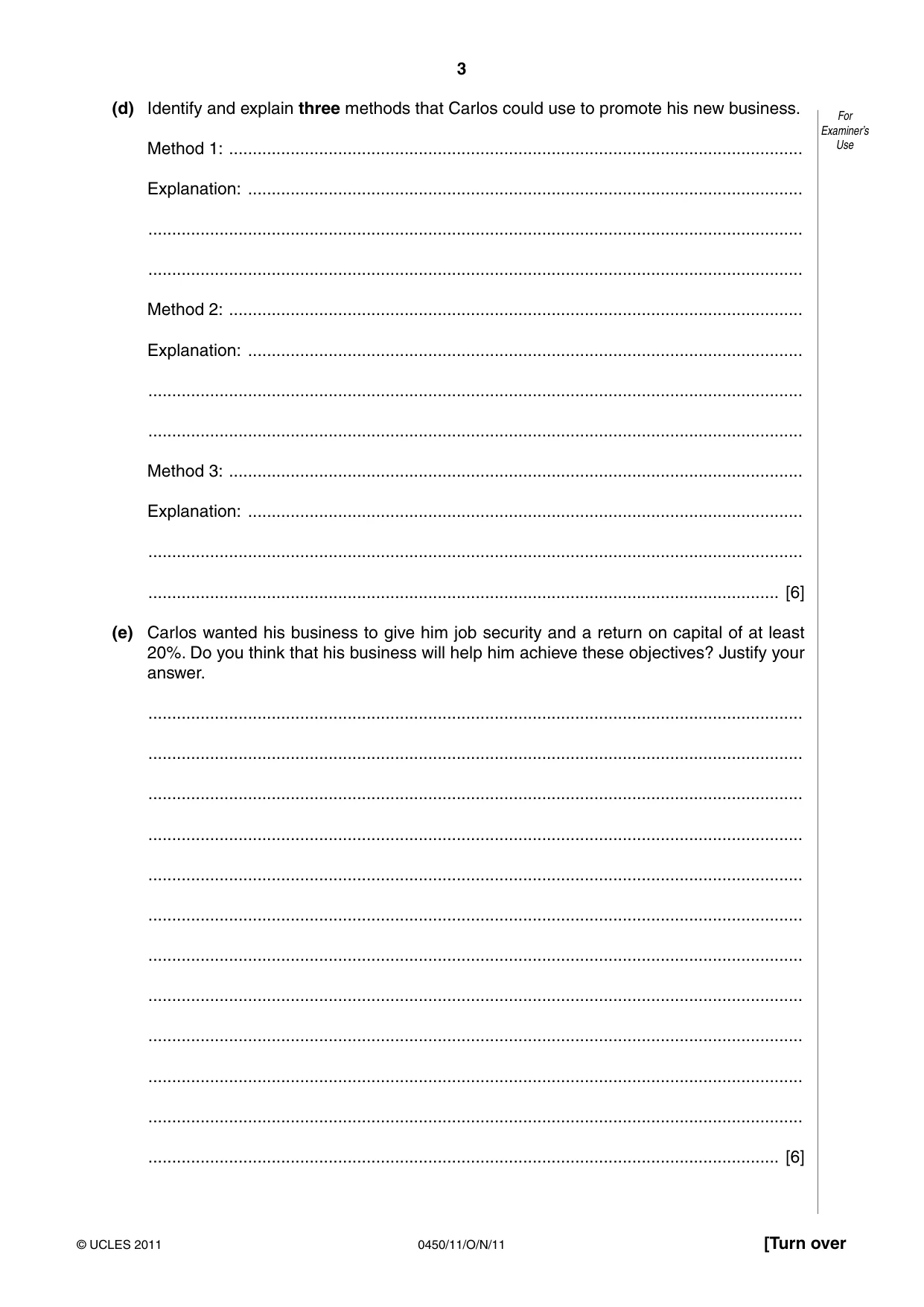
3 0450/11/O/N/11 © UCLES 2011 [Turn over For Examiner’s Use (d) Identify and explain three methods that Carlos could use to promote his new business. Method 1: … Explanation: … … … Method 2: … Explanation: … … … Method 3: … Explanation: … … … [6] (e) Carlos wanted his business to give him job security and a return on capital of at least 20%. Do you think that his business will help him achieve these objectives? Justify your answer. … … … … … … … … … … … … [6]
Question paper, page 4
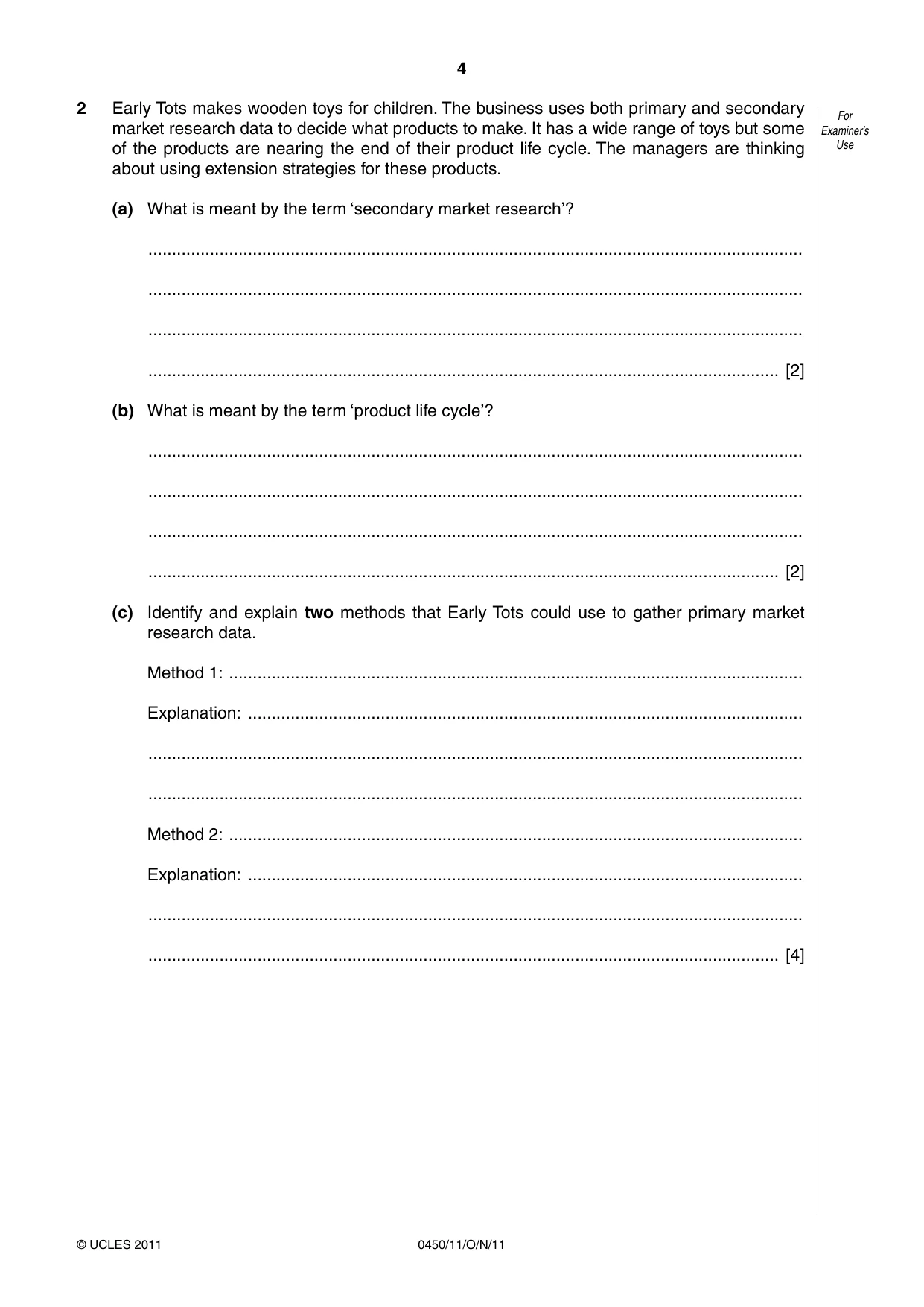
4 0450/11/O/N/11 © UCLES 2011 For Examiner’s Use 2 Early Tots makes wooden toys for children. The business uses both primary and secondary market research data to decide what products to make. It has a wide range of toys but some of the products are nearing the end of their product life cycle. The managers are thinking about using extension strategies for these products. (a) What is meant by the term ‘secondary market research’? … … … … [2] (b) What is meant by the term ‘product life cycle’? … … … … [2] (c) Identify and explain two methods that Early Tots could use to gather primary market research data. Method 1: … Explanation: … … … Method 2: … Explanation: … … … [4]
Question paper, page 5
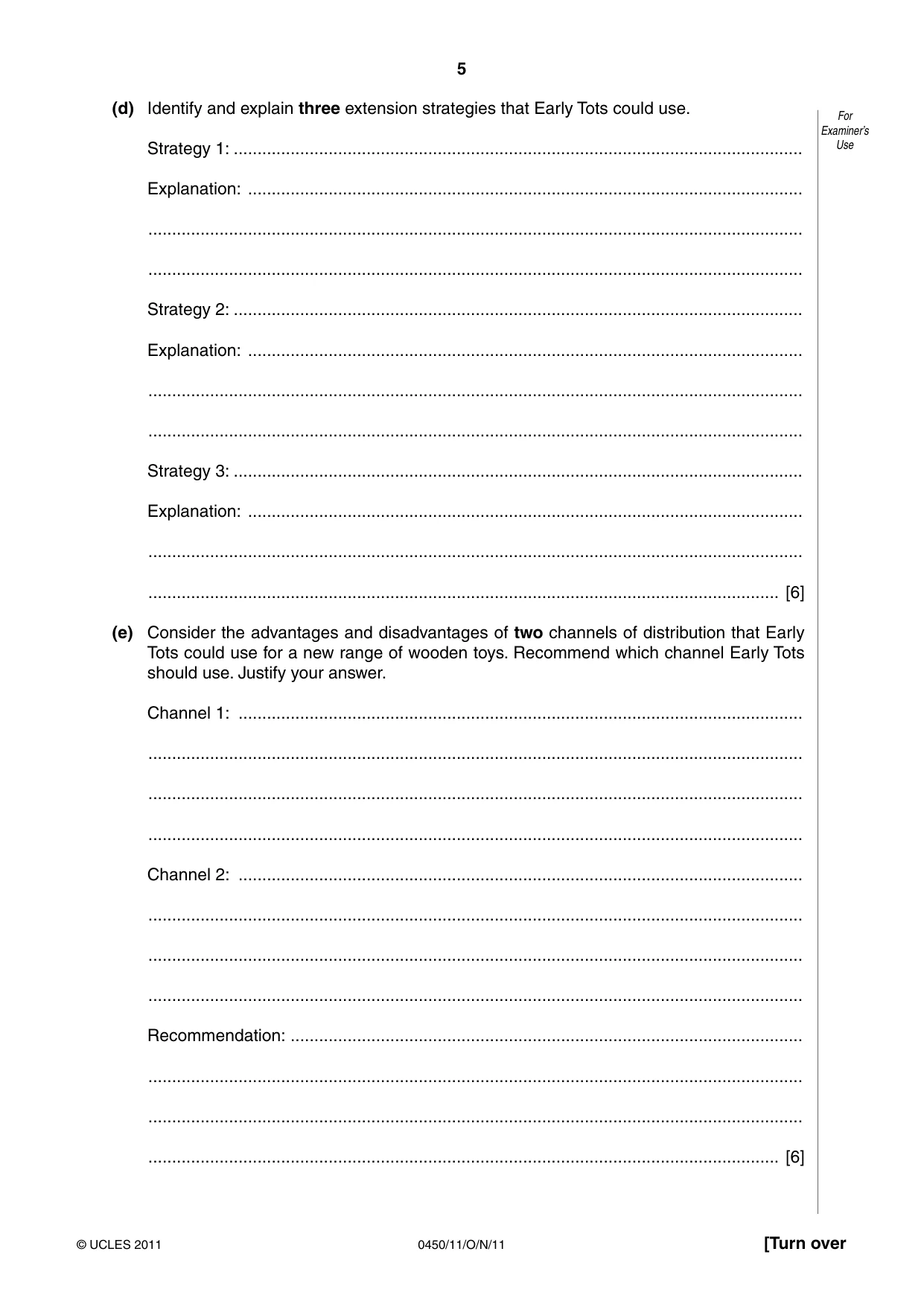
5 0450/11/O/N/11 © UCLES 2011 [Turn over For Examiner’s Use (d) Identify and explain three extension strategies that Early Tots could use. Strategy 1: … Explanation: … … … Strategy 2: … Explanation: … … … Strategy 3: … Explanation: … … … [6] (e) Consider the advantages and disadvantages of two channels of distribution that Early Tots could use for a new range of wooden toys. Recommend which channel Early Tots should use. Justify your answer. Channel 1: … … … … Channel 2: … … … … Recommendation: … … … … [6]
Question paper, page 6
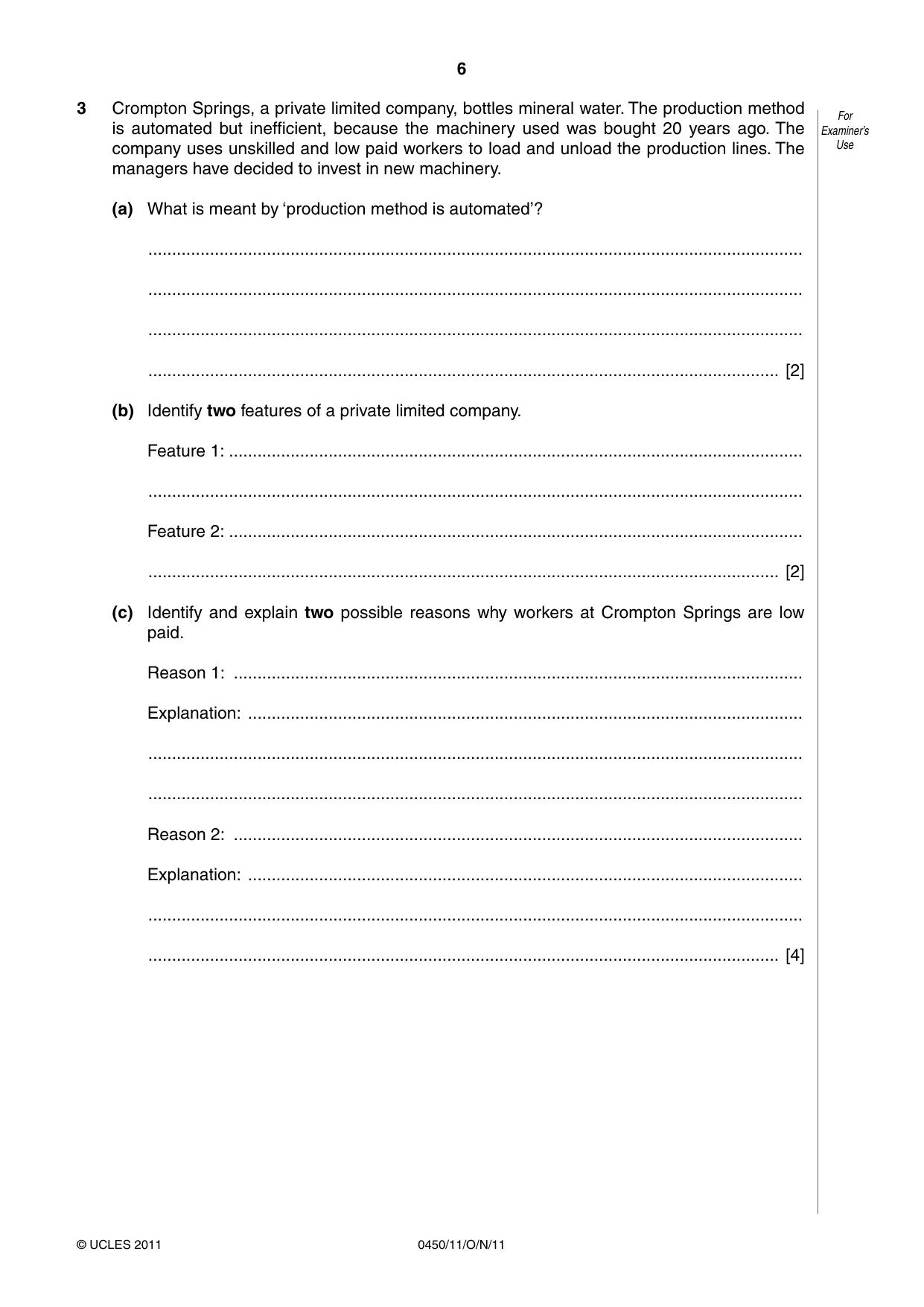
6 0450/11/O/N/11 © UCLES 2011 For Examiner’s Use 3 Crompton Springs, a private limited company, bottles mineral water. The production method is automated but inefficient, because the machinery used was bought 20 years ago. The company uses unskilled and low paid workers to load and unload the production lines. The managers have decided to invest in new machinery. (a) What is meant by ‘production method is automated’? … … … … [2] (b) Identify two features of a private limited company. Feature 1: … … Feature 2: … … [2] (c) Identify and explain two possible reasons why workers at Crompton Springs are low paid. Reason 1: … Explanation: … … … Reason 2: … Explanation: … … … [4]
Question paper, page 7
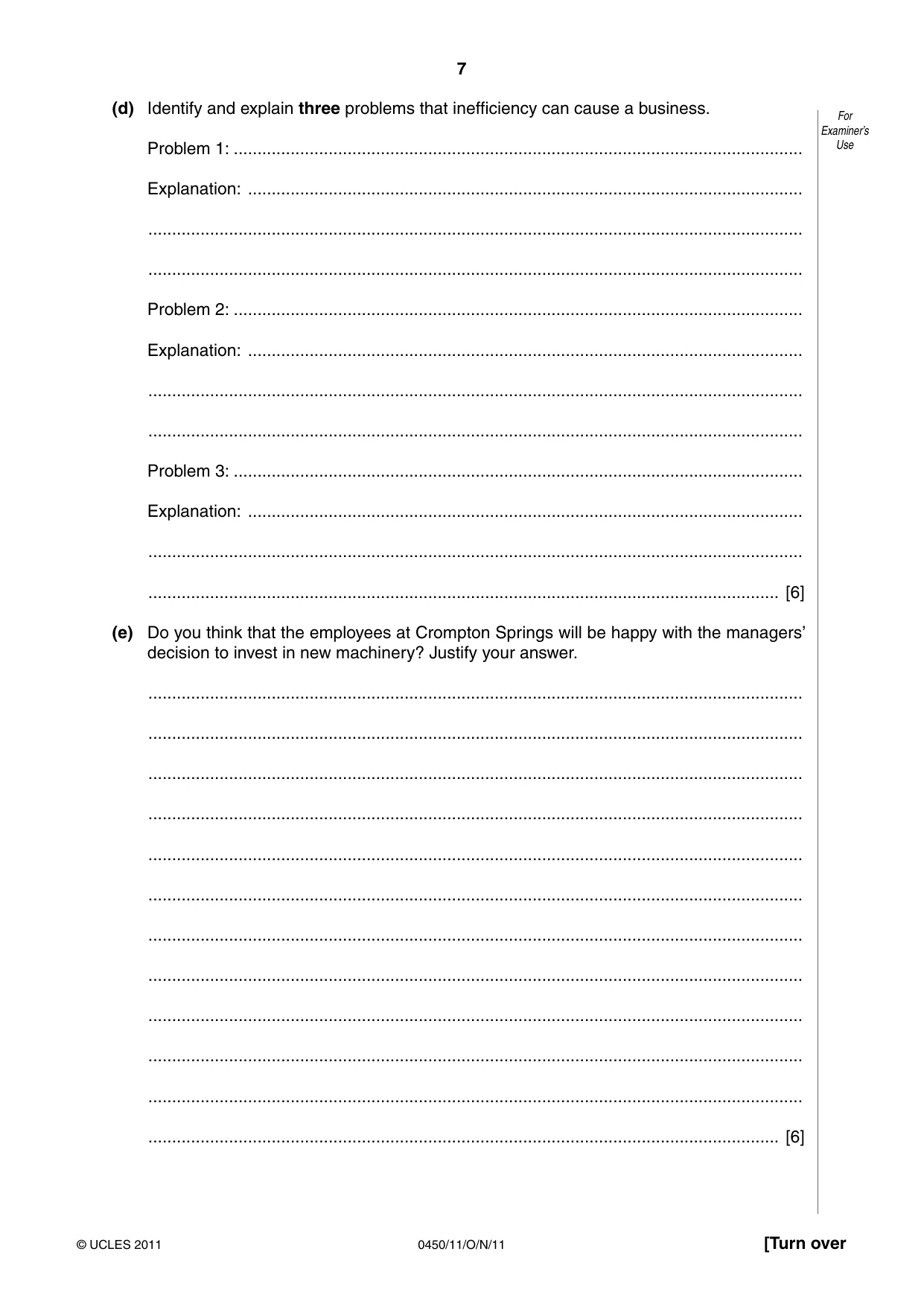
7 0450/11/O/N/11 © UCLES 2011 [Turn over For Examiner’s Use (d) Identify and explain three problems that inefficiency can cause a business. Problem 1: … Explanation: … … … Problem 2: … Explanation: … … … Problem 3: … Explanation: … … … [6] (e) Do you think that the employees at Crompton Springs will be happy with the managers’ decision to invest in new machinery? Justify your answer. … … … … … … … … … … … … [6]
Question paper, page 8
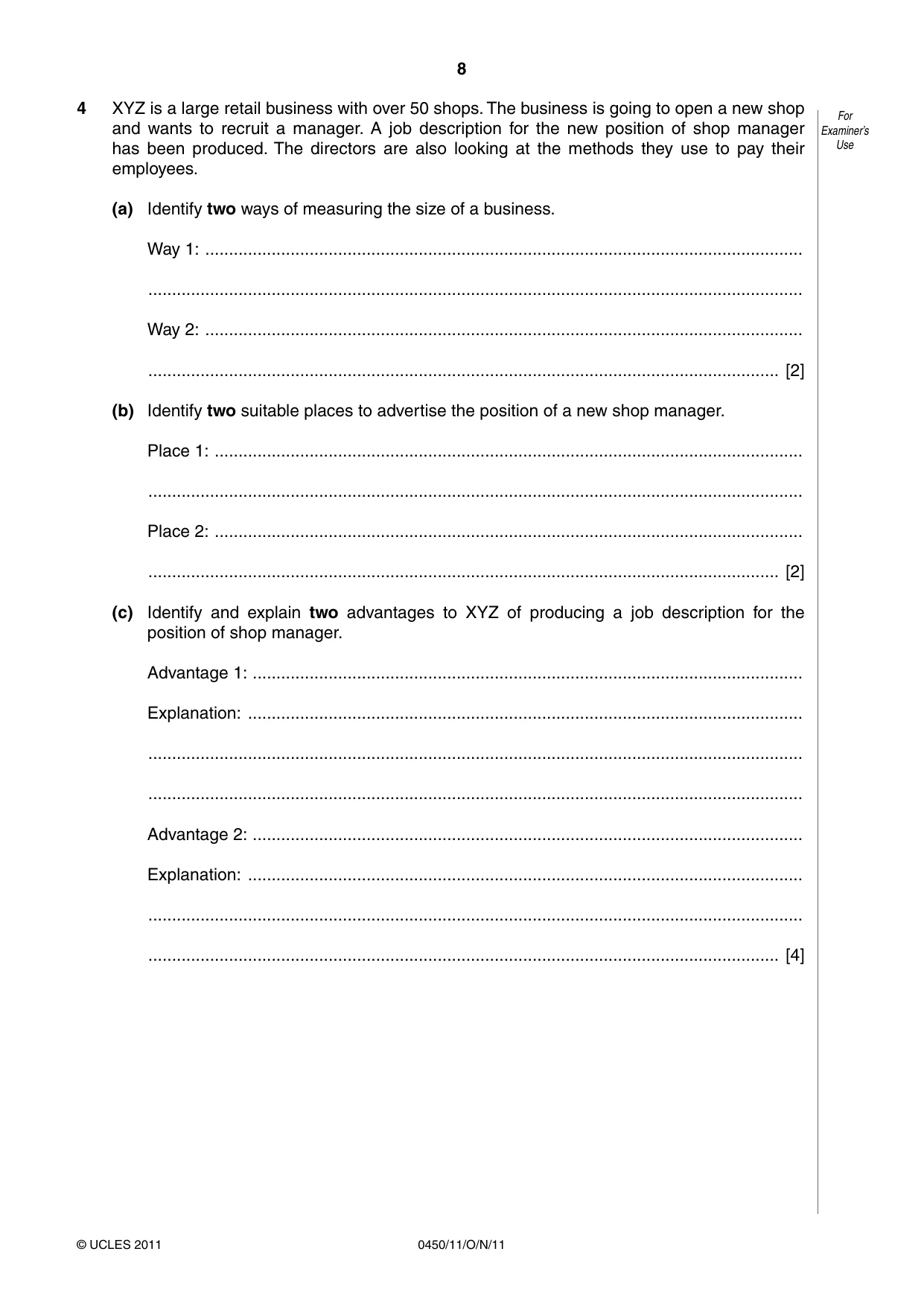
8 0450/11/O/N/11 © UCLES 2011 For Examiner’s Use 4 XYZ is a large retail business with over 50 shops. The business is going to open a new shop and wants to recruit a manager. A job description for the new position of shop manager has been produced. The directors are also looking at the methods they use to pay their employees. (a) Identify two ways of measuring the size of a business. Way 1: … … Way 2: … … [2] (b) Identify two suitable places to advertise the position of a new shop manager. Place 1: … … Place 2: … … [2] (c) Identify and explain two advantages to XYZ of producing a job description for the position of shop manager. Advantage 1: … Explanation: … … … Advantage 2: … Explanation: … … … [4]
Question paper, page 9
9 0450/11/O/N/11 © UCLES 2011 [Turn over For Examiner’s Use (d) Identify and explain three different payment methods that XYZ could use to reward their employees. Method 1: … Explanation: … … … Method 2: … Explanation: … … … Method 3: … Explanation: … … … [6] (e) Do you think that the appointment of a suitable shop manager will mean that the new shop is certain to be successful? Justify your answer. … … … … … … … … … … … … [6]
Question paper, page 10
10 0450/11/O/N/11 © UCLES 2011 For Examiner’s Use 5 Country W has a mixed economy. The public sector has grown in recent years. The Government has also introduced many new laws regulating business behaviour and protecting employees and consumers. (a) What is meant by the term ‘mixed economy’? … … … … [2] (b) Identify two objectives often set by businesses in the public sector. Objective 1: … … Objective 2: … … [2] (c) Identify and explain two reasons why the size of the public sector might increase over time. Reason 1: … Explanation: … … … Reason 2: … Explanation: … … … [4]
Question paper, page 11
11 0450/11/O/N/11 © UCLES 2011 For Examiner’s Use (d) Identify and explain three ways in which consumers might benefit from consumer protection laws. Way 1: … Explanation: … … … Way 2: … Explanation: … … … Way 3: … Explanation: … … … [6] (e) The management of many businesses in the private sector think that employment legislation is making them less competitive. Do you agree? Justify your answer. … … … … … … … … … … … … [6]
Question paper, page 12
12 0450/11/O/N/11 © UCLES 2011 Permission to reproduce items where third-party owned material protected by copyright is included has been sought and cleared where possible. Every reasonable effort has been made by the publisher (UCLES) to trace copyright holders, but if any items requiring clearance have unwittingly been included, the publisher will be pleased to make amends at the earliest possible opportunity. University of Cambridge International Examinations is part of the Cambridge Assessment Group. Cambridge Assessment is the brand name of University of Cambridge Local Examinations Syndicate (UCLES), which is itself a department of the University of Cambridge. BLANK PAGE
Mark scheme, page 1
UNIVERSITY OF CAMBRIDGE INTERNATIONAL EXAMINATIONS International General Certificate of Secondary Education MARK SCHEME for the October/November 2011 question paper for the guidance of teachers 0450 BUSINESS STUDIES 0450/11 Paper 1 (Short Answer/Structured Response), maximum raw mark 100 This mark scheme is published as an aid to teachers and candidates, to indicate the requirements of the examination. It shows the basis on which Examiners were instructed to award marks. It does not indicate the details of the discussions that took place at an Examiners’ meeting before marking began, which would have considered the acceptability of alternative answers. Mark schemes must be read in conjunction with the question papers and the report on the examination. • Cambridge will not enter into discussions or correspondence in connection with these mark schemes. Cambridge is publishing the mark schemes for the October/November 2011 question papers for most IGCSE, GCE Advanced Level and Advanced Subsidiary Level syllabuses and some Ordinary Level syllabuses.
Mark scheme, page 2
Page 2 Mark Scheme: Teachers’ version Syllabus Paper IGCSE – October/November 2011 0450 11 © University of Cambridge International Examinations 2011 This mark scheme includes a summary of appropriate content for answering each question. It should be emphasised, however, that this material is for illustrative purposes and is not intended to provide a definitive guide to acceptable answers. It is quite possible that among the scripts there will be some candidate answers that are not covered directly by the content of this mark scheme. In such cases, professional judgement should be exercised in assessing the merits of the answer. Examples of possible answers may also be included in this mark scheme. Again, it should be emphasised that this is for illustrative purposes and the examples chosen represent only some of the many possible responses that would merit reward.
Mark scheme, page 3
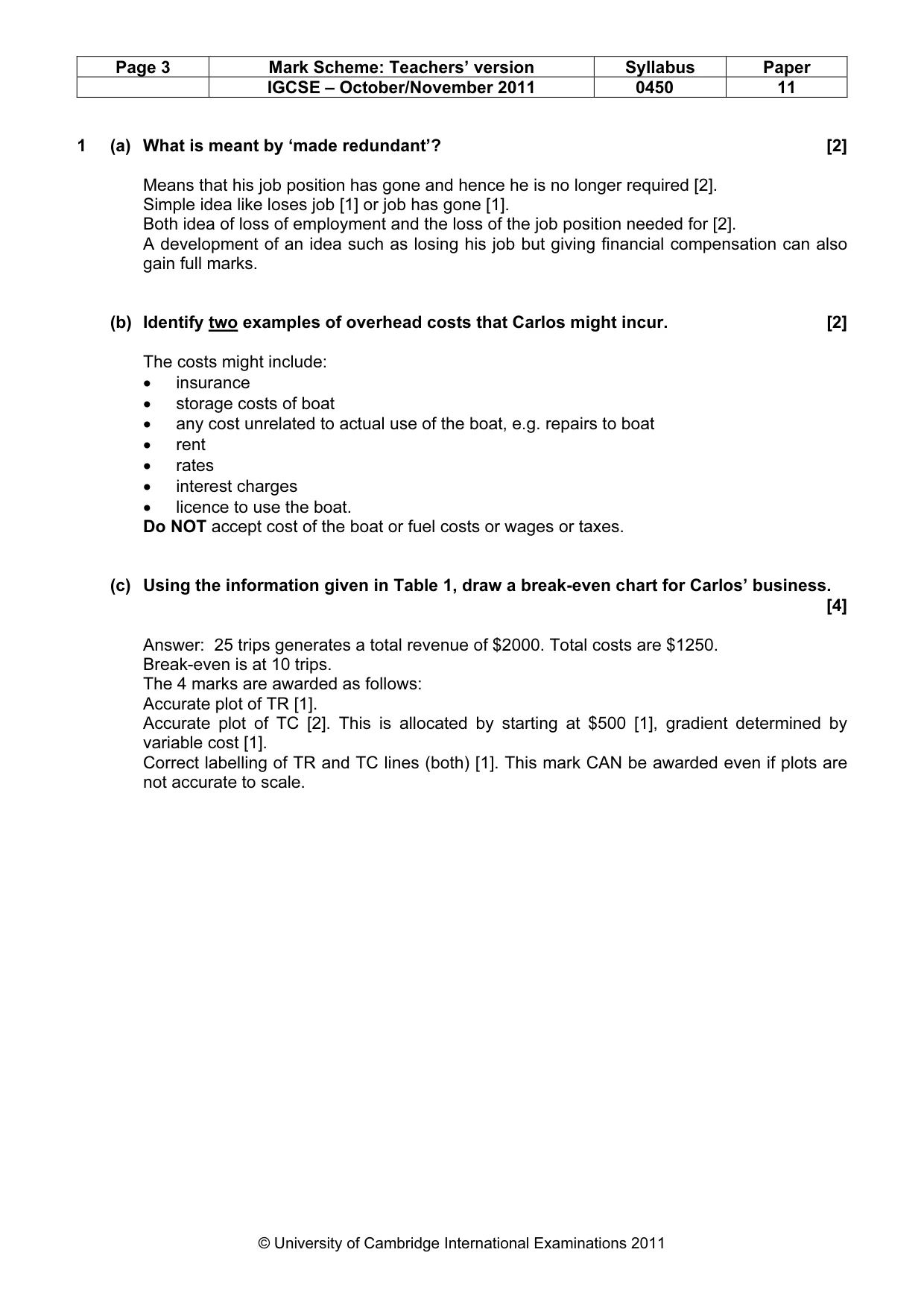
Page 3 Mark Scheme: Teachers’ version Syllabus Paper IGCSE – October/November 2011 0450 11 © University of Cambridge International Examinations 2011 1 (a) What is meant by ‘made redundant’? [2] Means that his job position has gone and hence he is no longer required [2]. Simple idea like loses job [1] or job has gone [1]. Both idea of loss of employment and the loss of the job position needed for [2]. A development of an idea such as losing his job but giving financial compensation can also gain full marks. (b) Identify two examples of overhead costs that Carlos might incur. [2] The costs might include: • insurance • storage costs of boat • any cost unrelated to actual use of the boat, e.g. repairs to boat • rent • rates • interest charges • licence to use the boat. Do NOT accept cost of the boat or fuel costs or wages or taxes. (c) Using the information given in Table 1, draw a break-even chart for Carlos’ business. [4] Answer: 25 trips generates a total revenue of $2000. Total costs are $1250. Break-even is at 10 trips. The 4 marks are awarded as follows: Accurate plot of TR [1]. Accurate plot of TC [2]. This is allocated by starting at $500 [1], gradient determined by variable cost [1]. Correct labelling of TR and TC lines (both) [1]. This mark CAN be awarded even if plots are not accurate to scale.
Mark scheme, page 4
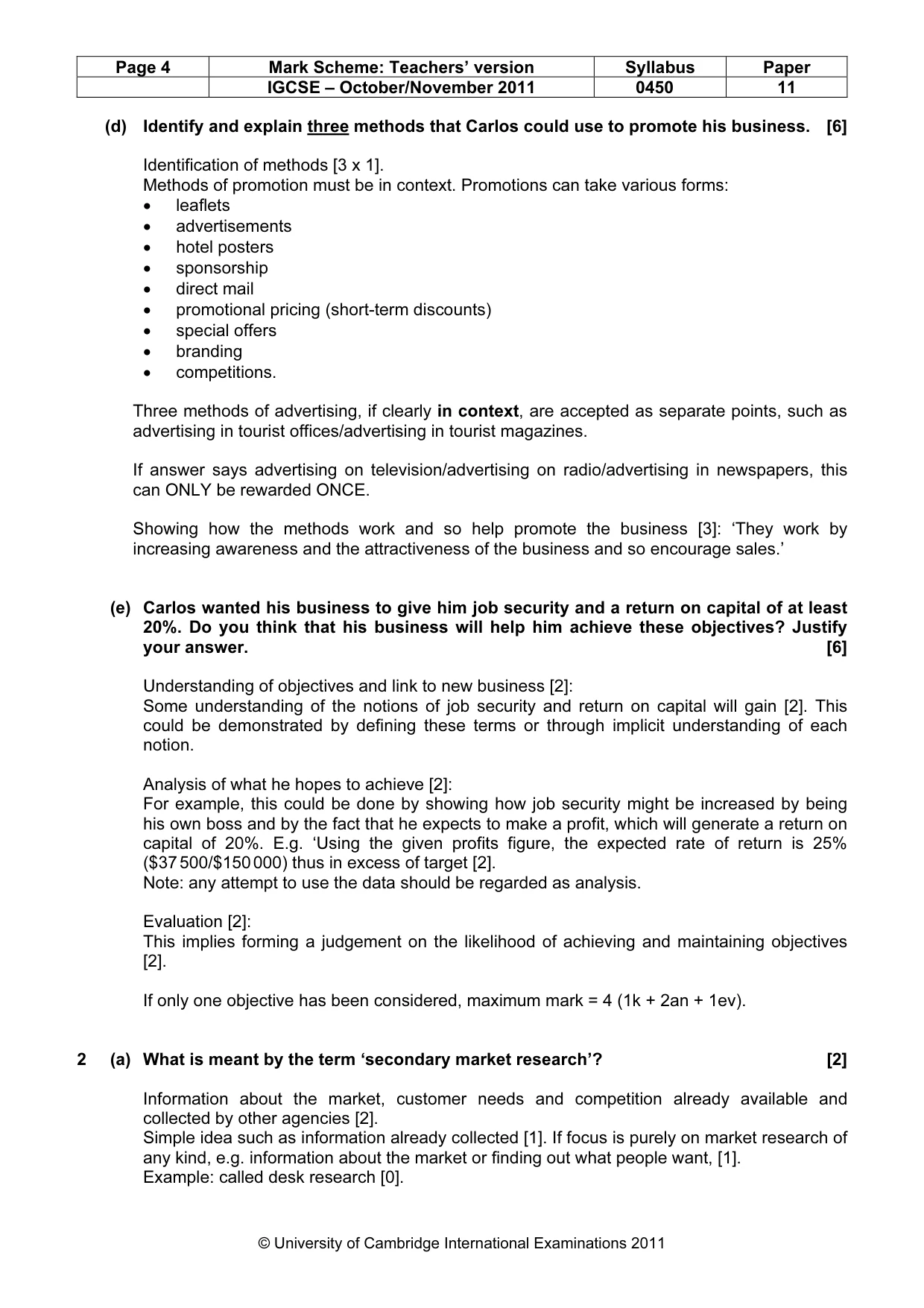
Page 4 Mark Scheme: Teachers’ version Syllabus Paper IGCSE – October/November 2011 0450 11 © University of Cambridge International Examinations 2011 (d) Identify and explain three methods that Carlos could use to promote his business. [6] Identification of methods [3 x 1]. Methods of promotion must be in context. Promotions can take various forms: • leaflets • advertisements • hotel posters • sponsorship • direct mail • promotional pricing (short-term discounts) • special offers • branding • competitions. Three methods of advertising, if clearly in context, are accepted as separate points, such as advertising in tourist offices/advertising in tourist magazines. If answer says advertising on television/advertising on radio/advertising in newspapers, this can ONLY be rewarded ONCE. Showing how the methods work and so help promote the business [3]: ‘They work by increasing awareness and the attractiveness of the business and so encourage sales.’ (e) Carlos wanted his business to give him job security and a return on capital of at least 20%. Do you think that his business will help him achieve these objectives? Justify your answer. [6] Understanding of objectives and link to new business [2]: Some understanding of the notions of job security and return on capital will gain [2]. This could be demonstrated by defining these terms or through implicit understanding of each notion. Analysis of what he hopes to achieve [2]: For example, this could be done by showing how job security might be increased by being his own boss and by the fact that he expects to make a profit, which will generate a return on capital of 20%. E.g. ‘Using the given profits figure, the expected rate of return is 25% ($37 500/$150 000) thus in excess of target [2]. Note: any attempt to use the data should be regarded as analysis. Evaluation [2]: This implies forming a judgement on the likelihood of achieving and maintaining objectives [2]. If only one objective has been considered, maximum mark = 4 (1k + 2an + 1ev). 2 (a) What is meant by the term ‘secondary market research’? [2] Information about the market, customer needs and competition already available and collected by other agencies [2]. Simple idea such as information already collected [1]. If focus is purely on market research of any kind, e.g. information about the market or finding out what people want, [1]. Example: called desk research [0].
Mark scheme, page 5
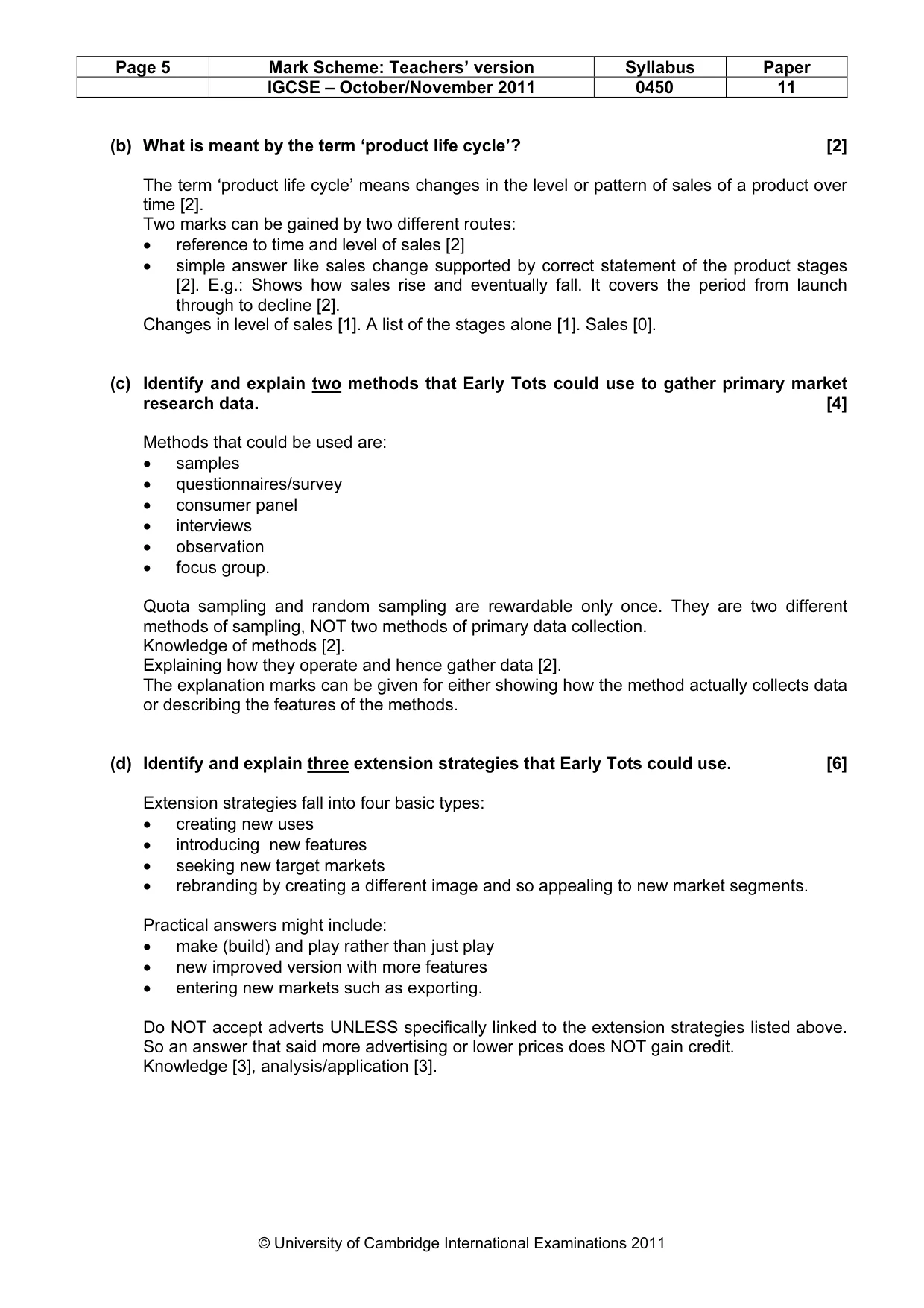
Page 5 Mark Scheme: Teachers’ version Syllabus Paper IGCSE – October/November 2011 0450 11 © University of Cambridge International Examinations 2011 (b) What is meant by the term ‘product life cycle’? [2] The term ‘product life cycle’ means changes in the level or pattern of sales of a product over time [2]. Two marks can be gained by two different routes: • reference to time and level of sales [2] • simple answer like sales change supported by correct statement of the product stages [2]. E.g.: Shows how sales rise and eventually fall. It covers the period from launch through to decline [2]. Changes in level of sales [1]. A list of the stages alone [1]. Sales [0]. (c) Identify and explain two methods that Early Tots could use to gather primary market research data. [4] Methods that could be used are: • samples • questionnaires/survey • consumer panel • interviews • observation • focus group. Quota sampling and random sampling are rewardable only once. They are two different methods of sampling, NOT two methods of primary data collection. Knowledge of methods [2]. Explaining how they operate and hence gather data [2]. The explanation marks can be given for either showing how the method actually collects data or describing the features of the methods. (d) Identify and explain three extension strategies that Early Tots could use. [6] Extension strategies fall into four basic types: • creating new uses • introducing new features • seeking new target markets • rebranding by creating a different image and so appealing to new market segments. Practical answers might include: • make (build) and play rather than just play • new improved version with more features • entering new markets such as exporting. Do NOT accept adverts UNLESS specifically linked to the extension strategies listed above. So an answer that said more advertising or lower prices does NOT gain credit. Knowledge [3], analysis/application [3].
Mark scheme, page 6
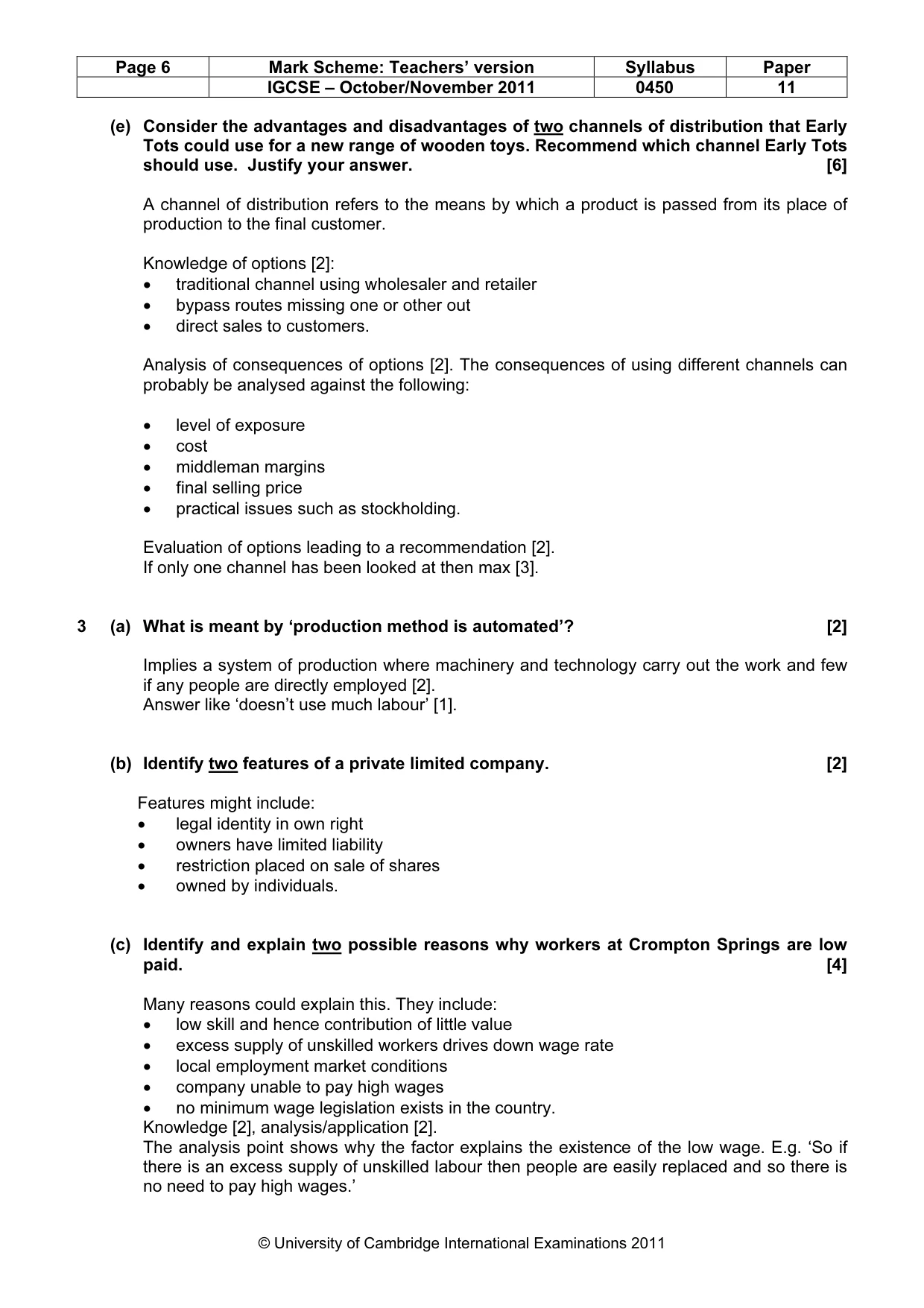
Page 6 Mark Scheme: Teachers’ version Syllabus Paper IGCSE – October/November 2011 0450 11 © University of Cambridge International Examinations 2011 (e) Consider the advantages and disadvantages of two channels of distribution that Early Tots could use for a new range of wooden toys. Recommend which channel Early Tots should use. Justify your answer. [6] A channel of distribution refers to the means by which a product is passed from its place of production to the final customer. Knowledge of options [2]: • traditional channel using wholesaler and retailer • bypass routes missing one or other out • direct sales to customers. Analysis of consequences of options [2]. The consequences of using different channels can probably be analysed against the following: • level of exposure • cost • middleman margins • final selling price • practical issues such as stockholding. Evaluation of options leading to a recommendation [2]. If only one channel has been looked at then max [3]. 3 (a) What is meant by ‘production method is automated’? [2] Implies a system of production where machinery and technology carry out the work and few if any people are directly employed [2]. Answer like ‘doesn’t use much labour’ [1]. (b) Identify two features of a private limited company. [2] Features might include: • legal identity in own right • owners have limited liability • restriction placed on sale of shares • owned by individuals. (c) Identify and explain two possible reasons why workers at Crompton Springs are low paid. [4] Many reasons could explain this. They include: • low skill and hence contribution of little value • excess supply of unskilled workers drives down wage rate • local employment market conditions • company unable to pay high wages • no minimum wage legislation exists in the country. Knowledge [2], analysis/application [2]. The analysis point shows why the factor explains the existence of the low wage. E.g. ‘So if there is an excess supply of unskilled labour then people are easily replaced and so there is no need to pay high wages.’
Mark scheme, page 7
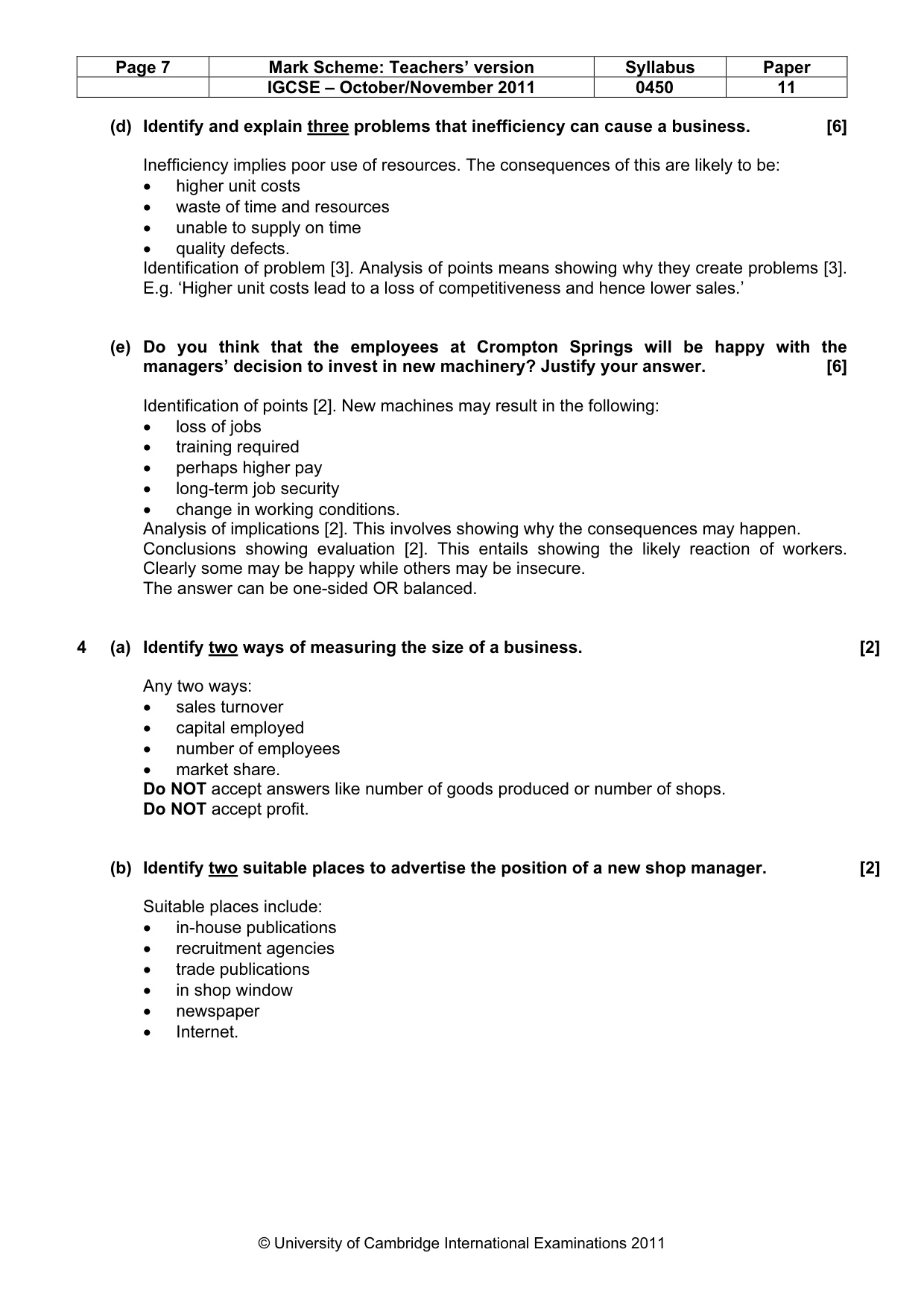
Page 7 Mark Scheme: Teachers’ version Syllabus Paper IGCSE – October/November 2011 0450 11 © University of Cambridge International Examinations 2011 (d) Identify and explain three problems that inefficiency can cause a business. [6] Inefficiency implies poor use of resources. The consequences of this are likely to be: • higher unit costs • waste of time and resources • unable to supply on time • quality defects. Identification of problem [3]. Analysis of points means showing why they create problems [3]. E.g. ‘Higher unit costs lead to a loss of competitiveness and hence lower sales.’ (e) Do you think that the employees at Crompton Springs will be happy with the managers’ decision to invest in new machinery? Justify your answer. [6] Identification of points [2]. New machines may result in the following: • loss of jobs • training required • perhaps higher pay • long-term job security • change in working conditions. Analysis of implications [2]. This involves showing why the consequences may happen. Conclusions showing evaluation [2]. This entails showing the likely reaction of workers. Clearly some may be happy while others may be insecure. The answer can be one-sided OR balanced. 4 (a) Identify two ways of measuring the size of a business. [2] Any two ways: • sales turnover • capital employed • number of employees • market share. Do NOT accept answers like number of goods produced or number of shops. Do NOT accept profit. (b) Identify two suitable places to advertise the position of a new shop manager. [2] Suitable places include: • in-house publications • recruitment agencies • trade publications • in shop window • newspaper • Internet.
Mark scheme, page 8
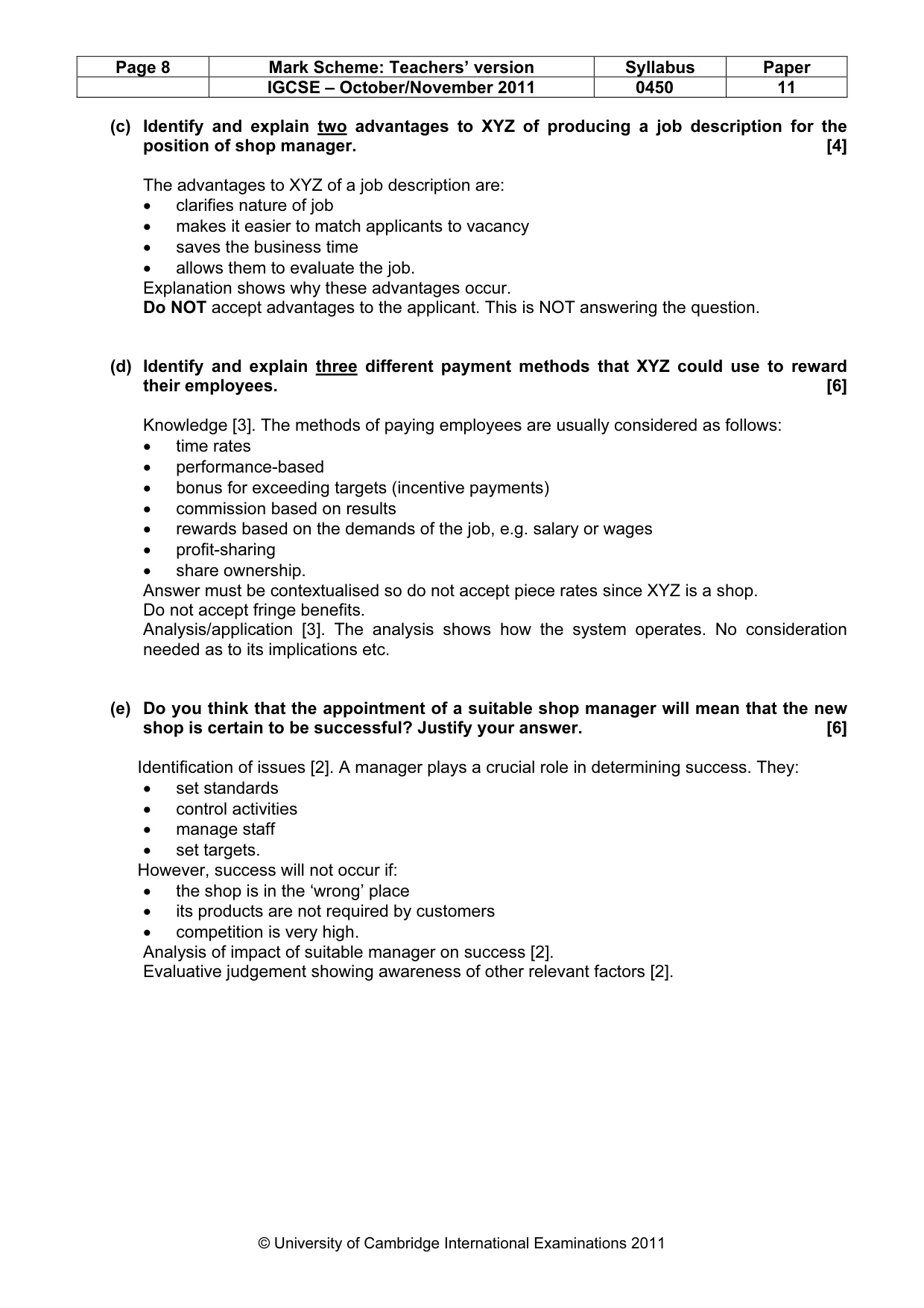
Page 8 Mark Scheme: Teachers’ version Syllabus Paper IGCSE – October/November 2011 0450 11 © University of Cambridge International Examinations 2011 (c) Identify and explain two advantages to XYZ of producing a job description for the position of shop manager. [4] The advantages to XYZ of a job description are: • clarifies nature of job • makes it easier to match applicants to vacancy • saves the business time • allows them to evaluate the job. Explanation shows why these advantages occur. Do NOT accept advantages to the applicant. This is NOT answering the question. (d) Identify and explain three different payment methods that XYZ could use to reward their employees. [6] Knowledge [3]. The methods of paying employees are usually considered as follows: • time rates • performance-based • bonus for exceeding targets (incentive payments) • commission based on results • rewards based on the demands of the job, e.g. salary or wages • profit-sharing • share ownership. Answer must be contextualised so do not accept piece rates since XYZ is a shop. Do not accept fringe benefits. Analysis/application [3]. The analysis shows how the system operates. No consideration needed as to its implications etc. (e) Do you think that the appointment of a suitable shop manager will mean that the new shop is certain to be successful? Justify your answer. [6] Identification of issues [2]. A manager plays a crucial role in determining success. They: • set standards • control activities • manage staff • set targets. However, success will not occur if: • the shop is in the ‘wrong’ place • its products are not required by customers • competition is very high. Analysis of impact of suitable manager on success [2]. Evaluative judgement showing awareness of other relevant factors [2].
Mark scheme, page 9
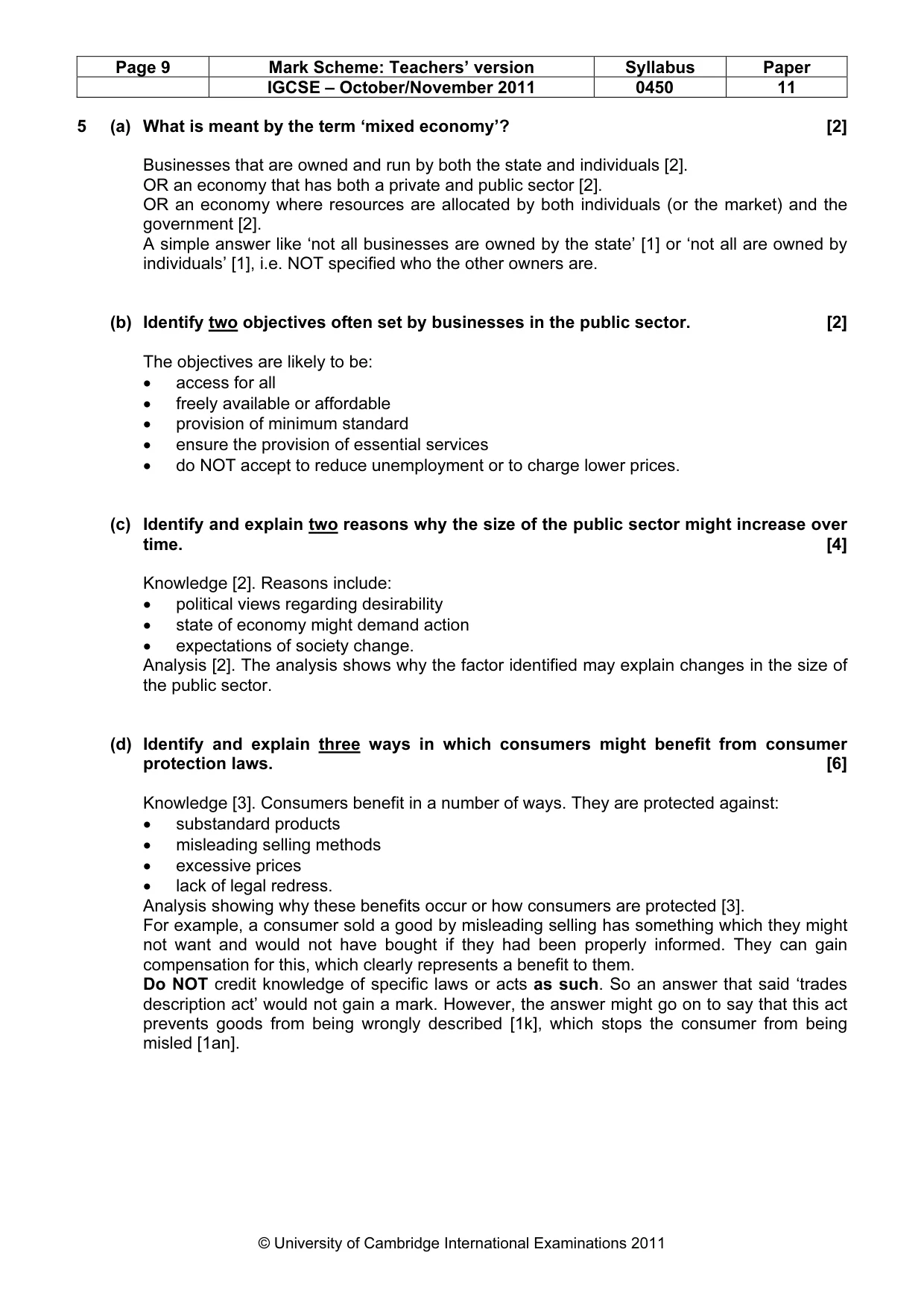
Page 9 Mark Scheme: Teachers’ version Syllabus Paper IGCSE – October/November 2011 0450 11 © University of Cambridge International Examinations 2011 5 (a) What is meant by the term ‘mixed economy’? [2] Businesses that are owned and run by both the state and individuals [2]. OR an economy that has both a private and public sector [2]. OR an economy where resources are allocated by both individuals (or the market) and the government [2]. A simple answer like ‘not all businesses are owned by the state’ [1] or ‘not all are owned by individuals’ [1], i.e. NOT specified who the other owners are. (b) Identify two objectives often set by businesses in the public sector. [2] The objectives are likely to be: • access for all • freely available or affordable • provision of minimum standard • ensure the provision of essential services • do NOT accept to reduce unemployment or to charge lower prices. (c) Identify and explain two reasons why the size of the public sector might increase over time. [4] Knowledge [2]. Reasons include: • political views regarding desirability • state of economy might demand action • expectations of society change. Analysis [2]. The analysis shows why the factor identified may explain changes in the size of the public sector. (d) Identify and explain three ways in which consumers might benefit from consumer protection laws. [6] Knowledge [3]. Consumers benefit in a number of ways. They are protected against: • substandard products • misleading selling methods • excessive prices • lack of legal redress. Analysis showing why these benefits occur or how consumers are protected [3]. For example, a consumer sold a good by misleading selling has something which they might not want and would not have bought if they had been properly informed. They can gain compensation for this, which clearly represents a benefit to them. Do NOT credit knowledge of specific laws or acts as such. So an answer that said ‘trades description act’ would not gain a mark. However, the answer might go on to say that this act prevents goods from being wrongly described [1k], which stops the consumer from being misled [1an].
Mark scheme, page 10
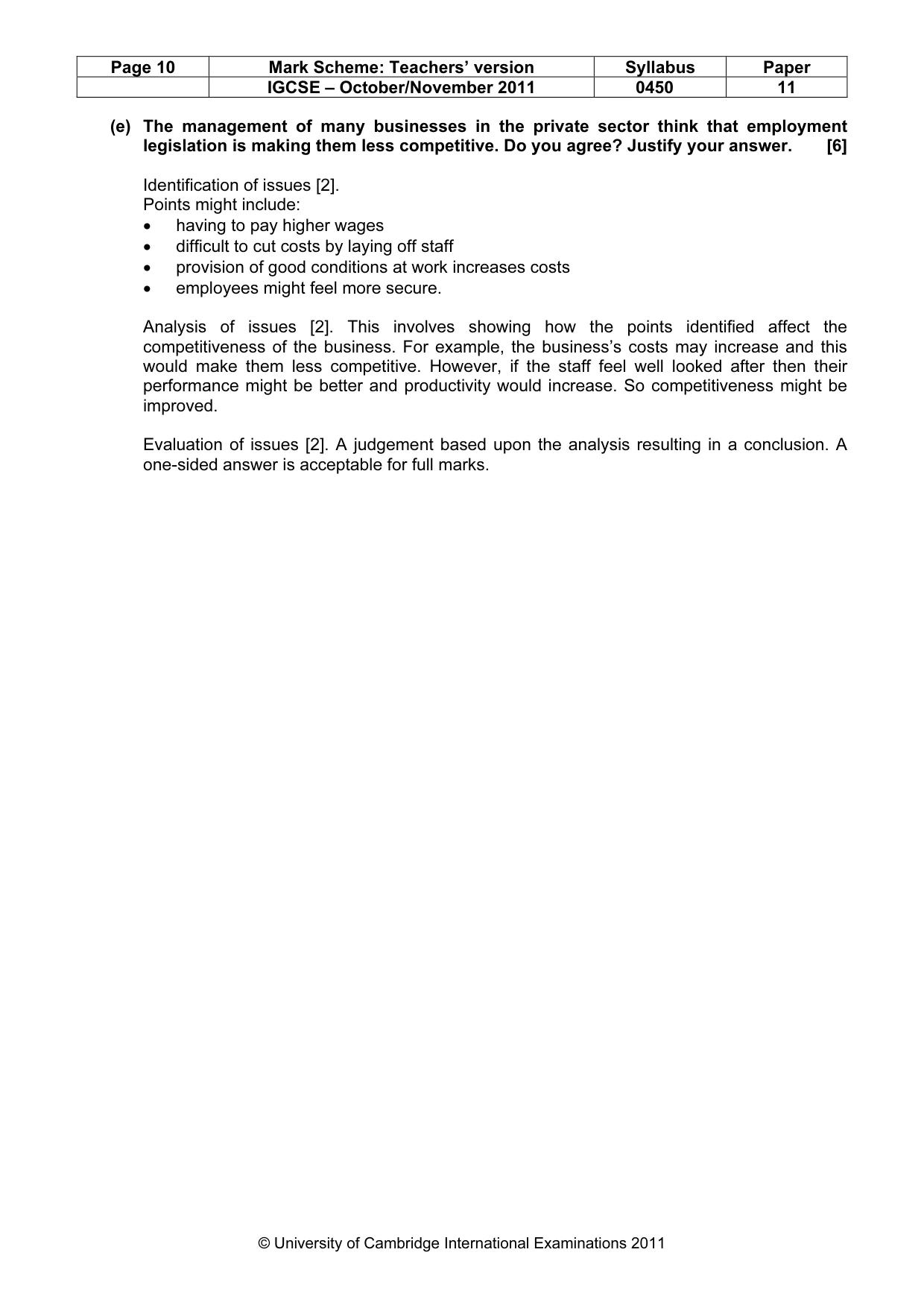
Page 10 Mark Scheme: Teachers’ version Syllabus Paper IGCSE – October/November 2011 0450 11 © University of Cambridge International Examinations 2011 (e) The management of many businesses in the private sector think that employment legislation is making them less competitive. Do you agree? Justify your answer. [6] Identification of issues [2]. Points might include: • having to pay higher wages • difficult to cut costs by laying off staff • provision of good conditions at work increases costs • employees might feel more secure. Analysis of issues [2]. This involves showing how the points identified affect the competitiveness of the business. For example, the business’s costs may increase and this would make them less competitive. However, if the staff feel well looked after then their performance might be better and productivity would increase. So competitiveness might be improved. Evaluation of issues [2]. A judgement based upon the analysis resulting in a conclusion. A one-sided answer is acceptable for full marks.
What you needed in this session
Cambridge’s own grade thresholds for 2011 Oct/Nov, Paper 1 · Variant 1. A higher threshold means an easier paper — the bar moves with how the cohort did.