Cambridge IGCSE Business Studies 0450 — 2011 May/June Paper 2 · Variant 1
0450/21/M/J/11 · 100 marks · ≈113 min
The question paper and its mark scheme, free to read here and free to download. This is Cambridge’s own paper, exactly as it was sat.
Question paper12 pages





Mark scheme10 pages
Answers below. Sit the paper first if you are practising.
Paper as text
Question paper, page 1
This document consists of 11 printed pages, 1 blank page and 1 Insert. DC (SM) 31365/3 © UCLES 2011 [Turn over UNIVERSITY OF CAMBRIDGE INTERNATIONAL EXAMINATIONS International General Certificate of Secondary Education * 6 2 0 3 8 5 2 4 4 4 * BUSINESS STUDIES 0450/21 Paper 2 May/June 2011 1 hour 45 minutes Candidates answer on the Question Paper. Additional Materials: Insert READ THESE INSTRUCTIONS FIRST Write your Centre number, candidate number and name on all the work you hand in. Write in dark blue or black pen. Do not use staples, paper clips, highlighters, glue or correction fluid. DO NOT WRITE IN ANY BARCODES. Answer all questions. The Insert contains the case study. The business described in this question paper is entirely fictitious. At the end of the examination, fasten all your work securely together. The number of marks is given in brackets [ ] at the end of each question or part question. For Examiner’s Use 1 2 3 4 5 Total
Question paper, page 2
2 0450/21/M/J/11 © UCLES 2011 For Examiner’s Use 1 (a) The Directors of Chocolate Delight think the business is successful. Identify and explain four ways they could use to measure the success of the business. Way 1: … … Explanation: … … Way 2: … … Explanation: … … Way 3: … … Explanation: … … Way 4: … … Explanation: … …[8]
Question paper, page 3
3 0450/21/M/J/11 © UCLES 2011 [Turn over For Examiner’s Use (b) The Directors of Chocolate Delight want to build a new factory and will need to raise $5m. Do you think the Managing Director is right in suggesting Chocolate Delight should become a public limited company, or is the Finance Manager right in suggesting retained profit should be used? Justify your answer using information in the case. Becoming a public limited company: … … … … … … … … Using retained profit: … … … … … … … … Recommendation: … … … … … … … …[12]
Question paper, page 4
4 0450/21/M/J/11 © UCLES 2011 For Examiner’s Use 2 (a) Appendix 1 shows plain chocolate bars are in the decline stage of the product life cycle. Identify and explain four ways in which the Directors of Chocolate Delight might respond to this problem. Way 1: … … Explanation: … … Way 2: … … Explanation: … … Way 3: … … Explanation: … … Way 4: … … Explanation: … …[8]
Question paper, page 5
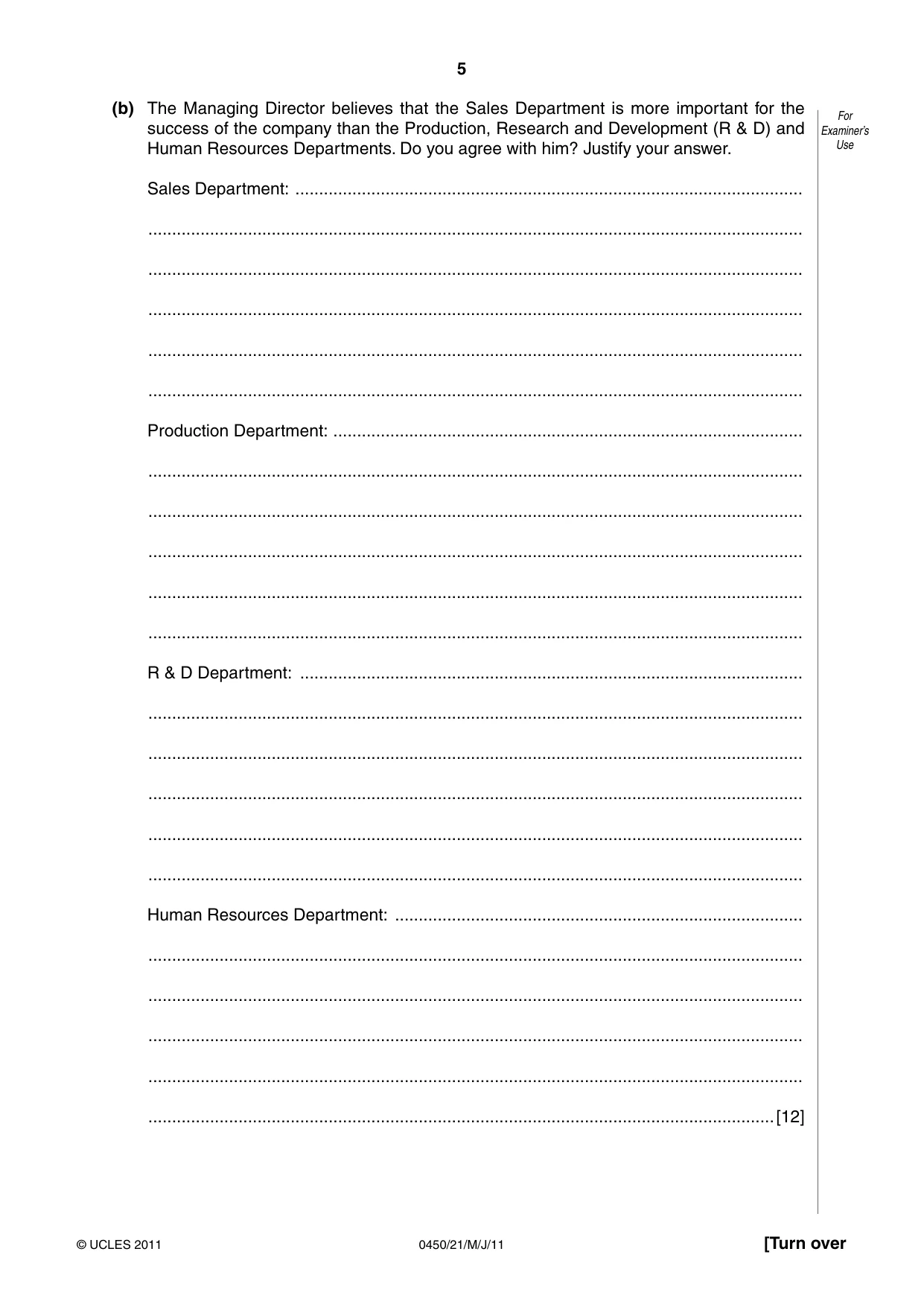
5 0450/21/M/J/11 © UCLES 2011 [Turn over For Examiner’s Use (b) The Managing Director believes that the Sales Department is more important for the success of the company than the Production, Research and Development (R & D) and Human Resources Departments. Do you agree with him? Justify your answer. Sales Department: … … … … … … Production Department: … … … … … … R & D Department: … … … … … … Human Resources Department: … … … … … …[12]
Question paper, page 6
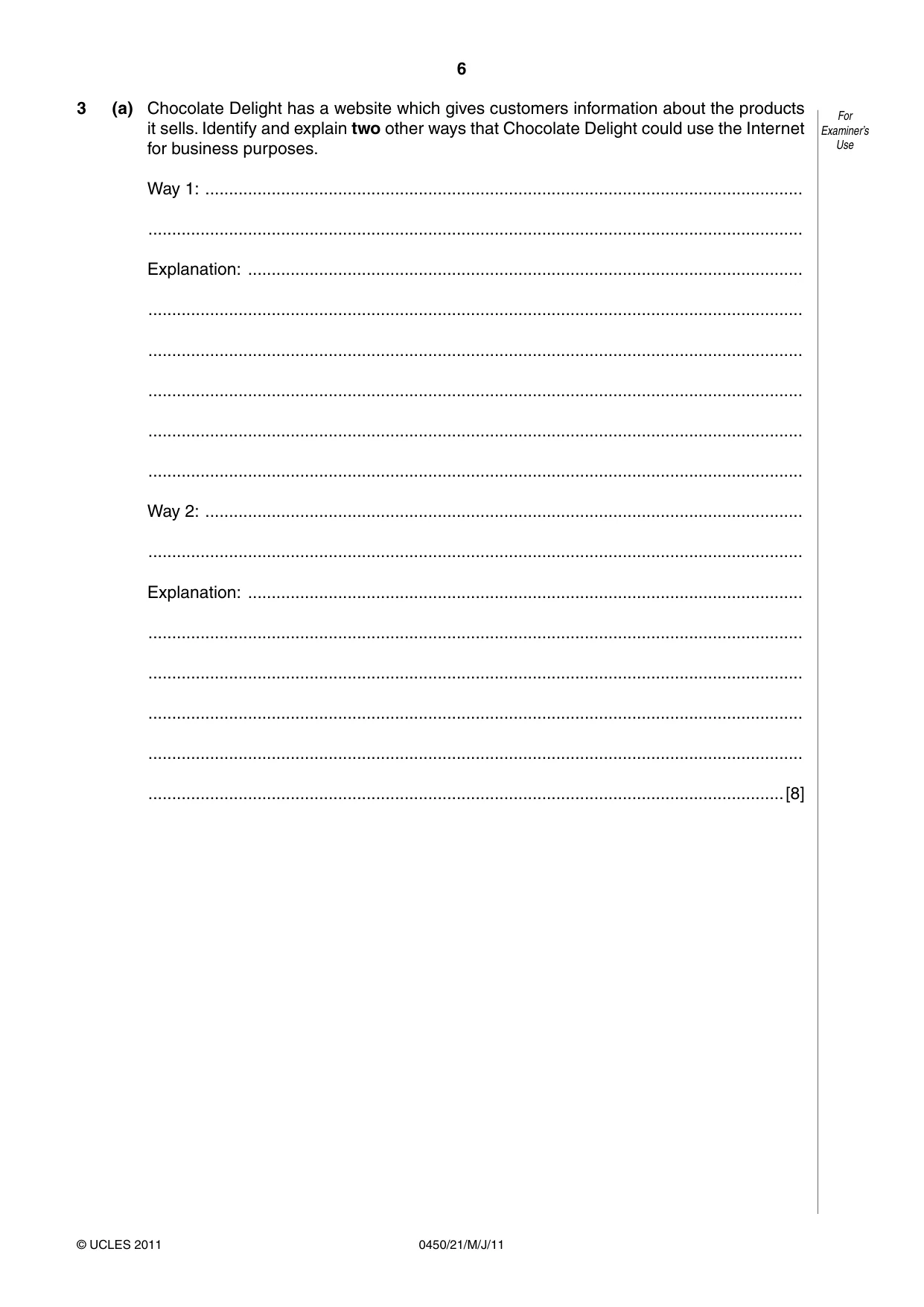
6 0450/21/M/J/11 © UCLES 2011 For Examiner’s Use 3 (a) Chocolate Delight has a website which gives customers information about the products it sells. Identify and explain two other ways that Chocolate Delight could use the Internet for business purposes. Way 1: … … Explanation: … … … … … … Way 2: … … Explanation: … … … … … …[8]
Question paper, page 7
7 0450/21/M/J/11 © UCLES 2011 [Turn over For Examiner’s Use (b) Appendix 3 gives information on two machines that the owners of Chocolate Delight could buy. Compare these two machines and recommend which machine they should buy. Justify your answer using calculations of output per worker and labour costs per chocolate bar. … … … … … … … … … … … … … … … … … … … … … … … …[12]
Question paper, page 8
8 0450/21/M/J/11 © UCLES 2011 For Examiner’s Use 4 (a) The Finance Director says that break-even charts are useful when analysing the different products that Chocolate Delight produce. Identify and explain two ways break-even charts can be useful to the Finance Director of Chocolate Delight. Way 1: … … Explanation: … … … … … … Way 2: … … Explanation: … … … … … …[8]
Question paper, page 9
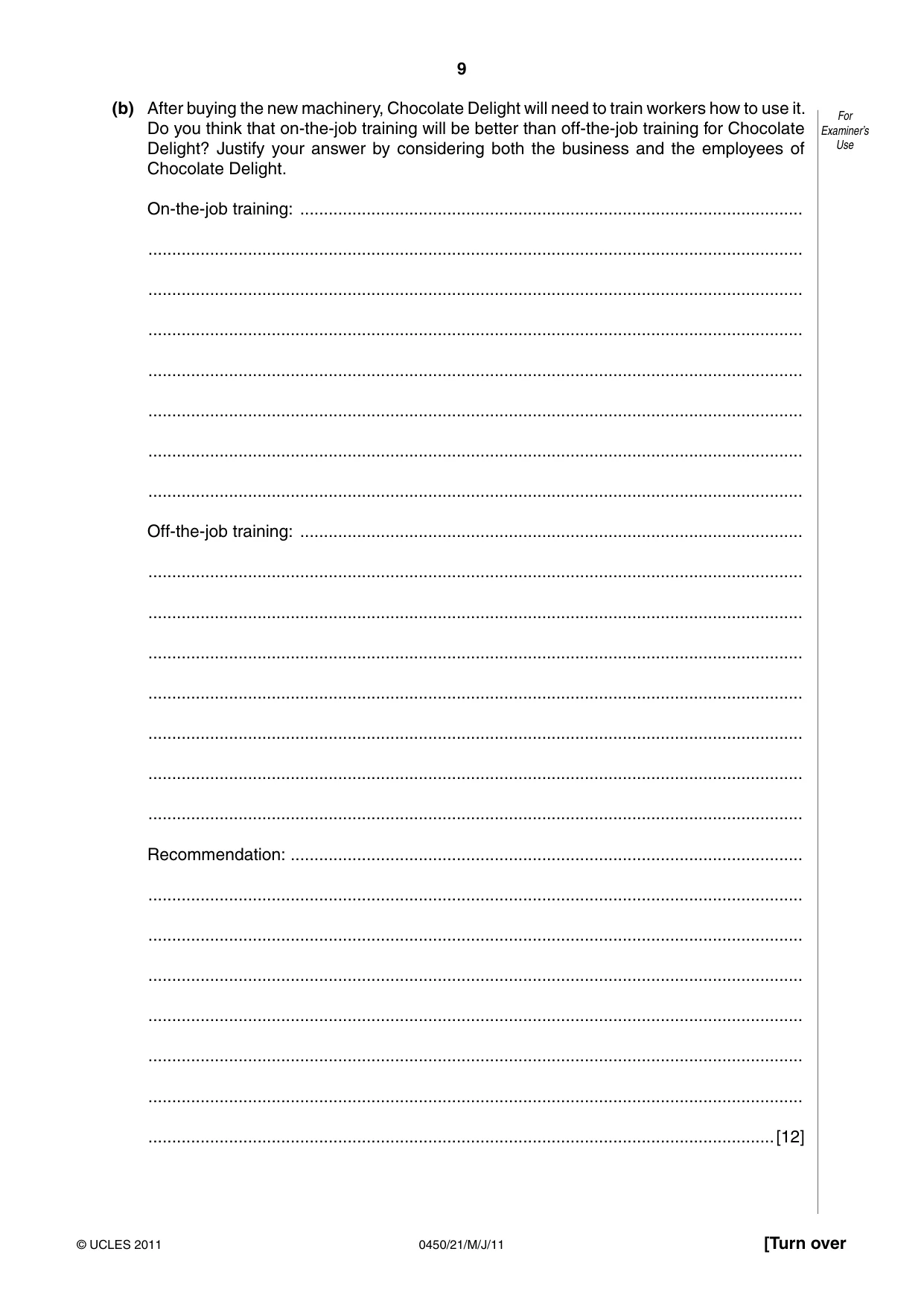
9 0450/21/M/J/11 © UCLES 2011 [Turn over For Examiner’s Use (b) After buying the new machinery, Chocolate Delight will need to train workers how to use it. Do you think that on-the-job training will be better than off-the-job training for Chocolate Delight? Justify your answer by considering both the business and the employees of Chocolate Delight. On-the-job training: … … … … … … … … Off-the-job training: … … … … … … … … Recommendation: … … … … … … … …[12]
Question paper, page 10
10 0450/21/M/J/11 © UCLES 2011 For Examiner’s Use 5 (a) Identify and explain two possible reasons Chocolate Delight buys its cocoa from Fair Trade cocoa farmers. Reason 1: … … Explanation: … … … … … … Reason 2: … … Explanation: … … … … … …[8]
Question paper, page 11
11 0450/21/M/J/11 © UCLES 2011 For Examiner’s Use (b) Consider how the economic forecasts shown in Appendix 2 might affect the sales, costs and profits of Chocolate Delight over the next few years. Do you think these economic trends will be good or bad for the company? Justify your answer. Economic growth: … … … … … … Inflation: … … … … … … Unemployment: … … … … … … Conclusion: … … … … … …[12]
Question paper, page 12
12 0450/21/M/J/11 © UCLES 2011 Permission to reproduce items where third-party owned material protected by copyright is included has been sought and cleared where possible. Every reasonable effort has been made by the publisher (UCLES) to trace copyright holders, but if any items requiring clearance have unwittingly been included, the publisher will be pleased to make amends at the earliest possible opportunity. University of Cambridge International Examinations is part of the Cambridge Assessment Group. Cambridge Assessment is the brand name of University of Cambridge Local Examinations Syndicate (UCLES), which is itself a department of the University of Cambridge. BLANK PAGE
Mark scheme, page 1
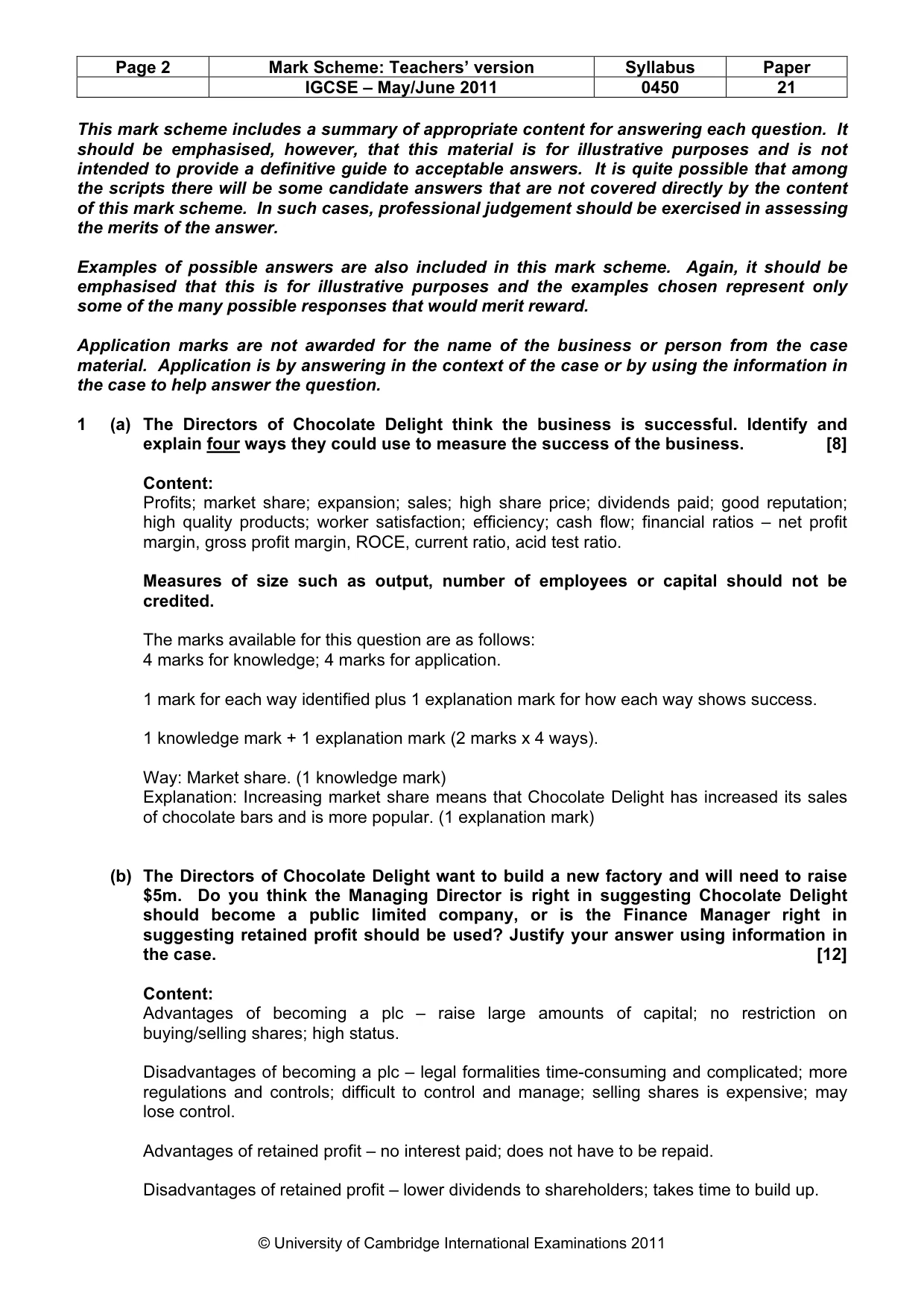
UNIVERSITY OF CAMBRIDGE INTERNATIONAL EXAMINATIONS International General Certificate of Secondary Education MARK SCHEME for the May/June 2011 question paper for the guidance of teachers 0450 BUSINESS STUDIES 0450/21 Paper 2 (Case Study), maximum raw mark 100 This mark scheme is published as an aid to teachers and candidates, to indicate the requirements of the examination. It shows the basis on which Examiners were instructed to award marks. It does not indicate the details of the discussions that took place at an Examiners’ meeting before marking began, which would have considered the acceptability of alternative answers. Mark schemes must be read in conjunction with the question papers and the report on the examination. • Cambridge will not enter into discussions or correspondence in connection with these mark schemes. Cambridge is publishing the mark schemes for the May/June 2011 question papers for most IGCSE, GCE Advanced Level and Advanced Subsidiary Level syllabuses and some Ordinary Level syllabuses.
Mark scheme, page 2
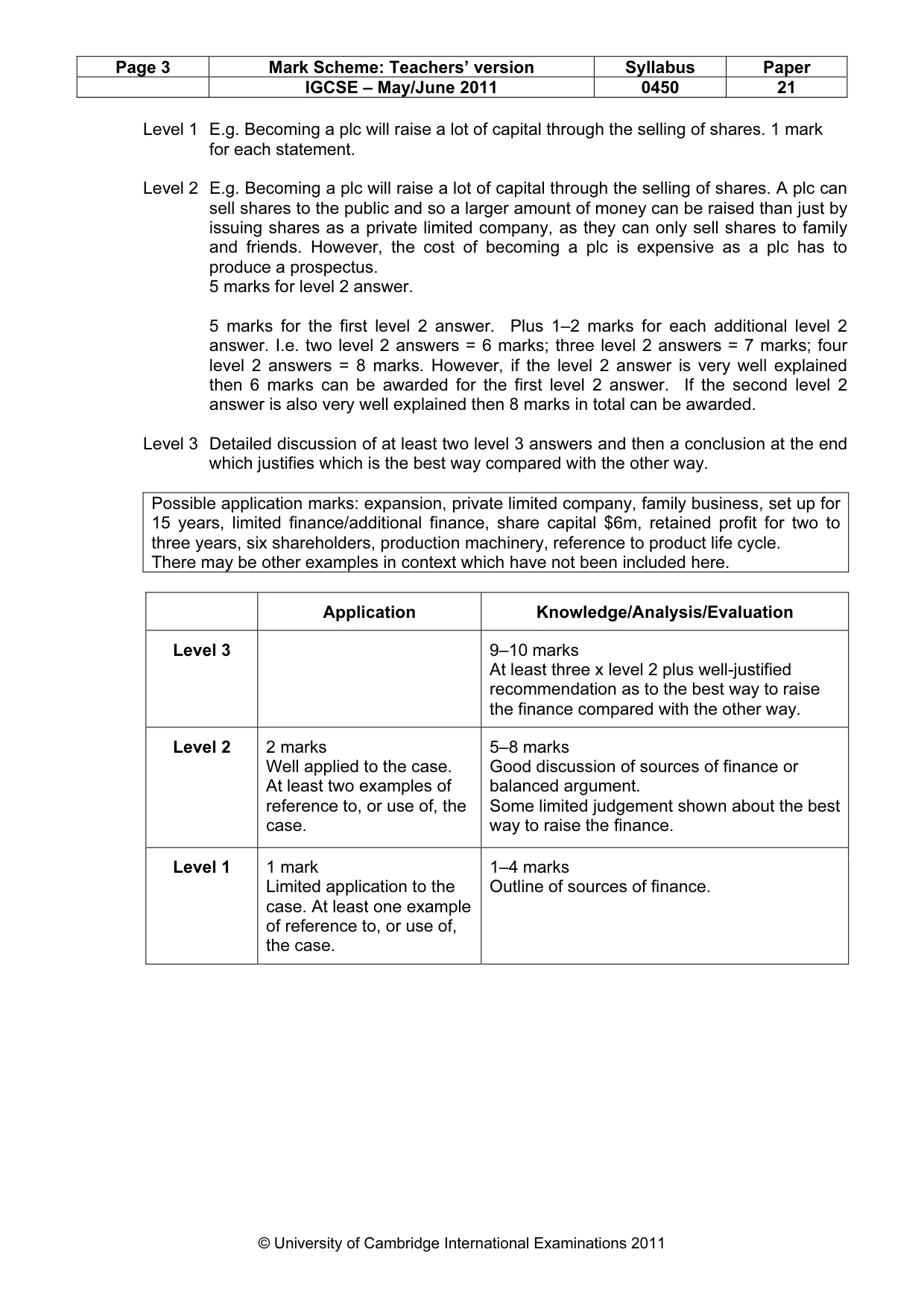
Page 2 Mark Scheme: Teachers’ version Syllabus Paper IGCSE – May/June 2011 0450 21 © University of Cambridge International Examinations 2011 This mark scheme includes a summary of appropriate content for answering each question. It should be emphasised, however, that this material is for illustrative purposes and is not intended to provide a definitive guide to acceptable answers. It is quite possible that among the scripts there will be some candidate answers that are not covered directly by the content of this mark scheme. In such cases, professional judgement should be exercised in assessing the merits of the answer. Examples of possible answers are also included in this mark scheme. Again, it should be emphasised that this is for illustrative purposes and the examples chosen represent only some of the many possible responses that would merit reward. Application marks are not awarded for the name of the business or person from the case material. Application is by answering in the context of the case or by using the information in the case to help answer the question. 1 (a) The Directors of Chocolate Delight think the business is successful. Identify and explain four ways they could use to measure the success of the business. [8] Content: Profits; market share; expansion; sales; high share price; dividends paid; good reputation; high quality products; worker satisfaction; efficiency; cash flow; financial ratios – net profit margin, gross profit margin, ROCE, current ratio, acid test ratio. Measures of size such as output, number of employees or capital should not be credited. The marks available for this question are as follows: 4 marks for knowledge; 4 marks for application. 1 mark for each way identified plus 1 explanation mark for how each way shows success. 1 knowledge mark + 1 explanation mark (2 marks x 4 ways). Way: Market share. (1 knowledge mark) Explanation: Increasing market share means that Chocolate Delight has increased its sales of chocolate bars and is more popular. (1 explanation mark) (b) The Directors of Chocolate Delight want to build a new factory and will need to raise $5m. Do you think the Managing Director is right in suggesting Chocolate Delight should become a public limited company, or is the Finance Manager right in suggesting retained profit should be used? Justify your answer using information in the case. [12] Content: Advantages of becoming a plc – raise large amounts of capital; no restriction on buying/selling shares; high status. Disadvantages of becoming a plc – legal formalities time-consuming and complicated; more regulations and controls; difficult to control and manage; selling shares is expensive; may lose control. Advantages of retained profit – no interest paid; does not have to be repaid. Disadvantages of retained profit – lower dividends to shareholders; takes time to build up.
Mark scheme, page 3
Page 3 Mark Scheme: Teachers’ version Syllabus Paper IGCSE – May/June 2011 0450 21 © University of Cambridge International Examinations 2011 Level 1 E.g. Becoming a plc will raise a lot of capital through the selling of shares. 1 mark for each statement. Level 2 E.g. Becoming a plc will raise a lot of capital through the selling of shares. A plc can sell shares to the public and so a larger amount of money can be raised than just by issuing shares as a private limited company, as they can only sell shares to family and friends. However, the cost of becoming a plc is expensive as a plc has to produce a prospectus. 5 marks for level 2 answer. 5 marks for the first level 2 answer. Plus 1–2 marks for each additional level 2 answer. I.e. two level 2 answers = 6 marks; three level 2 answers = 7 marks; four level 2 answers = 8 marks. However, if the level 2 answer is very well explained then 6 marks can be awarded for the first level 2 answer. If the second level 2 answer is also very well explained then 8 marks in total can be awarded. Level 3 Detailed discussion of at least two level 3 answers and then a conclusion at the end which justifies which is the best way compared with the other way. Possible application marks: expansion, private limited company, family business, set up for 15 years, limited finance/additional finance, share capital $6m, retained profit for two to three years, six shareholders, production machinery, reference to product life cycle. There may be other examples in context which have not been included here. Application Knowledge/Analysis/Evaluation Level 3 9–10 marks At least three x level 2 plus well-justified recommendation as to the best way to raise the finance compared with the other way. Level 2 2 marks Well applied to the case. At least two examples of reference to, or use of, the case. 5–8 marks Good discussion of sources of finance or balanced argument. Some limited judgement shown about the best way to raise the finance. Level 1 1 mark Limited application to the case. At least one example of reference to, or use of, the case. 1–4 marks Outline of sources of finance.
Mark scheme, page 4
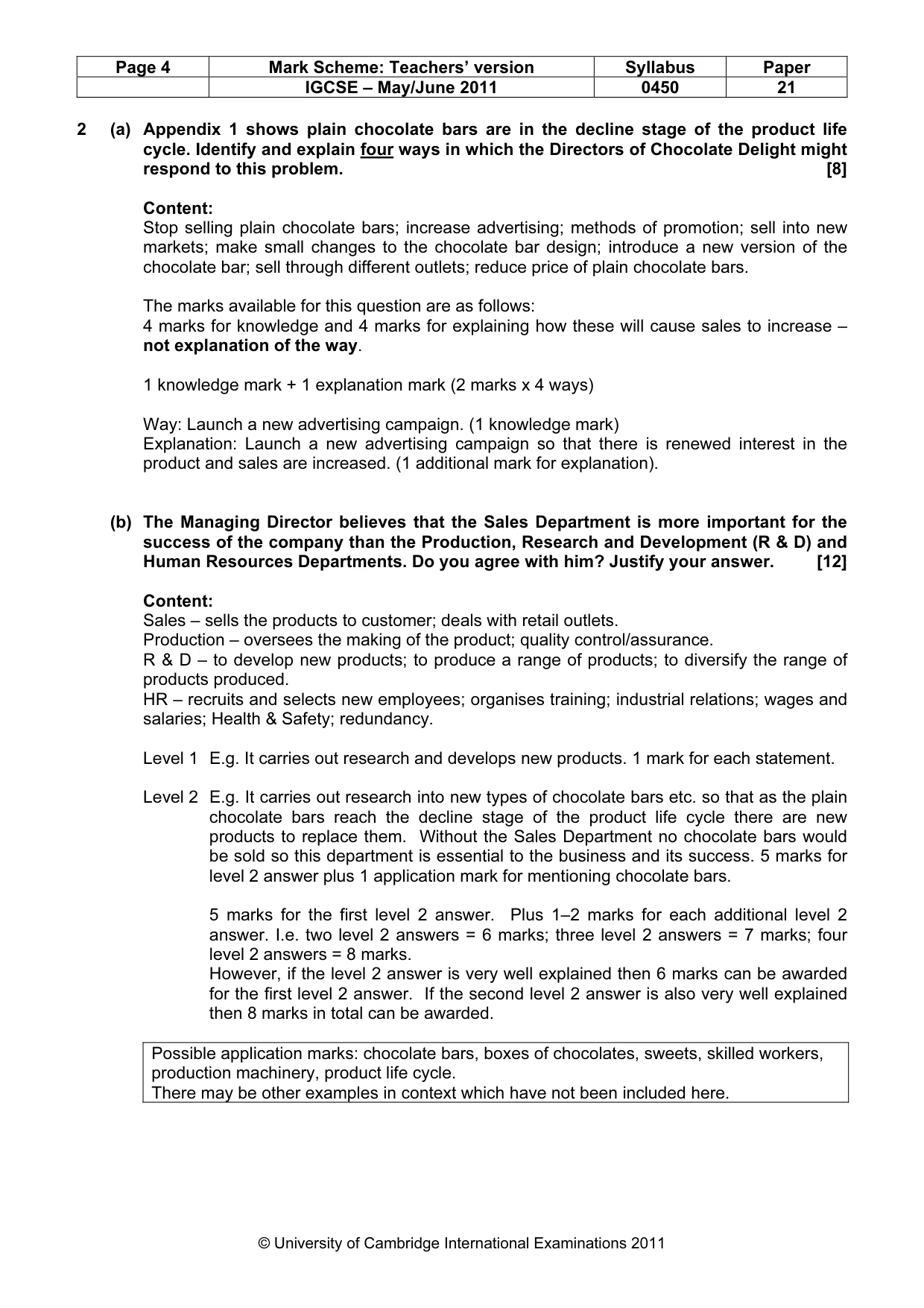
Page 4 Mark Scheme: Teachers’ version Syllabus Paper IGCSE – May/June 2011 0450 21 © University of Cambridge International Examinations 2011 2 (a) Appendix 1 shows plain chocolate bars are in the decline stage of the product life cycle. Identify and explain four ways in which the Directors of Chocolate Delight might respond to this problem. [8] Content: Stop selling plain chocolate bars; increase advertising; methods of promotion; sell into new markets; make small changes to the chocolate bar design; introduce a new version of the chocolate bar; sell through different outlets; reduce price of plain chocolate bars. The marks available for this question are as follows: 4 marks for knowledge and 4 marks for explaining how these will cause sales to increase – not explanation of the way. 1 knowledge mark + 1 explanation mark (2 marks x 4 ways) Way: Launch a new advertising campaign. (1 knowledge mark) Explanation: Launch a new advertising campaign so that there is renewed interest in the product and sales are increased. (1 additional mark for explanation). (b) The Managing Director believes that the Sales Department is more important for the success of the company than the Production, Research and Development (R & D) and Human Resources Departments. Do you agree with him? Justify your answer. [12] Content: Sales – sells the products to customer; deals with retail outlets. Production – oversees the making of the product; quality control/assurance. R & D – to develop new products; to produce a range of products; to diversify the range of products produced. HR – recruits and selects new employees; organises training; industrial relations; wages and salaries; Health & Safety; redundancy. Level 1 E.g. It carries out research and develops new products. 1 mark for each statement. Level 2 E.g. It carries out research into new types of chocolate bars etc. so that as the plain chocolate bars reach the decline stage of the product life cycle there are new products to replace them. Without the Sales Department no chocolate bars would be sold so this department is essential to the business and its success. 5 marks for level 2 answer plus 1 application mark for mentioning chocolate bars. 5 marks for the first level 2 answer. Plus 1–2 marks for each additional level 2 answer. I.e. two level 2 answers = 6 marks; three level 2 answers = 7 marks; four level 2 answers = 8 marks. However, if the level 2 answer is very well explained then 6 marks can be awarded for the first level 2 answer. If the second level 2 answer is also very well explained then 8 marks in total can be awarded. Possible application marks: chocolate bars, boxes of chocolates, sweets, skilled workers, production machinery, product life cycle. There may be other examples in context which have not been included here.
Mark scheme, page 5
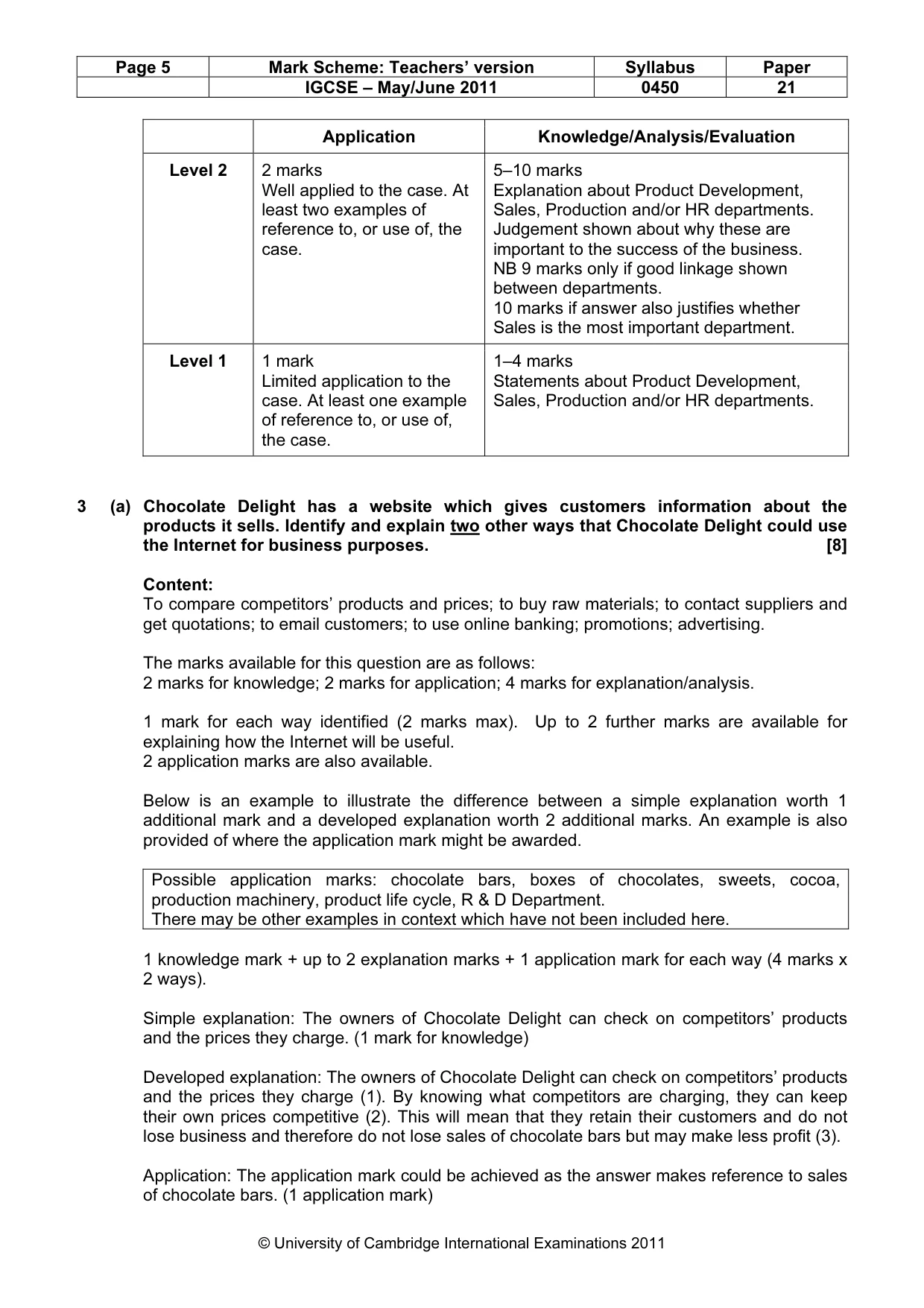
Page 5 Mark Scheme: Teachers’ version Syllabus Paper IGCSE – May/June 2011 0450 21 © University of Cambridge International Examinations 2011 Application Knowledge/Analysis/Evaluation Level 2 2 marks Well applied to the case. At least two examples of reference to, or use of, the case. 5–10 marks Explanation about Product Development, Sales, Production and/or HR departments. Judgement shown about why these are important to the success of the business. NB 9 marks only if good linkage shown between departments. 10 marks if answer also justifies whether Sales is the most important department. Level 1 1 mark Limited application to the case. At least one example of reference to, or use of, the case. 1–4 marks Statements about Product Development, Sales, Production and/or HR departments. 3 (a) Chocolate Delight has a website which gives customers information about the products it sells. Identify and explain two other ways that Chocolate Delight could use the Internet for business purposes. [8] Content: To compare competitors’ products and prices; to buy raw materials; to contact suppliers and get quotations; to email customers; to use online banking; promotions; advertising. The marks available for this question are as follows: 2 marks for knowledge; 2 marks for application; 4 marks for explanation/analysis. 1 mark for each way identified (2 marks max). Up to 2 further marks are available for explaining how the Internet will be useful. 2 application marks are also available. Below is an example to illustrate the difference between a simple explanation worth 1 additional mark and a developed explanation worth 2 additional marks. An example is also provided of where the application mark might be awarded. Possible application marks: chocolate bars, boxes of chocolates, sweets, cocoa, production machinery, product life cycle, R & D Department. There may be other examples in context which have not been included here. 1 knowledge mark + up to 2 explanation marks + 1 application mark for each way (4 marks x 2 ways). Simple explanation: The owners of Chocolate Delight can check on competitors’ products and the prices they charge. (1 mark for knowledge) Developed explanation: The owners of Chocolate Delight can check on competitors’ products and the prices they charge (1). By knowing what competitors are charging, they can keep their own prices competitive (2). This will mean that they retain their customers and do not lose business and therefore do not lose sales of chocolate bars but may make less profit (3). Application: The application mark could be achieved as the answer makes reference to sales of chocolate bars. (1 application mark)
Mark scheme, page 6
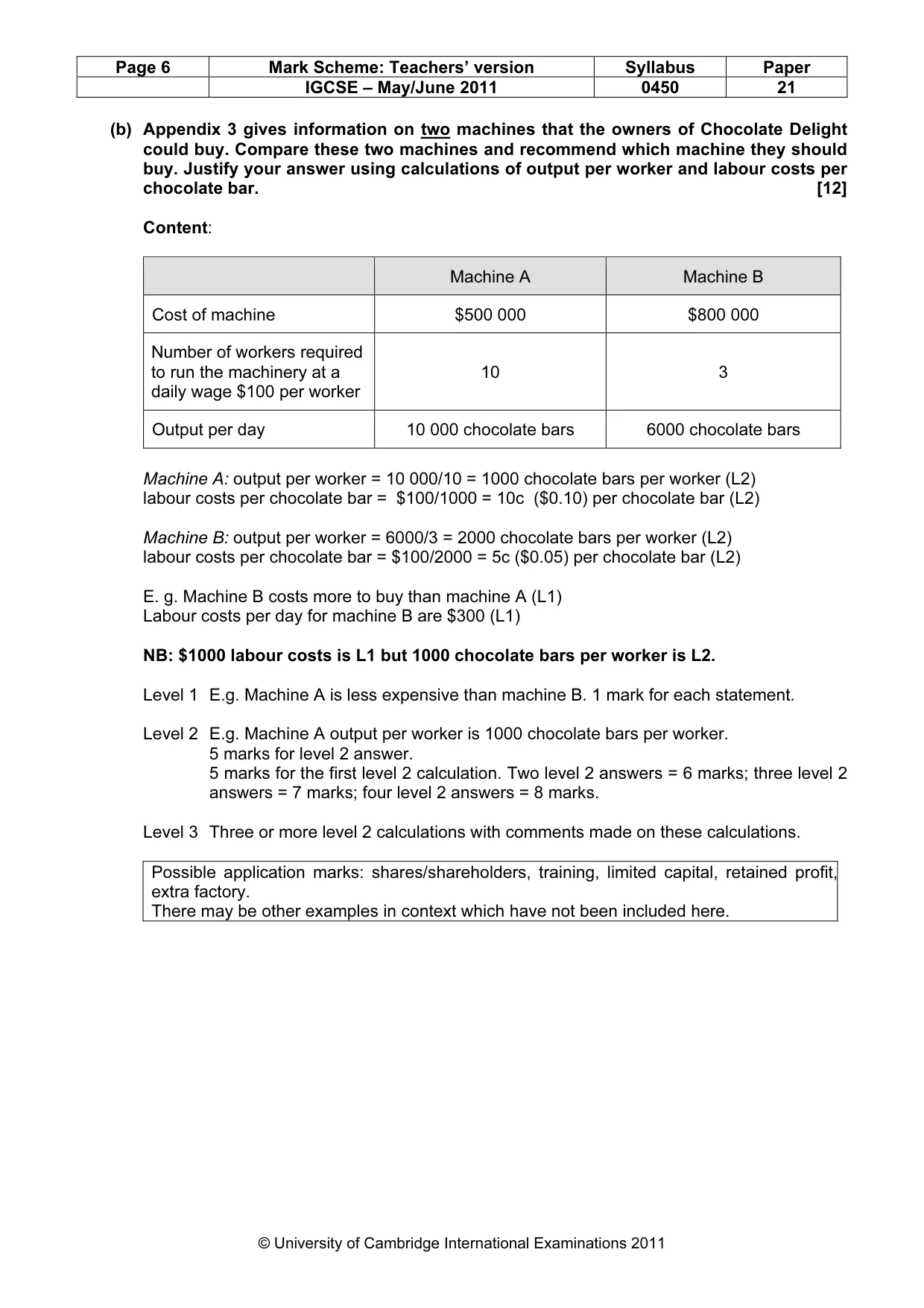
Page 6 Mark Scheme: Teachers’ version Syllabus Paper IGCSE – May/June 2011 0450 21 © University of Cambridge International Examinations 2011 (b) Appendix 3 gives information on two machines that the owners of Chocolate Delight could buy. Compare these two machines and recommend which machine they should buy. Justify your answer using calculations of output per worker and labour costs per chocolate bar. [12] Content: Machine A Machine B Cost of machine $500 000 $800 000 Number of workers required to run the machinery at a daily wage $100 per worker 10 3 Output per day 10 000 chocolate bars 6000 chocolate bars Machine A: output per worker = 10 000/10 = 1000 chocolate bars per worker (L2) labour costs per chocolate bar = $100/1000 = 10c ($0.10) per chocolate bar (L2) Machine B: output per worker = 6000/3 = 2000 chocolate bars per worker (L2) labour costs per chocolate bar = $100/2000 = 5c ($0.05) per chocolate bar (L2) E. g. Machine B costs more to buy than machine A (L1) Labour costs per day for machine B are $300 (L1) NB: $1000 labour costs is L1 but 1000 chocolate bars per worker is L2. Level 1 E.g. Machine A is less expensive than machine B. 1 mark for each statement. Level 2 E.g. Machine A output per worker is 1000 chocolate bars per worker. 5 marks for level 2 answer. 5 marks for the first level 2 calculation. Two level 2 answers = 6 marks; three level 2 answers = 7 marks; four level 2 answers = 8 marks. Level 3 Three or more level 2 calculations with comments made on these calculations. Possible application marks: shares/shareholders, training, limited capital, retained profit, extra factory. There may be other examples in context which have not been included here.
Mark scheme, page 7
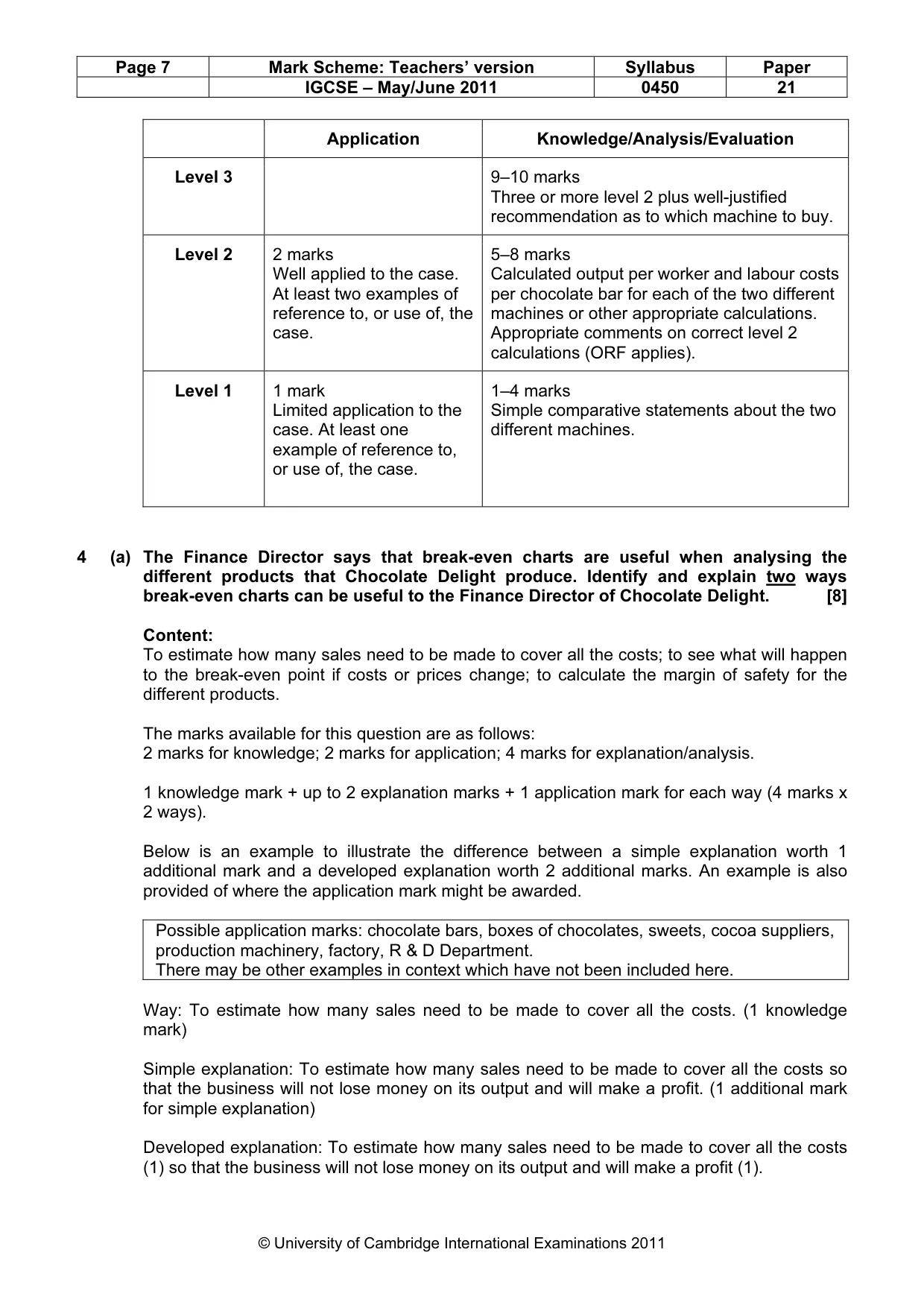
Page 7 Mark Scheme: Teachers’ version Syllabus Paper IGCSE – May/June 2011 0450 21 © University of Cambridge International Examinations 2011 Application Knowledge/Analysis/Evaluation Level 3 9–10 marks Three or more level 2 plus well-justified recommendation as to which machine to buy. Level 2 2 marks Well applied to the case. At least two examples of reference to, or use of, the case. 5–8 marks Calculated output per worker and labour costs per chocolate bar for each of the two different machines or other appropriate calculations. Appropriate comments on correct level 2 calculations (ORF applies). Level 1 1 mark Limited application to the case. At least one example of reference to, or use of, the case. 1–4 marks Simple comparative statements about the two different machines. 4 (a) The Finance Director says that break-even charts are useful when analysing the different products that Chocolate Delight produce. Identify and explain two ways break-even charts can be useful to the Finance Director of Chocolate Delight. [8] Content: To estimate how many sales need to be made to cover all the costs; to see what will happen to the break-even point if costs or prices change; to calculate the margin of safety for the different products. The marks available for this question are as follows: 2 marks for knowledge; 2 marks for application; 4 marks for explanation/analysis. 1 knowledge mark + up to 2 explanation marks + 1 application mark for each way (4 marks x 2 ways). Below is an example to illustrate the difference between a simple explanation worth 1 additional mark and a developed explanation worth 2 additional marks. An example is also provided of where the application mark might be awarded. Possible application marks: chocolate bars, boxes of chocolates, sweets, cocoa suppliers, production machinery, factory, R & D Department. There may be other examples in context which have not been included here. Way: To estimate how many sales need to be made to cover all the costs. (1 knowledge mark) Simple explanation: To estimate how many sales need to be made to cover all the costs so that the business will not lose money on its output and will make a profit. (1 additional mark for simple explanation) Developed explanation: To estimate how many sales need to be made to cover all the costs (1) so that the business will not lose money on its output and will make a profit (1).
Mark scheme, page 8
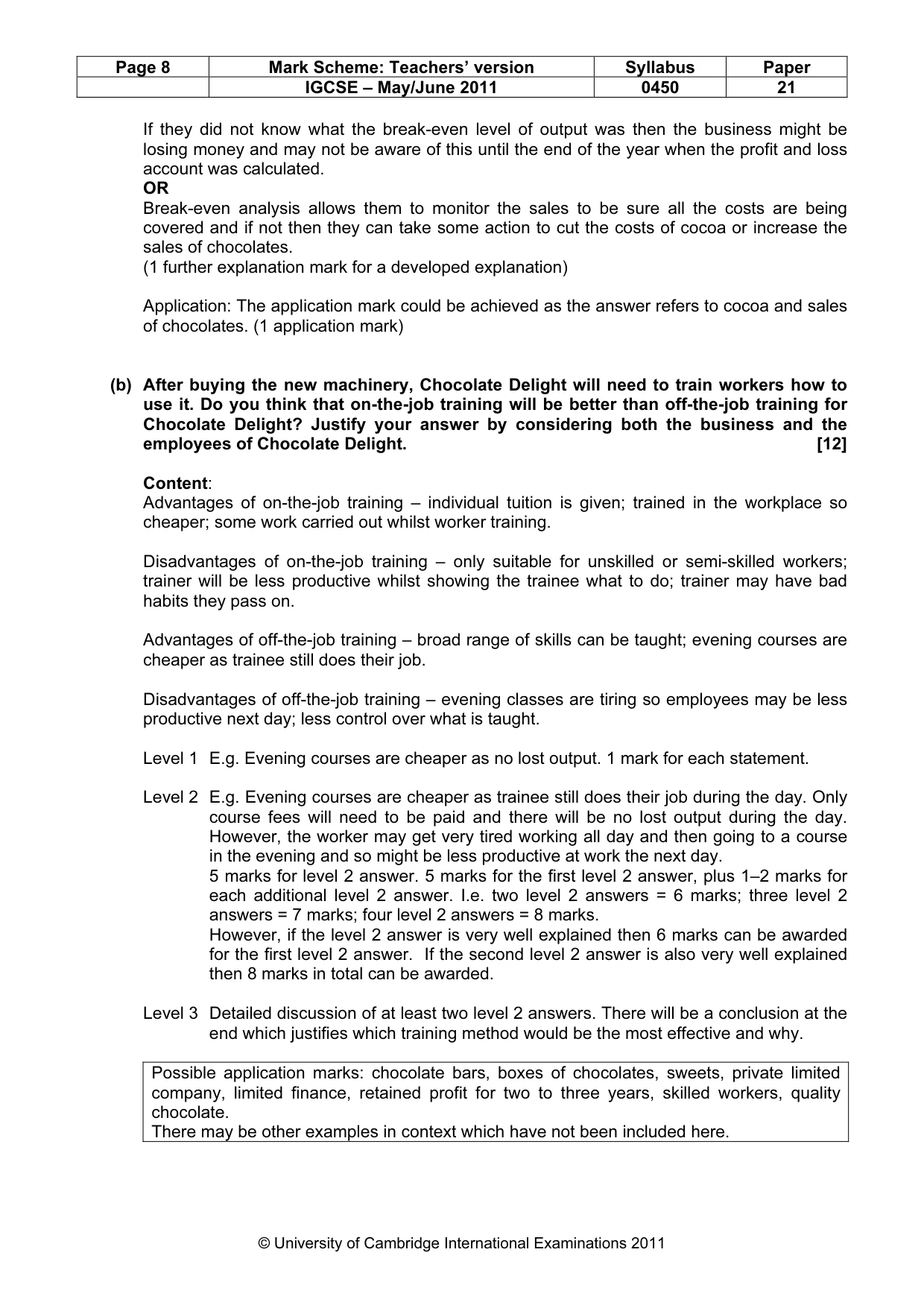
Page 8 Mark Scheme: Teachers’ version Syllabus Paper IGCSE – May/June 2011 0450 21 © University of Cambridge International Examinations 2011 If they did not know what the break-even level of output was then the business might be losing money and may not be aware of this until the end of the year when the profit and loss account was calculated. OR Break-even analysis allows them to monitor the sales to be sure all the costs are being covered and if not then they can take some action to cut the costs of cocoa or increase the sales of chocolates. (1 further explanation mark for a developed explanation) Application: The application mark could be achieved as the answer refers to cocoa and sales of chocolates. (1 application mark) (b) After buying the new machinery, Chocolate Delight will need to train workers how to use it. Do you think that on-the-job training will be better than off-the-job training for Chocolate Delight? Justify your answer by considering both the business and the employees of Chocolate Delight. [12] Content: Advantages of on-the-job training – individual tuition is given; trained in the workplace so cheaper; some work carried out whilst worker training. Disadvantages of on-the-job training – only suitable for unskilled or semi-skilled workers; trainer will be less productive whilst showing the trainee what to do; trainer may have bad habits they pass on. Advantages of off-the-job training – broad range of skills can be taught; evening courses are cheaper as trainee still does their job. Disadvantages of off-the-job training – evening classes are tiring so employees may be less productive next day; less control over what is taught. Level 1 E.g. Evening courses are cheaper as no lost output. 1 mark for each statement. Level 2 E.g. Evening courses are cheaper as trainee still does their job during the day. Only course fees will need to be paid and there will be no lost output during the day. However, the worker may get very tired working all day and then going to a course in the evening and so might be less productive at work the next day. 5 marks for level 2 answer. 5 marks for the first level 2 answer, plus 1–2 marks for each additional level 2 answer. I.e. two level 2 answers = 6 marks; three level 2 answers = 7 marks; four level 2 answers = 8 marks. However, if the level 2 answer is very well explained then 6 marks can be awarded for the first level 2 answer. If the second level 2 answer is also very well explained then 8 marks in total can be awarded. Level 3 Detailed discussion of at least two level 2 answers. There will be a conclusion at the end which justifies which training method would be the most effective and why. Possible application marks: chocolate bars, boxes of chocolates, sweets, private limited company, limited finance, retained profit for two to three years, skilled workers, quality chocolate. There may be other examples in context which have not been included here.
Mark scheme, page 9
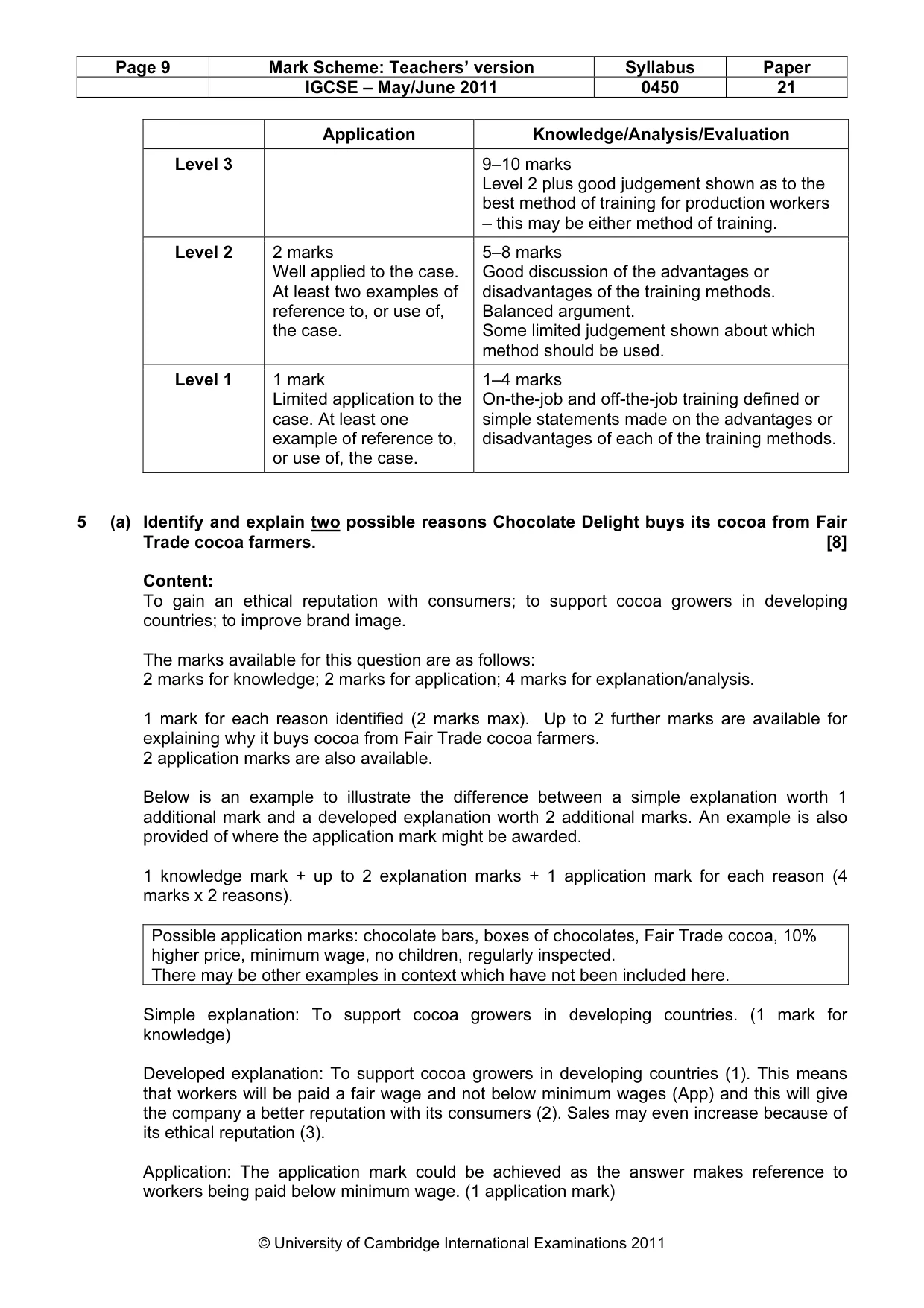
Page 9 Mark Scheme: Teachers’ version Syllabus Paper IGCSE – May/June 2011 0450 21 © University of Cambridge International Examinations 2011 Application Knowledge/Analysis/Evaluation Level 3 9–10 marks Level 2 plus good judgement shown as to the best method of training for production workers – this may be either method of training. Level 2 2 marks Well applied to the case. At least two examples of reference to, or use of, the case. 5–8 marks Good discussion of the advantages or disadvantages of the training methods. Balanced argument. Some limited judgement shown about which method should be used. Level 1 1 mark Limited application to the case. At least one example of reference to, or use of, the case. 1–4 marks On-the-job and off-the-job training defined or simple statements made on the advantages or disadvantages of each of the training methods. 5 (a) Identify and explain two possible reasons Chocolate Delight buys its cocoa from Fair Trade cocoa farmers. [8] Content: To gain an ethical reputation with consumers; to support cocoa growers in developing countries; to improve brand image. The marks available for this question are as follows: 2 marks for knowledge; 2 marks for application; 4 marks for explanation/analysis. 1 mark for each reason identified (2 marks max). Up to 2 further marks are available for explaining why it buys cocoa from Fair Trade cocoa farmers. 2 application marks are also available. Below is an example to illustrate the difference between a simple explanation worth 1 additional mark and a developed explanation worth 2 additional marks. An example is also provided of where the application mark might be awarded. 1 knowledge mark + up to 2 explanation marks + 1 application mark for each reason (4 marks x 2 reasons). Possible application marks: chocolate bars, boxes of chocolates, Fair Trade cocoa, 10% higher price, minimum wage, no children, regularly inspected. There may be other examples in context which have not been included here. Simple explanation: To support cocoa growers in developing countries. (1 mark for knowledge) Developed explanation: To support cocoa growers in developing countries (1). This means that workers will be paid a fair wage and not below minimum wages (App) and this will give the company a better reputation with its consumers (2). Sales may even increase because of its ethical reputation (3). Application: The application mark could be achieved as the answer makes reference to workers being paid below minimum wage. (1 application mark)
Mark scheme, page 10
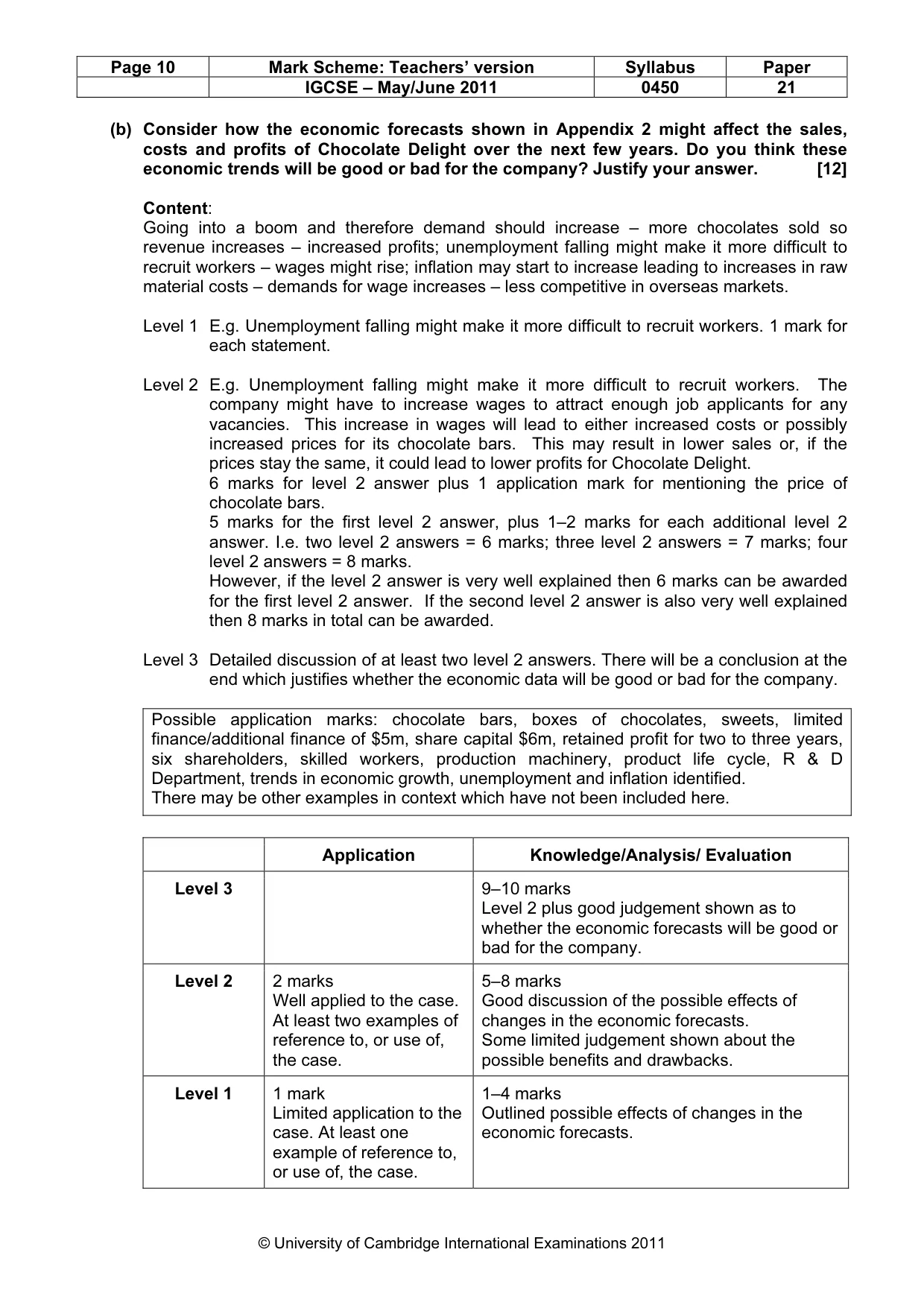
Page 10 Mark Scheme: Teachers’ version Syllabus Paper IGCSE – May/June 2011 0450 21 © University of Cambridge International Examinations 2011 (b) Consider how the economic forecasts shown in Appendix 2 might affect the sales, costs and profits of Chocolate Delight over the next few years. Do you think these economic trends will be good or bad for the company? Justify your answer. [12] Content: Going into a boom and therefore demand should increase – more chocolates sold so revenue increases – increased profits; unemployment falling might make it more difficult to recruit workers – wages might rise; inflation may start to increase leading to increases in raw material costs – demands for wage increases – less competitive in overseas markets. Level 1 E.g. Unemployment falling might make it more difficult to recruit workers. 1 mark for each statement. Level 2 E.g. Unemployment falling might make it more difficult to recruit workers. The company might have to increase wages to attract enough job applicants for any vacancies. This increase in wages will lead to either increased costs or possibly increased prices for its chocolate bars. This may result in lower sales or, if the prices stay the same, it could lead to lower profits for Chocolate Delight. 6 marks for level 2 answer plus 1 application mark for mentioning the price of chocolate bars. 5 marks for the first level 2 answer, plus 1–2 marks for each additional level 2 answer. I.e. two level 2 answers = 6 marks; three level 2 answers = 7 marks; four level 2 answers = 8 marks. However, if the level 2 answer is very well explained then 6 marks can be awarded for the first level 2 answer. If the second level 2 answer is also very well explained then 8 marks in total can be awarded. Level 3 Detailed discussion of at least two level 2 answers. There will be a conclusion at the end which justifies whether the economic data will be good or bad for the company. Possible application marks: chocolate bars, boxes of chocolates, sweets, limited finance/additional finance of $5m, share capital $6m, retained profit for two to three years, six shareholders, skilled workers, production machinery, product life cycle, R & D Department, trends in economic growth, unemployment and inflation identified. There may be other examples in context which have not been included here. Application Knowledge/Analysis/ Evaluation Level 3 9–10 marks Level 2 plus good judgement shown as to whether the economic forecasts will be good or bad for the company. Level 2 2 marks Well applied to the case. At least two examples of reference to, or use of, the case. 5–8 marks Good discussion of the possible effects of changes in the economic forecasts. Some limited judgement shown about the possible benefits and drawbacks. Level 1 1 mark Limited application to the case. At least one example of reference to, or use of, the case. 1–4 marks Outlined possible effects of changes in the economic forecasts.
What you needed in this session
Cambridge’s own grade thresholds for 2011 May/June, Paper 2 · Variant 1. A higher threshold means an easier paper — the bar moves with how the cohort did.