Cambridge IGCSE Business Studies 0450 — 2011 May/June Paper 1 · Variant 2
0450/12/M/J/11 · 100 marks · ≈113 min
The question paper and its mark scheme, free to read here and free to download. This is Cambridge’s own paper, exactly as it was sat.
Question paper12 pages

Mark scheme10 pages
Answers below. Sit the paper first if you are practising.
Paper as text
Question paper, page 1
This document consists of 11 printed pages and 1 blank page. DC (SM/CGW) 36369/1 © UCLES 2011 [Turn over UNIVERSITY OF CAMBRIDGE INTERNATIONAL EXAMINATIONS International General Certificate of Secondary Education * 1 5 5 6 5 7 0 4 0 6 * BUSINESS STUDIES 0450/12 Paper 1 May/June 2011 1 hour 45 minutes Candidates answer on the Question Paper. No Additional Materials are required. READ THESE INSTRUCTIONS FIRST Write your Centre number, candidate number and name on all the work you hand in. Write in dark blue or black pen. Do not use staples, paper clips, highlighters, glue or correction fluid. DO NOT WRITE IN ANY BARCODES. Answer all questions. The businesses described in this question paper are entirely fictitious. At the end of the examination, fasten all your work securely together. The number of marks is given in brackets [ ] at the end of each question or part question. For Examiner’s Use 1 2 3 4 5 Total
Question paper, page 2
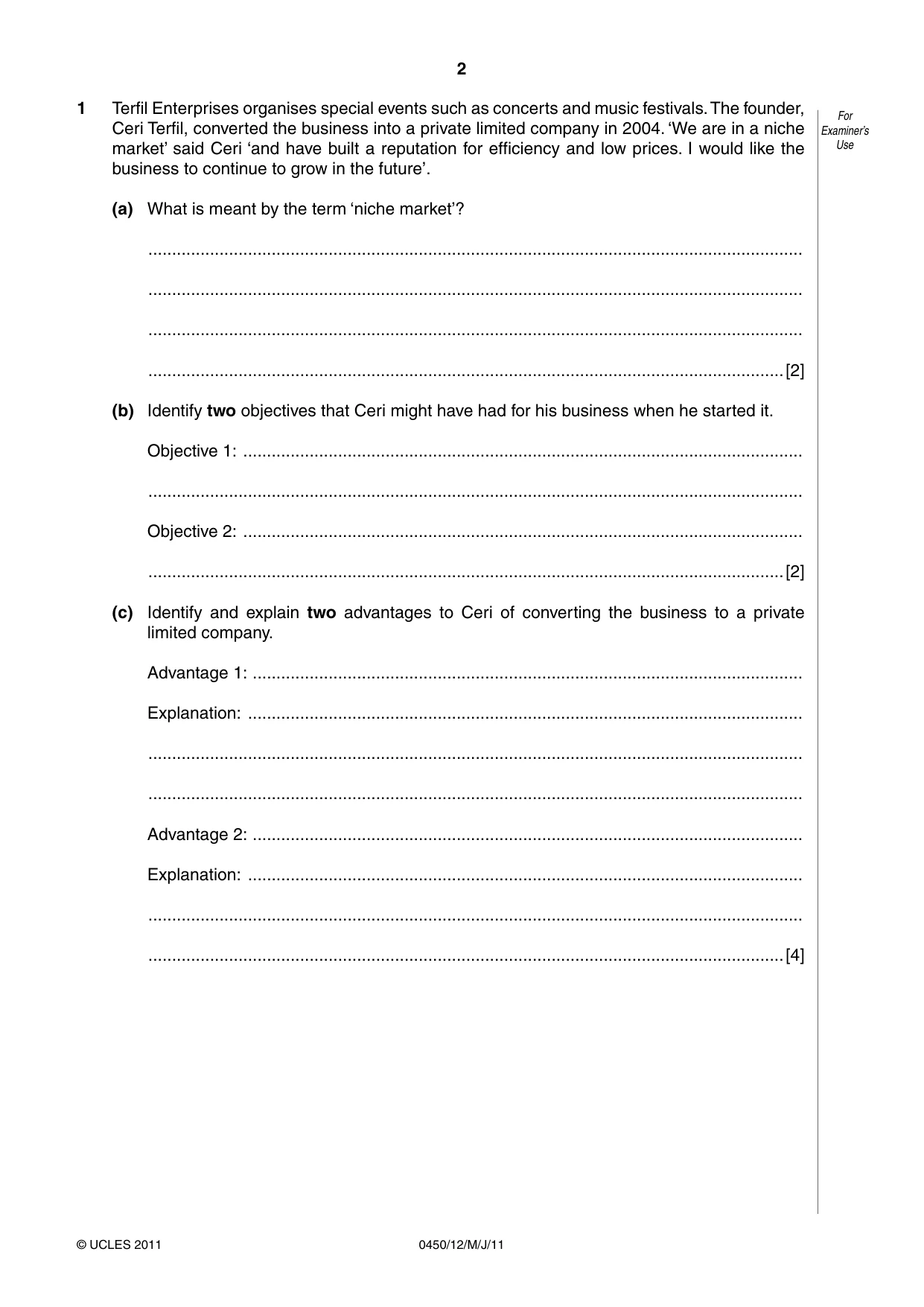
2 0450/12/M/J/11 © UCLES 2011 For Examiner’s Use 1 Terfil Enterprises organises special events such as concerts and music festivals. The founder, Ceri Terfil, converted the business into a private limited company in 2004. ‘We are in a niche market’ said Ceri ‘and have built a reputation for efficiency and low prices. I would like the business to continue to grow in the future’. (a) What is meant by the term ‘niche market’? … … … …[2] (b) Identify two objectives that Ceri might have had for his business when he started it. Objective 1: … … Objective 2: … …[2] (c) Identify and explain two advantages to Ceri of converting the business to a private limited company. Advantage 1: … Explanation: … … … Advantage 2: … Explanation: … … …[4]
Question paper, page 3
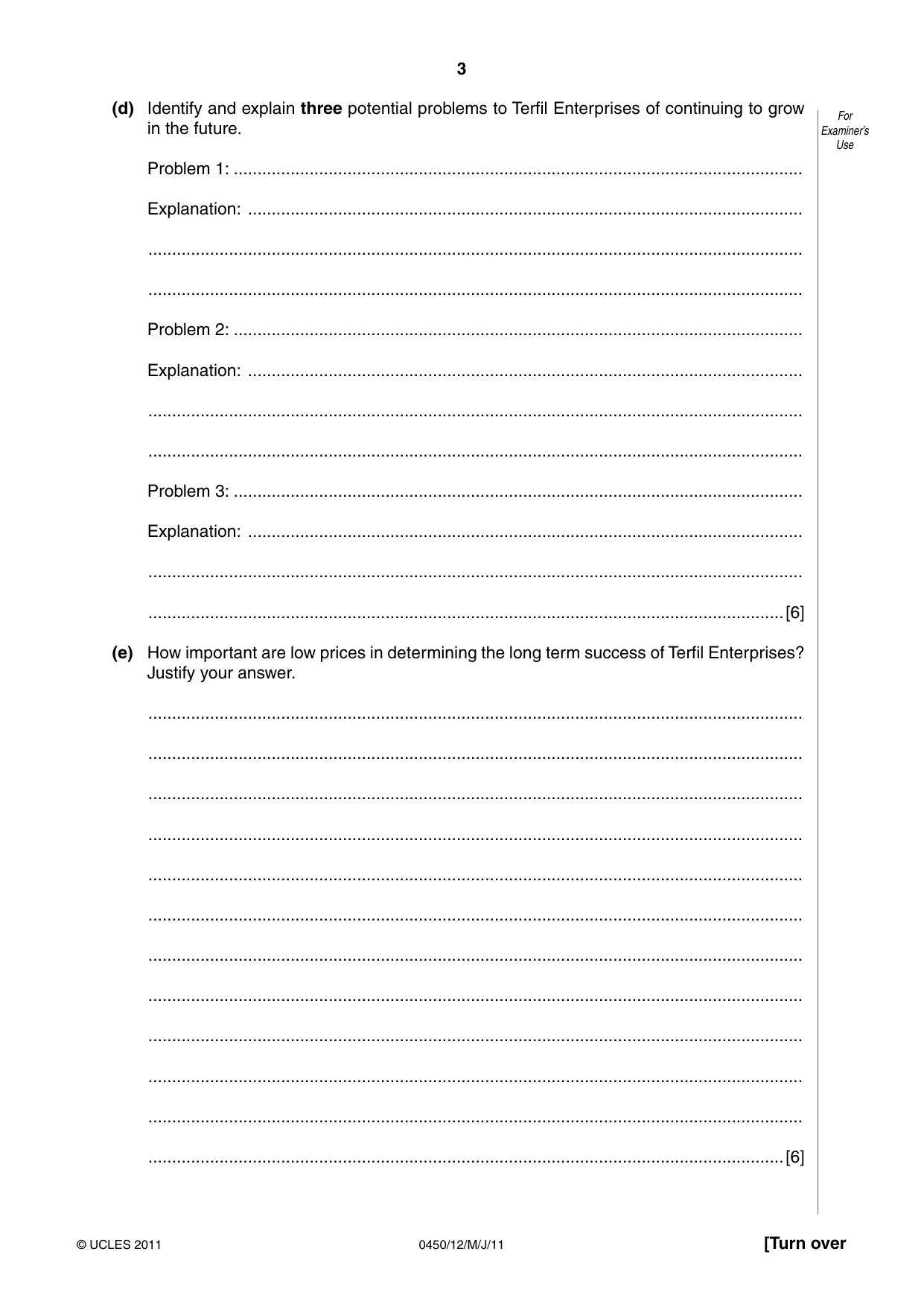
3 0450/12/M/J/11 © UCLES 2011 [Turn over For Examiner’s Use (d) Identify and explain three potential problems to Terfil Enterprises of continuing to grow in the future. Problem 1: … Explanation: … … … Problem 2: … Explanation: … … … Problem 3: … Explanation: … … …[6] (e) How important are low prices in determining the long term success of Terfil Enterprises? Justify your answer. … … … … … … … … … … … …[6]
Question paper, page 4
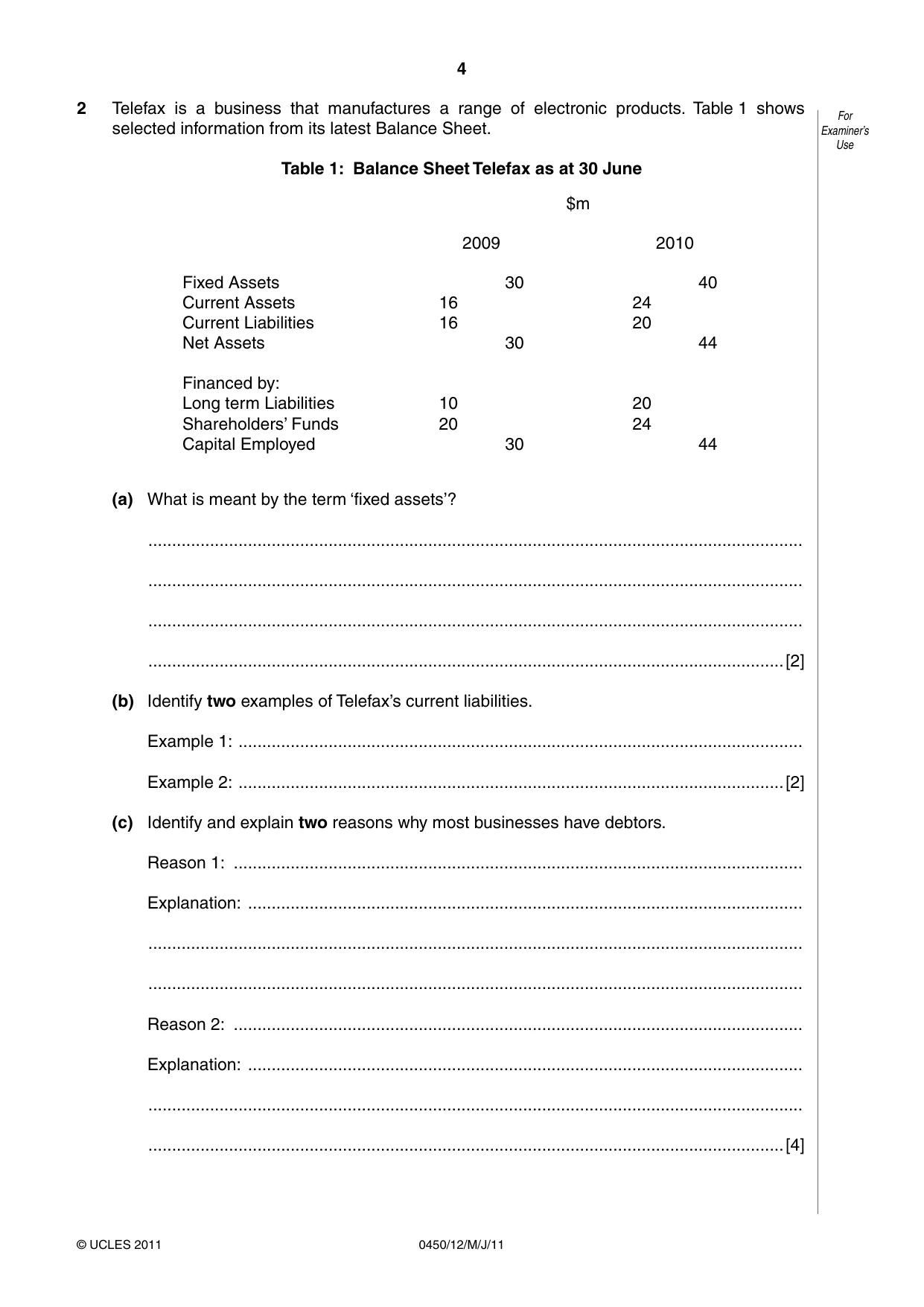
4 0450/12/M/J/11 © UCLES 2011 For Examiner’s Use 2 Telefax is a business that manufactures a range of electronic products. Table 1 shows selected information from its latest Balance Sheet. Table 1: Balance Sheet Telefax as at 30 June $m 2009 2010 Fixed Assets Current Assets Current Liabilities Net Assets Financed by: Long term Liabilities Shareholders’ Funds Capital Employed 16 16 10 20 30 30 30 24 20 20 24 40 44 44 (a) What is meant by the term ‘fixed assets’? … … … …[2] (b) Identify two examples of Telefax’s current liabilities. Example 1: … Example 2: …[2] (c) Identify and explain two reasons why most businesses have debtors. Reason 1: … Explanation: … … … Reason 2: … Explanation: … … …[4]
Question paper, page 5
5 0450/12/M/J/11 © UCLES 2011 [Turn over For Examiner’s Use (d) Identify and explain three reasons why Telefax’s bank manager might want to see the accounts of the business. Reason 1: … Explanation: … … … Reason 2: … Explanation: … … … Reason 3: … Explanation: … … …[6] (e) Do you think that the financial position of Telefax has improved in 2010? Justify your answer. … … … … … … … … … … … …[6]
Question paper, page 6
6 0450/12/M/J/11 © UCLES 2011 For Examiner’s Use 3 Kemptown Fried Chicken is a chain of fast food restaurants. The business is unsuccessful because it is badly managed. There is no organisational structure. Job tasks and roles are unclear. The workers are demotivated and low paid. Communication in the business is poor and meetings are rarely held because the management think they are ‘a non-productive use of time’. (a) What is meant by the term ‘organisational structure’? … … … …[2] (b) What is meant by ‘communication in the business is poor’? … … … …[2] (c) Identify and explain two advantages of delegating tasks in an organisation. Advantage 1: … Explanation: … … … Advantage 2: … Explanation: … … …[4]
Question paper, page 7
7 0450/12/M/J/11 © UCLES 2011 [Turn over For Examiner’s Use (d) Identify and explain three reasons why meetings between managers and workers can benefit the business. Reason 1: … Explanation: … … … Reason 2: … Explanation: … … … Reason 3: … Explanation: … … …[6] (e) How effective is money in motivating workers? Justify your answer. … … … … … … … … … … … …[6]
Question paper, page 8
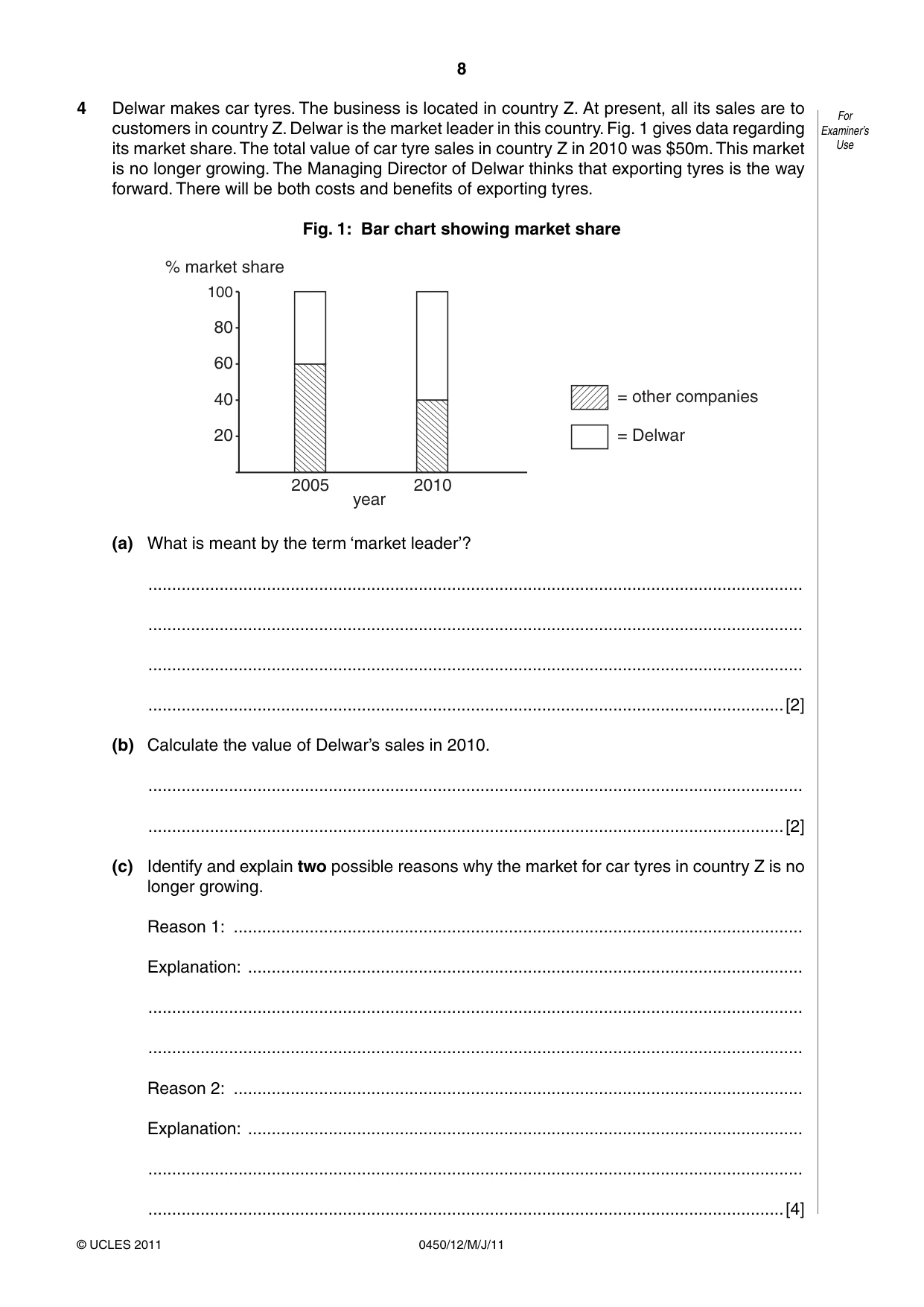
8 0450/12/M/J/11 © UCLES 2011 For Examiner’s Use 4 Delwar makes car tyres. The business is located in country Z. At present, all its sales are to customers in country Z. Delwar is the market leader in this country. Fig. 1 gives data regarding its market share. The total value of car tyre sales in country Z in 2010 was $50m. This market is no longer growing. The Managing Director of Delwar thinks that exporting tyres is the way forward. There will be both costs and benefits of exporting tyres. Fig. 1: Bar chart showing market share 2005 2010 40 20 60 80 100 % market share = Delwar year = other companies (a) What is meant by the term ‘market leader’? … … … …[2] (b) Calculate the value of Delwar’s sales in 2010. … …[2] (c) Identify and explain two possible reasons why the market for car tyres in country Z is no longer growing. Reason 1: … Explanation: … … … Reason 2: … Explanation: … … …[4]
Question paper, page 9
9 0450/12/M/J/11 © UCLES 2011 [Turn over For Examiner’s Use (d) Identify and explain three methods Delwar could use to increase its market share in country Z. Method 1: … Explanation: … … … Method 2: … Explanation: … … … Method 3: … Explanation: … … …[6] (e) Do you think Delwar’s profits would increase if the business were to export its tyres? Justify your answer. … … … … … … … … … … … …[6]
Question paper, page 10
10 0450/12/M/J/11 © UCLES 2011 For Examiner’s Use 5 Extracto is a multinational mining business. It has recently found mineral deposits in country X. The Managing Director hopes that the deposits found are large enough for them to make a good profit. Some pressure groups in country X think that Extracto has only considered the financial benefits of its plans and has ignored the social costs. (a) What is meant by a ‘financial benefit’? … … … …[2] (b) Identify two examples of social costs that extraction of minerals might create. Example 1: … … Example 2: … …[2] (c) Identify and explain two ways in which pressure groups could influence Extracto’s decisions. Way 1: … Explanation: … … … Way 2: … Explanation: … … …[4]
Question paper, page 11
11 0450/12/M/J/11 © UCLES 2011 For Examiner’s Use (d) Identify and explain three factors that Extracto should consider before deciding whether to begin mining in country X. Factor 1: … Explanation: … … … Factor 2: … Explanation: … … … Factor 3: … Explanation: … … …[6] (e) Governments often aim to attract multinational companies into their countries. Do you think that they should do this? Justify your answer. … … … … … … … … … … … …[6]
Question paper, page 12
12 0450/12/M/J/11 © UCLES 2011 Permission to reproduce items where third-party owned material protected by copyright is included has been sought and cleared where possible. Every reasonable effort has been made by the publisher (UCLES) to trace copyright holders, but if any items requiring clearance have unwittingly been included, the publisher will be pleased to make amends at the earliest possible opportunity. University of Cambridge International Examinations is part of the Cambridge Assessment Group. Cambridge Assessment is the brand name of University of Cambridge Local Examinations Syndicate (UCLES), which is itself a department of the University of Cambridge. BLANK PAGE
Mark scheme, page 1
UNIVERSITY OF CAMBRIDGE INTERNATIONAL EXAMINATIONS International General Certificate of Secondary Education MARK SCHEME for the May/June 2011 question paper for the guidance of teachers 0450 BUSINESS STUDIES 0450/12 Paper 1 (Short Answer/Structured response), maximum raw mark 100 This mark scheme is published as an aid to teachers and candidates, to indicate the requirements of the examination. It shows the basis on which Examiners were instructed to award marks. It does not indicate the details of the discussions that took place at an Examiners’ meeting before marking began, which would have considered the acceptability of alternative answers. Mark schemes must be read in conjunction with the question papers and the report on the examination. • Cambridge will not enter into discussions or correspondence in connection with these mark schemes. Cambridge is publishing the mark schemes for the May/June 2011 question papers for most IGCSE, GCE Advanced Level and Advanced Subsidiary Level syllabuses and some Ordinary Level syllabuses.
Mark scheme, page 2
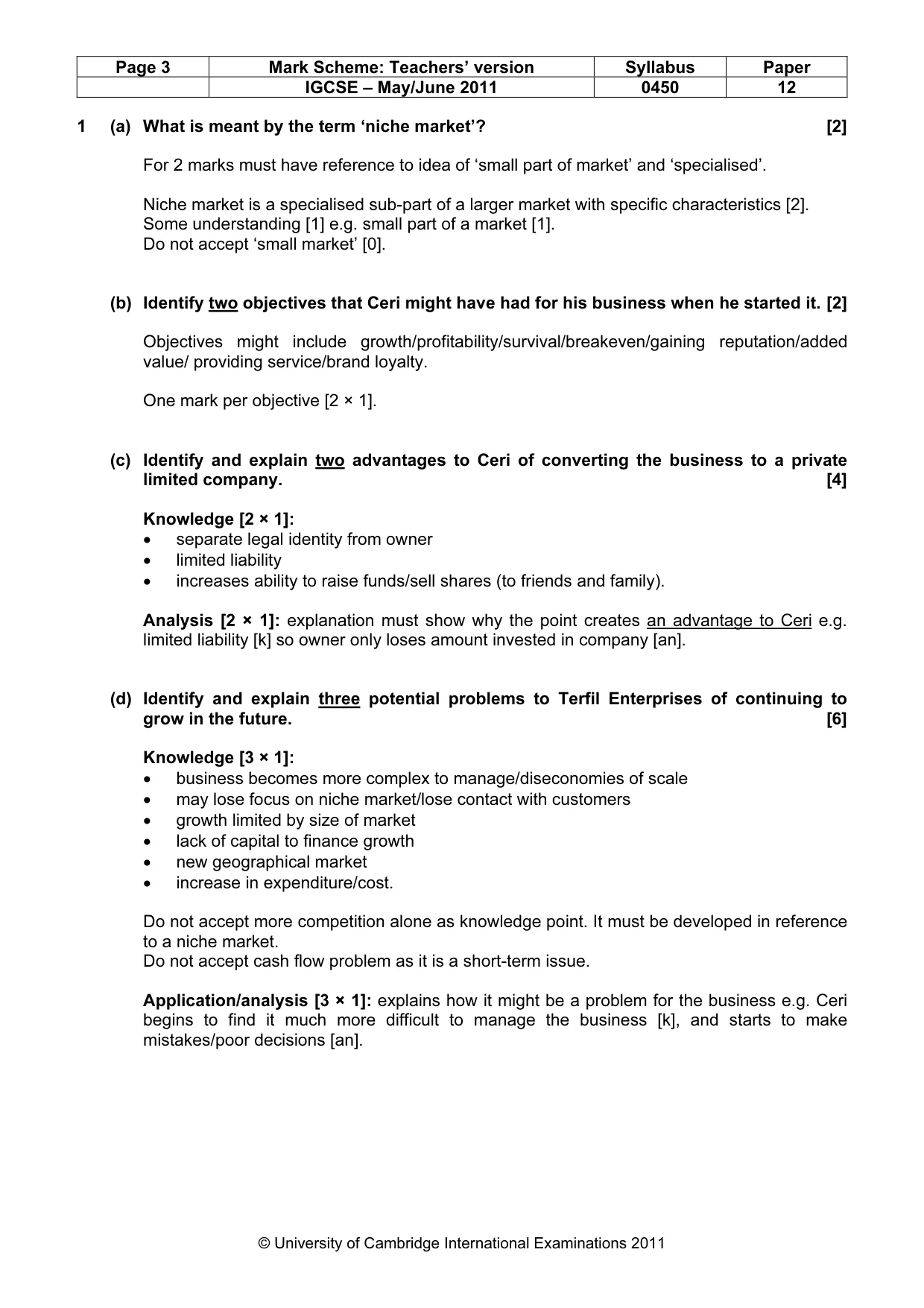
Page 2 Mark Scheme: Teachers’ version Syllabus Paper IGCSE – May/June 2011 0450 12 © University of Cambridge International Examinations 2011 This mark scheme includes a summary of appropriate content for answering each question. It should be emphasised, however, that this material is for illustrative purposes and is not intended to provide a definitive guide to acceptable answers. It is quite possible that among the scripts there will be some candidate answers that are not covered directly by the content of this mark scheme. In such cases, professional judgement should be exercised in assessing the merits of the answer. Examples of possible answers are also included in this mark scheme. Again, it should be emphasised that this is for illustrative purposes and the examples chosen represent only some of the many possible responses that would merit reward.
Mark scheme, page 3
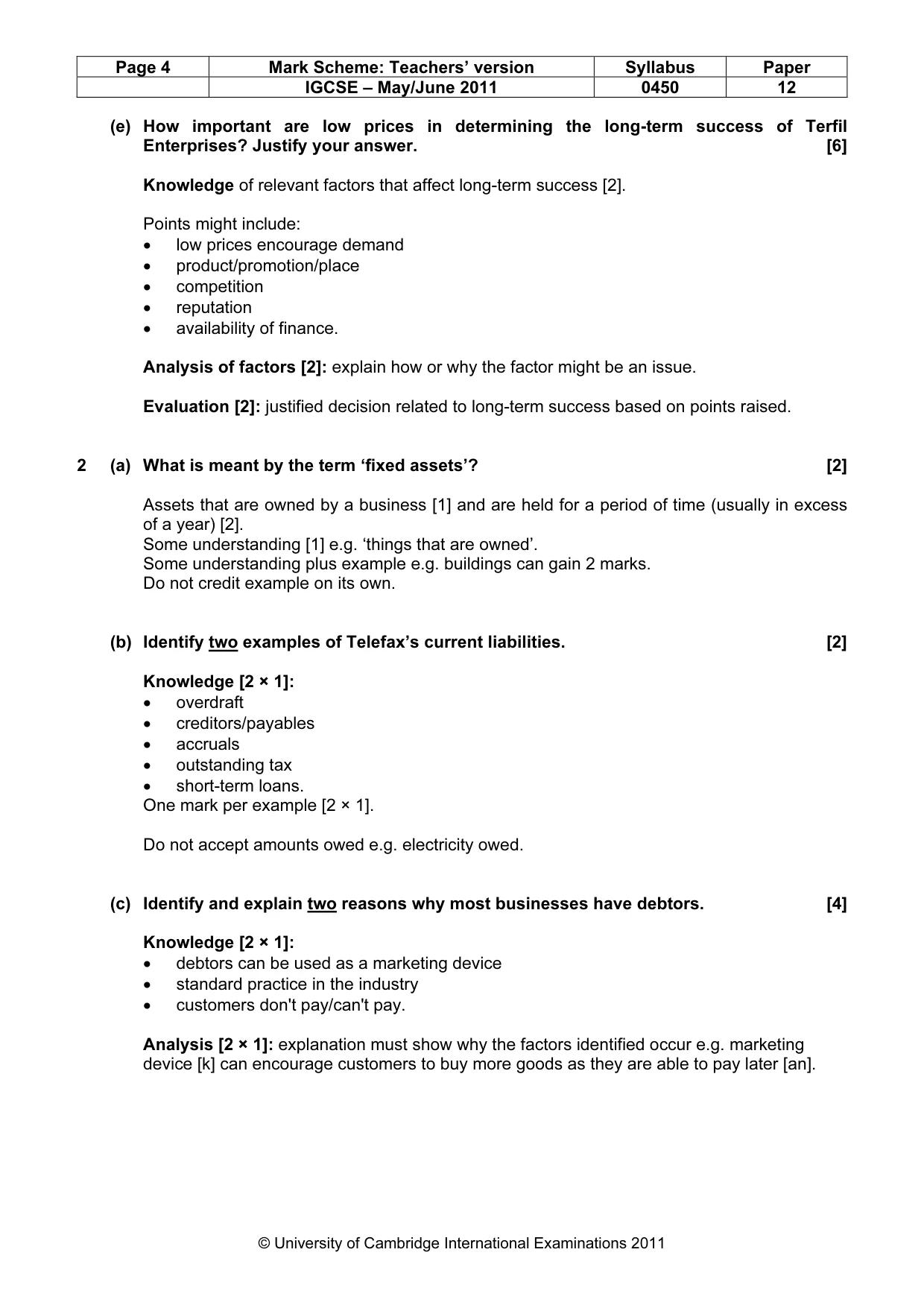
Page 3 Mark Scheme: Teachers’ version Syllabus Paper IGCSE – May/June 2011 0450 12 © University of Cambridge International Examinations 2011 1 (a) What is meant by the term ‘niche market’? [2] For 2 marks must have reference to idea of ‘small part of market’ and ‘specialised’. Niche market is a specialised sub-part of a larger market with specific characteristics [2]. Some understanding [1] e.g. small part of a market [1]. Do not accept ‘small market’ [0]. (b) Identify two objectives that Ceri might have had for his business when he started it. [2] Objectives might include growth/profitability/survival/breakeven/gaining reputation/added value/ providing service/brand loyalty. One mark per objective [2 × 1]. (c) Identify and explain two advantages to Ceri of converting the business to a private limited company. [4] Knowledge [2 × 1]: • separate legal identity from owner • limited liability • increases ability to raise funds/sell shares (to friends and family). Analysis [2 × 1]: explanation must show why the point creates an advantage to Ceri e.g. limited liability [k] so owner only loses amount invested in company [an]. (d) Identify and explain three potential problems to Terfil Enterprises of continuing to grow in the future. [6] Knowledge [3 × 1]: • business becomes more complex to manage/diseconomies of scale • may lose focus on niche market/lose contact with customers • growth limited by size of market • lack of capital to finance growth • new geographical market • increase in expenditure/cost. Do not accept more competition alone as knowledge point. It must be developed in reference to a niche market. Do not accept cash flow problem as it is a short-term issue. Application/analysis [3 × 1]: explains how it might be a problem for the business e.g. Ceri begins to find it much more difficult to manage the business [k], and starts to make mistakes/poor decisions [an].
Mark scheme, page 4
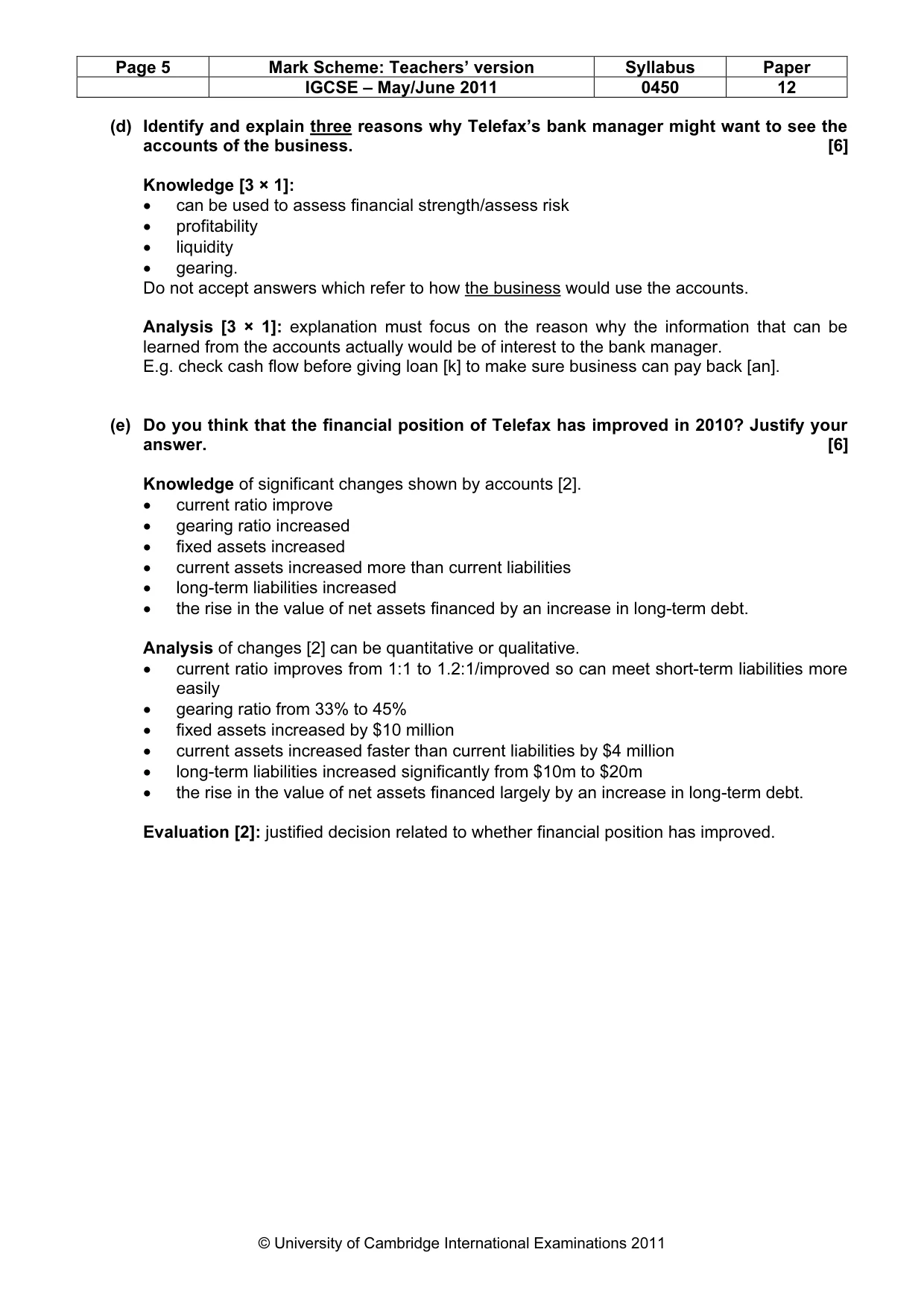
Page 4 Mark Scheme: Teachers’ version Syllabus Paper IGCSE – May/June 2011 0450 12 © University of Cambridge International Examinations 2011 (e) How important are low prices in determining the long-term success of Terfil Enterprises? Justify your answer. [6] Knowledge of relevant factors that affect long-term success [2]. Points might include: • low prices encourage demand • product/promotion/place • competition • reputation • availability of finance. Analysis of factors [2]: explain how or why the factor might be an issue. Evaluation [2]: justified decision related to long-term success based on points raised. 2 (a) What is meant by the term ‘fixed assets’? [2] Assets that are owned by a business [1] and are held for a period of time (usually in excess of a year) [2]. Some understanding [1] e.g. ‘things that are owned’. Some understanding plus example e.g. buildings can gain 2 marks. Do not credit example on its own. (b) Identify two examples of Telefax’s current liabilities. [2] Knowledge [2 × 1]: • overdraft • creditors/payables • accruals • outstanding tax • short-term loans. One mark per example [2 × 1]. Do not accept amounts owed e.g. electricity owed. (c) Identify and explain two reasons why most businesses have debtors. [4] Knowledge [2 × 1]: • debtors can be used as a marketing device • standard practice in the industry • customers don't pay/can't pay. Analysis [2 × 1]: explanation must show why the factors identified occur e.g. marketing device [k] can encourage customers to buy more goods as they are able to pay later [an].
Mark scheme, page 5
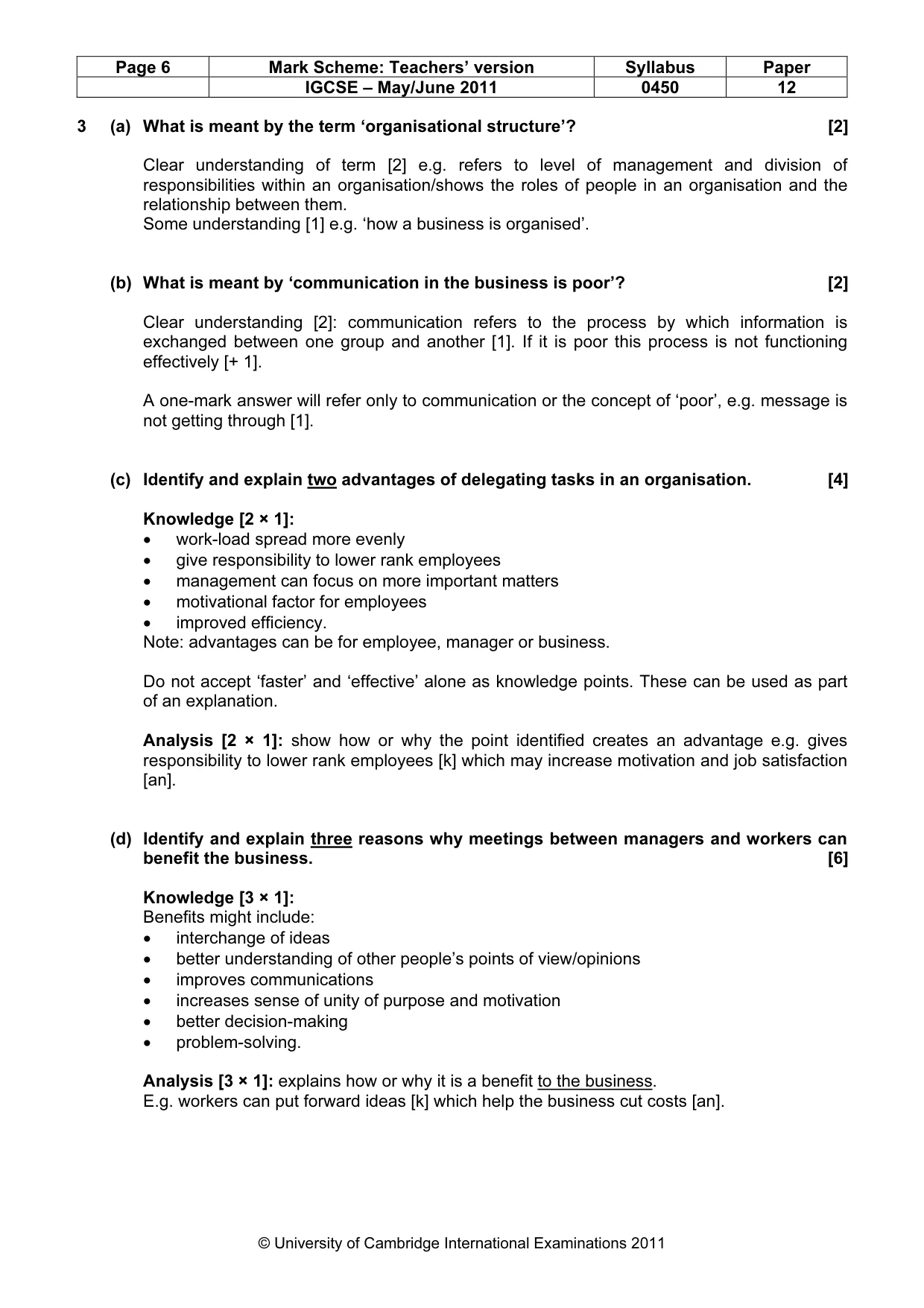
Page 5 Mark Scheme: Teachers’ version Syllabus Paper IGCSE – May/June 2011 0450 12 © University of Cambridge International Examinations 2011 (d) Identify and explain three reasons why Telefax’s bank manager might want to see the accounts of the business. [6] Knowledge [3 × 1]: • can be used to assess financial strength/assess risk • profitability • liquidity • gearing. Do not accept answers which refer to how the business would use the accounts. Analysis [3 × 1]: explanation must focus on the reason why the information that can be learned from the accounts actually would be of interest to the bank manager. E.g. check cash flow before giving loan [k] to make sure business can pay back [an]. (e) Do you think that the financial position of Telefax has improved in 2010? Justify your answer. [6] Knowledge of significant changes shown by accounts [2]. • current ratio improve • gearing ratio increased • fixed assets increased • current assets increased more than current liabilities • long-term liabilities increased • the rise in the value of net assets financed by an increase in long-term debt. Analysis of changes [2] can be quantitative or qualitative. • current ratio improves from 1:1 to 1.2:1/improved so can meet short-term liabilities more easily • gearing ratio from 33% to 45% • fixed assets increased by $10 million • current assets increased faster than current liabilities by $4 million • long-term liabilities increased significantly from $10m to $20m • the rise in the value of net assets financed largely by an increase in long-term debt. Evaluation [2]: justified decision related to whether financial position has improved.
Mark scheme, page 6
Page 6 Mark Scheme: Teachers’ version Syllabus Paper IGCSE – May/June 2011 0450 12 © University of Cambridge International Examinations 2011 3 (a) What is meant by the term ‘organisational structure’? [2] Clear understanding of term [2] e.g. refers to level of management and division of responsibilities within an organisation/shows the roles of people in an organisation and the relationship between them. Some understanding [1] e.g. ‘how a business is organised’. (b) What is meant by ‘communication in the business is poor’? [2] Clear understanding [2]: communication refers to the process by which information is exchanged between one group and another [1]. If it is poor this process is not functioning effectively [+ 1]. A one-mark answer will refer only to communication or the concept of ‘poor’, e.g. message is not getting through [1]. (c) Identify and explain two advantages of delegating tasks in an organisation. [4] Knowledge [2 × 1]: • work-load spread more evenly • give responsibility to lower rank employees • management can focus on more important matters • motivational factor for employees • improved efficiency. Note: advantages can be for employee, manager or business. Do not accept ‘faster’ and ‘effective’ alone as knowledge points. These can be used as part of an explanation. Analysis [2 × 1]: show how or why the point identified creates an advantage e.g. gives responsibility to lower rank employees [k] which may increase motivation and job satisfaction [an]. (d) Identify and explain three reasons why meetings between managers and workers can benefit the business. [6] Knowledge [3 × 1]: Benefits might include: • interchange of ideas • better understanding of other people’s points of view/opinions • improves communications • increases sense of unity of purpose and motivation • better decision-making • problem-solving. Analysis [3 × 1]: explains how or why it is a benefit to the business. E.g. workers can put forward ideas [k] which help the business cut costs [an].
Mark scheme, page 7
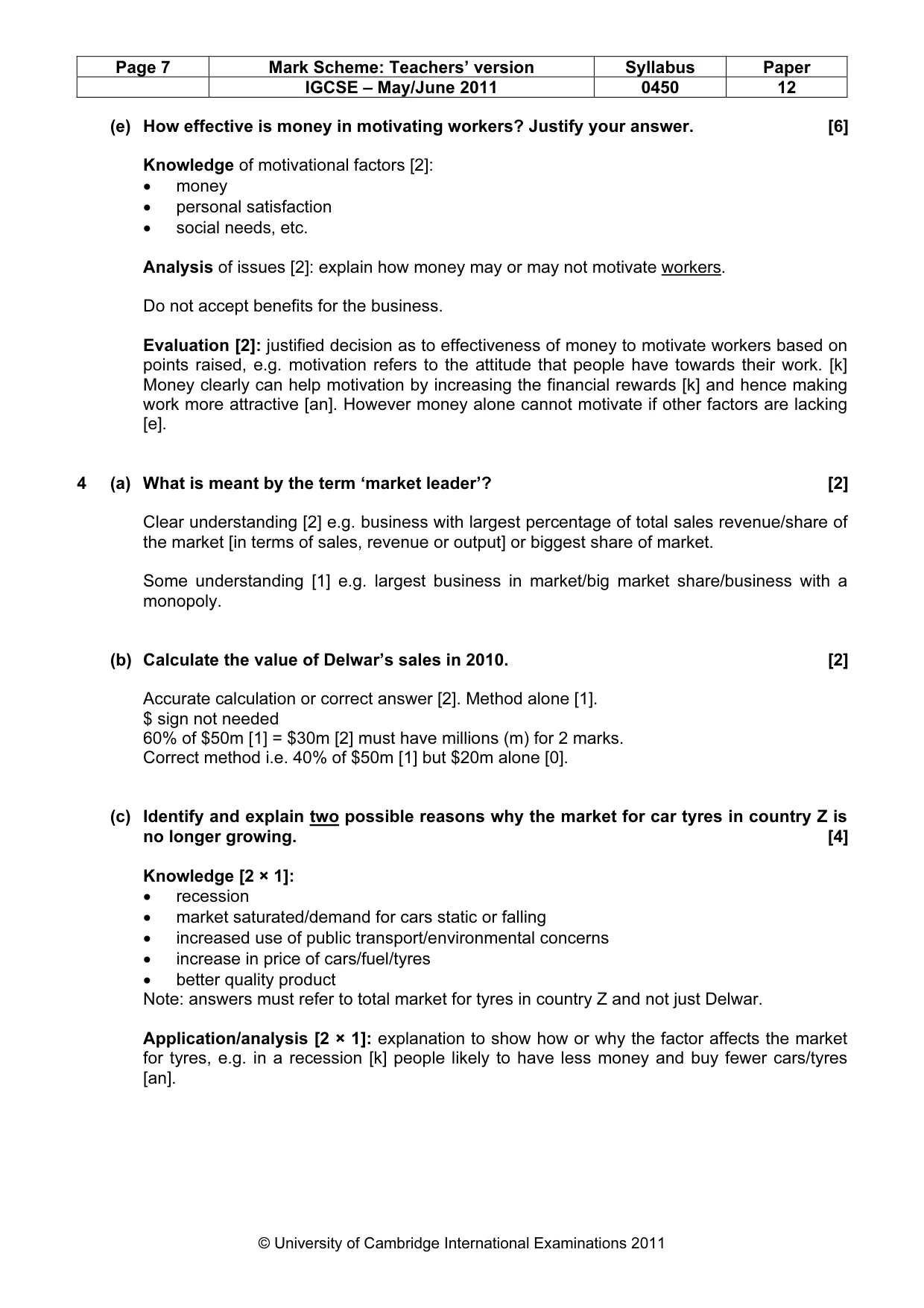
Page 7 Mark Scheme: Teachers’ version Syllabus Paper IGCSE – May/June 2011 0450 12 © University of Cambridge International Examinations 2011 (e) How effective is money in motivating workers? Justify your answer. [6] Knowledge of motivational factors [2]: • money • personal satisfaction • social needs, etc. Analysis of issues [2]: explain how money may or may not motivate workers. Do not accept benefits for the business. Evaluation [2]: justified decision as to effectiveness of money to motivate workers based on points raised, e.g. motivation refers to the attitude that people have towards their work. [k] Money clearly can help motivation by increasing the financial rewards [k] and hence making work more attractive [an]. However money alone cannot motivate if other factors are lacking [e]. 4 (a) What is meant by the term ‘market leader’? [2] Clear understanding [2] e.g. business with largest percentage of total sales revenue/share of the market [in terms of sales, revenue or output] or biggest share of market. Some understanding [1] e.g. largest business in market/big market share/business with a monopoly. (b) Calculate the value of Delwar’s sales in 2010. [2] Accurate calculation or correct answer [2]. Method alone [1]. $ sign not needed 60% of $50m [1] = $30m [2] must have millions (m) for 2 marks. Correct method i.e. 40% of $50m [1] but $20m alone [0]. (c) Identify and explain two possible reasons why the market for car tyres in country Z is no longer growing. [4] Knowledge [2 × 1]: • recession • market saturated/demand for cars static or falling • increased use of public transport/environmental concerns • increase in price of cars/fuel/tyres • better quality product Note: answers must refer to total market for tyres in country Z and not just Delwar. Application/analysis [2 × 1]: explanation to show how or why the factor affects the market for tyres, e.g. in a recession [k] people likely to have less money and buy fewer cars/tyres [an].
Mark scheme, page 8
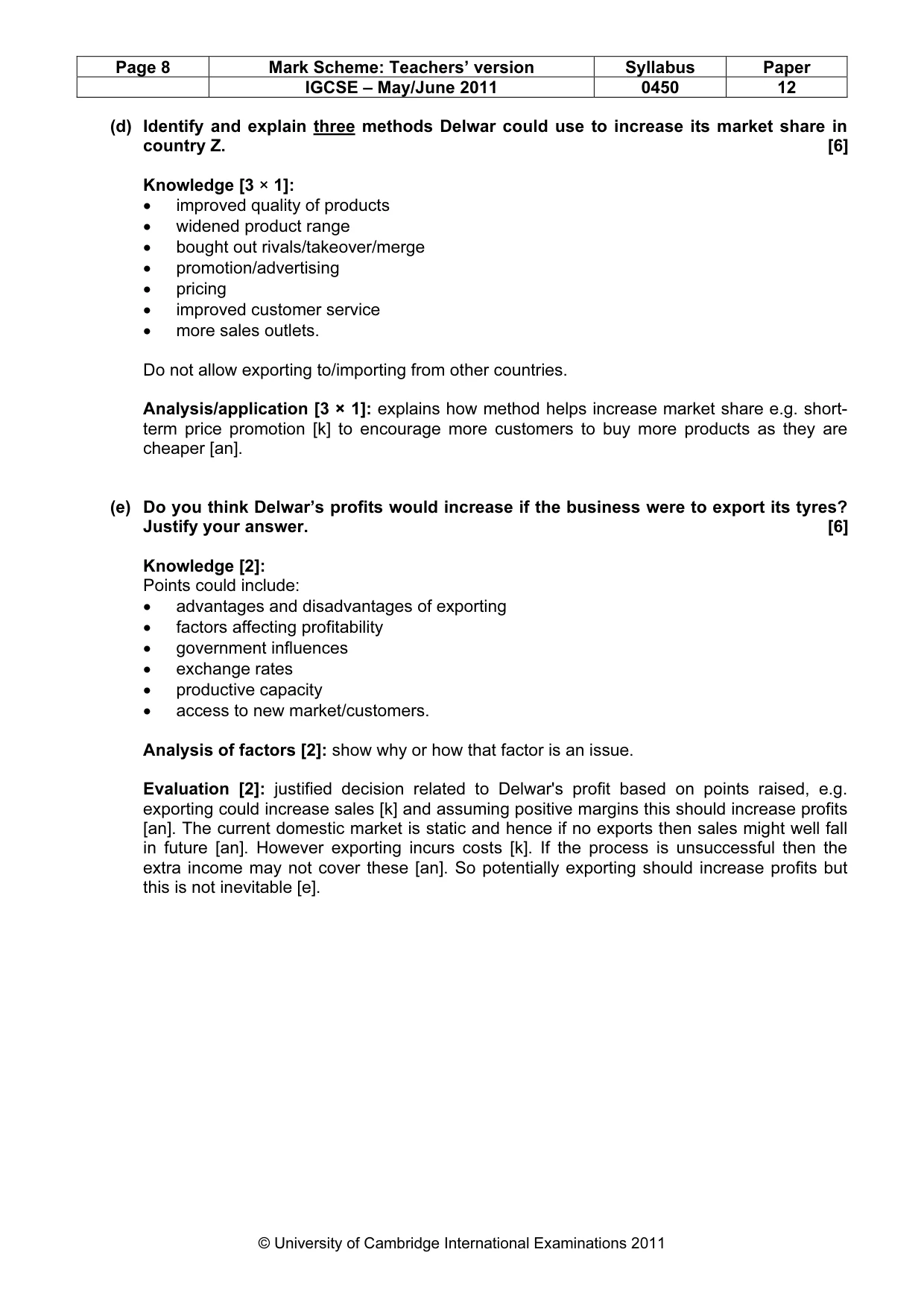
Page 8 Mark Scheme: Teachers’ version Syllabus Paper IGCSE – May/June 2011 0450 12 © University of Cambridge International Examinations 2011 (d) Identify and explain three methods Delwar could use to increase its market share in country Z. [6] Knowledge [3 × 1]: • improved quality of products • widened product range • bought out rivals/takeover/merge • promotion/advertising • pricing • improved customer service • more sales outlets. Do not allow exporting to/importing from other countries. Analysis/application [3 × 1]: explains how method helps increase market share e.g. short- term price promotion [k] to encourage more customers to buy more products as they are cheaper [an]. (e) Do you think Delwar’s profits would increase if the business were to export its tyres? Justify your answer. [6] Knowledge [2]: Points could include: • advantages and disadvantages of exporting • factors affecting profitability • government influences • exchange rates • productive capacity • access to new market/customers. Analysis of factors [2]: show why or how that factor is an issue. Evaluation [2]: justified decision related to Delwar's profit based on points raised, e.g. exporting could increase sales [k] and assuming positive margins this should increase profits [an]. The current domestic market is static and hence if no exports then sales might well fall in future [an]. However exporting incurs costs [k]. If the process is unsuccessful then the extra income may not cover these [an]. So potentially exporting should increase profits but this is not inevitable [e].
Mark scheme, page 9
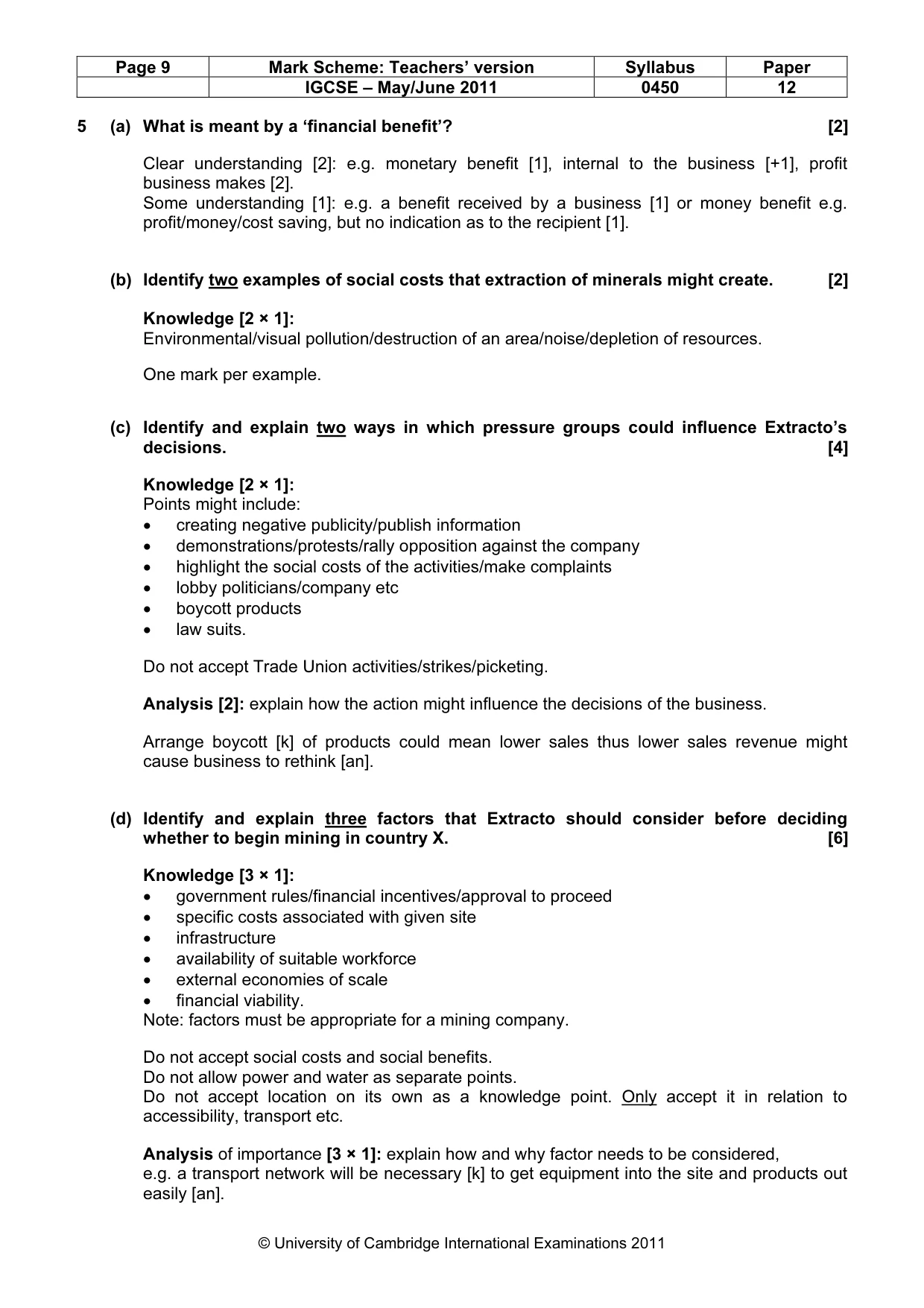
Page 9 Mark Scheme: Teachers’ version Syllabus Paper IGCSE – May/June 2011 0450 12 © University of Cambridge International Examinations 2011 5 (a) What is meant by a ‘financial benefit’? [2] Clear understanding [2]: e.g. monetary benefit [1], internal to the business [+1], profit business makes [2]. Some understanding [1]: e.g. a benefit received by a business [1] or money benefit e.g. profit/money/cost saving, but no indication as to the recipient [1]. (b) Identify two examples of social costs that extraction of minerals might create. [2] Knowledge [2 × 1]: Environmental/visual pollution/destruction of an area/noise/depletion of resources. One mark per example. (c) Identify and explain two ways in which pressure groups could influence Extracto’s decisions. [4] Knowledge [2 × 1]: Points might include: • creating negative publicity/publish information • demonstrations/protests/rally opposition against the company • highlight the social costs of the activities/make complaints • lobby politicians/company etc • boycott products • law suits. Do not accept Trade Union activities/strikes/picketing. Analysis [2]: explain how the action might influence the decisions of the business. Arrange boycott [k] of products could mean lower sales thus lower sales revenue might cause business to rethink [an]. (d) Identify and explain three factors that Extracto should consider before deciding whether to begin mining in country X. [6] Knowledge [3 × 1]: • government rules/financial incentives/approval to proceed • specific costs associated with given site • infrastructure • availability of suitable workforce • external economies of scale • financial viability. Note: factors must be appropriate for a mining company. Do not accept social costs and social benefits. Do not allow power and water as separate points. Do not accept location on its own as a knowledge point. Only accept it in relation to accessibility, transport etc. Analysis of importance [3 × 1]: explain how and why factor needs to be considered, e.g. a transport network will be necessary [k] to get equipment into the site and products out easily [an].
Mark scheme, page 10
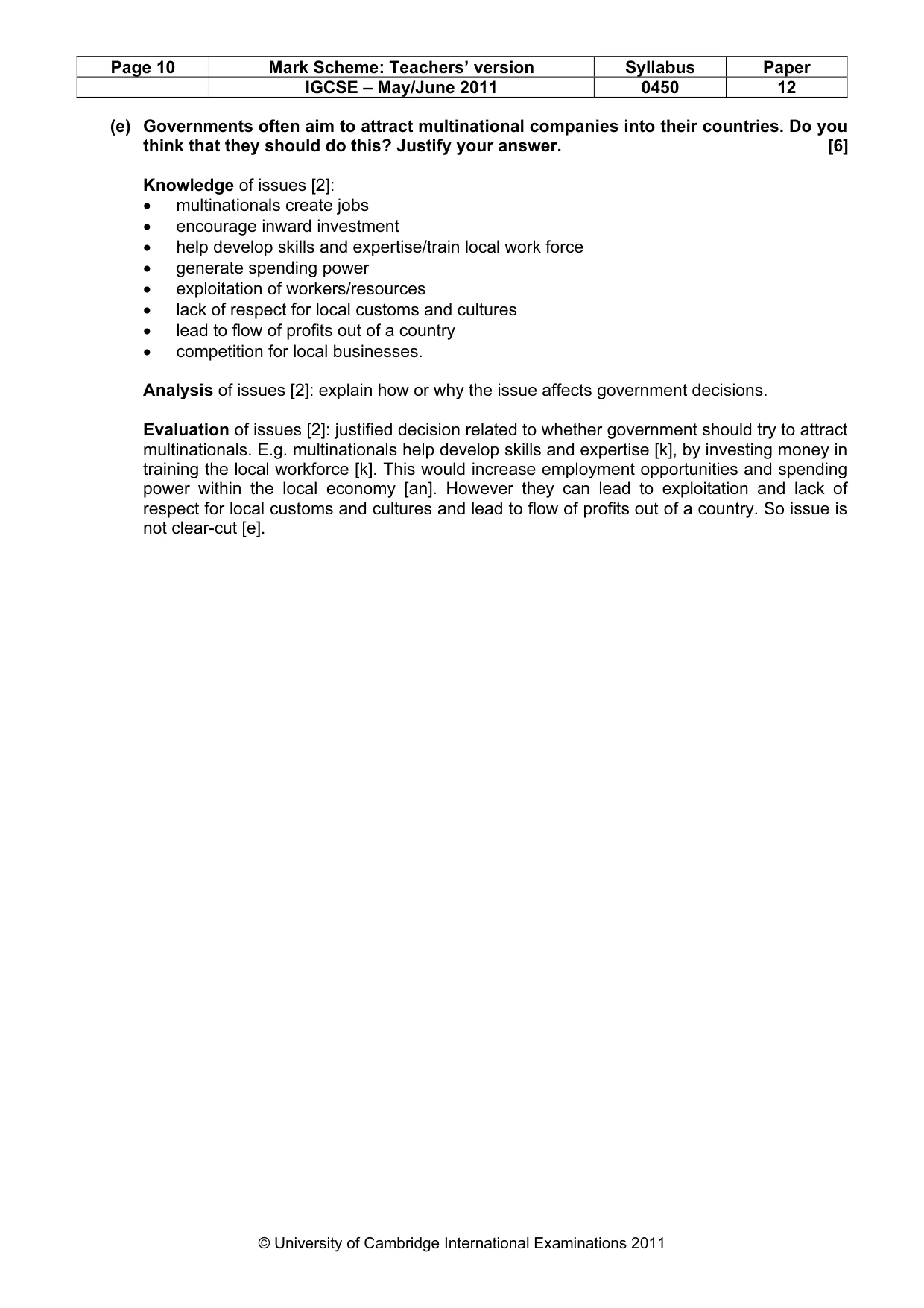
Page 10 Mark Scheme: Teachers’ version Syllabus Paper IGCSE – May/June 2011 0450 12 © University of Cambridge International Examinations 2011 (e) Governments often aim to attract multinational companies into their countries. Do you think that they should do this? Justify your answer. [6] Knowledge of issues [2]: • multinationals create jobs • encourage inward investment • help develop skills and expertise/train local work force • generate spending power • exploitation of workers/resources • lack of respect for local customs and cultures • lead to flow of profits out of a country • competition for local businesses. Analysis of issues [2]: explain how or why the issue affects government decisions. Evaluation of issues [2]: justified decision related to whether government should try to attract multinationals. E.g. multinationals help develop skills and expertise [k], by investing money in training the local workforce [k]. This would increase employment opportunities and spending power within the local economy [an]. However they can lead to exploitation and lack of respect for local customs and cultures and lead to flow of profits out of a country. So issue is not clear-cut [e].
What you needed in this session
Cambridge’s own grade thresholds for 2011 May/June, Paper 1 · Variant 2. A higher threshold means an easier paper — the bar moves with how the cohort did.