Cambridge IGCSE Business Studies 0450 — 2010 May/June Paper 2 · Variant 1
0450/21/M/J/10 · 100 marks · ≈113 min
The question paper and its mark scheme, free to read here and free to download. This is Cambridge’s own paper, exactly as it was sat.
Question paper12 pages

Mark scheme11 pages
Answers below. Sit the paper first if you are practising.
Paper as text
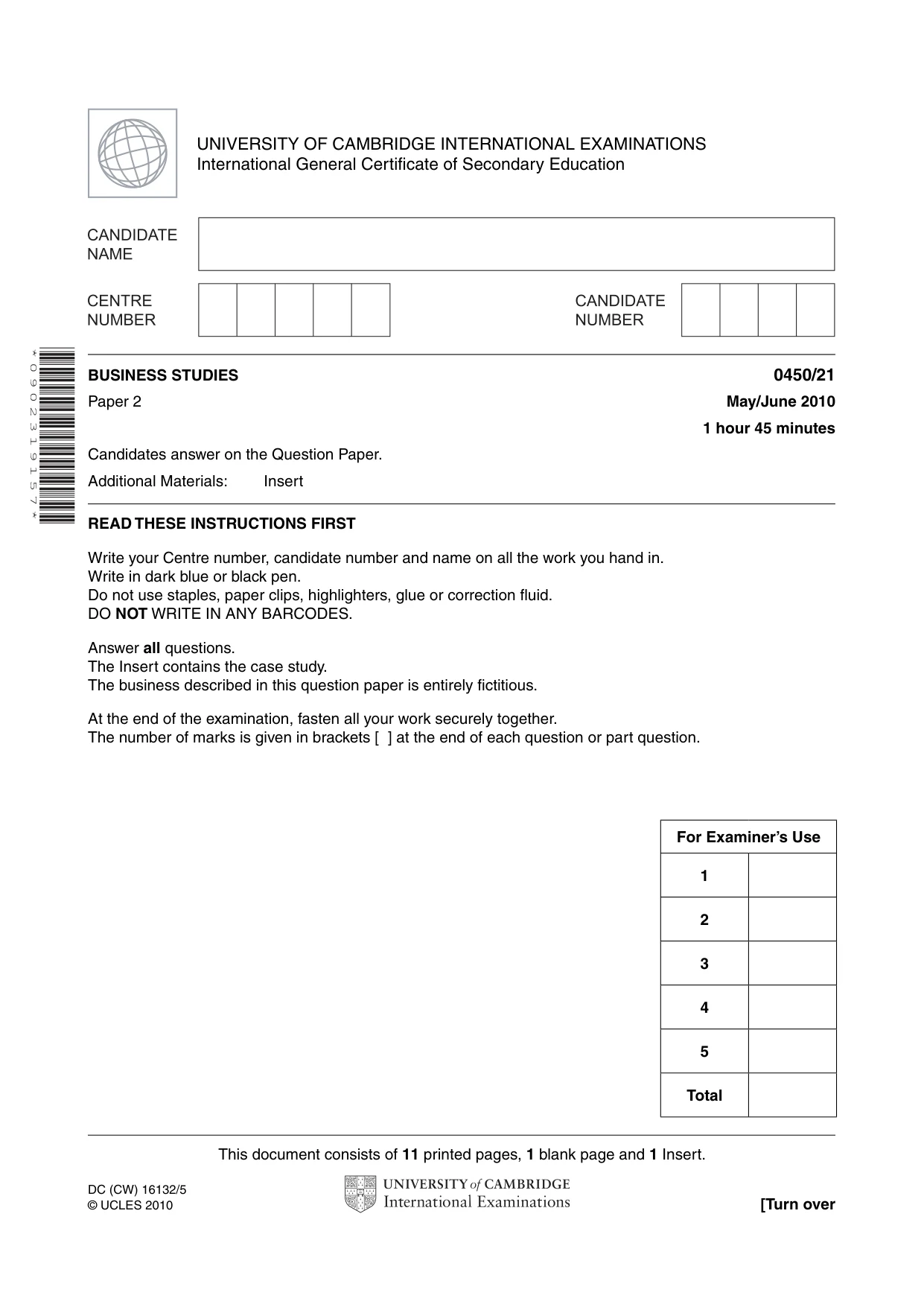
Question paper, page 1
This document consists of 11 printed pages, 1 blank page and 1 Insert. DC (CW) 16132/5 © UCLES 2010 [Turn over UNIVERSITY OF CAMBRIDGE INTERNATIONAL EXAMINATIONS International General Certificate of Secondary Education READ THESE INSTRUCTIONS FIRST Write your Centre number, candidate number and name on all the work you hand in. Write in dark blue or black pen. Do not use staples, paper clips, highlighters, glue or correction fluid. DO NOT WRITE IN ANY BARCODES. Answer all questions. The Insert contains the case study. The business described in this question paper is entirely fictitious. At the end of the examination, fasten all your work securely together. The number of marks is given in brackets [ ] at the end of each question or part question. * 0 9 0 2 3 1 9 1 5 7 * BUSINESS STUDIES 0450/21 Paper 2 May/June 2010 1 hour 45 minutes Candidates answer on the Question Paper. Additional Materials: Insert For Examiner’s Use 1 2 3 4 5 Total
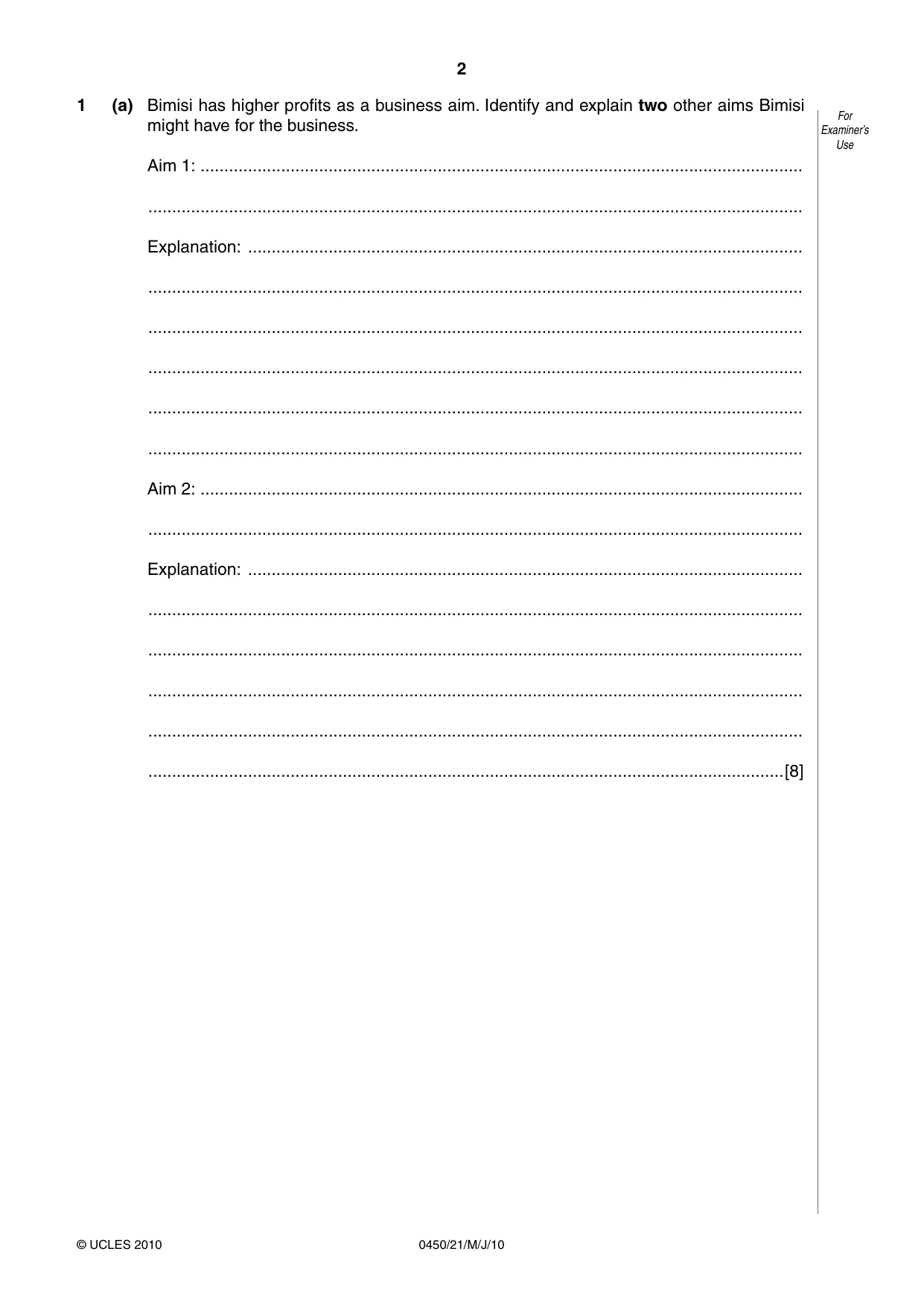
Question paper, page 2
2 0450/21/M/J/10 © UCLES 2010 For Examiner’s Use 1 (a) Bimisi has higher profits as a business aim. Identify and explain two other aims Bimisi might have for the business. Aim 1: … … Explanation: … … … … … … Aim 2: … … Explanation: … … … … … …[8]
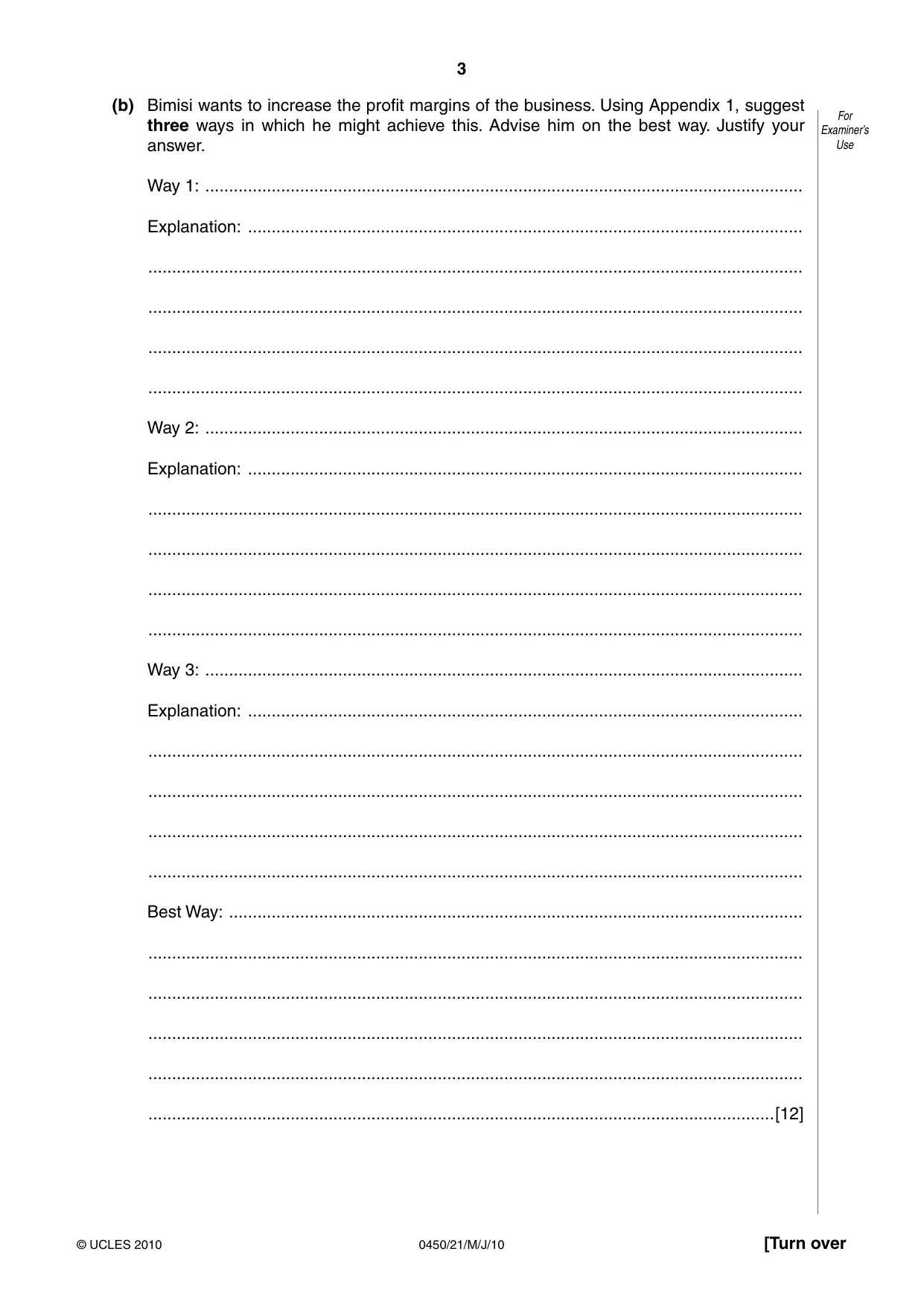
Question paper, page 3
3 0450/21/M/J/10 [Turn over © UCLES 2010 For Examiner’s Use (b) Bimisi wants to increase the profit margins of the business. Using Appendix 1, suggest three ways in which he might achieve this. Advise him on the best way. Justify your answer. Way 1: … Explanation: … … … … … Way 2: … Explanation: … … … … … Way 3: … Explanation: … … … … … Best Way: … … … … … …[12]
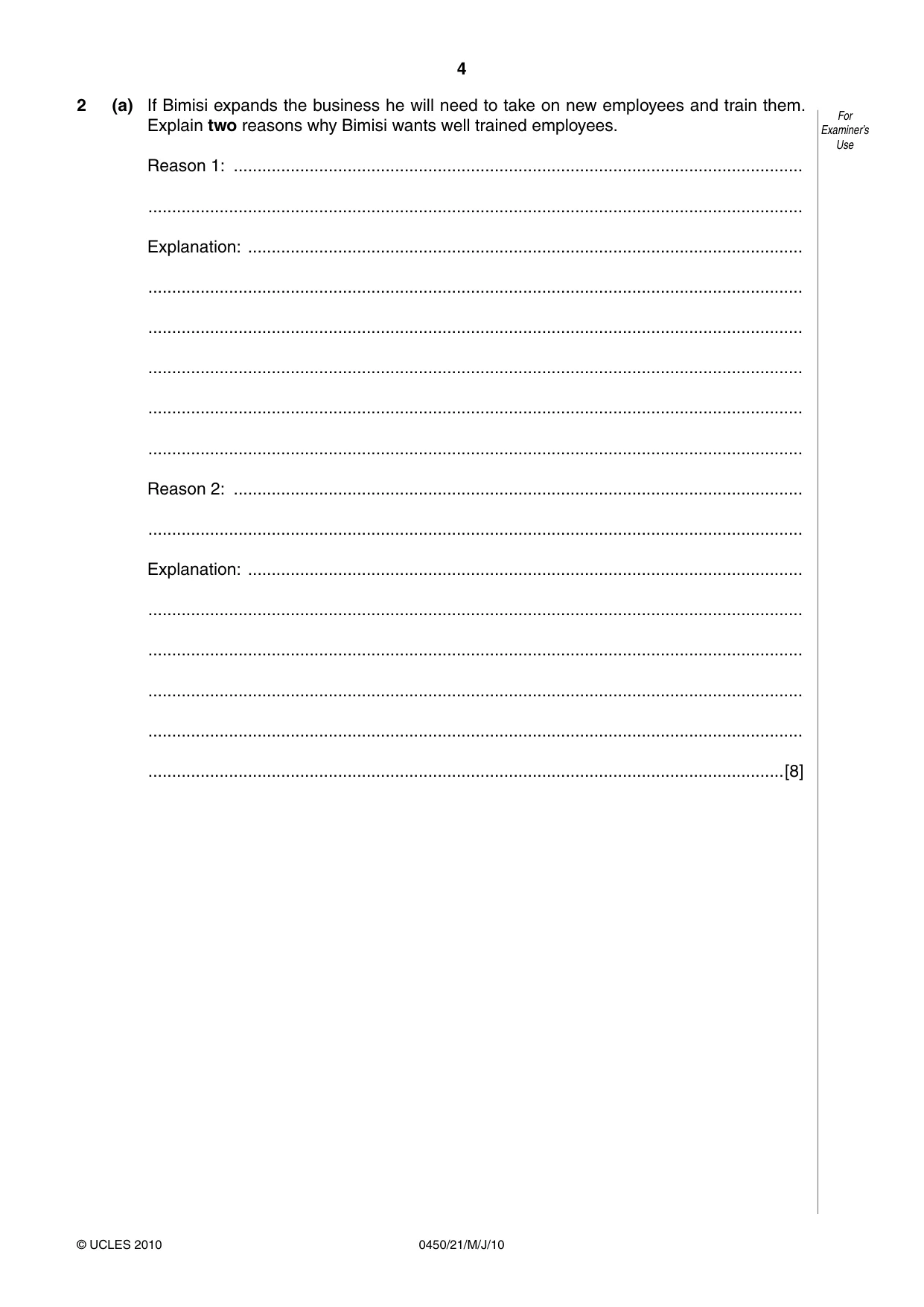
Question paper, page 4
4 0450/21/M/J/10 © UCLES 2010 For Examiner’s Use 2 (a) If Bimisi expands the business he will need to take on new employees and train them. Explain two reasons why Bimisi wants well trained employees. Reason 1: … … Explanation: … … … … … … Reason 2: … … Explanation: … … … … … …[8]
Question paper, page 5
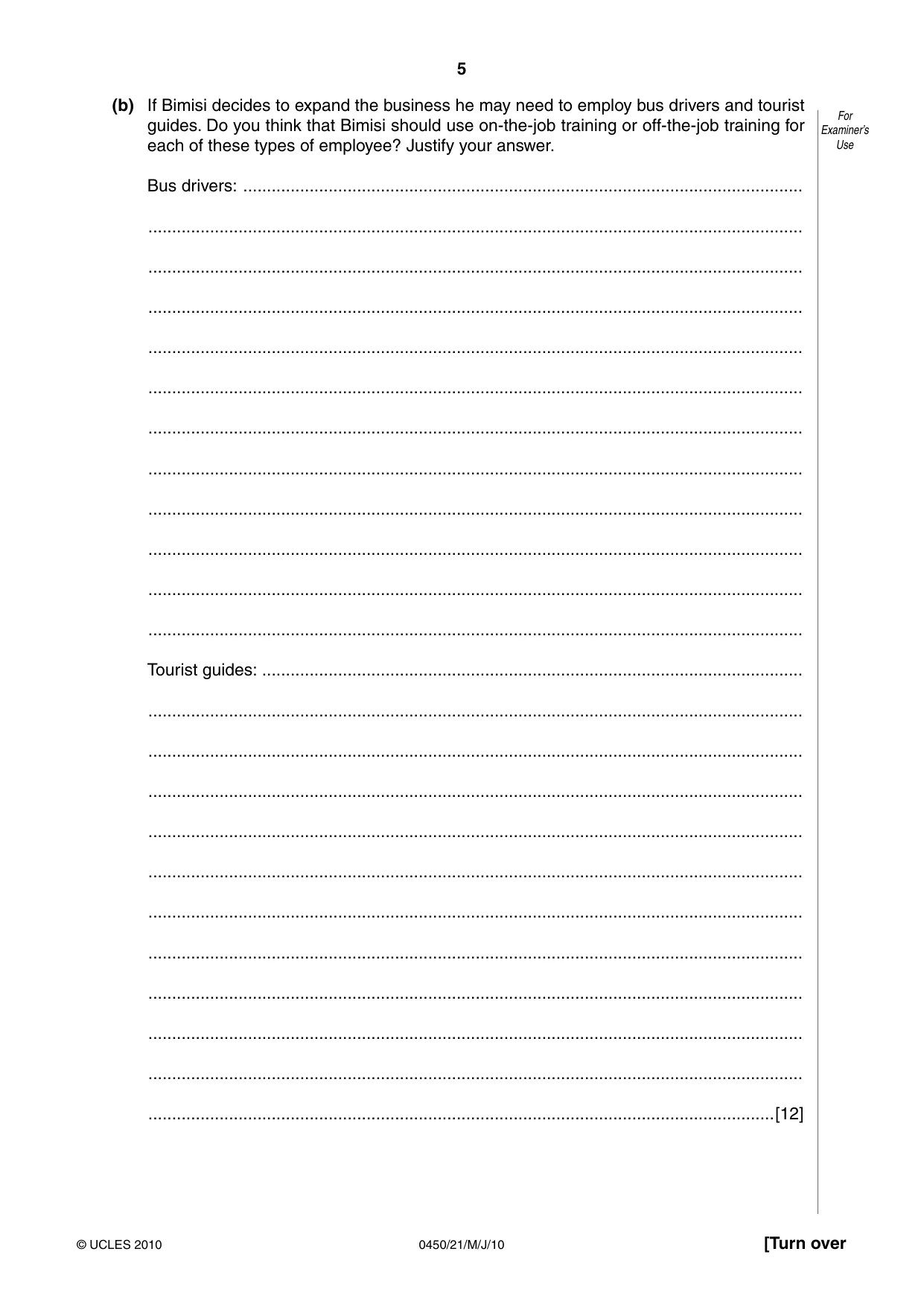
5 0450/21/M/J/10 [Turn over © UCLES 2010 For Examiner’s Use (b) If Bimisi decides to expand the business he may need to employ bus drivers and tourist guides. Do you think that Bimisi should use on-the-job training or off-the-job training for each of these types of employee? Justify your answer. Bus drivers: … … … … … … … … … … … … Tourist guides: … … … … … … … … … … … …[12]
Question paper, page 6
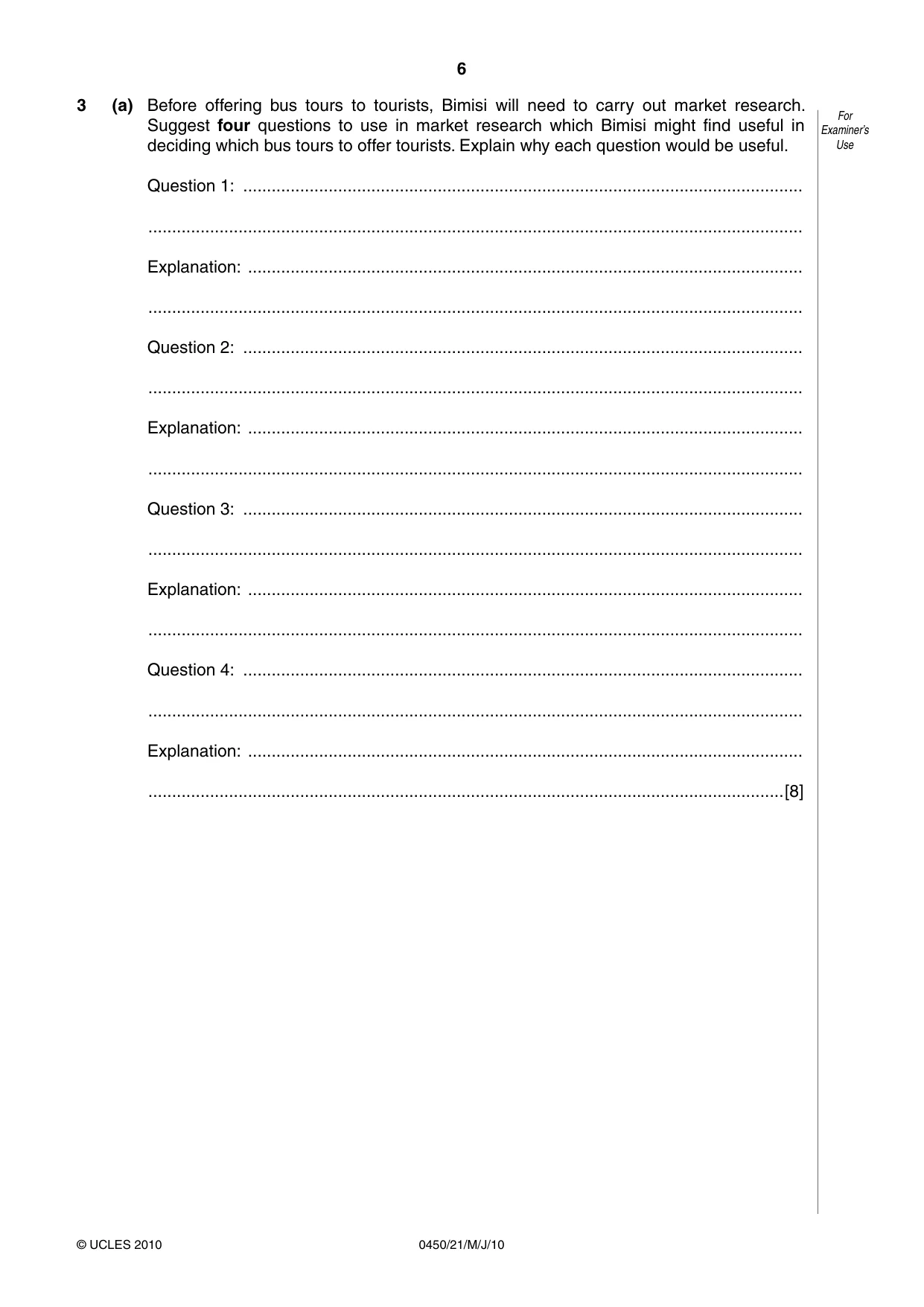
6 0450/21/M/J/10 © UCLES 2010 For Examiner’s Use 3 (a) Before offering bus tours to tourists, Bimisi will need to carry out market research. Suggest four questions to use in market research which Bimisi might find useful in deciding which bus tours to offer tourists. Explain why each question would be useful. Question 1: … … Explanation: … … Question 2: … … Explanation: … … Question 3: … … Explanation: … … Question 4: … … Explanation: … …[8]
Question paper, page 7
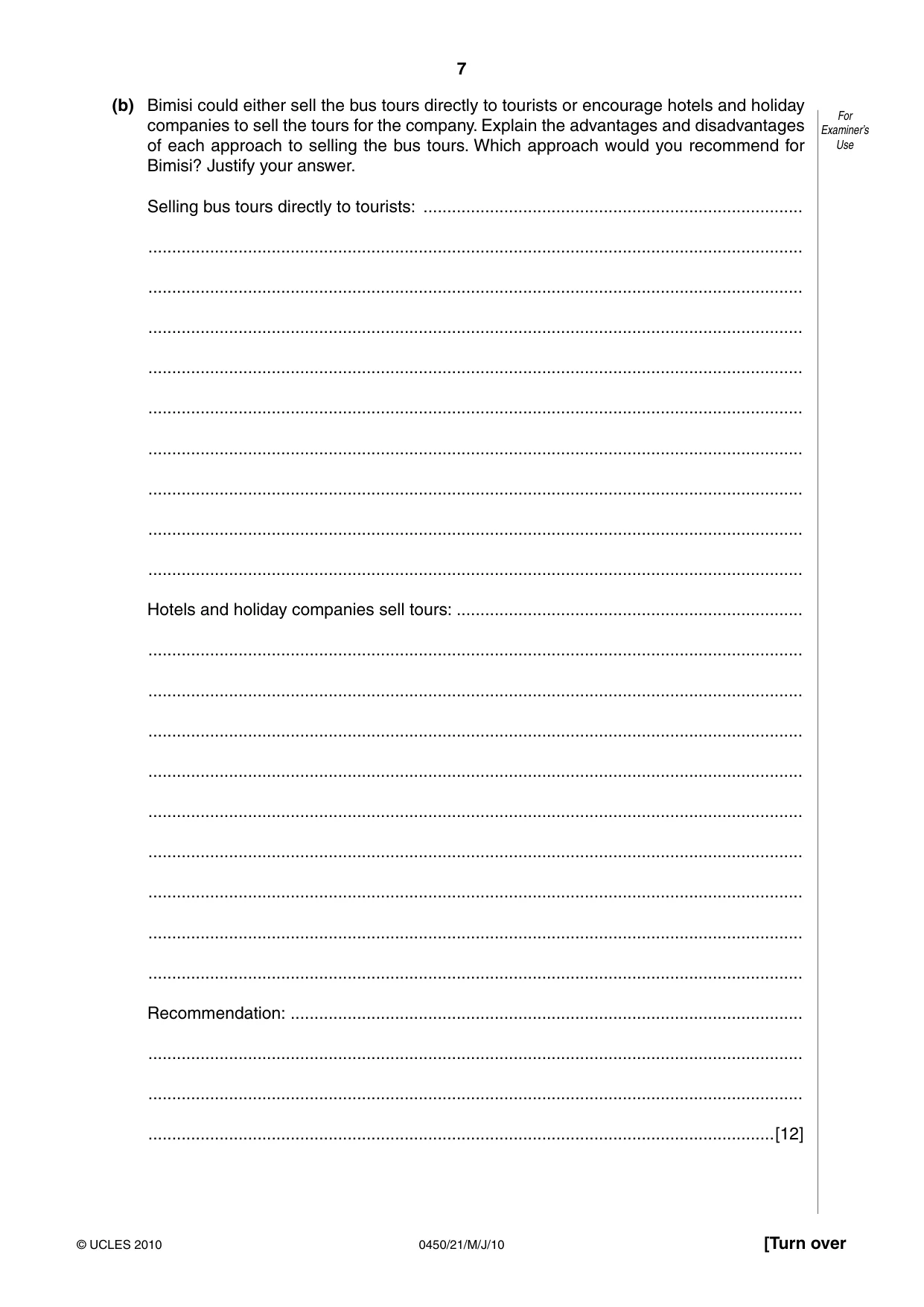
7 0450/21/M/J/10 [Turn over © UCLES 2010 For Examiner’s Use (b) Bimisi could either sell the bus tours directly to tourists or encourage hotels and holiday companies to sell the tours for the company. Explain the advantages and disadvantages of each approach to selling the bus tours. Which approach would you recommend for Bimisi? Justify your answer. Selling bus tours directly to tourists: … … … … … … … … … … Hotels and holiday companies sell tours: … … … … … … … … … … Recommendation: … … … …[12]
Question paper, page 8
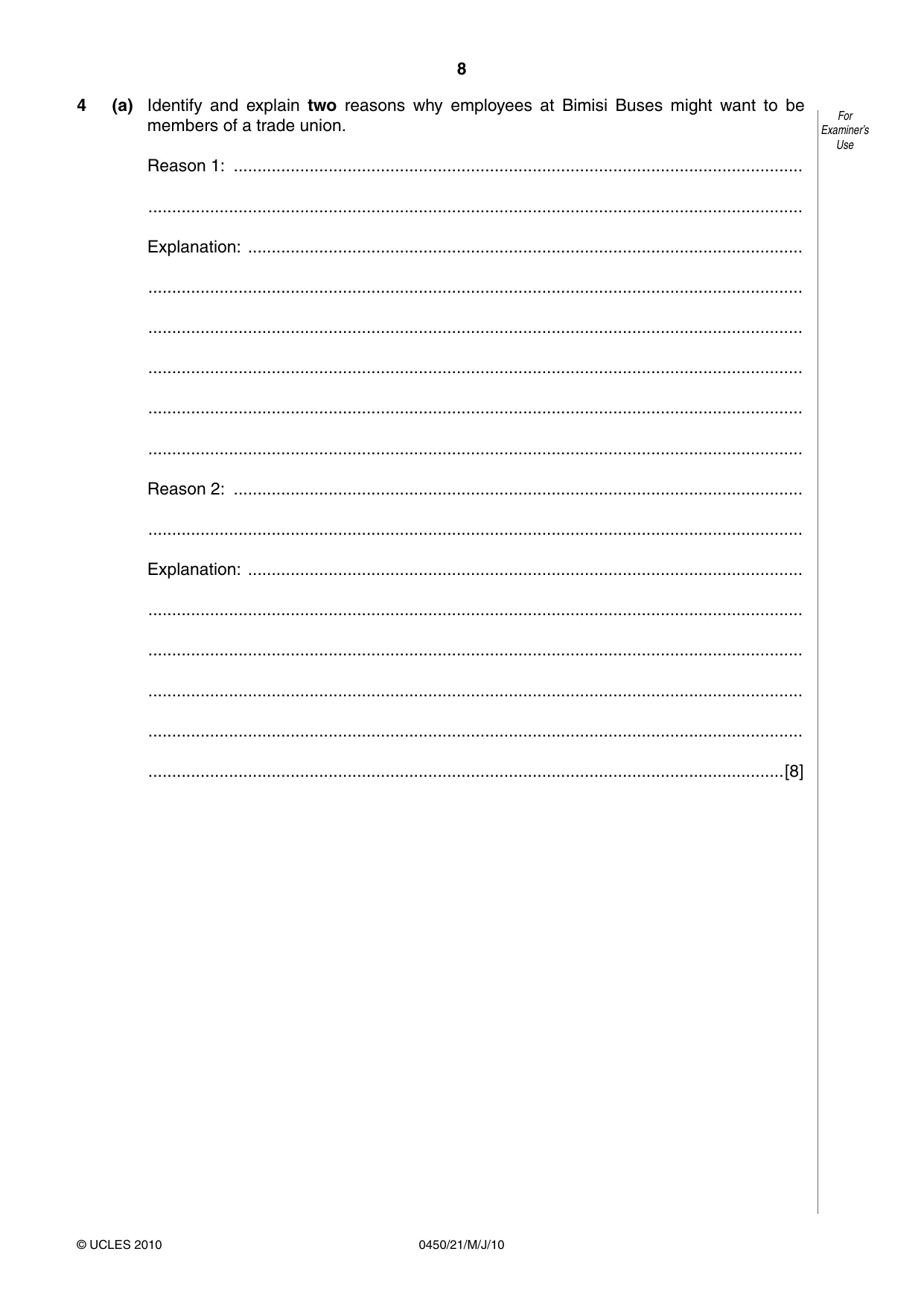
8 0450/21/M/J/10 © UCLES 2010 For Examiner’s Use 4 (a) Identify and explain two reasons why employees at Bimisi Buses might want to be members of a trade union. Reason 1: … … Explanation: … … … … … … Reason 2: … … Explanation: … … … … … …[8]
Question paper, page 9
9 0450/21/M/J/10 [Turn over © UCLES 2010 For Examiner’s Use (b) Governments often pass laws to protect employees and customers. Do you think it is necessary to have Government laws in order to protect employees and customers of bus companies such as Bimisi Buses? Justify your answer. … … … … … … … … … … … … … … … … … … … … … … … …[12]
Question paper, page 10
10 0450/21/M/J/10 © UCLES 2010 For Examiner’s Use 5 (a) If Bimisi decides to expand the business he will probably need a bank loan. Identify and explain two pieces of information that Bimisi will need to provide to the bank manager in order to get the bank loan. First piece of information: … … Explanation: … … … … … … Second piece of information: … … Explanation: … … … … … …[8]
Question paper, page 11
11 0450/21/M/J/10 © UCLES 2010 For Examiner’s Use (b) Bimisi has decided to expand his business. Do you think he should go for Option A or Option B? (These options are described in the case study.) Justify your answer. Option A: … … … … … … … … … … Option B: … … … … … … … … … … Decision: … … … …[12]
Question paper, page 12
12 0450/21/M/J/10 © UCLES 2010 BLANK PAGE Permission to reproduce items where third-party owned material protected by copyright is included has been sought and cleared where possible. Every reasonable effort has been made by the publisher (UCLES) to trace copyright holders, but if any items requiring clearance have unwittingly been included, the publisher will be pleased to make amends at the earliest possible opportunity. University of Cambridge International Examinations is part of the Cambridge Assessment Group. Cambridge Assessment is the brand name of University of Cambridge Local Examinations Syndicate (UCLES), which is itself a department of the University of Cambridge.
Mark scheme, page 1
UNIVERSITY OF CAMBRIDGE INTERNATIONAL EXAMINATIONS International General Certificate of Secondary Education MARK SCHEME for the May/June 2010 question paper for the guidance of teachers 0450 BUSINESS STUDIES 0450/21 Paper 21 (Case Study), maximum raw mark 100 This mark scheme is published as an aid to teachers and candidates, to indicate the requirements of the examination. It shows the basis on which Examiners were instructed to award marks. It does not indicate the details of the discussions that took place at an Examiners’ meeting before marking began, which would have considered the acceptability of alternative answers. Mark schemes must be read in conjunction with the question papers and the report on the examination. • CIE will not enter into discussions or correspondence in connection with these mark schemes. CIE is publishing the mark schemes for the May/June 2010 question papers for most IGCSE, GCE Advanced Level and Advanced Subsidiary Level syllabuses and some Ordinary Level syllabuses.
Mark scheme, page 2
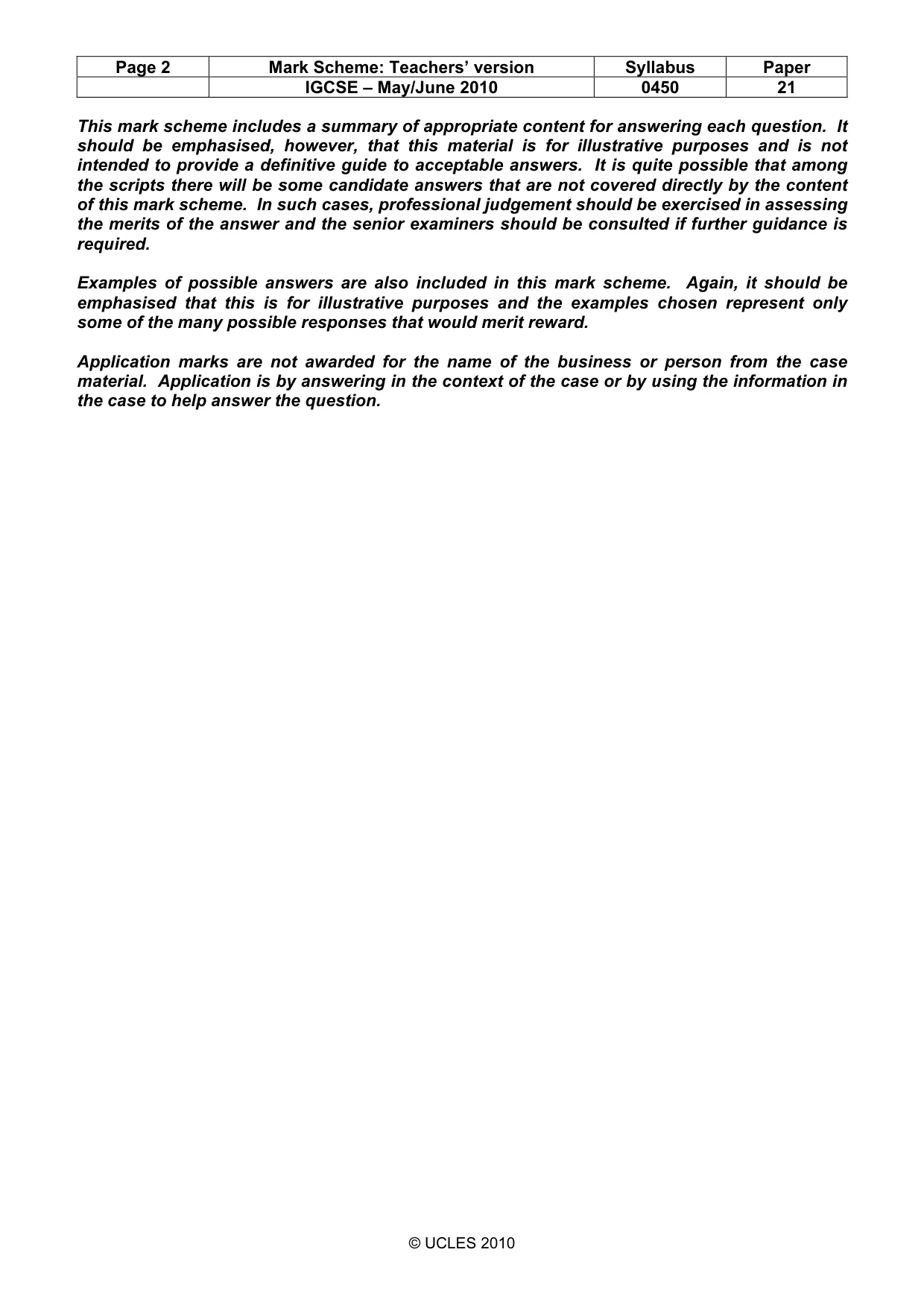
Page 2 Mark Scheme: Teachers’ version Syllabus Paper IGCSE – May/June 2010 0450 21 © UCLES 2010 This mark scheme includes a summary of appropriate content for answering each question. It should be emphasised, however, that this material is for illustrative purposes and is not intended to provide a definitive guide to acceptable answers. It is quite possible that among the scripts there will be some candidate answers that are not covered directly by the content of this mark scheme. In such cases, professional judgement should be exercised in assessing the merits of the answer and the senior examiners should be consulted if further guidance is required. Examples of possible answers are also included in this mark scheme. Again, it should be emphasised that this is for illustrative purposes and the examples chosen represent only some of the many possible responses that would merit reward. Application marks are not awarded for the name of the business or person from the case material. Application is by answering in the context of the case or by using the information in the case to help answer the question.
Mark scheme, page 3
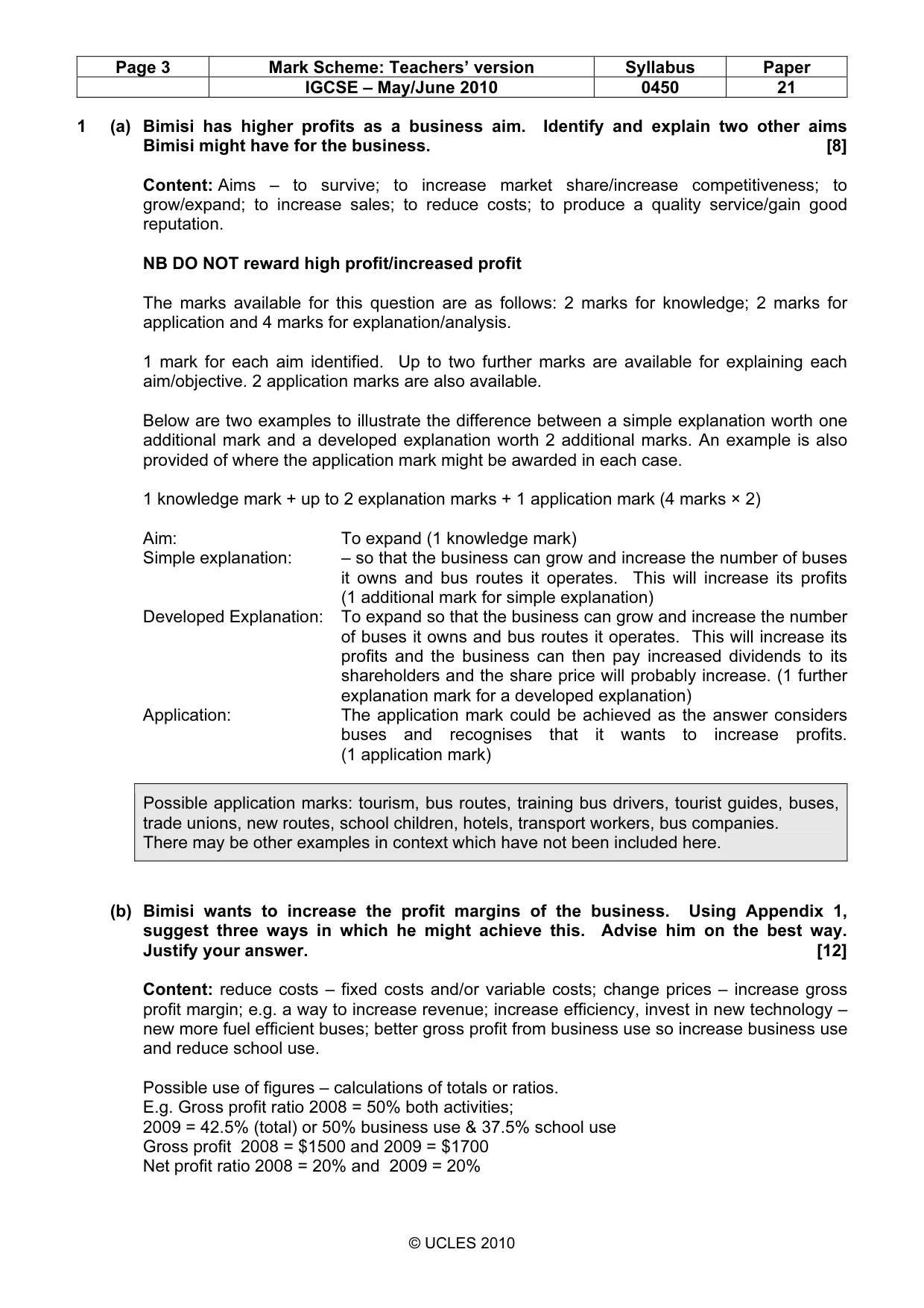
Page 3 Mark Scheme: Teachers’ version Syllabus Paper IGCSE – May/June 2010 0450 21 © UCLES 2010 1 (a) Bimisi has higher profits as a business aim. Identify and explain two other aims Bimisi might have for the business. [8] Content: Aims – to survive; to increase market share/increase competitiveness; to grow/expand; to increase sales; to reduce costs; to produce a quality service/gain good reputation. NB DO NOT reward high profit/increased profit The marks available for this question are as follows: 2 marks for knowledge; 2 marks for application and 4 marks for explanation/analysis. 1 mark for each aim identified. Up to two further marks are available for explaining each aim/objective. 2 application marks are also available. Below are two examples to illustrate the difference between a simple explanation worth one additional mark and a developed explanation worth 2 additional marks. An example is also provided of where the application mark might be awarded in each case. 1 knowledge mark + up to 2 explanation marks + 1 application mark (4 marks × 2) Aim: To expand (1 knowledge mark) Simple explanation: – so that the business can grow and increase the number of buses it owns and bus routes it operates. This will increase its profits (1 additional mark for simple explanation) Developed Explanation: To expand so that the business can grow and increase the number of buses it owns and bus routes it operates. This will increase its profits and the business can then pay increased dividends to its shareholders and the share price will probably increase. (1 further explanation mark for a developed explanation) Application: The application mark could be achieved as the answer considers buses and recognises that it wants to increase profits. (1 application mark) Possible application marks: tourism, bus routes, training bus drivers, tourist guides, buses, trade unions, new routes, school children, hotels, transport workers, bus companies. There may be other examples in context which have not been included here. (b) Bimisi wants to increase the profit margins of the business. Using Appendix 1, suggest three ways in which he might achieve this. Advise him on the best way. Justify your answer. [12] Content: reduce costs – fixed costs and/or variable costs; change prices – increase gross profit margin; e.g. a way to increase revenue; increase efficiency, invest in new technology – new more fuel efficient buses; better gross profit from business use so increase business use and reduce school use. Possible use of figures – calculations of totals or ratios. E.g. Gross profit ratio 2008 = 50% both activities; 2009 = 42.5% (total) or 50% business use & 37.5% school use Gross profit 2008 = $1500 and 2009 = $1700 Net profit ratio 2008 = 20% and 2009 = 20%
Mark scheme, page 4
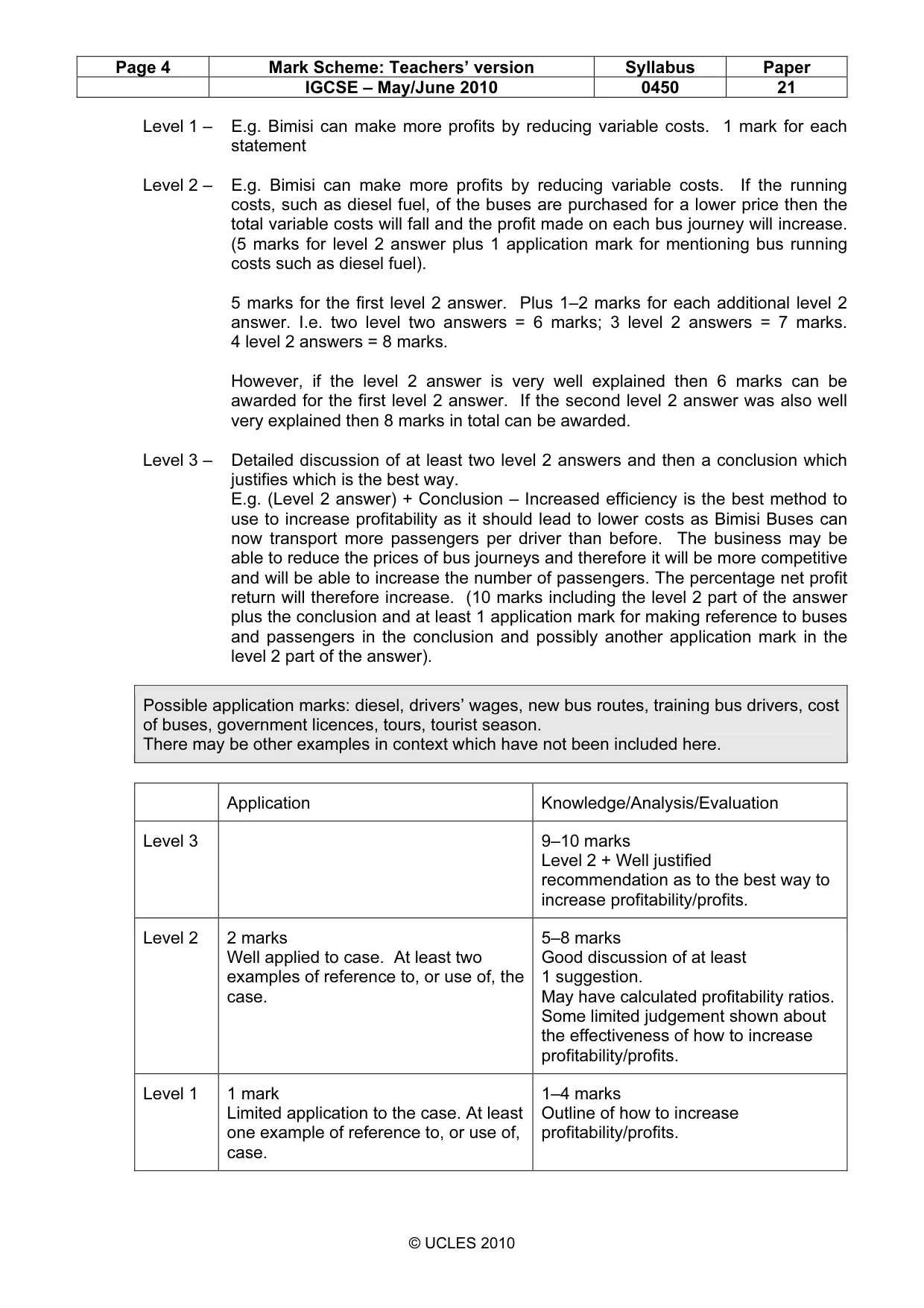
Page 4 Mark Scheme: Teachers’ version Syllabus Paper IGCSE – May/June 2010 0450 21 © UCLES 2010 Level 1 – E.g. Bimisi can make more profits by reducing variable costs. 1 mark for each statement Level 2 – E.g. Bimisi can make more profits by reducing variable costs. If the running costs, such as diesel fuel, of the buses are purchased for a lower price then the total variable costs will fall and the profit made on each bus journey will increase. (5 marks for level 2 answer plus 1 application mark for mentioning bus running costs such as diesel fuel). 5 marks for the first level 2 answer. Plus 1–2 marks for each additional level 2 answer. I.e. two level two answers = 6 marks; 3 level 2 answers = 7 marks. 4 level 2 answers = 8 marks. However, if the level 2 answer is very well explained then 6 marks can be awarded for the first level 2 answer. If the second level 2 answer was also well very explained then 8 marks in total can be awarded. Level 3 – Detailed discussion of at least two level 2 answers and then a conclusion which justifies which is the best way. E.g. (Level 2 answer) + Conclusion – Increased efficiency is the best method to use to increase profitability as it should lead to lower costs as Bimisi Buses can now transport more passengers per driver than before. The business may be able to reduce the prices of bus journeys and therefore it will be more competitive and will be able to increase the number of passengers. The percentage net profit return will therefore increase. (10 marks including the level 2 part of the answer plus the conclusion and at least 1 application mark for making reference to buses and passengers in the conclusion and possibly another application mark in the level 2 part of the answer). Possible application marks: diesel, drivers’ wages, new bus routes, training bus drivers, cost of buses, government licences, tours, tourist season. There may be other examples in context which have not been included here. Application Knowledge/Analysis/Evaluation Level 3 9–10 marks Level 2 + Well justified recommendation as to the best way to increase profitability/profits. Level 2 2 marks Well applied to case. At least two examples of reference to, or use of, the case. 5–8 marks Good discussion of at least 1 suggestion. May have calculated profitability ratios. Some limited judgement shown about the effectiveness of how to increase profitability/profits. Level 1 1 mark Limited application to the case. At least one example of reference to, or use of, case. 1–4 marks Outline of how to increase profitability/profits.
Mark scheme, page 5
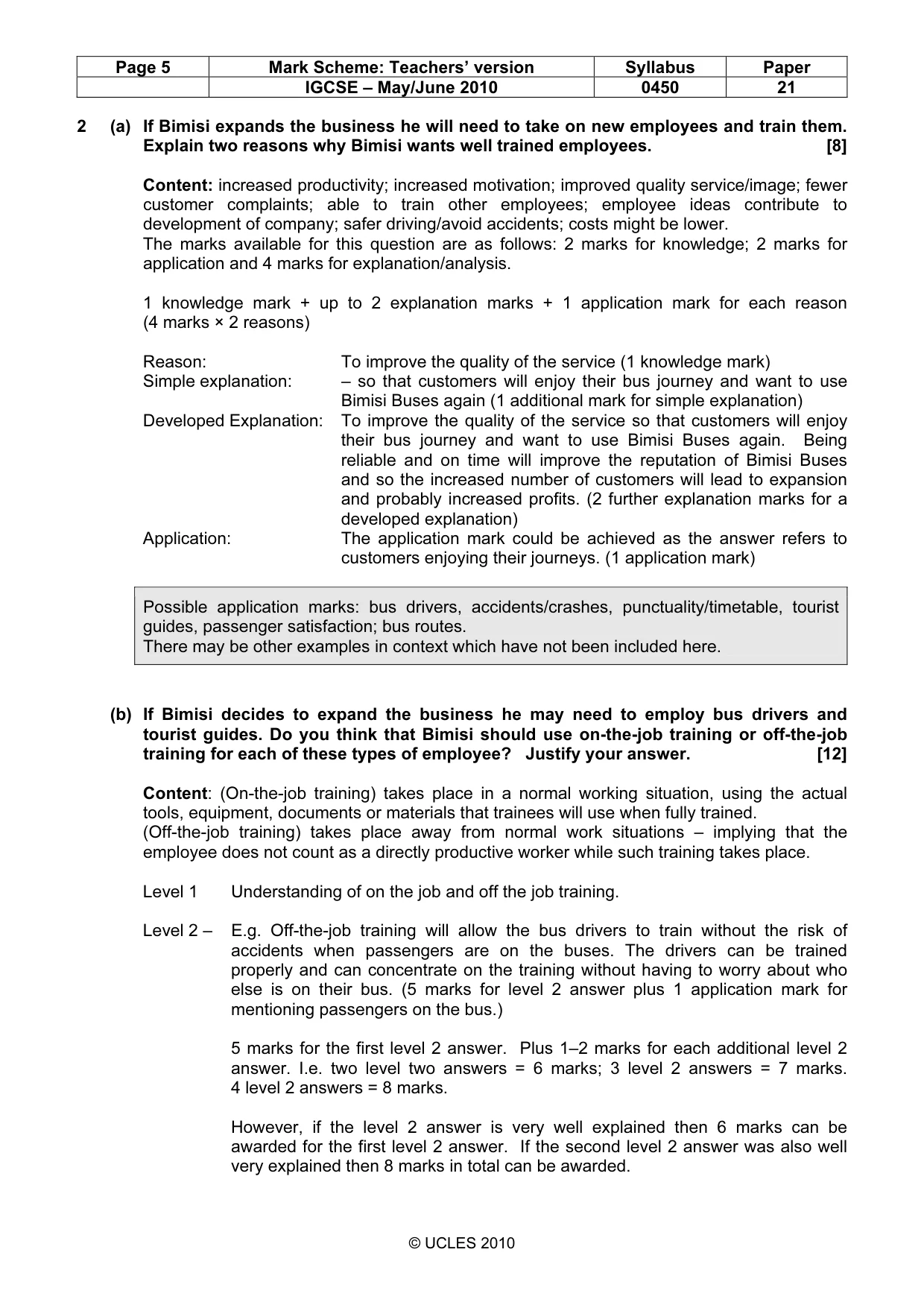
Page 5 Mark Scheme: Teachers’ version Syllabus Paper IGCSE – May/June 2010 0450 21 © UCLES 2010 2 (a) If Bimisi expands the business he will need to take on new employees and train them. Explain two reasons why Bimisi wants well trained employees. [8] Content: increased productivity; increased motivation; improved quality service/image; fewer customer complaints; able to train other employees; employee ideas contribute to development of company; safer driving/avoid accidents; costs might be lower. The marks available for this question are as follows: 2 marks for knowledge; 2 marks for application and 4 marks for explanation/analysis. 1 knowledge mark + up to 2 explanation marks + 1 application mark for each reason (4 marks × 2 reasons) Reason: To improve the quality of the service (1 knowledge mark) Simple explanation: – so that customers will enjoy their bus journey and want to use Bimisi Buses again (1 additional mark for simple explanation) Developed Explanation: To improve the quality of the service so that customers will enjoy their bus journey and want to use Bimisi Buses again. Being reliable and on time will improve the reputation of Bimisi Buses and so the increased number of customers will lead to expansion and probably increased profits. (2 further explanation marks for a developed explanation) Application: The application mark could be achieved as the answer refers to customers enjoying their journeys. (1 application mark) Possible application marks: bus drivers, accidents/crashes, punctuality/timetable, tourist guides, passenger satisfaction; bus routes. There may be other examples in context which have not been included here. (b) If Bimisi decides to expand the business he may need to employ bus drivers and tourist guides. Do you think that Bimisi should use on-the-job training or off-the-job training for each of these types of employee? Justify your answer. [12] Content: (On-the-job training) takes place in a normal working situation, using the actual tools, equipment, documents or materials that trainees will use when fully trained. (Off-the-job training) takes place away from normal work situations – implying that the employee does not count as a directly productive worker while such training takes place. Level 1 Understanding of on the job and off the job training. Level 2 – E.g. Off-the-job training will allow the bus drivers to train without the risk of accidents when passengers are on the buses. The drivers can be trained properly and can concentrate on the training without having to worry about who else is on their bus. (5 marks for level 2 answer plus 1 application mark for mentioning passengers on the bus.) 5 marks for the first level 2 answer. Plus 1–2 marks for each additional level 2 answer. I.e. two level two answers = 6 marks; 3 level 2 answers = 7 marks. 4 level 2 answers = 8 marks. However, if the level 2 answer is very well explained then 6 marks can be awarded for the first level 2 answer. If the second level 2 answer was also well very explained then 8 marks in total can be awarded.
Mark scheme, page 6
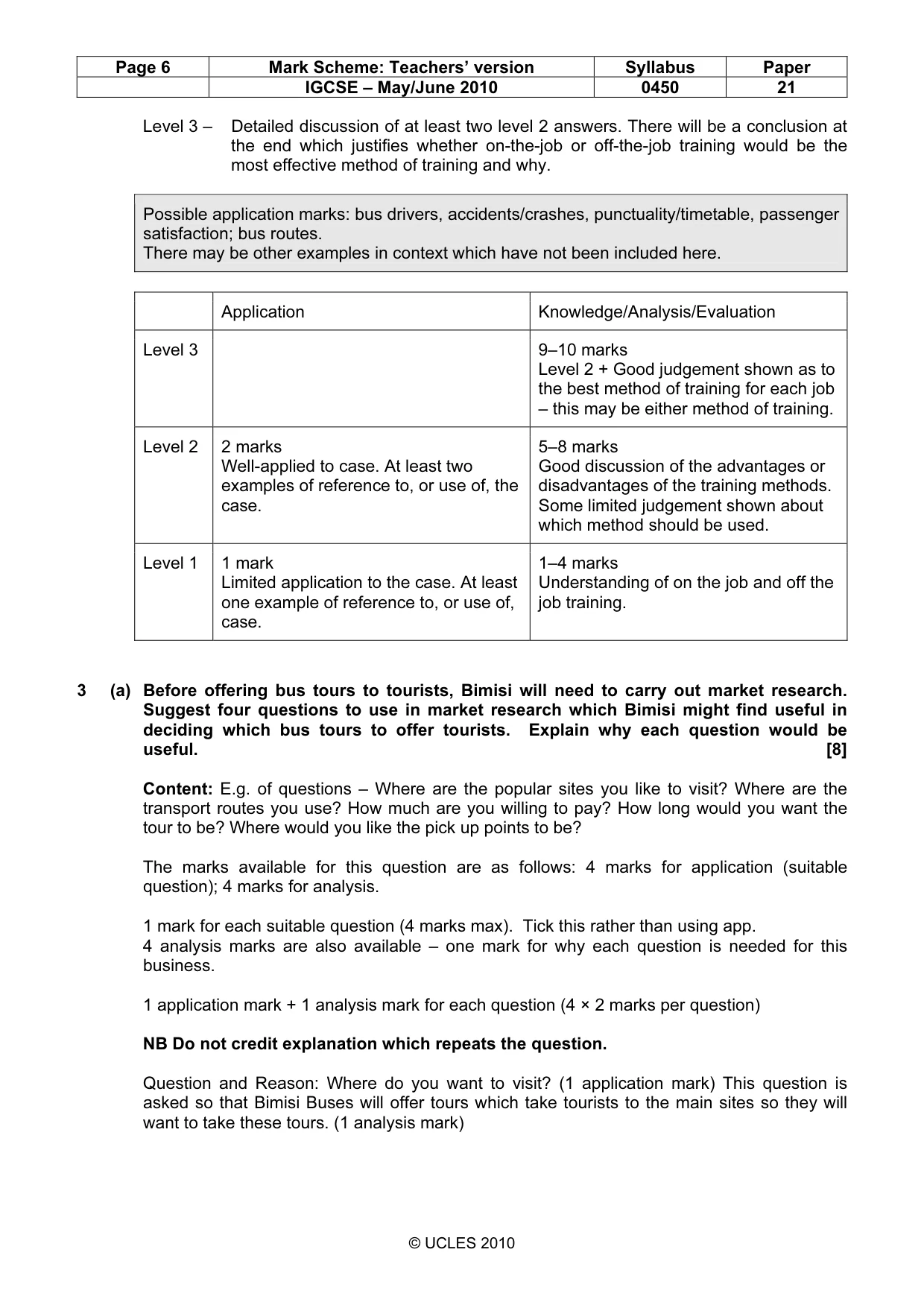
Page 6 Mark Scheme: Teachers’ version Syllabus Paper IGCSE – May/June 2010 0450 21 © UCLES 2010 Level 3 – Detailed discussion of at least two level 2 answers. There will be a conclusion at the end which justifies whether on-the-job or off-the-job training would be the most effective method of training and why. Possible application marks: bus drivers, accidents/crashes, punctuality/timetable, passenger satisfaction; bus routes. There may be other examples in context which have not been included here. Application Knowledge/Analysis/Evaluation Level 3 9–10 marks Level 2 + Good judgement shown as to the best method of training for each job – this may be either method of training. Level 2 2 marks Well-applied to case. At least two examples of reference to, or use of, the case. 5–8 marks Good discussion of the advantages or disadvantages of the training methods. Some limited judgement shown about which method should be used. Level 1 1 mark Limited application to the case. At least one example of reference to, or use of, case. 1–4 marks Understanding of on the job and off the job training. 3 (a) Before offering bus tours to tourists, Bimisi will need to carry out market research. Suggest four questions to use in market research which Bimisi might find useful in deciding which bus tours to offer tourists. Explain why each question would be useful. [8] Content: E.g. of questions – Where are the popular sites you like to visit? Where are the transport routes you use? How much are you willing to pay? How long would you want the tour to be? Where would you like the pick up points to be? The marks available for this question are as follows: 4 marks for application (suitable question); 4 marks for analysis. 1 mark for each suitable question (4 marks max). Tick this rather than using app. 4 analysis marks are also available – one mark for why each question is needed for this business. 1 application mark + 1 analysis mark for each question (4 × 2 marks per question) NB Do not credit explanation which repeats the question. Question and Reason: Where do you want to visit? (1 application mark) This question is asked so that Bimisi Buses will offer tours which take tourists to the main sites so they will want to take these tours. (1 analysis mark)
Mark scheme, page 7
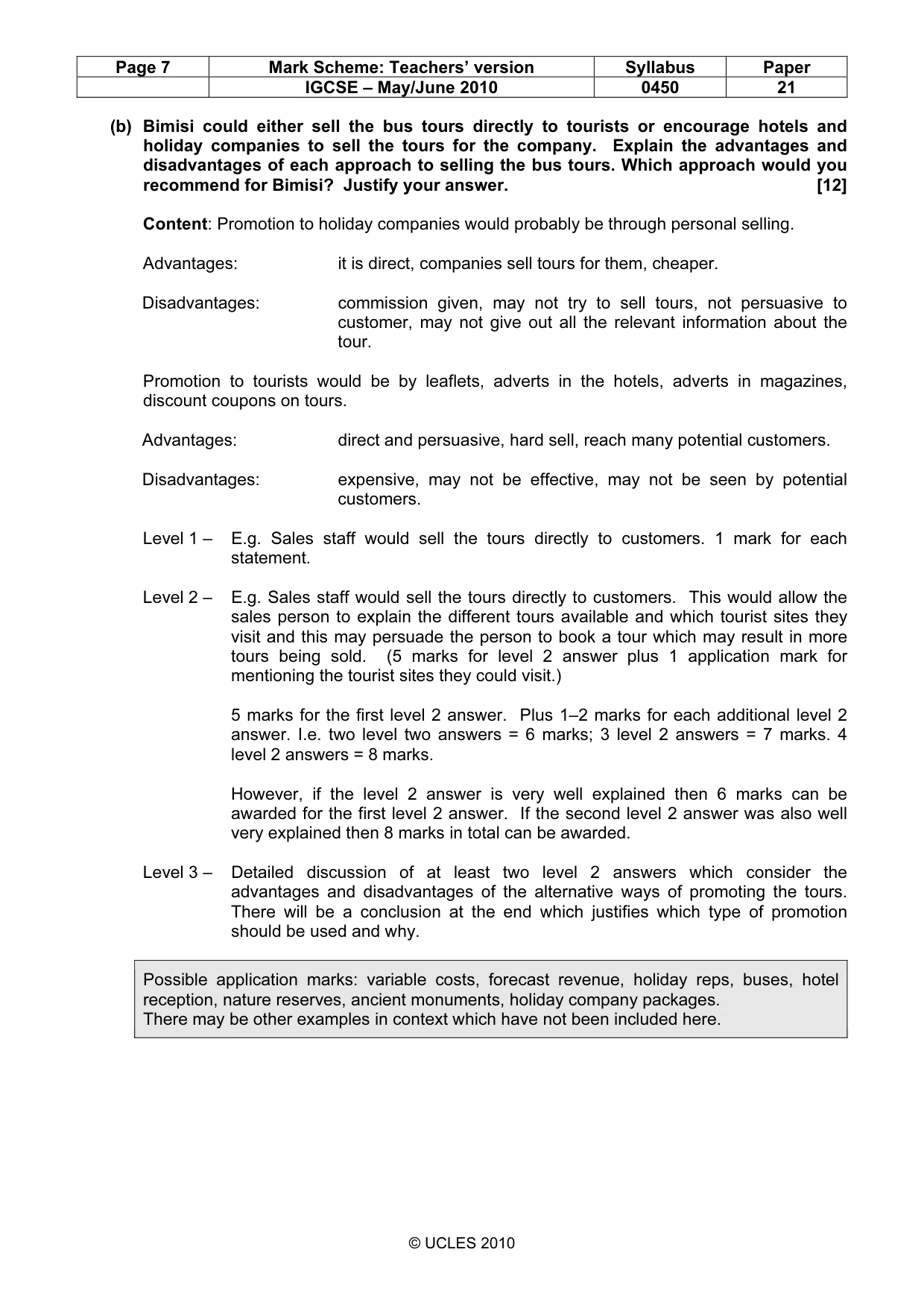
Page 7 Mark Scheme: Teachers’ version Syllabus Paper IGCSE – May/June 2010 0450 21 © UCLES 2010 (b) Bimisi could either sell the bus tours directly to tourists or encourage hotels and holiday companies to sell the tours for the company. Explain the advantages and disadvantages of each approach to selling the bus tours. Which approach would you recommend for Bimisi? Justify your answer. [12] Content: Promotion to holiday companies would probably be through personal selling. Advantages: it is direct, companies sell tours for them, cheaper. Disadvantages: commission given, may not try to sell tours, not persuasive to customer, may not give out all the relevant information about the tour. Promotion to tourists would be by leaflets, adverts in the hotels, adverts in magazines, discount coupons on tours. Advantages: direct and persuasive, hard sell, reach many potential customers. Disadvantages: expensive, may not be effective, may not be seen by potential customers. Level 1 – E.g. Sales staff would sell the tours directly to customers. 1 mark for each statement. Level 2 – E.g. Sales staff would sell the tours directly to customers. This would allow the sales person to explain the different tours available and which tourist sites they visit and this may persuade the person to book a tour which may result in more tours being sold. (5 marks for level 2 answer plus 1 application mark for mentioning the tourist sites they could visit.) 5 marks for the first level 2 answer. Plus 1–2 marks for each additional level 2 answer. I.e. two level two answers = 6 marks; 3 level 2 answers = 7 marks. 4 level 2 answers = 8 marks. However, if the level 2 answer is very well explained then 6 marks can be awarded for the first level 2 answer. If the second level 2 answer was also well very explained then 8 marks in total can be awarded. Level 3 – Detailed discussion of at least two level 2 answers which consider the advantages and disadvantages of the alternative ways of promoting the tours. There will be a conclusion at the end which justifies which type of promotion should be used and why. Possible application marks: variable costs, forecast revenue, holiday reps, buses, hotel reception, nature reserves, ancient monuments, holiday company packages. There may be other examples in context which have not been included here.
Mark scheme, page 8
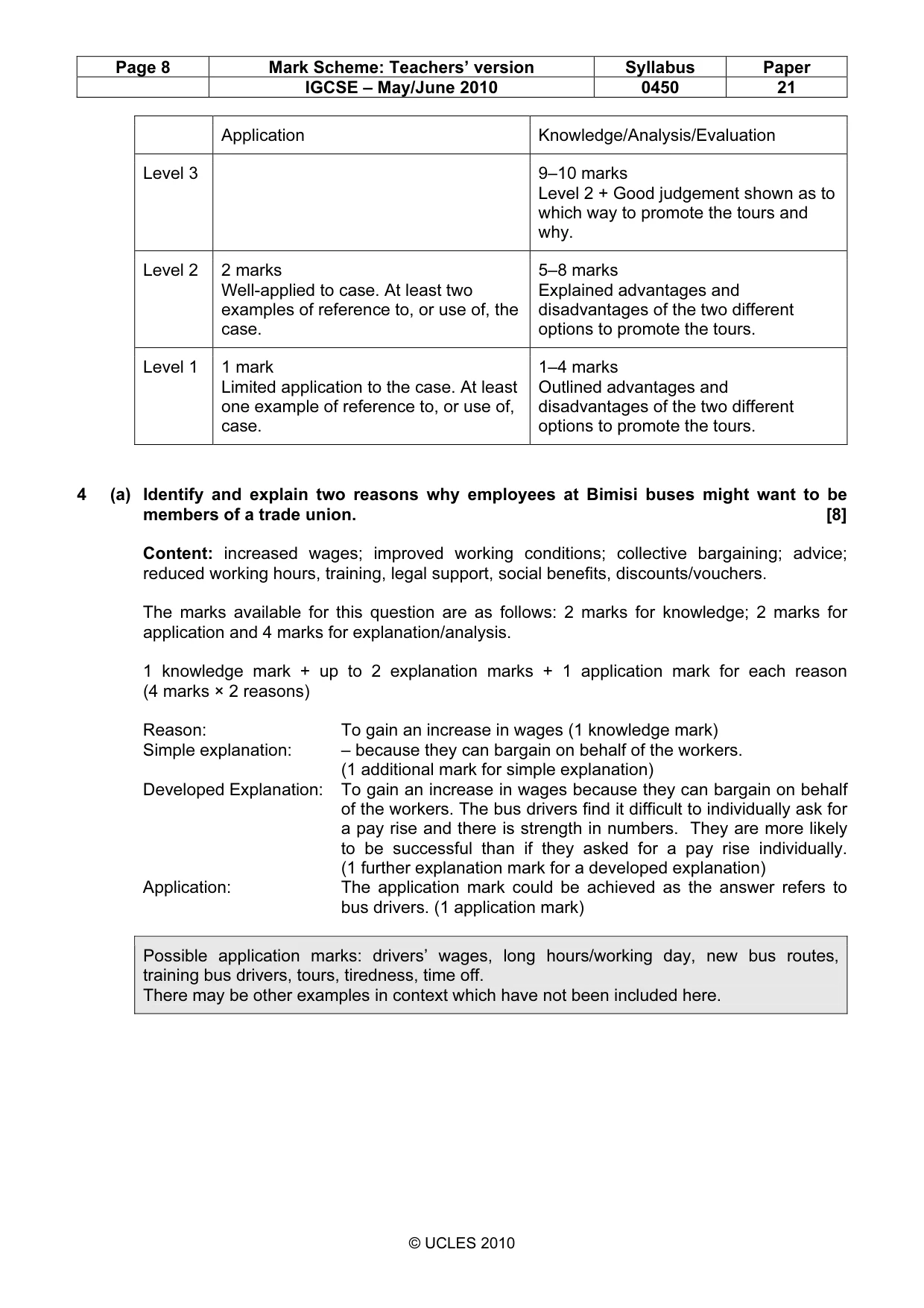
Page 8 Mark Scheme: Teachers’ version Syllabus Paper IGCSE – May/June 2010 0450 21 © UCLES 2010 Application Knowledge/Analysis/Evaluation Level 3 9–10 marks Level 2 + Good judgement shown as to which way to promote the tours and why. Level 2 2 marks Well-applied to case. At least two examples of reference to, or use of, the case. 5–8 marks Explained advantages and disadvantages of the two different options to promote the tours. Level 1 1 mark Limited application to the case. At least one example of reference to, or use of, case. 1–4 marks Outlined advantages and disadvantages of the two different options to promote the tours. 4 (a) Identify and explain two reasons why employees at Bimisi buses might want to be members of a trade union. [8] Content: increased wages; improved working conditions; collective bargaining; advice; reduced working hours, training, legal support, social benefits, discounts/vouchers. The marks available for this question are as follows: 2 marks for knowledge; 2 marks for application and 4 marks for explanation/analysis. 1 knowledge mark + up to 2 explanation marks + 1 application mark for each reason (4 marks × 2 reasons) Reason: To gain an increase in wages (1 knowledge mark) Simple explanation: – because they can bargain on behalf of the workers. (1 additional mark for simple explanation) Developed Explanation: To gain an increase in wages because they can bargain on behalf of the workers. The bus drivers find it difficult to individually ask for a pay rise and there is strength in numbers. They are more likely to be successful than if they asked for a pay rise individually. (1 further explanation mark for a developed explanation) Application: The application mark could be achieved as the answer refers to bus drivers. (1 application mark) Possible application marks: drivers’ wages, long hours/working day, new bus routes, training bus drivers, tours, tiredness, time off. There may be other examples in context which have not been included here.
Mark scheme, page 9
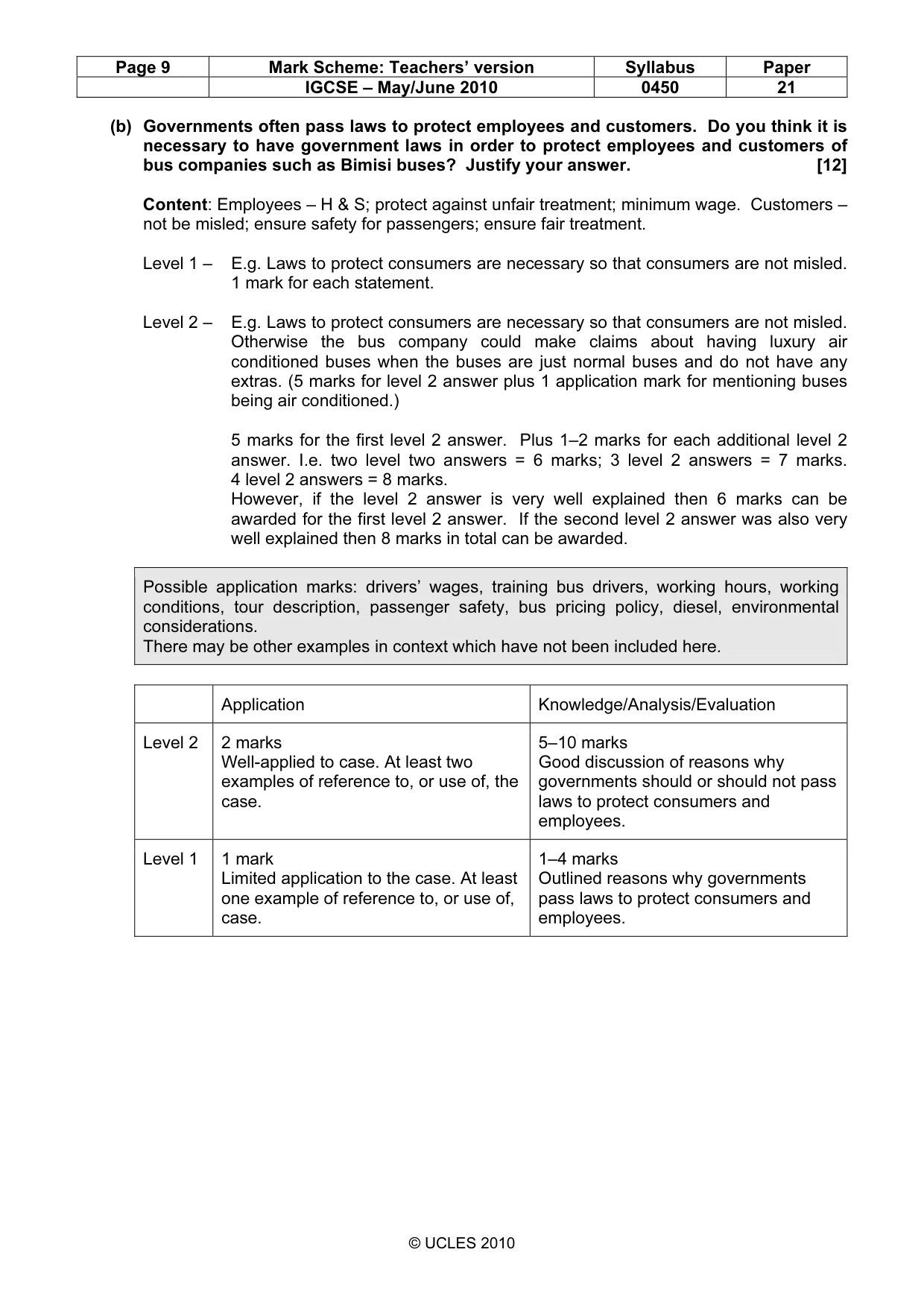
Page 9 Mark Scheme: Teachers’ version Syllabus Paper IGCSE – May/June 2010 0450 21 © UCLES 2010 (b) Governments often pass laws to protect employees and customers. Do you think it is necessary to have government laws in order to protect employees and customers of bus companies such as Bimisi buses? Justify your answer. [12] Content: Employees – H & S; protect against unfair treatment; minimum wage. Customers – not be misled; ensure safety for passengers; ensure fair treatment. Level 1 – E.g. Laws to protect consumers are necessary so that consumers are not misled. 1 mark for each statement. Level 2 – E.g. Laws to protect consumers are necessary so that consumers are not misled. Otherwise the bus company could make claims about having luxury air conditioned buses when the buses are just normal buses and do not have any extras. (5 marks for level 2 answer plus 1 application mark for mentioning buses being air conditioned.) 5 marks for the first level 2 answer. Plus 1–2 marks for each additional level 2 answer. I.e. two level two answers = 6 marks; 3 level 2 answers = 7 marks. 4 level 2 answers = 8 marks. However, if the level 2 answer is very well explained then 6 marks can be awarded for the first level 2 answer. If the second level 2 answer was also very well explained then 8 marks in total can be awarded. Possible application marks: drivers’ wages, training bus drivers, working hours, working conditions, tour description, passenger safety, bus pricing policy, diesel, environmental considerations. There may be other examples in context which have not been included here. Application Knowledge/Analysis/Evaluation Level 2 2 marks Well-applied to case. At least two examples of reference to, or use of, the case. 5–10 marks Good discussion of reasons why governments should or should not pass laws to protect consumers and employees. Level 1 1 mark Limited application to the case. At least one example of reference to, or use of, case. 1–4 marks Outlined reasons why governments pass laws to protect consumers and employees.
Mark scheme, page 10
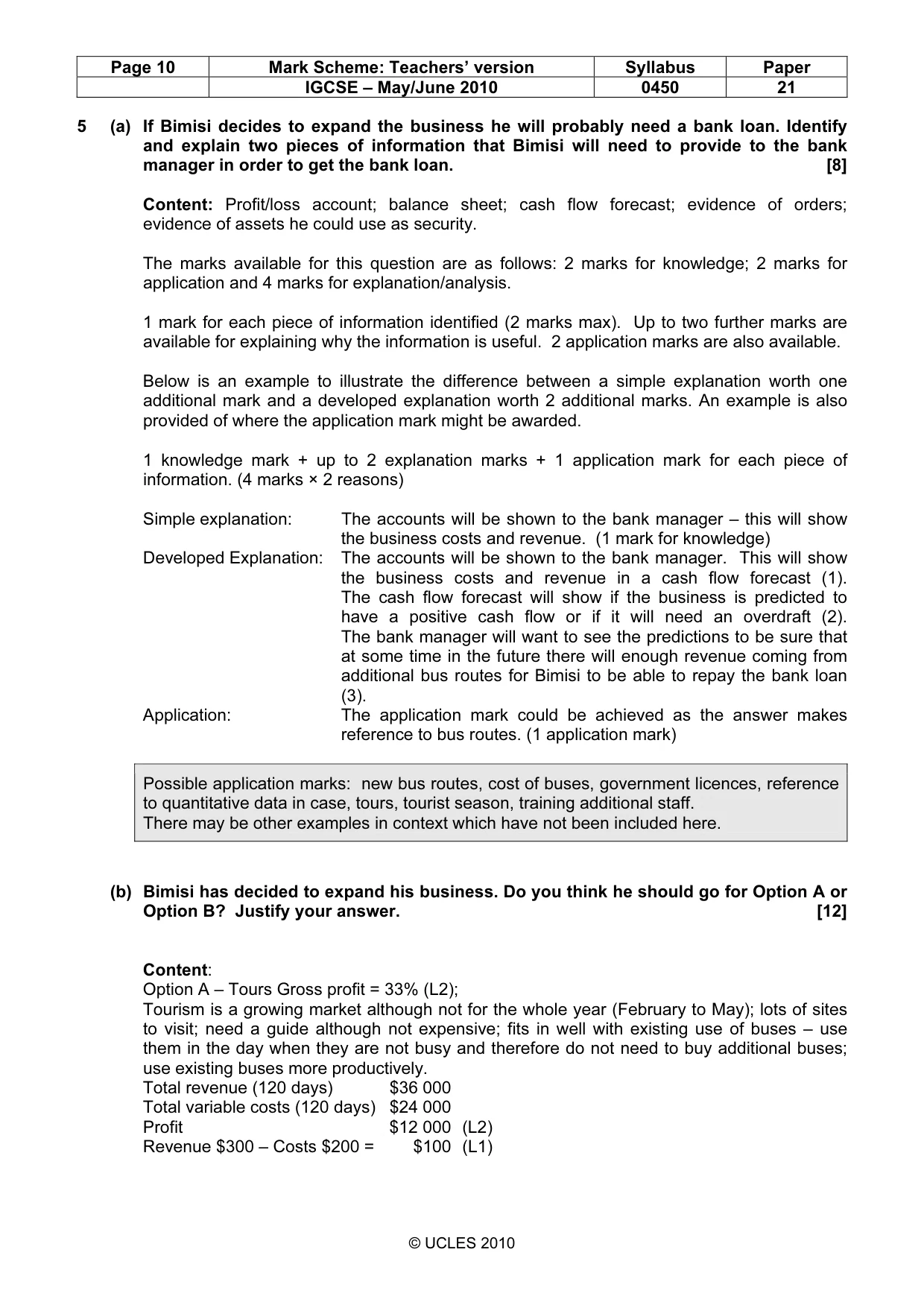
Page 10 Mark Scheme: Teachers’ version Syllabus Paper IGCSE – May/June 2010 0450 21 © UCLES 2010 5 (a) If Bimisi decides to expand the business he will probably need a bank loan. Identify and explain two pieces of information that Bimisi will need to provide to the bank manager in order to get the bank loan. [8] Content: Profit/loss account; balance sheet; cash flow forecast; evidence of orders; evidence of assets he could use as security. The marks available for this question are as follows: 2 marks for knowledge; 2 marks for application and 4 marks for explanation/analysis. 1 mark for each piece of information identified (2 marks max). Up to two further marks are available for explaining why the information is useful. 2 application marks are also available. Below is an example to illustrate the difference between a simple explanation worth one additional mark and a developed explanation worth 2 additional marks. An example is also provided of where the application mark might be awarded. 1 knowledge mark + up to 2 explanation marks + 1 application mark for each piece of information. (4 marks × 2 reasons) Simple explanation: The accounts will be shown to the bank manager – this will show the business costs and revenue. (1 mark for knowledge) Developed Explanation: The accounts will be shown to the bank manager. This will show the business costs and revenue in a cash flow forecast (1). The cash flow forecast will show if the business is predicted to have a positive cash flow or if it will need an overdraft (2). The bank manager will want to see the predictions to be sure that at some time in the future there will enough revenue coming from additional bus routes for Bimisi to be able to repay the bank loan (3). Application: The application mark could be achieved as the answer makes reference to bus routes. (1 application mark) Possible application marks: new bus routes, cost of buses, government licences, reference to quantitative data in case, tours, tourist season, training additional staff. There may be other examples in context which have not been included here. (b) Bimisi has decided to expand his business. Do you think he should go for Option A or Option B? Justify your answer. [12] Content: Option A – Tours Gross profit = 33% (L2); Tourism is a growing market although not for the whole year (February to May); lots of sites to visit; need a guide although not expensive; fits in well with existing use of buses – use them in the day when they are not busy and therefore do not need to buy additional buses; use existing buses more productively. Total revenue (120 days) $36 000 Total variable costs (120 days) $24 000 Profit $12 000 (L2) Revenue $300 – Costs $200 = $100 (L1)
Mark scheme, page 11
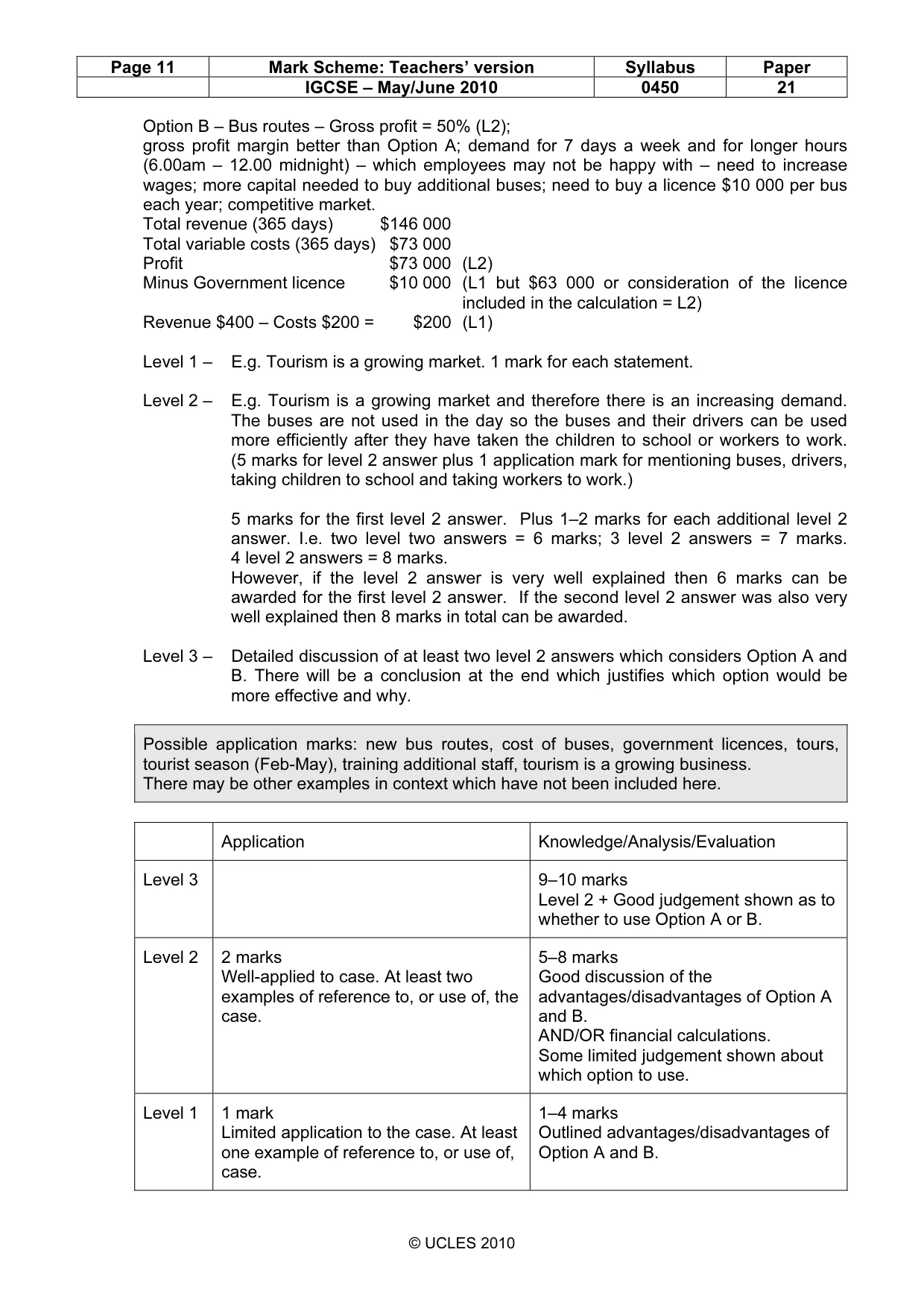
Page 11 Mark Scheme: Teachers’ version Syllabus Paper IGCSE – May/June 2010 0450 21 © UCLES 2010 Option B – Bus routes – Gross profit = 50% (L2); gross profit margin better than Option A; demand for 7 days a week and for longer hours (6.00am – 12.00 midnight) – which employees may not be happy with – need to increase wages; more capital needed to buy additional buses; need to buy a licence $10 000 per bus each year; competitive market. Total revenue (365 days) $146 000 Total variable costs (365 days) $73 000 Profit $73 000 (L2) Minus Government licence $10 000 (L1 but $63 000 or consideration of the licence included in the calculation = L2) Revenue $400 – Costs $200 = $200 (L1) Level 1 – E.g. Tourism is a growing market. 1 mark for each statement. Level 2 – E.g. Tourism is a growing market and therefore there is an increasing demand. The buses are not used in the day so the buses and their drivers can be used more efficiently after they have taken the children to school or workers to work. (5 marks for level 2 answer plus 1 application mark for mentioning buses, drivers, taking children to school and taking workers to work.) 5 marks for the first level 2 answer. Plus 1–2 marks for each additional level 2 answer. I.e. two level two answers = 6 marks; 3 level 2 answers = 7 marks. 4 level 2 answers = 8 marks. However, if the level 2 answer is very well explained then 6 marks can be awarded for the first level 2 answer. If the second level 2 answer was also very well explained then 8 marks in total can be awarded. Level 3 – Detailed discussion of at least two level 2 answers which considers Option A and B. There will be a conclusion at the end which justifies which option would be more effective and why. Possible application marks: new bus routes, cost of buses, government licences, tours, tourist season (Feb-May), training additional staff, tourism is a growing business. There may be other examples in context which have not been included here. Application Knowledge/Analysis/Evaluation Level 3 9–10 marks Level 2 + Good judgement shown as to whether to use Option A or B. Level 2 2 marks Well-applied to case. At least two examples of reference to, or use of, the case. 5–8 marks Good discussion of the advantages/disadvantages of Option A and B. AND/OR financial calculations. Some limited judgement shown about which option to use. Level 1 1 mark Limited application to the case. At least one example of reference to, or use of, case. 1–4 marks Outlined advantages/disadvantages of Option A and B.
What you needed in this session
Cambridge’s own grade thresholds for 2010 May/June, Paper 2 · Variant 1. A higher threshold means an easier paper — the bar moves with how the cohort did.