Cambridge IGCSE Business Studies 0450 — 2009 May/June Paper 2 · Variant 1
0450/21/M/J/09 · 100 marks · ≈113 min
The question paper and its mark scheme, free to read here and free to download. This is Cambridge’s own paper, exactly as it was sat.
Question paper12 pages






Mark scheme11 pages
Answers below. Sit the paper first if you are practising.
Paper as text
Question paper, page 1
This document consists of 11 printed pages, 1 blank page and 1 insert. IB09 06_0450_02/5RP © UCLES 2009 [Turn over *1286900189* For Examiner's Use 1 2 3 4 5 Total UNIVERSITY OF CAMBRIDGE INTERNATIONAL EXAMINATIONS International General Certificate of Secondary Education BUSINESS STUDIES 0450/02 Paper 2 May/June 2009 1 hour 45 minutes Candidates answer on the Question Paper. Additional Materials: Insert. READ THESE INSTRUCTIONS FIRST Write your Centre number, candidate number and name on all the work you hand in. Write in dark blue or black pen. Do not use staples, paper clips, highlighters, glue or correction fluid. DO NOT WRITE IN ANY BARCODES. Answer all questions. The Insert contains the case study. The businesses described in this question paper are entirely fictitious. At the end of the examination, fasten all your work securely together. The number of marks is given in brackets [ ] at the end of each question or part question. www.XtremePapers.com
Question paper, page 2
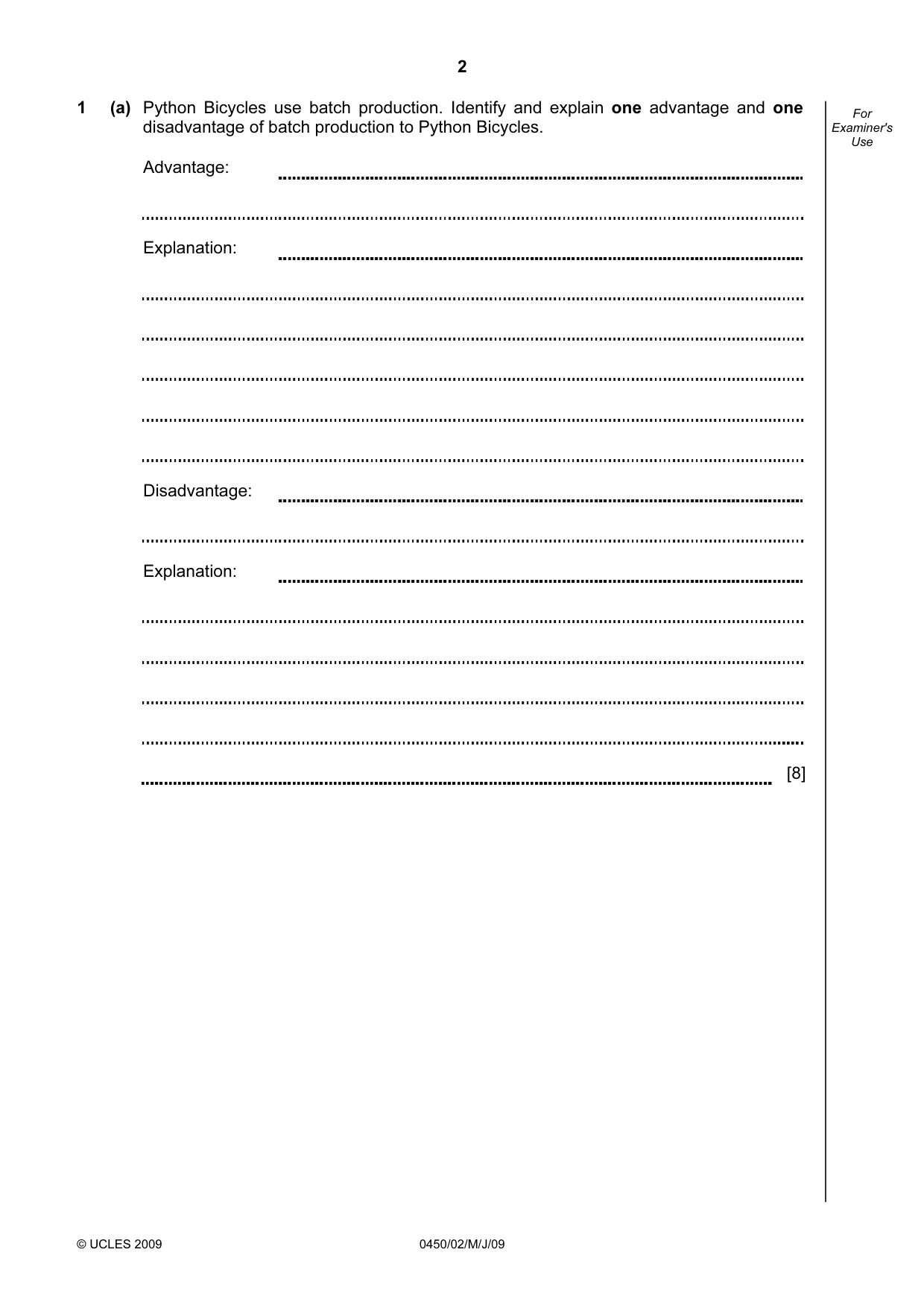
2 © UCLES 2009 0450/02/M/J/09 For Examiner's Use 1 (a) Python Bicycles use batch production. Identify and explain one advantage and one disadvantage of batch production to Python Bicycles. Advantage: Explanation: Disadvantage: Explanation: [8]
Question paper, page 3
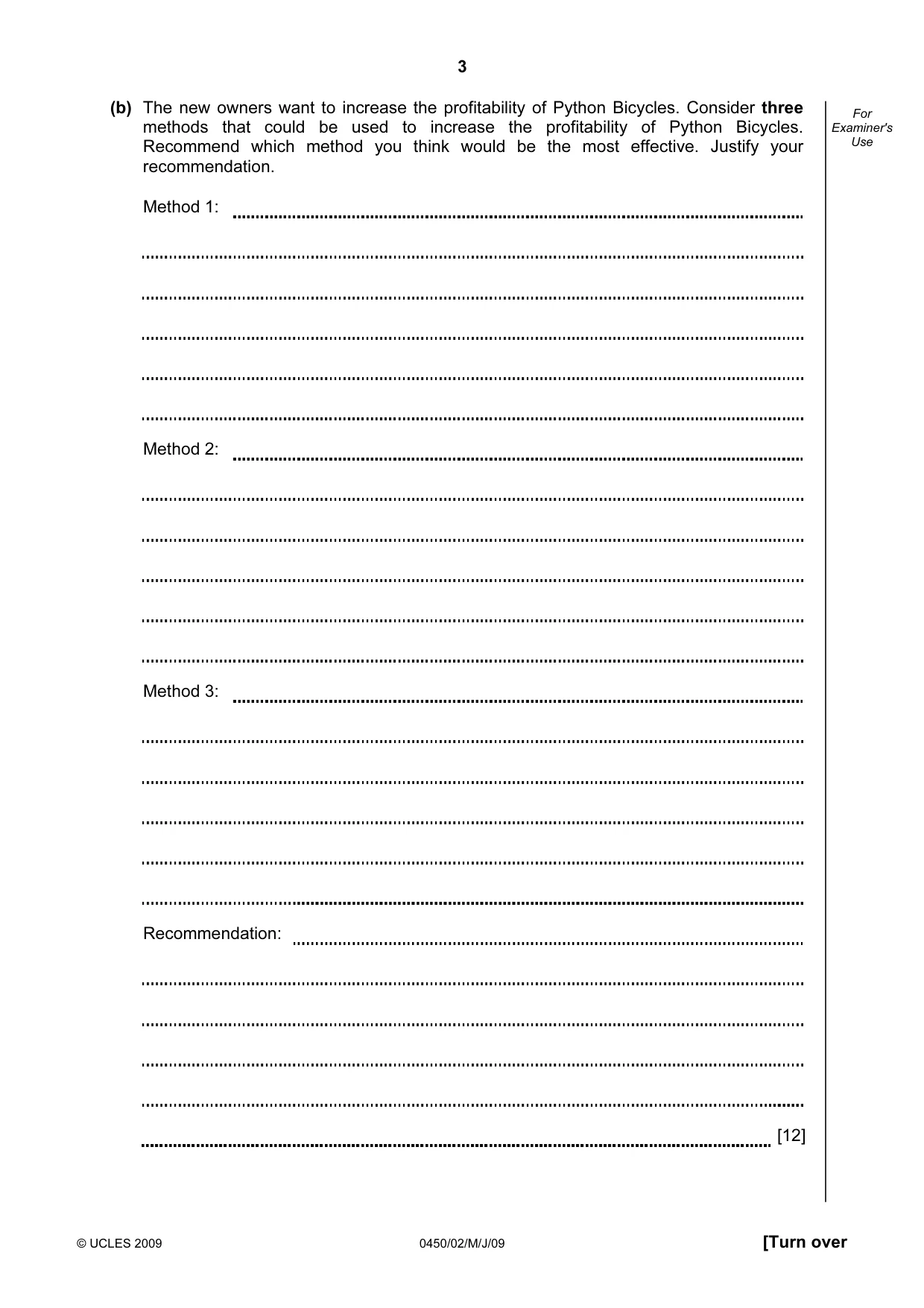
3 © UCLES 2009 0450/02/M/J/09 [Turn over For Examiner's Use (b) The new owners want to increase the profitability of Python Bicycles. Consider three methods that could be used to increase the profitability of Python Bicycles. Recommend which method you think would be the most effective. Justify your recommendation. Method 1: Method 2: Method 3: Recommendation: [12]
Question paper, page 4
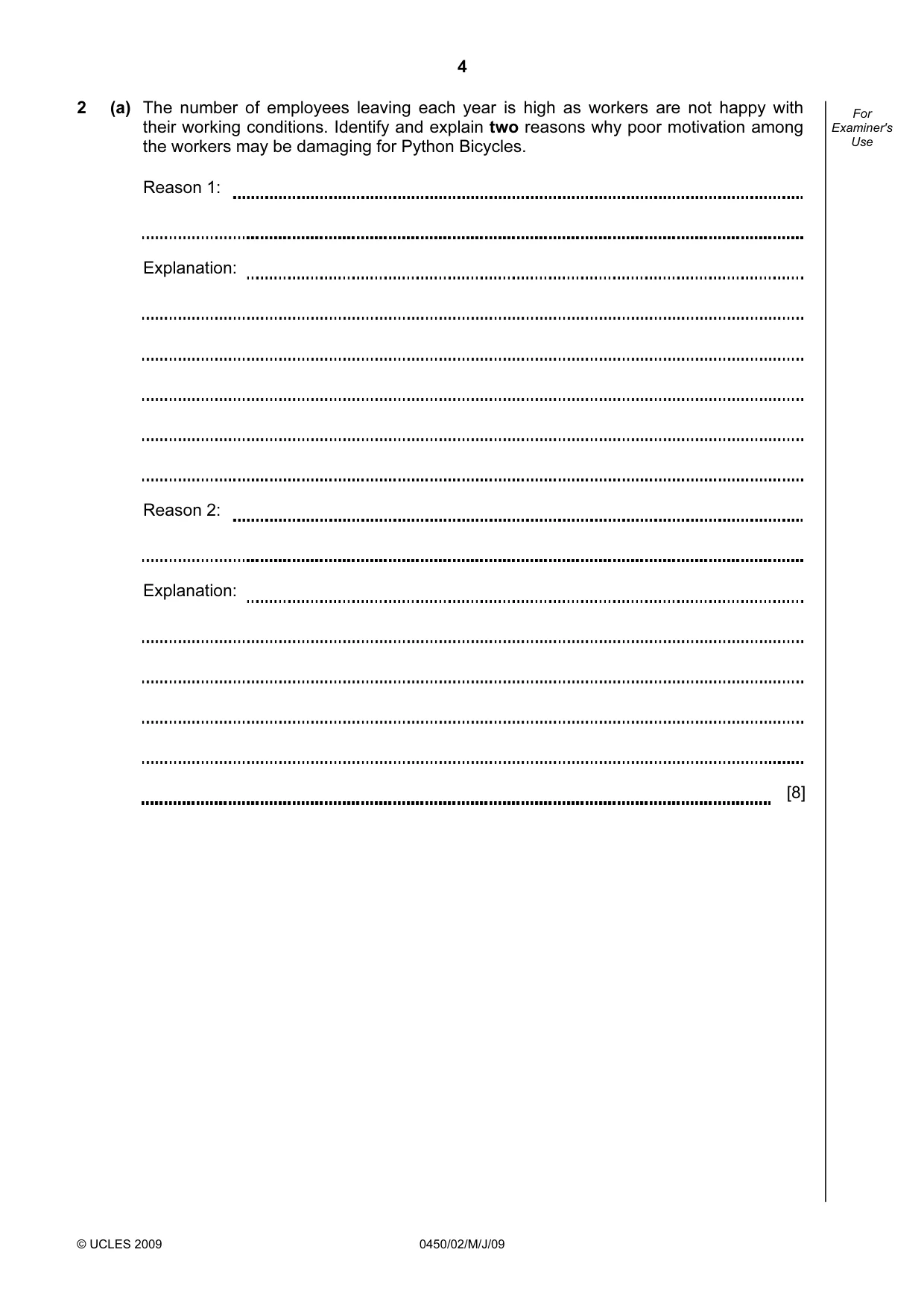
4 © UCLES 2009 0450/02/M/J/09 For Examiner's Use 2 (a) The number of employees leaving each year is high as workers are not happy with their working conditions. Identify and explain two reasons why poor motivation among the workers may be damaging for Python Bicycles. Reason 1: Explanation: Reason 2: Explanation: [8]
Question paper, page 5
5 © UCLES 2009 0450/02/M/J/09 [Turn over For Examiner's Use (b) Do you think that higher wages would be the most effective way of increasing the motivation of the employees at Python Bicycles? Justify your answer. [12]
Question paper, page 6
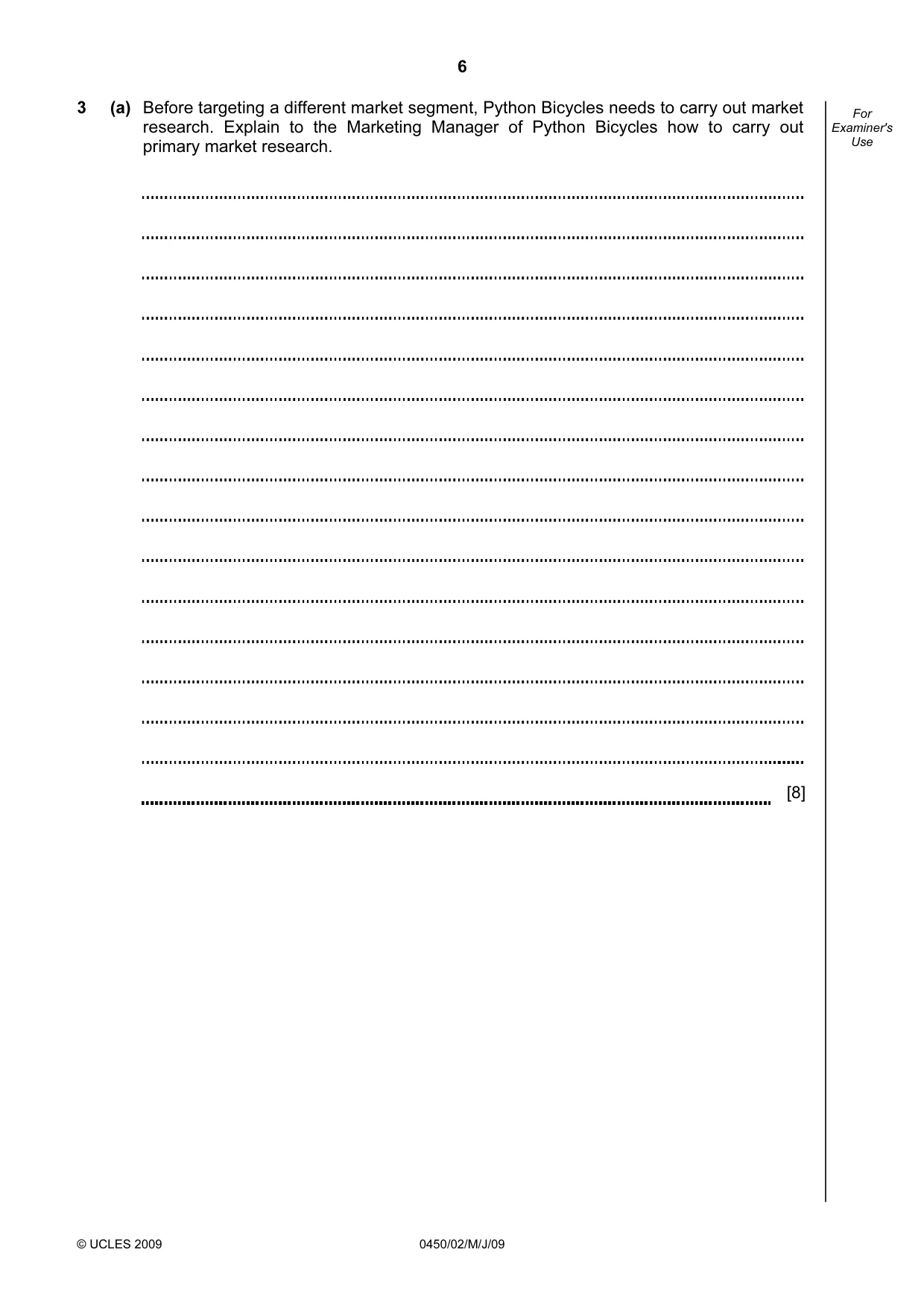
6 © UCLES 2009 0450/02/M/J/09 For Examiner's Use 3 (a) Before targeting a different market segment, Python Bicycles needs to carry out market research. Explain to the Marketing Manager of Python Bicycles how to carry out primary market research. [8]
Question paper, page 7
7 © UCLES 2009 0450/02/M/J/09 [Turn over For Examiner's Use (b) Do you agree with the Marketing Manager that Python Bicycles will need to change each of the elements of the marketing mix if children’s bicycles are to be sold? (See Appendix 2). Justify your answers. Element 1 of marketing mix: Need to change this element? Element 2 of marketing mix: Need to change this element? Element 3 of marketing mix: Need to change this element? Element 4 of marketing mix: Need to change this element? [12]
Question paper, page 8
8 © UCLES 2009 0450/02/M/J/09 For Examiner's Use 4 (a) A cash flow forecast is used by the company to help it with its financial control. Explain why Python Bicycles would find a cash flow forecast useful. [8]
Question paper, page 9
9 © UCLES 2009 0450/02/M/J/09 [Turn over For Examiner's Use (b) Do you think Python Bicycles is in a strong financial position? Explain your answer using information from Appendix 1 and the other case material given. [12]
Question paper, page 10
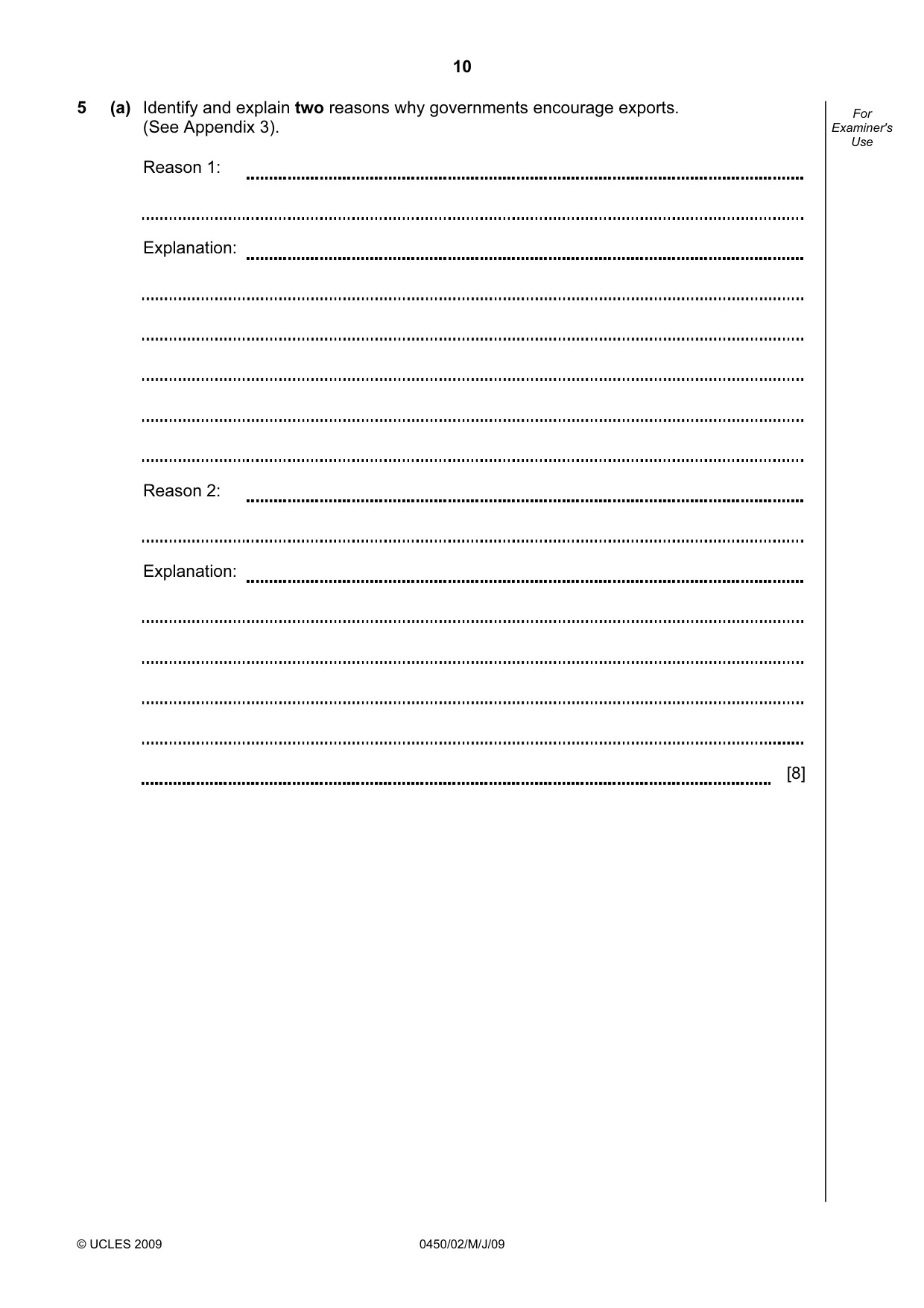
10 © UCLES 2009 0450/02/M/J/09 For Examiner's Use 5 (a) Identify and explain two reasons why governments encourage exports. (See Appendix 3). Reason 1: Explanation: Reason 2: Explanation: [8]
Question paper, page 11
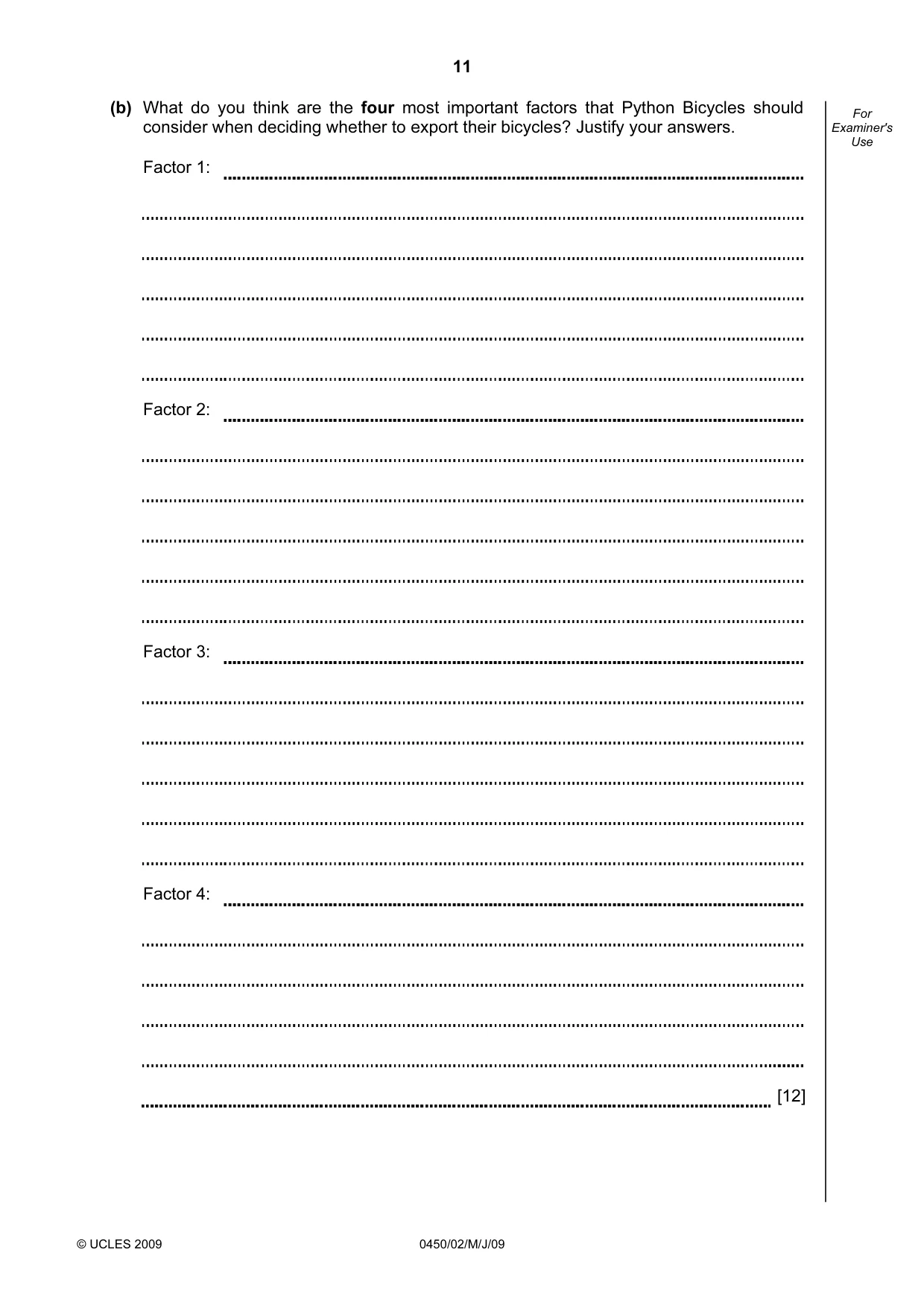
11 © UCLES 2009 0450/02/M/J/09 For Examiner's Use (b) What do you think are the four most important factors that Python Bicycles should consider when deciding whether to export their bicycles? Justify your answers. Factor 1: Factor 2: Factor 3: Factor 4: [12]
Question paper, page 12
12 BLANK PAGE Permission to reproduce items where third-party owned material protected by copyright is included has been sought and cleared where possible. Every reasonable effort has been made by the publisher (UCLES) to trace copyright holders, but if any items requiring clearance have unwittingly been included, the publisher will be pleased to make amends at the earliest possible opportunity. University of Cambridge International Examinations is part of the Cambridge Assessment Group. Cambridge Assessment is the brand name of University of Cambridge Local Examinations Syndicate (UCLES), which is itself a department of the University of Cambridge. 0450/02/M/J/09
Mark scheme, page 1
UNIVERSITY OF CAMBRIDGE INTERNATIONAL EXAMINATIONS International General Certificate of Secondary Education MARK SCHEME for the May/June 2009 question paper for the guidance of teachers 0450 BUSINESS STUDIES 0450/02 Paper 2 (Case Study), maximum raw mark 100 This mark scheme is published as an aid to teachers and candidates, to indicate the requirements of the examination. It shows the basis on which Examiners were instructed to award marks. It does not indicate the details of the discussions that took place at an Examiners’ meeting before marking began, which would have considered the acceptability of alternative answers. Mark schemes must be read in conjunction with the question papers and the report on the examination. • CIE will not enter into discussions or correspondence in connection with these mark schemes. CIE is publishing the mark schemes for the May/June 2009 question papers for most IGCSE, GCE Advanced Level and Advanced Subsidiary Level syllabuses and some Ordinary Level syllabuses. www.XtremePapers.com
Mark scheme, page 2
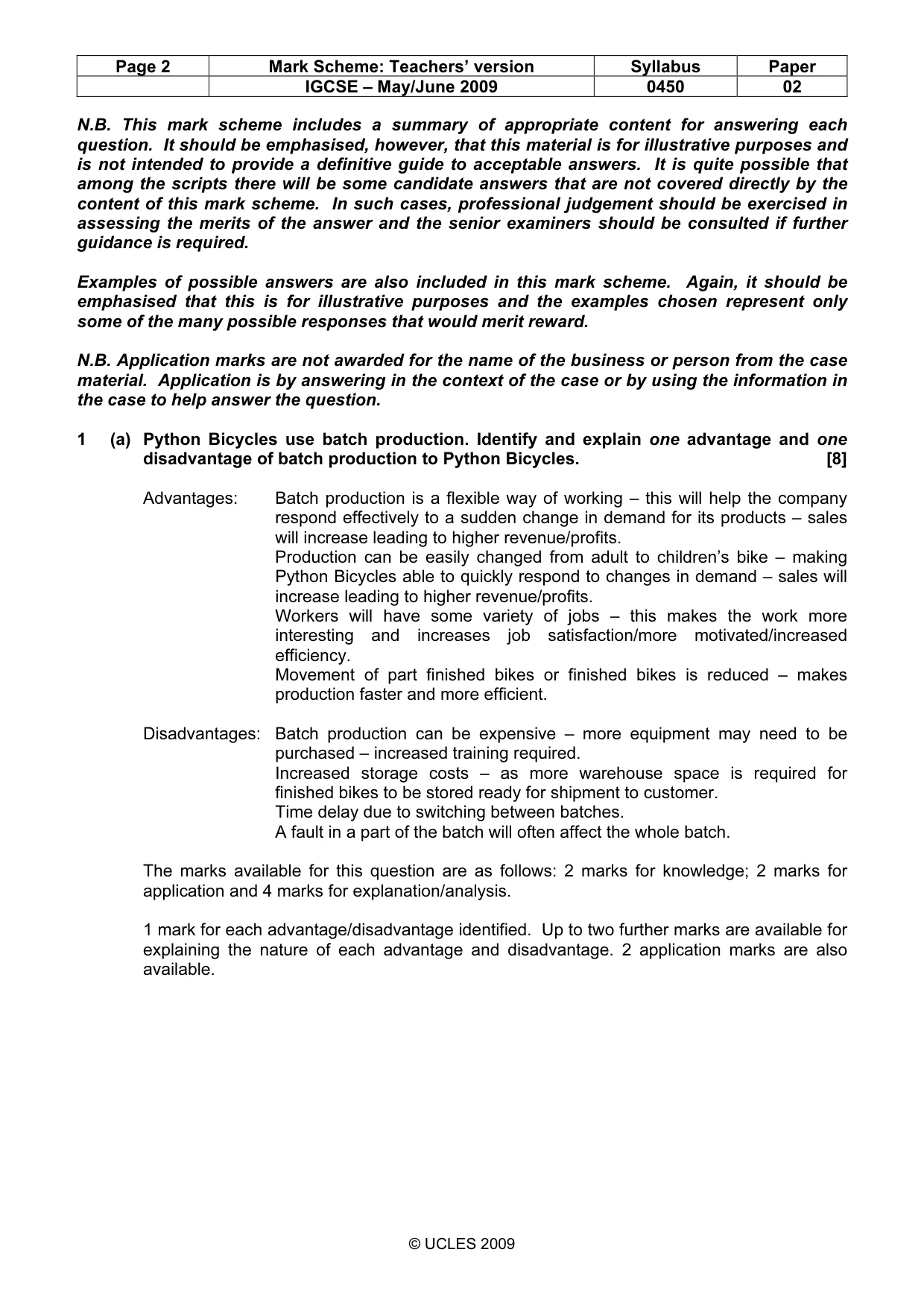
Page 2 Mark Scheme: Teachers’ version Syllabus Paper IGCSE – May/June 2009 0450 02 © UCLES 2009 N.B. This mark scheme includes a summary of appropriate content for answering each question. It should be emphasised, however, that this material is for illustrative purposes and is not intended to provide a definitive guide to acceptable answers. It is quite possible that among the scripts there will be some candidate answers that are not covered directly by the content of this mark scheme. In such cases, professional judgement should be exercised in assessing the merits of the answer and the senior examiners should be consulted if further guidance is required. Examples of possible answers are also included in this mark scheme. Again, it should be emphasised that this is for illustrative purposes and the examples chosen represent only some of the many possible responses that would merit reward. N.B. Application marks are not awarded for the name of the business or person from the case material. Application is by answering in the context of the case or by using the information in the case to help answer the question. 1 (a) Python Bicycles use batch production. Identify and explain one advantage and one disadvantage of batch production to Python Bicycles. [8] Advantages: Batch production is a flexible way of working – this will help the company respond effectively to a sudden change in demand for its products – sales will increase leading to higher revenue/profits. Production can be easily changed from adult to children’s bike – making Python Bicycles able to quickly respond to changes in demand – sales will increase leading to higher revenue/profits. Workers will have some variety of jobs – this makes the work more interesting and increases job satisfaction/more motivated/increased efficiency. Movement of part finished bikes or finished bikes is reduced – makes production faster and more efficient. Disadvantages: Batch production can be expensive – more equipment may need to be purchased – increased training required. Increased storage costs – as more warehouse space is required for finished bikes to be stored ready for shipment to customer. Time delay due to switching between batches. A fault in a part of the batch will often affect the whole batch. The marks available for this question are as follows: 2 marks for knowledge; 2 marks for application and 4 marks for explanation/analysis. 1 mark for each advantage/disadvantage identified. Up to two further marks are available for explaining the nature of each advantage and disadvantage. 2 application marks are also available.
Mark scheme, page 3
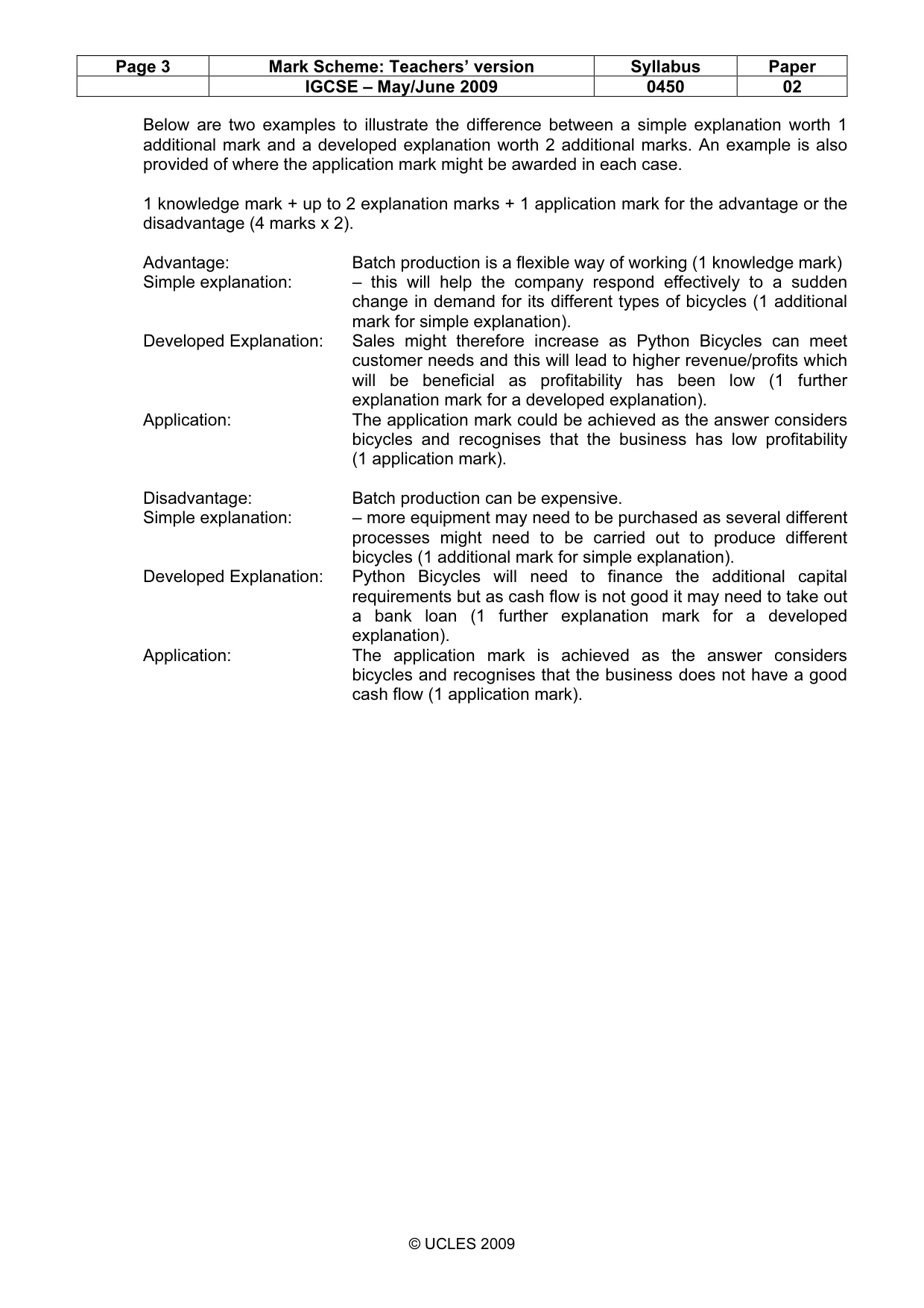
Page 3 Mark Scheme: Teachers’ version Syllabus Paper IGCSE – May/June 2009 0450 02 © UCLES 2009 Below are two examples to illustrate the difference between a simple explanation worth 1 additional mark and a developed explanation worth 2 additional marks. An example is also provided of where the application mark might be awarded in each case. 1 knowledge mark + up to 2 explanation marks + 1 application mark for the advantage or the disadvantage (4 marks x 2). Advantage: Batch production is a flexible way of working (1 knowledge mark) Simple explanation: – this will help the company respond effectively to a sudden change in demand for its different types of bicycles (1 additional mark for simple explanation). Developed Explanation: Sales might therefore increase as Python Bicycles can meet customer needs and this will lead to higher revenue/profits which will be beneficial as profitability has been low (1 further explanation mark for a developed explanation). Application: The application mark could be achieved as the answer considers bicycles and recognises that the business has low profitability (1 application mark). Disadvantage: Batch production can be expensive. Simple explanation: – more equipment may need to be purchased as several different processes might need to be carried out to produce different bicycles (1 additional mark for simple explanation). Developed Explanation: Python Bicycles will need to finance the additional capital requirements but as cash flow is not good it may need to take out a bank loan (1 further explanation mark for a developed explanation). Application: The application mark is achieved as the answer considers bicycles and recognises that the business does not have a good cash flow (1 application mark).
Mark scheme, page 4
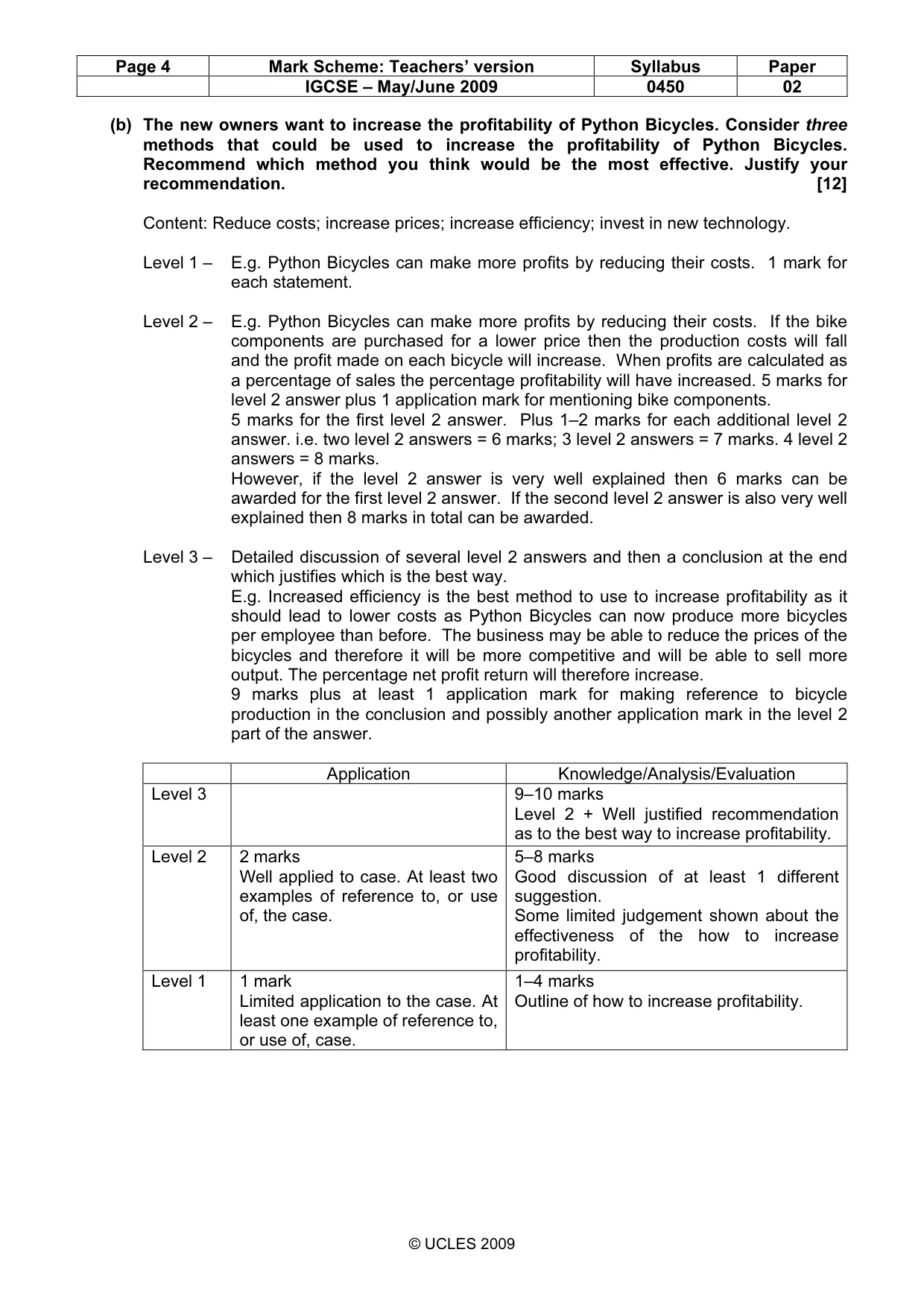
Page 4 Mark Scheme: Teachers’ version Syllabus Paper IGCSE – May/June 2009 0450 02 © UCLES 2009 (b) The new owners want to increase the profitability of Python Bicycles. Consider three methods that could be used to increase the profitability of Python Bicycles. Recommend which method you think would be the most effective. Justify your recommendation. [12] Content: Reduce costs; increase prices; increase efficiency; invest in new technology. Level 1 – E.g. Python Bicycles can make more profits by reducing their costs. 1 mark for each statement. Level 2 – E.g. Python Bicycles can make more profits by reducing their costs. If the bike components are purchased for a lower price then the production costs will fall and the profit made on each bicycle will increase. When profits are calculated as a percentage of sales the percentage profitability will have increased. 5 marks for level 2 answer plus 1 application mark for mentioning bike components. 5 marks for the first level 2 answer. Plus 1–2 marks for each additional level 2 answer. i.e. two level 2 answers = 6 marks; 3 level 2 answers = 7 marks. 4 level 2 answers = 8 marks. However, if the level 2 answer is very well explained then 6 marks can be awarded for the first level 2 answer. If the second level 2 answer is also very well explained then 8 marks in total can be awarded. Level 3 – Detailed discussion of several level 2 answers and then a conclusion at the end which justifies which is the best way. E.g. Increased efficiency is the best method to use to increase profitability as it should lead to lower costs as Python Bicycles can now produce more bicycles per employee than before. The business may be able to reduce the prices of the bicycles and therefore it will be more competitive and will be able to sell more output. The percentage net profit return will therefore increase. 9 marks plus at least 1 application mark for making reference to bicycle production in the conclusion and possibly another application mark in the level 2 part of the answer. Application Knowledge/Analysis/Evaluation Level 3 9–10 marks Level 2 + Well justified recommendation as to the best way to increase profitability. Level 2 2 marks Well applied to case. At least two examples of reference to, or use of, the case. 5–8 marks Good discussion of at least 1 different suggestion. Some limited judgement shown about the effectiveness of the how to increase profitability. Level 1 1 mark Limited application to the case. At least one example of reference to, or use of, case. 1–4 marks Outline of how to increase profitability.
Mark scheme, page 5
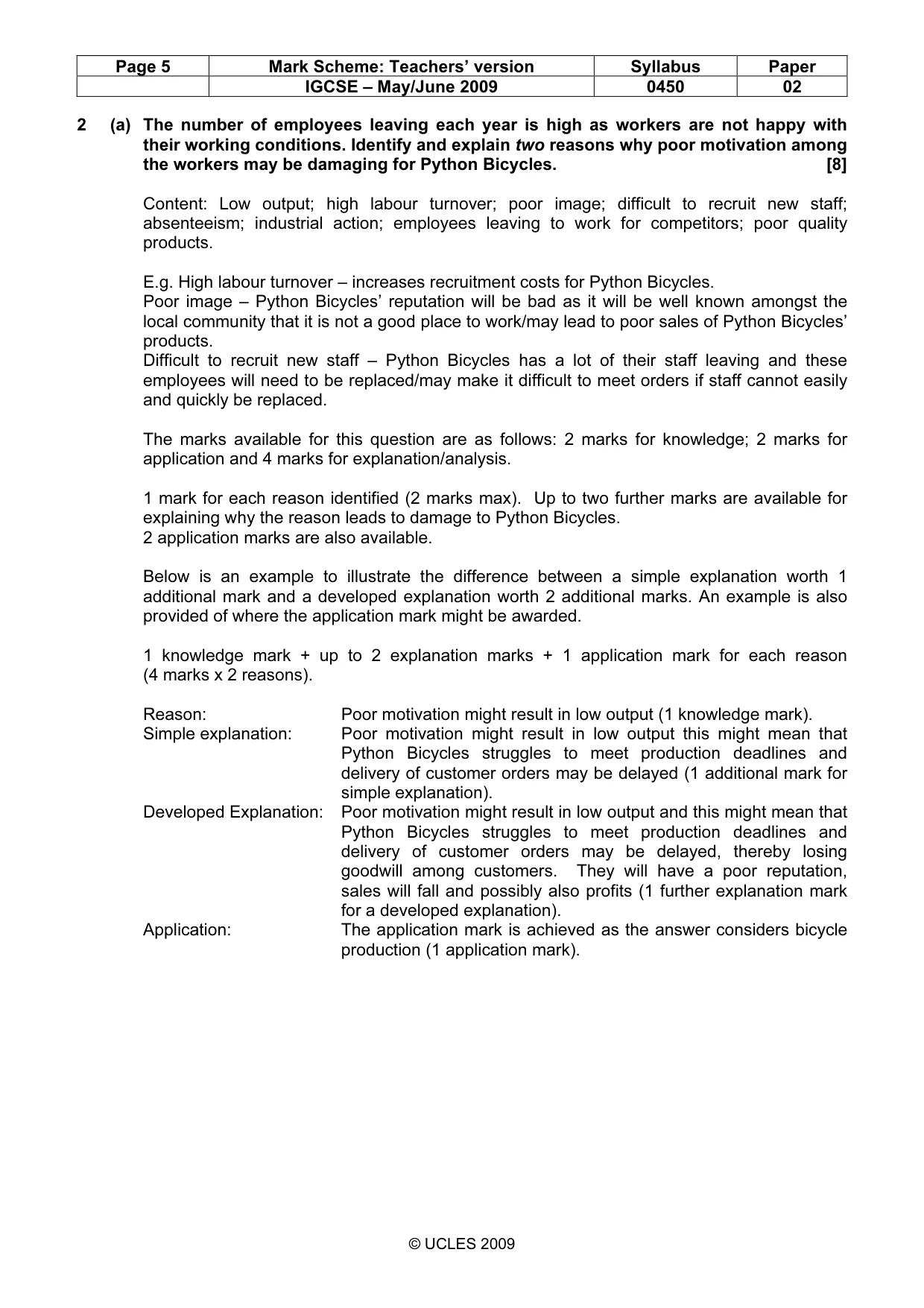
Page 5 Mark Scheme: Teachers’ version Syllabus Paper IGCSE – May/June 2009 0450 02 © UCLES 2009 2 (a) The number of employees leaving each year is high as workers are not happy with their working conditions. Identify and explain two reasons why poor motivation among the workers may be damaging for Python Bicycles. [8] Content: Low output; high labour turnover; poor image; difficult to recruit new staff; absenteeism; industrial action; employees leaving to work for competitors; poor quality products. E.g. High labour turnover – increases recruitment costs for Python Bicycles. Poor image – Python Bicycles’ reputation will be bad as it will be well known amongst the local community that it is not a good place to work/may lead to poor sales of Python Bicycles’ products. Difficult to recruit new staff – Python Bicycles has a lot of their staff leaving and these employees will need to be replaced/may make it difficult to meet orders if staff cannot easily and quickly be replaced. The marks available for this question are as follows: 2 marks for knowledge; 2 marks for application and 4 marks for explanation/analysis. 1 mark for each reason identified (2 marks max). Up to two further marks are available for explaining why the reason leads to damage to Python Bicycles. 2 application marks are also available. Below is an example to illustrate the difference between a simple explanation worth 1 additional mark and a developed explanation worth 2 additional marks. An example is also provided of where the application mark might be awarded. 1 knowledge mark + up to 2 explanation marks + 1 application mark for each reason (4 marks x 2 reasons). Reason: Poor motivation might result in low output (1 knowledge mark). Simple explanation: Poor motivation might result in low output this might mean that Python Bicycles struggles to meet production deadlines and delivery of customer orders may be delayed (1 additional mark for simple explanation). Developed Explanation: Poor motivation might result in low output and this might mean that Python Bicycles struggles to meet production deadlines and delivery of customer orders may be delayed, thereby losing goodwill among customers. They will have a poor reputation, sales will fall and possibly also profits (1 further explanation mark for a developed explanation). Application: The application mark is achieved as the answer considers bicycle production (1 application mark).
Mark scheme, page 6
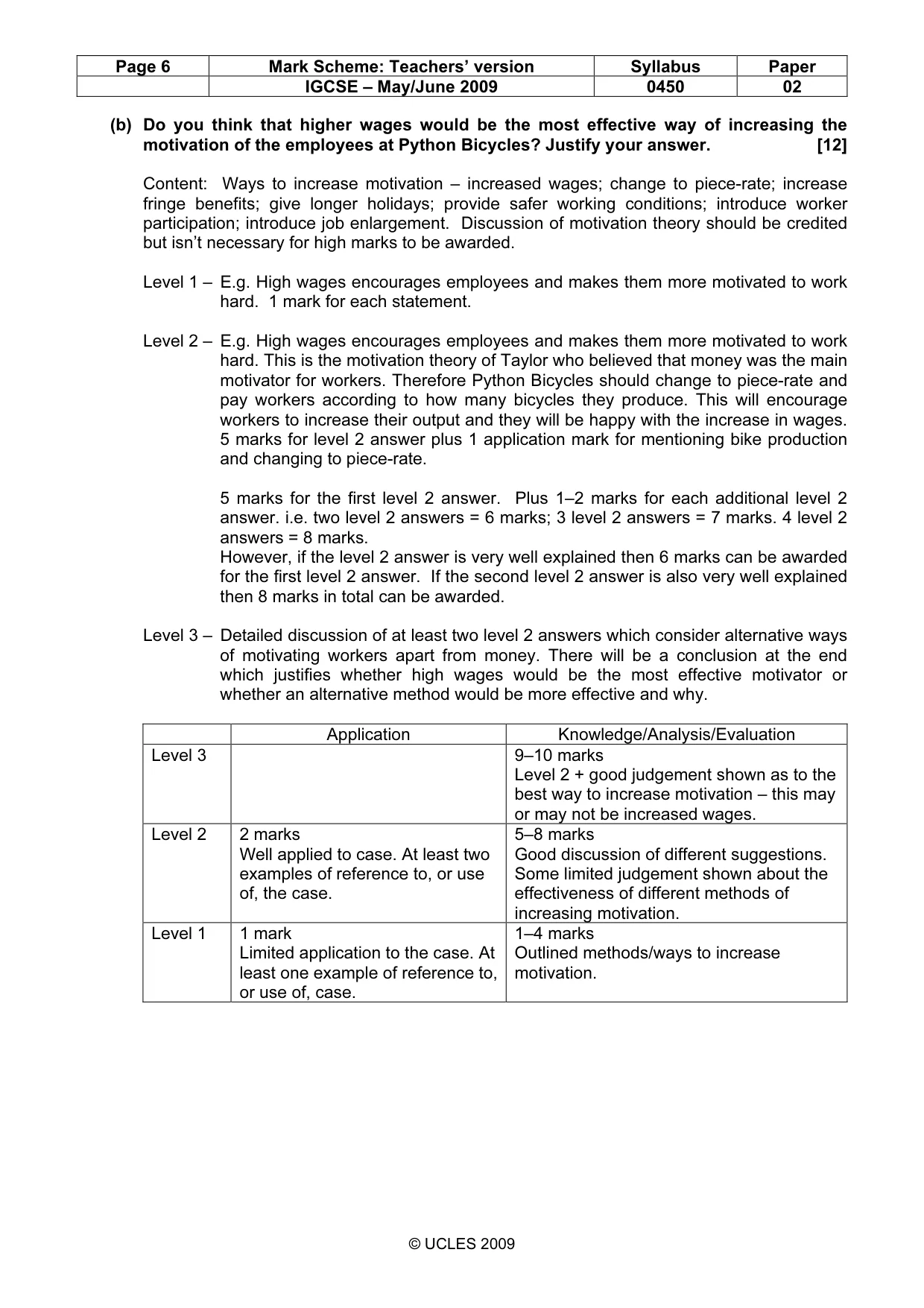
Page 6 Mark Scheme: Teachers’ version Syllabus Paper IGCSE – May/June 2009 0450 02 © UCLES 2009 (b) Do you think that higher wages would be the most effective way of increasing the motivation of the employees at Python Bicycles? Justify your answer. [12] Content: Ways to increase motivation – increased wages; change to piece-rate; increase fringe benefits; give longer holidays; provide safer working conditions; introduce worker participation; introduce job enlargement. Discussion of motivation theory should be credited but isn’t necessary for high marks to be awarded. Level 1 – E.g. High wages encourages employees and makes them more motivated to work hard. 1 mark for each statement. Level 2 – E.g. High wages encourages employees and makes them more motivated to work hard. This is the motivation theory of Taylor who believed that money was the main motivator for workers. Therefore Python Bicycles should change to piece-rate and pay workers according to how many bicycles they produce. This will encourage workers to increase their output and they will be happy with the increase in wages. 5 marks for level 2 answer plus 1 application mark for mentioning bike production and changing to piece-rate. 5 marks for the first level 2 answer. Plus 1–2 marks for each additional level 2 answer. i.e. two level 2 answers = 6 marks; 3 level 2 answers = 7 marks. 4 level 2 answers = 8 marks. However, if the level 2 answer is very well explained then 6 marks can be awarded for the first level 2 answer. If the second level 2 answer is also very well explained then 8 marks in total can be awarded. Level 3 – Detailed discussion of at least two level 2 answers which consider alternative ways of motivating workers apart from money. There will be a conclusion at the end which justifies whether high wages would be the most effective motivator or whether an alternative method would be more effective and why. Application Knowledge/Analysis/Evaluation Level 3 9–10 marks Level 2 + good judgement shown as to the best way to increase motivation – this may or may not be increased wages. Level 2 2 marks Well applied to case. At least two examples of reference to, or use of, the case. 5–8 marks Good discussion of different suggestions. Some limited judgement shown about the effectiveness of different methods of increasing motivation. Level 1 1 mark Limited application to the case. At least one example of reference to, or use of, case. 1–4 marks Outlined methods/ways to increase motivation.
Mark scheme, page 7
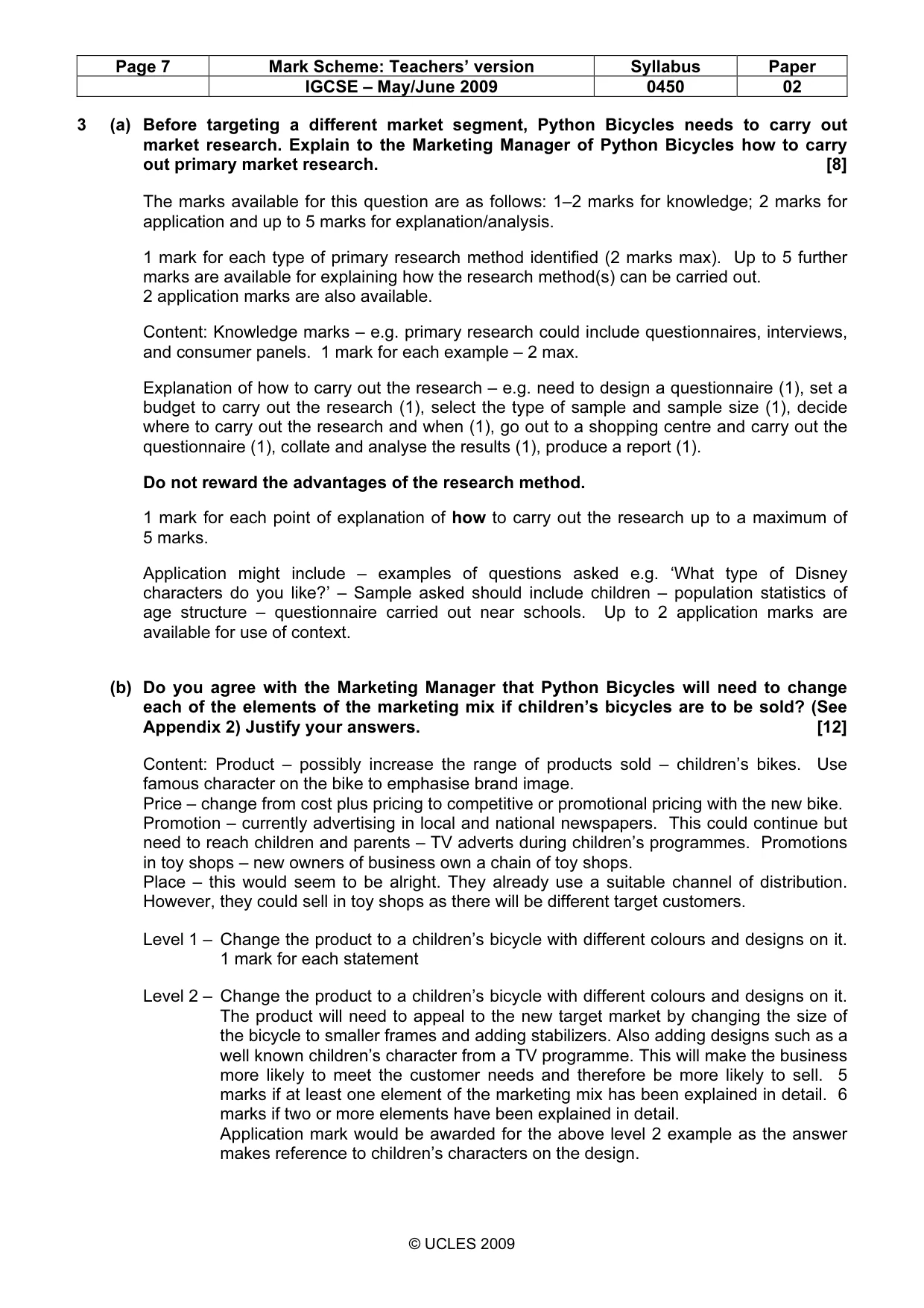
Page 7 Mark Scheme: Teachers’ version Syllabus Paper IGCSE – May/June 2009 0450 02 © UCLES 2009 3 (a) Before targeting a different market segment, Python Bicycles needs to carry out market research. Explain to the Marketing Manager of Python Bicycles how to carry out primary market research. [8] The marks available for this question are as follows: 1–2 marks for knowledge; 2 marks for application and up to 5 marks for explanation/analysis. 1 mark for each type of primary research method identified (2 marks max). Up to 5 further marks are available for explaining how the research method(s) can be carried out. 2 application marks are also available. Content: Knowledge marks – e.g. primary research could include questionnaires, interviews, and consumer panels. 1 mark for each example – 2 max. Explanation of how to carry out the research – e.g. need to design a questionnaire (1), set a budget to carry out the research (1), select the type of sample and sample size (1), decide where to carry out the research and when (1), go out to a shopping centre and carry out the questionnaire (1), collate and analyse the results (1), produce a report (1). Do not reward the advantages of the research method. 1 mark for each point of explanation of how to carry out the research up to a maximum of 5 marks. Application might include – examples of questions asked e.g. ‘What type of Disney characters do you like?’ – Sample asked should include children – population statistics of age structure – questionnaire carried out near schools. Up to 2 application marks are available for use of context. (b) Do you agree with the Marketing Manager that Python Bicycles will need to change each of the elements of the marketing mix if children’s bicycles are to be sold? (See Appendix 2) Justify your answers. [12] Content: Product – possibly increase the range of products sold – children’s bikes. Use famous character on the bike to emphasise brand image. Price – change from cost plus pricing to competitive or promotional pricing with the new bike. Promotion – currently advertising in local and national newspapers. This could continue but need to reach children and parents – TV adverts during children’s programmes. Promotions in toy shops – new owners of business own a chain of toy shops. Place – this would seem to be alright. They already use a suitable channel of distribution. However, they could sell in toy shops as there will be different target customers. Level 1 – Change the product to a children’s bicycle with different colours and designs on it. 1 mark for each statement Level 2 – Change the product to a children’s bicycle with different colours and designs on it. The product will need to appeal to the new target market by changing the size of the bicycle to smaller frames and adding stabilizers. Also adding designs such as a well known children’s character from a TV programme. This will make the business more likely to meet the customer needs and therefore be more likely to sell. 5 marks if at least one element of the marketing mix has been explained in detail. 6 marks if two or more elements have been explained in detail. Application mark would be awarded for the above level 2 example as the answer makes reference to children’s characters on the design.
Mark scheme, page 8
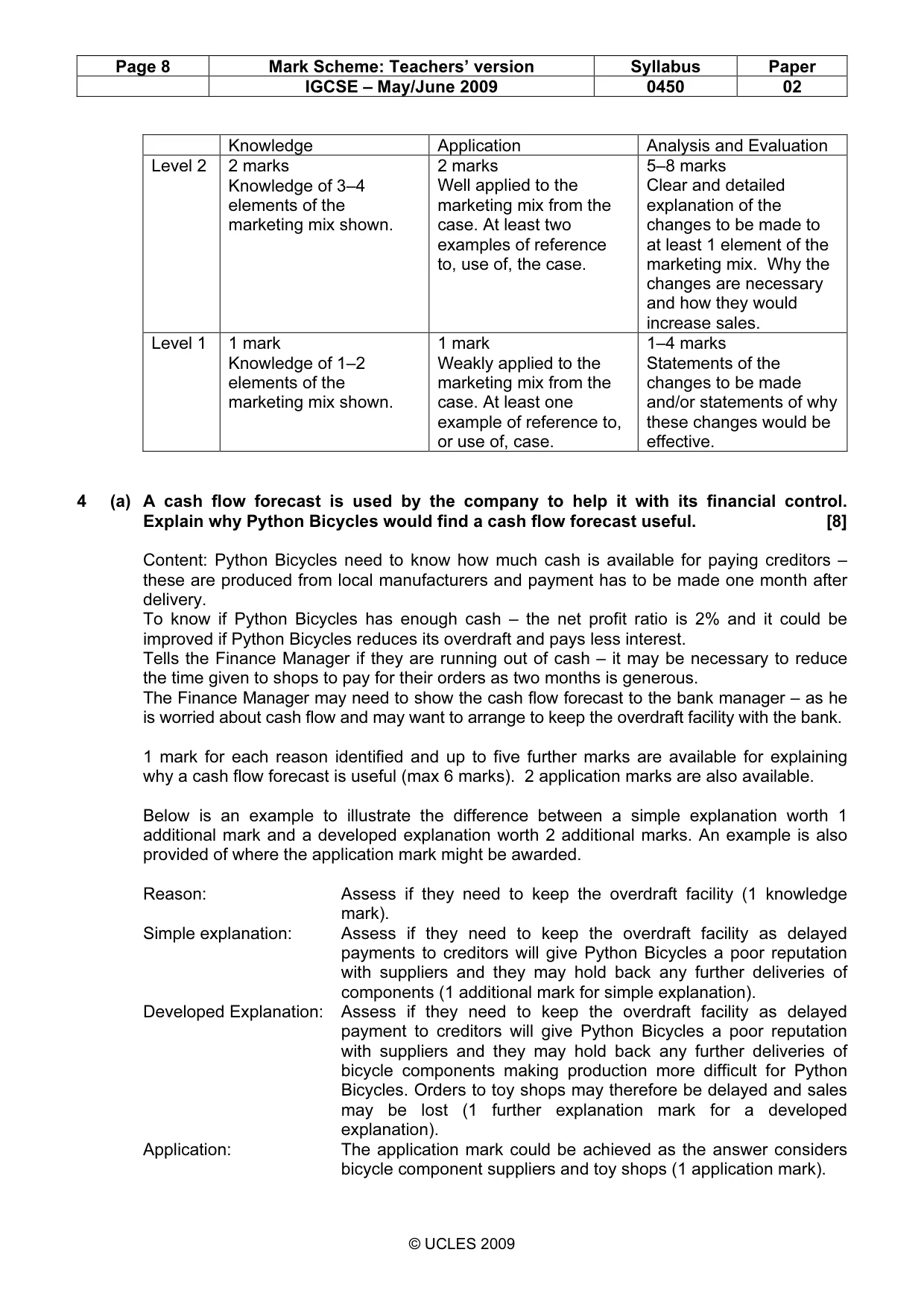
Page 8 Mark Scheme: Teachers’ version Syllabus Paper IGCSE – May/June 2009 0450 02 © UCLES 2009 Knowledge Application Analysis and Evaluation Level 2 2 marks Knowledge of 3–4 elements of the marketing mix shown. 2 marks Well applied to the marketing mix from the case. At least two examples of reference to, use of, the case. 5–8 marks Clear and detailed explanation of the changes to be made to at least 1 element of the marketing mix. Why the changes are necessary and how they would increase sales. Level 1 1 mark Knowledge of 1–2 elements of the marketing mix shown. 1 mark Weakly applied to the marketing mix from the case. At least one example of reference to, or use of, case. 1–4 marks Statements of the changes to be made and/or statements of why these changes would be effective. 4 (a) A cash flow forecast is used by the company to help it with its financial control. Explain why Python Bicycles would find a cash flow forecast useful. [8] Content: Python Bicycles need to know how much cash is available for paying creditors – these are produced from local manufacturers and payment has to be made one month after delivery. To know if Python Bicycles has enough cash – the net profit ratio is 2% and it could be improved if Python Bicycles reduces its overdraft and pays less interest. Tells the Finance Manager if they are running out of cash – it may be necessary to reduce the time given to shops to pay for their orders as two months is generous. The Finance Manager may need to show the cash flow forecast to the bank manager – as he is worried about cash flow and may want to arrange to keep the overdraft facility with the bank. 1 mark for each reason identified and up to five further marks are available for explaining why a cash flow forecast is useful (max 6 marks). 2 application marks are also available. Below is an example to illustrate the difference between a simple explanation worth 1 additional mark and a developed explanation worth 2 additional marks. An example is also provided of where the application mark might be awarded. Reason: Assess if they need to keep the overdraft facility (1 knowledge mark). Simple explanation: Assess if they need to keep the overdraft facility as delayed payments to creditors will give Python Bicycles a poor reputation with suppliers and they may hold back any further deliveries of components (1 additional mark for simple explanation). Developed Explanation: Assess if they need to keep the overdraft facility as delayed payment to creditors will give Python Bicycles a poor reputation with suppliers and they may hold back any further deliveries of bicycle components making production more difficult for Python Bicycles. Orders to toy shops may therefore be delayed and sales may be lost (1 further explanation mark for a developed explanation). Application: The application mark could be achieved as the answer considers bicycle component suppliers and toy shops (1 application mark).
Mark scheme, page 9
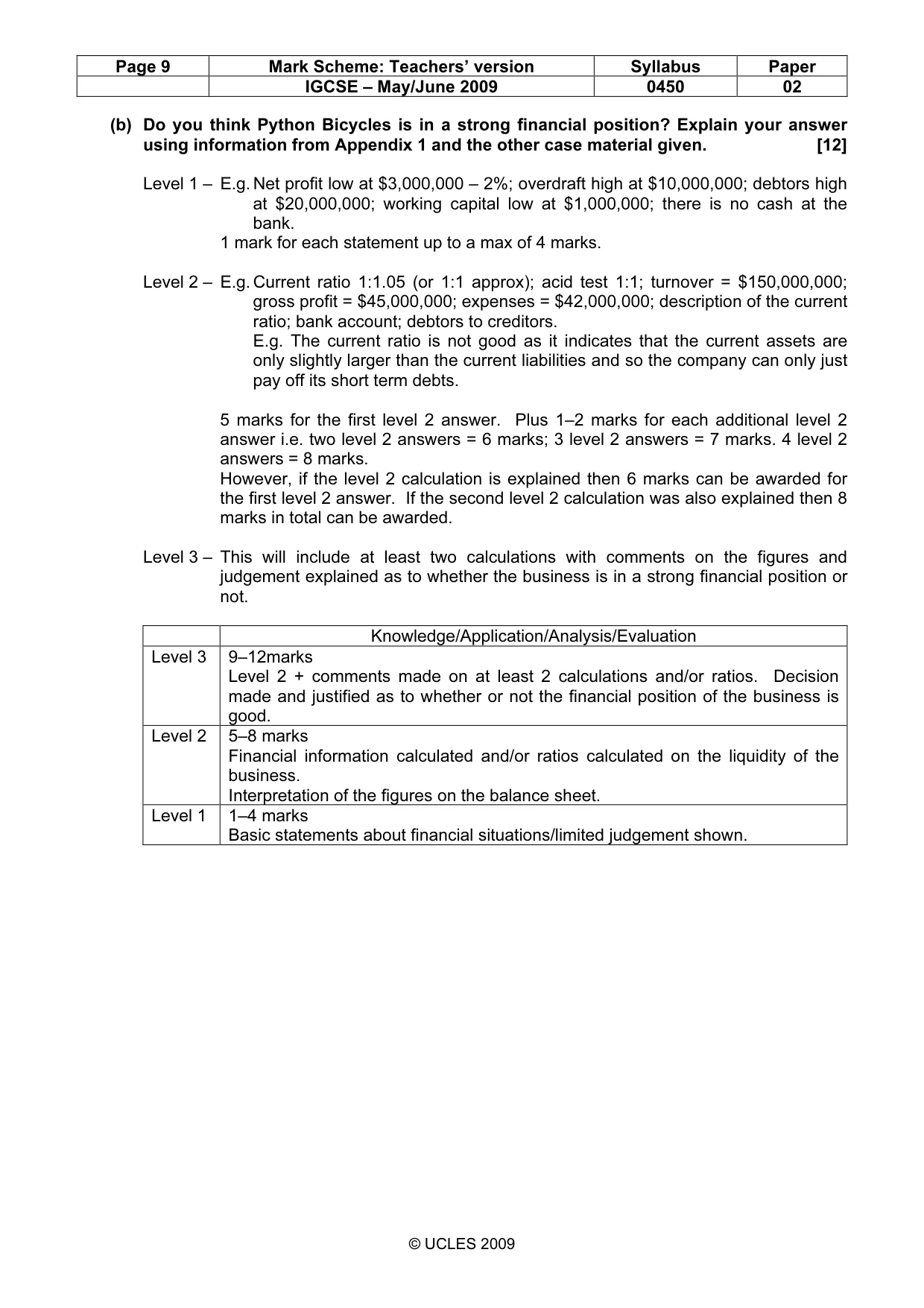
Page 9 Mark Scheme: Teachers’ version Syllabus Paper IGCSE – May/June 2009 0450 02 © UCLES 2009 (b) Do you think Python Bicycles is in a strong financial position? Explain your answer using information from Appendix 1 and the other case material given. [12] Level 1 – E.g. Net profit low at $3,000,000 – 2%; overdraft high at $10,000,000; debtors high at $20,000,000; working capital low at $1,000,000; there is no cash at the bank. 1 mark for each statement up to a max of 4 marks. Level 2 – E.g. Current ratio 1:1.05 (or 1:1 approx); acid test 1:1; turnover = $150,000,000; gross profit = $45,000,000; expenses = $42,000,000; description of the current ratio; bank account; debtors to creditors. E.g. The current ratio is not good as it indicates that the current assets are only slightly larger than the current liabilities and so the company can only just pay off its short term debts. 5 marks for the first level 2 answer. Plus 1–2 marks for each additional level 2 answer i.e. two level 2 answers = 6 marks; 3 level 2 answers = 7 marks. 4 level 2 answers = 8 marks. However, if the level 2 calculation is explained then 6 marks can be awarded for the first level 2 answer. If the second level 2 calculation was also explained then 8 marks in total can be awarded. Level 3 – This will include at least two calculations with comments on the figures and judgement explained as to whether the business is in a strong financial position or not. Knowledge/Application/Analysis/Evaluation Level 3 9–12marks Level 2 + comments made on at least 2 calculations and/or ratios. Decision made and justified as to whether or not the financial position of the business is good. Level 2 5–8 marks Financial information calculated and/or ratios calculated on the liquidity of the business. Interpretation of the figures on the balance sheet. Level 1 1–4 marks Basic statements about financial situations/limited judgement shown.
Mark scheme, page 10
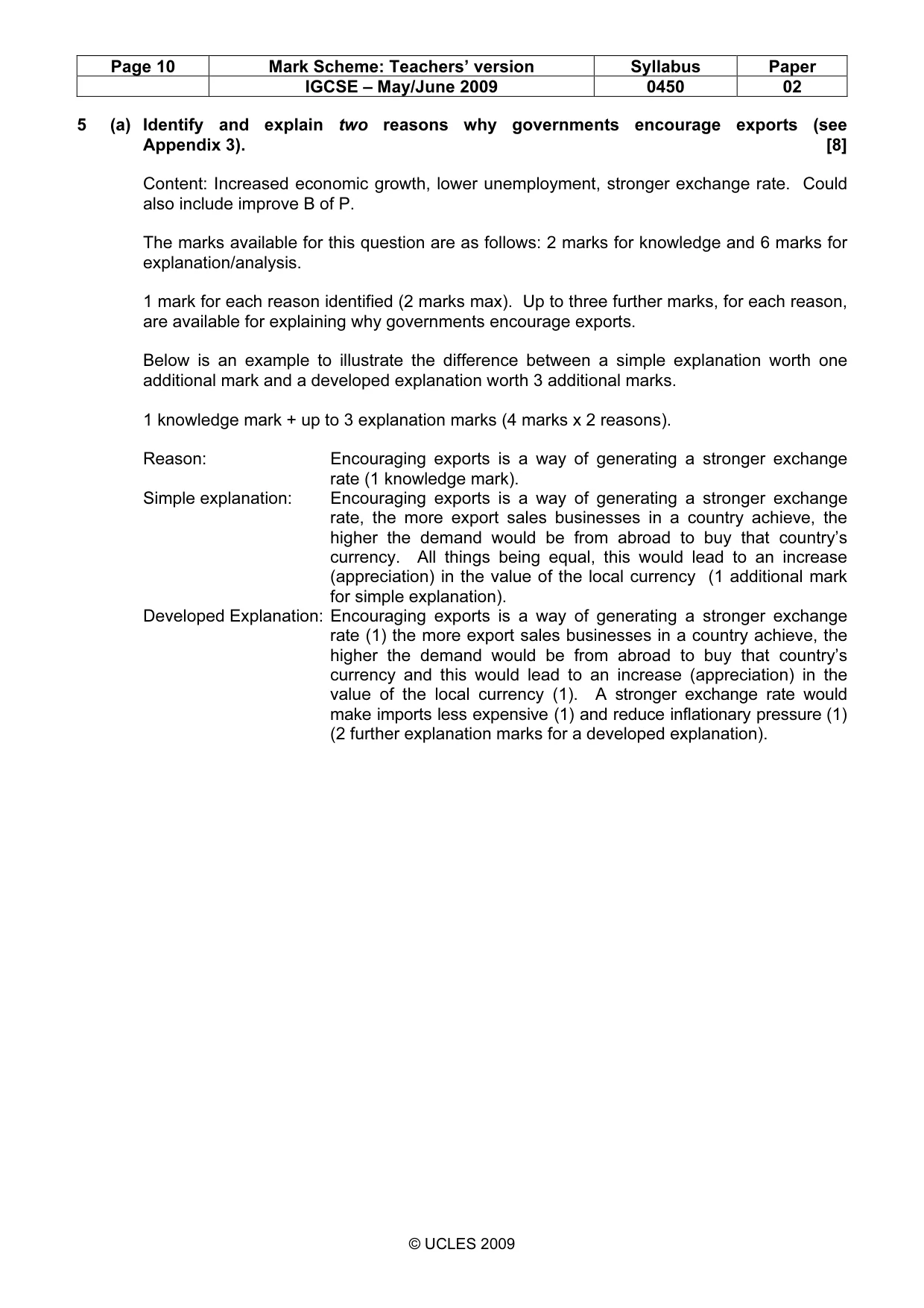
Page 10 Mark Scheme: Teachers’ version Syllabus Paper IGCSE – May/June 2009 0450 02 © UCLES 2009 5 (a) Identify and explain two reasons why governments encourage exports (see Appendix 3). [8] Content: Increased economic growth, lower unemployment, stronger exchange rate. Could also include improve B of P. The marks available for this question are as follows: 2 marks for knowledge and 6 marks for explanation/analysis. 1 mark for each reason identified (2 marks max). Up to three further marks, for each reason, are available for explaining why governments encourage exports. Below is an example to illustrate the difference between a simple explanation worth one additional mark and a developed explanation worth 3 additional marks. 1 knowledge mark + up to 3 explanation marks (4 marks x 2 reasons). Reason: Encouraging exports is a way of generating a stronger exchange rate (1 knowledge mark). Simple explanation: Encouraging exports is a way of generating a stronger exchange rate, the more export sales businesses in a country achieve, the higher the demand would be from abroad to buy that country’s currency. All things being equal, this would lead to an increase (appreciation) in the value of the local currency (1 additional mark for simple explanation). Developed Explanation: Encouraging exports is a way of generating a stronger exchange rate (1) the more export sales businesses in a country achieve, the higher the demand would be from abroad to buy that country’s currency and this would lead to an increase (appreciation) in the value of the local currency (1). A stronger exchange rate would make imports less expensive (1) and reduce inflationary pressure (1) (2 further explanation marks for a developed explanation).
Mark scheme, page 11
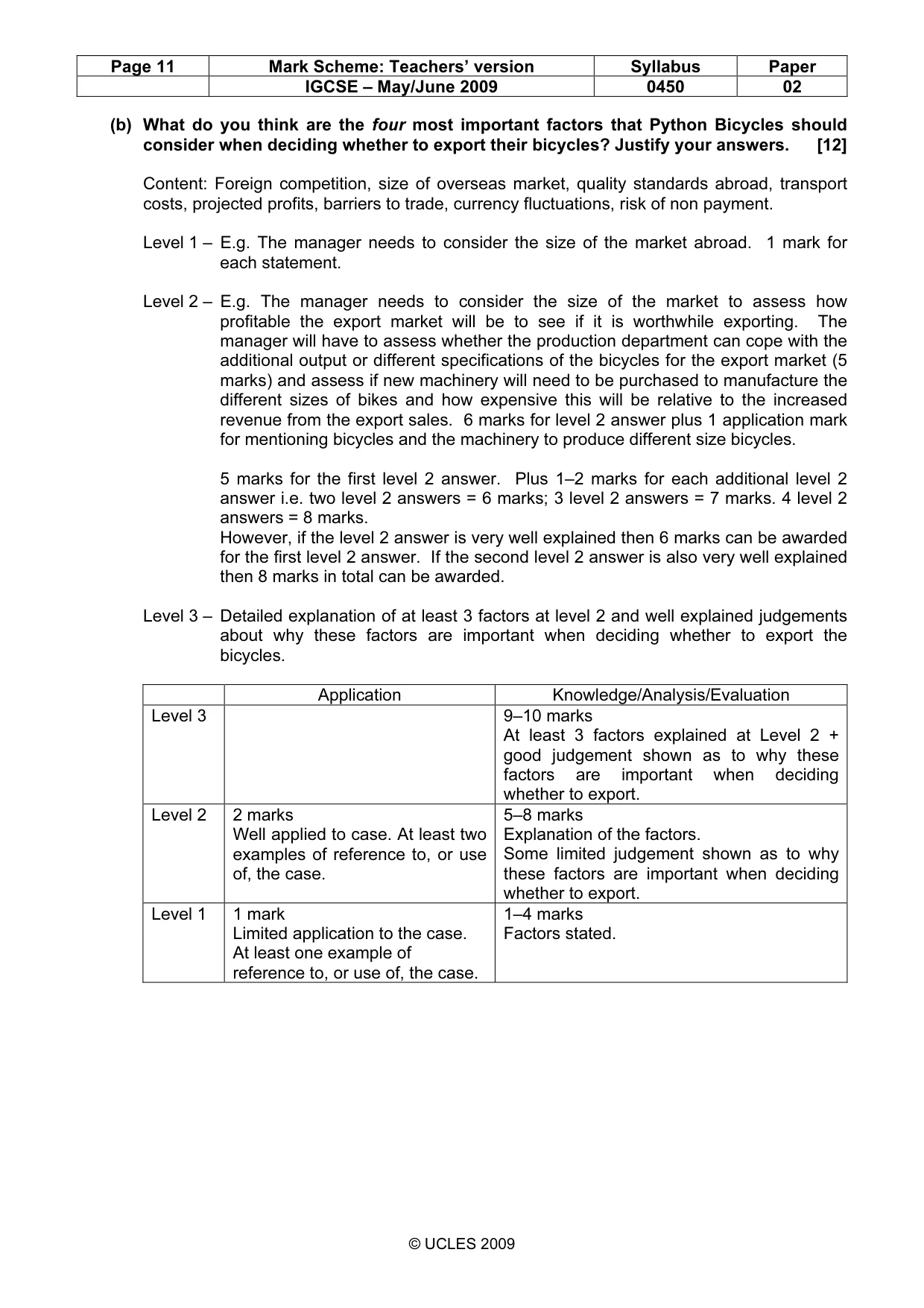
Page 11 Mark Scheme: Teachers’ version Syllabus Paper IGCSE – May/June 2009 0450 02 © UCLES 2009 (b) What do you think are the four most important factors that Python Bicycles should consider when deciding whether to export their bicycles? Justify your answers. [12] Content: Foreign competition, size of overseas market, quality standards abroad, transport costs, projected profits, barriers to trade, currency fluctuations, risk of non payment. Level 1 – E.g. The manager needs to consider the size of the market abroad. 1 mark for each statement. Level 2 – E.g. The manager needs to consider the size of the market to assess how profitable the export market will be to see if it is worthwhile exporting. The manager will have to assess whether the production department can cope with the additional output or different specifications of the bicycles for the export market (5 marks) and assess if new machinery will need to be purchased to manufacture the different sizes of bikes and how expensive this will be relative to the increased revenue from the export sales. 6 marks for level 2 answer plus 1 application mark for mentioning bicycles and the machinery to produce different size bicycles. 5 marks for the first level 2 answer. Plus 1–2 marks for each additional level 2 answer i.e. two level 2 answers = 6 marks; 3 level 2 answers = 7 marks. 4 level 2 answers = 8 marks. However, if the level 2 answer is very well explained then 6 marks can be awarded for the first level 2 answer. If the second level 2 answer is also very well explained then 8 marks in total can be awarded. Level 3 – Detailed explanation of at least 3 factors at level 2 and well explained judgements about why these factors are important when deciding whether to export the bicycles. Application Knowledge/Analysis/Evaluation Level 3 9–10 marks At least 3 factors explained at Level 2 + good judgement shown as to why these factors are important when deciding whether to export. Level 2 2 marks Well applied to case. At least two examples of reference to, or use of, the case. 5–8 marks Explanation of the factors. Some limited judgement shown as to why these factors are important when deciding whether to export. Level 1 1 mark Limited application to the case. At least one example of reference to, or use of, the case. 1–4 marks Factors stated.
What you needed in this session
Cambridge’s own grade thresholds for 2009 May/June, Paper 2 · Variant 1. A higher threshold means an easier paper — the bar moves with how the cohort did.