Cambridge IGCSE Business Studies 0450 — 2008 Oct/Nov Paper 2 · Variant 1
0450/21/O/N/08 · 100 marks · ≈113 min
The question paper and its mark scheme, free to read here and free to download. This is Cambridge’s own paper, exactly as it was sat.
Question paper16 pages











Mark scheme7 pages
Answers below. Sit the paper first if you are practising.


Paper as text
Question paper, page 1
This document consists of 13 printed pages and 3 blank pages. SP (SC/GW) T52448/2 © UCLES 2008 [Turn over UNIVERSITY OF CAMBRIDGE INTERNATIONAL EXAMINATIONS International General Certificate of Secondary Education READ THESE INSTRUCTIONS FIRST Write your Centre number, candidate number and name on all the work you hand in. Write in dark blue or black pen. Do not use staples, paper clips, highlighters, glue or correction fluid. DO NOT WRITE IN ANY BARCODES. Answer all questions. The business described in this question paper is entirely fictitious. At the end of the examination, fasten all your work securely together. The number of marks is given in brackets [ ] at the end of each question or part question. * 6 0 9 7 6 9 2 5 2 6 * BUSINESS STUDIES 0450/02 Paper 2 October/November 2008 1 hour 45 minutes Candidates answer on the Question Paper. No Additional Materials are required. For Examiner’s Use 1 2 3 4 5 Total www.XtremePapers.com
Question paper, page 2
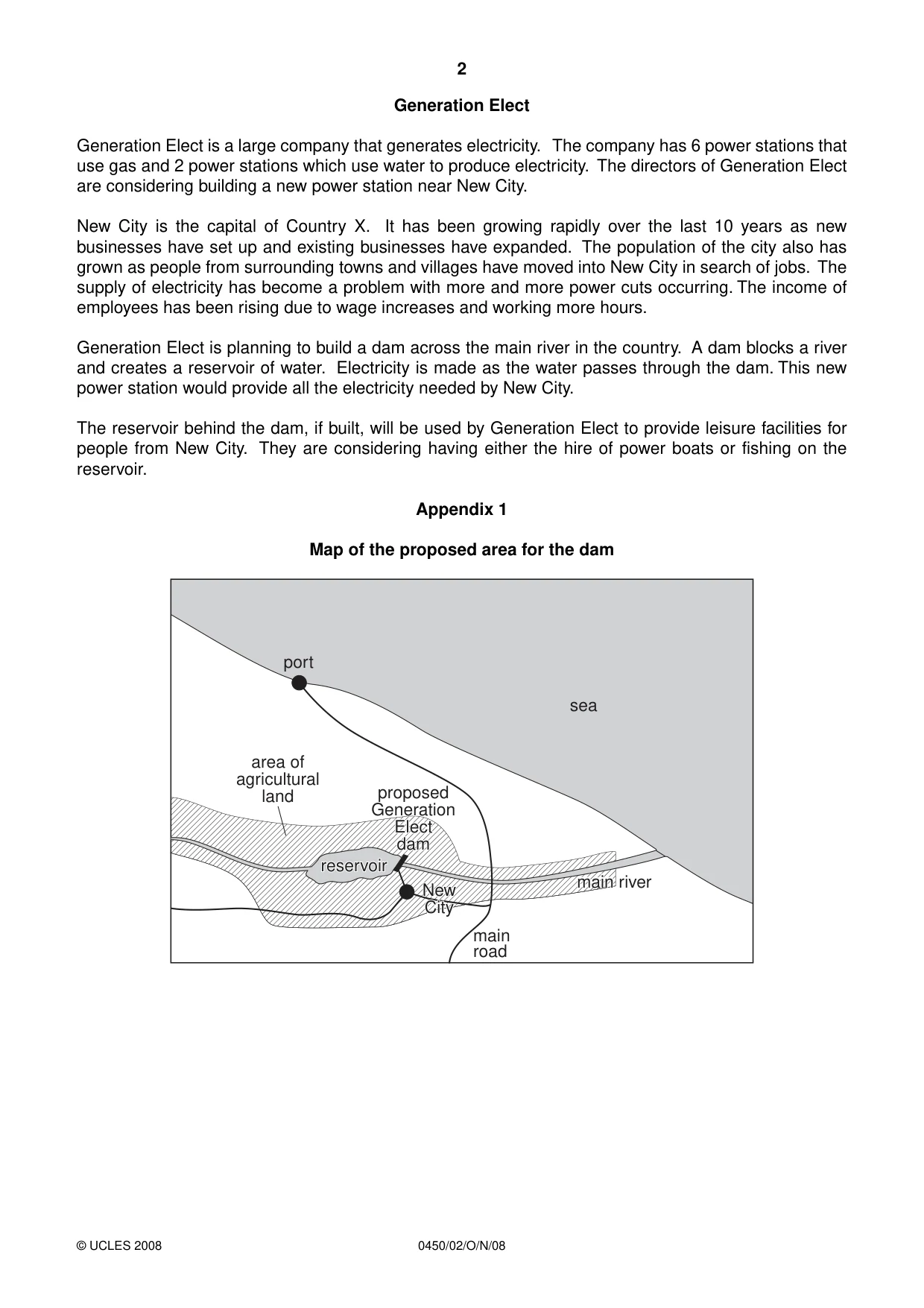
2 0450/02/O/N/08 © UCLES 2008 Generation Elect Generation Elect is a large company that generates electricity. The company has 6 power stations that use gas and 2 power stations which use water to produce electricity. The directors of Generation Elect are considering building a new power station near New City. New City is the capital of Country X. It has been growing rapidly over the last 10 years as new businesses have set up and existing businesses have expanded. The population of the city also has grown as people from surrounding towns and villages have moved into New City in search of jobs. The supply of electricity has become a problem with more and more power cuts occurring. The income of employees has been rising due to wage increases and working more hours. Generation Elect is planning to build a dam across the main river in the country. A dam blocks a river and creates a reservoir of water. Electricity is made as the water passes through the dam. This new power station would provide all the electricity needed by New City. The reservoir behind the dam, if built, will be used by Generation Elect to provide leisure facilities for people from New City. They are considering having either the hire of power boats or fishing on the reservoir. Appendix 1 Map of the proposed area for the dam port sea main river main river main river main road New New City City New City proposed proposed Generation Generation Elect Elect dam dam proposed Generation Elect dam area of agricultural land reservoir reservoir reservoir
Question paper, page 3
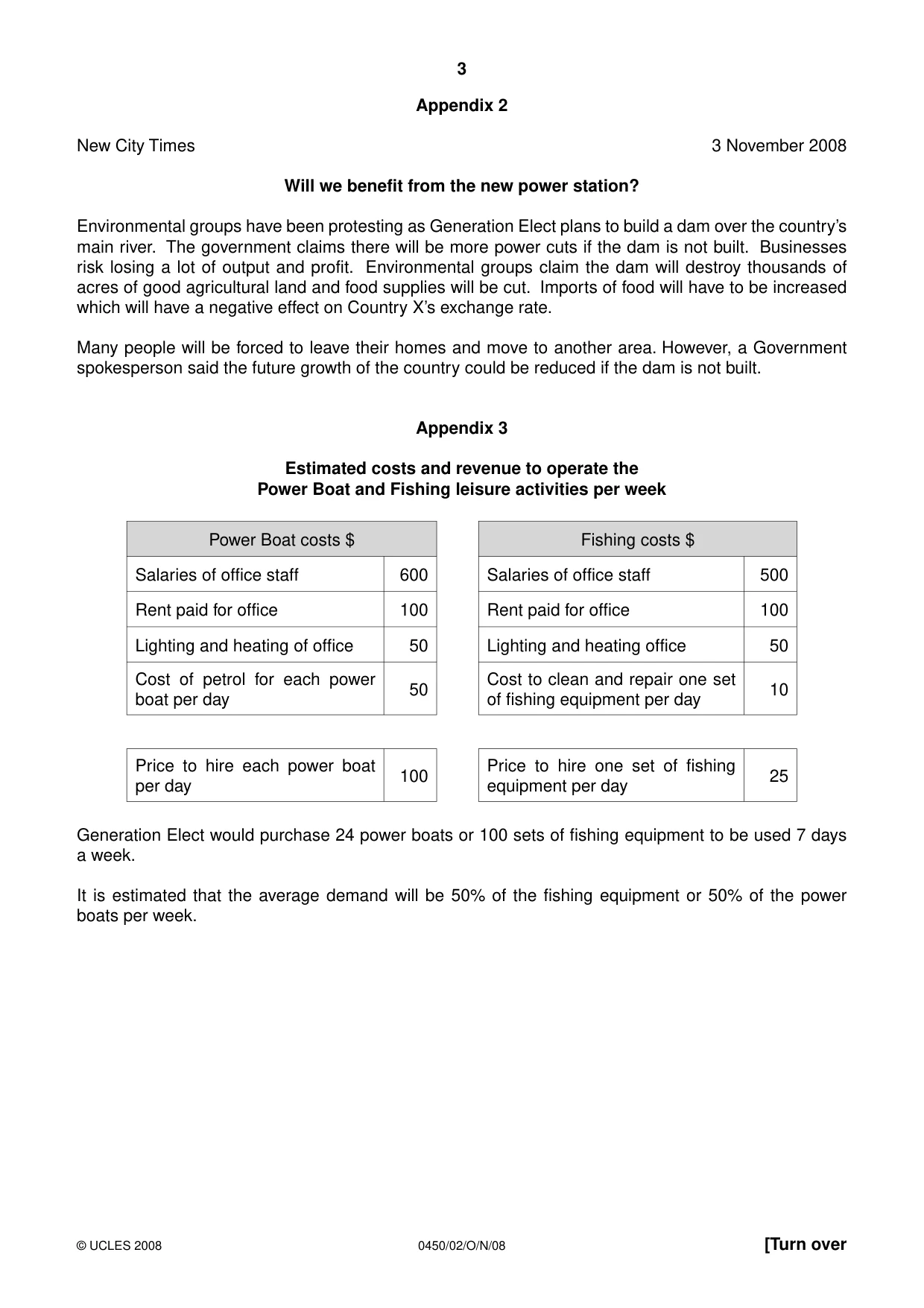
3 0450/02/O/N/08 © UCLES 2008 [Turn over Appendix 2 New City Times 3 November 2008 Will we benefit from the new power station? Environmental groups have been protesting as Generation Elect plans to build a dam over the country’s main river. The government claims there will be more power cuts if the dam is not built. Businesses risk losing a lot of output and profit. Environmental groups claim the dam will destroy thousands of acres of good agricultural land and food supplies will be cut. Imports of food will have to be increased which will have a negative effect on Country X’s exchange rate. Many people will be forced to leave their homes and move to another area. However, a Government spokesperson said the future growth of the country could be reduced if the dam is not built. Appendix 3 Estimated costs and revenue to operate the Power Boat and Fishing leisure activities per week Power Boat costs $ Fishing costs $ Salaries of office staff 600 Salaries of office staff 500 Rent paid for office 100 Rent paid for office 100 Lighting and heating of office 50 Lighting and heating office 50 Cost of petrol for each power boat per day 50 Cost to clean and repair one set of fishing equipment per day 10 Price to hire each power boat per day 100 Price to hire one set of fishing equipment per day 25 Generation Elect would purchase 24 power boats or 100 sets of fishing equipment to be used 7 days a week. It is estimated that the average demand will be 50% of the fishing equipment or 50% of the power boats per week.
Question paper, page 4
4 0450/02/O/N/08 For Examiner’s Use © UCLES 2008 1 (a) (i) Identify three stakeholder groups affected by the building of the dam. Stakeholder group 1: … Stakeholder group 2: … Stakeholder group 3: …[3] (ii) For each of the stakeholder groups listed in (i) explain how they would be affected by the building of the dam. … … … … … … … … … … … … … … … … … …[9]
Question paper, page 5
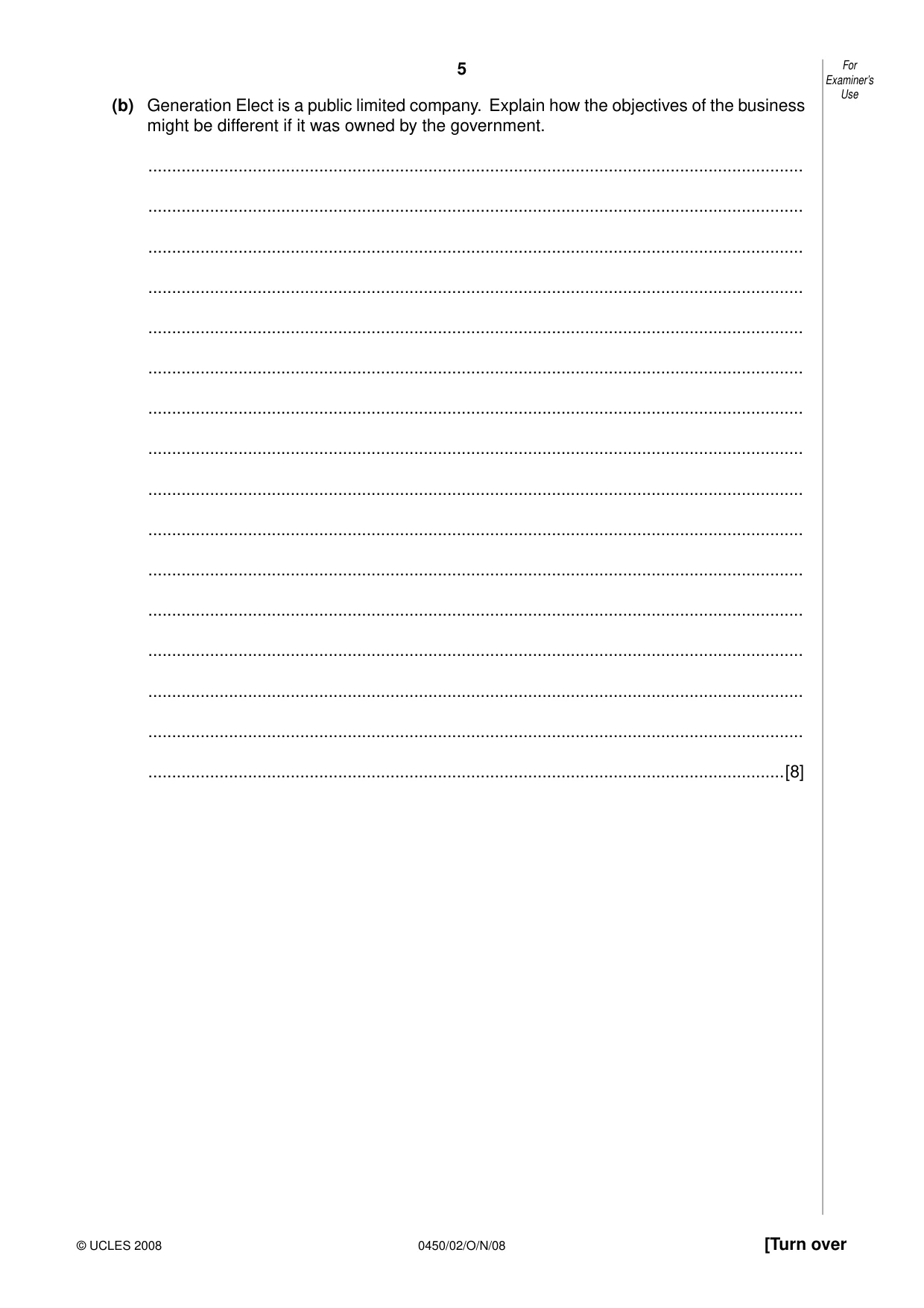
5 0450/02/O/N/08 [Turn over For Examiner’s Use © UCLES 2008 (b) Generation Elect is a public limited company. Explain how the objectives of the business might be different if it was owned by the government. … … … … … … … … … … … … … … … …[8]
Question paper, page 6
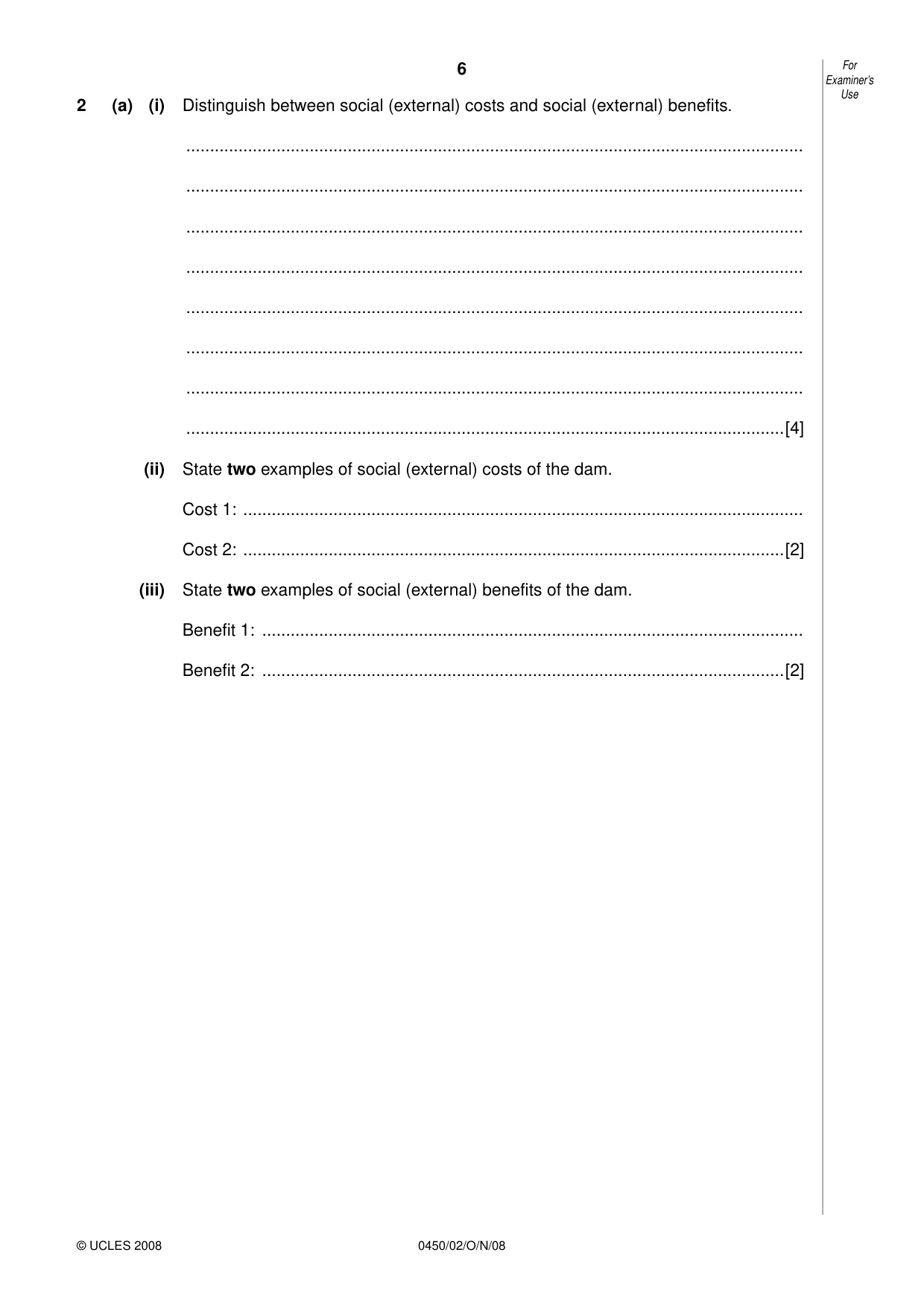
6 0450/02/O/N/08 For Examiner’s Use © UCLES 2008 2 (a) (i) Distinguish between social (external) costs and social (external) benefits. … … … … … … … …[4] (ii) State two examples of social (external) costs of the dam. Cost 1: … Cost 2: …[2] (iii) State two examples of social (external) benefits of the dam. Benefit 1: … Benefit 2: …[2]
Question paper, page 7
7 0450/02/O/N/08 [Turn over For Examiner’s Use © UCLES 2008 (b) Using all of the relevant information available to you, discuss whether or not the building of the dam will be beneficial to Country X. … … … … … … … … … … … … … … … … … … … … … … … …[12]
Question paper, page 8
8 0450/02/O/N/08 For Examiner’s Use © UCLES 2008 3 (a) Generation Elect will need to recruit construction workers to build the dam. Outline the recruitment and selection process Generation Elect will need to follow to employ these workers. … … … … … … … … … … … …[6] (b) Explain why it is important for Generation Elect to recruit skilled construction workers. … … … … … … … … … … … …[6]
Question paper, page 9
9 0450/02/O/N/08 [Turn over For Examiner’s Use © UCLES 2008 (c) All skilled construction workers in Country X are members of a Trade Union. Do you think this is an advantage to Generation Elect? Explain your answer. … … … … … … … … … … … … … … … …[8]
Question paper, page 10
10 0450/02/O/N/08 For Examiner’s Use © UCLES 2008 4 (a) Generation Elect intends to use the reservoir behind the dam to provide either the hire of power boats or fishing equipment for the people of New City. Should Generation Elect use primary research or secondary research to find out which activity will be the most popular? Justify your choice. … … … … … … … … … … … … … … … … … … … …[10]
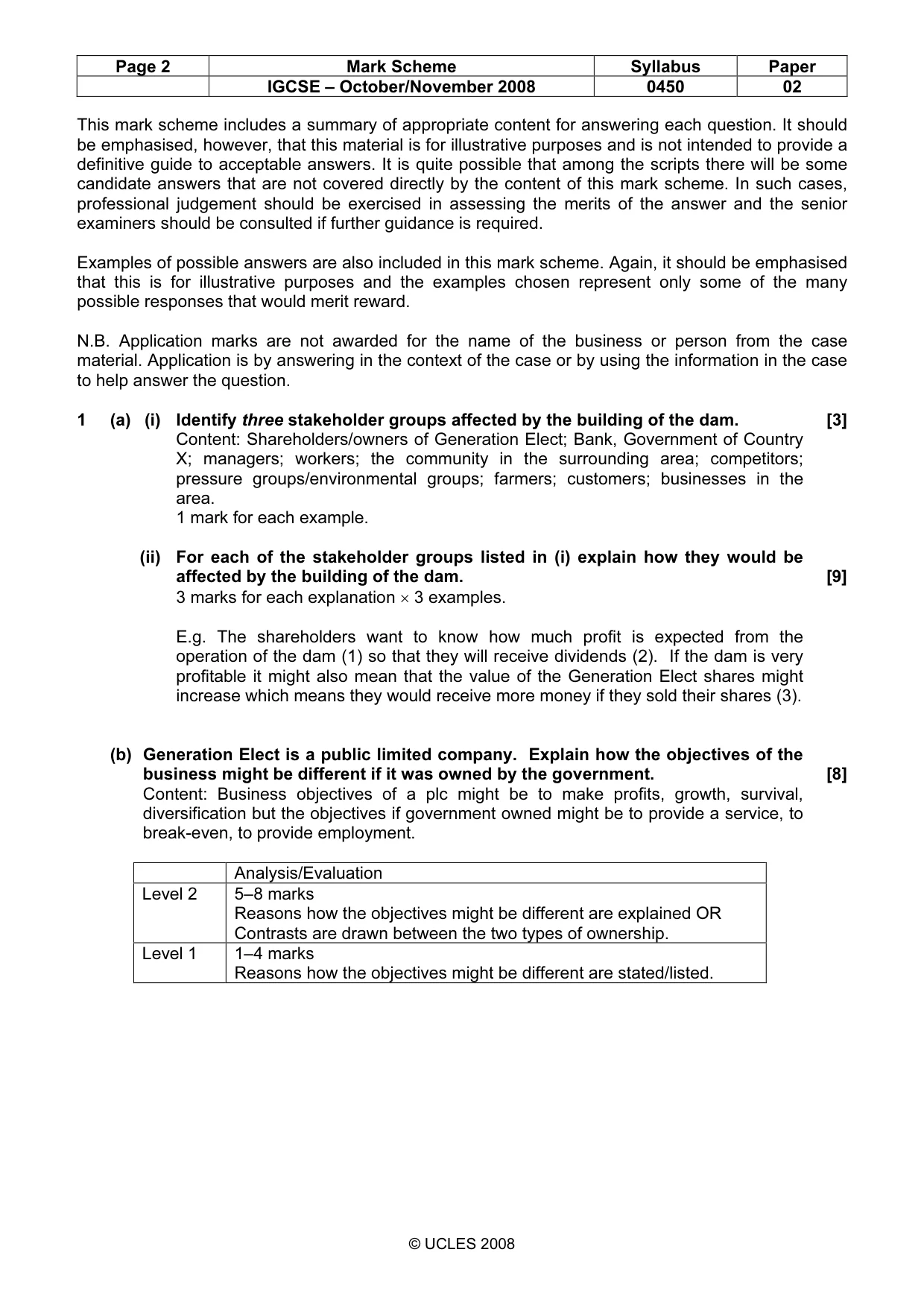
Question paper, page 11
11 0450/02/O/N/08 [Turn over For Examiner’s Use © UCLES 2008 (b) (i) There are no similar leisure activities near to the site of the reservoir. The Marketing Manager is considering using price skimming when setting a price for the new leisure activity. What is meant by price skimming? … … … …[2] (ii) Advise the Marketing Manager on alternative pricing strategies that could be used for the new leisure activity. … … … … … … … … … … … … … … … …[8]
Question paper, page 12
12 0450/02/O/N/08 For Examiner’s Use © UCLES 2008 5 (a) (i) Using the information in Appendix 3, explain the difference between fixed costs and variable costs. … … … … … … … …[4] (ii) Explain the possible financial problems that might arise for Generation Elect if the actual costs of the hire of power boats or fishing equipment were higher than the estimated costs shown in Appendix 3. … … … … … … … … … … … …[6]
Question paper, page 13
13 0450/02/O/N/08 For Examiner’s Use © UCLES 2008 (b) On the basis of the cost and revenue information in Appendix 3, would you advise Generation Elect to provide power boats or fishing equipment for hire? Give reasons for your choice. … … … … … … … … … … … … … … … … … … …[10]
Question paper, page 16
16 0450/02/O/N/08 BLANK PAGE Permission to reproduce items where third-party owned material protected by copyright is included has been sought and cleared where possible. Every reasonable effort has been made by the publisher (UCLES) to trace copyright holders, but if any items requiring clearance have unwittingly been included, the publisher will be pleased to make amends at the earliest possible opportunity. University of Cambridge International Examinations is part of the Cambridge Assessment Group. Cambridge Assessment is the brand name of University of Cambridge Local Examinations Syndicate (UCLES), which is itself a department of the University of Cambridge.
Mark scheme, page 1
UNIVERSITY OF CAMBRIDGE INTERNATIONAL EXAMINATIONS International General Certificate of Secondary Education MARK SCHEME for the October/November 2008 question paper 0450 BUSINESS STUDIES 0450/02 Paper 2 (Case Study), maximum raw mark 100 This mark scheme is published as an aid to teachers and candidates, to indicate the requirements of the examination. It shows the basis on which Examiners were instructed to award marks. It does not indicate the details of the discussions that took place at an Examiners’ meeting before marking began. All Examiners are instructed that alternative correct answers and unexpected approaches in candidates’ scripts must be given marks that fairly reflect the relevant knowledge and skills demonstrated. Mark schemes must be read in conjunction with the question papers and the report on the examination. • CIE will not enter into discussions or correspondence in connection with these mark schemes. CIE is publishing the mark schemes for the October/November 2008 question papers for most IGCSE, GCE Advanced Level and Advanced Subsidiary Level syllabuses and some Ordinary Level syllabuses. www.XtremePapers.com
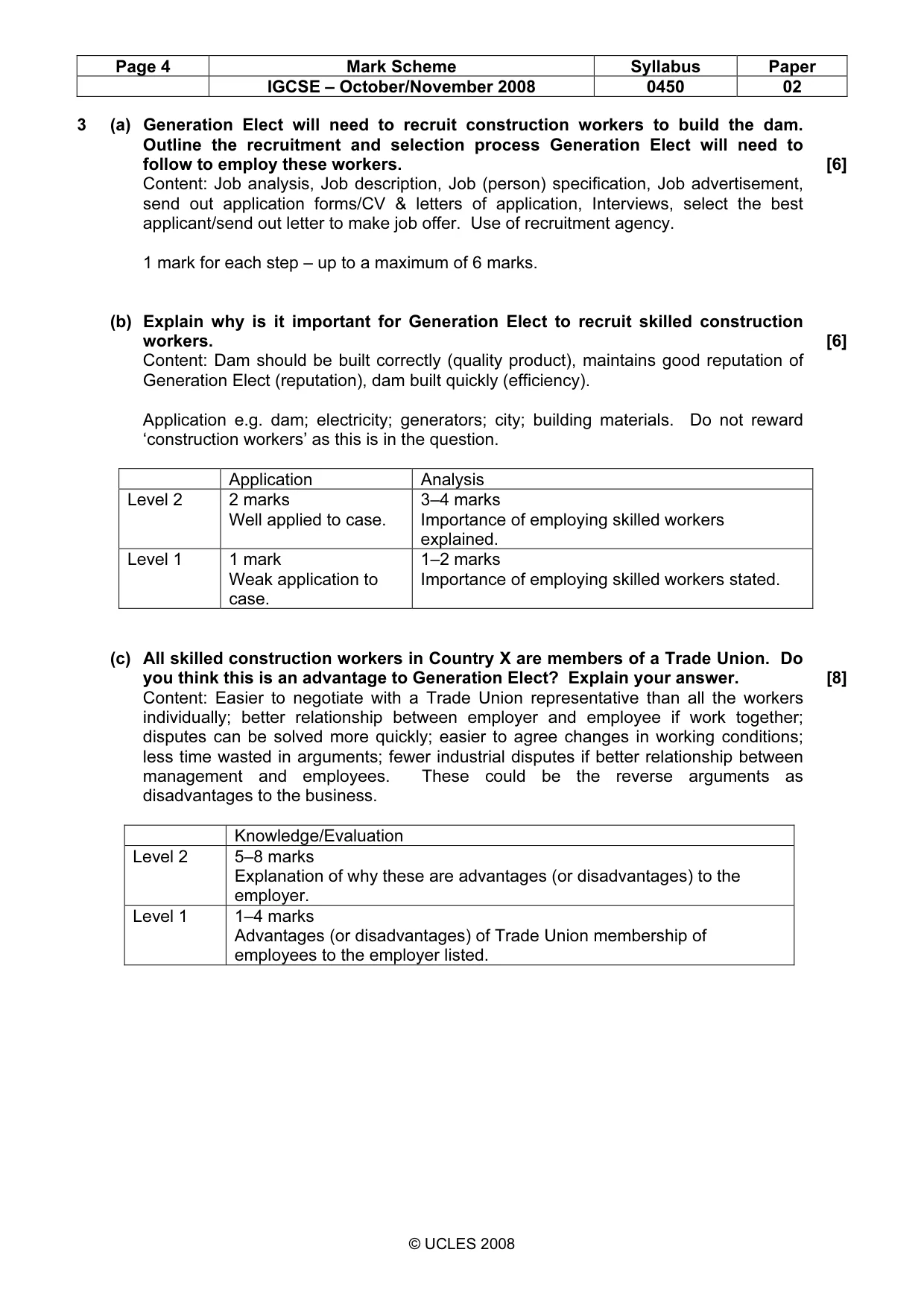
Mark scheme, page 2
Page 2 Mark Scheme Syllabus Paper IGCSE – October/November 2008 0450 02 © UCLES 2008 This mark scheme includes a summary of appropriate content for answering each question. It should be emphasised, however, that this material is for illustrative purposes and is not intended to provide a definitive guide to acceptable answers. It is quite possible that among the scripts there will be some candidate answers that are not covered directly by the content of this mark scheme. In such cases, professional judgement should be exercised in assessing the merits of the answer and the senior examiners should be consulted if further guidance is required. Examples of possible answers are also included in this mark scheme. Again, it should be emphasised that this is for illustrative purposes and the examples chosen represent only some of the many possible responses that would merit reward. N.B. Application marks are not awarded for the name of the business or person from the case material. Application is by answering in the context of the case or by using the information in the case to help answer the question. 1 (a) (i) Identify three stakeholder groups affected by the building of the dam. [3] Content: Shareholders/owners of Generation Elect; Bank, Government of Country X; managers; workers; the community in the surrounding area; competitors; pressure groups/environmental groups; farmers; customers; businesses in the area. 1 mark for each example. (ii) For each of the stakeholder groups listed in (i) explain how they would be affected by the building of the dam. [9] 3 marks for each explanation × 3 examples. E.g. The shareholders want to know how much profit is expected from the operation of the dam (1) so that they will receive dividends (2). If the dam is very profitable it might also mean that the value of the Generation Elect shares might increase which means they would receive more money if they sold their shares (3). (b) Generation Elect is a public limited company. Explain how the objectives of the business might be different if it was owned by the government. [8] Content: Business objectives of a plc might be to make profits, growth, survival, diversification but the objectives if government owned might be to provide a service, to break-even, to provide employment. Analysis/Evaluation Level 2 5–8 marks Reasons how the objectives might be different are explained OR Contrasts are drawn between the two types of ownership. Level 1 1–4 marks Reasons how the objectives might be different are stated/listed.
Mark scheme, page 3
Page 3 Mark Scheme Syllabus Paper IGCSE – October/November 2008 0450 02 © UCLES 2008 2 (a) (i) Distinguish between social (external) costs and social (external) benefits. [4] Content: Social cost is the total cost to society (1) as a result of a business decision (2) (accept private costs + external costs) Social benefit is the total benefit received by society (1) as a result of a business decision (2) (accept private benefit + external benefit) Vague definition – cost or benefit to society – 1 mark each. Clear definition – 2 marks each. (ii) State two examples of social (external) costs of the dam. [2] (iii) State two examples of social (external) benefits of the dam. [2] 1 mark for each suitable example given. 2 marks for costs and 2 marks for benefits. E.g. Costs – destroy agricultural land; food production reduced; increased cost of imported food; people forced to leave their homes; increased pressure on the area where people move to; pollution. Benefits – economic growth; increased business for importers; leisure facilities provided on the reservoir; fewer power cuts; increased employment. (b) Using all of the relevant information available to you, discuss whether or not the building of the dam will be beneficial to Country X. [12] Content: Advantage – no power cuts so business can keep producing their product; increased profits as output will no longer be lost through power cuts; economic growth in Country X as output will be higher; depreciating exchange rate would be beneficial to exporters as their goods may now have lower prices abroad. Disadvantage – may need to increase food imports leading to depreciating exchange rate; increased pressure on other areas as people move from land around the dam and this may lead to rising house prices, overcrowding in schools, etc. Environmental damage on the area around where the dam is being built as this is an area of natural beauty and habitat for wildlife. Application e.g. – growth; employment; city; exchange rate; imports of food; leisure facilities; raw materials required for building the dam; skilled workers; power cuts. Do not reward ‘dam’ as it in the question. Application Analysis/Evaluation Level 3 9–10 marks Level 2 two sided argument + well justified answer – either yes or no. Level 2 2 marks Well applied to the case. 5–8 marks Advantages and disadvantages of building the dam explained. Limited judgement shown. Level 1 1 mark Weak application to the case. 1–4 marks Advantages and disadvantages of building the dam listed. Limited judgement shown.
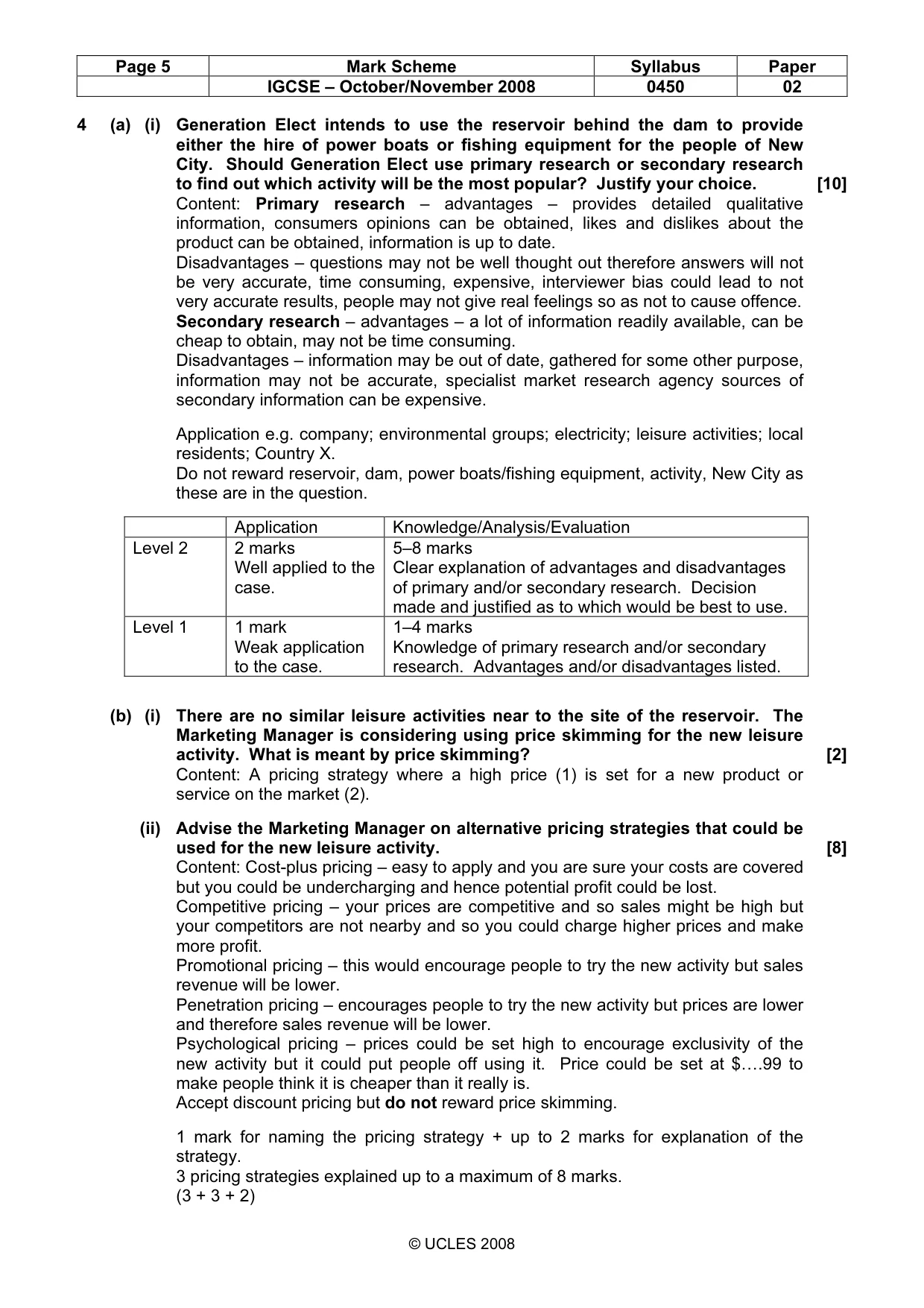
Mark scheme, page 4
Page 4 Mark Scheme Syllabus Paper IGCSE – October/November 2008 0450 02 © UCLES 2008 3 (a) Generation Elect will need to recruit construction workers to build the dam. Outline the recruitment and selection process Generation Elect will need to follow to employ these workers. [6] Content: Job analysis, Job description, Job (person) specification, Job advertisement, send out application forms/CV & letters of application, Interviews, select the best applicant/send out letter to make job offer. Use of recruitment agency. 1 mark for each step – up to a maximum of 6 marks. (b) Explain why is it important for Generation Elect to recruit skilled construction workers. [6] Content: Dam should be built correctly (quality product), maintains good reputation of Generation Elect (reputation), dam built quickly (efficiency). Application e.g. dam; electricity; generators; city; building materials. Do not reward ‘construction workers’ as this is in the question. Application Analysis Level 2 2 marks Well applied to case. 3–4 marks Importance of employing skilled workers explained. Level 1 1 mark Weak application to case. 1–2 marks Importance of employing skilled workers stated. (c) All skilled construction workers in Country X are members of a Trade Union. Do you think this is an advantage to Generation Elect? Explain your answer. [8] Content: Easier to negotiate with a Trade Union representative than all the workers individually; better relationship between employer and employee if work together; disputes can be solved more quickly; easier to agree changes in working conditions; less time wasted in arguments; fewer industrial disputes if better relationship between management and employees. These could be the reverse arguments as disadvantages to the business. Knowledge/Evaluation Level 2 5–8 marks Explanation of why these are advantages (or disadvantages) to the employer. Level 1 1–4 marks Advantages (or disadvantages) of Trade Union membership of employees to the employer listed.
Mark scheme, page 5
Page 5 Mark Scheme Syllabus Paper IGCSE – October/November 2008 0450 02 © UCLES 2008 4 (a) (i) Generation Elect intends to use the reservoir behind the dam to provide either the hire of power boats or fishing equipment for the people of New City. Should Generation Elect use primary research or secondary research to find out which activity will be the most popular? Justify your choice. [10] Content: Primary research – advantages – provides detailed qualitative information, consumers opinions can be obtained, likes and dislikes about the product can be obtained, information is up to date. Disadvantages – questions may not be well thought out therefore answers will not be very accurate, time consuming, expensive, interviewer bias could lead to not very accurate results, people may not give real feelings so as not to cause offence. Secondary research – advantages – a lot of information readily available, can be cheap to obtain, may not be time consuming. Disadvantages – information may be out of date, gathered for some other purpose, information may not be accurate, specialist market research agency sources of secondary information can be expensive. Application e.g. company; environmental groups; electricity; leisure activities; local residents; Country X. Do not reward reservoir, dam, power boats/fishing equipment, activity, New City as these are in the question. Application Knowledge/Analysis/Evaluation Level 2 2 marks Well applied to the case. 5–8 marks Clear explanation of advantages and disadvantages of primary and/or secondary research. Decision made and justified as to which would be best to use. Level 1 1 mark Weak application to the case. 1–4 marks Knowledge of primary research and/or secondary research. Advantages and/or disadvantages listed. (b) (i) There are no similar leisure activities near to the site of the reservoir. The Marketing Manager is considering using price skimming for the new leisure activity. What is meant by price skimming? [2] Content: A pricing strategy where a high price (1) is set for a new product or service on the market (2). (ii) Advise the Marketing Manager on alternative pricing strategies that could be used for the new leisure activity. [8] Content: Cost-plus pricing – easy to apply and you are sure your costs are covered but you could be undercharging and hence potential profit could be lost. Competitive pricing – your prices are competitive and so sales might be high but your competitors are not nearby and so you could charge higher prices and make more profit. Promotional pricing – this would encourage people to try the new activity but sales revenue will be lower. Penetration pricing – encourages people to try the new activity but prices are lower and therefore sales revenue will be lower. Psychological pricing – prices could be set high to encourage exclusivity of the new activity but it could put people off using it. Price could be set at $….99 to make people think it is cheaper than it really is. Accept discount pricing but do not reward price skimming. 1 mark for naming the pricing strategy + up to 2 marks for explanation of the strategy. 3 pricing strategies explained up to a maximum of 8 marks. (3 + 3 + 2)
Mark scheme, page 6
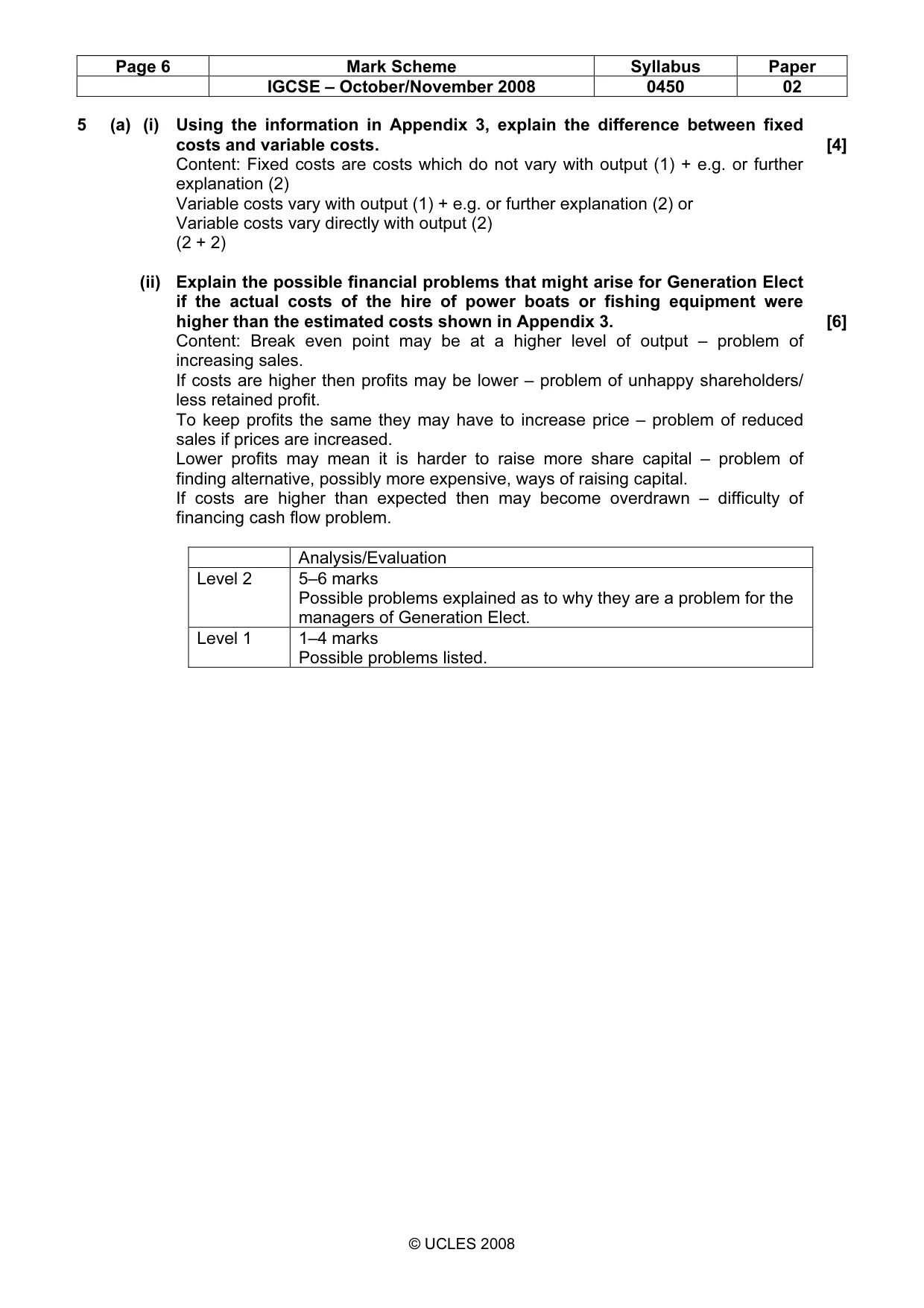
Page 6 Mark Scheme Syllabus Paper IGCSE – October/November 2008 0450 02 © UCLES 2008 5 (a) (i) Using the information in Appendix 3, explain the difference between fixed costs and variable costs. [4] Content: Fixed costs are costs which do not vary with output (1) + e.g. or further explanation (2) Variable costs vary with output (1) + e.g. or further explanation (2) or Variable costs vary directly with output (2) (2 + 2) (ii) Explain the possible financial problems that might arise for Generation Elect if the actual costs of the hire of power boats or fishing equipment were higher than the estimated costs shown in Appendix 3. [6] Content: Break even point may be at a higher level of output – problem of increasing sales. If costs are higher then profits may be lower – problem of unhappy shareholders/ less retained profit. To keep profits the same they may have to increase price – problem of reduced sales if prices are increased. Lower profits may mean it is harder to raise more share capital – problem of finding alternative, possibly more expensive, ways of raising capital. If costs are higher than expected then may become overdrawn – difficulty of financing cash flow problem. Analysis/Evaluation Level 2 5–6 marks Possible problems explained as to why they are a problem for the managers of Generation Elect. Level 1 1–4 marks Possible problems listed.
Mark scheme, page 7
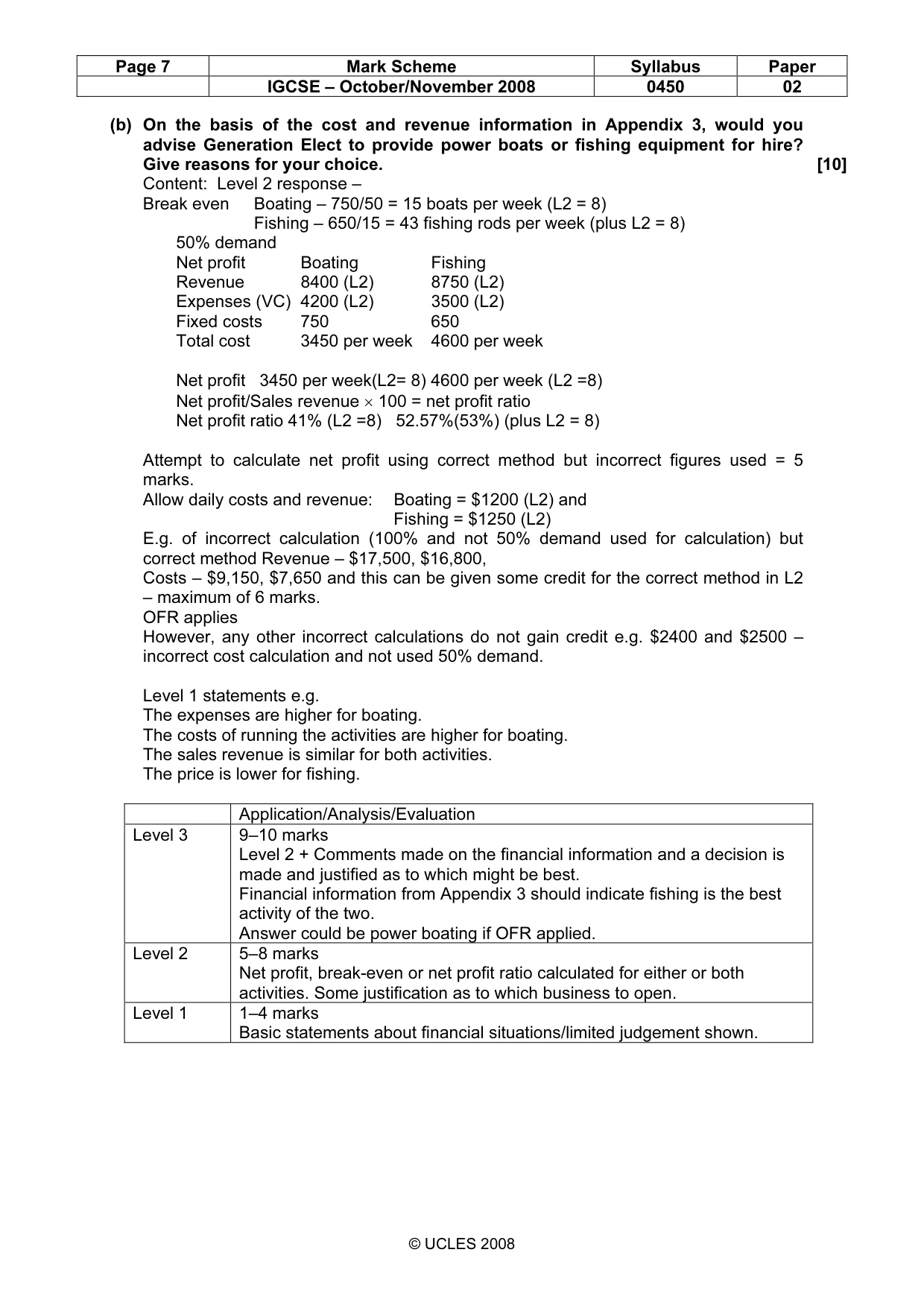
Page 7 Mark Scheme Syllabus Paper IGCSE – October/November 2008 0450 02 © UCLES 2008 (b) On the basis of the cost and revenue information in Appendix 3, would you advise Generation Elect to provide power boats or fishing equipment for hire? Give reasons for your choice. [10] Content: Level 2 response – Break even Boating – 750/50 = 15 boats per week (L2 = 8) Fishing – 650/15 = 43 fishing rods per week (plus L2 = 8) 50% demand Net profit Boating Fishing Revenue 8400 (L2) 8750 (L2) Expenses (VC) 4200 (L2) 3500 (L2) Fixed costs 750 650 Total cost 3450 per week 4600 per week Net profit 3450 per week(L2= 8) 4600 per week (L2 =8) Net profit/Sales revenue × 100 = net profit ratio Net profit ratio 41% (L2 =8) 52.57%(53%) (plus L2 = 8) Attempt to calculate net profit using correct method but incorrect figures used = 5 marks. Allow daily costs and revenue: Boating = $1200 (L2) and Fishing = $1250 (L2) E.g. of incorrect calculation (100% and not 50% demand used for calculation) but correct method Revenue – $17,500, $16,800, Costs – $9,150, $7,650 and this can be given some credit for the correct method in L2 – maximum of 6 marks. OFR applies However, any other incorrect calculations do not gain credit e.g. $2400 and $2500 – incorrect cost calculation and not used 50% demand. Level 1 statements e.g. The expenses are higher for boating. The costs of running the activities are higher for boating. The sales revenue is similar for both activities. The price is lower for fishing. Application/Analysis/Evaluation Level 3 9–10 marks Level 2 + Comments made on the financial information and a decision is made and justified as to which might be best. Financial information from Appendix 3 should indicate fishing is the best activity of the two. Answer could be power boating if OFR applied. Level 2 5–8 marks Net profit, break-even or net profit ratio calculated for either or both activities. Some justification as to which business to open. Level 1 1–4 marks Basic statements about financial situations/limited judgement shown.
What you needed in this session
Cambridge’s own grade thresholds for 2008 Oct/Nov, Paper 2 · Variant 1. A higher threshold means an easier paper — the bar moves with how the cohort did.