Cambridge IGCSE Business Studies 0450 — 2008 May/June Paper 2 · Variant 1
0450/21/M/J/08 · 100 marks · ≈113 min
The question paper and its mark scheme, free to read here and free to download. This is Cambridge’s own paper, exactly as it was sat.
Question paper16 pages

Mark scheme6 pages
Answers below. Sit the paper first if you are practising.
Paper as text
Question paper, page 1
This document consists of 16 printed pages. SP (SJF4739/DT) T49255/2 © UCLES 2008 [Turn over UNIVERSITY OF CAMBRIDGE INTERNATIONAL EXAMINATIONS International General Certificate of Secondary Education READ THESE INSTRUCTIONS FIRST Write your Centre number, candidate number and name on all the work you hand in. Write in dark blue or black pen. Do not use staples, paper clips, highlighters, glue or correction fluid. DO NOT WRITE IN ANY BARCODES. Answer all questions. The businesses described in this question paper are entirely fictitious. At the end of the examination, fasten all your work securely together. The number of marks is given in brackets [ ] at the end of each question or part question. * 0 0 0 6 5 5 8 9 1 3 * CANDIDATE NAME CENTRE NUMBER CANDIDATE NUMBER BUSINESS STUDIES 0450/02 Paper 2 May/June 2008 1 hour 45 minutes Candidates answer on the Question Paper No Additional Materials are required. For Examiner’s Use 1 2 3 4 5 Total www.XtremePapers.com
Question paper, page 2
2 0450/02/M/J/08 © UCLES 2008 A new business – but which one? Abdul’s job is to repair cars. He works for a large car sales business that sells new and secondhand cars. Abdul’s uncle died earlier this year and left him $5 000. He has always wanted to work for himself and now he has some money to start his own business. He could do this by buying a franchise. Abdul’s wife is a qualified accountant. She works for a company that owns several furniture shops. Abdul is going to choose between opening his own car repair business or buying a franchise from a big furniture retail business. To open his own car repair business will take a lot of effort to find a suitable location with the equipment needed. Buying a franchise for a furniture shop will be expensive. However, the franchise company will help Abdul with a lot of the start-up problems such as finding a suitable shop. Abdul will need to employ staff whichever business he sets up. The car repair business will need qualified car repair workers and the furniture shop will require sales staff. Abdul and his wife live in a large city in Country X. The country has a population of 10 million who are enjoying increasing incomes as there has been economic growth in Country X in recent years. However, unemployment is still a problem. Abdul has carried out some market research for the car repair business as shown in Appendix 3. He has also prepared two profit forecasts for the businesses and these are given in Appendix 1.
Question paper, page 3
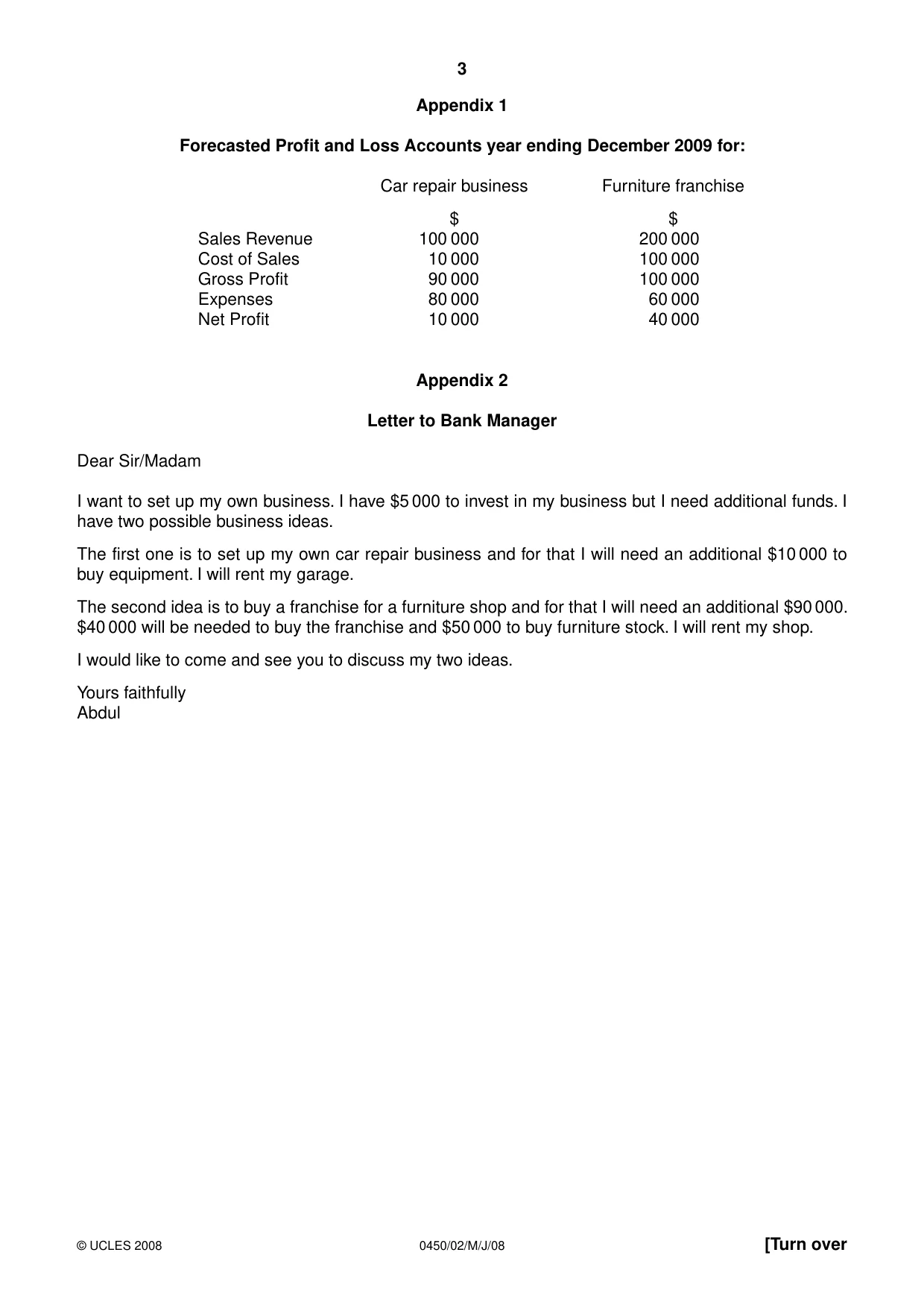
3 0450/02/M/J/08 © UCLES 2008 [Turn over Appendix 1 Forecasted Profit and Loss Accounts year ending December 2009 for: Car repair business Furniture franchise $ $ Sales Revenue 100 000 200 000 Cost of Sales 10 000 100 000 Gross Profit 90 000 100 000 Expenses 80 000 60 000 Net Profit 10 000 40 000 Appendix 2 Letter to Bank Manager Dear Sir/Madam I want to set up my own business. I have $5 000 to invest in my business but I need additional funds. I have two possible business ideas. The first one is to set up my own car repair business and for that I will need an additional $10 000 to buy equipment. I will rent my garage. The second idea is to buy a franchise for a furniture shop and for that I will need an additional $90 000. $40 000 will be needed to buy the franchise and $50 000 to buy furniture stock. I will rent my shop. I would like to come and see you to discuss my two ideas. Yours faithfully Abdul
Question paper, page 4
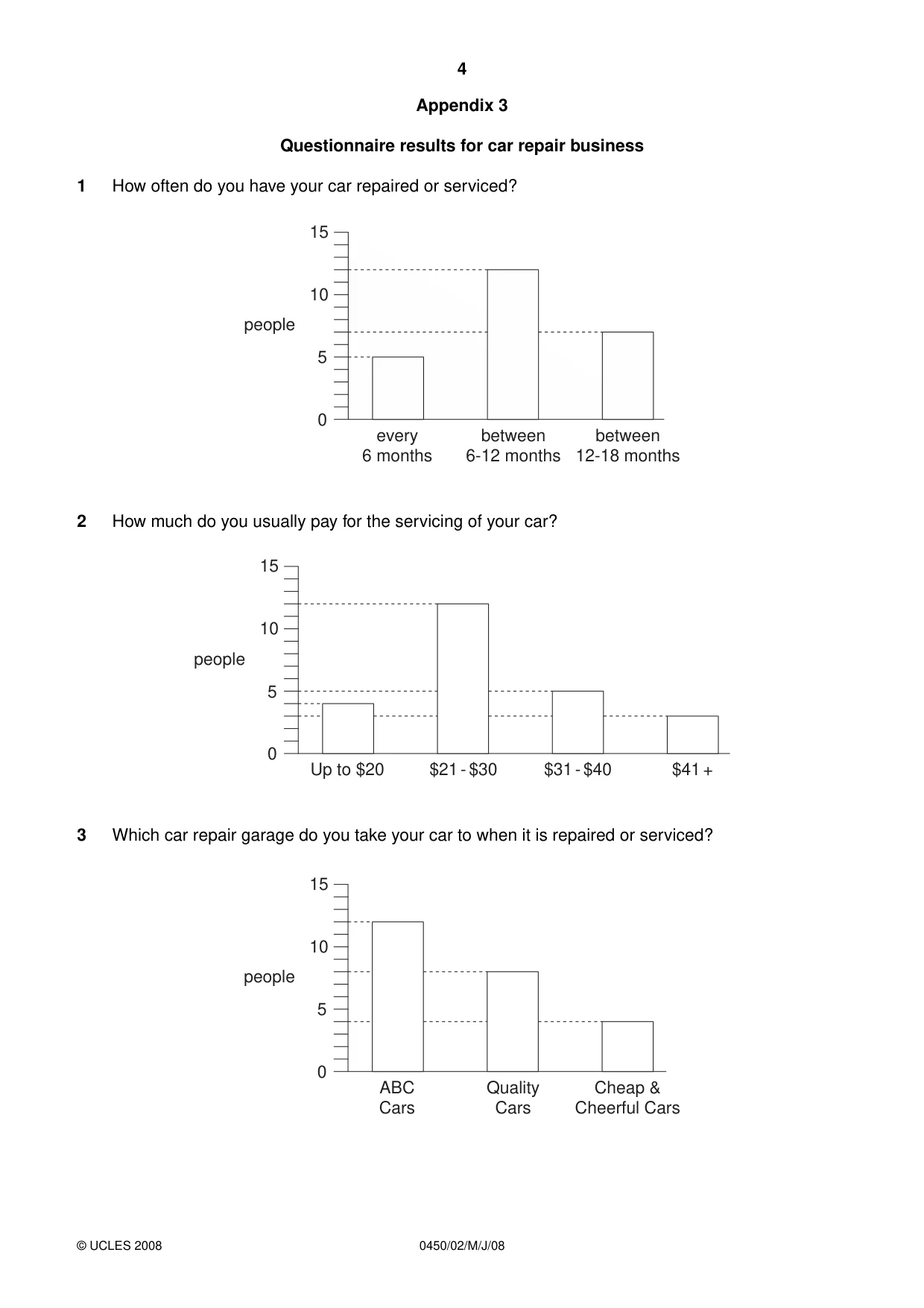
4 0450/02/M/J/08 © UCLES 2008 Appendix 3 Questionnaire results for car repair business 1 How often do you have your car repaired or serviced? 0 5 10 15 people every 6 months between 6-12 months between 12-18 months 2 How much do you usually pay for the servicing of your car? 0 5 10 15 people Up to $20 $21 - $30 $41 + $31 - $40 3 Which car repair garage do you take your car to when it is repaired or serviced? 0 5 10 15 people ABC Cars Quality Cars Cheap & Cheerful Cars
Question paper, page 5
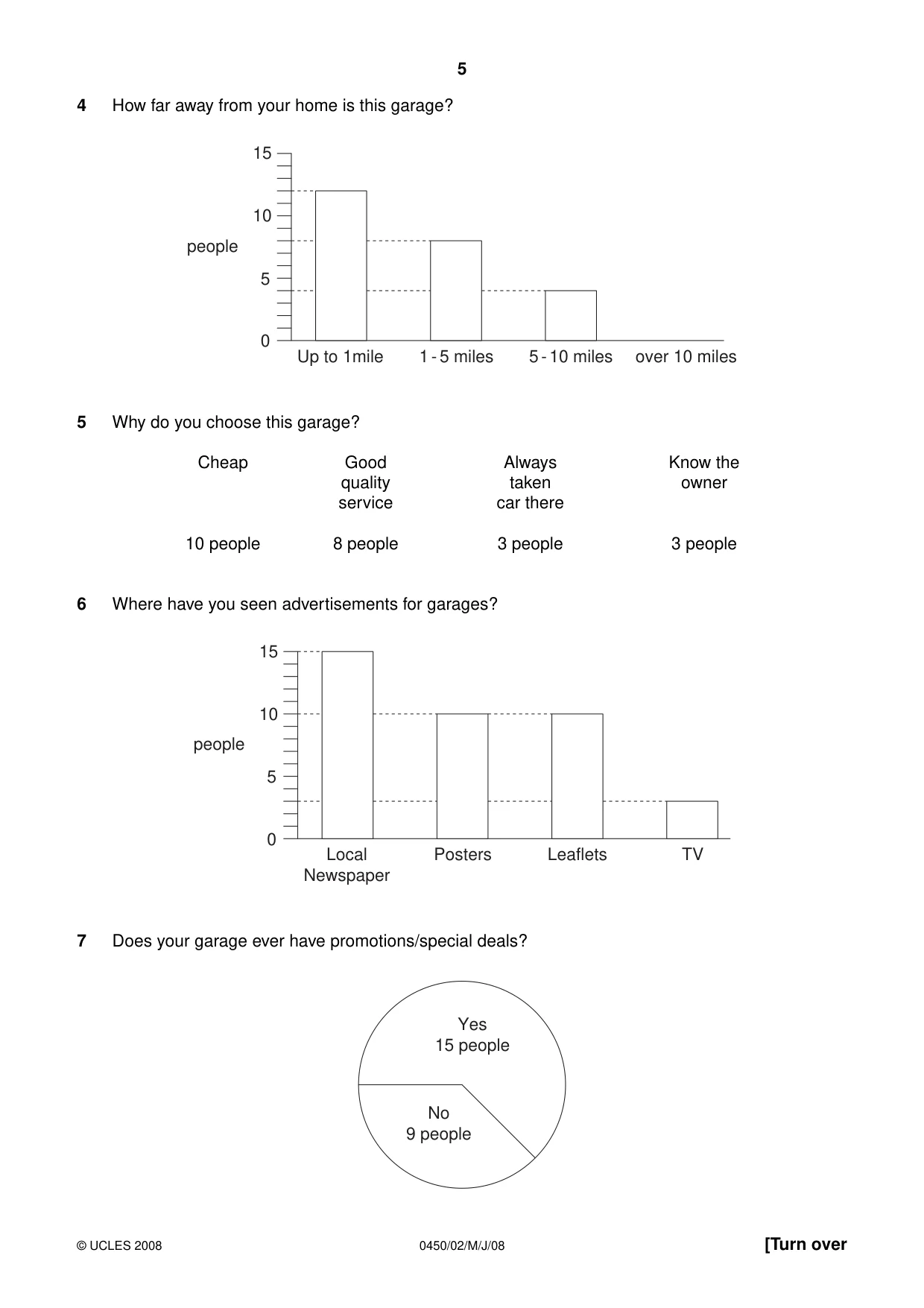
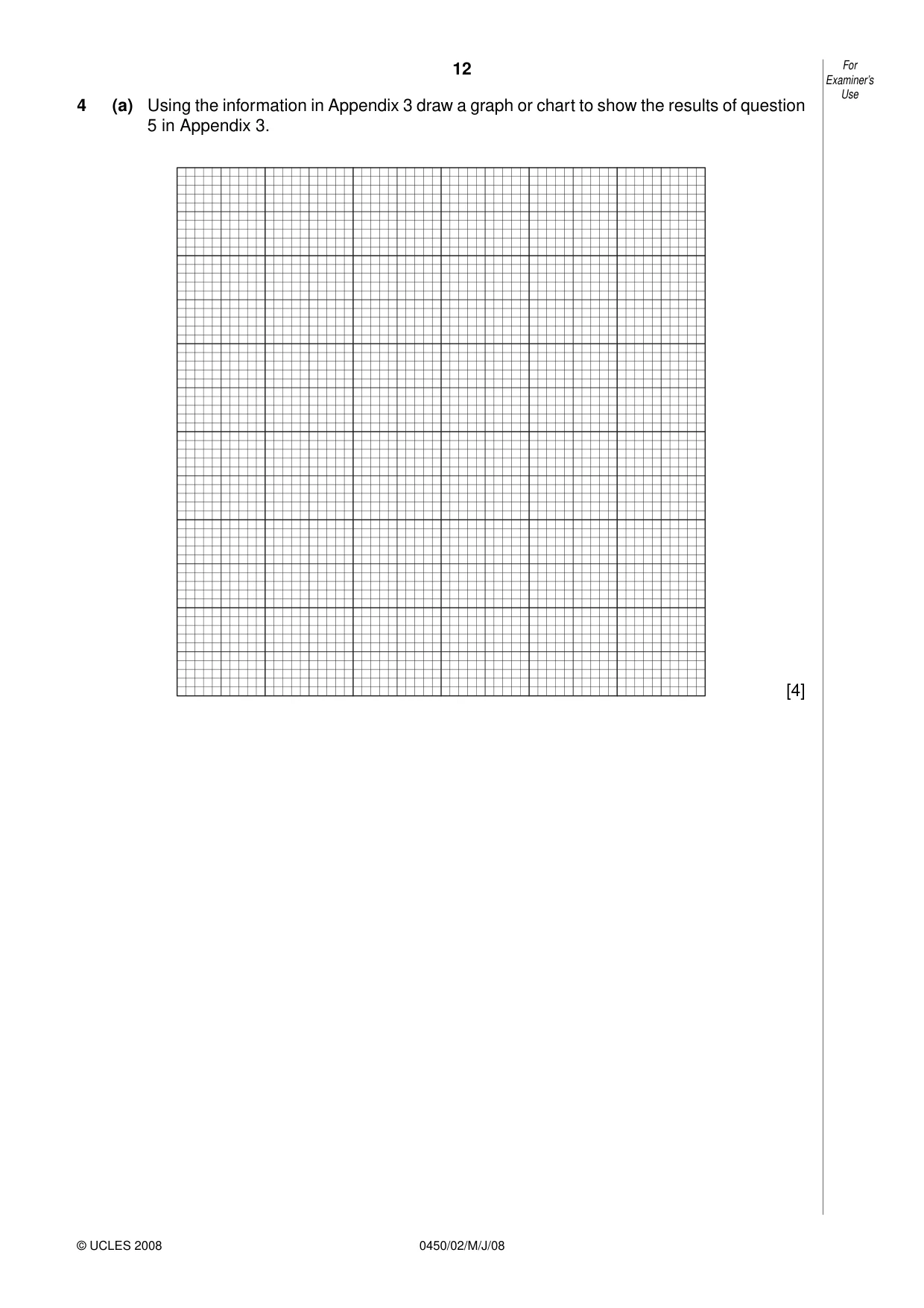
5 0450/02/M/J/08 © UCLES 2008 [Turn over 4 How far away from your home is this garage? 0 5 10 15 people Up to 1mile 1 - 5 miles 5 - 10 miles over 10 miles 5 Why do you choose this garage? Cheap Good Always Know the quality taken owner service car there 10 people 8 people 3 people 3 people 6 Where have you seen advertisements for garages? 0 5 10 15 people Local Newspaper Posters Leaflets TV 7 Does your garage ever have promotions/special deals? Yes 15 people No 9 people
Question paper, page 6
6 0450/02/M/J/08 For Examiner’s Use © UCLES 2008 1 (a) (i) Abdul has made an appointment to see the Bank Manager. List three suitable questions the Bank Manager might ask Abdul before deciding whether to give him the capital he will need. Bank Manager’s Question 1: … … Bank Manager’s Question 2: … … Bank Manager’s Question 3: … … [3] (ii) For each of the three questions, explain why the Bank Manager would ask the question. Explanation (Question 1): … … … … … … Explanation (Question 2): … … … … … … Explanation (Question 3): … … … … … … [9]
Question paper, page 7
7 0450/02/M/J/08 [Turn over For Examiner’s Use © UCLES 2008 (b) How useful would break-even analysis be to Abdul in helping him choose between the two business options? Explain your answer. … … … … … … … … … … … … … … … … [8]
Question paper, page 8
8 0450/02/M/J/08 For Examiner’s Use © UCLES 2008 2 (a) Abdul is considering buying a franchise for a furniture shop. What are the advantages and disadvantages for Abdul of buying a franchise from a big furniture retail business instead of setting up his own furniture shop? Advantages: … … … … … … … … … … Disadvantages: … … … … … … … … … … [10]
Question paper, page 9
9 0450/02/M/J/08 [Turn over For Examiner’s Use © UCLES 2008 (b) A suitable location will be needed if Abdul decides to open the furniture shop. Discuss the most important factors that will affect this decision of where to locate his furniture shop. … … … … … … … … … … … … … … … … … … … … [10]
Question paper, page 10
10 0450/02/M/J/08 For Examiner’s Use © UCLES 2008 3 (a) Abdul has to decide which business to open. Using the financial information in Appendices 1 and 2, compare the profitability of the two businesses and advise Abdul which one to open. Give reasons for your choice. … … … … … … … … … … … … … … … … … … … … … … … … [12]
Question paper, page 11
11 0450/02/M/J/08 [Turn over For Examiner’s Use © UCLES 2008 (b) Governments often help new businesses to start up. Explain why the government of Country X might help Abdul to start his business. … … … … … … … … … … … … … … … … [8]
Question paper, page 12
12 0450/02/M/J/08 For Examiner’s Use © UCLES 2008 4 (a) Using the information in Appendix 3 draw a graph or chart to show the results of question 5 in Appendix 3. [4]
Question paper, page 13
13 0450/02/M/J/08 [Turn over For Examiner’s Use © UCLES 2008 (b) Abdul has carried out market research for the car repair business and a summary of the results are in Appendix 3. How would this information help Abdul when deciding on the marketing for this business? … … … … … … … … … … … … … … … … … … … … [10]
Question paper, page 14
14 0450/02/M/J/08 For Examiner’s Use © UCLES 2008 (c) How useful would the Internet be to Abdul if he set up the car repair business? … … … … … … … … … … … … [6]
Question paper, page 15
15 0450/02/M/J/08 [Turn over For Examiner’s Use © UCLES 2008 5 (a) Abdul will need to employ sales staff if he opens the furniture shop. Advise him on the best ways to recruit and select new staff. … … … … … … … … … … … … … … … … … … … … [10]
Question paper, page 16
16 0450/02/M/J/08 For Examiner’s Use © UCLES 2008 Permission to reproduce items where third-party owned material protected by copyright is included has been sought and cleared where possible. Every reasonable effort has been made by the publisher (UCLES) to trace copyright holders, but if any items requiring clearance have unwittingly been included, the publisher will be pleased to make amends at the earliest possible opportunity. University of Cambridge International Examinations is part of the Cambridge Assessment Group. Cambridge Assessment is the brand name of University of Cambridge Local Examinations Syndicate (UCLES), which is itself a department of the University of Cambridge. (b) To be successful the furniture shop will need motivated sales staff. Advise Abdul on how he could motivate his sales staff. … … … … … … … … … … … … … … … … … … … … [10]
Mark scheme, page 1
UNIVERSITY OF CAMBRIDGE INTERNATIONAL EXAMINATIONS International General Certificate of Secondary Education MARK SCHEME for the May/June 2008 question paper 0450 BUSINESS STUDIES 0450/02 Paper 2 (Case Study), maximum raw mark 100 This mark scheme is published as an aid to teachers and candidates, to indicate the requirements of the examination. It shows the basis on which Examiners were instructed to award marks. It does not indicate the details of the discussions that took place at an Examiners’ meeting before marking began. All Examiners are instructed that alternative correct answers and unexpected approaches in candidates’ scripts must be given marks that fairly reflect the relevant knowledge and skills demonstrated. Mark schemes must be read in conjunction with the question papers and the report on the examination. • CIE will not enter into discussions or correspondence in connection with these mark schemes. CIE is publishing the mark schemes for the May/June 2008 question papers for most IGCSE, GCE Advanced Level and Advanced Subsidiary Level syllabuses and some Ordinary Level syllabuses. www.XtremePapers.com
Mark scheme, page 2
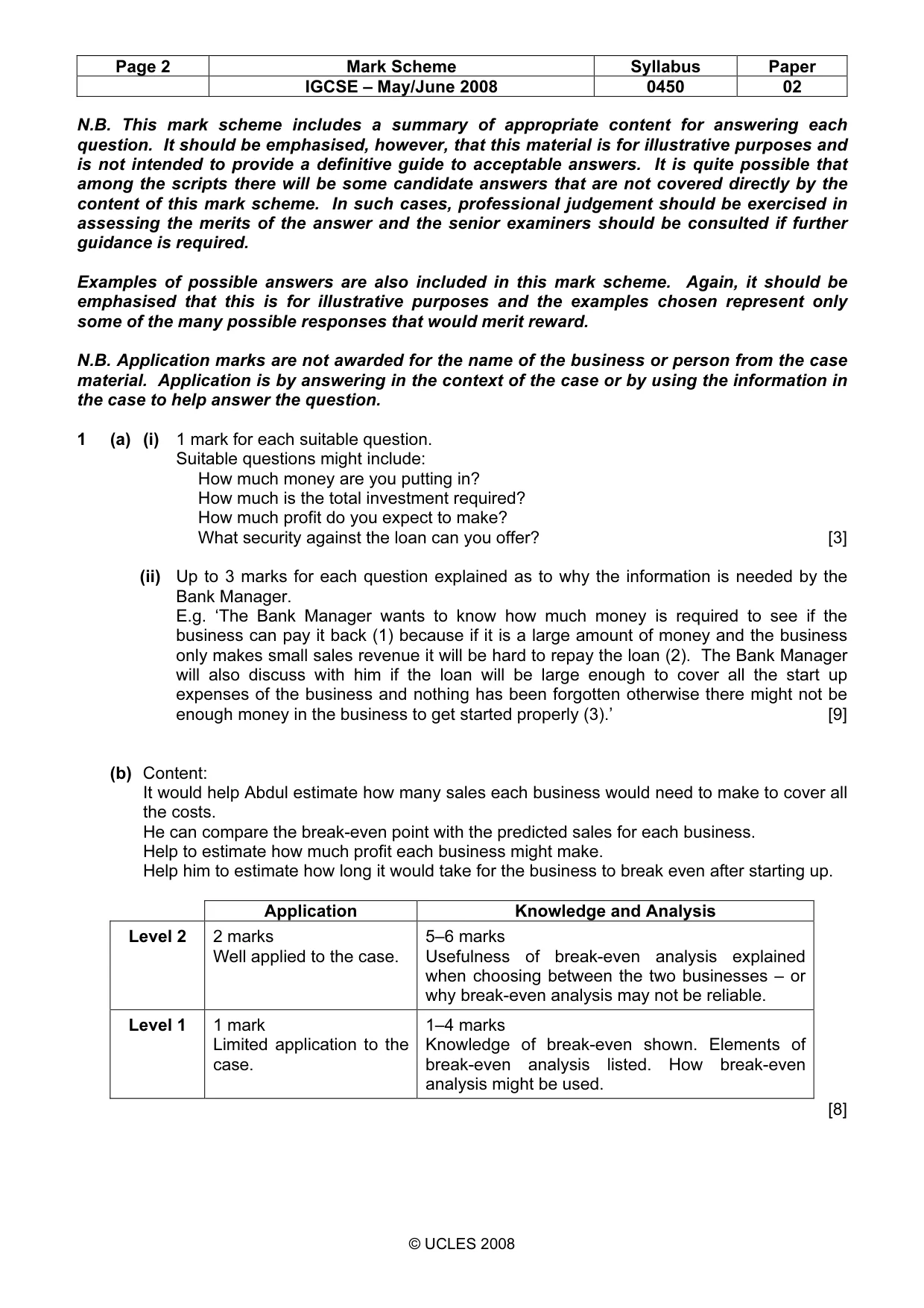
Page 2 Mark Scheme Syllabus Paper IGCSE – May/June 2008 0450 02 © UCLES 2008 N.B. This mark scheme includes a summary of appropriate content for answering each question. It should be emphasised, however, that this material is for illustrative purposes and is not intended to provide a definitive guide to acceptable answers. It is quite possible that among the scripts there will be some candidate answers that are not covered directly by the content of this mark scheme. In such cases, professional judgement should be exercised in assessing the merits of the answer and the senior examiners should be consulted if further guidance is required. Examples of possible answers are also included in this mark scheme. Again, it should be emphasised that this is for illustrative purposes and the examples chosen represent only some of the many possible responses that would merit reward. N.B. Application marks are not awarded for the name of the business or person from the case material. Application is by answering in the context of the case or by using the information in the case to help answer the question. 1 (a) (i) 1 mark for each suitable question. Suitable questions might include: How much money are you putting in? How much is the total investment required? How much profit do you expect to make? What security against the loan can you offer? [3] (ii) Up to 3 marks for each question explained as to why the information is needed by the Bank Manager. E.g. ‘The Bank Manager wants to know how much money is required to see if the business can pay it back (1) because if it is a large amount of money and the business only makes small sales revenue it will be hard to repay the loan (2). The Bank Manager will also discuss with him if the loan will be large enough to cover all the start up expenses of the business and nothing has been forgotten otherwise there might not be enough money in the business to get started properly (3).’ [9] (b) Content: It would help Abdul estimate how many sales each business would need to make to cover all the costs. He can compare the break-even point with the predicted sales for each business. Help to estimate how much profit each business might make. Help him to estimate how long it would take for the business to break even after starting up. Application Knowledge and Analysis Level 2 2 marks Well applied to the case. 5–6 marks Usefulness of break-even analysis explained when choosing between the two businesses – or why break-even analysis may not be reliable. Level 1 1 mark Limited application to the case. 1–4 marks Knowledge of break-even shown. Elements of break-even analysis listed. How break-even analysis might be used. [8]
Mark scheme, page 3
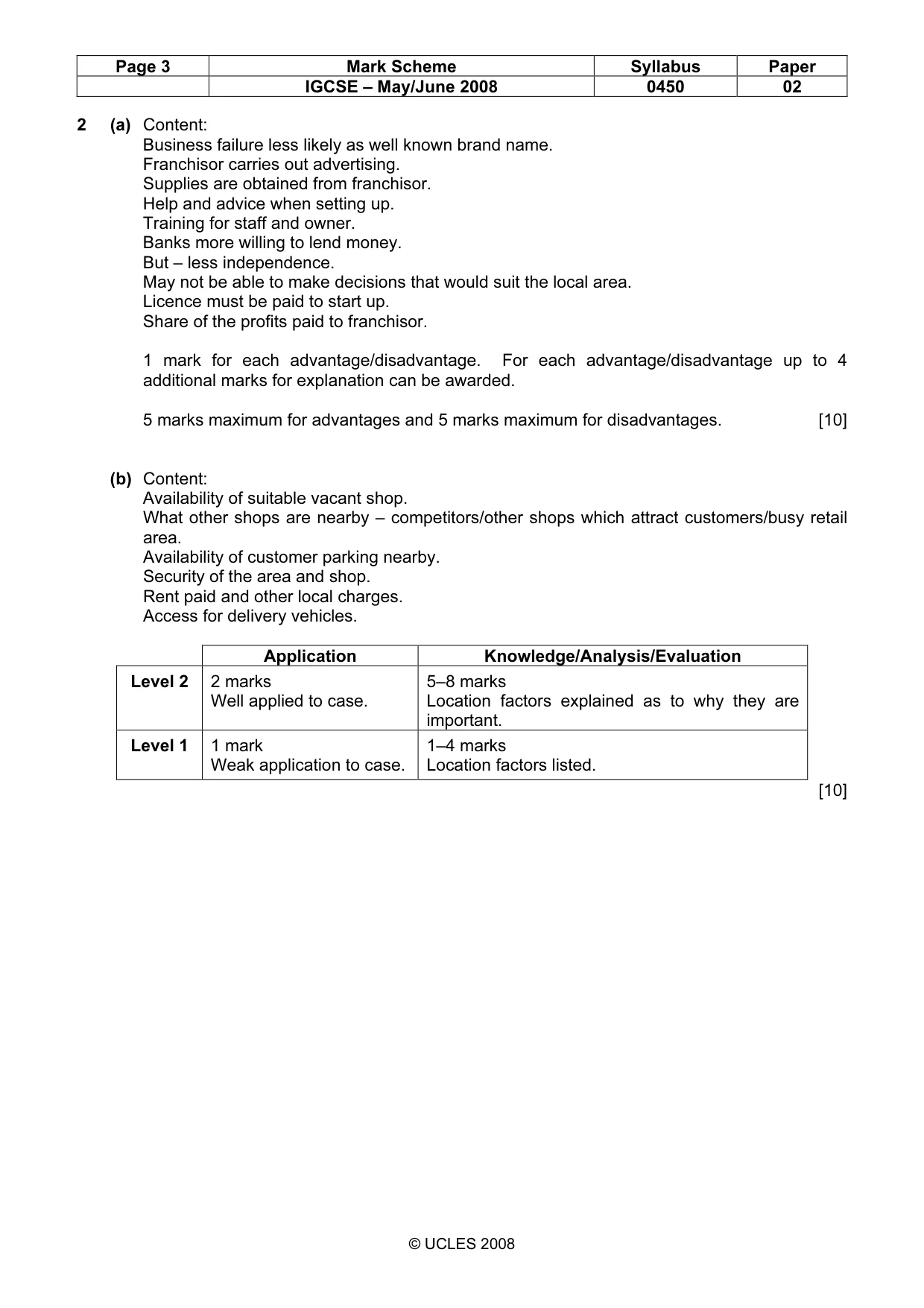
Page 3 Mark Scheme Syllabus Paper IGCSE – May/June 2008 0450 02 © UCLES 2008 2 (a) Content: Business failure less likely as well known brand name. Franchisor carries out advertising. Supplies are obtained from franchisor. Help and advice when setting up. Training for staff and owner. Banks more willing to lend money. But – less independence. May not be able to make decisions that would suit the local area. Licence must be paid to start up. Share of the profits paid to franchisor. 1 mark for each advantage/disadvantage. For each advantage/disadvantage up to 4 additional marks for explanation can be awarded. 5 marks maximum for advantages and 5 marks maximum for disadvantages. [10] (b) Content: Availability of suitable vacant shop. What other shops are nearby – competitors/other shops which attract customers/busy retail area. Availability of customer parking nearby. Security of the area and shop. Rent paid and other local charges. Access for delivery vehicles. Application Knowledge/Analysis/Evaluation Level 2 2 marks Well applied to case. 5–8 marks Location factors explained as to why they are important. Level 1 1 mark Weak application to case. 1–4 marks Location factors listed. [10]
Mark scheme, page 4
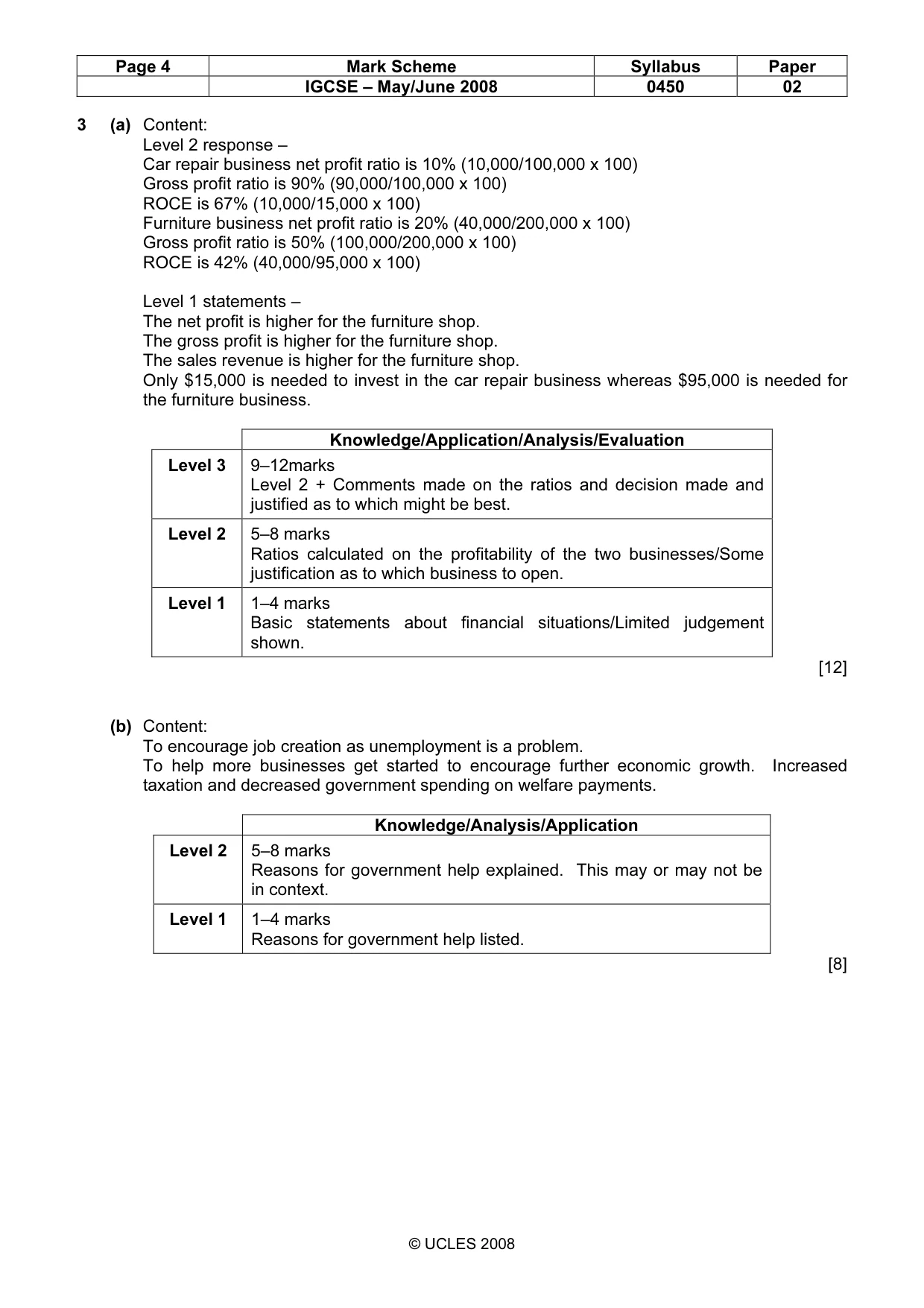
Page 4 Mark Scheme Syllabus Paper IGCSE – May/June 2008 0450 02 © UCLES 2008 3 (a) Content: Level 2 response – Car repair business net profit ratio is 10% (10,000/100,000 x 100) Gross profit ratio is 90% (90,000/100,000 x 100) ROCE is 67% (10,000/15,000 x 100) Furniture business net profit ratio is 20% (40,000/200,000 x 100) Gross profit ratio is 50% (100,000/200,000 x 100) ROCE is 42% (40,000/95,000 x 100) Level 1 statements – The net profit is higher for the furniture shop. The gross profit is higher for the furniture shop. The sales revenue is higher for the furniture shop. Only $15,000 is needed to invest in the car repair business whereas $95,000 is needed for the furniture business. Knowledge/Application/Analysis/Evaluation Level 3 9–12marks Level 2 + Comments made on the ratios and decision made and justified as to which might be best. Level 2 5–8 marks Ratios calculated on the profitability of the two businesses/Some justification as to which business to open. Level 1 1–4 marks Basic statements about financial situations/Limited judgement shown. [12] (b) Content: To encourage job creation as unemployment is a problem. To help more businesses get started to encourage further economic growth. Increased taxation and decreased government spending on welfare payments. Knowledge/Analysis/Application Level 2 5–8 marks Reasons for government help explained. This may or may not be in context. Level 1 1–4 marks Reasons for government help listed. [8]
Mark scheme, page 5
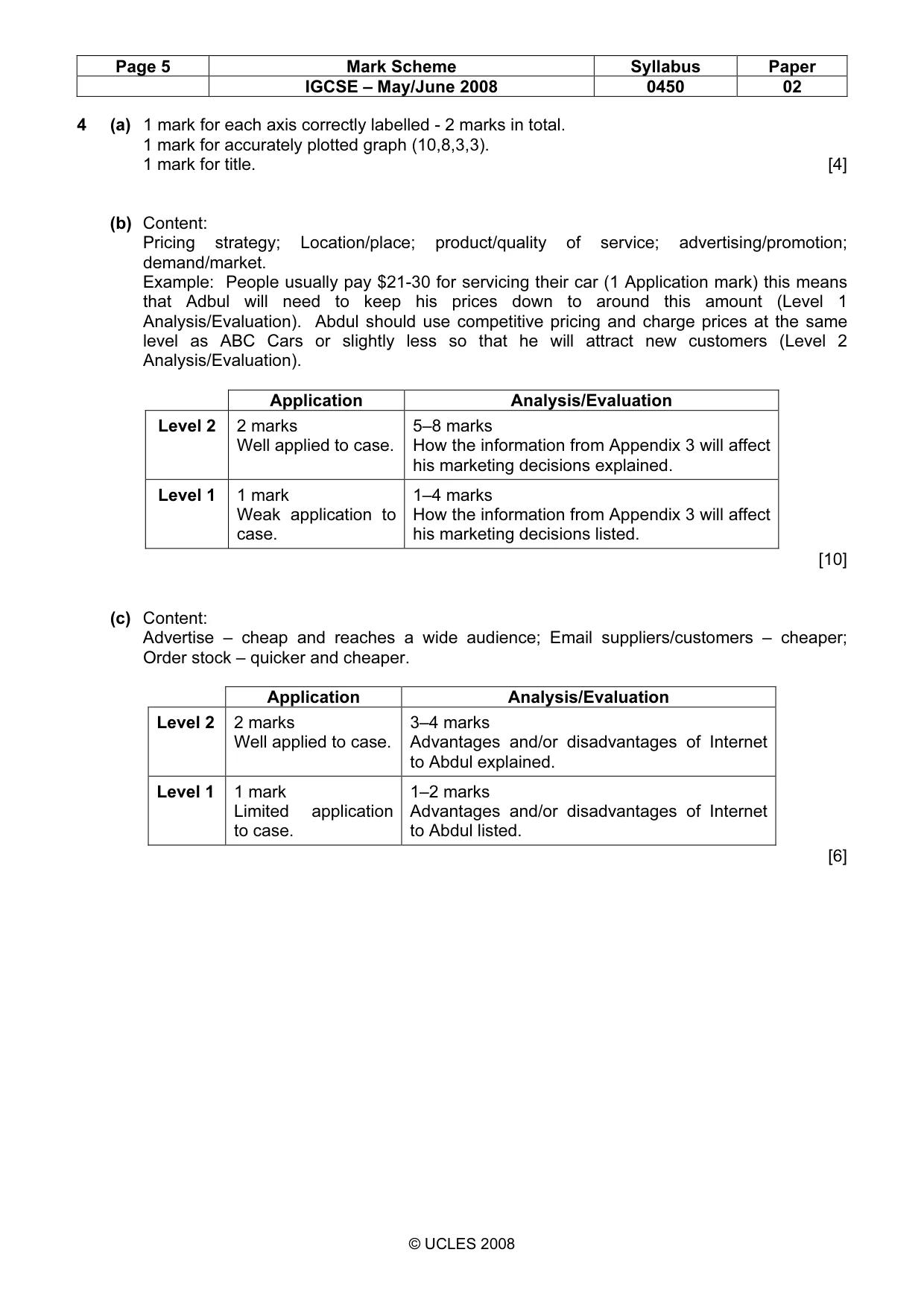
Page 5 Mark Scheme Syllabus Paper IGCSE – May/June 2008 0450 02 © UCLES 2008 4 (a) 1 mark for each axis correctly labelled - 2 marks in total. 1 mark for accurately plotted graph (10,8,3,3). 1 mark for title. [4] (b) Content: Pricing strategy; Location/place; product/quality of service; advertising/promotion; demand/market. Example: People usually pay $21-30 for servicing their car (1 Application mark) this means that Adbul will need to keep his prices down to around this amount (Level 1 Analysis/Evaluation). Abdul should use competitive pricing and charge prices at the same level as ABC Cars or slightly less so that he will attract new customers (Level 2 Analysis/Evaluation). Application Analysis/Evaluation Level 2 2 marks Well applied to case. 5–8 marks How the information from Appendix 3 will affect his marketing decisions explained. Level 1 1 mark Weak application to case. 1–4 marks How the information from Appendix 3 will affect his marketing decisions listed. [10] (c) Content: Advertise – cheap and reaches a wide audience; Email suppliers/customers – cheaper; Order stock – quicker and cheaper. Application Analysis/Evaluation Level 2 2 marks Well applied to case. 3–4 marks Advantages and/or disadvantages of Internet to Abdul explained. Level 1 1 mark Limited application to case. 1–2 marks Advantages and/or disadvantages of Internet to Abdul listed. [6]
Mark scheme, page 6
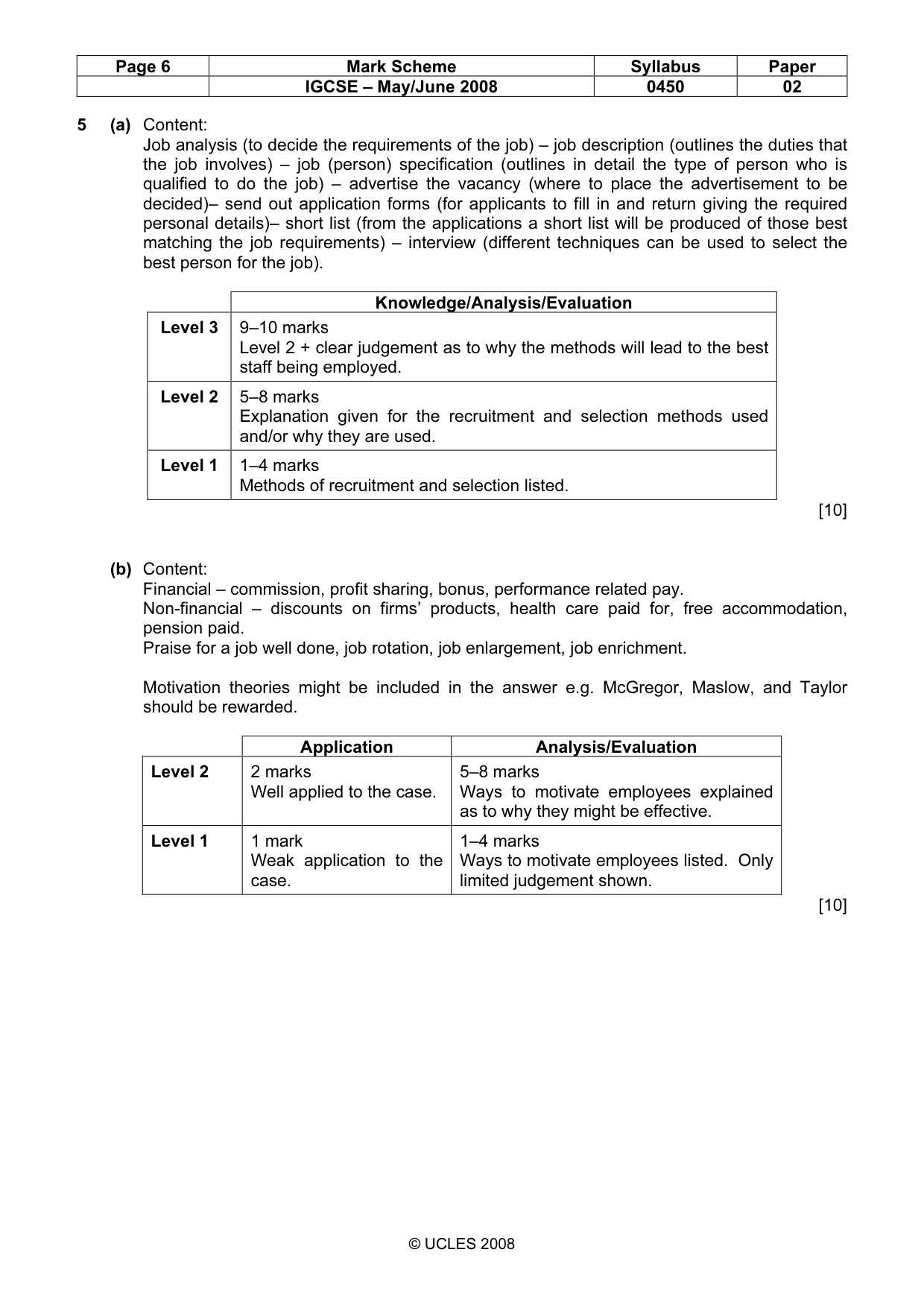
Page 6 Mark Scheme Syllabus Paper IGCSE – May/June 2008 0450 02 © UCLES 2008 5 (a) Content: Job analysis (to decide the requirements of the job) – job description (outlines the duties that the job involves) – job (person) specification (outlines in detail the type of person who is qualified to do the job) – advertise the vacancy (where to place the advertisement to be decided)– send out application forms (for applicants to fill in and return giving the required personal details)– short list (from the applications a short list will be produced of those best matching the job requirements) – interview (different techniques can be used to select the best person for the job). Knowledge/Analysis/Evaluation Level 3 9–10 marks Level 2 + clear judgement as to why the methods will lead to the best staff being employed. Level 2 5–8 marks Explanation given for the recruitment and selection methods used and/or why they are used. Level 1 1–4 marks Methods of recruitment and selection listed. [10] (b) Content: Financial – commission, profit sharing, bonus, performance related pay. Non-financial – discounts on firms’ products, health care paid for, free accommodation, pension paid. Praise for a job well done, job rotation, job enlargement, job enrichment. Motivation theories might be included in the answer e.g. McGregor, Maslow, and Taylor should be rewarded. Application Analysis/Evaluation Level 2 2 marks Well applied to the case. 5–8 marks Ways to motivate employees explained as to why they might be effective. Level 1 1 mark Weak application to the case. 1–4 marks Ways to motivate employees listed. Only limited judgement shown. [10]
What you needed in this session
Cambridge’s own grade thresholds for 2008 May/June, Paper 2 · Variant 1. A higher threshold means an easier paper — the bar moves with how the cohort did.