Cambridge IGCSE Business Studies 0450 — 2007 Oct/Nov Paper 2 · Variant 1
0450/21/O/N/07 · 100 marks · ≈113 min
The question paper and its mark scheme, free to read here and free to download. This is Cambridge’s own paper, exactly as it was sat.
Question paper16 pages



Mark scheme6 pages
Answers below. Sit the paper first if you are practising.
Paper as text
Question paper, page 1
This document consists of 13 printed pages and 3 blank pages. SP (CW/KS) T29834/2 © UCLES 2007 [Turn over UNIVERSITY OF CAMBRIDGE INTERNATIONAL EXAMINATIONS International General Certificate of Secondary Education READ THESE INSTRUCTIONS FIRST Write your Centre number, candidate number and name on all the work you hand in. Write in dark blue or black pen. Do not use staples, paper clips, highlighters, glue or correction fluid. DO NOT WRITE IN ANY BARCODES. Answer all questions. The business described in this question paper is entirely fictitious. At the end of the examination, fasten all your work securely together. The number of marks is given in brackets [ ] at the end of each question or part question. * 8 3 4 4 3 3 1 5 1 7 * BUSINESS STUDIES 0450/02 Paper 2 October/November 2007 1 hour 45 minutes Candidates answer on the Question Paper. No Additional Materials are required. For Examiner’s Use 1 2 3 4 5 Total www.XtremePapers.com
Question paper, page 2
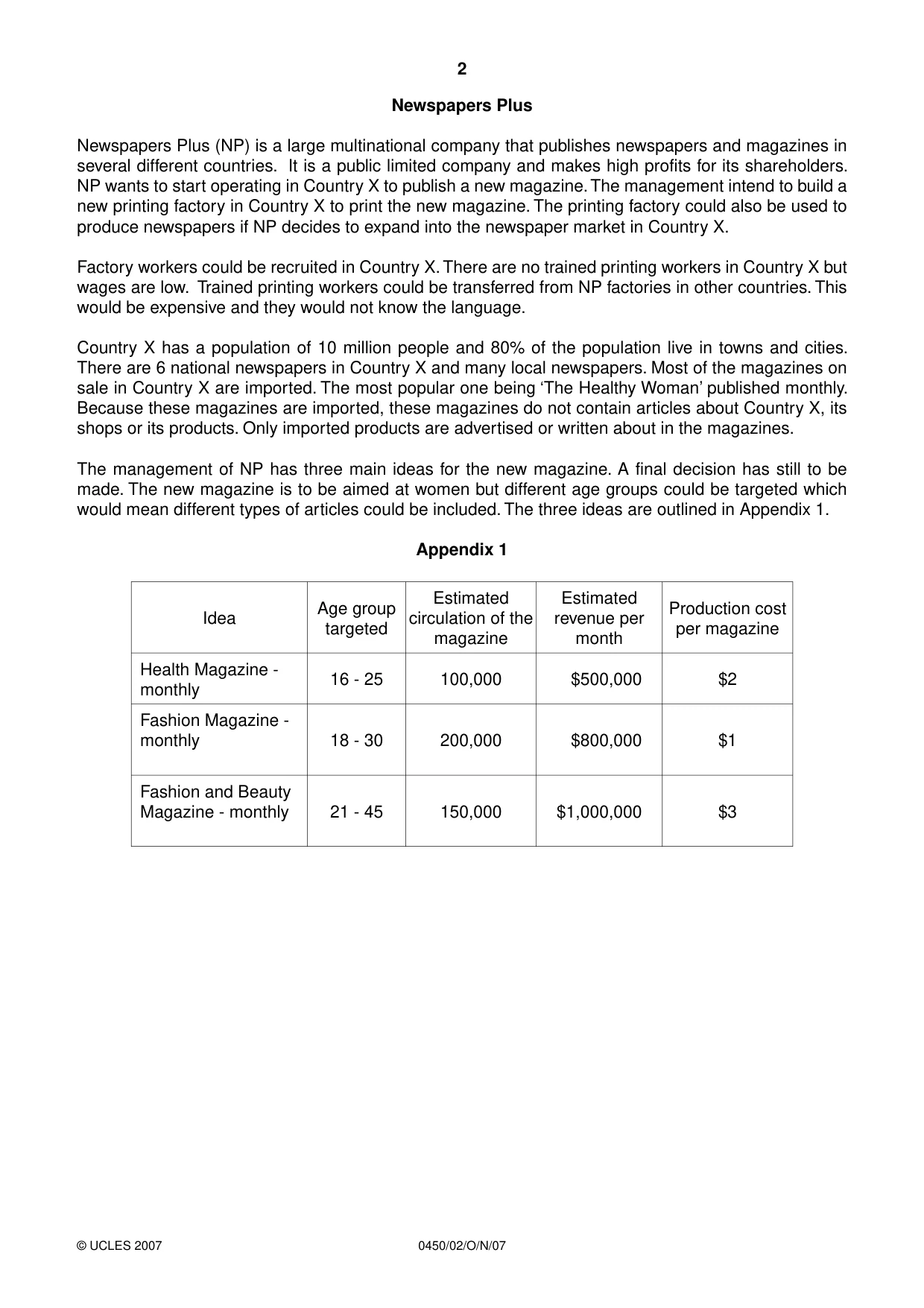
2 0450/02/O/N/07 © UCLES 2007 Newspapers Plus Newspapers Plus (NP) is a large multinational company that publishes newspapers and magazines in several different countries. It is a public limited company and makes high profits for its shareholders. NP wants to start operating in Country X to publish a new magazine. The management intend to build a new printing factory in Country X to print the new magazine. The printing factory could also be used to produce newspapers if NP decides to expand into the newspaper market in Country X. Factory workers could be recruited in Country X. There are no trained printing workers in Country X but wages are low. Trained printing workers could be transferred from NP factories in other countries. This would be expensive and they would not know the language. Country X has a population of 10 million people and 80% of the population live in towns and cities. There are 6 national newspapers in Country X and many local newspapers. Most of the magazines on sale in Country X are imported. The most popular one being ‘The Healthy Woman’ published monthly. Because these magazines are imported, these magazines do not contain articles about Country X, its shops or its products. Only imported products are advertised or written about in the magazines. The management of NP has three main ideas for the new magazine. A final decision has still to be made. The new magazine is to be aimed at women but different age groups could be targeted which would mean different types of articles could be included. The three ideas are outlined in Appendix 1. Appendix 1 Idea Age group targeted Estimated circulation of the magazine Estimated revenue per month Production cost per magazine Health Magazine - monthly 16 - 25 100,000 $500,000 $2 Fashion Magazine - monthly 18 - 30 200,000 $800,000 $1 Fashion and Beauty Magazine - monthly 21 - 45 150,000 $1,000,000 $3
Question paper, page 3
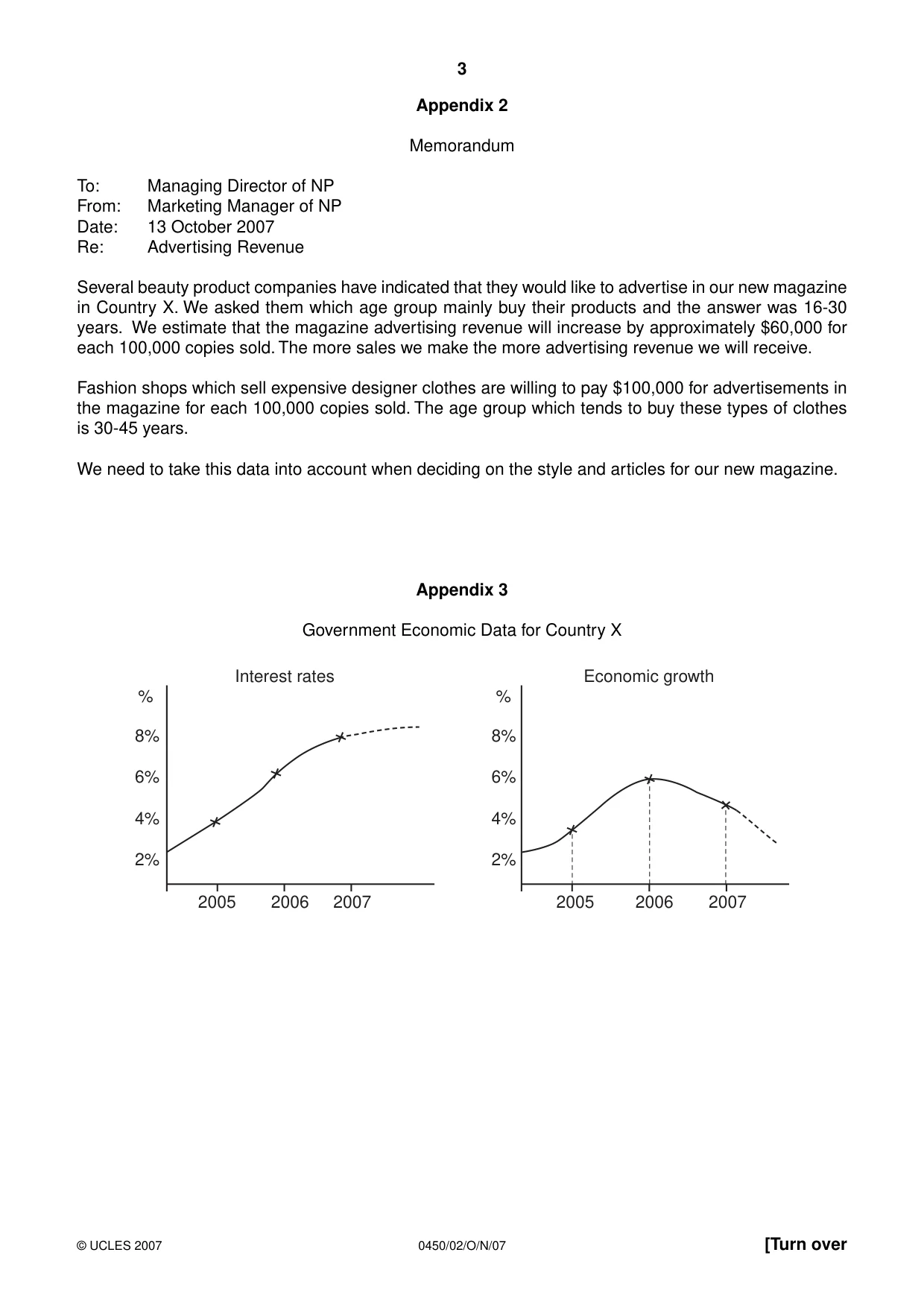
3 0450/02/O/N/07 © UCLES 2007 [Turn over Appendix 2 Memorandum To: Managing Director of NP From: Marketing Manager of NP Date: 13 October 2007 Re: Advertising Revenue Several beauty product companies have indicated that they would like to advertise in our new magazine in Country X. We asked them which age group mainly buy their products and the answer was 16-30 years. We estimate that the magazine advertising revenue will increase by approximately $60,000 for each 100,000 copies sold. The more sales we make the more advertising revenue we will receive. Fashion shops which sell expensive designer clothes are willing to pay $100,000 for advertisements in the magazine for each 100,000 copies sold. The age group which tends to buy these types of clothes is 30-45 years. We need to take this data into account when deciding on the style and articles for our new magazine. Appendix 3 Government Economic Data for Country X 2005 2006 2007 2% 4% 6% 8% Interest rates Economic growth 2005 2006 2007 2% 4% 6% 8% % %
Question paper, page 4
4 0450/02/O/N/07 For Examiner’s Use © UCLES 2007 1 (a) Explain two advantages to NP of being a multinational company. Advantage 1: … … … … … … … … Advantage 2: … … … … … … … …[8]
Question paper, page 5
5 0450/02/O/N/07 [Turn over For Examiner’s Use © UCLES 2007 (b) Do you think the Government in Country X should encourage NP to open the new printing factory? Explain your answer. … … … … … … … … … … … … … … … … … … … … … … … …[12]
Question paper, page 6
6 0450/02/O/N/07 For Examiner’s Use © UCLES 2007 2 (a) How do you think NP researched the market to estimate the number of copies likely to be sold of each type of magazine? … … … … … … … … … … … … … … … …[8]
Question paper, page 7
7 0450/02/O/N/07 [Turn over For Examiner’s Use © UCLES 2007 (b) Advise NP on which one of the three magazines to publish. Use the information in the case and appendices 1 and 2 to support your answer. … … … … … … … … … … … … … … … … … … … … … … … …[12]
Question paper, page 8
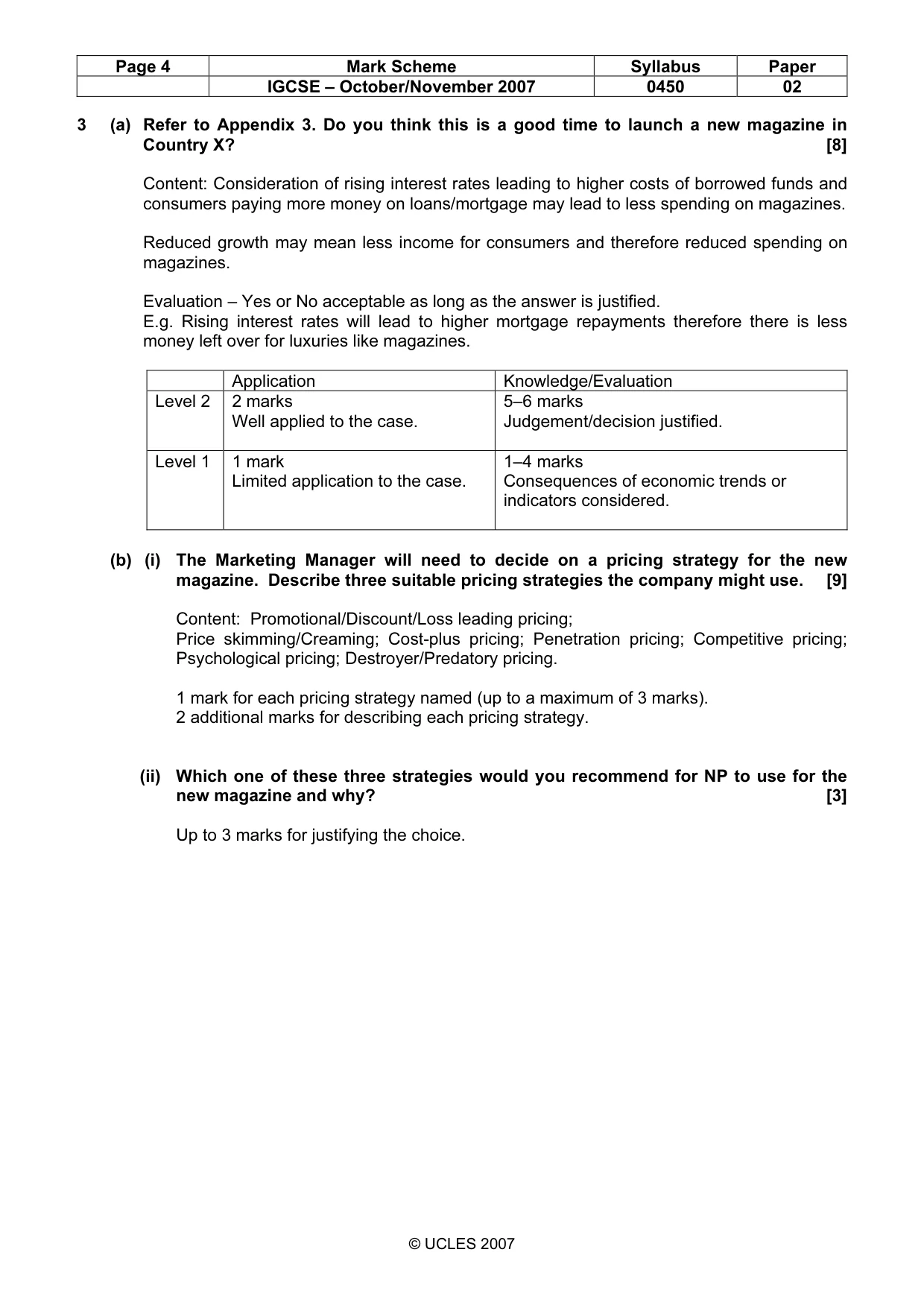
8 0450/02/O/N/07 For Examiner’s Use © UCLES 2007 3 (a) Refer to Appendix 3. Do you think this is a good time to launch a new magazine in Country X? … … … … … … … … … … … … … … … …[8]
Question paper, page 9
9 0450/02/O/N/07 [Turn over For Examiner’s Use © UCLES 2007 (b) (i) The Marketing Manager will need to decide on a pricing strategy for the new magazine. Describe three suitable pricing strategies the company might use. Strategy 1: … … … … … … Strategy 2: … … … … … … Strategy 3: … … … … … …[9] (ii) Which one of these three strategies would you recommend for NP to use for the new magazine and why? … … … … … …[3]
Question paper, page 10
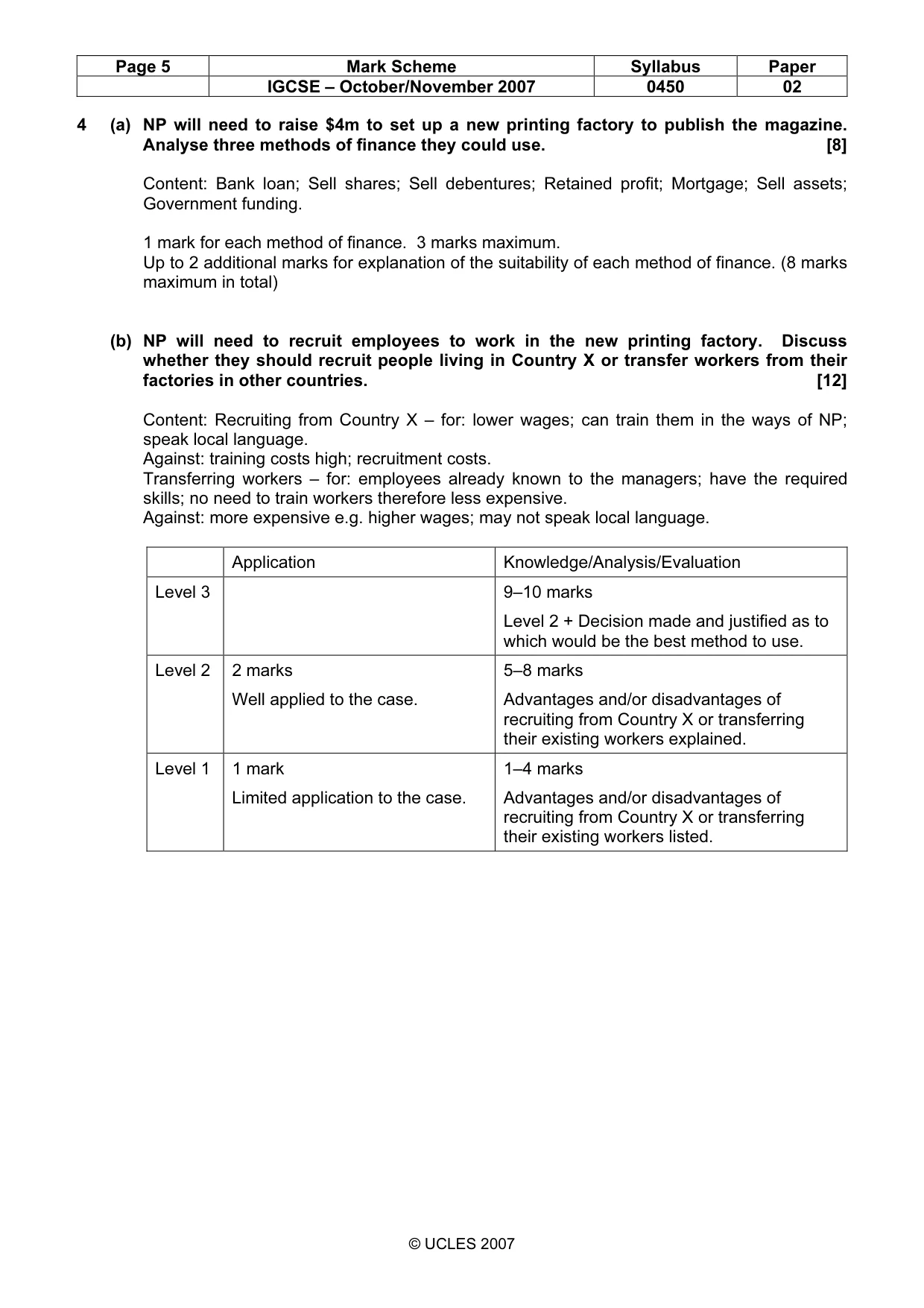
10 0450/02/O/N/07 For Examiner’s Use © UCLES 2007 4 (a) NP will need to raise $4m to set up a new printing factory to publish the magazine. Analyse three methods of finance they could use. Method 1: … … … … … … Method 2: … … … … … … Method 3: … … … … … …[8]
Question paper, page 11
11 0450/02/O/N/07 [Turn over For Examiner’s Use © UCLES 2007 (b) NP will need to recruit employees to work in the new printing factory. Discuss whether they should recruit people living in Country X or transfer workers from their factories in other countries. … … … … … … … … … … … … … … … … … … … … … … … …[12]
Question paper, page 12
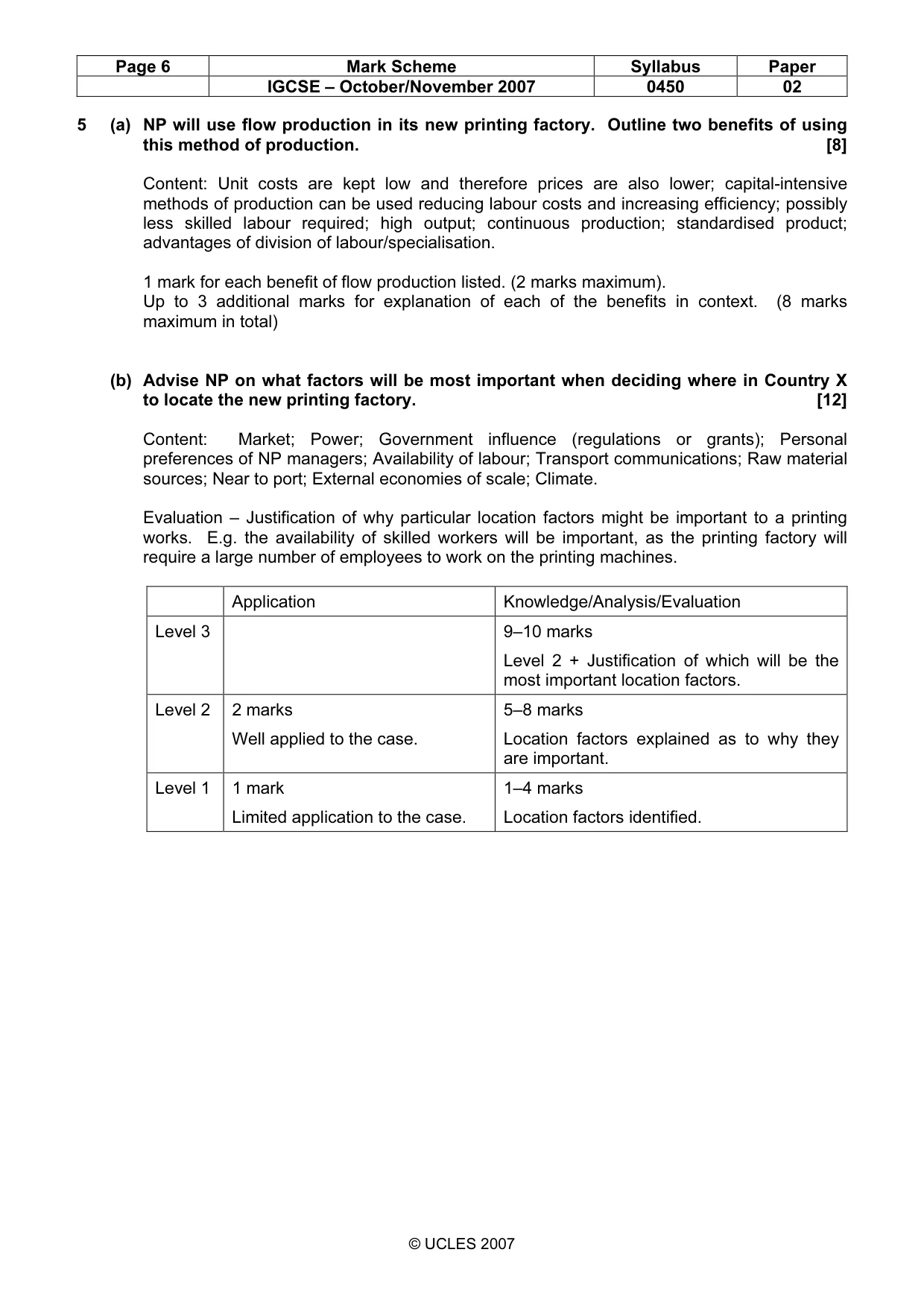
12 0450/02/O/N/07 For Examiner’s Use © UCLES 2007 5 (a) NP will use flow production in its new printing factory. Outline two benefits of using this method of production. Benefit 1: … … … … … … … … Benefit 2: … … … … … … … …[8]
Question paper, page 13
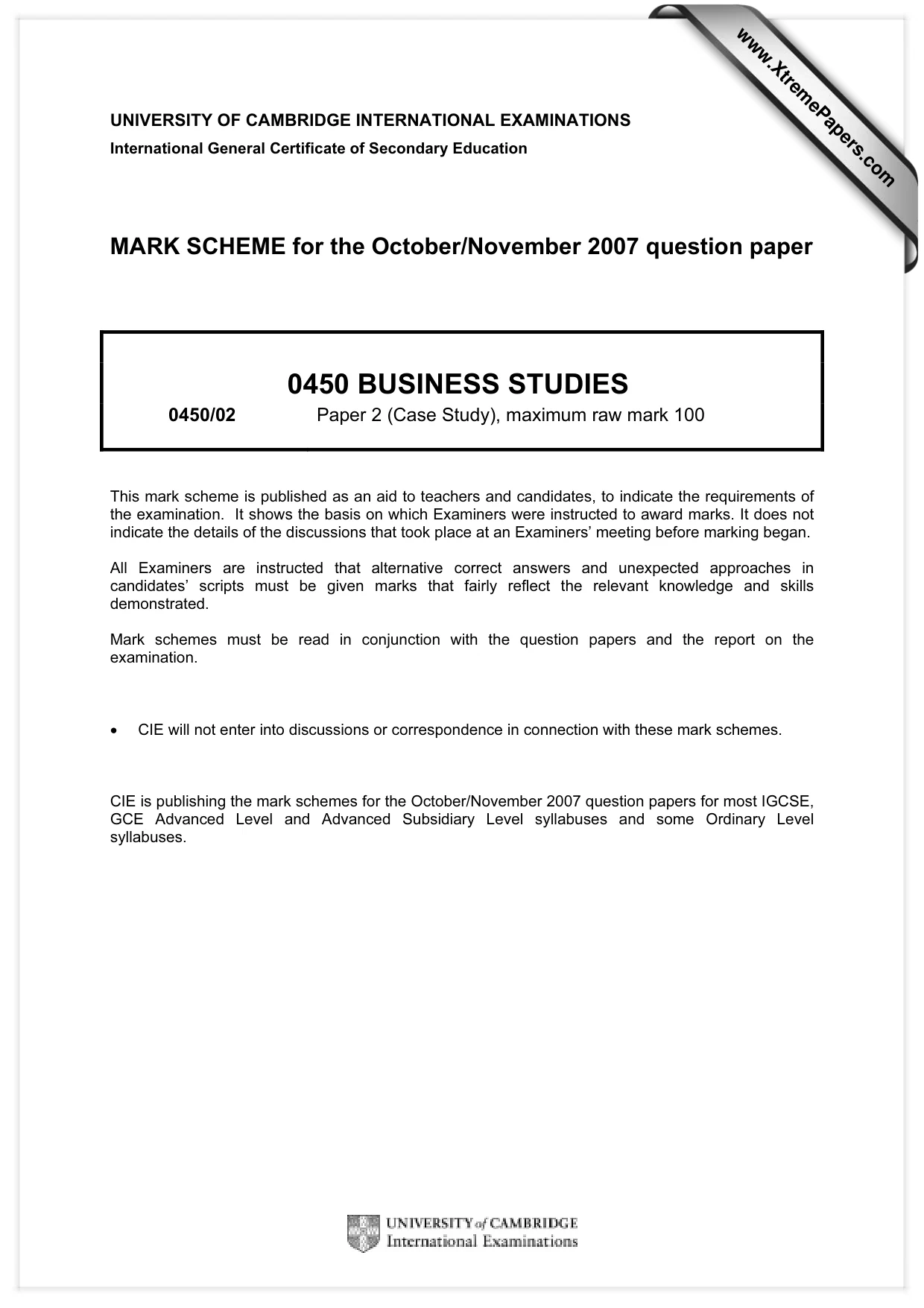
13 0450/02/O/N/07 For Examiner’s Use © UCLES 2007 (b) Advise NP on what factors will be most important when deciding where in Country X to locate the new printing factory. … … … … … … … … … … … … … … … … … … … … … … … …[12]
Question paper, page 16
16 0450/02/O/N/07 BLANK PAGE Permission to reproduce items where third-party owned material protected by copyright is included has been sought and cleared where possible. Every reasonable effort has been made by the publisher (UCLES) to trace copyright holders, but if any items requiring clearance have unwittingly been included, the publisher will be pleased to make amends at the earliest possible opportunity. University of Cambridge International Examinations is part of the Cambridge Assessment Group. Cambridge Assessment is the brand name of University of Cambridge Local Examinations Syndicate (UCLES), which is itself a department of the University of Cambridge.
Mark scheme, page 1
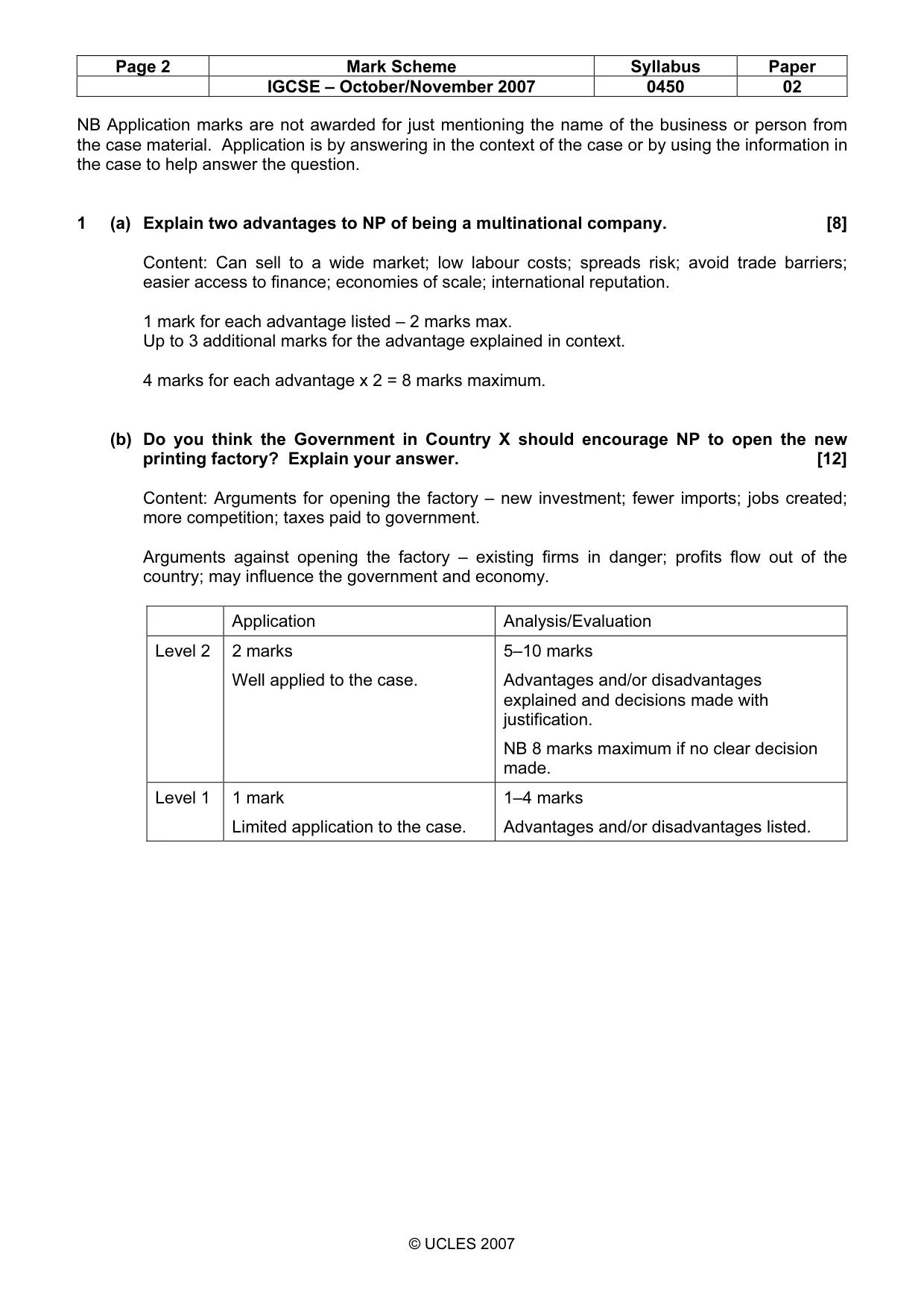
UNIVERSITY OF CAMBRIDGE INTERNATIONAL EXAMINATIONS International General Certificate of Secondary Education MARK SCHEME for the October/November 2007 question paper 0450 BUSINESS STUDIES 0450/02 Paper 2 (Case Study), maximum raw mark 100 This mark scheme is published as an aid to teachers and candidates, to indicate the requirements of the examination. It shows the basis on which Examiners were instructed to award marks. It does not indicate the details of the discussions that took place at an Examiners’ meeting before marking began. All Examiners are instructed that alternative correct answers and unexpected approaches in candidates’ scripts must be given marks that fairly reflect the relevant knowledge and skills demonstrated. Mark schemes must be read in conjunction with the question papers and the report on the examination. • CIE will not enter into discussions or correspondence in connection with these mark schemes. CIE is publishing the mark schemes for the October/November 2007 question papers for most IGCSE, GCE Advanced Level and Advanced Subsidiary Level syllabuses and some Ordinary Level syllabuses. www.XtremePapers.com
Mark scheme, page 2
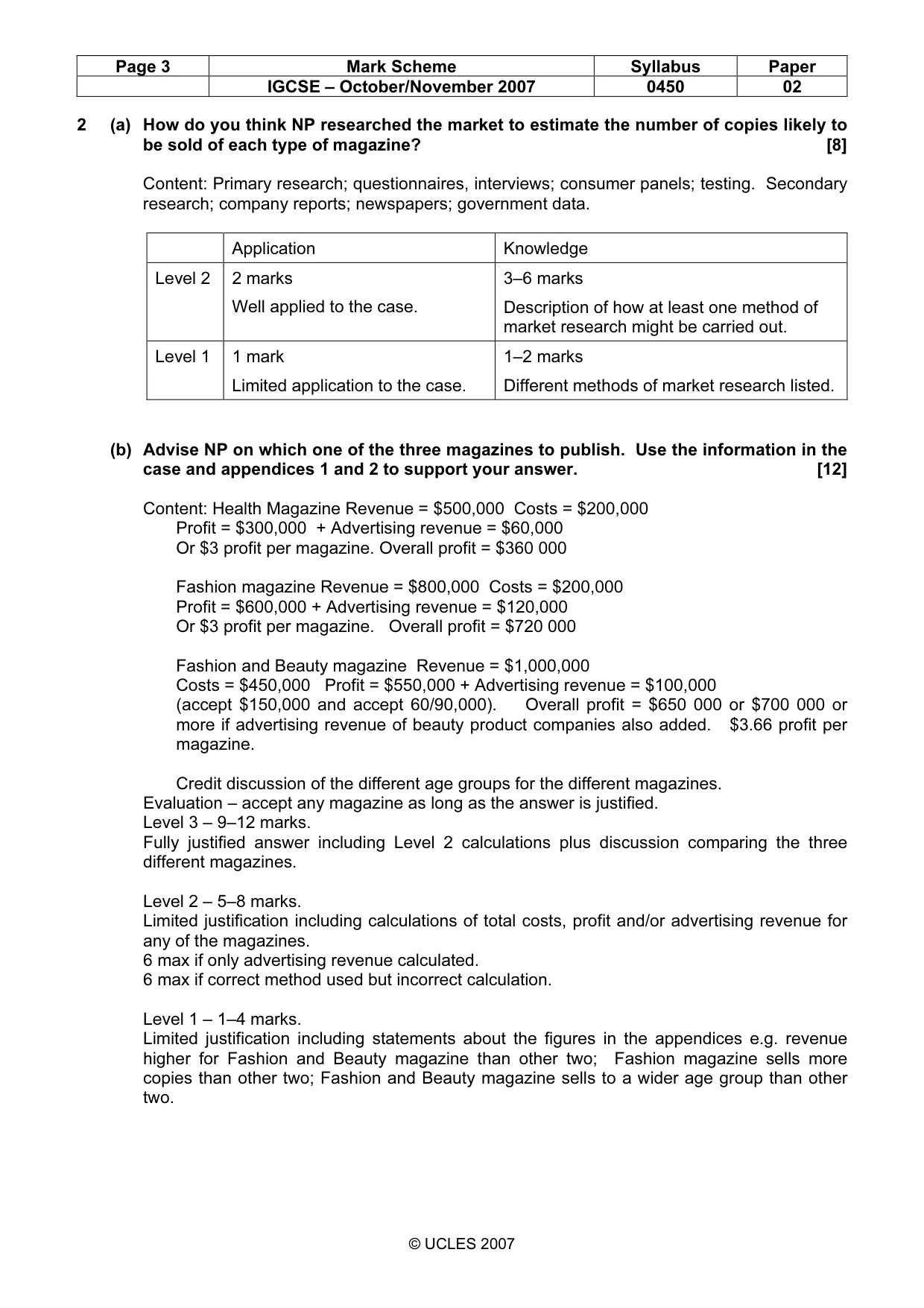
Page 2 Mark Scheme Syllabus Paper IGCSE – October/November 2007 0450 02 © UCLES 2007 NB Application marks are not awarded for just mentioning the name of the business or person from the case material. Application is by answering in the context of the case or by using the information in the case to help answer the question. 1 (a) Explain two advantages to NP of being a multinational company. [8] Content: Can sell to a wide market; low labour costs; spreads risk; avoid trade barriers; easier access to finance; economies of scale; international reputation. 1 mark for each advantage listed – 2 marks max. Up to 3 additional marks for the advantage explained in context. 4 marks for each advantage x 2 = 8 marks maximum. (b) Do you think the Government in Country X should encourage NP to open the new printing factory? Explain your answer. [12] Content: Arguments for opening the factory – new investment; fewer imports; jobs created; more competition; taxes paid to government. Arguments against opening the factory – existing firms in danger; profits flow out of the country; may influence the government and economy. Application Analysis/Evaluation Level 2 2 marks Well applied to the case. 5–10 marks Advantages and/or disadvantages explained and decisions made with justification. NB 8 marks maximum if no clear decision made. Level 1 1 mark Limited application to the case. 1–4 marks Advantages and/or disadvantages listed.
Mark scheme, page 3
Page 3 Mark Scheme Syllabus Paper IGCSE – October/November 2007 0450 02 © UCLES 2007 2 (a) How do you think NP researched the market to estimate the number of copies likely to be sold of each type of magazine? [8] Content: Primary research; questionnaires, interviews; consumer panels; testing. Secondary research; company reports; newspapers; government data. Application Knowledge Level 2 2 marks Well applied to the case. 3–6 marks Description of how at least one method of market research might be carried out. Level 1 1 mark Limited application to the case. 1–2 marks Different methods of market research listed. (b) Advise NP on which one of the three magazines to publish. Use the information in the case and appendices 1 and 2 to support your answer. [12] Content: Health Magazine Revenue = $500,000 Costs = $200,000 Profit = $300,000 + Advertising revenue = $60,000 Or $3 profit per magazine. Overall profit = $360 000 Fashion magazine Revenue = $800,000 Costs = $200,000 Profit = $600,000 + Advertising revenue = $120,000 Or $3 profit per magazine. Overall profit = $720 000 Fashion and Beauty magazine Revenue = $1,000,000 Costs = $450,000 Profit = $550,000 + Advertising revenue = $100,000 (accept $150,000 and accept 60/90,000). Overall profit = $650 000 or $700 000 or more if advertising revenue of beauty product companies also added. $3.66 profit per magazine. Credit discussion of the different age groups for the different magazines. Evaluation – accept any magazine as long as the answer is justified. Level 3 – 9–12 marks. Fully justified answer including Level 2 calculations plus discussion comparing the three different magazines. Level 2 – 5–8 marks. Limited justification including calculations of total costs, profit and/or advertising revenue for any of the magazines. 6 max if only advertising revenue calculated. 6 max if correct method used but incorrect calculation. Level 1 – 1–4 marks. Limited justification including statements about the figures in the appendices e.g. revenue higher for Fashion and Beauty magazine than other two; Fashion magazine sells more copies than other two; Fashion and Beauty magazine sells to a wider age group than other two.
Mark scheme, page 4
Page 4 Mark Scheme Syllabus Paper IGCSE – October/November 2007 0450 02 © UCLES 2007 3 (a) Refer to Appendix 3. Do you think this is a good time to launch a new magazine in Country X? [8] Content: Consideration of rising interest rates leading to higher costs of borrowed funds and consumers paying more money on loans/mortgage may lead to less spending on magazines. Reduced growth may mean less income for consumers and therefore reduced spending on magazines. Evaluation – Yes or No acceptable as long as the answer is justified. E.g. Rising interest rates will lead to higher mortgage repayments therefore there is less money left over for luxuries like magazines. Application Knowledge/Evaluation Level 2 2 marks Well applied to the case. 5–6 marks Judgement/decision justified. Level 1 1 mark Limited application to the case. 1–4 marks Consequences of economic trends or indicators considered. (b) (i) The Marketing Manager will need to decide on a pricing strategy for the new magazine. Describe three suitable pricing strategies the company might use. [9] Content: Promotional/Discount/Loss leading pricing; Price skimming/Creaming; Cost-plus pricing; Penetration pricing; Competitive pricing; Psychological pricing; Destroyer/Predatory pricing. 1 mark for each pricing strategy named (up to a maximum of 3 marks). 2 additional marks for describing each pricing strategy. (ii) Which one of these three strategies would you recommend for NP to use for the new magazine and why? [3] Up to 3 marks for justifying the choice.
Mark scheme, page 5
Page 5 Mark Scheme Syllabus Paper IGCSE – October/November 2007 0450 02 © UCLES 2007 4 (a) NP will need to raise $4m to set up a new printing factory to publish the magazine. Analyse three methods of finance they could use. [8] Content: Bank loan; Sell shares; Sell debentures; Retained profit; Mortgage; Sell assets; Government funding. 1 mark for each method of finance. 3 marks maximum. Up to 2 additional marks for explanation of the suitability of each method of finance. (8 marks maximum in total) (b) NP will need to recruit employees to work in the new printing factory. Discuss whether they should recruit people living in Country X or transfer workers from their factories in other countries. [12] Content: Recruiting from Country X – for: lower wages; can train them in the ways of NP; speak local language. Against: training costs high; recruitment costs. Transferring workers – for: employees already known to the managers; have the required skills; no need to train workers therefore less expensive. Against: more expensive e.g. higher wages; may not speak local language. Application Knowledge/Analysis/Evaluation Level 3 9–10 marks Level 2 + Decision made and justified as to which would be the best method to use. Level 2 2 marks Well applied to the case. 5–8 marks Advantages and/or disadvantages of recruiting from Country X or transferring their existing workers explained. Level 1 1 mark Limited application to the case. 1–4 marks Advantages and/or disadvantages of recruiting from Country X or transferring their existing workers listed.
Mark scheme, page 6
Page 6 Mark Scheme Syllabus Paper IGCSE – October/November 2007 0450 02 © UCLES 2007 5 (a) NP will use flow production in its new printing factory. Outline two benefits of using this method of production. [8] Content: Unit costs are kept low and therefore prices are also lower; capital-intensive methods of production can be used reducing labour costs and increasing efficiency; possibly less skilled labour required; high output; continuous production; standardised product; advantages of division of labour/specialisation. 1 mark for each benefit of flow production listed. (2 marks maximum). Up to 3 additional marks for explanation of each of the benefits in context. (8 marks maximum in total) (b) Advise NP on what factors will be most important when deciding where in Country X to locate the new printing factory. [12] Content: Market; Power; Government influence (regulations or grants); Personal preferences of NP managers; Availability of labour; Transport communications; Raw material sources; Near to port; External economies of scale; Climate. Evaluation – Justification of why particular location factors might be important to a printing works. E.g. the availability of skilled workers will be important, as the printing factory will require a large number of employees to work on the printing machines. Application Knowledge/Analysis/Evaluation Level 3 9–10 marks Level 2 + Justification of which will be the most important location factors. Level 2 2 marks Well applied to the case. 5–8 marks Location factors explained as to why they are important. Level 1 1 mark Limited application to the case. 1–4 marks Location factors identified.
What you needed in this session
Cambridge’s own grade thresholds for 2007 Oct/Nov, Paper 2 · Variant 1. A higher threshold means an easier paper — the bar moves with how the cohort did.