Cambridge IGCSE Business Studies 0450 — 2007 May/June Paper 2 · Variant 1
0450/21/M/J/07 · 100 marks · ≈113 min
The question paper and its mark scheme, free to read here and free to download. This is Cambridge’s own paper, exactly as it was sat.
Question paper16 pages








Mark scheme6 pages
Answers below. Sit the paper first if you are practising.


Paper as text
Question paper, page 1
This document consists of 13 printed pages and 3 blank pages. SP (SLM/SLM) T27347/3 © UCLES 2007 [Turn over UNIVERSITY OF CAMBRIDGE INTERNATIONAL EXAMINATIONS International General Certificate of Secondary Education READ THESE INSTRUCTIONS FIRST Write your Centre number, candidate number and name on all the work you hand in. Write in dark blue or black pen. Do not use staples, paper clips, highlighters, glue or correction fluid. DO NOT WRITE IN ANY BARCODES. Answer all questions. The businesses described in this question paper are entirely fictitious. At the end of the examination, fasten all your work securely together. The number of marks is given in brackets [ ] at the end of each question or part question. * 9 7 1 6 6 1 8 4 4 7 * BUSINESS STUDIES 0450/02 Paper 2 May/June 2007 1 hour 45 minutes Candidates answer on the Question Paper No Additional Materials are required. For Examiner’s Use 1 2 3 4 5 Total www.XtremePapers.com
Question paper, page 2
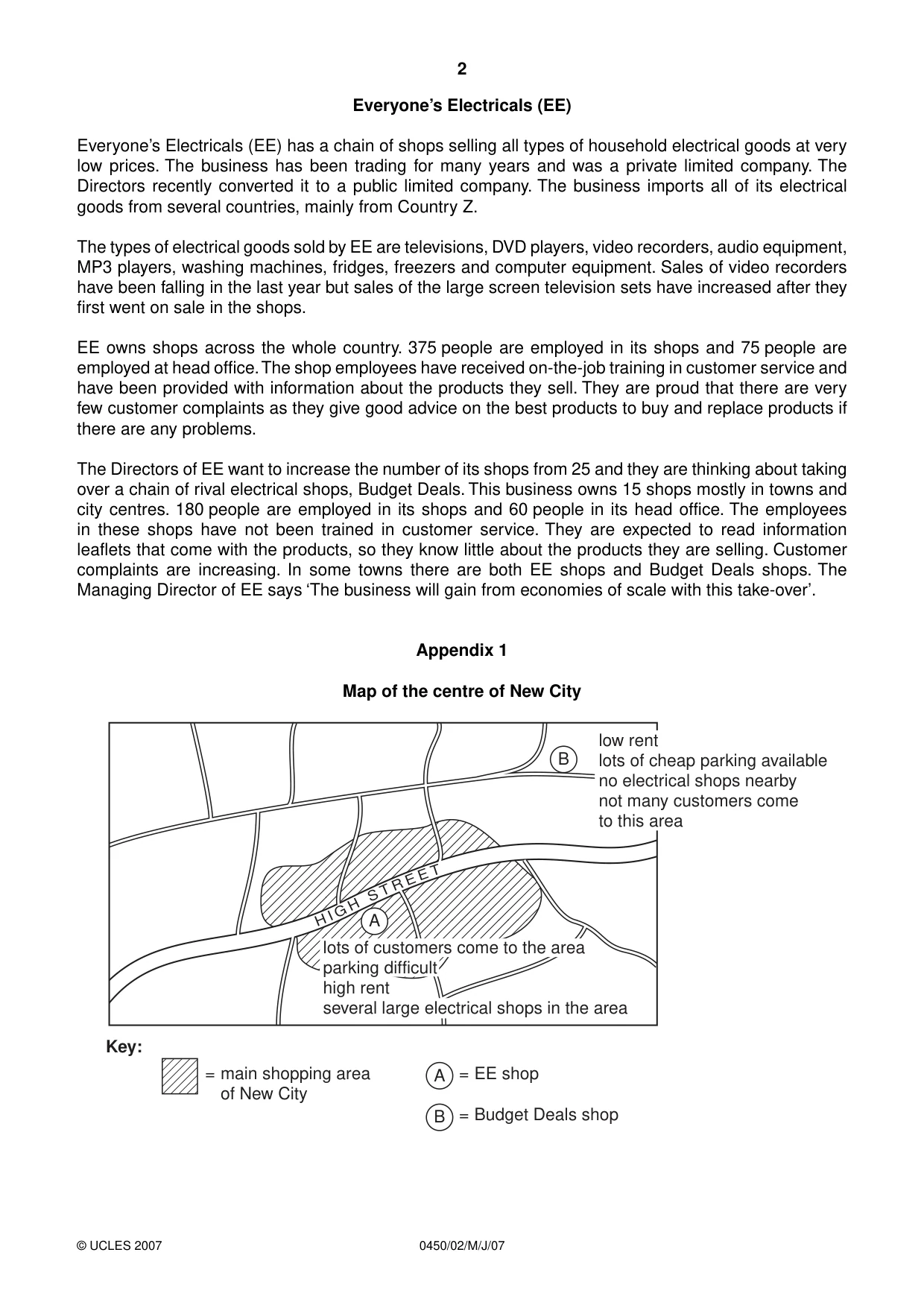
2 0450/02/M/J/07 © UCLES 2007 Everyone’s Electricals (EE) Everyone’s Electricals (EE) has a chain of shops selling all types of household electrical goods at very low prices. The business has been trading for many years and was a private limited company. The Directors recently converted it to a public limited company. The business imports all of its electrical goods from several countries, mainly from Country Z. The types of electrical goods sold by EE are televisions, DVD players, video recorders, audio equipment, MP3 players, washing machines, fridges, freezers and computer equipment. Sales of video recorders have been falling in the last year but sales of the large screen television sets have increased after they first went on sale in the shops. EE owns shops across the whole country. 375 people are employed in its shops and 75 people are employed at head office. The shop employees have received on-the-job training in customer service and have been provided with information about the products they sell. They are proud that there are very few customer complaints as they give good advice on the best products to buy and replace products if there are any problems. The Directors of EE want to increase the number of its shops from 25 and they are thinking about taking over a chain of rival electrical shops, Budget Deals. This business owns 15 shops mostly in towns and city centres. 180 people are employed in its shops and 60 people in its head office. The employees in these shops have not been trained in customer service. They are expected to read information leaflets that come with the products, so they know little about the products they are selling. Customer complaints are increasing. In some towns there are both EE shops and Budget Deals shops. The Managing Director of EE says ‘The business will gain from economies of scale with this take-over’. Appendix 1 Map of the centre of New City Key: A A B B H I G H S T R E E T = main shopping area of New City = EE shop = Budget Deals shop low rent lots of cheap parking available no electrical shops nearby not many customers come to this area lots of customers come to the area parking difficult high rent several large electrical shops in the area
Question paper, page 3
3 0450/02/M/J/07 © UCLES 2007 [Turn over Appendix 2 Daily News 25 May 2007 EE plans to cut jobs! The shopworkers’ Trade Union is worried about possible job losses. The planned take-over of Budget Deals by EE could lead to redundancy (retrenchment). It is expected that some shops will close and not all the employees will have a job in the remaining shops. It is not clear which workers will lose their jobs. An EE spokesman said ‘It might depend on experience, length of employment with the company and their age’. The Trade Union is negotiating with EE to see if a solution can be found. Will industrial action be taken? Appendix 3 Memorandum To: Manager Director of EE From: Purchasing Manager of EE Date: 24 May 2007 Re: Should we change our suppliers? The exchange rate of our country has increased (appreciated) against other countries’ currencies over recent months. The only currency that it has remained stable against is the currency of Country Z. We buy most of our supplies from Country Z. The quality of our supplies from Country Z manufacturers is high. They do not break down very often. The quality of supplies from firms in other countries is not as good but it is improving. Country Z has a good road system and deliveries from the factories do not take very long. Do we need to consider changing our suppliers?
Question paper, page 4
4 0450/02/M/J/07 For Examiner’s Use © UCLES 2007 1 (a) The Directors of EE recently converted the business from a private limited company to a public limited company. Explain two possible benefits and two possible drawbacks to this business of the change. Benefit 1: … … … … … Benefit 2: … … … … … Drawback 1: … … … … … Drawback 2: … … … … …[10]
Question paper, page 5
5 0450/02/M/J/07 [Turn over For Examiner’s Use © UCLES 2007 (b) If EE take over Budget Deals then EE will need to raise finance for new delivery lorries (trucks). Explain three sources of finance EE could use. Finance source 1: … … … … … … … Finance source 2: … … … … … … … Finance source 3: … … … … … … …[10]
Question paper, page 6
6 0450/02/M/J/07 For Examiner’s Use © UCLES 2007 2 (a) EE currently sells its products directly to consumers through its shops. The Directors are considering selling goods on the Internet. Discuss whether you think they should do this. … … … … … … … … … … … … … … … … … … … … … … … …[12]
Question paper, page 7
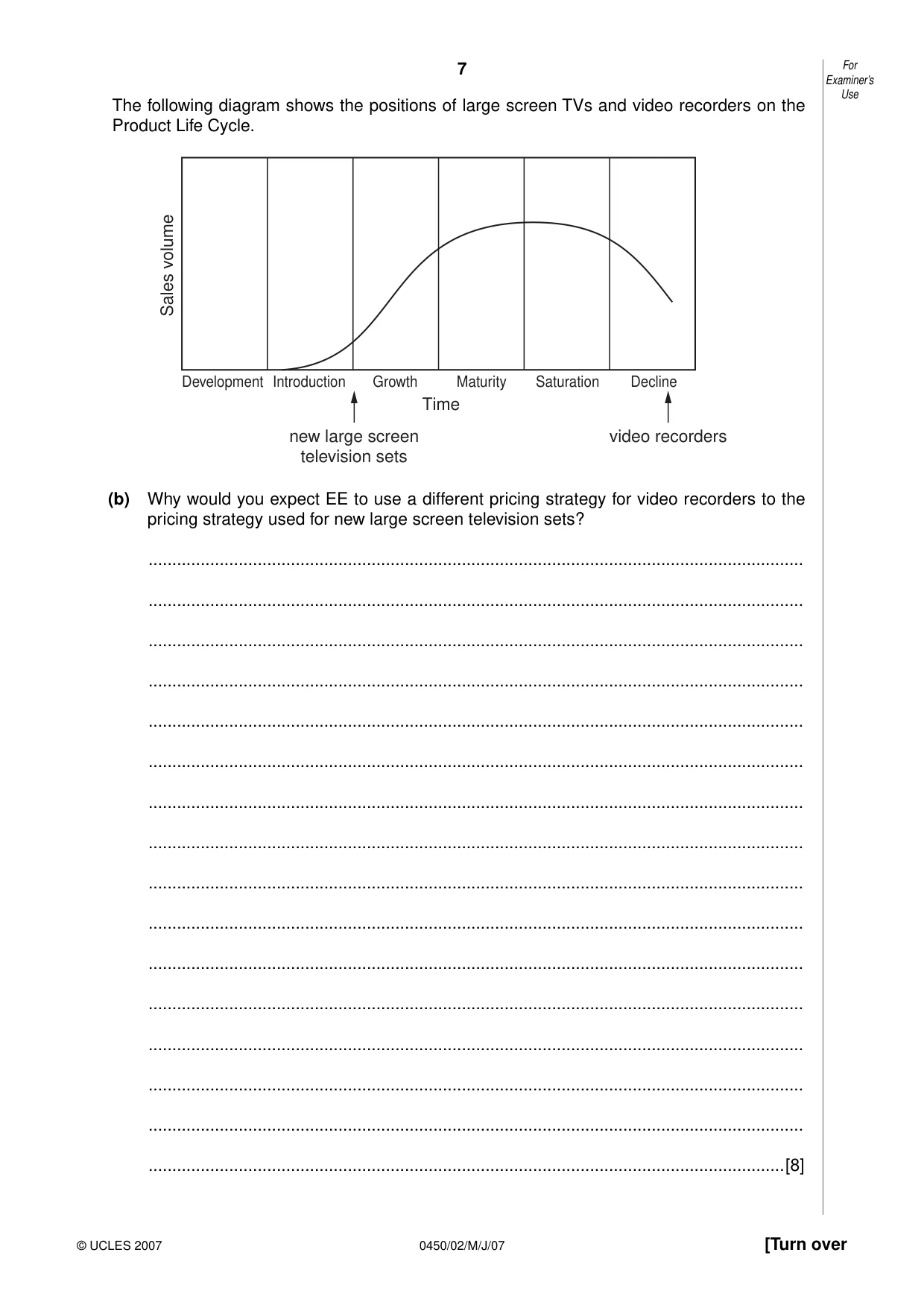
7 0450/02/M/J/07 [Turn over For Examiner’s Use © UCLES 2007 The following diagram shows the positions of large screen TVs and video recorders on the Product Life Cycle. Sales volume Time Development Introduction Growth Maturity Saturation Decline new large screen television sets video recorders (b) Why would you expect EE to use a different pricing strategy for video recorders to the pricing strategy used for new large screen television sets? … … … … … … … … … … … … … … … …[8]
Question paper, page 8
8 0450/02/M/J/07 For Examiner’s Use © UCLES 2007 3 (a) EE is planning a take-over of Budget Deals. State and explain three possible economies of scale from which EE might benefit. Economy of scale 1: … … … … … … Economy of scale 2: … … … … … … Economy of scale 3: … … … … … …[8]
Question paper, page 9
9 0450/02/M/J/07 [Turn over For Examiner’s Use © UCLES 2007 (b) See Appendix 1. Both EE and Budget Deals have shops in New City. Recommend which shop EE should close if it takes over Budget Deals. Justify your choice. … … … … … … … … … … … … … … … … … … … … … … … …[12]
Question paper, page 10
10 0450/02/M/J/07 For Examiner’s Use © UCLES 2007 4 (a) Appendix 2 outlines the possible need to reduce the number of employees following the take-over. Discuss the factors that will be most important to EE when deciding which employees will be made redundant. … … … … … … … … … … … … … … … … … … … … … … … …[12]
Question paper, page 11
11 0450/02/M/J/07 [Turn over For Examiner’s Use © UCLES 2007 (b) EE provides training to its staff. Analyse the benefits of this training to customers and employees of EE. Benefits to customers: … … … … … … … … Benefits to employees: … … … … … … … …[8]
Question paper, page 12
12 0450/02/M/J/07 For Examiner’s Use © UCLES 2007 5 (a) See Appendix 3. Do you think EE should change its main supplier? Explain your answer. … … … … … … … … … … … … … … … … … … … …[10]
Question paper, page 13
13 0450/02/M/J/07 For Examiner’s Use © UCLES 2007 (b) Governments often pass laws which affect how employees are treated and how customers are treated. (i) Outline one law to protect employees and one law to protect customers (the names of the laws need not be included). Law to protect employees: … … … … Law to protect customers: … … … …[4] (ii) Discuss the effects each of these laws might have on EE. … … … … … … … … … … … …[6]
Question paper, page 16
16 0450/02/M/J/07 Permission to reproduce items where third-party owned material protected by copyright is included has been sought and cleared where possible. Every reasonable effort has been made by the publisher (UCLES) to trace copyright holders, but if any items requiring clearance have unwittingly been included, the publisher will be pleased to make amends at the earliest possible opportunity. University of Cambridge International Examinations is part of the Cambridge Assessment Group. Cambridge Assessment is the brand name of University of Cambridge Local Examinations Syndicate (UCLES), which is itself a department of the University of Cambridge. BLANK PAGE
Mark scheme, page 1
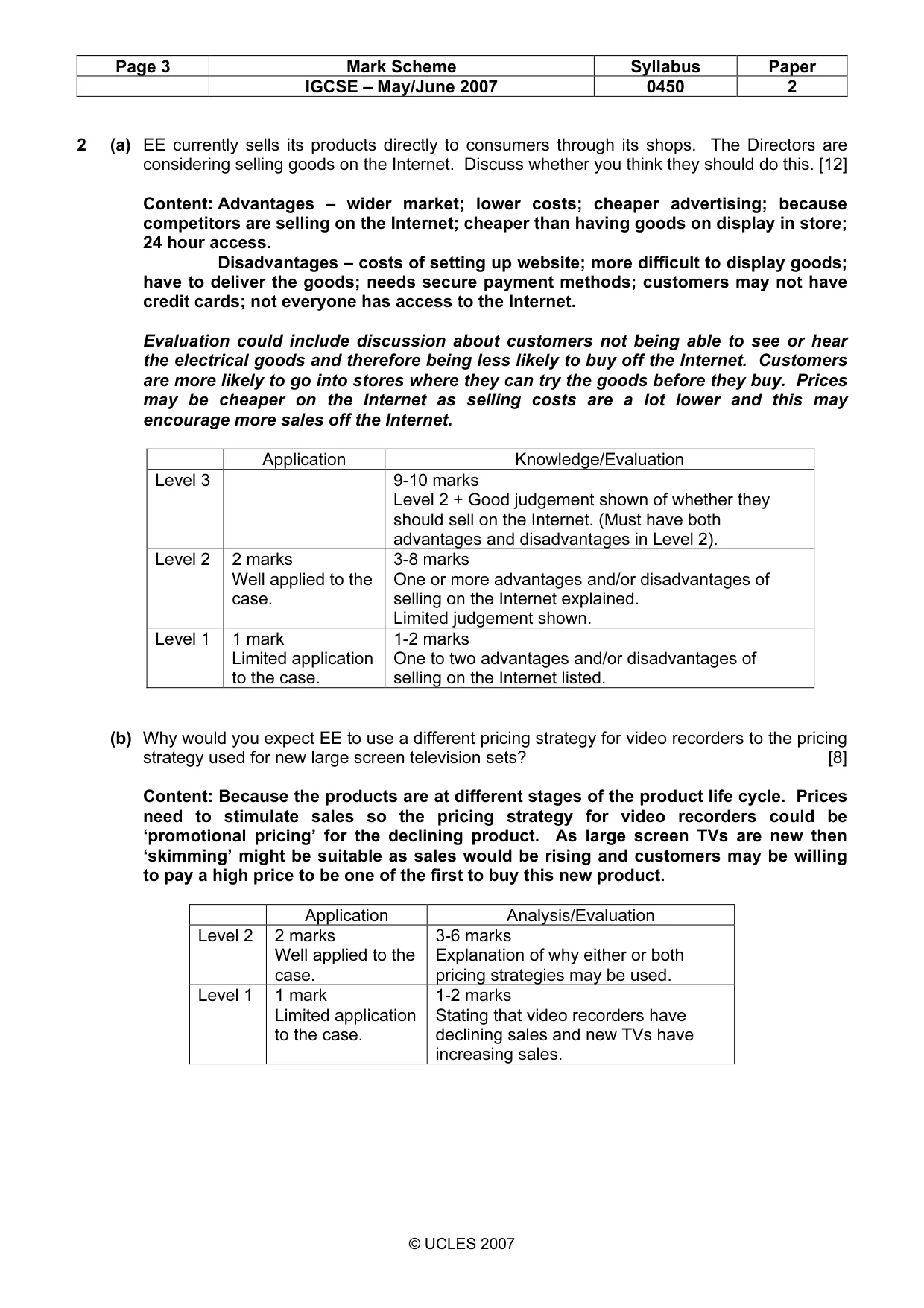
UNIVERSITY OF CAMBRIDGE INTERNATIONAL EXAMINATIONS International General Certificate of Secondary Education MARK SCHEME for the May/June 2007 question paper 0450 BUSINESS STUDIES 0450/02 Paper 2 (Case Study), maximum raw mark 100 This mark scheme is published as an aid to teachers and candidates, to indicate the requirements of the examination. It shows the basis on which Examiners were instructed to award marks. It does not indicate the details of the discussions that took place at an Examiners’ meeting before marking began. All Examiners are instructed that alternative correct answers and unexpected approaches in candidates’ scripts must be given marks that fairly reflect the relevant knowledge and skills demonstrated. Mark schemes must be read in conjunction with the question papers and the report on the examination. • CIE will not enter into discussions or correspondence in connection with these mark schemes. CIE is publishing the mark schemes for the May/June 2007 question papers for most IGCSE, GCE Advanced Level and Advanced Subsidiary Level syllabuses and some Ordinary Level syllabuses. www.XtremePapers.com
Mark scheme, page 2
Page 2 Mark Scheme Syllabus Paper IGCSE – May/June 2007 0450 2 © UCLES 2007 N.B. Application marks are not awarded for the name of the business or person from the case material. Application is by answering in the context of the case or by using the information in the case to help answer the question. 1 (a) The Directors of EE recently converted the business from a private limited company to a public limited company. Explain two possible benefits and two possible drawbacks to this business of the change. [10] Content: Advantages of a plc – can sell shares to the public; rapid expansion possible with specialist managers appointed; easier to raise finance; high status; easier to attract suppliers. Disadvantages – many legal formalities; have to disclose accounts and other information to any interested parties; expensive to ‘go public’; divorce between ownership and control more likely; risk of takeover. Application Knowledge/Analysis 2 marks Two or more advantages or disadvantages applied to the case. 1 additional mark for each advantage explained. 1 additional mark for each disadvantage explained. 1 mark At least one advantage or disadvantage applied to the case. 1 mark for each advantage stated. 2 + 2 marks 1 mark for each disadvantage stated. 2 + 2 marks (b) If EE took over Budget Deals they will need to raise finance for new delivery lorries. Explain THREE sources of finance EE could use. [10] Content: Bank loan; Leasing; Hire Purchase; Retained profit; Issue shares; Sale of assets; Debentures; Venture Capital. Application Knowledge/Analysis/Evaluation 2 marks Applied to the case in at least two sources of finance. Up to 2 additional marks for each source of finance explained. Maximum of 8 marks in total. 1 mark Limited application in at least one source of finance. 1-3 marks 1 mark for each method of finance listed.
Mark scheme, page 3
Page 3 Mark Scheme Syllabus Paper IGCSE – May/June 2007 0450 2 © UCLES 2007 2 (a) EE currently sells its products directly to consumers through its shops. The Directors are considering selling goods on the Internet. Discuss whether you think they should do this. [12] Content: Advantages – wider market; lower costs; cheaper advertising; because competitors are selling on the Internet; cheaper than having goods on display in store; 24 hour access. Disadvantages – costs of setting up website; more difficult to display goods; have to deliver the goods; needs secure payment methods; customers may not have credit cards; not everyone has access to the Internet. Evaluation could include discussion about customers not being able to see or hear the electrical goods and therefore being less likely to buy off the Internet. Customers are more likely to go into stores where they can try the goods before they buy. Prices may be cheaper on the Internet as selling costs are a lot lower and this may encourage more sales off the Internet. Application Knowledge/Evaluation Level 3 9-10 marks Level 2 + Good judgement shown of whether they should sell on the Internet. (Must have both advantages and disadvantages in Level 2). Level 2 2 marks Well applied to the case. 3-8 marks One or more advantages and/or disadvantages of selling on the Internet explained. Limited judgement shown. Level 1 1 mark Limited application to the case. 1-2 marks One to two advantages and/or disadvantages of selling on the Internet listed. (b) Why would you expect EE to use a different pricing strategy for video recorders to the pricing strategy used for new large screen television sets? [8] Content: Because the products are at different stages of the product life cycle. Prices need to stimulate sales so the pricing strategy for video recorders could be ‘promotional pricing’ for the declining product. As large screen TVs are new then ‘skimming’ might be suitable as sales would be rising and customers may be willing to pay a high price to be one of the first to buy this new product. Application Analysis/Evaluation Level 2 2 marks Well applied to the case. 3-6 marks Explanation of why either or both pricing strategies may be used. Level 1 1 mark Limited application to the case. 1-2 marks Stating that video recorders have declining sales and new TVs have increasing sales.
Mark scheme, page 4
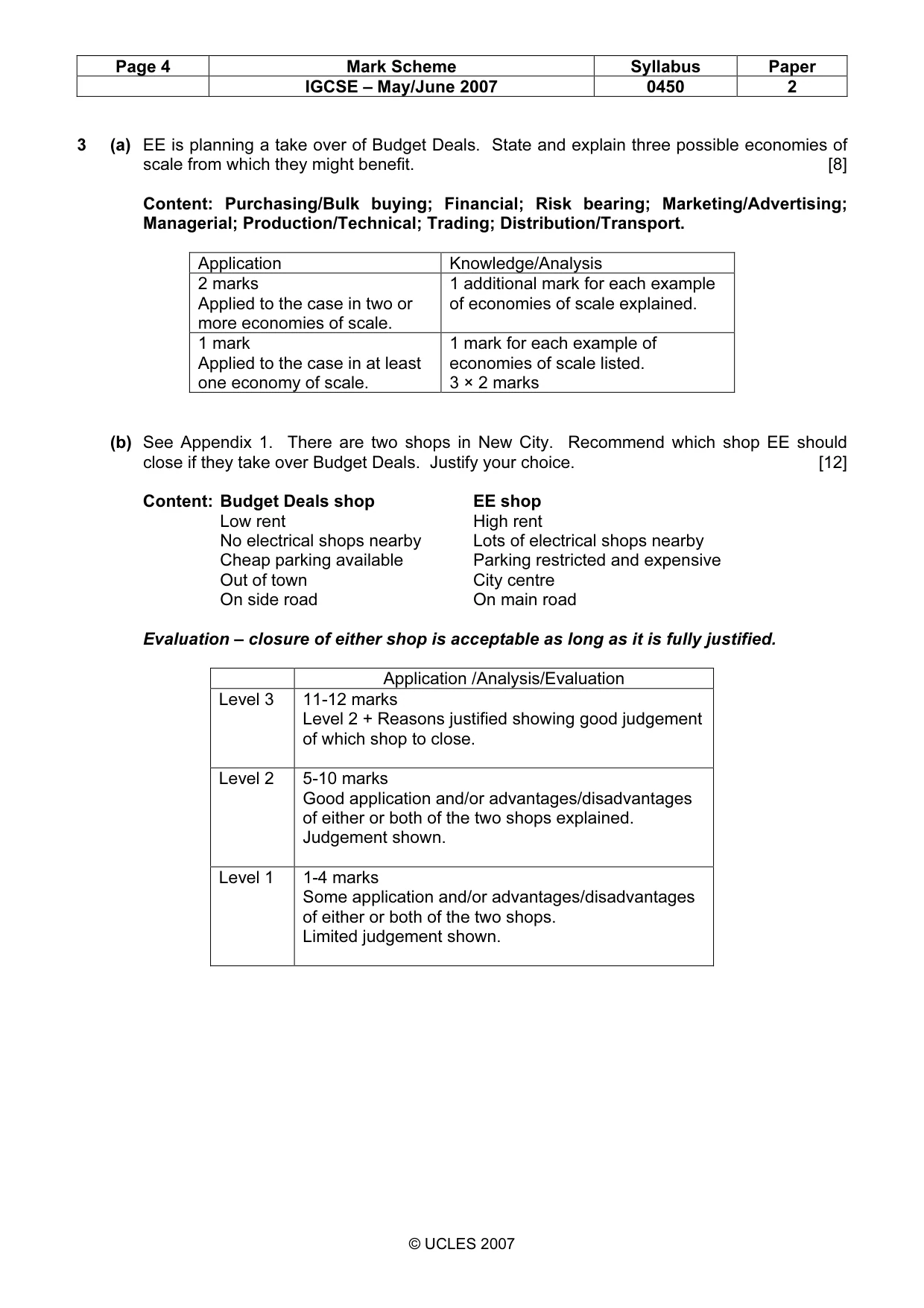
Page 4 Mark Scheme Syllabus Paper IGCSE – May/June 2007 0450 2 © UCLES 2007 3 (a) EE is planning a take over of Budget Deals. State and explain three possible economies of scale from which they might benefit. [8] Content: Purchasing/Bulk buying; Financial; Risk bearing; Marketing/Advertising; Managerial; Production/Technical; Trading; Distribution/Transport. Application Knowledge/Analysis 2 marks Applied to the case in two or more economies of scale. 1 additional mark for each example of economies of scale explained. 1 mark Applied to the case in at least one economy of scale. 1 mark for each example of economies of scale listed. 3 × 2 marks (b) See Appendix 1. There are two shops in New City. Recommend which shop EE should close if they take over Budget Deals. Justify your choice. [12] Content: Budget Deals shop EE shop Low rent High rent No electrical shops nearby Lots of electrical shops nearby Cheap parking available Parking restricted and expensive Out of town City centre On side road On main road Evaluation – closure of either shop is acceptable as long as it is fully justified. Application /Analysis/Evaluation Level 3 11-12 marks Level 2 + Reasons justified showing good judgement of which shop to close. Level 2 5-10 marks Good application and/or advantages/disadvantages of either or both of the two shops explained. Judgement shown. Level 1 1-4 marks Some application and/or advantages/disadvantages of either or both of the two shops. Limited judgement shown.
Mark scheme, page 5
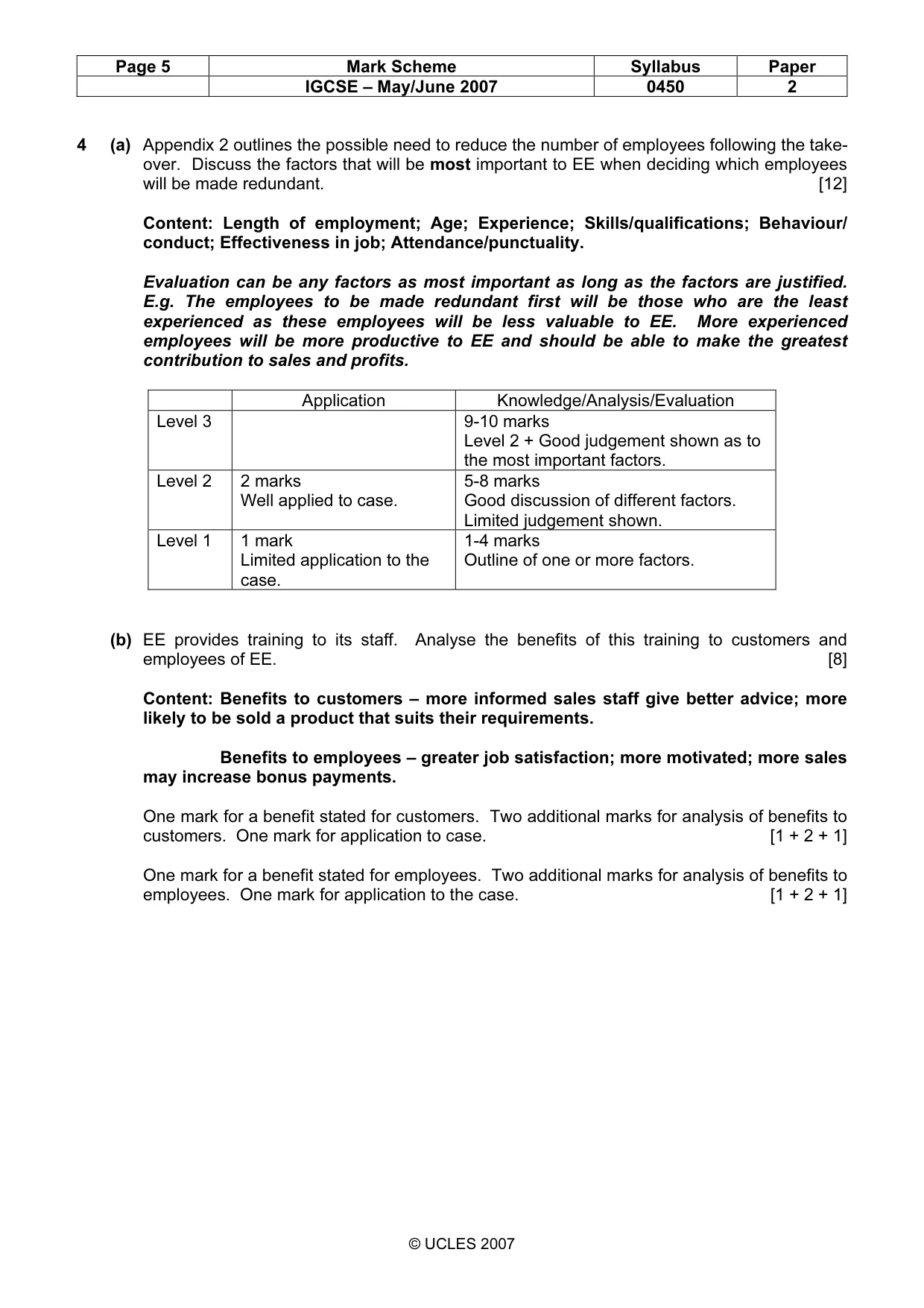
Page 5 Mark Scheme Syllabus Paper IGCSE – May/June 2007 0450 2 © UCLES 2007 4 (a) Appendix 2 outlines the possible need to reduce the number of employees following the take- over. Discuss the factors that will be most important to EE when deciding which employees will be made redundant. [12] Content: Length of employment; Age; Experience; Skills/qualifications; Behaviour/ conduct; Effectiveness in job; Attendance/punctuality. Evaluation can be any factors as most important as long as the factors are justified. E.g. The employees to be made redundant first will be those who are the least experienced as these employees will be less valuable to EE. More experienced employees will be more productive to EE and should be able to make the greatest contribution to sales and profits. Application Knowledge/Analysis/Evaluation Level 3 9-10 marks Level 2 + Good judgement shown as to the most important factors. Level 2 2 marks Well applied to case. 5-8 marks Good discussion of different factors. Limited judgement shown. Level 1 1 mark Limited application to the case. 1-4 marks Outline of one or more factors. (b) EE provides training to its staff. Analyse the benefits of this training to customers and employees of EE. [8] Content: Benefits to customers – more informed sales staff give better advice; more likely to be sold a product that suits their requirements. Benefits to employees – greater job satisfaction; more motivated; more sales may increase bonus payments. One mark for a benefit stated for customers. Two additional marks for analysis of benefits to customers. One mark for application to case. [1 + 2 + 1] One mark for a benefit stated for employees. Two additional marks for analysis of benefits to employees. One mark for application to the case. [1 + 2 + 1]
Mark scheme, page 6
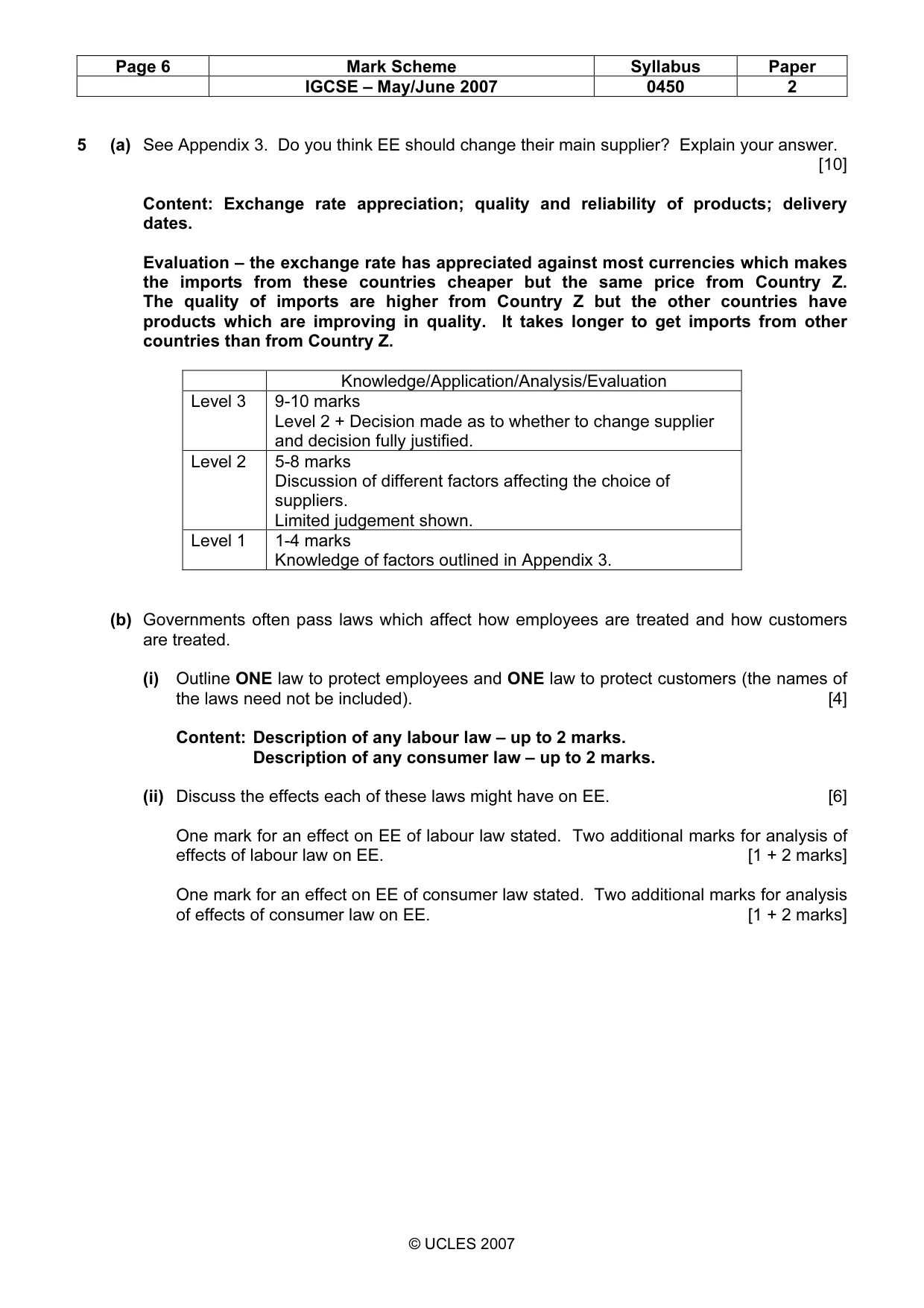
Page 6 Mark Scheme Syllabus Paper IGCSE – May/June 2007 0450 2 © UCLES 2007 5 (a) See Appendix 3. Do you think EE should change their main supplier? Explain your answer. [10] Content: Exchange rate appreciation; quality and reliability of products; delivery dates. Evaluation – the exchange rate has appreciated against most currencies which makes the imports from these countries cheaper but the same price from Country Z. The quality of imports are higher from Country Z but the other countries have products which are improving in quality. It takes longer to get imports from other countries than from Country Z. Knowledge/Application/Analysis/Evaluation Level 3 9-10 marks Level 2 + Decision made as to whether to change supplier and decision fully justified. Level 2 5-8 marks Discussion of different factors affecting the choice of suppliers. Limited judgement shown. Level 1 1-4 marks Knowledge of factors outlined in Appendix 3. (b) Governments often pass laws which affect how employees are treated and how customers are treated. (i) Outline ONE law to protect employees and ONE law to protect customers (the names of the laws need not be included). [4] Content: Description of any labour law – up to 2 marks. Description of any consumer law – up to 2 marks. (ii) Discuss the effects each of these laws might have on EE. [6] One mark for an effect on EE of labour law stated. Two additional marks for analysis of effects of labour law on EE. [1 + 2 marks] One mark for an effect on EE of consumer law stated. Two additional marks for analysis of effects of consumer law on EE. [1 + 2 marks]
What you needed in this session
Cambridge’s own grade thresholds for 2007 May/June, Paper 2 · Variant 1. A higher threshold means an easier paper — the bar moves with how the cohort did.