Cambridge IGCSE Business Studies 0450 — 2006 May/June Paper 2 · Variant 1
0450/21/M/J/06 · 100 marks · ≈113 min
The question paper and its mark scheme, free to read here and free to download. This is Cambridge’s own paper, exactly as it was sat.
Question paper16 pages




Mark scheme6 pages
Answers below. Sit the paper first if you are practising.
Paper as text
Question paper, page 1
This document consists of 13 printed pages and 3 blank pages. SP (SJF3875) T04406/3 © UCLES 2006 [Turn over UNIVERSITY OF CAMBRIDGE INTERNATIONAL EXAMINATIONS International General Certificate of Secondary Education BUSINESS STUDIES 0450/02 Paper 2 May/June 2006 1 hour 45 minutes Candidates answer on the Question Paper No Additional Materials are required. READ THESE INSTRUCTIONS FIRST Write your Centre number, candidate number and name on all the work you hand in. Write in dark blue or black pen. Do not use staples, paper clips, highlighters, glue or correction fluid. Answer all questions. The businesses described in this question paper are entirely fictitious. At the end of the examination, fasten all your work securely together. The number of marks is given in brackets [ ] at the end of each question or part question. Centre Number Candidate Number Name For Examiner’s Use 1 2 3 4 5 Total www.XtremePapers.com
Question paper, page 2
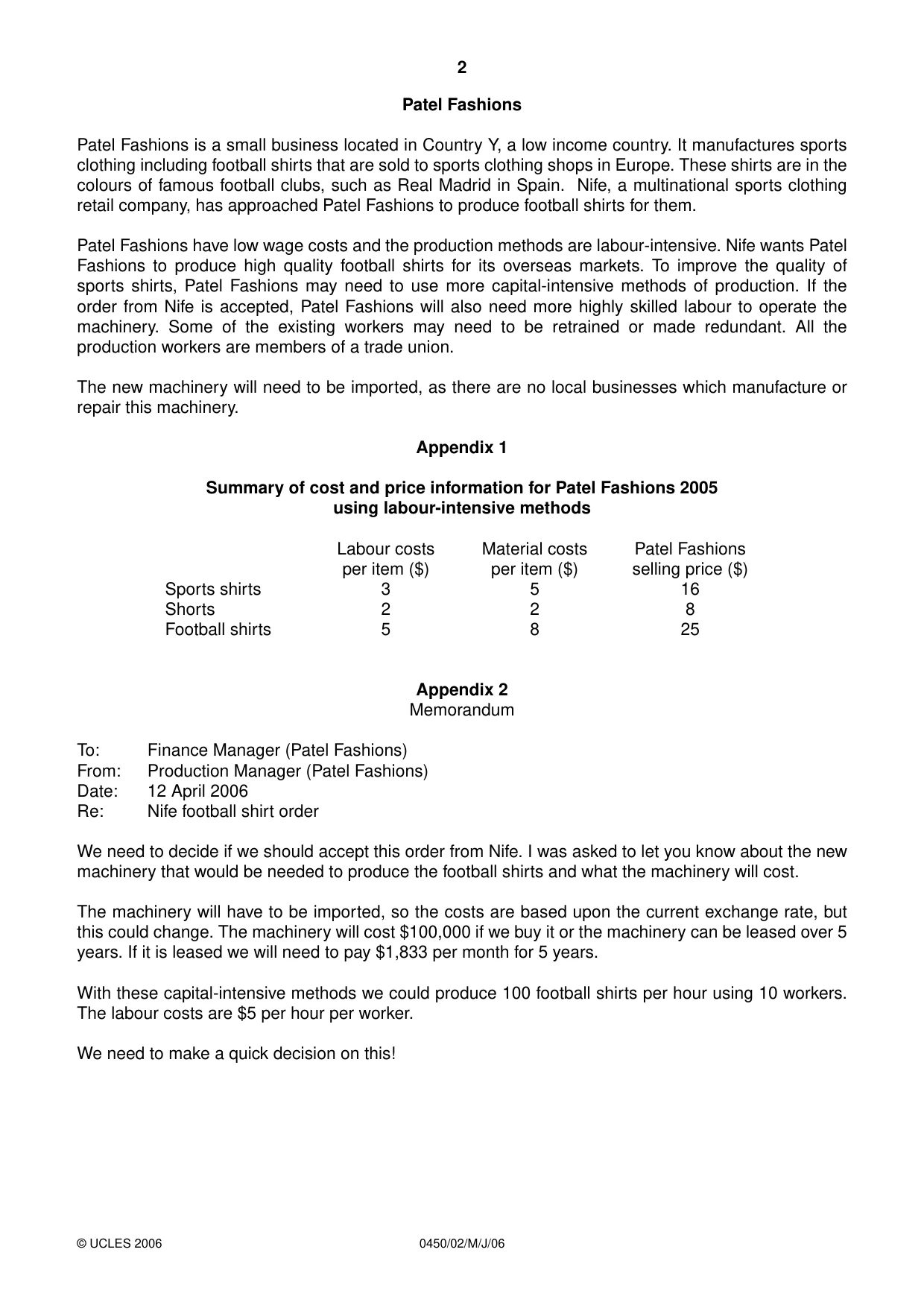
2 0450/02/M/J/06 Patel Fashions Patel Fashions is a small business located in Country Y, a low income country. It manufactures sports clothing including football shirts that are sold to sports clothing shops in Europe. These shirts are in the colours of famous football clubs, such as Real Madrid in Spain. Nife, a multinational sports clothing retail company, has approached Patel Fashions to produce football shirts for them. Patel Fashions have low wage costs and the production methods are labour-intensive. Nife wants Patel Fashions to produce high quality football shirts for its overseas markets. To improve the quality of sports shirts, Patel Fashions may need to use more capital-intensive methods of production. If the order from Nife is accepted, Patel Fashions will also need more highly skilled labour to operate the machinery. Some of the existing workers may need to be retrained or made redundant. All the production workers are members of a trade union. The new machinery will need to be imported, as there are no local businesses which manufacture or repair this machinery. Appendix 1 Summary of cost and price information for Patel Fashions 2005 using labour-intensive methods Labour costs Material costs Patel Fashions per item ($) per item ($) selling price ($) Sports shirts 3 5 16 Shorts 2 2 8 Football shirts 5 8 25 Appendix 2 Memorandum To: Finance Manager (Patel Fashions) From: Production Manager (Patel Fashions) Date: 12 April 2006 Re: Nife football shirt order We need to decide if we should accept this order from Nife. I was asked to let you know about the new machinery that would be needed to produce the football shirts and what the machinery will cost. The machinery will have to be imported, so the costs are based upon the current exchange rate, but this could change. The machinery will cost $100,000 if we buy it or the machinery can be leased over 5 years. If it is leased we will need to pay $1,833 per month for 5 years. With these capital-intensive methods we could produce 100 football shirts per hour using 10 workers. The labour costs are $5 per hour per worker. We need to make a quick decision on this! © UCLES 2006
Question paper, page 3
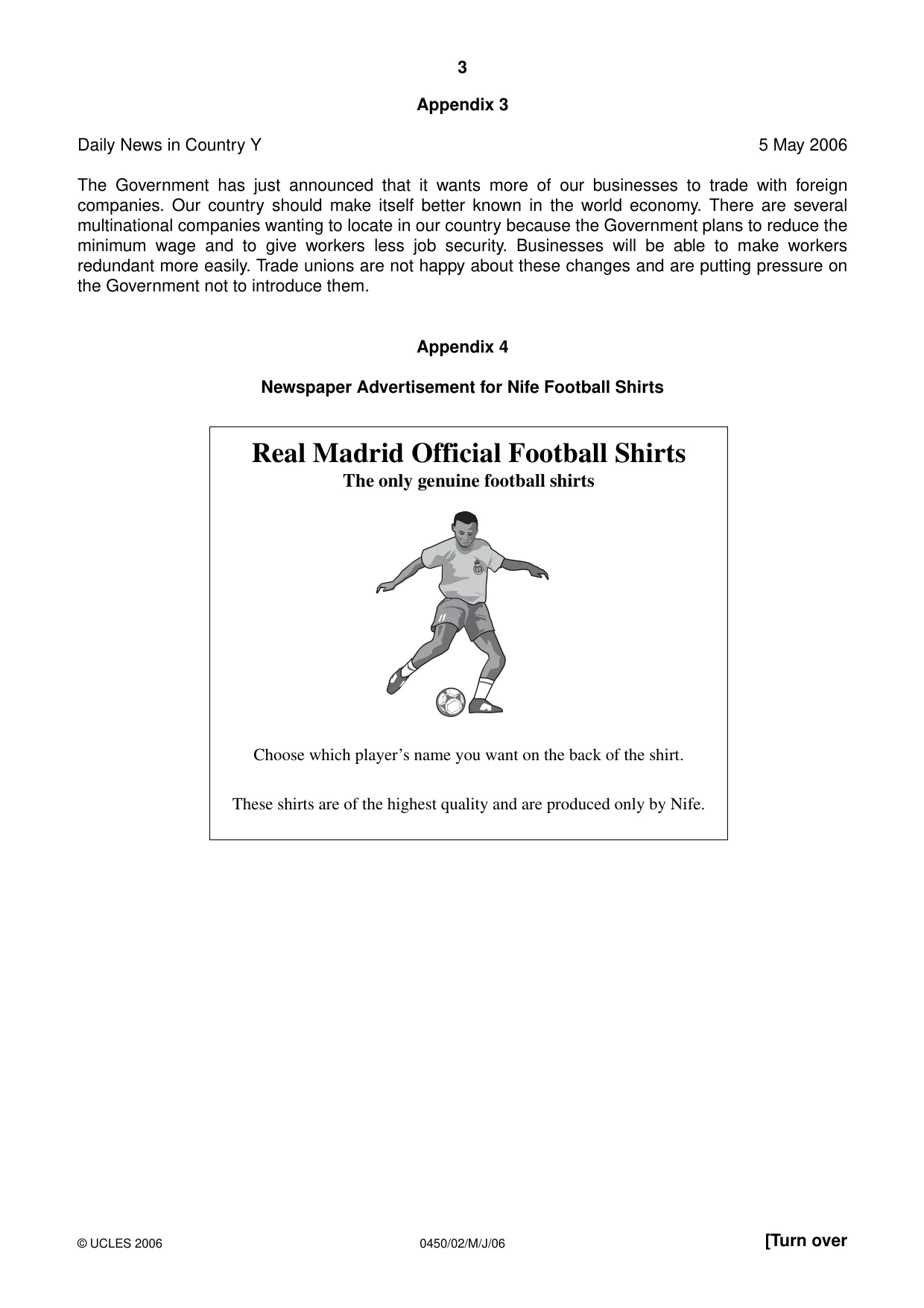
3 0450/02/M/J/06 [Turn over Appendix 3 Daily News in Country Y 5 May 2006 The Government has just announced that it wants more of our businesses to trade with foreign companies. Our country should make itself better known in the world economy. There are several multinational companies wanting to locate in our country because the Government plans to reduce the minimum wage and to give workers less job security. Businesses will be able to make workers redundant more easily. Trade unions are not happy about these changes and are putting pressure on the Government not to introduce them. Appendix 4 Newspaper Advertisement for Nife Football Shirts © UCLES 2006 Real Madrid Official Football Shirts The only genuine football shirts Choose which player’s name you want on the back of the shirt. These shirts are of the highest quality and are produced only by Nife.
Question paper, page 4
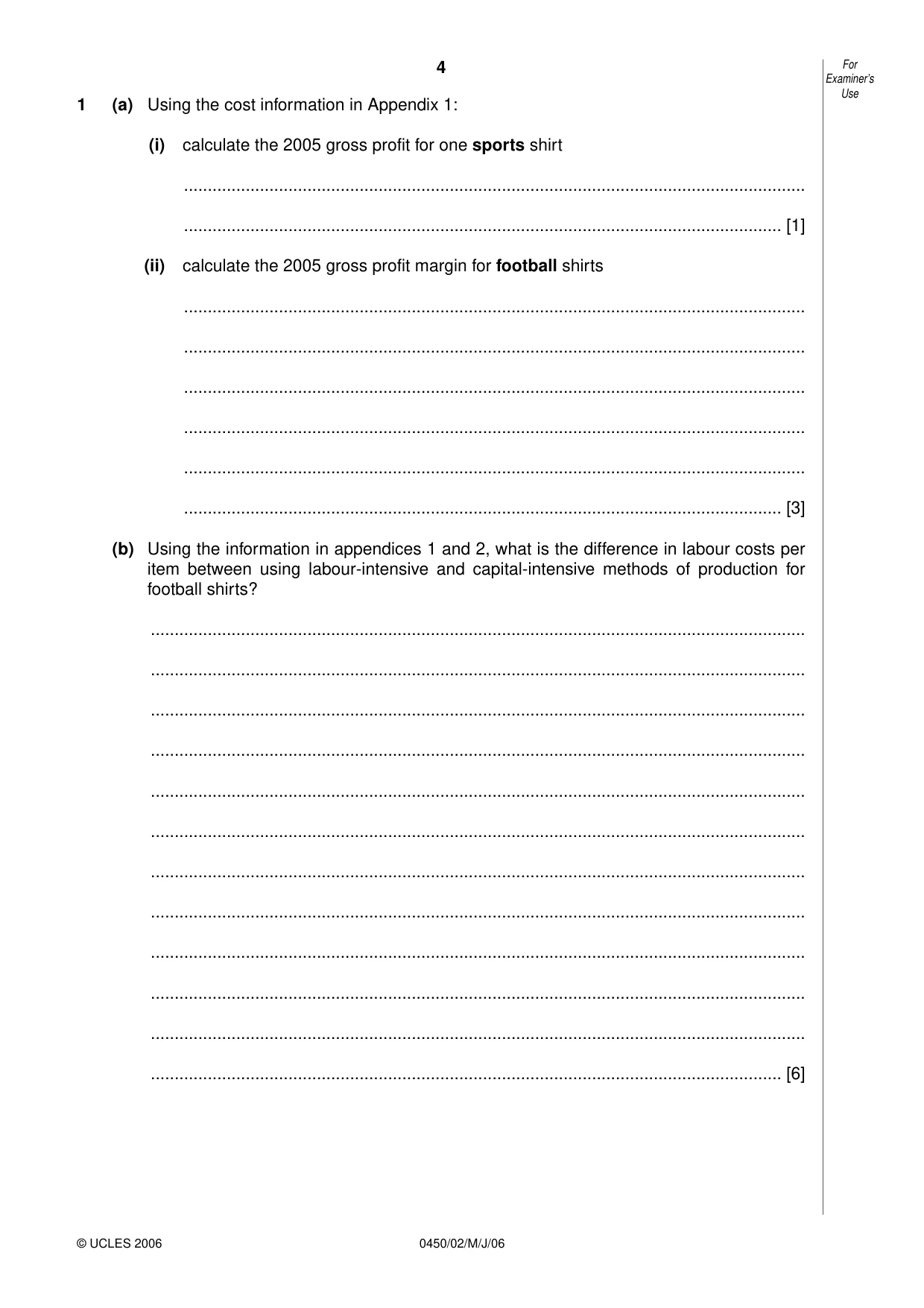
4 0450/02/M/J/06 1 (a) Using the cost information in Appendix 1: (i) calculate the 2005 gross profit for one sports shirt … … [1] (ii) calculate the 2005 gross profit margin for football shirts … … … … … … [3] (b) Using the information in appendices 1 and 2, what is the difference in labour costs per item between using labour-intensive and capital-intensive methods of production for football shirts? … … … … … … … … … … … … [6] For Examiner’s Use © UCLES 2006
Question paper, page 5
5 0450/02/M/J/06 [Turn over (c) Patel Fashions are thinking about changing from labour-intensive to capital-intensive methods of production. Do you think Patel Fashions should introduce capital-intensive methods of production? Explain your answer. … … … … … … … … … … … … … … … … … … … … [10] For Examiner’s Use © UCLES 2006
Question paper, page 6
6 0450/02/M/J/06 2 (a) If the large order is accepted from Nife, 75% of output will be for just one multinational customer. Do you think it would it be wise for the company to depend on one customer so much? Explain your answer. … … … … … … … … … … … … … … … … … … … … [10] For Examiner’s Use © UCLES 2006
Question paper, page 7
7 0450/02/M/J/06 [Turn over (b) If the order is accepted, Patel Fashions will need to have good communications with Nife’s head office which is in country X. Explain the advantages and disadvantages of TWO methods of communication Patel Fashions could use to communicate with Nife. Method 1 … … … … … … … … … … Method 2 … … … … … … … … … … [10] For Examiner’s Use © UCLES 2006
Question paper, page 8
8 0450/02/M/J/06 3 (a) Nife are only interested in purchasing high quality football shirts. How would you advise Patel Fashions on how they could make sure that its football shirts are of high quality? … … … … … … … … … … … … … … … … … … … … [10] For Examiner’s Use © UCLES 2006
Question paper, page 9
9 0450/02/M/J/06 [Turn over (b) Explain a suitable marketing mix that Nife could use to sell these high quality football shirts to customers. … … … … … … … … … … … … … … … … … … … … [10] For Examiner’s Use © UCLES 2006
Question paper, page 10
10 0450/02/M/J/06 4 (a) If Patel Fashions decide to change to capital-intensive methods of production some of the workers will not have the right skills to operate the new equipment. Would you advise Patel Fashions to recruit new fully trained workers or retrain the existing production workers? Explain your answer. … … … … … … … … … … … … … … … … … … … … [10] For Examiner’s Use © UCLES 2006
Question paper, page 11
11 0450/02/M/J/06 [Turn over (b) All of Patel Fashions’ production workers are members of a trade union. Explain the benefits to both Patel Fashions and the production workers of the production workers being members of a trade union. … … … … … … … … … … … … … … … … … … … … [10] For Examiner’s Use © UCLES 2006
Question paper, page 12
12 0450/02/M/J/06 5 (a) The Government wants to encourage more multinational companies to come to their country Y. Do you think the Government is right to do this? Explain your answer. … … … … … … … … … … … … … … … … … … … … … … … … [12] For Examiner’s Use © UCLES 2006
Question paper, page 13
13 0450/02/M/J/06 (b) Explain why the trade unions might be against the changes in employment laws proposed by the government in country Y. (See Appendix 3) … … … … … … … … … … … … … … … … [8] For Examiner’s Use © UCLES 2006
Question paper, page 16
16 0450/02/M/J/06 BLANK PAGE Permission to reproduce items where third-party owned material protected by copyright is included has been sought and cleared where possible. Every reasonable effort has been made by the publisher (UCLES) to trace copyright holders, but if any items requiring clearance have unwittingly been included, the publisher will be pleased to make amends at the earliest possible opportunity. University of Cambridge International Examinations is part of the University of Cambridge Local Examinations Syndicate (UCLES), which is itself a department of the University of Cambridge.
Mark scheme, page 1
UNIVERSITY OF CAMBRIDGE INTERNATIONAL EXAMINATIONS International General Certificate of Secondary Education MARK SCHEME for the May/June 2006 question paper 0450 BUSINESS STUDIES 0450/02 Paper 2, maximum raw mark 100 These mark schemes are published as an aid to teachers and students, to indicate the requirements of the examination. They show the basis on which Examiners were initially instructed to award marks. They do not indicate the details of the discussions that took place at an Examiners’ meeting before marking began. Any substantial changes to the mark scheme that arose from these discussions will be recorded in the published Report on the Examination. All Examiners are instructed that alternative correct answers and unexpected approaches in candidates’ scripts must be given marks that fairly reflect the relevant knowledge and skills demonstrated. Mark schemes must be read in conjunction with the question papers and the Report on the Examination. The minimum marks in these components needed for various grades were previously published with these mark schemes, but are now instead included in the Report on the Examination for this session. • CIE will not enter into discussion or correspondence in connection with these mark schemes. CIE is publishing the mark schemes for the May/June 2006 question papers for most IGCSE and GCE Advanced Level and Advanced Subsidiary Level syllabuses and some Ordinary Level syllabuses. www.XtremePapers.com
Mark scheme, page 2
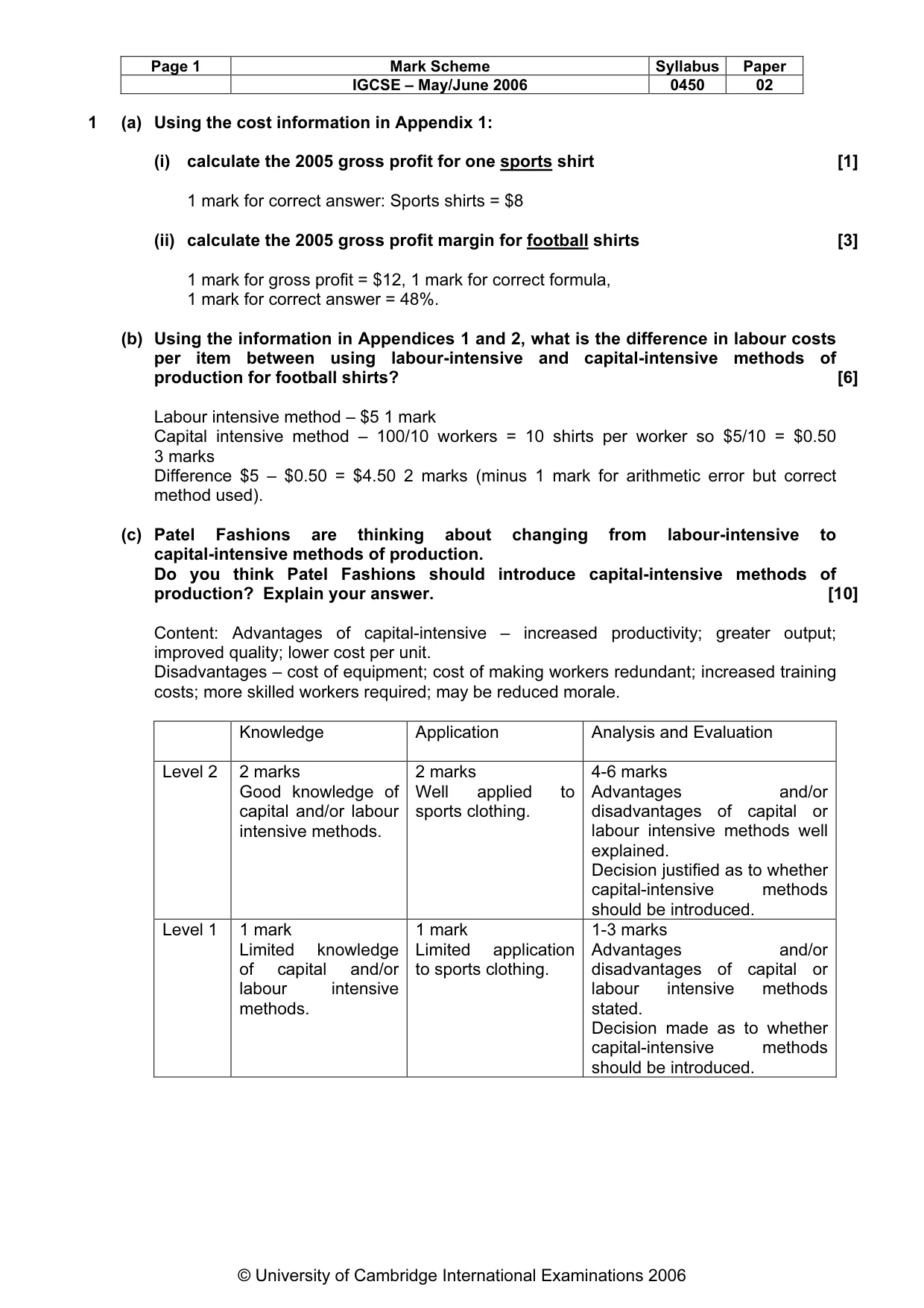
Page 1 Mark Scheme Syllabus Paper IGCSE – May/June 2006 0450 02 © University of Cambridge International Examinations 2006 1 (a) Using the cost information in Appendix 1: (i) calculate the 2005 gross profit for one sports shirt [1] 1 mark for correct answer: Sports shirts = $8 (ii) calculate the 2005 gross profit margin for football shirts [3] 1 mark for gross profit = $12, 1 mark for correct formula, 1 mark for correct answer = 48%. (b) Using the information in Appendices 1 and 2, what is the difference in labour costs per item between using labour-intensive and capital-intensive methods of production for football shirts? [6] Labour intensive method – $5 1 mark Capital intensive method – 100/10 workers = 10 shirts per worker so $5/10 = $0.50 3 marks Difference $5 – $0.50 = $4.50 2 marks (minus 1 mark for arithmetic error but correct method used). (c) Patel Fashions are thinking about changing from labour-intensive to capital-intensive methods of production. Do you think Patel Fashions should introduce capital-intensive methods of production? Explain your answer. [10] Content: Advantages of capital-intensive – increased productivity; greater output; improved quality; lower cost per unit. Disadvantages – cost of equipment; cost of making workers redundant; increased training costs; more skilled workers required; may be reduced morale. Knowledge Application Analysis and Evaluation Level 2 2 marks Good knowledge of capital and/or labour intensive methods. 2 marks Well applied to sports clothing. 4-6 marks Advantages and/or disadvantages of capital or labour intensive methods well explained. Decision justified as to whether capital-intensive methods should be introduced. Level 1 1 mark Limited knowledge of capital and/or labour intensive methods. 1 mark Limited application to sports clothing. 1-3 marks Advantages and/or disadvantages of capital or labour intensive methods stated. Decision made as to whether capital-intensive methods should be introduced.
Mark scheme, page 3
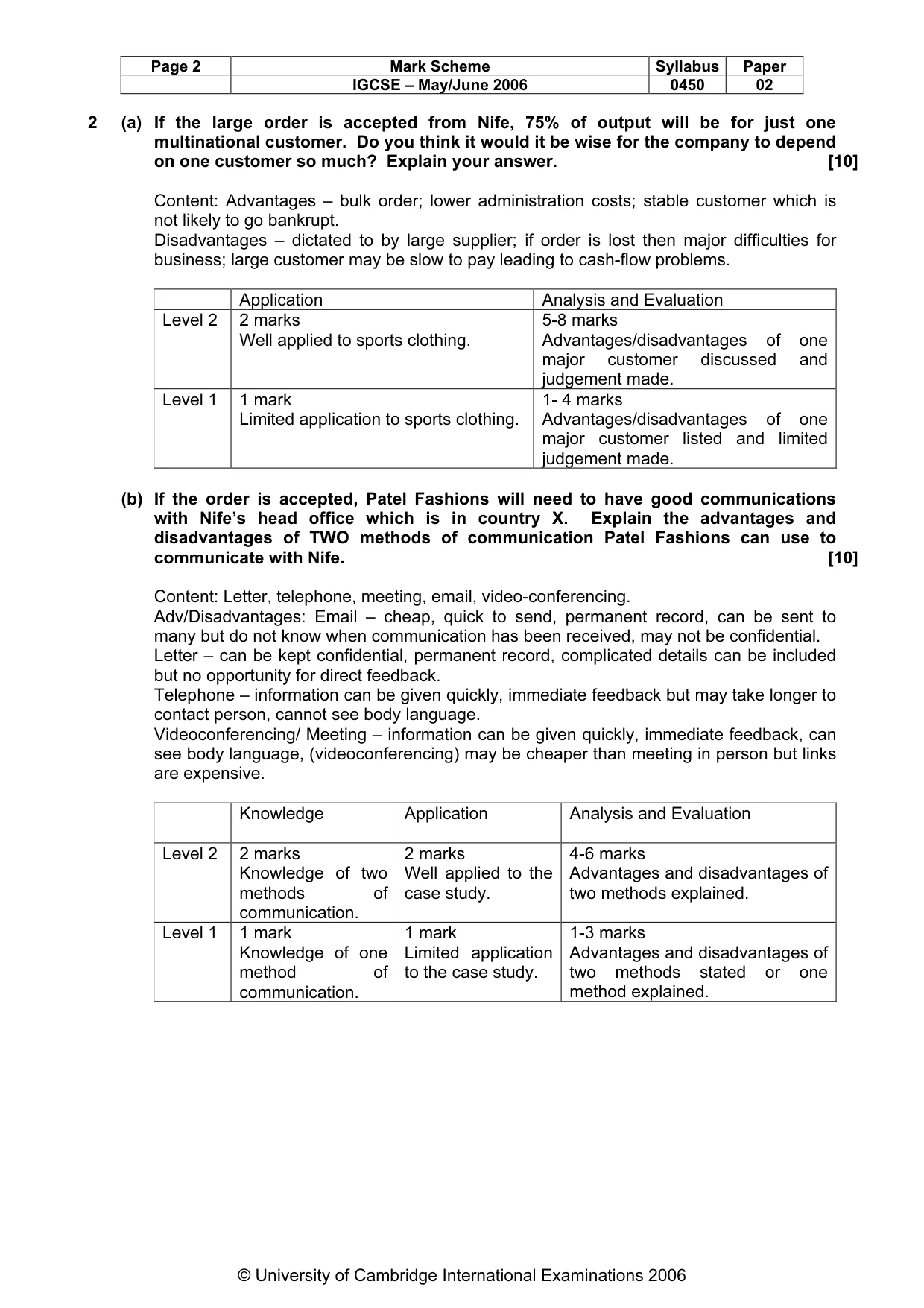
Page 2 Mark Scheme Syllabus Paper IGCSE – May/June 2006 0450 02 © University of Cambridge International Examinations 2006 2 (a) If the large order is accepted from Nife, 75% of output will be for just one multinational customer. Do you think it would it be wise for the company to depend on one customer so much? Explain your answer. [10] Content: Advantages – bulk order; lower administration costs; stable customer which is not likely to go bankrupt. Disadvantages – dictated to by large supplier; if order is lost then major difficulties for business; large customer may be slow to pay leading to cash-flow problems. Application Analysis and Evaluation Level 2 2 marks Well applied to sports clothing. 5-8 marks Advantages/disadvantages of one major customer discussed and judgement made. Level 1 1 mark Limited application to sports clothing. 1- 4 marks Advantages/disadvantages of one major customer listed and limited judgement made. (b) If the order is accepted, Patel Fashions will need to have good communications with Nife’s head office which is in country X. Explain the advantages and disadvantages of TWO methods of communication Patel Fashions can use to communicate with Nife. [10] Content: Letter, telephone, meeting, email, video-conferencing. Adv/Disadvantages: Email – cheap, quick to send, permanent record, can be sent to many but do not know when communication has been received, may not be confidential. Letter – can be kept confidential, permanent record, complicated details can be included but no opportunity for direct feedback. Telephone – information can be given quickly, immediate feedback but may take longer to contact person, cannot see body language. Videoconferencing/ Meeting – information can be given quickly, immediate feedback, can see body language, (videoconferencing) may be cheaper than meeting in person but links are expensive. Knowledge Application Analysis and Evaluation Level 2 2 marks Knowledge of two methods of communication. 2 marks Well applied to the case study. 4-6 marks Advantages and disadvantages of two methods explained. Level 1 1 mark Knowledge of one method of communication. 1 mark Limited application to the case study. 1-3 marks Advantages and disadvantages of two methods stated or one method explained.
Mark scheme, page 4
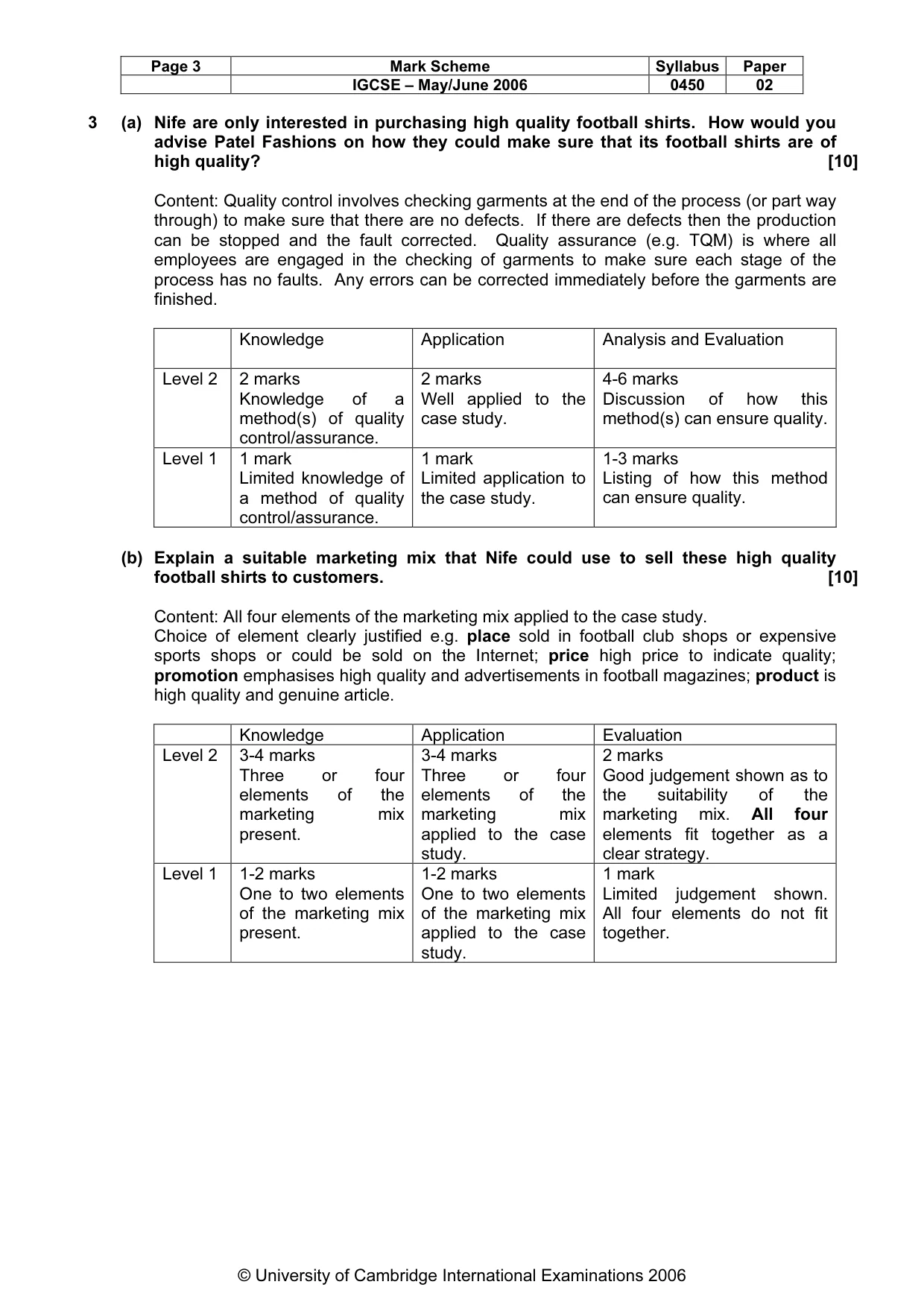
Page 3 Mark Scheme Syllabus Paper IGCSE – May/June 2006 0450 02 © University of Cambridge International Examinations 2006 3 (a) Nife are only interested in purchasing high quality football shirts. How would you advise Patel Fashions on how they could make sure that its football shirts are of high quality? [10] Content: Quality control involves checking garments at the end of the process (or part way through) to make sure that there are no defects. If there are defects then the production can be stopped and the fault corrected. Quality assurance (e.g. TQM) is where all employees are engaged in the checking of garments to make sure each stage of the process has no faults. Any errors can be corrected immediately before the garments are finished. Knowledge Application Analysis and Evaluation Level 2 2 marks Knowledge of a method(s) of quality control/assurance. 2 marks Well applied to the case study. 4-6 marks Discussion of how this method(s) can ensure quality. Level 1 1 mark Limited knowledge of a method of quality control/assurance. 1 mark Limited application to the case study. 1-3 marks Listing of how this method can ensure quality. (b) Explain a suitable marketing mix that Nife could use to sell these high quality football shirts to customers. [10] Content: All four elements of the marketing mix applied to the case study. Choice of element clearly justified e.g. place sold in football club shops or expensive sports shops or could be sold on the Internet; price high price to indicate quality; promotion emphasises high quality and advertisements in football magazines; product is high quality and genuine article. Knowledge Application Evaluation Level 2 3-4 marks Three or four elements of the marketing mix present. 3-4 marks Three or four elements of the marketing mix applied to the case study. 2 marks Good judgement shown as to the suitability of the marketing mix. All four elements fit together as a clear strategy. Level 1 1-2 marks One to two elements of the marketing mix present. 1-2 marks One to two elements of the marketing mix applied to the case study. 1 mark Limited judgement shown. All four elements do not fit together.
Mark scheme, page 5
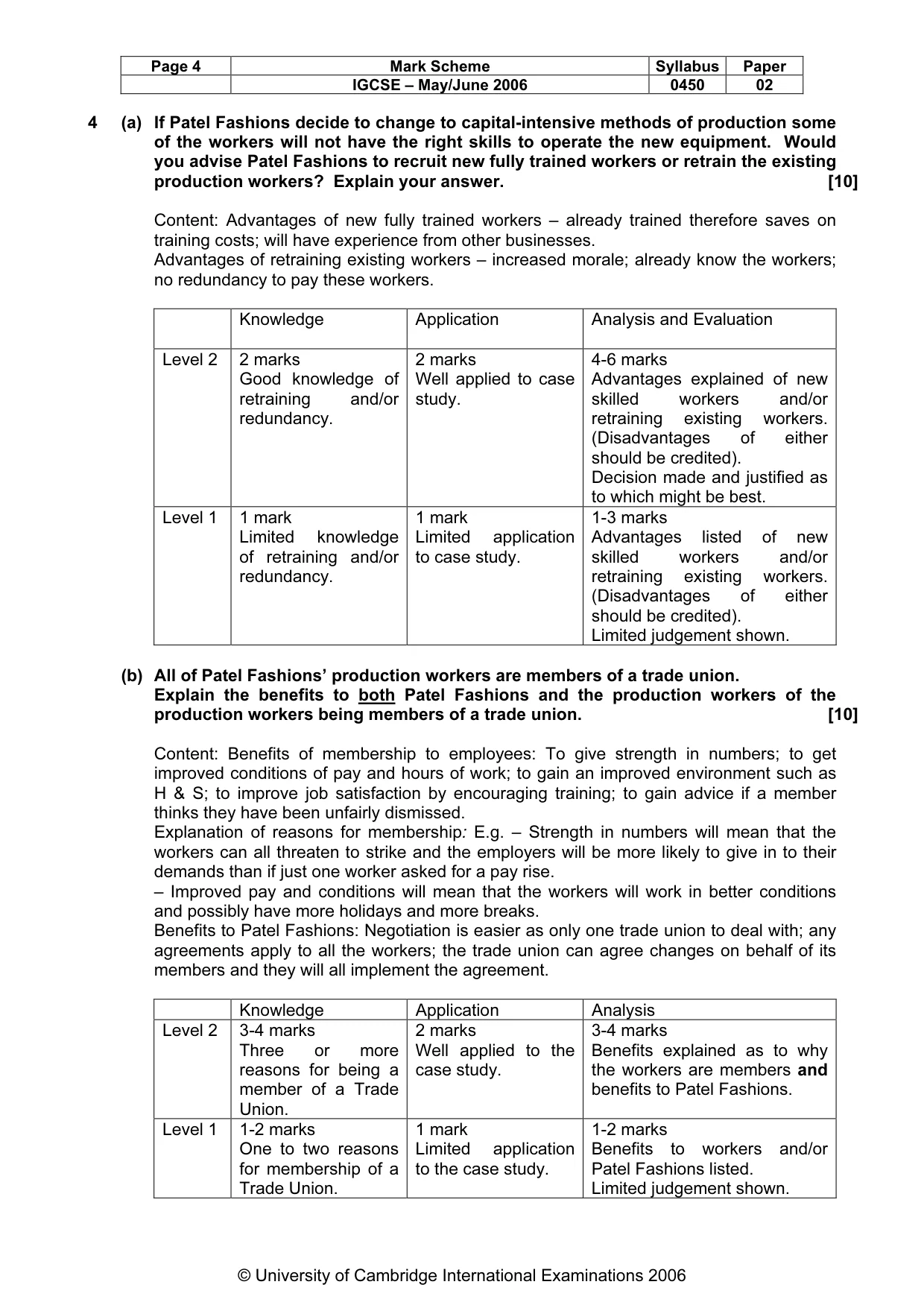
Page 4 Mark Scheme Syllabus Paper IGCSE – May/June 2006 0450 02 © University of Cambridge International Examinations 2006 4 (a) If Patel Fashions decide to change to capital-intensive methods of production some of the workers will not have the right skills to operate the new equipment. Would you advise Patel Fashions to recruit new fully trained workers or retrain the existing production workers? Explain your answer. [10] Content: Advantages of new fully trained workers – already trained therefore saves on training costs; will have experience from other businesses. Advantages of retraining existing workers – increased morale; already know the workers; no redundancy to pay these workers. Knowledge Application Analysis and Evaluation Level 2 2 marks Good knowledge of retraining and/or redundancy. 2 marks Well applied to case study. 4-6 marks Advantages explained of new skilled workers and/or retraining existing workers. (Disadvantages of either should be credited). Decision made and justified as to which might be best. Level 1 1 mark Limited knowledge of retraining and/or redundancy. 1 mark Limited application to case study. 1-3 marks Advantages listed of new skilled workers and/or retraining existing workers. (Disadvantages of either should be credited). Limited judgement shown. (b) All of Patel Fashions’ production workers are members of a trade union. Explain the benefits to both Patel Fashions and the production workers of the production workers being members of a trade union. [10] Content: Benefits of membership to employees: To give strength in numbers; to get improved conditions of pay and hours of work; to gain an improved environment such as H & S; to improve job satisfaction by encouraging training; to gain advice if a member thinks they have been unfairly dismissed. Explanation of reasons for membership: E.g. – Strength in numbers will mean that the workers can all threaten to strike and the employers will be more likely to give in to their demands than if just one worker asked for a pay rise. – Improved pay and conditions will mean that the workers will work in better conditions and possibly have more holidays and more breaks. Benefits to Patel Fashions: Negotiation is easier as only one trade union to deal with; any agreements apply to all the workers; the trade union can agree changes on behalf of its members and they will all implement the agreement. Knowledge Application Analysis Level 2 3-4 marks Three or more reasons for being a member of a Trade Union. 2 marks Well applied to the case study. 3-4 marks Benefits explained as to why the workers are members and benefits to Patel Fashions. Level 1 1-2 marks One to two reasons for membership of a Trade Union. 1 mark Limited application to the case study. 1-2 marks Benefits to workers and/or Patel Fashions listed. Limited judgement shown.
Mark scheme, page 6
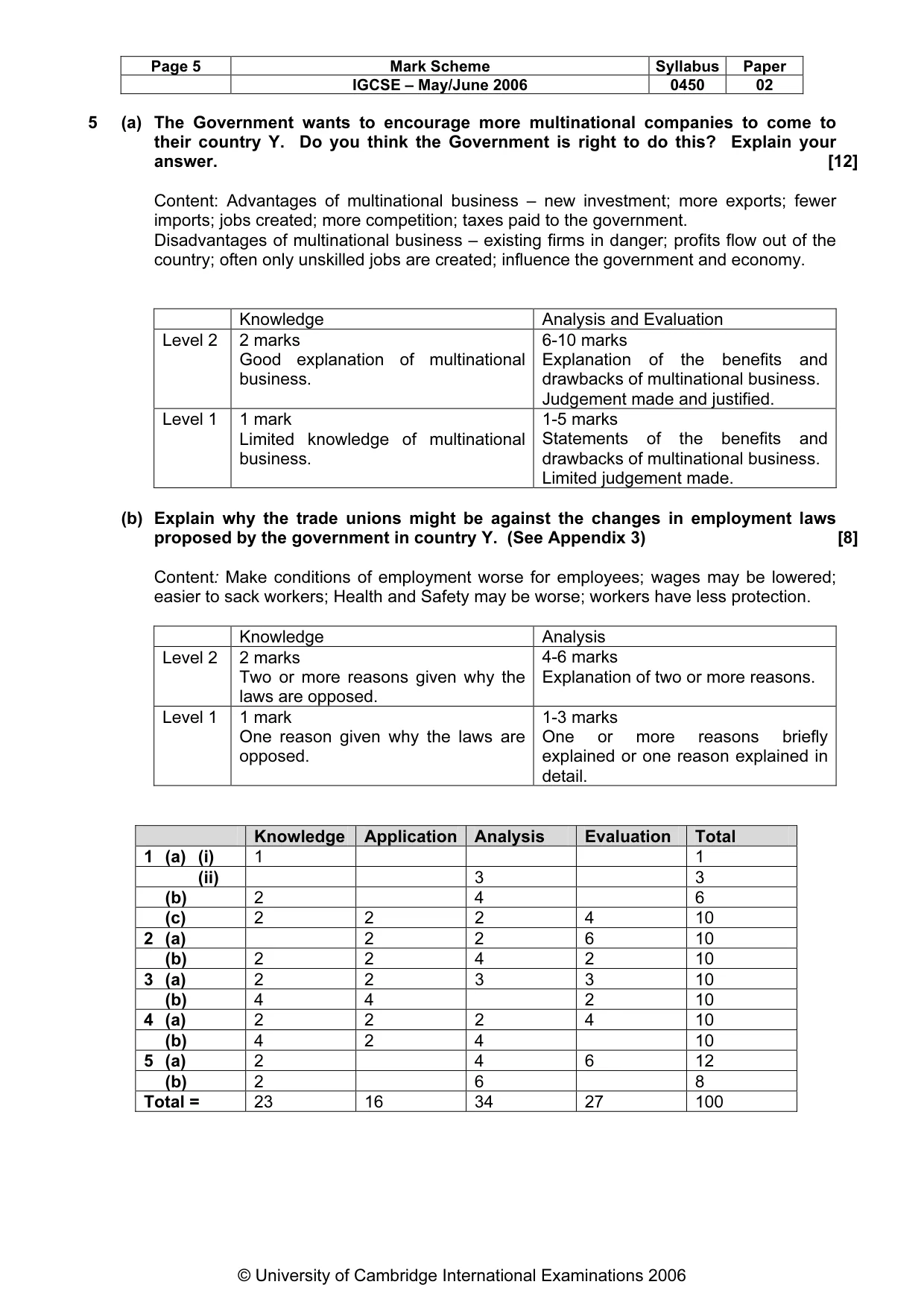
Page 5 Mark Scheme Syllabus Paper IGCSE – May/June 2006 0450 02 © University of Cambridge International Examinations 2006 5 (a) The Government wants to encourage more multinational companies to come to their country Y. Do you think the Government is right to do this? Explain your answer. [12] Content: Advantages of multinational business – new investment; more exports; fewer imports; jobs created; more competition; taxes paid to the government. Disadvantages of multinational business – existing firms in danger; profits flow out of the country; often only unskilled jobs are created; influence the government and economy. Knowledge Analysis and Evaluation Level 2 2 marks Good explanation of multinational business. 6-10 marks Explanation of the benefits and drawbacks of multinational business. Judgement made and justified. Level 1 1 mark Limited knowledge of multinational business. 1-5 marks Statements of the benefits and drawbacks of multinational business. Limited judgement made. (b) Explain why the trade unions might be against the changes in employment laws proposed by the government in country Y. (See Appendix 3) [8] Content: Make conditions of employment worse for employees; wages may be lowered; easier to sack workers; Health and Safety may be worse; workers have less protection. Knowledge Analysis Level 2 2 marks Two or more reasons given why the laws are opposed. 4-6 marks Explanation of two or more reasons. Level 1 1 mark One reason given why the laws are opposed. 1-3 marks One or more reasons briefly explained or one reason explained in detail. Knowledge Application Analysis Evaluation Total 1 (a) (i) 1 1 (ii) 3 3 (b) 2 4 6 (c) 2 2 2 4 10 2 (a) 2 2 6 10 (b) 2 2 4 2 10 3 (a) 2 2 3 3 10 (b) 4 4 2 10 4 (a) 2 2 2 4 10 (b) 4 2 4 10 5 (a) 2 4 6 12 (b) 2 6 8 Total = 23 16 34 27 100
What you needed in this session
Cambridge’s own grade thresholds for 2006 May/June, Paper 2 · Variant 1. A higher threshold means an easier paper — the bar moves with how the cohort did.