Cambridge IGCSE Business Studies 0450 — 2003 May/June Paper 2 · Variant 1
0450/21/M/J/03
The question paper and its mark scheme, free to read here and free to download. This is Cambridge’s own paper, exactly as it was sat.
Question paper12 pages




Mark scheme
No mark scheme is in the library for this paper.
Paper as text
Question paper, page 1
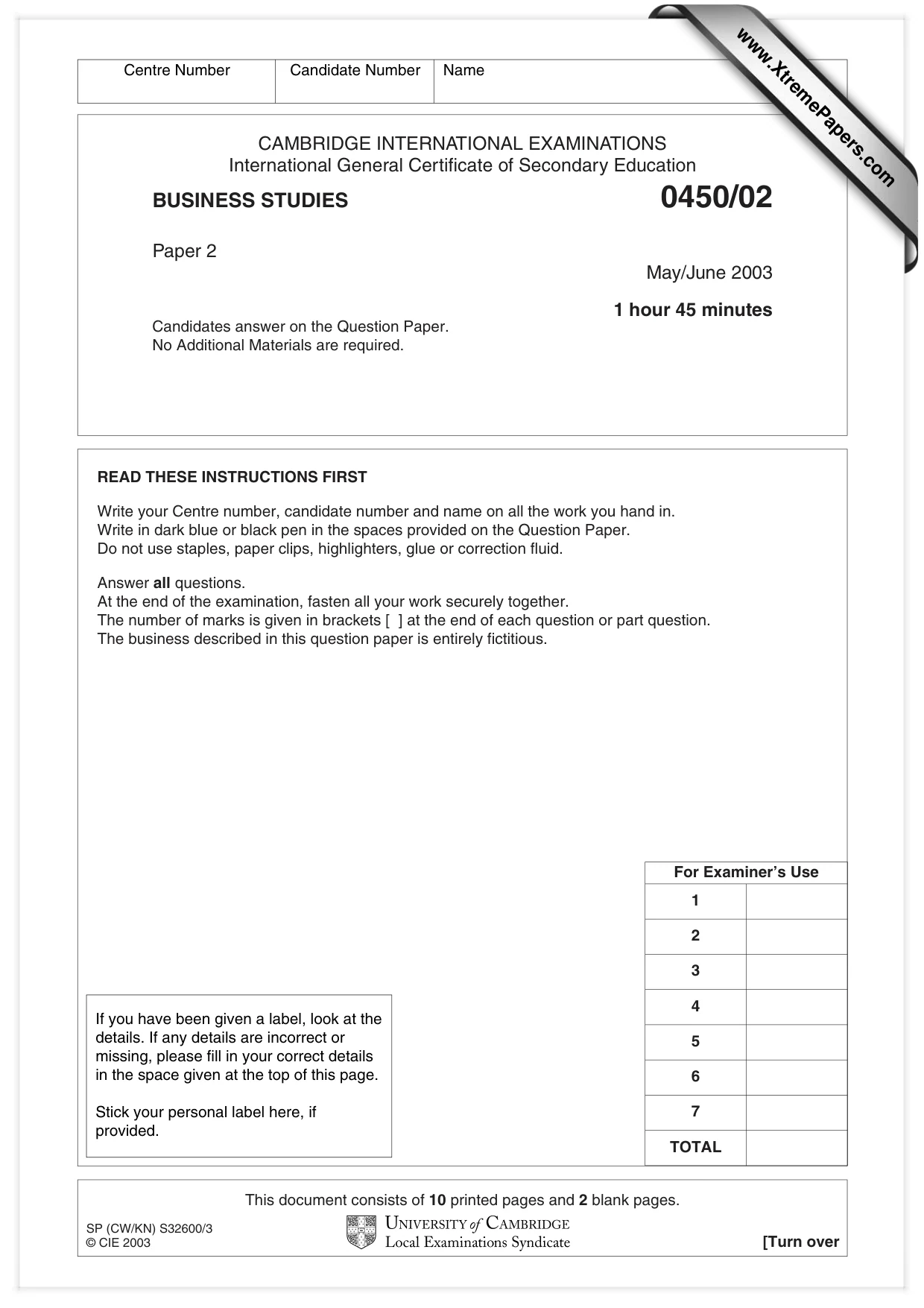
This document consists of 10 printed pages and 2 blank pages. SP (CW/KN) S32600/3 © CIE 2003 [Turn over CAMBRIDGE INTERNATIONAL EXAMINATIONS International General Certificate of Secondary Education BUSINESS STUDIES 0450/02 Paper 2 May/June 2003 1 hour 45 minutes Candidates answer on the Question Paper. No Additional Materials are required. READ THESE INSTRUCTIONS FIRST Write your Centre number, candidate number and name on all the work you hand in. Write in dark blue or black pen in the spaces provided on the Question Paper. Do not use staples, paper clips, highlighters, glue or correction fluid. Answer all questions. At the end of the examination, fasten all your work securely together. The number of marks is given in brackets [ ] at the end of each question or part question. The business described in this question paper is entirely fictitious. Centre Number Candidate Number Name If you have been given a label, look at the details. If any details are incorrect or missing, please fill in your correct details in the space given at the top of this page. Stick your personal label here, if provided. For Examiner’s Use 1 2 3 4 5 6 7 TOTAL www.XtremePapers.com
Question paper, page 2
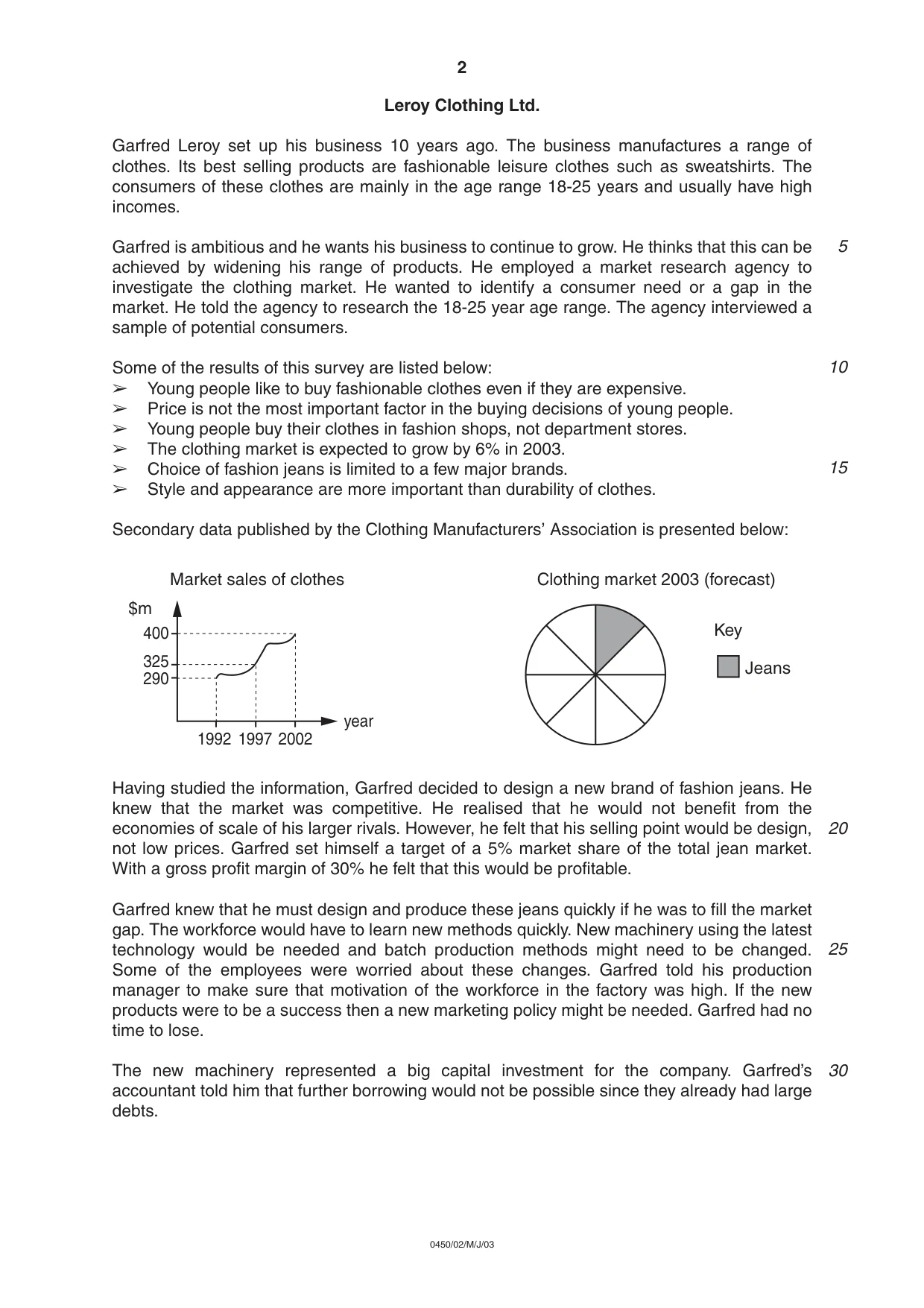
2 0450/02/M/J/03 Leroy Clothing Ltd. Garfred Leroy set up his business 10 years ago. The business manufactures a range of clothes. Its best selling products are fashionable leisure clothes such as sweatshirts. The consumers of these clothes are mainly in the age range 18-25 years and usually have high incomes. Garfred is ambitious and he wants his business to continue to grow. He thinks that this can be achieved by widening his range of products. He employed a market research agency to investigate the clothing market. He wanted to identify a consumer need or a gap in the market. He told the agency to research the 18-25 year age range. The agency interviewed a sample of potential consumers. Some of the results of this survey are listed below: ➢ Young people like to buy fashionable clothes even if they are expensive. ➢ Price is not the most important factor in the buying decisions of young people. ➢ Young people buy their clothes in fashion shops, not department stores. ➢ The clothing market is expected to grow by 6% in 2003. ➢ Choice of fashion jeans is limited to a few major brands. ➢ Style and appearance are more important than durability of clothes. Secondary data published by the Clothing Manufacturers’ Association is presented below: Having studied the information, Garfred decided to design a new brand of fashion jeans. He knew that the market was competitive. He realised that he would not benefit from the economies of scale of his larger rivals. However, he felt that his selling point would be design, not low prices. Garfred set himself a target of a 5% market share of the total jean market. With a gross profit margin of 30% he felt that this would be profitable. Garfred knew that he must design and produce these jeans quickly if he was to fill the market gap. The workforce would have to learn new methods quickly. New machinery using the latest technology would be needed and batch production methods might need to be changed. Some of the employees were worried about these changes. Garfred told his production manager to make sure that motivation of the workforce in the factory was high. If the new products were to be a success then a new marketing policy might be needed. Garfred had no time to lose. The new machinery represented a big capital investment for the company. Garfred’s accountant told him that further borrowing would not be possible since they already had large debts. 290 400 325 1992 1997 2002 year $m Market sales of clothes Clothing market 2003 (forecast) Key Jeans 5 10 15 20 25 30
Question paper, page 3
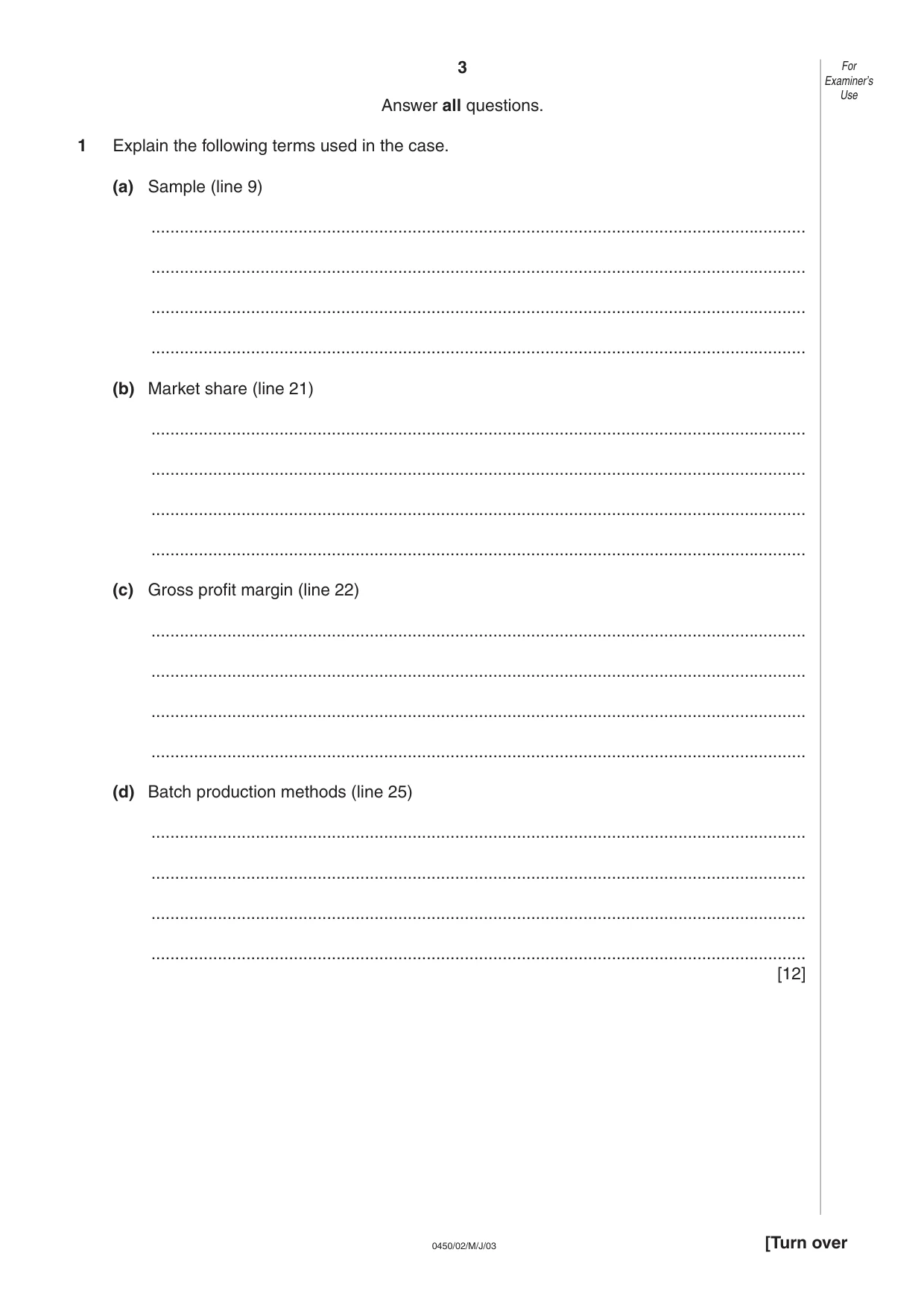
3 0450/02/M/J/03 Answer all questions. 1 Explain the following terms used in the case. (a) Sample (line 9) … … … … (b) Market share (line 21) … … … … (c) Gross profit margin (line 22) … … … … (d) Batch production methods (line 25) … … … … [12] For Examiner’s Use [Turn over
Question paper, page 4
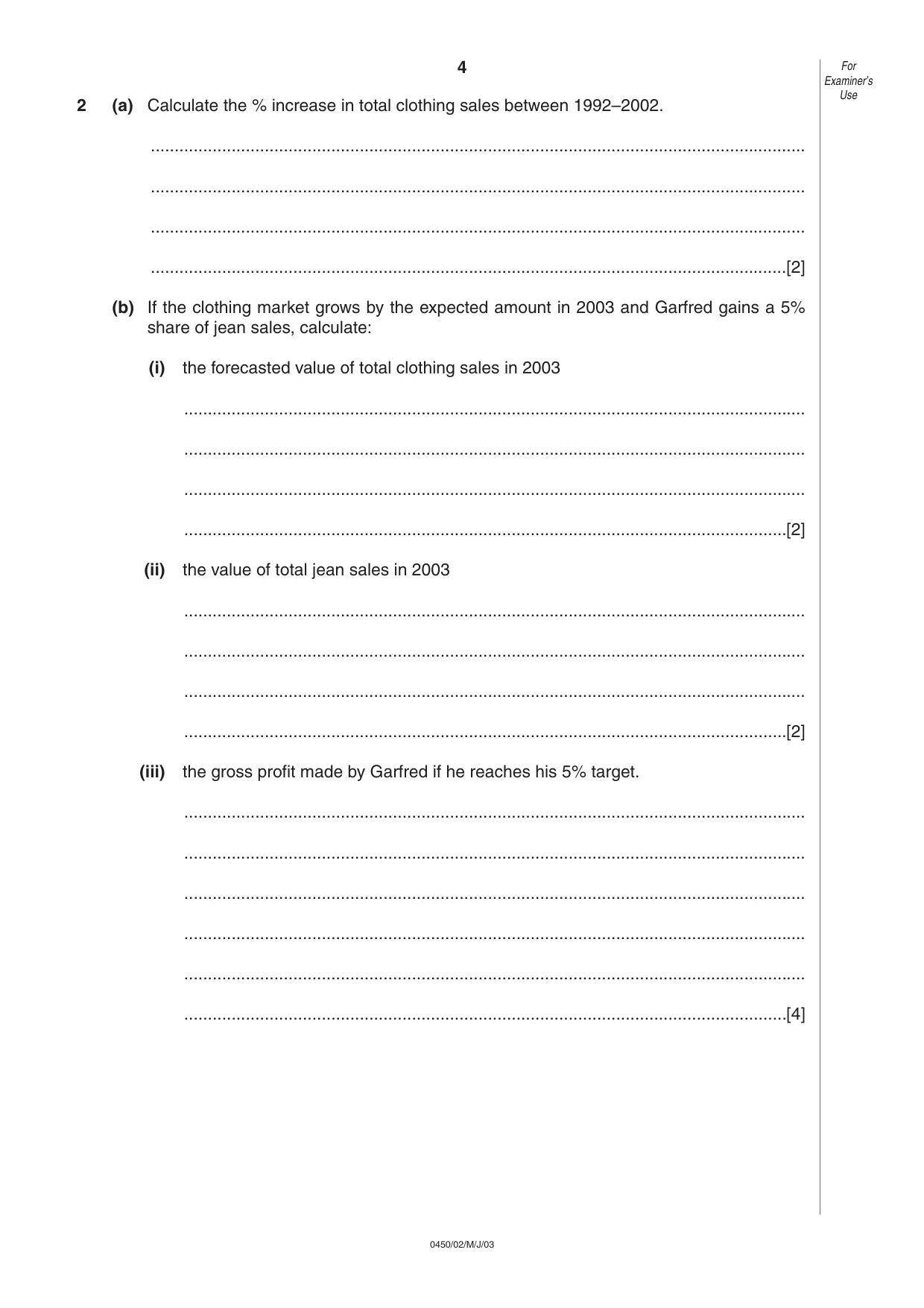
4 0450/02/M/J/03 For Examiner’s Use 2 (a) Calculate the % increase in total clothing sales between 1992–2002. … … … …[2] (b) If the clothing market grows by the expected amount in 2003 and Garfred gains a 5% share of jean sales, calculate: (i) the forecasted value of total clothing sales in 2003 … … … …[2] (ii) the value of total jean sales in 2003 … … … …[2] (iii) the gross profit made by Garfred if he reaches his 5% target. … … … … … …[4]
Question paper, page 5
5 0450/02/M/J/03 3 The management of Leroy Clothing Ltd. know that motivation of employees is important for the success of their business. Explain how the production manager could motivate employees. … … … … … … … … … … … … … … … … … … … … … … … …[12] For Examiner’s Use [Turn over
Question paper, page 6
6 0450/02/M/J/03 4 (a) Explain why the market research results were particularly useful to Garfred. … … … … … … … … … … … … … … … …[8] For Examiner’s Use
Question paper, page 7
7 0450/02/M/J/03 (b) Suggest and justify a marketing mix policy for the launch of the new jeans. … … … … … … … … … … … … … … … … … … … …[10] For Examiner’s Use [Turn over
Question paper, page 8
8 0450/02/M/J/03 5 Outline the economies of scale that Garfred’s major competitors might benefit from. … … … … … … … … … … … … … … … … … … … …[10] For Examiner’s Use
Question paper, page 9
9 0450/02/M/J/03 6 Suggest, with reasons, how the investment in new machinery could be financed. … … … … … … … … … … … …[6] For Examiner’s Use [Turn over
Question paper, page 10
10 0450/02/M/J/03 7 The government in Garfred’s country has recently introduced new laws aimed at protecting consumers. (a) Do you think that consumers need protecting from some business activity? Explain your answer. … … … … … … … … … … … …[6] (b) Outline how such laws might affect Garfred’s marketing policies. … … … … … … … … … … … …[6] For Examiner’s Use