Cambridge IGCSE Business Studies 0450 — 2002 Oct/Nov Paper 2 · Variant 1
0450/21/O/N/02
The question paper and its mark scheme, free to read here and free to download. This is Cambridge’s own paper, exactly as it was sat.
Question paper12 pages




Mark scheme3 pages
Answers below. Sit the paper first if you are practising.

Paper as text
Question paper, page 1
This question paper consists of 9 printed pages and 3 blank pages. SP (NF) S10535/3 © UCLES 2002 [Turn over International General Certificate of Secondary Education CAMBRIDGE INTERNATIONAL EXAMINATIONS BUSINESS STUDIES 0450/2 PAPER 2 OCTOBER/NOVEMBER SESSION 2002 1 hour 45 minutes Candidates answer on the question paper. No additional materials are required. TIME 1 hour 45 minutes INSTRUCTIONS TO CANDIDATES Write your name, Centre number and candidate number in the spaces at the top of this page. Read the passage and answer all questions. Write your answers in the spaces provided on the question paper. INFORMATION FOR CANDIDATES The number of marks is given in brackets [ ] at the end of each question or part question. The business described in the case study is entirely fictitious. Candidate Centre Number Number Candidate Name FOR EXAMINER’S USE 3 2 1 4 7 TOTAL 6 5 www.XtremePapers.com
Question paper, page 2
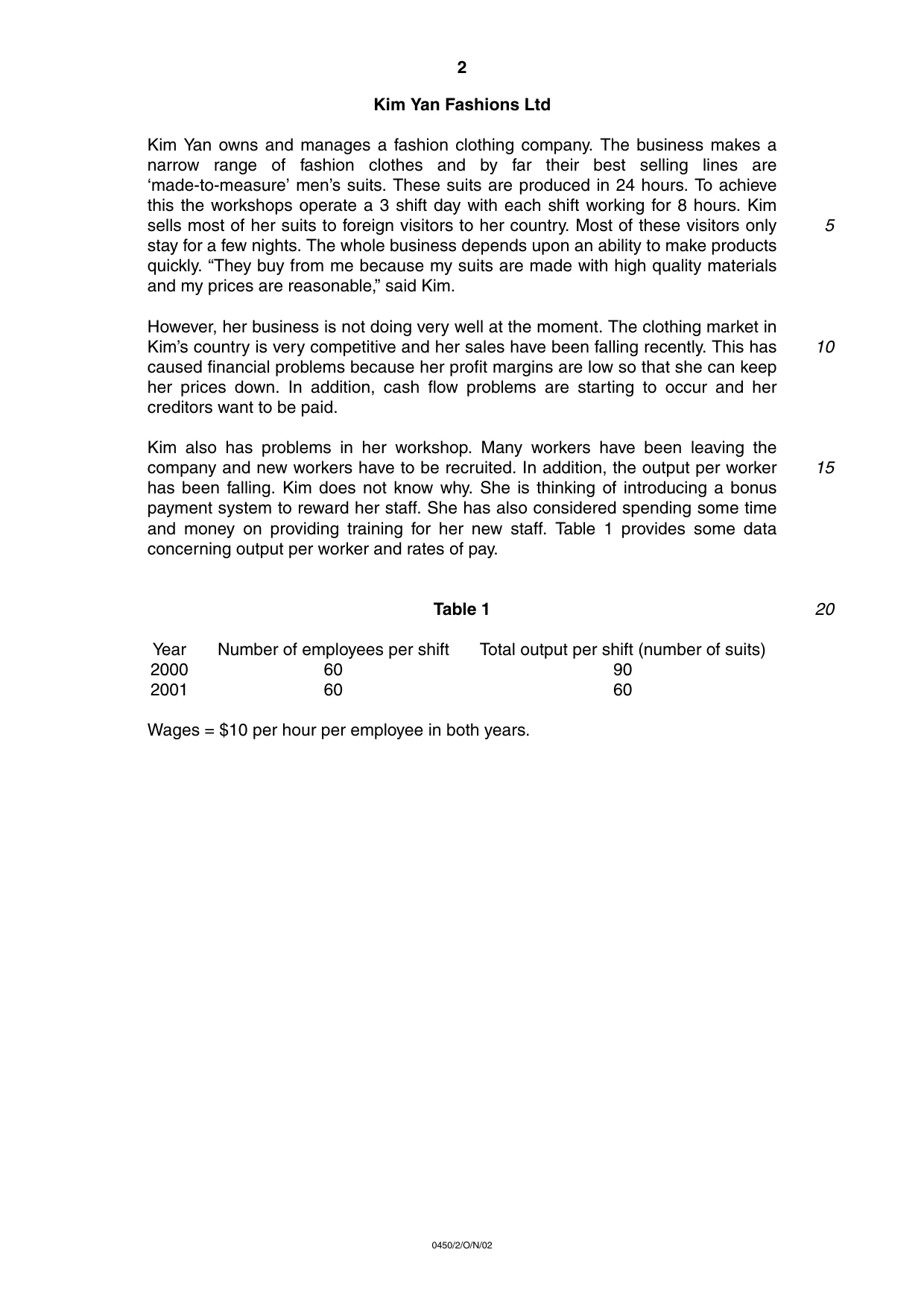
2 0450/2/O/N/02 Kim Yan Fashions Ltd Kim Yan owns and manages a fashion clothing company. The business makes a narrow range of fashion clothes and by far their best selling lines are ‘made-to-measure’ men’s suits. These suits are produced in 24 hours. To achieve this the workshops operate a 3 shift day with each shift working for 8 hours. Kim sells most of her suits to foreign visitors to her country. Most of these visitors only stay for a few nights. The whole business depends upon an ability to make products quickly. “They buy from me because my suits are made with high quality materials and my prices are reasonable,” said Kim. However, her business is not doing very well at the moment. The clothing market in Kim’s country is very competitive and her sales have been falling recently. This has caused financial problems because her profit margins are low so that she can keep her prices down. In addition, cash flow problems are starting to occur and her creditors want to be paid. Kim also has problems in her workshop. Many workers have been leaving the company and new workers have to be recruited. In addition, the output per worker has been falling. Kim does not know why. She is thinking of introducing a bonus payment system to reward her staff. She has also considered spending some time and money on providing training for her new staff. Table 1 provides some data concerning output per worker and rates of pay. Table 1 Year Number of employees per shift Total output per shift (number of suits) 2000 60 90 2001 60 60 Wages = $10 per hour per employee in both years. 5 10 15 20
Question paper, page 3
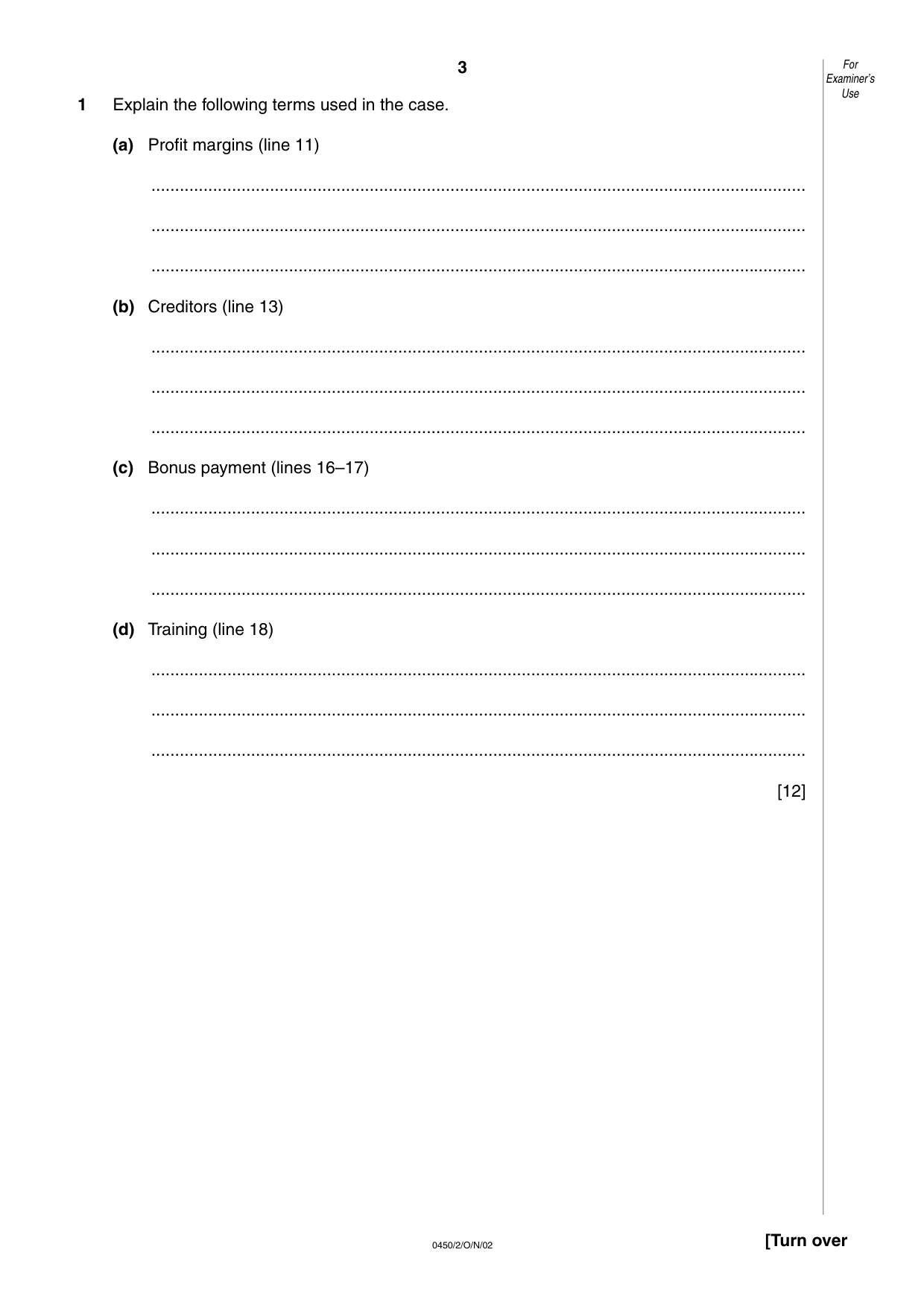
3 0450/2/O/N/02 [Turn over 1 Explain the following terms used in the case. (a) Profit margins (line 11) … … … (b) Creditors (line 13) … … … (c) Bonus payment (lines 16–17) … … … (d) Training (line 18) … … … [12] For Examiner’s Use
Question paper, page 4
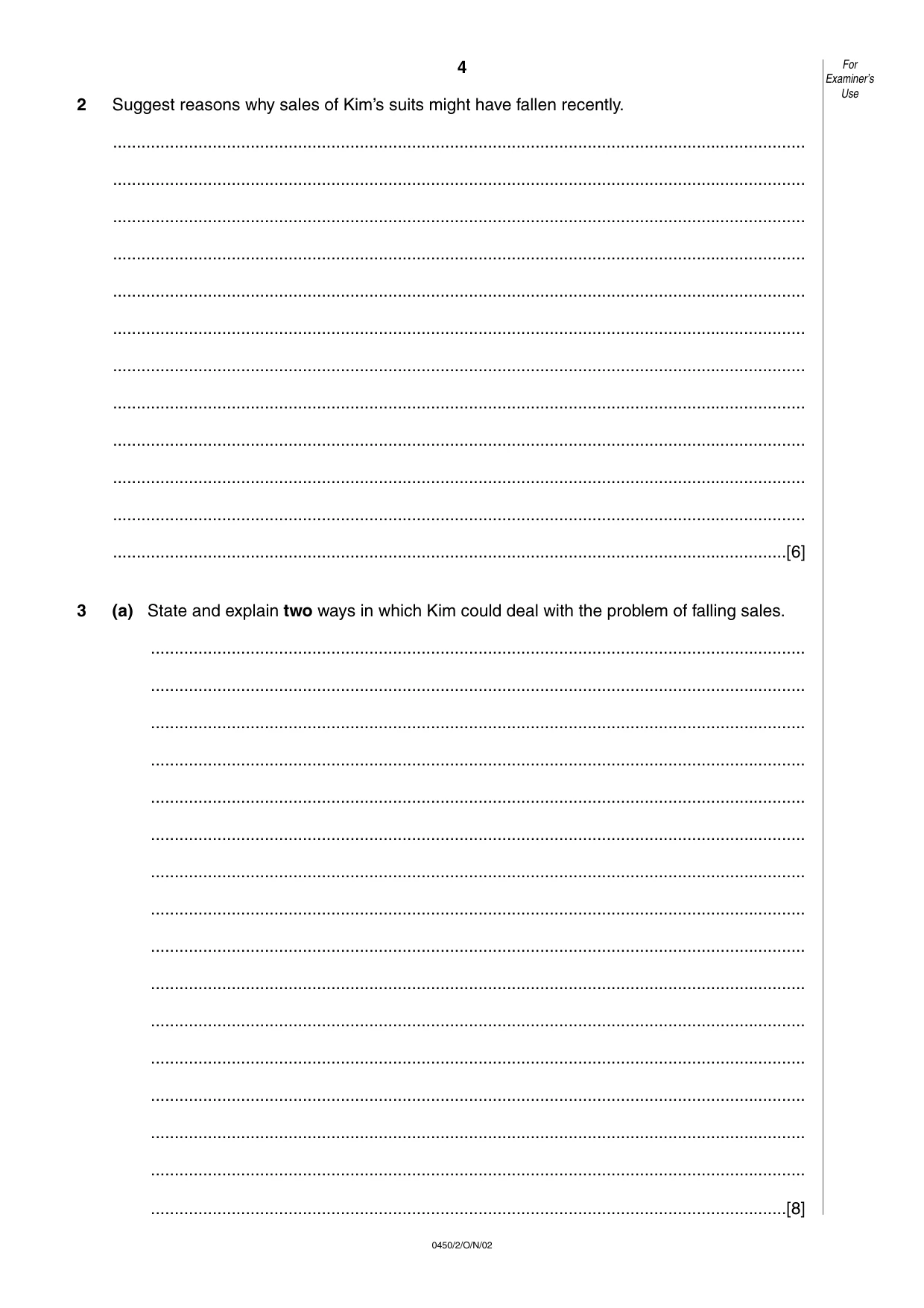
4 0450/2/O/N/02 2 Suggest reasons why sales of Kim’s suits might have fallen recently. … … … … … … … … … … … …[6] 3 (a) State and explain two ways in which Kim could deal with the problem of falling sales. … … … … … … … … … … … … … … … …[8] For Examiner’s Use
Question paper, page 5
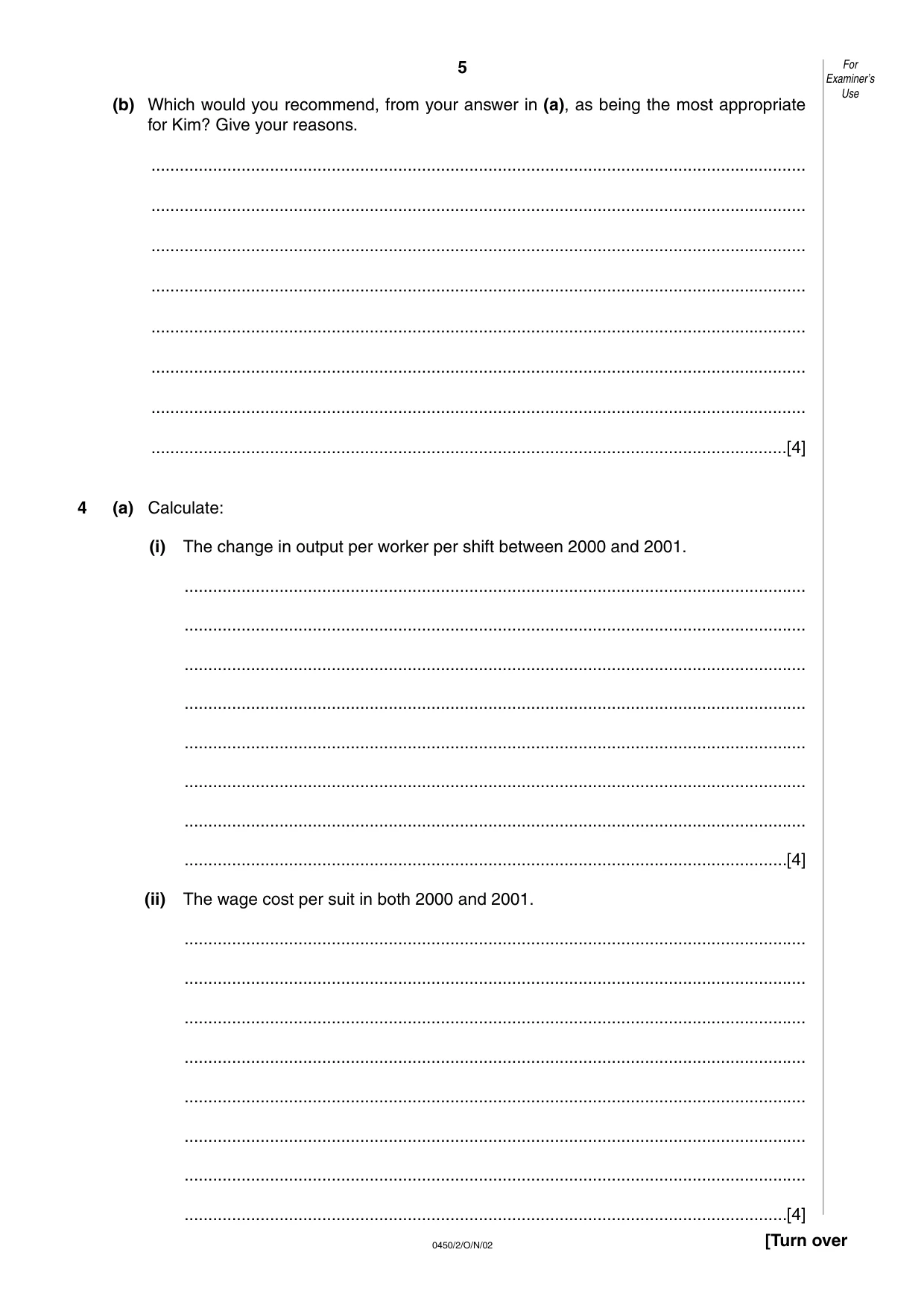
5 0450/2/O/N/02 [Turn over (b) Which would you recommend, from your answer in (a), as being the most appropriate for Kim? Give your reasons. … … … … … … … …[4] 4 (a) Calculate: (i) The change in output per worker per shift between 2000 and 2001. … … … … … … … …[4] (ii) The wage cost per suit in both 2000 and 2001. … … … … … … … …[4] For Examiner’s Use
Question paper, page 6
6 0450/2/O/N/02 (b) Explain how this change in wage cost per suit could affect Kim’s business. … … … … … … … … … … … …[6] For Examiner’s Use
Question paper, page 7
7 0450/2/O/N/02 [Turn over 5 (a) Why do you think Kim Yan Fashions Ltd is having cash flow problems? … … … … … … … … … … … …[6] (b) Explain two ways in which the business could try to solve this problem. … … … … … … … … … … … …[6] For Examiner’s Use
Question paper, page 8
8 0450/2/O/N/02 6 (a) State and explain two disadvantages to the business of many workers leaving the company. … … … … … … … … … … … …[6] (b) How might Kim try to reduce the number of workers who leave? … … … … … … … … … … … … … … … …[8] For Examiner’s Use
Question paper, page 9
9 0450/2/O/N/02 7 Recently, a business friend of Kim’s made an offer to buy the business from her. What factors should Kim consider before making a decision as to whether to sell? Explain the importance of these factors. … … … … … … … … … … … … … … … … … … … …[10] For Examiner’s Use
Mark scheme, page 1
CAMBRIDGE INTERNATIONAL EXAMINATIONS November 2002 INTERNATIONAL GCSE UNIversiry of CAMBRIDGE Local Examinations Syndicate
Mark scheme, page 2
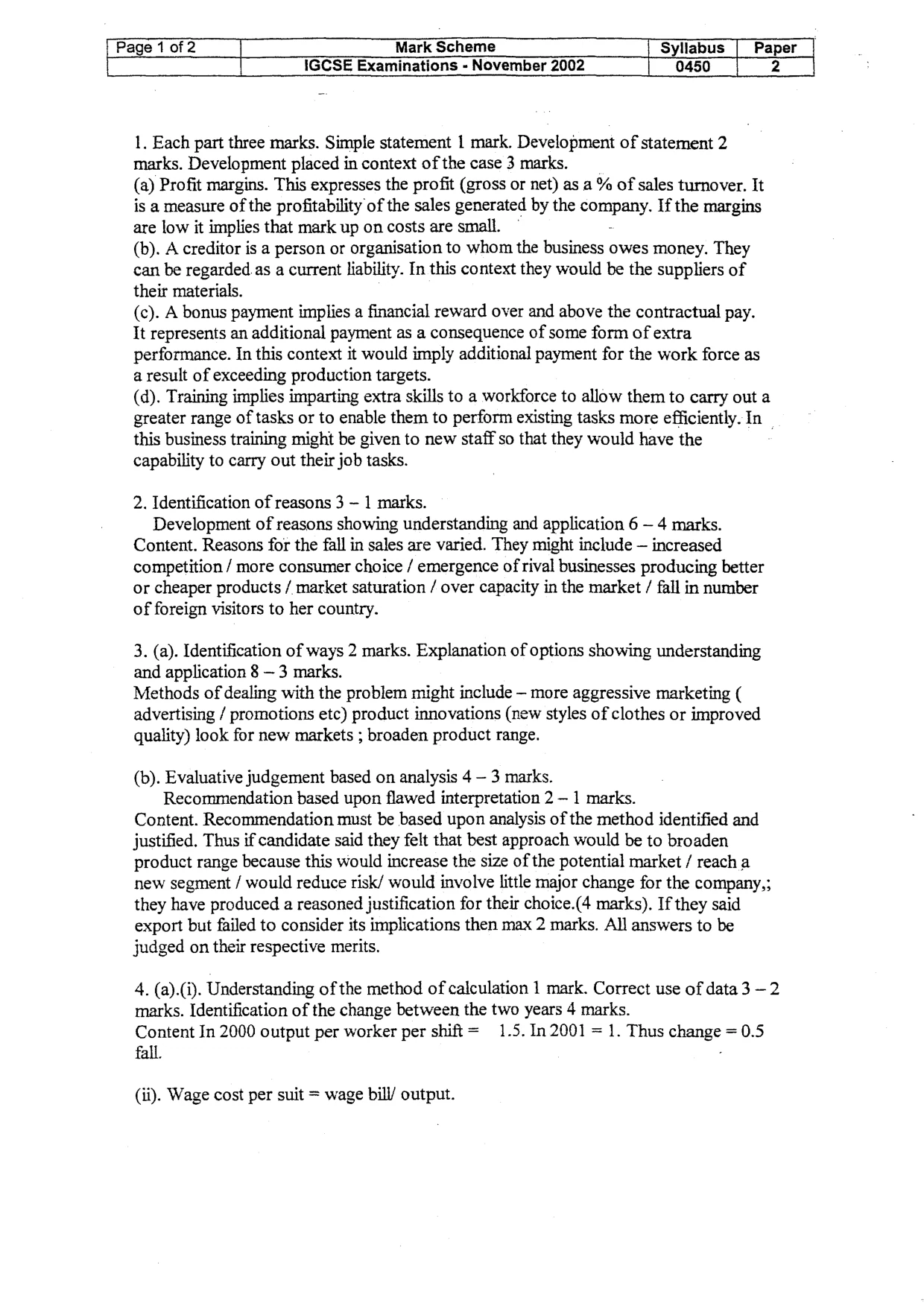
Page 1 of 2 Mark Scheme Syllabus | Paper IGCSE Examinations - November 2002 0450 2 1, Each part three marks. Simple statement 1 mark. Development of statement 2 marks. Development placed in context of the case 3 marks. (a) Profit margins. This expresses the profit (gross or net) as a % of sales turnover. It is a measure of the profitability of the sales generated by the company. If the margins are low it implies that mark up on costs are small. (b). A creditor is a person or organisation to whom the business owes money. They can be regarded.as a current liability. In this context they would be the suppliers of their materials. (c). A bonus payment implies a financial reward over and above the contractual pay. It represents an additional payment as a consequence of some form of extra performance. In this context it would imply additional payment for the work force as a result of exceeding production targets. (d). Training implies imparting extra skills to a workforce to allow them to carry out a greater range of tasks or to enable them to perform existing tasks more efficiently. In this business training might be given to new staff so that they would have the capability to carry out their job tasks. 2. Identification of reasons 3 - 1 marks. Development of reasons showing understanding and application 6 ~ 4 marks. Content. Reasons for the fall in sales are varied. They might include — increased competition / more consumer choice / emergence of rival businesses producing better or cheaper products / market saturation / over capacity in the market / fall in number of foreign visitors to her country. 3. (a). Identification of ways 2 marks. Explanation of options showing understanding and application 8 — 3 marks. Methods of dealing with the problem might include — more aggressive marketing ( advertising / promotions etc) product innovations (new styles of clothes or improved quality) look for new markets ; broaden product range. (b). Evaluative judgement based on analysis 4 — 3 marks. Recommendation based upon flawed interpretation 2 — 1 marks. Content. Recommendation must be based upon analysis of the method identified and justified. Thus if candidate said they felt that best approach would be to broaden product range because this would increase the size of the potential market / reach a new segment / would reduce risk/ would involve little major change for the company,; they have produced a reasoned justification for their choice.(4 marks). If they said export but failed to consider its implications then max 2 marks. All answers to be judged on their respective merits. 4. (a).(i). Understanding of the method of calculation 1 mark. Correct use of data 3 -2 marks. Identification of the change between the two years 4 marks. Content In 2000 output per worker per shift= 1.5. In 2001 = 1. Thus change = 0.5 fall. . (ii). Wage cost per suit = wage bill/ output.
Mark scheme, page 3
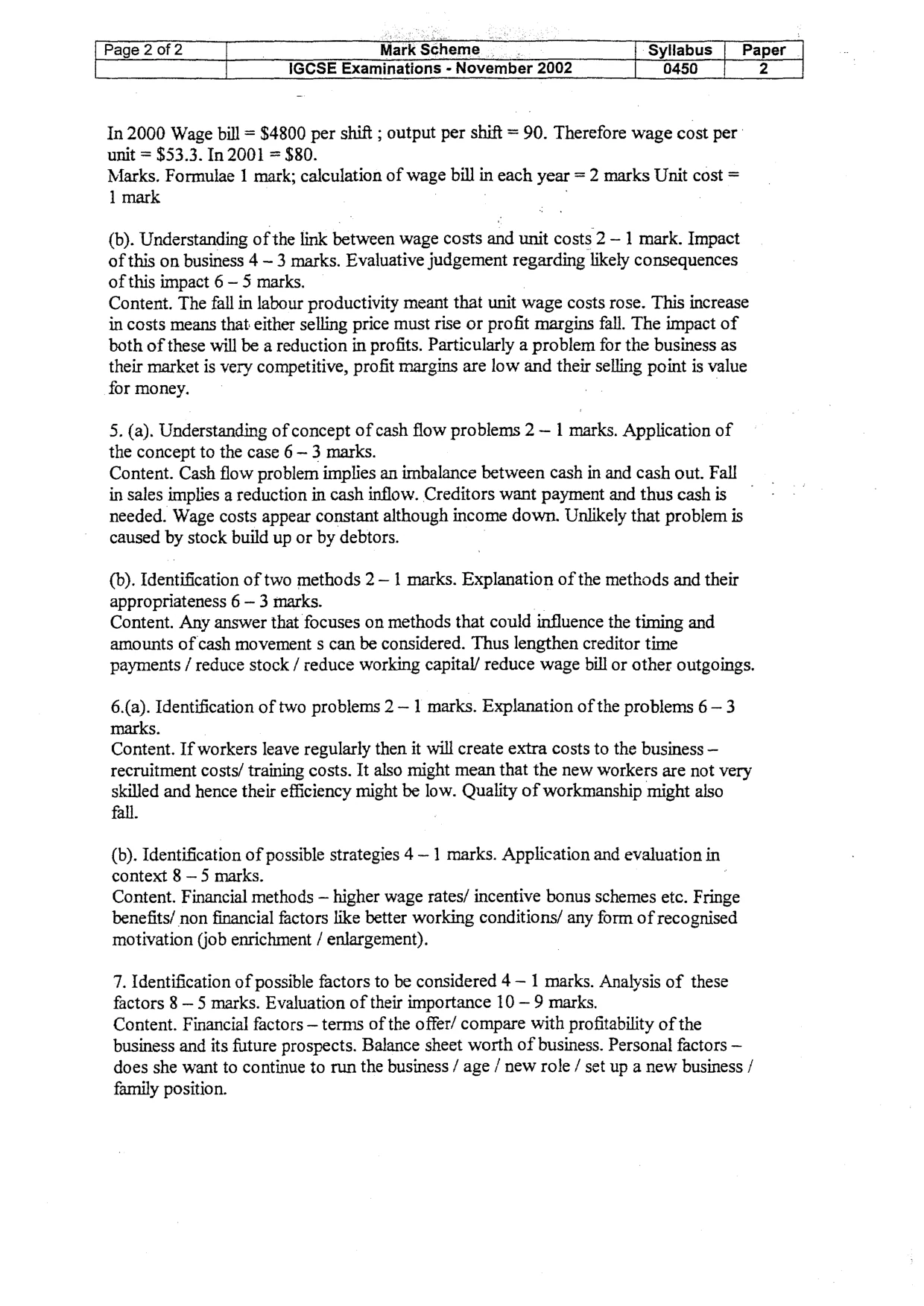
Page 2 of 2 Mark Scheme __ Syllabus | Paper IGCSE Examinations - November 2002 0450 2 In 2000 Wage bill = $4800 per shift ; output per shift = 90. Therefore wage cost per unit = $53.3. In 2001 = $80. Marks. Formulae 1 mark; calculation of wage bill in each year = 2 marks Unit cost = 1 mark (b). Understanding of the link between wage costs and unit costs 2 — 1 mark. Impact of this on business 4 — 3 marks. Evaluative judgement regarding likely consequences of this impact 6 — 5 marks. Content. The fall in labour productivity meant that unit wage costs rose. This increase in costs means that either selling price must rise or profit margins fall. The impact of both of these will be a reduction in profits. Particularly a problem for the business as their market is very competitive, profit margins are low and their selling point is value for money. 5. (a). Understanding of concept of cash flow problems 2 — 1 marks. Application of the concept to the case 6 — 3 marks. Content. Cash flow problem implies an imbalance between cash in and cash out. Fall in sales implies a reduction in cash inflow. Creditors want payment and thus cash is needed. Wage costs appear constant although income down. Unlikely that problem is caused by stock build up or by debtors. (b). Identification of two methods 2 — 1 marks. Explanation of the methods and their appropriateness 6 — 3 marks. Content. Any answer that focuses on methods that could influence the timing and amounts of cash movement s can be considered. Thus lengthen creditor time payments / reduce stock / reduce working capital/ reduce wage bill or other outgoings. 6.(a). Identification of two problems 2 — 1 marks. Explanation of the problems 6 — 3 marks. Content. If workers leave regularly then it will create extra costs to the business — recruitment costs/ training costs. It also might mean that the new workers are not very skilled and hence their efficiency might be low. Quality of workmanship might also fall. (b). Identification of possible strategies 4 ~ 1 marks. Application and evaluation in context 8 — 5 marks. Content. Financial methods — higher wage rates/ incentive bonus schemes etc. Fringe benefits/ non financial factors like better working conditions/ any form of recognised motivation (job enrichment / enlargement). 7. Identification of possible factors to be considered 4 — 1 marks. Analysis of these factors 8 — 5 marks. Evaluation of their importance 10 — 9 marks, Content. Financial factors — terms of the offer/ compare with profitability of the business and its future prospects. Balance sheet worth of business. Personal factors — does she want to continue to run the business / age / new role / set up a new business / family position.