Cambridge IGCSE Biology (BES) 0438 — 2018 Oct/Nov Paper 4 · Variant 1
0438/41/O/N/18 · 80 marks · ≈90 min
The question paper and its mark scheme, free to read here and free to download. This is Cambridge’s own paper, exactly as it was sat.
Question paper16 pages
Mark scheme11 pages
Answers below. Sit the paper first if you are practising.
Paper as text
Question paper, page 1
* 3 0 8 9 2 5 9 2 1 3 * This document consists of 16 printed pages. DC (CE/CB) 173265 © UCLES 2018 [Turn over Cambridge International Examinations Cambridge International General Certificate of Secondary Education BIOLOGY (US) 0438/41 Paper 4 Theory (Extended) October/November 2018 1 hour 15 minutes Candidates answer on the Question Paper. No Additional Materials are required. READ THESE INSTRUCTIONS FIRST Write your Center number, candidate number and name on all the work you hand in. Write in dark blue or black pen. You may use an HB pencil for any diagrams or graphs. Do not use staples, paper clips, glue or correction fluid. DO NOT WRITE IN ANY BARCODES. Answer all questions. Electronic calculators may be used. You may lose marks if you do not show your working or if you do not use appropriate units. At the end of the examination, fasten all your work securely together. The number of marks is given in brackets [ ] at the end of each question or part question.
Question paper, page 2
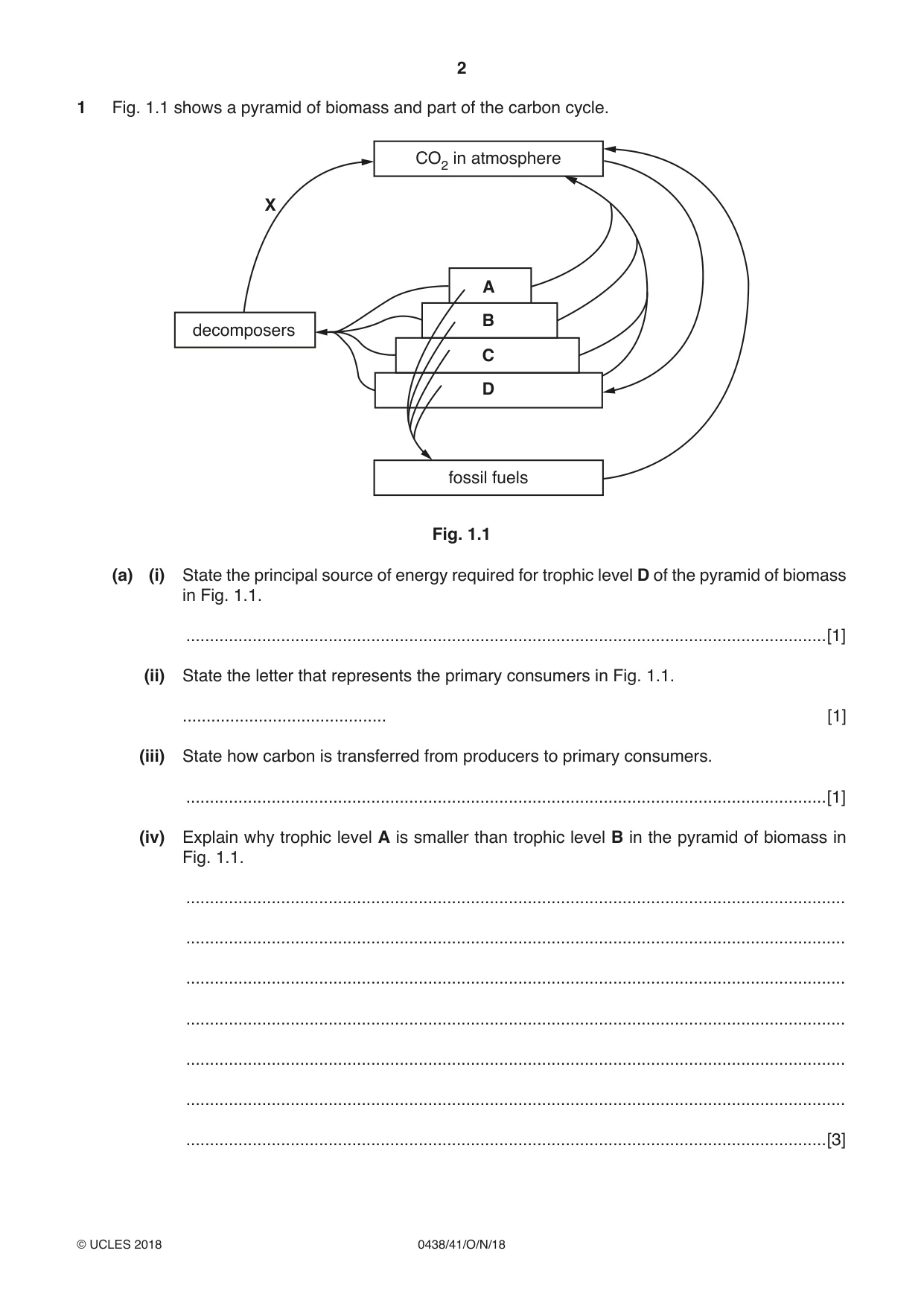
2 0438/41/O/N/18 © UCLES 2018 1 Fig. 1.1 shows a pyramid of biomass and part of the carbon cycle. CO2 in atmosphere fossil fuels D C B A decomposers X Fig. 1.1 (a) (i) State the principal source of energy required for trophic level D of the pyramid of biomass in Fig. 1.1. …[1] (ii) State the letter that represents the primary consumers in Fig. 1.1. … [1] (iii) State how carbon is transferred from producers to primary consumers. …[1] (iv) Explain why trophic level A is smaller than trophic level B in the pyramid of biomass in Fig. 1.1. … … … … … … …[3]
Question paper, page 3
3 0438/41/O/N/18 © UCLES 2018 [Turn over (b) Some fungi and bacteria are decomposers. (i) Define the term decomposer. … … …[1] (ii) Arrow X on Fig. 1.1 indicates the transfer of carbon from decomposers to the atmosphere. State the name of process X. …[1] (c) Describe how human activities are affecting the carbon cycle. … … … … … … … … … … …[5] [Total: 13]
Question paper, page 4
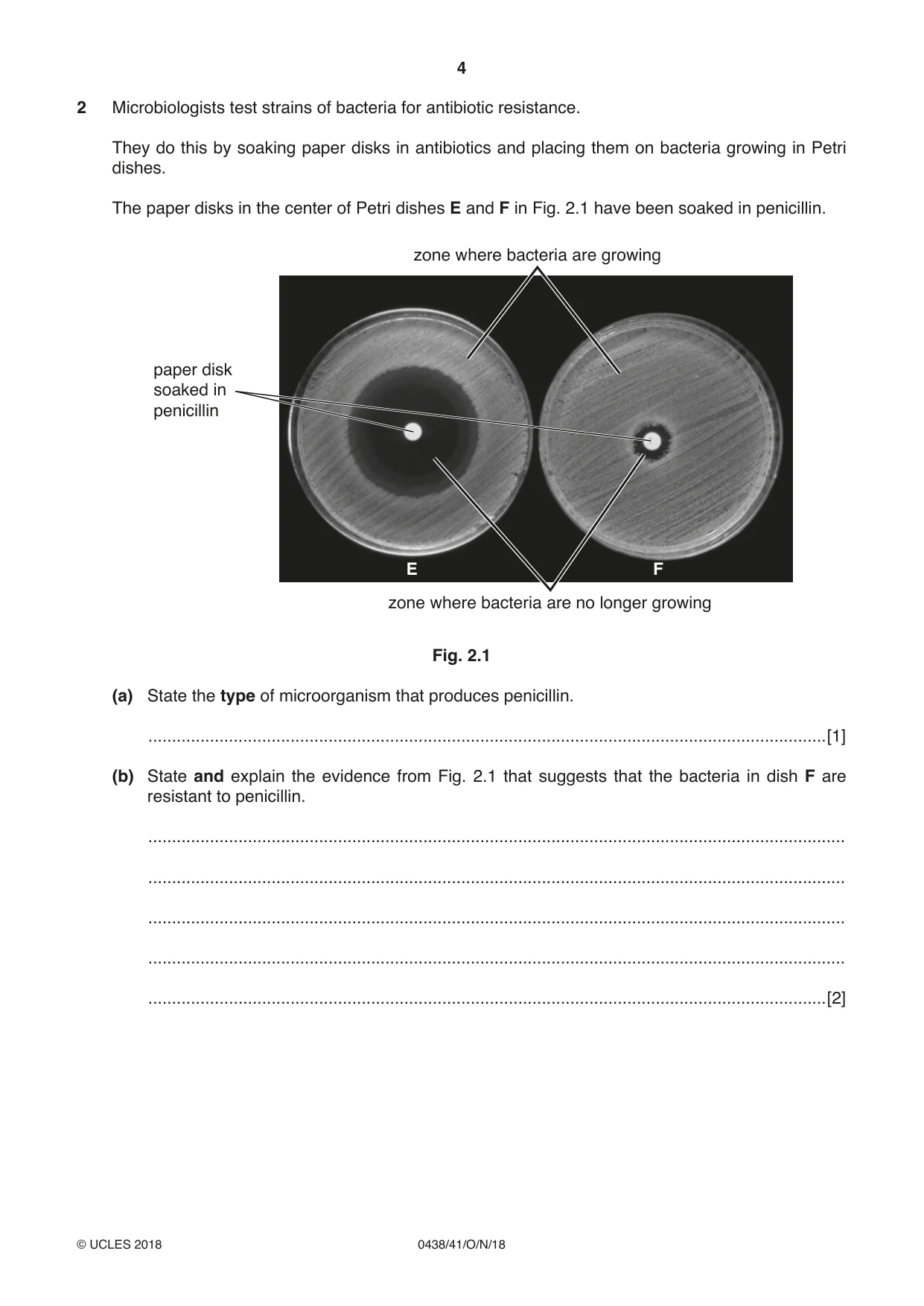
4 0438/41/O/N/18 © UCLES 2018 2 Microbiologists test strains of bacteria for antibiotic resistance. They do this by soaking paper disks in antibiotics and placing them on bacteria growing in Petri dishes. The paper disks in the center of Petri dishes E and F in Fig. 2.1 have been soaked in penicillin. paper disk soaked in penicillin zone where bacteria are growing zone where bacteria are no longer growing E F Fig. 2.1 (a) State the type of microorganism that produces penicillin. …[1] (b) State and explain the evidence from Fig. 2.1 that suggests that the bacteria in dish F are resistant to penicillin. … … … … …[2]
Question paper, page 5
5 0438/41/O/N/18 © UCLES 2018 [Turn over (c) (i) Explain how bacteria become resistant to antibiotics and how humans can reduce the problem of antibiotic resistance. … … … … … … … … … … … … …[6] (ii) Explain why viral infections cannot be treated with antibiotics. … …[1] (d) Some bacteria and viruses cause disease but many are useful to the biotechnology industry. Explain why bacteria are useful in biotechnology. … … … … … … …[3] [Total: 13]
Question paper, page 6
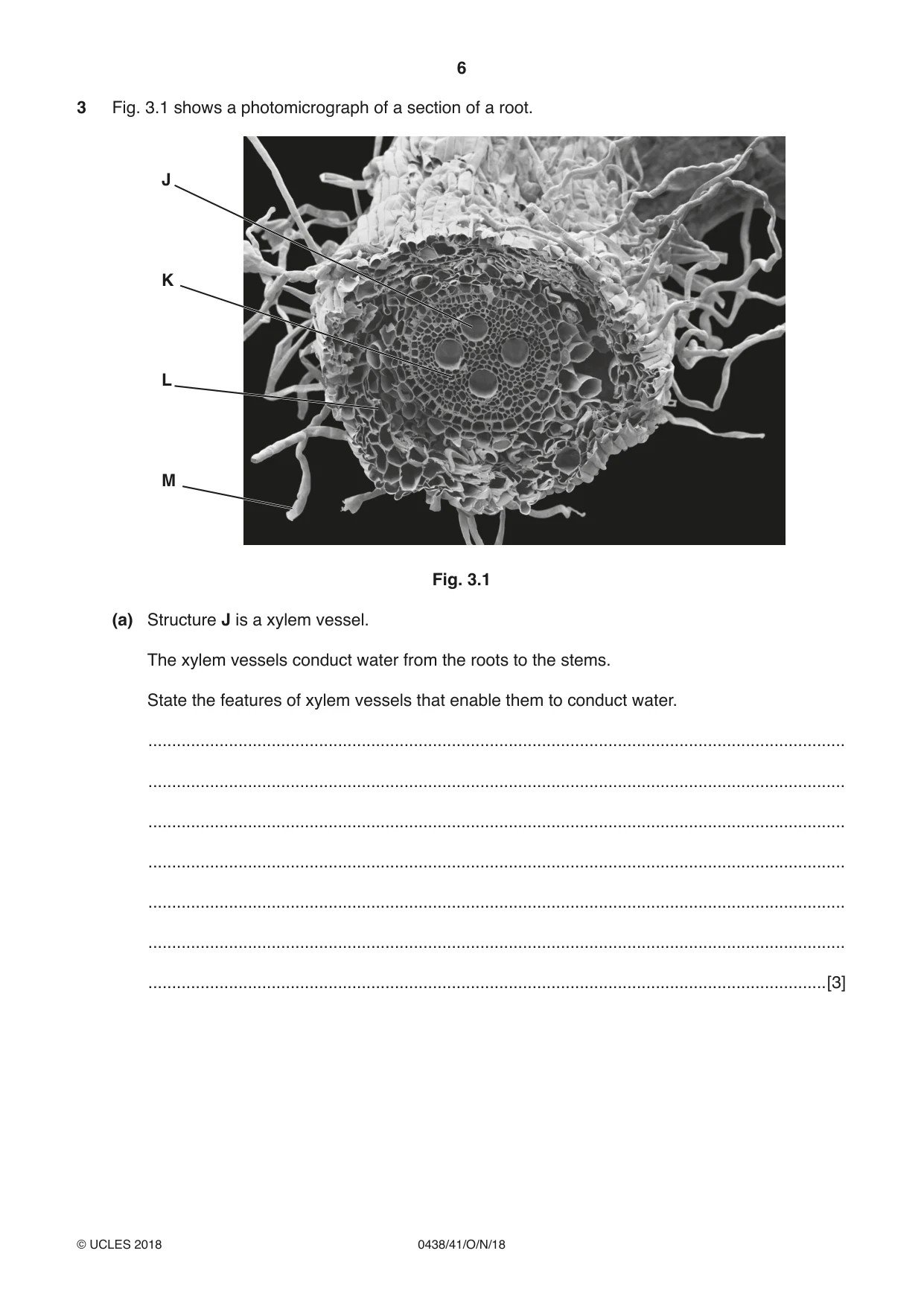
6 0438/41/O/N/18 © UCLES 2018 3 Fig. 3.1 shows a photomicrograph of a section of a root. J K L M Fig. 3.1 (a) Structure J is a xylem vessel. The xylem vessels conduct water from the roots to the stems. State the features of xylem vessels that enable them to conduct water. … … … … … … …[3]
Question paper, page 7
7 0438/41/O/N/18 © UCLES 2018 [Turn over (b) Describe the pathway of water from outside the root to the xylem vessels (J) at the center of the root. Use the letters in Fig. 3.1 in your answer. … … … … … … … … … … …[5]
Question paper, page 8
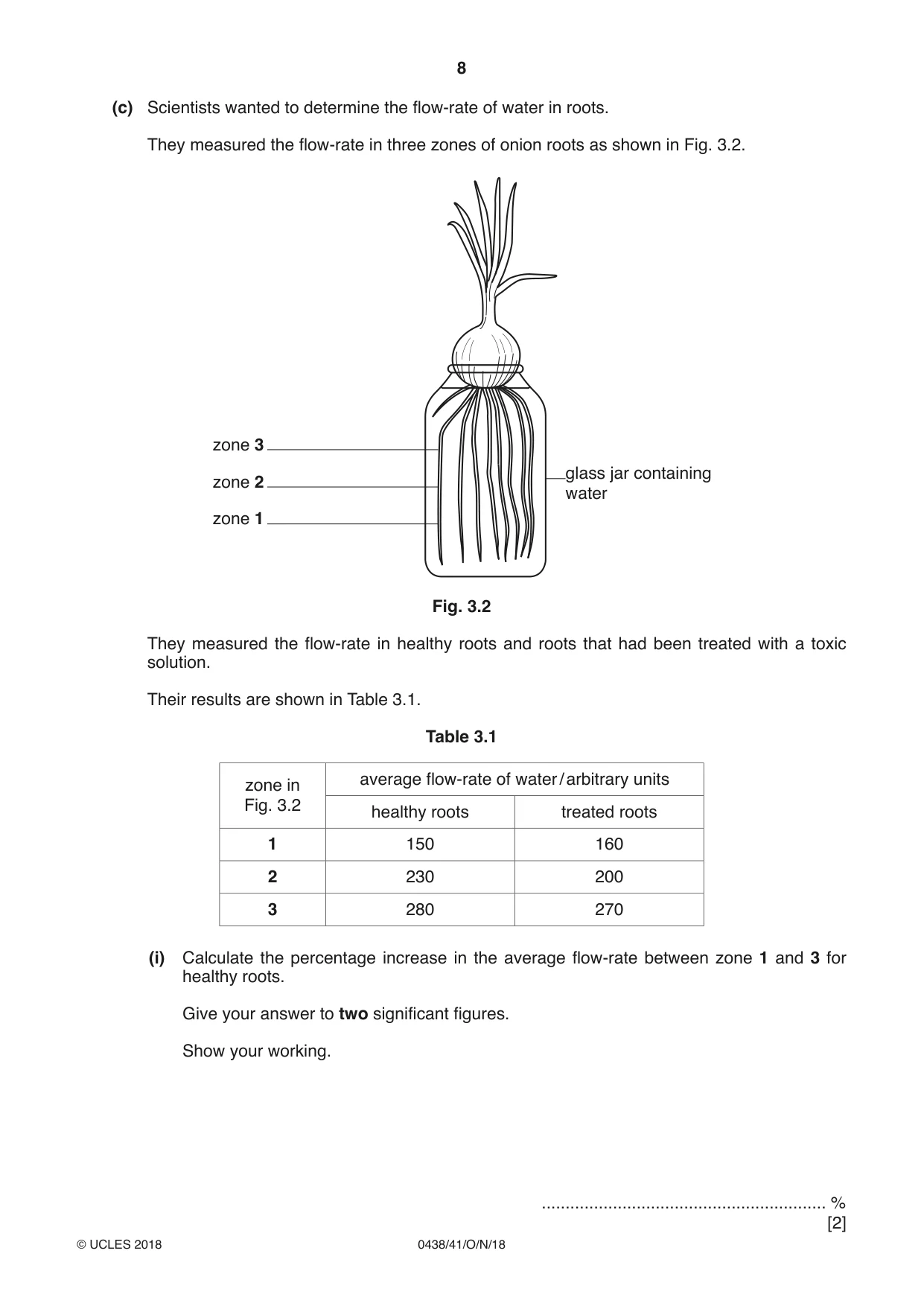
8 0438/41/O/N/18 © UCLES 2018 (c) Scientists wanted to determine the flow-rate of water in roots. They measured the flow-rate in three zones of onion roots as shown in Fig. 3.2. zone 3 zone 2 zone 1 glass jar containing water Fig. 3.2 They measured the flow-rate in healthy roots and roots that had been treated with a toxic solution. Their results are shown in Table 3.1. Table 3.1 zone in Fig. 3.2 average flow-rate of water / arbitrary units healthy roots treated roots 1 150 160 2 230 200 3 280 270 (i) Calculate the percentage increase in the average flow-rate between zone 1 and 3 for healthy roots. Give your answer to two significant figures. Show your working. … % [2]
Question paper, page 9
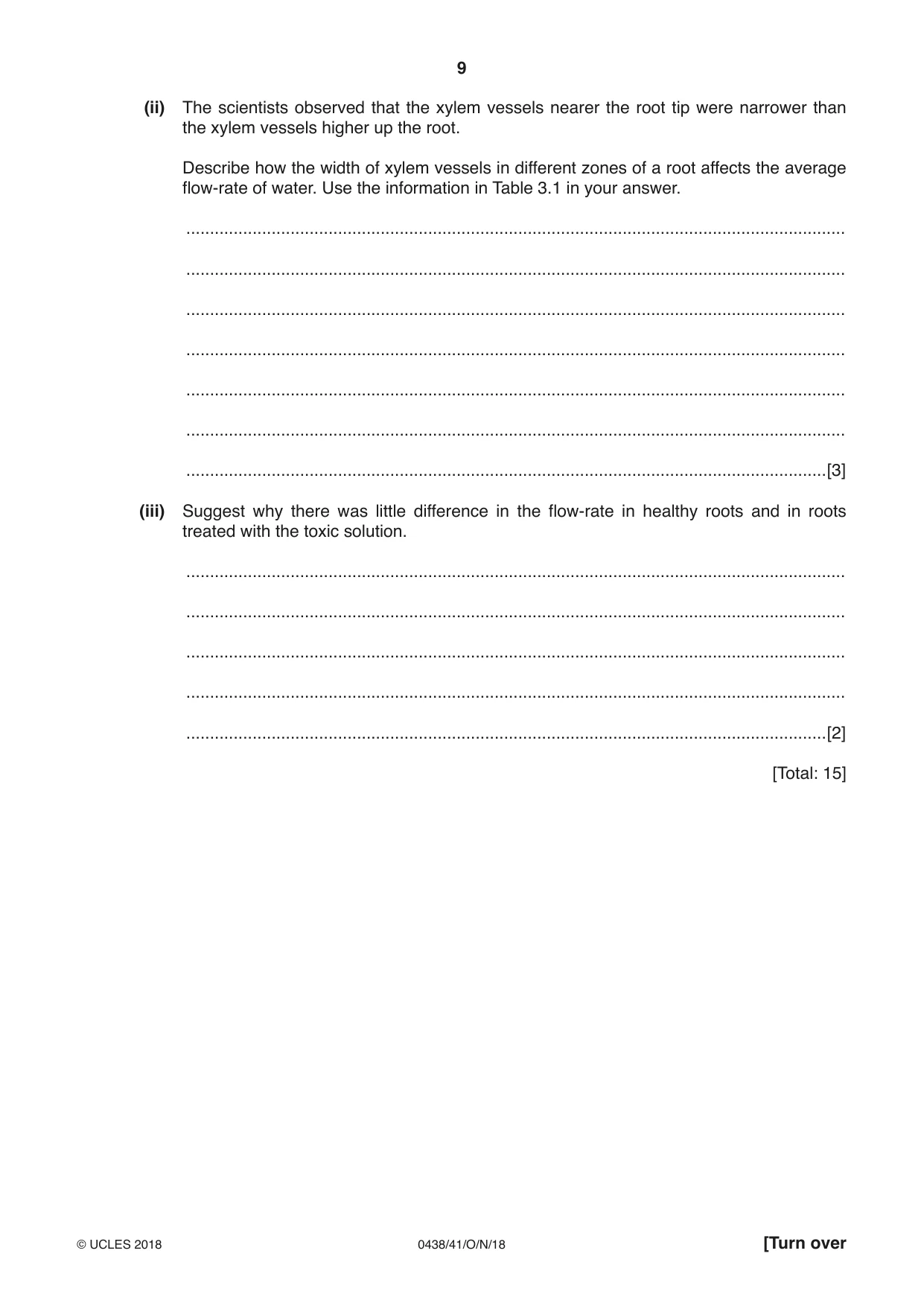
9 0438/41/O/N/18 © UCLES 2018 [Turn over (ii) The scientists observed that the xylem vessels nearer the root tip were narrower than the xylem vessels higher up the root. Describe how the width of xylem vessels in different zones of a root affects the average flow-rate of water. Use the information in Table 3.1 in your answer. … … … … … … …[3] (iii) Suggest why there was little difference in the flow-rate in healthy roots and in roots treated with the toxic solution. … … … … …[2] [Total: 15]
Question paper, page 10
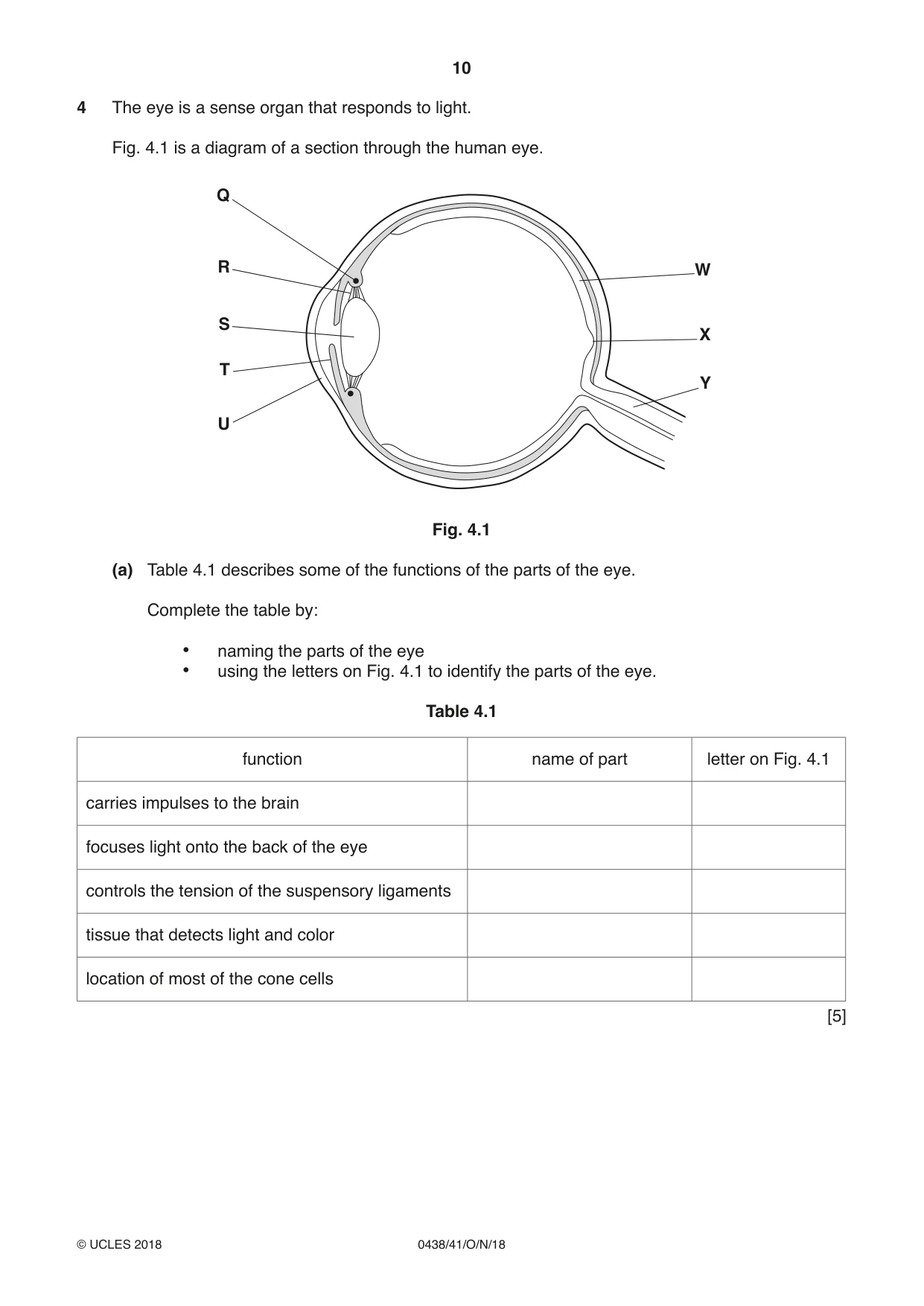
10 0438/41/O/N/18 © UCLES 2018 4 The eye is a sense organ that responds to light. Fig. 4.1 is a diagram of a section through the human eye. Q W X Y R S T U Fig. 4.1 (a) Table 4.1 describes some of the functions of the parts of the eye. Complete the table by: • naming the parts of the eye • using the letters on Fig. 4.1 to identify the parts of the eye. Table 4.1 function name of part letter on Fig. 4.1 carries impulses to the brain focuses light onto the back of the eye controls the tension of the suspensory ligaments tissue that detects light and color location of most of the cone cells [5]
Question paper, page 11
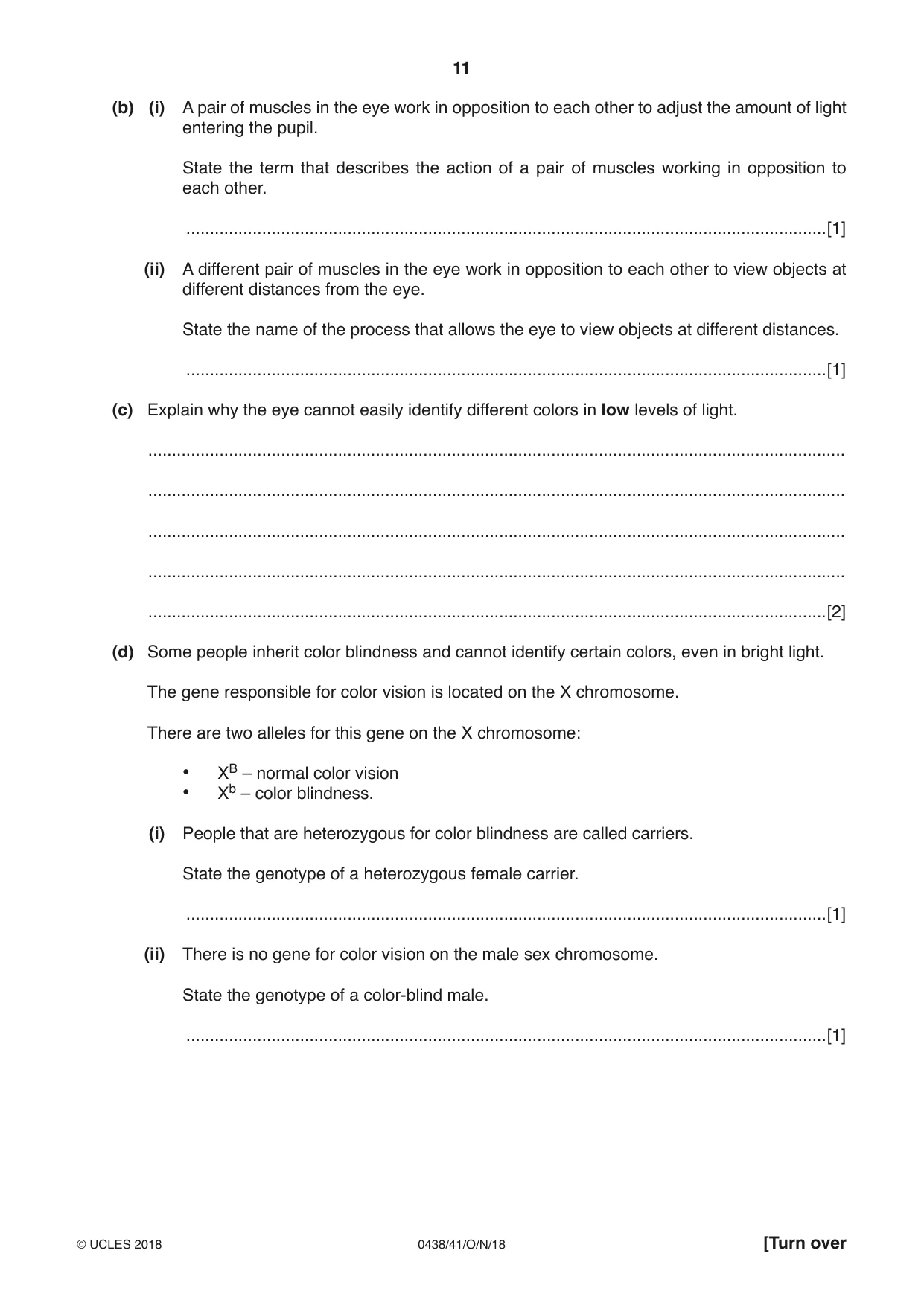
11 0438/41/O/N/18 © UCLES 2018 [Turn over (b) (i) A pair of muscles in the eye work in opposition to each other to adjust the amount of light entering the pupil. State the term that describes the action of a pair of muscles working in opposition to each other. …[1] (ii) A different pair of muscles in the eye work in opposition to each other to view objects at different distances from the eye. State the name of the process that allows the eye to view objects at different distances. …[1] (c) Explain why the eye cannot easily identify different colors in low levels of light. … … … … …[2] (d) Some people inherit color blindness and cannot identify certain colors, even in bright light. The gene responsible for color vision is located on the X chromosome. There are two alleles for this gene on the X chromosome: • XB – normal color vision • Xb – color blindness. (i) People that are heterozygous for color blindness are called carriers. State the genotype of a heterozygous female carrier. …[1] (ii) There is no gene for color vision on the male sex chromosome. State the genotype of a color-blind male. …[1]
Question paper, page 12
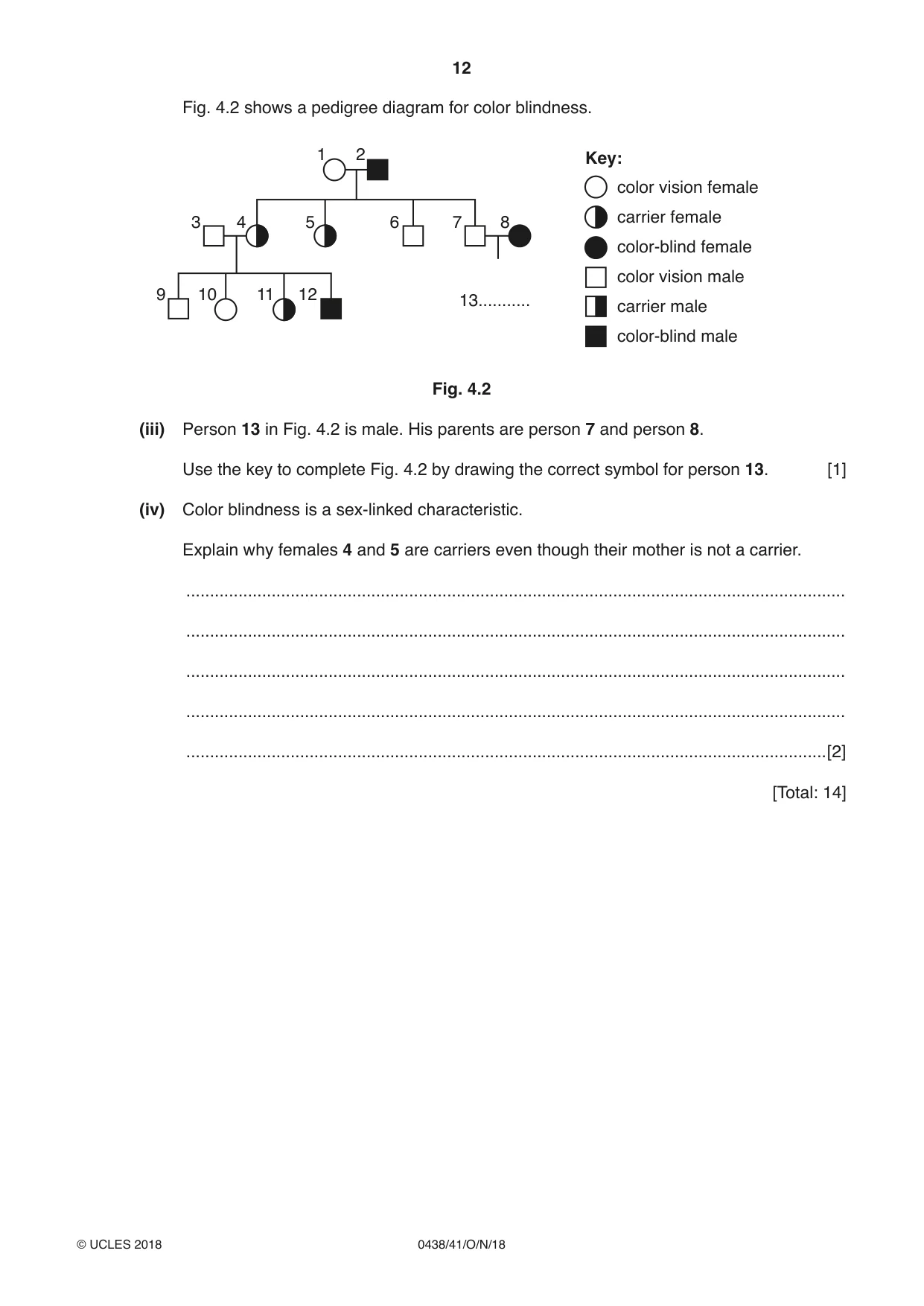
12 0438/41/O/N/18 © UCLES 2018 Fig. 4.2 shows a pedigree diagram for color blindness. 3 9 10 11 12 4 5 6 7 8 color vision female carrier female color-blind female color vision male carrier male color-blind male 2 1 13… Key: Fig. 4.2 (iii) Person 13 in Fig. 4.2 is male. His parents are person 7 and person 8. Use the key to complete Fig. 4.2 by drawing the correct symbol for person 13. [1] (iv) Color blindness is a sex-linked characteristic. Explain why females 4 and 5 are carriers even though their mother is not a carrier. … … … … …[2] [Total: 14]
Question paper, page 13
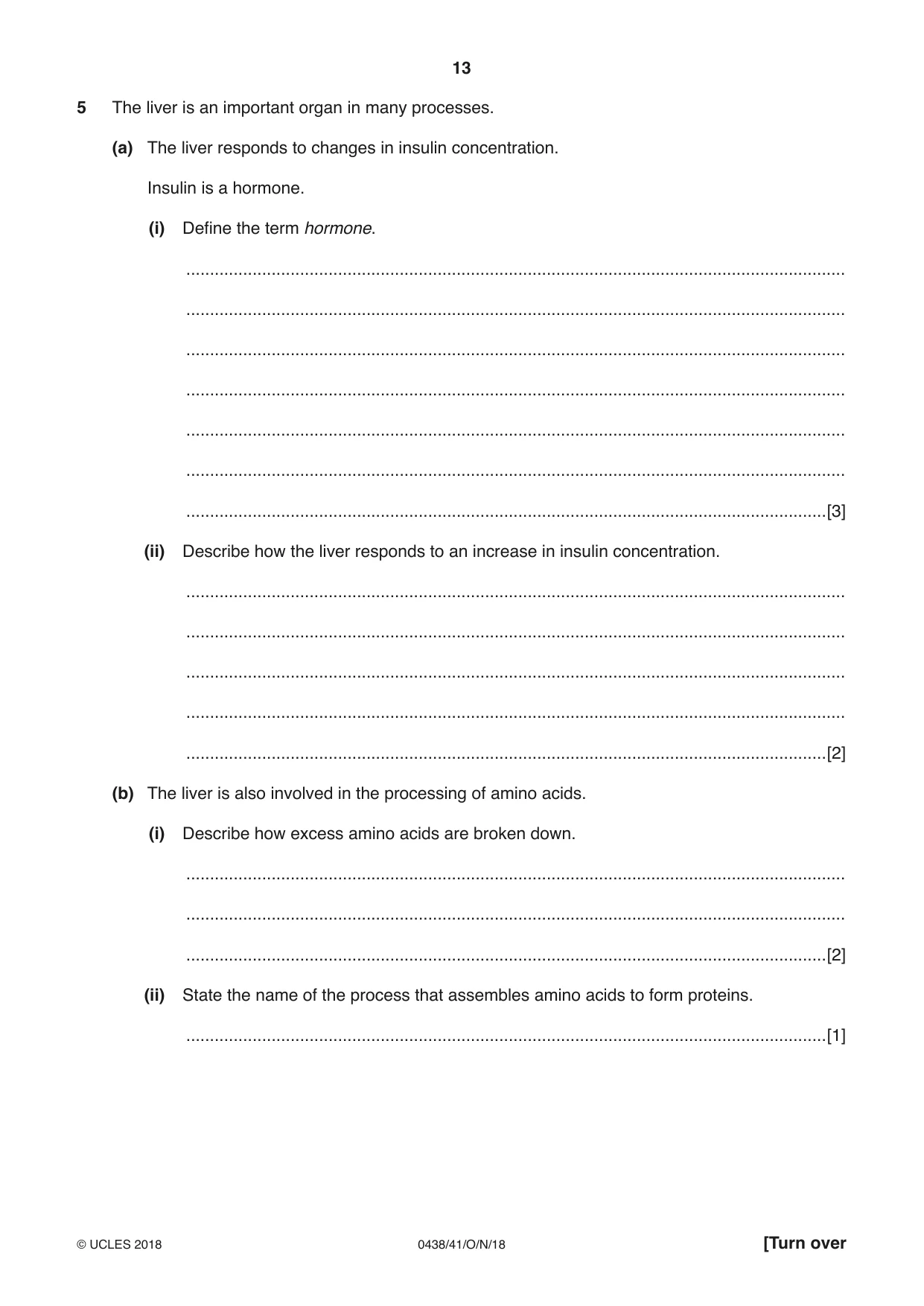
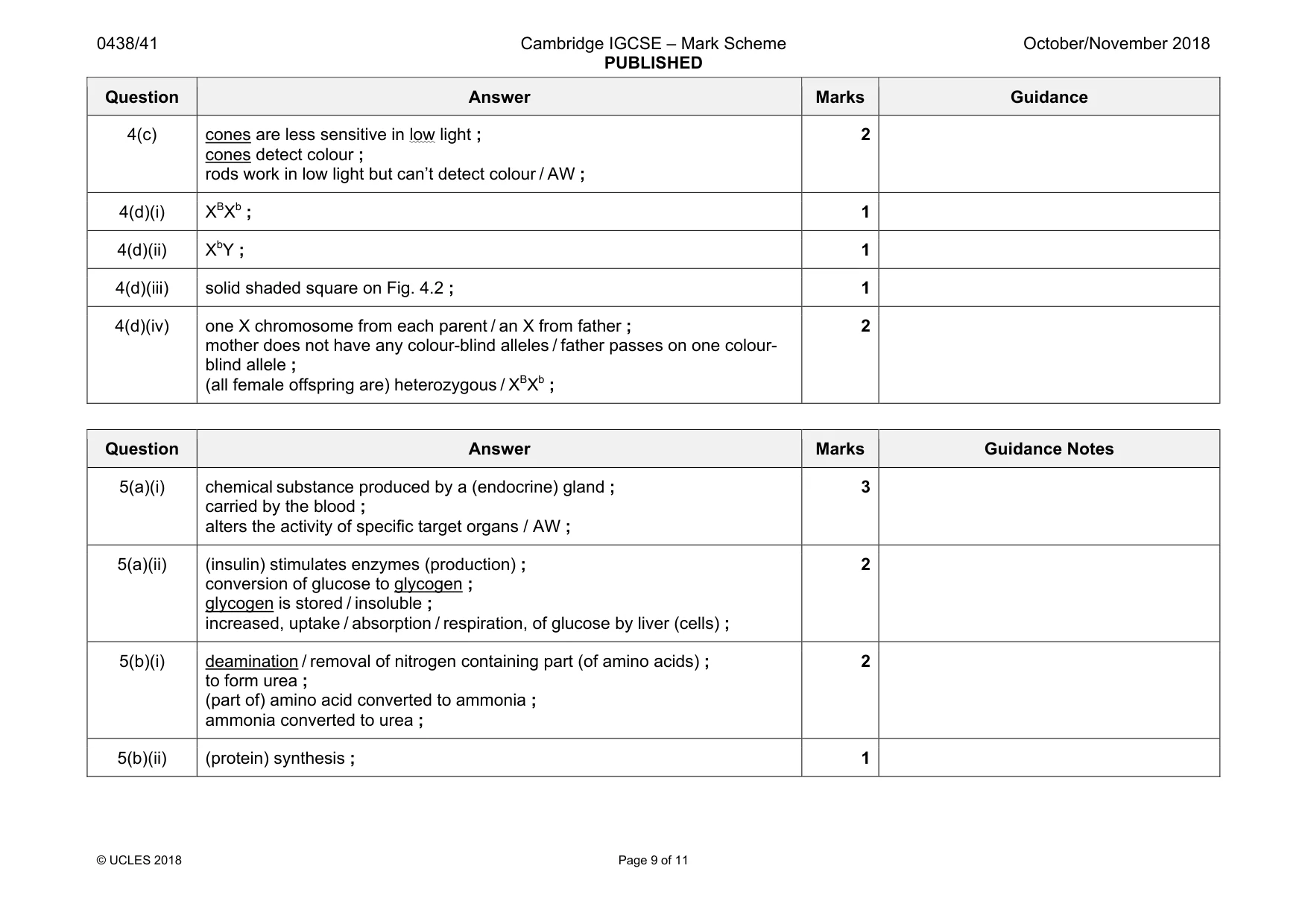
13 0438/41/O/N/18 © UCLES 2018 [Turn over 5 The liver is an important organ in many processes. (a) The liver responds to changes in insulin concentration. Insulin is a hormone. (i) Define the term hormone. … … … … … … …[3] (ii) Describe how the liver responds to an increase in insulin concentration. … … … … …[2] (b) The liver is also involved in the processing of amino acids. (i) Describe how excess amino acids are broken down. … … …[2] (ii) State the name of the process that assembles amino acids to form proteins. …[1]
Question paper, page 14
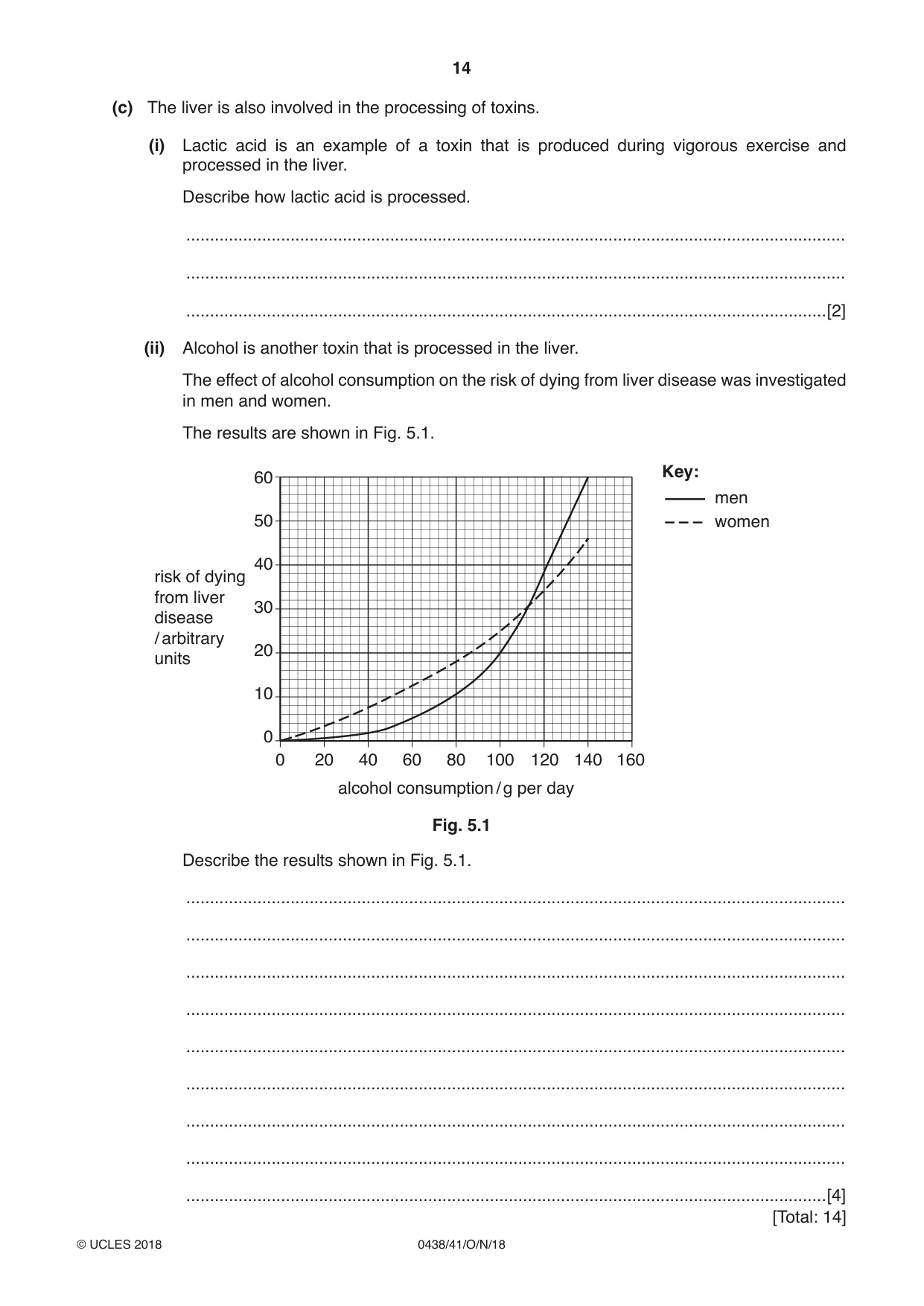
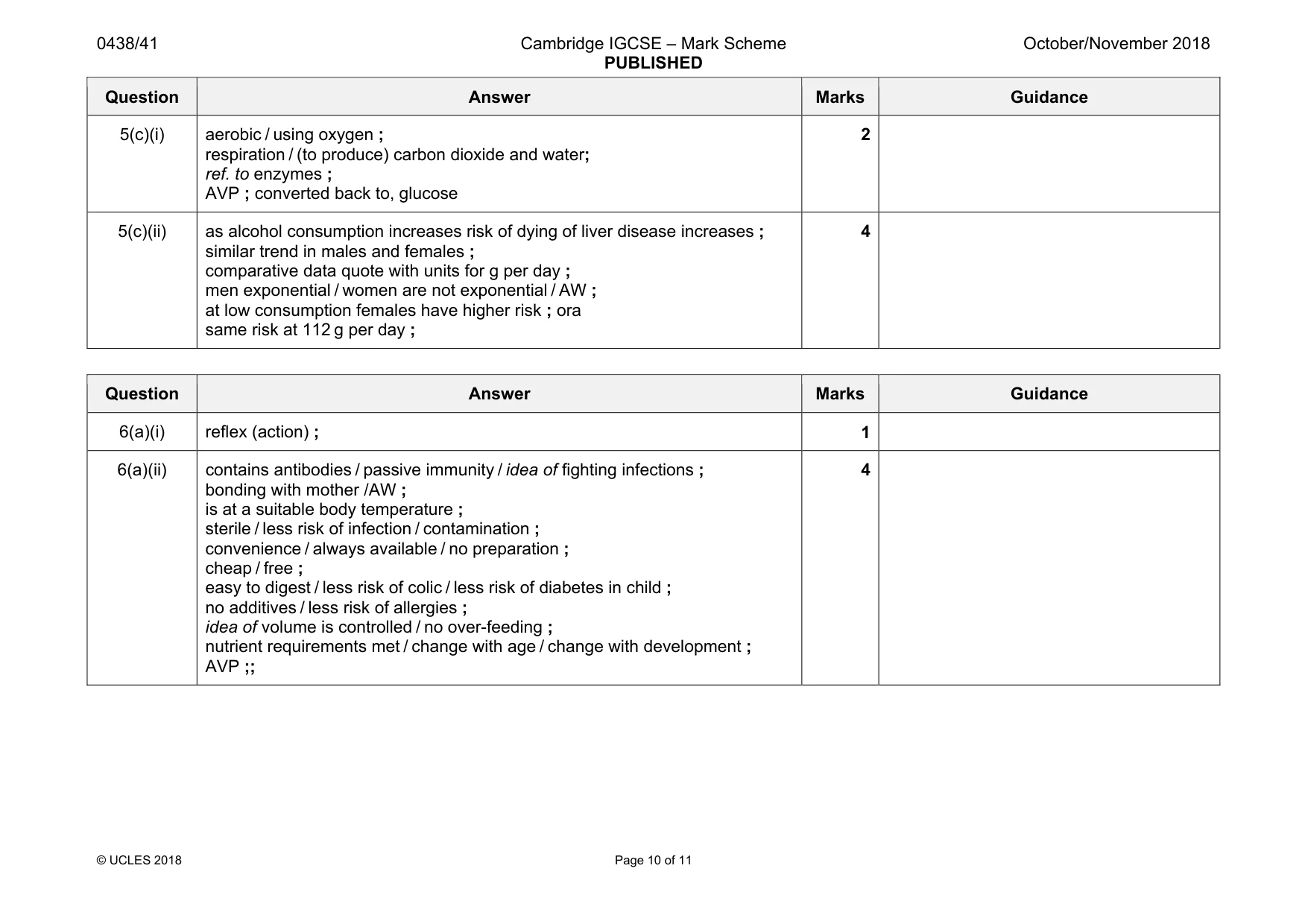
14 0438/41/O/N/18 © UCLES 2018 (c) The liver is also involved in the processing of toxins. (i) Lactic acid is an example of a toxin that is produced during vigorous exercise and processed in the liver. Describe how lactic acid is processed. … … …[2] (ii) Alcohol is another toxin that is processed in the liver. The effect of alcohol consumption on the risk of dying from liver disease was investigated in men and women. The results are shown in Fig. 5.1. 60 50 40 30 20 10 0 0 100 80 60 40 20 140 160 men women 120 alcohol consumption / g per day risk of dying from liver disease / arbitrary units Key: Fig. 5.1 Describe the results shown in Fig. 5.1. … … … … … … … … …[4] [Total: 14]
Question paper, page 15
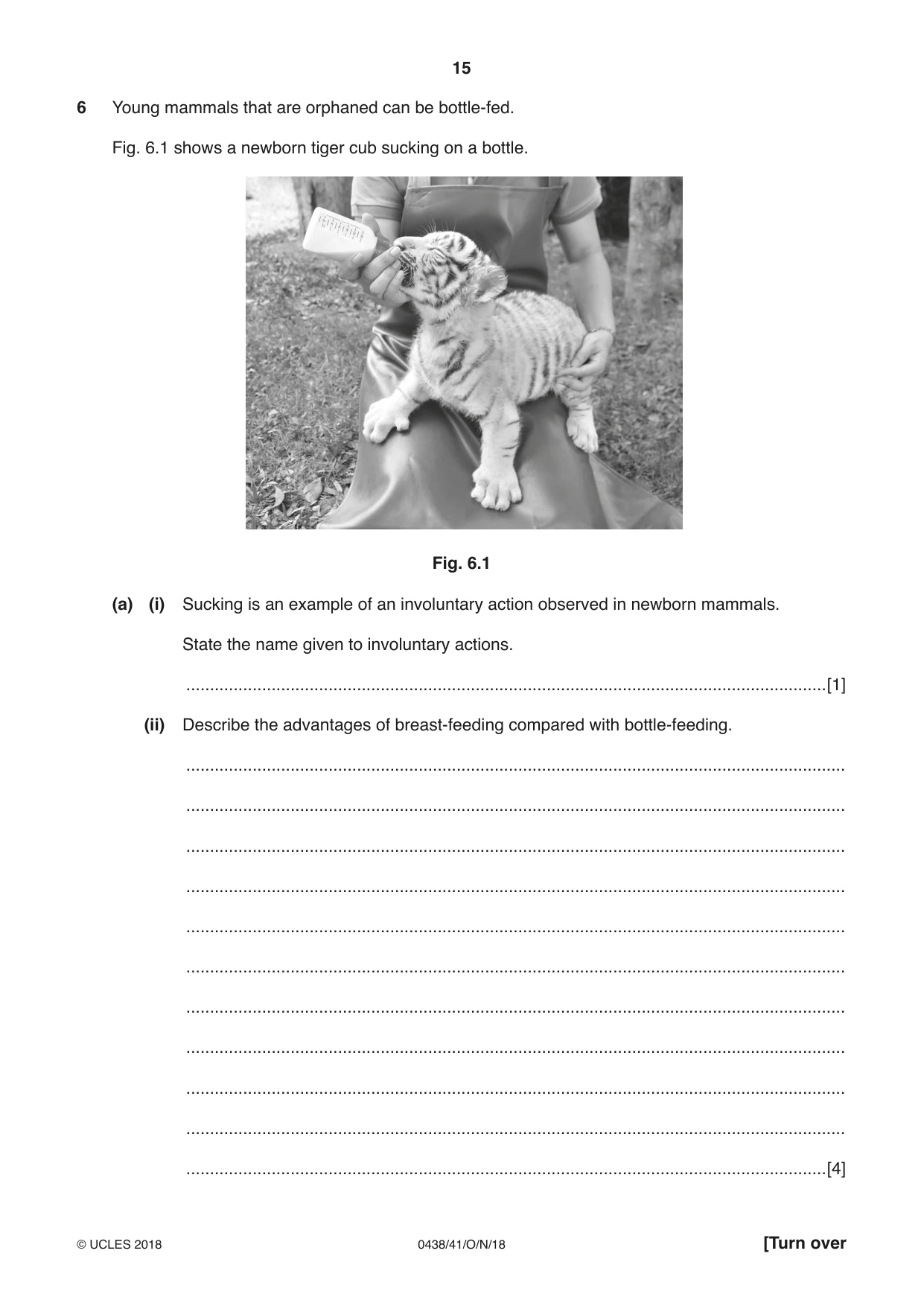
15 0438/41/O/N/18 © UCLES 2018 [Turn over 6 Young mammals that are orphaned can be bottle-fed. Fig. 6.1 shows a newborn tiger cub sucking on a bottle. Fig. 6.1 (a) (i) Sucking is an example of an involuntary action observed in newborn mammals. State the name given to involuntary actions. …[1] (ii) Describe the advantages of breast-feeding compared with bottle-feeding. … … … … … … … … … … …[4]
Question paper, page 16
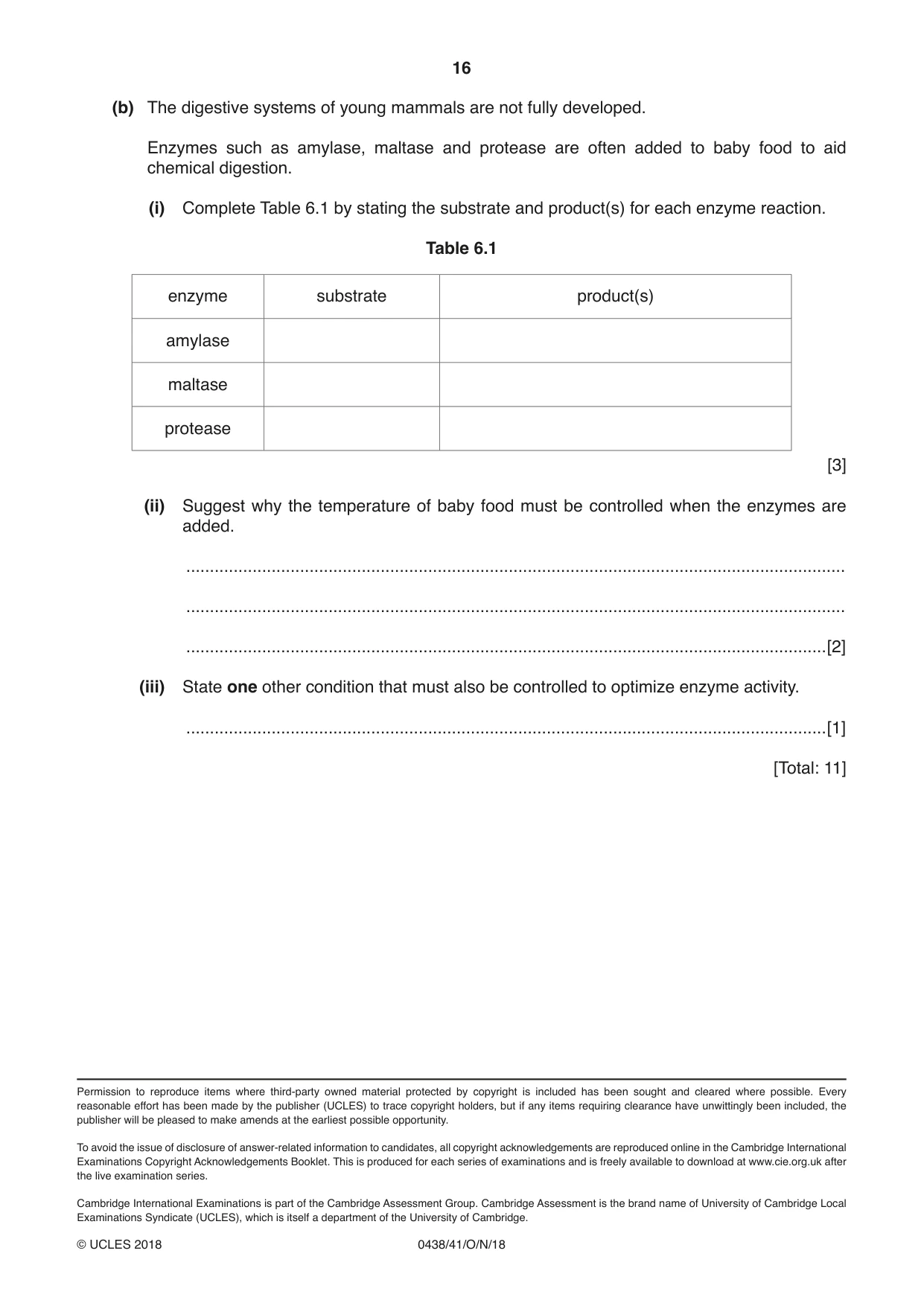
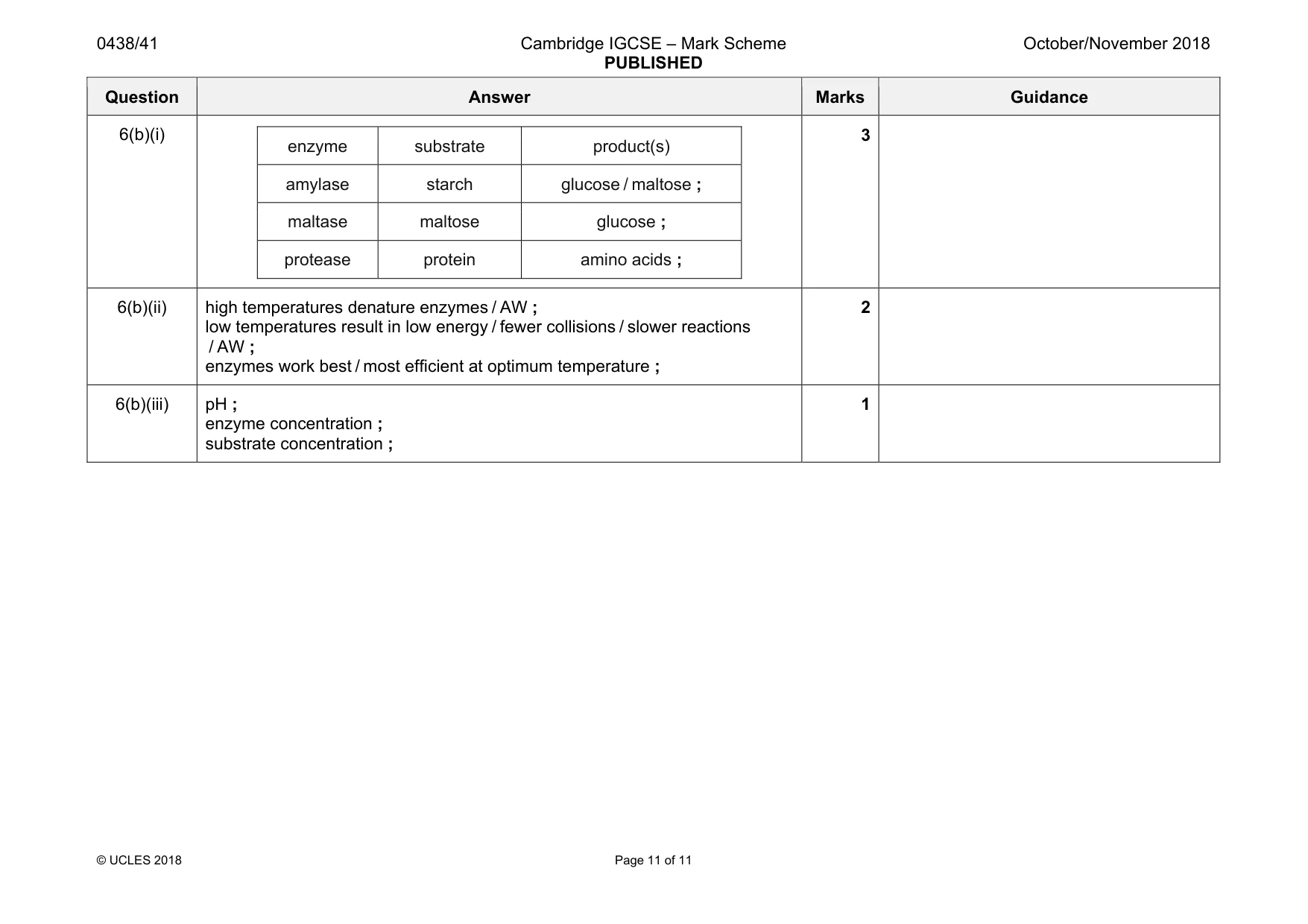
16 0438/41/O/N/18 © UCLES 2018 Permission to reproduce items where third-party owned material protected by copyright is included has been sought and cleared where possible. Every reasonable effort has been made by the publisher (UCLES) to trace copyright holders, but if any items requiring clearance have unwittingly been included, the publisher will be pleased to make amends at the earliest possible opportunity. To avoid the issue of disclosure of answer-related information to candidates, all copyright acknowledgements are reproduced online in the Cambridge International Examinations Copyright Acknowledgements Booklet. This is produced for each series of examinations and is freely available to download at www.cie.org.uk after the live examination series. Cambridge International Examinations is part of the Cambridge Assessment Group. Cambridge Assessment is the brand name of University of Cambridge Local Examinations Syndicate (UCLES), which is itself a department of the University of Cambridge. (b) The digestive systems of young mammals are not fully developed. Enzymes such as amylase, maltase and protease are often added to baby food to aid chemical digestion. (i) Complete Table 6.1 by stating the substrate and product(s) for each enzyme reaction. Table 6.1 enzyme substrate product(s) amylase maltase protease [3] (ii) Suggest why the temperature of baby food must be controlled when the enzymes are added. … … …[2] (iii) State one other condition that must also be controlled to optimize enzyme activity. …[1] [Total: 11]
Mark scheme, page 1
This document consists of 11 printed pages. © UCLES 2018 [Turn over Cambridge Assessment International Education Cambridge International General Certificate of Secondary Education BIOLOGY (US) 0438/41 Paper 4 Extended Theory October/November 2018 MARK SCHEME Maximum Mark: 80 Published This mark scheme is published as an aid to teachers and candidates, to indicate the requirements of the examination. It shows the basis on which Examiners were instructed to award marks. It does not indicate the details of the discussions that took place at an Examiners’ meeting before marking began, which would have considered the acceptability of alternative answers. Mark schemes should be read in conjunction with the question paper and the Principal Examiner Report for Teachers. Cambridge International will not enter into discussions about these mark schemes. Cambridge International is publishing the mark schemes for the October/November 2018 series for most Cambridge IGCSE™, Cambridge International A and AS Level components and some Cambridge O Level components.
Mark scheme, page 2
0438/41 Cambridge IGCSE – Mark Scheme PUBLISHED October/November 2018 © UCLES 2018 Page 2 of 11 Generic Marking Principles These general marking principles must be applied by all examiners when marking candidate answers. They should be applied alongside the specific content of the mark scheme or generic level descriptors for a question. Each question paper and mark scheme will also comply with these marking principles. GENERIC MARKING PRINCIPLE 1: Marks must be awarded in line with: • the specific content of the mark scheme or the generic level descriptors for the question • the specific skills defined in the mark scheme or in the generic level descriptors for the question • the standard of response required by a candidate as exemplified by the standardisation scripts. GENERIC MARKING PRINCIPLE 2: Marks awarded are always whole marks (not half marks, or other fractions). GENERIC MARKING PRINCIPLE 3: Marks must be awarded positively: • marks are awarded for correct/valid answers, as defined in the mark scheme. However, credit is given for valid answers which go beyond the scope of the syllabus and mark scheme, referring to your Team Leader as appropriate • marks are awarded when candidates clearly demonstrate what they know and can do • marks are not deducted for errors • marks are not deducted for omissions • answers should only be judged on the quality of spelling, punctuation and grammar when these features are specifically assessed by the question as indicated by the mark scheme. The meaning, however, should be unambiguous. GENERIC MARKING PRINCIPLE 4: Rules must be applied consistently e.g. in situations where candidates have not followed instructions or in the application of generic level descriptors.
Mark scheme, page 3
0438/41 Cambridge IGCSE – Mark Scheme PUBLISHED October/November 2018 © UCLES 2018 Page 3 of 11 GENERIC MARKING PRINCIPLE 5: Marks should be awarded using the full range of marks defined in the mark scheme for the question (however; the use of the full mark range may be limited according to the quality of the candidate responses seen). GENERIC MARKING PRINCIPLE 6: Marks awarded are based solely on the requirements as defined in the mark scheme. Marks should not be awarded with grade thresholds or grade descriptors in mind.
Mark scheme, page 4
0438/41 Cambridge IGCSE – Mark Scheme PUBLISHED October/November 2018 © UCLES 2018 Page 4 of 11 Mark scheme abbreviations • ; separates marking points • / alternative responses for the same marking point • R reject the response • A accept the response • I ignore the response • ecf error carried forward • AVP any valid point • ora or reverse argument • AW alternative wording • underline actual word given must be used by candidate (grammatical variants excepted) • ( ) the word / phrase in brackets is not required but sets the context
Mark scheme, page 5
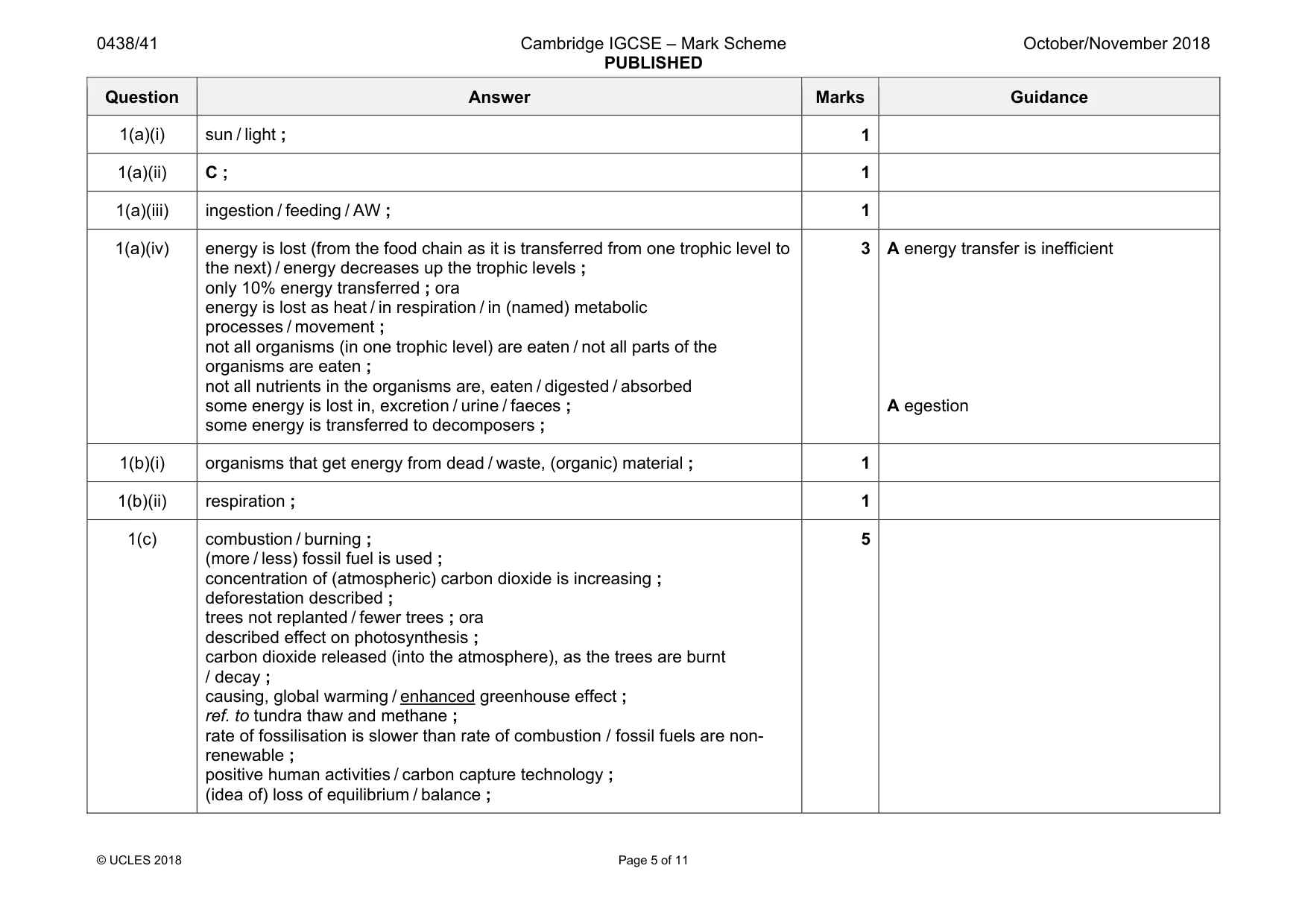
0438/41 Cambridge IGCSE – Mark Scheme PUBLISHED October/November 2018 © UCLES 2018 Page 5 of 11 Question Answer Marks Guidance 1(a)(i) sun / light ; 1 1(a)(ii) C ; 1 1(a)(iii) ingestion / feeding / AW ; 1 1(a)(iv) energy is lost (from the food chain as it is transferred from one trophic level to the next) / energy decreases up the trophic levels ; only 10% energy transferred ; ora energy is lost as heat / in respiration / in (named) metabolic processes / movement ; not all organisms (in one trophic level) are eaten / not all parts of the organisms are eaten ; not all nutrients in the organisms are, eaten / digested / absorbed some energy is lost in, excretion / urine / faeces ; some energy is transferred to decomposers ; 3 A energy transfer is inefficient A egestion 1(b)(i) organisms that get energy from dead / waste, (organic) material ; 1 1(b)(ii) respiration ; 1 1(c) combustion / burning ; (more / less) fossil fuel is used ; concentration of (atmospheric) carbon dioxide is increasing ; deforestation described ; trees not replanted / fewer trees ; ora described effect on photosynthesis ; carbon dioxide released (into the atmosphere), as the trees are burnt / decay ; causing, global warming / enhanced greenhouse effect ; ref. to tundra thaw and methane ; rate of fossilisation is slower than rate of combustion / fossil fuels are non- renewable ; positive human activities / carbon capture technology ; (idea of) loss of equilibrium / balance ; 5
Mark scheme, page 6
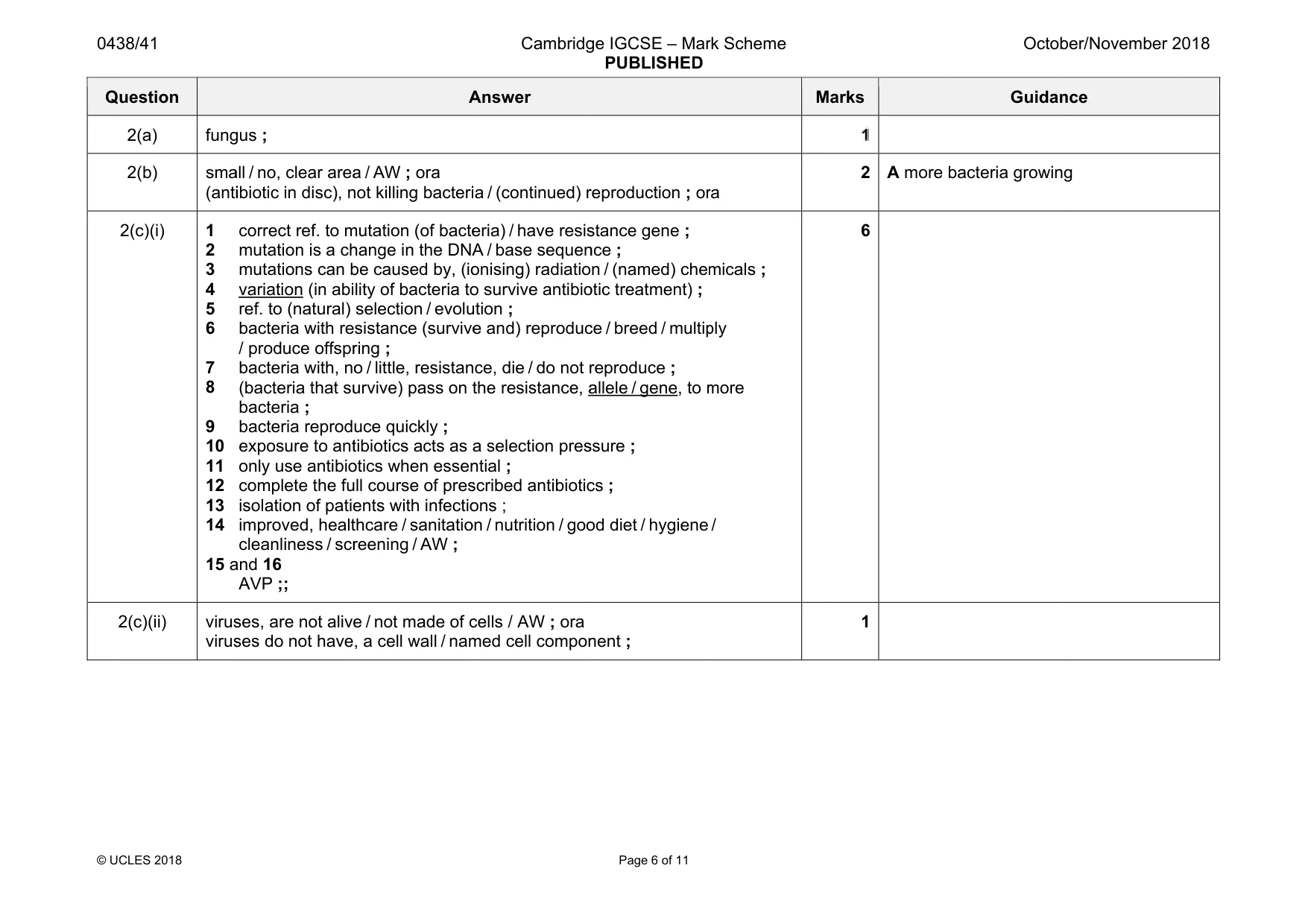
043 © U Q 38/41 CLES 2018 uestion 2(a) fung 2(b) sma (anti 2(c)(i) 1 2 3 4 5 6 7 8 9 10 11 12 13 14 15 a 2(c)(ii) virus virus gus ; all / no, clear area ibiotic in disc), n correct ref. to m mutation is a ch mutations can b variation (in abi ref. to (natural) bacteria with re / produce offspr bacteria with, no (bacteria that su bacteria ; bacteria reprod exposure to ant only use antibio complete the fu isolation of patie improved, healt cleanliness / scr and 16 AVP ;; ses, are not alive ses do not have A a / AW ; ora not killing bacteri mutation (of bacte hange in the DNA be caused by, (io lity of bacteria to selection / evolu sistance (survive ring ; o / little, resistan urvive) pass on t uce quickly ; tibiotics acts as otics when essen ll course of pres ents with infectio thcare / sanitatio reening / AW ; e / not made of c , a cell wall / nam Cambridg Answer ia / (continued) r eria) / have resis A / base sequen onising) radiatio o survive antibio ution ; e and) reproduc nce, die / do not r the resistance, a a selection pres ntial ; scribed antibiotic ons ; on / nutrition / goo cells / AW ; ora med cell compon ge IGCSE – Mar PUBLISHED Page 6 of 11 reproduction ; or stance gene ; nce ; n / (named) che otic treatment) ; ce / breed / multip reproduce ; allele / gene, to m ssure ; cs ; od diet / hygiene nent ; rk Scheme M ra micals ; ply more / Marks 1 2 A more 6 1 Octob Guidan bacteria growin ber/November 2 nce g 018
Mark scheme, page 7
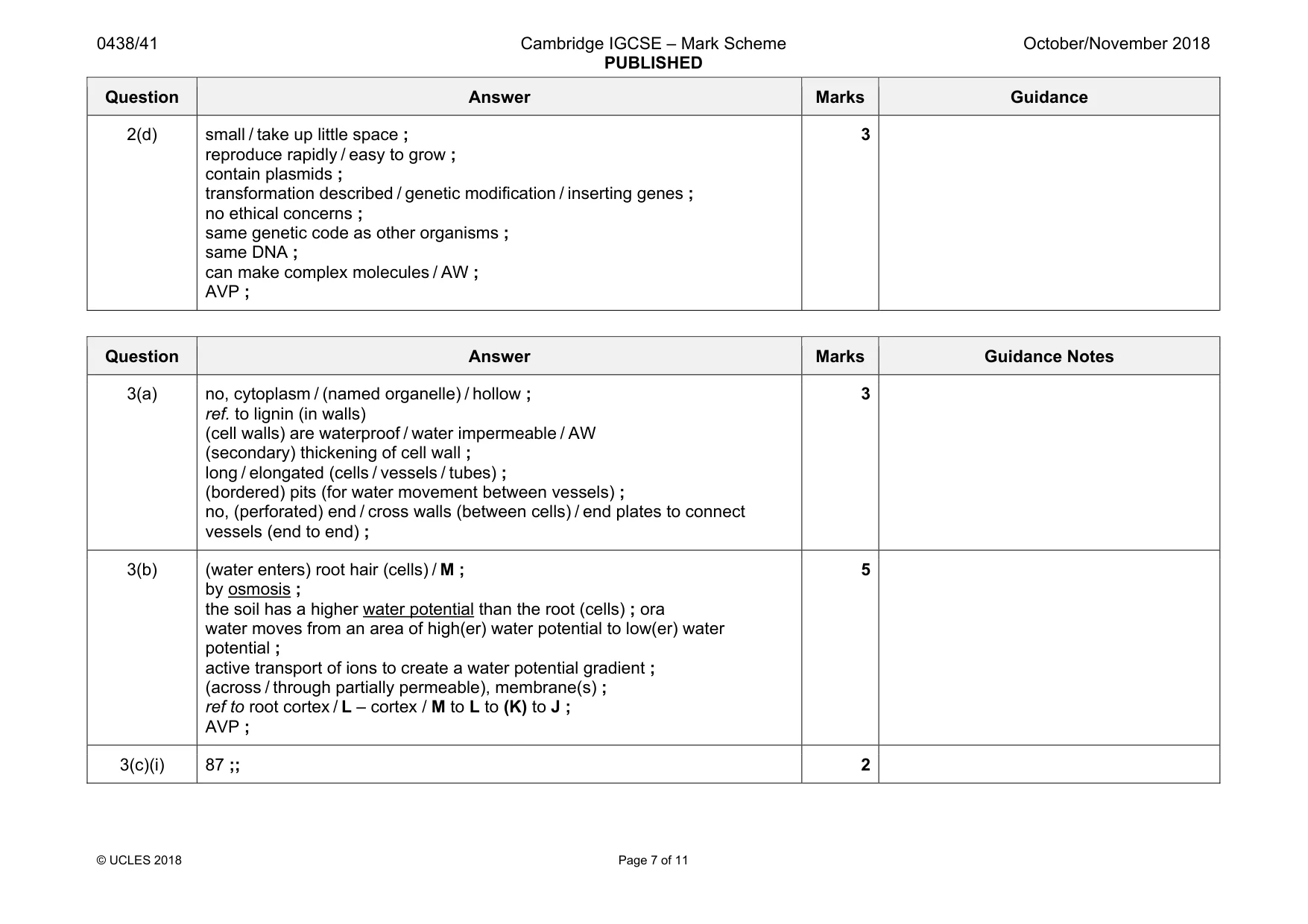
0438/41 Cambridge IGCSE – Mark Scheme PUBLISHED October/November 2018 © UCLES 2018 Page 7 of 11 Question Answer Marks Guidance 2(d) small / take up little space ; reproduce rapidly / easy to grow ; contain plasmids ; transformation described / genetic modification / inserting genes ; no ethical concerns ; same genetic code as other organisms ; same DNA ; can make complex molecules / AW ; AVP ; 3 Question Answer Marks Guidance Notes 3(a) no, cytoplasm / (named organelle) / hollow ; ref. to lignin (in walls) (cell walls) are waterproof / water impermeable / AW (secondary) thickening of cell wall ; long / elongated (cells / vessels / tubes) ; (bordered) pits (for water movement between vessels) ; no, (perforated) end / cross walls (between cells) / end plates to connect vessels (end to end) ; 3 3(b) (water enters) root hair (cells) / M ; by osmosis ; the soil has a higher water potential than the root (cells) ; ora water moves from an area of high(er) water potential to low(er) water potential ; active transport of ions to create a water potential gradient ; (across / through partially permeable), membrane(s) ; ref to root cortex / L – cortex / M to L to (K) to J ; AVP ; 5 3(c)(i) 87 ;; 2
Mark scheme, page 8
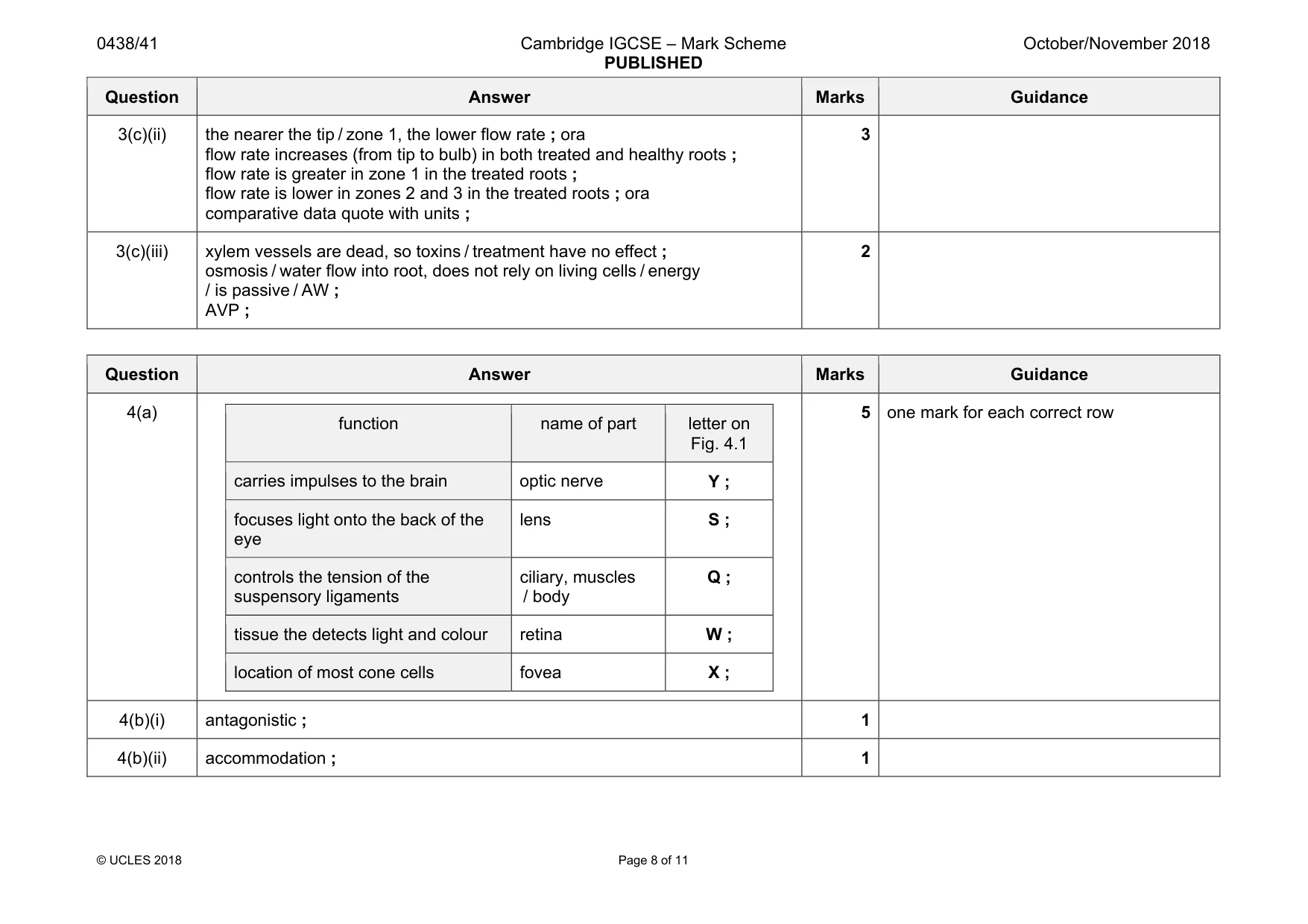
0438/41 Cambridge IGCSE – Mark Scheme PUBLISHED October/November 2018 © UCLES 2018 Page 8 of 11 Question Answer Marks Guidance 3(c)(ii) the nearer the tip / zone 1, the lower flow rate ; ora flow rate increases (from tip to bulb) in both treated and healthy roots ; flow rate is greater in zone 1 in the treated roots ; flow rate is lower in zones 2 and 3 in the treated roots ; ora comparative data quote with units ; 3 3(c)(iii) xylem vessels are dead, so toxins / treatment have no effect ; osmosis / water flow into root, does not rely on living cells / energy / is passive / AW ; AVP ; 2 Question Answer Marks Guidance 4(a) function name of part letter on Fig. 4.1 carries impulses to the brain optic nerve Y ; focuses light onto the back of the eye lens S ; controls the tension of the suspensory ligaments ciliary, muscles / body Q ; tissue the detects light and colour retina W ; location of most cone cells fovea X ; 5 one mark for each correct row 4(b)(i) antagonistic ; 1 4(b)(ii) accommodation ; 1
Mark scheme, page 9
0438/41 Cambridge IGCSE – Mark Scheme PUBLISHED October/November 2018 © UCLES 2018 Page 9 of 11 Question Answer Marks Guidance 4(c) cones are less sensitive in low light ; cones detect colour ; rods work in low light but can’t detect colour / AW ; 2 4(d)(i) XBXb ; 1 4(d)(ii) XbY ; 1 4(d)(iii) solid shaded square on Fig. 4.2 ; 1 4(d)(iv) one X chromosome from each parent / an X from father ; mother does not have any colour-blind alleles / father passes on one colour- blind allele ; (all female offspring are) heterozygous / XBXb ; 2 Question Answer Marks Guidance Notes 5(a)(i) chemical substance produced by a (endocrine) gland ; carried by the blood ; alters the activity of specific target organs / AW ; 3 5(a)(ii) (insulin) stimulates enzymes (production) ; conversion of glucose to glycogen ; glycogen is stored / insoluble ; increased, uptake / absorption / respiration, of glucose by liver (cells) ; 2 5(b)(i) deamination / removal of nitrogen containing part (of amino acids) ; to form urea ; (part of) amino acid converted to ammonia ; ammonia converted to urea ; 2 5(b)(ii) (protein) synthesis ; 1
Mark scheme, page 10
0438/41 Cambridge IGCSE – Mark Scheme PUBLISHED October/November 2018 © UCLES 2018 Page 10 of 11 Question Answer Marks Guidance 5(c)(i) aerobic / using oxygen ; respiration / (to produce) carbon dioxide and water; ref. to enzymes ; AVP ; converted back to, glucose 2 5(c)(ii) as alcohol consumption increases risk of dying of liver disease increases ; similar trend in males and females ; comparative data quote with units for g per day ; men exponential / women are not exponential / AW ; at low consumption females have higher risk ; ora same risk at 112 g per day ; 4 Question Answer Marks Guidance 6(a)(i) reflex (action) ; 1 6(a)(ii) contains antibodies / passive immunity / idea of fighting infections ; bonding with mother /AW ; is at a suitable body temperature ; sterile / less risk of infection / contamination ; convenience / always available / no preparation ; cheap / free ; easy to digest / less risk of colic / less risk of diabetes in child ; no additives / less risk of allergies ; idea of volume is controlled / no over-feeding ; nutrient requirements met / change with age / change with development ; AVP ;; 4
Mark scheme, page 11
0438/41 Cambridge IGCSE – Mark Scheme PUBLISHED October/November 2018 © UCLES 2018 Page 11 of 11 Question Answer Marks Guidance 6(b)(i) enzyme substrate product(s) amylase starch glucose / maltose ; maltase maltose glucose ; protease protein amino acids ; 3 6(b)(ii) high temperatures denature enzymes / AW ; low temperatures result in low energy / fewer collisions / slower reactions / AW ; enzymes work best / most efficient at optimum temperature ; 2 6(b)(iii) pH ; enzyme concentration ; substrate concentration ; 1
What you needed in this session
Cambridge’s own grade thresholds for 2018 Oct/Nov, Paper 4 · Variant 1. A higher threshold means an easier paper — the bar moves with how the cohort did.