Cambridge IGCSE Art and Design 0400 — 2005 Oct/Nov Paper 3 · Variant 1
0400/31/O/N/05
The question paper and its mark scheme, free to read here and free to download. This is Cambridge’s own paper, exactly as it was sat.
Question paper4 pages
Mark scheme2 pages
Answers below. Sit the paper first if you are practising.
Paper as text
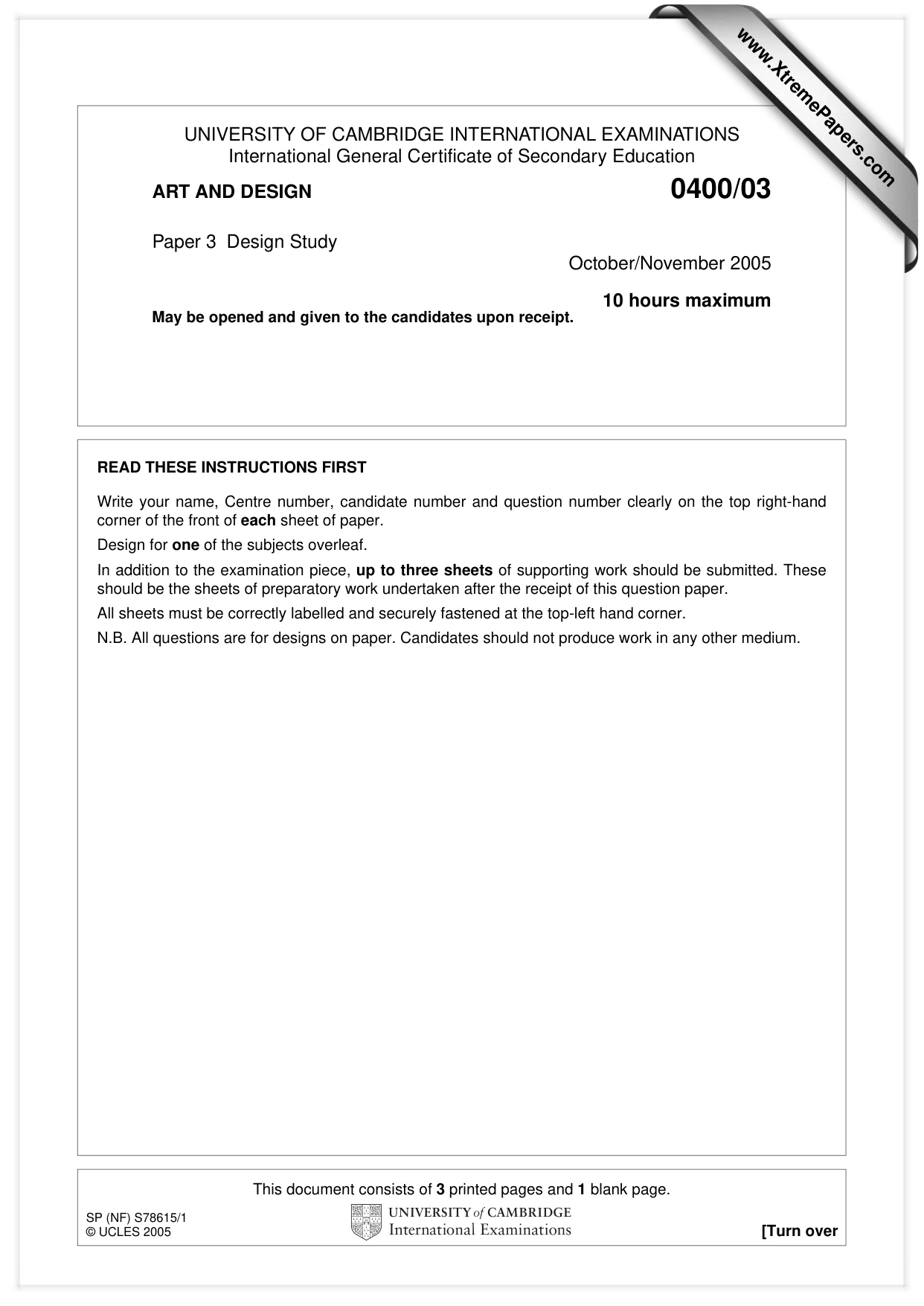
Question paper, page 1
This document consists of 3 printed pages and 1 blank page. SP (NF) S78615/1 © UCLES 2005 [Turn over UNIVERSITY OF CAMBRIDGE INTERNATIONAL EXAMINATIONS International General Certificate of Secondary Education ART AND DESIGN 0400/03 Paper 3 Design Study October/November 2005 10 hours maximum May be opened and given to the candidates upon receipt. READ THESE INSTRUCTIONS FIRST Write your name, Centre number, candidate number and question number clearly on the top right-hand corner of the front of each sheet of paper. Design for one of the subjects overleaf. In addition to the examination piece, up to three sheets of supporting work should be submitted. These should be the sheets of preparatory work undertaken after the receipt of this question paper. All sheets must be correctly labelled and securely fastened at the top-left hand corner. N.B. All questions are for designs on paper. Candidates should not produce work in any other medium. www.XtremePapers.com
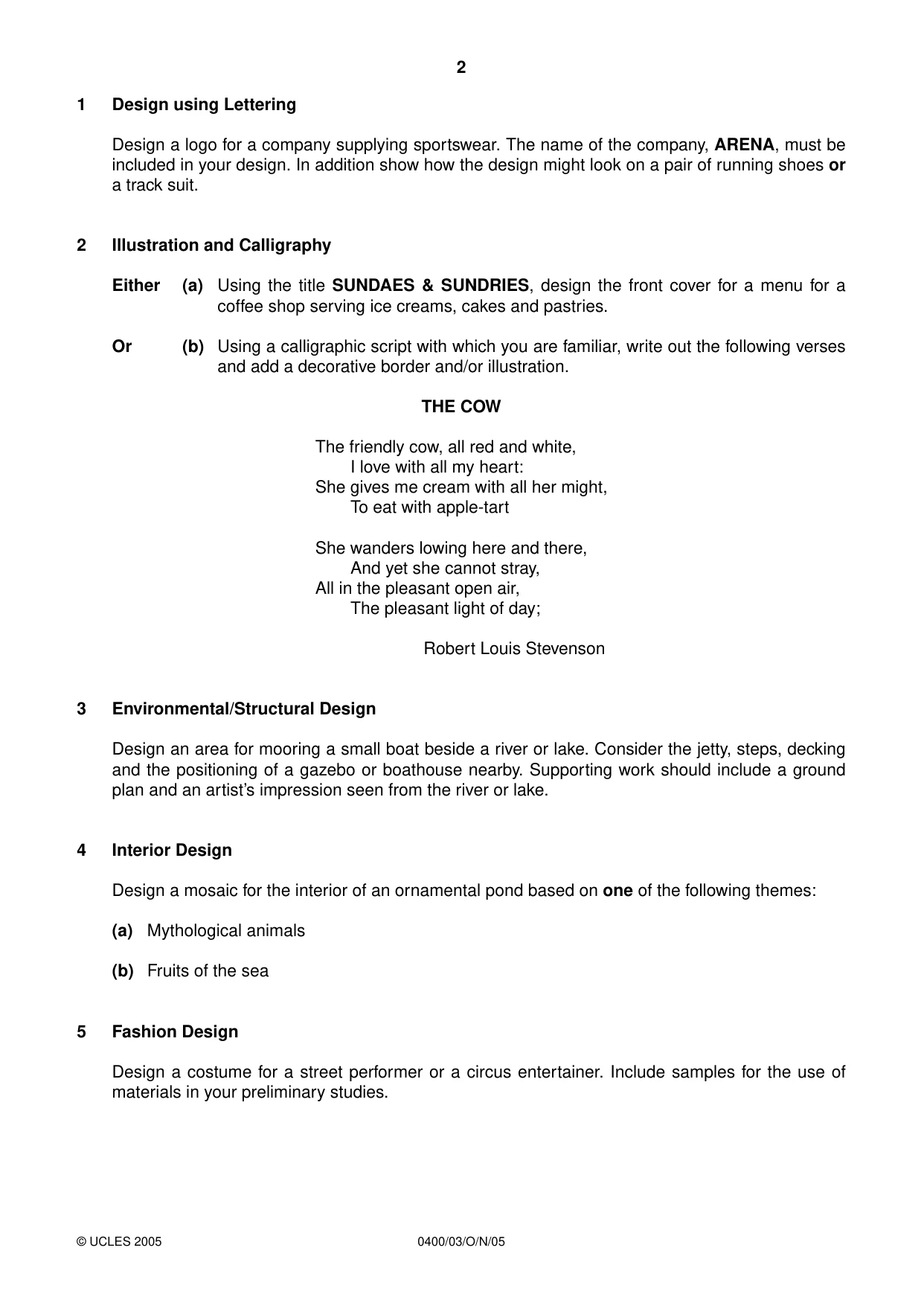
Question paper, page 2
2 0400/03/O/N/05 1 Design using Lettering Design a logo for a company supplying sportswear. The name of the company, ARENA, must be included in your design. In addition show how the design might look on a pair of running shoes or a track suit. 2 Illustration and Calligraphy Either (a) Using the title SUNDAES & SUNDRIES, design the front cover for a menu for a coffee shop serving ice creams, cakes and pastries. Or (b) Using a calligraphic script with which you are familiar, write out the following verses and add a decorative border and/or illustration. THE COW The friendly cow, all red and white, I love with all my heart: She gives me cream with all her might, To eat with apple-tart She wanders lowing here and there, And yet she cannot stray, All in the pleasant open air, The pleasant light of day; Robert Louis Stevenson 3 Environmental/Structural Design Design an area for mooring a small boat beside a river or lake. Consider the jetty, steps, decking and the positioning of a gazebo or boathouse nearby. Supporting work should include a ground plan and an artist’s impression seen from the river or lake. 4 Interior Design Design a mosaic for the interior of an ornamental pond based on one of the following themes: (a) Mythological animals (b) Fruits of the sea 5 Fashion Design Design a costume for a street performer or a circus entertainer. Include samples for the use of materials in your preliminary studies. © UCLES 2005
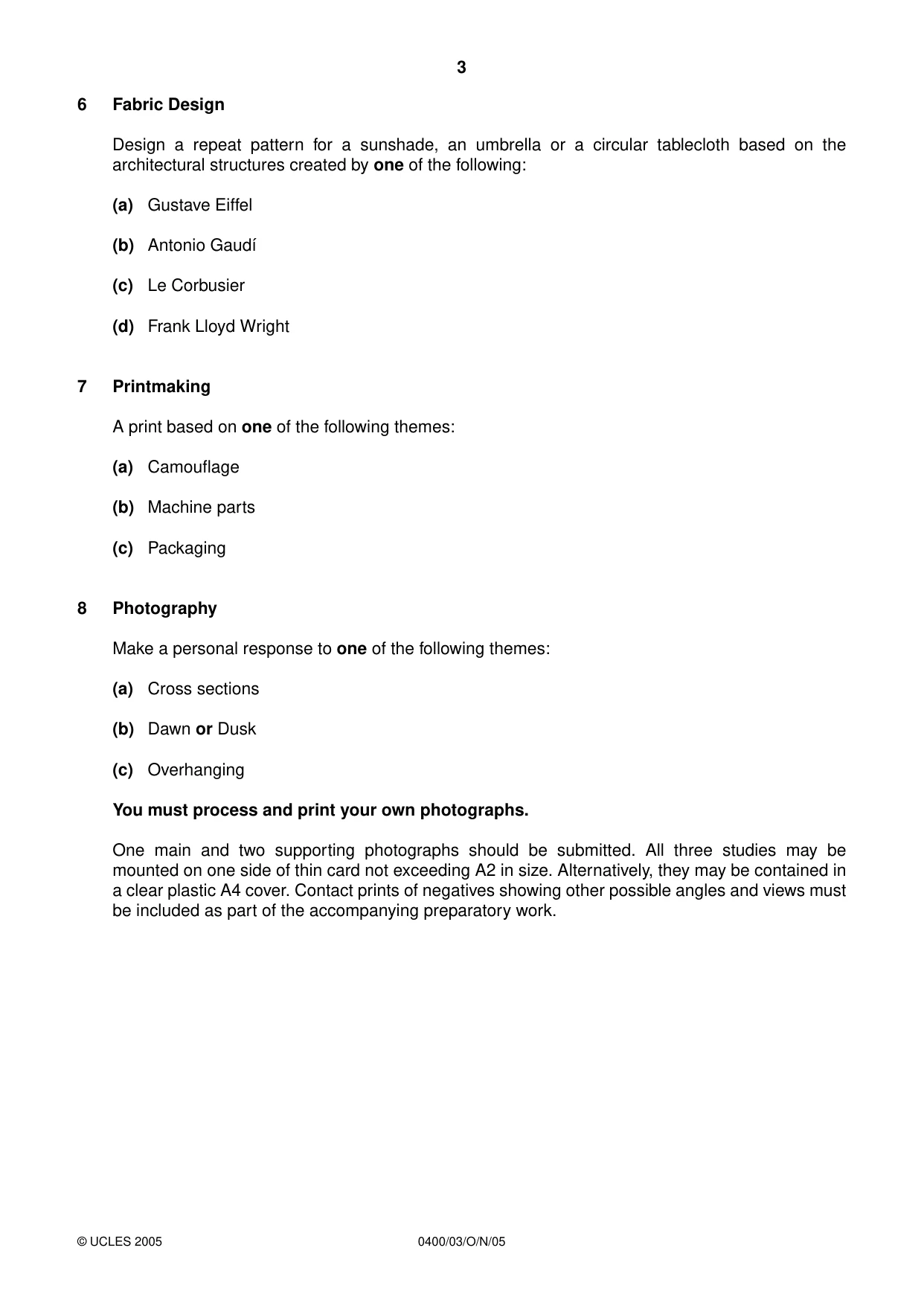
Question paper, page 3
3 0400/03/O/N/05 6 Fabric Design Design a repeat pattern for a sunshade, an umbrella or a circular tablecloth based on the architectural structures created by one of the following: (a) Gustave Eiffel (b) Antonio Gaudí (c) Le Corbusier (d) Frank Lloyd Wright 7 Printmaking A print based on one of the following themes: (a) Camouflage (b) Machine parts (c) Packaging 8 Photography Make a personal response to one of the following themes: (a) Cross sections (b) Dawn or Dusk (c) Overhanging You must process and print your own photographs. One main and two supporting photographs should be submitted. All three studies may be mounted on one side of thin card not exceeding A2 in size. Alternatively, they may be contained in a clear plastic A4 cover. Contact prints of negatives showing other possible angles and views must be included as part of the accompanying preparatory work. © UCLES 2005
Question paper, page 4
4 0400/03/O/N/05 BLANK PAGE Copyright Acknowledgements: Question 2 © Robert Louis Stevenson; The Cow. Every reasonable effort has been made to trace all copyright holders where the publishers (i.e. UCLES) are aware that third-party material has been reproduced. The publishers would be pleased to hear from anyone whose rights they have unwittingly infringed. University of Cambridge International Examinations is part of the University of Cambridge Local Examinations Syndicate (UCLES), which is itself a department of the University of Cambridge.
Mark scheme, page 1
UNIVERSITY OF CAMBRIDGE INTERNATIONAL EXAMINATIONS International General Certificate of Secondary Education MARK SCHEME for the November 2005 question paper 0400 ART AND DESIGN 0400/03 Paper 3 Design Study, maximum raw mark 100 This mark scheme is published as an aid to teachers and students, to indicate the requirements of the examination. It shows the basis on which Examiners were initially instructed to award marks. It does not indicate the details of the discussions that took place at an Examiners’ meeting before marking began. Any substantial changes to the mark scheme that arose from these discussions will be recorded in the published Report on the Examination. All Examiners are instructed that alternative correct answers and unexpected approaches in candidates’ scripts must be given marks that fairly reflect the relevant knowledge and skills demonstrated. Mark schemes must be read in conjunction with the question papers and the Report on the Examination. The minimum marks in these components needed for various grades were previously published with these mark schemes, but are now instead included in the Report on the Examination for this session. • CIE will not enter into discussion or correspondence in connection with these mark schemes. CIE is publishing the mark schemes for the November 2005 question papers for most IGCSE and GCE Advanced Level and Advanced Subsidiary Level syllabuses and some Ordinary Level syllabuses. www.XtremePapers.com
Mark scheme, page 2
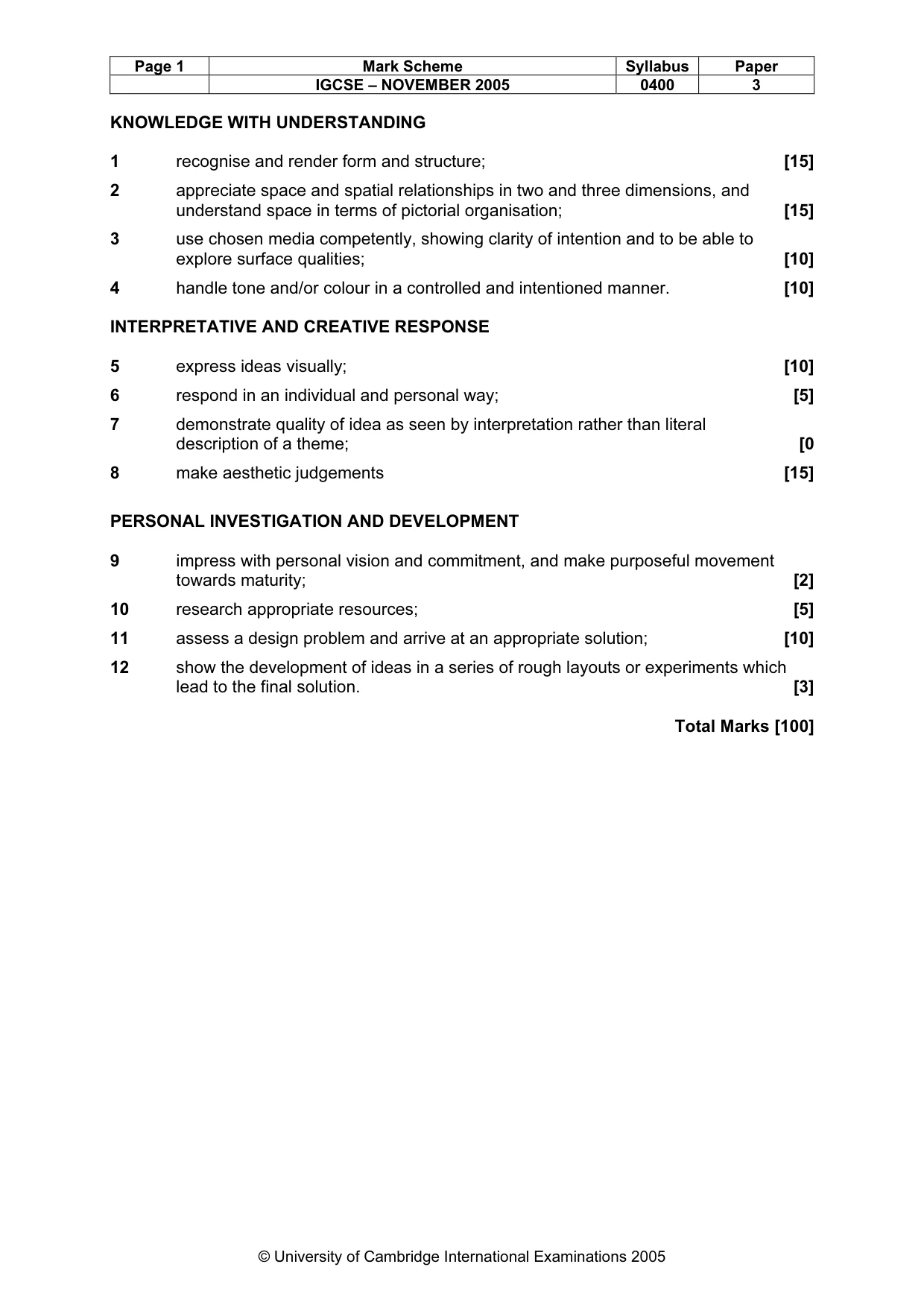
Page 1 Mark Scheme Syllabus Paper IGCSE – NOVEMBER 2005 0400 3 © University of Cambridge International Examinations 2005 KNOWLEDGE WITH UNDERSTANDING 1 recognise and render form and structure; [15] 2 appreciate space and spatial relationships in two and three dimensions, and understand space in terms of pictorial organisation; [15] 3 use chosen media competently, showing clarity of intention and to be able to explore surface qualities; [10] 4 handle tone and/or colour in a controlled and intentioned manner. [10] INTERPRETATIVE AND CREATIVE RESPONSE 5 express ideas visually; [10] 6 respond in an individual and personal way; [5] 7 demonstrate quality of idea as seen by interpretation rather than literal description of a theme; [0 8 make aesthetic judgements [15] PERSONAL INVESTIGATION AND DEVELOPMENT 9 impress with personal vision and commitment, and make purposeful movement towards maturity; [2] 10 research appropriate resources; [5] 11 assess a design problem and arrive at an appropriate solution; [10] 12 show the development of ideas in a series of rough layouts or experiments which lead to the final solution. [3] Total Marks [100]