Cambridge IGCSE Arabic - Foreign Language 0544 — 2020 May/June Paper 4 · Variant 2
0544/42/M/J/20
The question paper and its mark scheme, free to read here and free to download. This is Cambridge’s own paper, exactly as it was sat.
Question paper8 pages


Mark scheme26 pages
Answers below. Sit the paper first if you are practising.
Paper as text
Question paper, page 1
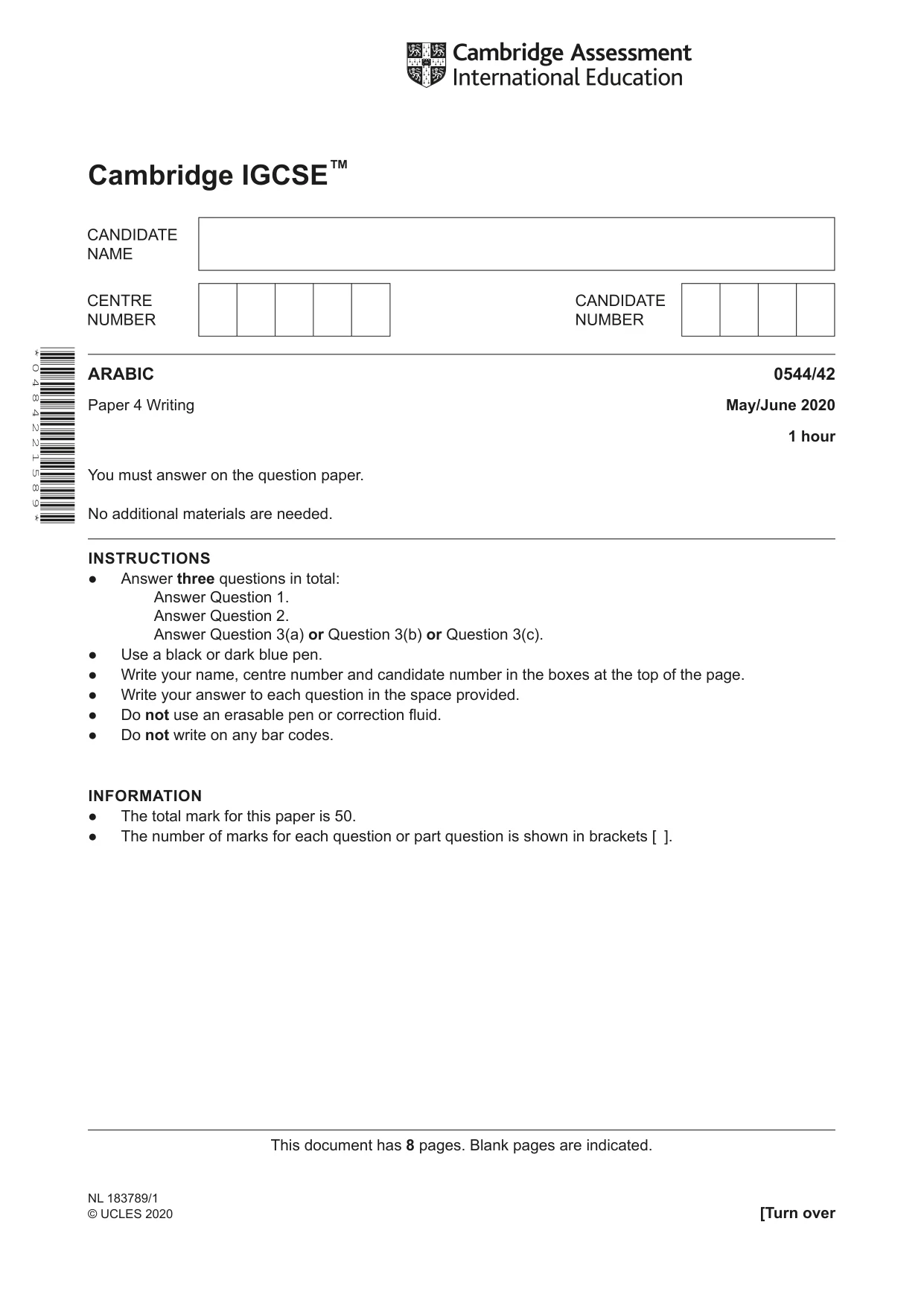
This document has 8 pages. Blank pages are indicated. NL 183789/1 © UCLES 2020 [Turn over * 0 4 8 4 2 2 1 5 8 9 * Cambridge IGCSE™ ARABIC 0544/42 Paper 4 Writing May/June 2020 1 hour You must answer on the question paper. No additional materials are needed. INSTRUCTIONS ● Answer three questions in total: Answer Question 1. Answer Question 2. Answer Question 3(a) or Question 3(b) or Question 3(c). ● Use a black or dark blue pen. ● Write your name, centre number and candidate number in the boxes at the top of the page. ● Write your answer to each question in the space provided. ● Do not use an erasable pen or correction fluid. ● Do not write on any bar codes. INFORMATION ● The total mark for this paper is 50. ● The number of marks for each question or part question is shown in brackets [ ].
Question paper, page 2
2 0544/42/M/J/20 © UCLES 2020 BLANK PAGE
Question paper, page 3
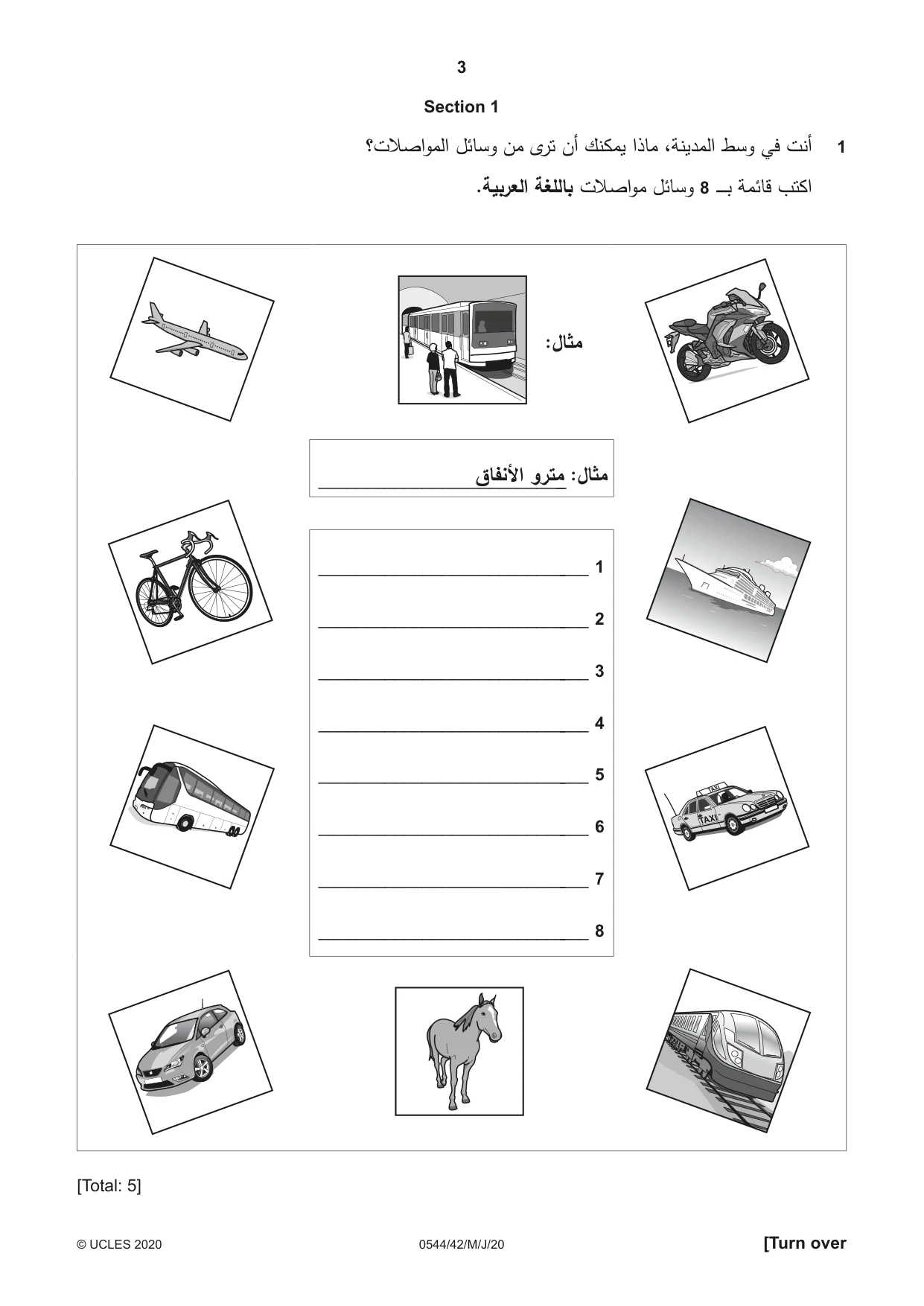
3 0544/42/M/J/20 © UCLES 2020 [Turn over Section 1 أنت في وسط المدينة، ماذا يمكنك أن ترى من وسائل المواصالت؟ 1 . وسائل مواصالت باللغة العربية8 اكتب قائمة بـــ :مثال __________________________ _____________________________ 1 _____________________________ 2 _____________________________ 3 _____________________________ 4 _____________________________ 5 _____________________________ 6 _____________________________ 7 _____________________________ 8 [Total: 5] مثال: مترو األنفاق
Question paper, page 4
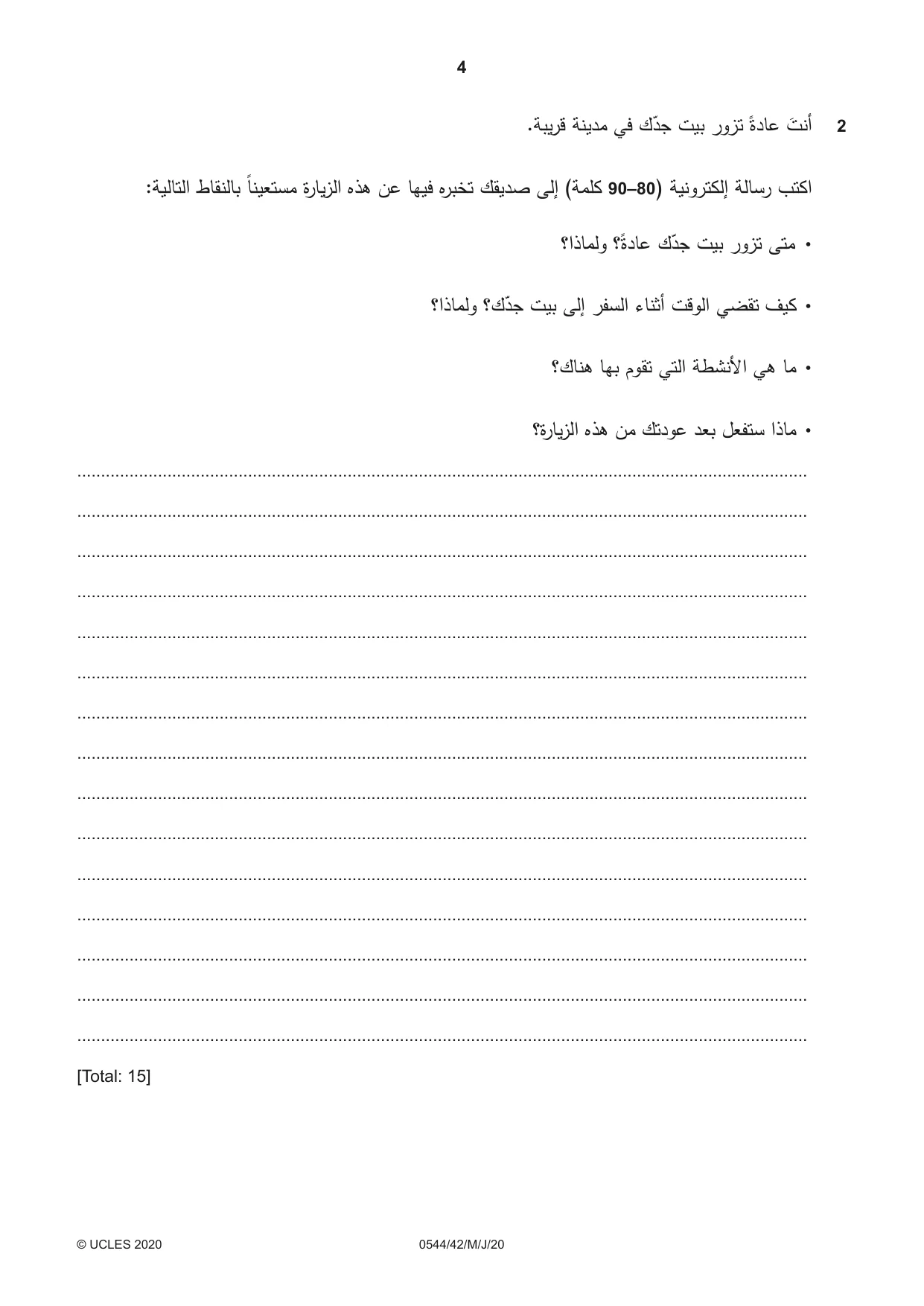
4 0544/42/M/J/20 © UCLES 2020 .أنتَ عادةً تزور بيت جدّك في مدينة قريبة 2 : كلمة) إلى صديقك تخبره فيها عن هذه الزيارة مستعيناً بالنقاط التالية90–80( اكتب رسالة إلكترونية • متى تزور بيت جدّك عادةً؟ ولماذا؟ • كيف تقضي الوقت أثناء السفر إلى بيت جدّك؟ ولماذا؟ • ما هي األنشطة التي تقوم بها هناك؟ • ماذا ستفعل بعد عودتك من هذه الزيارة؟ … … … … … … … … … … … … … … … [Total: 15]
Question paper, page 5
5 0544/42/M/J/20 © UCLES 2020 [Turn over BLANK PAGE
Question paper, page 6
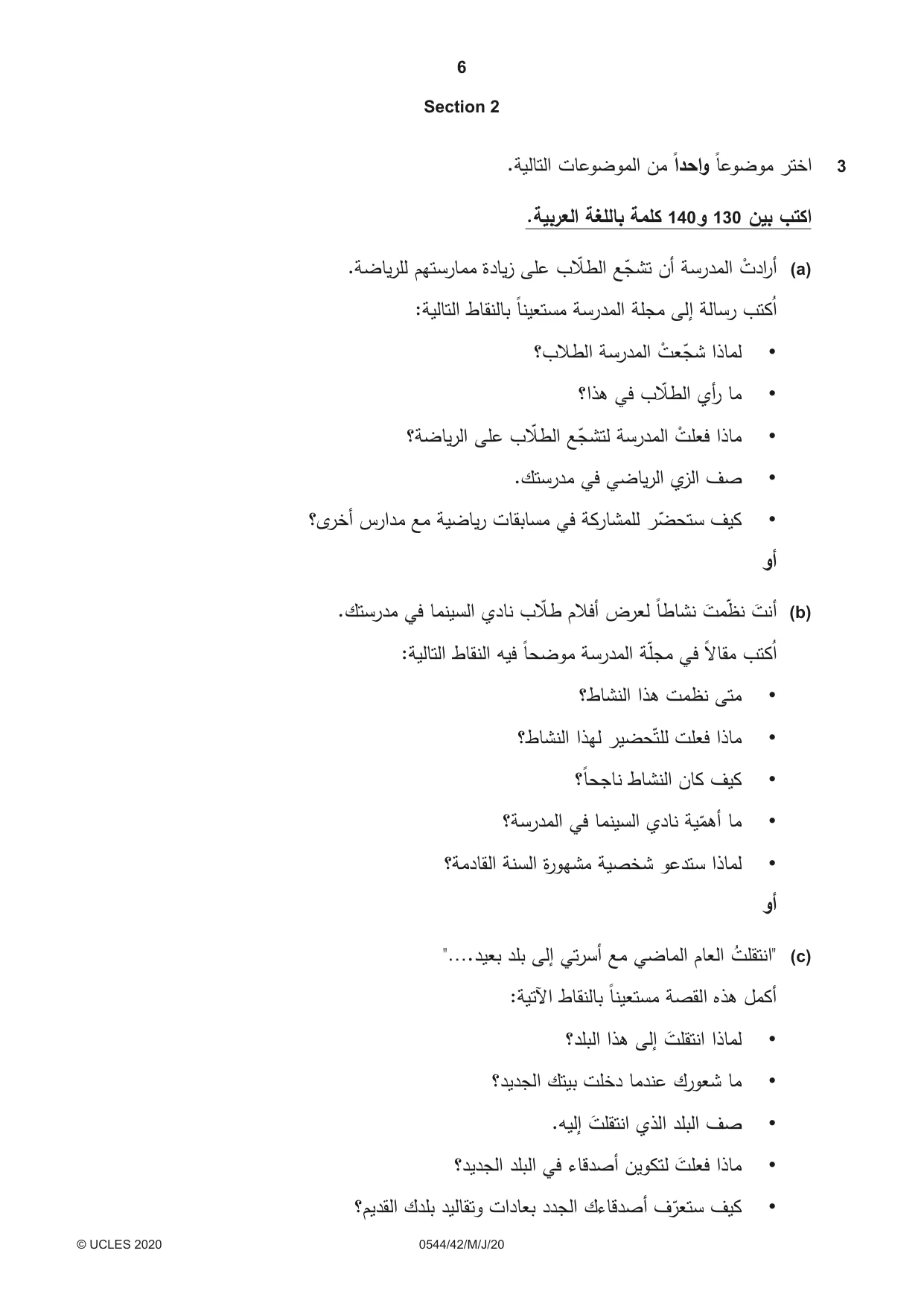
6 0544/42/M/J/20 © UCLES 2020 Section 2 .اختر موضوعاً واحداً من الموضوعات التالية 3 . كلمة باللغة العربية140 و130 اكتب بين أرادتْ المدرسة أن تشجّع الطالّ ب على زيادة ممارستهم للرياضة. )a( :اُكتب رسالة إلى مجلة المدرسة مستعيناً بالنقاط التالية لماذا شجّعتْ المدرسة الطالب؟ • ما رأي الطالّ ب في هذا؟ • ماذا فعلتْ المدرسة لتشجّع الطالّ ب على الرياضة؟ • صف الزي الرياضي في مدرستك. • كيف ستحضّر للمشاركة في مسابقات رياضية مع مدارس أخرى؟ • أو ) أنتَ نظّمتَ نشاطاً لعرض أفالم طالّ ب نادي السينما في مدرستك. b( :اُكتب مقاالً في مجلّة المدرسة موضحاً فيه النقاط التالية متى نظمت هذا النشاط؟ • ماذا فعلت للتّحضير لهذا النشاط؟ • كيف كان النشاط ناجحاً؟ • ما أهمّية نادي السينما في المدرسة؟ • لماذا ستدعو شخصية مشهورة السنة القادمة؟ • أو "انتقلتُ العام الماضي مع أسرتي إلى بلد بعيد.…" )c( :أكمل هذه القصة مستعيناً بالنقاط اآلتية لماذا انتقلتَ إلى هذا البلد؟ • ما شعورك عندما دخلت بيتك الجديد؟ • صف البلد الذي انتقلتَ إليه. • ماذا فعلتَ لتكوين أصدقاء في البلد الجديد؟ • كيف ستعرّف أصدقاءك الجدد بعادات وتقاليد بلدك القديم؟ •
Question paper, page 7
7 0544/42/M/J/20 © UCLES 2020 … … … … … … … … … … … … … … … … … … … … … … … … … [Total: 30] … اكتب هنا رقم السؤال الذي تختاره اكتب إجابتك عن السؤال الثالث هنا:
Question paper, page 8
8 0544/42/M/J/20 © UCLES 2020 BLANK PAGE Permission to reproduce items where third-party owned material protected by copyright is included has been sought and cleared where possible. Every reasonable effort has been made by the publisher (UCLES) to trace copyright holders, but if any items requiring clearance have unwittingly been included, the publisher will be pleased to make amends at the earliest possible opportunity. To avoid the issue of disclosure of answer-related information to candidates, all copyright acknowledgements are reproduced online in the Cambridge Assessment International Education Copyright Acknowledgements Booklet. This is produced for each series of examinations and is freely available to download at www.cambridgeinternational.org after the live examination series. Cambridge Assessment International Education is part of the Cambridge Assessment Group. Cambridge Assessment is the brand name of the University of Cambridge Local Examinations Syndicate (UCLES), which itself is a department of the University of Cambridge.
Mark scheme, page 1
This document consists of 26 printed pages. © UCLES 2020 [Turn over Cambridge IGCSE™ ARABIC 0544/42 Paper 4 Writing May/June 2020 MARK SCHEME Maximum Mark: 50 Published Students did not sit exam papers in the June 2020 series due to the Covid-19 global pandemic. This mark scheme is published to support teachers and students and should be read together with the question paper. It shows the requirements of the exam. The answer column of the mark scheme shows the proposed basis on which Examiners would award marks for this exam. Where appropriate, this column also provides the most likely acceptable alternative responses expected from students. Examiners usually review the mark scheme after they have seen student responses and update the mark scheme if appropriate. In the June series, Examiners were unable to consider the acceptability of alternative responses, as there were no student responses to consider. Mark schemes should usually be read together with the Principal Examiner Report for Teachers. However, because students did not sit exam papers, there is no Principal Examiner Report for Teachers for the June 2020 series. Cambridge International will not enter into discussions about these mark schemes. Cambridge International is publishing the mark schemes for the June 2020 series for most Cambridge IGCSE™ and Cambridge International A & AS Level components, and some Cambridge O Level components.
Mark scheme, page 2
0544/42 Cambridge IGCSE – Mark Scheme PUBLISHED May/June 2020 © UCLES 2020 Page 2 of 26 Generic Marking Principles These general marking principles must be applied by all examiners when marking candidate answers. They should be applied alongside the specific content of the mark scheme or generic level descriptors for a question. Each question paper and mark scheme will also comply with these marking principles. GENERIC MARKING PRINCIPLE 1: Marks must be awarded in line with: • the specific content of the mark scheme or the generic level descriptors for the question • the specific skills defined in the mark scheme or in the generic level descriptors for the question • the standard of response required by a candidate as exemplified by the standardisation scripts. GENERIC MARKING PRINCIPLE 2: Marks awarded are always whole marks (not half marks, or other fractions). GENERIC MARKING PRINCIPLE 3: Marks must be awarded positively: • marks are awarded for correct/valid answers, as defined in the mark scheme. However, credit is given for valid answers which go beyond the scope of the syllabus and mark scheme, referring to your Team Leader as appropriate • marks are awarded when candidates clearly demonstrate what they know and can do • marks are not deducted for errors • marks are not deducted for omissions • answers should only be judged on the quality of spelling, punctuation and grammar when these features are specifically assessed by the question as indicated by the mark scheme. The meaning, however, should be unambiguous. GENERIC MARKING PRINCIPLE 4: Rules must be applied consistently e.g. in situations where candidates have not followed instructions or in the application of generic level descriptors.
Mark scheme, page 3
0544/42 Cambridge IGCSE – Mark Scheme PUBLISHED May/June 2020 © UCLES 2020 Page 3 of 26 GENERIC MARKING PRINCIPLE 5: Marks should be awarded using the full range of marks defined in the mark scheme for the question (however; the use of the full mark range may be limited according to the quality of the candidate responses seen). GENERIC MARKING PRINCIPLE 6: Marks awarded are based solely on the requirements as defined in the mark scheme. Marks should not be awarded with grade thresholds or grade descriptors in mind.
Mark scheme, page 4
0544/42 Cambridge IGCSE – Mark Scheme PUBLISHED May/June 2020 © UCLES 2020 Page 4 of 26 1 General Marking Principles 1.1 Crossing out: (a) If a candidate changes his/her mind over an answer and crosses out an attempt, award a mark if the final attempt is correct. (b) If a candidate crosses out an answer to a whole question but makes no second attempt at it, mark the crossed out work. 1.2 For Questions 2 and 3, if the candidate has written an answer in the space provided for that purpose, you should ignore anything written anywhere else, unless: (i) there is an indication from the candidate that other material should be considered (ii) the candidate has continued their answer outside the space provided (iii) there is no answer in the space provided 1.3 Annotation used in the Mark Scheme and/or Marking: (a) tc = ‘tout court’ and means that on its own the material is not sufficient to score the mark. (b) BOD = Benefit of the Doubt and is used to indicate material considered by the Examiner and judged to be more correct than incorrect: the benefit of the doubt is given to the candidate and the mark is awarded. 1.4 No response and '0' marks Award NR (No Response): • If there is nothing written at all in the answer space or • If there is only a comment which does not in any way relate to the question being asked (e.g. ‘can’t do’ or ‘don’t know’) or • If there is only a mark which isn’t an attempt at the question (e.g. a dash, a question mark). Award 0: • If there is any attempt that earns no credit. This could, for example, include the candidate copying all or some of the question, or any working that does not earn any marks, whether crossed out or not. 1.5 Optional questions: you must mark all questions attempted by the candidate. Where a question has not been attempted then a NR must be entered. (For Question 3 only, after marking the question(s) the candidate has answered, NR is populated automatically when you click on ‘Complete’.) Where the candidate attempts more than one of the alternatives in Question 3, scoris will automatically only aggregate the candidate’s best result.
Mark scheme, page 5
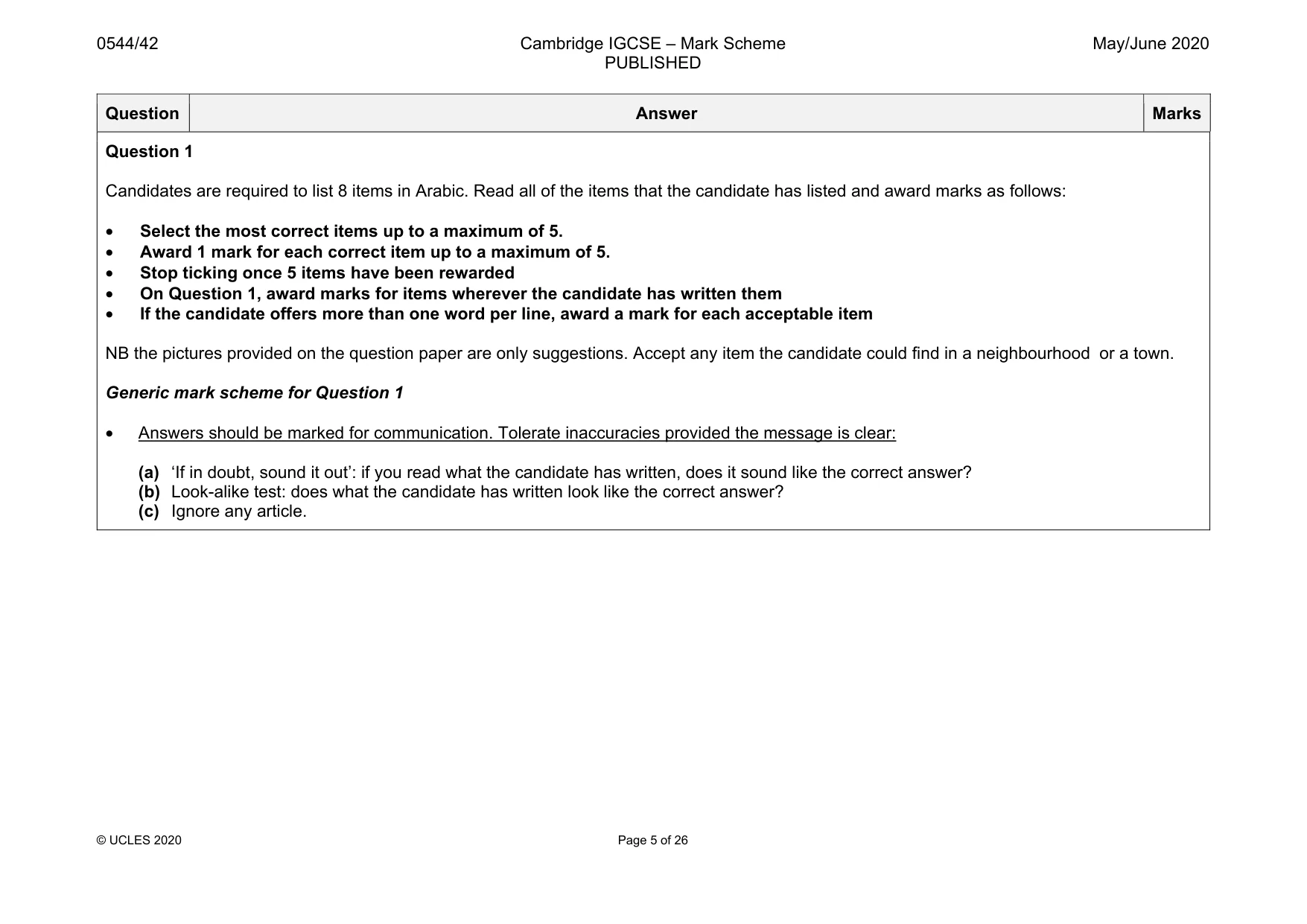
0544/42 Cambridge IGCSE – Mark Scheme PUBLISHED May/June 2020 © UCLES 2020 Page 5 of 26 Question Answer Marks Question 1 Candidates are required to list 8 items in Arabic. Read all of the items that the candidate has listed and award marks as follows: • Select the most correct items up to a maximum of 5. • Award 1 mark for each correct item up to a maximum of 5. • Stop ticking once 5 items have been rewarded • On Question 1, award marks for items wherever the candidate has written them • If the candidate offers more than one word per line, award a mark for each acceptable item NB the pictures provided on the question paper are only suggestions. Accept any item the candidate could find in a neighbourhood or a town. Generic mark scheme for Question 1 • Answers should be marked for communication. Tolerate inaccuracies provided the message is clear: (a) ‘If in doubt, sound it out’: if you read what the candidate has written, does it sound like the correct answer? (b) Look-alike test: does what the candidate has written look like the correct answer? (c) Ignore any article.
Mark scheme, page 6
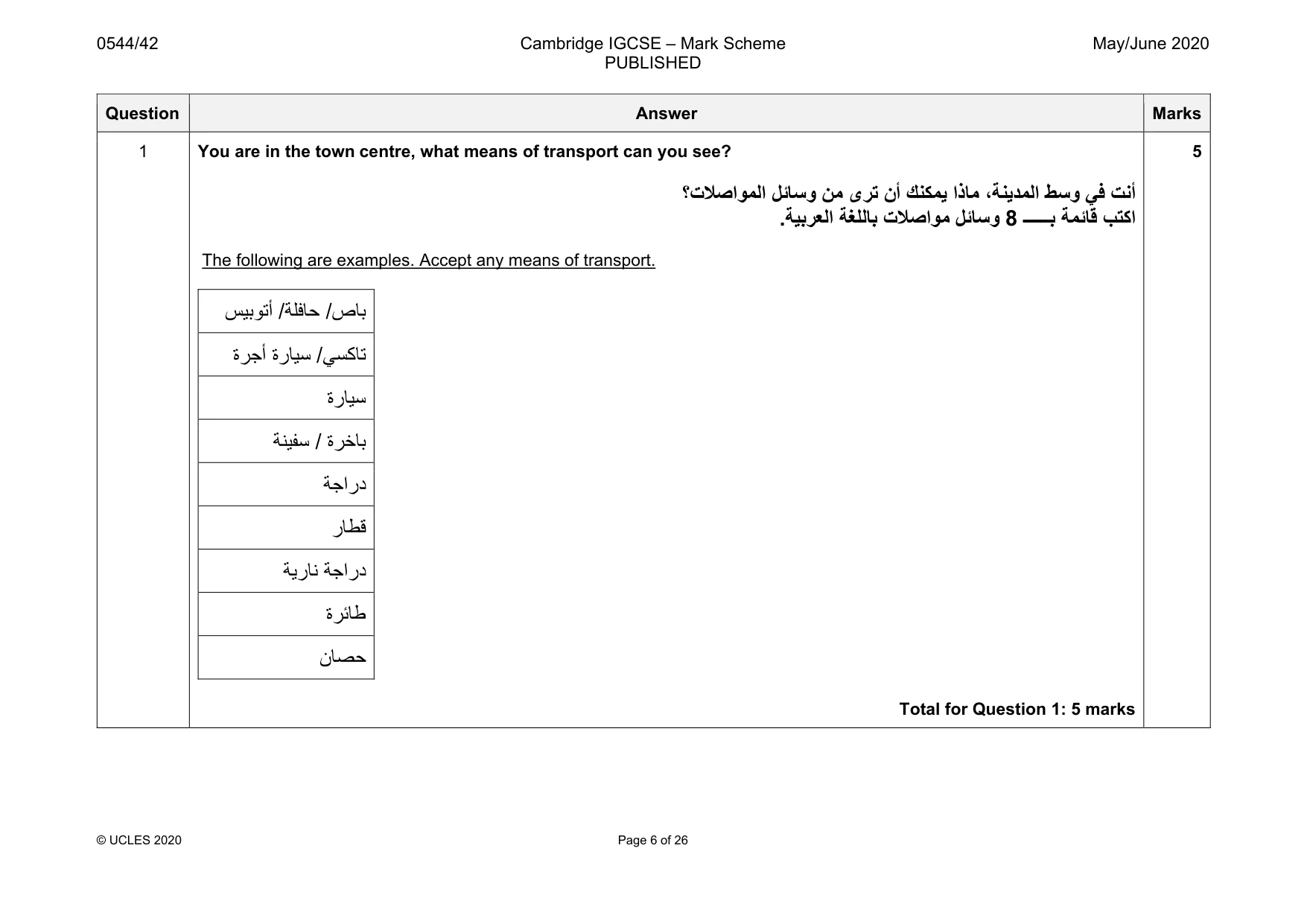
0544/42 Cambridge IGCSE – Mark Scheme PUBLISHED May/June 2020 © UCLES 2020 Page 6 of 26 Question Answer Marks 1 You are in the town centre, what means of transport can you see? أنت في وسط المدينة، ماذا يمكنك أن ترى من وسائل المواصالت؟ اكتب قائمة بــــــ 8 وسائل مواصالت باللغة العربية. The following are examples. Accept any means of transport. باص / حافلة/ أتوبيس /تاكسي سيارة أجرة سيارة باخرة / سفينة دراجة قطار دراجة نارية طائرة حصان Total for Question 1: 5 marks 5
Mark scheme, page 7
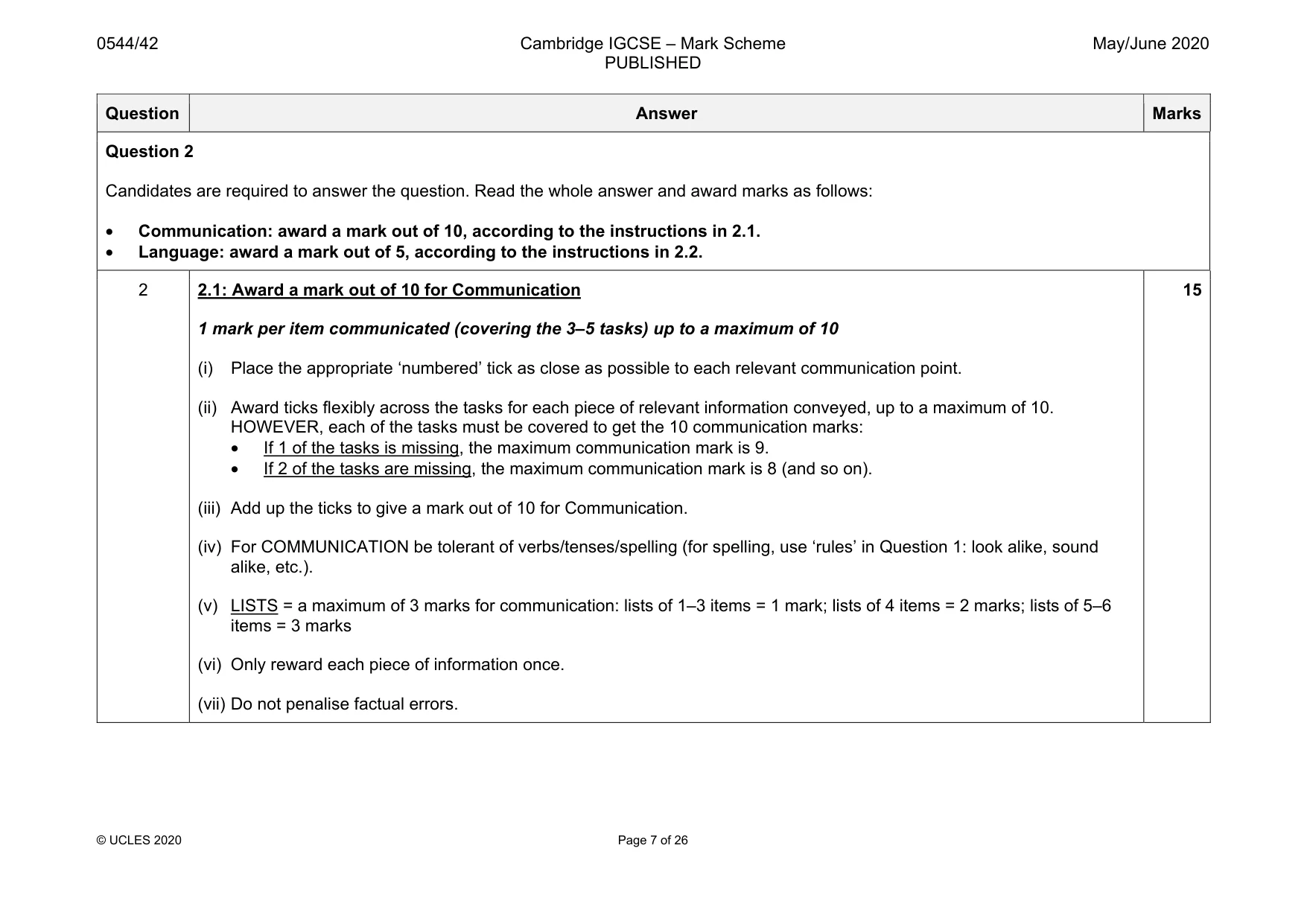
0544/42 Cambridge IGCSE – Mark Scheme PUBLISHED May/June 2020 © UCLES 2020 Page 7 of 26 Question Answer Marks Question 2 Candidates are required to answer the question. Read the whole answer and award marks as follows: • Communication: award a mark out of 10, according to the instructions in 2.1. • Language: award a mark out of 5, according to the instructions in 2.2. 2 2.1: Award a mark out of 10 for Communication 1 mark per item communicated (covering the 3–5 tasks) up to a maximum of 10 (i) Place the appropriate ‘numbered’ tick as close as possible to each relevant communication point. (ii) Award ticks flexibly across the tasks for each piece of relevant information conveyed, up to a maximum of 10. HOWEVER, each of the tasks must be covered to get the 10 communication marks: • If 1 of the tasks is missing, the maximum communication mark is 9. • If 2 of the tasks are missing, the maximum communication mark is 8 (and so on). (iii) Add up the ticks to give a mark out of 10 for Communication. (iv) For COMMUNICATION be tolerant of verbs/tenses/spelling (for spelling, use ‘rules’ in Question 1: look alike, sound alike, etc.). (v) LISTS = a maximum of 3 marks for communication: lists of 1–3 items = 1 mark; lists of 4 items = 2 marks; lists of 5–6 items = 3 marks (vi) Only reward each piece of information once. (vii) Do not penalise factual errors. 15
Mark scheme, page 8
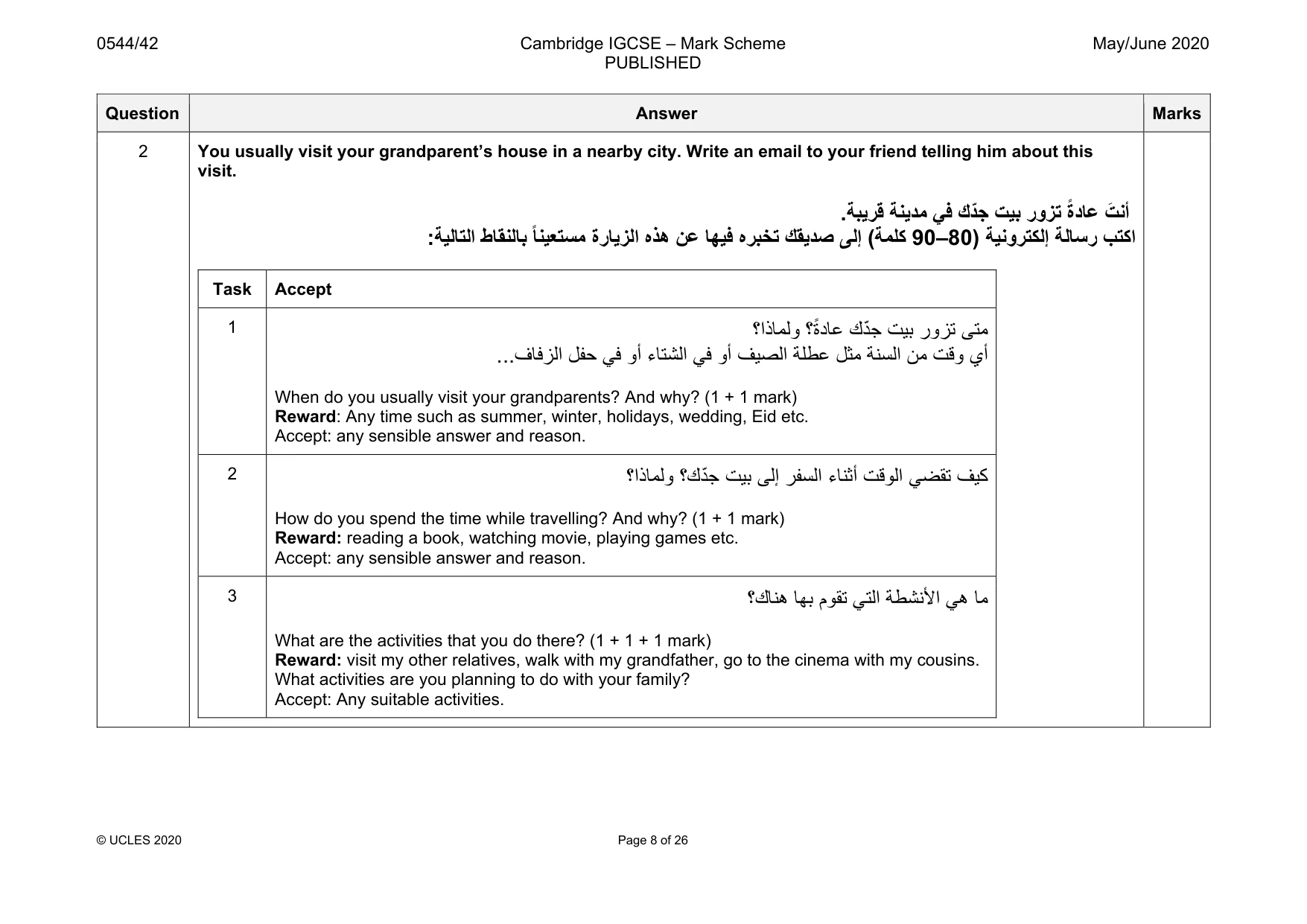
0544/42 Cambridge IGCSE – Mark Scheme PUBLISHED May/June 2020 © UCLES 2020 Page 8 of 26 Question Answer Marks 2 You usually visit your grandparent’s house in a nearby city. Write an email to your friend telling him about this visit. . أنتَ عادةً تزور بيت جدّك في مدينة قريبة اكتب رسالة إلكترونية )80 – 90 :كلمة( إلى صديقك تخبره فيھا عن ھذه الزيارة مستعيناً بالنقاط التالية Task Accept 1 متى تزور بيت جدّك عادةً؟ ولماذا؟ وقت أي من السنة مثل عطلة الصيف في أو الشتاء حفل في أو الزفاف... When do you usually visit your grandparents? And why? (1 + 1 mark) Reward: Any time such as summer, winter, holidays, wedding, Eid etc. Accept: any sensible answer and reason. 2 كيف تقضي الوقت أثناء السفر بيت إلى جدّك؟ ولماذا؟ How do you spend the time while travelling? And why? (1 + 1 mark) Reward: reading a book, watching movie, playing games etc. Accept: any sensible answer and reason. 3 ھي ما األنشطة التي تقوم بھا ھناك؟ What are the activities that you do there? (1 + 1 + 1 mark) Reward: visit my other relatives, walk with my grandfather, go to the cinema with my cousins. What activities are you planning to do with your family? Accept: Any suitable activities.
Mark scheme, page 9
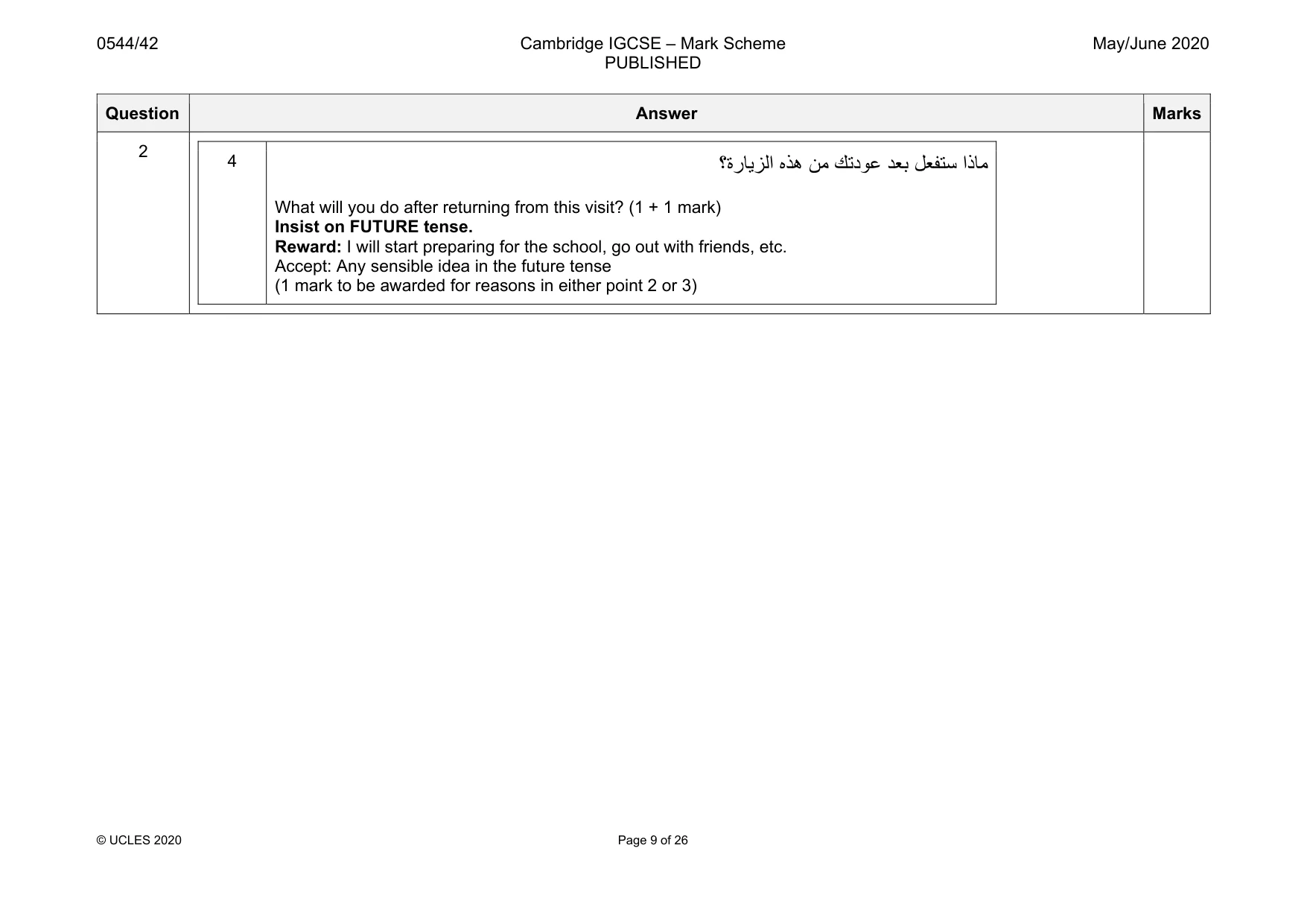
0544/42 Cambridge IGCSE – Mark Scheme PUBLISHED May/June 2020 © UCLES 2020 Page 9 of 26 Question Answer Marks 2 4 ماذا ستفعل بعد عودتك ھذه من الزيارة؟ What will you do after returning from this visit? (1 + 1 mark) Insist on FUTURE tense. Reward: I will start preparing for the school, go out with friends, etc. Accept: Any sensible idea in the future tense (1 mark to be awarded for reasons in either point 2 or 3)
Mark scheme, page 10
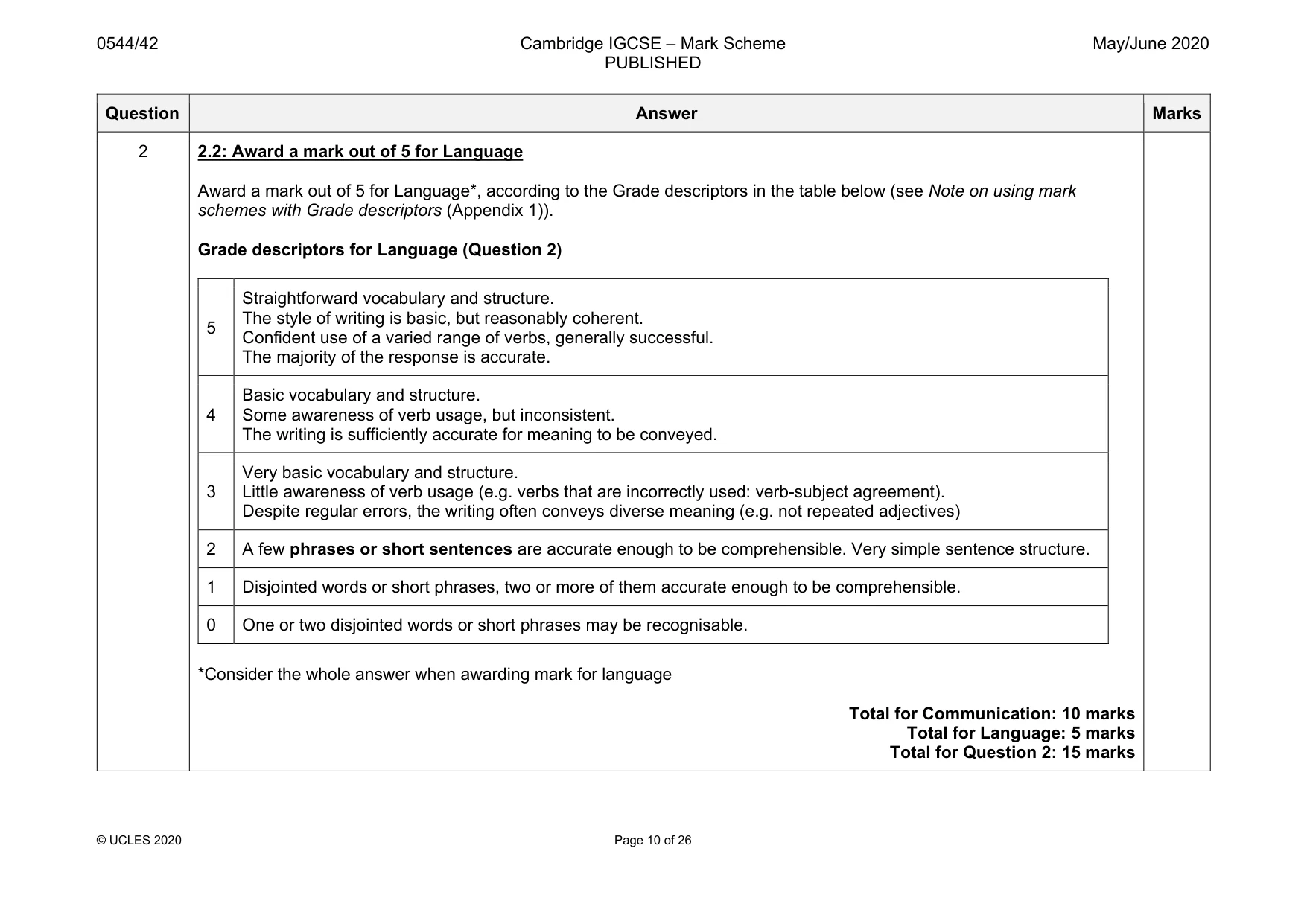
0544/42 Cambridge IGCSE – Mark Scheme PUBLISHED May/June 2020 © UCLES 2020 Page 10 of 26 Question Answer Marks 2 2.2: Award a mark out of 5 for Language Award a mark out of 5 for Language*, according to the Grade descriptors in the table below (see Note on using mark schemes with Grade descriptors (Appendix 1)). Grade descriptors for Language (Question 2) 5 Straightforward vocabulary and structure. The style of writing is basic, but reasonably coherent. Confident use of a varied range of verbs, generally successful. The majority of the response is accurate. 4 Basic vocabulary and structure. Some awareness of verb usage, but inconsistent. The writing is sufficiently accurate for meaning to be conveyed. 3 Very basic vocabulary and structure. Little awareness of verb usage (e.g. verbs that are incorrectly used: verb-subject agreement). Despite regular errors, the writing often conveys diverse meaning (e.g. not repeated adjectives) 2 A few phrases or short sentences are accurate enough to be comprehensible. Very simple sentence structure. 1 Disjointed words or short phrases, two or more of them accurate enough to be comprehensible. 0 One or two disjointed words or short phrases may be recognisable. *Consider the whole answer when awarding mark for language Total for Communication: 10 marks Total for Language: 5 marks Total for Question 2: 15 marks
Mark scheme, page 11
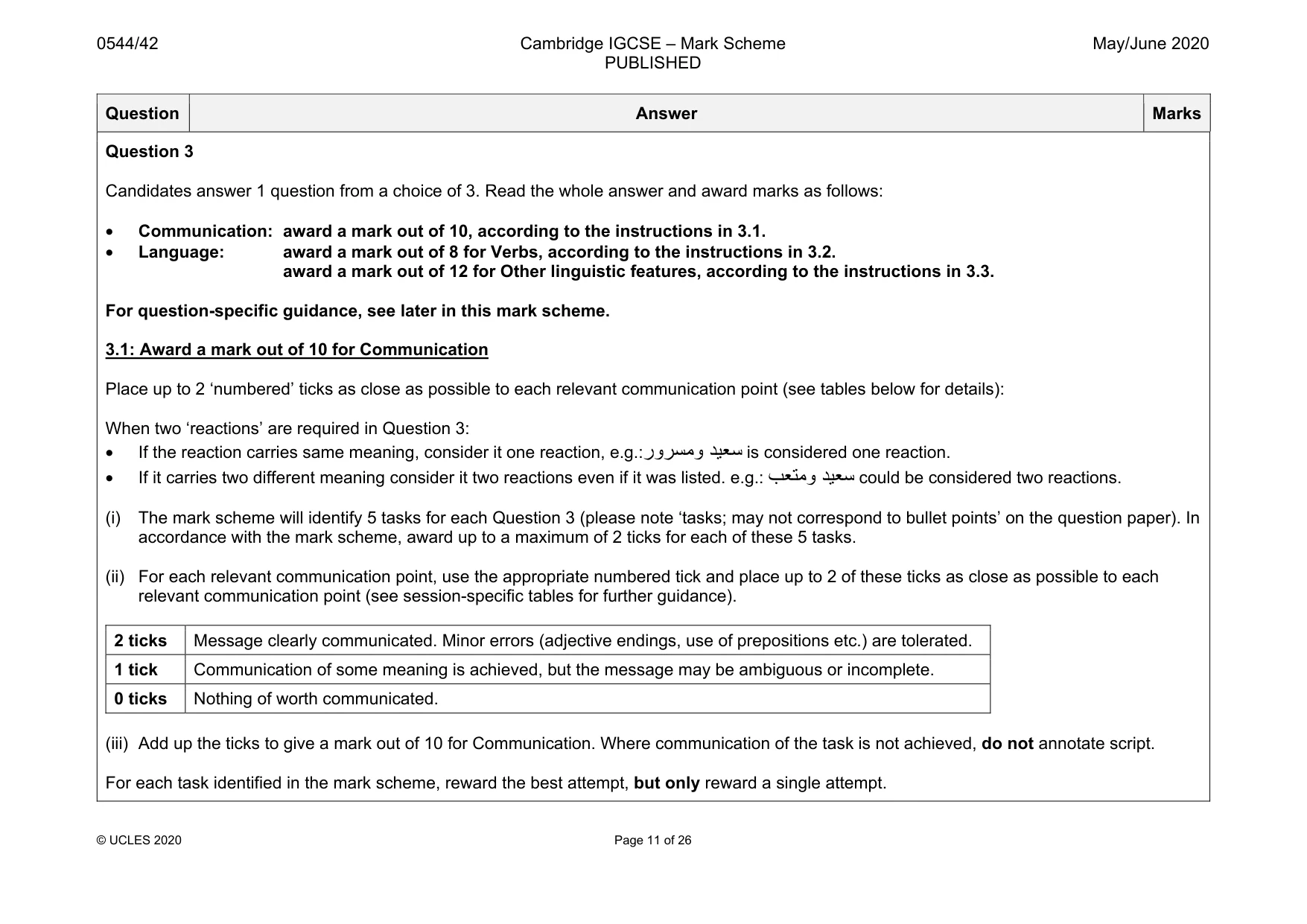
0544/42 Cambridge IGCSE – Mark Scheme PUBLISHED May/June 2020 © UCLES 2020 Page 11 of 26 Question Answer Marks Question 3 Candidates answer 1 question from a choice of 3. Read the whole answer and award marks as follows: • Communication: award a mark out of 10, according to the instructions in 3.1. • Language: award a mark out of 8 for Verbs, according to the instructions in 3.2. award a mark out of 12 for Other linguistic features, according to the instructions in 3.3. For question-specific guidance, see later in this mark scheme. 3.1: Award a mark out of 10 for Communication Place up to 2 ‘numbered’ ticks as close as possible to each relevant communication point (see tables below for details): When two ‘reactions’ are required in Question 3: • If the reaction carries same meaning, consider it one reaction, e.g.: سعيد ومسرورis considered one reaction. • If it carries two different meaning consider it two reactions even if it was listed. e.g.:سعيد ومتعب could be considered two reactions. (i) The mark scheme will identify 5 tasks for each Question 3 (please note ‘tasks; may not correspond to bullet points’ on the question paper). In accordance with the mark scheme, award up to a maximum of 2 ticks for each of these 5 tasks. (ii) For each relevant communication point, use the appropriate numbered tick and place up to 2 of these ticks as close as possible to each relevant communication point (see session-specific tables for further guidance). 2 ticks Message clearly communicated. Minor errors (adjective endings, use of prepositions etc.) are tolerated. 1 tick Communication of some meaning is achieved, but the message may be ambiguous or incomplete. 0 ticks Nothing of worth communicated. (iii) Add up the ticks to give a mark out of 10 for Communication. Where communication of the task is not achieved, do not annotate script. For each task identified in the mark scheme, reward the best attempt, but only reward a single attempt.
Mark scheme, page 12
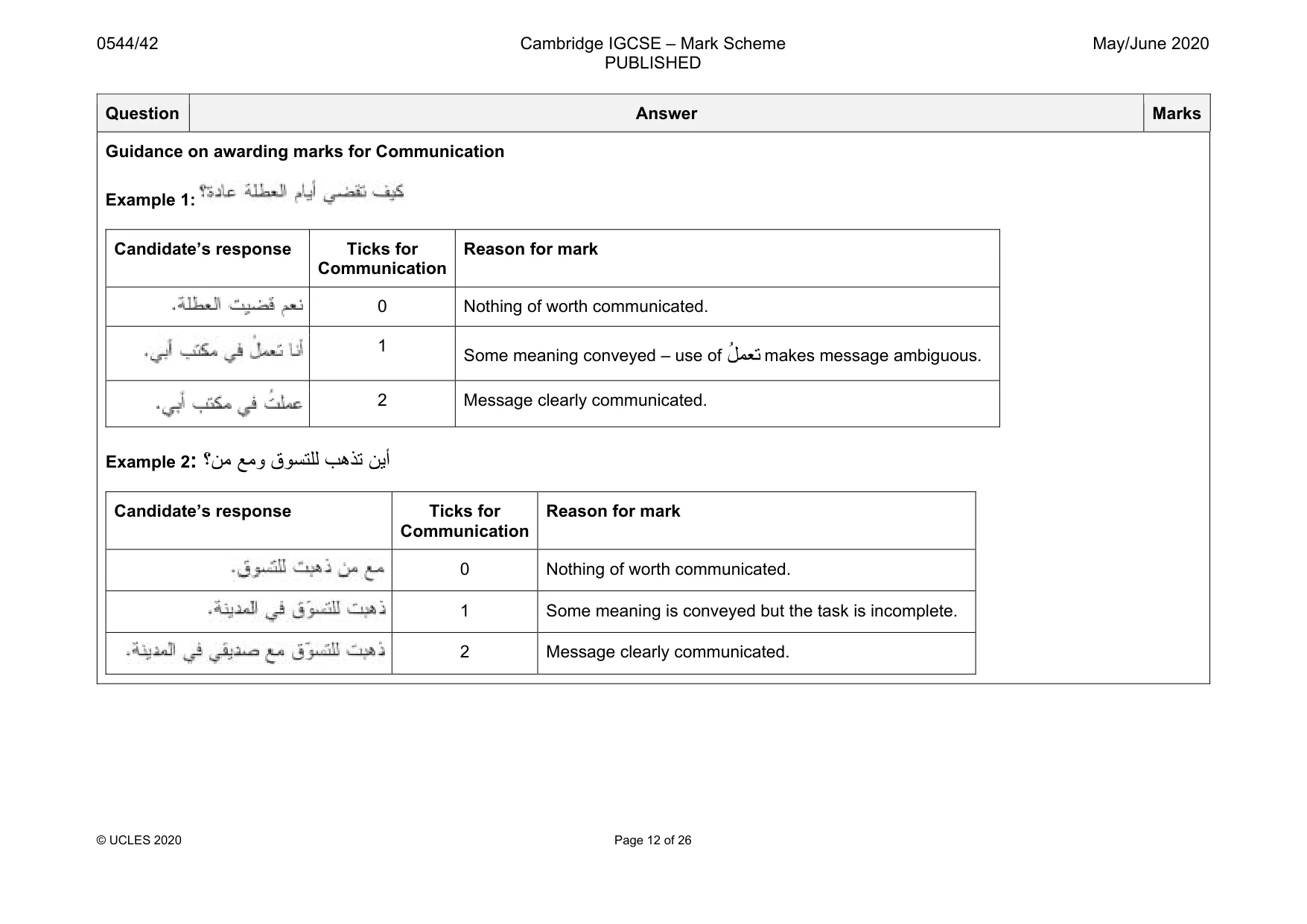
0544/42 Cambridge IGCSE – Mark Scheme PUBLISHED May/June 2020 © UCLES 2020 Page 12 of 26 Question Answer Marks Guidance on awarding marks for Communication Example 1: Candidate’s response Ticks for Communication Reason for mark 0 Nothing of worth communicated. 1 Some meaning conveyed – use of ُ ﺗﻌﻣﻝmakes message ambiguous. 2 Message clearly communicated. أين تذھب للتسوق ومع من؟Example 2: Candidate’s response Ticks for Communication Reason for mark 0 Nothing of worth communicated. 1 Some meaning is conveyed but the task is incomplete. 2 Message clearly communicated.
Mark scheme, page 13
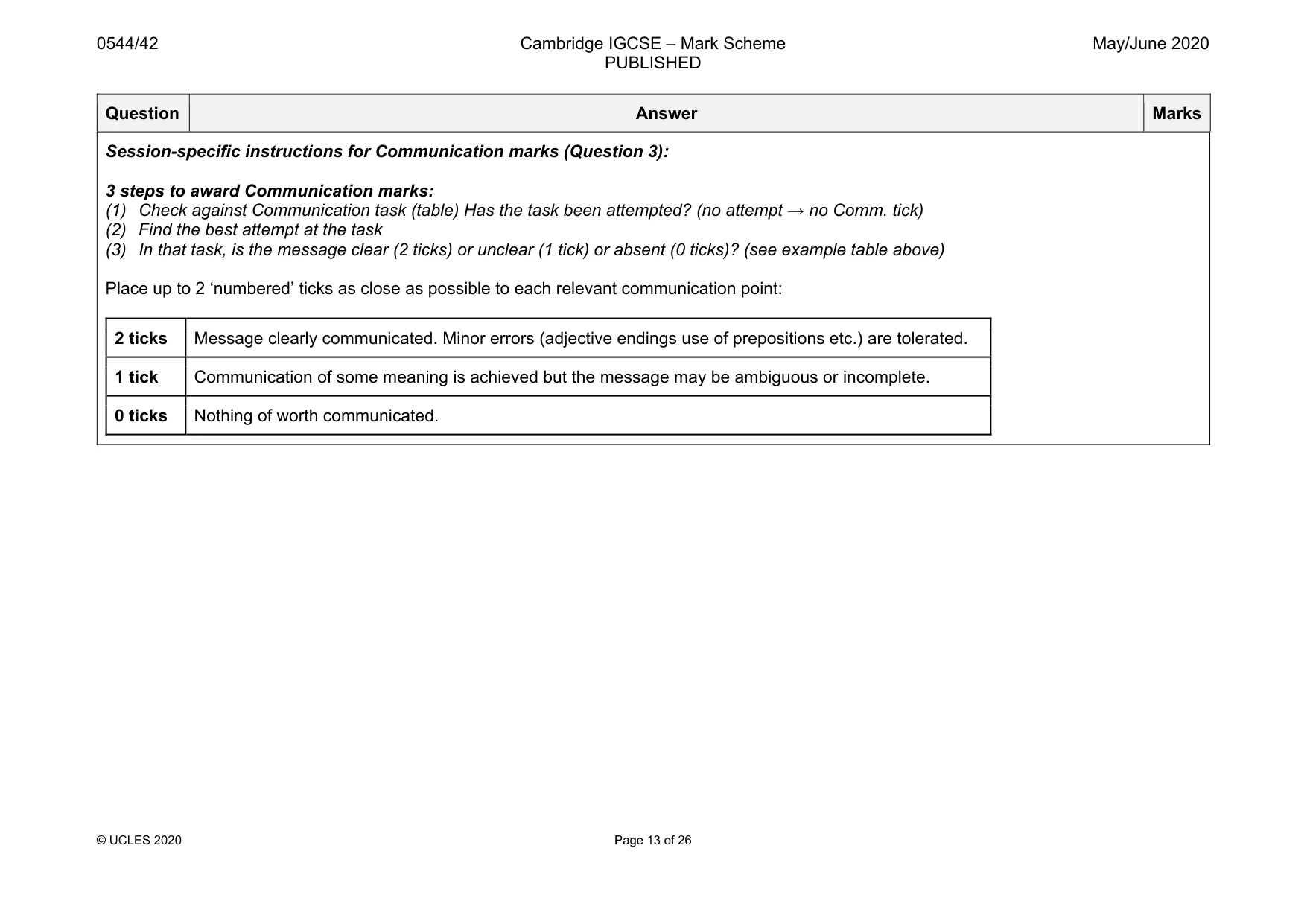
0544/42 Cambridge IGCSE – Mark Scheme PUBLISHED May/June 2020 © UCLES 2020 Page 13 of 26 Question Answer Marks Session-specific instructions for Communication marks (Question 3): 3 steps to award Communication marks: (1) Check against Communication task (table) Has the task been attempted? (no attempt → no Comm. tick) (2) Find the best attempt at the task (3) In that task, is the message clear (2 ticks) or unclear (1 tick) or absent (0 ticks)? (see example table above) Place up to 2 ‘numbered’ ticks as close as possible to each relevant communication point: 2 ticks Message clearly communicated. Minor errors (adjective endings use of prepositions etc.) are tolerated. 1 tick Communication of some meaning is achieved but the message may be ambiguous or incomplete. 0 ticks Nothing of worth communicated.
Mark scheme, page 14
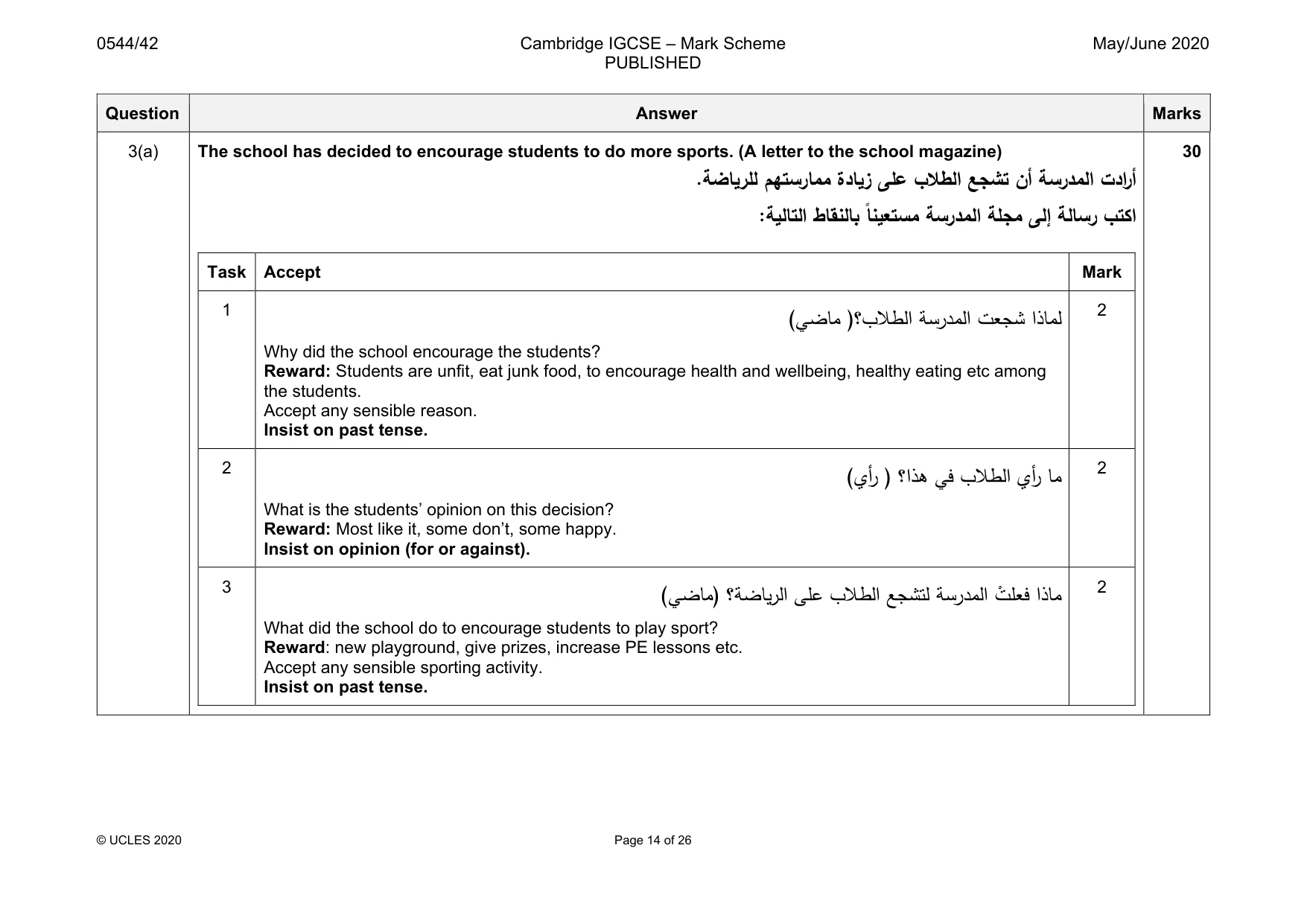
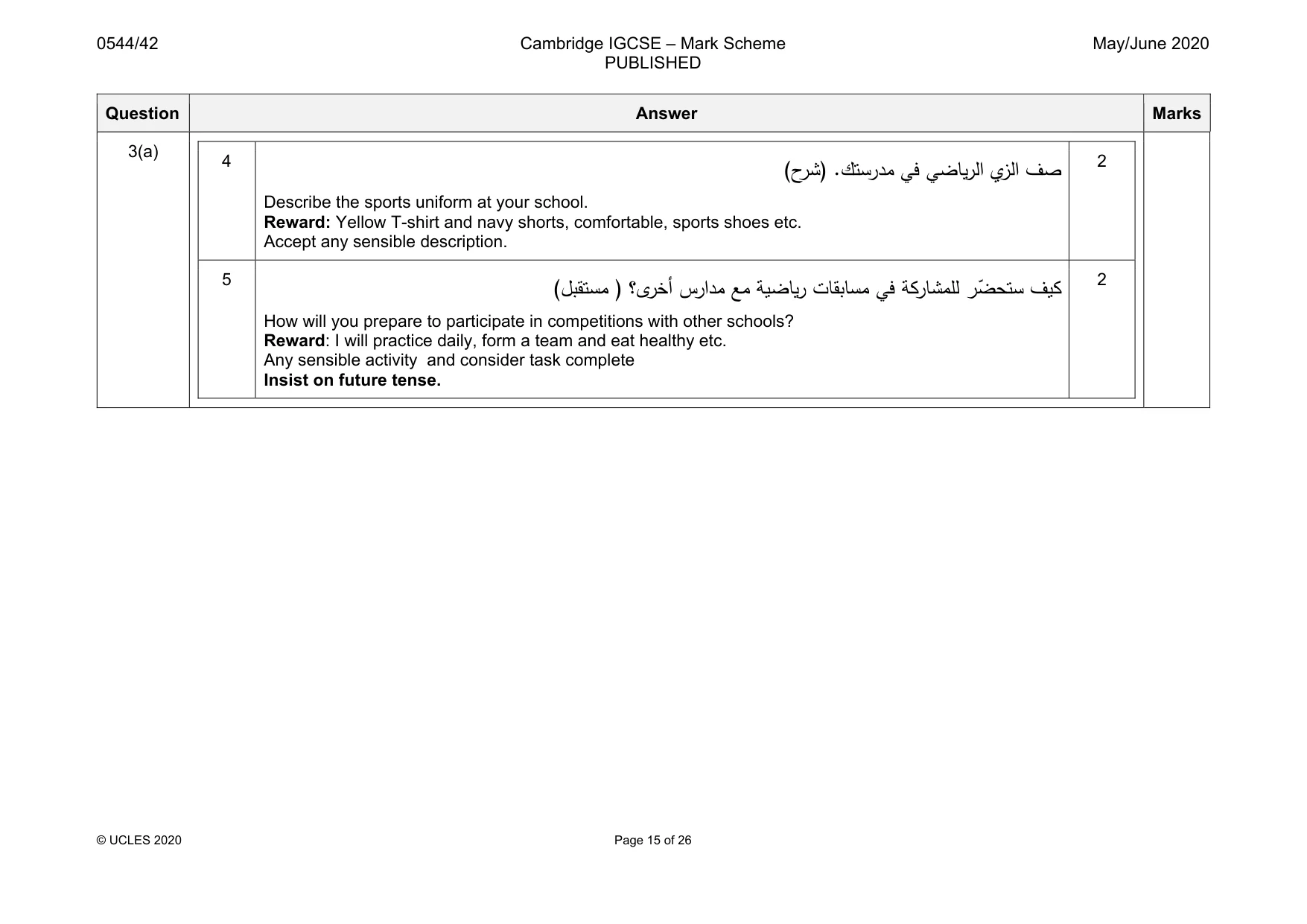
0544/42 Cambridge IGCSE – Mark Scheme PUBLISHED May/June 2020 © UCLES 2020 Page 14 of 26 Question Answer Marks 3(a) The school has decided to encourage students to do more sports. (A letter to the school magazine) أرادت اﻟﻣدرﺳﺔ أن ﺗﺷﺟﻊ اﻟطﻼب ﻋﻠﻰ زﻳﺎدة ﻣﻣﺎرﺳﺗﻬم ﻟ ﻠرﻳﺎﺿﺔ. اﻛﺗب رﺳﺎﻟﺔ ﻟﻰ إ ﻣﺟﻠﺔ اﻟﻣدرﺳﺔ ﻣﺳﺗﻌﻳﻧﺎً ﺑﺎﻟﻧﻘﺎط اﻟﺗﺎﻟﻳﺔ: Task Accept Mark 1 ﻟﻣﺎذا ﺷﺟﻌت اﻟﻣدرﺳﺔ اﻟطﻼب؟) ﻣﺎﺿﻲ( Why did the school encourage the students? Reward: Students are unfit, eat junk food, to encourage health and wellbeing, healthy eating etc among the students. Accept any sensible reason. Insist on past tense. 2 2 رأي ﻣﺎ اﻟطﻼب ) ؟ﻫذا ﻓﻲ رأي( What is the students’ opinion on this decision? Reward: Most like it, some don’t, some happy. Insist on opinion (for or against). 2 3 ﻣﺎذا ﻓﻌﻠتْ اﻟﻣدرﺳﺔ ﻟﺗﺷﺟﻊ اﻟطﻼب ﻋﻠﻰ اﻟرﻳﺎﺿﺔ ؟ )ﻣﺎﺿﻲ( What did the school do to encourage students to play sport? Reward: new playground, give prizes, increase PE lessons etc. Accept any sensible sporting activity. Insist on past tense. 2 30
Mark scheme, page 15
0544/42 Cambridge IGCSE – Mark Scheme PUBLISHED May/June 2020 © UCLES 2020 Page 15 of 26 Question Answer Marks 3(a) 4 اﻟزي ﺻف اﻟرﻳﺎﺿﻲ ﻓﻲ ﻣدرﺳﺗك. )ﺷرح( Describe the sports uniform at your school. Reward: Yellow T-shirt and navy shorts, comfortable, sports shoes etc. Accept any sensible description. 2 5 ﻛﻳف ﺳﺗﺣﺿّر ﻟﻠﻣﺷﺎرﻛﺔ ﻓﻲ ﻣﺳﺎﺑﻘﺎت رﻳﺎﺿﻳﺔ ﻣﻊ ﻣدارس أﺧرى؟ ) ﻣﺳﺗﻘﺑﻝ( How will you prepare to participate in competitions with other schools? Reward: I will practice daily, form a team and eat healthy etc. Any sensible activity and consider task complete Insist on future tense. 2
Mark scheme, page 16
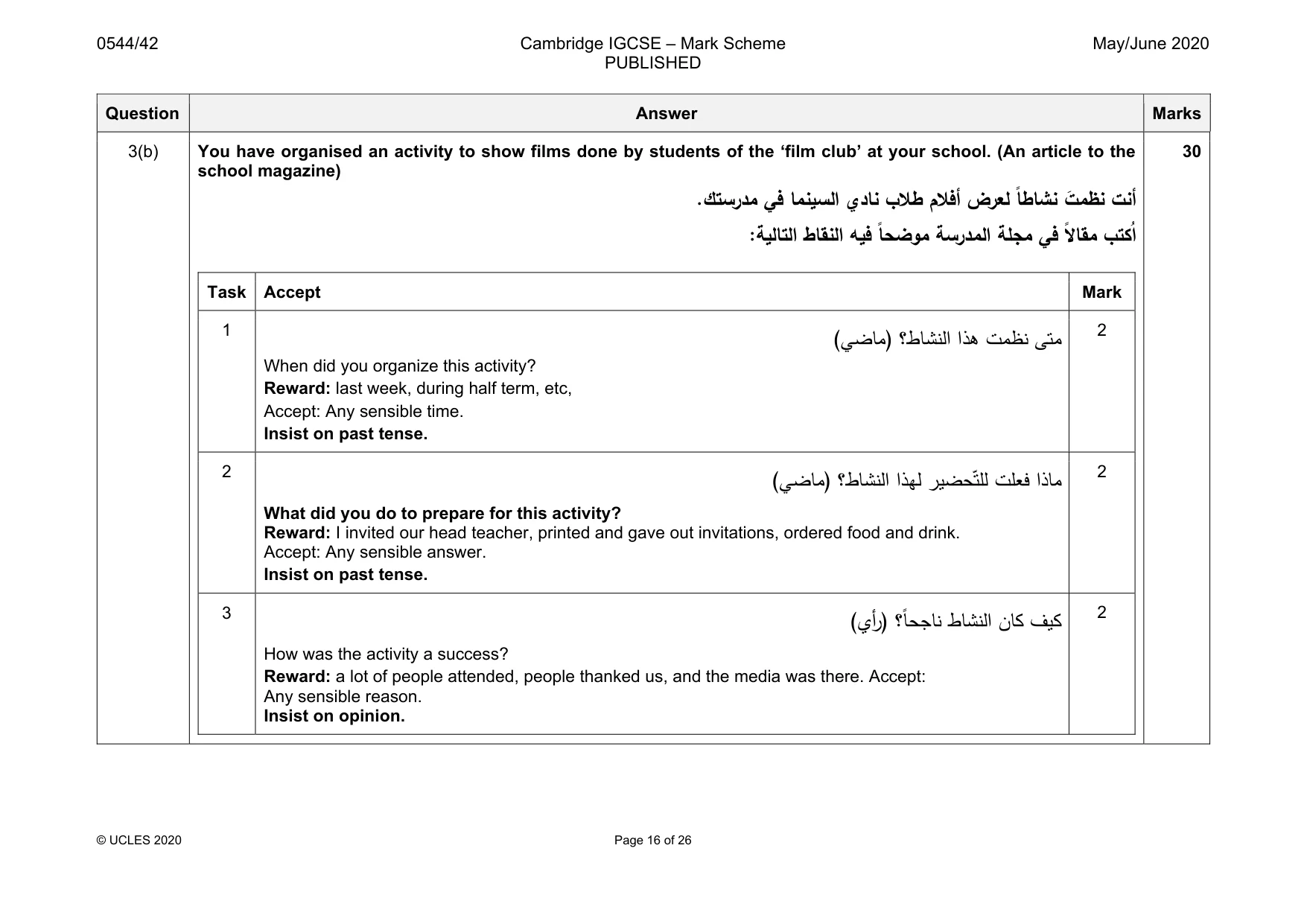
0544/42 Cambridge IGCSE – Mark Scheme PUBLISHED May/June 2020 © UCLES 2020 Page 16 of 26 Question Answer Marks 3(b) You have organised an activity to show films done by students of the ‘film club’ at your school. (An article to the school magazine) أﻧت ﻧظﻣتَ ﻧﺷﺎطﺎً ﻟﻌرض أﻓﻼم طﻼب ﻧﺎدي اﻟﺳﻳﻧﻣﺎ ﻓﻲ ﻣدرﺳﺗك. ﻛﺗب اُ ﻣﻘﺎﻻً ﻓﻲ ﻣﺟﻠﺔ اﻟﻣدرﺳﺔ ﻣوﺿﺣﺎً ﻓﻳﻪ اﻟﻧﻘﺎط اﻟﺗﺎﻟﻳﺔ: Task Accept Mark 1 ﻣﺗﻰ ﻧظﻣت ﻫذا اﻟ ﻧﺷﺎط ؟ ) ﻣﺎﺿﻲ ( When did you organize this activity? Reward: last week, during half term, etc, Accept: Any sensible time. Insist on past tense. 2 2 ﻣﺎذا ﻓﻌﻠت ﻟﻠﺗّﺣﺿﻳر ﻟﻬذا اﻟﻧﺷﺎط؟ ) ﻣﺎﺿﻲ ( What did you do to prepare for this activity? Reward: I invited our head teacher, printed and gave out invitations, ordered food and drink. Accept: Any sensible answer. Insist on past tense. 2 3 ﻛﻳف ﻛﺎن اﻟﻧﺷﺎط ﻧﺎﺟﺣﺎً؟ ( رأي ) How was the activity a success? Reward: a lot of people attended, people thanked us, and the media was there. Accept: Any sensible reason. Insist on opinion. 2 30
Mark scheme, page 17
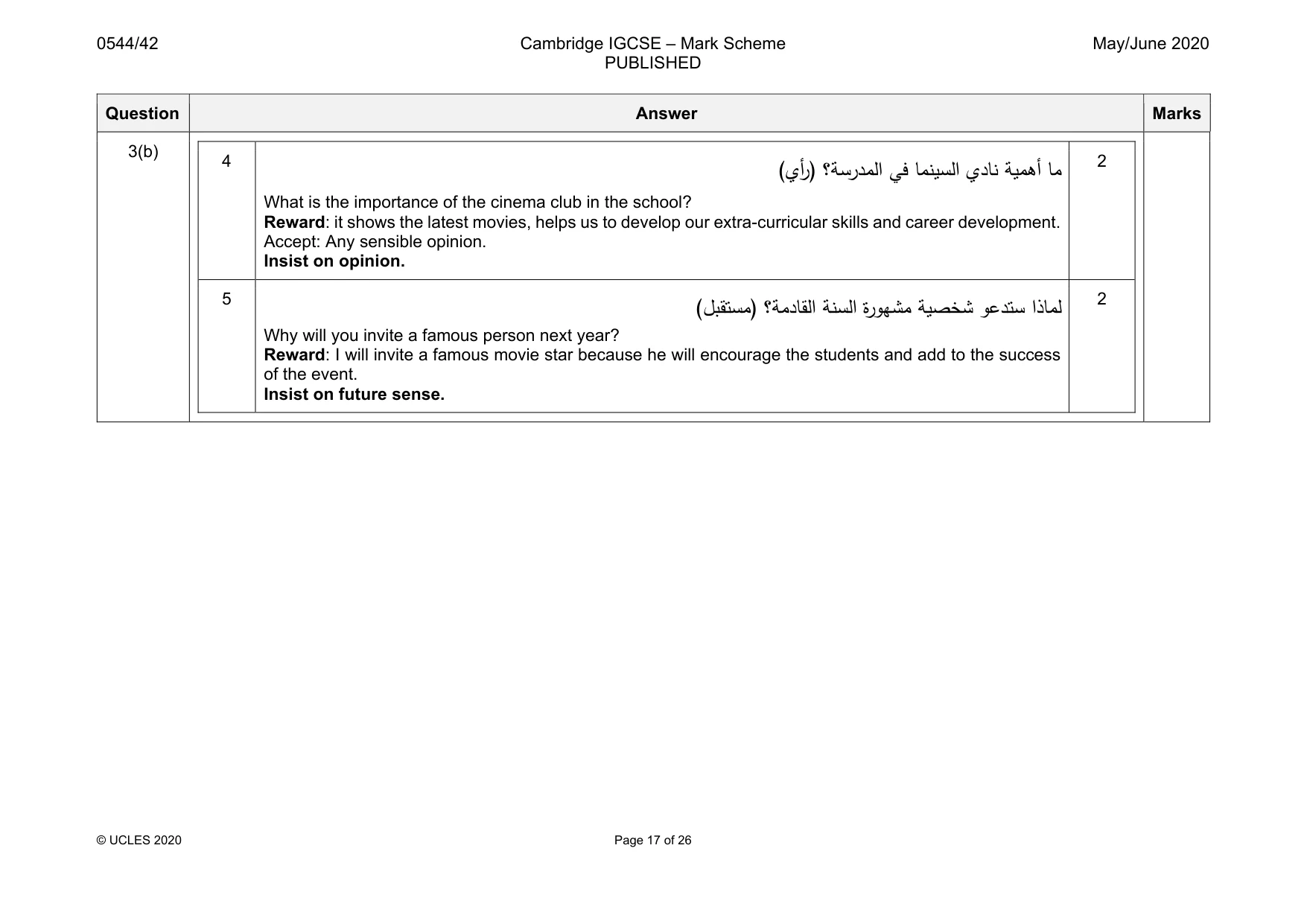
0544/42 Cambridge IGCSE – Mark Scheme PUBLISHED May/June 2020 © UCLES 2020 Page 17 of 26 Question Answer Marks 3(b) 4 ﻣﺎ أﻫﻣﻳﺔ ﻧﺎدي اﻟﺳﻳﻧﻣﺎ ﻓﻲ اﻟﻣدرﺳﺔ؟ ( رأي ) What is the importance of the cinema club in the school? Reward: it shows the latest movies, helps us to develop our extra-curricular skills and career development. Accept: Any sensible opinion. Insist on opinion. 2 5 ﻟﻣﺎذا ﺳﺗدﻋو ﺷﺧﺻﻳﺔ ﻣﺷﻬورة اﻟﺳﻧﺔ اﻟﻘﺎدﻣﺔ؟ ) ﻣﺳﺗﻘﺑﻝ ( Why will you invite a famous person next year? Reward: I will invite a famous movie star because he will encourage the students and add to the success of the event. Insist on future sense. 2
Mark scheme, page 18
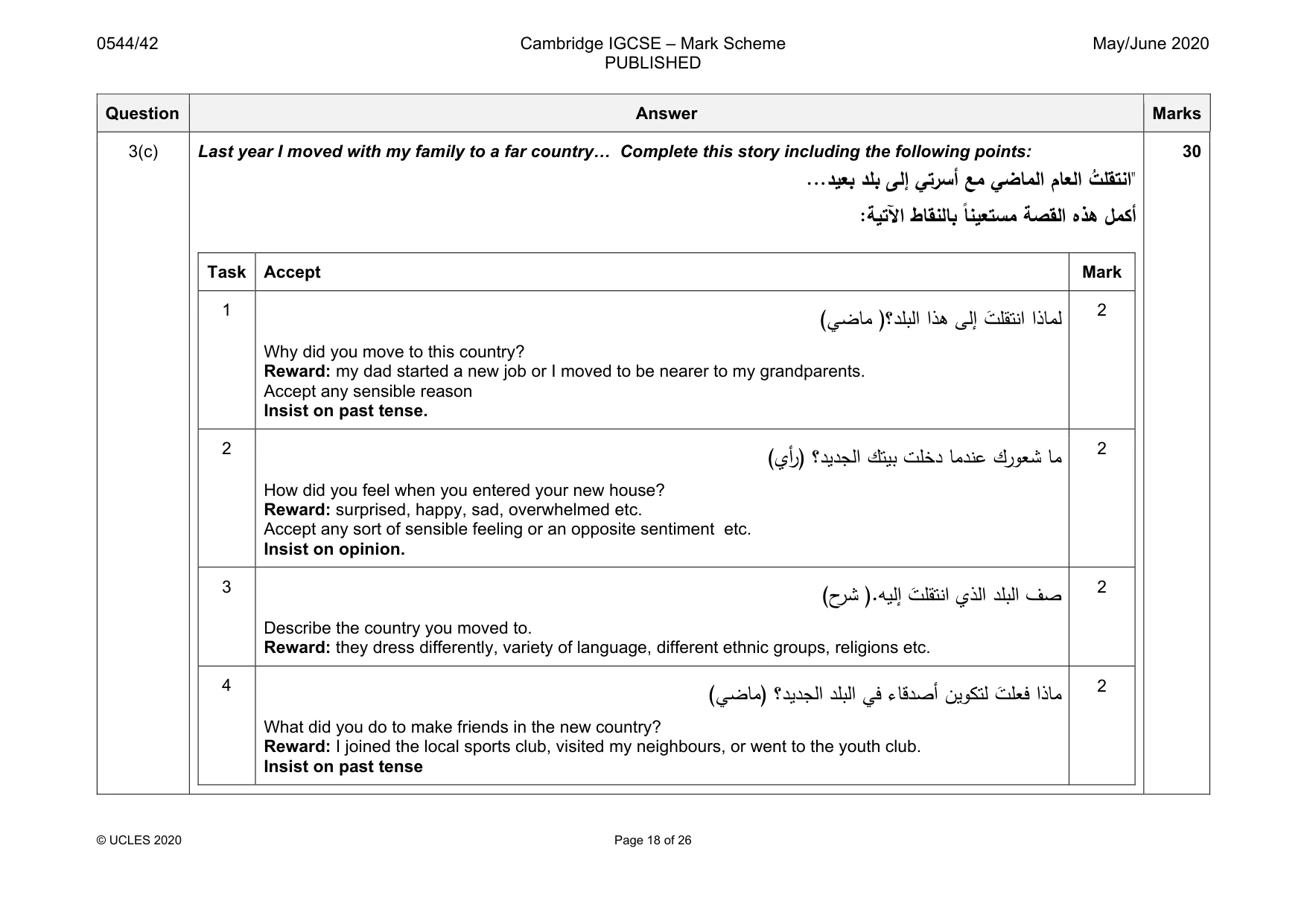
0544/42 Cambridge IGCSE – Mark Scheme PUBLISHED May/June 2020 © UCLES 2020 Page 18 of 26 Question Answer Marks 3(c) Last year I moved with my family to a far country… Complete this story including the following points: " ُاﻧﺗﻘﻠت اﻟﻌﺎم اﻟﻣﺎﺿﻲ أ ﻣﻊ ﺳرﺗﻲ ﺑﻠد ﻟﻰ إ ﺑﻌﻳد .. . أﻛﻣﻝ ﻫذﻩ اﻟﻘﺻﺔ ﻣﺳﺗﻌﻳﻧﺎً ﺑﺎﻟﻧﻘﺎط اﻵﺗﻳﺔ: Task Accept Mark 1 ﻟﻣﺎذا اﻧﺗﻘﻠتَ )؟ﺑﻠد اﻟ ﻫذا ﻟﻰ إ ﻣﺎﺿﻲ( Why did you move to this country? Reward: my dad started a new job or I moved to be nearer to my grandparents. Accept any sensible reason Insist on past tense. 2 2 ﻣﺎ ﺷﻌورك ﻋﻧدﻣﺎ دﺧﻠت ﺑﻳﺗك اﻟﺟدﻳد؟ )رأي( How did you feel when you entered your new house? Reward: surprised, happy, sad, overwhelmed etc. Accept any sort of sensible feeling or an opposite sentiment etc. Insist on opinion. 2 3 ﺻف اﻟﺑﻠد ذي اﻟ اﻧﺗﻘﻠتَ ).ﻟﻳﻪ إ ﺷرح( Describe the country you moved to. Reward: they dress differently, variety of language, different ethnic groups, religions etc. 2 4 ﻣﺎذا ﻓﻌﻠتَ ﻟﺗﻛوﻳن أﺻدﻗﺎء ﻓﻲ اﻟﺑﻠد اﻟﺟدﻳد؟ )ﻣﺎﺿﻲ( What did you do to make friends in the new country? Reward: I joined the local sports club, visited my neighbours, or went to the youth club. Insist on past tense 2 30
Mark scheme, page 19
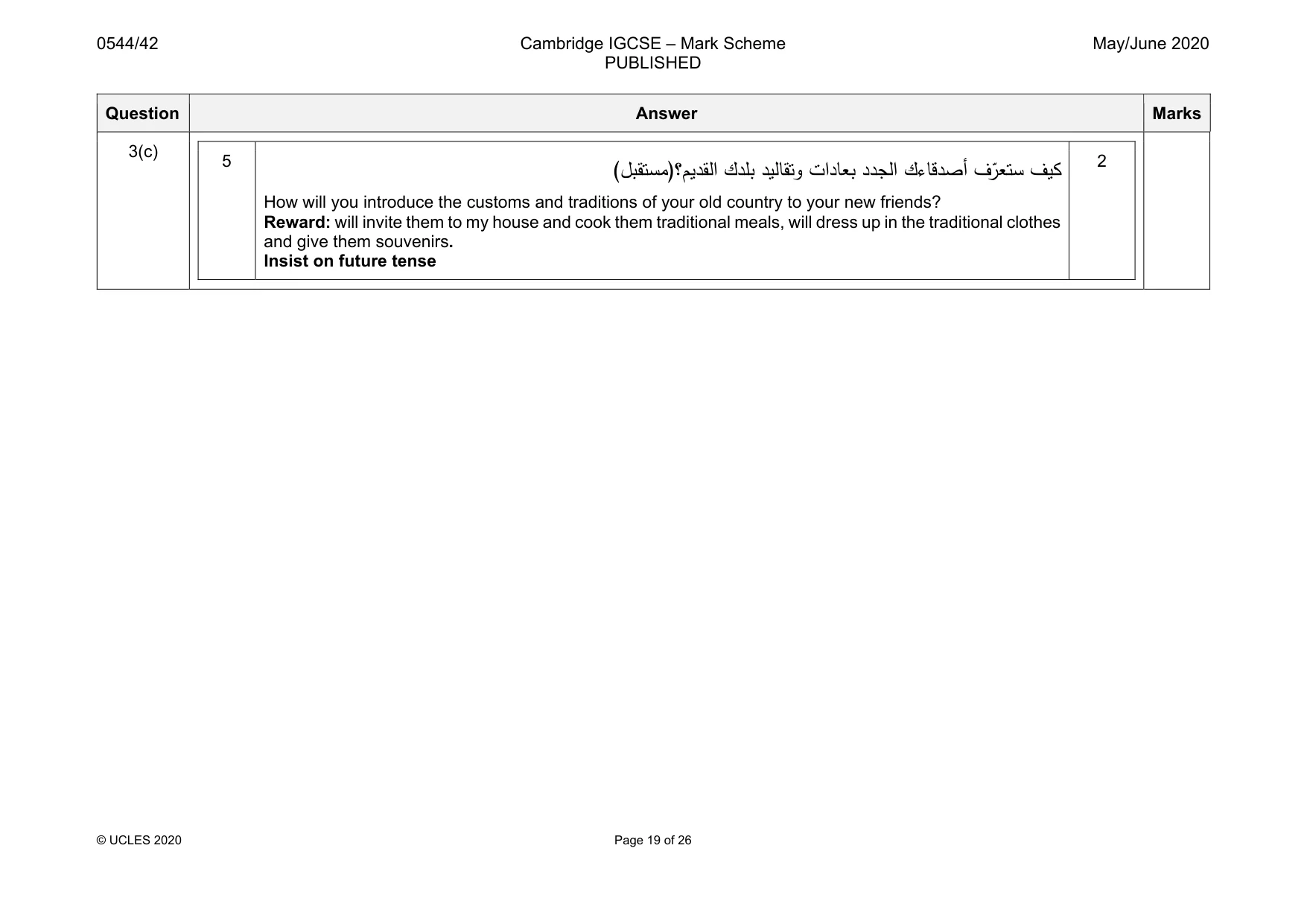
0544/42 Cambridge IGCSE – Mark Scheme PUBLISHED May/June 2020 © UCLES 2020 Page 19 of 26 Question Answer Marks 3(c) 5 ﻛﻳف ﺳﺗﻌرّف أﺻدﻗﺎءك اﻟﺟدد ﺑﻌﺎدات وﺗﻘﺎﻟﻳد ﺑﻠدك اﻟﻘدﻳم ؟ )ﻣﺳﺗﻘﺑﻝ( How will you introduce the customs and traditions of your old country to your new friends? Reward: will invite them to my house and cook them traditional meals, will dress up in the traditional clothes and give them souvenirs. Insist on future tense 2
Mark scheme, page 20
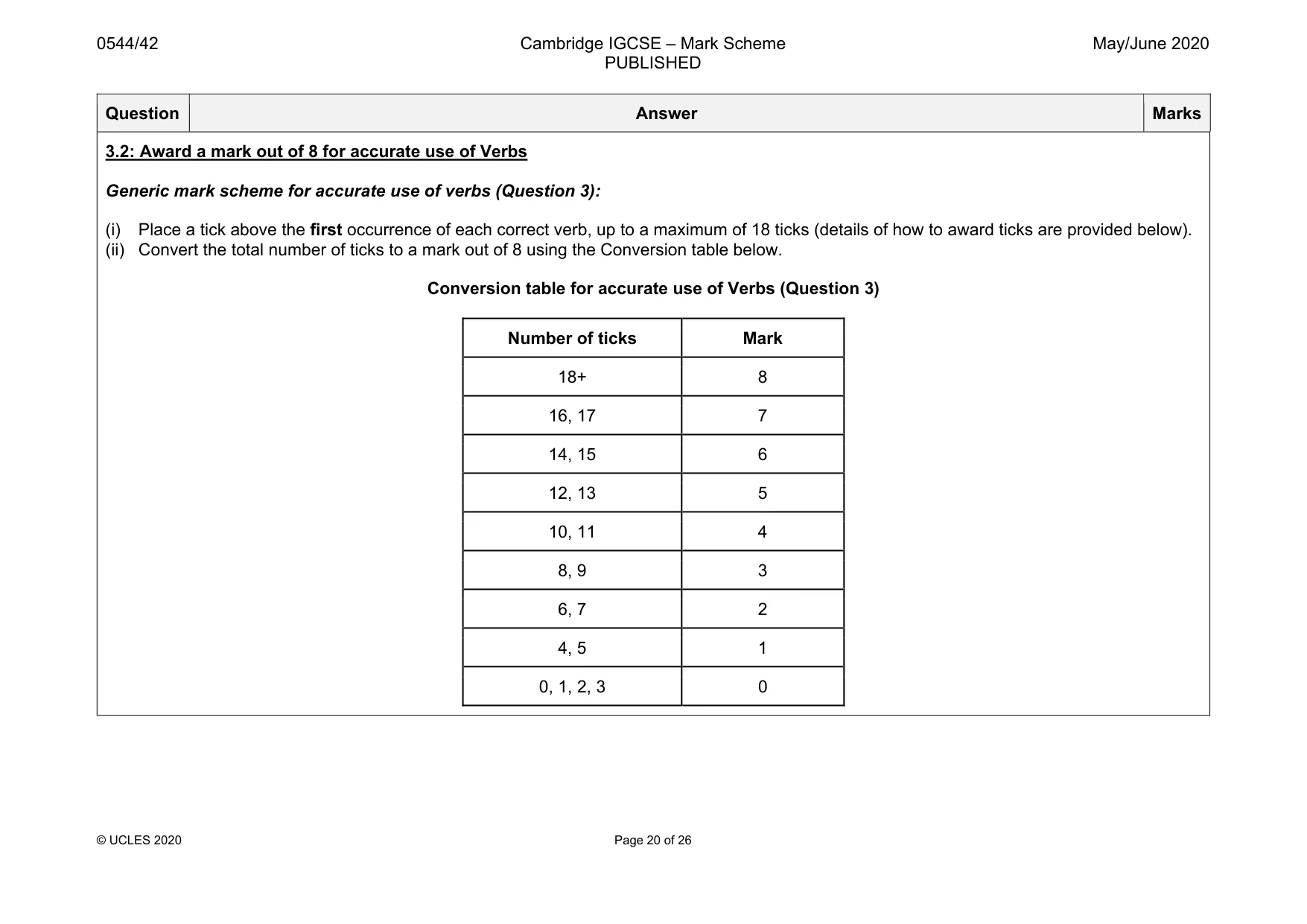
0544/42 Cambridge IGCSE – Mark Scheme PUBLISHED May/June 2020 © UCLES 2020 Page 20 of 26 Question Answer Marks 3.2: Award a mark out of 8 for accurate use of Verbs Generic mark scheme for accurate use of verbs (Question 3): (i) Place a tick above the first occurrence of each correct verb, up to a maximum of 18 ticks (details of how to award ticks are provided below). (ii) Convert the total number of ticks to a mark out of 8 using the Conversion table below. Conversion table for accurate use of Verbs (Question 3) Number of ticks Mark 18+ 8 16, 17 7 14, 15 6 12, 13 5 10, 11 4 8, 9 3 6, 7 2 4, 5 1 0, 1, 2, 3 0
Mark scheme, page 21
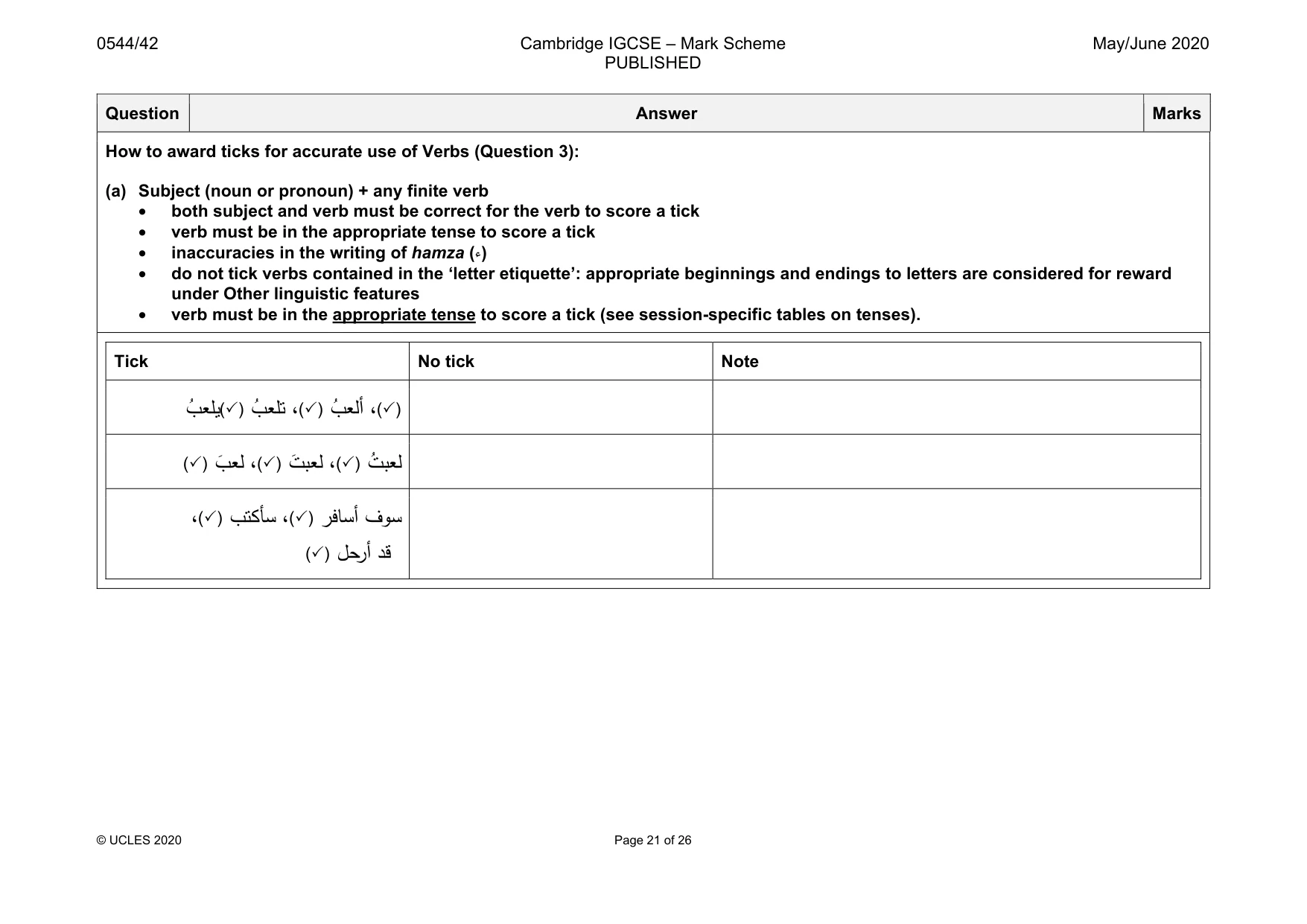
0544/42 Cambridge IGCSE – Mark Scheme PUBLISHED May/June 2020 © UCLES 2020 Page 21 of 26 Question Answer Marks How to award ticks for accurate use of Verbs (Question 3): (a) Subject (noun or pronoun) + any finite verb • both subject and verb must be correct for the verb to score a tick • verb must be in the appropriate tense to score a tick • inaccuracies in the writing of hamza ( )ء •do not tick verbs contained in the ‘letter etiquette’: appropriate beginnings and endings to letters are considered for reward under Other linguistic features • verb must be in the appropriate tense to score a tick (see session-specific tables on tenses). Tick No tick Note () ، ُأﻟﻌب () ، ُﺗﻠﻌب () ُﻳﻠﻌب ُﻟﻌﺑت () ، َﻟﻌﺑت () ، َﻟﻌب () ﺳوف أﺳﺎﻓر () ، ﺳﺄﻛﺗب () ، ﻗد أرﺣﻝ ()
Mark scheme, page 22
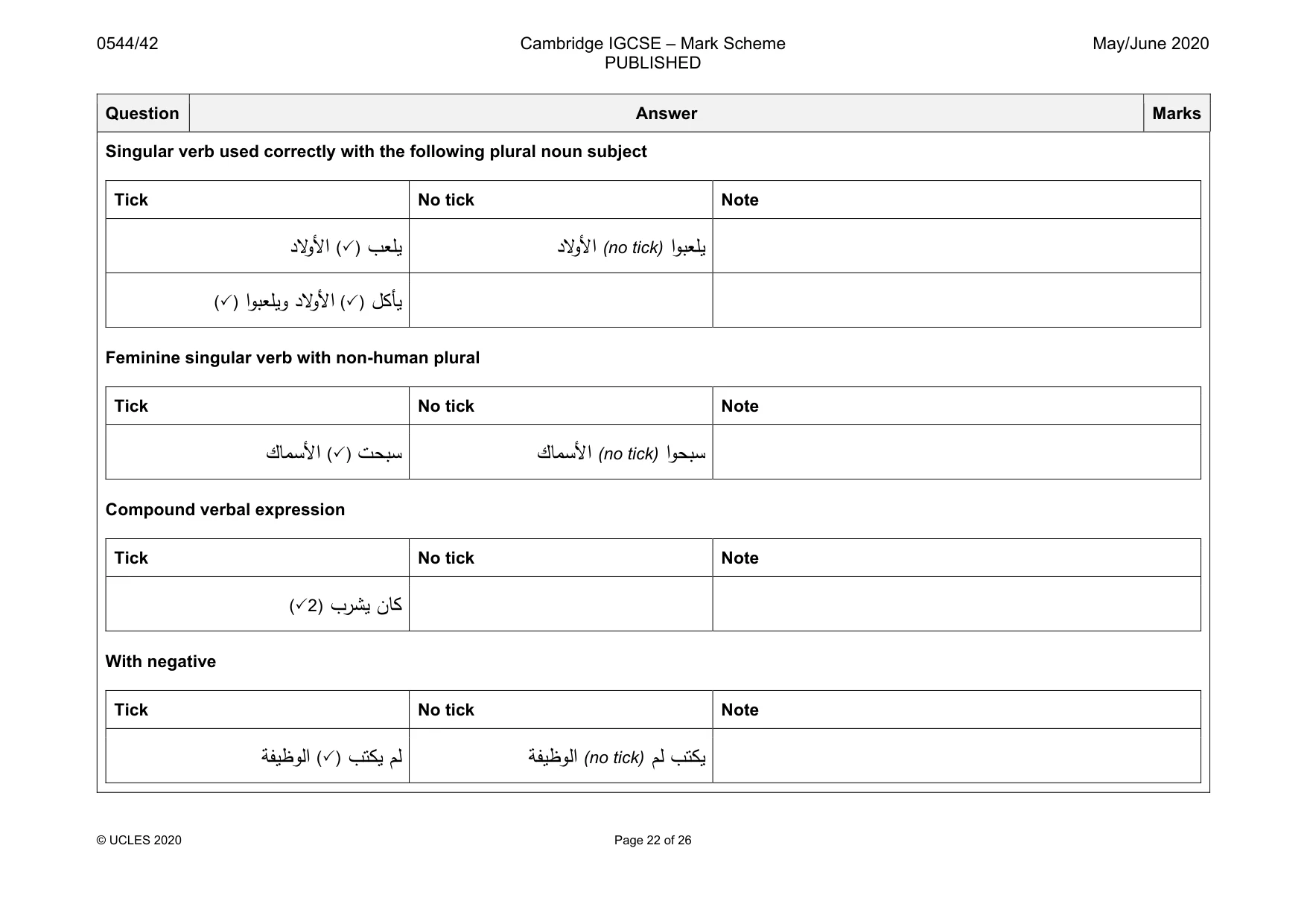
0544/42 Cambridge IGCSE – Mark Scheme PUBLISHED May/June 2020 © UCLES 2020 Page 22 of 26 Question Answer Marks Singular verb used correctly with the following plural noun subject Tick No tick Note ﻳﻠﻌب () اﻷوﻻد ﻳﻠﻌﺑوا (no tick) اﻷوﻻد ﻳﺄﻛﻝ ( )اﻷوﻻد وﻳﻠﻌﺑوا ( ) Feminine singular verb with non-human plural Tick No tick Note ﺳﺑﺣت () اﻷﺳﻣﺎك ﺳﺑﺣوا (no tick) اﻷﺳﻣﺎك Compound verbal expression Tick No tick Note ﻛﺎن ﻳﺷر ب ( 2) With negative Tick No tick Note ﻟم ﻳﻛﺗب () اﻟوظﻳﻔﺔ ﻳﻛﺗب ﻟم (no tick) اﻟوظﻳﻔﺔ
Mark scheme, page 23
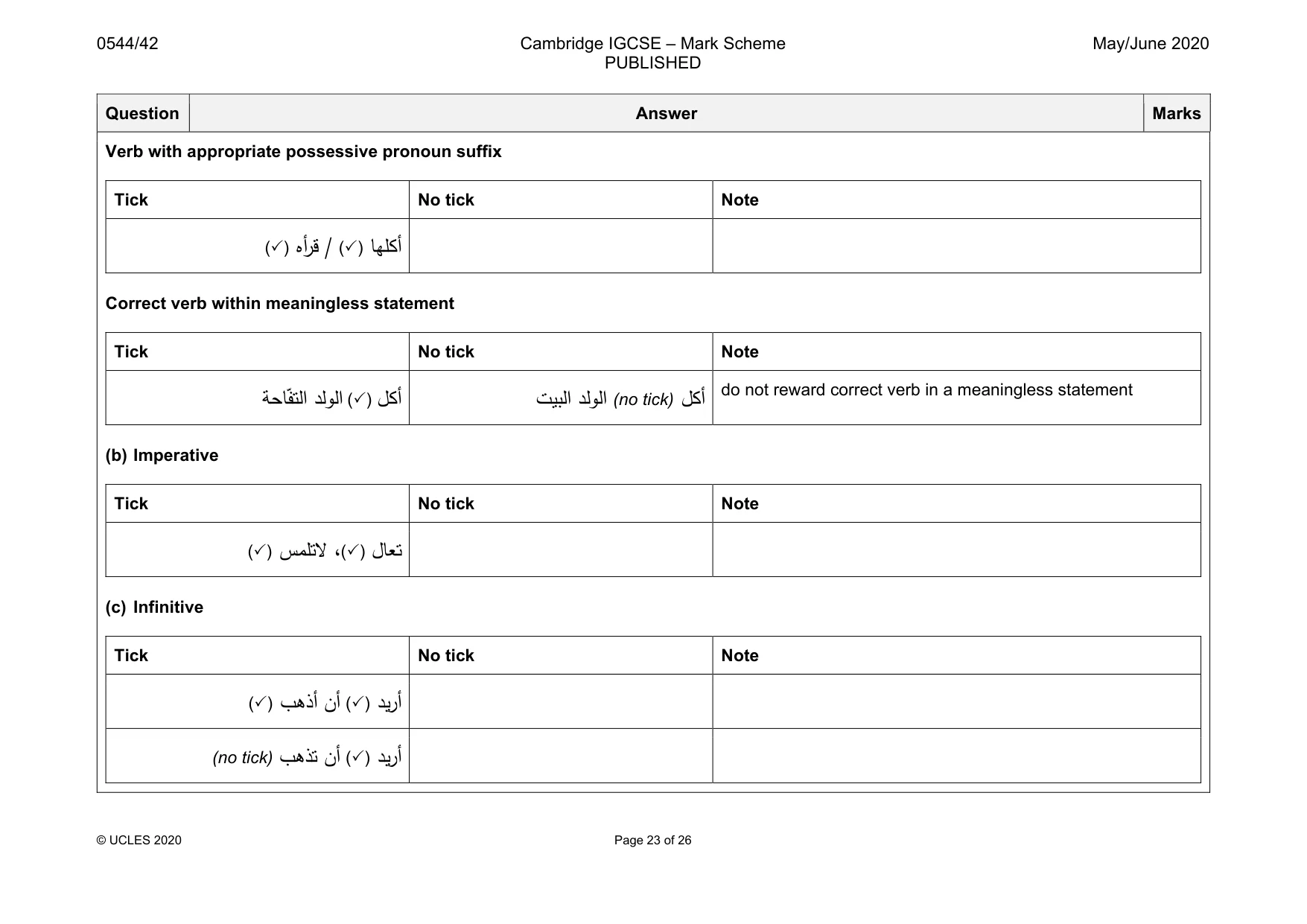
0544/42 Cambridge IGCSE – Mark Scheme PUBLISHED May/June 2020 © UCLES 2020 Page 23 of 26 Question Answer Marks Verb with appropriate possessive pronoun suffix Tick No tick Note أﻛﻠﻬﺎ () / ﻗرأﻩ () Correct verb within meaningless statement Tick No tick Note أﻛﻝ ( )اﻟوﻟد اﻟﺗﻔّﺎﺣﺔ أﻛﻝ (no tick) اﻟوﻟد اﻟﺑﻳت do not reward correct verb in a meaningless statement (b) Imperative Tick No tick Note ﺗﻌﺎﻝ () ، ﻻﺗﻠﻣس () (c) Infinitive Tick No tick Note أرﻳد ()أن أذﻫب () أرﻳد ( )أن ﺗذﻫب (no tick)
Mark scheme, page 24
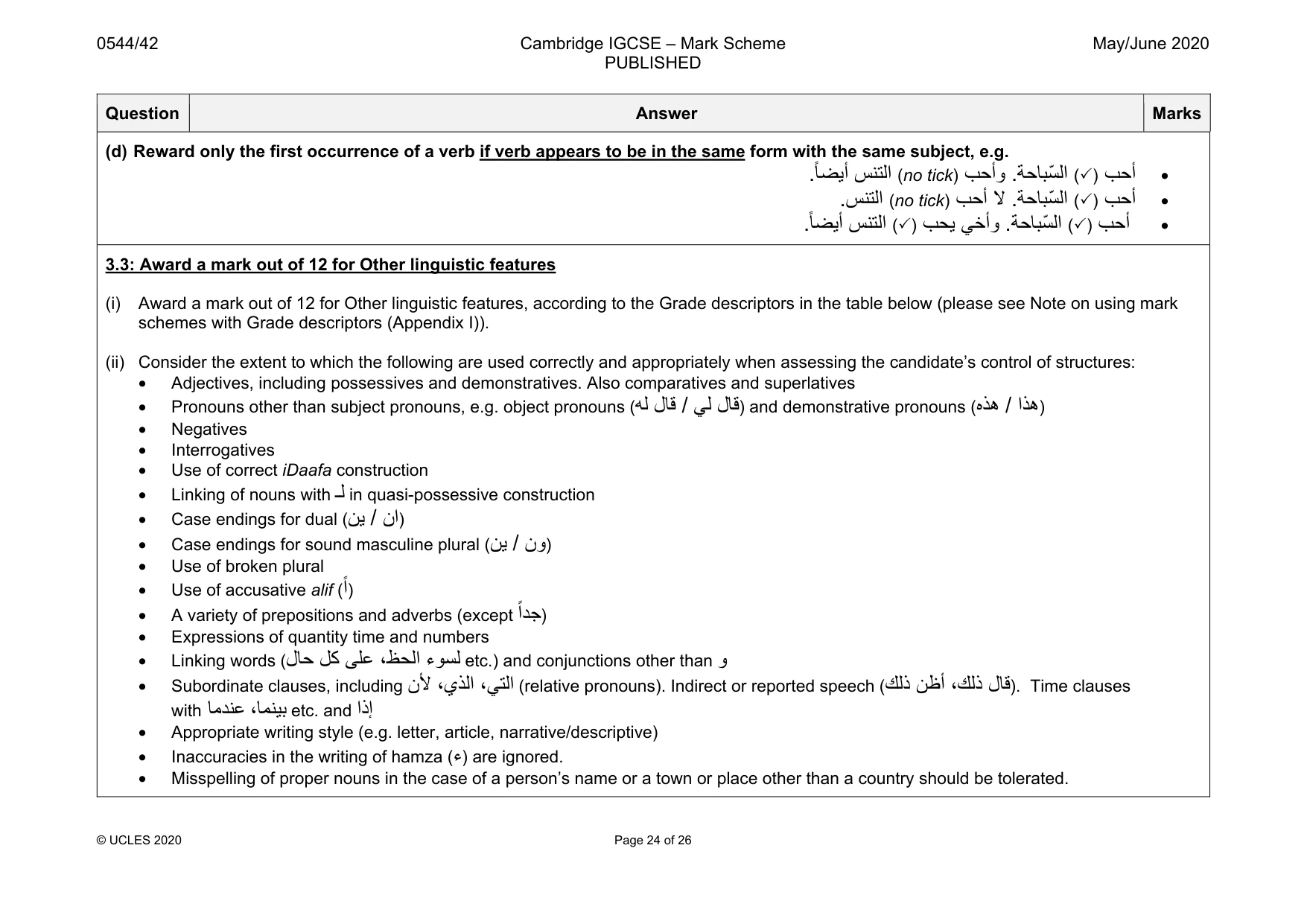
0544/42 Cambridge IGCSE – Mark Scheme PUBLISHED May/June 2020 © UCLES 2020 Page 24 of 26 Question Answer Marks (d) Reward only the first occurrence of a verb if verb appears to be in the same form with the same subject, e.g. • أحب () السّباحة. وأحب (no tick) .ًالتنس أيضا • أحب () .السّباحة ال أحب (no tick) التنس . • أحب () السّباحة. وأخي يحب () .ًالتنس أيضا 3.3: Award a mark out of 12 for Other linguistic features (i) Award a mark out of 12 for Other linguistic features, according to the Grade descriptors in the table below (please see Note on using mark schemes with Grade descriptors (Appendix I)). (ii) Consider the extent to which the following are used correctly and appropriately when assessing the candidate’s control of structures: • Adjectives, including possessives and demonstratives. Also comparatives and superlatives • Pronouns other than subject pronouns, e.g. object pronouns (قال لي / قال له )and demonstrative pronouns ( )ھذا / ھذه •Negatives • Interrogatives • Use of correct iDaafa construction • Linking of nouns with لـin quasi-possessive construction • Case endings for dual ( )ان / ين •Case endings for sound masculine plural ( )ون / ين •Use of broken plural • Use of accusative alif ( ً )ا •A variety of prepositions and adverbs (except ً )جدا •Expressions of quantity time and numbers • Linking words ( لسوء الحظ، على كل حالetc.) and conjunctions other than و •Subordinate clauses, including ( التي، الذي، ألنrelative pronouns). Indirect or reported speech ( .)قال ذلك، أظن ذلكTime clauses with ،بينما عندما etc. and إذا •Appropriate writing style (e.g. letter, article, narrative/descriptive) • Inaccuracies in the writing of hamza ( )ءare ignored. • Misspelling of proper nouns in the case of a person’s name or a town or place other than a country should be tolerated.
Mark scheme, page 25
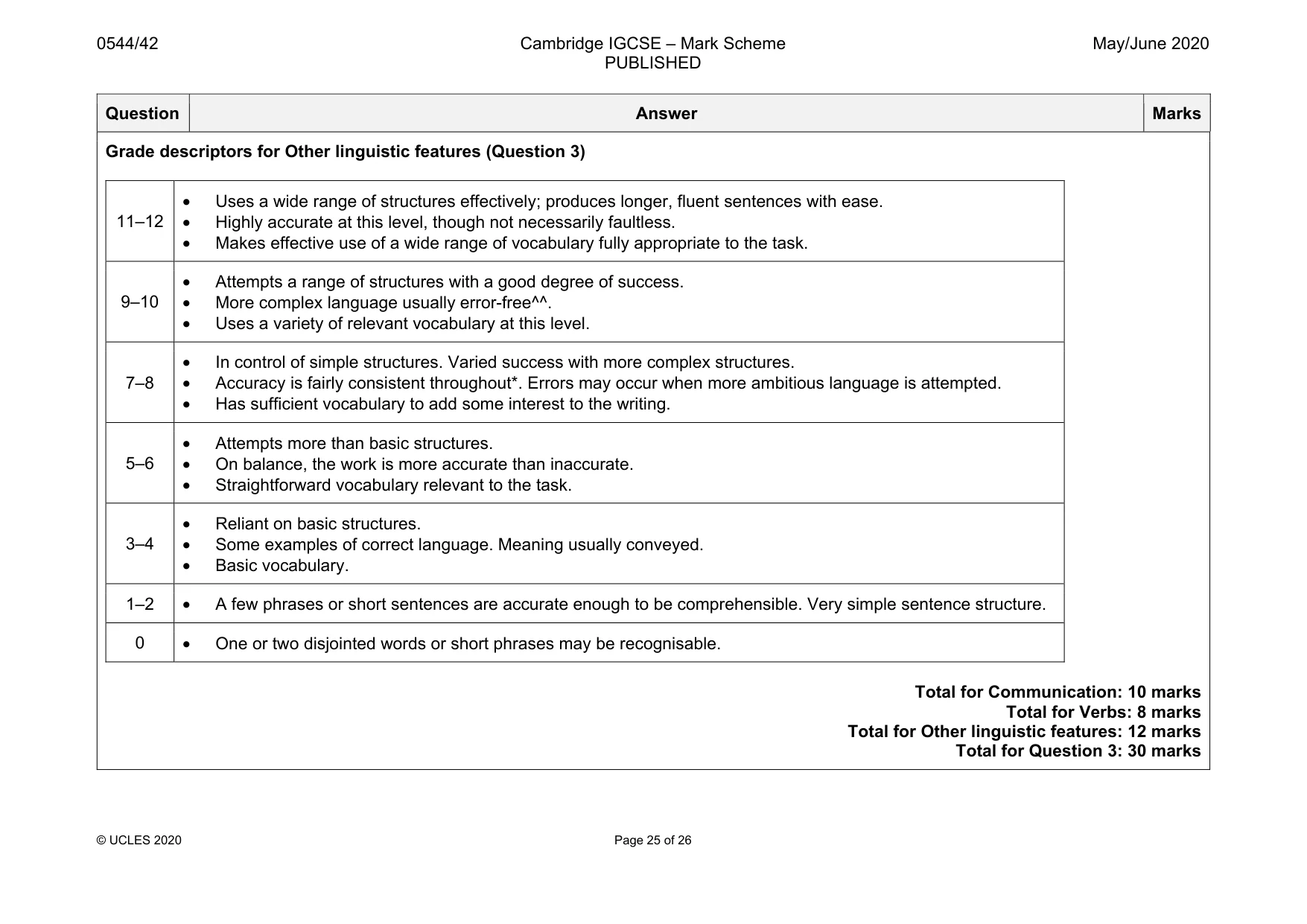
0544/42 Cambridge IGCSE – Mark Scheme PUBLISHED May/June 2020 © UCLES 2020 Page 25 of 26 Question Answer Marks Grade descriptors for Other linguistic features (Question 3) 11–12 • Uses a wide range of structures effectively; produces longer, fluent sentences with ease. • Highly accurate at this level, though not necessarily faultless. • Makes effective use of a wide range of vocabulary fully appropriate to the task. 9–10 • Attempts a range of structures with a good degree of success. • More complex language usually error-free^^. • Uses a variety of relevant vocabulary at this level. 7–8 • In control of simple structures. Varied success with more complex structures. • Accuracy is fairly consistent throughout*. Errors may occur when more ambitious language is attempted. • Has sufficient vocabulary to add some interest to the writing. 5–6 • Attempts more than basic structures. • On balance, the work is more accurate than inaccurate. • Straightforward vocabulary relevant to the task. 3–4 • Reliant on basic structures. • Some examples of correct language. Meaning usually conveyed. • Basic vocabulary. 1–2 • A few phrases or short sentences are accurate enough to be comprehensible. Very simple sentence structure. 0 • One or two disjointed words or short phrases may be recognisable. Total for Communication: 10 marks Total for Verbs: 8 marks Total for Other linguistic features: 12 marks Total for Question 3: 30 marks
Mark scheme, page 26
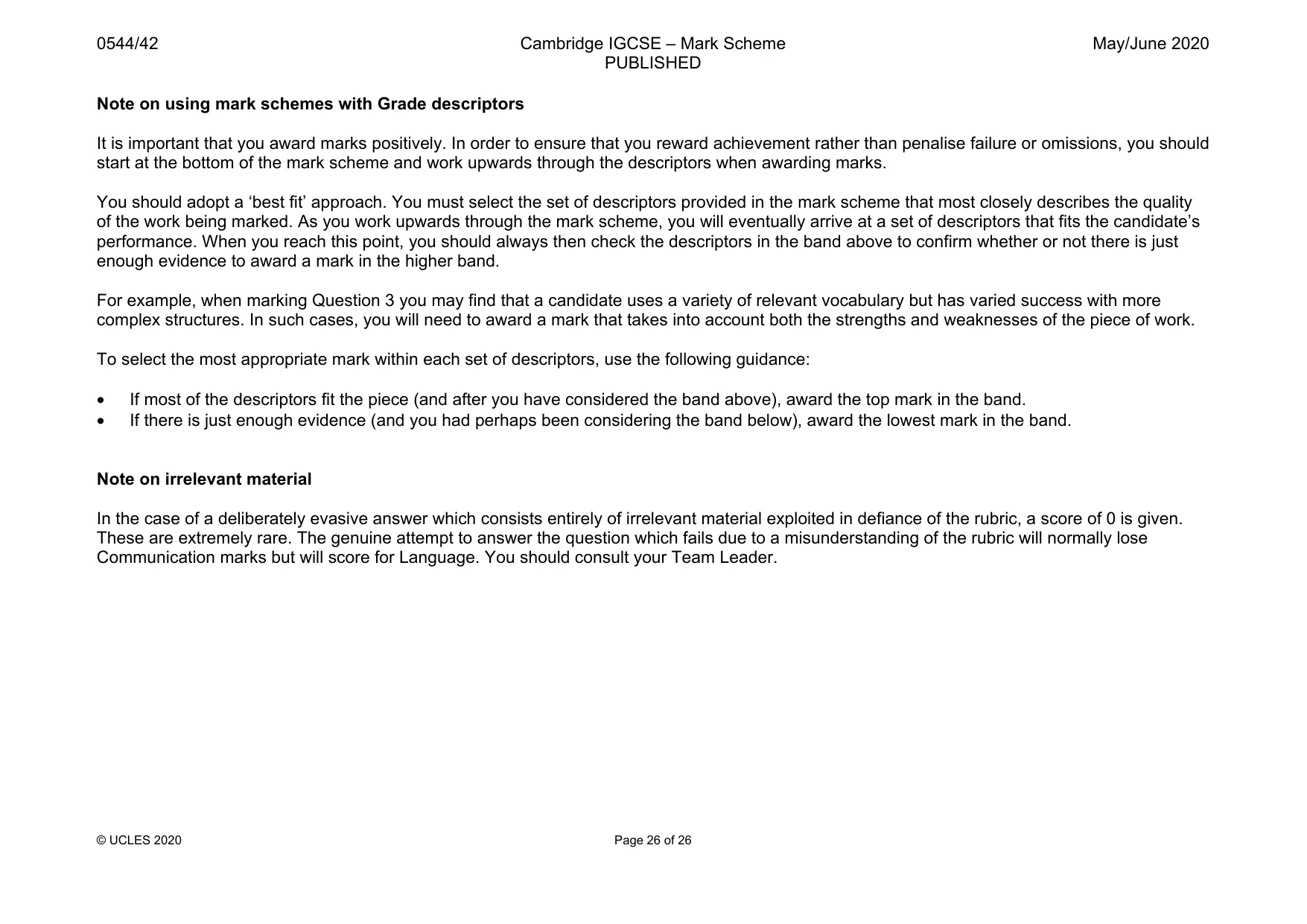
0544/42 Cambridge IGCSE – Mark Scheme PUBLISHED May/June 2020 © UCLES 2020 Page 26 of 26 Note on using mark schemes with Grade descriptors It is important that you award marks positively. In order to ensure that you reward achievement rather than penalise failure or omissions, you should start at the bottom of the mark scheme and work upwards through the descriptors when awarding marks. You should adopt a ‘best fit’ approach. You must select the set of descriptors provided in the mark scheme that most closely describes the quality of the work being marked. As you work upwards through the mark scheme, you will eventually arrive at a set of descriptors that fits the candidate’s performance. When you reach this point, you should always then check the descriptors in the band above to confirm whether or not there is just enough evidence to award a mark in the higher band. For example, when marking Question 3 you may find that a candidate uses a variety of relevant vocabulary but has varied success with more complex structures. In such cases, you will need to award a mark that takes into account both the strengths and weaknesses of the piece of work. To select the most appropriate mark within each set of descriptors, use the following guidance: • If most of the descriptors fit the piece (and after you have considered the band above), award the top mark in the band. • If there is just enough evidence (and you had perhaps been considering the band below), award the lowest mark in the band. Note on irrelevant material In the case of a deliberately evasive answer which consists entirely of irrelevant material exploited in defiance of the rubric, a score of 0 is given. These are extremely rare. The genuine attempt to answer the question which fails due to a misunderstanding of the rubric will normally lose Communication marks but will score for Language. You should consult your Team Leader.