Cambridge IGCSE Arabic - Foreign Language 0544 — 2019 May/June Paper 4 · Variant 2
0544/42/M/J/19 · 50 marks · ≈56 min
The question paper and its mark scheme, free to read here and free to download. This is Cambridge’s own paper, exactly as it was sat.
Question paper8 pages
Mark scheme24 pages
Answers below. Sit the paper first if you are practising.
Paper as text
Question paper, page 1
This document consists of 5 printed pages and 3 blank pages. NL (CB) 166502/1 © UCLES 2019 [Turn over Cambridge Assessment International Education Cambridge International General Certificate of Secondary Education ARABIC 0544/42 Paper 4 Writing May/June 2019 1 hour Candidates answer on the Question Paper. No Additional Materials are required. READ THESE INSTRUCTIONS FIRST Write your centre number, candidate number and name in the spaces at the top of this page. Write in dark blue or black pen. Do not use staples, paper clips, glue or correction fluid. DO NOT WRITE IN ANY BARCODES. Answer three questions: Question 1, Question 2 and Question 3(a) or Question 3(b) or Question 3(c). The number of marks is given in brackets [ ] at the end of each question or part question. * 9 4 2 3 8 6 7 0 6 9 *
Question paper, page 2
2 0544/42/M/J/19 © UCLES 2019 BLANK PAGE
Question paper, page 3
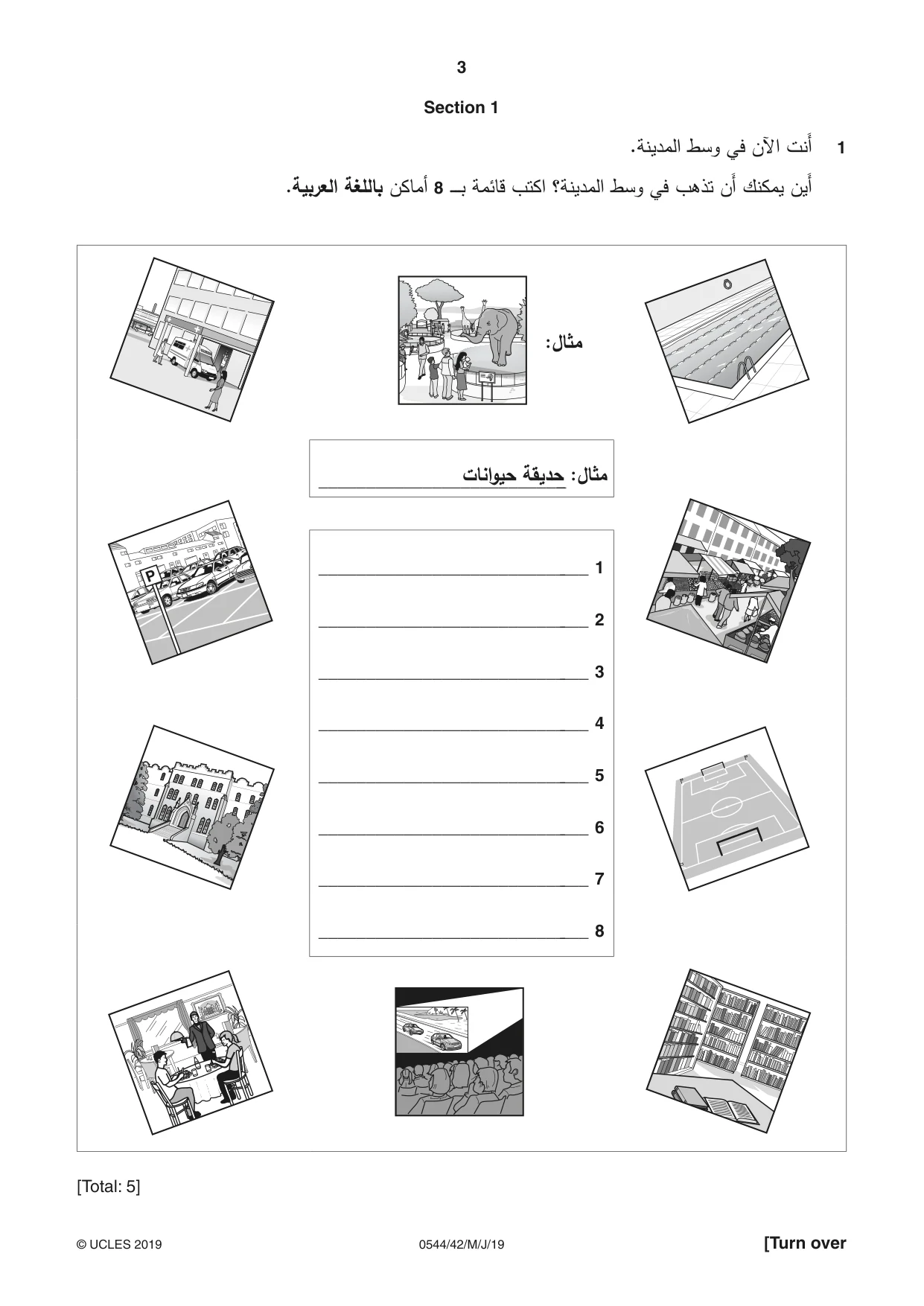
3 0544/42/M/J/19 © UCLES 2019 [Turn over Section 1 .أَنت اﻵن في وسط المدينة 1 . أماكن باللغة العربية8 أَين يمكنك أَن تذهب في وسط المدينة؟ اكتب قائمة بـــ :مثال __________________________ _____________________________ 1 _____________________________ 2 _____________________________ 3 _____________________________ 4 _____________________________ 5 _____________________________ 6 _____________________________ 7 _____________________________ 8 [Total: 5] مثال: حديﻘة حيوانات
Question paper, page 4
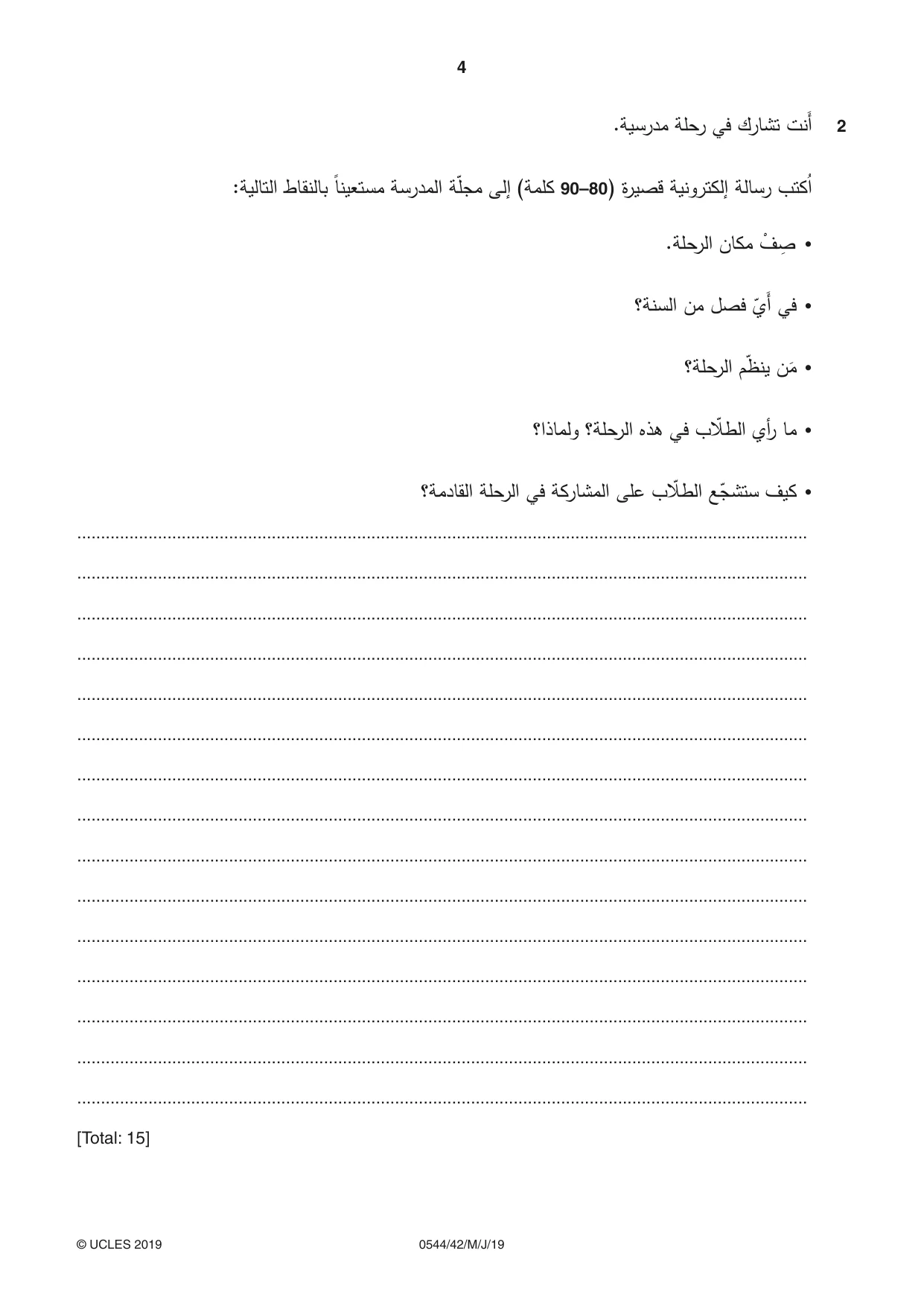
4 0544/42/M/J/19 © UCLES 2019 .أَنت تشارك في رحلة مدرسية 2 : كلمة) إلى مجلّة المدرسة مستعيناً بالنقاط التالية90–80( اُكتب رسالة إلكترونية قصيرة • صِ فْ مكان الرحلة. • في أَيّ فصل من السنة؟ • مَن ينظّم الرحلة؟ • ما رأي الطلّ ب في هذه الرحلة؟ ولماذا؟ • كيف ستشجّع الطلّ ب على المشاركة في الرحلة القادمة؟ … … … … … … … … … … … … … … … [Total: 15]
Question paper, page 5
5 0544/42/M/J/19 © UCLES 2019 [Turn over BLANK PAGE
Question paper, page 6
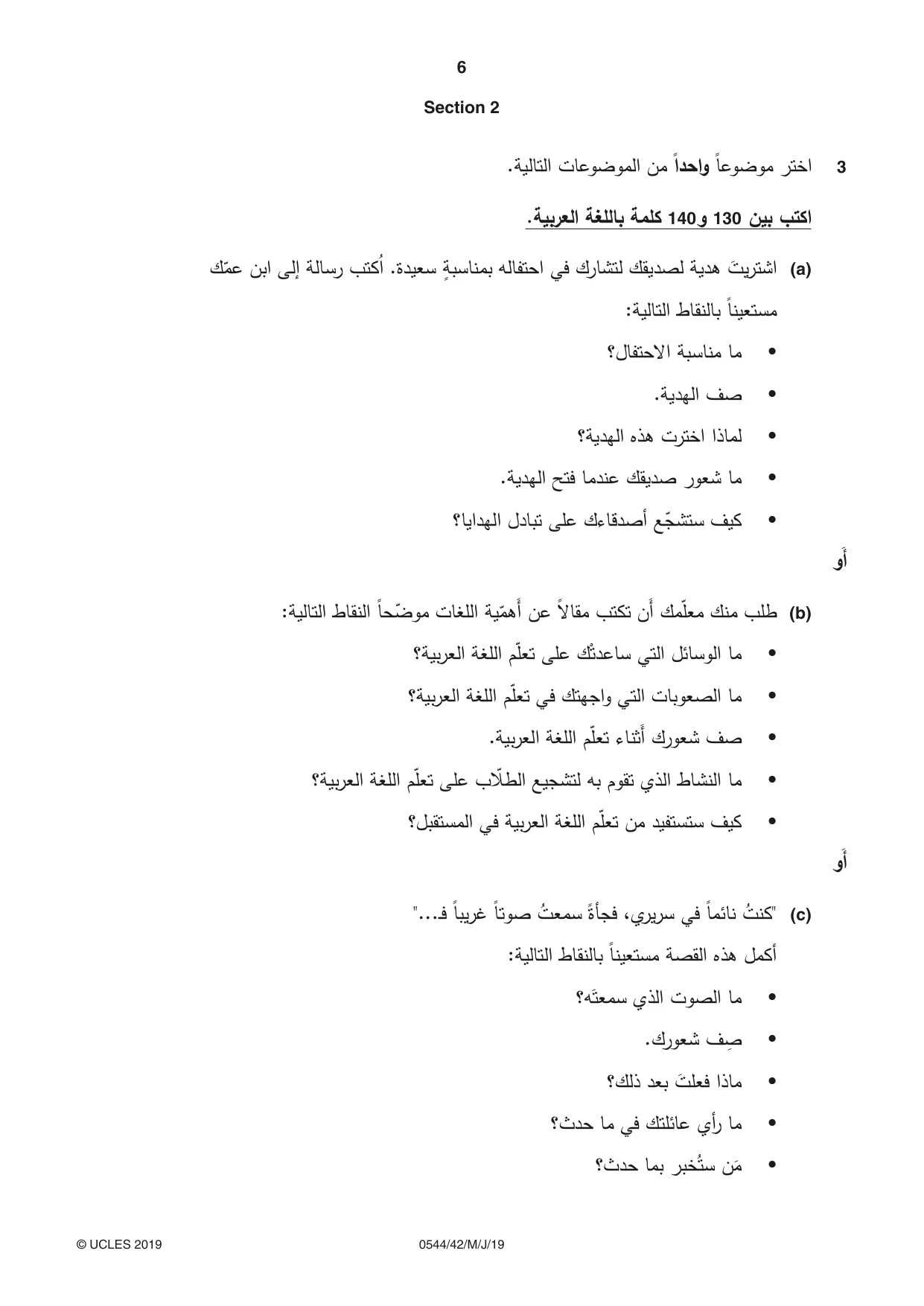
6 0544/42/M/J/19 © UCLES 2019 Section 2 .اختر موضوعاً واحداً من الموضوعات التالية 3 . كلمة باللغة العربية140 و130 اكتب بين اشتريتَ هدية لصديقك لتشارك في احتفاله بمناسبةٍ سعيدة. اُكتب رسالة إلى ابن عمّك (a) :مستعيناً بالنقاط التالية ما مناسبة االحتفال؟ • صف الهدية. • لماذا اخترت هذه الهدية؟ • ما شعور صديقك عندما فتح الهدية. • كيف ستشجّع أصدقاءك على تبادل الهدايا؟ • أَو ( طلب منك معلّمك أَن تكتب مقاالً عن أَهمّية اللغات موضّحاً النقاط التالية:b) ما الوسائل التي ساعدتْك على تعلّم اللغة العربية؟ • ما الصعوبات التي واجهتك في تعلّم اللغة العربية؟ • صف شعورك أَثناء تعلّم اللغة العربية. • ما النشاط الذي تقوم به لتشجيع الطلّ ب على تعلّم اللغة العربية؟ • كيف ستستفيد من تعلّم اللغة العربية في المستقبل؟ • أَو "كنتُ نائماً في سريري، فجأةً سمعتُ صوتاً غريباً فـ..." (c) :أكمل هذه القصة مستعيناً بالنقاط التالية ما الصوت الذي سمعتَه؟ • صِ ف شعورك. • ماذا فعلتَ بعد ذلك؟ • ما رأي عائلتك في ما حدث؟ • مَن ستُخبر بما حدث؟ •
Question paper, page 7
7 0544/42/M/J/19 © UCLES 2019 … … … … … … … … … … … … … … … … … … … … … … … … … [Total: 30] … اكتب هنا رقم السؤال الذي تختاره اكتب إجابتك عن السؤال الثالث هنا:
Question paper, page 8
8 0544/42/M/J/19 © UCLES 2019 BLANK PAGE Permission to reproduce items where third-party owned material protected by copyright is included has been sought and cleared where possible. Every reasonable effort has been made by the publisher (UCLES) to trace copyright holders, but if any items requiring clearance have unwittingly been included, the publisher will be pleased to make amends at the earliest possible opportunity. To avoid the issue of disclosure of answer-related information to candidates, all copyright acknowledgements are reproduced online in the Cambridge Assessment International Education Copyright Acknowledgements Booklet. This is produced for each series of examinations and is freely available to download at www.cambridgeinternational.org after the live examination series. Cambridge Assessment International Education is part of the Cambridge Assessment Group. Cambridge Assessment is the brand name of the University of Cambridge Local Examinations Syndicate (UCLES), which itself is a department of the University of Cambridge.
Mark scheme, page 1
This document consists of 24 printed pages. © UCLES 2019 [Turn over Cambridge Assessment International Education Cambridge International General Certificate of Secondary Education ARABIC 0544/42 Paper 4 Writing May/June 2019 MARK SCHEME Maximum Mark: 50 Published This mark scheme is published as an aid to teachers and candidates, to indicate the requirements of the examination. It shows the basis on which Examiners were instructed to award marks. It does not indicate the details of the discussions that took place at an Examiners’ meeting before marking began, which would have considered the acceptability of alternative answers. Mark schemes should be read in conjunction with the question paper and the Principal Examiner Report for Teachers. Cambridge International will not enter into discussions about these mark schemes. Cambridge International is publishing the mark schemes for the May/June 2019 series for most Cambridge IGCSE™, Cambridge International A and AS Level and Cambridge Pre-U components, and some Cambridge O Level components.
Mark scheme, page 2
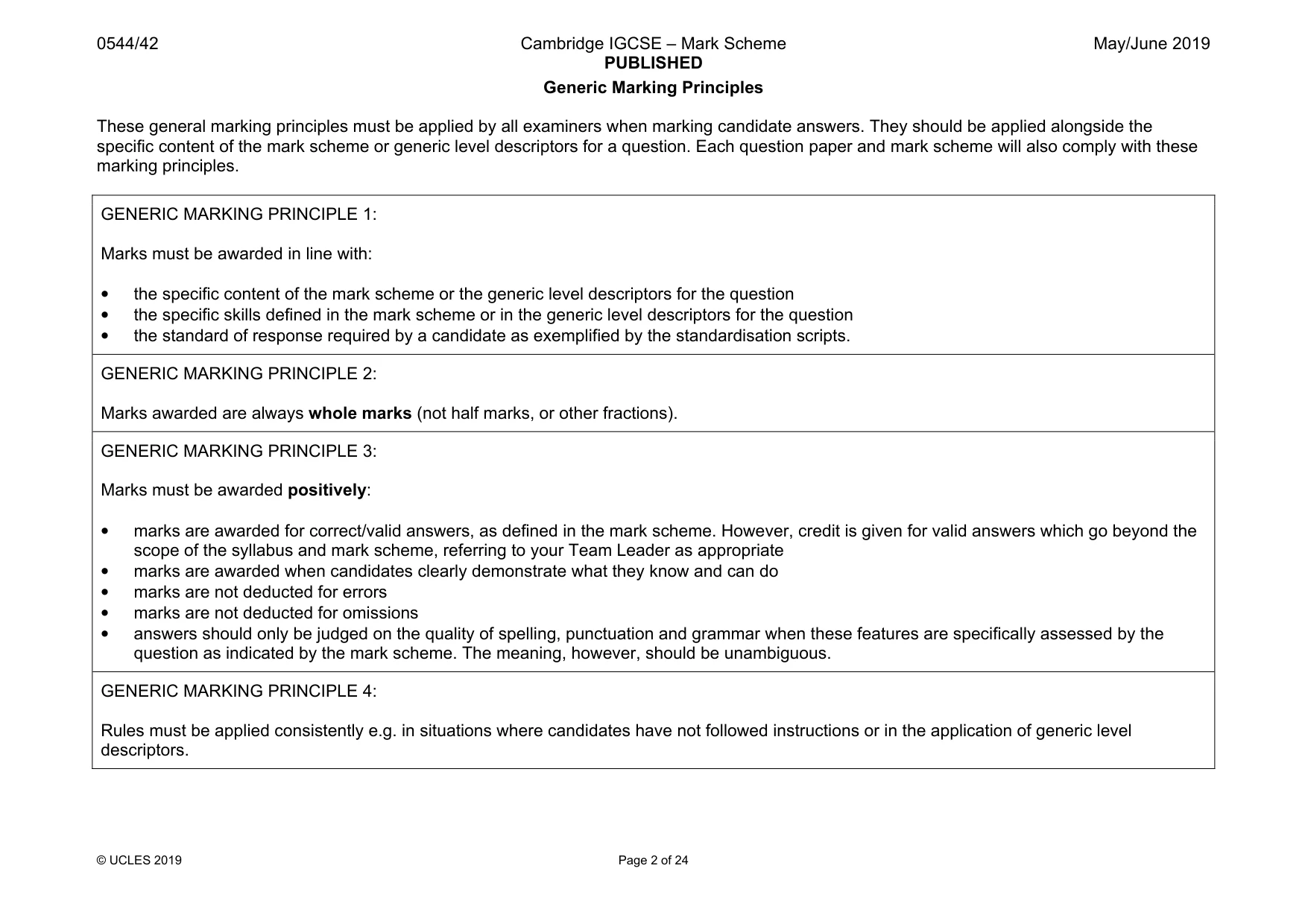
0544/42 Cambridge IGCSE – Mark Scheme PUBLISHED May/June 2019 © UCLES 2019 Page 2 of 24 Generic Marking Principles These general marking principles must be applied by all examiners when marking candidate answers. They should be applied alongside the specific content of the mark scheme or generic level descriptors for a question. Each question paper and mark scheme will also comply with these marking principles. GENERIC MARKING PRINCIPLE 1: Marks must be awarded in line with: • the specific content of the mark scheme or the generic level descriptors for the question • the specific skills defined in the mark scheme or in the generic level descriptors for the question • the standard of response required by a candidate as exemplified by the standardisation scripts. GENERIC MARKING PRINCIPLE 2: Marks awarded are always whole marks (not half marks, or other fractions). GENERIC MARKING PRINCIPLE 3: Marks must be awarded positively: • marks are awarded for correct/valid answers, as defined in the mark scheme. However, credit is given for valid answers which go beyond the scope of the syllabus and mark scheme, referring to your Team Leader as appropriate • marks are awarded when candidates clearly demonstrate what they know and can do • marks are not deducted for errors • marks are not deducted for omissions • answers should only be judged on the quality of spelling, punctuation and grammar when these features are specifically assessed by the question as indicated by the mark scheme. The meaning, however, should be unambiguous. GENERIC MARKING PRINCIPLE 4: Rules must be applied consistently e.g. in situations where candidates have not followed instructions or in the application of generic level descriptors.
Mark scheme, page 3
0544/42 Cambridge IGCSE – Mark Scheme PUBLISHED May/June 2019 © UCLES 2019 Page 3 of 24 GENERIC MARKING PRINCIPLE 5: Marks should be awarded using the full range of marks defined in the mark scheme for the question (however; the use of the full mark range may be limited according to the quality of the candidate responses seen). GENERIC MARKING PRINCIPLE 6: Marks awarded are based solely on the requirements as defined in the mark scheme. Marks should not be awarded with grade thresholds or grade descriptors in mind.
Mark scheme, page 4
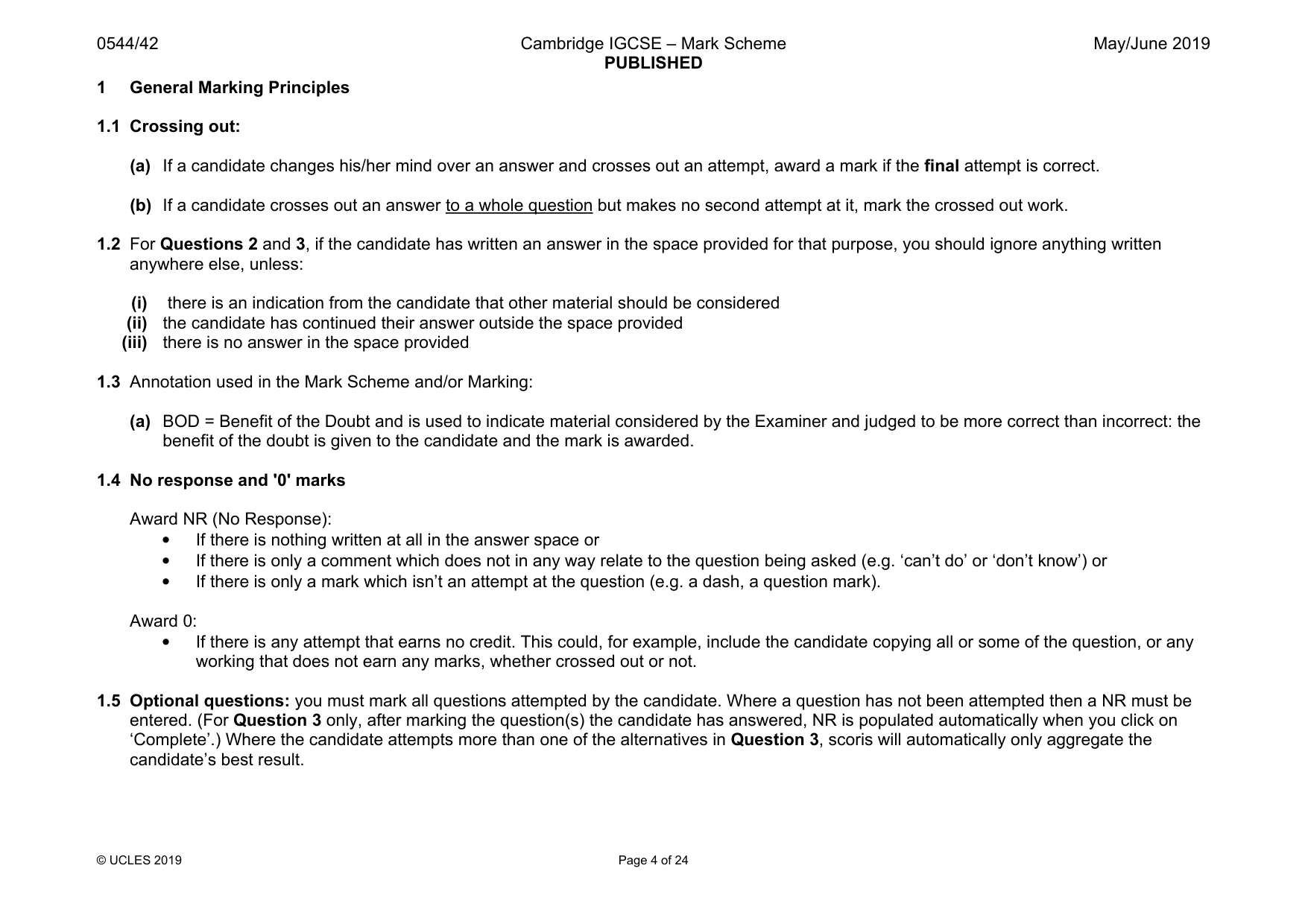
0544/42 Cambridge IGCSE – Mark Scheme PUBLISHED May/June 2019 © UCLES 2019 Page 4 of 24 1 General Marking Principles 1.1 Crossing out: (a) If a candidate changes his/her mind over an answer and crosses out an attempt, award a mark if the final attempt is correct. (b) If a candidate crosses out an answer to a whole question but makes no second attempt at it, mark the crossed out work. 1.2 For Questions 2 and 3, if the candidate has written an answer in the space provided for that purpose, you should ignore anything written anywhere else, unless: (i) there is an indication from the candidate that other material should be considered (ii) the candidate has continued their answer outside the space provided (iii) there is no answer in the space provided 1.3 Annotation used in the Mark Scheme and/or Marking: (a) BOD = Benefit of the Doubt and is used to indicate material considered by the Examiner and judged to be more correct than incorrect: the benefit of the doubt is given to the candidate and the mark is awarded. 1.4 No response and '0' marks Award NR (No Response): • If there is nothing written at all in the answer space or • If there is only a comment which does not in any way relate to the question being asked (e.g. ‘can’t do’ or ‘don’t know’) or • If there is only a mark which isn’t an attempt at the question (e.g. a dash, a question mark). Award 0: • If there is any attempt that earns no credit. This could, for example, include the candidate copying all or some of the question, or any working that does not earn any marks, whether crossed out or not. 1.5 Optional questions: you must mark all questions attempted by the candidate. Where a question has not been attempted then a NR must be entered. (For Question 3 only, after marking the question(s) the candidate has answered, NR is populated automatically when you click on ‘Complete’.) Where the candidate attempts more than one of the alternatives in Question 3, scoris will automatically only aggregate the candidate’s best result.
Mark scheme, page 5
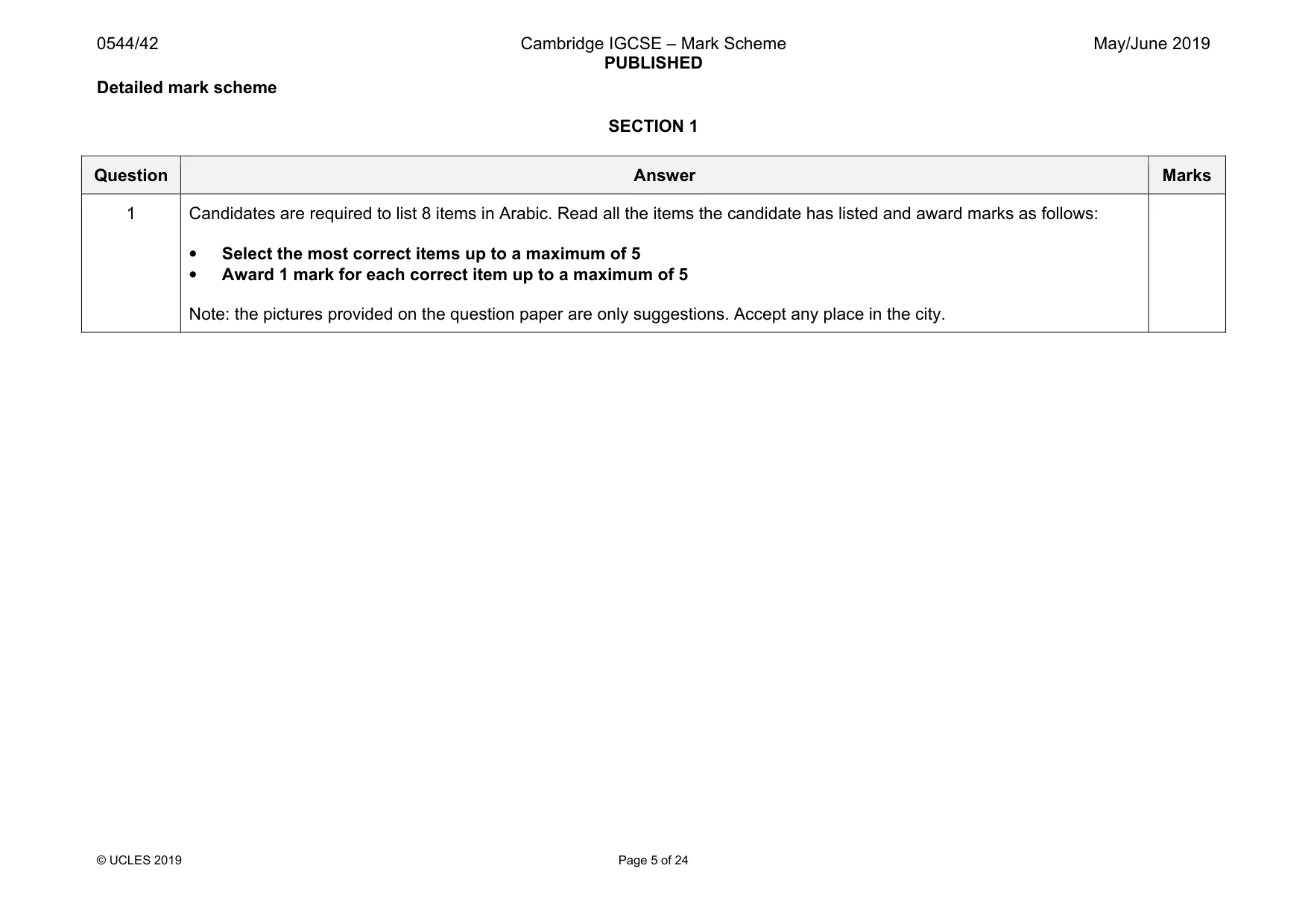
0544/42 Cambridge IGCSE – Mark Scheme PUBLISHED May/June 2019 © UCLES 2019 Page 5 of 24 Detailed mark scheme SECTION 1 Question Answer Marks 1 Candidates are required to list 8 items in Arabic. Read all the items the candidate has listed and award marks as follows: • Select the most correct items up to a maximum of 5 • Award 1 mark for each correct item up to a maximum of 5 Note: the pictures provided on the question paper are only suggestions. Accept any place in the city.
Mark scheme, page 6
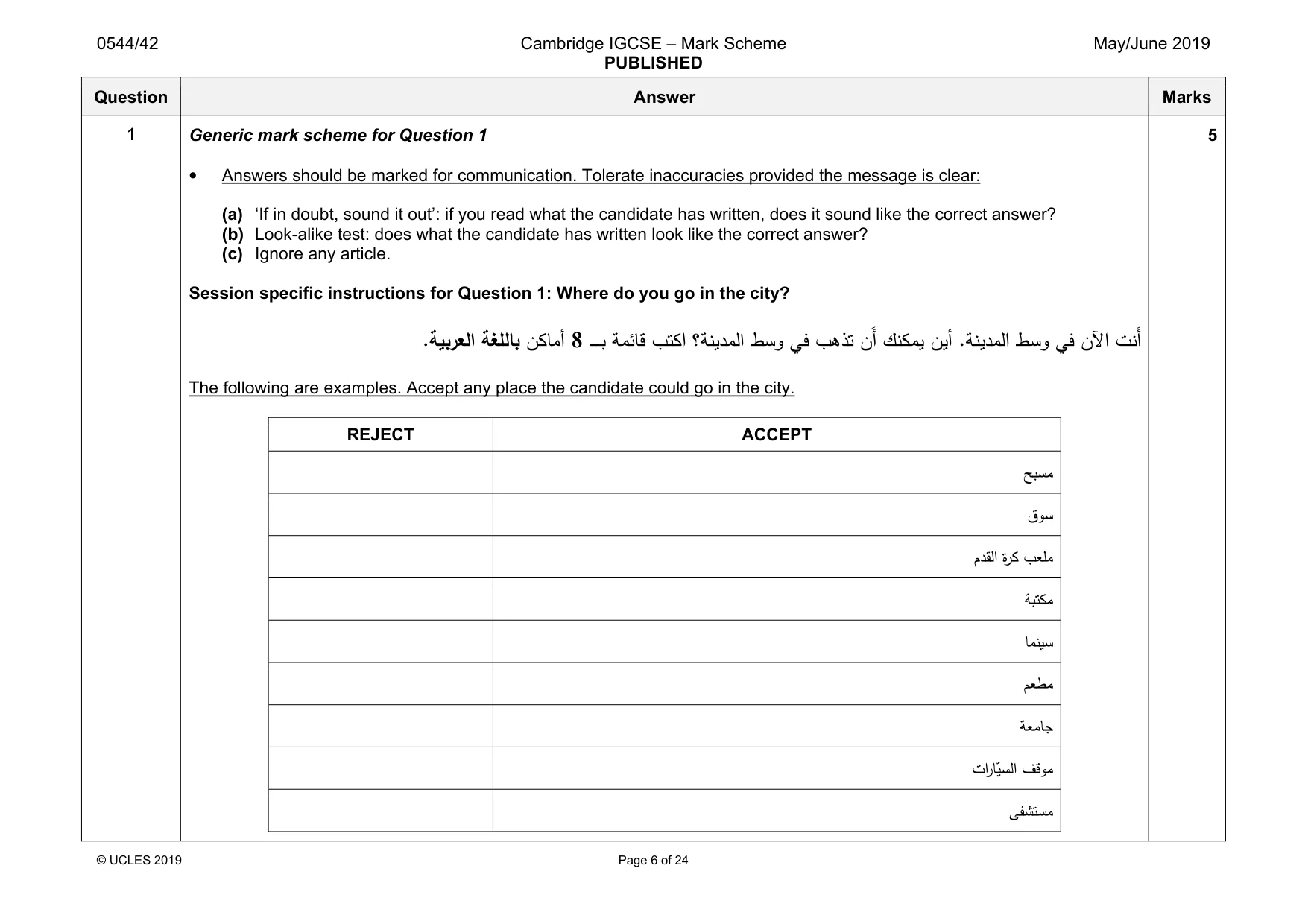
0544/42 Cambridge IGCSE – Mark Scheme PUBLISHED May/June 2019 © UCLES 2019 Page 6 of 24 Question Answer Marks 1 Generic mark scheme for Question 1 • Answers should be marked for communication. Tolerate inaccuracies provided the message is clear: (a) ‘If in doubt, sound it out’: if you read what the candidate has written, does it sound like the correct answer? (b) Look-alike test: does what the candidate has written look like the correct answer? (c) Ignore any article. Session specific instructions for Question 1: Where do you go in the city? ž Áƕ§ ªƊÉ£ Ɠ řƈœŕƁ ¨śƄ§ řƊƔ¯ƈƅ§ ·Ŭà Ɠž ¨ƍ°ś ÁÉ£ ¾ƊƄƈƔ ÁƔ£ .řƊƔ¯ƈƅ§ ·Ŭà »»»ŗ 8 ÁƄŕƈ£ ŗźƄƃœŕ .ŗƒŕ°Ŷƃ¦ The following are examples. Accept any place the candidate could go in the city. REJECT ACCEPT ŢŗŬƈ ½ÃŬ À¯Ƃƅ§ ©±Ƅ ¨ŸƆƈ řŗśƄƈ ŕƈƊƔŬ ÀŸ·ƈ řŸƈ੠ª§±ŕÌƔŬƅ§ ¼ƁÃƈ ƑſŮśŬƈ 5
Mark scheme, page 7
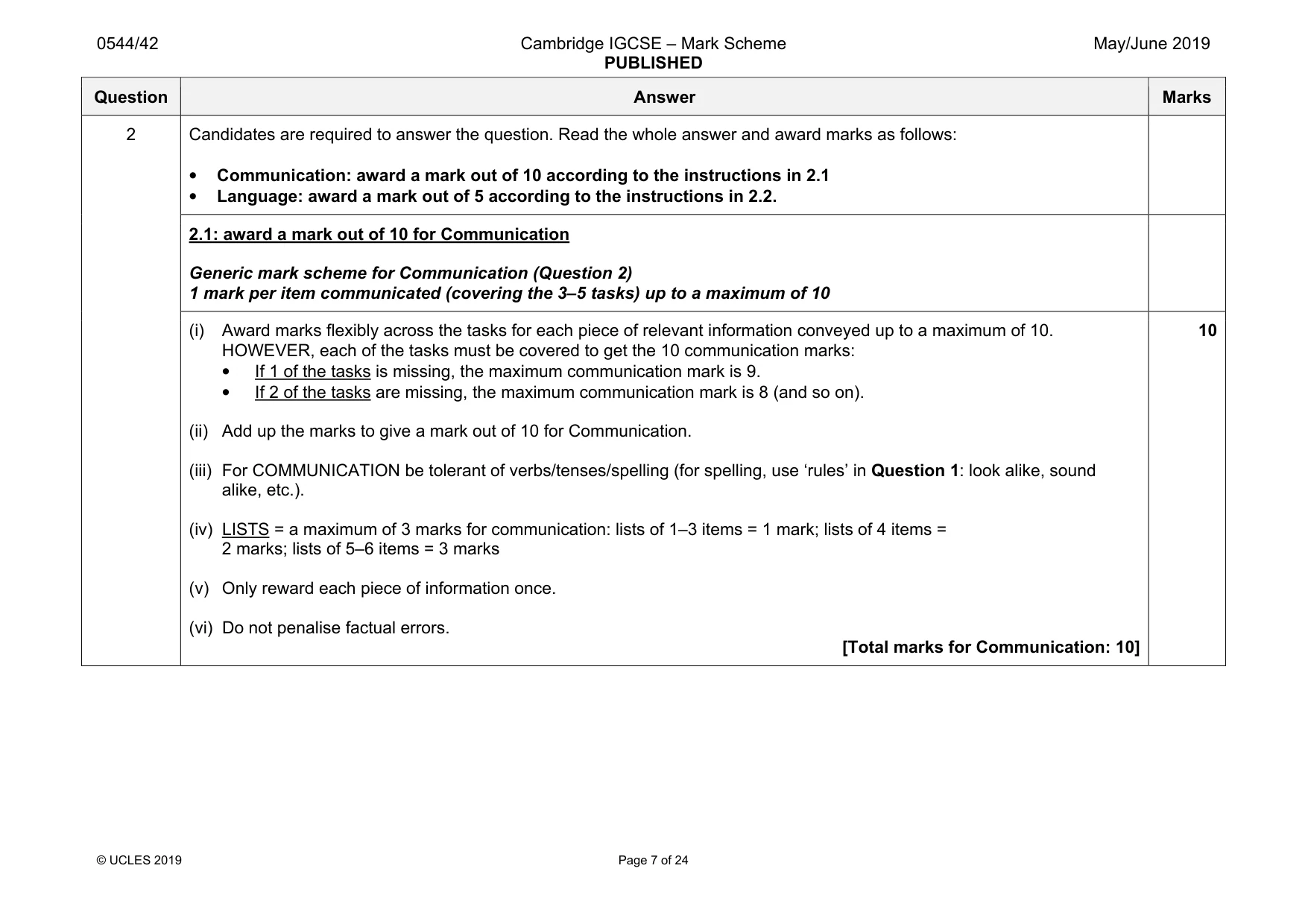
0544/42 Cambridge IGCSE – Mark Scheme PUBLISHED May/June 2019 © UCLES 2019 Page 7 of 24 Question Answer Marks 2 Candidates are required to answer the question. Read the whole answer and award marks as follows: • Communication: award a mark out of 10 according to the instructions in 2.1 • Language: award a mark out of 5 according to the instructions in 2.2. 2.1: award a mark out of 10 for Communication Generic mark scheme for Communication (Question 2) 1 mark per item communicated (covering the 3–5 tasks) up to a maximum of 10 (i) Award marks flexibly across the tasks for each piece of relevant information conveyed up to a maximum of 10. HOWEVER, each of the tasks must be covered to get the 10 communication marks: • If 1 of the tasks is missing, the maximum communication mark is 9. • If 2 of the tasks are missing, the maximum communication mark is 8 (and so on). (ii) Add up the marks to give a mark out of 10 for Communication. (iii) For COMMUNICATION be tolerant of verbs/tenses/spelling (for spelling, use ‘rules’ in Question 1: look alike, sound alike, etc.). (iv) LISTS = a maximum of 3 marks for communication: lists of 1–3 items = 1 mark; lists of 4 items = 2 marks; lists of 5–6 items = 3 marks (v) Only reward each piece of information once. (vi) Do not penalise factual errors. [Total marks for Communication: 10] 10
Mark scheme, page 8
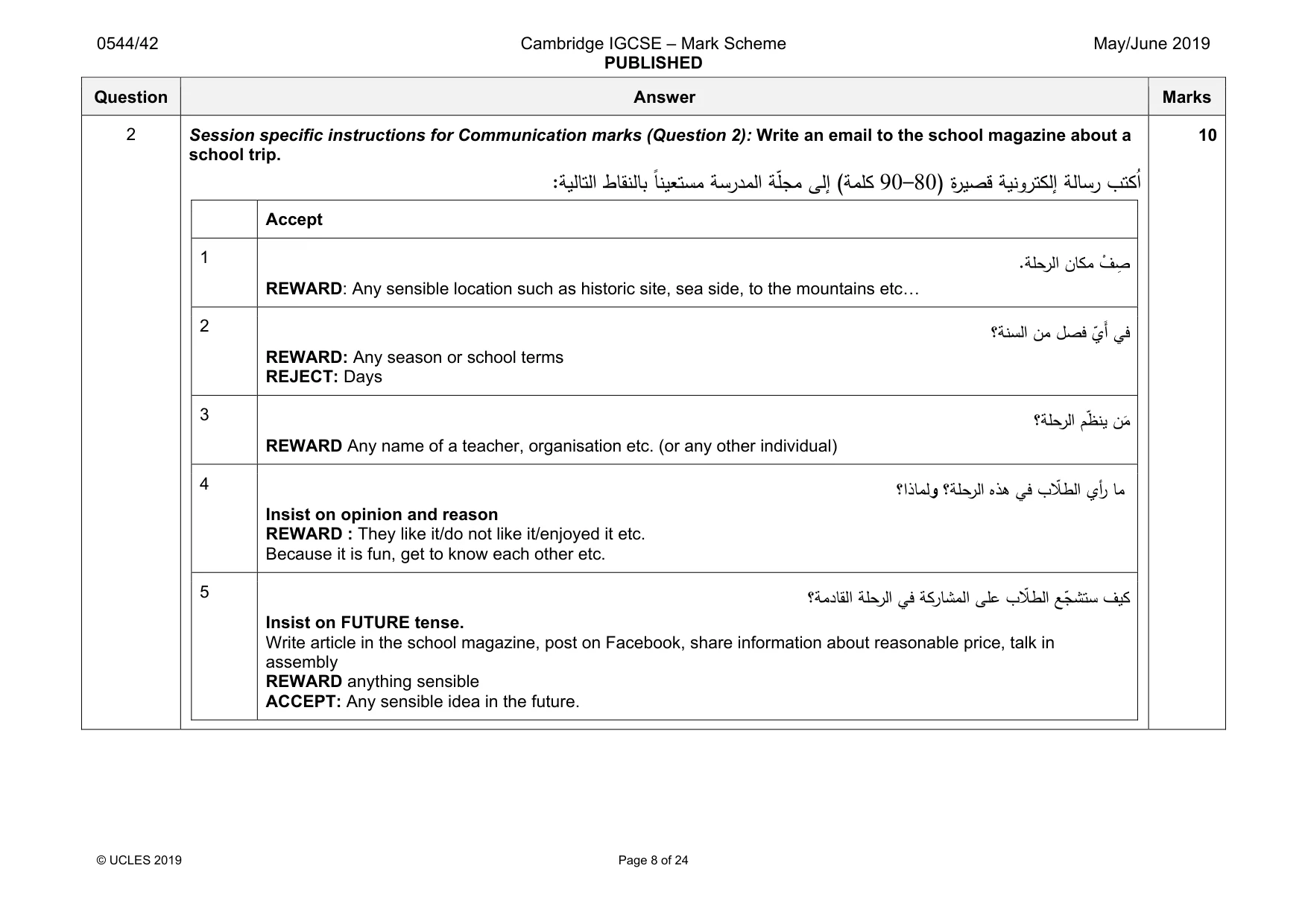
0544/42 Cambridge IGCSE – Mark Scheme PUBLISHED May/June 2019 © UCLES 2019 Page 8 of 24 Question Answer Marks 2 Session specific instructions for Communication marks (Question 2): Write an email to the school magazine about a school trip. ¨śƄʧ řƅŕŬ± řƔƊñśƄƅ¥ ©±ƔŰƁ ) 0 8 – 0 9 Ƅ (řƈƆ Ƒƅ¥ ƈ řÌƆŠ řŬ±¯ƈƅ§ ÆŕƊƔŸśŬƈ ŗ ·ŕƂƊƅŕ :řƔƅŕśƅ§ Accept 1 .řƆţ±ƅ§ ÁŕƄƈ ͼ ËŰ REWARD: Any sensible location such as historic site, sea side, to the mountains etc« 2 Áƈ ¿Űž ÌÅÉ£ Ɠž řƊŬƅ§ REWARD: Any season or school terms REJECT: Days 3 ÁÉƈ À̸ƊƔ řƆţ±ƅ§ REWARD Any name of a teacher, organisation etc. (or any other individual) 4 ŕƈ Å£± ¨ ÌƜ·ƅ§ Ɠž Ƌ°ƍ řƆţ±ƅ§  §°ŕƈƅ Insist on opinion and reason REWARD : They like it/do not like it/enjoyed it etc. Because it is fun, get to know each other etc. 5 ¼ƔƄ ŶÌŠŮśŬ ¨ ÌƜ·ƅ§ ƑƆŷ řƄ±ŕŮƈƅ§ Ɠž § řƆţ±ƅ řƈ¯ŕƂƅ§ Insist on FUTURE tense. Write article in the school magazine, post on Facebook, share information about reasonable price, talk in assembly REWARD anything sensible ACCEPT: Any sensible idea in the future. 10
Mark scheme, page 9
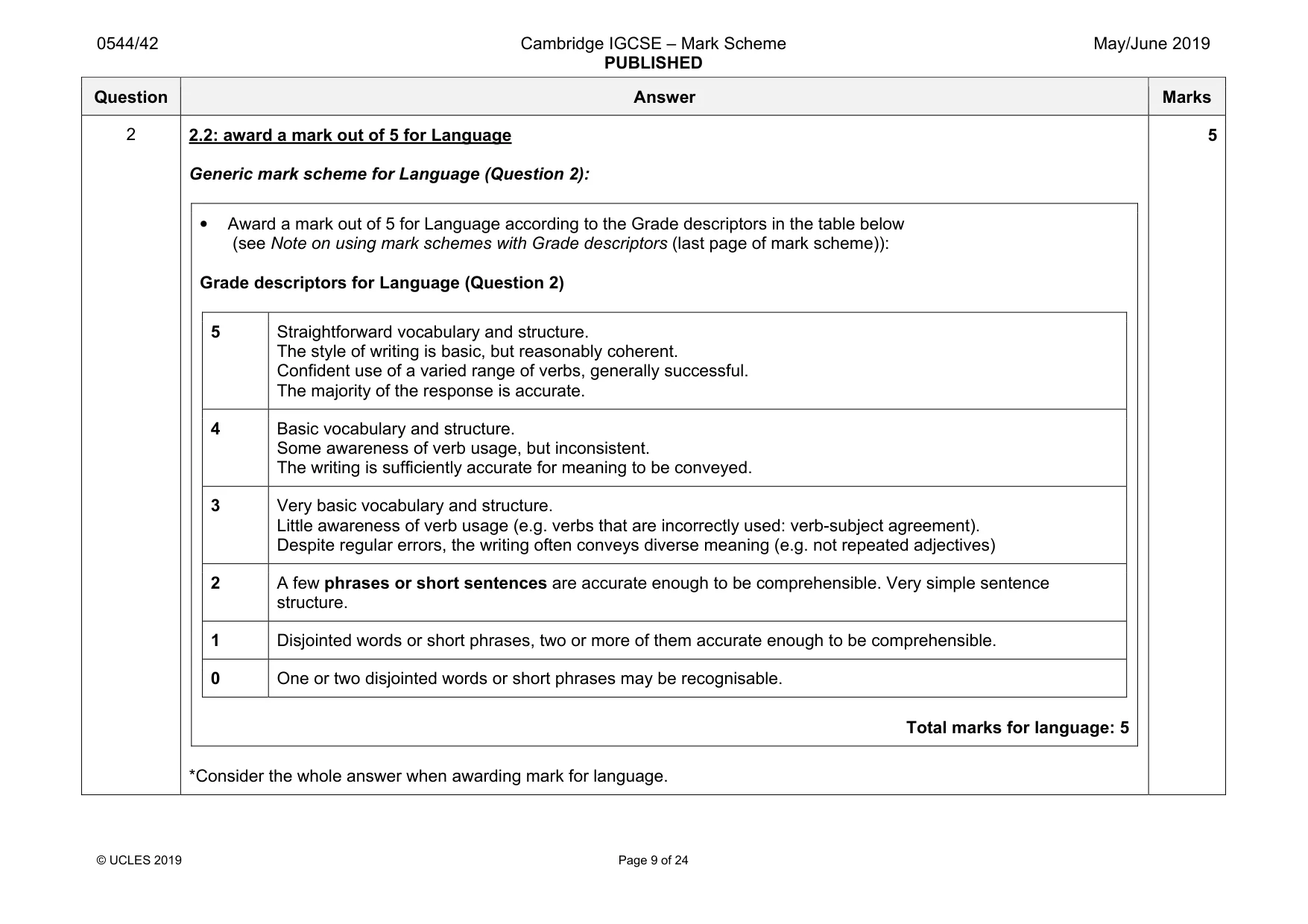
0544/42 Cambridge IGCSE – Mark Scheme PUBLISHED May/June 2019 © UCLES 2019 Page 9 of 24 Question Answer Marks 2 2.2: award a mark out of 5 for Language Generic mark scheme for Language (Question 2): • Award a mark out of 5 for Language according to the Grade descriptors in the table below (see Note on using mark schemes with Grade descriptors (last page of mark scheme)): Grade descriptors for Language (Question 2) 5 Straightforward vocabulary and structure. The style of writing is basic, but reasonably coherent. Confident use of a varied range of verbs, generally successful. The majority of the response is accurate. 4 Basic vocabulary and structure. Some awareness of verb usage, but inconsistent. The writing is sufficiently accurate for meaning to be conveyed. 3 Very basic vocabulary and structure. Little awareness of verb usage (e.g. verbs that are incorrectly used: verb-subject agreement). Despite regular errors, the writing often conveys diverse meaning (e.g. not repeated adjectives) 2 A few phrases or short sentences are accurate enough to be comprehensible. Very simple sentence structure. 1 Disjointed words or short phrases, two or more of them accurate enough to be comprehensible. 0 One or two disjointed words or short phrases may be recognisable. Total marks for language: 5 *Consider the whole answer when awarding mark for language. 5
Mark scheme, page 10
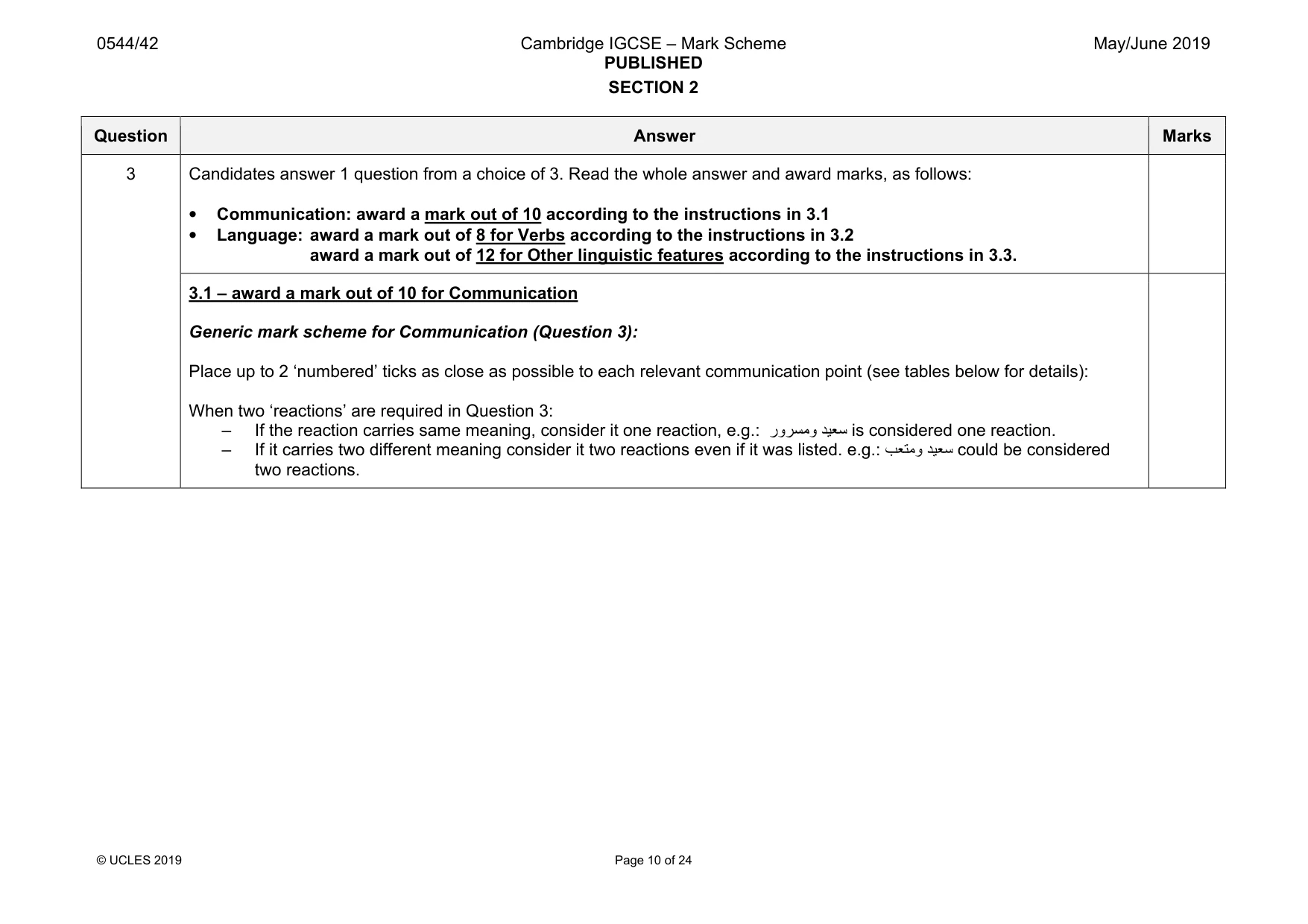
0544/42 Cambridge IGCSE – Mark Scheme PUBLISHED May/June 2019 © UCLES 2019 Page 10 of 24 SECTION 2 Question Answer Marks 3 Candidates answer 1 question from a choice of 3. Read the whole answer and award marks, as follows: • Communication: award a mark out of 10 according to the instructions in 3.1 • Language: award a mark out of 8 for Verbs according to the instructions in 3.2 award a mark out of 12 for Other linguistic features according to the instructions in 3.3. 3.1 – award a mark out of 10 for Communication Generic mark scheme for Communication (Question 3): Place up to 2 ‘numbered’ ticks as close as possible to each relevant communication point (see tables below for details): When two ‘reactions’ are required in Question 3: – If the reaction carries same meaning, consider it one reaction, e.g.: سعيد ومسرورis considered one reaction. – If it carries two different meaning consider it two reactions even if it was listed. e.g.: سعيد ومتعبcould be considered two reactions.
Mark scheme, page 11
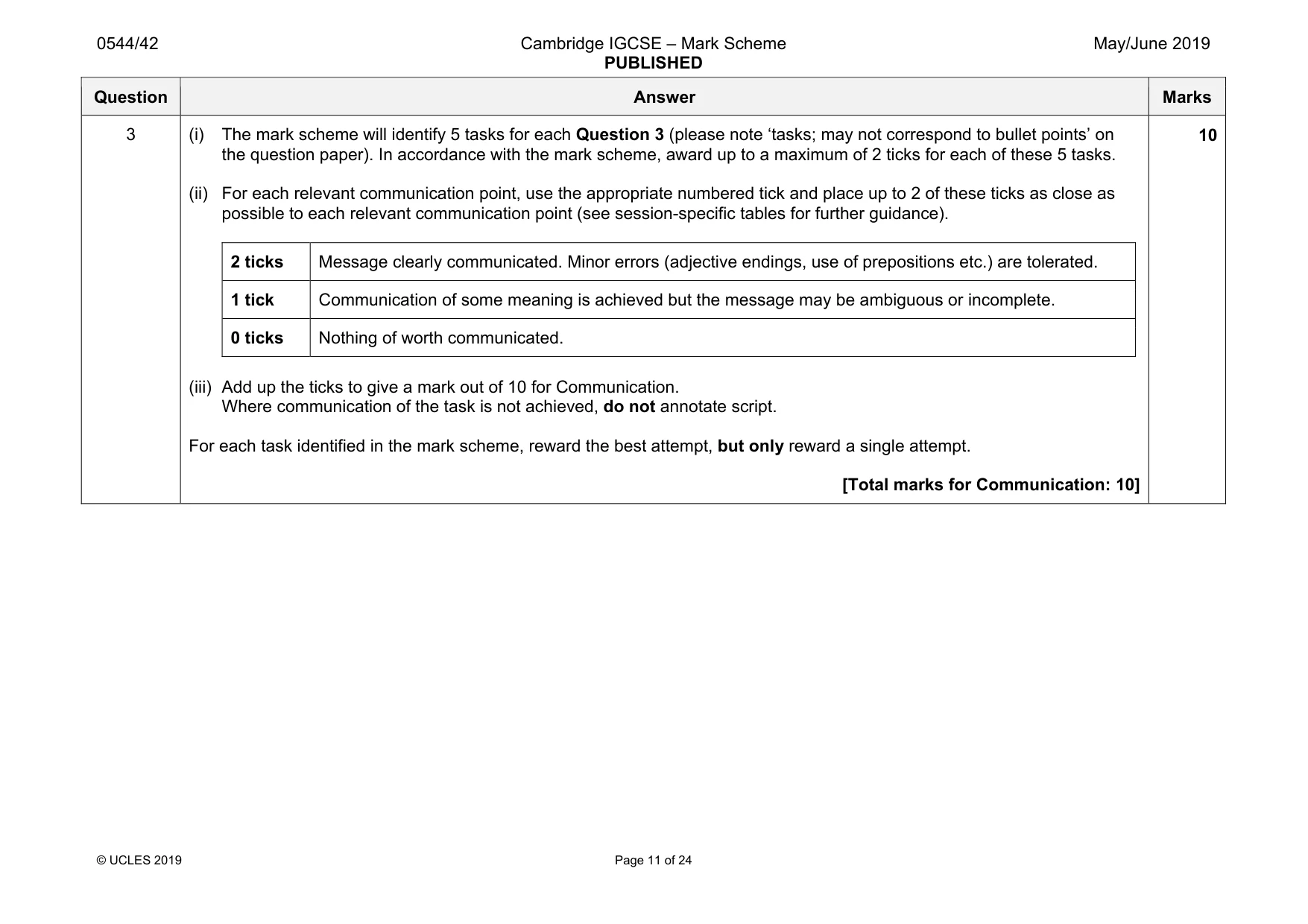
0544/42 Cambridge IGCSE – Mark Scheme PUBLISHED May/June 2019 © UCLES 2019 Page 11 of 24 Question Answer Marks 3 (i) The mark scheme will identify 5 tasks for each Question 3 (please note ‘tasks; may not correspond to bullet points’ on the question paper). In accordance with the mark scheme, award up to a maximum of 2 ticks for each of these 5 tasks. (ii) For each relevant communication point, use the appropriate numbered tick and place up to 2 of these ticks as close as possible to each relevant communication point (see session-specific tables for further guidance). 2 ticks Message clearly communicated. Minor errors (adjective endings, use of prepositions etc.) are tolerated. 1 tick Communication of some meaning is achieved but the message may be ambiguous or incomplete. 0 ticks Nothing of worth communicated. (iii) Add up the ticks to give a mark out of 10 for Communication. Where communication of the task is not achieved, do not annotate script. For each task identified in the mark scheme, reward the best attempt, but only reward a single attempt. [Total marks for Communication: 10] 10
Mark scheme, page 12
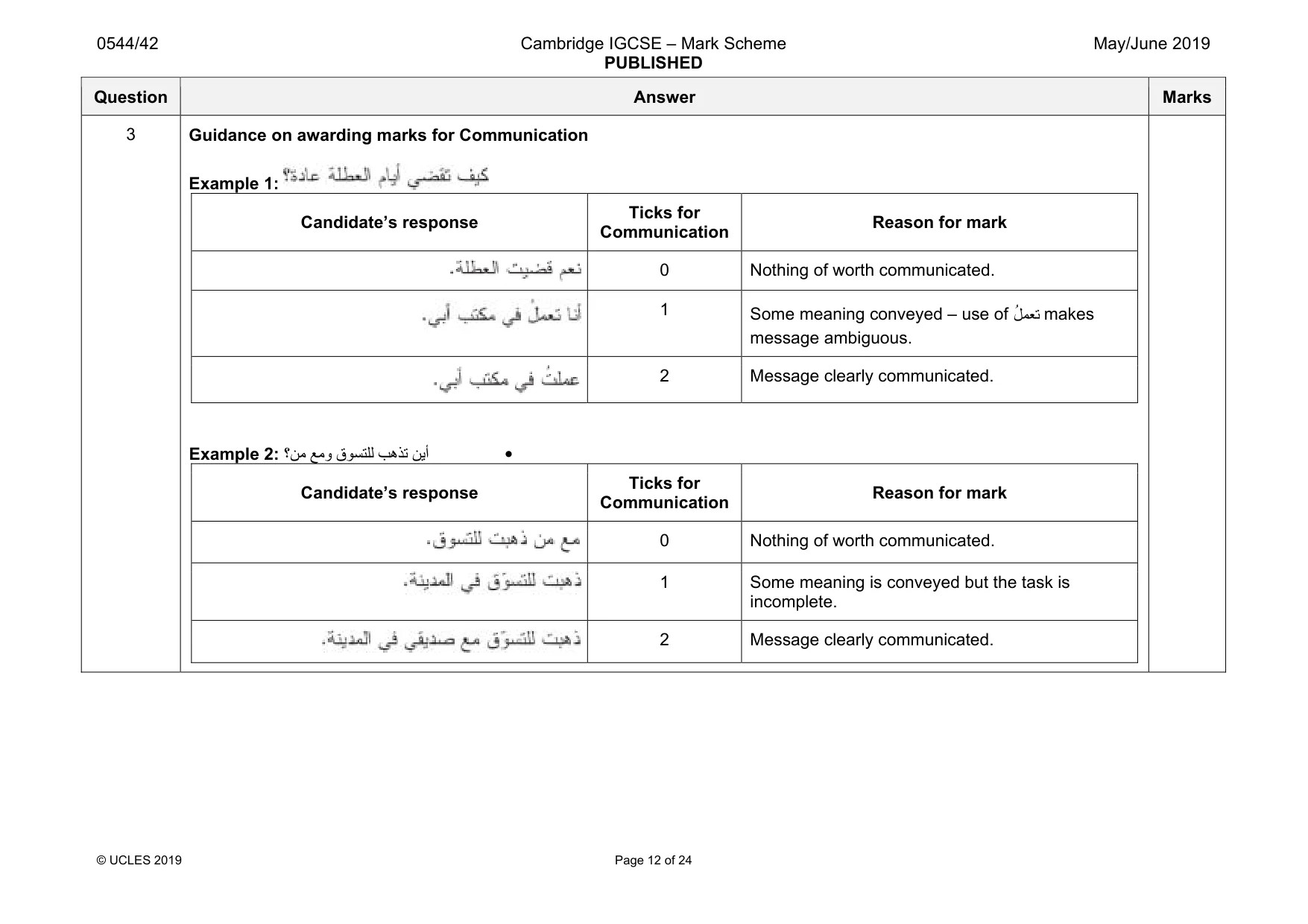
0544/42 Cambridge IGCSE – Mark Scheme PUBLISHED May/June 2019 © UCLES 2019 Page 12 of 24 Question Answer Marks 3 Guidance on awarding marks for Communication Example 1: Candidate’s response Ticks for Communication Reason for mark 0 Nothing of worth communicated. 1 Some meaning conveyed – use of Ê¿ƈŸś makes message ambiguous. 2 Message clearly communicated. • أين تذھب للتسوق ومع من؟Example 2: Candidate’s response Ticks for Communication Reason for mark 0 Nothing of worth communicated. 1 Some meaning is conveyed but the task is incomplete. 2 Message clearly communicated.
Mark scheme, page 13
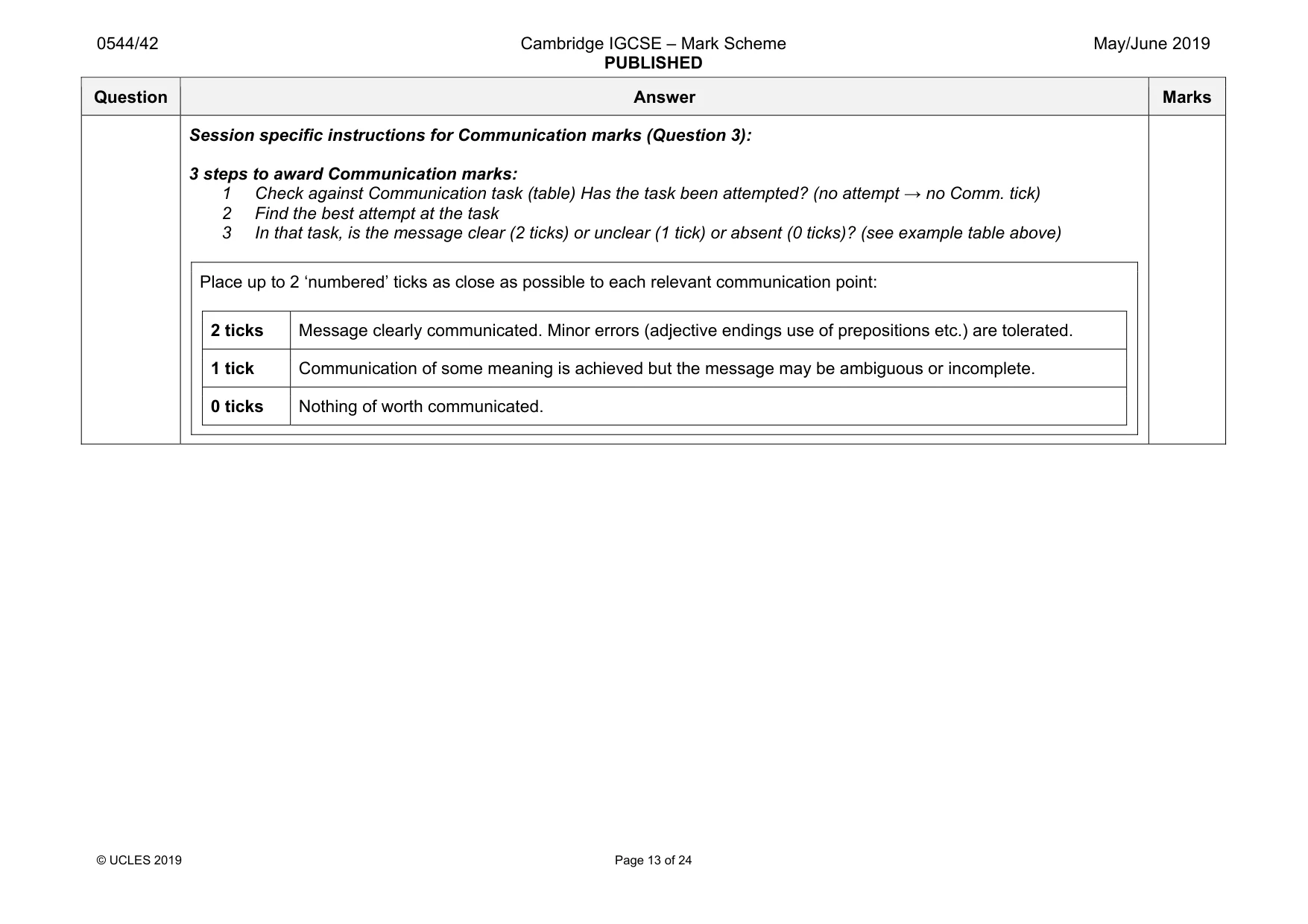
0544/42 Cambridge IGCSE – Mark Scheme PUBLISHED May/June 2019 © UCLES 2019 Page 13 of 24 Question Answer Marks Session specific instructions for Communication marks (Question 3): 3 steps to award Communication marks: 1 Check against Communication task (table) Has the task been attempted? (no attempt → no Comm. tick) 2 Find the best attempt at the task 3 In that task, is the message clear (2 ticks) or unclear (1 tick) or absent (0 ticks)? (see example table above) Place up to 2 ‘numbered’ ticks as close as possible to each relevant communication point: 2 ticks Message clearly communicated. Minor errors (adjective endings use of prepositions etc.) are tolerated. 1 tick Communication of some meaning is achieved but the message may be ambiguous or incomplete. 0 ticks Nothing of worth communicated.
Mark scheme, page 14
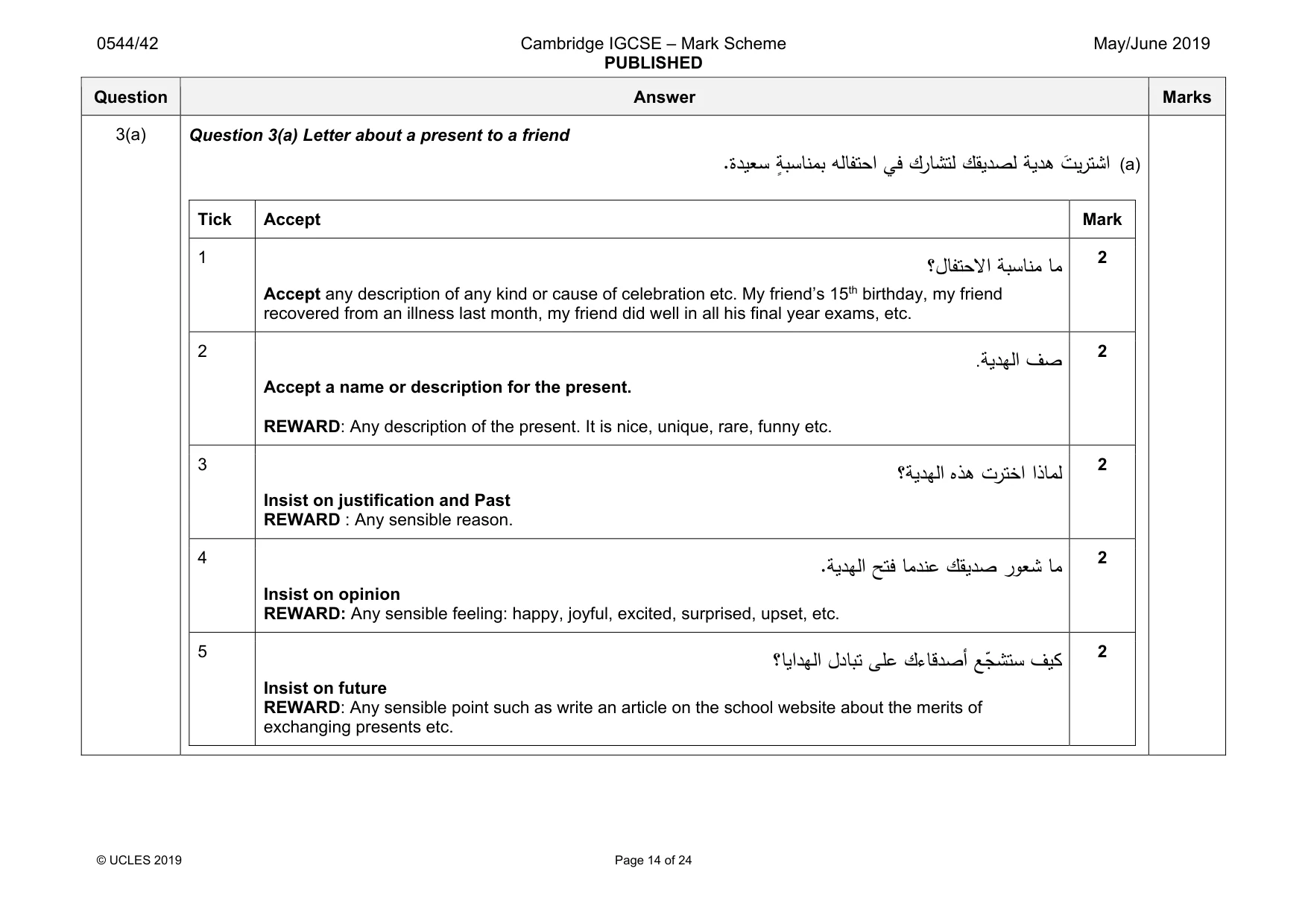
0544/42 Cambridge IGCSE – Mark Scheme PUBLISHED May/June 2019 © UCLES 2019 Page 14 of 24 Question Answer Marks 3(a) Question 3(a) Letter about a present to a friend (a) .©¯ƔŸŬ ÈřŗŬŕƊƈŗ ƌƅŕſśţ§ Ɠž ¾±ŕŮśƅ ¾ƂƔ¯Űƅ řƔ¯ƍ ɪƔ±śŮ§ Tick Accept Mark 1 ¿ŕſśţƛ§ řŗŬŕƊƈ ŕƈ Accept any description of any kind or cause of celebration etc. My friend’s 15th birthday, my friend recovered from an illness last month, my friend did well in all his final year exams, etc. 2 2 řƔ¯Ǝƅ§ ¼Ű . Accept a name or description for the present. REWARD: Any description of the present. It is nice, unique, rare, funny etc. 2 3 §°ŕƈƅ ª±śŦ§ Ƌ°ƍ řƔ¯Ǝƅ§ Insist on justification and Past REWARD : Any sensible reason. 2 4 ŕƈ ±ÃŸŮ ¾ƂƔ¯Ű ŕƈ¯Ɗŷ ž Ţś řƔ¯Ǝƅ§ . Insist on opinion REWARD: Any sensible feeling: happy, joyful, excited, surprised, upset, etc. 2 5 ¼ƔƄ ŶÌŠŮśŬ ¾¡ŕƁ¯Ű£ ƑƆŷ ¿¯ŕŗś Ɣ§¯Ǝƅ§ ŕ Insist on future REWARD: Any sensible point such as write an article on the school website about the merits of exchanging presents etc. 2
Mark scheme, page 15
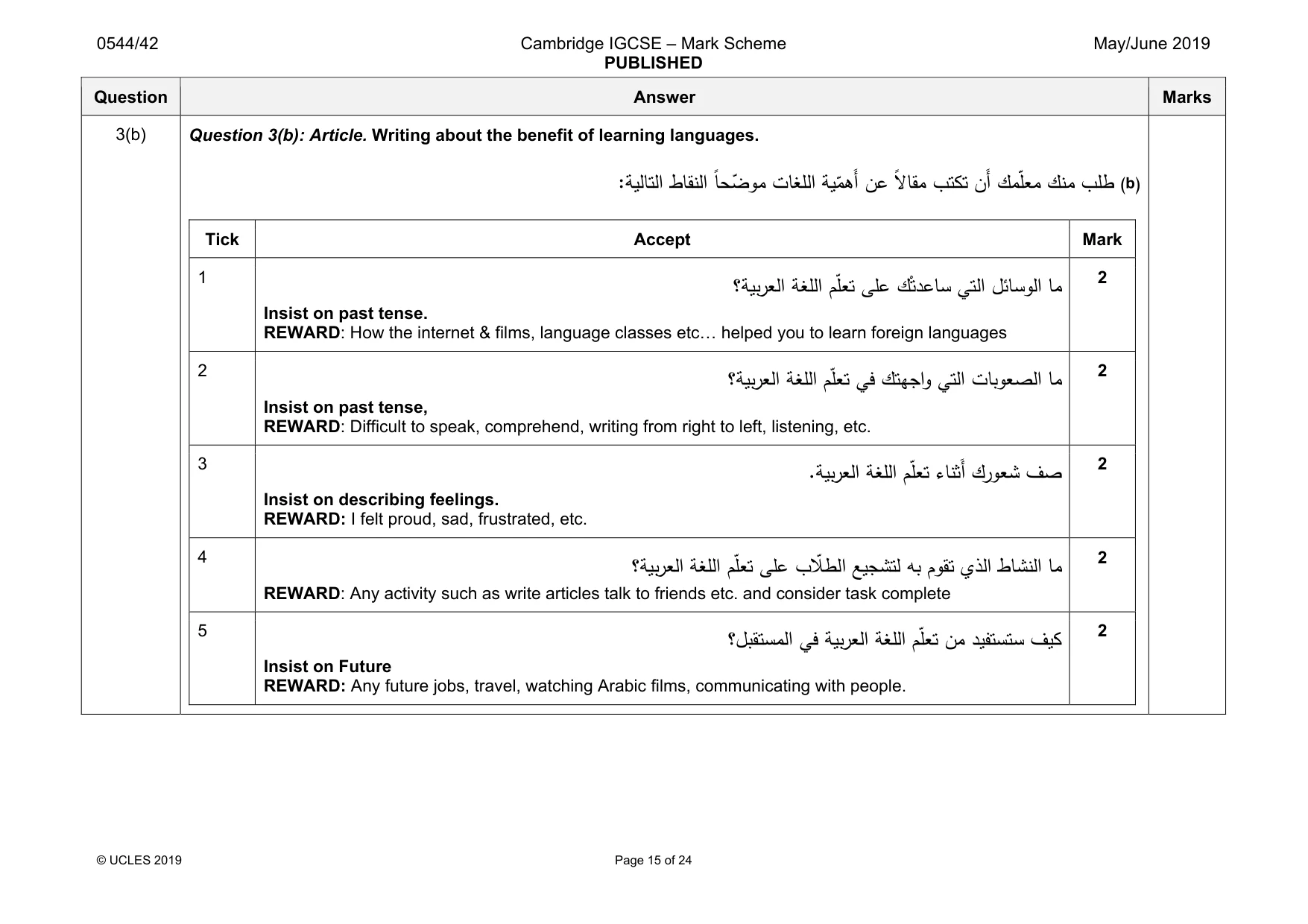
0544/42 Cambridge IGCSE – Mark Scheme PUBLISHED May/June 2019 © UCLES 2019 Page 15 of 24 Question Answer Marks 3(b) Question 3(b): Article. Writing about the benefit of learning languages. ) b ( ¨Ɔ· ¾Ɗƈ ¾ƈÌƆŸƈ ÁÉ£ ¨śƄś ÆƛŕƂƈ Áŷ ÌƈƍÉ£ řƔ ªŕżƆƅ§ ÆŕţÌŲÃƈ ŕƂƊƅ§ · :řƔƅŕśƅ§ Tick Accept Mark 1 ŕƈ ¿œŕŬÃƅ§ Ɠśƅ§ ¾Íś¯ŷŕŬ ƑƆŷ ÀÌƆŸś řżƆƅ§ § řƔŗ±Ÿƅ Insist on past tense. REWARD: How the internet & films, language classes etc« helped you to learn foreign languages 2 2 ŕƈ ªŕŗßŰƅ§ Ɠśƅ§ ¾śƎŠ§Ã ž Ɠ ÀÌƆŸś řżƆƅ§ řƔŗ±Ÿƅ§ Insist on past tense, REWARD: Difficult to speak, comprehend, writing from right to left, listening, etc. 2 3 řƔŗ±Ÿƅ§ řżƆƅ§ ÀÌƆŸś ¡ŕƊŝÉ£ ¾±ÃŸŮ ¼Ű . Insist on describing feelings. REWARD: I felt proud, sad, frustrated, etc. 2 4 ŕƈ ·ŕŮƊƅ§ § Å°ƅ ÀÃƂś ŗƌ ŶƔŠŮśƅ ¨ ÌƜ·ƅ§ ŷ ƑƆ ÀÌƆŸś řżƆƅ§ řƔŗ±Ÿƅ§ REWARD: Any activity such as write articles talk to friends etc. and consider task complete 2 5 ¿ŗƂśŬƈƅ§ Ɠž řƔŗ±Ÿƅ§ řżƆƅ§ ÀÌƆŸś Áƈ ¯ƔſśŬśŬ ¼ƔƄ Insist on Future REWARD: Any future jobs, travel, watching Arabic films, communicating with people. 2
Mark scheme, page 16
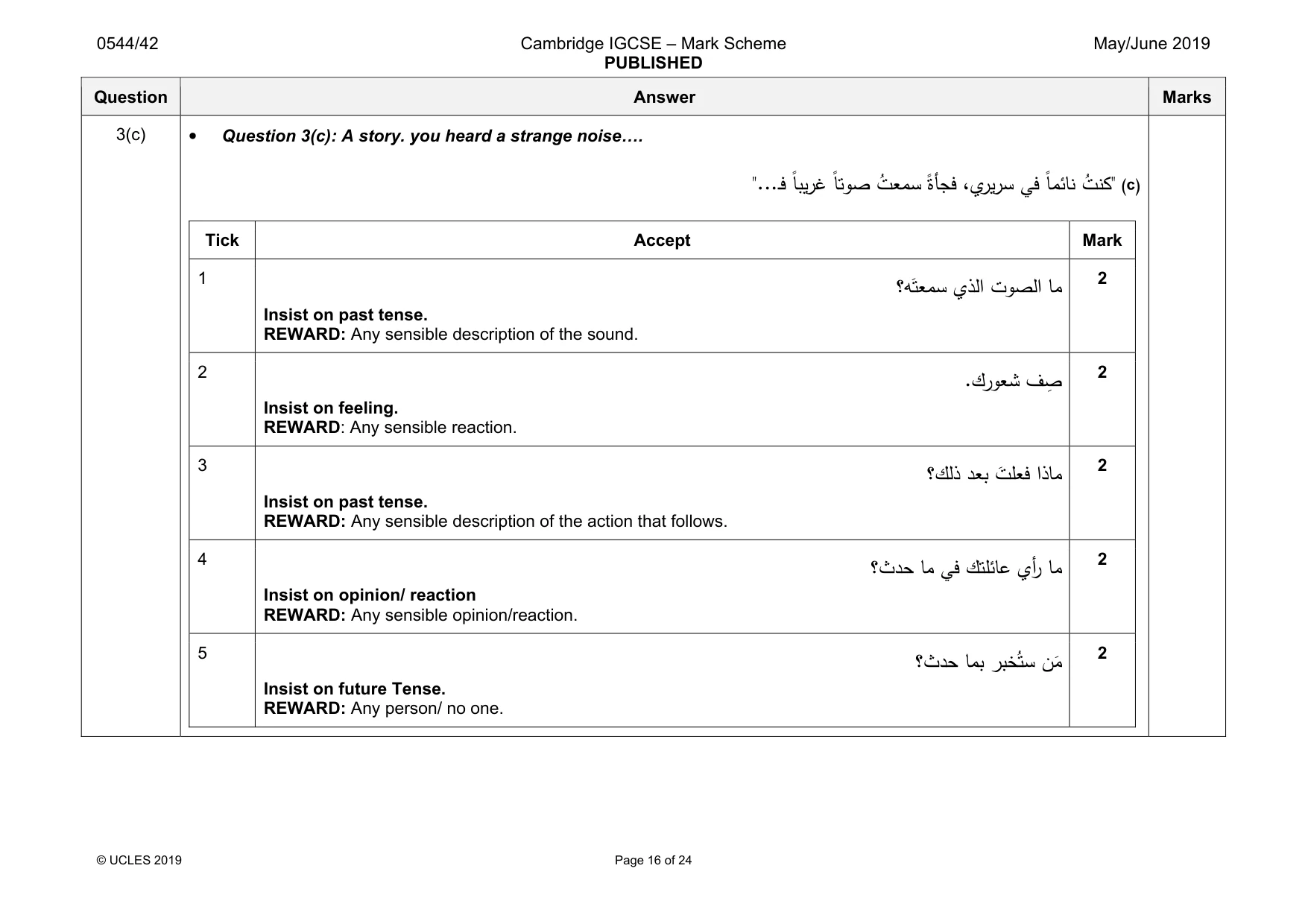
0544/42 Cambridge IGCSE – Mark Scheme PUBLISHED May/June 2019 © UCLES 2019 Page 16 of 24 Question Answer Marks 3(c) • Question 3(c): A story. you heard a strange noise«. ) c ( ʪƊƄ" ÆŕƈœŕƊ Ɠž Ŭ űƔ± Æ©ōŠž ʪŸƈŬ ÆŕśÃŰ ÆŕŗƔ±Ż "...»ž Tick Accept Mark 1 ŕƈ ªÃŰƅ§ Å°ƅ§ ƌÉśŸƈŬ Insist on past tense. REWARD: Any sensible description of the sound. 2 2 ¼ ËŰ .¾±ÃŸŮ Insist on feeling. REWARD: Any sensible reaction. 2 3 §°ŕƈ ɪƆŸž ¯Ÿŗ ¾ƅ° Insist on past tense. . follows hat t action the of escription d sensible Any REWARD: 2 4 ŕƈ Å£± ¾śƆœŕŷ Ɠž ŕƈ «¯ţ reaction opinion/ on Insist . opinion/reaction sensible Any REWARD: 2 5 ÁÉƈ ±ŗŦÊśŬ ŕƈŗ «¯ţ Insist on future Tense. REWARD: Any person/ no one. 2
Mark scheme, page 17
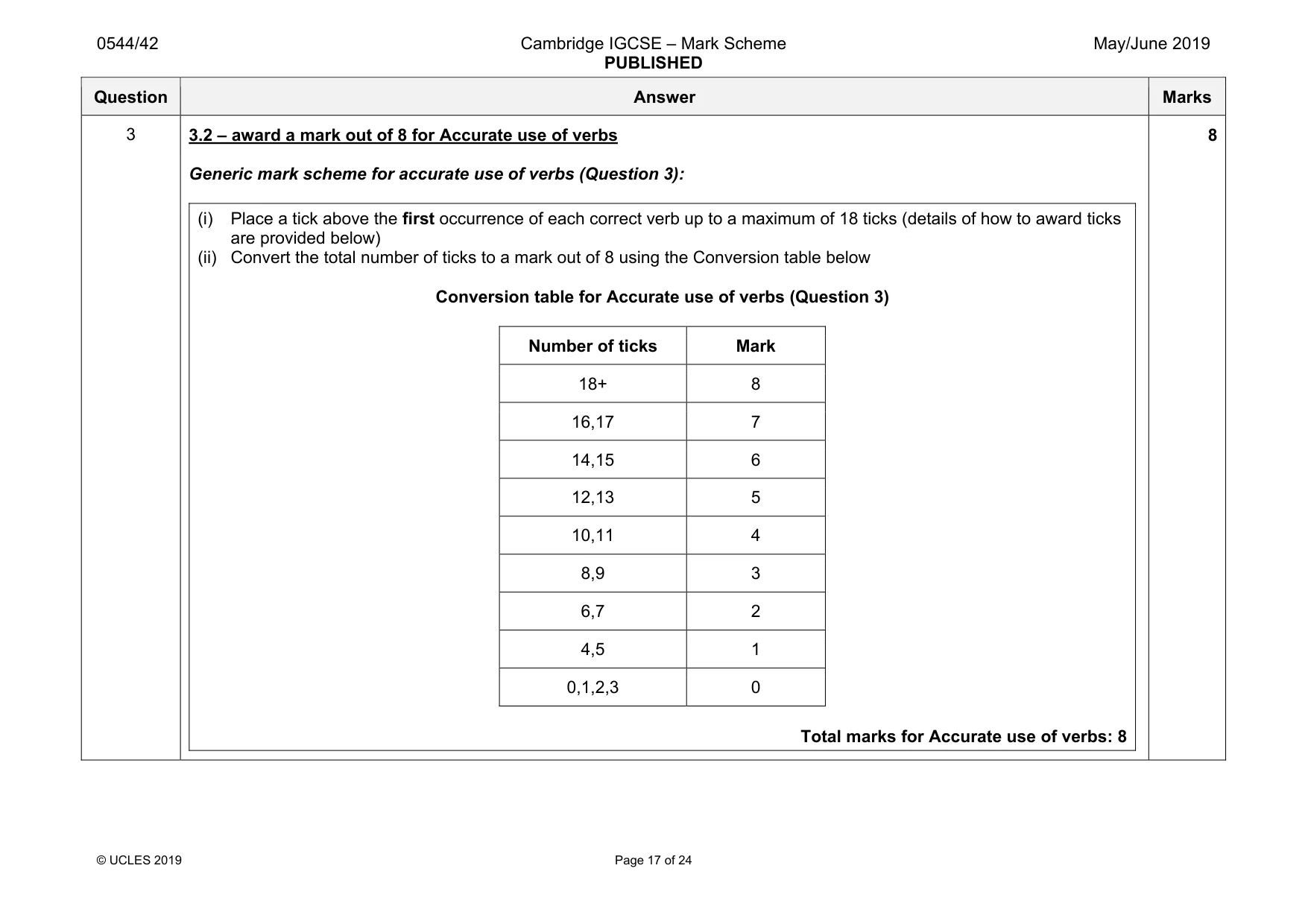
0544/42 Cambridge IGCSE – Mark Scheme PUBLISHED May/June 2019 © UCLES 2019 Page 17 of 24 Question Answer Marks 3 3.2 – award a mark out of 8 for Accurate use of verbs Generic mark scheme for accurate use of verbs (Question 3): (i) Place a tick above the first occurrence of each correct verb up to a maximum of 18 ticks (details of how to award ticks are provided below) (ii) Convert the total number of ticks to a mark out of 8 using the Conversion table below Conversion table for Accurate use of verbs (Question 3) Number of ticks Mark 18+ 8 16,17 7 14,15 6 12,13 5 10,11 4 8,9 3 6,7 2 4,5 1 0,1,2,3 0 Total marks for Accurate use of verbs: 8 8
Mark scheme, page 18
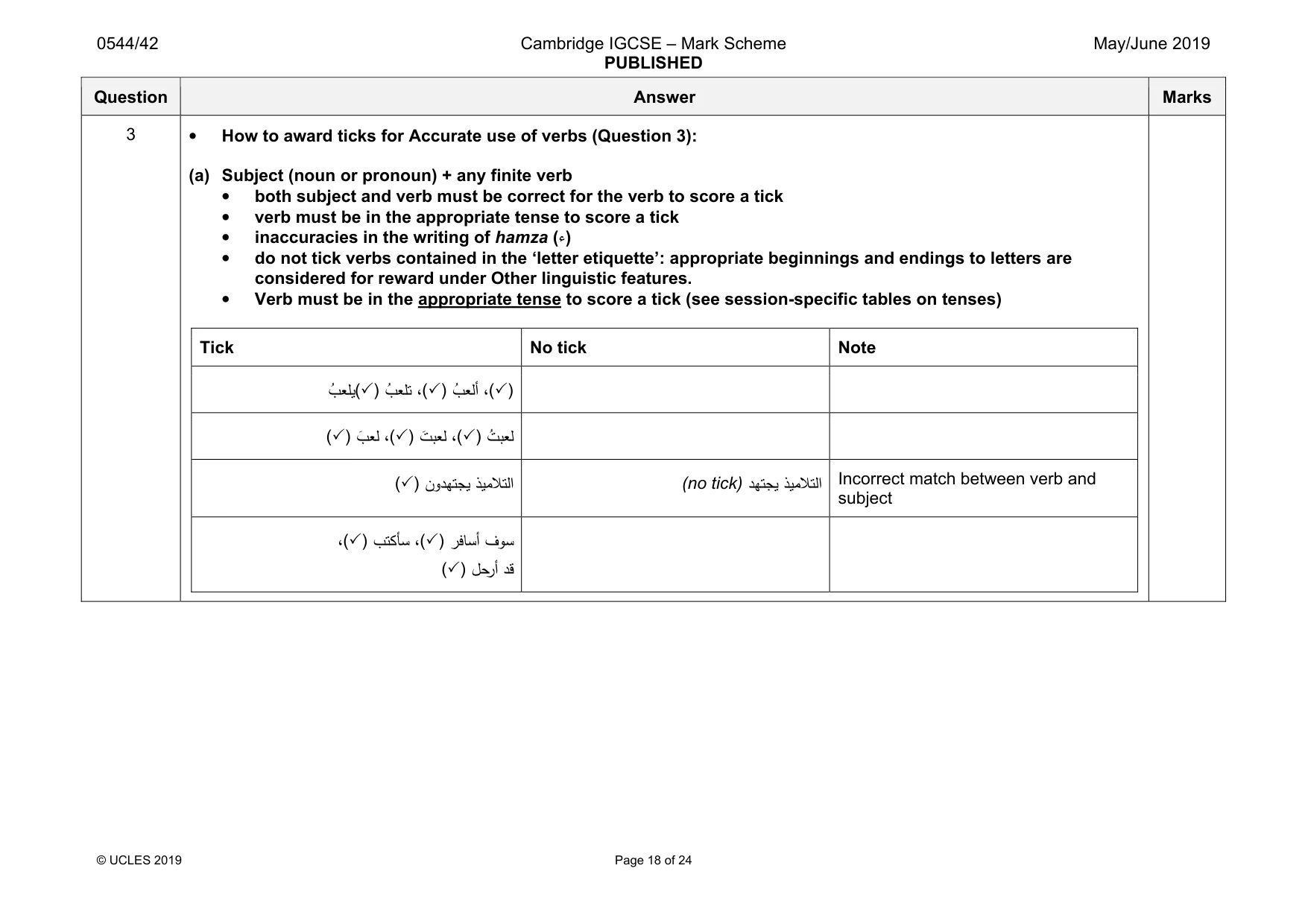
0544/42 Cambridge IGCSE – Mark Scheme PUBLISHED May/June 2019 © UCLES 2019 Page 18 of 24 Question Answer Marks 3 • How to award ticks for Accurate use of verbs (Question 3): (a) Subject (noun or pronoun) + any finite verb • both subject and verb must be correct for the verb to score a tick • verb must be in the appropriate tense to score a tick • inaccuracies in the writing of hamza ( )ء •do not tick verbs contained in the ‘letter etiquette’: appropriate beginnings and endings to letters are considered for reward under Other linguistic features. • Verb must be in the appropriate tense to score a tick (see session-specific tables on tenses) Tick No tick Note (3) ʨŸƅ£ (3) ʨŸƆś (3) ʨŸƆƔ ʪŗŸƅ (3) ɪŗŸƅ (3) ɨŸƅ (3) ÁïƎśŠƔ °ƔƈƜśƅ§ (3) ¯ƎśŠƔ °ƔƈƜśƅ§ (no tick) Incorrect match between verb and subject ±žŕŬ£ ¼ÃŬ (3) ¨śƄōŬ (3) ¿ţ±£ ¯Ɓ (3)
Mark scheme, page 19
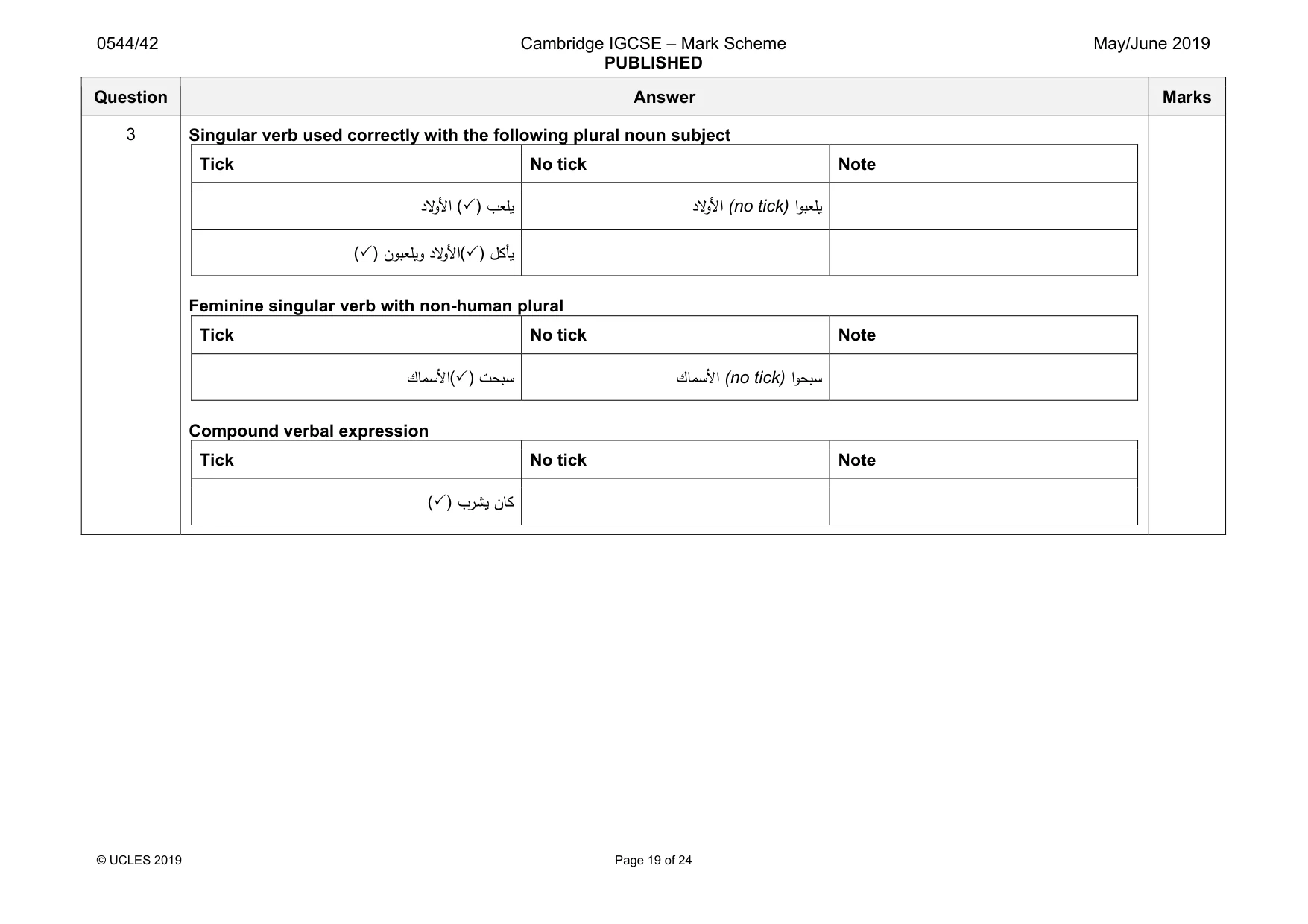
0544/42 Cambridge IGCSE – Mark Scheme PUBLISHED May/June 2019 © UCLES 2019 Page 19 of 24 Question Answer Marks 3 Singular verb used correctly with the following plural noun subject Tick No tick Note ¨ŸƆƔ (3) ¯ƛÃƗ§ §ÃŗŸƆƔ (no tick) ¯ƛÃƗ§ ¿ƄōƔ (3) ÁÃŗŸƆƔà ¯ƛÃƗ§ (3) Feminine singular verb with non-human plural Tick No tick Note ªţŗŬ (3) ¾ŕƈŬƗ§ §ÃţŗŬ (no tick) ¾ŕƈŬƗ§ Compound verbal expression Tick No tick Note ¨±ŮƔ ÁŕƄ (3)
Mark scheme, page 20
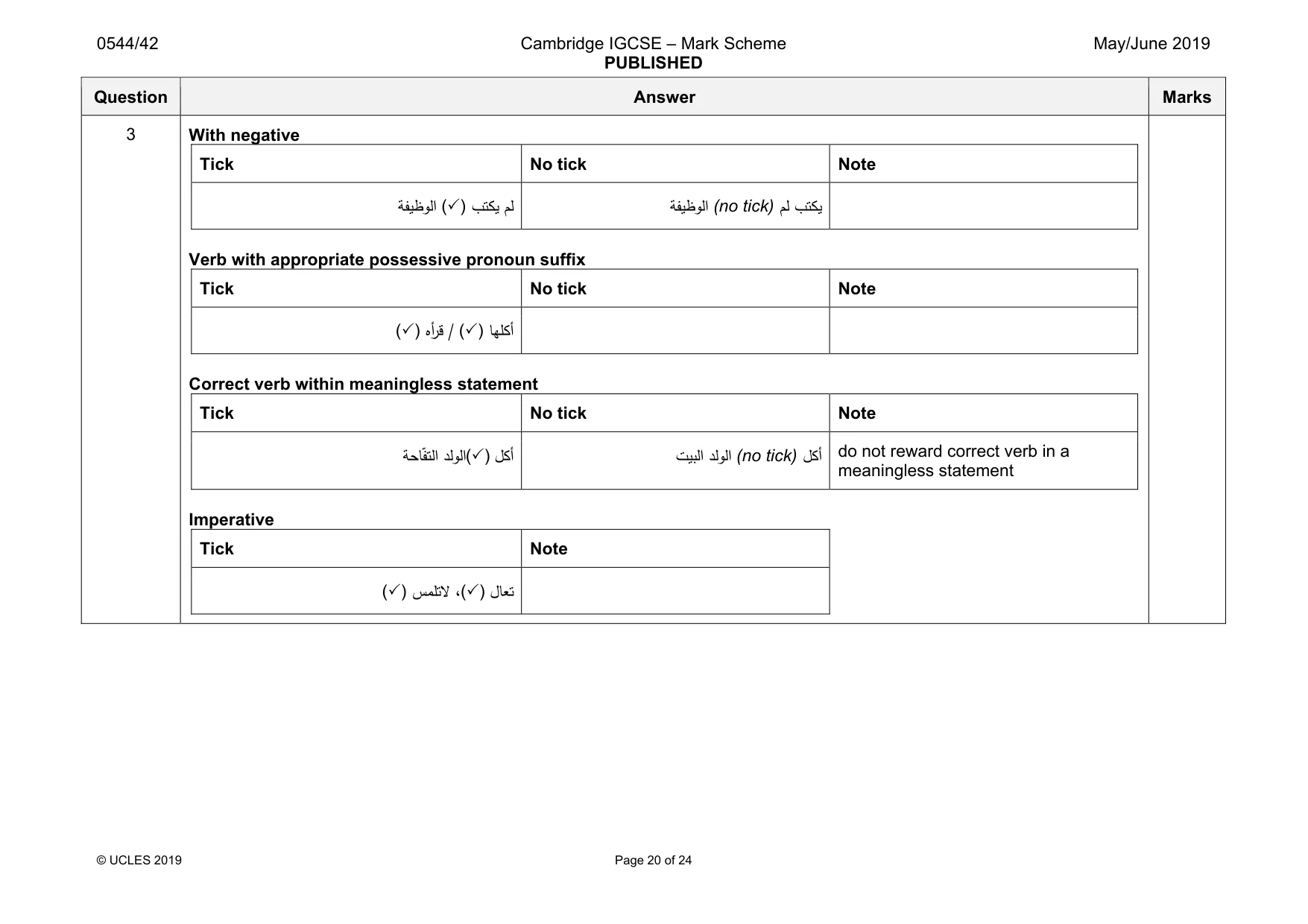
0544/42 Cambridge IGCSE – Mark Scheme PUBLISHED May/June 2019 © UCLES 2019 Page 20 of 24 Question Answer Marks 3 With negative Tick No tick Note ¨śƄƔ Àƅ (3) řſƔ¸Ãƅ§ Àƅ ¨śƄƔ (no tick) řſƔ¸Ãƅ§ Verb with appropriate possessive pronoun suffix Tick No tick Note ŕƎƆƄ£ (3) Ƌ£±Ɓ / (3) Correct verb within meaningless statement Tick No tick Note ¿Ƅ£ (3) řţŕÌſśƅ§ ¯ƅÃƅ§ ¿Ƅ£ (no tick) ªƔŗƅ§ ¯ƅÃƅ§ do not reward correct verb in a meaningless statement Imperative Tick Note ¿ŕŸś (3) ³ƈƆśƛ (3)
Mark scheme, page 21
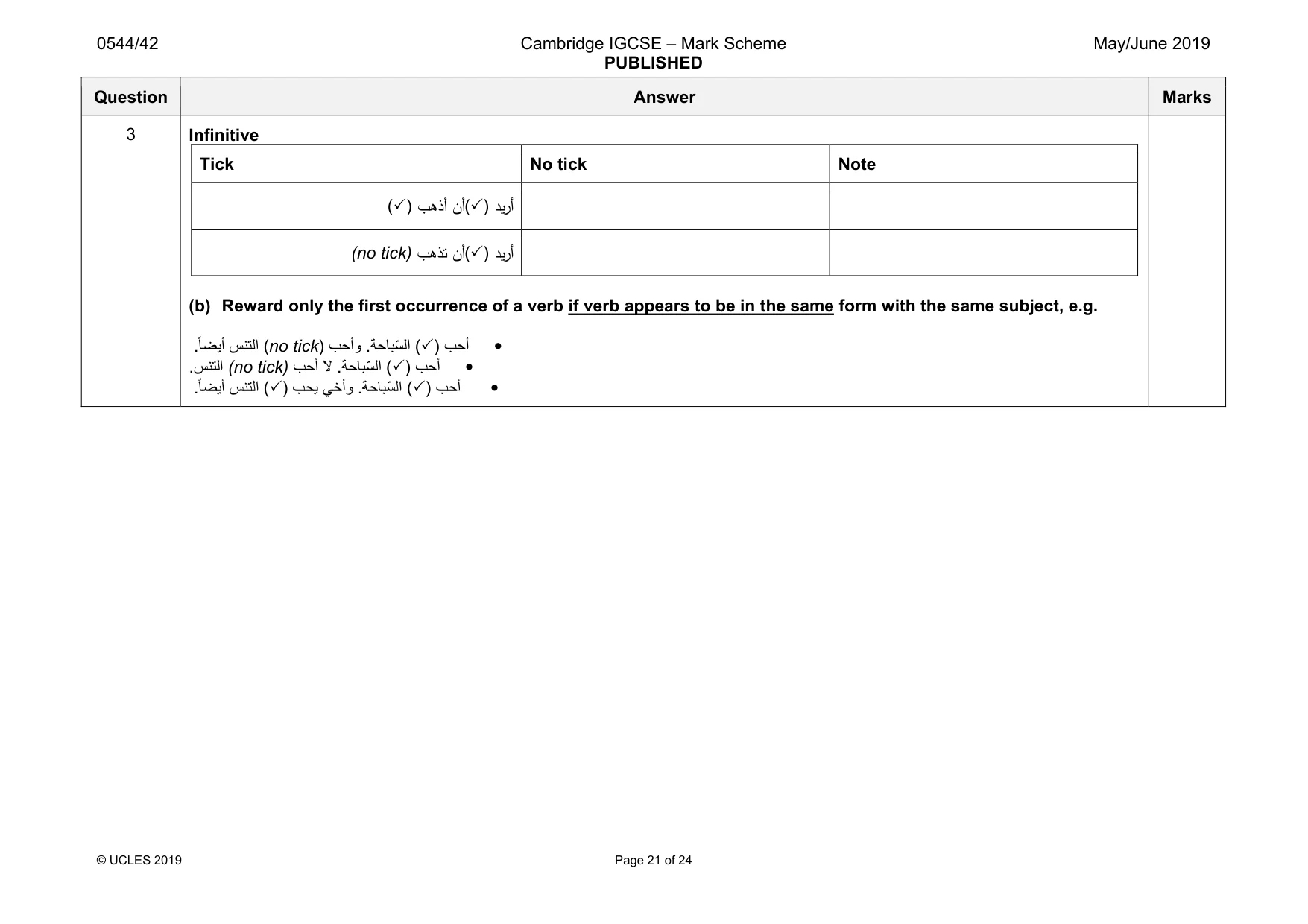
0544/42 Cambridge IGCSE – Mark Scheme PUBLISHED May/June 2019 © UCLES 2019 Page 21 of 24 Question Answer Marks 3 Infinitive Tick No tick Note ¯Ɣ±£ (3) ¨ƍ°£ Á£ (3) ¯Ɣ±£ (3) ¨ƍ°ś Á£ (no tick) (b) Reward only the first occurrence of a verb if verb appears to be in the same form with the same subject, e.g. • أحب )3( السّباحة. وأحب (no tick) .ًالتنس أيضا • أحب )3( السّباحة. ال أحب (no tick) التنس . • أحب )3( السّباحة. وأخي يحب )3( التنس أيضاً.
Mark scheme, page 22
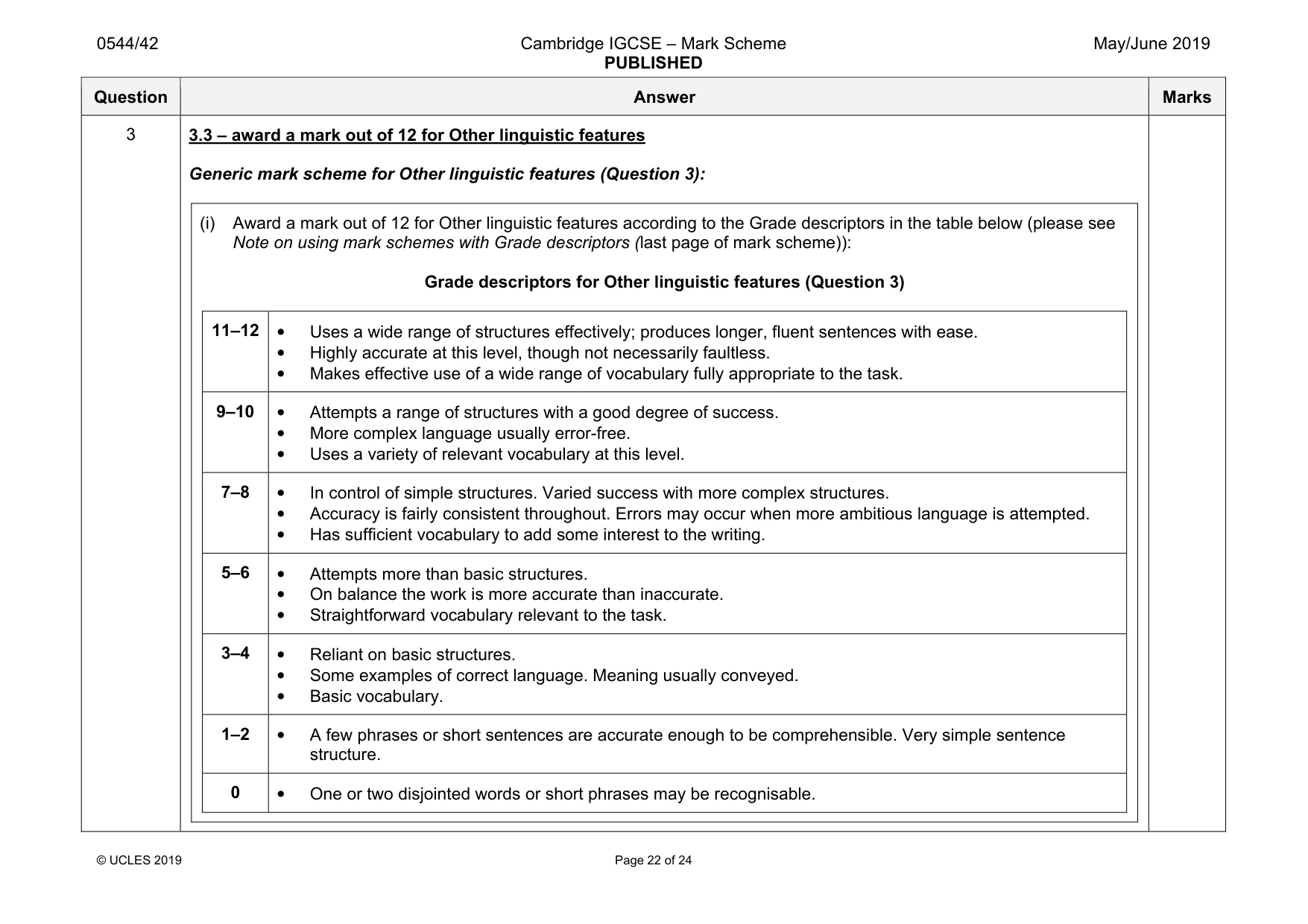
0544/42 Cambridge IGCSE – Mark Scheme PUBLISHED May/June 2019 © UCLES 2019 Page 22 of 24 Question Answer Marks 3 3.3 – award a mark out of 12 for Other linguistic features Generic mark scheme for Other linguistic features (Question 3): (i) Award a mark out of 12 for Other linguistic features according to the Grade descriptors in the table below (please see Note on using mark schemes with Grade descriptors (last page of mark scheme)): Grade descriptors for Other linguistic features (Question 3) 11–12 • Uses a wide range of structures effectively; produces longer, fluent sentences with ease. • Highly accurate at this level, though not necessarily faultless. • Makes effective use of a wide range of vocabulary fully appropriate to the task. 9–10 • Attempts a range of structures with a good degree of success. • More complex language usually error-free. • Uses a variety of relevant vocabulary at this level. 7–8 • In control of simple structures. Varied success with more complex structures. • Accuracy is fairly consistent throughout. Errors may occur when more ambitious language is attempted. • Has sufficient vocabulary to add some interest to the writing. 5–6 • Attempts more than basic structures. • On balance the work is more accurate than inaccurate. • Straightforward vocabulary relevant to the task. 3–4 • Reliant on basic structures. • Some examples of correct language. Meaning usually conveyed. • Basic vocabulary. 1–2 • A few phrases or short sentences are accurate enough to be comprehensible. Very simple sentence structure. 0 • One or two disjointed words or short phrases may be recognisable.
Mark scheme, page 23
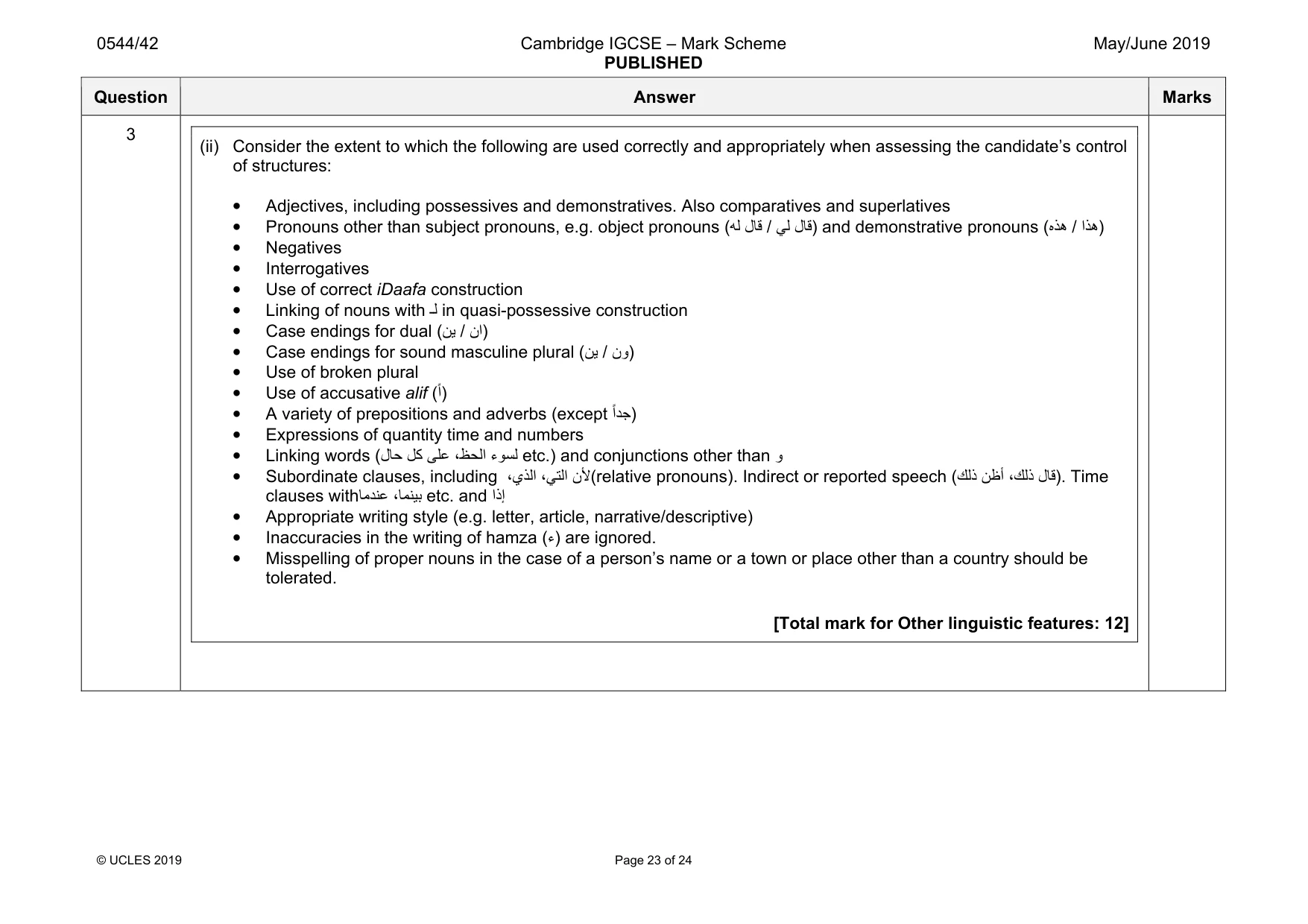
0544/42 Cambridge IGCSE – Mark Scheme PUBLISHED May/June 2019 © UCLES 2019 Page 23 of 24 Question Answer Marks 3 (ii) Consider the extent to which the following are used correctly and appropriately when assessing the candidate’s control of structures: • Adjectives, including possessives and demonstratives. Also comparatives and superlatives • Pronouns other than subject pronouns, e.g. object pronouns (قال ل ي / قال له )and demonstrative pronouns ( )ھذا / ھذه •Negatives • Interrogatives • Use of correct iDaafa construction • Linking of nouns with لـin quasi-possessive construction • Case endings for dual ( )ان / ين •Case endings for sound masculine plural ( )ون / ين •Use of broken plural • Use of accusative alif ( ً )ا •A variety of prepositions and adverbs (except ً )جدا •Expressions of quantity time and numbers • Linking words ( لسوء الحظ، على كل حالetc.) and conjunctions other than و •Subordinate clauses, including ألن التي، الذي ، (relative pronouns). Indirect or reported speech ( .)قال ذلك، أظن ذلكTime clauses with بينما، عندماetc. and إذا •Appropriate writing style (e.g. letter, article, narrative/descriptive) • Inaccuracies in the writing of hamza ( )ءare ignored. • Misspelling of proper nouns in the case of a person’s name or a town or place other than a country should be tolerated. [Total mark for Other linguistic features: 12]
Mark scheme, page 24
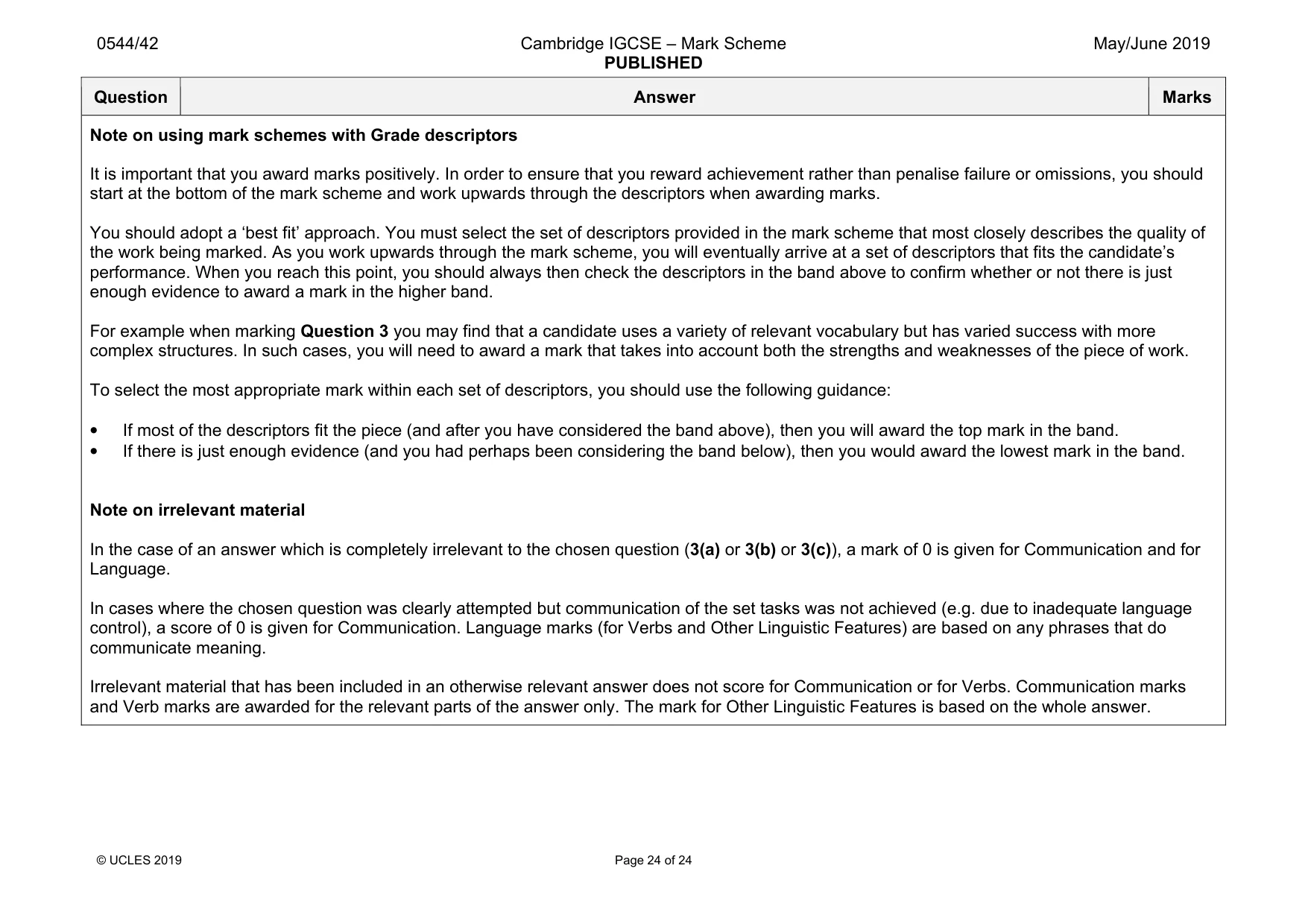
0544/42 Cambridge IGCSE – Mark Scheme PUBLISHED May/June 2019 © UCLES 2019 Page 24 of 24 Question Answer Marks Note on using mark schemes with Grade descriptors It is important that you award marks positively. In order to ensure that you reward achievement rather than penalise failure or omissions, you should start at the bottom of the mark scheme and work upwards through the descriptors when awarding marks. You should adopt a ‘best fit’ approach. You must select the set of descriptors provided in the mark scheme that most closely describes the quality of the work being marked. As you work upwards through the mark scheme, you will eventually arrive at a set of descriptors that fits the candidate’s performance. When you reach this point, you should always then check the descriptors in the band above to confirm whether or not there is just enough evidence to award a mark in the higher band. For example when marking Question 3 you may find that a candidate uses a variety of relevant vocabulary but has varied success with more complex structures. In such cases, you will need to award a mark that takes into account both the strengths and weaknesses of the piece of work. To select the most appropriate mark within each set of descriptors, you should use the following guidance: • If most of the descriptors fit the piece (and after you have considered the band above), then you will award the top mark in the band. • If there is just enough evidence (and you had perhaps been considering the band below), then you would award the lowest mark in the band. Note on irrelevant material In the case of an answer which is completely irrelevant to the chosen question (3(a) or 3(b) or 3(c)), a mark of 0 is given for Communication and for Language. In cases where the chosen question was clearly attempted but communication of the set tasks was not achieved (e.g. due to inadequate language control), a score of 0 is given for Communication. Language marks (for Verbs and Other Linguistic Features) are based on any phrases that do communicate meaning. Irrelevant material that has been included in an otherwise relevant answer does not score for Communication or for Verbs. Communication marks and Verb marks are awarded for the relevant parts of the answer only. The mark for Other Linguistic Features is based on the whole answer.
What you needed in this session
Cambridge’s own grade thresholds for 2019 May/June, Paper 4 · Variant 2. A higher threshold means an easier paper — the bar moves with how the cohort did.