Cambridge IGCSE Accounting (9-1) 0985 — 2025 May/June Paper 1 · Variant 1
0985/11/M/J/25 · 35 questions · 35 marks · ≈39 min
The question paper and its mark scheme, free to read here and free to download. This is Cambridge’s own paper, exactly as it was sat.
Question paper16 pages


Mark scheme3 pages
Answers below. Sit the paper first if you are practising.
Questions as text
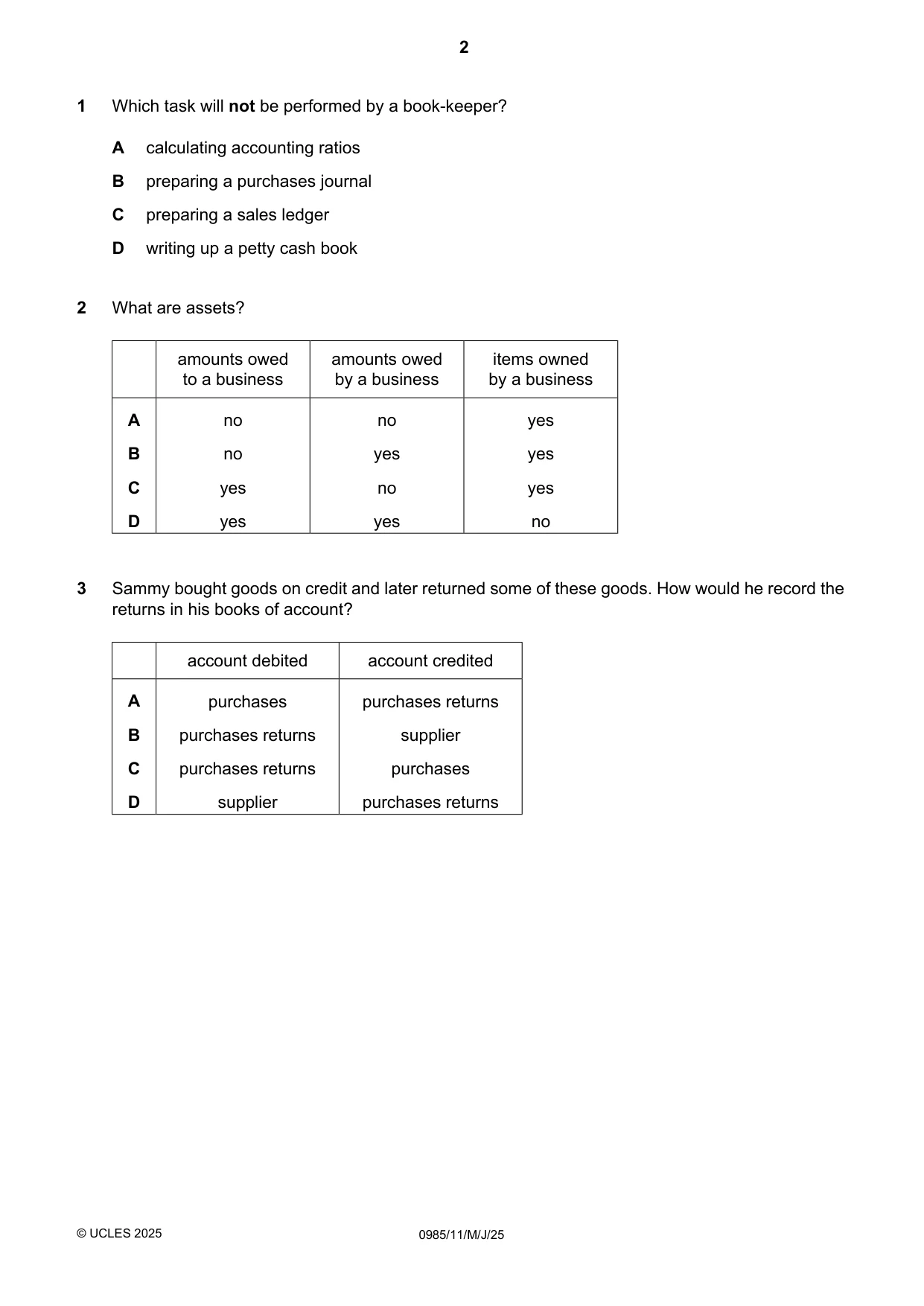
Q1 · Which task will not be performed by a book-keeper?
1 Which task will not be performed by a book-keeper? A calculating accounting ratios B preparing a purchases journal C preparing a sales ledger D writing up a petty cash book
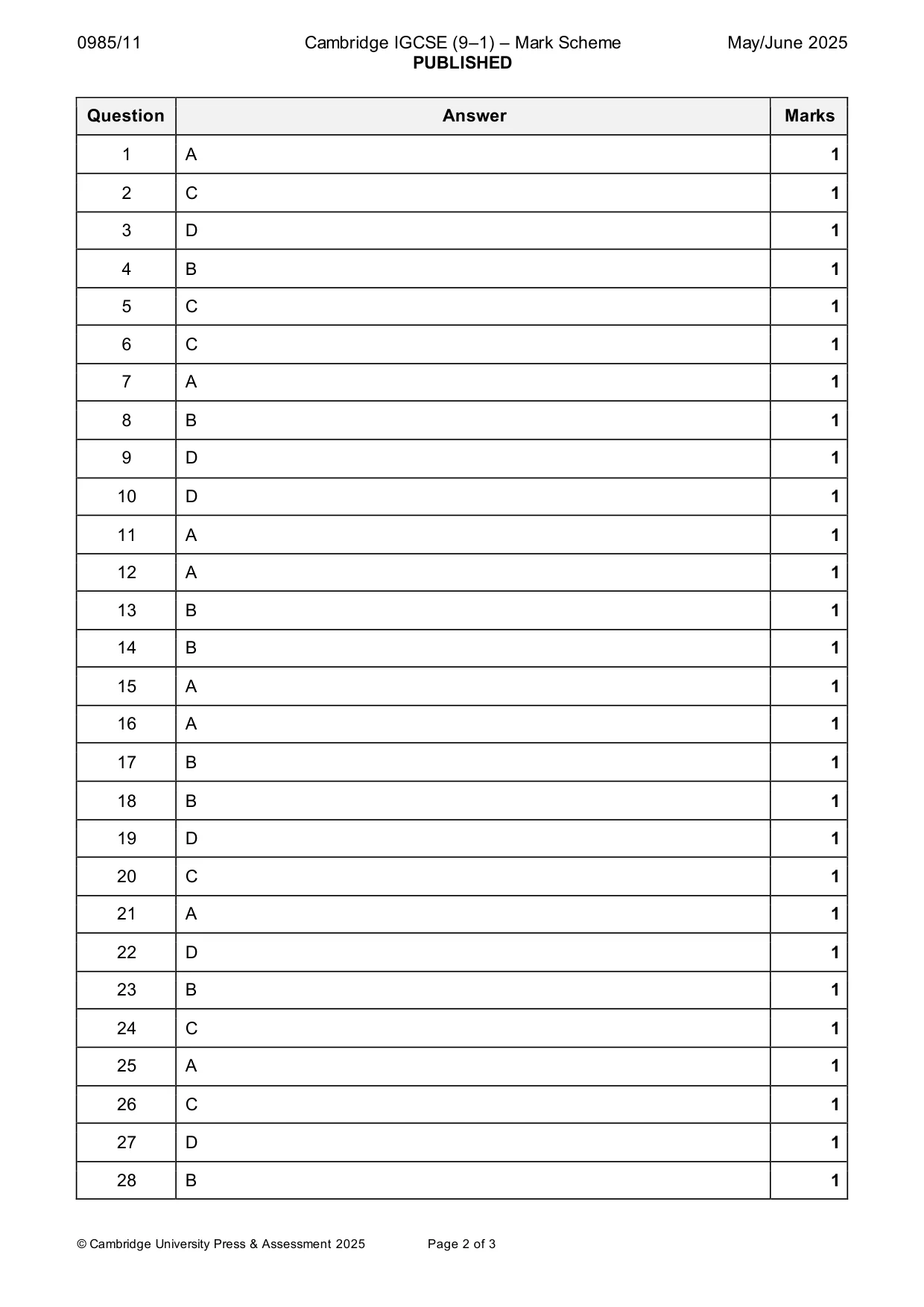
Mark scheme: A
Question 2
2 What are assets? amounts owed amounts owed items owned to a business by a business by a business A no no yes B no yes yes C yes no yes D yes yes no
Mark scheme: C
Q3 · Sammy bought goods on credit and later returned some of these goods
3 Sammy bought goods on credit and later returned some of these goods. How would he record the returns in his books of account? account debited account credited A purchases purchases returns B purchases returns supplier C purchases returns purchases D supplier purchases returns
Mark scheme: D
Q4 · An account in Peter’s books of account was as follows: Rami $ $ bank 380 balance b/d 400…
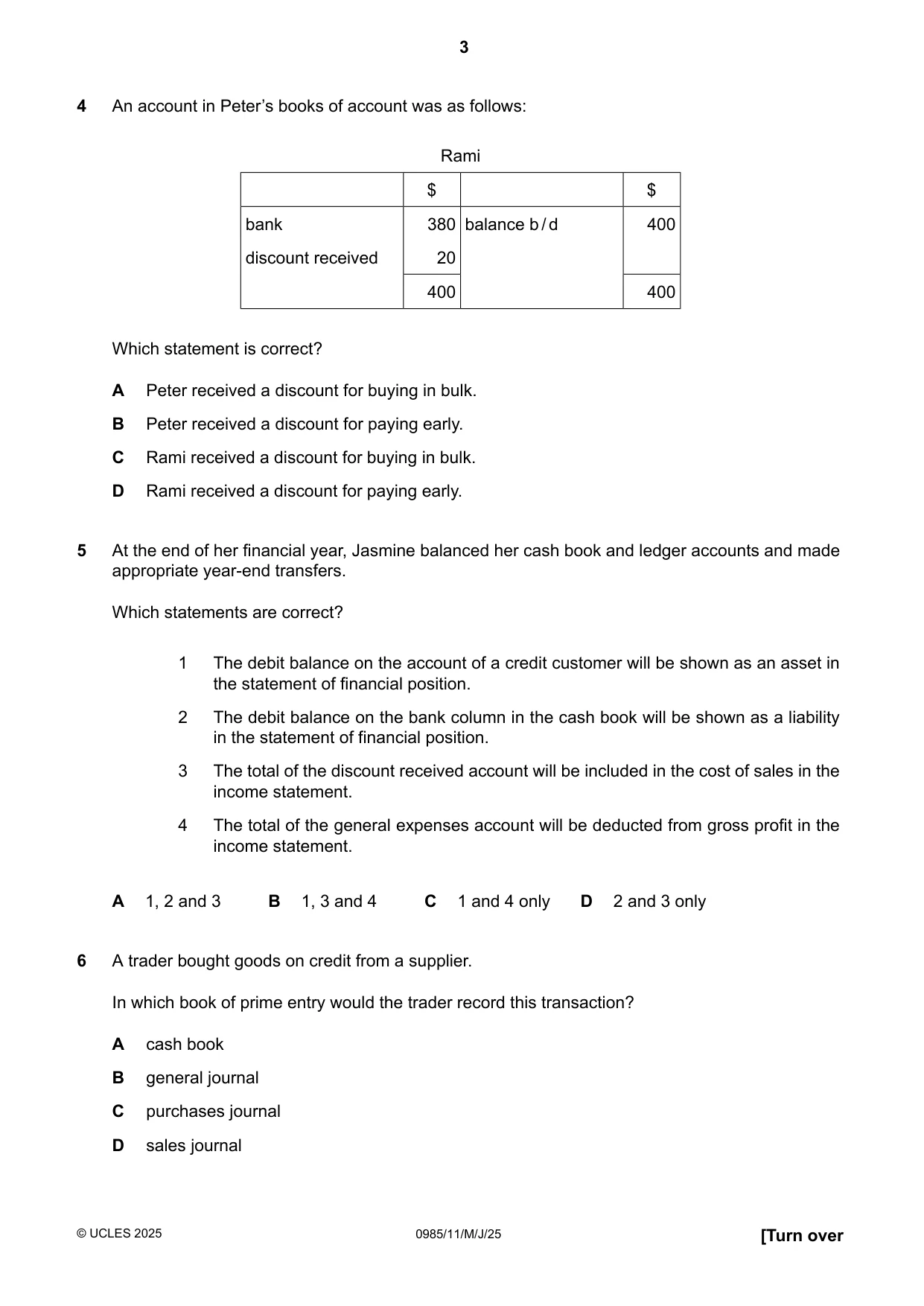
4 An account in Peter’s books of account was as follows: Rami $ $ bank 380 balance b/d 400 discount received 20 400 400 Which statement is correct? A Peter received a discount for buying in bulk. B Peter received a discount for paying early. C Rami received a discount for buying in bulk. D Rami received a discount for paying early.
Mark scheme: B
Q5 · At the end of her financial year, Jasmine balanced her cash book and ledger accounts and…
5 At the end of her financial year, Jasmine balanced her cash book and ledger accounts and made appropriate year-end transfers. Which statements are correct? 1 The debit balance on the account of a credit customer will be shown as an asset in the statement of financial position. 2 The debit balance on the bank column in the cash book will be shown as a liability in the statement of financial position. 3 The total of the discount received account will be included in the cost of sales in the income statement. 4 The total of the general expenses account will be deducted from gross profit in the income statement. A 1, 2 and 3 B 1, 3 and 4 C 1 and 4 only D 2 and 3 only
Mark scheme: C
Q6 · A trader bought goods on credit from a supplier
6 A trader bought goods on credit from a supplier. In which book of prime entry would the trader record this transaction? A cash book B general journal C purchases journal D sales journal
Mark scheme: C
Q7 · Which account balance will appear in the debit column of a trial balance?
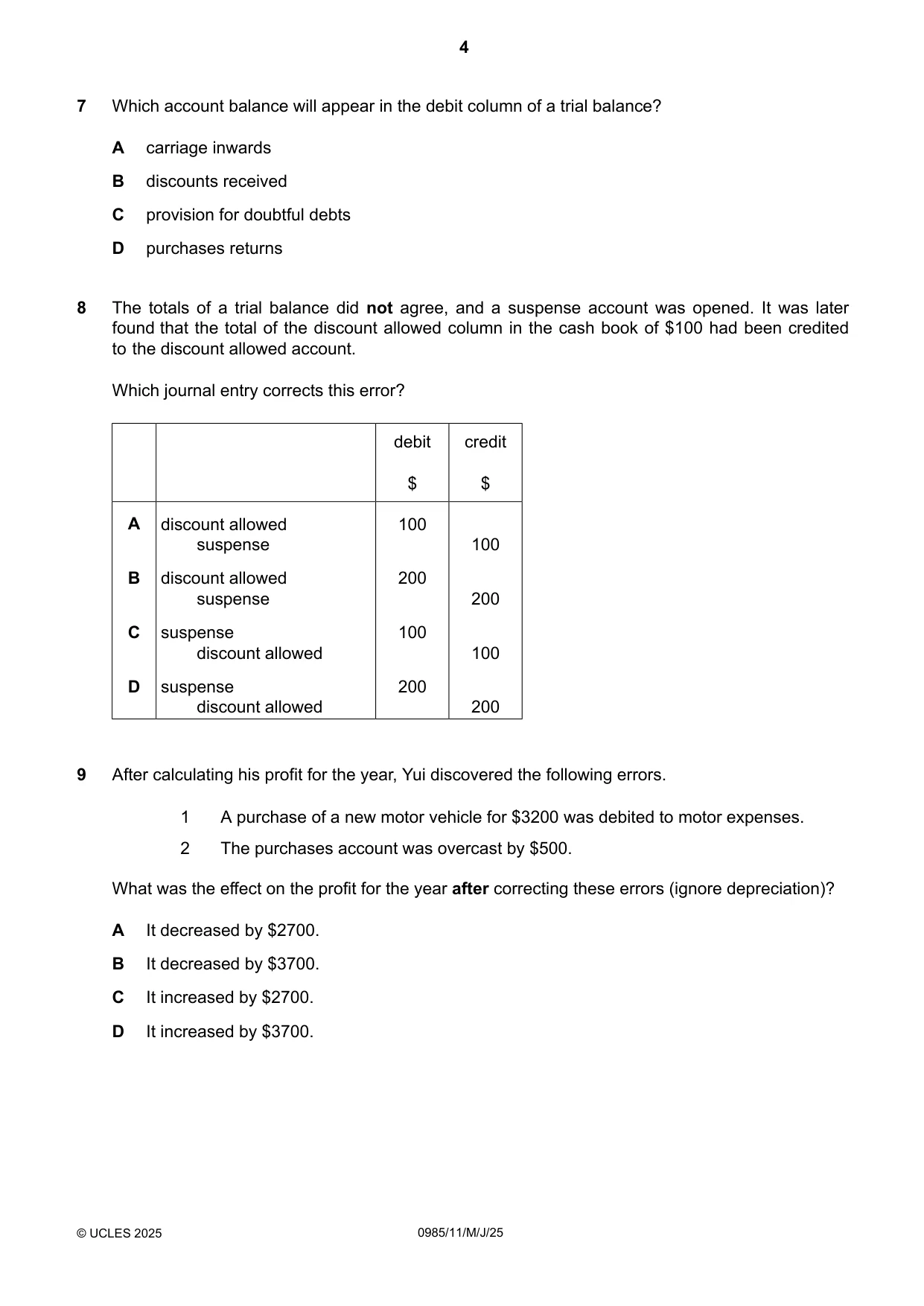
7 Which account balance will appear in the debit column of a trial balance? A carriage inwards B discounts received C provision for doubtful debts D purchases returns
Mark scheme: A
Q8 · The totals of a trial balance did not agree, and a suspense account was opened
8 The totals of a trial balance did not agree, and a suspense account was opened. It was later found that the total of the discount allowed column in the cash book of $100 had been credited to the discount allowed account. Which journal entry corrects this error? debit credit $ $ A discount allowed 100 suspense 100 B discount allowed 200 suspense 200 C suspense 100 discount allowed 100 D suspense 200 discount allowed 200
Mark scheme: B
Q9 · After calculating his profit for the year, Yui discovered the following errors
9 After calculating his profit for the year, Yui discovered the following errors. 1 A purchase of a new motor vehicle for $3200 was debited to motor expenses. 2 The purchases account was overcast by $500. What was the effect on the profit for the year after correcting these errors (ignore depreciation)? A It decreased by $2700. B It decreased by $3700. C It increased by $2700. D It increased by $3700.
Mark scheme: D
Q10 · Jerry received a cheque of $450 from Fatima
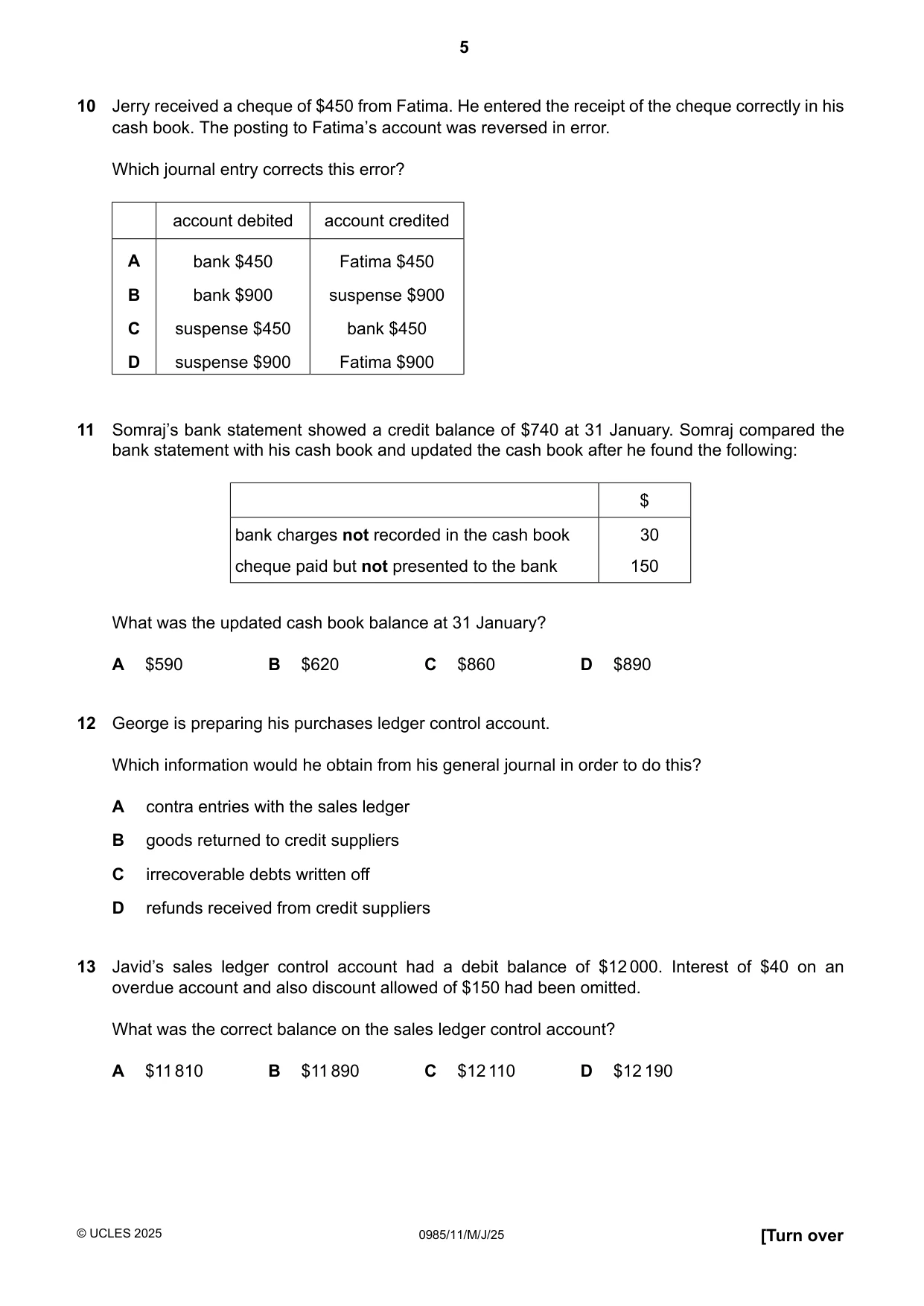
10 Jerry received a cheque of $450 from Fatima. He entered the receipt of the cheque correctly in his cash book. The posting to Fatima’s account was reversed in error. Which journal entry corrects this error? account debited account credited A bank $450 Fatima $450 B bank $900 suspense $900 C suspense $450 bank $450 D suspense $900 Fatima $900
Mark scheme: D
Q11 · Somraj’s bank statement showed a credit balance of $740 at 31 January
11 Somraj’s bank statement showed a credit balance of $740 at 31 January. Somraj compared the bank statement with his cash book and updated the cash book after he found the following: $ bank charges not recorded in the cash book 30 cheque paid but not presented to the bank 150 What was the updated cash book balance at 31 January? A $590 B $620 C $860 D $890
Mark scheme: A
Q12 · George is preparing his purchases ledger control account
12 George is preparing his purchases ledger control account. Which information would he obtain from his general journal in order to do this? A contra entries with the sales ledger B goods returned to credit suppliers C irrecoverable debts written off D refunds received from credit suppliers
Mark scheme: A
Q13 · Javid’s sales ledger control account had a debit balance of $12000
13 Javid’s sales ledger control account had a debit balance of $12000. Interest of $40 on an overdue account and also discount allowed of $150 had been omitted. What was the correct balance on the sales ledger control account? A $11810 B $11890 C $12110 D $12190
Mark scheme: B
Q14 · What is the effect of incorrectly treating expenses as capital expenditure?
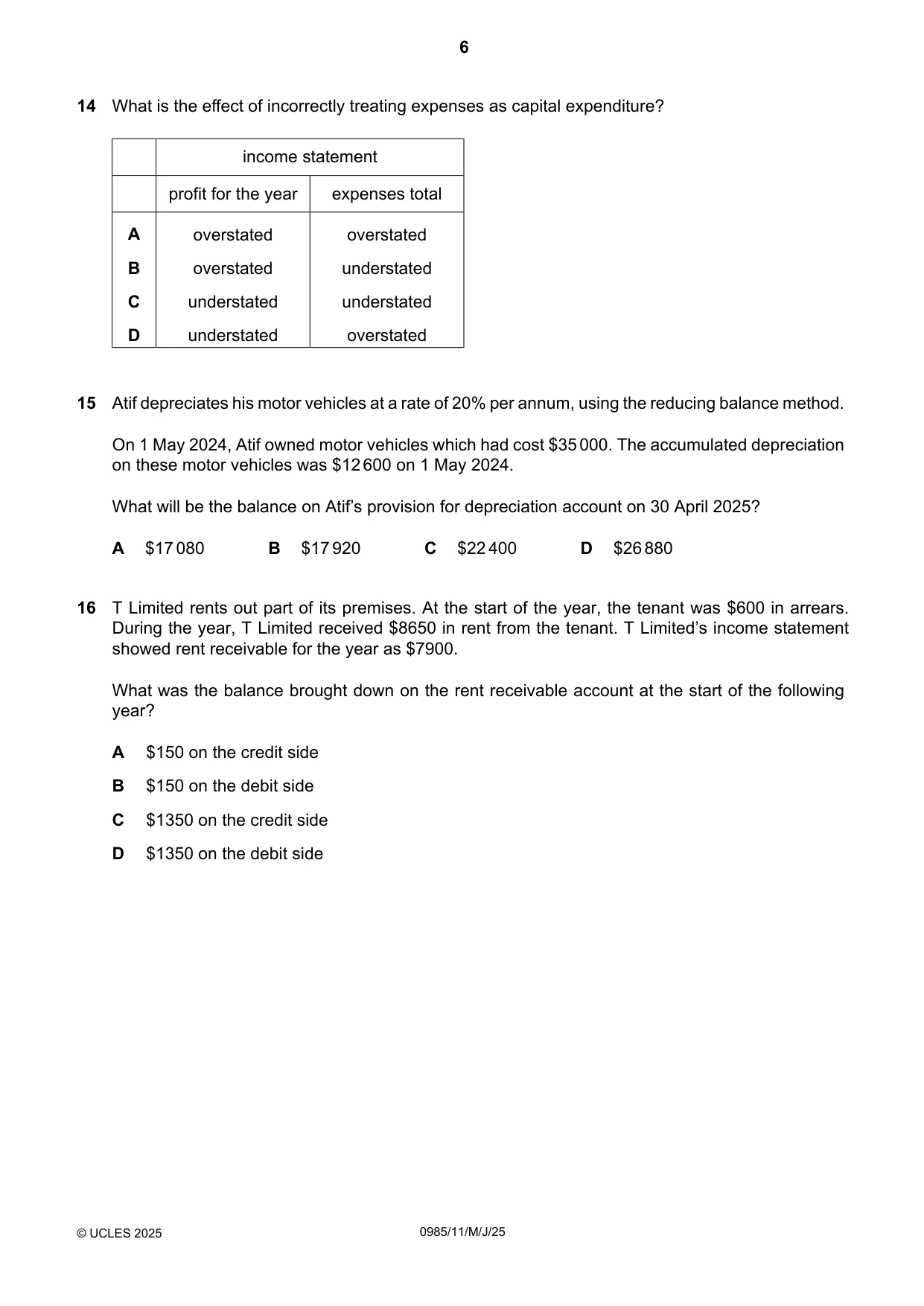
14 What is the effect of incorrectly treating expenses as capital expenditure? income statement profit for the year expenses total A overstated overstated B overstated understated C understated understated D understated overstated
Mark scheme: B
More questions on Capital and revenue expenditure and receipts
Q15 · Atif depreciates his motor vehicles at a rate of 20% per annum, using the reducing…
15 Atif depreciates his motor vehicles at a rate of 20% per annum, using the reducing balance method. On 1 May 2024, Atif owned motor vehicles which had cost $35 000. The accumulated depreciation on these motor vehicles was $12 600 on 1 May 2024. What will be the balance on Atif’s provision for depreciation account on 30 April 2025? A $17 080 B $17 920 C $22 400 D $26 880
Mark scheme: A
More questions on Accounting for depreciation and disposal of non-current assets
Q16 · T Limited rents out part of its premises
16 T Limited rents out part of its premises. At the start of the year, the tenant was $600 in arrears. During the year, T Limited received $8650 in rent from the tenant. T Limited’s income statement showed rent receivable for the year as $7900. What was the balance brought down on the rent receivable account at the start of the following year? A $150 on the credit side B $150 on the debit side C $1350 on the credit side D $1350 on the debit side
Mark scheme: A
Q17 · A provision for doubtful debts of 5% of trade receivables is maintained
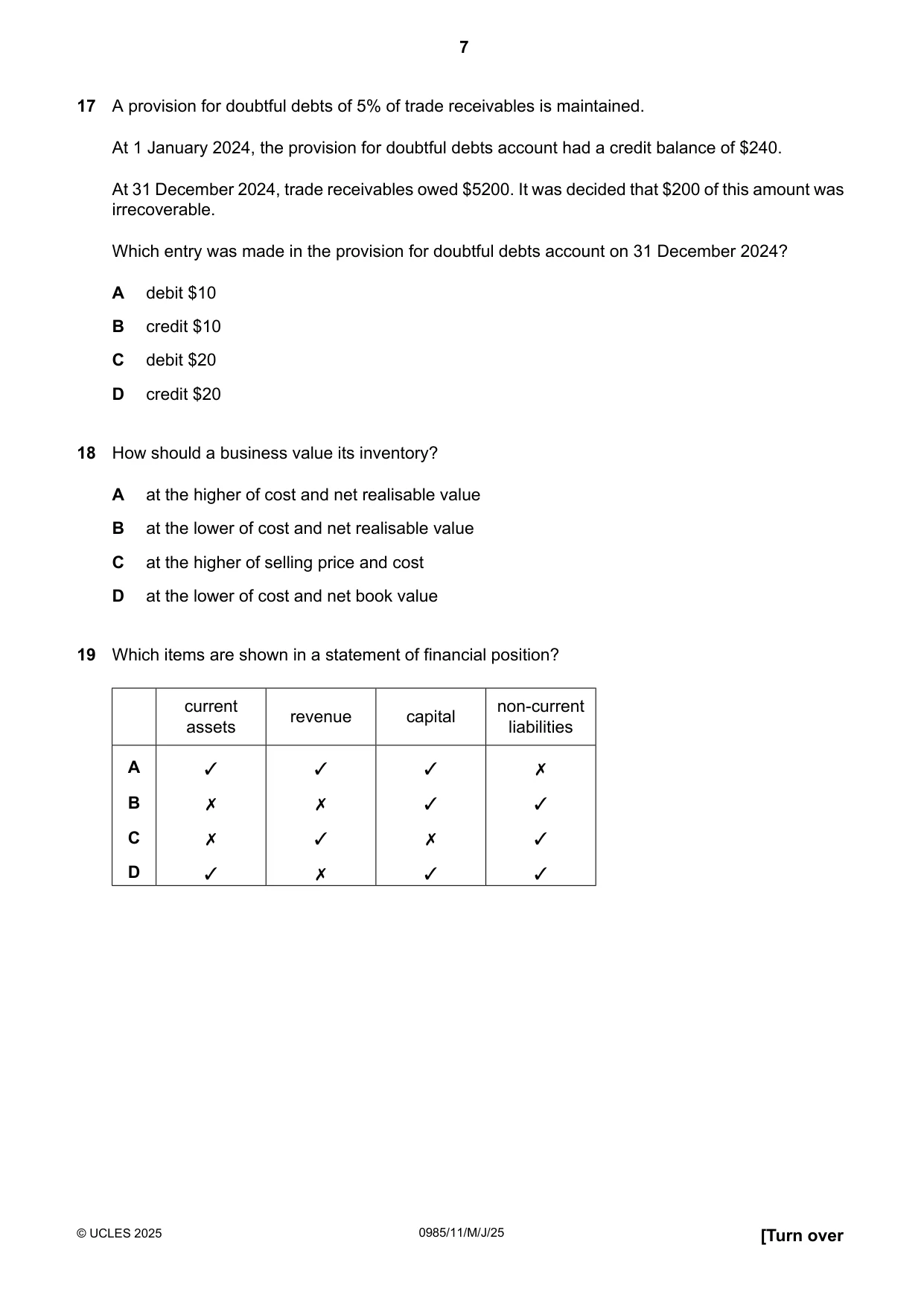
17 A provision for doubtful debts of 5% of trade receivables is maintained. At 1 January 2024, the provision for doubtful debts account had a credit balance of $240. At 31 December 2024, trade receivables owed $5200. It was decided that $200 of this amount was irrecoverable. Which entry was made in the provision for doubtful debts account on 31 December 2024? A debit $10 B credit $10 C debit $20 D credit $20
Mark scheme: B
More questions on Irrecoverable debts and allowance for irrecoverable debts
Q18 · How should a business value its inventory?
18 How should a business value its inventory? A at the higher of cost and net realisable value B at the lower of cost and net realisable value C at the higher of selling price and cost D at the lower of cost and net book value
Mark scheme: B
Q19 · Which items are shown in a statement of financial position?
19 Which items are shown in a statement of financial position? current non-current revenue capital assets liabilities A ✓ ✓ ✓ ✗ B ✗ ✗ ✓ ✓ C ✗ ✓ ✗ ✓ D ✓ ✗ ✓ ✓
Mark scheme: D
Q20 · A business provided the following information about two expenses
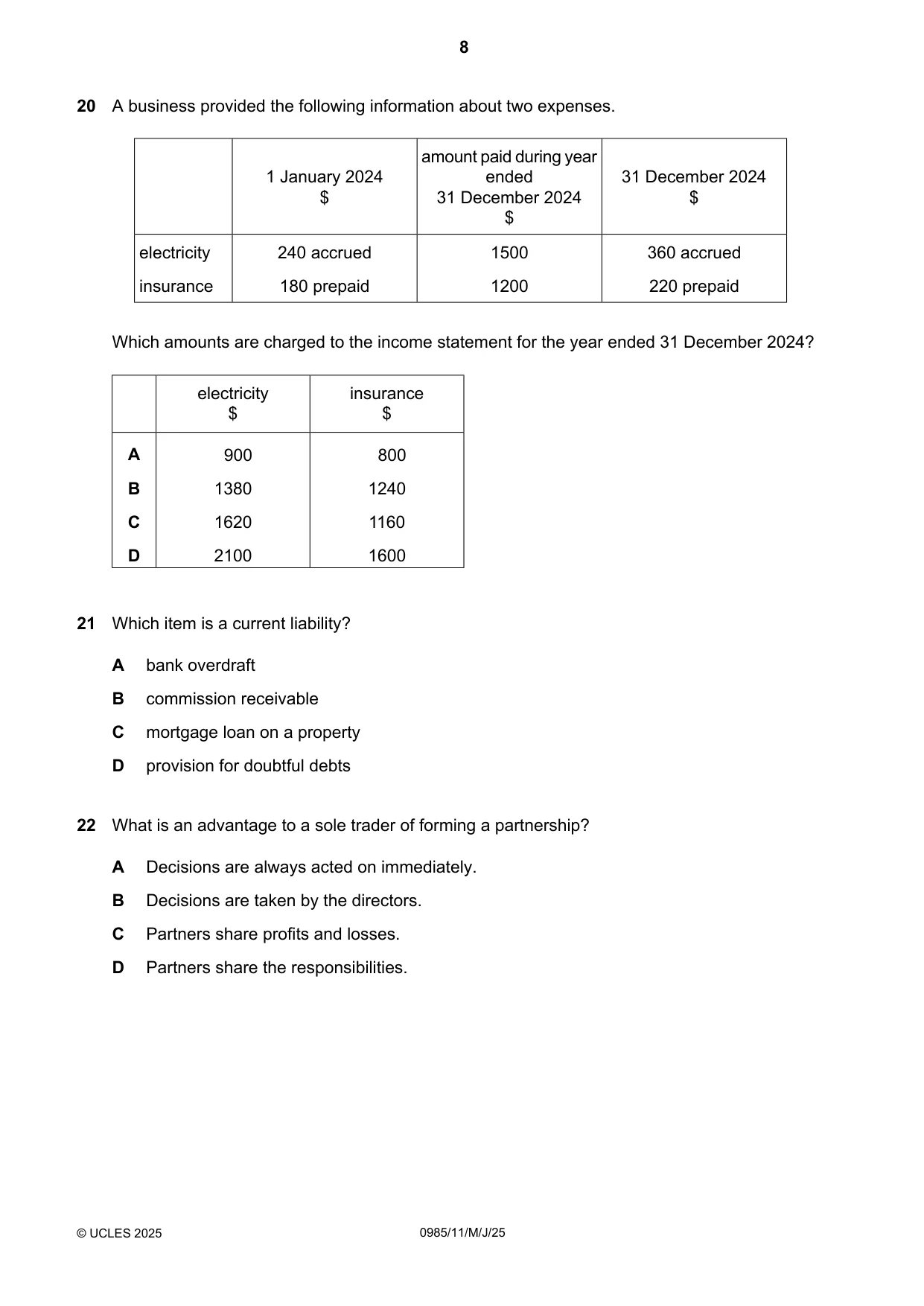
20 A business provided the following information about two expenses. amount paid during year 1 January 2024 ended 31 December 2024 $ 31 December 2024 $ $ electricity 240 accrued 1500 360 accrued insurance 180 prepaid 1200 220 prepaid Which amounts are charged to the income statement for the year ended 31 December 2024? electricity insurance $ $ A 900 800 B 1380 1240 C 1620 1160 D 2100 1600
Mark scheme: C
Q21 · Which item is a current liability?
21 Which item is a current liability? A bank overdraft B commission receivable C mortgage loan on a property D provision for doubtful debts
Mark scheme: A
Q22 · What is an advantage to a sole trader of forming a partnership?
22 What is an advantage to a sole trader of forming a partnership? A Decisions are always acted on immediately. B Decisions are taken by the directors. C Partners share profits and losses. D Partners share the responsibilities.
Mark scheme: D
Q23 · Which statements are correct in relation to the financial statements of a partnership?
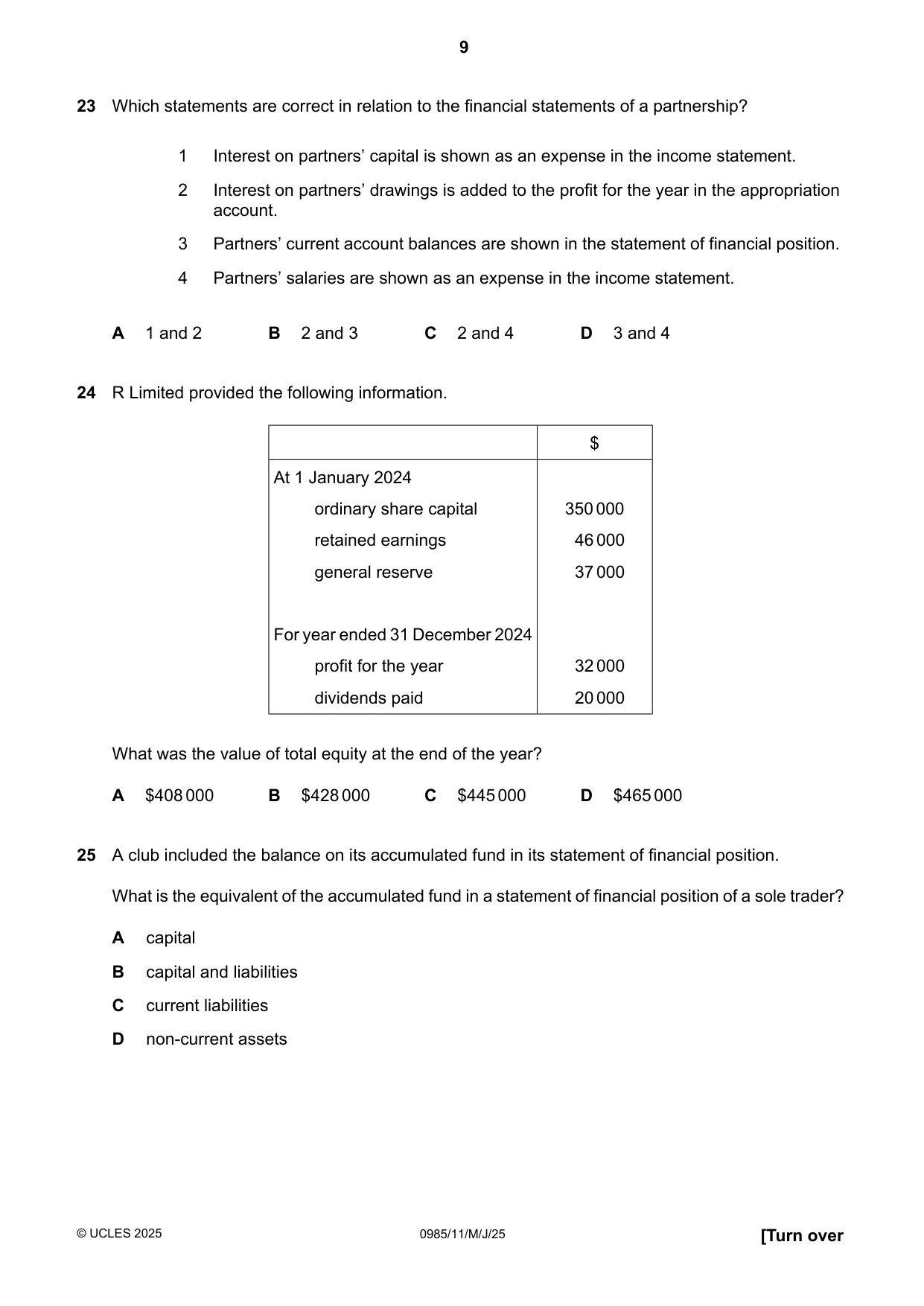
23 Which statements are correct in relation to the financial statements of a partnership? 1 Interest on partners’ capital is shown as an expense in the income statement. 2 Interest on partners’ drawings is added to the profit for the year in the appropriation account. 3 Partners’ current account balances are shown in the statement of financial position. 4 Partners’ salaries are shown as an expense in the income statement. A 1 and 2 B 2 and 3 C 2 and 4 D 3 and 4
Mark scheme: B
Q24 · R Limited provided the following information
24 R Limited provided the following information. $ At 1 January 2024 ordinary share capital 350000 retained earnings 46000 general reserve 37000 For year ended 31 December 2024 profit for the year 32000 dividends paid 20000 What was the value of total equity at the end of the year? A $408000 B $428000 C $445000 D $465000
Mark scheme: C
Q25 · A club included the balance on its accumulated fund in its statement of financial position
25 A club included the balance on its accumulated fund in its statement of financial position. What is the equivalent of the accumulated fund in a statement of financial position of a sole trader? A capital B capital and liabilities C current liabilities D non-current assets
Mark scheme: A
Q26 · Which item is included in a manufacturing account?
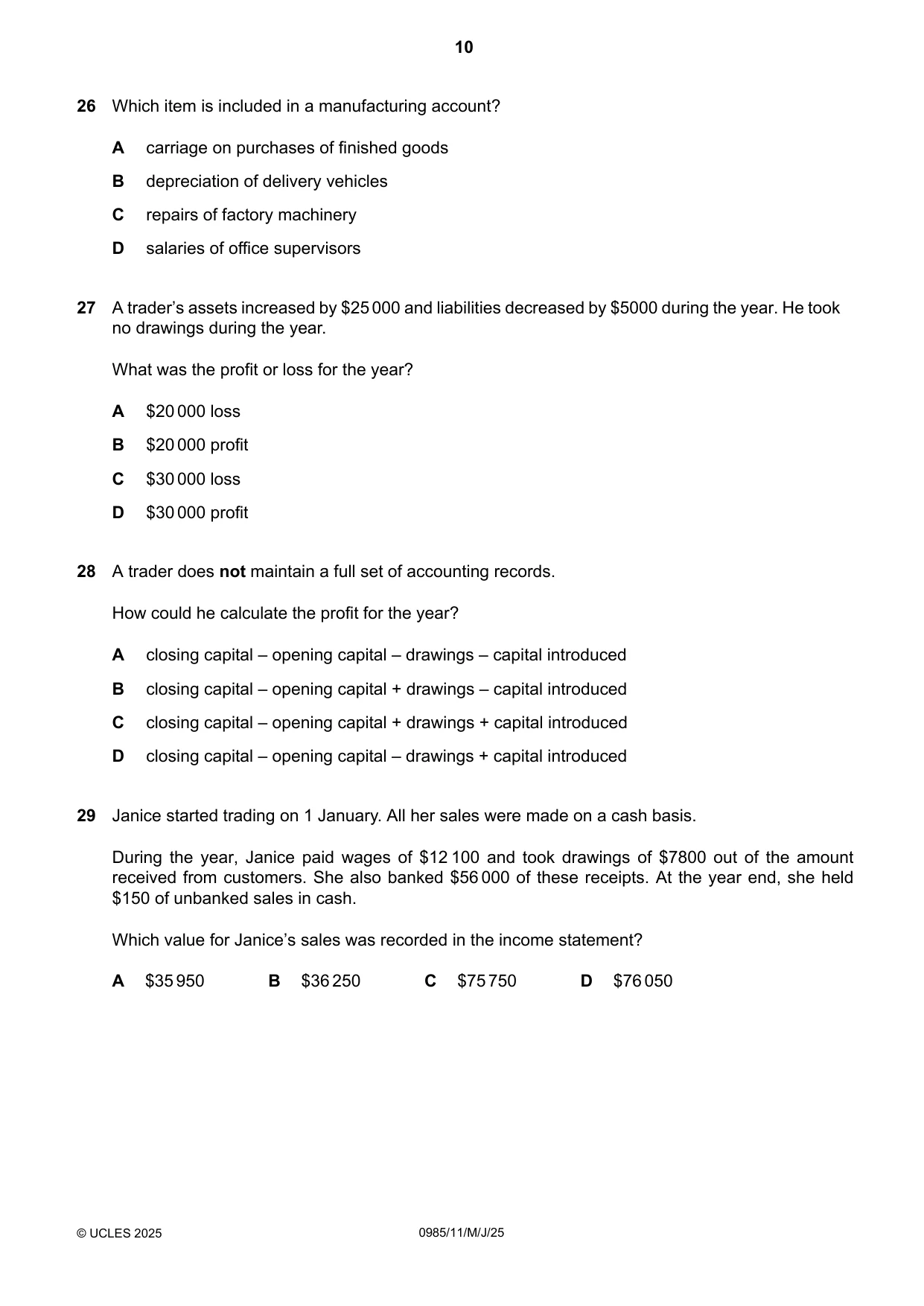
26 Which item is included in a manufacturing account? A carriage on purchases of finished goods B depreciation of delivery vehicles C repairs of factory machinery D salaries of office supervisors
Mark scheme: C
Q27 · A trader’s assets increased by $25 000 and liabilities decreased by $5000 during the year
27 A trader’s assets increased by $25 000 and liabilities decreased by $5000 during the year. He took no drawings during the year. What was the profit or loss for the year? A $20000 loss B $20000 profit C $30000 loss D $30000 profit
Mark scheme: D
Q28 · A trader does not maintain a full set of accounting records
28 A trader does not maintain a full set of accounting records. How could he calculate the profit for the year? A closing capital – opening capital – drawings – capital introduced B closing capital – opening capital + drawings – capital introduced C closing capital – opening capital + drawings + capital introduced D closing capital – opening capital – drawings + capital introduced
Mark scheme: B
Q29 · Janice started trading on 1 January
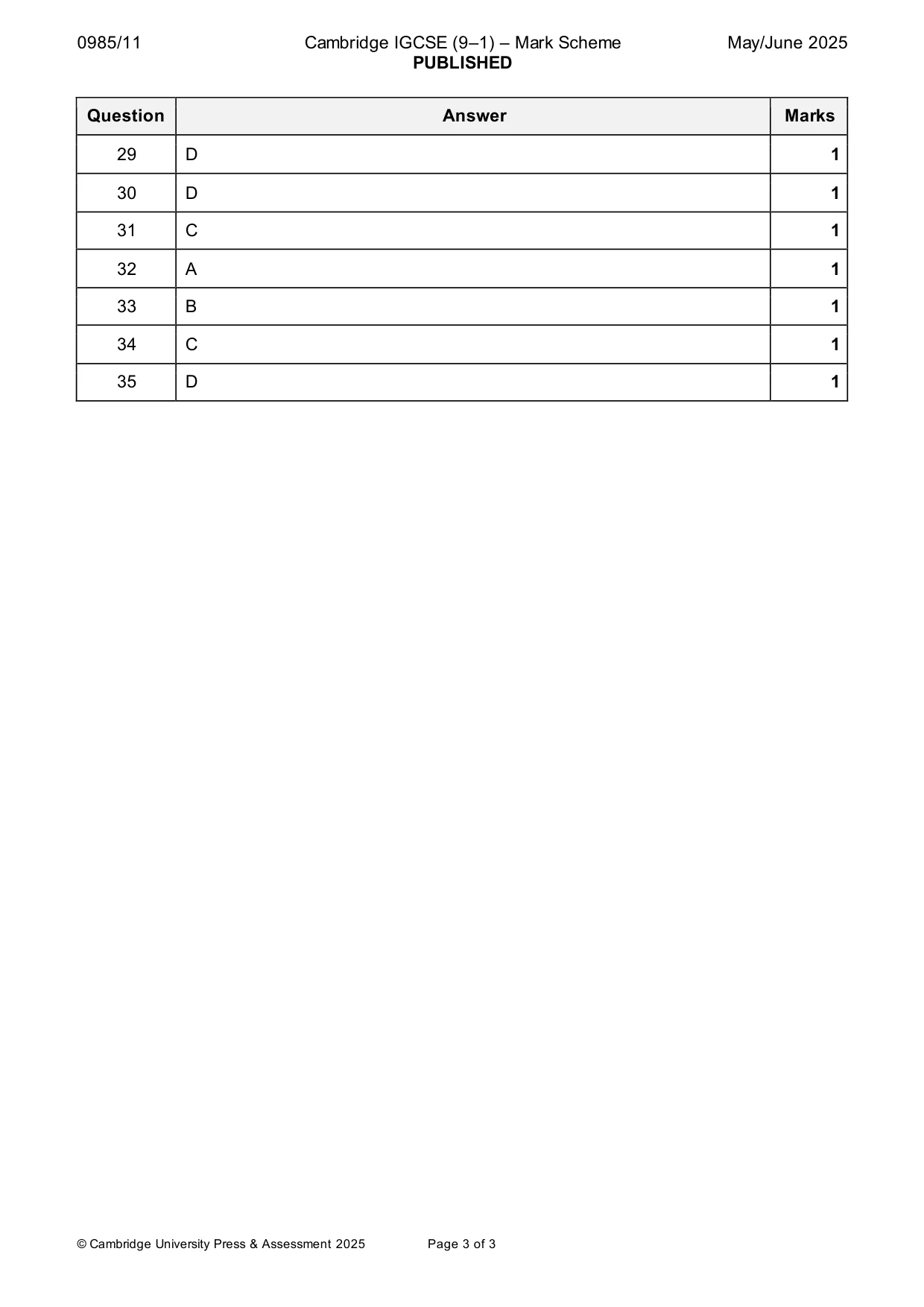
29 Janice started trading on 1 January. All her sales were made on a cash basis. During the year, Janice paid wages of $12 100 and took drawings of $7800 out of the amount received from customers. She also banked $56 000 of these receipts. At the year end, she held $150 of unbanked sales in cash. Which value for Janice’s sales was recorded in the income statement? A $35950 B $36250 C $75750 D $76050
Mark scheme: D
Q30 · A trader provided the following information
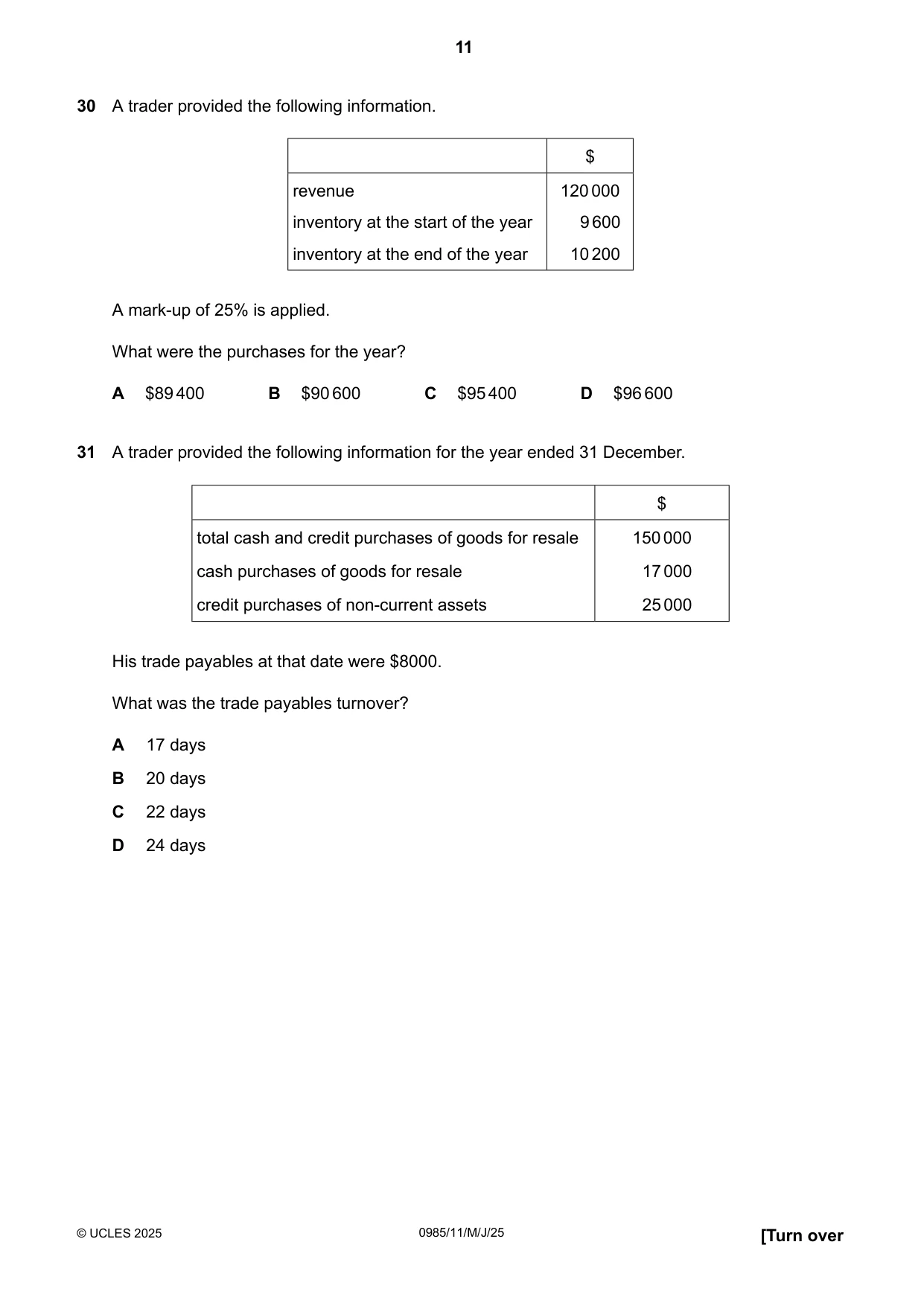
30 A trader provided the following information. $ revenue 120000 inventory at the start of the year 9600 inventory at the end of the year 10200 A mark-up of 25% is applied. What were the purchases for the year? A $89400 B $90600 C $95400 D $96600
Mark scheme: D
Q31 · A trader provided the following information for the year ended 31 December
31 A trader provided the following information for the year ended 31 December. $ total cash and credit purchases of goods for resale 150000 cash purchases of goods for resale 17000 credit purchases of non-current assets 25000 His trade payables at that date were $8000. What was the trade payables turnover? A 17 days B 20 days C 22 days D 24 days
Mark scheme: C
More questions on Calculation and understanding of accounting ratios
Q32 · The following information is taken from an income statement
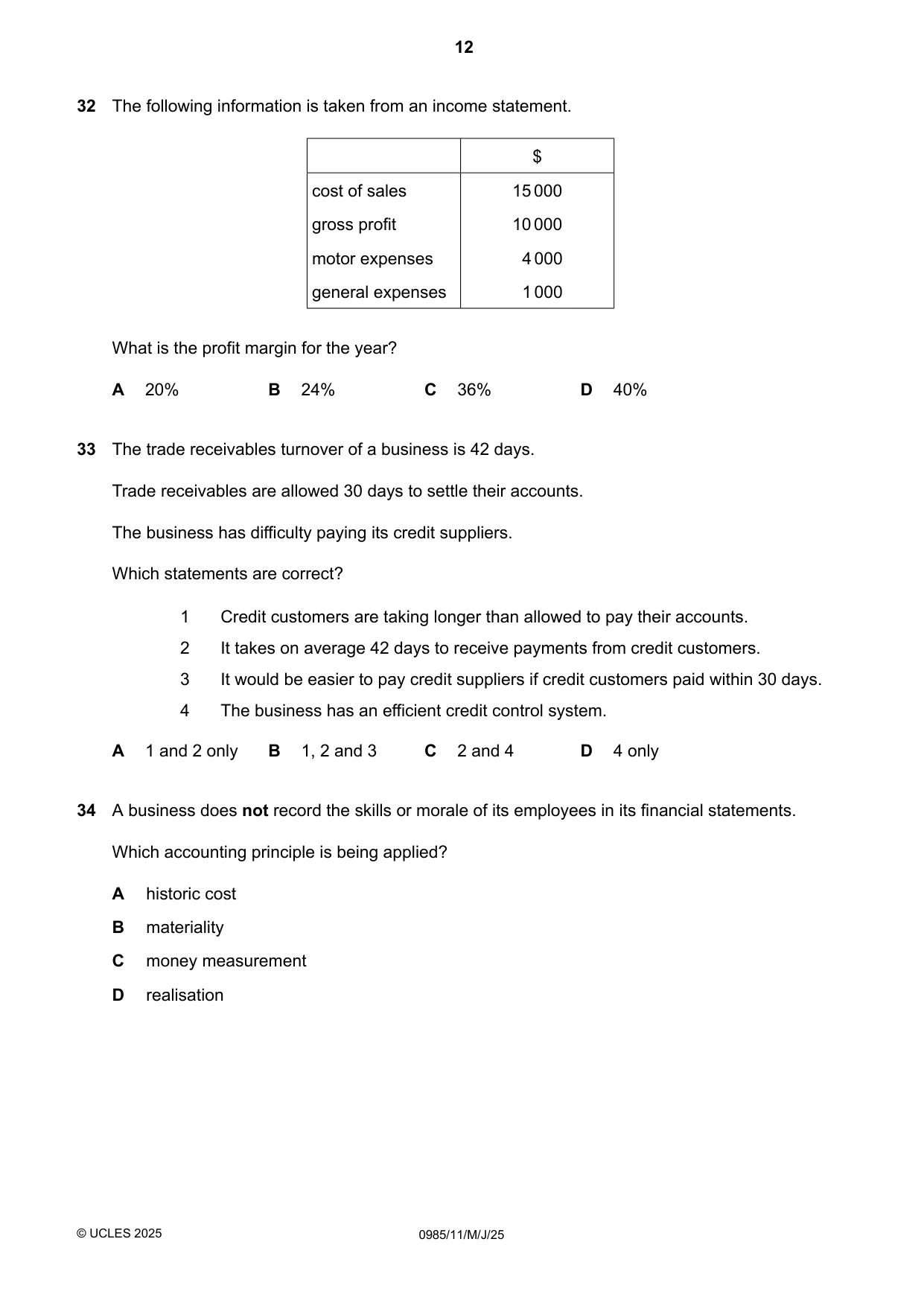
32 The following information is taken from an income statement. $ cost of sales 15000 gross profit 10000 motor expenses 4000 general expenses 1000 What is the profit margin for the year? A 20% B 24% C 36% D 40%
Mark scheme: A
More questions on Calculation and understanding of accounting ratios
Q33 · The trade receivables turnover of a business is 42 days
33 The trade receivables turnover of a business is 42 days. Trade receivables are allowed 30 days to settle their accounts. The business has difficulty paying its credit suppliers. Which statements are correct? 1 Credit customers are taking longer than allowed to pay their accounts. 2 It takes on average 42 days to receive payments from credit customers. 3 It would be easier to pay credit suppliers if credit customers paid within 30 days. 4 The business has an efficient credit control system. A 1 and 2 only B 1, 2 and 3 C 2 and 4 D 4 only
Mark scheme: B
Q34 · A business does not record the skills or morale of its employees in its financial…
34 A business does not record the skills or morale of its employees in its financial statements. Which accounting principle is being applied? A historic cost B materiality C money measurement D realisation
Mark scheme: C
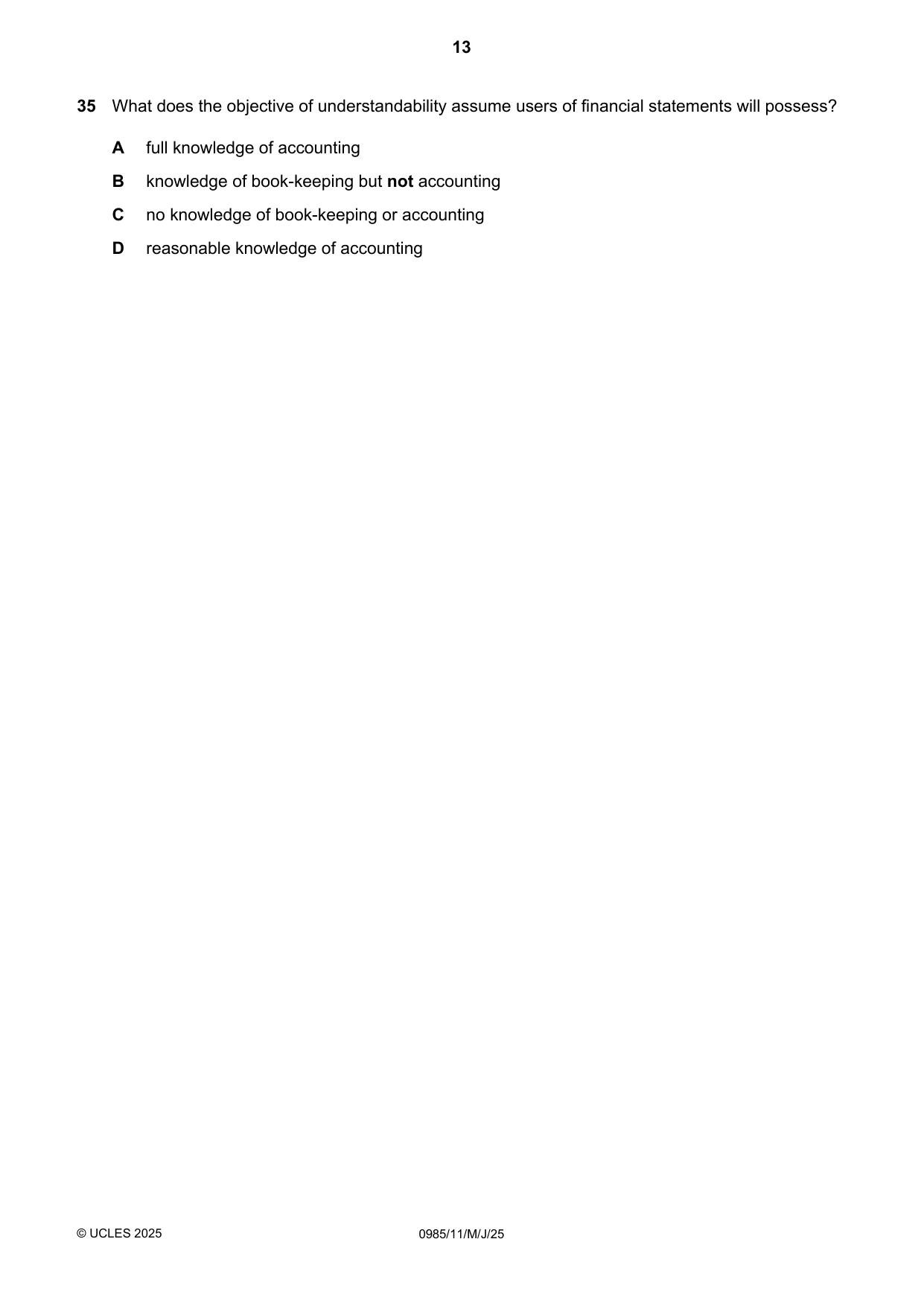
Q35 · What does the objective of understandability assume users of financial statements will…
35 What does the objective of understandability assume users of financial statements will possess? A full knowledge of accounting B knowledge of book-keeping but not accounting C no knowledge of book-keeping or accounting D reasonable knowledge of accounting
Mark scheme: D
What was in this paper
The subtopics covered by these 35 questions, and how many questions each got. Open one in a new tab to see every Cambridge question on it.
4Corrections of errors3Accounting concepts2Calculation and understanding of accounting ratios2Control accounts2Incomplete records2Other payables and other receivables2Partnerships2The double entry system of book-keeping2The trial balance2Valuation of inventory2Accounting for depreciation and disposal of non-current assets1Bank reconciliation1Books of prime entry1Capital and revenue expenditure and receipts1Interpretation of accounting ratios1Irrecoverable debts and allowance for irrecoverable debts1Limited companies1Manufacturing accounts1Sole traders1The purpose of accounting1What you needed in this session
Cambridge’s own grade thresholds for 2025 May/June, Paper 1 · Variant 1. A higher threshold means an easier paper — the bar moves with how the cohort did.