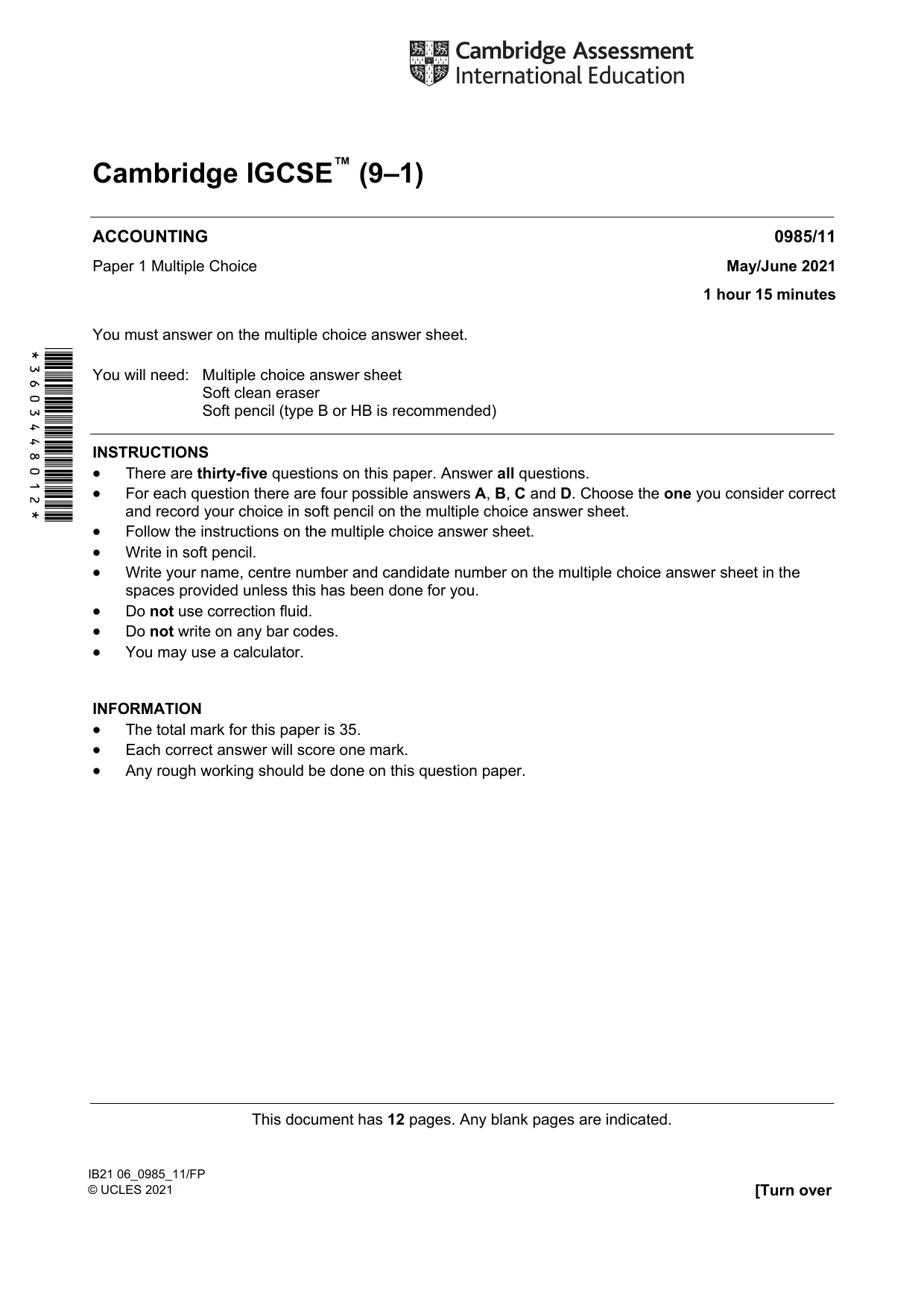
Cambridge IGCSE Accounting (9-1) 0985 — 2021 May/June Paper 1 · Variant 1
0985/11/M/J/21 · 35 questions · 35 marks · ≈39 min
The question paper and its mark scheme, free to read here and free to download. This is Cambridge’s own paper, exactly as it was sat.
Question paper12 pages
Mark scheme3 pages
Answers below. Sit the paper first if you are practising.
Questions as text
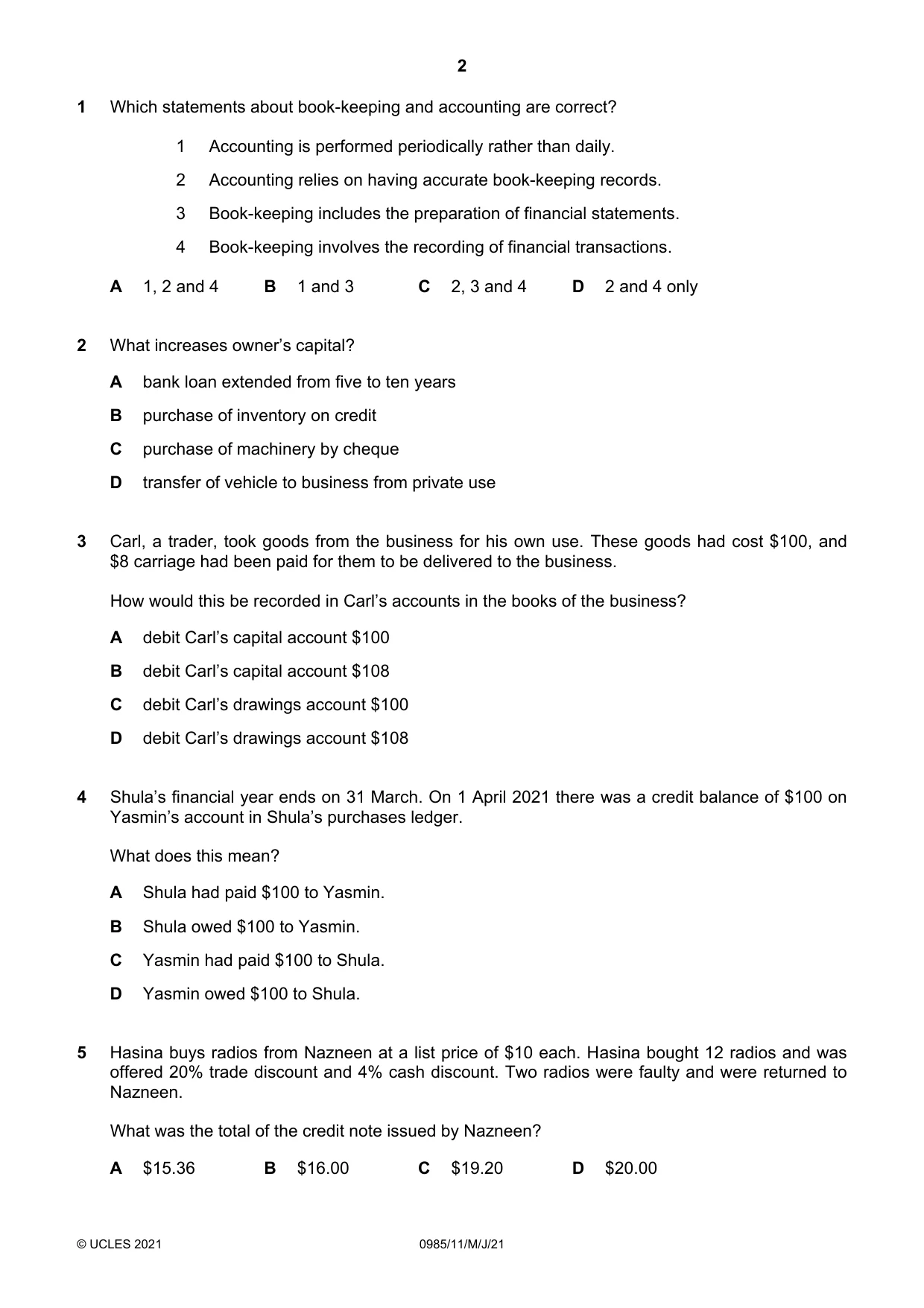
Q1 · Which statements about book-keeping and accounting are correct?
1 Which statements about book-keeping and accounting are correct? 1 Accounting is performed periodically rather than daily. 2 Accounting relies on having accurate book-keeping records. 3 Book-keeping includes the preparation of financial statements. 4 Book-keeping involves the recording of financial transactions. A 1, 2 and 4 B 1 and 3 C 2, 3 and 4 D 2 and 4 only
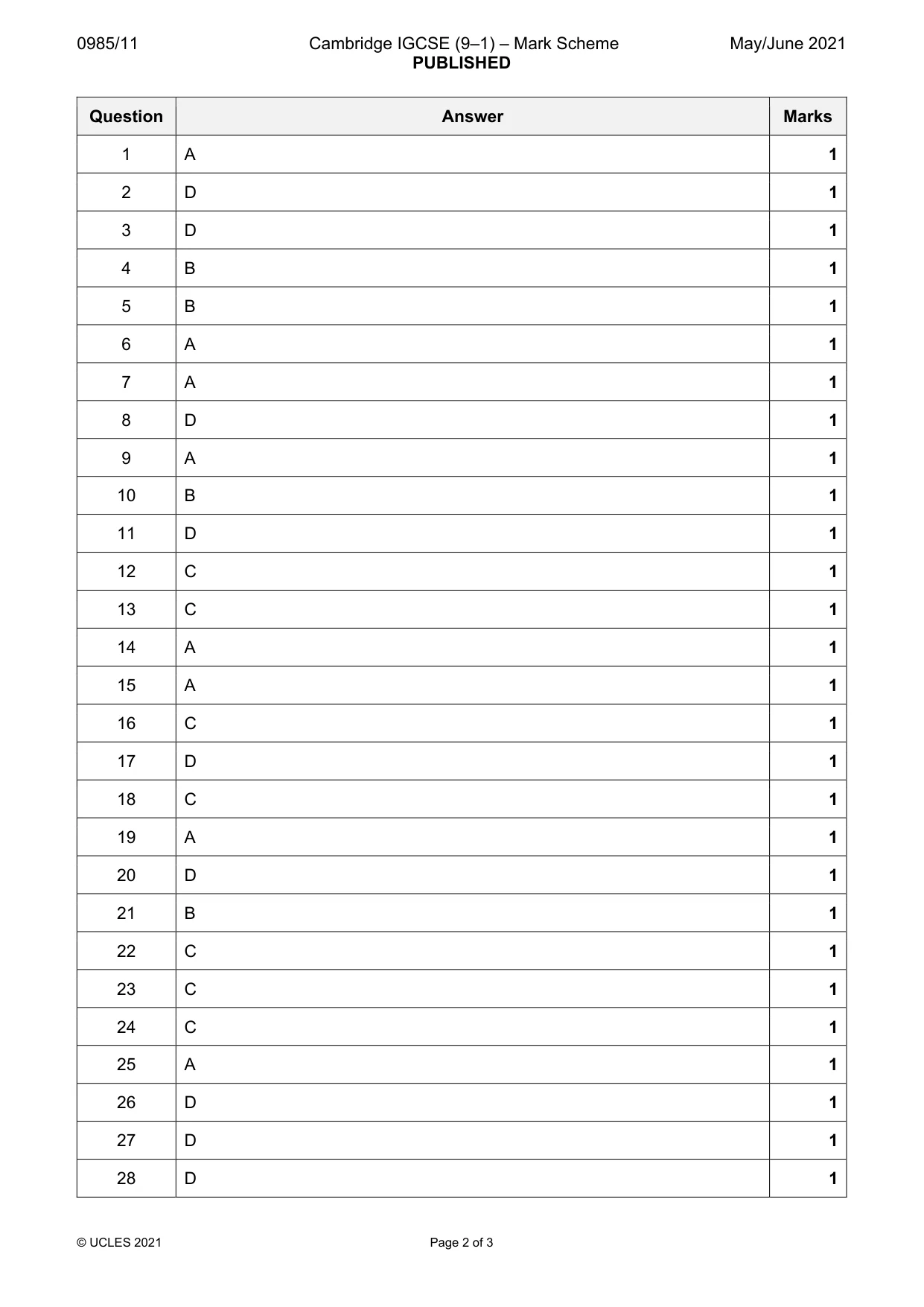
Mark scheme: A
Q2 · What increases owner’s capital?
2 What increases owner’s capital? A bank loan extended from five to ten years B purchase of inventory on credit C purchase of machinery by cheque D transfer of vehicle to business from private use
Mark scheme: D
Q3 · Carl, a trader, took goods from the business for his own use
3 Carl, a trader, took goods from the business for his own use. These goods had cost $100, and $8 carriage had been paid for them to be delivered to the business. How would this be recorded in Carl’s accounts in the books of the business? A debit Carl’s capital account $100 B debit Carl’s capital account $108 C debit Carl’s drawings account $100 D debit Carl’s drawings account $108
Mark scheme: D
Q4 · Shula’s financial year ends on 31 March
4 Shula’s financial year ends on 31 March. On 1 April 2021 there was a credit balance of $100 on Yasmin’s account in Shula’s purchases ledger. What does this mean? A Shula had paid $100 to Yasmin. B Shula owed $100 to Yasmin. C Yasmin had paid $100 to Shula. D Yasmin owed $100 to Shula.
Mark scheme: B
Q5 · Hasina buys radios from Nazneen at a list price of $10 each
5 Hasina buys radios from Nazneen at a list price of $10 each. Hasina bought 12 radios and was offered 20% trade discount and 4% cash discount. Two radios were faulty and were returned to Nazneen. What was the total of the credit note issued by Nazneen? A $15.36 B $16.00 C $19.20 D $20.00
Mark scheme: B
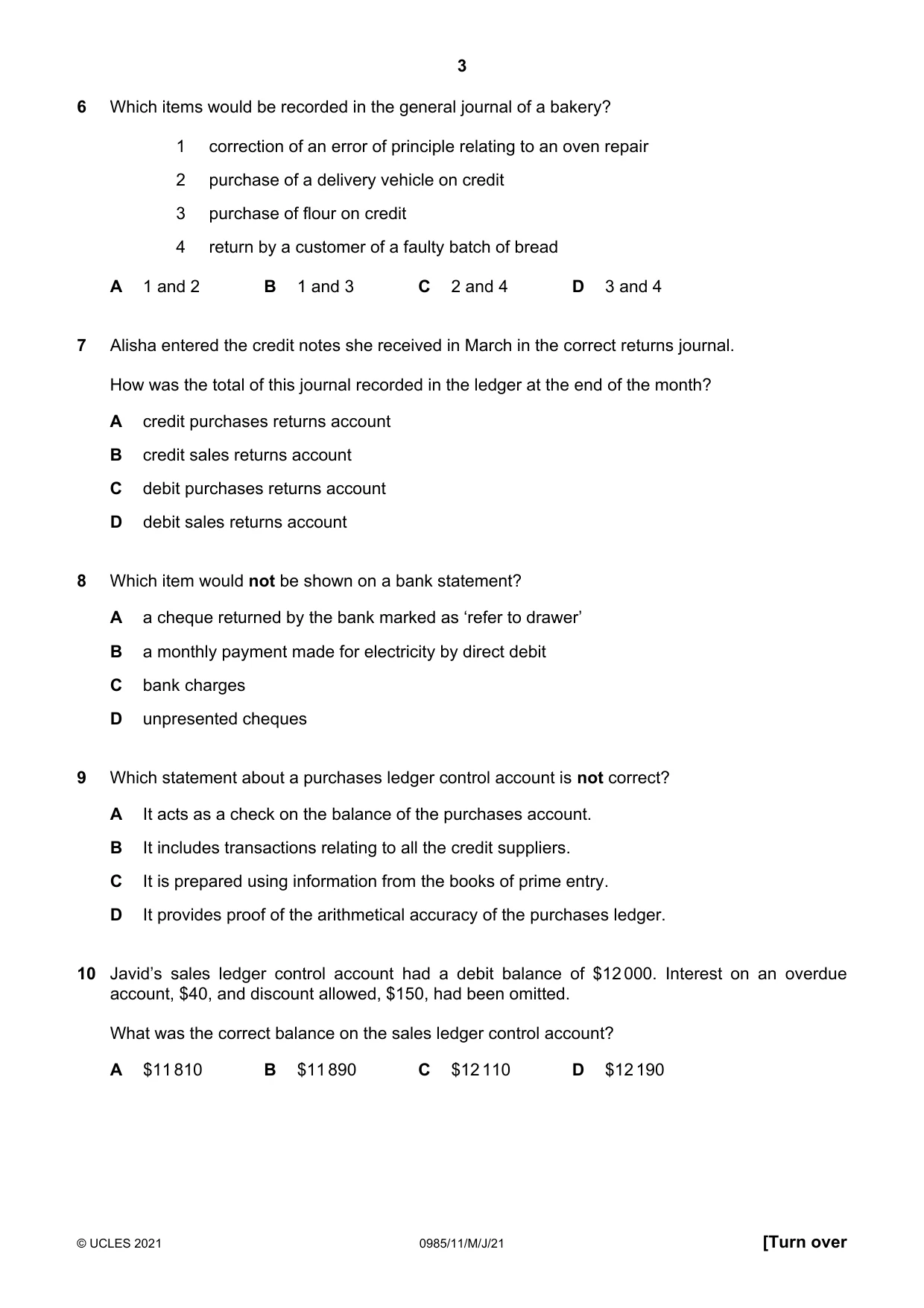
Q6 · Which items would be recorded in the general journal of a bakery?
6 Which items would be recorded in the general journal of a bakery? 1 correction of an error of principle relating to an oven repair 2 purchase of a delivery vehicle on credit 3 purchase of flour on credit 4 return by a customer of a faulty batch of bread A 1 and 2 B 1 and 3 C 2 and 4 D 3 and 4
Mark scheme: A
Q7 · Alisha entered the credit notes she received in March in the correct returns journal
7 Alisha entered the credit notes she received in March in the correct returns journal. How was the total of this journal recorded in the ledger at the end of the month? A credit purchases returns account B credit sales returns account C debit purchases returns account D debit sales returns account
Mark scheme: A
Q8 · Which item would not be shown on a bank statement?
8 Which item would not be shown on a bank statement? A a cheque returned by the bank marked as ‘refer to drawer’ B a monthly payment made for electricity by direct debit C bank charges D unpresented cheques
Mark scheme: D
Q9 · Which statement about a purchases ledger control account is not correct?
9 Which statement about a purchases ledger control account is not correct? A It acts as a check on the balance of the purchases account. B It includes transactions relating to all the credit suppliers. C It is prepared using information from the books of prime entry. D It provides proof of the arithmetical accuracy of the purchases ledger.
Mark scheme: A
Q10 · Javid’s sales ledger control account had a debit balance of $12 000
10 Javid’s sales ledger control account had a debit balance of $12 000. Interest on an overdue account, $40, and discount allowed, $150, had been omitted. What was the correct balance on the sales ledger control account? A $11 810 B $11 890 C $12 110 D $12 190
Mark scheme: B
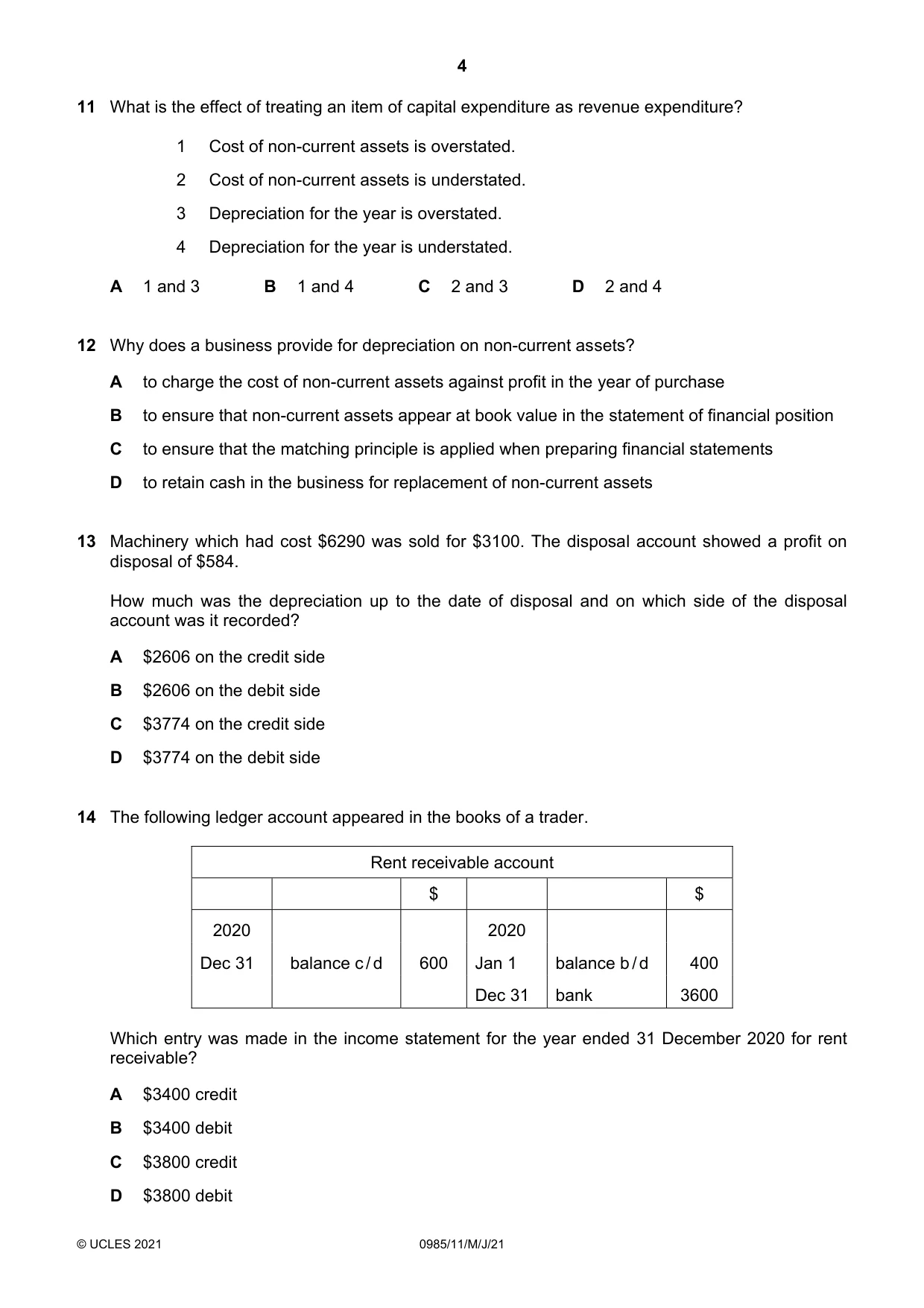
Q11 · What is the effect of treating an item of capital expenditure as revenue expenditure?
11 What is the effect of treating an item of capital expenditure as revenue expenditure? 1 Cost of non-current assets is overstated. 2 Cost of non-current assets is understated. 3 Depreciation for the year is overstated. 4 Depreciation for the year is understated. A 1 and 3 B 1 and 4 C 2 and 3 D 2 and 4
Mark scheme: D
More questions on Capital and revenue expenditure and receipts
Q12 · Why does a business provide for depreciation on non-current assets?
12 Why does a business provide for depreciation on non-current assets? A to charge the cost of non-current assets against profit in the year of purchase B to ensure that non-current assets appear at book value in the statement of financial position C to ensure that the matching principle is applied when preparing financial statements D to retain cash in the business for replacement of non-current assets
Mark scheme: C
More questions on Accounting for depreciation and disposal of non-current assets
Q13 · Machinery which had cost $6290 was sold for $3100
13 Machinery which had cost $6290 was sold for $3100. The disposal account showed a profit on disposal of $584. How much was the depreciation up to the date of disposal and on which side of the disposal account was it recorded? A $2606 on the credit side B $2606 on the debit side C $3774 on the credit side D $3774 on the debit side
Mark scheme: C
More questions on Accounting for depreciation and disposal of non-current assets
Q14 · The following ledger account appeared in the books of a trader
14 The following ledger account appeared in the books of a trader. Rent receivable account $ $ 2020 2020 Dec 31 balance c / d 600 Jan 1 balance b / d 400 Dec 31 bank 3600 Which entry was made in the income statement for the year ended 31 December 2020 for rent receivable? A $3400 credit B $3400 debit C $3800 credit D $3800 debit
Mark scheme: A
Q15 · Why does a business maintain a provision for doubtful debts account?
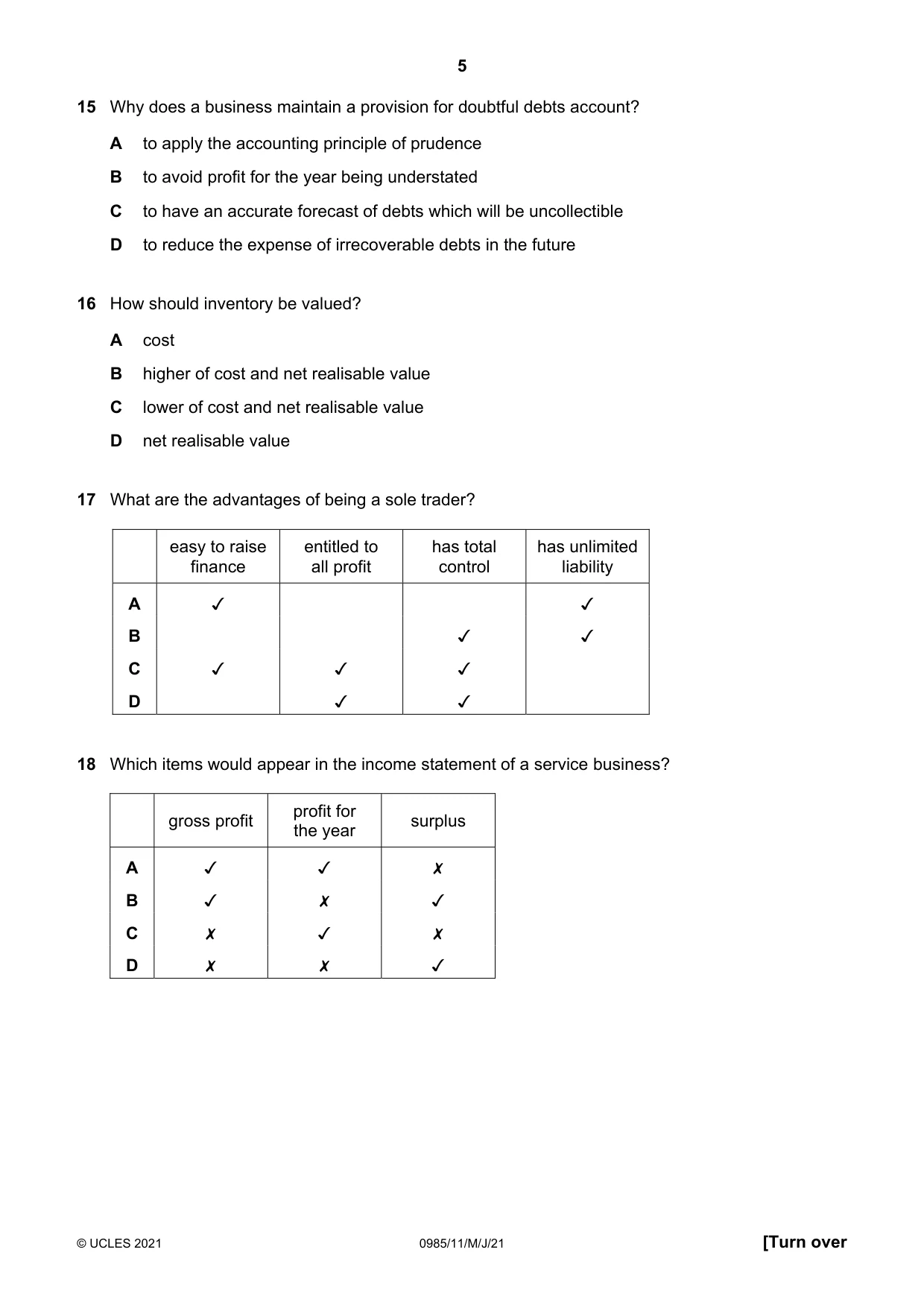
15 Why does a business maintain a provision for doubtful debts account? A to apply the accounting principle of prudence B to avoid profit for the year being understated C to have an accurate forecast of debts which will be uncollectible D to reduce the expense of irrecoverable debts in the future
Mark scheme: A
More questions on Irrecoverable debts and allowance for irrecoverable debts
Q16 · How should inventory be valued?
16 How should inventory be valued? A cost B higher of cost and net realisable value C lower of cost and net realisable value D net realisable value
Mark scheme: C
Q17 · What are the advantages of being a sole trader?
17 What are the advantages of being a sole trader? easy to raise finance entitled to all profit has total control has unlimited liability
Mark scheme: D
Q18 · Which items would appear in the income statement of a service business?
18 Which items would appear in the income statement of a service business? gross profit fhe ear surplus A J J x B J x Jv Cc x Jv x D x x Jv
Mark scheme: C
Q19 · A business provided the following information
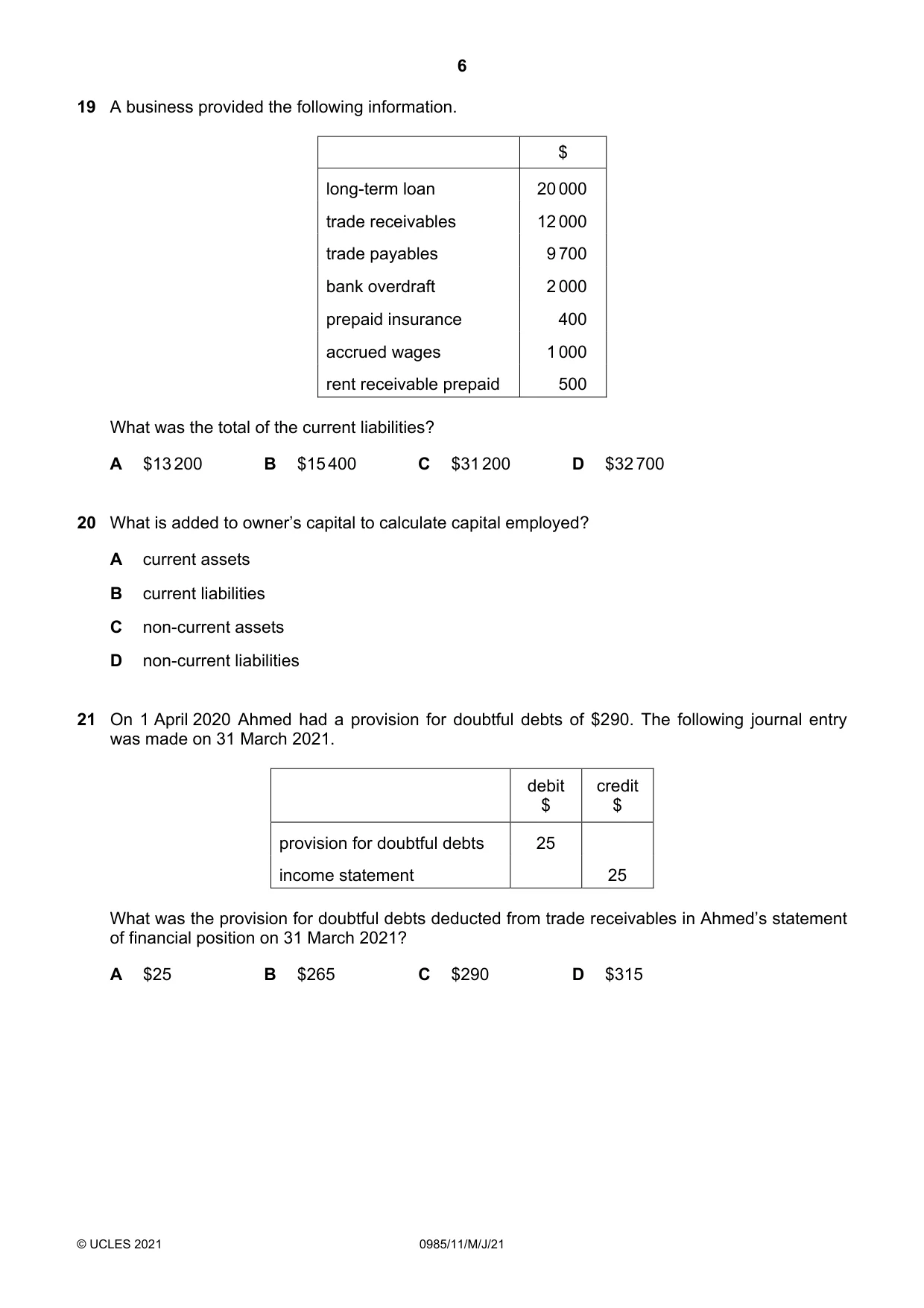
19 A business provided the following information. $ long-term loan 20 000 trade receivables 12 000 trade payables 9 700 bank overdraft 2 000 prepaid insurance 400 accrued wages 1 000 rent receivable prepaid 500 What was the total of the current liabilities? A $13 200 B $15 400 C $31 200 D $32 700
Mark scheme: A
Q20 · What is added to owner’s capital to calculate capital employed?
20 What is added to owner’s capital to calculate capital employed? A current assets B current liabilities C non-current assets D non-current liabilities
Mark scheme: D
More questions on Calculation and understanding of accounting ratios
Q21 · On 1 April 2020 Ahmed had a provision for doubtful debts of $290
21 On 1 April 2020 Ahmed had a provision for doubtful debts of $290. The following journal entry was made on 31 March 2021. debit credit $ $ provision for doubtful debts 25 income statement 25 What was the provision for doubtful debts deducted from trade receivables in Ahmed’s statement of financial position on 31 March 2021? A $25 B $265 C $290 D $315
Mark scheme: B
More questions on Irrecoverable debts and allowance for irrecoverable debts
Q22 · X Limited started the year with an ordinary share capital of $100 000
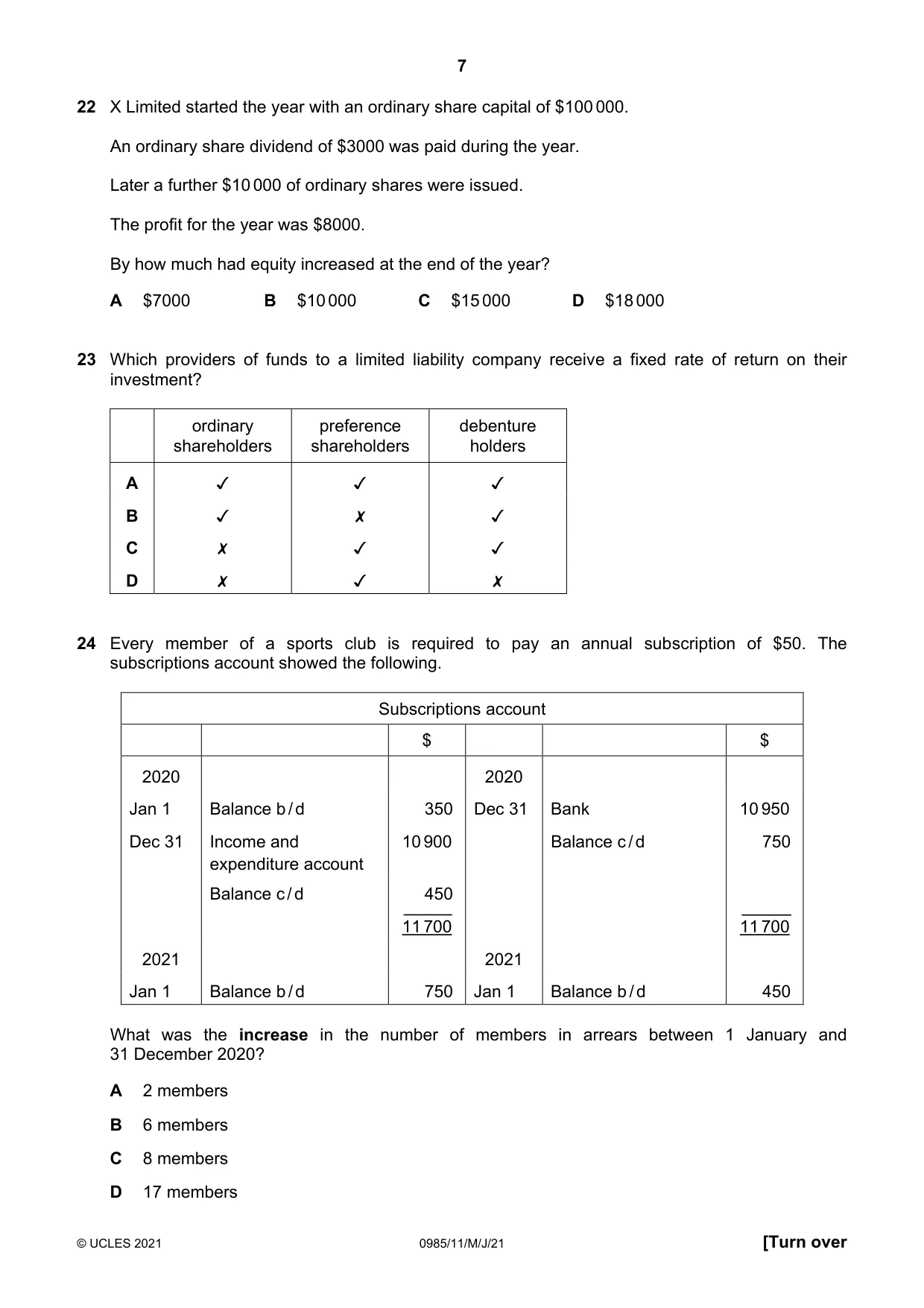
22 X Limited started the year with an ordinary share capital of $100 000. An ordinary share dividend of $3000 was paid during the year. Later a further $10 000 of ordinary shares were issued. The profit for the year was $8000. By how much had equity increased at the end of the year? A $7000 B $10 000 C $15 000 D $18 000
Mark scheme: C
Q23 · Which providers of funds to a limited liability company receive a fixed rate of return on…
23 Which providers of funds to a limited liability company receive a fixed rate of return on their investment? ordinary preference debenture shareholders shareholders holders A Jv J Jv B Jv x Jv Cc x J Jv D x Jv x
Mark scheme: C
Q24 · Every member of a sports club is required to pay an annual subscription of $50
24 Every member of a sports club is required to pay an annual subscription of $50. The subscriptions account showed the following. Subscriptions account $ $ 2020 2020 Jan 1 Balance b / d 350 Dec 31 Bank 10 950 Dec 31 Income and 10 900 Balance c / d 750 expenditure account Balance c / d 450 11 700 11 700 2021 2021 Jan 1 Balance b / d 750 Jan 1 Balance b / d 450 What was the increase in the number of members in arrears between 1 January and 31 December 2020? A 2 members B 6 members C 8 members D 17 members
Mark scheme: C
Q25 · Which term is used to describe the surpluses which have been earned by a club over its…
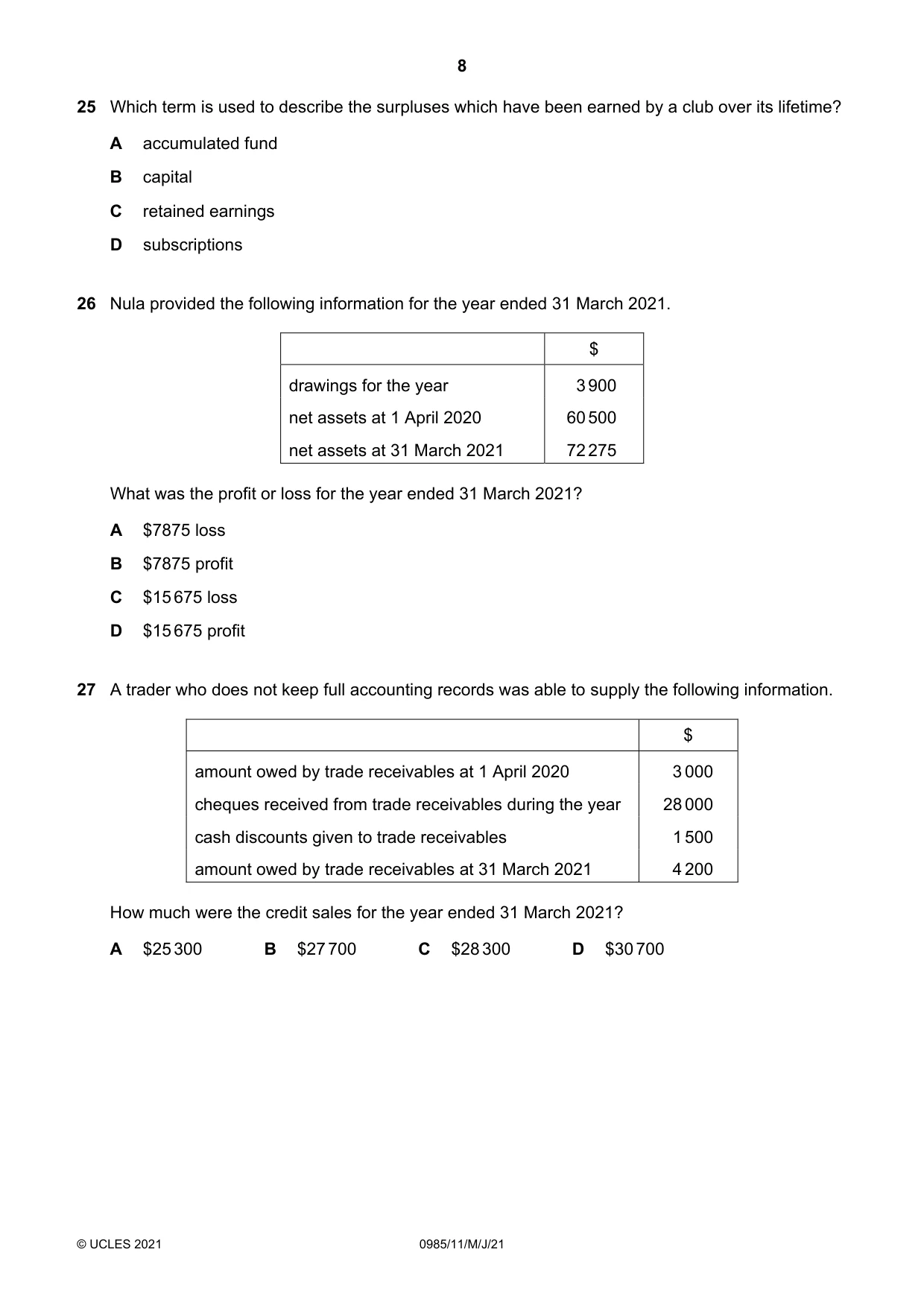
25 Which term is used to describe the surpluses which have been earned by a club over its lifetime? A accumulated fund B capital C retained earnings D subscriptions
Mark scheme: A
Q26 · Nula provided the following information for the year ended 31 March 2021
26 Nula provided the following information for the year ended 31 March 2021. $ drawings for the year 3 900 net assets at 1 April 2020 60 500 net assets at 31 March 2021 72 275 What was the profit or loss for the year ended 31 March 2021? A $7875 loss B $7875 profit C $15 675 loss D $15 675 profit
Mark scheme: D
Q27 · A trader who does not keep full accounting records was able to supply the following…
27 A trader who does not keep full accounting records was able to supply the following information. $ amount owed by trade receivables at 1 April 2020 3 000 cheques received from trade receivables during the year 28 000 cash discounts given to trade receivables 1 500 amount owed by trade receivables at 31 March 2021 4 200 How much were the credit sales for the year ended 31 March 2021? A $25 300 B $27 700 C $28 300 D $30 700
Mark scheme: D
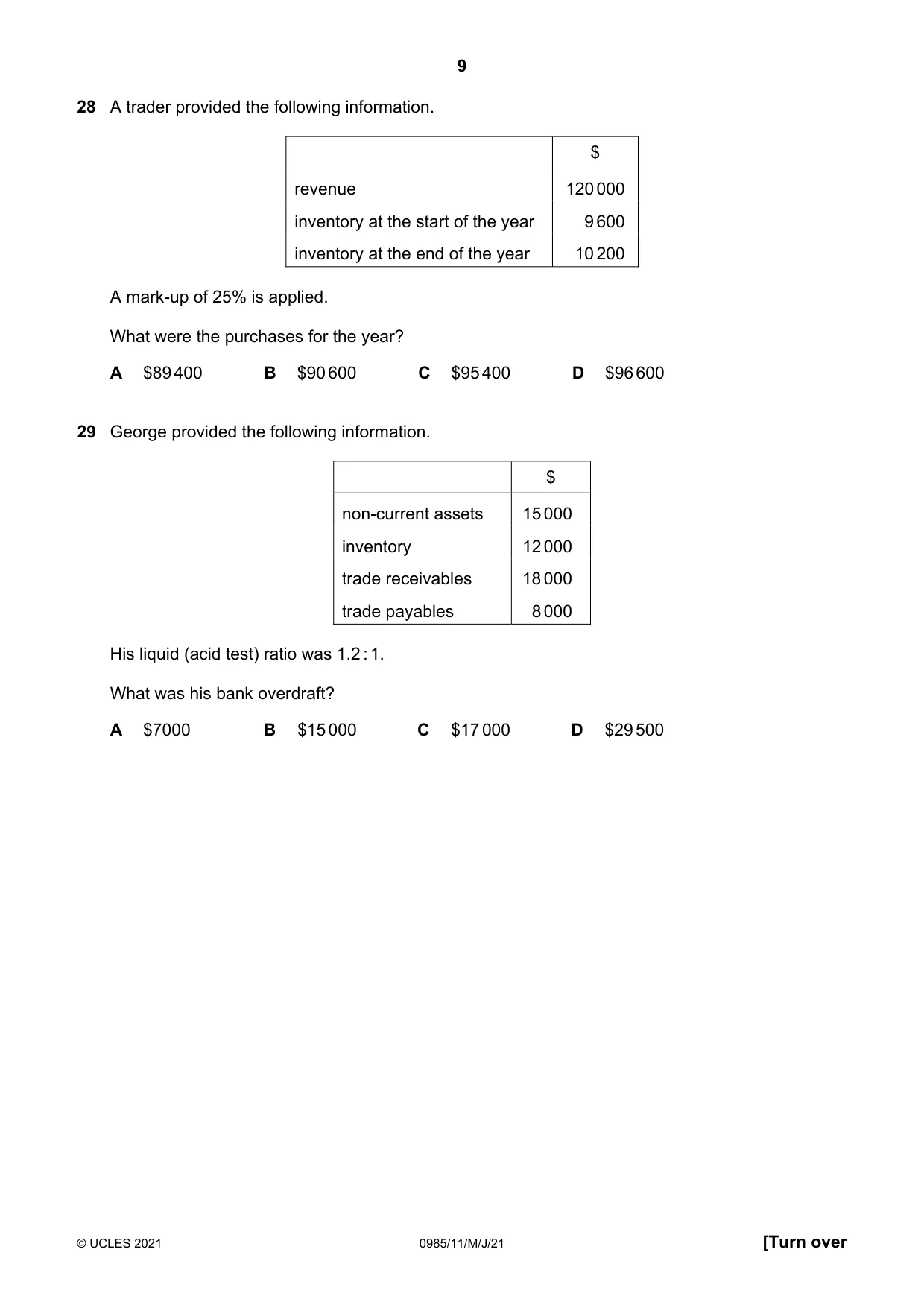
Q28 · A trader provided the following information
28 A trader provided the following information. $ revenue 120 000 inventory at the start of the year 9 600 inventory at the end of the year 10 200 A mark-up of 25% is applied. What were the purchases for the year? A $89 400 B $90 600 C $95 400 D $96 600
Mark scheme: D
Q29 · George provided the following information
29 George provided the following information. $ non-current assets 15 000 inventory 12 000 trade receivables 18 000 trade payables 8 000 His liquid (acid test) ratio was 1.2 : 1. What was his bank overdraft? A $7000 B $15 000 C $17 000 D $29 500
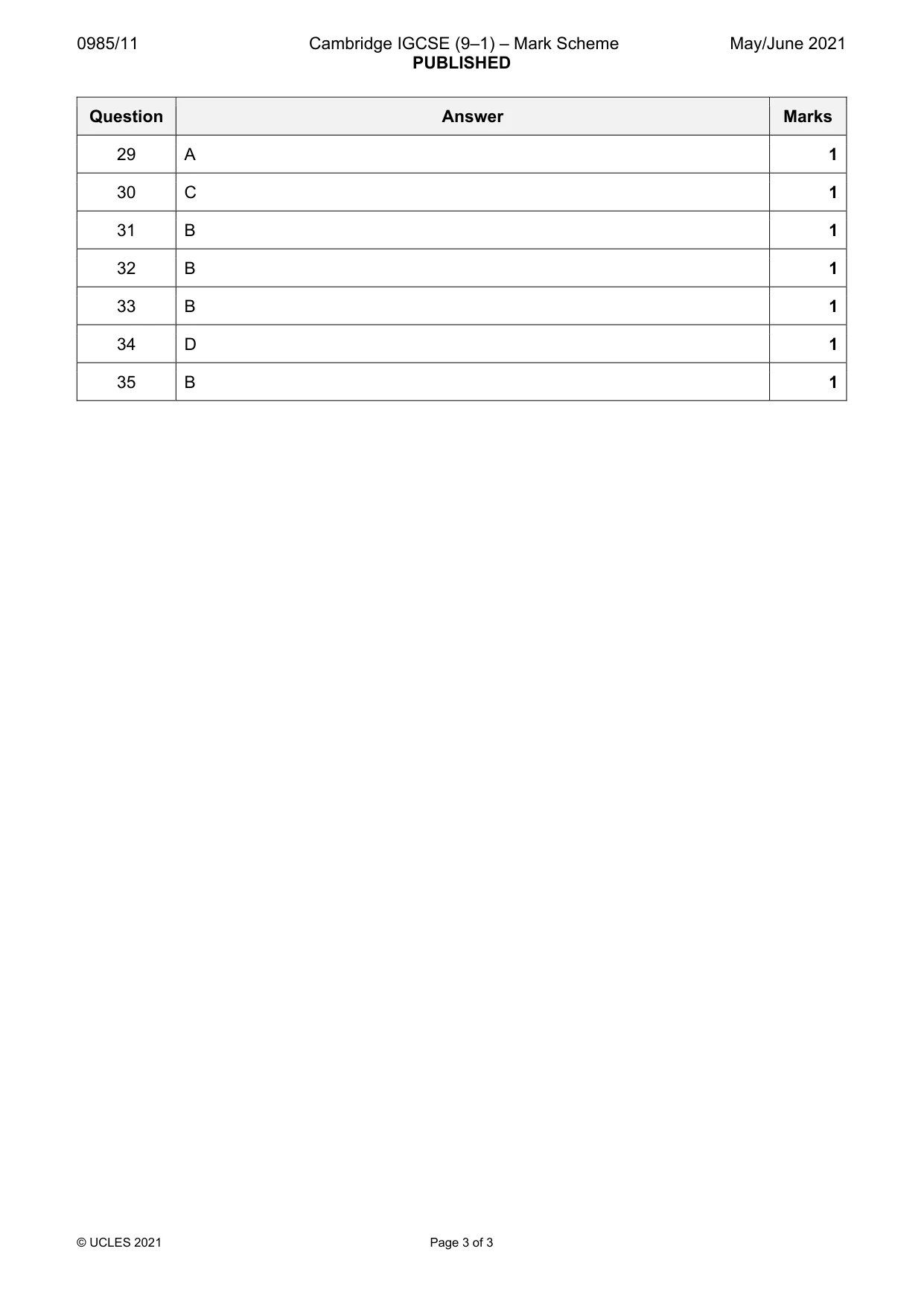
Mark scheme: A
More questions on Calculation and understanding of accounting ratios
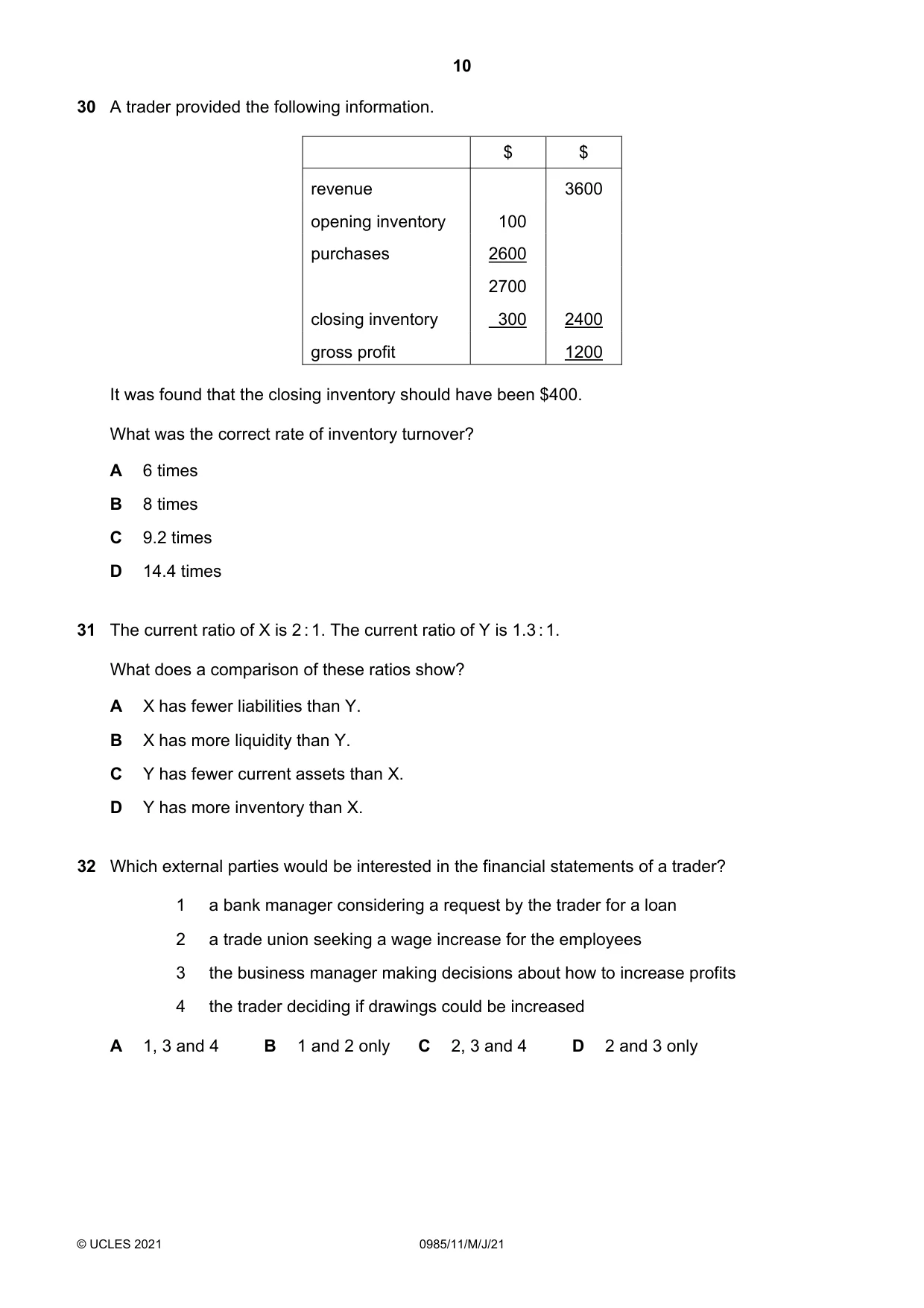
Q30 · A trader provided the following information
30 A trader provided the following information. $ $ revenue 3600 opening inventory 100 purchases 2600 2700 closing inventory 300 2400 gross profit 1200 It was found that the closing inventory should have been $400. What was the correct rate of inventory turnover? A 6 times B 8 times C 9.2 times D 14.4 times
Mark scheme: C
More questions on Calculation and understanding of accounting ratios
Q31 · The current ratio of X is 2 : 1
31 The current ratio of X is 2 : 1. The current ratio of Y is 1.3 : 1. What does a comparison of these ratios show? A X has fewer liabilities than Y. B X has more liquidity than Y. C Y has fewer current assets than X. D Y has more inventory than X.
Mark scheme: B
Q32 · Which external parties would be interested in the financial statements of a trader?
32 Which external parties would be interested in the financial statements of a trader? 1 a bank manager considering a request by the trader for a loan 2 a trade union seeking a wage increase for the employees 3 the business manager making decisions about how to increase profits 4 the trader deciding if drawings could be increased A 1, 3 and 4 B 1 and 2 only C 2, 3 and 4 D 2 and 3 only
Mark scheme: B
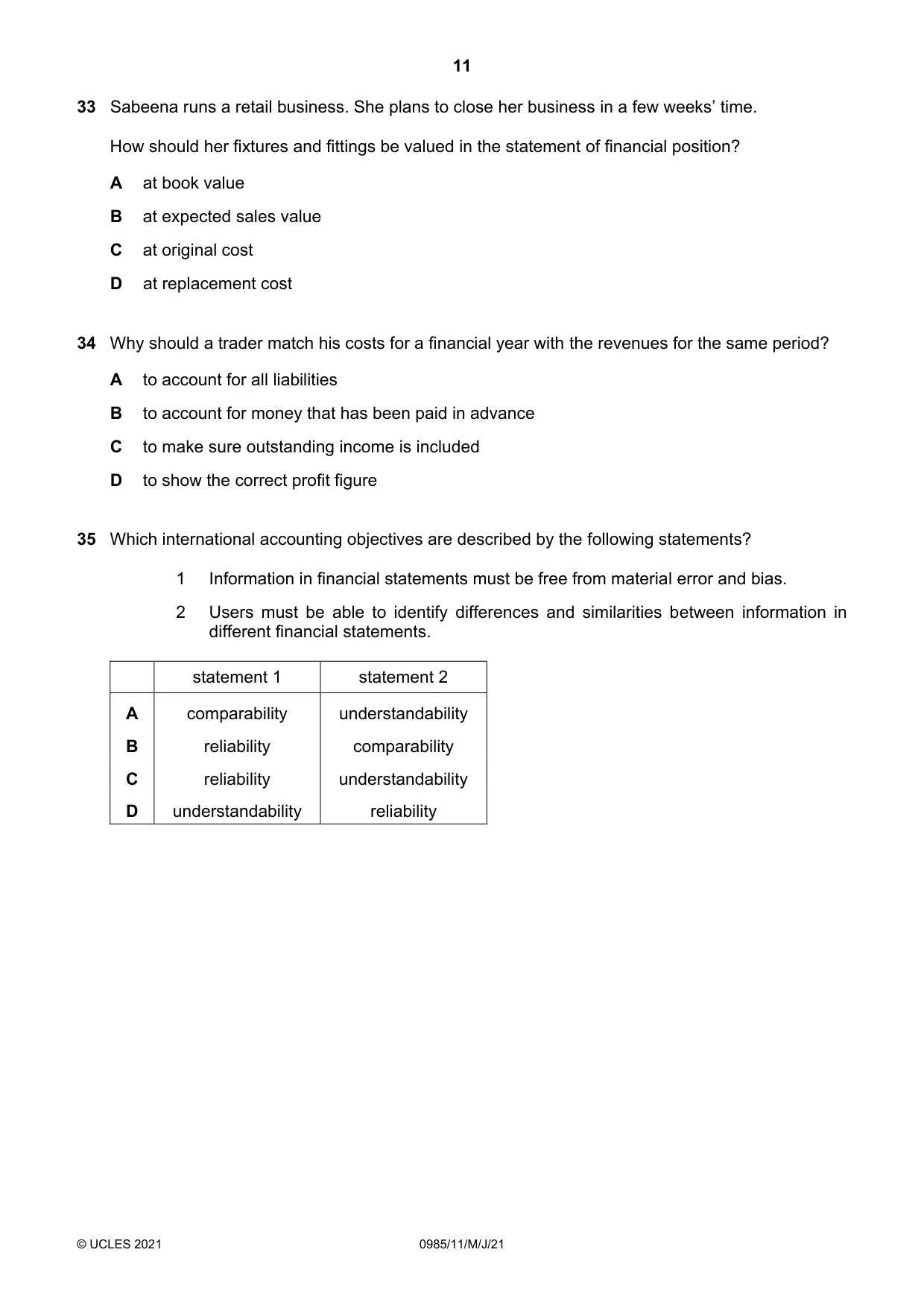
Q33 · Sabeena runs a retail business
33 Sabeena runs a retail business. She plans to close her business in a few weeks’ time. How should her fixtures and fittings be valued in the statement of financial position? A at book value B at expected sales value C at original cost D at replacement cost
Mark scheme: B
Q34 · Why should a trader match his costs for a financial year with the revenues for the same…
34 Why should a trader match his costs for a financial year with the revenues for the same period? A to account for all liabilities B to account for money that has been paid in advance C to make sure outstanding income is included D to show the correct profit figure
Mark scheme: D
Q35 · Which international accounting objectives are described by the following statements?
35 Which international accounting objectives are described by the following statements? 1 Information in financial statements must be free from material error and bias. 2 Users must be able to identify differences and similarities between information in different financial statements. statement 1 statement 2 A comparability understandability B reliability comparability C reliability understandability D understandability reliability
Mark scheme: B
What was in this paper
The subtopics covered by these 35 questions, and how many questions each got. Open one in a new tab to see every Cambridge question on it.
3Books of prime entry3Calculation and understanding of accounting ratios3Control accounts3Accounting for depreciation and disposal of non-current assets2Clubs and societies2Incomplete records2Irrecoverable debts and allowance for irrecoverable debts2Limited companies2Sole traders2The accounting equation2Valuation of inventory2Bank reconciliation1Capital and revenue expenditure and receipts1Interested parties1Interpretation of accounting ratios1Other payables and other receivables1The double entry system of book-keeping1The purpose of accounting1What you needed in this session
Cambridge’s own grade thresholds for 2021 May/June, Paper 1 · Variant 1. A higher threshold means an easier paper — the bar moves with how the cohort did.