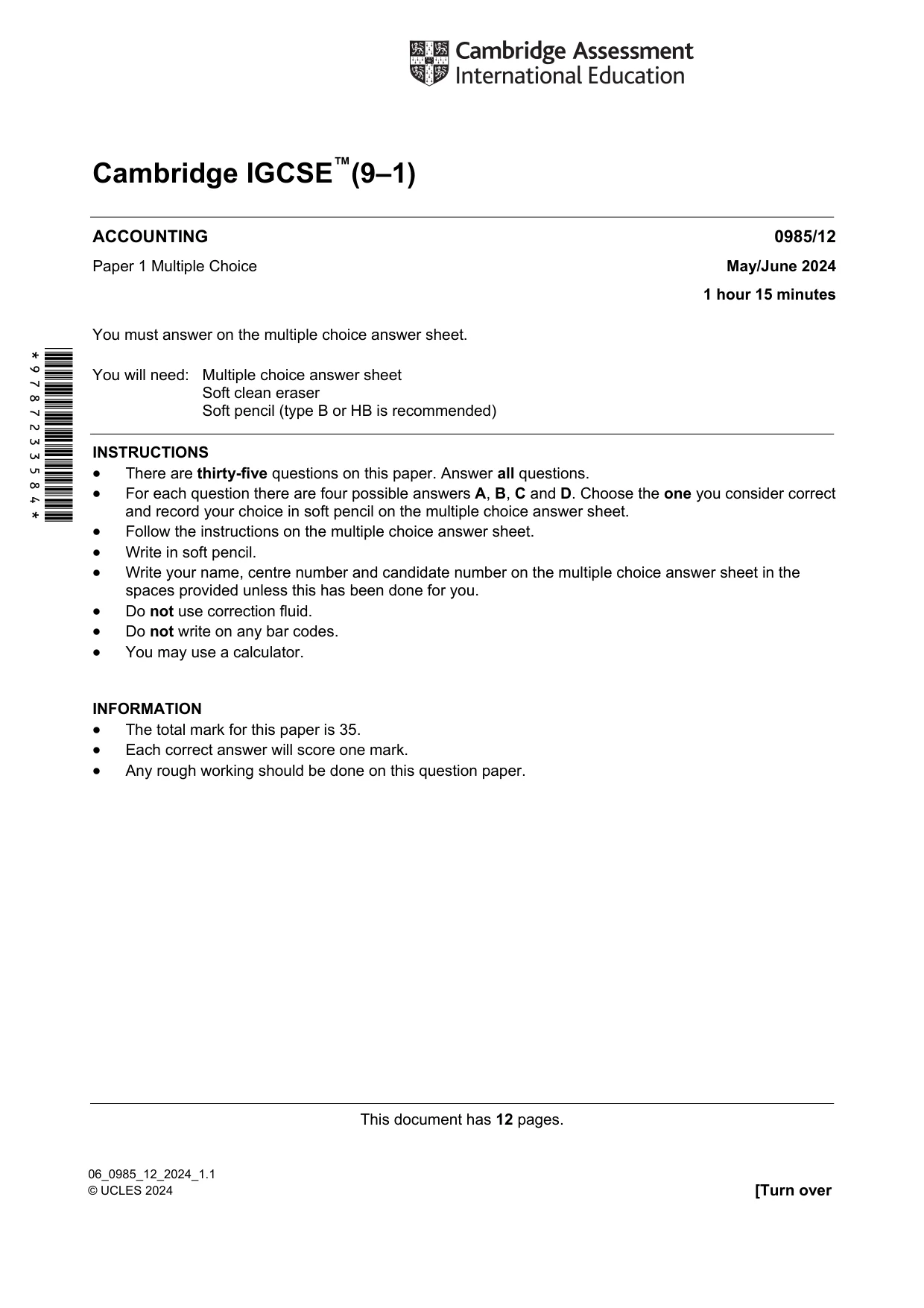
Cambridge IGCSE Accounting (9-1) 0985 — 2024 May/June Paper 1 · Variant 2
0985/12/M/J/24 · 35 questions · 35 marks · ≈39 min
The question paper and its mark scheme, free to read here and free to download. This is Cambridge’s own paper, exactly as it was sat.
Question paper12 pages
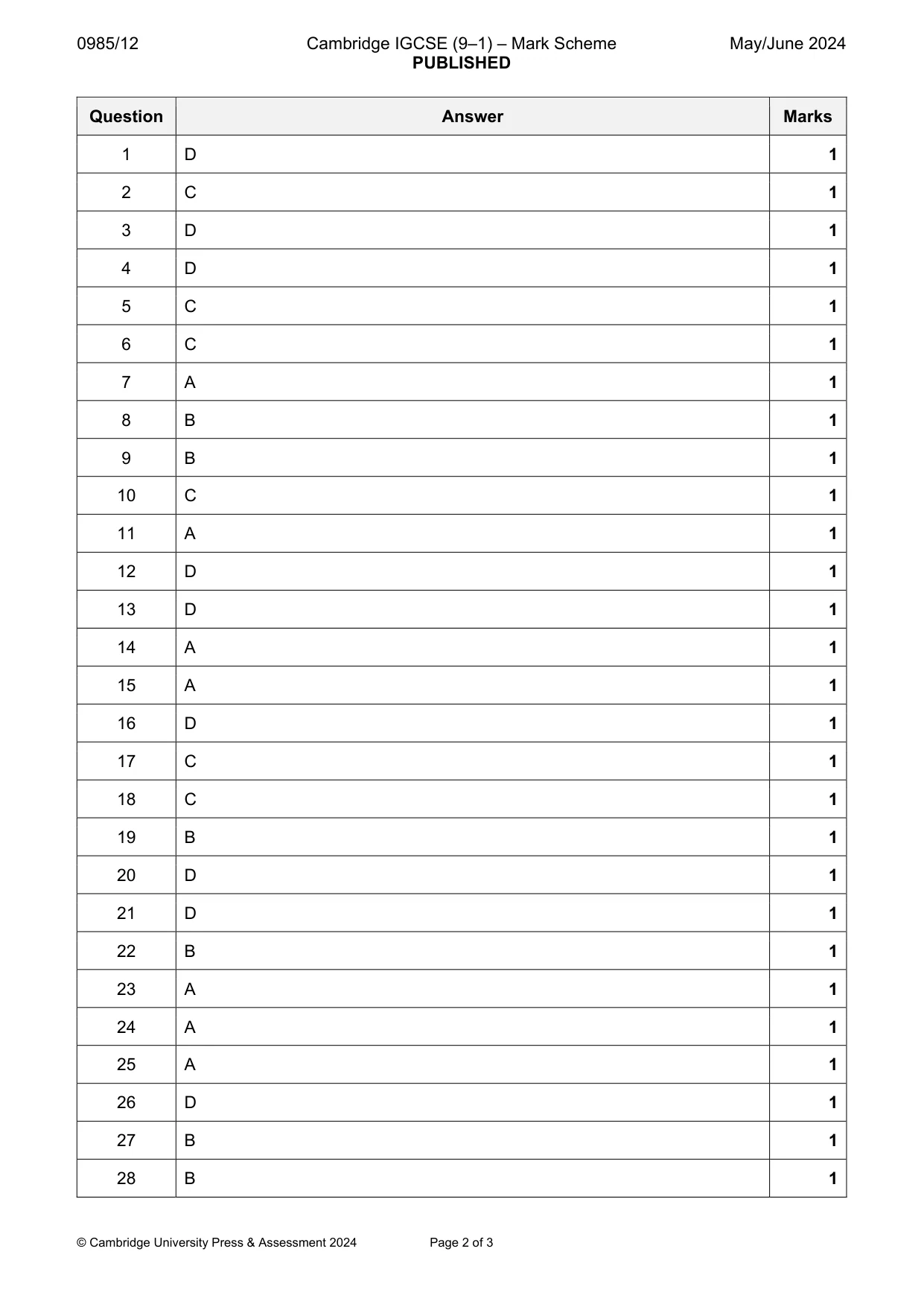
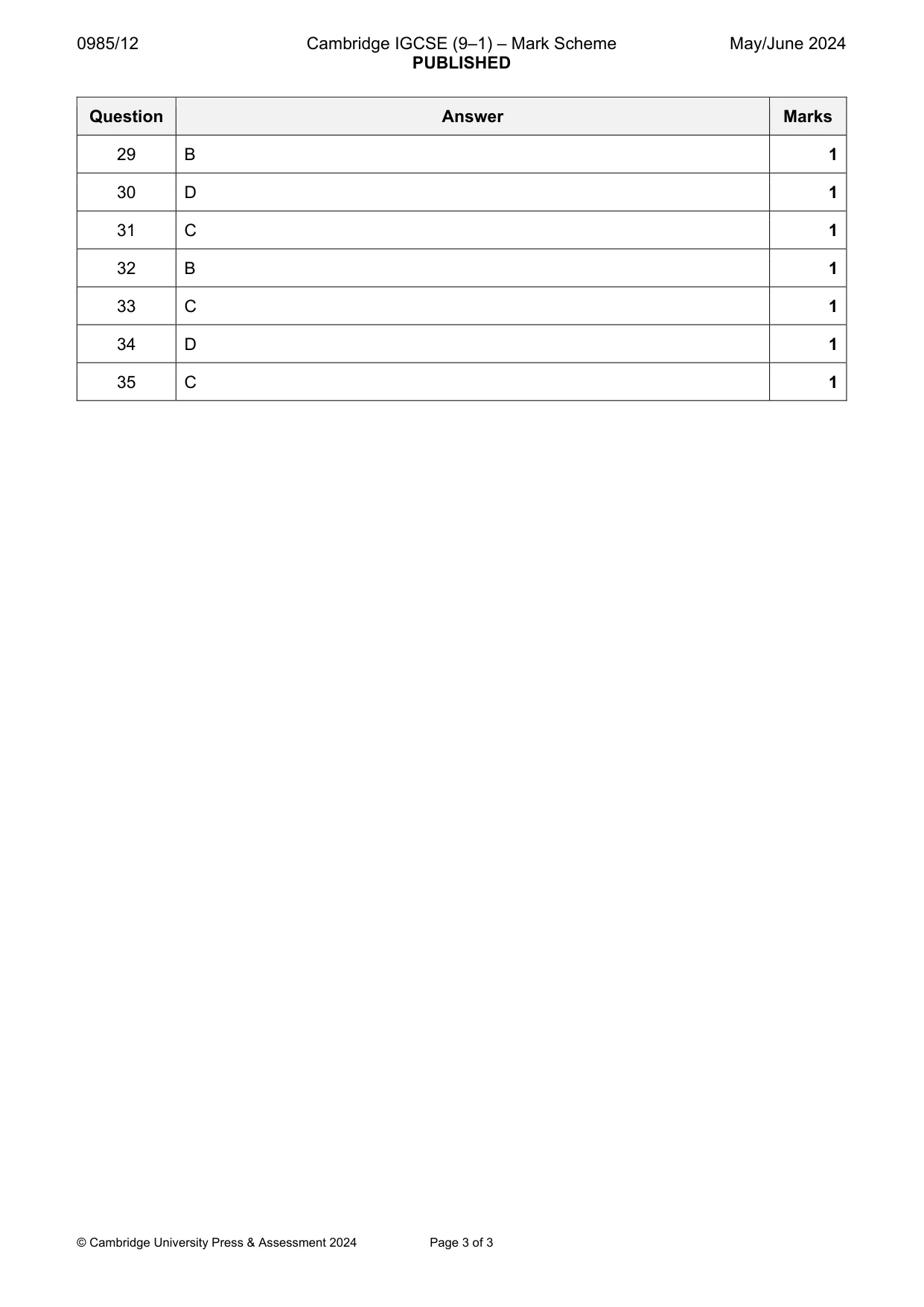
Mark scheme3 pages
Answers below. Sit the paper first if you are practising.
Questions as text
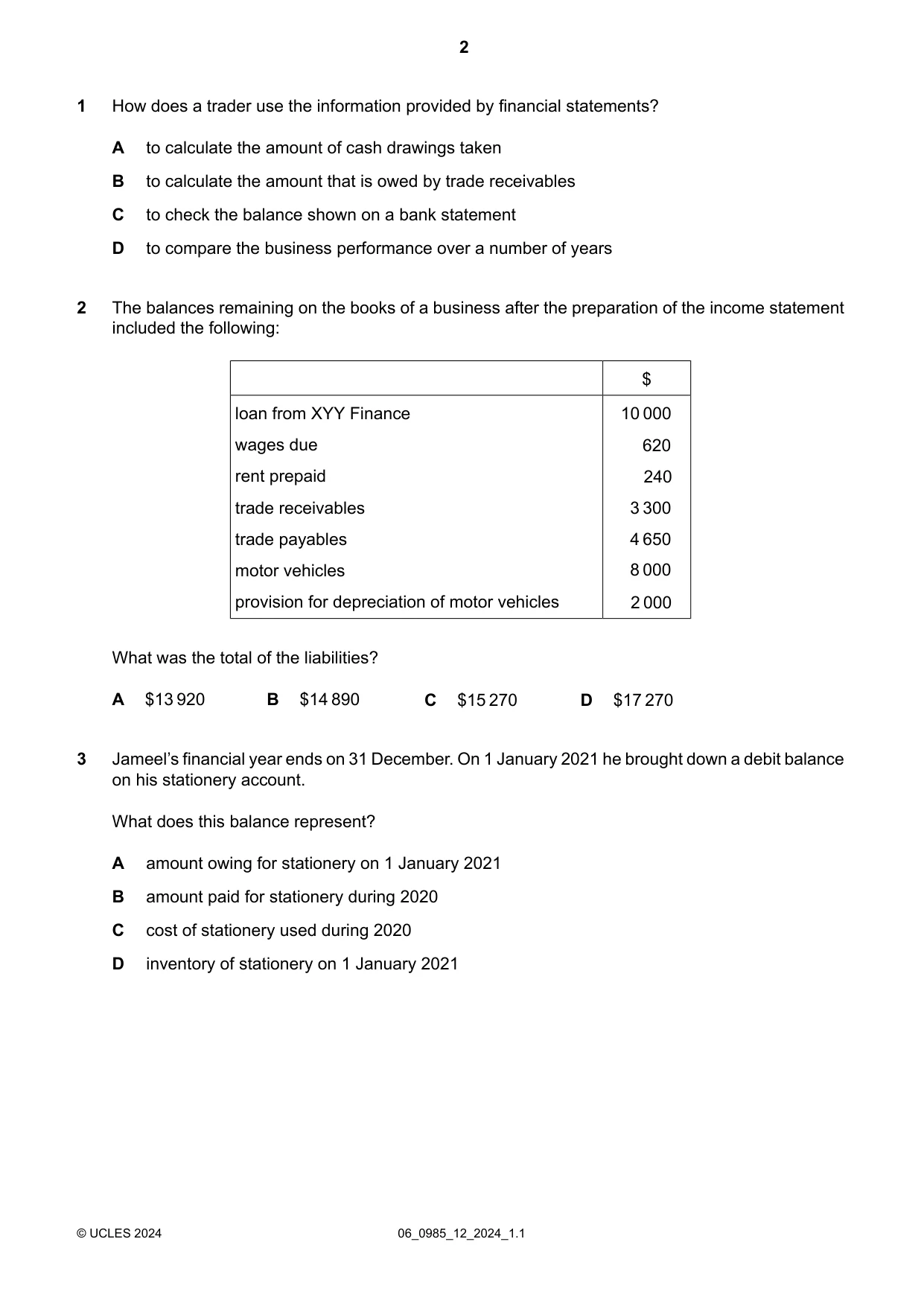
Q1 · How does a trader use the information provided by financial statements?
1 How does a trader use the information provided by financial statements? A to calculate the amount of cash drawings taken B to calculate the amount that is owed by trade receivables C to check the balance shown on a bank statement D to compare the business performance over a number of years
Mark scheme: D
Q2 · The balances remaining on the books of a business after the preparation of the income…
2 The balances remaining on the books of a business after the preparation of the income statement included the following: $ loan from XYY Finance 10 000 wages due 620 rent prepaid 240 trade receivables 3 300 trade payables 4 650 motor vehicles 8 000 provision for depreciation of motor vehicles 2 000 What was the total of the liabilities? A $13 920 B $14 890 C $15 270 D $17 270
Mark scheme: C
Q3 · Jameel’s financial year ends on 31 December
3 Jameel’s financial year ends on 31 December. On 1 January 2021 he brought down a debit balance on his stationery account. What does this balance represent? A amount owing for stationery on 1 January 2021 B amount paid for stationery during 2020 C cost of stationery used during 2020 D inventory of stationery on 1 January 2021
Mark scheme: D
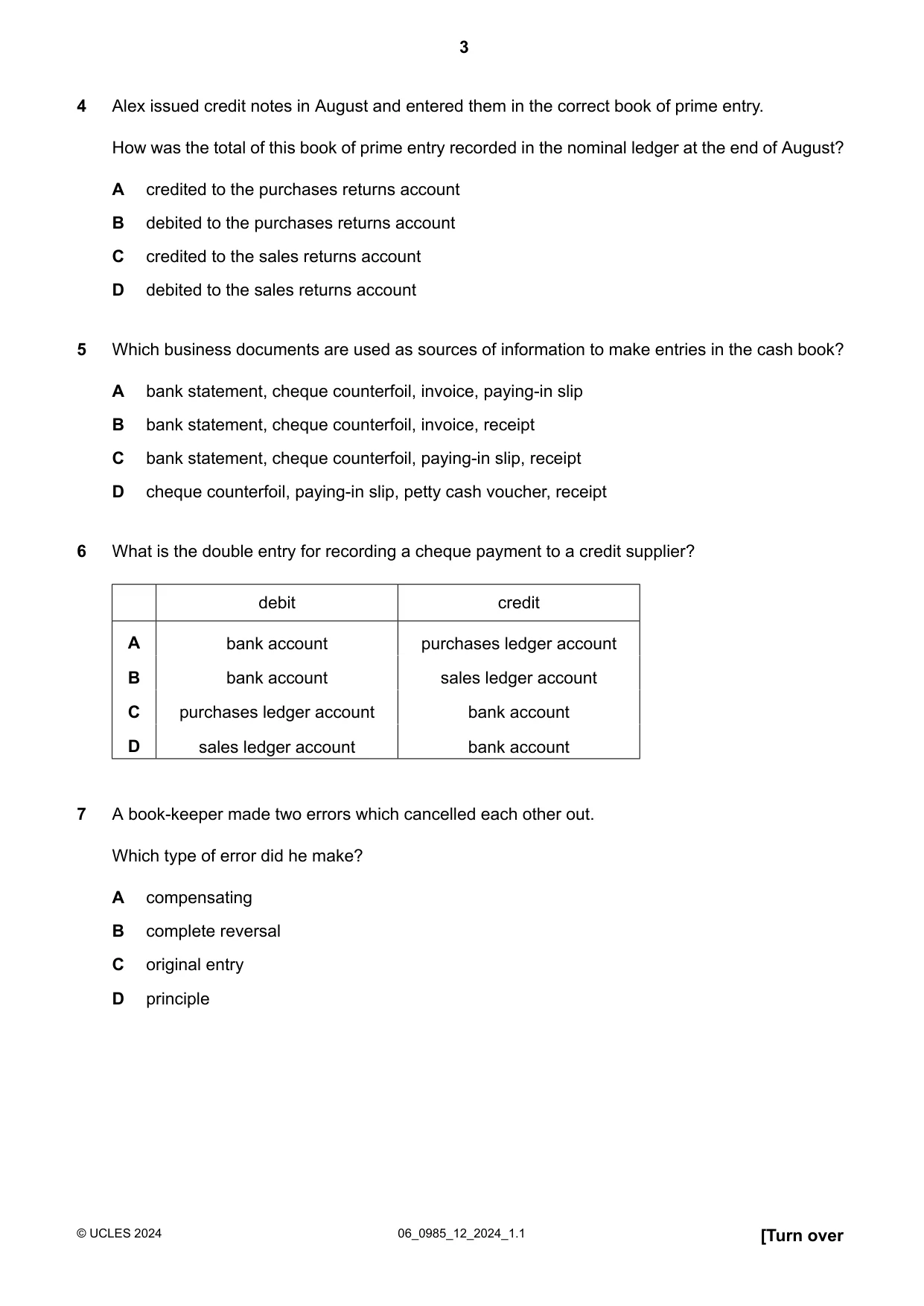
Q4 · Alex issued credit notes in August and entered them in the correct book of prime entry
4 Alex issued credit notes in August and entered them in the correct book of prime entry. How was the total of this book of prime entry recorded in the nominal ledger at the end of August? A credited to the purchases returns account B debited to the purchases returns account C credited to the sales returns account D debited to the sales returns account
Mark scheme: D
Q5 · Which business documents are used as sources of information to make entries in the cash…
5 Which business documents are used as sources of information to make entries in the cash book? A bank statement, cheque counterfoil, invoice, paying-in slip B bank statement, cheque counterfoil, invoice, receipt C bank statement, cheque counterfoil, paying-in slip, receipt D cheque counterfoil, paying-in slip, petty cash voucher, receipt
Mark scheme: C
Q6 · What is the double entry for recording a cheque payment to a credit supplier?
6 What is the double entry for recording a cheque payment to a credit supplier? debit credit A bank account purchases ledger account B bank account sales ledger account C purchases ledger account bank account D sales ledger account bank account
Mark scheme: C
Q7 · A book-keeper made two errors which cancelled each other out
7 A book-keeper made two errors which cancelled each other out. Which type of error did he make? A compensating B complete reversal C original entry D principle
Mark scheme: A
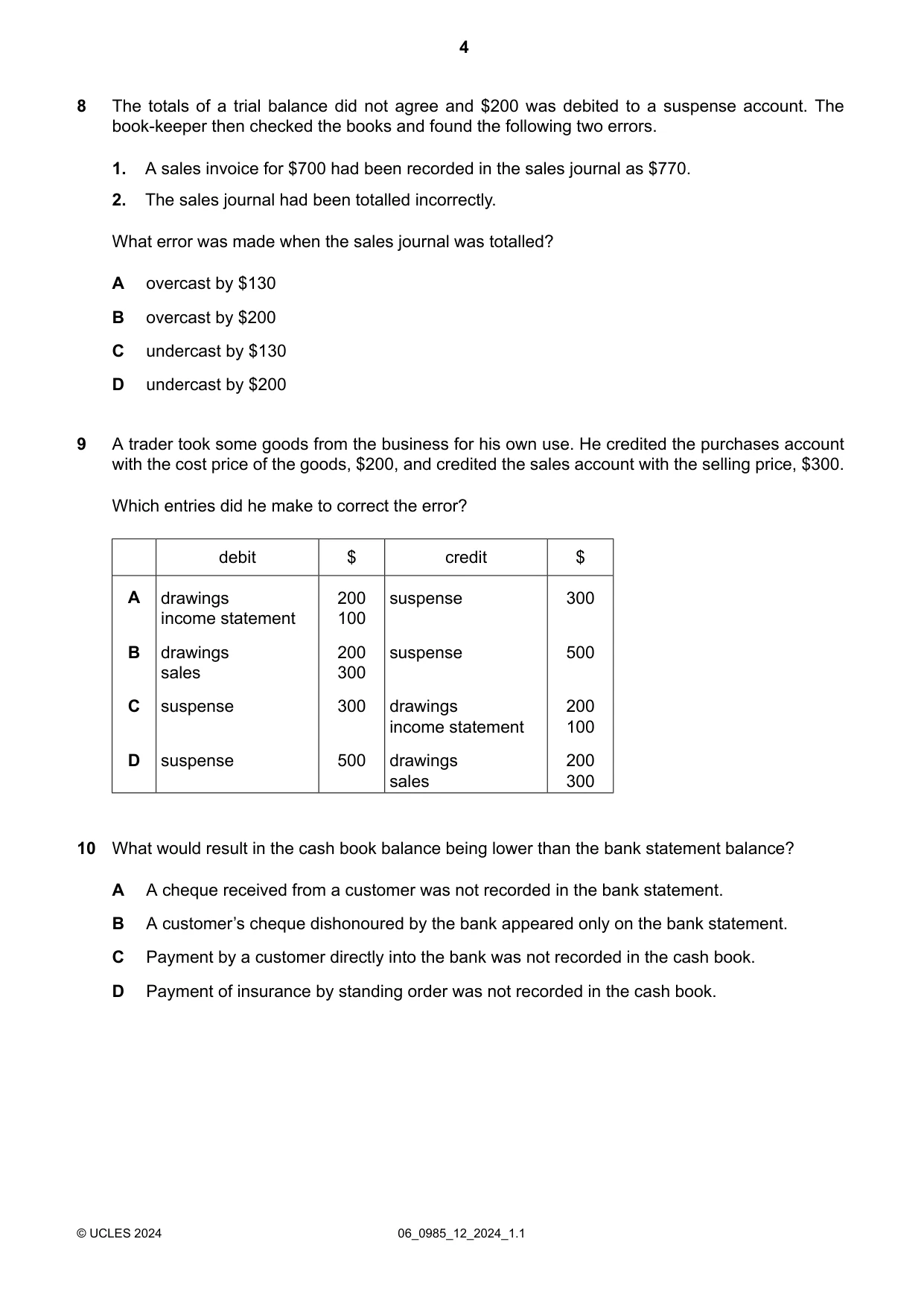
Q8 · The totals of a trial balance did not agree and $200 was debited to a suspense account
8 The totals of a trial balance did not agree and $200 was debited to a suspense account. The book-keeper then checked the books and found the following two errors. 1. A sales invoice for $700 had been recorded in the sales journal as $770. 2. The sales journal had been totalled incorrectly. What error was made when the sales journal was totalled? A overcast by $130 B overcast by $200 C undercast by $130 D undercast by $200
Mark scheme: B
Q9 · A trader took some goods from the business for his own use
9 A trader took some goods from the business for his own use. He credited the purchases account with the cost price of the goods, $200, and credited the sales account with the selling price, $300. Which entries did he make to correct the error? debit $ credit $ A drawings 200 suspense 300 income statement 100 B drawings 200 suspense 500 sales 300 C suspense 300 drawings 200 income statement 100 D suspense 500 drawings 200 sales 300
Mark scheme: B
Q10 · What would result in the cash book balance being lower than the bank statement balance?
10 What would result in the cash book balance being lower than the bank statement balance? A A cheque received from a customer was not recorded in the bank statement. B A customer’s cheque dishonoured by the bank appeared only on the bank statement. C Payment by a customer directly into the bank was not recorded in the cash book. D Payment of insurance by standing order was not recorded in the cash book.
Mark scheme: C
Q11 · The bank statement of a business showed a credit balance of $280 on 31 December
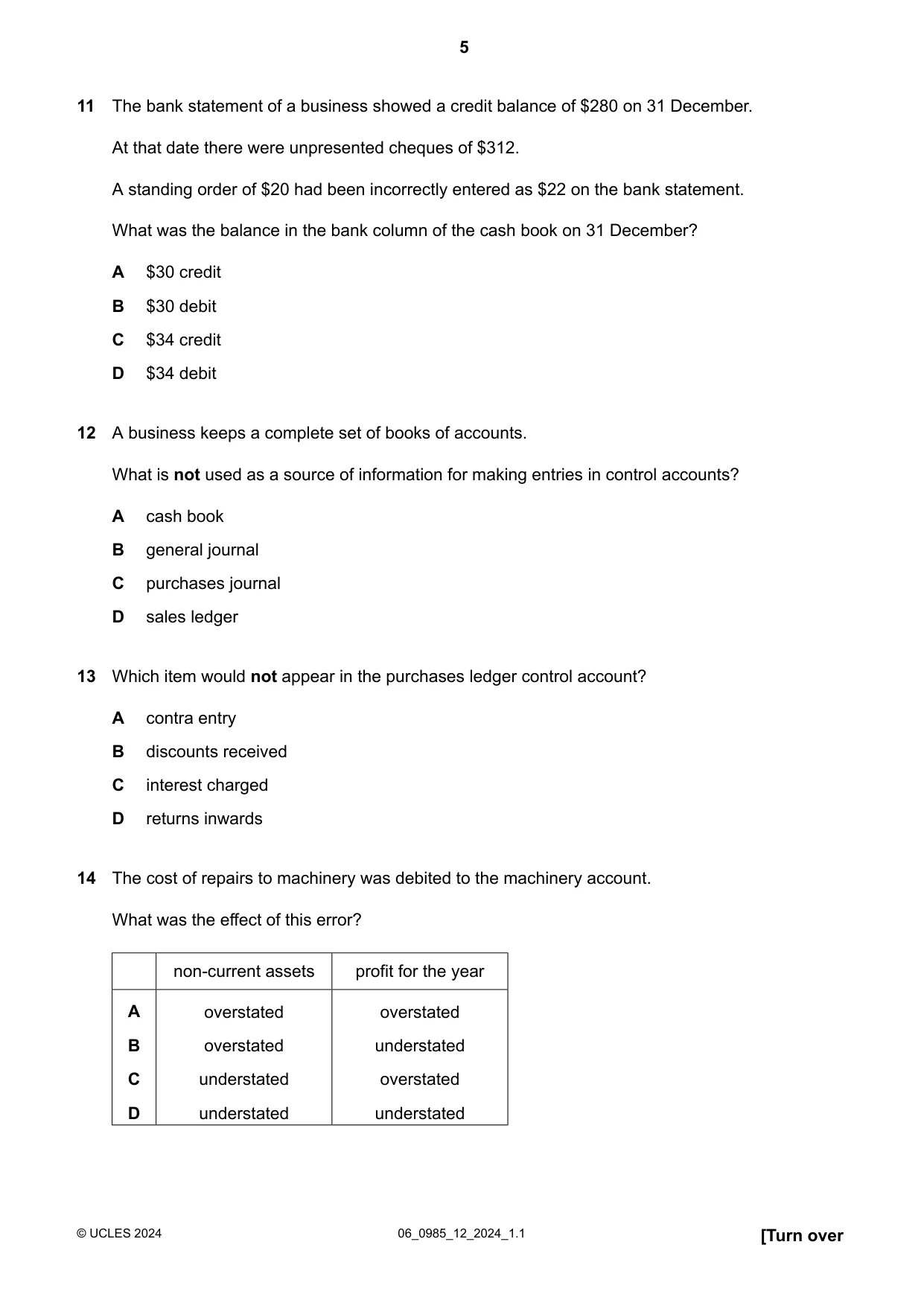
11 The bank statement of a business showed a credit balance of $280 on 31 December. At that date there were unpresented cheques of $312. A standing order of $20 had been incorrectly entered as $22 on the bank statement. What was the balance in the bank column of the cash book on 31 December? A $30 credit B $30 debit C $34 credit D $34 debit
Mark scheme: A
Q12 · A business keeps a complete set of books of accounts
12 A business keeps a complete set of books of accounts. What is not used as a source of information for making entries in control accounts? A cash book B general journal C purchases journal D sales ledger
Mark scheme: D
Q13 · Which item would not appear in the purchases ledger control account?
13 Which item would not appear in the purchases ledger control account? A contra entry B discounts received C interest charged D returns inwards
Mark scheme: D
Q14 · The cost of repairs to machinery was debited to the machinery account
14 The cost of repairs to machinery was debited to the machinery account. What was the effect of this error? non-current assets profit for the year A overstated overstated B overstated understated C understated overstated D understated understated
Mark scheme: A
Q15 · Elzevir purchased a motor vehicle costing $8000 on 1 January 2018
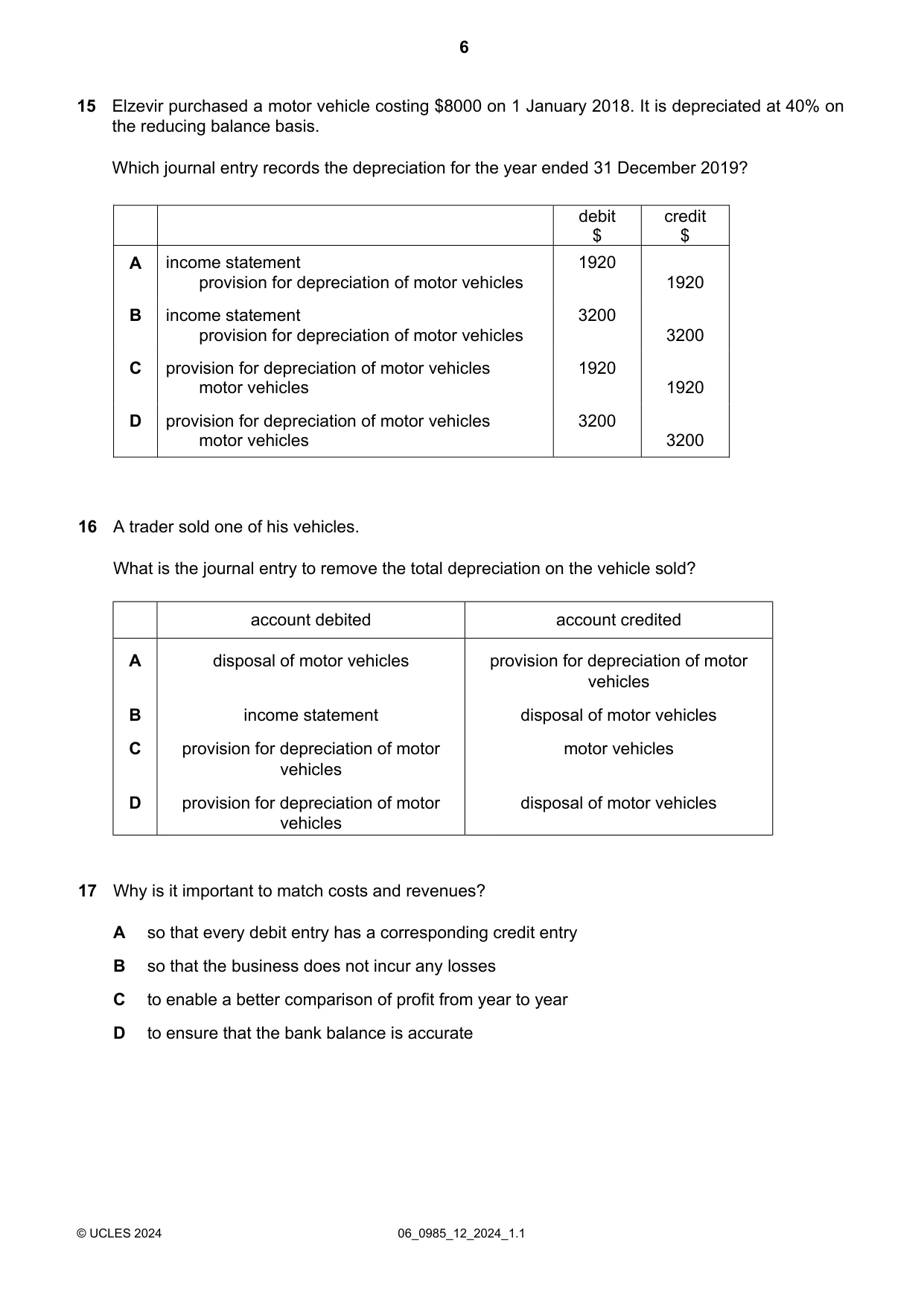
15 Elzevir purchased a motor vehicle costing $8000 on 1 January 2018. It is depreciated at 40% on the reducing balance basis. Which journal entry records the depreciation for the year ended 31 December 2019? debit credit $ $ A income statement 1920 provision for depreciation of motor vehicles 1920 B income statement 3200 provision for depreciation of motor vehicles 3200 C provision for depreciation of motor vehicles 1920 motor vehicles 1920 D provision for depreciation of motor vehicles 3200 motor vehicles 3200
Mark scheme: A
More questions on Accounting for depreciation and disposal of non-current assets
Q16 · A trader sold one of his vehicles
16 A trader sold one of his vehicles. What is the journal entry to remove the total depreciation on the vehicle sold? account debited account credited A disposal of motor vehicles provision for depreciation of motor vehicles B income statement disposal of motor vehicles C provision for depreciation of motor motor vehicles vehicles D provision for depreciation of motor disposal of motor vehicles vehicles
Mark scheme: D
More questions on Accounting for depreciation and disposal of non-current assets
Q17 · Why is it important to match costs and revenues?
17 Why is it important to match costs and revenues? A so that every debit entry has a corresponding credit entry B so that the business does not incur any losses C to enable a better comparison of profit from year to year D to ensure that the bank balance is accurate
Mark scheme: C
Q18 · Devendra prepared the following journal entry
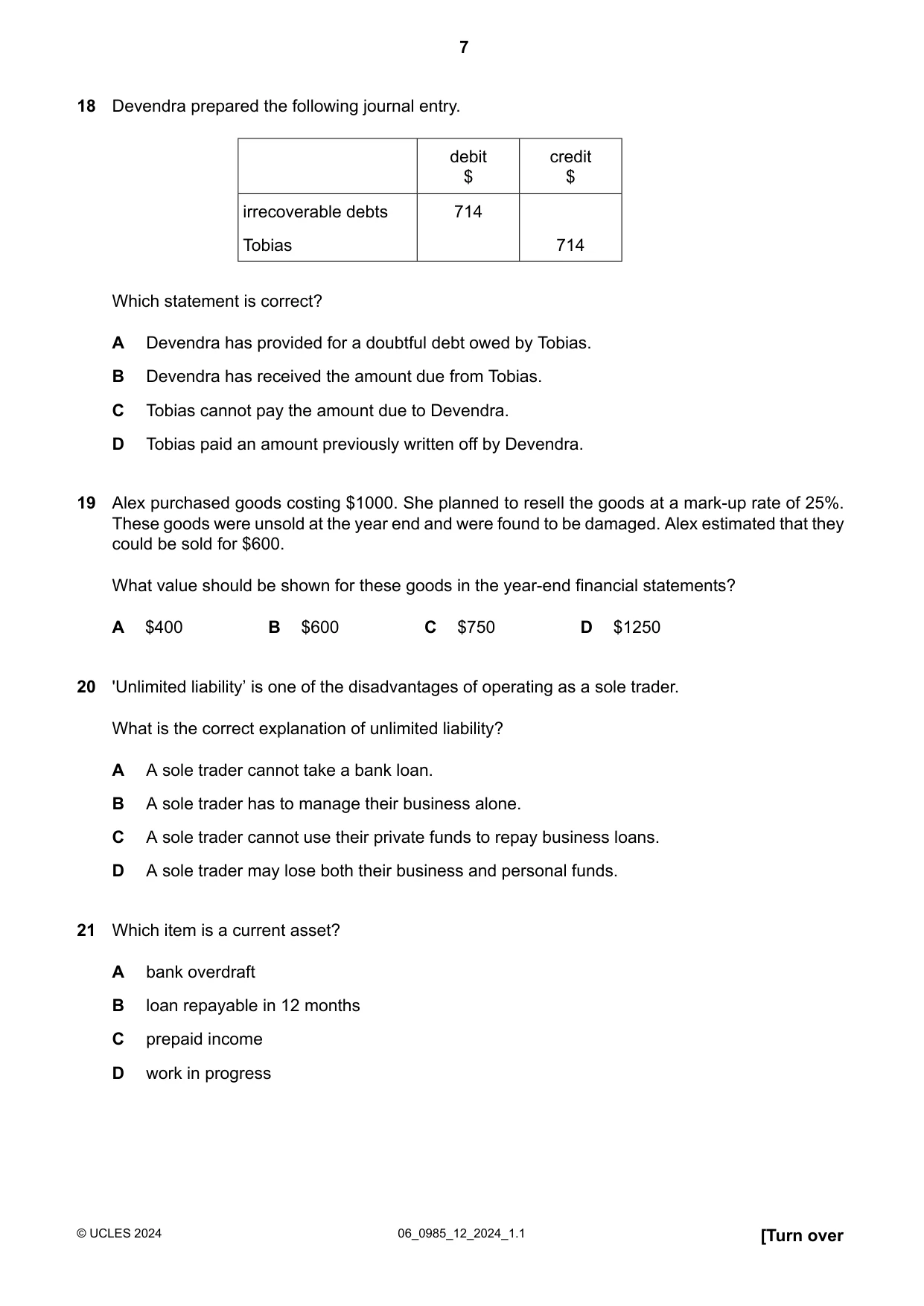
18 Devendra prepared the following journal entry. debit credit $ $ irrecoverable debts 714 Tobias 714 Which statement is correct? A Devendra has provided for a doubtful debt owed by Tobias. B Devendra has received the amount due from Tobias. C Tobias cannot pay the amount due to Devendra. D Tobias paid an amount previously written off by Devendra.
Mark scheme: C
More questions on Irrecoverable debts and allowance for irrecoverable debts
Q19 · Alex purchased goods costing $1000
19 Alex purchased goods costing $1000. She planned to resell the goods at a mark-up rate of 25%. These goods were unsold at the year end and were found to be damaged. Alex estimated that they could be sold for $600. What value should be shown for these goods in the year-end financial statements? A $400 B $600 C $750 D $1250
Mark scheme: B
Q20 · 'Unlimited liability’ is one of the disadvantages of operating as a sole trader
20 'Unlimited liability’ is one of the disadvantages of operating as a sole trader. What is the correct explanation of unlimited liability? A A sole trader cannot take a bank loan. B A sole trader has to manage their business alone. C A sole trader cannot use their private funds to repay business loans. D A sole trader may lose both their business and personal funds.
Mark scheme: D
Q21 · Which item is a current asset?
21 Which item is a current asset? A bank overdraft B loan repayable in 12 months C prepaid income D work in progress
Mark scheme: D
Q22 · Where is interest on drawings entered in the accounting records of a partnership business?
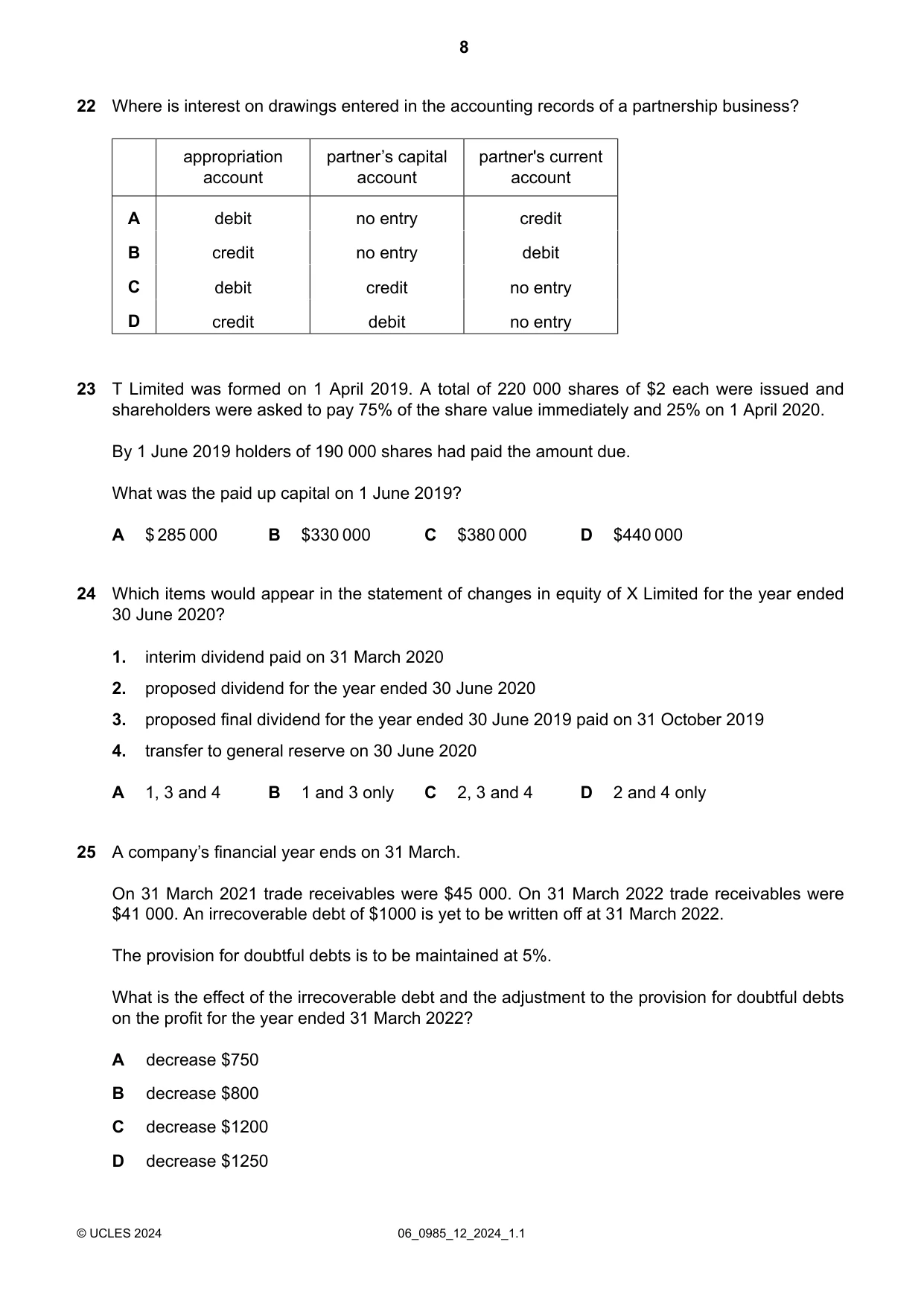
22 Where is interest on drawings entered in the accounting records of a partnership business? appropriation partner’s capital partner's current account account account A debit no entry credit B credit no entry debit C debit credit no entry D credit debit no entry
Mark scheme: B
Q23 · T Limited was formed on 1 April 2019
23 T Limited was formed on 1 April 2019. A total of 220 000 shares of $2 each were issued and shareholders were asked to pay 75% of the share value immediately and 25% on 1 April 2020. By 1 June 2019 holders of 190 000 shares had paid the amount due. What was the paid up capital on 1 June 2019? A $ 285 000 B $330 000 C $380 000 D $440 000
Mark scheme: A
Q24 · Which items would appear in the statement of changes in equity of X Limited for the year…
24 Which items would appear in the statement of changes in equity of X Limited for the year ended 30 June 2020? 1. interim dividend paid on 31 March 2020 2. proposed dividend for the year ended 30 June 2020 3. proposed final dividend for the year ended 30 June 2019 paid on 31 October 2019 4. transfer to general reserve on 30 June 2020 A 1, 3 and 4 B 1 and 3 only C 2, 3 and 4 D 2 and 4 only
Mark scheme: A
Q25 · A company’s financial year ends on 31 March
25 A company’s financial year ends on 31 March. On 31 March 2021 trade receivables were $45 000. On 31 March 2022 trade receivables were $41 000. An irrecoverable debt of $1000 is yet to be written off at 31 March 2022. The provision for doubtful debts is to be maintained at 5%. What is the effect of the irrecoverable debt and the adjustment to the provision for doubtful debts on the profit for the year ended 31 March 2022? A decrease $750 B decrease $800 C decrease $1200 D decrease $1250
Mark scheme: A
More questions on Irrecoverable debts and allowance for irrecoverable debts
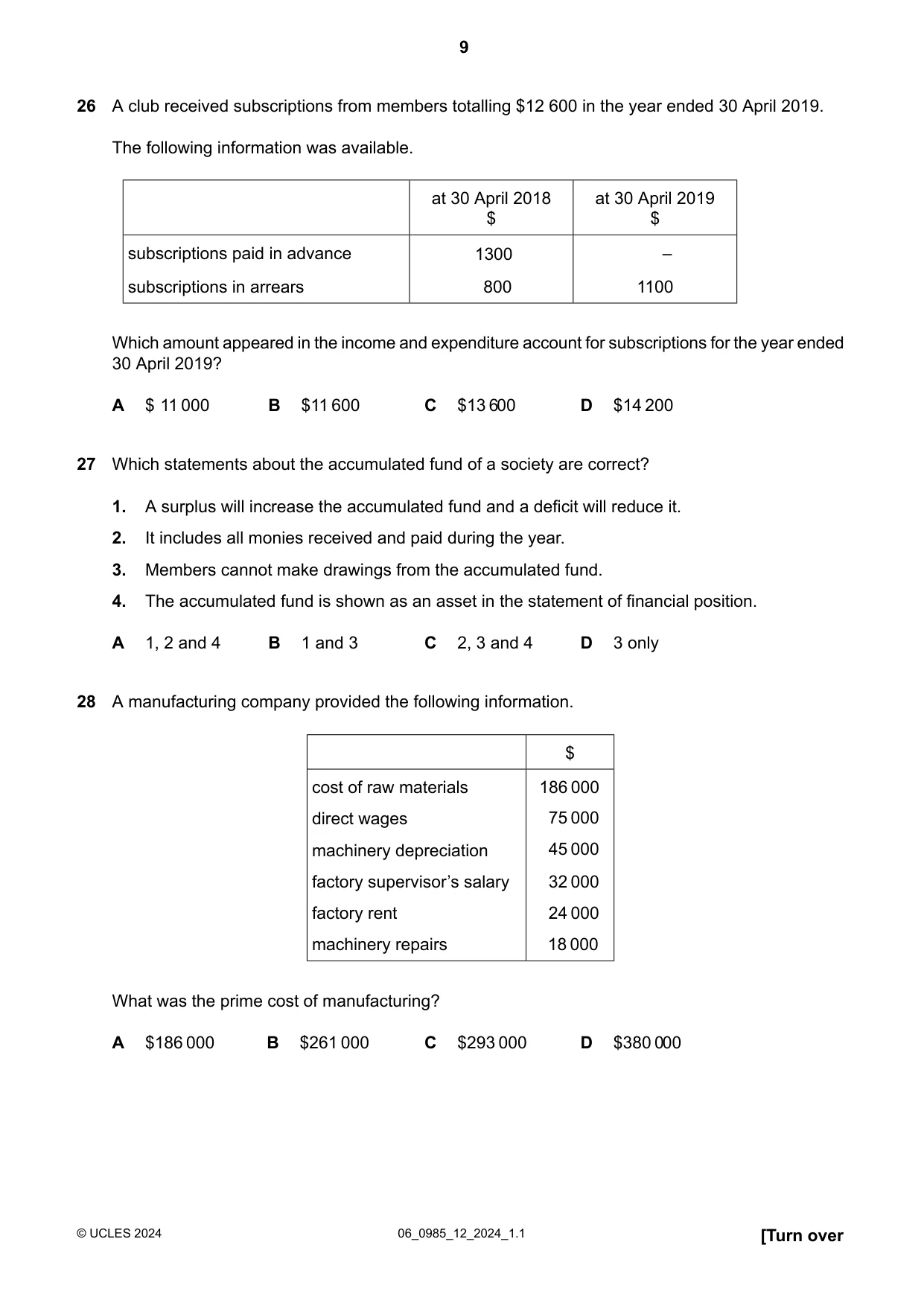
Q26 · A club received subscriptions from members totalling $12 600 in the year ended 30 April…
26 A club received subscriptions from members totalling $12 600 in the year ended 30 April 2019. The following information was available. at 30 April 2018 at 30 April 2019 $ $ subscriptions paid in advance 1300 – subscriptions in arrears 800 1100 Which amount appeared in the income and expenditure account for subscriptions for the year ended 30 April 2019? A $ 11 000 B $11 600 C $13 600 D $14 200
Mark scheme: D
Q27 · Which statements about the accumulated fund of a society are correct?
27 Which statements about the accumulated fund of a society are correct? 1. A surplus will increase the accumulated fund and a deficit will reduce it. 2. It includes all monies received and paid during the year. 3. Members cannot make drawings from the accumulated fund. 4. The accumulated fund is shown as an asset in the statement of financial position. A 1, 2 and 4 B 1 and 3 C 2, 3 and 4 D 3 only
Mark scheme: B
Q28 · A manufacturing company provided the following information
28 A manufacturing company provided the following information. $ cost of raw materials 186 000 direct wages 75 000 machinery depreciation 45 000 factory supervisor’s salary 32 000 factory rent 24 000 machinery repairs 18 000 What was the prime cost of manufacturing? A $186 000 B $261 000 C $293 000 D $380 000
Mark scheme: B
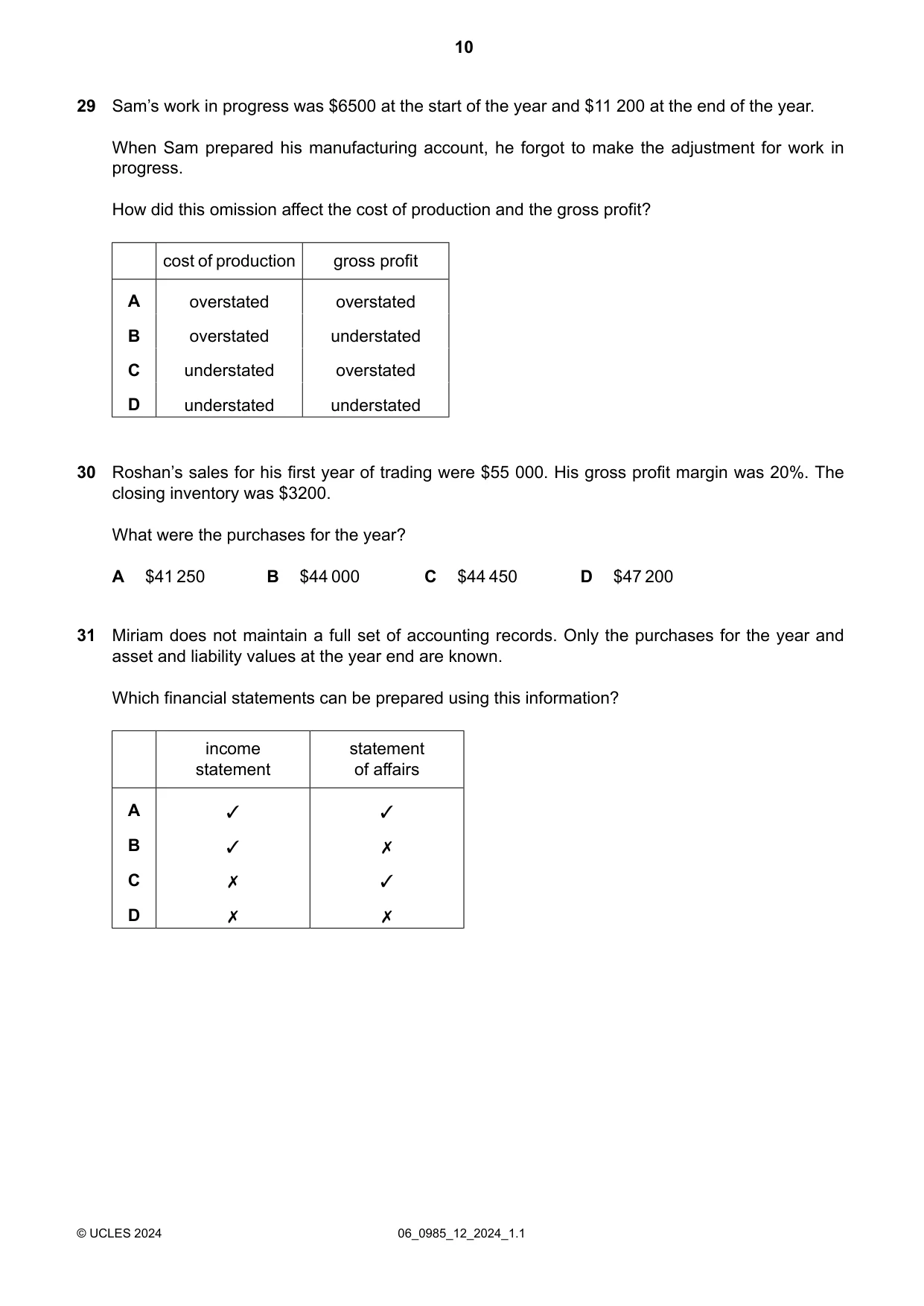
Q29 · Sam’s work in progress was $6500 at the start of the year and $11 200 at the end of the…
29 Sam’s work in progress was $6500 at the start of the year and $11 200 at the end of the year. When Sam prepared his manufacturing account, he forgot to make the adjustment for work in progress. How did this omission affect the cost of production and the gross profit? cost of production gross profit A overstated overstated B overstated understated C understated overstated D understated understated
Mark scheme: B
Q30 · Roshan’s sales for his first year of trading were $55 000
30 Roshan’s sales for his first year of trading were $55 000. His gross profit margin was 20%. The closing inventory was $3200. What were the purchases for the year? A $41 250 B $44 000 C $44 450 D $47 200
Mark scheme: D
More questions on Calculation and understanding of accounting ratios
Q31 · Miriam does not maintain a full set of accounting records
31 Miriam does not maintain a full set of accounting records. Only the purchases for the year and asset and liability values at the year end are known. Which financial statements can be prepared using this information? income statement statement of affairs A ✓ ✓ B ✓ ✗ C ✗ ✓ D ✗ ✗
Mark scheme: C
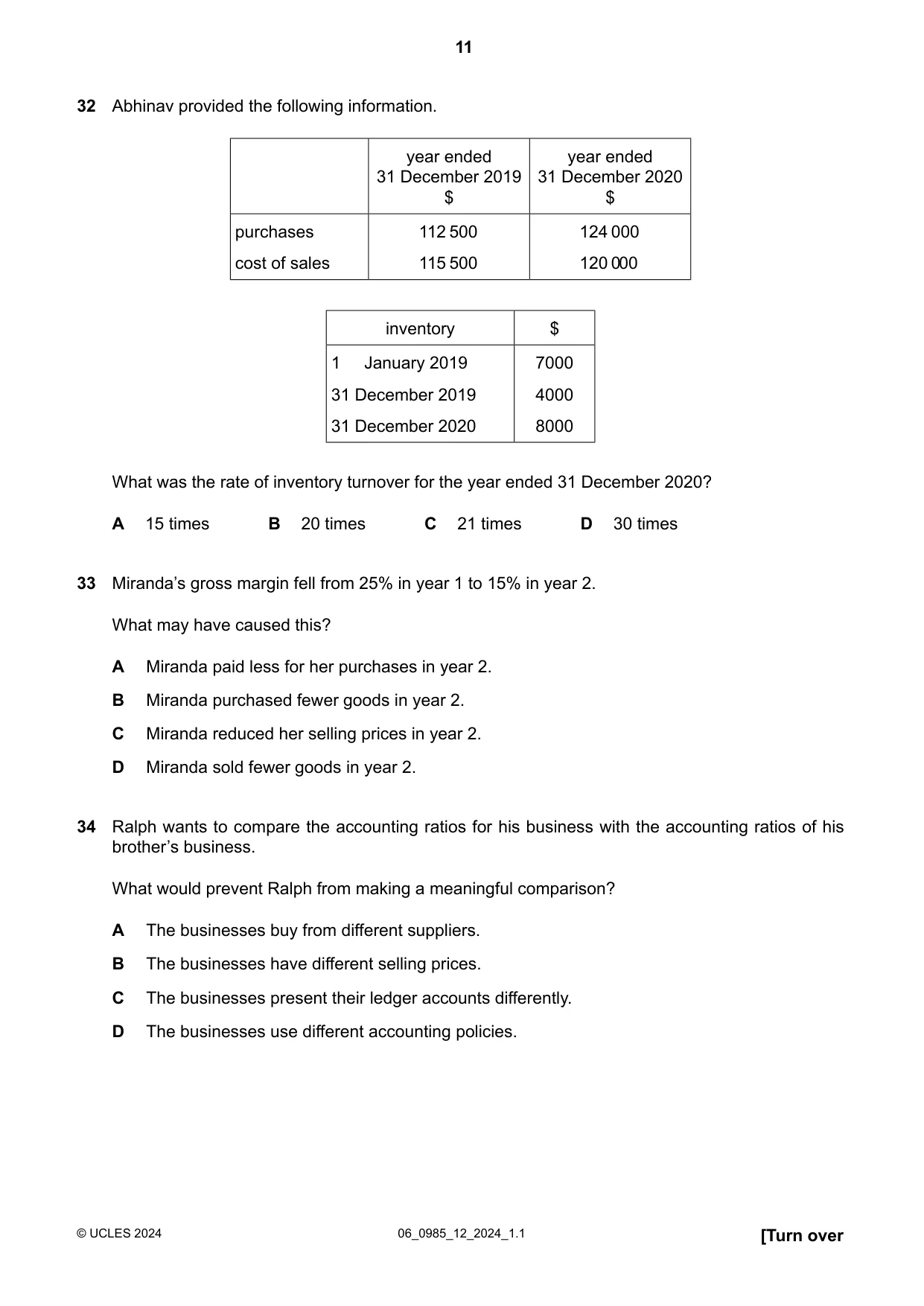
Q32 · Abhinav provided the following information
32 Abhinav provided the following information. year ended year ended 31 December 2019 31 December 2020 $ $ purchases 112 500 124 000 cost of sales 115 500 120 000 inventory $ 1 January 2019 7000 31 December 2019 4000 31 December 2020 8000 What was the rate of inventory turnover for the year ended 31 December 2020? A 15 times B 20 times C 21 times D 30 times
Mark scheme: B
More questions on Calculation and understanding of accounting ratios
Q33 · Miranda’s gross margin fell from 25% in year 1 to 15% in year 2
33 Miranda’s gross margin fell from 25% in year 1 to 15% in year 2. What may have caused this? A Miranda paid less for her purchases in year 2. B Miranda purchased fewer goods in year 2. C Miranda reduced her selling prices in year 2. D Miranda sold fewer goods in year 2.
Mark scheme: C
Q34 · Ralph wants to compare the accounting ratios for his business with the accounting ratios…
34 Ralph wants to compare the accounting ratios for his business with the accounting ratios of his brother’s business. What would prevent Ralph from making a meaningful comparison? A The businesses buy from different suppliers. B The businesses have different selling prices. C The businesses present their ledger accounts differently. D The businesses use different accounting policies.
Mark scheme: D
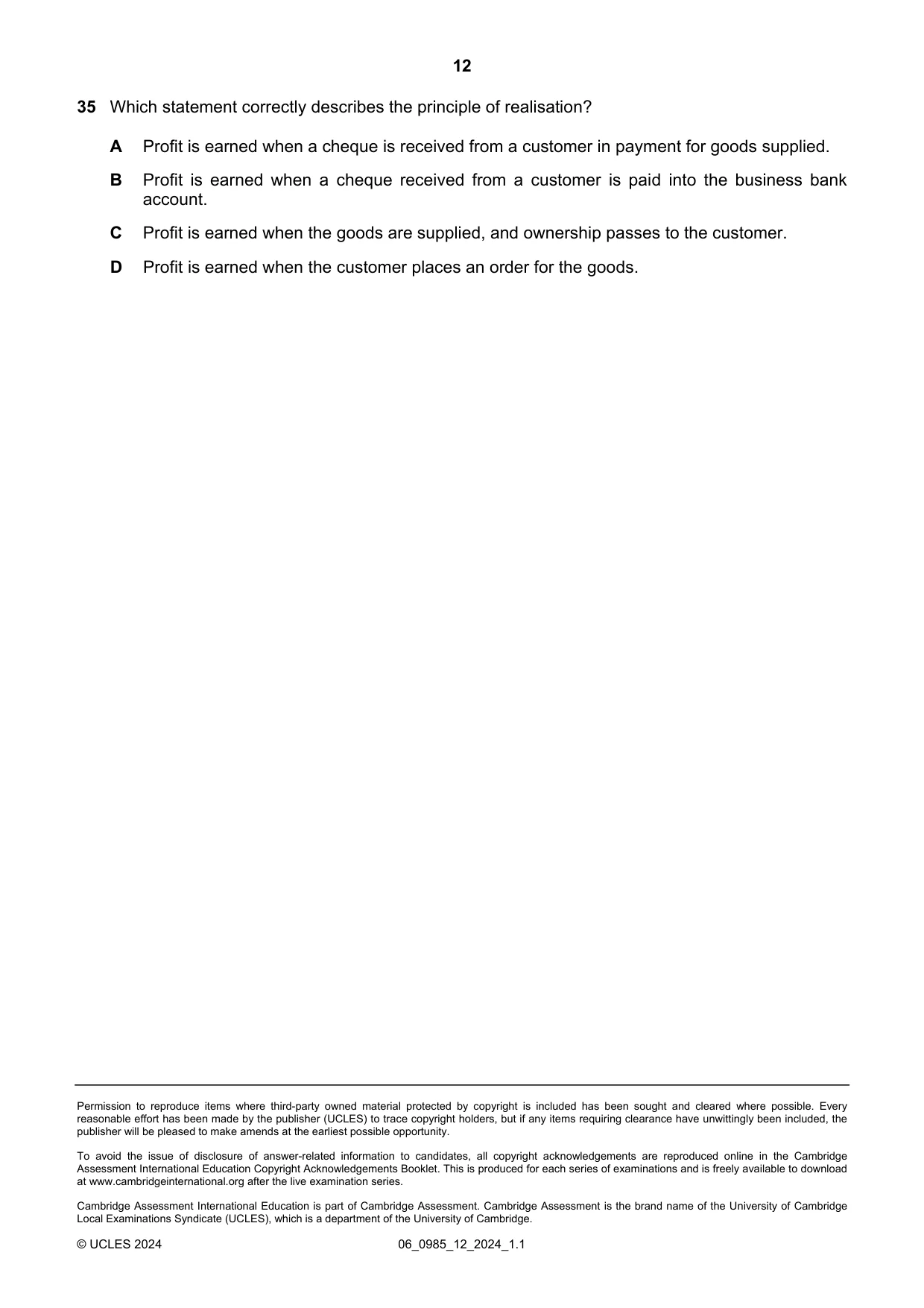
Q35 · Which statement correctly describes the principle of realisation?
35 Which statement correctly describes the principle of realisation? A Profit is earned when a cheque is received from a customer in payment for goods supplied. B Profit is earned when a cheque received from a customer is paid into the business bank account. C Profit is earned when the goods are supplied, and ownership passes to the customer. D Profit is earned when the customer places an order for the goods.
Mark scheme: C
What was in this paper
The subtopics covered by these 35 questions, and how many questions each got. Open one in a new tab to see every Cambridge question on it.
4Manufacturing accounts3Accounting concepts2Accounting for depreciation and disposal of non-current assets2Bank reconciliation2Calculation and understanding of accounting ratios2Clubs and societies2Control accounts2Irrecoverable debts and allowance for irrecoverable debts2Limited companies2The double entry system of book-keeping2Books of prime entry1Business documents1Incomplete records1Inter-business comparison1Interested parties1Interpretation of accounting ratios1Partnerships1Sole traders1The accounting equation1Valuation of inventory1What you needed in this session
Cambridge’s own grade thresholds for 2024 May/June, Paper 1 · Variant 2. A higher threshold means an easier paper — the bar moves with how the cohort did.