Cambridge A Level Travel and Tourism 9395 — 2021 Oct/Nov Paper 1 · Variant 1
9395/11/O/N/21 · 100 marks · ≈113 min
The question paper and its mark scheme, free to read here and free to download. This is Cambridge’s own paper, exactly as it was sat.
Question paper16 pages



Mark scheme14 pages
Answers below. Sit the paper first if you are practising.
Paper as text
Question paper, page 1
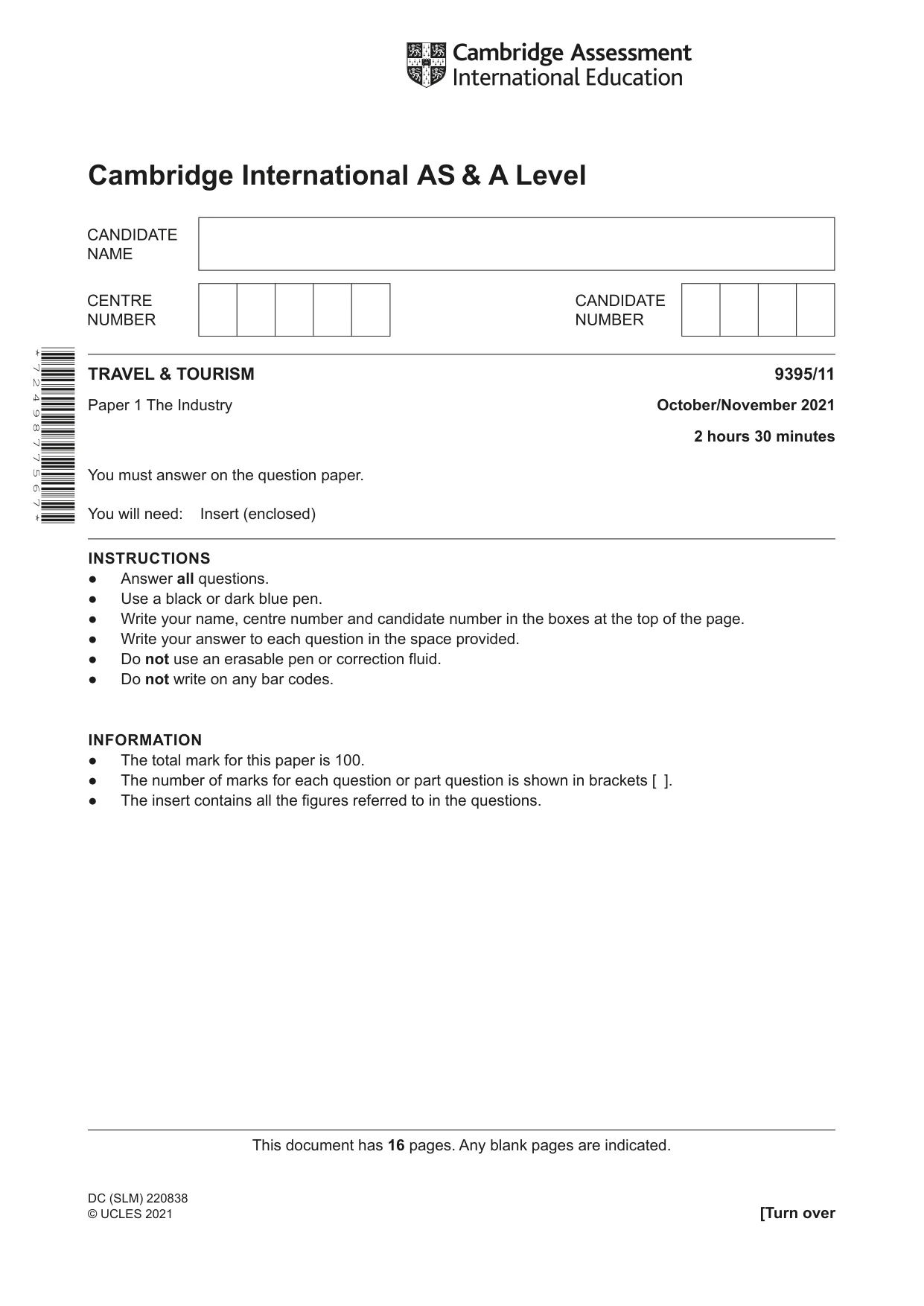
* 7 2 4 9 8 7 7 5 6 7 * DC (SLM) 220838 © UCLES 2021 [Turn over This document has 16 pages. Any blank pages are indicated. TRAVEL & TOURISM 9395/11 Paper 1 The Industry October/November 2021 2 hours 30 minutes You must answer on the question paper. You will need: Insert (enclosed) INSTRUCTIONS ● Answer all questions. ● Use a black or dark blue pen. ● Write your name, centre number and candidate number in the boxes at the top of the page. ● Write your answer to each question in the space provided. ● Do not use an erasable pen or correction fluid. ● Do not write on any bar codes. INFORMATION ● The total mark for this paper is 100. ● The number of marks for each question or part question is shown in brackets [ ]. ● The insert contains all the figures referred to in the questions. Cambridge International AS & A Level
Question paper, page 2
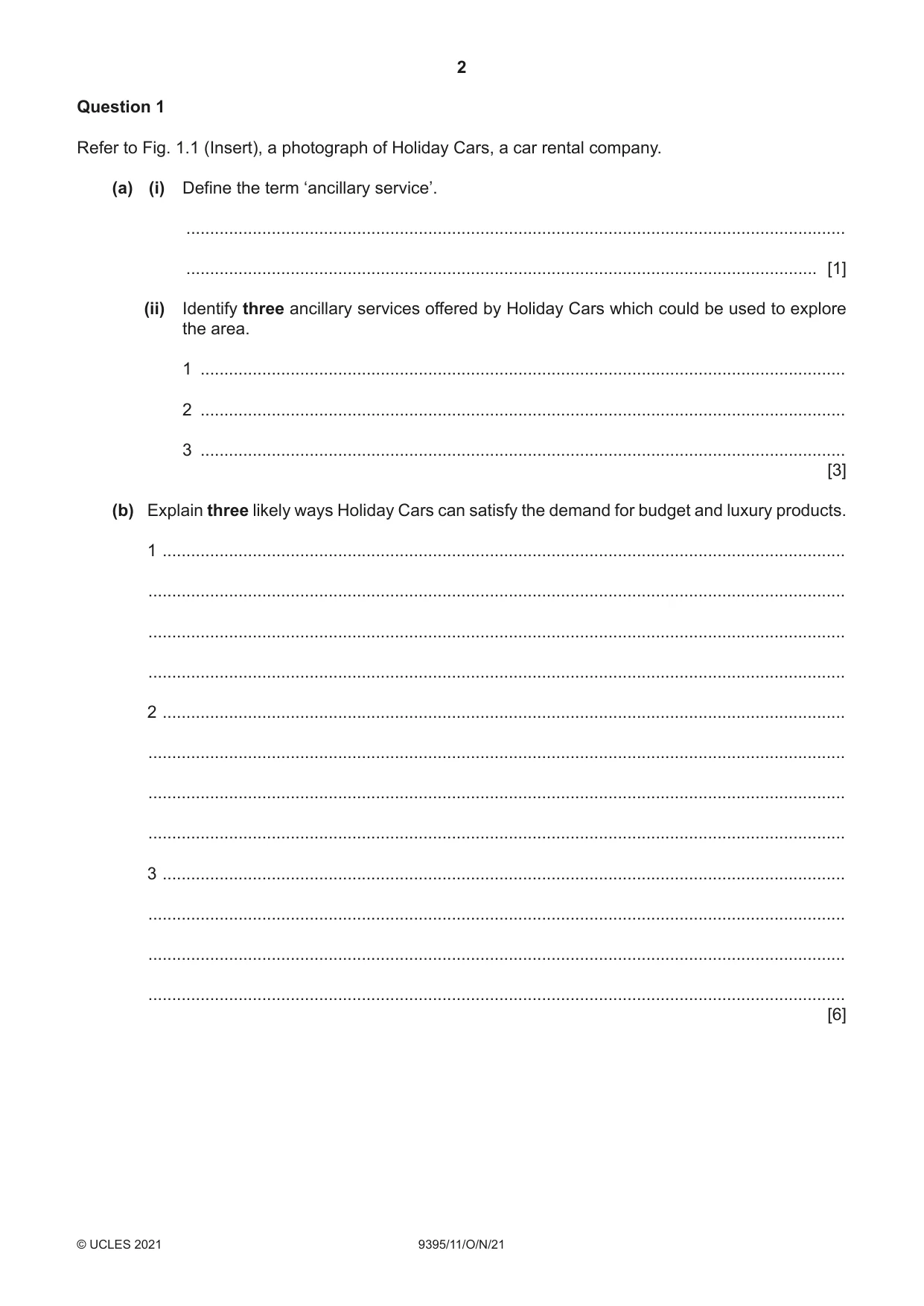
2 9395/11/O/N/21 © UCLES 2021 Question 1 Refer to Fig. 1.1 (Insert), a photograph of Holiday Cars, a car rental company. (a) (i) Define the term ‘ancillary service’. … … [1] (ii) Identify three ancillary services offered by Holiday Cars which could be used to explore the area. 1 … 2 … 3 … [3] (b) Explain three likely ways Holiday Cars can satisfy the demand for budget and luxury products. 1 … … … … 2 … … … … 3 … … … … [6]
Question paper, page 3
3 9395/11/O/N/21 © UCLES 2021 [Turn over (c) Explain two likely business objectives of a car hire company. 1 … … … … … … 2 … … … … … … [6]
Question paper, page 4
4 9395/11/O/N/21 © UCLES 2021 (d) Discuss the likely disadvantages for tourists of using public transport. … … … … … … … … … … … … … … … … … … [9] [Total: 25]
Question paper, page 5
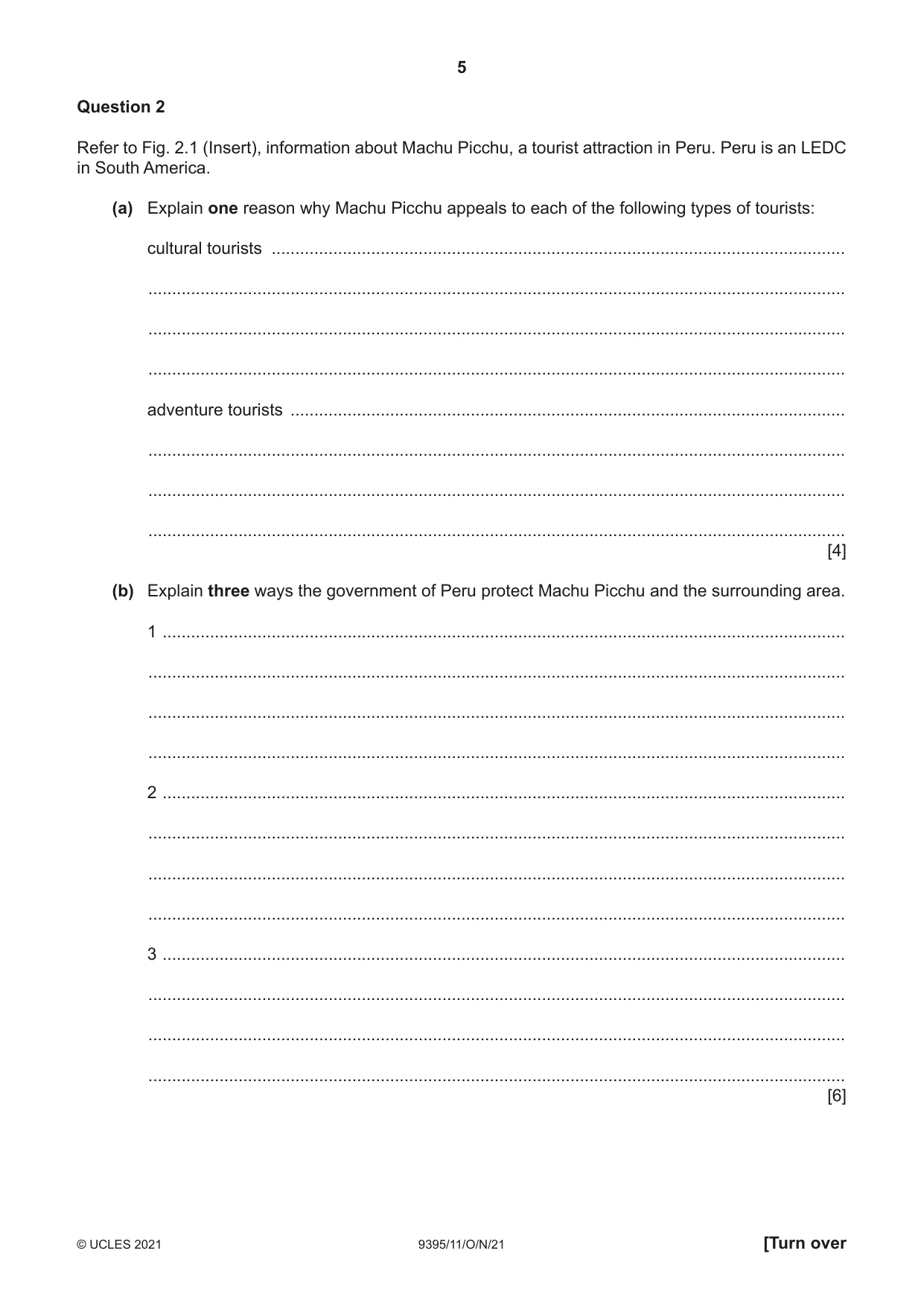
5 9395/11/O/N/21 © UCLES 2021 [Turn over Question 2 Refer to Fig. 2.1 (Insert), information about Machu Picchu, a tourist attraction in Peru. Peru is an LEDC in South America. (a) Explain one reason why Machu Picchu appeals to each of the following types of tourists: cultural tourists … … … … adventure tourists … … … … [4] (b) Explain three ways the government of Peru protect Machu Picchu and the surrounding area. 1 … … … … 2 … … … … 3 … … … … [6]
Question paper, page 6
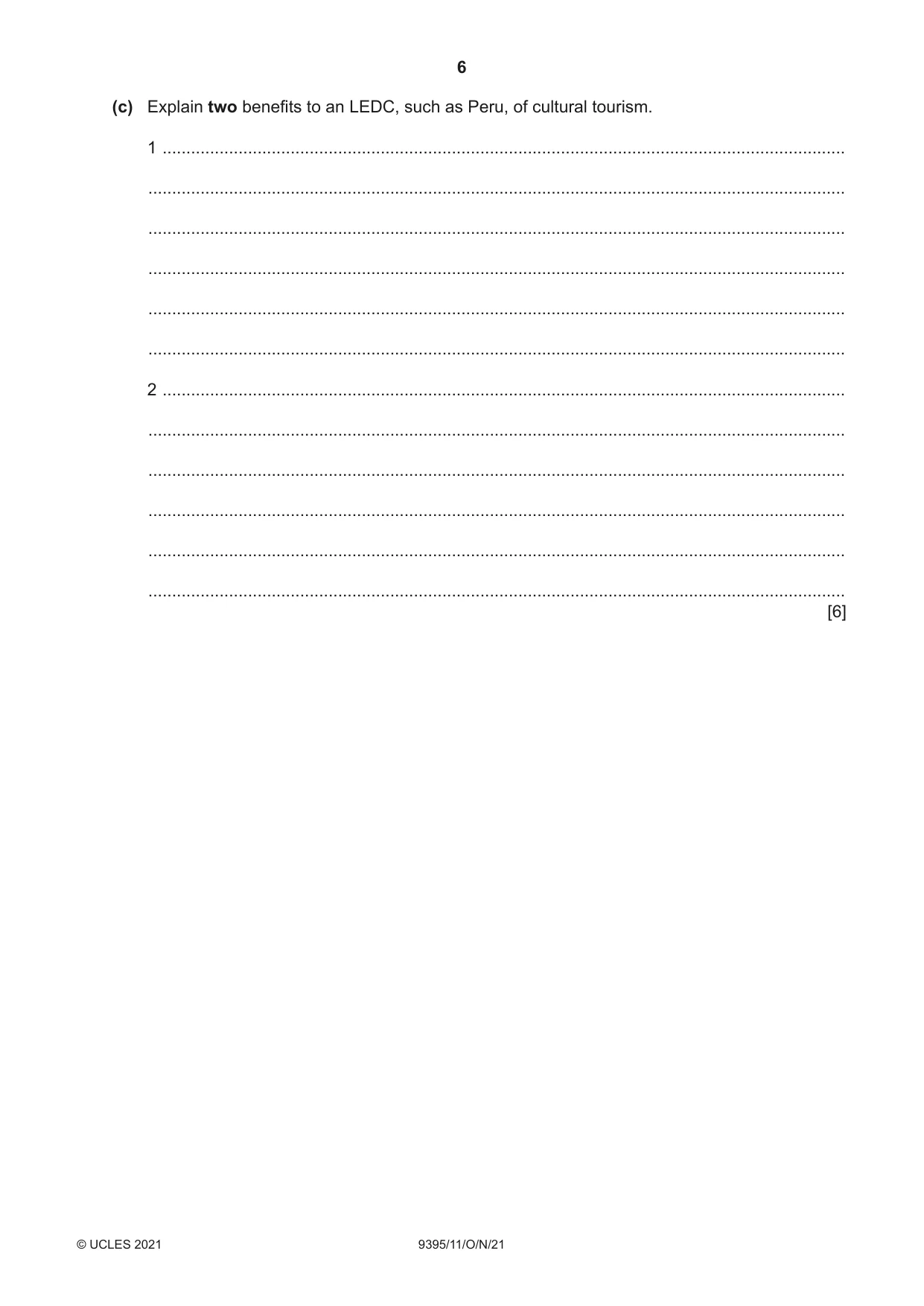
6 9395/11/O/N/21 © UCLES 2021 (c) Explain two benefits to an LEDC, such as Peru, of cultural tourism. 1 … … … … … … 2 … … … … … … [6]
Question paper, page 7
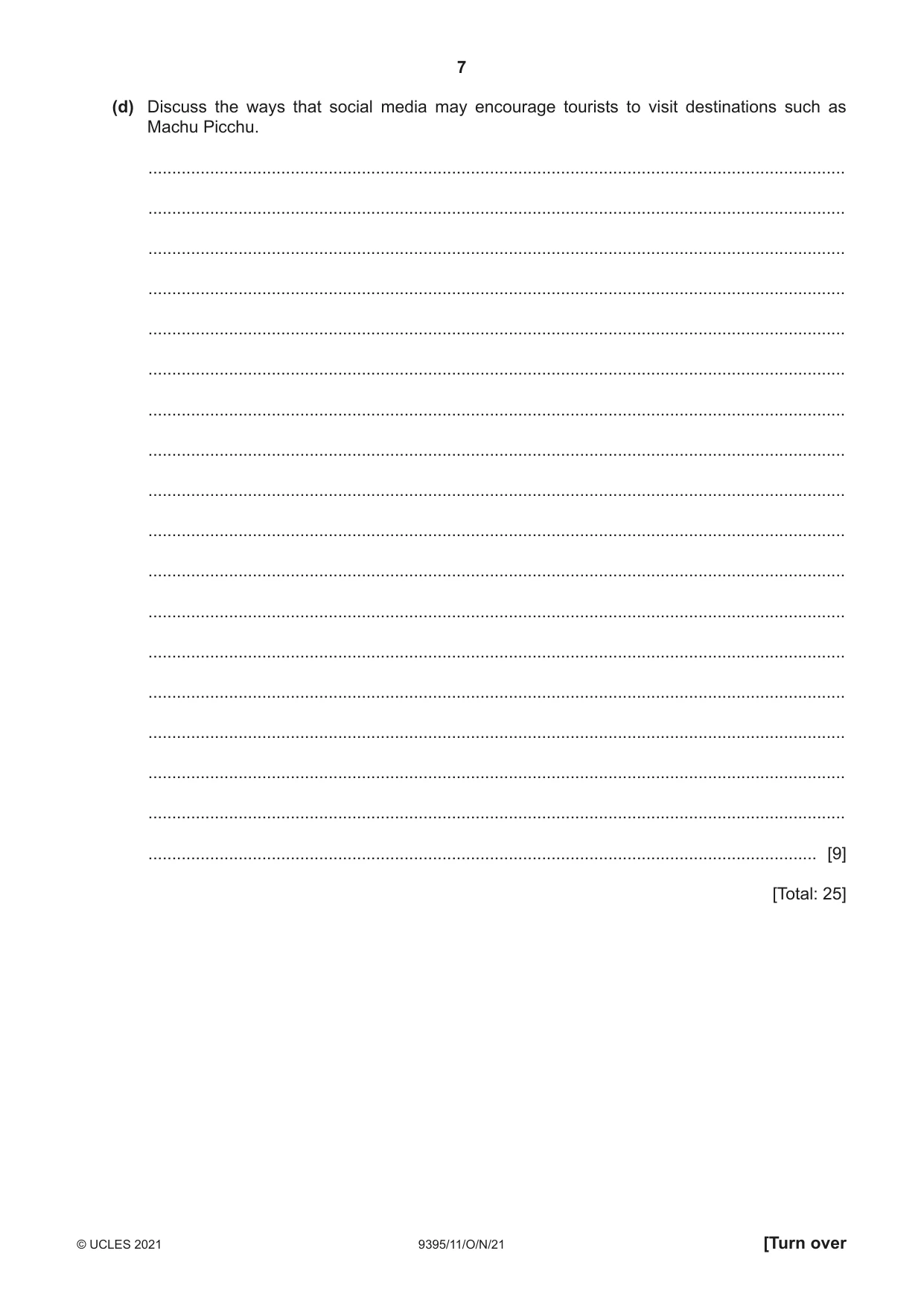
7 9395/11/O/N/21 © UCLES 2021 [Turn over (d) Discuss the ways that social media may encourage tourists to visit destinations such as Machu Picchu. … … … … … … … … … … … … … … … … … … [9] [Total: 25]
Question paper, page 8
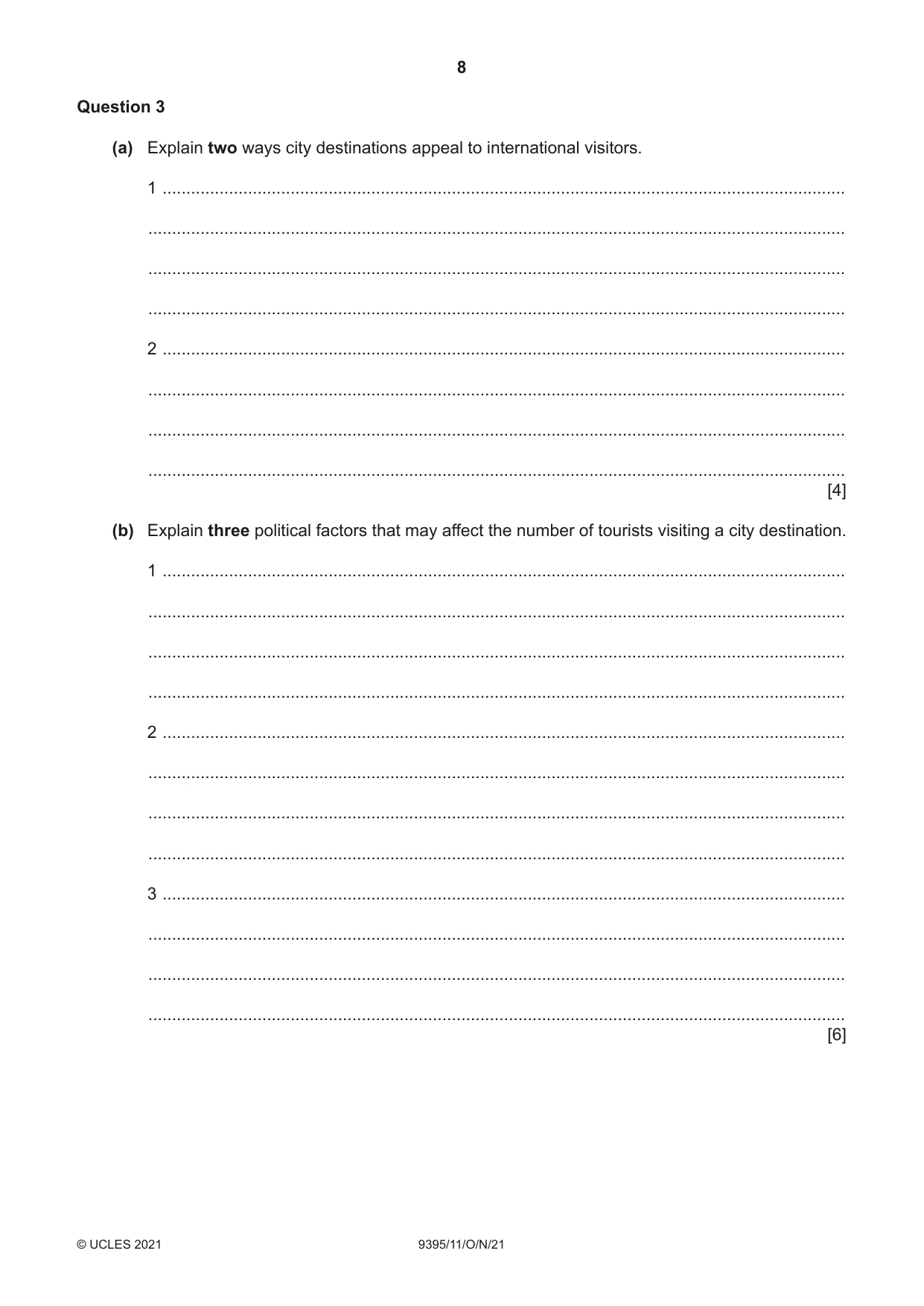
8 9395/11/O/N/21 © UCLES 2021 Question 3 (a) Explain two ways city destinations appeal to international visitors. 1 … … … … 2 … … … … [4] (b) Explain three political factors that may affect the number of tourists visiting a city destination. 1 … … … … 2 … … … … 3 … … … … [6]
Question paper, page 9
9 9395/11/O/N/21 © UCLES 2021 [Turn over (c) Explain why seasonality is less of a problem for major cities than many other types of destination. … … … … … … … … … … … … [6]
Question paper, page 10
10 9395/11/O/N/21 © UCLES 2021 (d) Discuss the benefits to customers of accommodation grading schemes. … … … … … … … … … … … … … … … … … … [9] [Total: 25]
Question paper, page 11
11 9395/11/O/N/21 © UCLES 2021 [Turn over Question 4 (a) Explain two benefits for staff of having respect from colleagues and managers. 1 … … … … 2 … … … … [4] (b) Explain three likely impacts of poor customer service on a travel agency. 1 … … … … 2 … … … … 3 … … … … [6]
Question paper, page 12
12 9395/11/O/N/21 © UCLES 2021 (c) Explain how travel agencies differ from tour operators. … … … … … … … … … … … … [6]
Question paper, page 13
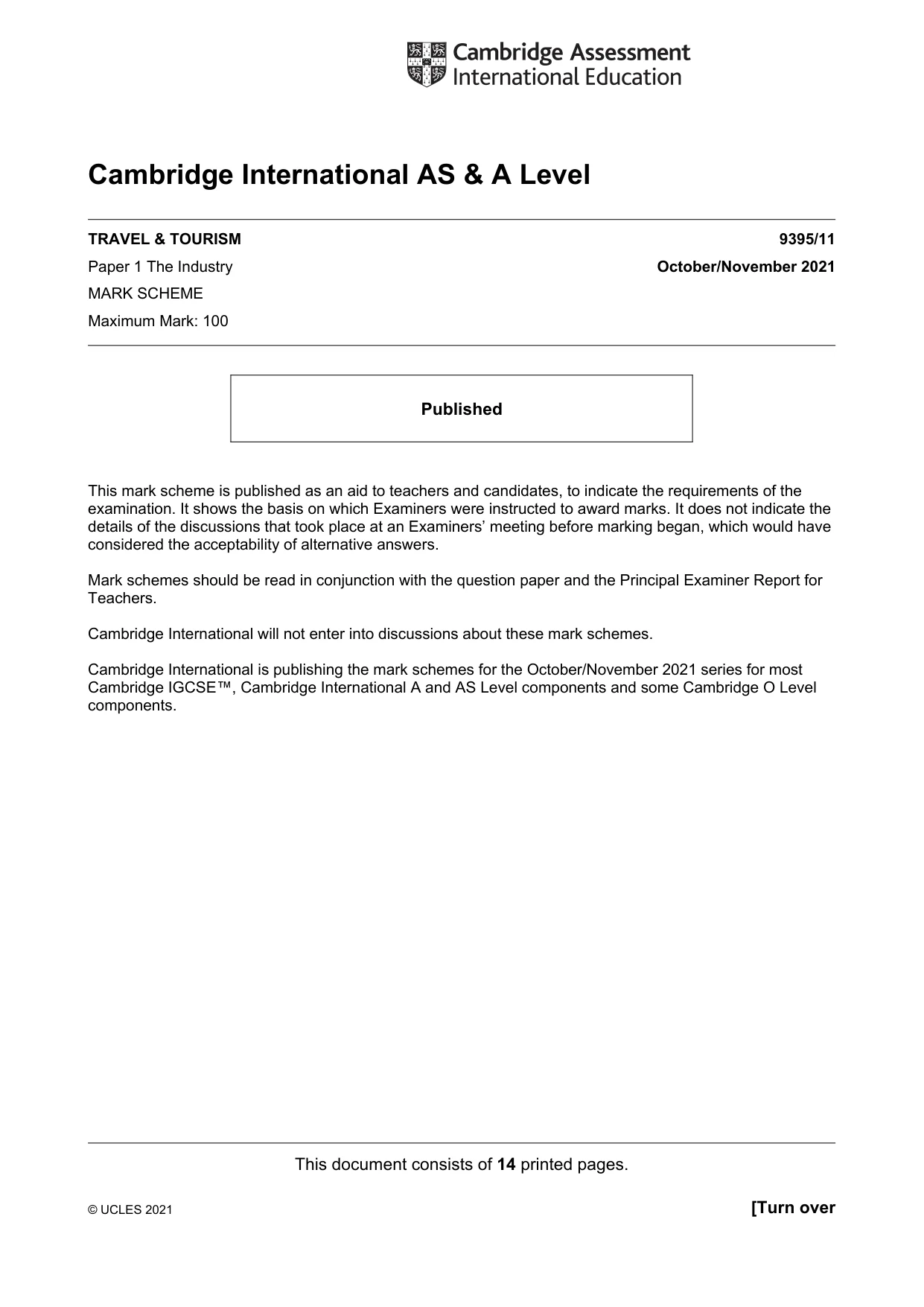
13 9395/11/O/N/21 © UCLES 2021 (d) Discuss why an increasing number of tourists book their holidays independently rather than using a travel agency. … … … … … … … … … … … … … … … … … … [9] [Total: 25]
Question paper, page 14
14 9395/11/O/N/21 © UCLES 2021 BLANK PAGE
Question paper, page 15
15 9395/11/O/N/21 © UCLES 2021 BLANK PAGE
Question paper, page 16
16 9395/11/O/N/21 © UCLES 2021 Permission to reproduce items where third-party owned material protected by copyright is included has been sought and cleared where possible. Every reasonable effort has been made by the publisher (UCLES) to trace copyright holders, but if any items requiring clearance have unwittingly been included, the publisher will be pleased to make amends at the earliest possible opportunity. To avoid the issue of disclosure of answer-related information to candidates, all copyright acknowledgements are reproduced online in the Cambridge Assessment International Education Copyright Acknowledgements Booklet. This is produced for each series of examinations and is freely available to download at www.cambridgeinternational.org after the live examination series. Cambridge Assessment International Education is part of the Cambridge Assessment Group. Cambridge Assessment is the brand name of the University of Cambridge Local Examinations Syndicate (UCLES), which itself is a department of the University of Cambridge. BLANK PAGE
Mark scheme, page 1
This document consists of 14 printed pages. © UCLES 2021 [Turn over Cambridge International AS & A Level TRAVEL & TOURISM 9395/11 Paper 1 The Industry October/November 2021 MARK SCHEME Maximum Mark: 100 Published This mark scheme is published as an aid to teachers and candidates, to indicate the requirements of the examination. It shows the basis on which Examiners were instructed to award marks. It does not indicate the details of the discussions that took place at an Examiners’ meeting before marking began, which would have considered the acceptability of alternative answers. Mark schemes should be read in conjunction with the question paper and the Principal Examiner Report for Teachers. Cambridge International will not enter into discussions about these mark schemes. Cambridge International is publishing the mark schemes for the October/November 2021 series for most Cambridge IGCSE™, Cambridge International A and AS Level components and some Cambridge O Level components.
Mark scheme, page 2
9395/11 Cambridge International AS & A Level – Mark Scheme PUBLISHED October/November 2021 © UCLES 2021 Page 2 of 14 Generic Marking Principles These general marking principles must be applied by all examiners when marking candidate answers. They should be applied alongside the specific content of the mark scheme or generic level descriptors for a question. Each question paper and mark scheme will also comply with these marking principles. GENERIC MARKING PRINCIPLE 1: Marks must be awarded in line with: • the specific content of the mark scheme or the generic level descriptors for the question • the specific skills defined in the mark scheme or in the generic level descriptors for the question • the standard of response required by a candidate as exemplified by the standardisation scripts. GENERIC MARKING PRINCIPLE 2: Marks awarded are always whole marks (not half marks, or other fractions). GENERIC MARKING PRINCIPLE 3: Marks must be awarded positively: • marks are awarded for correct/valid answers, as defined in the mark scheme. However, credit is given for valid answers which go beyond the scope of the syllabus and mark scheme, referring to your Team Leader as appropriate • marks are awarded when candidates clearly demonstrate what they know and can do • marks are not deducted for errors • marks are not deducted for omissions • answers should only be judged on the quality of spelling, punctuation and grammar when these features are specifically assessed by the question as indicated by the mark scheme. The meaning, however, should be unambiguous. GENERIC MARKING PRINCIPLE 4: Rules must be applied consistently, e.g. in situations where candidates have not followed instructions or in the application of generic level descriptors. GENERIC MARKING PRINCIPLE 5: Marks should be awarded using the full range of marks defined in the mark scheme for the question (however; the use of the full mark range may be limited according to the quality of the candidate responses seen). GENERIC MARKING PRINCIPLE 6: Marks awarded are based solely on the requirements as defined in the mark scheme. Marks should not be awarded with grade thresholds or grade descriptors in mind.
Mark scheme, page 3
9395/11 Cambridge International AS & A Level – Mark Scheme PUBLISHED October/November 2021 © UCLES 2021 Page 3 of 14 Social Science-Specific Marking Principles (for point-based marking) 1 Components using point-based marking: • Point marking is often used to reward knowledge, understanding and application of skills. We give credit where the candidate’s answer shows relevant knowledge, understanding and application of skills in answering the question. We do not give credit where the answer shows confusion. From this it follows that we: a DO credit answers which are worded differently from the mark scheme if they clearly convey the same meaning (unless the mark scheme requires a specific term) b DO credit alternative answers/examples which are not written in the mark scheme if they are correct c DO credit answers where candidates give more than one correct answer in one prompt/numbered/scaffolded space where extended writing is required rather than list-type answers. For example, questions that require n reasons (e.g. State two reasons …). d DO NOT credit answers simply for using a ‘key term’ unless that is all that is required. (Check for evidence it is understood and not used wrongly.) e DO NOT credit answers which are obviously self-contradicting or trying to cover all possibilities f DO NOT give further credit for what is effectively repetition of a correct point already credited unless the language itself is being tested. This applies equally to ‘mirror statements’ (i.e. polluted/not polluted). g DO NOT require spellings to be correct, unless this is part of the test. However spellings of syllabus terms must allow for clear and unambiguous separation from other syllabus terms with which they may be confused (e.g. Corrasion/Corrosion) 2 Presentation of mark scheme: • Slashes (/) or the word ‘or’ separate alternative ways of making the same point. • Semi colons (;) bullet points (•) or figures in brackets (1) separate different points. • Content in the answer column in brackets is for examiner information/context to clarify the marking but is not required to earn the mark (except Accounting syllabuses where they indicate negative numbers). 3 Annotation: • For point marking, ticks can be used to indicate correct answers and crosses can be used to indicate wrong answers. There is no direct relationship between ticks and marks. Ticks have no defined meaning for levels of response marking. • For levels of response marking, the level awarded should be annotated on the script. • Other annotations will be used by examiners as agreed during standardisation, and the meaning will be understood by all examiners who marked that paper.
Mark scheme, page 4
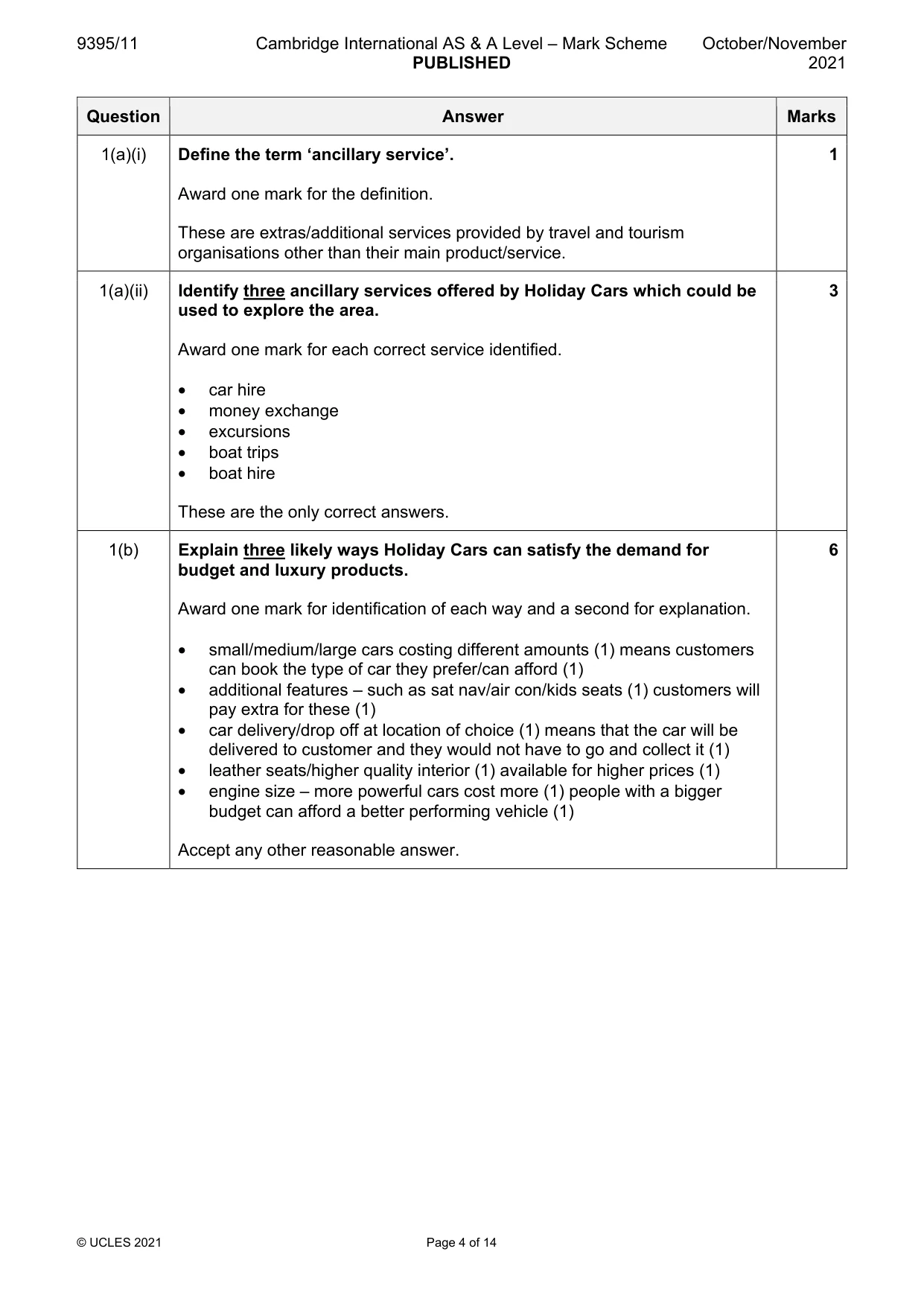
9395/11 Cambridge International AS & A Level – Mark Scheme PUBLISHED October/November 2021 © UCLES 2021 Page 4 of 14 Question Answer Marks 1(a)(i) Define the term ‘ancillary service’. Award one mark for the definition. These are extras/additional services provided by travel and tourism organisations other than their main product/service. 1 1(a)(ii) Identify three ancillary services offered by Holiday Cars which could be used to explore the area. Award one mark for each correct service identified. • car hire • money exchange • excursions • boat trips • boat hire These are the only correct answers. 3 1(b) Explain three likely ways Holiday Cars can satisfy the demand for budget and luxury products. Award one mark for identification of each way and a second for explanation. • small/medium/large cars costing different amounts (1) means customers can book the type of car they prefer/can afford (1) • additional features – such as sat nav/air con/kids seats (1) customers will pay extra for these (1) • car delivery/drop off at location of choice (1) means that the car will be delivered to customer and they would not have to go and collect it (1) • leather seats/higher quality interior (1) available for higher prices (1) • engine size – more powerful cars cost more (1) people with a bigger budget can afford a better performing vehicle (1) Accept any other reasonable answer. 6
Mark scheme, page 5
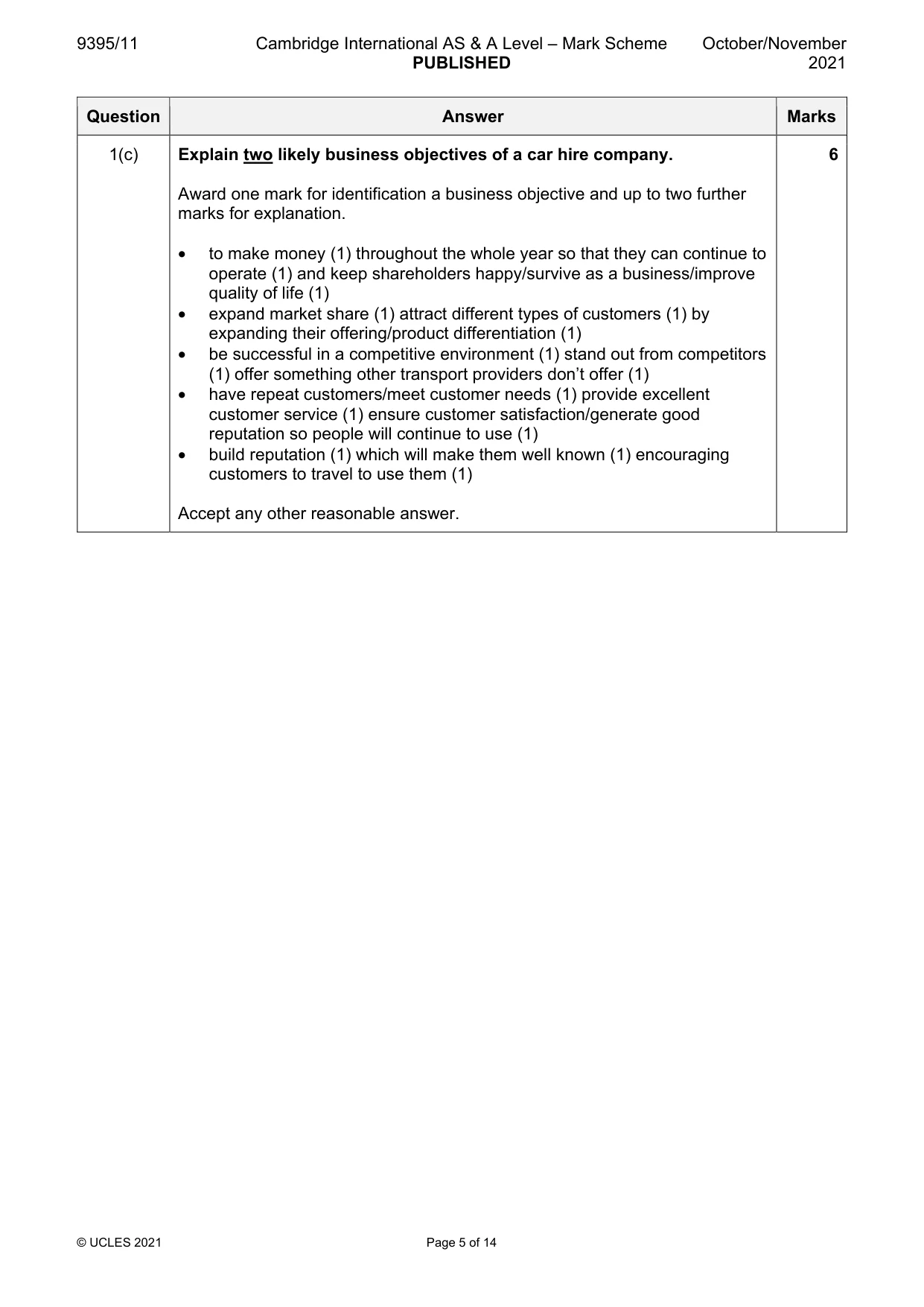
9395/11 Cambridge International AS & A Level – Mark Scheme PUBLISHED October/November 2021 © UCLES 2021 Page 5 of 14 Question Answer Marks 1(c) Explain two likely business objectives of a car hire company. Award one mark for identification a business objective and up to two further marks for explanation. • to make money (1) throughout the whole year so that they can continue to operate (1) and keep shareholders happy/survive as a business/improve quality of life (1) • expand market share (1) attract different types of customers (1) by expanding their offering/product differentiation (1) • be successful in a competitive environment (1) stand out from competitors (1) offer something other transport providers don’t offer (1) • have repeat customers/meet customer needs (1) provide excellent customer service (1) ensure customer satisfaction/generate good reputation so people will continue to use (1) • build reputation (1) which will make them well known (1) encouraging customers to travel to use them (1) Accept any other reasonable answer. 6
Mark scheme, page 6
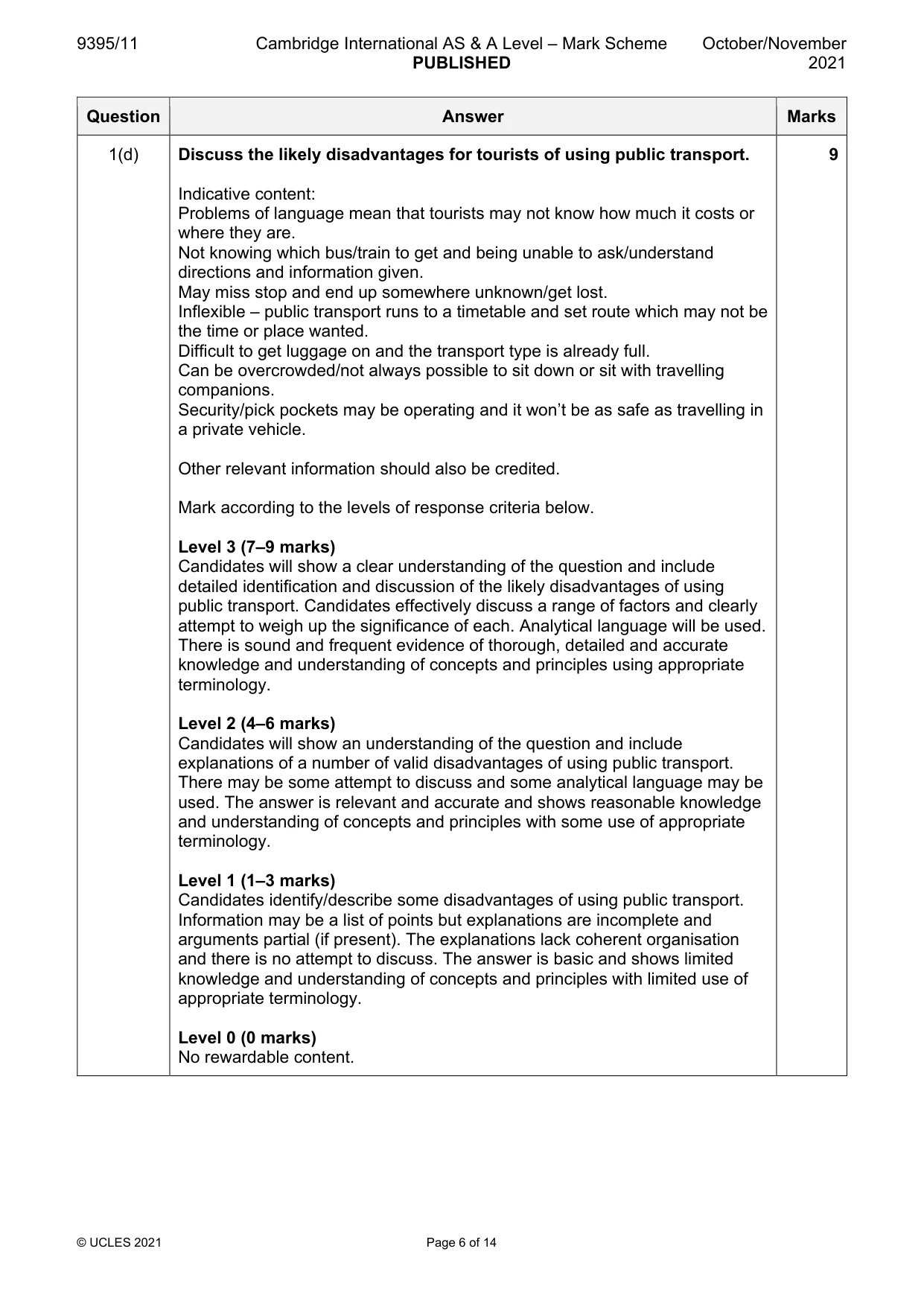
9395/11 Cambridge International AS & A Level – Mark Scheme PUBLISHED October/November 2021 © UCLES 2021 Page 6 of 14 Question Answer Marks 1(d) Discuss the likely disadvantages for tourists of using public transport. Indicative content: Problems of language mean that tourists may not know how much it costs or where they are. Not knowing which bus/train to get and being unable to ask/understand directions and information given. May miss stop and end up somewhere unknown/get lost. Inflexible – public transport runs to a timetable and set route which may not be the time or place wanted. Difficult to get luggage on and the transport type is already full. Can be overcrowded/not always possible to sit down or sit with travelling companions. Security/pick pockets may be operating and it won’t be as safe as travelling in a private vehicle. Other relevant information should also be credited. Mark according to the levels of response criteria below. Level 3 (7–9 marks) Candidates will show a clear understanding of the question and include detailed identification and discussion of the likely disadvantages of using public transport. Candidates effectively discuss a range of factors and clearly attempt to weigh up the significance of each. Analytical language will be used. There is sound and frequent evidence of thorough, detailed and accurate knowledge and understanding of concepts and principles using appropriate terminology. Level 2 (4–6 marks) Candidates will show an understanding of the question and include explanations of a number of valid disadvantages of using public transport. There may be some attempt to discuss and some analytical language may be used. The answer is relevant and accurate and shows reasonable knowledge and understanding of concepts and principles with some use of appropriate terminology. Level 1 (1–3 marks) Candidates identify/describe some disadvantages of using public transport. Information may be a list of points but explanations are incomplete and arguments partial (if present). The explanations lack coherent organisation and there is no attempt to discuss. The answer is basic and shows limited knowledge and understanding of concepts and principles with limited use of appropriate terminology. Level 0 (0 marks) No rewardable content. 9
Mark scheme, page 7
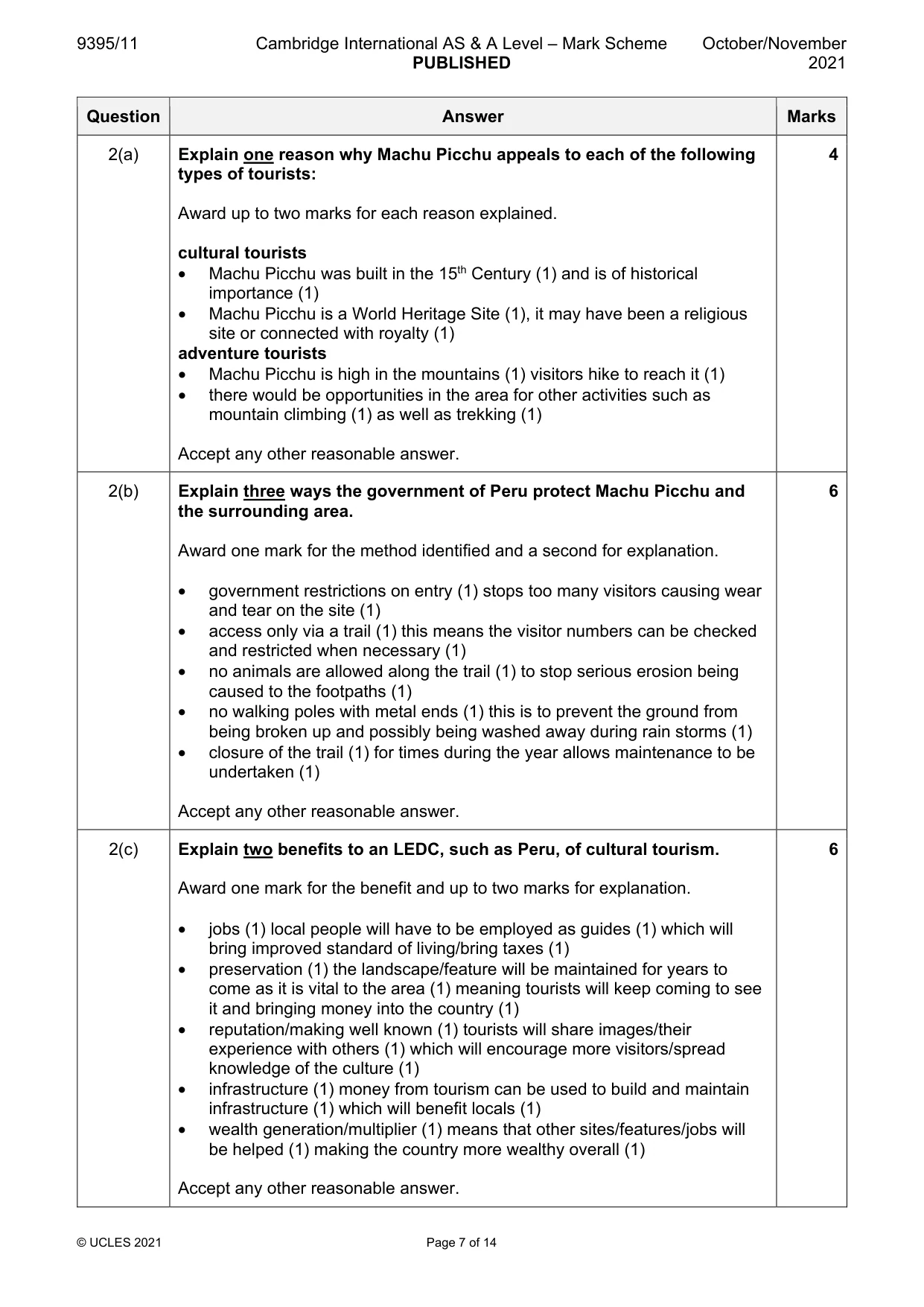
9395/11 Cambridge International AS & A Level – Mark Scheme PUBLISHED October/November 2021 © UCLES 2021 Page 7 of 14 Question Answer Marks 2(a) Explain one reason why Machu Picchu appeals to each of the following types of tourists: Award up to two marks for each reason explained. cultural tourists • Machu Picchu was built in the 15th Century (1) and is of historical importance (1) • Machu Picchu is a World Heritage Site (1), it may have been a religious site or connected with royalty (1) adventure tourists • Machu Picchu is high in the mountains (1) visitors hike to reach it (1) • there would be opportunities in the area for other activities such as mountain climbing (1) as well as trekking (1) Accept any other reasonable answer. 4 2(b) Explain three ways the government of Peru protect Machu Picchu and the surrounding area. Award one mark for the method identified and a second for explanation. • government restrictions on entry (1) stops too many visitors causing wear and tear on the site (1) • access only via a trail (1) this means the visitor numbers can be checked and restricted when necessary (1) • no animals are allowed along the trail (1) to stop serious erosion being caused to the footpaths (1) • no walking poles with metal ends (1) this is to prevent the ground from being broken up and possibly being washed away during rain storms (1) • closure of the trail (1) for times during the year allows maintenance to be undertaken (1) Accept any other reasonable answer. 6 2(c) Explain two benefits to an LEDC, such as Peru, of cultural tourism. Award one mark for the benefit and up to two marks for explanation. • jobs (1) local people will have to be employed as guides (1) which will bring improved standard of living/bring taxes (1) • preservation (1) the landscape/feature will be maintained for years to come as it is vital to the area (1) meaning tourists will keep coming to see it and bringing money into the country (1) • reputation/making well known (1) tourists will share images/their experience with others (1) which will encourage more visitors/spread knowledge of the culture (1) • infrastructure (1) money from tourism can be used to build and maintain infrastructure (1) which will benefit locals (1) • wealth generation/multiplier (1) means that other sites/features/jobs will be helped (1) making the country more wealthy overall (1) Accept any other reasonable answer. 6
Mark scheme, page 8
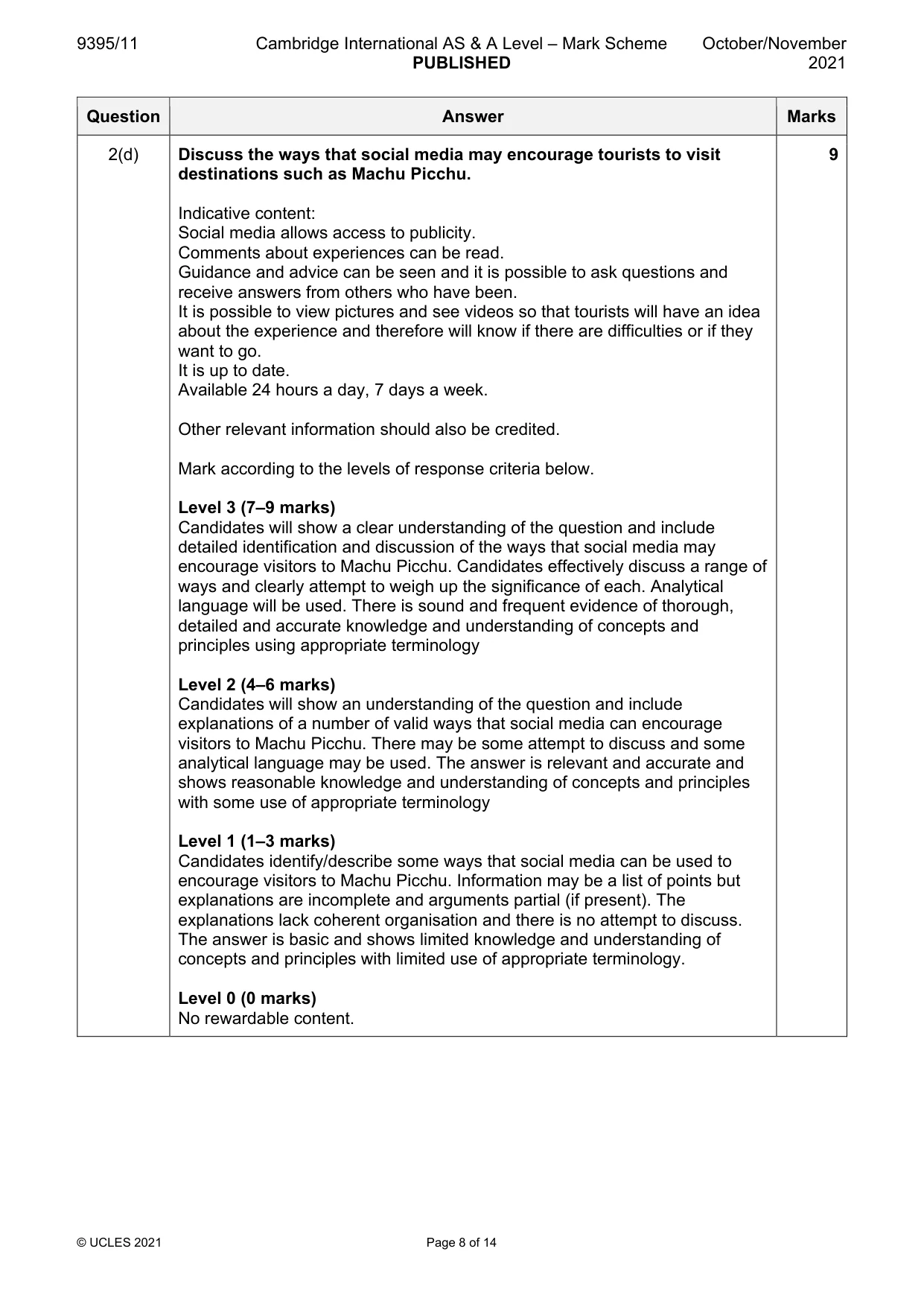
9395/11 Cambridge International AS & A Level – Mark Scheme PUBLISHED October/November 2021 © UCLES 2021 Page 8 of 14 Question Answer Marks 2(d) Discuss the ways that social media may encourage tourists to visit destinations such as Machu Picchu. Indicative content: Social media allows access to publicity. Comments about experiences can be read. Guidance and advice can be seen and it is possible to ask questions and receive answers from others who have been. It is possible to view pictures and see videos so that tourists will have an idea about the experience and therefore will know if there are difficulties or if they want to go. It is up to date. Available 24 hours a day, 7 days a week. Other relevant information should also be credited. Mark according to the levels of response criteria below. Level 3 (7–9 marks) Candidates will show a clear understanding of the question and include detailed identification and discussion of the ways that social media may encourage visitors to Machu Picchu. Candidates effectively discuss a range of ways and clearly attempt to weigh up the significance of each. Analytical language will be used. There is sound and frequent evidence of thorough, detailed and accurate knowledge and understanding of concepts and principles using appropriate terminology Level 2 (4–6 marks) Candidates will show an understanding of the question and include explanations of a number of valid ways that social media can encourage visitors to Machu Picchu. There may be some attempt to discuss and some analytical language may be used. The answer is relevant and accurate and shows reasonable knowledge and understanding of concepts and principles with some use of appropriate terminology Level 1 (1–3 marks) Candidates identify/describe some ways that social media can be used to encourage visitors to Machu Picchu. Information may be a list of points but explanations are incomplete and arguments partial (if present). The explanations lack coherent organisation and there is no attempt to discuss. The answer is basic and shows limited knowledge and understanding of concepts and principles with limited use of appropriate terminology. Level 0 (0 marks) No rewardable content. 9
Mark scheme, page 9
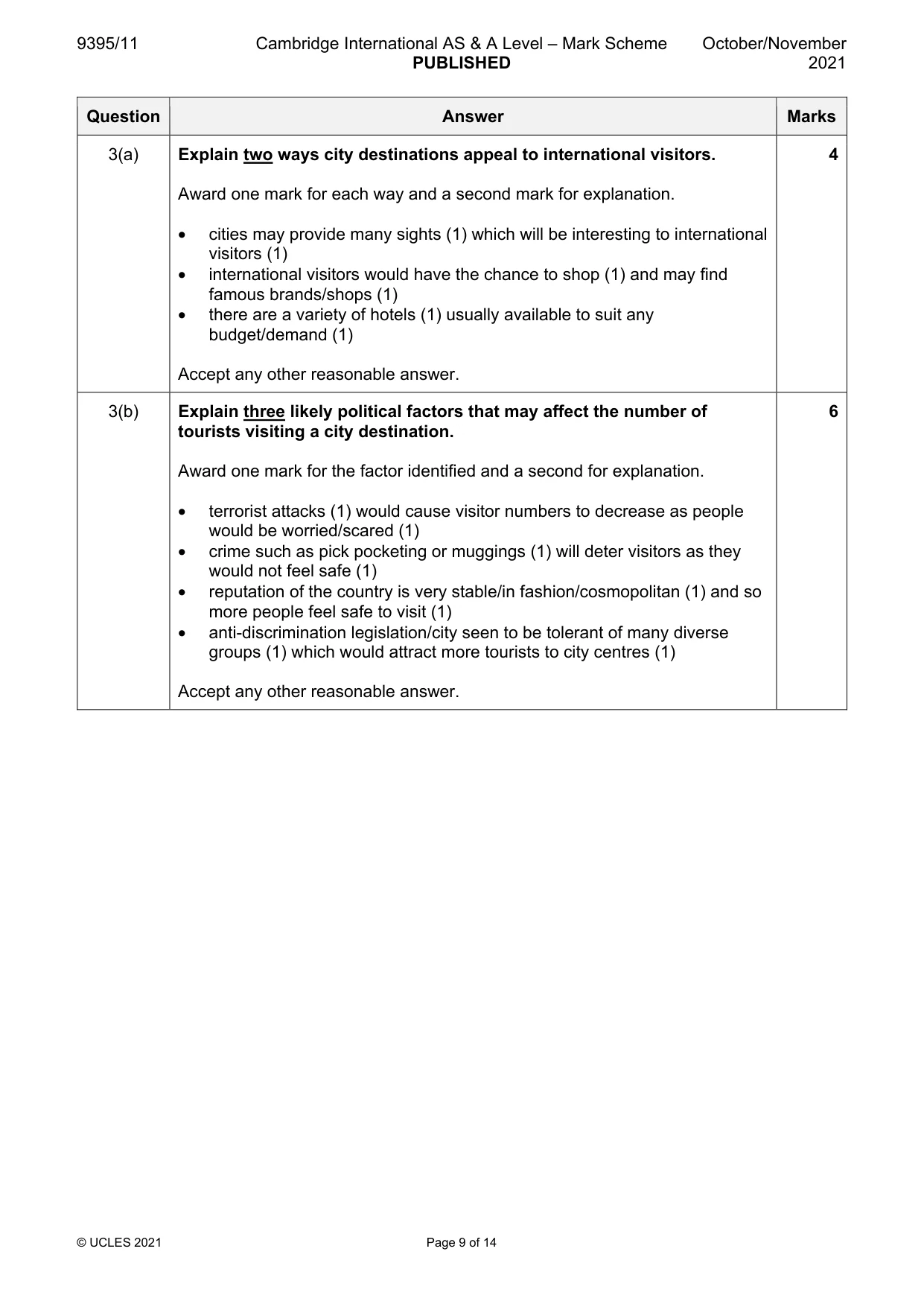
9395/11 Cambridge International AS & A Level – Mark Scheme PUBLISHED October/November 2021 © UCLES 2021 Page 9 of 14 Question Answer Marks 3(a) Explain two ways city destinations appeal to international visitors. Award one mark for each way and a second mark for explanation. • cities may provide many sights (1) which will be interesting to international visitors (1) • international visitors would have the chance to shop (1) and may find famous brands/shops (1) • there are a variety of hotels (1) usually available to suit any budget/demand (1) Accept any other reasonable answer. 4 3(b) Explain three likely political factors that may affect the number of tourists visiting a city destination. Award one mark for the factor identified and a second for explanation. • terrorist attacks (1) would cause visitor numbers to decrease as people would be worried/scared (1) • crime such as pick pocketing or muggings (1) will deter visitors as they would not feel safe (1) • reputation of the country is very stable/in fashion/cosmopolitan (1) and so more people feel safe to visit (1) • anti-discrimination legislation/city seen to be tolerant of many diverse groups (1) which would attract more tourists to city centres (1) Accept any other reasonable answer. 6
Mark scheme, page 10
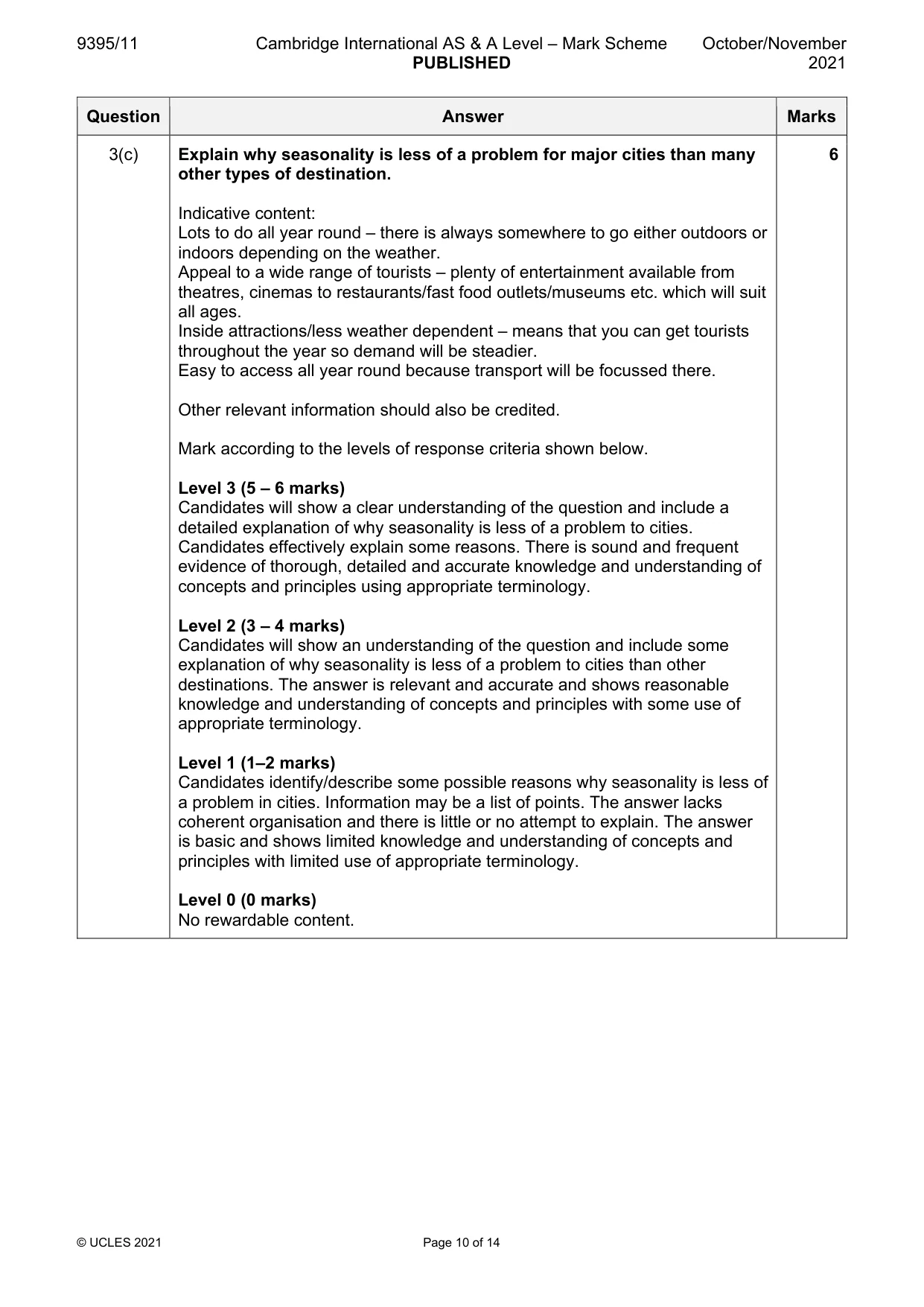
9395/11 Cambridge International AS & A Level – Mark Scheme PUBLISHED October/November 2021 © UCLES 2021 Page 10 of 14 Question Answer Marks 3(c) Explain why seasonality is less of a problem for major cities than many other types of destination. Indicative content: Lots to do all year round – there is always somewhere to go either outdoors or indoors depending on the weather. Appeal to a wide range of tourists – plenty of entertainment available from theatres, cinemas to restaurants/fast food outlets/museums etc. which will suit all ages. Inside attractions/less weather dependent – means that you can get tourists throughout the year so demand will be steadier. Easy to access all year round because transport will be focussed there. Other relevant information should also be credited. Mark according to the levels of response criteria shown below. Level 3 (5 – 6 marks) Candidates will show a clear understanding of the question and include a detailed explanation of why seasonality is less of a problem to cities. Candidates effectively explain some reasons. There is sound and frequent evidence of thorough, detailed and accurate knowledge and understanding of concepts and principles using appropriate terminology. Level 2 (3 – 4 marks) Candidates will show an understanding of the question and include some explanation of why seasonality is less of a problem to cities than other destinations. The answer is relevant and accurate and shows reasonable knowledge and understanding of concepts and principles with some use of appropriate terminology. Level 1 (1–2 marks) Candidates identify/describe some possible reasons why seasonality is less of a problem in cities. Information may be a list of points. The answer lacks coherent organisation and there is little or no attempt to explain. The answer is basic and shows limited knowledge and understanding of concepts and principles with limited use of appropriate terminology. Level 0 (0 marks) No rewardable content. 6
Mark scheme, page 11
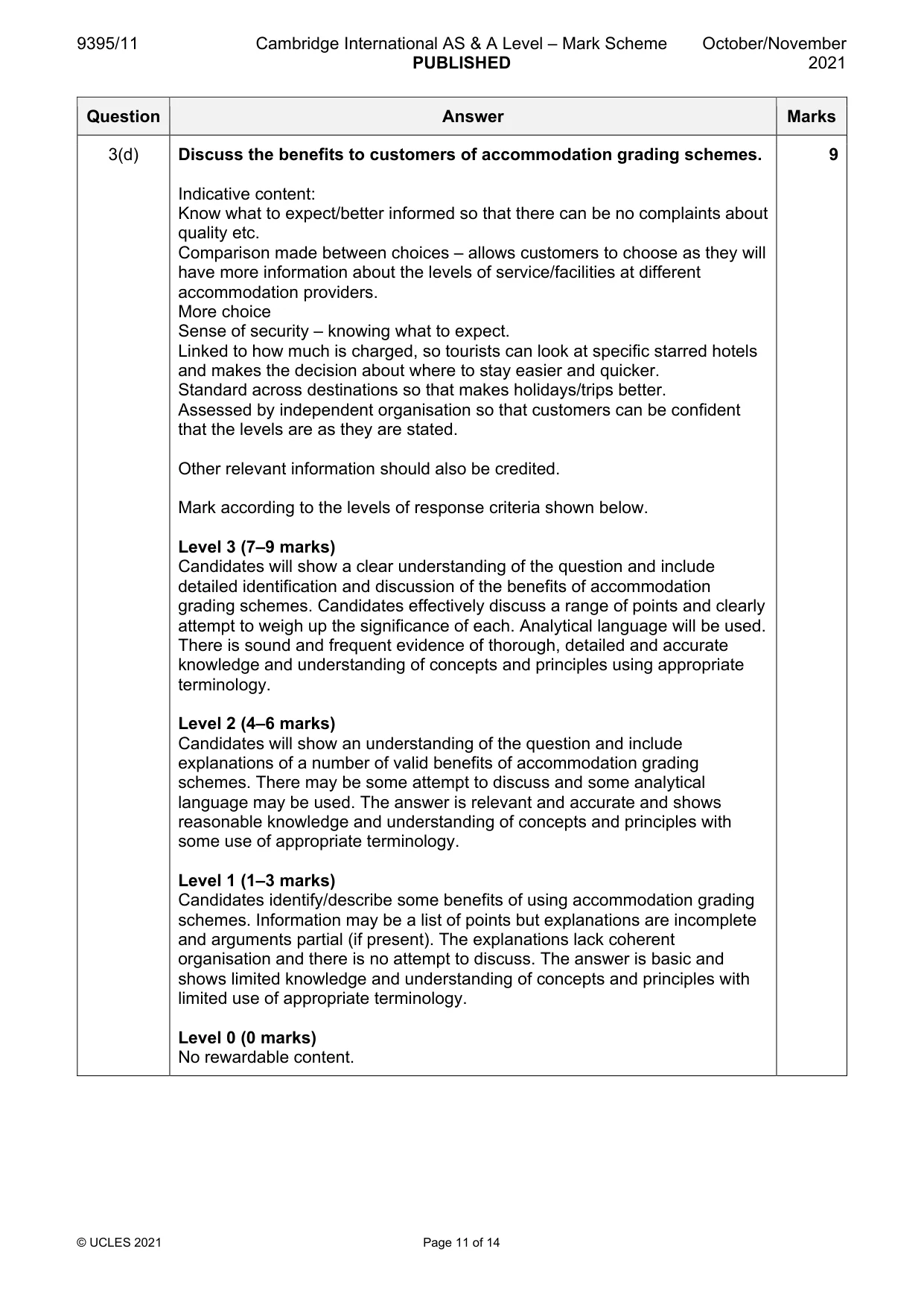
9395/11 Cambridge International AS & A Level – Mark Scheme PUBLISHED October/November 2021 © UCLES 2021 Page 11 of 14 Question Answer Marks 3(d) Discuss the benefits to customers of accommodation grading schemes. Indicative content: Know what to expect/better informed so that there can be no complaints about quality etc. Comparison made between choices – allows customers to choose as they will have more information about the levels of service/facilities at different accommodation providers. More choice Sense of security – knowing what to expect. Linked to how much is charged, so tourists can look at specific starred hotels and makes the decision about where to stay easier and quicker. Standard across destinations so that makes holidays/trips better. Assessed by independent organisation so that customers can be confident that the levels are as they are stated. Other relevant information should also be credited. Mark according to the levels of response criteria shown below. Level 3 (7–9 marks) Candidates will show a clear understanding of the question and include detailed identification and discussion of the benefits of accommodation grading schemes. Candidates effectively discuss a range of points and clearly attempt to weigh up the significance of each. Analytical language will be used. There is sound and frequent evidence of thorough, detailed and accurate knowledge and understanding of concepts and principles using appropriate terminology. Level 2 (4–6 marks) Candidates will show an understanding of the question and include explanations of a number of valid benefits of accommodation grading schemes. There may be some attempt to discuss and some analytical language may be used. The answer is relevant and accurate and shows reasonable knowledge and understanding of concepts and principles with some use of appropriate terminology. Level 1 (1–3 marks) Candidates identify/describe some benefits of using accommodation grading schemes. Information may be a list of points but explanations are incomplete and arguments partial (if present). The explanations lack coherent organisation and there is no attempt to discuss. The answer is basic and shows limited knowledge and understanding of concepts and principles with limited use of appropriate terminology. Level 0 (0 marks) No rewardable content. 9
Mark scheme, page 12
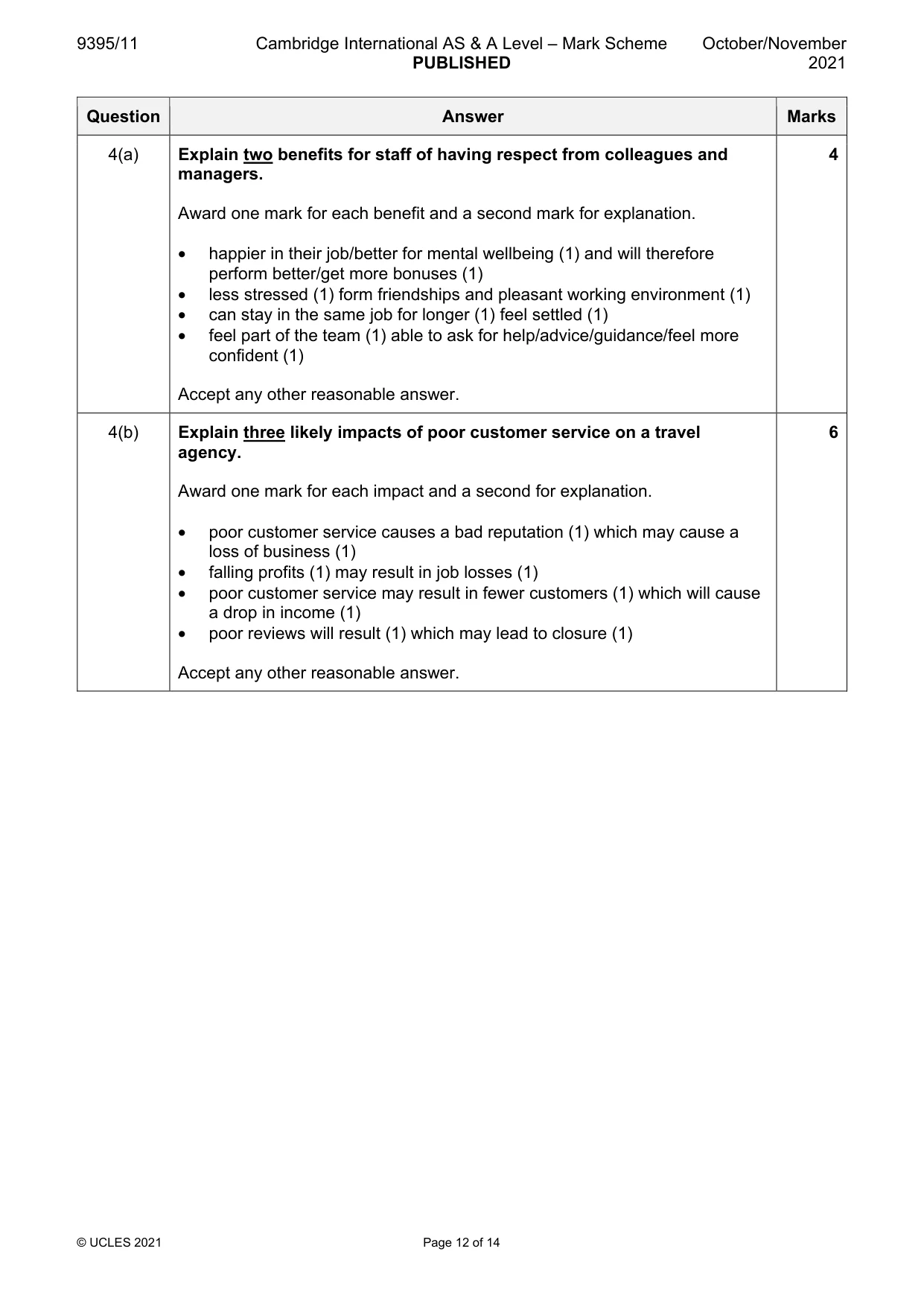
9395/11 Cambridge International AS & A Level – Mark Scheme PUBLISHED October/November 2021 © UCLES 2021 Page 12 of 14 Question Answer Marks 4(a) Explain two benefits for staff of having respect from colleagues and managers. Award one mark for each benefit and a second mark for explanation. • happier in their job/better for mental wellbeing (1) and will therefore perform better/get more bonuses (1) • less stressed (1) form friendships and pleasant working environment (1) • can stay in the same job for longer (1) feel settled (1) • feel part of the team (1) able to ask for help/advice/guidance/feel more confident (1) Accept any other reasonable answer. 4 4(b) Explain three likely impacts of poor customer service on a travel agency. Award one mark for each impact and a second for explanation. • poor customer service causes a bad reputation (1) which may cause a loss of business (1) • falling profits (1) may result in job losses (1) • poor customer service may result in fewer customers (1) which will cause a drop in income (1) • poor reviews will result (1) which may lead to closure (1) Accept any other reasonable answer. 6
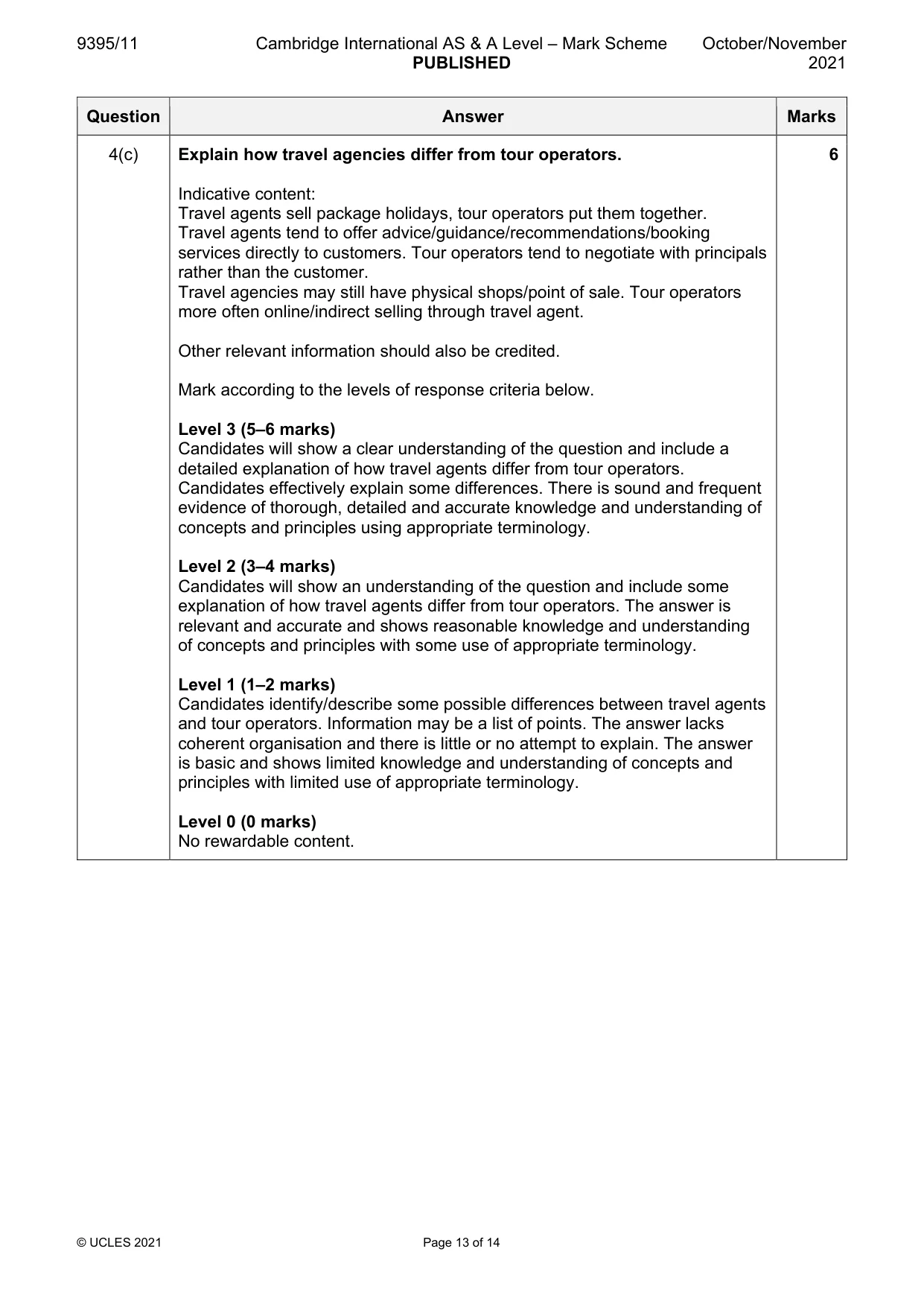
Mark scheme, page 13
9395/11 Cambridge International AS & A Level – Mark Scheme PUBLISHED October/November 2021 © UCLES 2021 Page 13 of 14 Question Answer Marks 4(c) Explain how travel agencies differ from tour operators. Indicative content: Travel agents sell package holidays, tour operators put them together. Travel agents tend to offer advice/guidance/recommendations/booking services directly to customers. Tour operators tend to negotiate with principals rather than the customer. Travel agencies may still have physical shops/point of sale. Tour operators more often online/indirect selling through travel agent. Other relevant information should also be credited. Mark according to the levels of response criteria below. Level 3 (5–6 marks) Candidates will show a clear understanding of the question and include a detailed explanation of how travel agents differ from tour operators. Candidates effectively explain some differences. There is sound and frequent evidence of thorough, detailed and accurate knowledge and understanding of concepts and principles using appropriate terminology. Level 2 (3–4 marks) Candidates will show an understanding of the question and include some explanation of how travel agents differ from tour operators. The answer is relevant and accurate and shows reasonable knowledge and understanding of concepts and principles with some use of appropriate terminology. Level 1 (1–2 marks) Candidates identify/describe some possible differences between travel agents and tour operators. Information may be a list of points. The answer lacks coherent organisation and there is little or no attempt to explain. The answer is basic and shows limited knowledge and understanding of concepts and principles with limited use of appropriate terminology. Level 0 (0 marks) No rewardable content. 6
Mark scheme, page 14
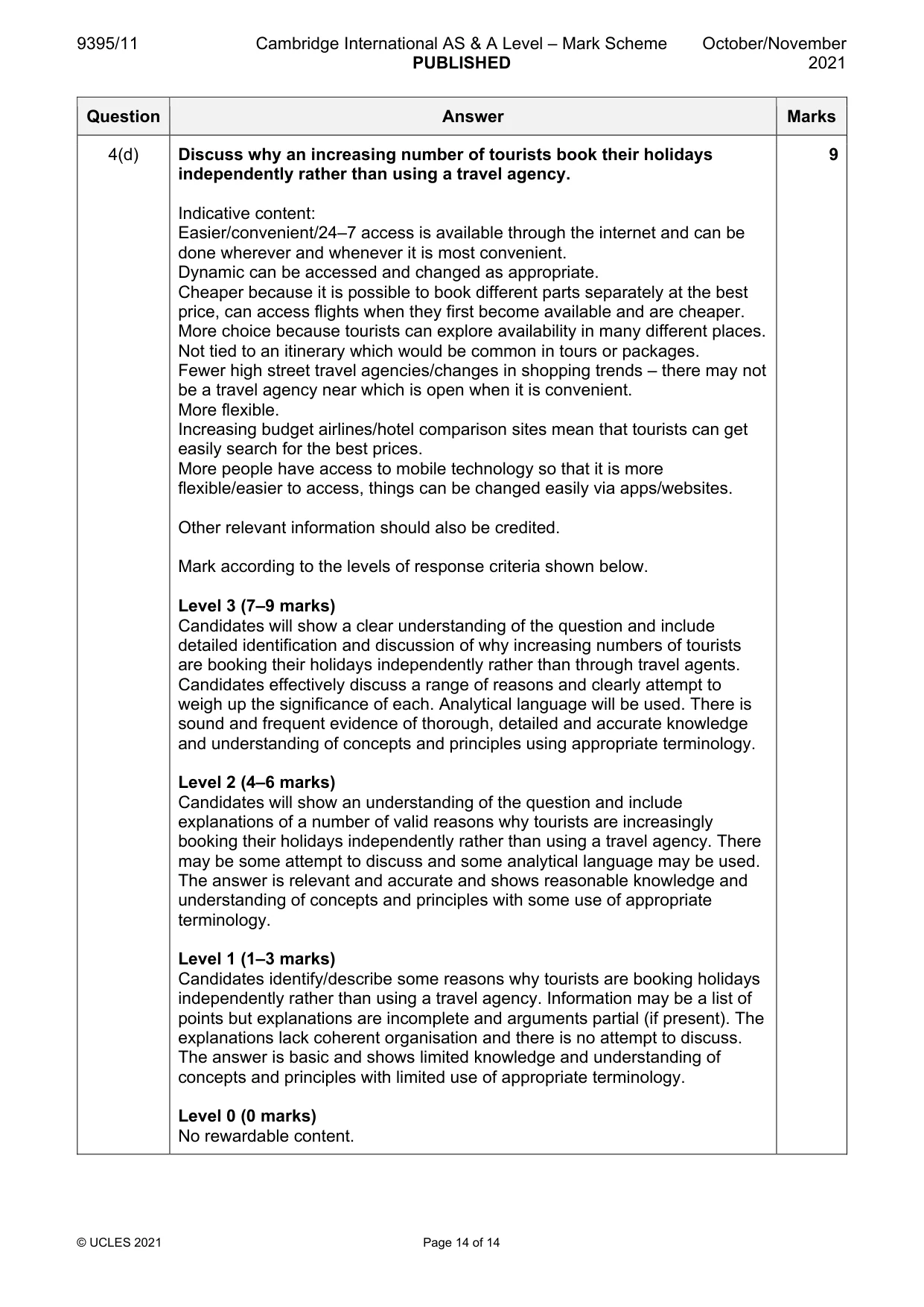
9395/11 Cambridge International AS & A Level – Mark Scheme PUBLISHED October/November 2021 © UCLES 2021 Page 14 of 14 Question Answer Marks 4(d) Discuss why an increasing number of tourists book their holidays independently rather than using a travel agency. Indicative content: Easier/convenient/24–7 access is available through the internet and can be done wherever and whenever it is most convenient. Dynamic can be accessed and changed as appropriate. Cheaper because it is possible to book different parts separately at the best price, can access flights when they first become available and are cheaper. More choice because tourists can explore availability in many different places. Not tied to an itinerary which would be common in tours or packages. Fewer high street travel agencies/changes in shopping trends – there may not be a travel agency near which is open when it is convenient. More flexible. Increasing budget airlines/hotel comparison sites mean that tourists can get easily search for the best prices. More people have access to mobile technology so that it is more flexible/easier to access, things can be changed easily via apps/websites. Other relevant information should also be credited. Mark according to the levels of response criteria shown below. Level 3 (7–9 marks) Candidates will show a clear understanding of the question and include detailed identification and discussion of why increasing numbers of tourists are booking their holidays independently rather than through travel agents. Candidates effectively discuss a range of reasons and clearly attempt to weigh up the significance of each. Analytical language will be used. There is sound and frequent evidence of thorough, detailed and accurate knowledge and understanding of concepts and principles using appropriate terminology. Level 2 (4–6 marks) Candidates will show an understanding of the question and include explanations of a number of valid reasons why tourists are increasingly booking their holidays independently rather than using a travel agency. There may be some attempt to discuss and some analytical language may be used. The answer is relevant and accurate and shows reasonable knowledge and understanding of concepts and principles with some use of appropriate terminology. Level 1 (1–3 marks) Candidates identify/describe some reasons why tourists are booking holidays independently rather than using a travel agency. Information may be a list of points but explanations are incomplete and arguments partial (if present). The explanations lack coherent organisation and there is no attempt to discuss. The answer is basic and shows limited knowledge and understanding of concepts and principles with limited use of appropriate terminology. Level 0 (0 marks) No rewardable content. 9
What you needed in this session
Cambridge’s own grade thresholds for 2021 Oct/Nov, Paper 1 · Variant 1. A higher threshold means an easier paper — the bar moves with how the cohort did.