Cambridge A Level Travel and Tourism 9395 — 2021 May/June Paper 4 · Variant 1
9395/41/M/J/21 · 50 marks · ≈56 min
The question paper and its mark scheme, free to read here and free to download. This is Cambridge’s own paper, exactly as it was sat.
Question paper12 pages






Mark scheme8 pages
Answers below. Sit the paper first if you are practising.
Paper as text
Question paper, page 1
This document has 12 pages. Any blank pages are indicated. Cambridge International AS & A Level DC (PQ) 200703/1 © UCLES 2021 [Turn over * 1 1 4 9 9 3 9 1 0 8 * TRAVEL & TOURISM 9395/41 Paper 4 Destination Management May/June 2021 1 hour 30 minutes You must answer on the question paper. You will need: Insert (enclosed) INSTRUCTIONS ● Answer all questions. ● Use a black or dark blue pen. ● Write your name, centre number and candidate number in the boxes at the top of the page. ● Write your answer to each question in the space provided. ● Do not use an erasable pen or correction fluid. ● Do not write on any bar codes. INFORMATION ● The total mark for this paper is 50. ● The number of marks for each question or part question is shown in brackets [ ]. ● The insert contains all the figures referred to in the questions.
Question paper, page 2
2 9395/41/M/J/21 © UCLES 2021 Question 1 Refer to Fig. 1.1 (Insert), information about The Kingdom of Bahrain, a country in the Persian Gulf. (a) Explain two benefits of partnership work. 1 … … … … 2 … … … … [4] (b) Discuss why building a new visitor attraction may benefit the local community and economy. … … … … … … … … … … … … … … … …
Question paper, page 3
3 9395/41/M/J/21 © UCLES 2021 [Turn over … … … … … … … … … … … … … … … … … … … … … … … … … … … … [9]
Question paper, page 4
4 9395/41/M/J/21 © UCLES 2021 (c) Assess ways to prevent negative socio-cultural impacts of tourism on Bahrain. … … … … … … … … … … … … … … … … … … … … … … … … … … …
Question paper, page 5
5 9395/41/M/J/21 © UCLES 2021 [Turn over … … … … … … … … … … … … … … … … … … … … … … … … … … … [12] [Total: 25]
Question paper, page 6
6 9395/41/M/J/21 © UCLES 2021 Question 2 Refer to Fig. 2.1 (Insert), information about Parkbus, an NGO in Ontario, Canada. (a) Explain two roles of an NGO. 1 … … … … 2 … … … … [4] (b) Discuss how ActiveDays aims to help widen access to the outdoors. … … … … … … … … … … … … … … … …
Question paper, page 7
7 9395/41/M/J/21 © UCLES 2021 [Turn over … … … … … … … … … … … … … … … … … … … … … … … … … … … … [9]
Question paper, page 8
8 9395/41/M/J/21 © UCLES 2021 (c) Assess negative environmental impacts a growth in tourism may have on National Parks in Canada. … … … … … … … … … … … … … … … … … … … … … … … … … … …
Question paper, page 9
9 9395/41/M/J/21 © UCLES 2021 … … … … … … … … … … … … … … … … … … … … … … … … … … … [12] [Total: 25]
Question paper, page 10
10 9395/41/M/J/21 © UCLES 2021 BLANK PAGE
Question paper, page 11
11 9395/41/M/J/21 © UCLES 2021 BLANK PAGE
Question paper, page 12
12 9395/41/M/J/21 © UCLES 2021 The boundaries and names shown, the designations used and the presentation of material on any maps contained in this question paper/insert do not imply official endorsement or acceptance by Cambridge Assessment International Education concerning the legal status of any country, territory, or area or any of its authorities, or of the delimitation of its frontiers or boundaries. Permission to reproduce items where third-party owned material protected by copyright is included has been sought and cleared where possible. Every reasonable effort has been made by the publisher (UCLES) to trace copyright holders, but if any items requiring clearance have unwittingly been included, the publisher will be pleased to make amends at the earliest possible opportunity. To avoid the issue of disclosure of answer-related information to candidates, all copyright acknowledgements are reproduced online in the Cambridge Assessment International Education Copyright Acknowledgements Booklet. This is produced for each series of examinations and is freely available to download at www.cambridgeinternational.org after the live examination series. Cambridge Assessment International Education is part of the Cambridge Assessment Group. Cambridge Assessment is the brand name of the University of Cambridge Local Examinations Syndicate (UCLES), which itself is a department of the University of Cambridge. BLANK PAGE
Mark scheme, page 1
This document consists of 8 printed pages. © UCLES 2021 [Turn over Cambridge International A Level TRAVEL & TOURISM 9395/41 Paper 4 Destination Management May/June 2021 MARK SCHEME Maximum Mark: 50 Published This mark scheme is published as an aid to teachers and candidates, to indicate the requirements of the examination. It shows the basis on which Examiners were instructed to award marks. It does not indicate the details of the discussions that took place at an Examiners’ meeting before marking began, which would have considered the acceptability of alternative answers. Mark schemes should be read in conjunction with the question paper and the Principal Examiner Report for Teachers. Cambridge International will not enter into discussions about these mark schemes. Cambridge International is publishing the mark schemes for the May/June 2021 series for most Cambridge IGCSE™, Cambridge International A and AS Level components and some Cambridge O Level components.
Mark scheme, page 2
9395/41 Cambridge International A Level – Mark Scheme PUBLISHED May/June 2021 © UCLES 2021 Page 2 of 8 Generic Marking Principles These general marking principles must be applied by all examiners when marking candidate answers. They should be applied alongside the specific content of the mark scheme or generic level descriptors for a question. Each question paper and mark scheme will also comply with these marking principles. GENERIC MARKING PRINCIPLE 1: Marks must be awarded in line with: • the specific content of the mark scheme or the generic level descriptors for the question • the specific skills defined in the mark scheme or in the generic level descriptors for the question • the standard of response required by a candidate as exemplified by the standardisation scripts. GENERIC MARKING PRINCIPLE 2: Marks awarded are always whole marks (not half marks, or other fractions). GENERIC MARKING PRINCIPLE 3: Marks must be awarded positively: • marks are awarded for correct/valid answers, as defined in the mark scheme. However, credit is given for valid answers which go beyond the scope of the syllabus and mark scheme, referring to your Team Leader as appropriate • marks are awarded when candidates clearly demonstrate what they know and can do • marks are not deducted for errors • marks are not deducted for omissions • answers should only be judged on the quality of spelling, punctuation and grammar when these features are specifically assessed by the question as indicated by the mark scheme. The meaning, however, should be unambiguous. GENERIC MARKING PRINCIPLE 4: Rules must be applied consistently, e.g. in situations where candidates have not followed instructions or in the application of generic level descriptors. GENERIC MARKING PRINCIPLE 5: Marks should be awarded using the full range of marks defined in the mark scheme for the question (however; the use of the full mark range may be limited according to the quality of the candidate responses seen). GENERIC MARKING PRINCIPLE 6: Marks awarded are based solely on the requirements as defined in the mark scheme. Marks should not be awarded with grade thresholds or grade descriptors in mind.
Mark scheme, page 3
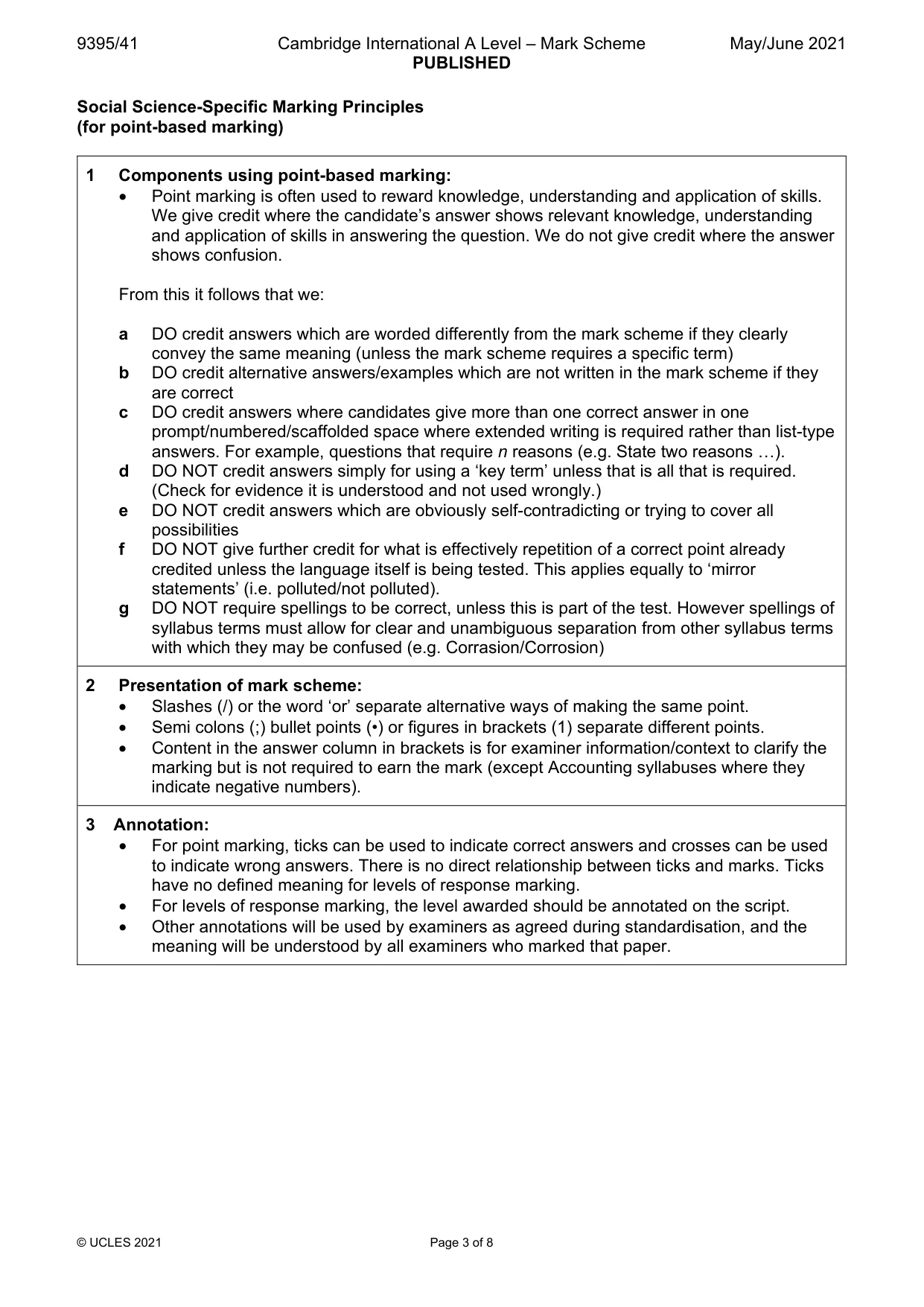
9395/41 Cambridge International A Level – Mark Scheme PUBLISHED May/June 2021 © UCLES 2021 Page 3 of 8 Social Science-Specific Marking Principles (for point-based marking) 1 Components using point-based marking: • Point marking is often used to reward knowledge, understanding and application of skills. We give credit where the candidate’s answer shows relevant knowledge, understanding and application of skills in answering the question. We do not give credit where the answer shows confusion. From this it follows that we: a DO credit answers which are worded differently from the mark scheme if they clearly convey the same meaning (unless the mark scheme requires a specific term) b DO credit alternative answers/examples which are not written in the mark scheme if they are correct c DO credit answers where candidates give more than one correct answer in one prompt/numbered/scaffolded space where extended writing is required rather than list-type answers. For example, questions that require n reasons (e.g. State two reasons …). d DO NOT credit answers simply for using a ‘key term’ unless that is all that is required. (Check for evidence it is understood and not used wrongly.) e DO NOT credit answers which are obviously self-contradicting or trying to cover all possibilities f DO NOT give further credit for what is effectively repetition of a correct point already credited unless the language itself is being tested. This applies equally to ‘mirror statements’ (i.e. polluted/not polluted). g DO NOT require spellings to be correct, unless this is part of the test. However spellings of syllabus terms must allow for clear and unambiguous separation from other syllabus terms with which they may be confused (e.g. Corrasion/Corrosion) 2 Presentation of mark scheme: • Slashes (/) or the word ‘or’ separate alternative ways of making the same point. • Semi colons (;) bullet points (•) or figures in brackets (1) separate different points. • Content in the answer column in brackets is for examiner information/context to clarify the marking but is not required to earn the mark (except Accounting syllabuses where they indicate negative numbers). 3 Annotation: • For point marking, ticks can be used to indicate correct answers and crosses can be used to indicate wrong answers. There is no direct relationship between ticks and marks. Ticks have no defined meaning for levels of response marking. • For levels of response marking, the level awarded should be annotated on the script. • Other annotations will be used by examiners as agreed during standardisation, and the meaning will be understood by all examiners who marked that paper.
Mark scheme, page 4
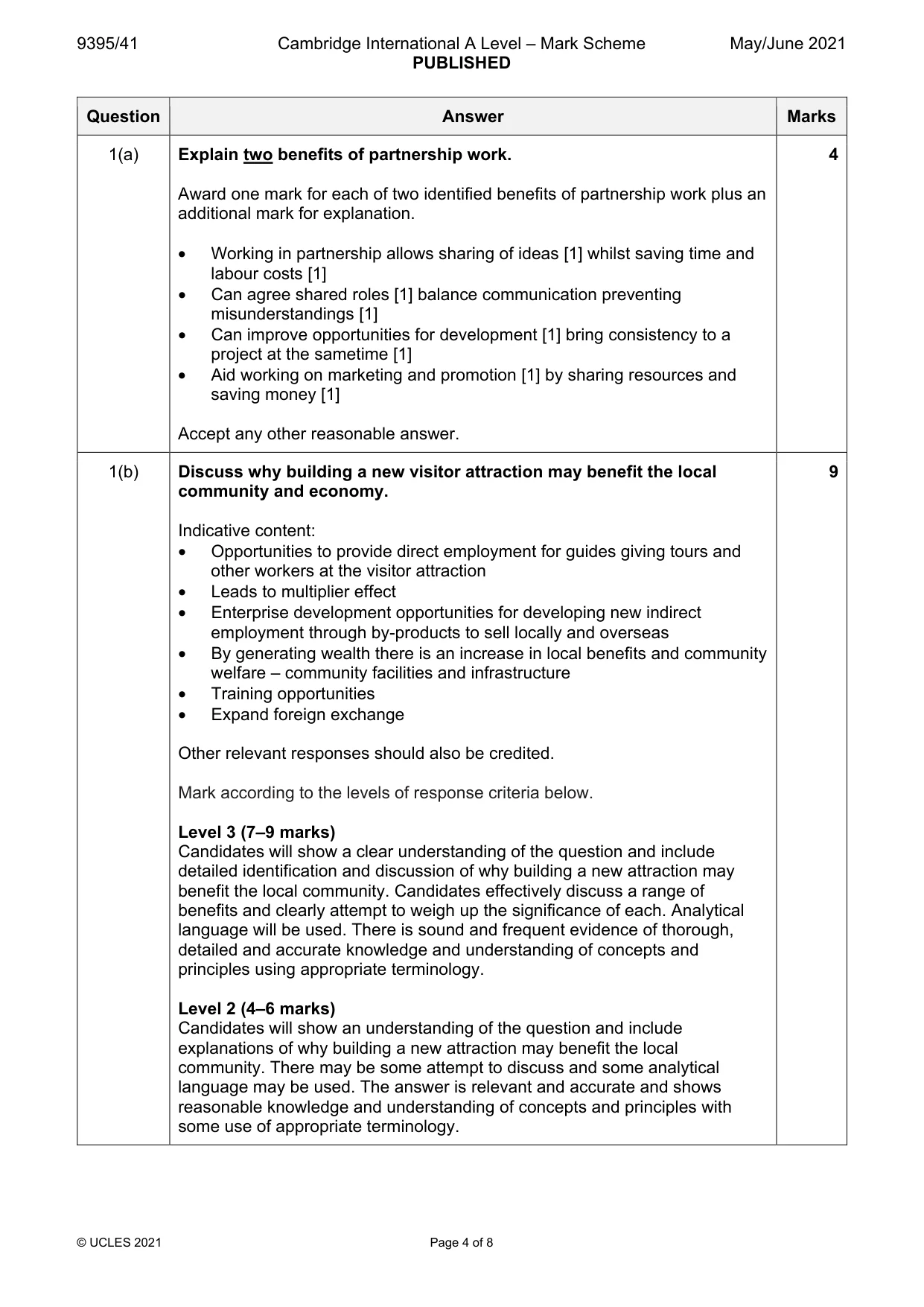
9395/41 Cambridge International A Level – Mark Scheme PUBLISHED May/June 2021 © UCLES 2021 Page 4 of 8 Question Answer Marks 1(a) Explain two benefits of partnership work. Award one mark for each of two identified benefits of partnership work plus an additional mark for explanation. • Working in partnership allows sharing of ideas [1] whilst saving time and labour costs [1] • Can agree shared roles [1] balance communication preventing misunderstandings [1] • Can improve opportunities for development [1] bring consistency to a project at the sametime [1] • Aid working on marketing and promotion [1] by sharing resources and saving money [1] Accept any other reasonable answer. 4 1(b) Discuss why building a new visitor attraction may benefit the local community and economy. Indicative content: • Opportunities to provide direct employment for guides giving tours and other workers at the visitor attraction • Leads to multiplier effect • Enterprise development opportunities for developing new indirect employment through by-products to sell locally and overseas • By generating wealth there is an increase in local benefits and community welfare – community facilities and infrastructure • Training opportunities • Expand foreign exchange Other relevant responses should also be credited. Mark according to the levels of response criteria below. Level 3 (7–9 marks) Candidates will show a clear understanding of the question and include detailed identification and discussion of why building a new attraction may benefit the local community. Candidates effectively discuss a range of benefits and clearly attempt to weigh up the significance of each. Analytical language will be used. There is sound and frequent evidence of thorough, detailed and accurate knowledge and understanding of concepts and principles using appropriate terminology. Level 2 (4–6 marks) Candidates will show an understanding of the question and include explanations of why building a new attraction may benefit the local community. There may be some attempt to discuss and some analytical language may be used. The answer is relevant and accurate and shows reasonable knowledge and understanding of concepts and principles with some use of appropriate terminology. 9
Mark scheme, page 5
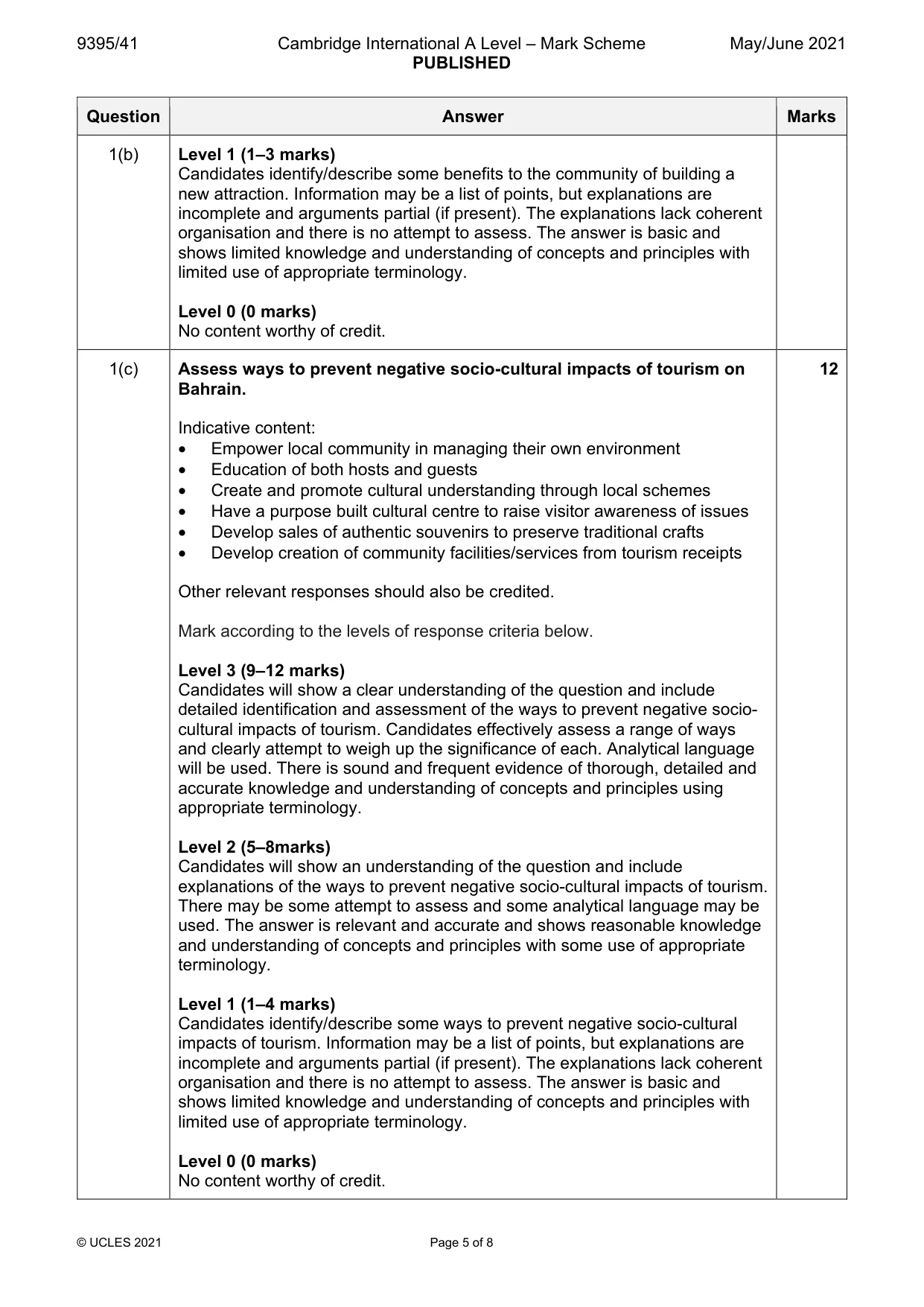
9395/41 Cambridge International A Level – Mark Scheme PUBLISHED May/June 2021 © UCLES 2021 Page 5 of 8 Question Answer Marks 1(b) Level 1 (1–3 marks) Candidates identify/describe some benefits to the community of building a new attraction. Information may be a list of points, but explanations are incomplete and arguments partial (if present). The explanations lack coherent organisation and there is no attempt to assess. The answer is basic and shows limited knowledge and understanding of concepts and principles with limited use of appropriate terminology. Level 0 (0 marks) No content worthy of credit. 1(c) Assess ways to prevent negative socio-cultural impacts of tourism on Bahrain. Indicative content: • Empower local community in managing their own environment • Education of both hosts and guests • Create and promote cultural understanding through local schemes • Have a purpose built cultural centre to raise visitor awareness of issues • Develop sales of authentic souvenirs to preserve traditional crafts • Develop creation of community facilities/services from tourism receipts Other relevant responses should also be credited. Mark according to the levels of response criteria below. Level 3 (9–12 marks) Candidates will show a clear understanding of the question and include detailed identification and assessment of the ways to prevent negative socio- cultural impacts of tourism. Candidates effectively assess a range of ways and clearly attempt to weigh up the significance of each. Analytical language will be used. There is sound and frequent evidence of thorough, detailed and accurate knowledge and understanding of concepts and principles using appropriate terminology. Level 2 (5–8marks) Candidates will show an understanding of the question and include explanations of the ways to prevent negative socio-cultural impacts of tourism. There may be some attempt to assess and some analytical language may be used. The answer is relevant and accurate and shows reasonable knowledge and understanding of concepts and principles with some use of appropriate terminology. Level 1 (1–4 marks) Candidates identify/describe some ways to prevent negative socio-cultural impacts of tourism. Information may be a list of points, but explanations are incomplete and arguments partial (if present). The explanations lack coherent organisation and there is no attempt to assess. The answer is basic and shows limited knowledge and understanding of concepts and principles with limited use of appropriate terminology. Level 0 (0 marks) No content worthy of credit. 12
Mark scheme, page 6
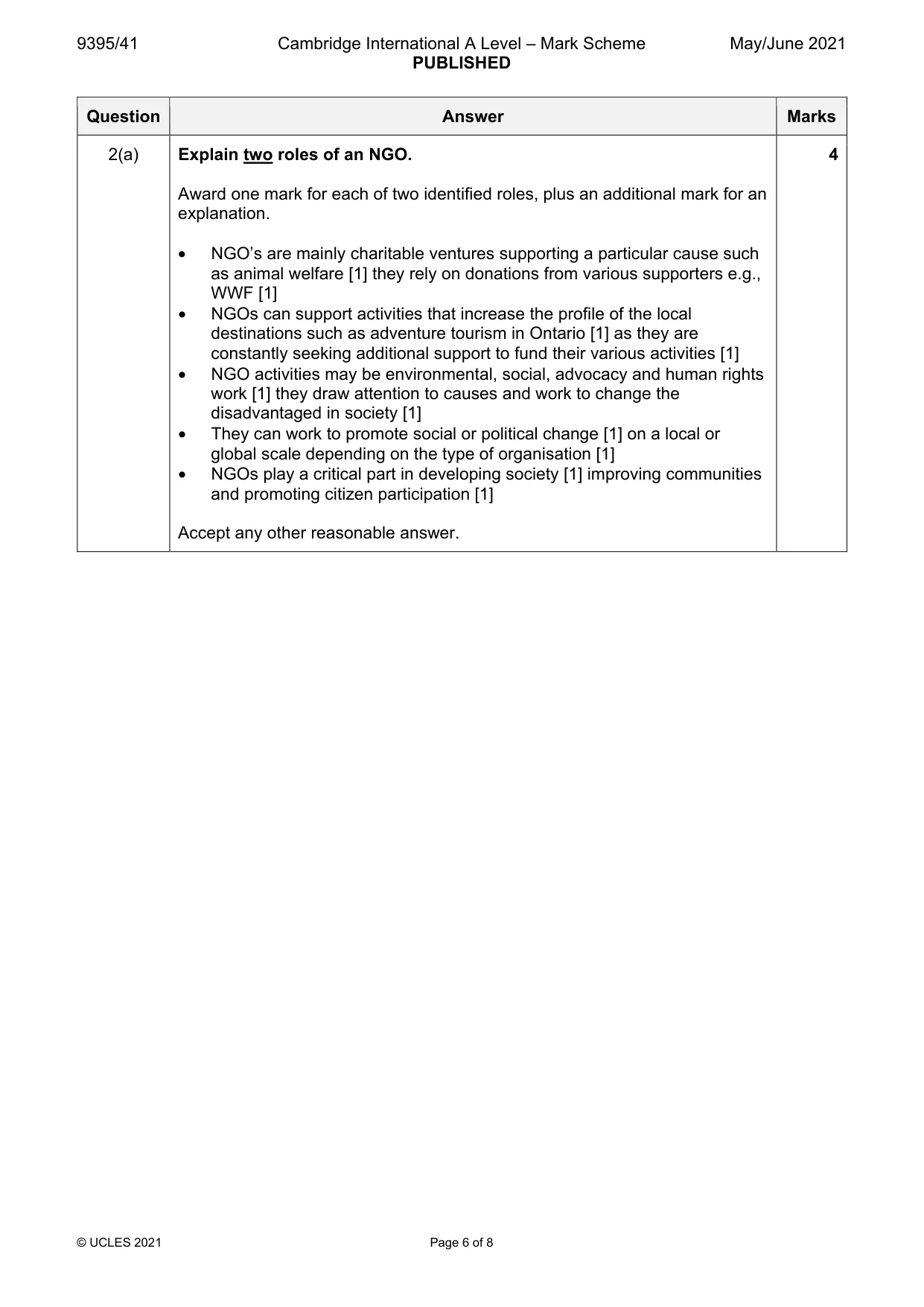
9395/41 Cambridge International A Level – Mark Scheme PUBLISHED May/June 2021 © UCLES 2021 Page 6 of 8 Question Answer Marks 2(a) Explain two roles of an NGO. Award one mark for each of two identified roles, plus an additional mark for an explanation. • NGO’s are mainly charitable ventures supporting a particular cause such as animal welfare [1] they rely on donations from various supporters e.g., WWF [1] • NGOs can support activities that increase the profile of the local destinations such as adventure tourism in Ontario [1] as they are constantly seeking additional support to fund their various activities [1] • NGO activities may be environmental, social, advocacy and human rights work [1] they draw attention to causes and work to change the disadvantaged in society [1] • They can work to promote social or political change [1] on a local or global scale depending on the type of organisation [1] • NGOs play a critical part in developing society [1] improving communities and promoting citizen participation [1] Accept any other reasonable answer. 4
Mark scheme, page 7
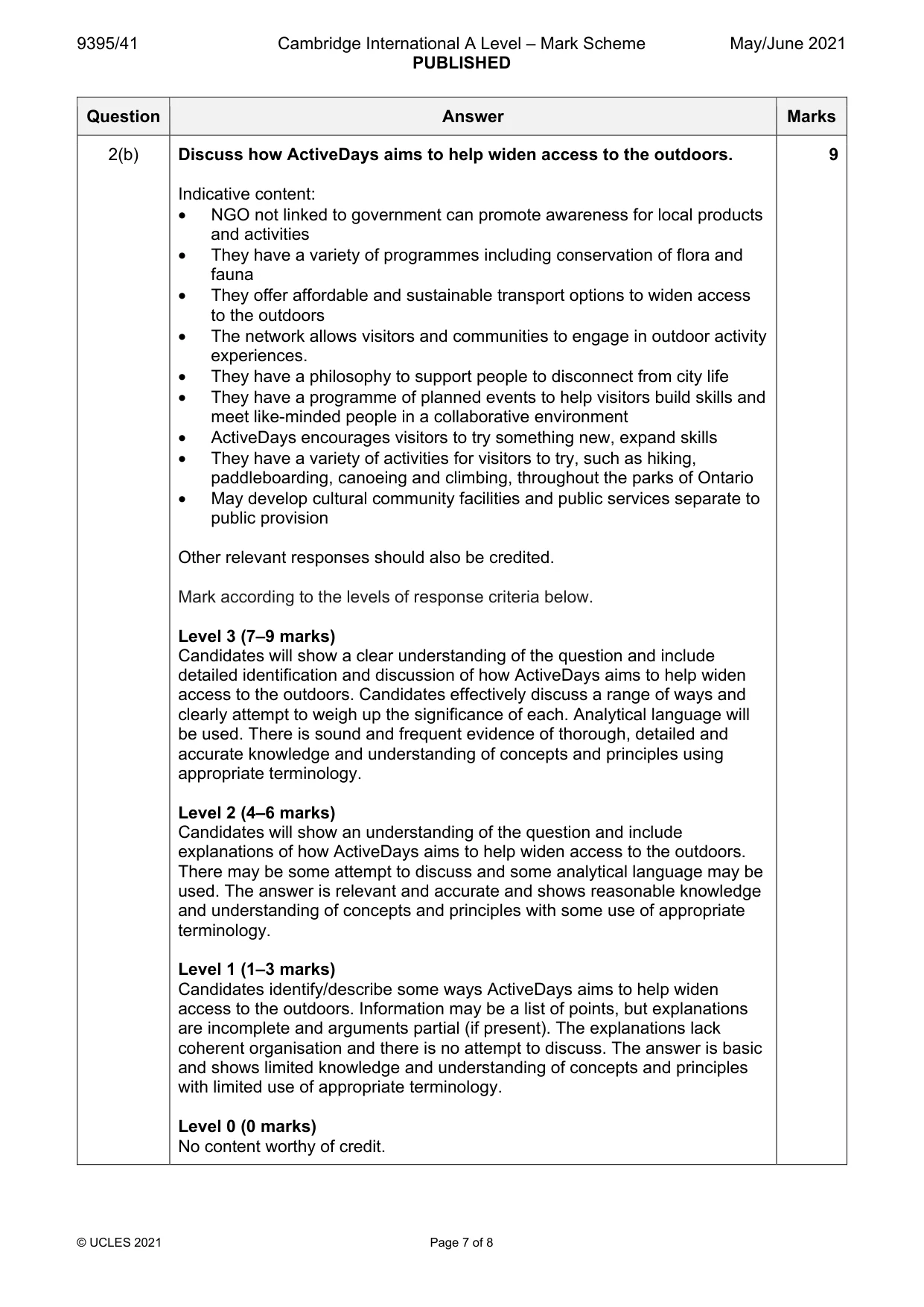
9395/41 Cambridge International A Level – Mark Scheme PUBLISHED May/June 2021 © UCLES 2021 Page 7 of 8 Question Answer Marks 2(b) Discuss how ActiveDays aims to help widen access to the outdoors. Indicative content: • NGO not linked to government can promote awareness for local products and activities • They have a variety of programmes including conservation of flora and fauna • They offer affordable and sustainable transport options to widen access to the outdoors • The network allows visitors and communities to engage in outdoor activity experiences. • They have a philosophy to support people to disconnect from city life • They have a programme of planned events to help visitors build skills and meet like-minded people in a collaborative environment • ActiveDays encourages visitors to try something new, expand skills • They have a variety of activities for visitors to try, such as hiking, paddleboarding, canoeing and climbing, throughout the parks of Ontario • May develop cultural community facilities and public services separate to public provision Other relevant responses should also be credited. Mark according to the levels of response criteria below. Level 3 (7–9 marks) Candidates will show a clear understanding of the question and include detailed identification and discussion of how ActiveDays aims to help widen access to the outdoors. Candidates effectively discuss a range of ways and clearly attempt to weigh up the significance of each. Analytical language will be used. There is sound and frequent evidence of thorough, detailed and accurate knowledge and understanding of concepts and principles using appropriate terminology. Level 2 (4–6 marks) Candidates will show an understanding of the question and include explanations of how ActiveDays aims to help widen access to the outdoors. There may be some attempt to discuss and some analytical language may be used. The answer is relevant and accurate and shows reasonable knowledge and understanding of concepts and principles with some use of appropriate terminology. Level 1 (1–3 marks) Candidates identify/describe some ways ActiveDays aims to help widen access to the outdoors. Information may be a list of points, but explanations are incomplete and arguments partial (if present). The explanations lack coherent organisation and there is no attempt to discuss. The answer is basic and shows limited knowledge and understanding of concepts and principles with limited use of appropriate terminology. Level 0 (0 marks) No content worthy of credit. 9
Mark scheme, page 8
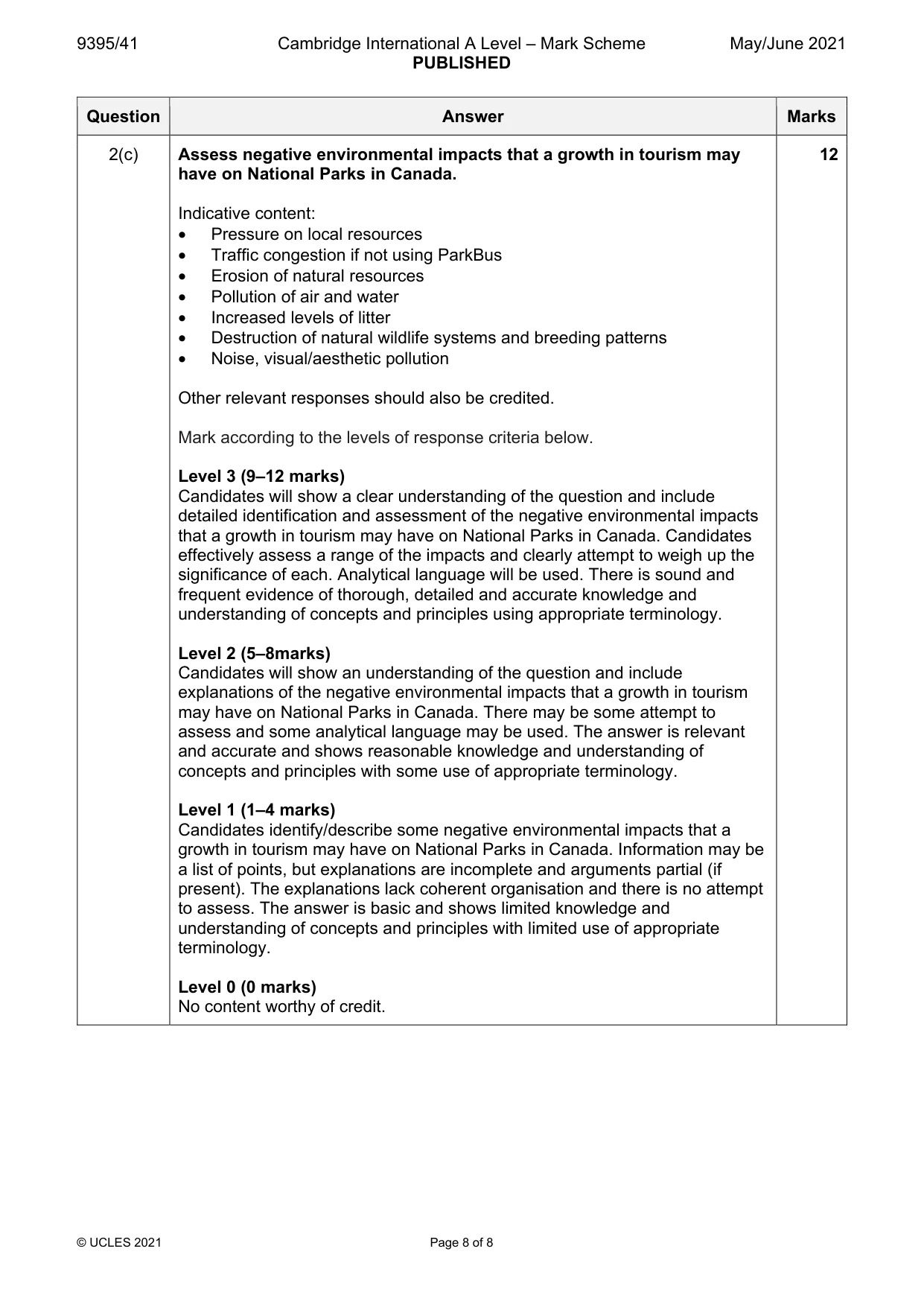
9395/41 Cambridge International A Level – Mark Scheme PUBLISHED May/June 2021 © UCLES 2021 Page 8 of 8 Question Answer Marks 2(c) Assess negative environmental impacts that a growth in tourism may have on National Parks in Canada. Indicative content: • Pressure on local resources • Traffic congestion if not using ParkBus • Erosion of natural resources • Pollution of air and water • Increased levels of litter • Destruction of natural wildlife systems and breeding patterns • Noise, visual/aesthetic pollution Other relevant responses should also be credited. Mark according to the levels of response criteria below. Level 3 (9–12 marks) Candidates will show a clear understanding of the question and include detailed identification and assessment of the negative environmental impacts that a growth in tourism may have on National Parks in Canada. Candidates effectively assess a range of the impacts and clearly attempt to weigh up the significance of each. Analytical language will be used. There is sound and frequent evidence of thorough, detailed and accurate knowledge and understanding of concepts and principles using appropriate terminology. Level 2 (5–8marks) Candidates will show an understanding of the question and include explanations of the negative environmental impacts that a growth in tourism may have on National Parks in Canada. There may be some attempt to assess and some analytical language may be used. The answer is relevant and accurate and shows reasonable knowledge and understanding of concepts and principles with some use of appropriate terminology. Level 1 (1–4 marks) Candidates identify/describe some negative environmental impacts that a growth in tourism may have on National Parks in Canada. Information may be a list of points, but explanations are incomplete and arguments partial (if present). The explanations lack coherent organisation and there is no attempt to assess. The answer is basic and shows limited knowledge and understanding of concepts and principles with limited use of appropriate terminology. Level 0 (0 marks) No content worthy of credit. 12
What you needed in this session
Cambridge’s own grade thresholds for 2021 May/June, Paper 4 · Variant 1. A higher threshold means an easier paper — the bar moves with how the cohort did.