Cambridge A Level Travel and Tourism 9395 — 2021 May/June Paper 1 · Variant 2
9395/12/M/J/21 · 100 marks · ≈113 min
The question paper and its mark scheme, free to read here and free to download. This is Cambridge’s own paper, exactly as it was sat.
Question paper16 pages



Mark scheme12 pages
Answers below. Sit the paper first if you are practising.
Paper as text
Question paper, page 1
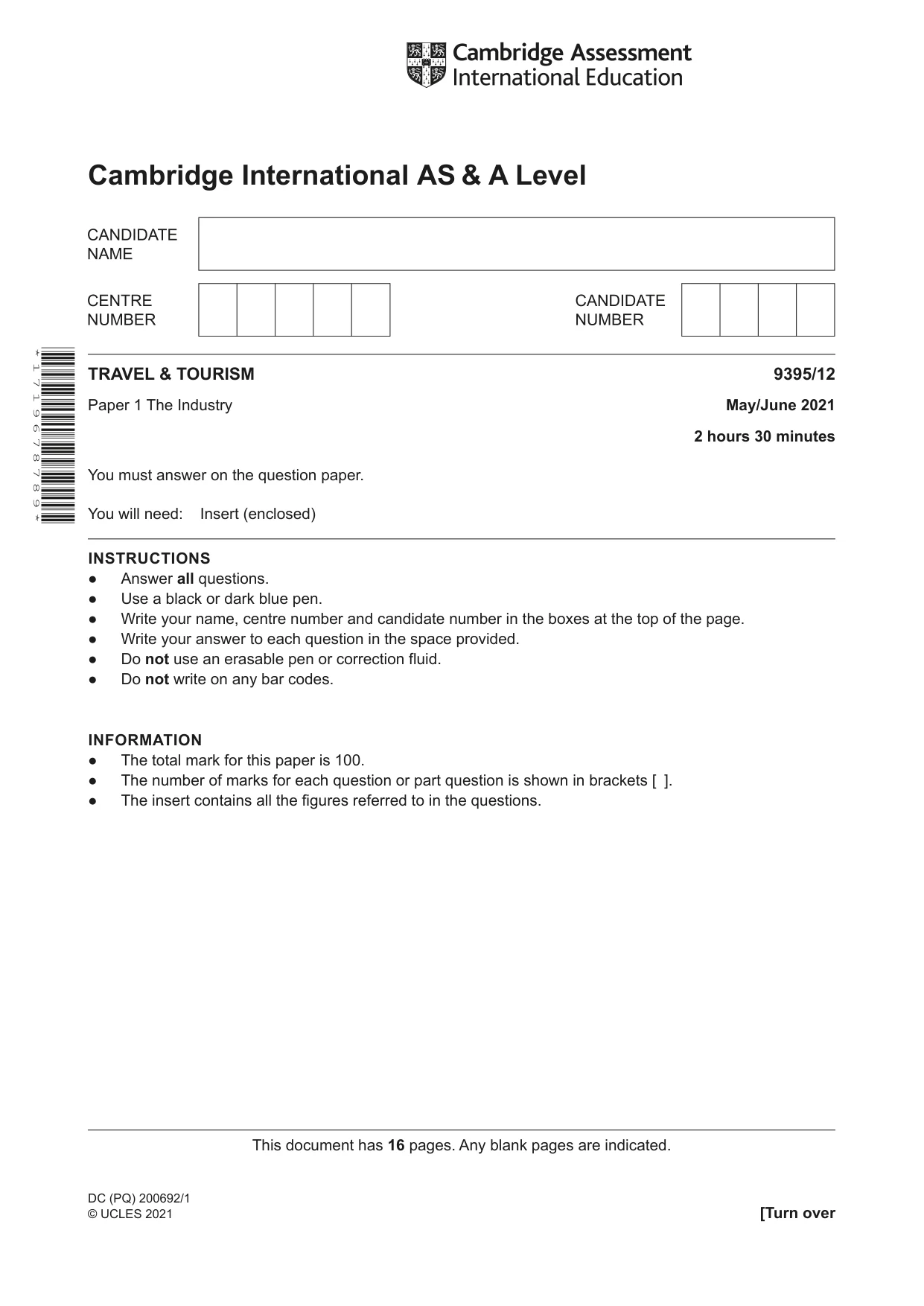
This document has 16 pages. Any blank pages are indicated. Cambridge International AS & A Level DC (PQ) 200692/1 © UCLES 2021 [Turn over * 1 7 1 9 6 7 8 7 8 9 * TRAVEL & TOURISM 9395/12 Paper 1 The Industry May/June 2021 2 hours 30 minutes You must answer on the question paper. You will need: Insert (enclosed) INSTRUCTIONS ● Answer all questions. ● Use a black or dark blue pen. ● Write your name, centre number and candidate number in the boxes at the top of the page. ● Write your answer to each question in the space provided. ● Do not use an erasable pen or correction fluid. ● Do not write on any bar codes. INFORMATION ● The total mark for this paper is 100. ● The number of marks for each question or part question is shown in brackets [ ]. ● The insert contains all the figures referred to in the questions.
Question paper, page 2
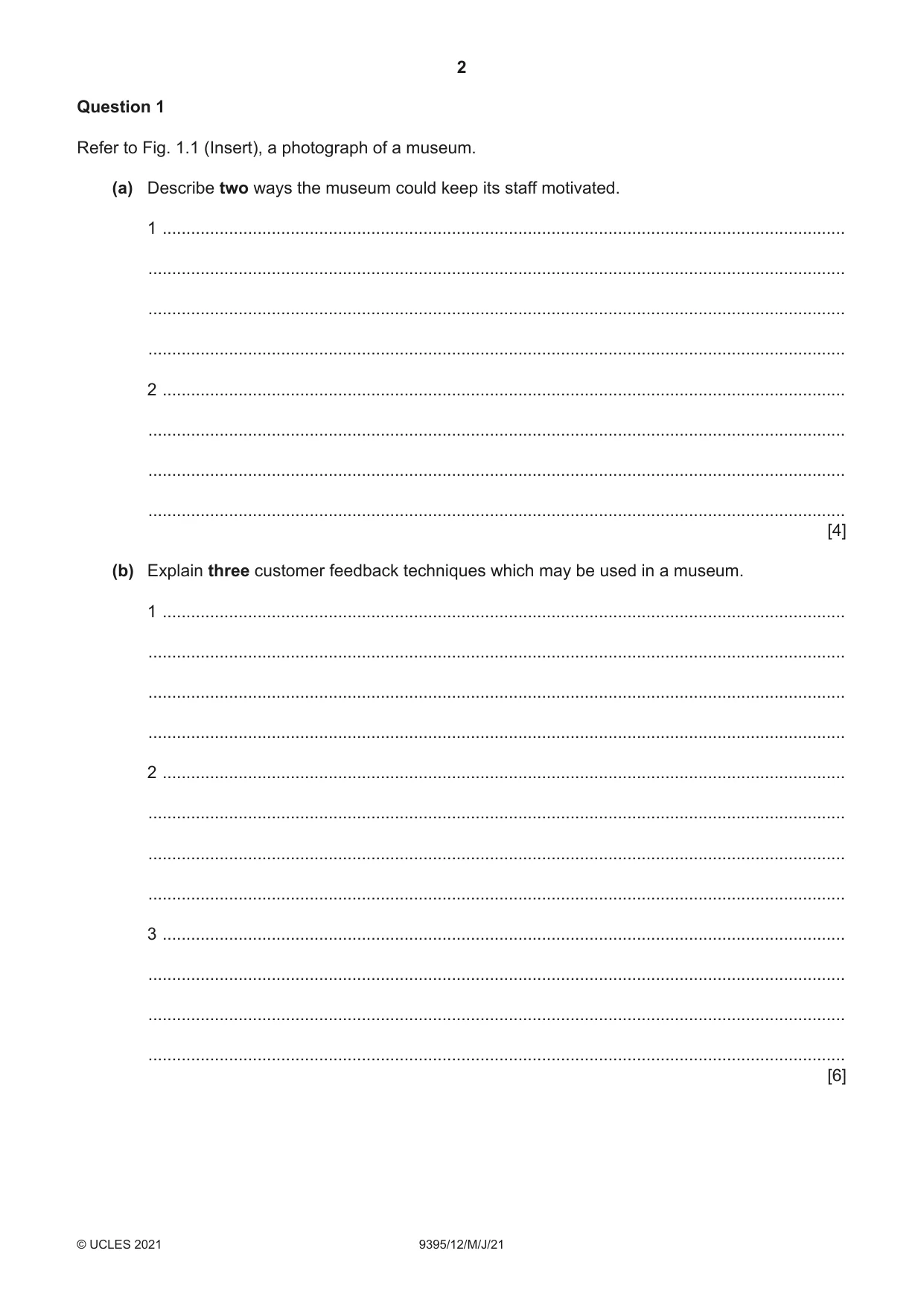
2 9395/12/M/J/21 © UCLES 2021 Question 1 Refer to Fig. 1.1 (Insert), a photograph of a museum. (a) Describe two ways the museum could keep its staff motivated. 1 … … … … 2 … … … … [4] (b) Explain three customer feedback techniques which may be used in a museum. 1 … … … … 2 … … … … 3 … … … … [6]
Question paper, page 3
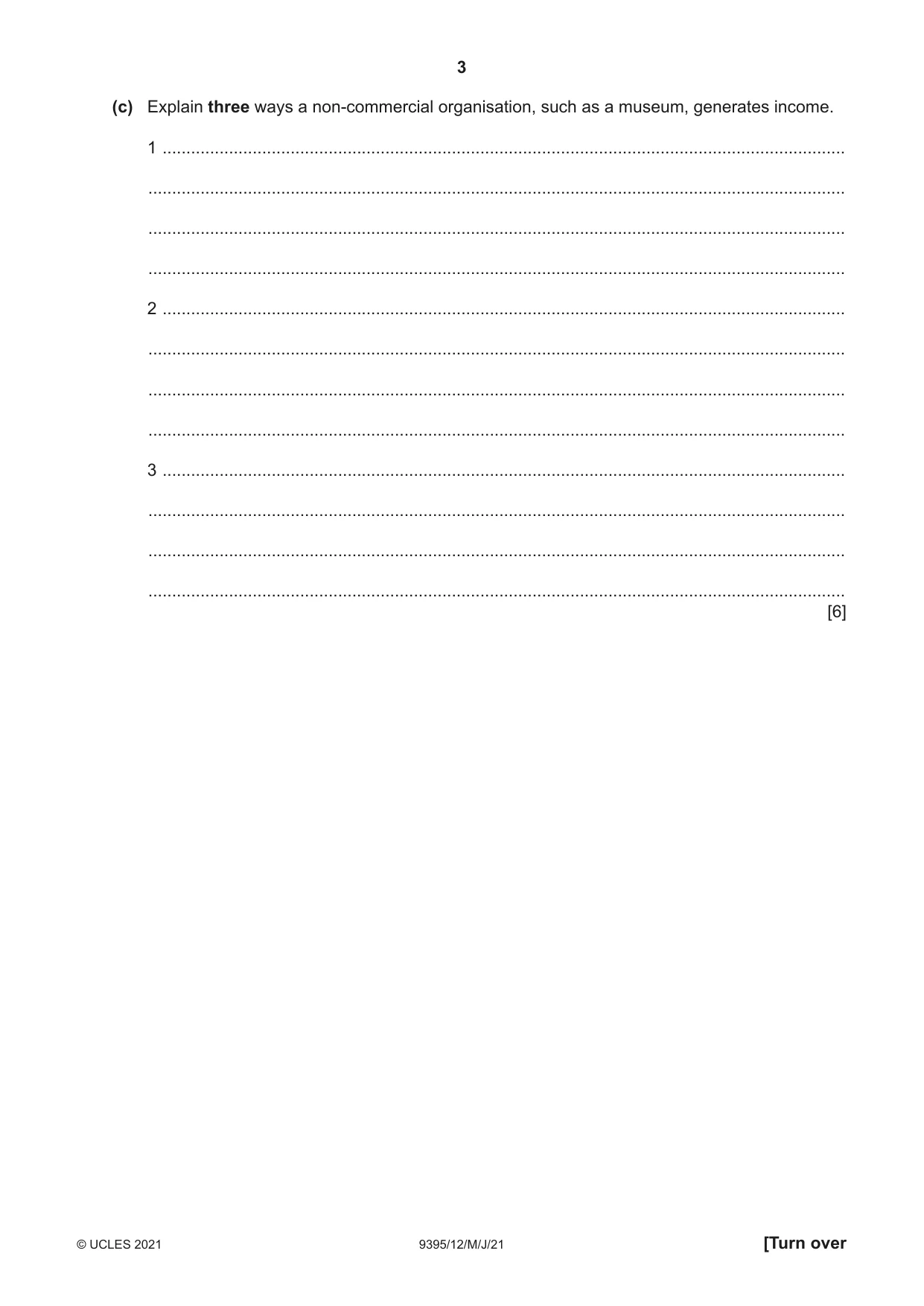
3 9395/12/M/J/21 © UCLES 2021 [Turn over (c) Explain three ways a non-commercial organisation, such as a museum, generates income. 1 … … … … 2 … … … … 3 … … … … [6]
Question paper, page 4
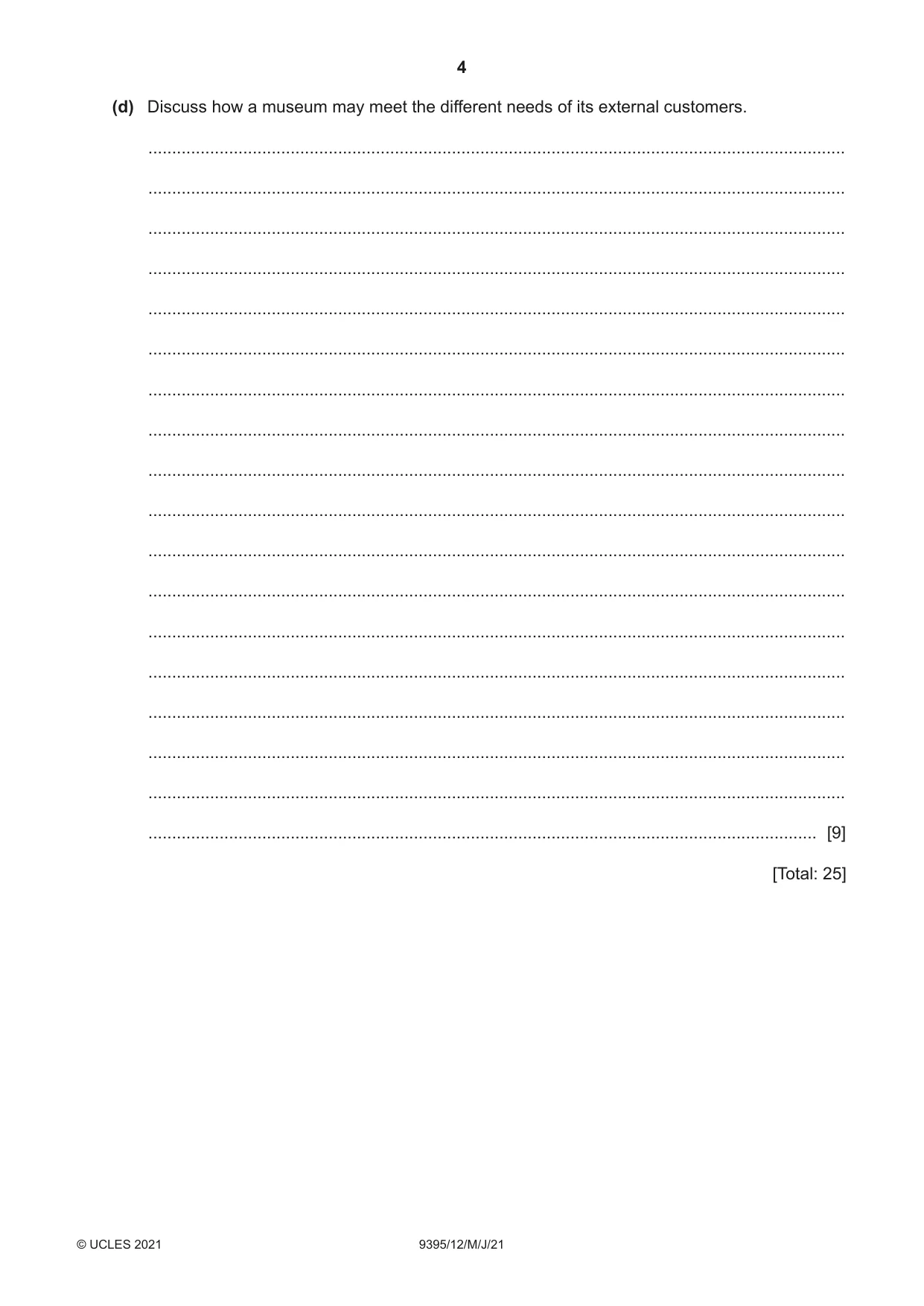
4 9395/12/M/J/21 © UCLES 2021 (d) Discuss how a museum may meet the different needs of its external customers. … … … … … … … … … … … … … … … … … … [9] [Total: 25]
Question paper, page 5
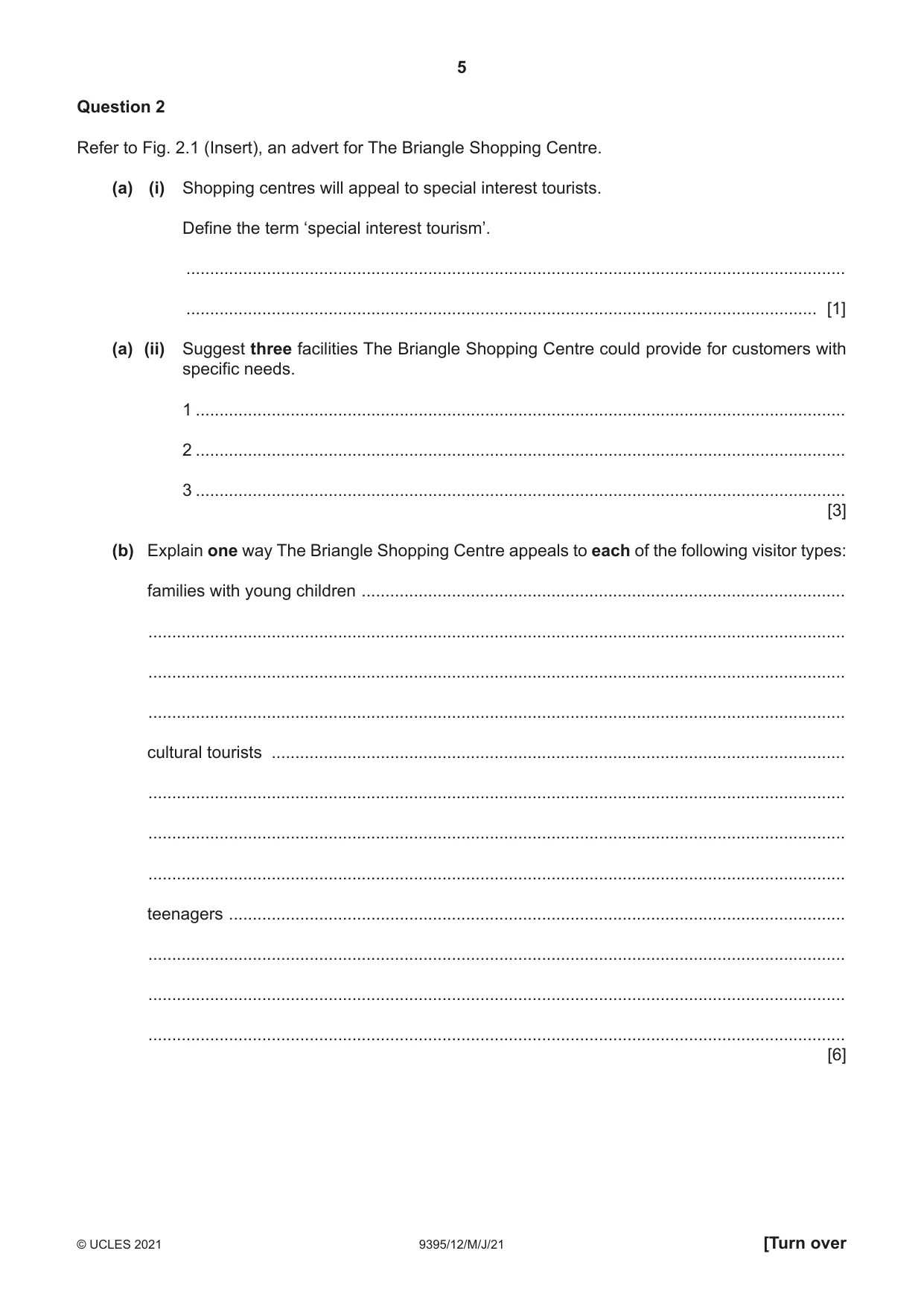
5 9395/12/M/J/21 © UCLES 2021 [Turn over Question 2 Refer to Fig. 2.1 (Insert), an advert for The Briangle Shopping Centre. (a) (i) Shopping centres will appeal to special interest tourists. Define the term ‘special interest tourism’. … … [1] (a) (ii) Suggest three facilities The Briangle Shopping Centre could provide for customers with specific needs. 1 … 2 … 3 … [3] (b) Explain one way The Briangle Shopping Centre appeals to each of the following visitor types: families with young children … … … … cultural tourists … … … … teenagers … … … … [6]
Question paper, page 6
6 9395/12/M/J/21 © UCLES 2021 (c) Explain two benefits to The Briangle Shopping Centre of providing good customer service to its internal customers. 1 … … … … … … 2 … … … … … … [6]
Question paper, page 7
7 9395/12/M/J/21 © UCLES 2021 [Turn over (d) Discuss the likely impacts of changes in the value of the national currency on different visitor attractions. … … … … … … … … … … … … … … … … … … [9] [Total: 25]
Question paper, page 8
8 9395/12/M/J/21 © UCLES 2021 Question 3 Refer to Fig. 3.1 (Insert), information about tourism in Costa Rica. (a) Describe two characteristics of rural destinations. 1 … … … … 2 … … … … [4] (b) Explain three likely roles of a local tourism organisation in Costa Rica. 1 … … … … 2 … … … … 3 … … … … [6]
Question paper, page 9
9 9395/12/M/J/21 © UCLES 2021 [Turn over (c) Explain how Costa Rica has differentiated its tourism products to appeal to different types of tourists. … … … … … … … … … … … … [6]
Question paper, page 10
10 9395/12/M/J/21 © UCLES 2021 (d) Discuss how social factors may encourage the growth of international tourism. … … … … … … … … … … … … … … … … … … [9] [Total: 25]
Question paper, page 11
11 9395/12/M/J/21 © UCLES 2021 [Turn over Question 4 (a) Suggest four reasons why tourism may be in decline in some countries. 1 … … 2 … … 3 … … 4 … … [4] (b) Explain three reasons why countries may use visas. 1 … … … … 2 … … … … 3 … … … … [6]
Question paper, page 12
12 9395/12/M/J/21 © UCLES 2021 (c) Explain two reasons why domestic tourism is important to a country. 1 … … … … … … 2 … … … … … … [6]
Question paper, page 13
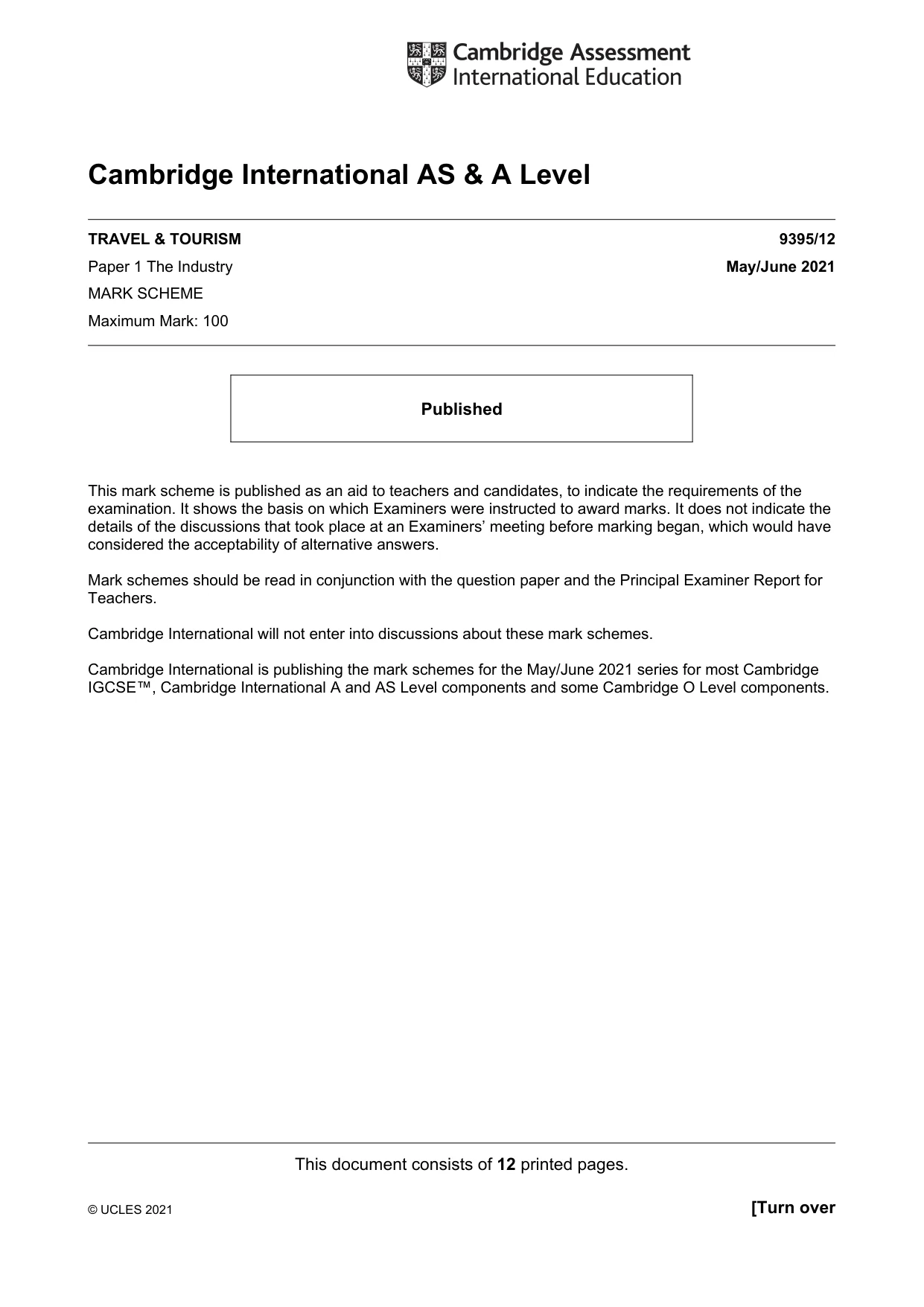
13 9395/12/M/J/21 © UCLES 2021 (d) Discuss the likely impacts of changes to legislation on tourism. … … … … … … … … … … … … … … … … … … [9] [Total: 25]
Question paper, page 14
14 9395/12/M/J/21 © UCLES 2021 BLANK PAGE
Question paper, page 15
15 9395/12/M/J/21 © UCLES 2021 BLANK PAGE
Question paper, page 16
16 9395/12/M/J/21 © UCLES 2021 The boundaries and names shown, the designations used and the presentation of material on any maps contained in this question paper/insert do not imply official endorsement or acceptance by Cambridge Assessment International Education concerning the legal status of any country, territory, or area or any of its authorities, or of the delimitation of its frontiers or boundaries. Permission to reproduce items where third-party owned material protected by copyright is included has been sought and cleared where possible. Every reasonable effort has been made by the publisher (UCLES) to trace copyright holders, but if any items requiring clearance have unwittingly been included, the publisher will be pleased to make amends at the earliest possible opportunity. To avoid the issue of disclosure of answer-related information to candidates, all copyright acknowledgements are reproduced online in the Cambridge Assessment International Education Copyright Acknowledgements Booklet. This is produced for each series of examinations and is freely available to download at www.cambridgeinternational.org after the live examination series. Cambridge Assessment International Education is part of the Cambridge Assessment Group. Cambridge Assessment is the brand name of the University of Cambridge Local Examinations Syndicate (UCLES), which itself is a department of the University of Cambridge.
Mark scheme, page 1
This document consists of 12 printed pages. © UCLES 2021 [Turn over Cambridge International AS & A Level TRAVEL & TOURISM 9395/12 Paper 1 The Industry May/June 2021 MARK SCHEME Maximum Mark: 100 Published This mark scheme is published as an aid to teachers and candidates, to indicate the requirements of the examination. It shows the basis on which Examiners were instructed to award marks. It does not indicate the details of the discussions that took place at an Examiners’ meeting before marking began, which would have considered the acceptability of alternative answers. Mark schemes should be read in conjunction with the question paper and the Principal Examiner Report for Teachers. Cambridge International will not enter into discussions about these mark schemes. Cambridge International is publishing the mark schemes for the May/June 2021 series for most Cambridge IGCSE™, Cambridge International A and AS Level components and some Cambridge O Level components.
Mark scheme, page 2
9395/12 Cambridge International AS & A Level – Mark Scheme PUBLISHED May/June 2021 © UCLES 2021 Page 2 of 12 Generic Marking Principles These general marking principles must be applied by all examiners when marking candidate answers. They should be applied alongside the specific content of the mark scheme or generic level descriptors for a question. Each question paper and mark scheme will also comply with these marking principles. GENERIC MARKING PRINCIPLE 1: Marks must be awarded in line with: • the specific content of the mark scheme or the generic level descriptors for the question • the specific skills defined in the mark scheme or in the generic level descriptors for the question • the standard of response required by a candidate as exemplified by the standardisation scripts. GENERIC MARKING PRINCIPLE 2: Marks awarded are always whole marks (not half marks, or other fractions). GENERIC MARKING PRINCIPLE 3: Marks must be awarded positively: • marks are awarded for correct/valid answers, as defined in the mark scheme. However, credit is given for valid answers which go beyond the scope of the syllabus and mark scheme, referring to your Team Leader as appropriate • marks are awarded when candidates clearly demonstrate what they know and can do • marks are not deducted for errors • marks are not deducted for omissions • answers should only be judged on the quality of spelling, punctuation and grammar when these features are specifically assessed by the question as indicated by the mark scheme. The meaning, however, should be unambiguous. GENERIC MARKING PRINCIPLE 4: Rules must be applied consistently, e.g. in situations where candidates have not followed instructions or in the application of generic level descriptors. GENERIC MARKING PRINCIPLE 5: Marks should be awarded using the full range of marks defined in the mark scheme for the question (however; the use of the full mark range may be limited according to the quality of the candidate responses seen). GENERIC MARKING PRINCIPLE 6: Marks awarded are based solely on the requirements as defined in the mark scheme. Marks should not be awarded with grade thresholds or grade descriptors in mind.
Mark scheme, page 3
9395/12 Cambridge International AS & A Level – Mark Scheme PUBLISHED May/June 2021 © UCLES 2021 Page 3 of 12 Social Science-Specific Marking Principles (for point-based marking) 1 Components using point-based marking: • Point marking is often used to reward knowledge, understanding and application of skills. We give credit where the candidate’s answer shows relevant knowledge, understanding and application of skills in answering the question. We do not give credit where the answer shows confusion. From this it follows that we: (a) DO credit answers which are worded differently from the mark scheme if they clearly convey the same meaning (unless the mark scheme requires a specific term) (b) DO credit alternative answers/examples which are not written in the mark scheme if they are correct (c) DO credit answers where candidates give more than one correct answer in one prompt/numbered/scaffolded space where extended writing is required rather than list-type answers. For example, questions that require n reasons (e.g. State two reasons …). (d) DO NOT credit answers simply for using a ‘key term’ unless that is all that is required. (Check for evidence it is understood and not used wrongly.) (e) DO NOT credit answers which are obviously self-contradicting or trying to cover all possibilities (f) DO NOT give further credit for what is effectively repetition of a correct point already credited unless the language itself is being tested. This applies equally to ‘mirror statements’ (i.e. polluted/not polluted). (g) DO NOT require spellings to be correct, unless this is part of the test. However spellings of syllabus terms must allow for clear and unambiguous separation from other syllabus terms with which they may be confused (e.g. Corrasion/Corrosion) 2 Presentation of mark scheme: • Slashes (/) or the word ‘or’ separate alternative ways of making the same point. • Semi colons (;) bullet points (•) or figures in brackets (1) separate different points. • Content in the answer column in brackets is for examiner information/context to clarify the marking but is not required to earn the mark (except Accounting syllabuses where they indicate negative numbers). 3 Annotation: • For point marking, ticks can be used to indicate correct answers and crosses can be used to indicate wrong answers. There is no direct relationship between ticks and marks. Ticks have no defined meaning for levels of response marking. • For levels of response marking, the level awarded should be annotated on the script. • Other annotations will be used by examiners as agreed during standardisation, and the meaning will be understood by all examiners who marked that paper.
Mark scheme, page 4
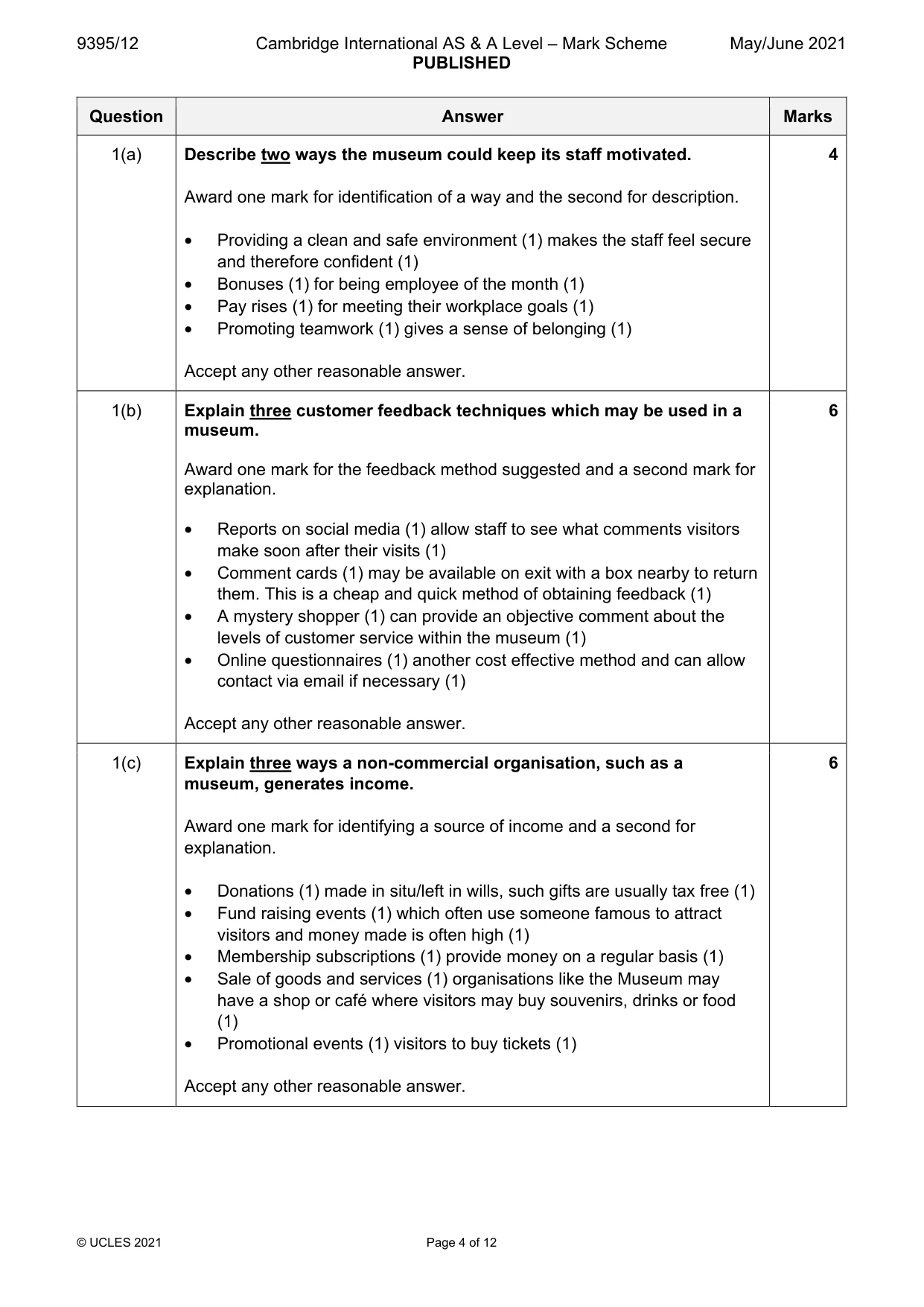
9395/12 Cambridge International AS & A Level – Mark Scheme PUBLISHED May/June 2021 © UCLES 2021 Page 4 of 12 Question Answer Marks 1(a) Describe two ways the museum could keep its staff motivated. Award one mark for identification of a way and the second for description. • Providing a clean and safe environment (1) makes the staff feel secure and therefore confident (1) • Bonuses (1) for being employee of the month (1) • Pay rises (1) for meeting their workplace goals (1) • Promoting teamwork (1) gives a sense of belonging (1) Accept any other reasonable answer. 4 1(b) Explain three customer feedback techniques which may be used in a museum. Award one mark for the feedback method suggested and a second mark for explanation. • Reports on social media (1) allow staff to see what comments visitors make soon after their visits (1) • Comment cards (1) may be available on exit with a box nearby to return them. This is a cheap and quick method of obtaining feedback (1) • A mystery shopper (1) can provide an objective comment about the levels of customer service within the museum (1) • Online questionnaires (1) another cost effective method and can allow contact via email if necessary (1) Accept any other reasonable answer. 6 1(c) Explain three ways a non-commercial organisation, such as a museum, generates income. Award one mark for identifying a source of income and a second for explanation. • Donations (1) made in situ/left in wills, such gifts are usually tax free (1) • Fund raising events (1) which often use someone famous to attract visitors and money made is often high (1) • Membership subscriptions (1) provide money on a regular basis (1) • Sale of goods and services (1) organisations like the Museum may have a shop or café where visitors may buy souvenirs, drinks or food (1) • Promotional events (1) visitors to buy tickets (1) Accept any other reasonable answer. 6
Mark scheme, page 5
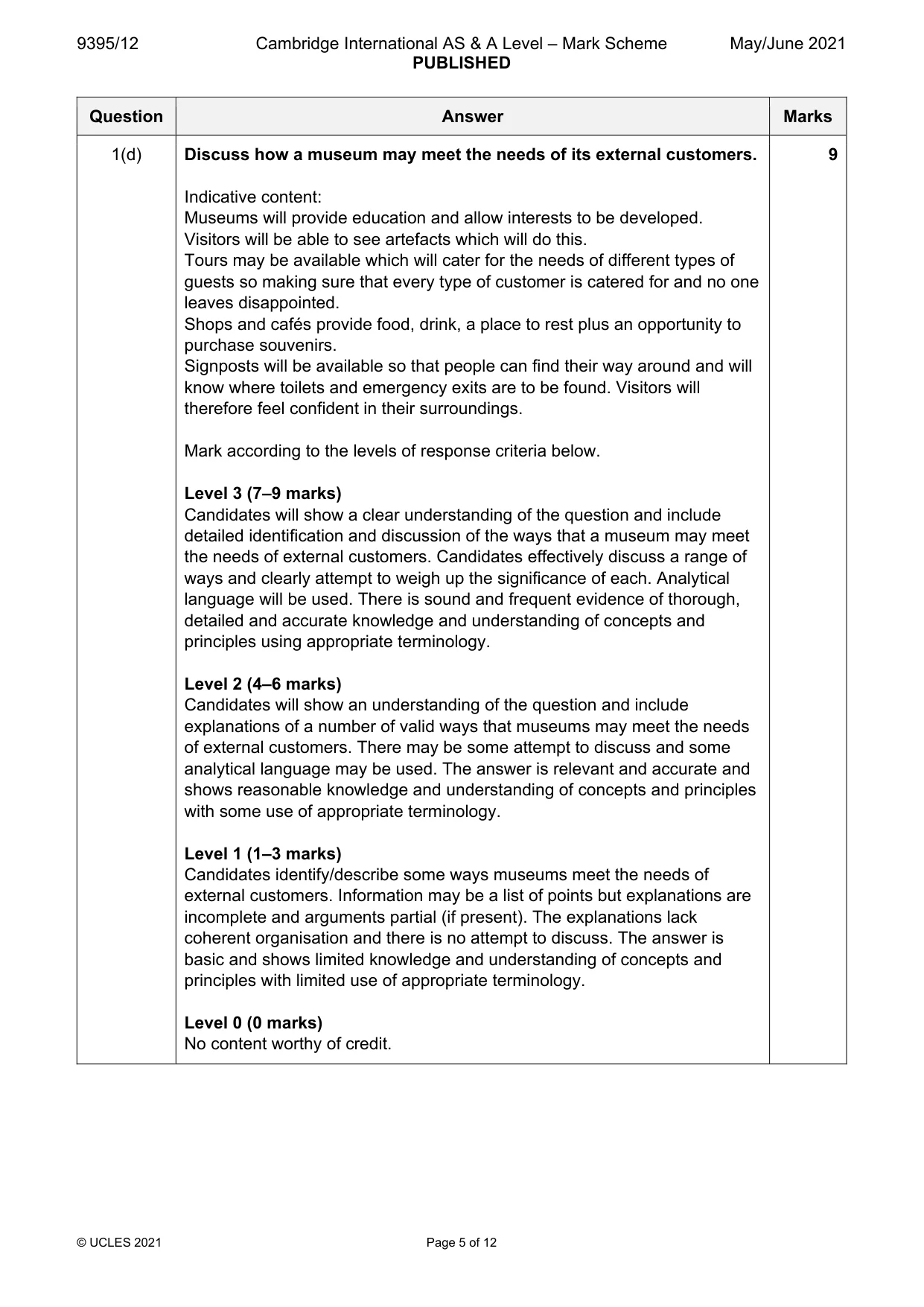
9395/12 Cambridge International AS & A Level – Mark Scheme PUBLISHED May/June 2021 © UCLES 2021 Page 5 of 12 Question Answer Marks 1(d) Discuss how a museum may meet the needs of its external customers. Indicative content: Museums will provide education and allow interests to be developed. Visitors will be able to see artefacts which will do this. Tours may be available which will cater for the needs of different types of guests so making sure that every type of customer is catered for and no one leaves disappointed. Shops and cafés provide food, drink, a place to rest plus an opportunity to purchase souvenirs. Signposts will be available so that people can find their way around and will know where toilets and emergency exits are to be found. Visitors will therefore feel confident in their surroundings. Mark according to the levels of response criteria below. Level 3 (7–9 marks) Candidates will show a clear understanding of the question and include detailed identification and discussion of the ways that a museum may meet the needs of external customers. Candidates effectively discuss a range of ways and clearly attempt to weigh up the significance of each. Analytical language will be used. There is sound and frequent evidence of thorough, detailed and accurate knowledge and understanding of concepts and principles using appropriate terminology. Level 2 (4–6 marks) Candidates will show an understanding of the question and include explanations of a number of valid ways that museums may meet the needs of external customers. There may be some attempt to discuss and some analytical language may be used. The answer is relevant and accurate and shows reasonable knowledge and understanding of concepts and principles with some use of appropriate terminology. Level 1 (1–3 marks) Candidates identify/describe some ways museums meet the needs of external customers. Information may be a list of points but explanations are incomplete and arguments partial (if present). The explanations lack coherent organisation and there is no attempt to discuss. The answer is basic and shows limited knowledge and understanding of concepts and principles with limited use of appropriate terminology. Level 0 (0 marks) No content worthy of credit. 9
Mark scheme, page 6
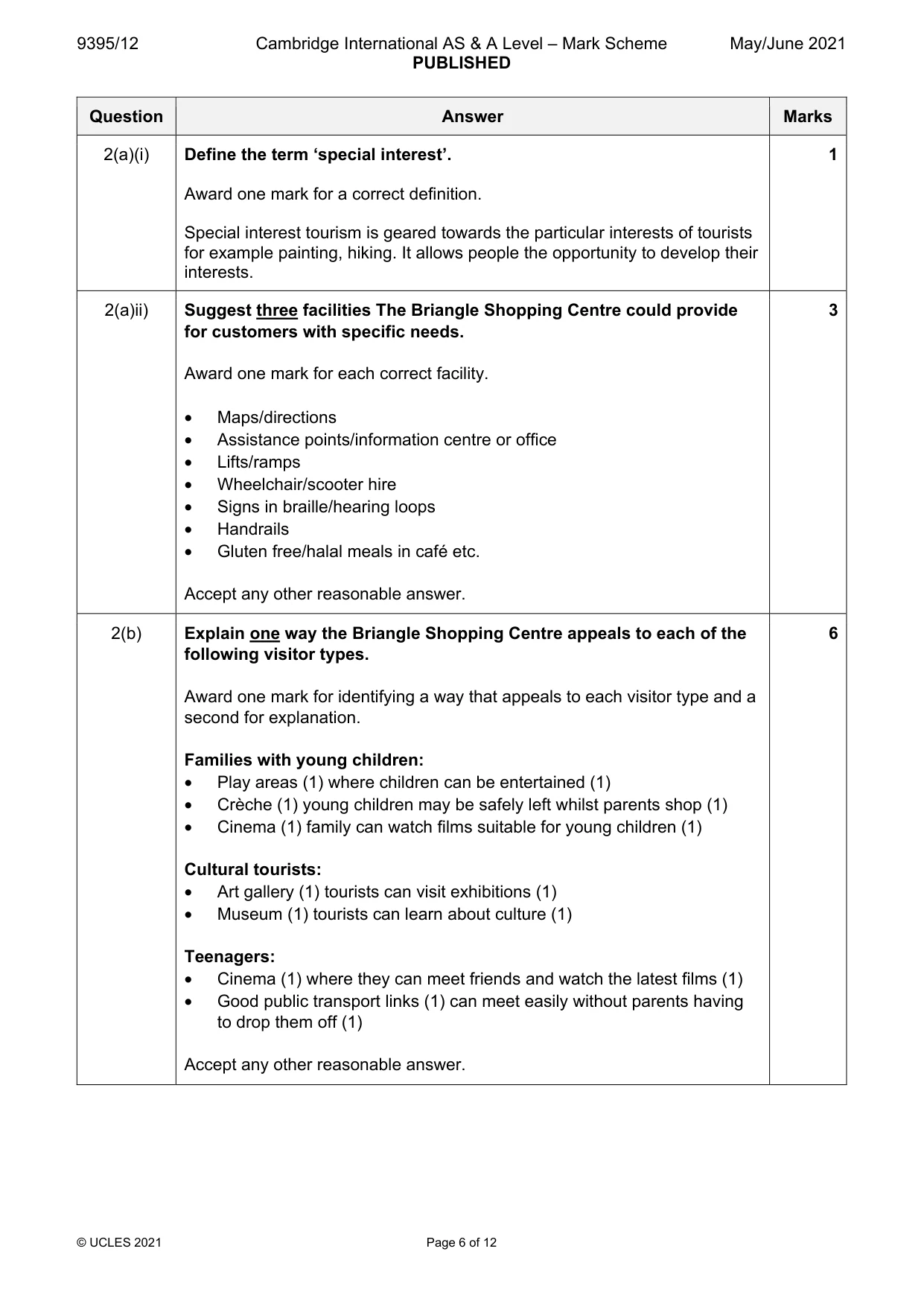
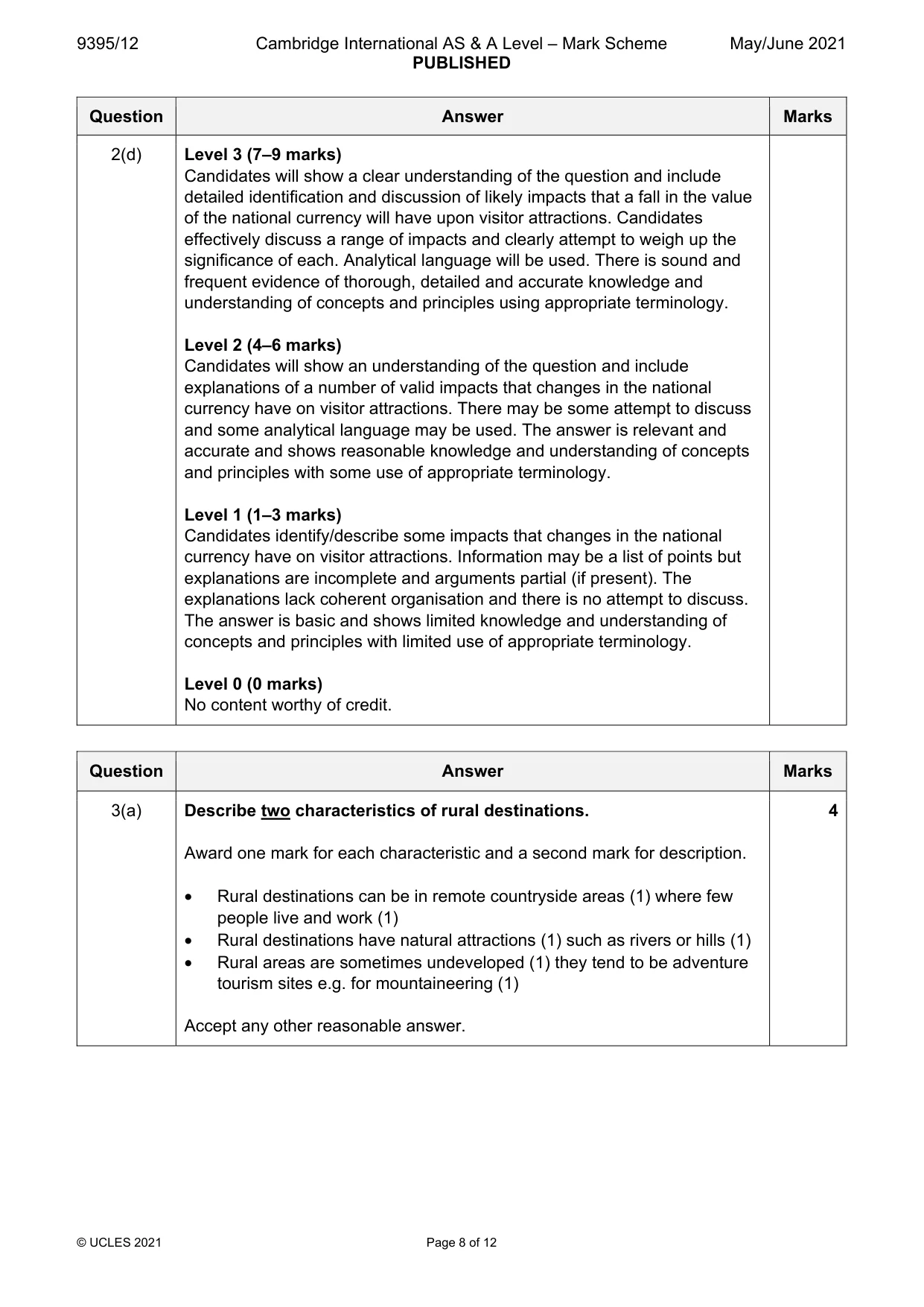
9395/12 Cambridge International AS & A Level – Mark Scheme PUBLISHED May/June 2021 © UCLES 2021 Page 6 of 12 Question Answer Marks 2(a)(i) Define the term ‘special interest’. Award one mark for a correct definition. Special interest tourism is geared towards the particular interests of tourists for example painting, hiking. It allows people the opportunity to develop their interests. 1 2(a)ii) Suggest three facilities The Briangle Shopping Centre could provide for customers with specific needs. Award one mark for each correct facility. • Maps/directions • Assistance points/information centre or office • Lifts/ramps • Wheelchair/scooter hire • Signs in braille/hearing loops • Handrails • Gluten free/halal meals in café etc. Accept any other reasonable answer. 3 2(b) Explain one way the Briangle Shopping Centre appeals to each of the following visitor types. Award one mark for identifying a way that appeals to each visitor type and a second for explanation. Families with young children: • Play areas (1) where children can be entertained (1) • Crèche (1) young children may be safely left whilst parents shop (1) • Cinema (1) family can watch films suitable for young children (1) Cultural tourists: • Art gallery (1) tourists can visit exhibitions (1) • Museum (1) tourists can learn about culture (1) Teenagers: • Cinema (1) where they can meet friends and watch the latest films (1) • Good public transport links (1) can meet easily without parents having to drop them off (1) Accept any other reasonable answer. 6
Mark scheme, page 7
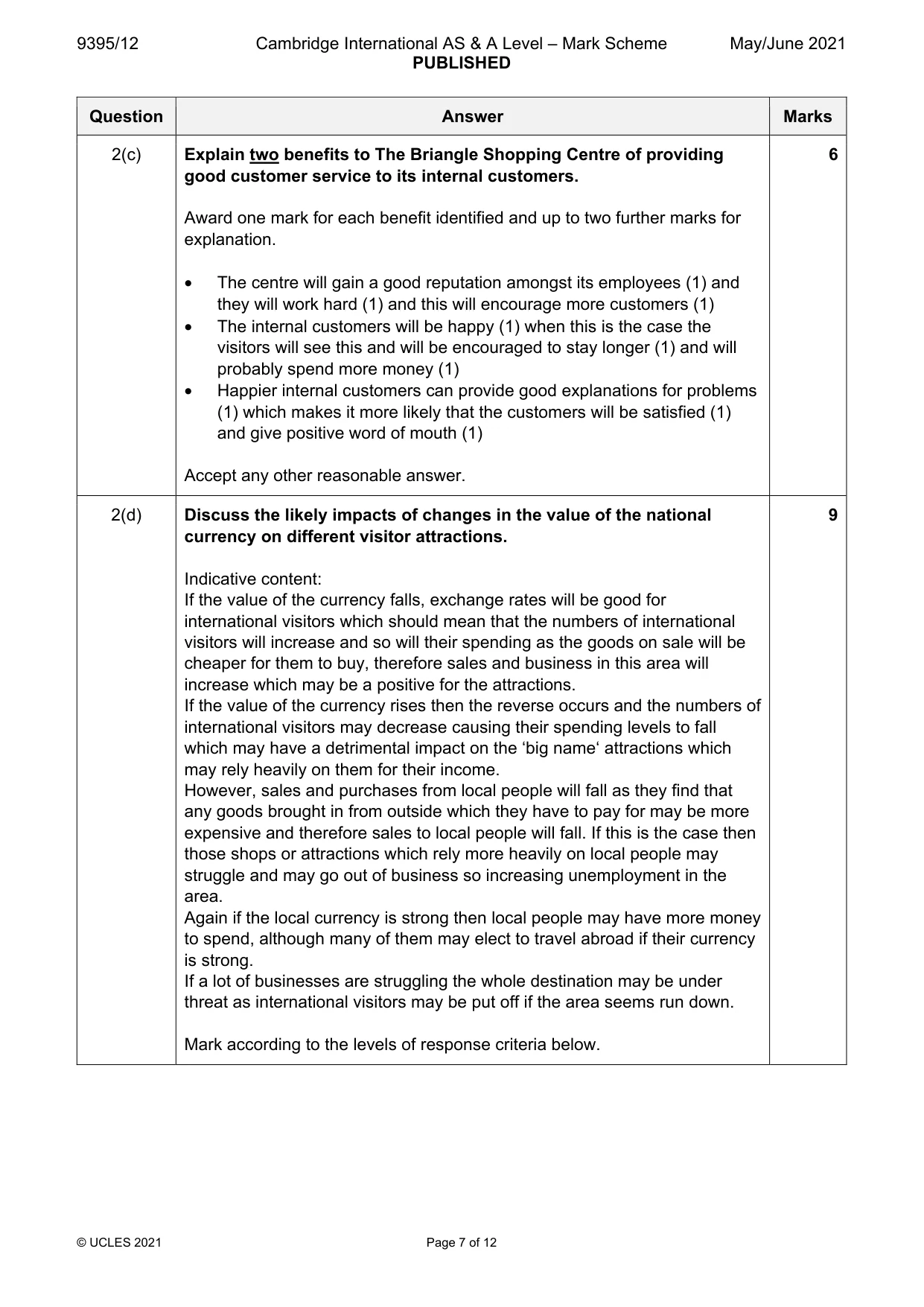
9395/12 Cambridge International AS & A Level – Mark Scheme PUBLISHED May/June 2021 © UCLES 2021 Page 7 of 12 Question Answer Marks 2(c) Explain two benefits to The Briangle Shopping Centre of providing good customer service to its internal customers. Award one mark for each benefit identified and up to two further marks for explanation. • The centre will gain a good reputation amongst its employees (1) and they will work hard (1) and this will encourage more customers (1) • The internal customers will be happy (1) when this is the case the visitors will see this and will be encouraged to stay longer (1) and will probably spend more money (1) • Happier internal customers can provide good explanations for problems (1) which makes it more likely that the customers will be satisfied (1) and give positive word of mouth (1) Accept any other reasonable answer. 6 2(d) Discuss the likely impacts of changes in the value of the national currency on different visitor attractions. Indicative content: If the value of the currency falls, exchange rates will be good for international visitors which should mean that the numbers of international visitors will increase and so will their spending as the goods on sale will be cheaper for them to buy, therefore sales and business in this area will increase which may be a positive for the attractions. If the value of the currency rises then the reverse occurs and the numbers of international visitors may decrease causing their spending levels to fall which may have a detrimental impact on the ‘big name‘ attractions which may rely heavily on them for their income. However, sales and purchases from local people will fall as they find that any goods brought in from outside which they have to pay for may be more expensive and therefore sales to local people will fall. If this is the case then those shops or attractions which rely more heavily on local people may struggle and may go out of business so increasing unemployment in the area. Again if the local currency is strong then local people may have more money to spend, although many of them may elect to travel abroad if their currency is strong. If a lot of businesses are struggling the whole destination may be under threat as international visitors may be put off if the area seems run down. Mark according to the levels of response criteria below. 9
Mark scheme, page 8
9395/12 Cambridge International AS & A Level – Mark Scheme PUBLISHED May/June 2021 © UCLES 2021 Page 8 of 12 Question Answer Marks 2(d) Level 3 (7–9 marks) Candidates will show a clear understanding of the question and include detailed identification and discussion of likely impacts that a fall in the value of the national currency will have upon visitor attractions. Candidates effectively discuss a range of impacts and clearly attempt to weigh up the significance of each. Analytical language will be used. There is sound and frequent evidence of thorough, detailed and accurate knowledge and understanding of concepts and principles using appropriate terminology. Level 2 (4–6 marks) Candidates will show an understanding of the question and include explanations of a number of valid impacts that changes in the national currency have on visitor attractions. There may be some attempt to discuss and some analytical language may be used. The answer is relevant and accurate and shows reasonable knowledge and understanding of concepts and principles with some use of appropriate terminology. Level 1 (1–3 marks) Candidates identify/describe some impacts that changes in the national currency have on visitor attractions. Information may be a list of points but explanations are incomplete and arguments partial (if present). The explanations lack coherent organisation and there is no attempt to discuss. The answer is basic and shows limited knowledge and understanding of concepts and principles with limited use of appropriate terminology. Level 0 (0 marks) No content worthy of credit. Question Answer Marks 3(a) Describe two characteristics of rural destinations. Award one mark for each characteristic and a second mark for description. • Rural destinations can be in remote countryside areas (1) where few people live and work (1) • Rural destinations have natural attractions (1) such as rivers or hills (1) • Rural areas are sometimes undeveloped (1) they tend to be adventure tourism sites e.g. for mountaineering (1) Accept any other reasonable answer. 4
Mark scheme, page 9
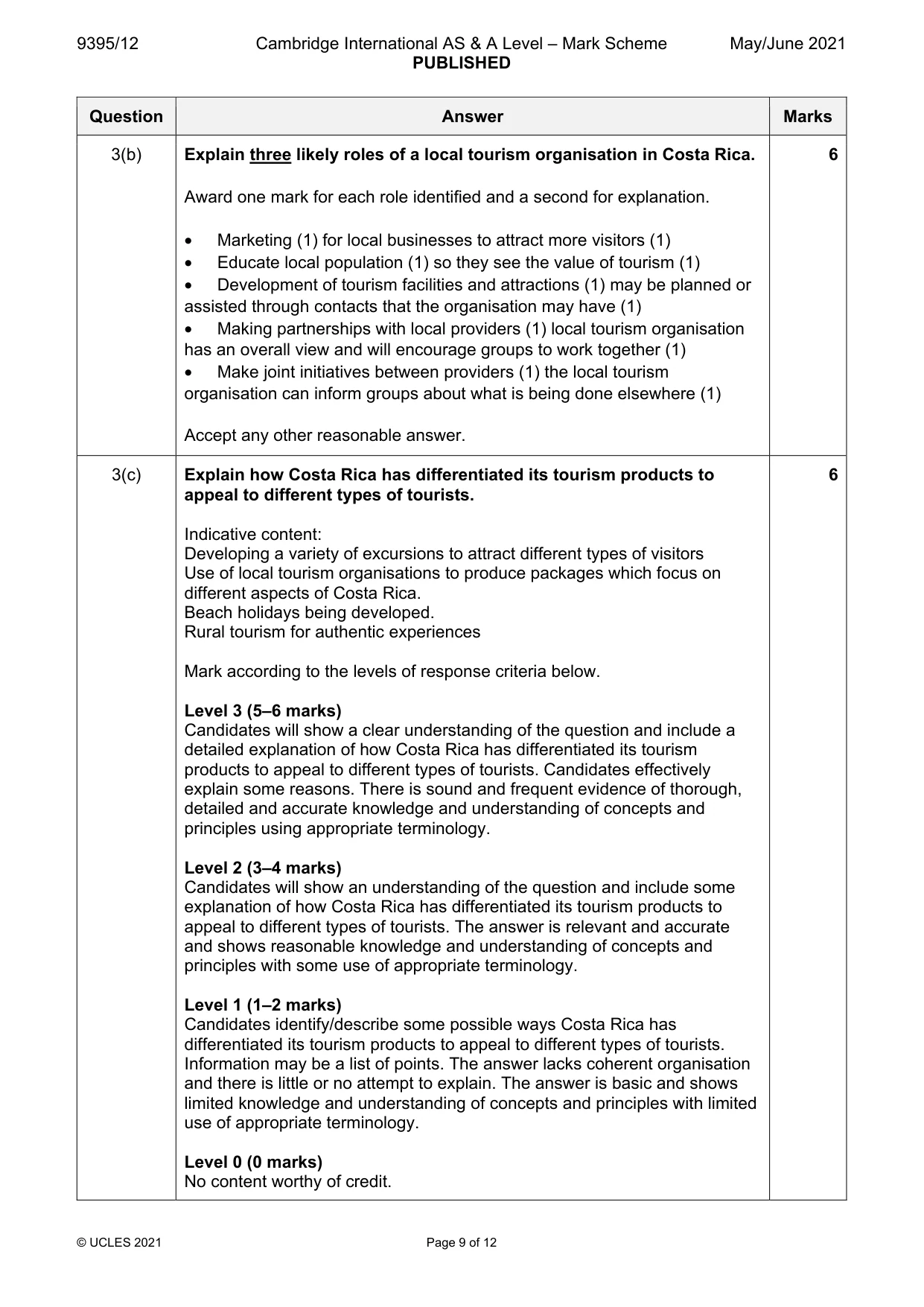
9395/12 Cambridge International AS & A Level – Mark Scheme PUBLISHED May/June 2021 © UCLES 2021 Page 9 of 12 Question Answer Marks 3(b) Explain three likely roles of a local tourism organisation in Costa Rica. Award one mark for each role identified and a second for explanation. • Marketing (1) for local businesses to attract more visitors (1) • Educate local population (1) so they see the value of tourism (1) • Development of tourism facilities and attractions (1) may be planned or assisted through contacts that the organisation may have (1) • Making partnerships with local providers (1) local tourism organisation has an overall view and will encourage groups to work together (1) • Make joint initiatives between providers (1) the local tourism organisation can inform groups about what is being done elsewhere (1) Accept any other reasonable answer. 6 3(c) Explain how Costa Rica has differentiated its tourism products to appeal to different types of tourists. Indicative content: Developing a variety of excursions to attract different types of visitors Use of local tourism organisations to produce packages which focus on different aspects of Costa Rica. Beach holidays being developed. Rural tourism for authentic experiences Mark according to the levels of response criteria below. Level 3 (5–6 marks) Candidates will show a clear understanding of the question and include a detailed explanation of how Costa Rica has differentiated its tourism products to appeal to different types of tourists. Candidates effectively explain some reasons. There is sound and frequent evidence of thorough, detailed and accurate knowledge and understanding of concepts and principles using appropriate terminology. Level 2 (3–4 marks) Candidates will show an understanding of the question and include some explanation of how Costa Rica has differentiated its tourism products to appeal to different types of tourists. The answer is relevant and accurate and shows reasonable knowledge and understanding of concepts and principles with some use of appropriate terminology. Level 1 (1–2 marks) Candidates identify/describe some possible ways Costa Rica has differentiated its tourism products to appeal to different types of tourists. Information may be a list of points. The answer lacks coherent organisation and there is little or no attempt to explain. The answer is basic and shows limited knowledge and understanding of concepts and principles with limited use of appropriate terminology. Level 0 (0 marks) No content worthy of credit. 6
Mark scheme, page 10
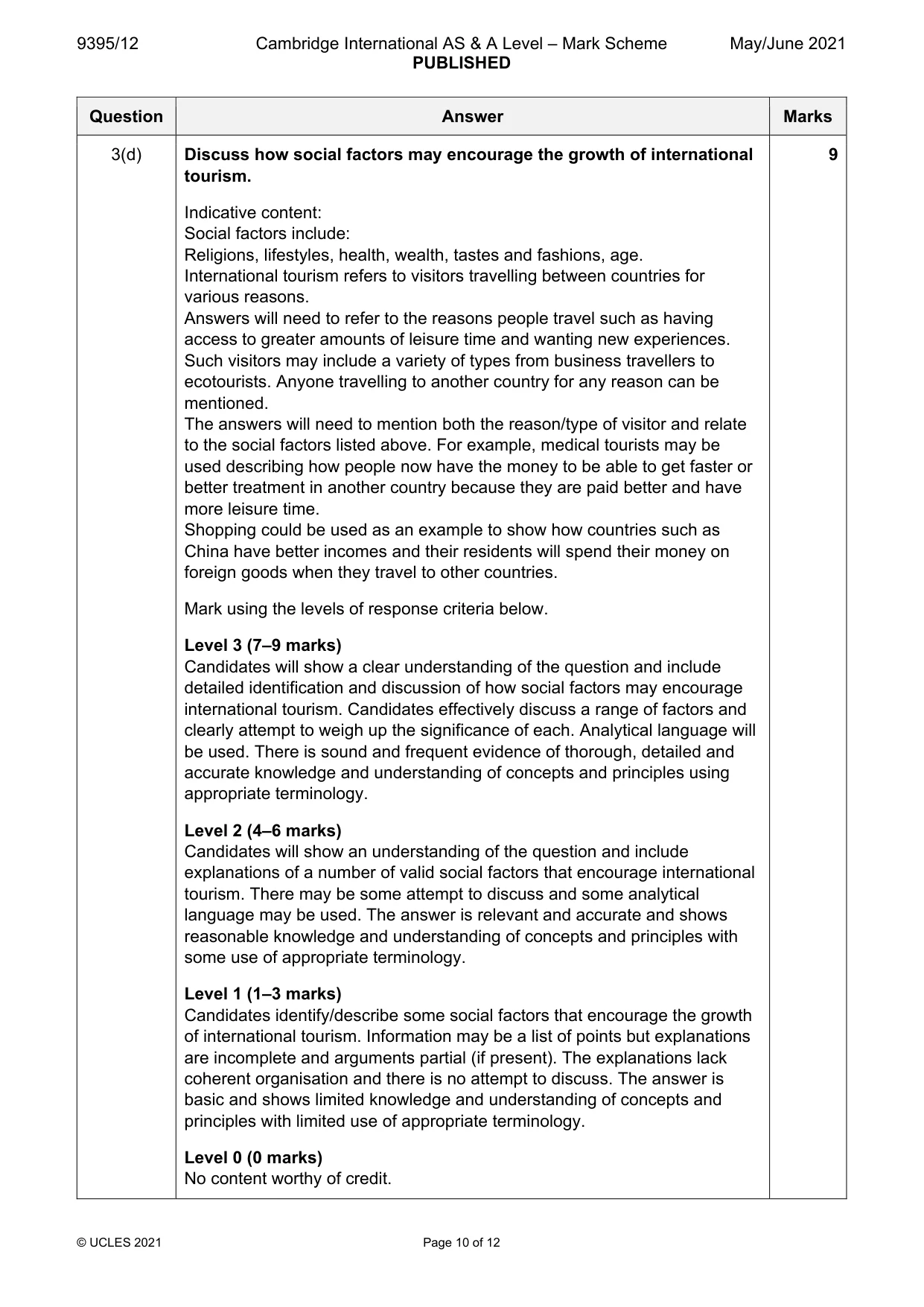
9395/12 Cambridge International AS & A Level – Mark Scheme PUBLISHED May/June 2021 © UCLES 2021 Page 10 of 12 Question Answer Marks 3(d) Discuss how social factors may encourage the growth of international tourism. Indicative content: Social factors include: Religions, lifestyles, health, wealth, tastes and fashions, age. International tourism refers to visitors travelling between countries for various reasons. Answers will need to refer to the reasons people travel such as having access to greater amounts of leisure time and wanting new experiences. Such visitors may include a variety of types from business travellers to ecotourists. Anyone travelling to another country for any reason can be mentioned. The answers will need to mention both the reason/type of visitor and relate to the social factors listed above. For example, medical tourists may be used describing how people now have the money to be able to get faster or better treatment in another country because they are paid better and have more leisure time. Shopping could be used as an example to show how countries such as China have better incomes and their residents will spend their money on foreign goods when they travel to other countries. Mark using the levels of response criteria below. Level 3 (7–9 marks) Candidates will show a clear understanding of the question and include detailed identification and discussion of how social factors may encourage international tourism. Candidates effectively discuss a range of factors and clearly attempt to weigh up the significance of each. Analytical language will be used. There is sound and frequent evidence of thorough, detailed and accurate knowledge and understanding of concepts and principles using appropriate terminology. Level 2 (4–6 marks) Candidates will show an understanding of the question and include explanations of a number of valid social factors that encourage international tourism. There may be some attempt to discuss and some analytical language may be used. The answer is relevant and accurate and shows reasonable knowledge and understanding of concepts and principles with some use of appropriate terminology. Level 1 (1–3 marks) Candidates identify/describe some social factors that encourage the growth of international tourism. Information may be a list of points but explanations are incomplete and arguments partial (if present). The explanations lack coherent organisation and there is no attempt to discuss. The answer is basic and shows limited knowledge and understanding of concepts and principles with limited use of appropriate terminology. Level 0 (0 marks) No content worthy of credit. 9
Mark scheme, page 11
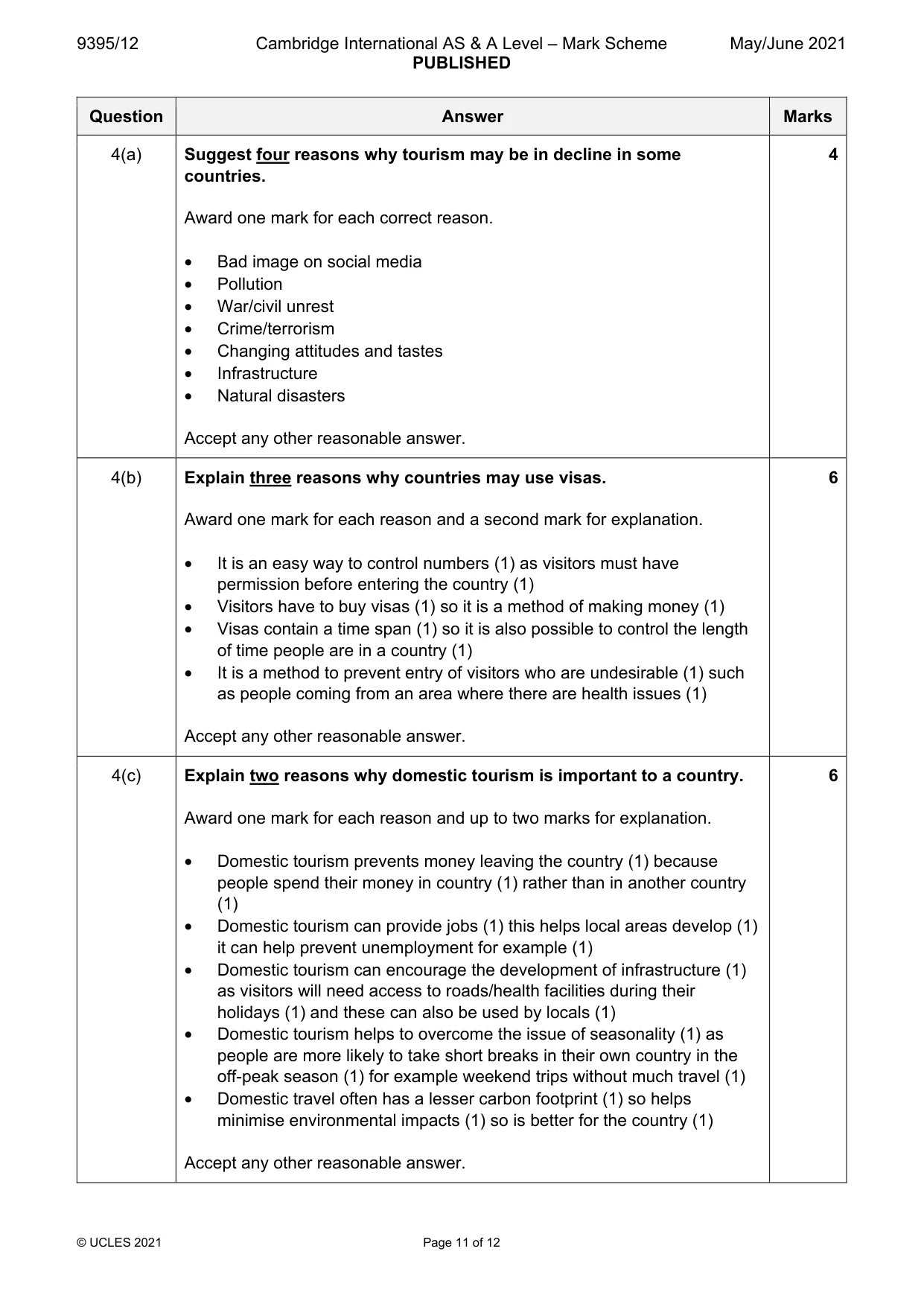
9395/12 Cambridge International AS & A Level – Mark Scheme PUBLISHED May/June 2021 © UCLES 2021 Page 11 of 12 Question Answer Marks 4(a) Suggest four reasons why tourism may be in decline in some countries. Award one mark for each correct reason. • Bad image on social media • Pollution • War/civil unrest • Crime/terrorism • Changing attitudes and tastes • Infrastructure • Natural disasters Accept any other reasonable answer. 4 4(b) Explain three reasons why countries may use visas. Award one mark for each reason and a second mark for explanation. • It is an easy way to control numbers (1) as visitors must have permission before entering the country (1) • Visitors have to buy visas (1) so it is a method of making money (1) • Visas contain a time span (1) so it is also possible to control the length of time people are in a country (1) • It is a method to prevent entry of visitors who are undesirable (1) such as people coming from an area where there are health issues (1) Accept any other reasonable answer. 6 4(c) Explain two reasons why domestic tourism is important to a country. Award one mark for each reason and up to two marks for explanation. • Domestic tourism prevents money leaving the country (1) because people spend their money in country (1) rather than in another country (1) • Domestic tourism can provide jobs (1) this helps local areas develop (1) it can help prevent unemployment for example (1) • Domestic tourism can encourage the development of infrastructure (1) as visitors will need access to roads/health facilities during their holidays (1) and these can also be used by locals (1) • Domestic tourism helps to overcome the issue of seasonality (1) as people are more likely to take short breaks in their own country in the off-peak season (1) for example weekend trips without much travel (1) • Domestic travel often has a lesser carbon footprint (1) so helps minimise environmental impacts (1) so is better for the country (1) Accept any other reasonable answer. 6
Mark scheme, page 12
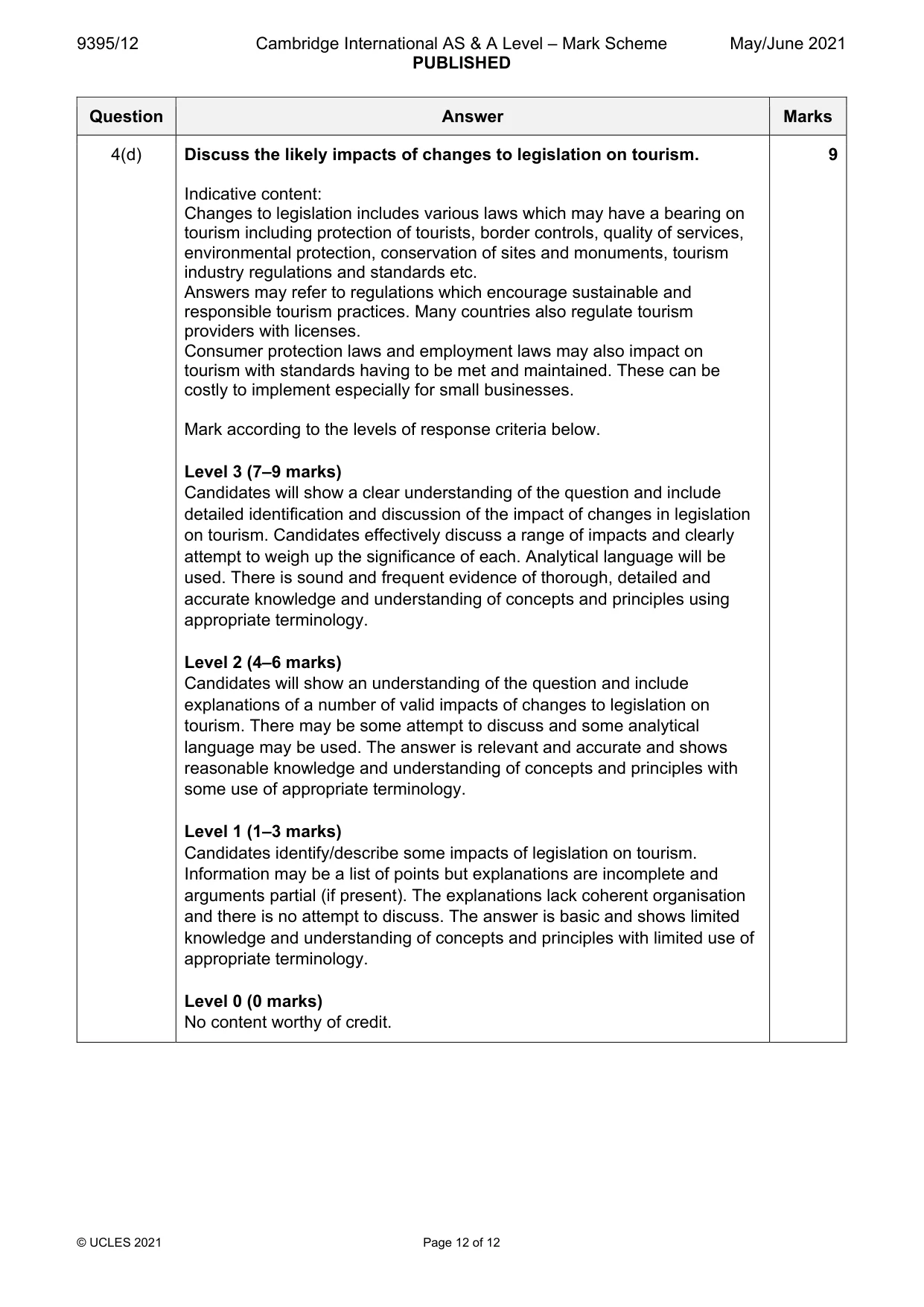
9395/12 Cambridge International AS & A Level – Mark Scheme PUBLISHED May/June 2021 © UCLES 2021 Page 12 of 12 Question Answer Marks 4(d) Discuss the likely impacts of changes to legislation on tourism. Indicative content: Changes to legislation includes various laws which may have a bearing on tourism including protection of tourists, border controls, quality of services, environmental protection, conservation of sites and monuments, tourism industry regulations and standards etc. Answers may refer to regulations which encourage sustainable and responsible tourism practices. Many countries also regulate tourism providers with licenses. Consumer protection laws and employment laws may also impact on tourism with standards having to be met and maintained. These can be costly to implement especially for small businesses. Mark according to the levels of response criteria below. Level 3 (7–9 marks) Candidates will show a clear understanding of the question and include detailed identification and discussion of the impact of changes in legislation on tourism. Candidates effectively discuss a range of impacts and clearly attempt to weigh up the significance of each. Analytical language will be used. There is sound and frequent evidence of thorough, detailed and accurate knowledge and understanding of concepts and principles using appropriate terminology. Level 2 (4–6 marks) Candidates will show an understanding of the question and include explanations of a number of valid impacts of changes to legislation on tourism. There may be some attempt to discuss and some analytical language may be used. The answer is relevant and accurate and shows reasonable knowledge and understanding of concepts and principles with some use of appropriate terminology. Level 1 (1–3 marks) Candidates identify/describe some impacts of legislation on tourism. Information may be a list of points but explanations are incomplete and arguments partial (if present). The explanations lack coherent organisation and there is no attempt to discuss. The answer is basic and shows limited knowledge and understanding of concepts and principles with limited use of appropriate terminology. Level 0 (0 marks) No content worthy of credit. 9
What you needed in this session
Cambridge’s own grade thresholds for 2021 May/June, Paper 1 · Variant 2. A higher threshold means an easier paper — the bar moves with how the cohort did.