Cambridge A Level Travel and Tourism 9395 — 2018 Oct/Nov Paper 4 · Variant 3
9395/43/O/N/18 · 50 marks · ≈56 min
The question paper and its mark scheme, free to read here and free to download. This is Cambridge’s own paper, exactly as it was sat.
Question paper12 pages








Mark scheme8 pages
Answers below. Sit the paper first if you are practising.
Paper as text
Question paper, page 1
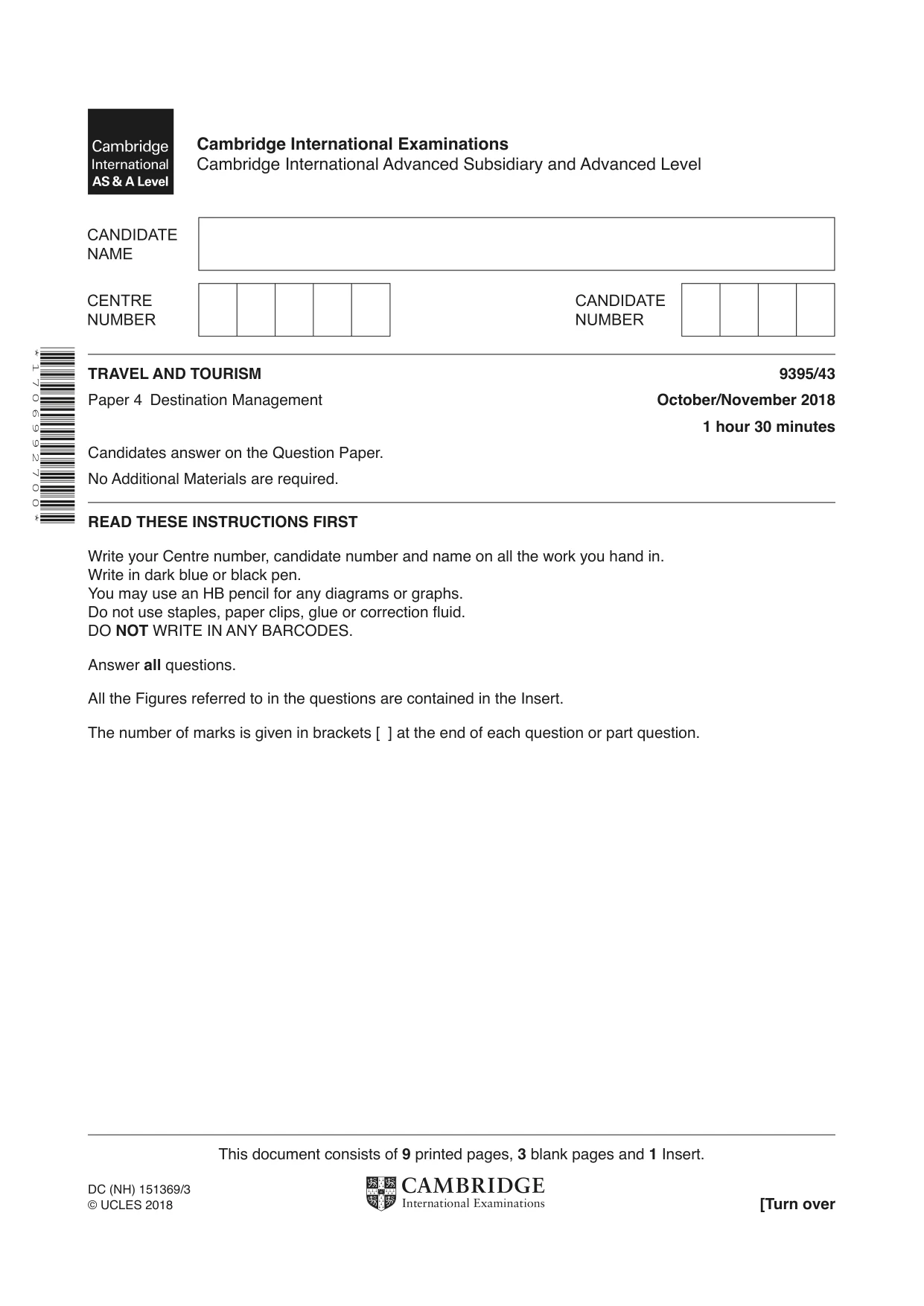
This document consists of 9 printed pages, 3 blank pages and 1 Insert. DC (NH) 151369/3 © UCLES 2018 [Turn over * 1 7 0 6 9 9 2 7 0 0 * TRAVEL AND TOURISM 9395/43 Paper 4 Destination Management October/November 2018 1 hour 30 minutes Candidates answer on the Question Paper. No Additional Materials are required. READ THESE INSTRUCTIONS FIRST Write your Centre number, candidate number and name on all the work you hand in. Write in dark blue or black pen. You may use an HB pencil for any diagrams or graphs. Do not use staples, paper clips, glue or correction fluid. DO NOT WRITE IN ANY BARCODES. Answer all questions. All the Figures referred to in the questions are contained in the Insert. The number of marks is given in brackets [ ] at the end of each question or part question. Cambridge International Examinations Cambridge International Advanced Subsidiary and Advanced Level
Question paper, page 2
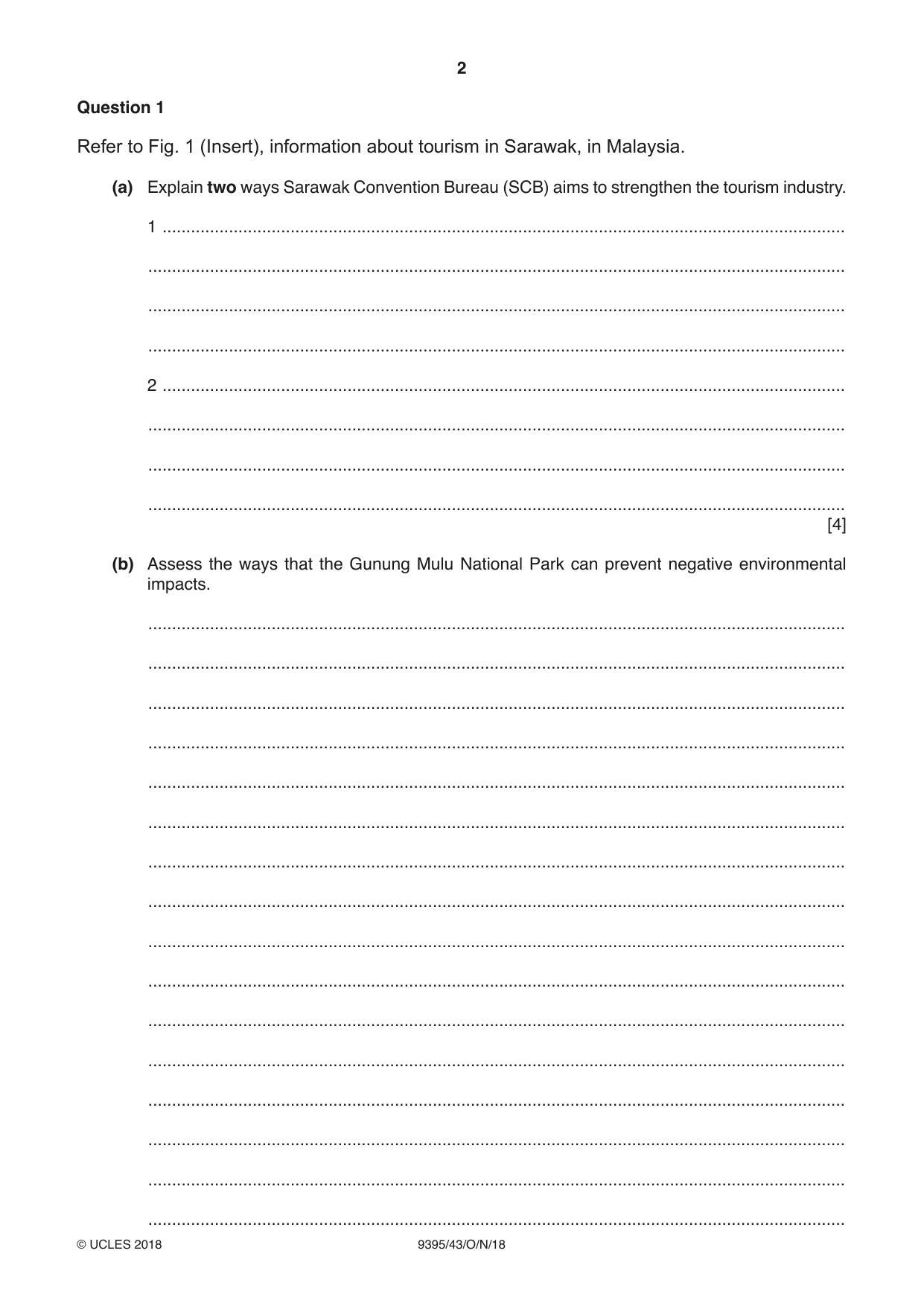
2 9395/43/O/N/18 © UCLES 2018 Question 1 Refer to Fig. 1 (Insert), information about tourism in Sarawak, in Malaysia. (a) Explain two ways Sarawak Convention Bureau (SCB) aims to strengthen the tourism industry. 1 … … … … 2 … … … … [4] (b) Assess the ways that the Gunung Mulu National Park can prevent negative environmental impacts. … … … … … … … … … … … … … … … …
Question paper, page 3
3 9395/43/O/N/18 © UCLES 2018 [Turn over … … … … … … … … … … … … … … … … … … … … … … … … … … … …[9]
Question paper, page 4
4 9395/43/O/N/18 © UCLES 2018 (c) Evaluate the economic impacts of tourism to Sarawak. … … … … … … … … … … … … … … … … … … … … … … … … … … …
Question paper, page 5
5 9395/43/O/N/18 © UCLES 2018 [Turn over … … … … … … … … … … … … … … … … … … … … … … … … … …[12] [Total: 25]
Question paper, page 6
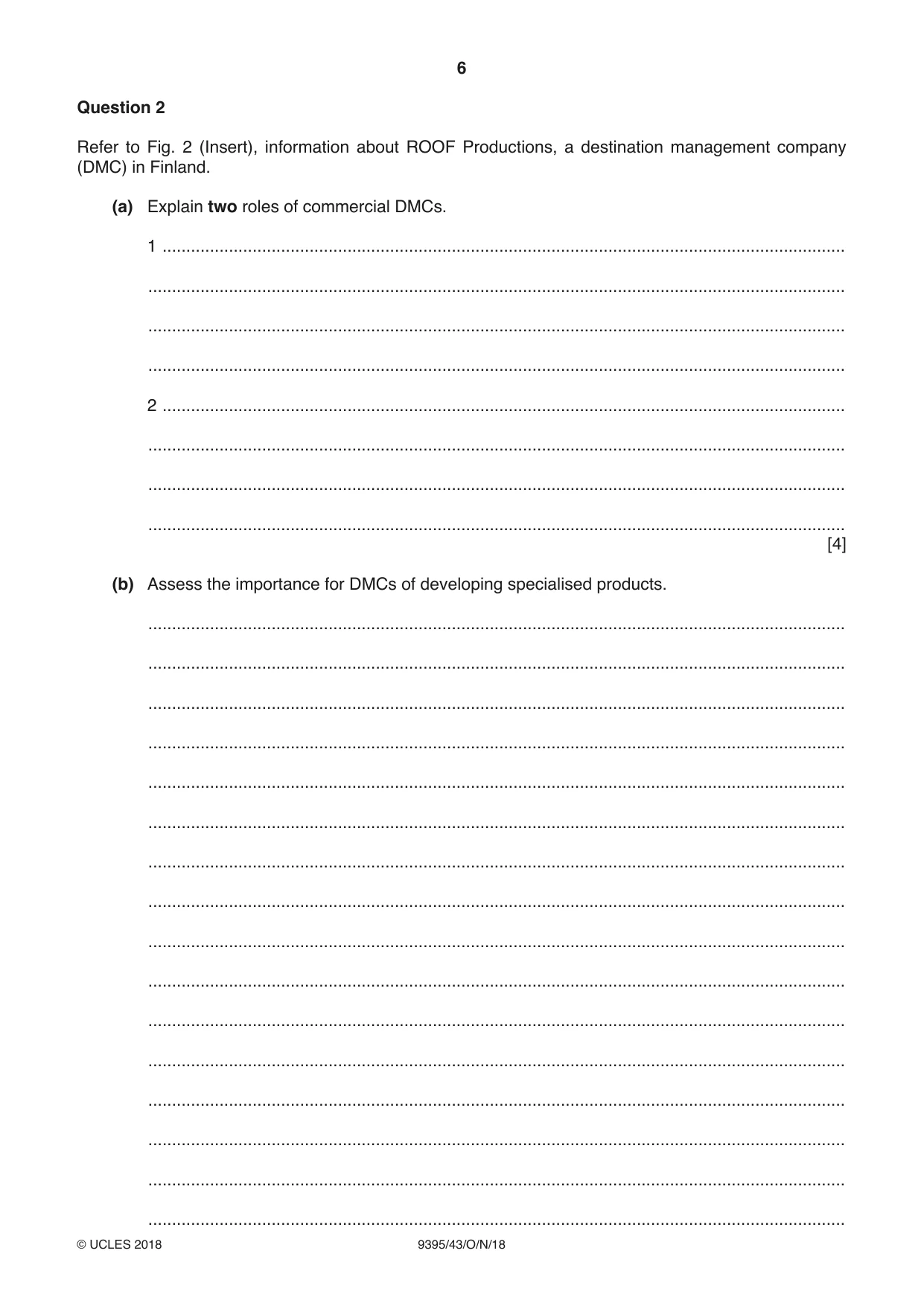
6 9395/43/O/N/18 © UCLES 2018 Question 2 Refer to Fig. 2 (Insert), information about ROOF Productions, a destination management company (DMC) in Finland. (a) Explain two roles of commercial DMCs. 1 … … … … 2 … … … … [4] (b) Assess the importance for DMCs of developing specialised products. … … … … … … … … … … … … … … … …
Question paper, page 7
7 9395/43/O/N/18 © UCLES 2018 [Turn over … … … … … … … … … … … … … … … … … … … … … … … … … … … …[9]
Question paper, page 8
8 9395/43/O/N/18 © UCLES 2018 (c) Evaluate the advantages to tourism development of developing strong community links. … … … … … … … … … … … … … … … … … … … … … … … … … … …
Question paper, page 9
9 9395/43/O/N/18 © UCLES 2018 … … … … … … … … … … … … … … … … … … … … … … … … … …[12] [Total: 25]
Question paper, page 10
10 9395/43/O/N/18 © UCLES 2018 BLANK PAGE
Question paper, page 11
11 9395/43/O/N/18 © UCLES 2018 BLANK PAGE
Question paper, page 12
12 9395/43/O/N/18 © UCLES 2018 Permission to reproduce items where third-party owned material protected by copyright is included has been sought and cleared where possible. Every reasonable effort has been made by the publisher (UCLES) to trace copyright holders, but if any items requiring clearance have unwittingly been included, the publisher will be pleased to make amends at the earliest possible opportunity. To avoid the issue of disclosure of answer-related information to candidates, all copyright acknowledgements are reproduced online in the Cambridge International Examinations Copyright Acknowledgements Booklet. This is produced for each series of examinations and is freely available to download at www.cie.org.uk after the live examination series. Cambridge International Examinations is part of the Cambridge Assessment Group. Cambridge Assessment is the brand name of University of Cambridge Local Examinations Syndicate (UCLES), which is itself a department of the University of Cambridge. BLANK PAGE
Mark scheme, page 1
This document consists of 8 printed pages. © UCLES 2018 [Turn over Cambridge Assessment International Education Cambridge International Advanced Subsidiary and Advanced Level TRAVEL AND TOURISM 9395/43 Paper 4 Destination Management October/November 2018 MARK SCHEME Maximum Mark: 50 Published This mark scheme is published as an aid to teachers and candidates, to indicate the requirements of the examination. It shows the basis on which Examiners were instructed to award marks. It does not indicate the details of the discussions that took place at an Examiners’ meeting before marking began, which would have considered the acceptability of alternative answers. Mark schemes should be read in conjunction with the question paper and the Principal Examiner Report for Teachers. Cambridge International will not enter into discussions about these mark schemes. Cambridge International is publishing the mark schemes for the October/November 2018 series for most Cambridge IGCSE™, Cambridge International A and AS Level components and some Cambridge O Level components.
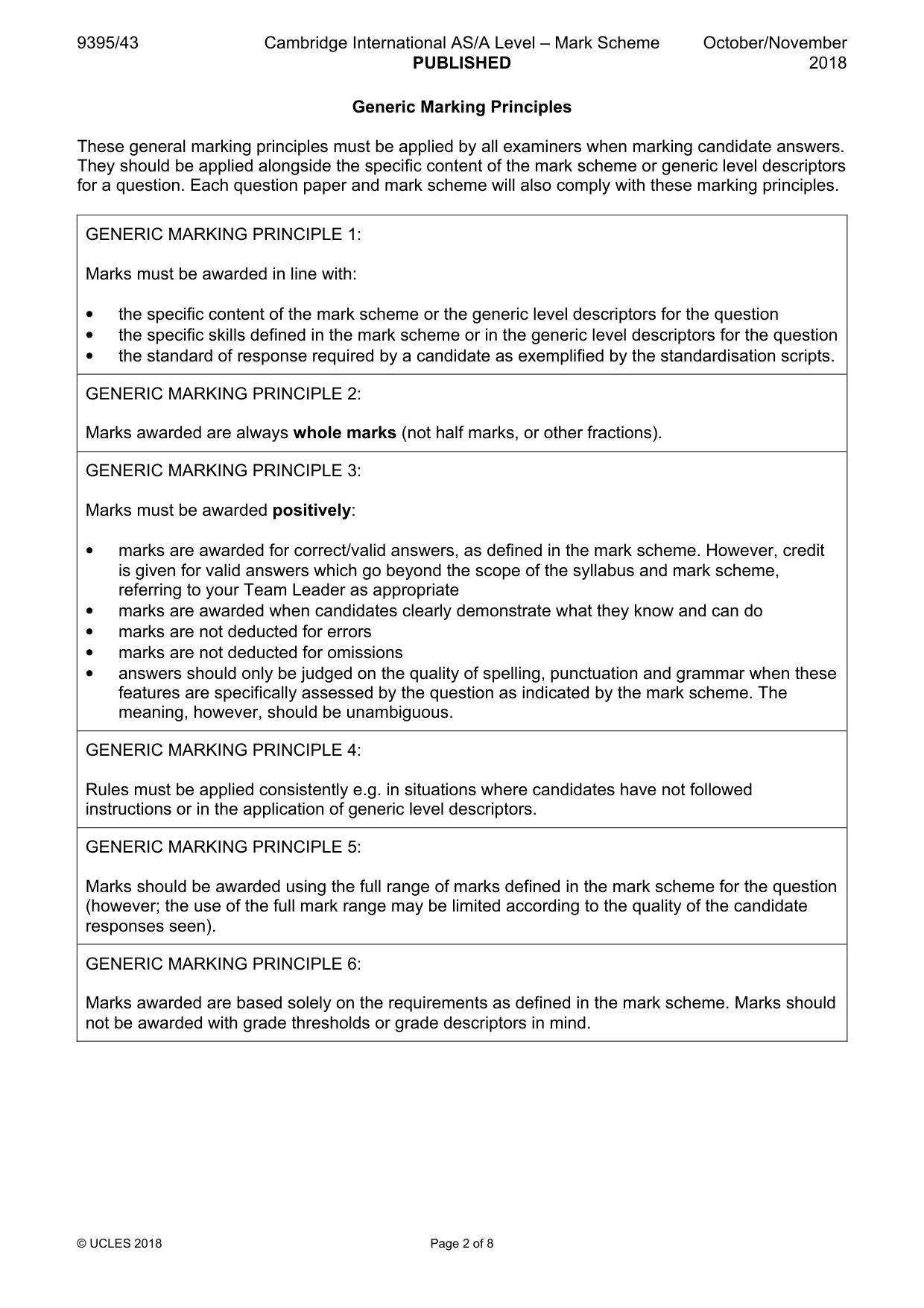
Mark scheme, page 2
9395/43 Cambridge International AS/A Level – Mark Scheme PUBLISHED October/November 2018 © UCLES 2018 Page 2 of 8 Generic Marking Principles These general marking principles must be applied by all examiners when marking candidate answers. They should be applied alongside the specific content of the mark scheme or generic level descriptors for a question. Each question paper and mark scheme will also comply with these marking principles. GENERIC MARKING PRINCIPLE 1: Marks must be awarded in line with: • the specific content of the mark scheme or the generic level descriptors for the question • the specific skills defined in the mark scheme or in the generic level descriptors for the question • the standard of response required by a candidate as exemplified by the standardisation scripts. GENERIC MARKING PRINCIPLE 2: Marks awarded are always whole marks (not half marks, or other fractions). GENERIC MARKING PRINCIPLE 3: Marks must be awarded positively: • marks are awarded for correct/valid answers, as defined in the mark scheme. However, credit is given for valid answers which go beyond the scope of the syllabus and mark scheme, referring to your Team Leader as appropriate • marks are awarded when candidates clearly demonstrate what they know and can do • marks are not deducted for errors • marks are not deducted for omissions • answers should only be judged on the quality of spelling, punctuation and grammar when these features are specifically assessed by the question as indicated by the mark scheme. The meaning, however, should be unambiguous. GENERIC MARKING PRINCIPLE 4: Rules must be applied consistently e.g. in situations where candidates have not followed instructions or in the application of generic level descriptors. GENERIC MARKING PRINCIPLE 5: Marks should be awarded using the full range of marks defined in the mark scheme for the question (however; the use of the full mark range may be limited according to the quality of the candidate responses seen). GENERIC MARKING PRINCIPLE 6: Marks awarded are based solely on the requirements as defined in the mark scheme. Marks should not be awarded with grade thresholds or grade descriptors in mind.
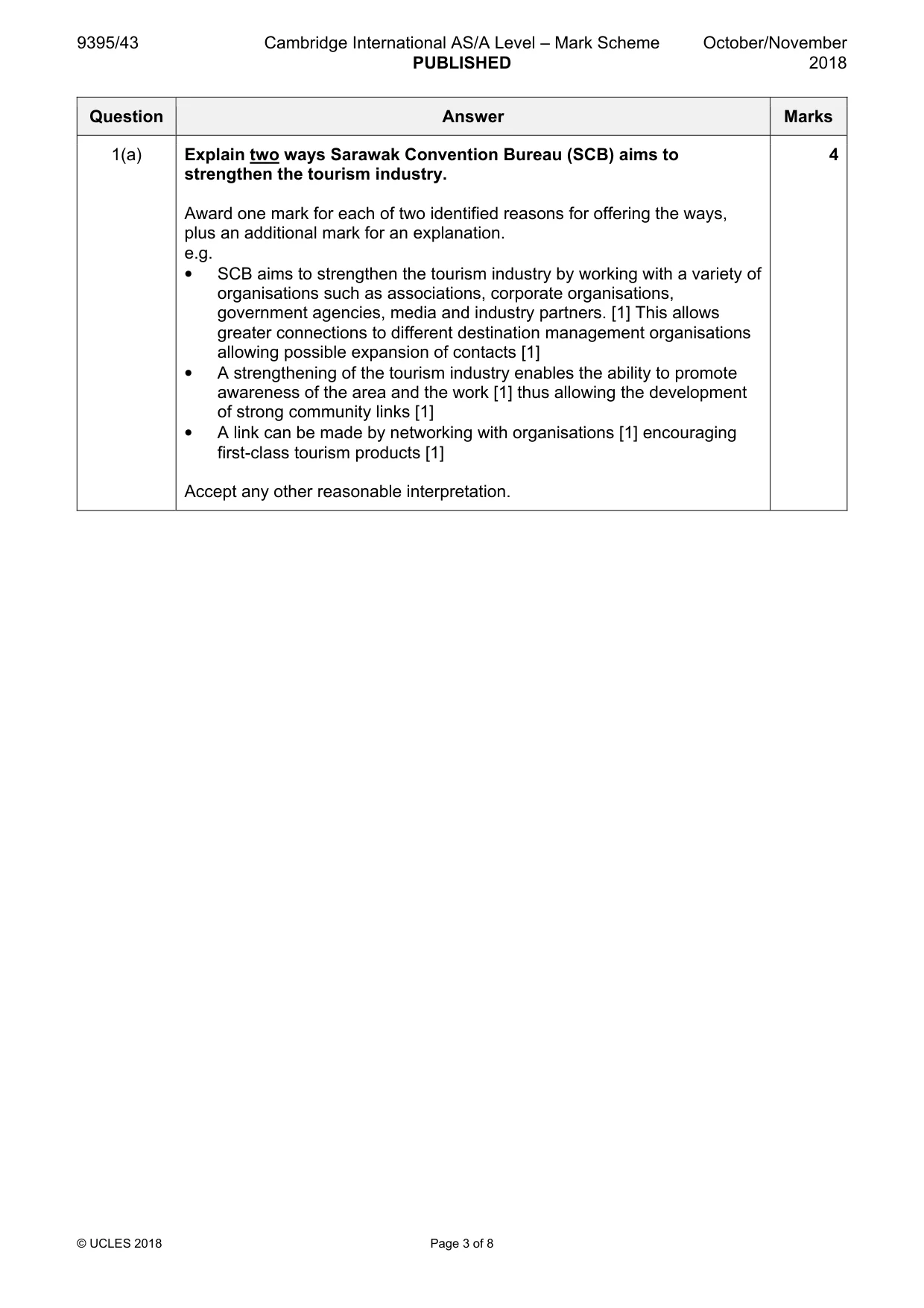
Mark scheme, page 3
9395/43 Cambridge International AS/A Level – Mark Scheme PUBLISHED October/November 2018 © UCLES 2018 Page 3 of 8 Question Answer Marks 1(a) Explain two ways Sarawak Convention Bureau (SCB) aims to strengthen the tourism industry. Award one mark for each of two identified reasons for offering the ways, plus an additional mark for an explanation. e.g. • SCB aims to strengthen the tourism industry by working with a variety of organisations such as associations, corporate organisations, government agencies, media and industry partners. [1] This allows greater connections to different destination management organisations allowing possible expansion of contacts [1] • A strengthening of the tourism industry enables the ability to promote awareness of the area and the work [1] thus allowing the development of strong community links [1] • A link can be made by networking with organisations [1] encouraging first-class tourism products [1] Accept any other reasonable interpretation. 4
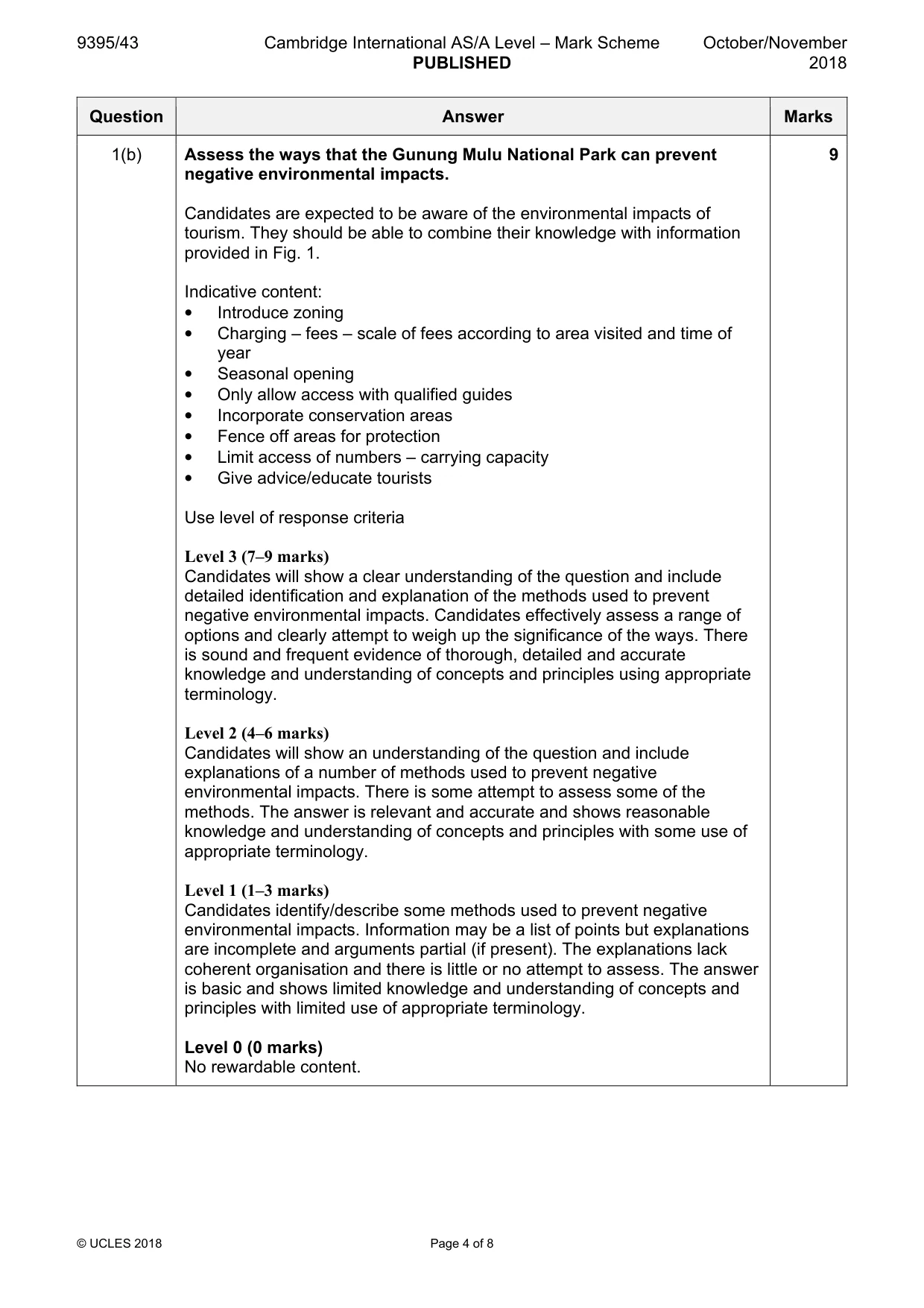
Mark scheme, page 4
9395/43 Cambridge International AS/A Level – Mark Scheme PUBLISHED October/November 2018 © UCLES 2018 Page 4 of 8 Question Answer Marks 1(b) Assess the ways that the Gunung Mulu National Park can prevent negative environmental impacts. Candidates are expected to be aware of the environmental impacts of tourism. They should be able to combine their knowledge with information provided in Fig. 1. Indicative content: • Introduce zoning • Charging – fees – scale of fees according to area visited and time of year • Seasonal opening • Only allow access with qualified guides • Incorporate conservation areas • Fence off areas for protection • Limit access of numbers – carrying capacity • Give advice/educate tourists Use level of response criteria Level 3 (7–9 marks) Candidates will show a clear understanding of the question and include detailed identification and explanation of the methods used to prevent negative environmental impacts. Candidates effectively assess a range of options and clearly attempt to weigh up the significance of the ways. There is sound and frequent evidence of thorough, detailed and accurate knowledge and understanding of concepts and principles using appropriate terminology. Level 2 (4–6 marks) Candidates will show an understanding of the question and include explanations of a number of methods used to prevent negative environmental impacts. There is some attempt to assess some of the methods. The answer is relevant and accurate and shows reasonable knowledge and understanding of concepts and principles with some use of appropriate terminology. Level 1 (1–3 marks) Candidates identify/describe some methods used to prevent negative environmental impacts. Information may be a list of points but explanations are incomplete and arguments partial (if present). The explanations lack coherent organisation and there is little or no attempt to assess. The answer is basic and shows limited knowledge and understanding of concepts and principles with limited use of appropriate terminology. Level 0 (0 marks) No rewardable content. 9
Mark scheme, page 5
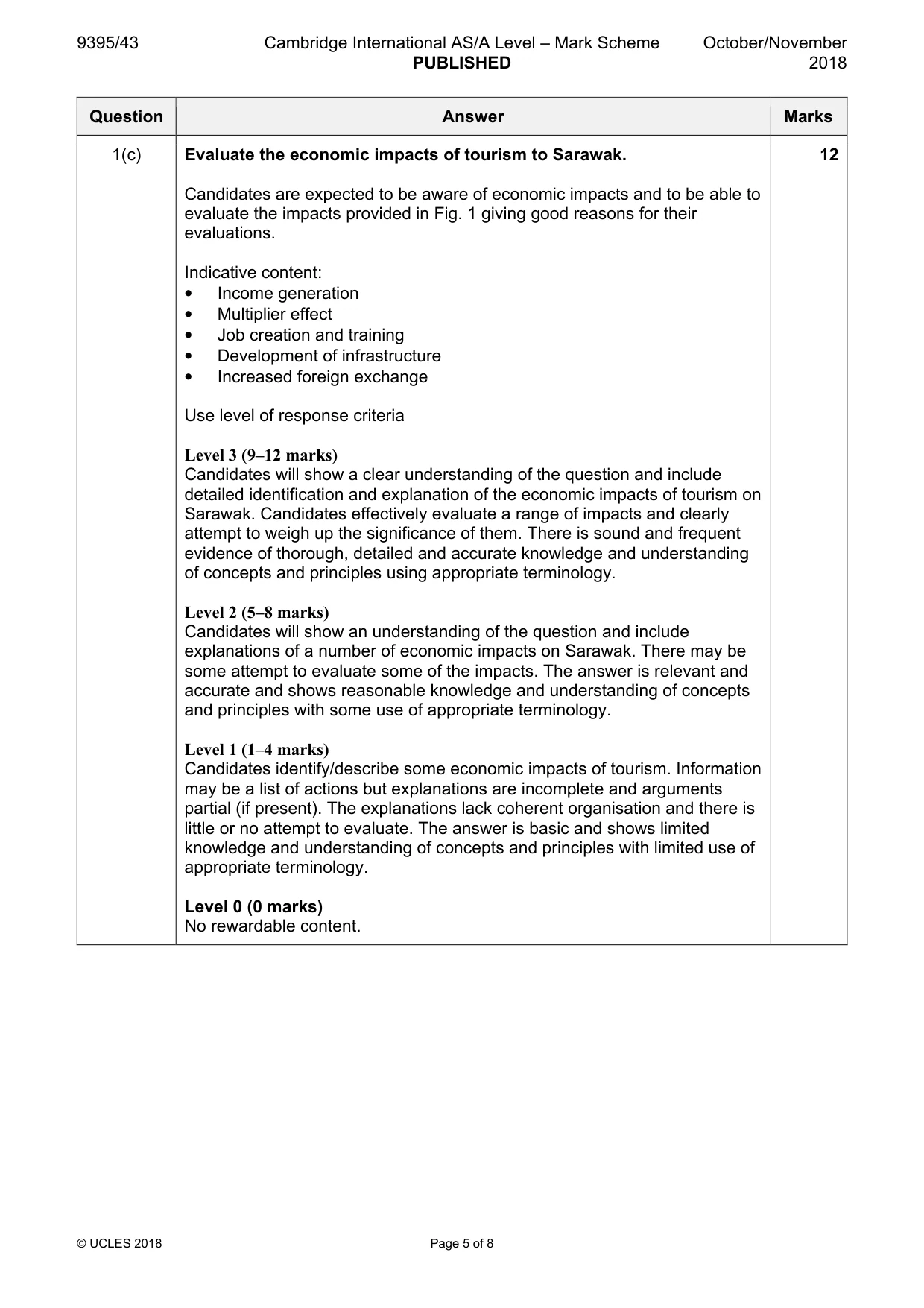
9395/43 Cambridge International AS/A Level – Mark Scheme PUBLISHED October/November 2018 © UCLES 2018 Page 5 of 8 Question Answer Marks 1(c) Evaluate the economic impacts of tourism to Sarawak. Candidates are expected to be aware of economic impacts and to be able to evaluate the impacts provided in Fig. 1 giving good reasons for their evaluations. Indicative content: • Income generation • Multiplier effect • Job creation and training • Development of infrastructure • Increased foreign exchange Use level of response criteria Level 3 (9–12 marks) Candidates will show a clear understanding of the question and include detailed identification and explanation of the economic impacts of tourism on Sarawak. Candidates effectively evaluate a range of impacts and clearly attempt to weigh up the significance of them. There is sound and frequent evidence of thorough, detailed and accurate knowledge and understanding of concepts and principles using appropriate terminology. Level 2 (5–8 marks) Candidates will show an understanding of the question and include explanations of a number of economic impacts on Sarawak. There may be some attempt to evaluate some of the impacts. The answer is relevant and accurate and shows reasonable knowledge and understanding of concepts and principles with some use of appropriate terminology. Level 1 (1–4 marks) Candidates identify/describe some economic impacts of tourism. Information may be a list of actions but explanations are incomplete and arguments partial (if present). The explanations lack coherent organisation and there is little or no attempt to evaluate. The answer is basic and shows limited knowledge and understanding of concepts and principles with limited use of appropriate terminology. Level 0 (0 marks) No rewardable content. 12
Mark scheme, page 6
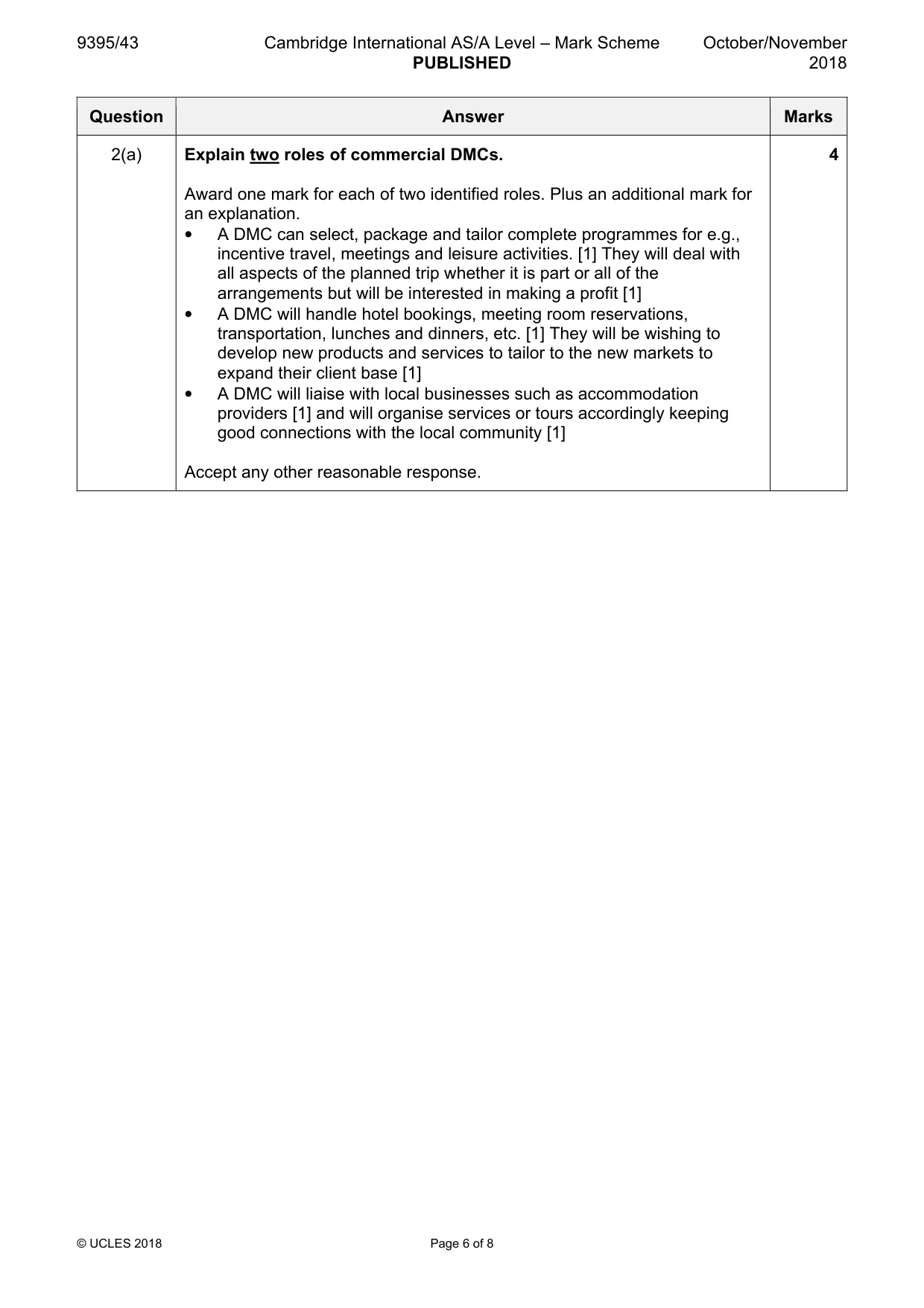
9395/43 Cambridge International AS/A Level – Mark Scheme PUBLISHED October/November 2018 © UCLES 2018 Page 6 of 8 Question Answer Marks 2(a) Explain two roles of commercial DMCs. Award one mark for each of two identified roles. Plus an additional mark for an explanation. • A DMC can select, package and tailor complete programmes for e.g., incentive travel, meetings and leisure activities. [1] They will deal with all aspects of the planned trip whether it is part or all of the arrangements but will be interested in making a profit [1] • A DMC will handle hotel bookings, meeting room reservations, transportation, lunches and dinners, etc. [1] They will be wishing to develop new products and services to tailor to the new markets to expand their client base [1] • A DMC will liaise with local businesses such as accommodation providers [1] and will organise services or tours accordingly keeping good connections with the local community [1] Accept any other reasonable response. 4
Mark scheme, page 7
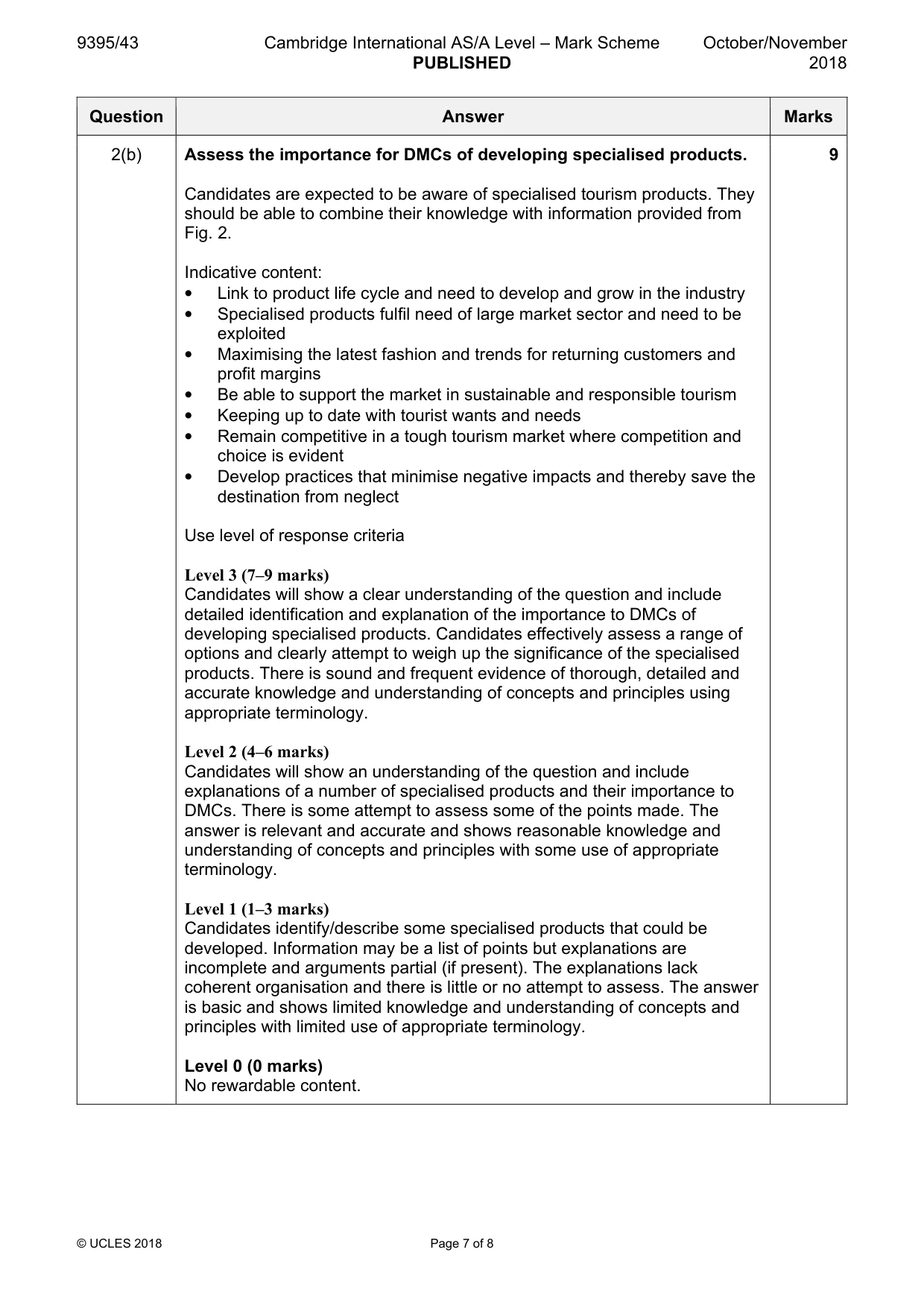
9395/43 Cambridge International AS/A Level – Mark Scheme PUBLISHED October/November 2018 © UCLES 2018 Page 7 of 8 Question Answer Marks 2(b) Assess the importance for DMCs of developing specialised products. Candidates are expected to be aware of specialised tourism products. They should be able to combine their knowledge with information provided from Fig. 2. Indicative content: • Link to product life cycle and need to develop and grow in the industry • Specialised products fulfil need of large market sector and need to be exploited • Maximising the latest fashion and trends for returning customers and profit margins • Be able to support the market in sustainable and responsible tourism • Keeping up to date with tourist wants and needs • Remain competitive in a tough tourism market where competition and choice is evident • Develop practices that minimise negative impacts and thereby save the destination from neglect Use level of response criteria Level 3 (7–9 marks) Candidates will show a clear understanding of the question and include detailed identification and explanation of the importance to DMCs of developing specialised products. Candidates effectively assess a range of options and clearly attempt to weigh up the significance of the specialised products. There is sound and frequent evidence of thorough, detailed and accurate knowledge and understanding of concepts and principles using appropriate terminology. Level 2 (4–6 marks) Candidates will show an understanding of the question and include explanations of a number of specialised products and their importance to DMCs. There is some attempt to assess some of the points made. The answer is relevant and accurate and shows reasonable knowledge and understanding of concepts and principles with some use of appropriate terminology. Level 1 (1–3 marks) Candidates identify/describe some specialised products that could be developed. Information may be a list of points but explanations are incomplete and arguments partial (if present). The explanations lack coherent organisation and there is little or no attempt to assess. The answer is basic and shows limited knowledge and understanding of concepts and principles with limited use of appropriate terminology. Level 0 (0 marks) No rewardable content. 9
Mark scheme, page 8
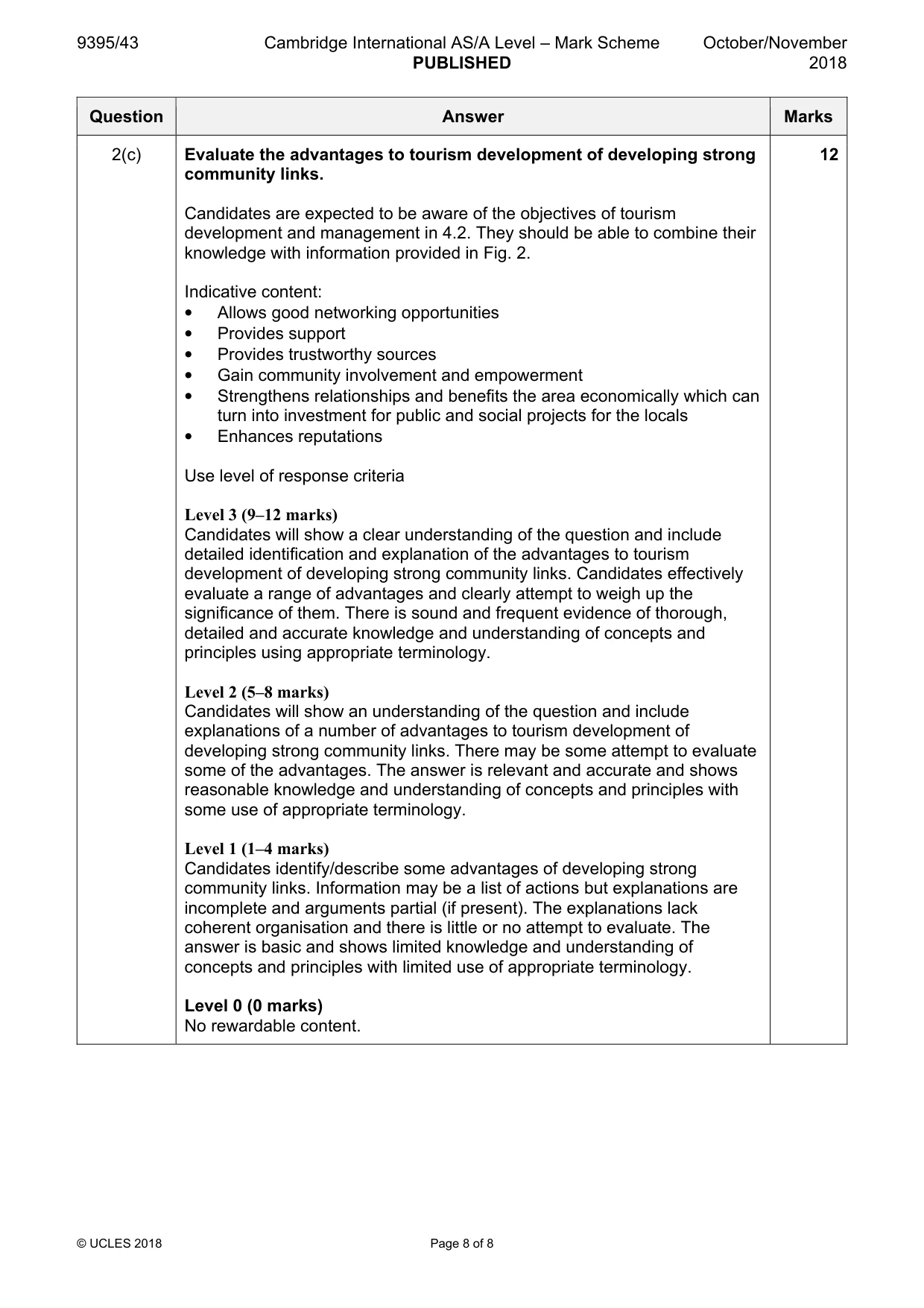
9395/43 Cambridge International AS/A Level – Mark Scheme PUBLISHED October/November 2018 © UCLES 2018 Page 8 of 8 Question Answer Marks 2(c) Evaluate the advantages to tourism development of developing strong community links. Candidates are expected to be aware of the objectives of tourism development and management in 4.2. They should be able to combine their knowledge with information provided in Fig. 2. Indicative content: • Allows good networking opportunities • Provides support • Provides trustworthy sources • Gain community involvement and empowerment • Strengthens relationships and benefits the area economically which can turn into investment for public and social projects for the locals • Enhances reputations Use level of response criteria Level 3 (9–12 marks) Candidates will show a clear understanding of the question and include detailed identification and explanation of the advantages to tourism development of developing strong community links. Candidates effectively evaluate a range of advantages and clearly attempt to weigh up the significance of them. There is sound and frequent evidence of thorough, detailed and accurate knowledge and understanding of concepts and principles using appropriate terminology. Level 2 (5–8 marks) Candidates will show an understanding of the question and include explanations of a number of advantages to tourism development of developing strong community links. There may be some attempt to evaluate some of the advantages. The answer is relevant and accurate and shows reasonable knowledge and understanding of concepts and principles with some use of appropriate terminology. Level 1 (1–4 marks) Candidates identify/describe some advantages of developing strong community links. Information may be a list of actions but explanations are incomplete and arguments partial (if present). The explanations lack coherent organisation and there is little or no attempt to evaluate. The answer is basic and shows limited knowledge and understanding of concepts and principles with limited use of appropriate terminology. Level 0 (0 marks) No rewardable content. 12
What you needed in this session
Cambridge’s own grade thresholds for 2018 Oct/Nov, Paper 4 · Variant 3. A higher threshold means an easier paper — the bar moves with how the cohort did.