Cambridge A Level Travel and Tourism 9395 — 2018 Oct/Nov Paper 4 · Variant 2
9395/42/O/N/18 · 50 marks · ≈56 min
The question paper and its mark scheme, free to read here and free to download. This is Cambridge’s own paper, exactly as it was sat.
Question paper12 pages






Mark scheme8 pages
Answers below. Sit the paper first if you are practising.
Paper as text
Question paper, page 1
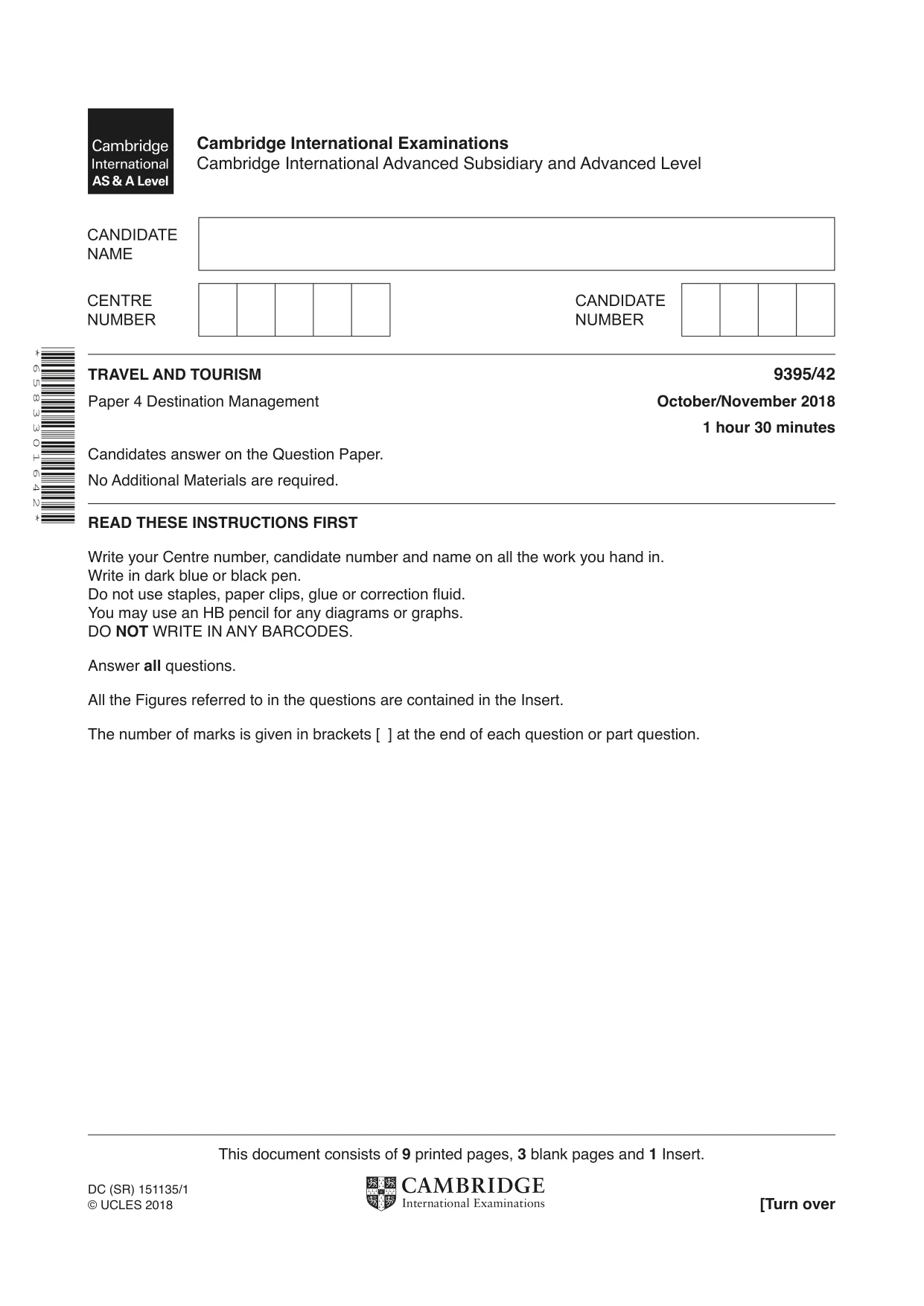
* 6 5 8 3 3 0 1 6 4 2 * This document consists of 9 printed pages, 3 blank pages and 1 Insert. DC (SR) 151135/1 © UCLES 2018 [Turn over TRAVEL AND TOURISM 9395/42 Paper 4 Destination Management October/November 2018 1 hour 30 minutes Candidates answer on the Question Paper. No Additional Materials are required. READ THESE INSTRUCTIONS FIRST Write your Centre number, candidate number and name on all the work you hand in. Write in dark blue or black pen. Do not use staples, paper clips, glue or correction fluid. You may use an HB pencil for any diagrams or graphs. DO NOT WRITE IN ANY BARCODES. Answer all questions. All the Figures referred to in the questions are contained in the Insert. The number of marks is given in brackets [ ] at the end of each question or part question. Cambridge International Examinations Cambridge International Advanced Subsidiary and Advanced Level
Question paper, page 2
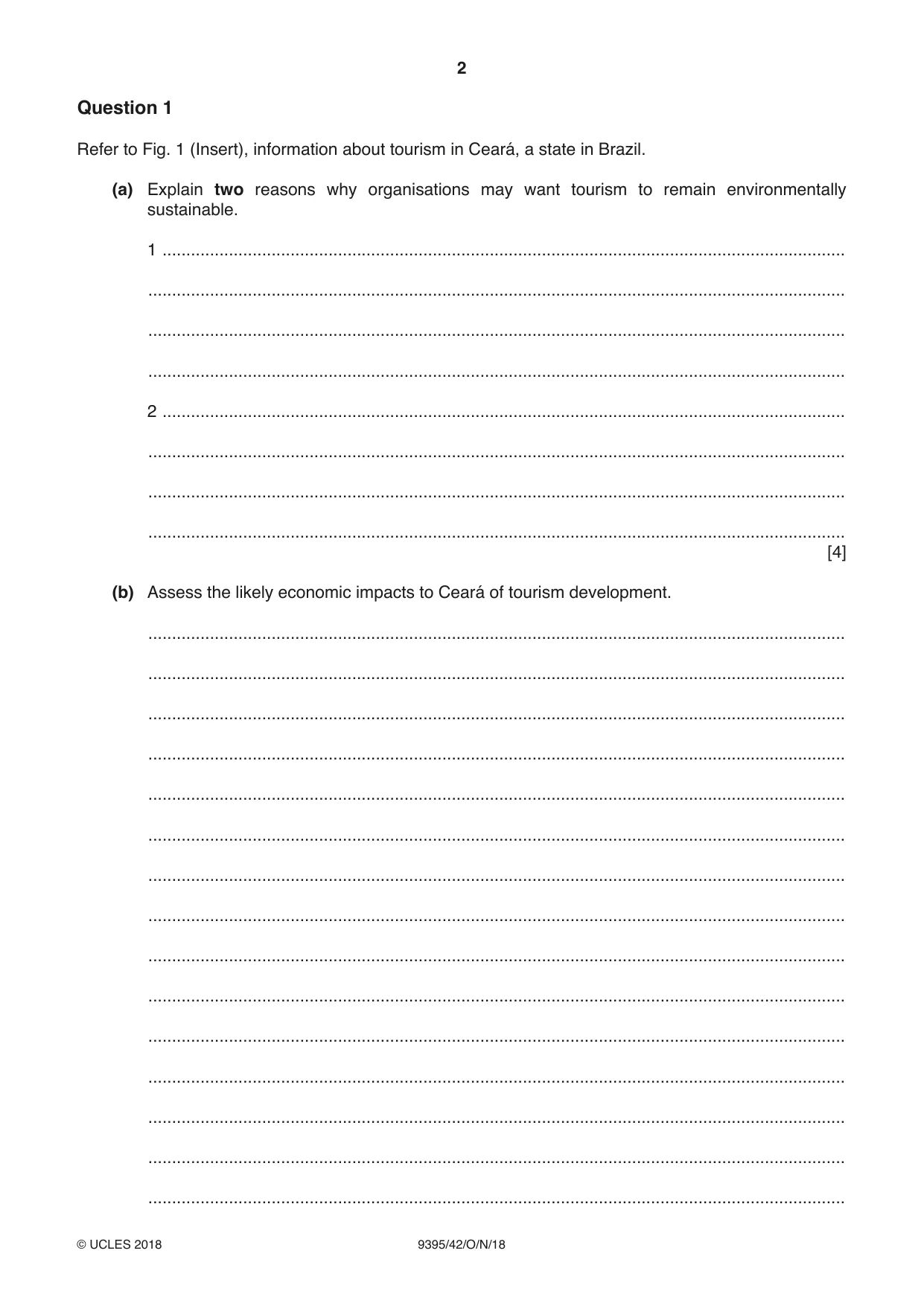
2 9395/42/O/N/18 © UCLES 2018 Question 1 Refer to Fig. 1 (Insert), information about tourism in Ceará, a state in Brazil. (a) Explain two reasons why organisations may want tourism to remain environmentally sustainable. 1 … … … … 2 … … … … [4] (b) Assess the likely economic impacts to Ceará of tourism development. … … … … … … … … … … … … … … …
Question paper, page 3
3 9395/42/O/N/18 © UCLES 2018 [Turn over … … … … … … … … … … … … … … … … … … … … … … … … … … … …[9]
Question paper, page 4
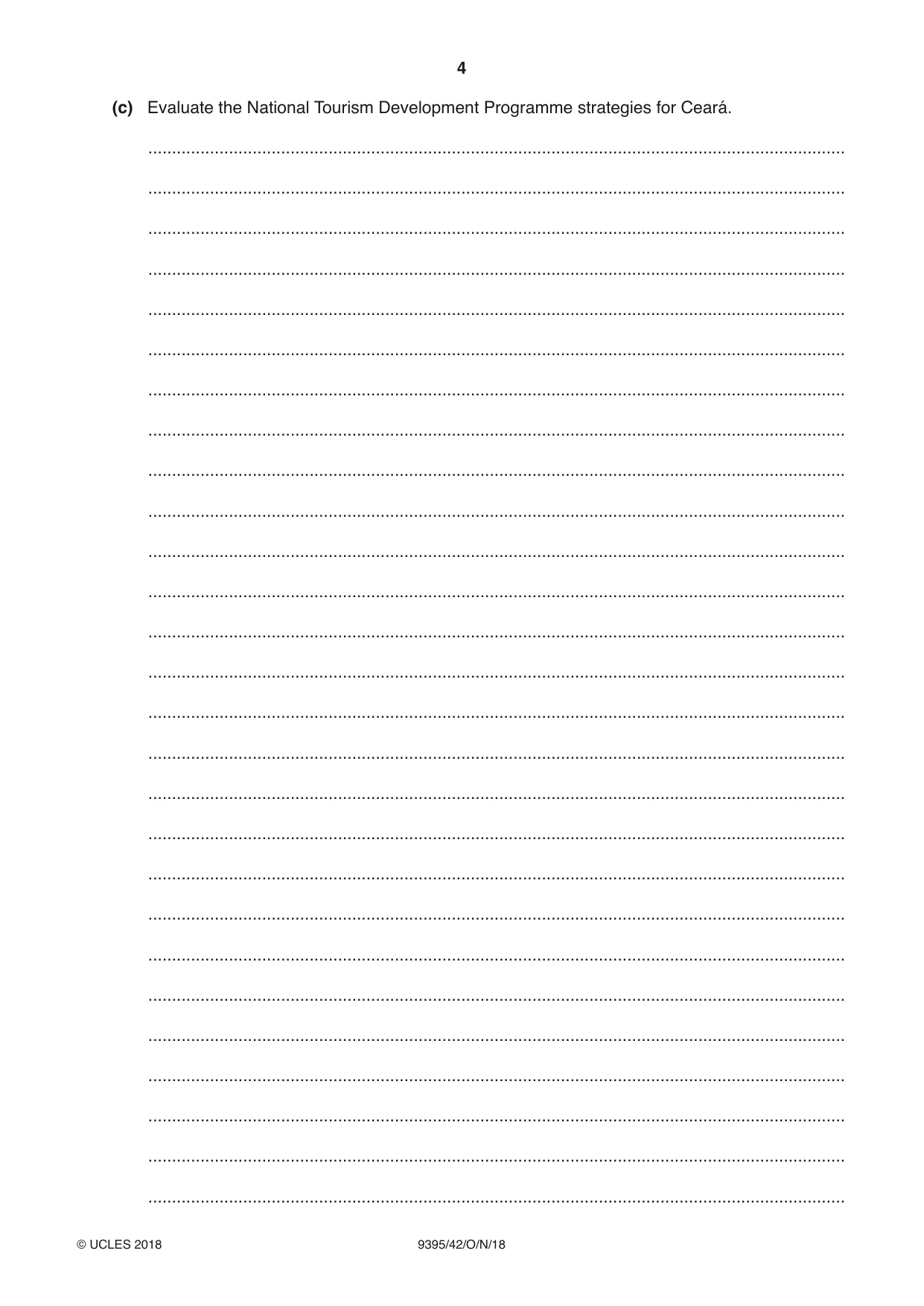
4 9395/42/O/N/18 © UCLES 2018 (c) Evaluate the National Tourism Development Programme strategies for Ceará. … … … … … … … … … … … … … … … … … … … … … … … … … … …
Question paper, page 5
5 9395/42/O/N/18 © UCLES 2018 [Turn over … … … … … … … … … … … … … … … … … … … … … … … … … … …[12] [Total: 25]
Question paper, page 6
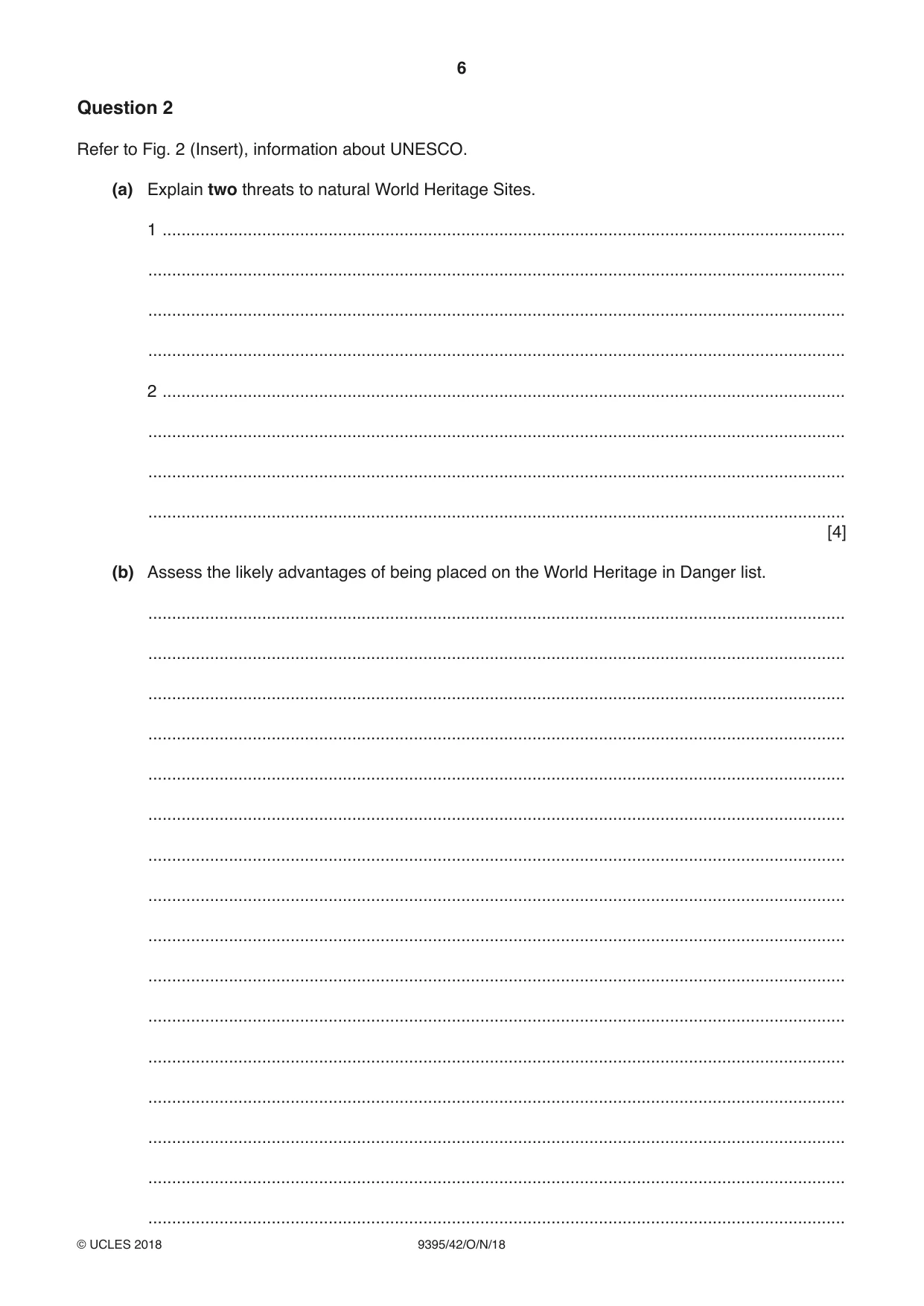
6 9395/42/O/N/18 © UCLES 2018 Question 2 Refer to Fig. 2 (Insert), information about UNESCO. (a) Explain two threats to natural World Heritage Sites. 1 … … … … 2 … … … … [4] (b) Assess the likely advantages of being placed on the World Heritage in Danger list. … … … … … … … … … … … … … … … …
Question paper, page 7
7 9395/42/O/N/18 © UCLES 2018 [Turn over … … … … … … … … … … … … … … … … … … … … … … … … … … … …[9]
Question paper, page 8
8 9395/42/O/N/18 © UCLES 2018 (c) Evaluate the likely positive sociocultural impacts of being given World Heritage Site status. … … … … … … … … … … … … … … … … … … … … … … … … … … …
Question paper, page 9
9 9395/42/O/N/18 © UCLES 2018 … … … … … … … … … … … … … … … … … … … … … … … … … … …[12] [Total: 25]
Question paper, page 10
10 9395/42/O/N/18 © UCLES 2018 BLANK PAGE
Question paper, page 11
11 9395/42/O/N/18 © UCLES 2018 BLANK PAGE
Question paper, page 12
12 9395/42/O/N/18 © UCLES 2018 BLANK PAGE Permission to reproduce items where third-party owned material protected by copyright is included has been sought and cleared where possible. Every reasonable effort has been made by the publisher (UCLES) to trace copyright holders, but if any items requiring clearance have unwittingly been included, the publisher will be pleased to make amends at the earliest possible opportunity. To avoid the issue of disclosure of answer-related information to candidates, all copyright acknowledgements are reproduced online in the Cambridge International Examinations Copyright Acknowledgements Booklet. This is produced for each series of examinations and is freely available to download at www.cie.org.uk after the live examination series. Cambridge International Examinations is part of the Cambridge Assessment Group. Cambridge Assessment is the brand name of University of Cambridge Local Examinations Syndicate (UCLES), which is itself a department of the University of Cambridge.
Mark scheme, page 1
This document consists of 8 printed pages. © UCLES 2018 [Turn over Cambridge Assessment International Education Cambridge International Advanced Subsidiary and Advanced Level TRAVEL AND TOURISM 9395/42 Paper 4 Destination Management October/November 2018 MARK SCHEME Maximum Mark: 50 Published This mark scheme is published as an aid to teachers and candidates, to indicate the requirements of the examination. It shows the basis on which Examiners were instructed to award marks. It does not indicate the details of the discussions that took place at an Examiners’ meeting before marking began, which would have considered the acceptability of alternative answers. Mark schemes should be read in conjunction with the question paper and the Principal Examiner Report for Teachers. Cambridge International will not enter into discussions about these mark schemes. Cambridge International is publishing the mark schemes for the October/November 2018 series for most Cambridge IGCSE™, Cambridge International A and AS Level components and some Cambridge O Level components.
Mark scheme, page 2
9395/42 Cambridge International AS/A Level – Mark Scheme PUBLISHED October/November 2018 © UCLES 2018 Page 2 of 8 Generic Marking Principles These general marking principles must be applied by all examiners when marking candidate answers. They should be applied alongside the specific content of the mark scheme or generic level descriptors for a question. Each question paper and mark scheme will also comply with these marking principles. GENERIC MARKING PRINCIPLE 1: Marks must be awarded in line with: • the specific content of the mark scheme or the generic level descriptors for the question • the specific skills defined in the mark scheme or in the generic level descriptors for the question • the standard of response required by a candidate as exemplified by the standardisation scripts. GENERIC MARKING PRINCIPLE 2: Marks awarded are always whole marks (not half marks, or other fractions). GENERIC MARKING PRINCIPLE 3: Marks must be awarded positively: • marks are awarded for correct/valid answers, as defined in the mark scheme. However, credit is given for valid answers which go beyond the scope of the syllabus and mark scheme, referring to your Team Leader as appropriate • marks are awarded when candidates clearly demonstrate what they know and can do • marks are not deducted for errors • marks are not deducted for omissions • answers should only be judged on the quality of spelling, punctuation and grammar when these features are specifically assessed by the question as indicated by the mark scheme. The meaning, however, should be unambiguous. GENERIC MARKING PRINCIPLE 4: Rules must be applied consistently e.g. in situations where candidates have not followed instructions or in the application of generic level descriptors. GENERIC MARKING PRINCIPLE 5: Marks should be awarded using the full range of marks defined in the mark scheme for the question (however; the use of the full mark range may be limited according to the quality of the candidate responses seen). GENERIC MARKING PRINCIPLE 6: Marks awarded are based solely on the requirements as defined in the mark scheme. Marks should not be awarded with grade thresholds or grade descriptors in mind.
Mark scheme, page 3
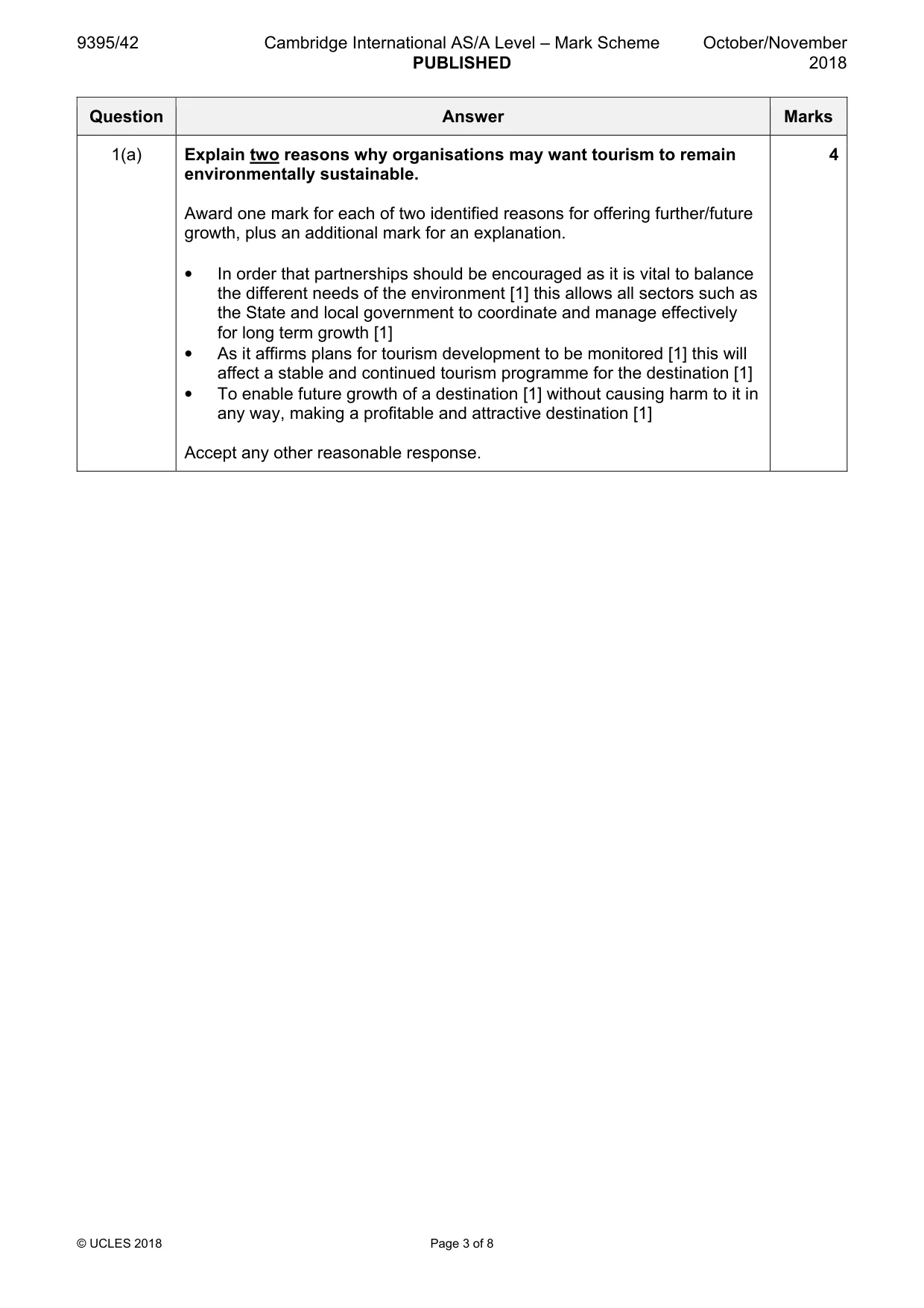
9395/42 Cambridge International AS/A Level – Mark Scheme PUBLISHED October/November 2018 © UCLES 2018 Page 3 of 8 Question Answer Marks 1(a) Explain two reasons why organisations may want tourism to remain environmentally sustainable. Award one mark for each of two identified reasons for offering further/future growth, plus an additional mark for an explanation. • In order that partnerships should be encouraged as it is vital to balance the different needs of the environment [1] this allows all sectors such as the State and local government to coordinate and manage effectively for long term growth [1] • As it affirms plans for tourism development to be monitored [1] this will affect a stable and continued tourism programme for the destination [1] • To enable future growth of a destination [1] without causing harm to it in any way, making a profitable and attractive destination [1] Accept any other reasonable response. 4
Mark scheme, page 4
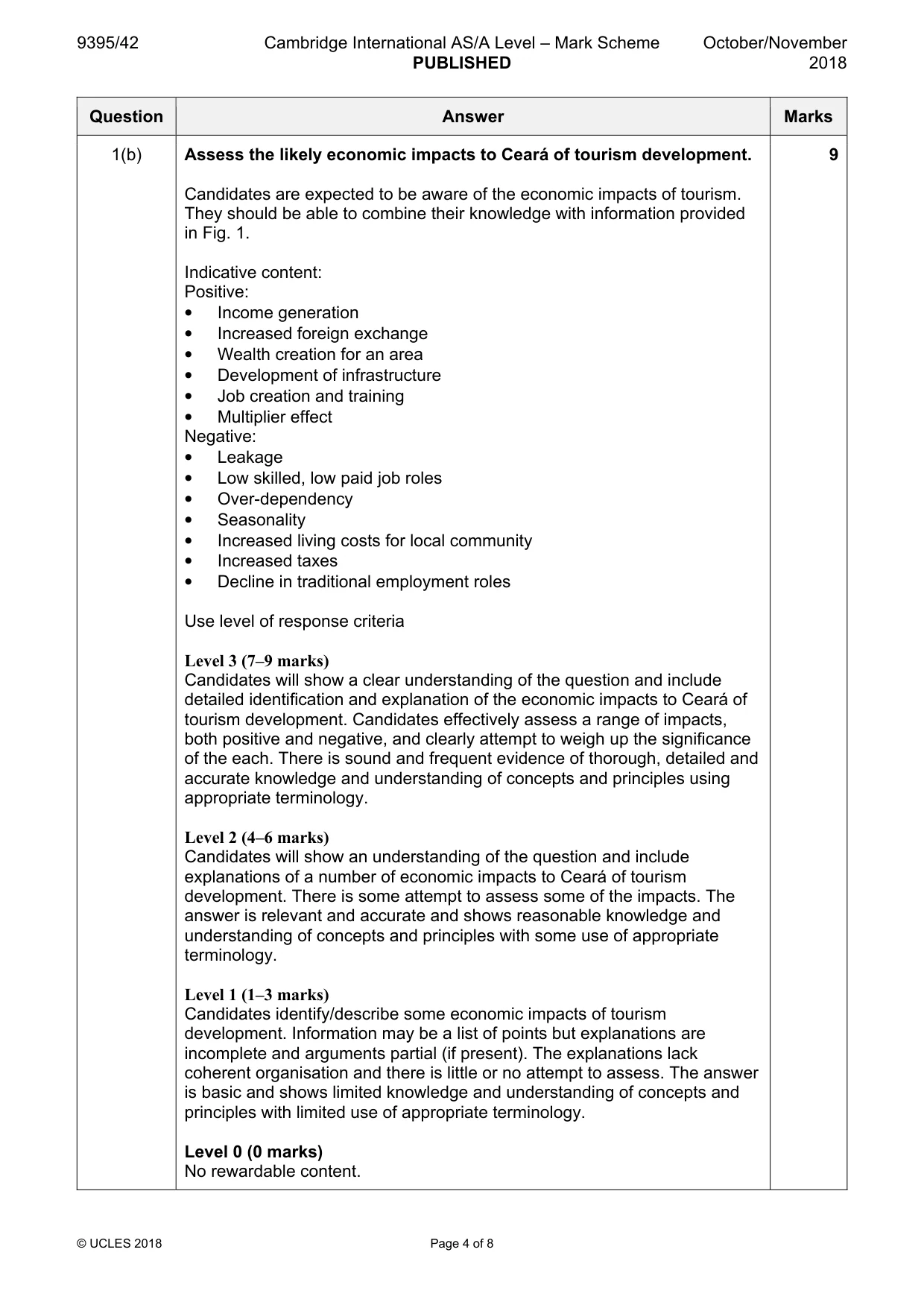
9395/42 Cambridge International AS/A Level – Mark Scheme PUBLISHED October/November 2018 © UCLES 2018 Page 4 of 8 Question Answer Marks 1(b) Assess the likely economic impacts to Ceará of tourism development. Candidates are expected to be aware of the economic impacts of tourism. They should be able to combine their knowledge with information provided in Fig. 1. Indicative content: Positive: • Income generation • Increased foreign exchange • Wealth creation for an area • Development of infrastructure • Job creation and training • Multiplier effect Negative: • Leakage • Low skilled, low paid job roles • Over-dependency • Seasonality • Increased living costs for local community • Increased taxes • Decline in traditional employment roles Use level of response criteria Level 3 (7–9 marks) Candidates will show a clear understanding of the question and include detailed identification and explanation of the economic impacts to Ceará of tourism development. Candidates effectively assess a range of impacts, both positive and negative, and clearly attempt to weigh up the significance of the each. There is sound and frequent evidence of thorough, detailed and accurate knowledge and understanding of concepts and principles using appropriate terminology. Level 2 (4–6 marks) Candidates will show an understanding of the question and include explanations of a number of economic impacts to Ceará of tourism development. There is some attempt to assess some of the impacts. The answer is relevant and accurate and shows reasonable knowledge and understanding of concepts and principles with some use of appropriate terminology. Level 1 (1–3 marks) Candidates identify/describe some economic impacts of tourism development. Information may be a list of points but explanations are incomplete and arguments partial (if present). The explanations lack coherent organisation and there is little or no attempt to assess. The answer is basic and shows limited knowledge and understanding of concepts and principles with limited use of appropriate terminology. Level 0 (0 marks) No rewardable content. 9
Mark scheme, page 5
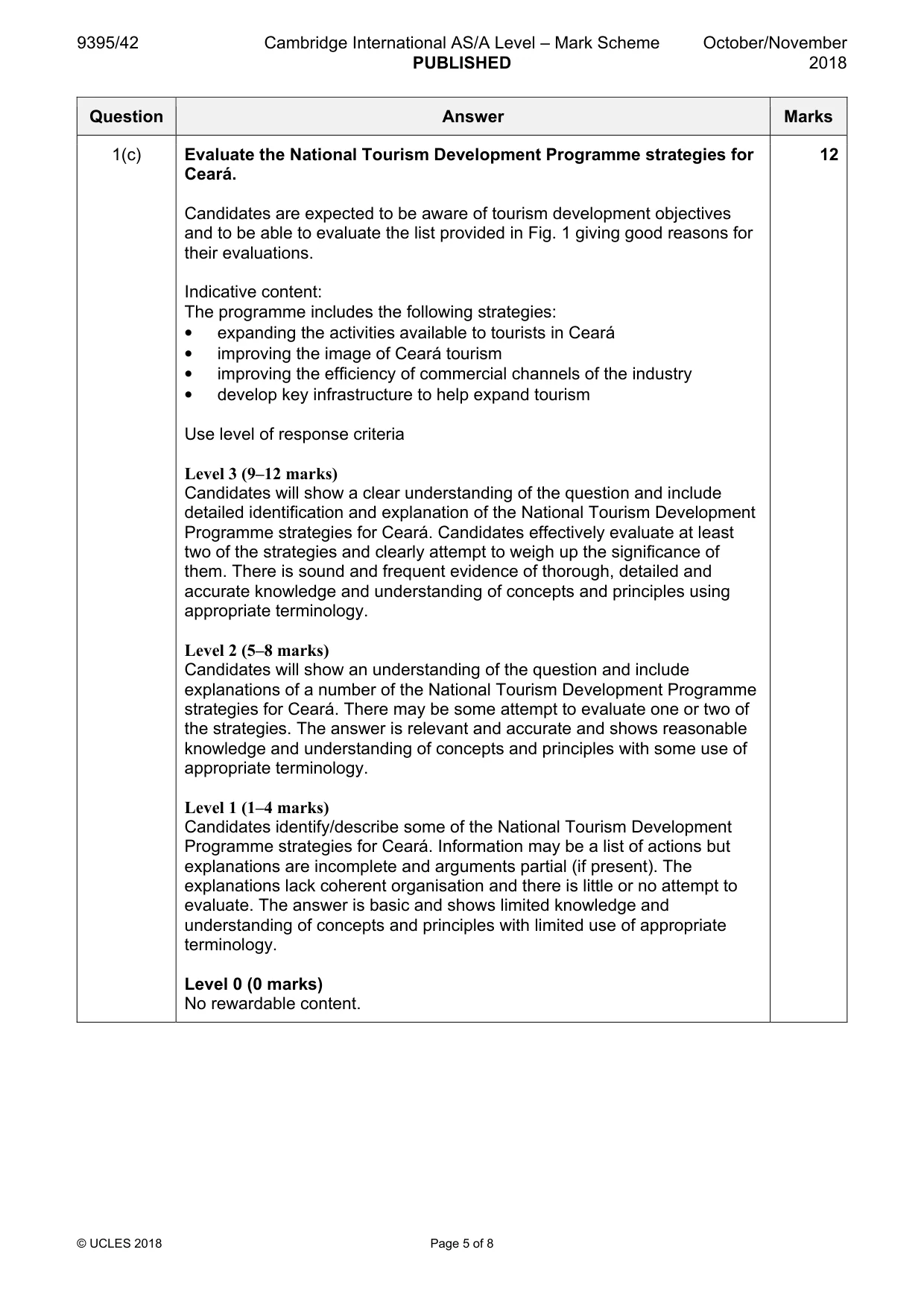
9395/42 Cambridge International AS/A Level – Mark Scheme PUBLISHED October/November 2018 © UCLES 2018 Page 5 of 8 Question Answer Marks 1(c) Evaluate the National Tourism Development Programme strategies for Ceará. Candidates are expected to be aware of tourism development objectives and to be able to evaluate the list provided in Fig. 1 giving good reasons for their evaluations. Indicative content: The programme includes the following strategies: • expanding the activities available to tourists in Ceará • improving the image of Ceará tourism • improving the efficiency of commercial channels of the industry • develop key infrastructure to help expand tourism Use level of response criteria Level 3 (9–12 marks) Candidates will show a clear understanding of the question and include detailed identification and explanation of the National Tourism Development Programme strategies for Ceará. Candidates effectively evaluate at least two of the strategies and clearly attempt to weigh up the significance of them. There is sound and frequent evidence of thorough, detailed and accurate knowledge and understanding of concepts and principles using appropriate terminology. Level 2 (5–8 marks) Candidates will show an understanding of the question and include explanations of a number of the National Tourism Development Programme strategies for Ceará. There may be some attempt to evaluate one or two of the strategies. The answer is relevant and accurate and shows reasonable knowledge and understanding of concepts and principles with some use of appropriate terminology. Level 1 (1–4 marks) Candidates identify/describe some of the National Tourism Development Programme strategies for Ceará. Information may be a list of actions but explanations are incomplete and arguments partial (if present). The explanations lack coherent organisation and there is little or no attempt to evaluate. The answer is basic and shows limited knowledge and understanding of concepts and principles with limited use of appropriate terminology. Level 0 (0 marks) No rewardable content. 12
Mark scheme, page 6
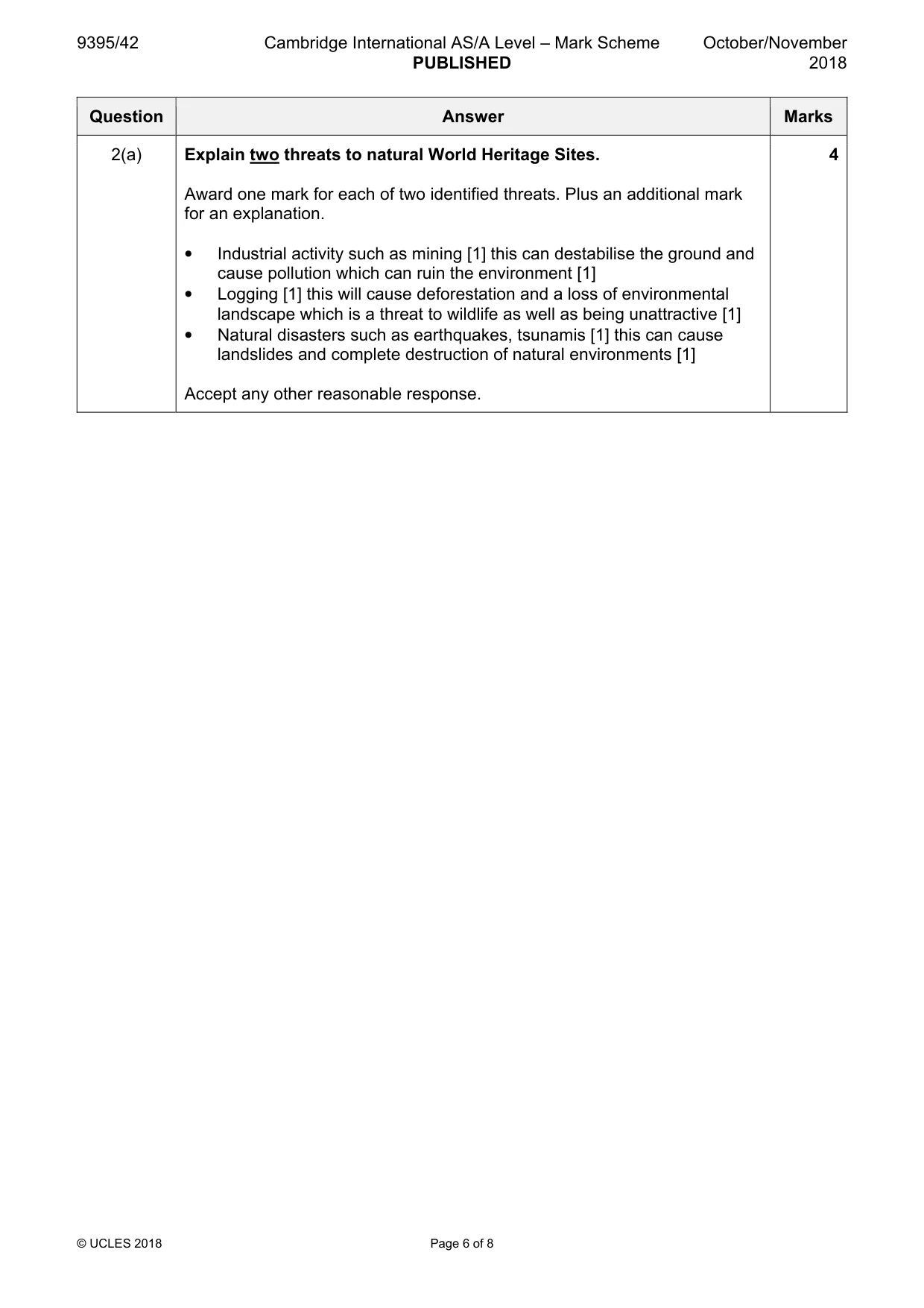
9395/42 Cambridge International AS/A Level – Mark Scheme PUBLISHED October/November 2018 © UCLES 2018 Page 6 of 8 Question Answer Marks 2(a) Explain two threats to natural World Heritage Sites. Award one mark for each of two identified threats. Plus an additional mark for an explanation. • Industrial activity such as mining [1] this can destabilise the ground and cause pollution which can ruin the environment [1] • Logging [1] this will cause deforestation and a loss of environmental landscape which is a threat to wildlife as well as being unattractive [1] • Natural disasters such as earthquakes, tsunamis [1] this can cause landslides and complete destruction of natural environments [1] Accept any other reasonable response. 4
Mark scheme, page 7
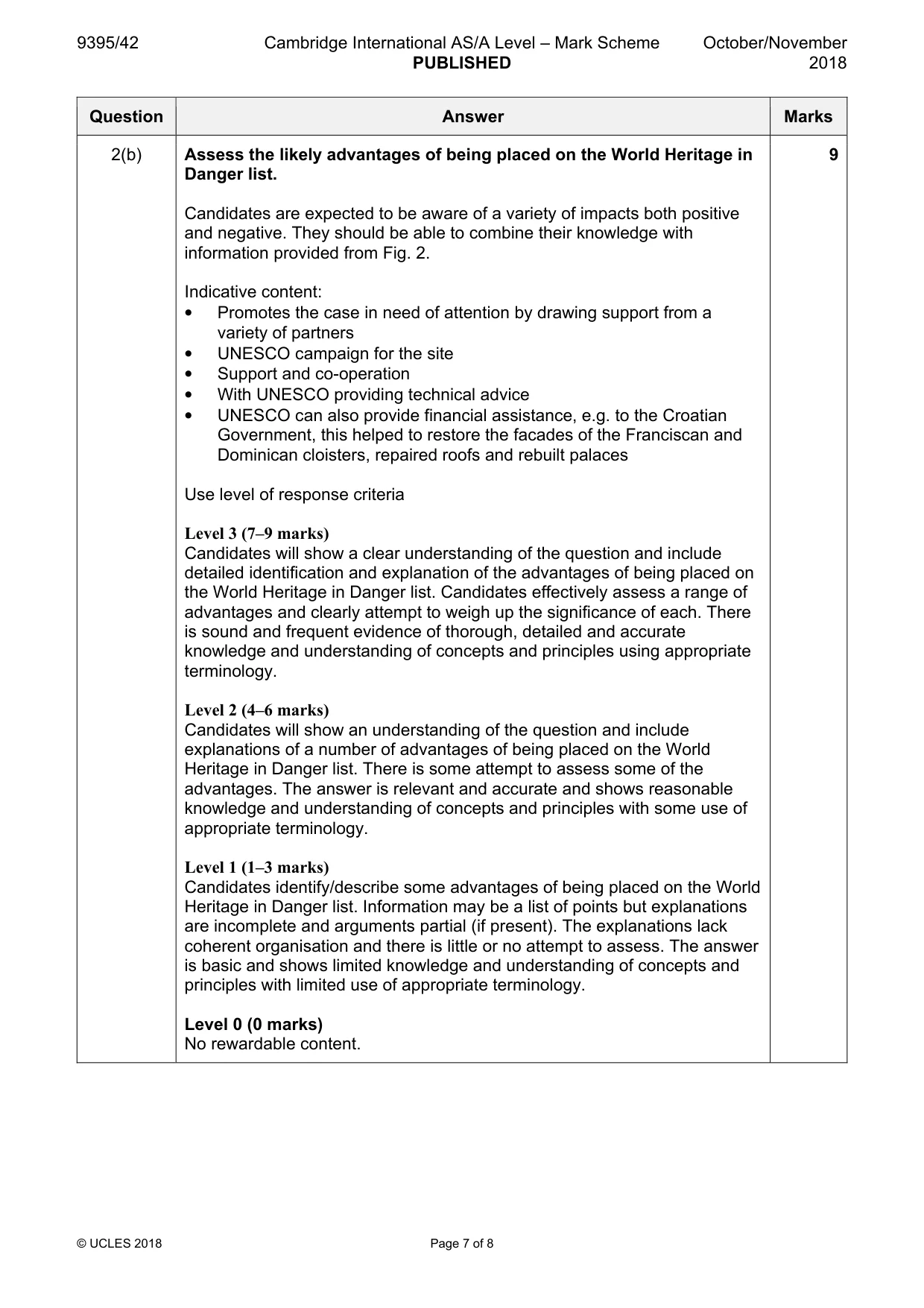
9395/42 Cambridge International AS/A Level – Mark Scheme PUBLISHED October/November 2018 © UCLES 2018 Page 7 of 8 Question Answer Marks 2(b) Assess the likely advantages of being placed on the World Heritage in Danger list. Candidates are expected to be aware of a variety of impacts both positive and negative. They should be able to combine their knowledge with information provided from Fig. 2. Indicative content: • Promotes the case in need of attention by drawing support from a variety of partners • UNESCO campaign for the site • Support and co-operation • With UNESCO providing technical advice • UNESCO can also provide financial assistance, e.g. to the Croatian Government, this helped to restore the facades of the Franciscan and Dominican cloisters, repaired roofs and rebuilt palaces Use level of response criteria Level 3 (7–9 marks) Candidates will show a clear understanding of the question and include detailed identification and explanation of the advantages of being placed on the World Heritage in Danger list. Candidates effectively assess a range of advantages and clearly attempt to weigh up the significance of each. There is sound and frequent evidence of thorough, detailed and accurate knowledge and understanding of concepts and principles using appropriate terminology. Level 2 (4–6 marks) Candidates will show an understanding of the question and include explanations of a number of advantages of being placed on the World Heritage in Danger list. There is some attempt to assess some of the advantages. The answer is relevant and accurate and shows reasonable knowledge and understanding of concepts and principles with some use of appropriate terminology. Level 1 (1–3 marks) Candidates identify/describe some advantages of being placed on the World Heritage in Danger list. Information may be a list of points but explanations are incomplete and arguments partial (if present). The explanations lack coherent organisation and there is little or no attempt to assess. The answer is basic and shows limited knowledge and understanding of concepts and principles with limited use of appropriate terminology. Level 0 (0 marks) No rewardable content. 9
Mark scheme, page 8
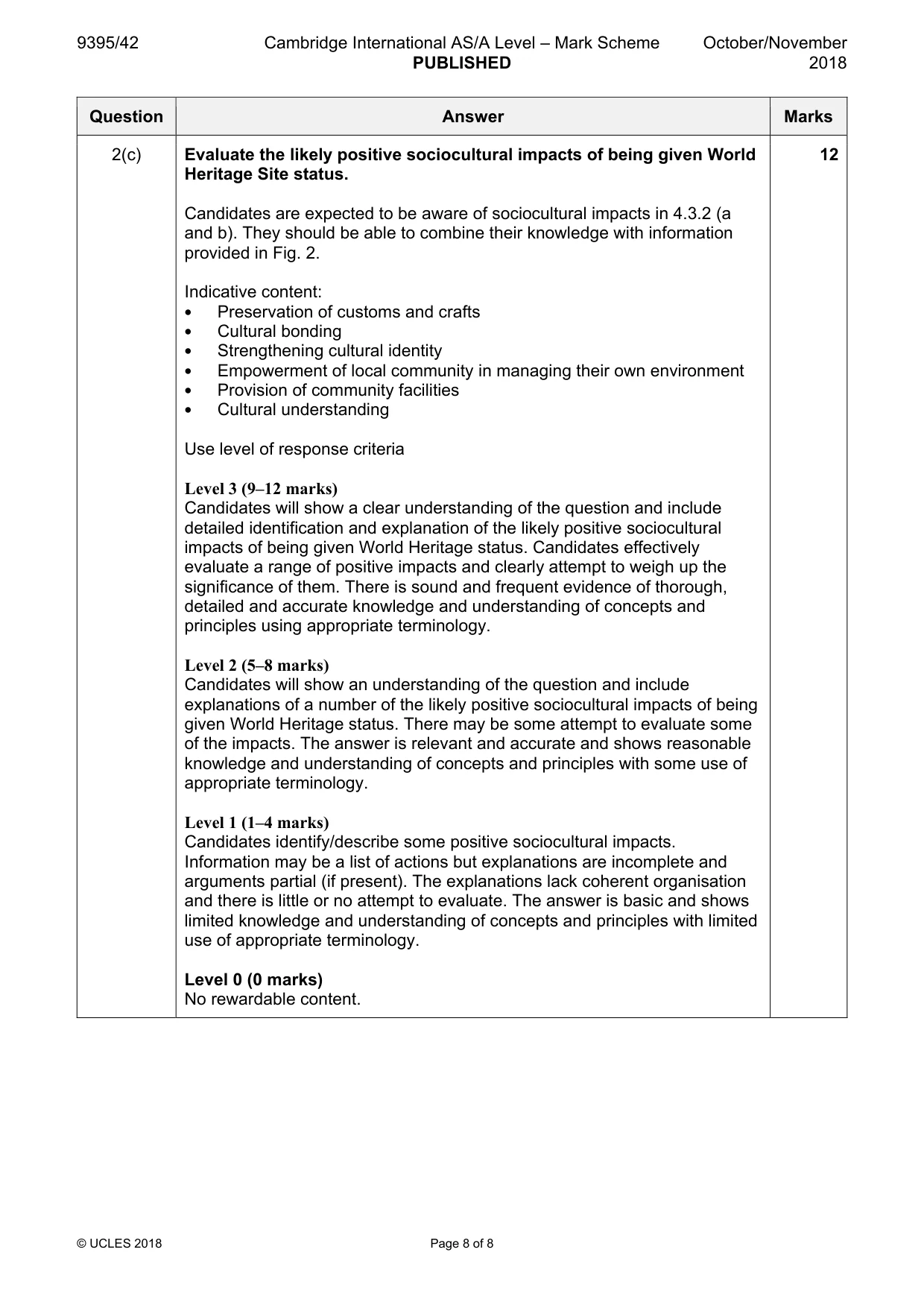
9395/42 Cambridge International AS/A Level – Mark Scheme PUBLISHED October/November 2018 © UCLES 2018 Page 8 of 8 Question Answer Marks 2(c) Evaluate the likely positive sociocultural impacts of being given World Heritage Site status. Candidates are expected to be aware of sociocultural impacts in 4.3.2 (a and b). They should be able to combine their knowledge with information provided in Fig. 2. Indicative content: • Preservation of customs and crafts • Cultural bonding • Strengthening cultural identity • Empowerment of local community in managing their own environment • Provision of community facilities • Cultural understanding Use level of response criteria Level 3 (9–12 marks) Candidates will show a clear understanding of the question and include detailed identification and explanation of the likely positive sociocultural impacts of being given World Heritage status. Candidates effectively evaluate a range of positive impacts and clearly attempt to weigh up the significance of them. There is sound and frequent evidence of thorough, detailed and accurate knowledge and understanding of concepts and principles using appropriate terminology. Level 2 (5–8 marks) Candidates will show an understanding of the question and include explanations of a number of the likely positive sociocultural impacts of being given World Heritage status. There may be some attempt to evaluate some of the impacts. The answer is relevant and accurate and shows reasonable knowledge and understanding of concepts and principles with some use of appropriate terminology. Level 1 (1–4 marks) Candidates identify/describe some positive sociocultural impacts. Information may be a list of actions but explanations are incomplete and arguments partial (if present). The explanations lack coherent organisation and there is little or no attempt to evaluate. The answer is basic and shows limited knowledge and understanding of concepts and principles with limited use of appropriate terminology. Level 0 (0 marks) No rewardable content. 12
What you needed in this session
Cambridge’s own grade thresholds for 2018 Oct/Nov, Paper 4 · Variant 2. A higher threshold means an easier paper — the bar moves with how the cohort did.