Cambridge A Level Travel and Tourism 9395 — 2018 May/June Paper 3 · Variant 3
9395/33/M/J/18 · 50 marks · ≈56 min
The question paper and its mark scheme, free to read here and free to download. This is Cambridge’s own paper, exactly as it was sat.
Question paper12 pages







Mark scheme9 pages
Answers below. Sit the paper first if you are practising.
Paper as text
Question paper, page 1
* 2 7 1 0 2 5 8 4 7 3 * This document consists of 9 printed pages, 3 blank pages and 1 Insert. DC (KS) 165429 © UCLES 2018 [Turn over TRAVEL AND TOURISM 9395/33 Paper 3 Destination Marketing May/June 2018 1 hour 30 minutes Candidates answer on the Question Paper. No Additional Materials are required. READ THESE INSTRUCTIONS FIRST Write your Centre number, candidate number and name on all the work you hand in. Write in dark blue or black pen. You may use an HB pencil for any diagrams or graphs. Do not use staples, paper clips, glue or correction fluid. DO NOT WRITE IN ANY BARCODES. Answer all questions. All the Figures referred to in the questions are contained in the Insert. The number of marks is given in brackets [ ] at the end of each question or part question. Cambridge International Examinations Cambridge International Advanced Subsidiary and Advanced Level
Question paper, page 2
2 9395/33/M/J/18 © UCLES 2018 Question 1 Refer to Fig. 1 (Insert), information about Tourisme Montréal and its new brand identity. Montréal is a city in Canada. (a) Explain two reasons why Tourisme Montréal wanted to rebrand itself. 1 … … … … 2 … … … … [4] (b) Discuss the ways Montréal has created an effective destination brand identity. … … … … … … … … … … … … … … …
Question paper, page 3
3 9395/33/M/J/18 © UCLES 2018 [Turn over … … … … … … … … … … … … … … … … … … … … … … … … … … … …[9]
Question paper, page 4
4 9395/33/M/J/18 © UCLES 2018 (c) Evaluate how Tourisme Montréal might overcome the challenge of intangibility for its branded tourism products. … … … … … … … … … … … … … … … … … … … … … … … … … … …
Question paper, page 5
5 9395/33/M/J/18 © UCLES 2018 [Turn over … … … … … … … … … … … … … … … … … … … … … … … … … … …[12] [Total: 25]
Question paper, page 6
6 9395/33/M/J/18 © UCLES 2018 Question 2 Refer to Fig. 2 (Insert), information about the work of the Destination Marketing Organisation (DMO) in Verona, a city in Italy. The DMO carried out a study of visitor perceptions of the city through market research. (a) Explain two likely aims of the market research carried out by the DMO. 1 … … … … 2 … … … … [4] (b) Analyse how the service factors identified by the DMO can be used to raise awareness of the destination’s brand identity with visitors to Verona. … … … … … … … … … … … … … …
Question paper, page 7
7 9395/33/M/J/18 © UCLES 2018 [Turn over … … … … … … … … … … … … … … … … … … … … … … … … … … … …[9]
Question paper, page 8
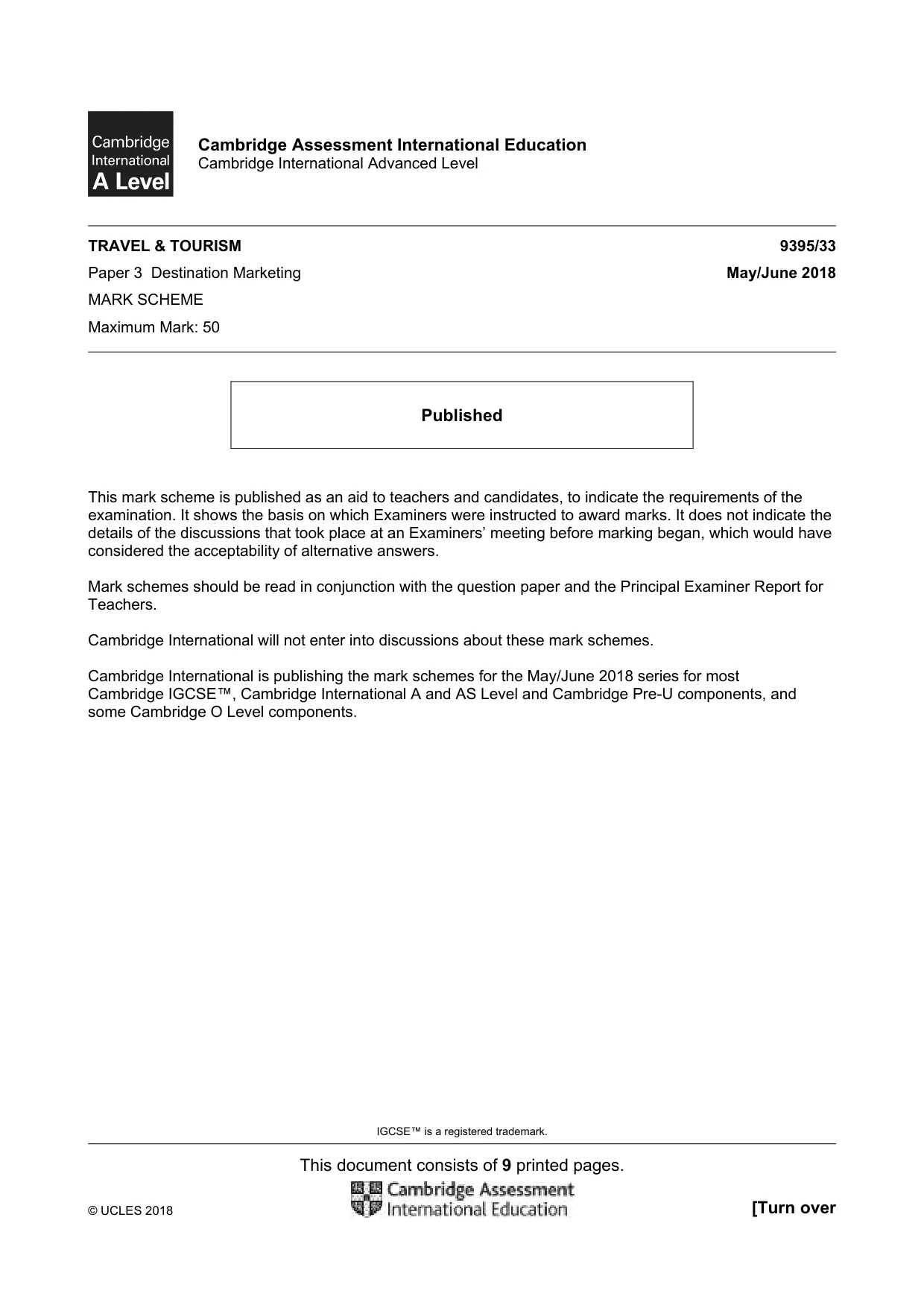
8 9395/33/M/J/18 © UCLES 2018 (c) Discuss the view that margin of satisfaction and price-quality ratio could be used as key performance indicators (KPIs) for monitoring the effectiveness of the destination brand for Verona. … … … … … … … … … … … … … … … … … … … … … … … … … …
Question paper, page 9
9 9395/33/M/J/18 © UCLES 2018 … … … … … … … … … … … … … … … … … … … … … … … … … … …[12] [Total: 25]
Question paper, page 10
10 9395/33/M/J/18 © UCLES 2018 BLANK PAGE
Question paper, page 11
11 9395/33/M/J/18 © UCLES 2018 BLANK PAGE
Question paper, page 12
12 9395/33/M/J/18 © UCLES 2018 Permission to reproduce items where third-party owned material protected by copyright is included has been sought and cleared where possible. Every reasonable effort has been made by the publisher (UCLES) to trace copyright holders, but if any items requiring clearance have unwittingly been included, the publisher will be pleased to make amends at the earliest possible opportunity. To avoid the issue of disclosure of answer-related information to candidates, all copyright acknowledgements are reproduced online in the Cambridge International Examinations Copyright Acknowledgements Booklet. This is produced for each series of examinations and is freely available to download at www.cie.org.uk after the live examination series. Cambridge International Examinations is part of the Cambridge Assessment Group. Cambridge Assessment is the brand name of University of Cambridge Local Examinations Syndicate (UCLES), which is itself a department of the University of Cambridge. BLANK PAGE
Mark scheme, page 1
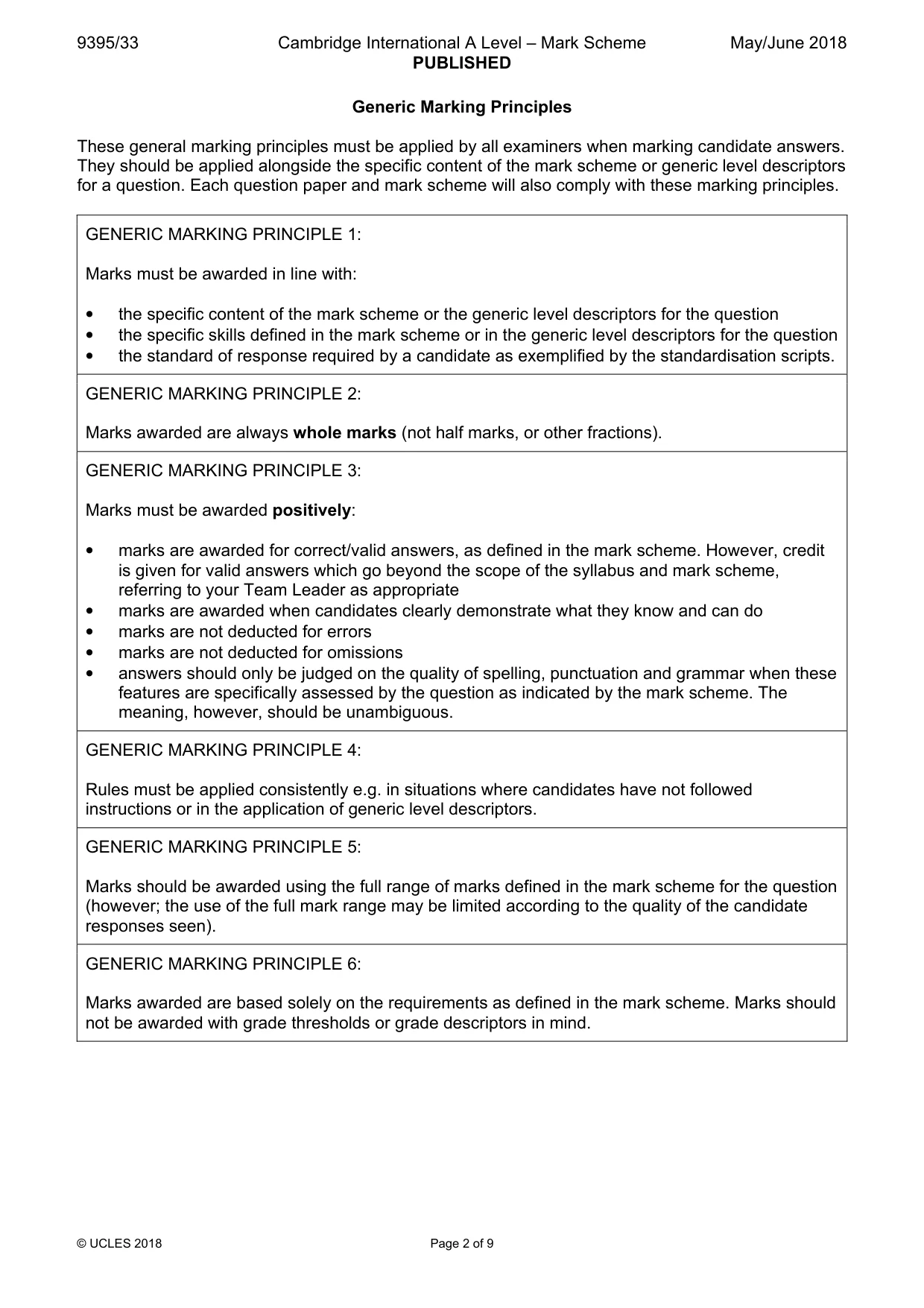
IGCSE™ is a registered trademark. This document consists of 9 printed pages. © UCLES 2018 [Turn over Cambridge Assessment International Education Cambridge International Advanced Level TRAVEL & TOURISM 9395/33 Paper 3 Destination Marketing May/June 2018 MARK SCHEME Maximum Mark: 50 Published This mark scheme is published as an aid to teachers and candidates, to indicate the requirements of the examination. It shows the basis on which Examiners were instructed to award marks. It does not indicate the details of the discussions that took place at an Examiners’ meeting before marking began, which would have considered the acceptability of alternative answers. Mark schemes should be read in conjunction with the question paper and the Principal Examiner Report for Teachers. Cambridge International will not enter into discussions about these mark schemes. Cambridge International is publishing the mark schemes for the May/June 2018 series for most Cambridge IGCSE™, Cambridge International A and AS Level and Cambridge Pre-U components, and some Cambridge O Level components.
Mark scheme, page 2
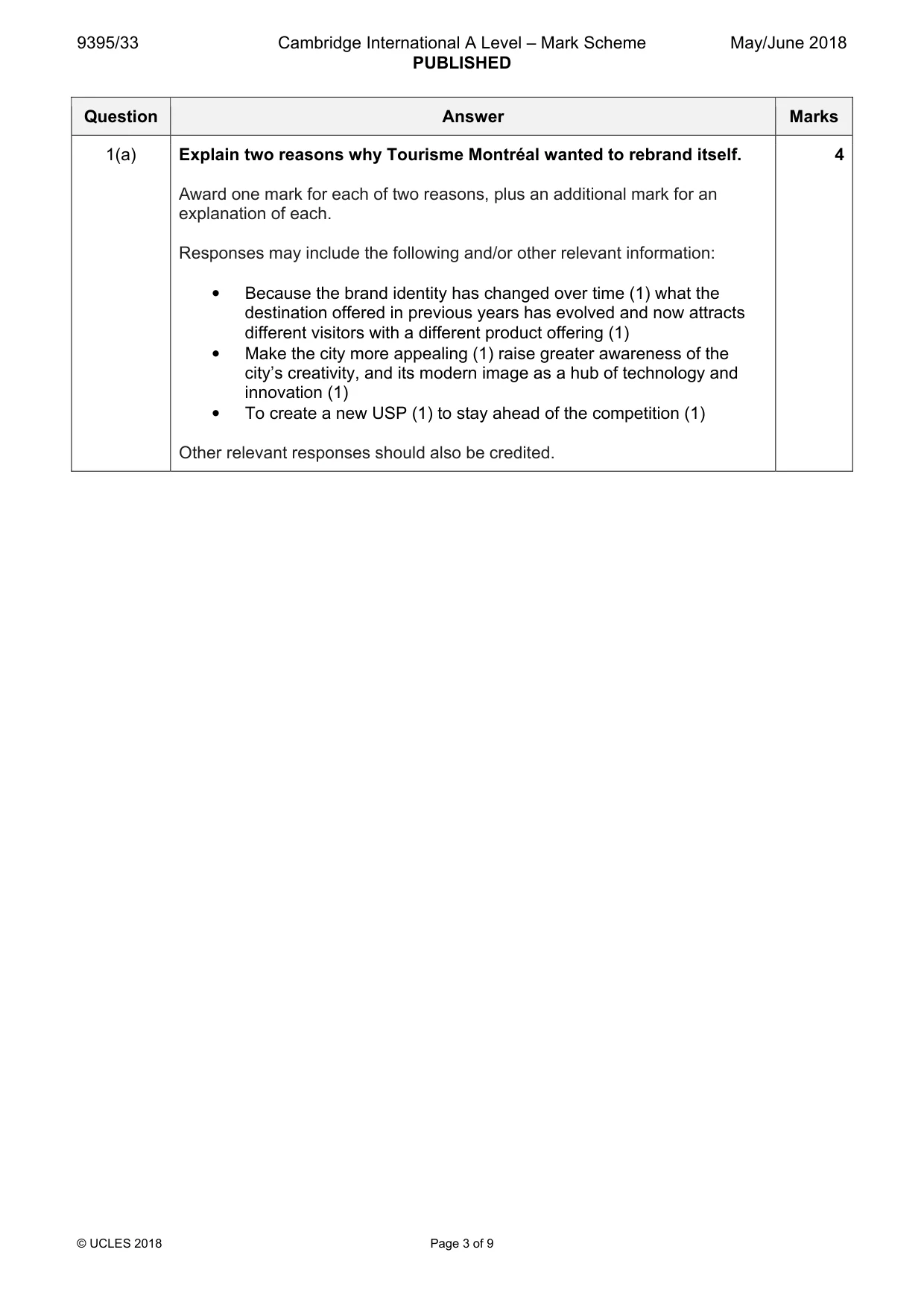
9395/33 Cambridge International A Level – Mark Scheme PUBLISHED May/June 2018 © UCLES 2018 Page 2 of 9 Generic Marking Principles These general marking principles must be applied by all examiners when marking candidate answers. They should be applied alongside the specific content of the mark scheme or generic level descriptors for a question. Each question paper and mark scheme will also comply with these marking principles. GENERIC MARKING PRINCIPLE 1: Marks must be awarded in line with: • the specific content of the mark scheme or the generic level descriptors for the question • the specific skills defined in the mark scheme or in the generic level descriptors for the question • the standard of response required by a candidate as exemplified by the standardisation scripts. GENERIC MARKING PRINCIPLE 2: Marks awarded are always whole marks (not half marks, or other fractions). GENERIC MARKING PRINCIPLE 3: Marks must be awarded positively: • marks are awarded for correct/valid answers, as defined in the mark scheme. However, credit is given for valid answers which go beyond the scope of the syllabus and mark scheme, referring to your Team Leader as appropriate • marks are awarded when candidates clearly demonstrate what they know and can do • marks are not deducted for errors • marks are not deducted for omissions • answers should only be judged on the quality of spelling, punctuation and grammar when these features are specifically assessed by the question as indicated by the mark scheme. The meaning, however, should be unambiguous. GENERIC MARKING PRINCIPLE 4: Rules must be applied consistently e.g. in situations where candidates have not followed instructions or in the application of generic level descriptors. GENERIC MARKING PRINCIPLE 5: Marks should be awarded using the full range of marks defined in the mark scheme for the question (however; the use of the full mark range may be limited according to the quality of the candidate responses seen). GENERIC MARKING PRINCIPLE 6: Marks awarded are based solely on the requirements as defined in the mark scheme. Marks should not be awarded with grade thresholds or grade descriptors in mind.
Mark scheme, page 3
9395/33 Cambridge International A Level – Mark Scheme PUBLISHED May/June 2018 © UCLES 2018 Page 3 of 9 Question Answer Marks 1(a) Explain two reasons why Tourisme Montréal wanted to rebrand itself. Award one mark for each of two reasons, plus an additional mark for an explanation of each. Responses may include the following and/or other relevant information: • Because the brand identity has changed over time (1) what the destination offered in previous years has evolved and now attracts different visitors with a different product offering (1) • Make the city more appealing (1) raise greater awareness of the city’s creativity, and its modern image as a hub of technology and innovation (1) • To create a new USP (1) to stay ahead of the competition (1) Other relevant responses should also be credited. 4
Mark scheme, page 4
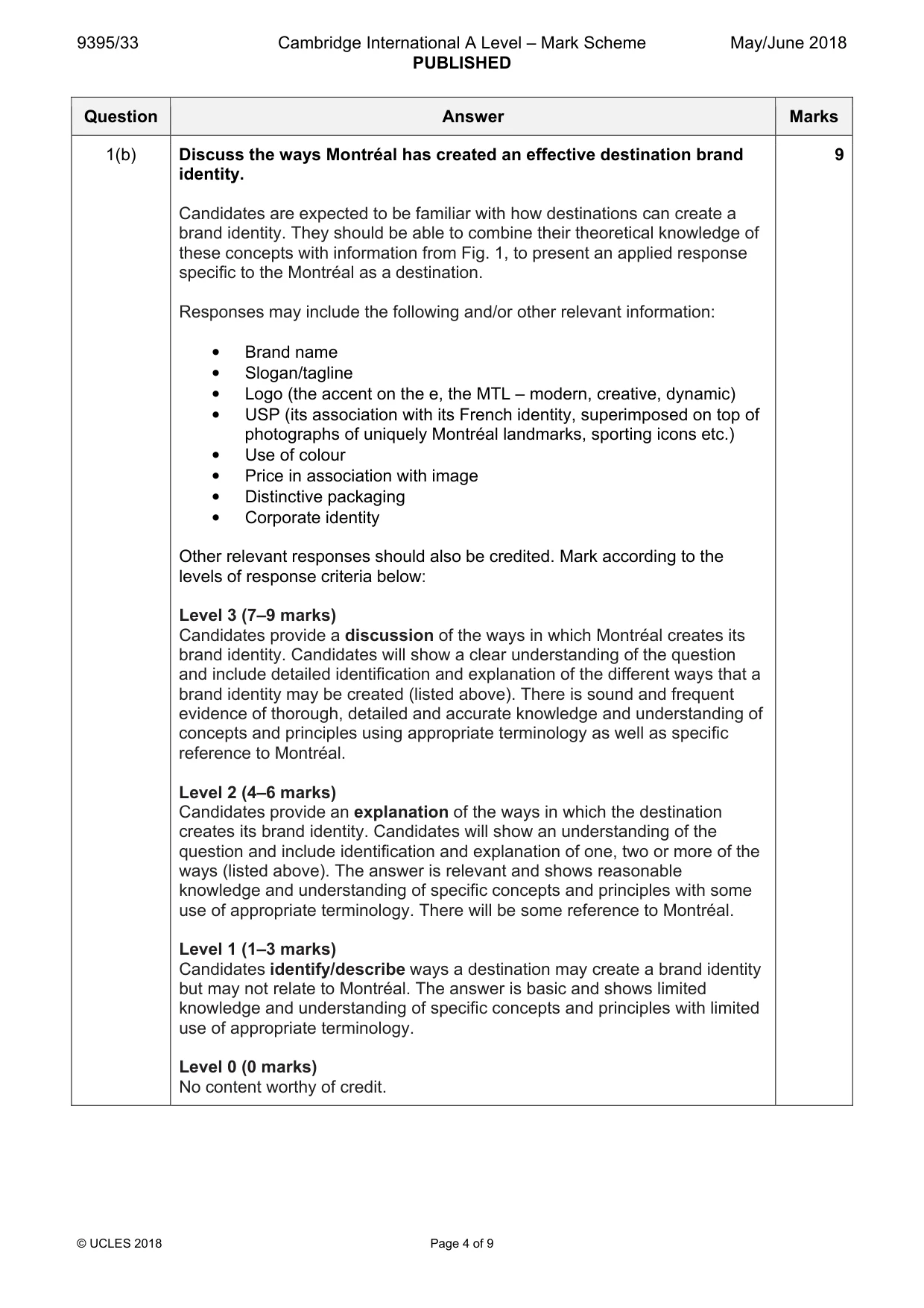
9395/33 Cambridge International A Level – Mark Scheme PUBLISHED May/June 2018 © UCLES 2018 Page 4 of 9 Question Answer Marks 1(b) Discuss the ways Montréal has created an effective destination brand identity. Candidates are expected to be familiar with how destinations can create a brand identity. They should be able to combine their theoretical knowledge of these concepts with information from Fig. 1, to present an applied response specific to the Montréal as a destination. Responses may include the following and/or other relevant information: • Brand name • Slogan/tagline • Logo (the accent on the e, the MTL – modern, creative, dynamic) • USP (its association with its French identity, superimposed on top of photographs of uniquely Montréal landmarks, sporting icons etc.) • Use of colour • Price in association with image • Distinctive packaging • Corporate identity Other relevant responses should also be credited. Mark according to the levels of response criteria below: Level 3 (7–9 marks) Candidates provide a discussion of the ways in which Montréal creates its brand identity. Candidates will show a clear understanding of the question and include detailed identification and explanation of the different ways that a brand identity may be created (listed above). There is sound and frequent evidence of thorough, detailed and accurate knowledge and understanding of concepts and principles using appropriate terminology as well as specific reference to Montréal. Level 2 (4–6 marks) Candidates provide an explanation of the ways in which the destination creates its brand identity. Candidates will show an understanding of the question and include identification and explanation of one, two or more of the ways (listed above). The answer is relevant and shows reasonable knowledge and understanding of specific concepts and principles with some use of appropriate terminology. There will be some reference to Montréal. Level 1 (1–3 marks) Candidates identify/describe ways a destination may create a brand identity but may not relate to Montréal. The answer is basic and shows limited knowledge and understanding of specific concepts and principles with limited use of appropriate terminology. Level 0 (0 marks) No content worthy of credit. 9
Mark scheme, page 5
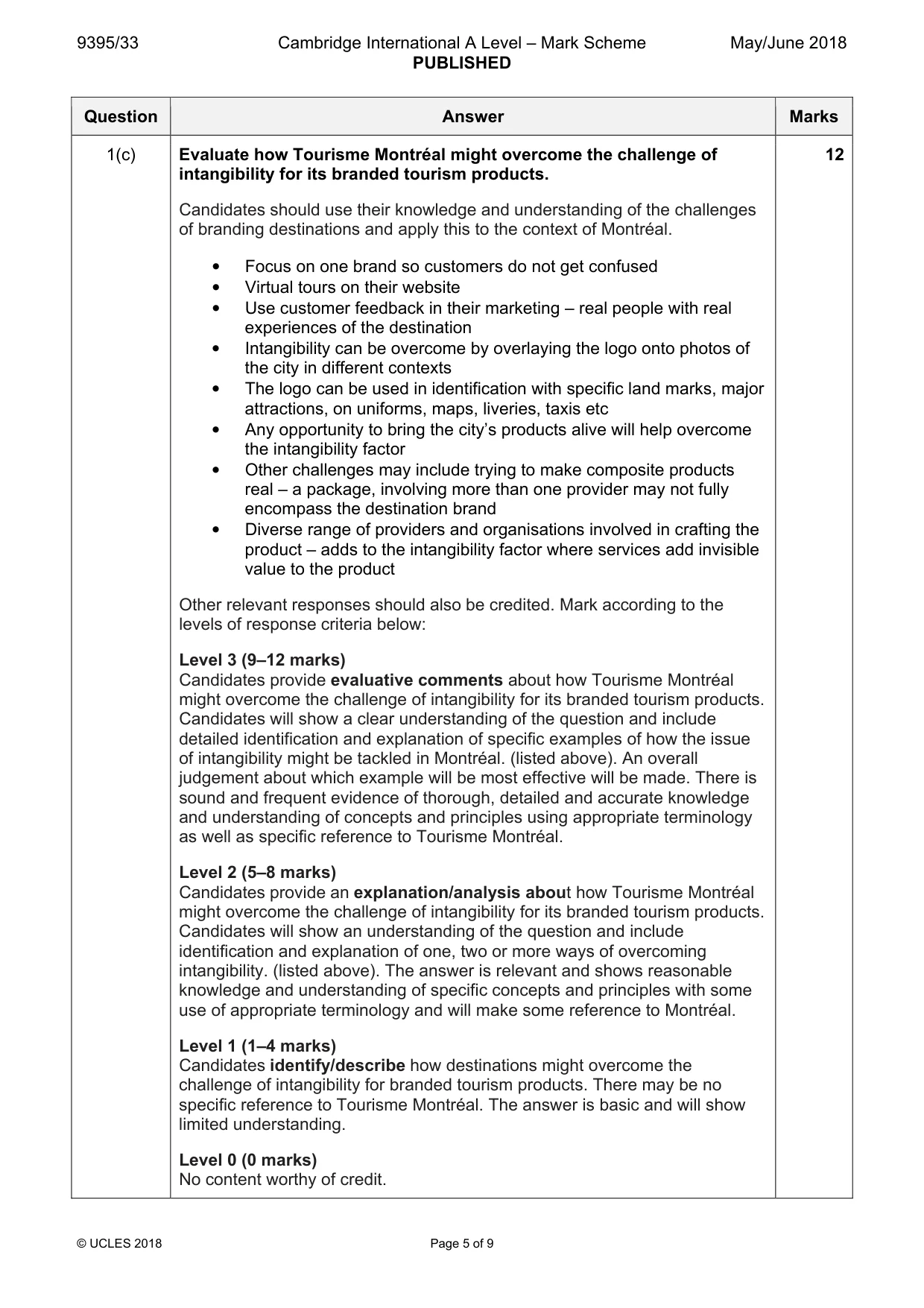
9395/33 Cambridge International A Level – Mark Scheme PUBLISHED May/June 2018 © UCLES 2018 Page 5 of 9 Question Answer Marks 1(c) Evaluate how Tourisme Montréal might overcome the challenge of intangibility for its branded tourism products. Candidates should use their knowledge and understanding of the challenges of branding destinations and apply this to the context of Montréal. • Focus on one brand so customers do not get confused • Virtual tours on their website • Use customer feedback in their marketing – real people with real experiences of the destination • Intangibility can be overcome by overlaying the logo onto photos of the city in different contexts • The logo can be used in identification with specific land marks, major attractions, on uniforms, maps, liveries, taxis etc • Any opportunity to bring the city’s products alive will help overcome the intangibility factor • Other challenges may include trying to make composite products real – a package, involving more than one provider may not fully encompass the destination brand • Diverse range of providers and organisations involved in crafting the product – adds to the intangibility factor where services add invisible value to the product Other relevant responses should also be credited. Mark according to the levels of response criteria below: Level 3 (9–12 marks) Candidates provide evaluative comments about how Tourisme Montréal might overcome the challenge of intangibility for its branded tourism products. Candidates will show a clear understanding of the question and include detailed identification and explanation of specific examples of how the issue of intangibility might be tackled in Montréal. (listed above). An overall judgement about which example will be most effective will be made. There is sound and frequent evidence of thorough, detailed and accurate knowledge and understanding of concepts and principles using appropriate terminology as well as specific reference to Tourisme Montréal. Level 2 (5–8 marks) Candidates provide an explanation/analysis about how Tourisme Montréal might overcome the challenge of intangibility for its branded tourism products. Candidates will show an understanding of the question and include identification and explanation of one, two or more ways of overcoming intangibility. (listed above). The answer is relevant and shows reasonable knowledge and understanding of specific concepts and principles with some use of appropriate terminology and will make some reference to Montréal. Level 1 (1–4 marks) Candidates identify/describe how destinations might overcome the challenge of intangibility for branded tourism products. There may be no specific reference to Tourisme Montréal. The answer is basic and will show limited understanding. Level 0 (0 marks) No content worthy of credit. 12
Mark scheme, page 6
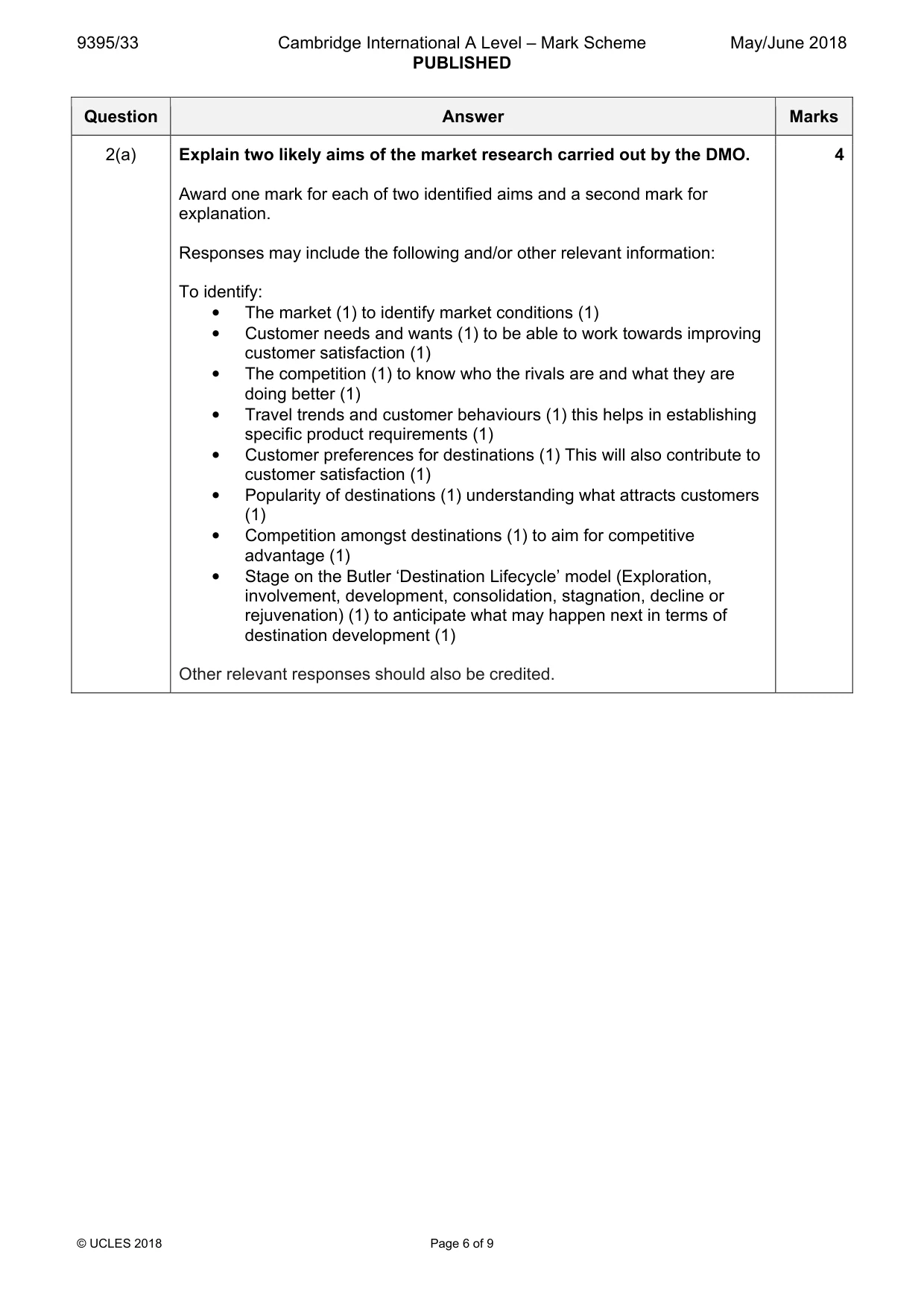
9395/33 Cambridge International A Level – Mark Scheme PUBLISHED May/June 2018 © UCLES 2018 Page 6 of 9 Question Answer Marks 2(a) Explain two likely aims of the market research carried out by the DMO. Award one mark for each of two identified aims and a second mark for explanation. Responses may include the following and/or other relevant information: To identify: • The market (1) to identify market conditions (1) • Customer needs and wants (1) to be able to work towards improving customer satisfaction (1) • The competition (1) to know who the rivals are and what they are doing better (1) • Travel trends and customer behaviours (1) this helps in establishing specific product requirements (1) • Customer preferences for destinations (1) This will also contribute to customer satisfaction (1) • Popularity of destinations (1) understanding what attracts customers (1) • Competition amongst destinations (1) to aim for competitive advantage (1) • Stage on the Butler ‘Destination Lifecycle’ model (Exploration, involvement, development, consolidation, stagnation, decline or rejuvenation) (1) to anticipate what may happen next in terms of destination development (1) Other relevant responses should also be credited. 4
Mark scheme, page 7
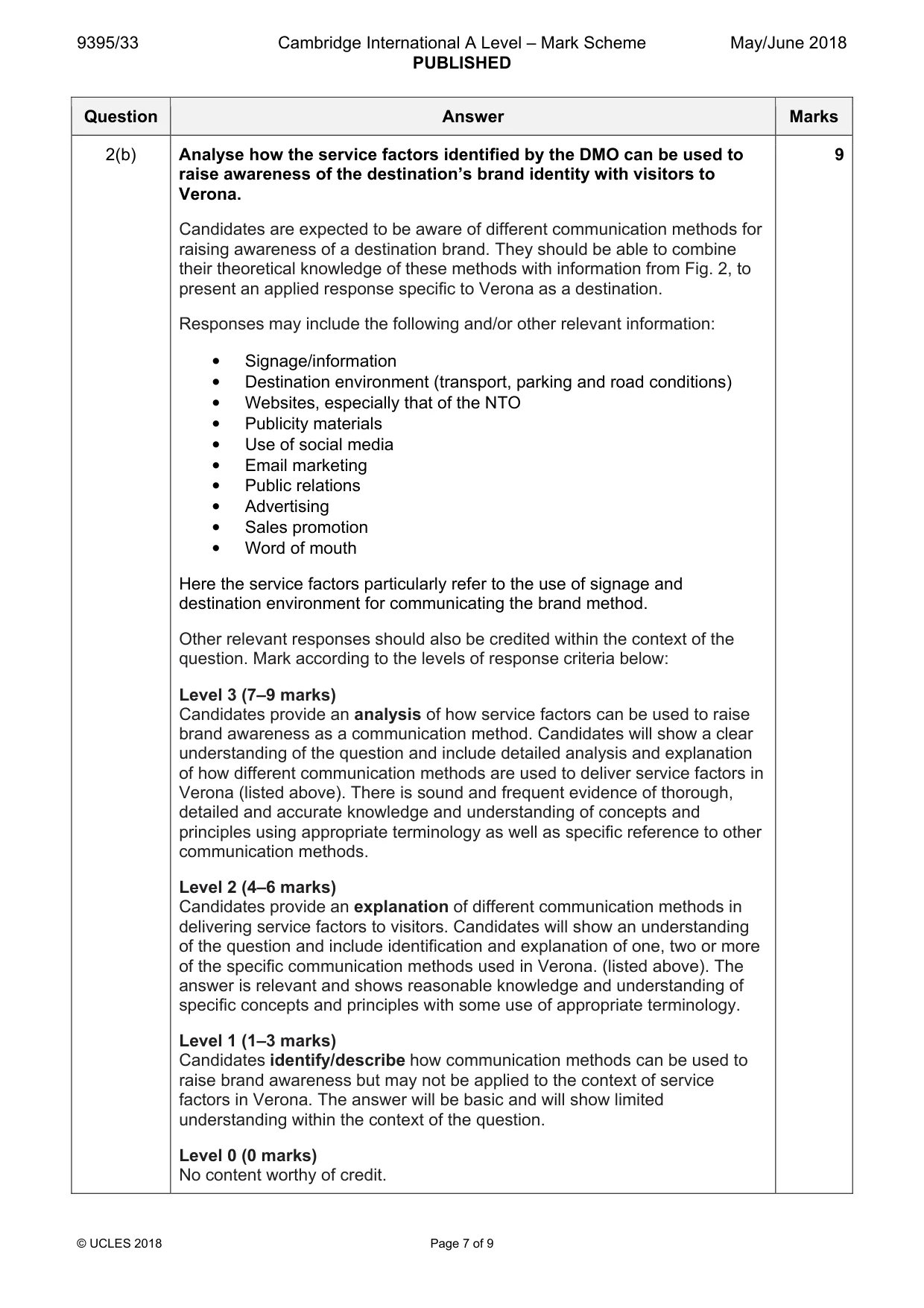
9395/33 Cambridge International A Level – Mark Scheme PUBLISHED May/June 2018 © UCLES 2018 Page 7 of 9 Question Answer Marks 2(b) Analyse how the service factors identified by the DMO can be used to raise awareness of the destination’s brand identity with visitors to Verona. Candidates are expected to be aware of different communication methods for raising awareness of a destination brand. They should be able to combine their theoretical knowledge of these methods with information from Fig. 2, to present an applied response specific to Verona as a destination. Responses may include the following and/or other relevant information: • Signage/information • Destination environment (transport, parking and road conditions) • Websites, especially that of the NTO • Publicity materials • Use of social media • Email marketing • Public relations • Advertising • Sales promotion • Word of mouth Here the service factors particularly refer to the use of signage and destination environment for communicating the brand method. Other relevant responses should also be credited within the context of the question. Mark according to the levels of response criteria below: Level 3 (7–9 marks) Candidates provide an analysis of how service factors can be used to raise brand awareness as a communication method. Candidates will show a clear understanding of the question and include detailed analysis and explanation of how different communication methods are used to deliver service factors in Verona (listed above). There is sound and frequent evidence of thorough, detailed and accurate knowledge and understanding of concepts and principles using appropriate terminology as well as specific reference to other communication methods. Level 2 (4–6 marks) Candidates provide an explanation of different communication methods in delivering service factors to visitors. Candidates will show an understanding of the question and include identification and explanation of one, two or more of the specific communication methods used in Verona. (listed above). The answer is relevant and shows reasonable knowledge and understanding of specific concepts and principles with some use of appropriate terminology. Level 1 (1–3 marks) Candidates identify/describe how communication methods can be used to raise brand awareness but may not be applied to the context of service factors in Verona. The answer will be basic and will show limited understanding within the context of the question. Level 0 (0 marks) No content worthy of credit. 9
Mark scheme, page 8
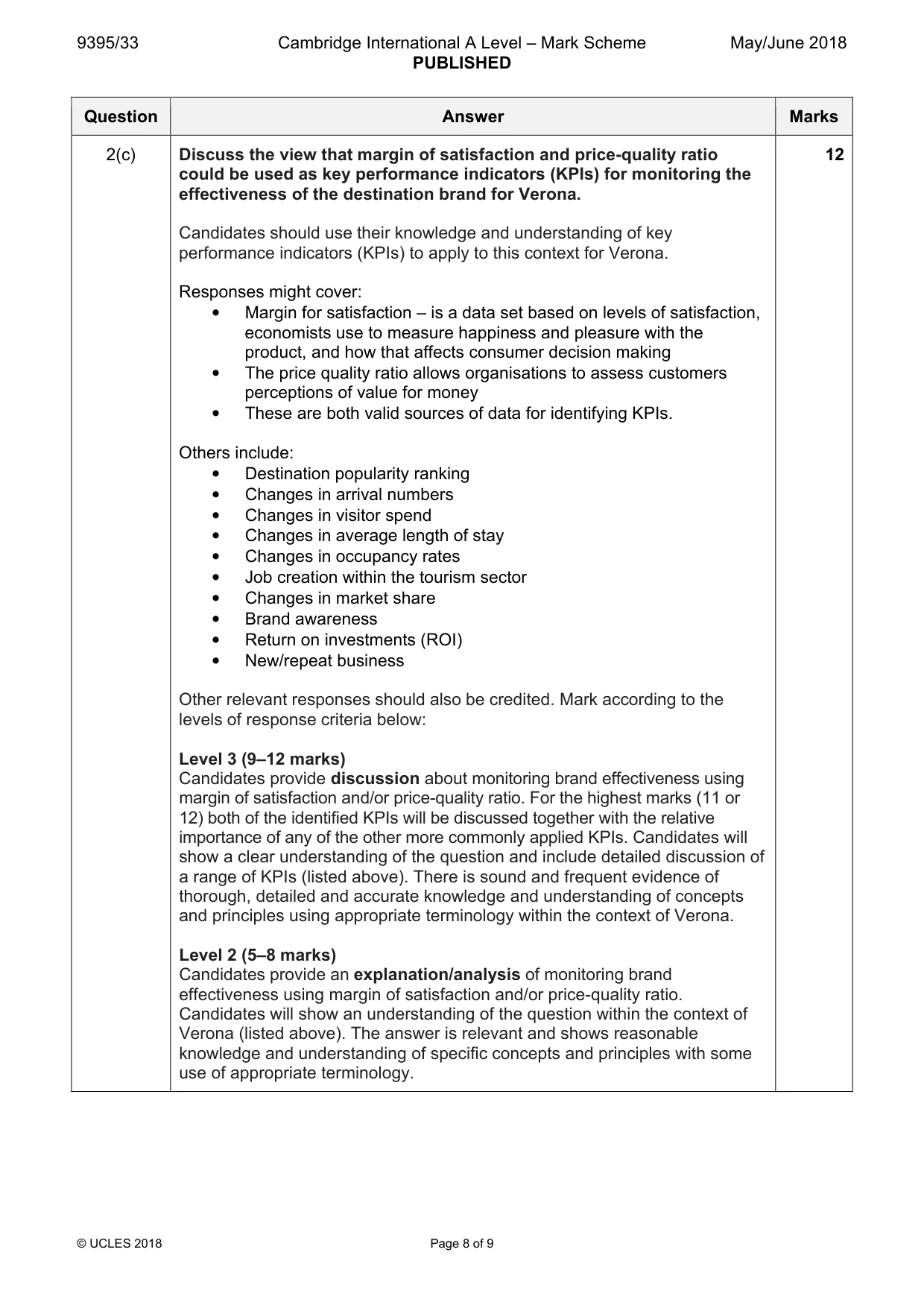
9395/33 Cambridge International A Level – Mark Scheme PUBLISHED May/June 2018 © UCLES 2018 Page 8 of 9 Question Answer Marks 2(c) Discuss the view that margin of satisfaction and price-quality ratio could be used as key performance indicators (KPIs) for monitoring the effectiveness of the destination brand for Verona. Candidates should use their knowledge and understanding of key performance indicators (KPIs) to apply to this context for Verona. Responses might cover: • Margin for satisfaction – is a data set based on levels of satisfaction, economists use to measure happiness and pleasure with the product, and how that affects consumer decision making • The price quality ratio allows organisations to assess customers perceptions of value for money • These are both valid sources of data for identifying KPIs. Others include: • Destination popularity ranking • Changes in arrival numbers • Changes in visitor spend • Changes in average length of stay • Changes in occupancy rates • Job creation within the tourism sector • Changes in market share • Brand awareness • Return on investments (ROI) • New/repeat business Other relevant responses should also be credited. Mark according to the levels of response criteria below: Level 3 (9–12 marks) Candidates provide discussion about monitoring brand effectiveness using margin of satisfaction and/or price-quality ratio. For the highest marks (11 or 12) both of the identified KPIs will be discussed together with the relative importance of any of the other more commonly applied KPIs. Candidates will show a clear understanding of the question and include detailed discussion of a range of KPIs (listed above). There is sound and frequent evidence of thorough, detailed and accurate knowledge and understanding of concepts and principles using appropriate terminology within the context of Verona. Level 2 (5–8 marks) Candidates provide an explanation/analysis of monitoring brand effectiveness using margin of satisfaction and/or price-quality ratio. Candidates will show an understanding of the question within the context of Verona (listed above). The answer is relevant and shows reasonable knowledge and understanding of specific concepts and principles with some use of appropriate terminology. 12
Mark scheme, page 9
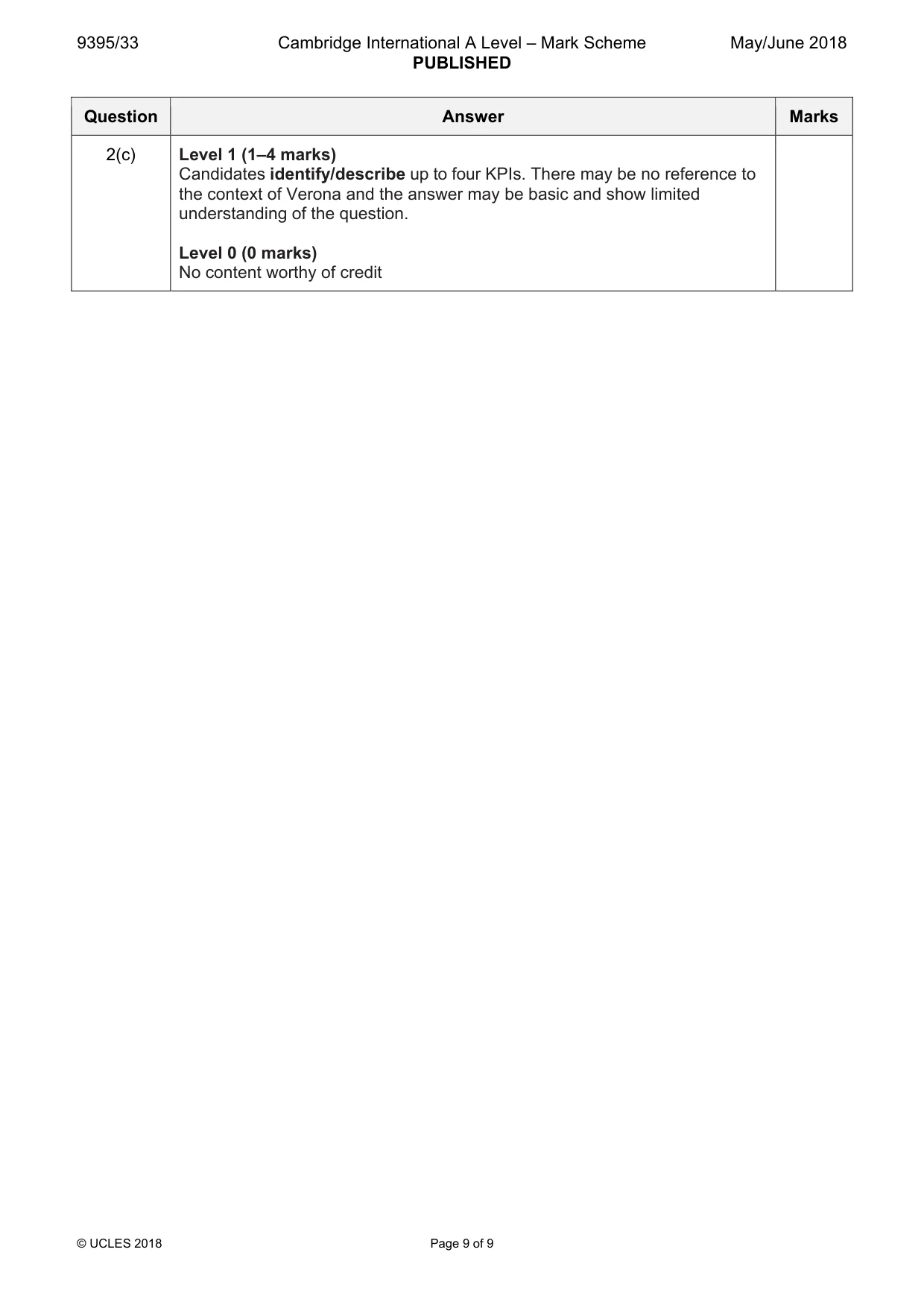
9395/33 Cambridge International A Level – Mark Scheme PUBLISHED May/June 2018 © UCLES 2018 Page 9 of 9 Question Answer Marks 2(c) Level 1 (1–4 marks) Candidates identify/describe up to four KPIs. There may be no reference to the context of Verona and the answer may be basic and show limited understanding of the question. Level 0 (0 marks) No content worthy of credit
What you needed in this session
Cambridge’s own grade thresholds for 2018 May/June, Paper 3 · Variant 3. A higher threshold means an easier paper — the bar moves with how the cohort did.