Cambridge A Level Travel and Tourism 9395 — 2017 Oct/Nov Paper 4 · Variant 2
9395/42/O/N/17 · 50 marks · ≈56 min
The question paper and its mark scheme, free to read here and free to download. This is Cambridge’s own paper, exactly as it was sat.
Question paper8 pages




Mark scheme7 pages
Answers below. Sit the paper first if you are practising.
Paper as text
Question paper, page 1
This document consists of 7 printed pages, 1 blank page and 1 Insert. DC (RCL (JDA)) 131822/3 © UCLES 2017 [Turn over * 3 0 4 0 8 4 8 8 5 6 * TRAVEL AND TOURISM 9395/42 Paper 4 Destination Management October/November 2017 1 hour 30 minutes Candidates answer on the Question Paper. No Additional Materials are required. READ THESE INSTRUCTIONS FIRST Write your Centre number, candidate number and name on all the work you hand in. Write in dark blue or black pen. Do not use staples, paper clips, glue or correction fluid. You may use an HB pencil for any diagrams or graphs. DO NOT WRITE IN ANY BARCODES. Answer all questions. All the Figures referred to in the questions are contained in the Insert. The number of marks is given in brackets [ ] at the end of each question or part question. Cambridge International Examinations Cambridge International Advanced Subsidiary and Advanced Level
Question paper, page 2
2 9395/42/O/N/17 © UCLES 2017 Question 1 Refer to Fig.1 (Insert), information about Sumak Travel, a responsible tour operator. (a) Explain two roles of commercial organisations, such as Sumak Travel, in destination management. 1 … … … … 2 … … … …[4]
Question paper, page 3
3 9395/42/O/N/17 © UCLES 2017 [Turn over (b) Explain how tour operators, such as Sumak Travel, try to educate tourists to be culturally aware. … … … … … … … … … … … … … … … … … …[9]
Question paper, page 4
4 9395/42/O/N/17 © UCLES 2017 (c) Discuss the importance of developing new products and services in destination management. … … … … … … … … … … … … … … … … … … … … … … … …[12] [Total: 25]
Question paper, page 5
5 9395/42/O/N/17 © UCLES 2017 [Turn over Question 2 Refer to Fig. 2 (Insert), information about airport expansion. (a) Explain two advantages of conducting an Environmental Impact Assessment (EIA) before an airport is built. 1 … … … … 2 … … … …[4]
Question paper, page 6
6 9395/42/O/N/17 © UCLES 2017 (b) Assess the economic impacts that airport expansion may bring to the local community. … … … … … … … … … … … … … … … … … …[9]
Question paper, page 7
7 9395/42/O/N/17 © UCLES 2017 (c) Evaluate the possible negative environmental impacts of airport expansion. … … … … … … … … … … … … … … … … … … … … … … … …[12] [Total: 25]
Question paper, page 8
8 9395/42/O/N/17 © UCLES 2017 Permission to reproduce items where third-party owned material protected by copyright is included has been sought and cleared where possible. Every reasonable effort has been made by the publisher (UCLES) to trace copyright holders, but if any items requiring clearance have unwittingly been included, the publisher will be pleased to make amends at the earliest possible opportunity. To avoid the issue of disclosure of answer-related information to candidates, all copyright acknowledgements are reproduced online in the Cambridge International Examinations Copyright Acknowledgements Booklet. This is produced for each series of examinations and is freely available to download at www.cie.org.uk after the live examination series. Cambridge International Examinations is part of the Cambridge Assessment Group. Cambridge Assessment is the brand name of University of Cambridge Local Examinations Syndicate (UCLES), which is itself a department of the University of Cambridge. BLANK PAGE
Mark scheme, page 1
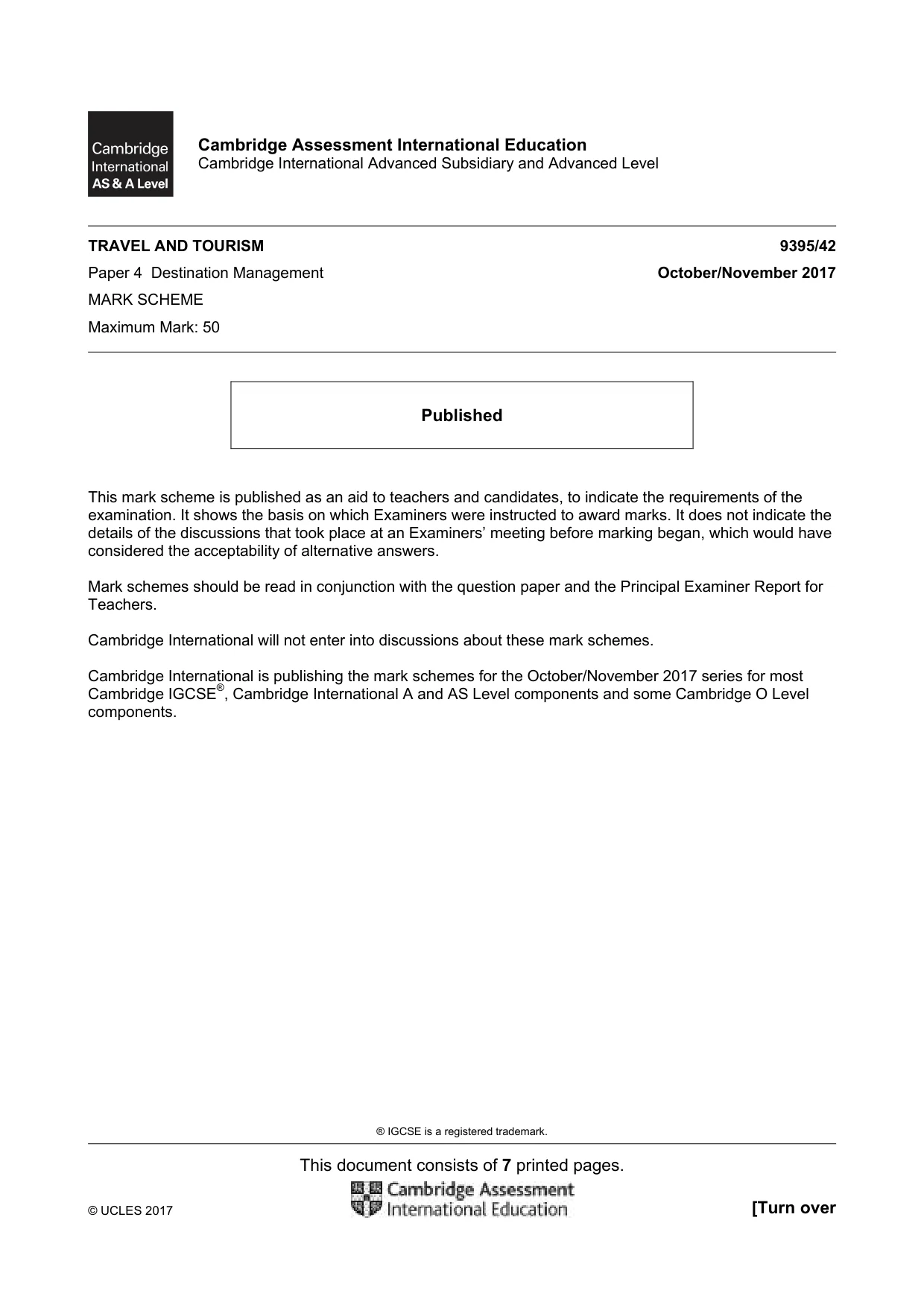
® IGCSE is a registered trademark. This document consists of 7 printed pages. © UCLES 2017 [Turn over Cambridge Assessment International Education Cambridge International Advanced Subsidiary and Advanced Level TRAVEL AND TOURISM 9395/42 Paper 4 Destination Management October/November 2017 MARK SCHEME Maximum Mark: 50 Published This mark scheme is published as an aid to teachers and candidates, to indicate the requirements of the examination. It shows the basis on which Examiners were instructed to award marks. It does not indicate the details of the discussions that took place at an Examiners’ meeting before marking began, which would have considered the acceptability of alternative answers. Mark schemes should be read in conjunction with the question paper and the Principal Examiner Report for Teachers. Cambridge International will not enter into discussions about these mark schemes. Cambridge International is publishing the mark schemes for the October/November 2017 series for most Cambridge IGCSE®, Cambridge International A and AS Level components and some Cambridge O Level components.
Mark scheme, page 2
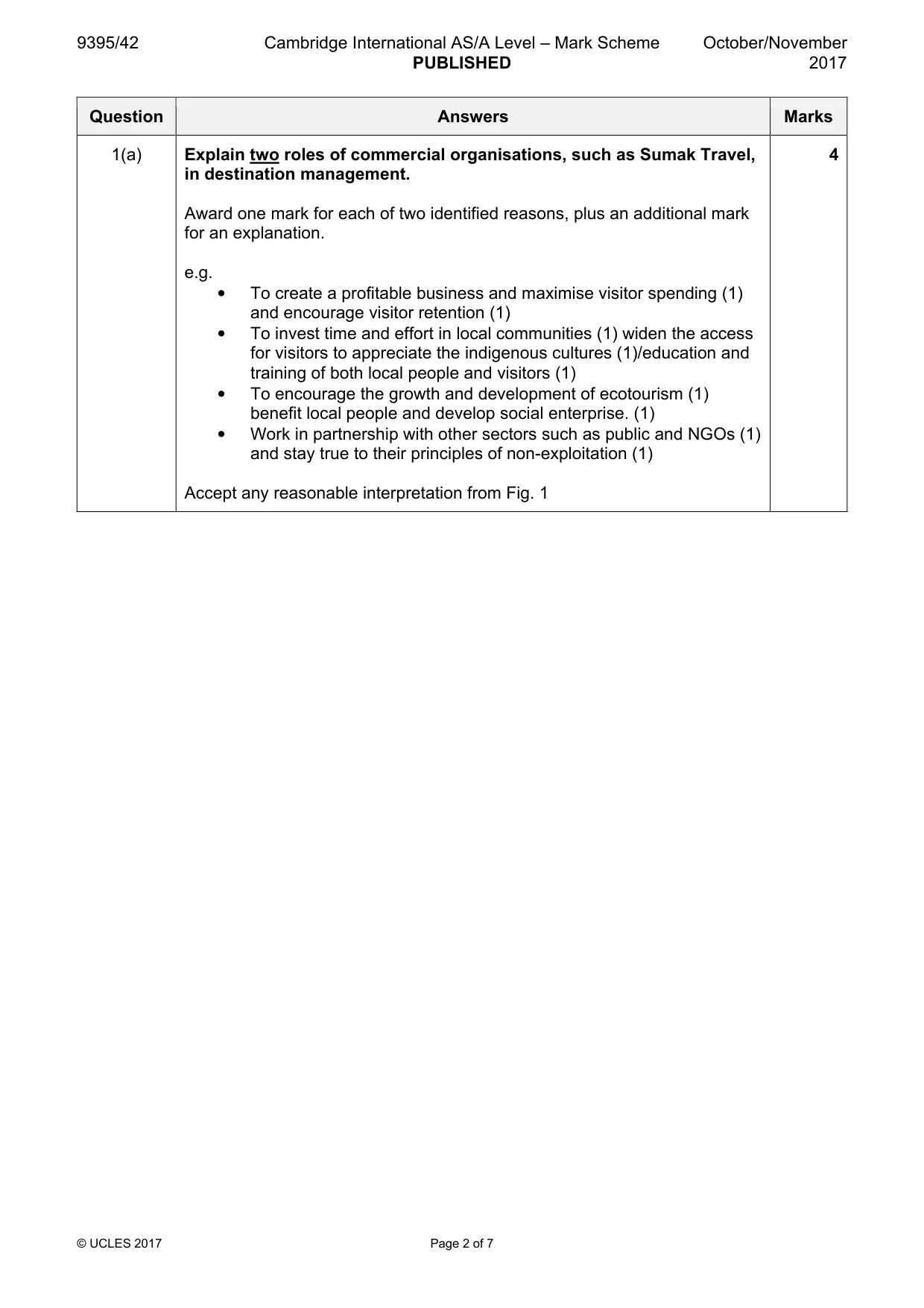
9395/42 Cambridge International AS/A Level – Mark Scheme PUBLISHED October/November 2017 © UCLES 2017 Page 2 of 7 Question Answers Marks 1(a) Explain two roles of commercial organisations, such as Sumak Travel, in destination management. Award one mark for each of two identified reasons, plus an additional mark for an explanation. e.g. • To create a profitable business and maximise visitor spending (1) and encourage visitor retention (1) • To invest time and effort in local communities (1) widen the access for visitors to appreciate the indigenous cultures (1)/education and training of both local people and visitors (1) • To encourage the growth and development of ecotourism (1) benefit local people and develop social enterprise. (1) • Work in partnership with other sectors such as public and NGOs (1) and stay true to their principles of non-exploitation (1) Accept any reasonable interpretation from Fig. 1 4
Mark scheme, page 3
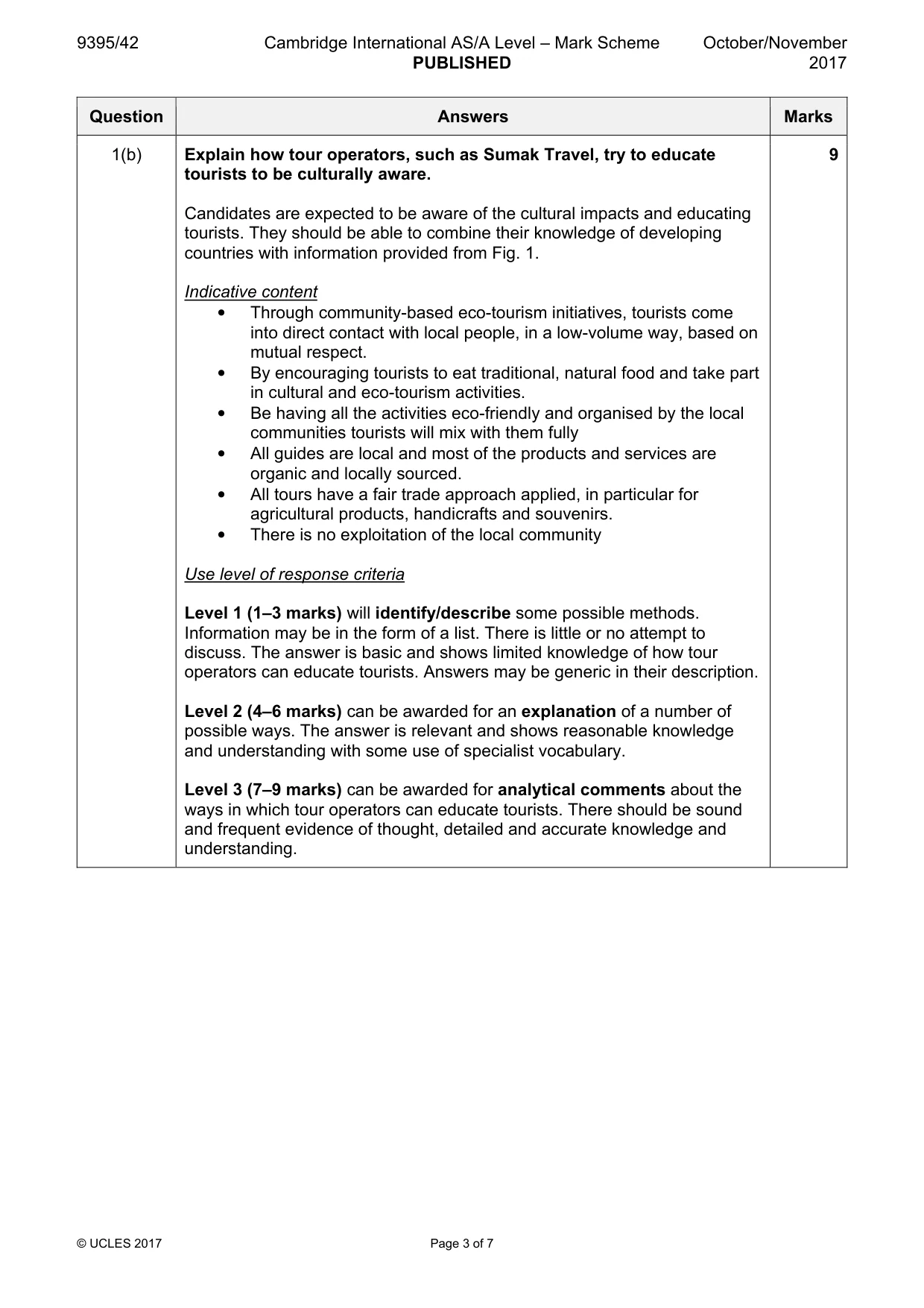
9395/42 Cambridge International AS/A Level – Mark Scheme PUBLISHED October/November 2017 © UCLES 2017 Page 3 of 7 Question Answers Marks 1(b) Explain how tour operators, such as Sumak Travel, try to educate tourists to be culturally aware. Candidates are expected to be aware of the cultural impacts and educating tourists. They should be able to combine their knowledge of developing countries with information provided from Fig. 1. Indicative content • Through community-based eco-tourism initiatives, tourists come into direct contact with local people, in a low-volume way, based on mutual respect. • By encouraging tourists to eat traditional, natural food and take part in cultural and eco-tourism activities. • Be having all the activities eco-friendly and organised by the local communities tourists will mix with them fully • All guides are local and most of the products and services are organic and locally sourced. • All tours have a fair trade approach applied, in particular for agricultural products, handicrafts and souvenirs. • There is no exploitation of the local community Use level of response criteria Level 1 (1–3 marks) will identify/describe some possible methods. Information may be in the form of a list. There is little or no attempt to discuss. The answer is basic and shows limited knowledge of how tour operators can educate tourists. Answers may be generic in their description. Level 2 (4–6 marks) can be awarded for an explanation of a number of possible ways. The answer is relevant and shows reasonable knowledge and understanding with some use of specialist vocabulary. Level 3 (7–9 marks) can be awarded for analytical comments about the ways in which tour operators can educate tourists. There should be sound and frequent evidence of thought, detailed and accurate knowledge and understanding. 9
Mark scheme, page 4
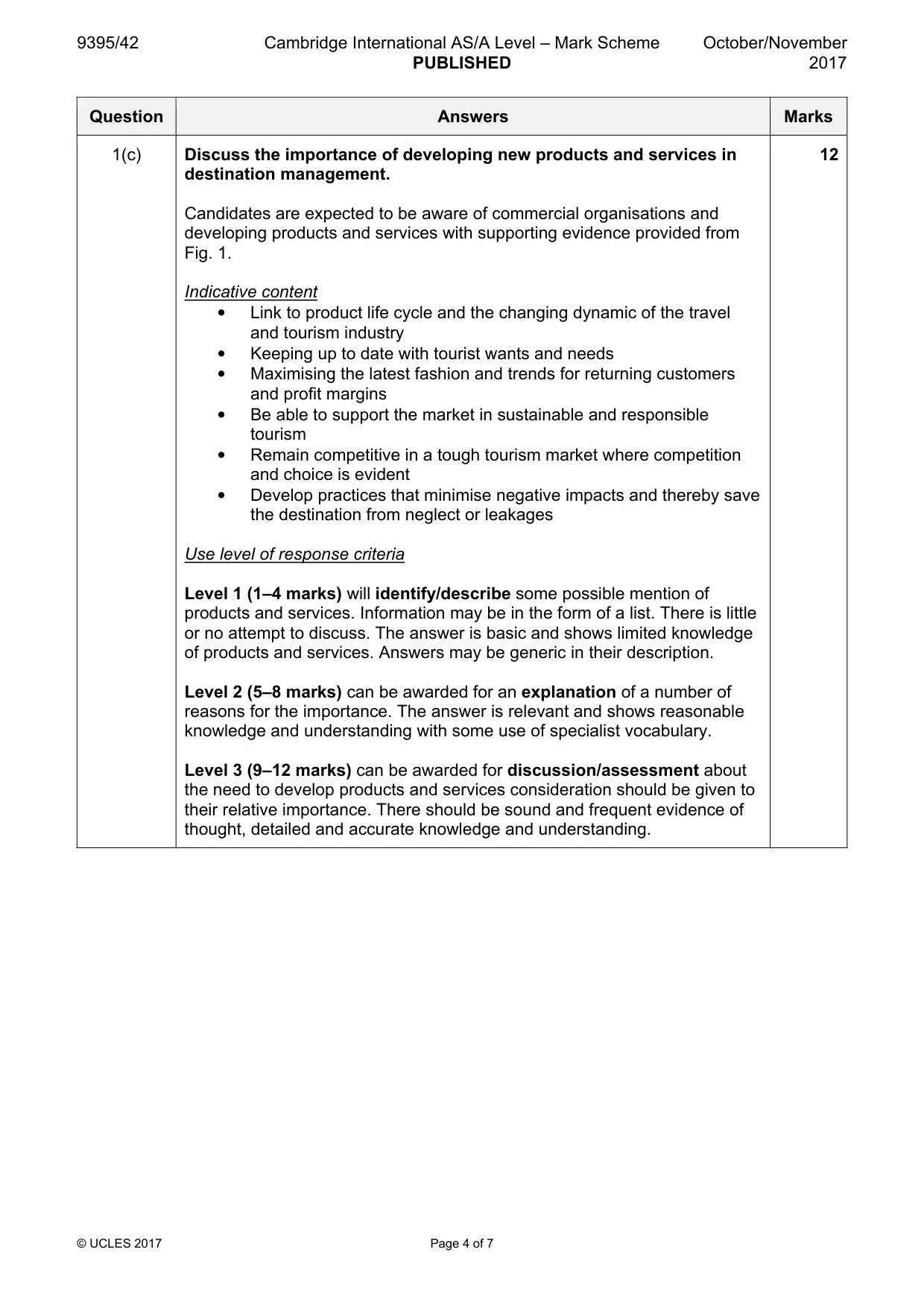
9395/42 Cambridge International AS/A Level – Mark Scheme PUBLISHED October/November 2017 © UCLES 2017 Page 4 of 7 Question Answers Marks 1(c) Discuss the importance of developing new products and services in destination management. Candidates are expected to be aware of commercial organisations and developing products and services with supporting evidence provided from Fig. 1. Indicative content • Link to product life cycle and the changing dynamic of the travel and tourism industry • Keeping up to date with tourist wants and needs • Maximising the latest fashion and trends for returning customers and profit margins • Be able to support the market in sustainable and responsible tourism • Remain competitive in a tough tourism market where competition and choice is evident • Develop practices that minimise negative impacts and thereby save the destination from neglect or leakages Use level of response criteria Level 1 (1–4 marks) will identify/describe some possible mention of products and services. Information may be in the form of a list. There is little or no attempt to discuss. The answer is basic and shows limited knowledge of products and services. Answers may be generic in their description. Level 2 (5–8 marks) can be awarded for an explanation of a number of reasons for the importance. The answer is relevant and shows reasonable knowledge and understanding with some use of specialist vocabulary. Level 3 (9–12 marks) can be awarded for discussion/assessment about the need to develop products and services consideration should be given to their relative importance. There should be sound and frequent evidence of thought, detailed and accurate knowledge and understanding. 12
Mark scheme, page 5
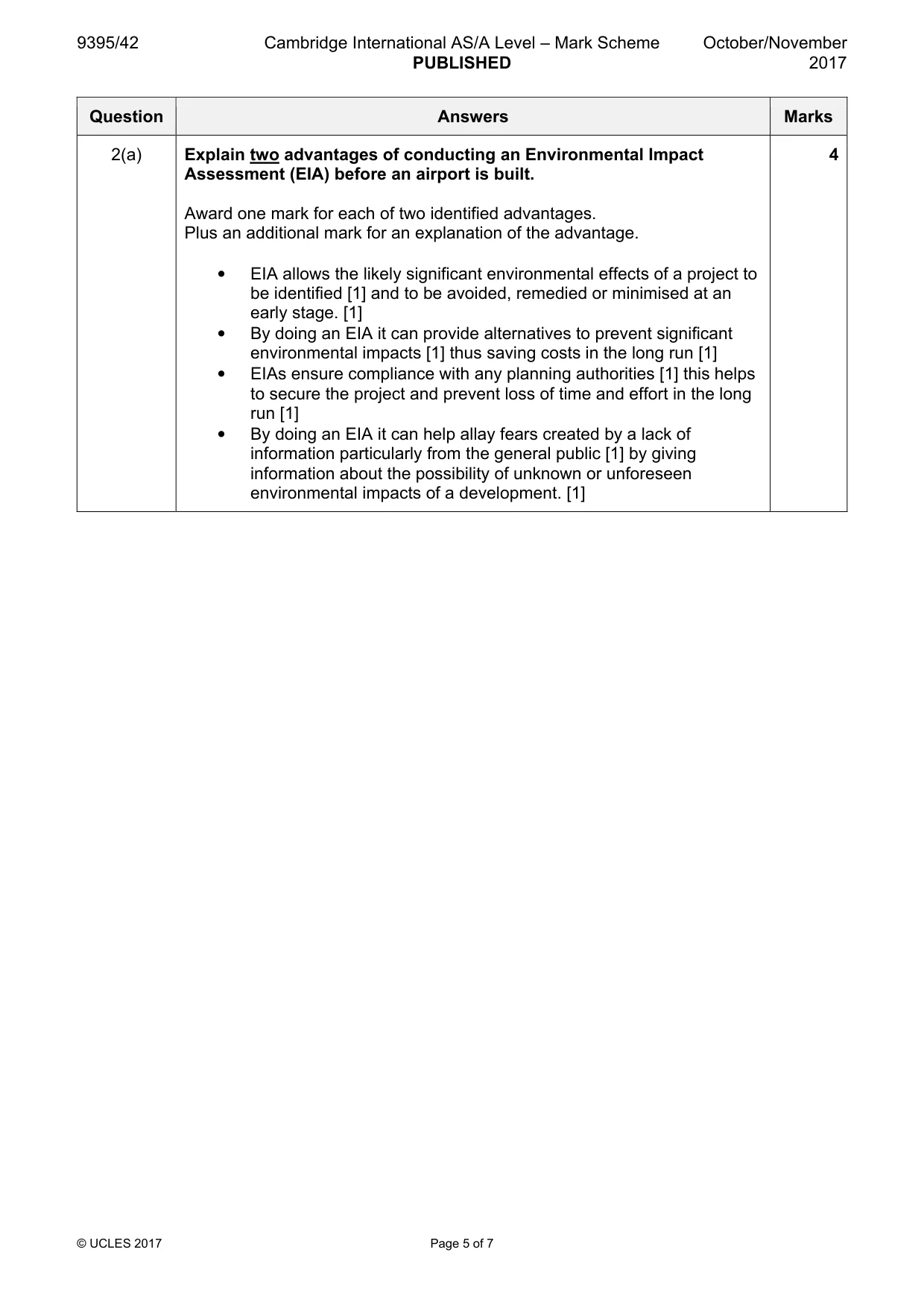
9395/42 Cambridge International AS/A Level – Mark Scheme PUBLISHED October/November 2017 © UCLES 2017 Page 5 of 7 Question Answers Marks 2(a) Explain two advantages of conducting an Environmental Impact Assessment (EIA) before an airport is built. Award one mark for each of two identified advantages. Plus an additional mark for an explanation of the advantage. • EIA allows the likely significant environmental effects of a project to be identified [1] and to be avoided, remedied or minimised at an early stage. [1] • By doing an EIA it can provide alternatives to prevent significant environmental impacts [1] thus saving costs in the long run [1] • EIAs ensure compliance with any planning authorities [1] this helps to secure the project and prevent loss of time and effort in the long run [1] • By doing an EIA it can help allay fears created by a lack of information particularly from the general public [1] by giving information about the possibility of unknown or unforeseen environmental impacts of a development. [1] 4
Mark scheme, page 6
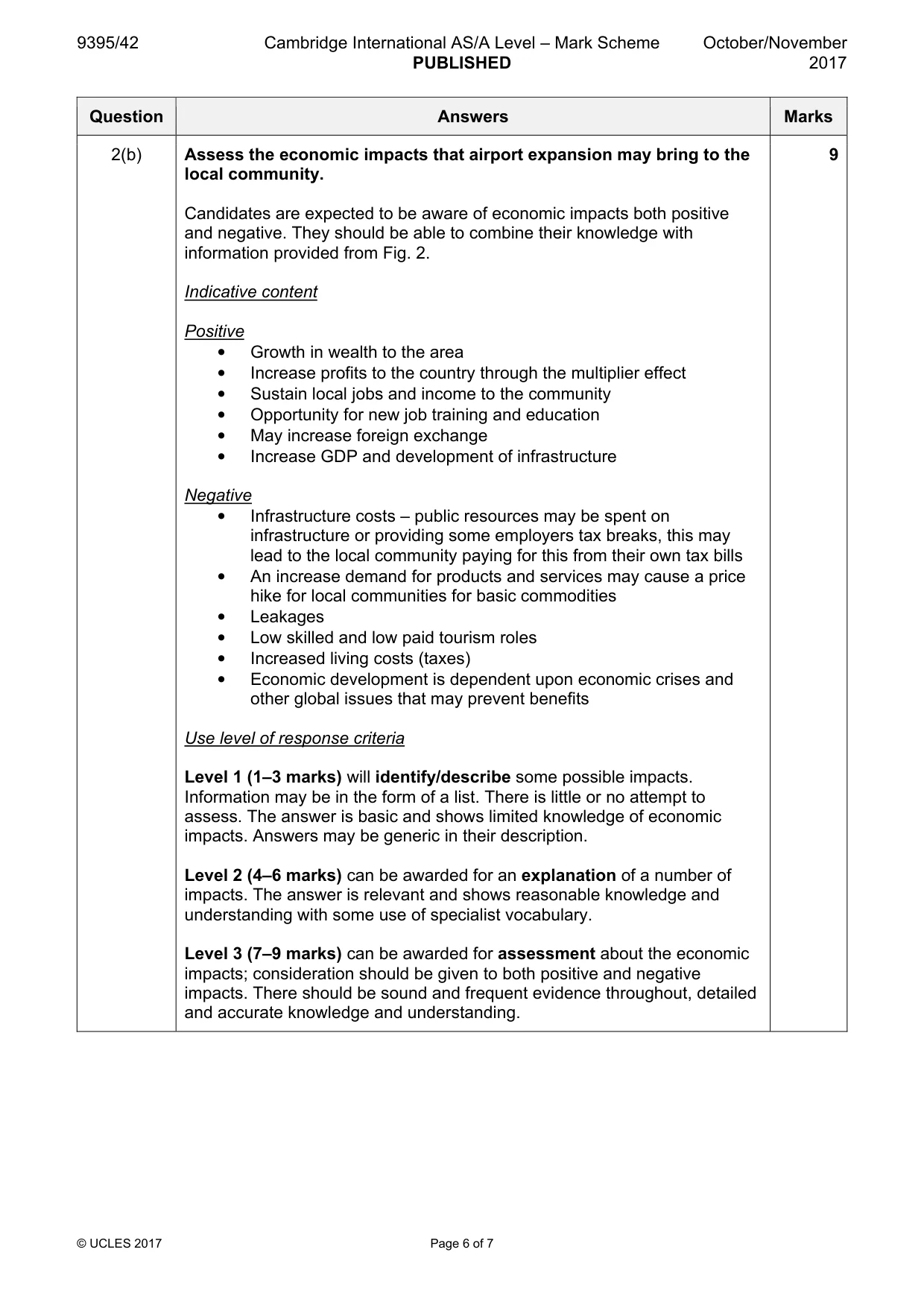
9395/42 Cambridge International AS/A Level – Mark Scheme PUBLISHED October/November 2017 © UCLES 2017 Page 6 of 7 Question Answers Marks 2(b) Assess the economic impacts that airport expansion may bring to the local community. Candidates are expected to be aware of economic impacts both positive and negative. They should be able to combine their knowledge with information provided from Fig. 2. Indicative content Positive • Growth in wealth to the area • Increase profits to the country through the multiplier effect • Sustain local jobs and income to the community • Opportunity for new job training and education • May increase foreign exchange • Increase GDP and development of infrastructure Negative • Infrastructure costs – public resources may be spent on infrastructure or providing some employers tax breaks, this may lead to the local community paying for this from their own tax bills • An increase demand for products and services may cause a price hike for local communities for basic commodities • Leakages • Low skilled and low paid tourism roles • Increased living costs (taxes) • Economic development is dependent upon economic crises and other global issues that may prevent benefits Use level of response criteria Level 1 (1–3 marks) will identify/describe some possible impacts. Information may be in the form of a list. There is little or no attempt to assess. The answer is basic and shows limited knowledge of economic impacts. Answers may be generic in their description. Level 2 (4–6 marks) can be awarded for an explanation of a number of impacts. The answer is relevant and shows reasonable knowledge and understanding with some use of specialist vocabulary. Level 3 (7–9 marks) can be awarded for assessment about the economic impacts; consideration should be given to both positive and negative impacts. There should be sound and frequent evidence throughout, detailed and accurate knowledge and understanding. 9
Mark scheme, page 7
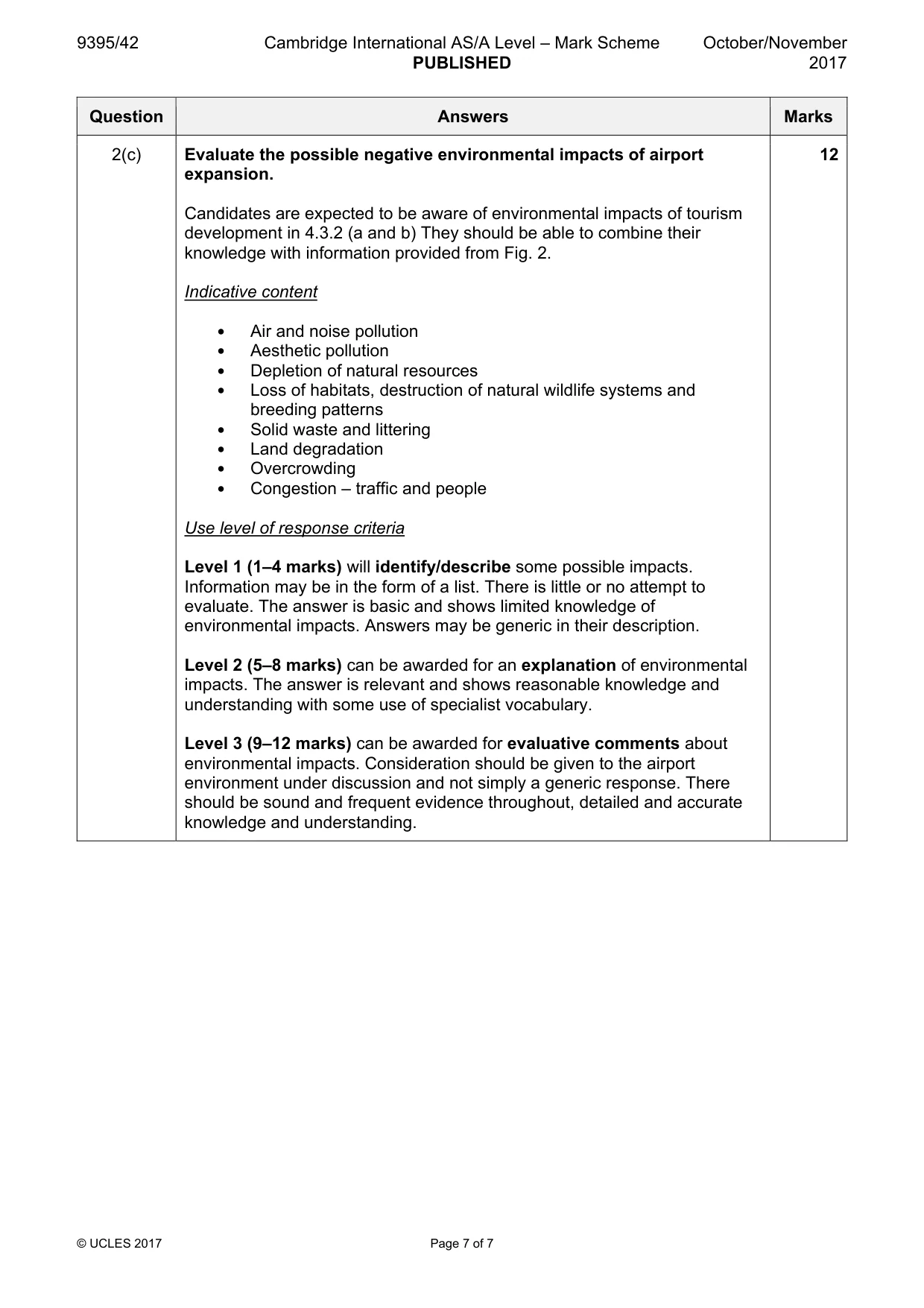
9395/42 Cambridge International AS/A Level – Mark Scheme PUBLISHED October/November 2017 © UCLES 2017 Page 7 of 7 Question Answers Marks 2(c) Evaluate the possible negative environmental impacts of airport expansion. Candidates are expected to be aware of environmental impacts of tourism development in 4.3.2 (a and b) They should be able to combine their knowledge with information provided from Fig. 2. Indicative content • Air and noise pollution • Aesthetic pollution • Depletion of natural resources • Loss of habitats, destruction of natural wildlife systems and breeding patterns • Solid waste and littering • Land degradation • Overcrowding • Congestion – traffic and people Use level of response criteria Level 1 (1–4 marks) will identify/describe some possible impacts. Information may be in the form of a list. There is little or no attempt to evaluate. The answer is basic and shows limited knowledge of environmental impacts. Answers may be generic in their description. Level 2 (5–8 marks) can be awarded for an explanation of environmental impacts. The answer is relevant and shows reasonable knowledge and understanding with some use of specialist vocabulary. Level 3 (9–12 marks) can be awarded for evaluative comments about environmental impacts. Consideration should be given to the airport environment under discussion and not simply a generic response. There should be sound and frequent evidence throughout, detailed and accurate knowledge and understanding. 12
What you needed in this session
Cambridge’s own grade thresholds for 2017 Oct/Nov, Paper 4 · Variant 2. A higher threshold means an easier paper — the bar moves with how the cohort did.