Cambridge A Level Travel and Tourism 9395 — 2017 Oct/Nov Paper 1 · Variant 1
9395/11/O/N/17 · 100 marks · ≈113 min
The question paper and its mark scheme, free to read here and free to download. This is Cambridge’s own paper, exactly as it was sat.
Question paper16 pages





Mark scheme13 pages
Answers below. Sit the paper first if you are practising.
Paper as text
Question paper, page 1
This document consists of 13 printed pages, 3 blank pages and 1 Insert. DC (JP) 153027 © UCLES 2017 [Turn over Cambridge International Examinations Cambridge International Advanced Subsidiary and Advanced Level * 7 0 6 6 6 7 1 2 9 6 * TRAVEL AND TOURISM 9395/11 Paper 1 The Industry October/November 2017 2 hours and 30 minutes Candidates answer on the Question Paper. No Additional Materials are required. READ THESE INSTRUCTIONS FIRST Write your Centre number, candidate number and name on all the work you hand in. Write in dark blue or black pen. You may use an HB pencil for any diagrams or graphs. Do not use staples, paper clips, glue or correction fluid. DO NOT WRITE IN ANY BARCODES. Answer all questions. All the Figures referred to in the questions are contained in the Insert. The number of marks is given in brackets [ ] at the end of each question or part question.
Question paper, page 2
2 9395/11/O/N/17 © UCLES 2017 Question 1 Refer to Fig. 1 (Insert), which provides information about Gare du Nord International Station, Paris. (a) Explain how two of the services provided at this station meet the needs of business travellers. 1 … … … … 2 … … … …[4] (b) Explain three advantages of rail transport for international tourists. 1 … … … … 2 … … … … 3 … … … …[6]
Question paper, page 3
3 9395/11/O/N/17 © UCLES 2017 [Turn over (c) Eurostar is a commercial organisation. Explain two business objectives of a commercial travel organisation. … … … … … … … … … … … …[6]
Question paper, page 4
4 9395/11/O/N/17 © UCLES 2017 (d) Discuss the economic factors that have encouraged the growth of leisure travel. … … … … … … … … … … … … … … … … … …[9] [Total: 25]
Question paper, page 5
5 9395/11/O/N/17 © UCLES 2017 [Turn over Question 2 Refer to Fig. 2 (Insert), information detailing the top 10 overseas tourism markets for Zimbabwe. (a) (i) Identify the country which replaced Italy within the top 10 for 2014. …[1] (ii) Suggest reasons for this change. … … … … … …[3] (b) National Tourism Organisations have a range of measures they can use for marketing. Describe three likely roles of the National Tourist Organisation of Zimbabwe. 1 … … … … 2 … … … … 3 … … … …[6]
Question paper, page 6
6 9395/11/O/N/17 © UCLES 2017 (c) Explain why domestic tourism is important to many countries. … … … … … … … … … … … …[6]
Question paper, page 7
7 9395/11/O/N/17 © UCLES 2017 [Turn over (d) Assess the impacts of the increased risk of a disease on the travel and tourism industry. … … … … … … … … … … … … … … … … … …[9] [Total: 25]
Question paper, page 8
8 9395/11/O/N/17 © UCLES 2017 Question 3 Refer to Fig. 3 (Insert), information about XYZ Flights, an online tour operator. (a) Describe two ways the XYZ Flights website meets the needs of external customers. 1 … … … … 2 … … … …[4] (b) Explain three likely needs of XYZ Flights’ internal customers. 1 … … … … 2 … … … … 3 … … … …[6]
Question paper, page 9
9 9395/11/O/N/17 © UCLES 2017 [Turn over (c) XYZ Flights encourages customer feedback via a questionnaire. Assess the value of questionnaires as a feedback method for XYZ Flights. … … … … … … … … … … … …[6]
Question paper, page 10
10 9395/11/O/N/17 © UCLES 2017 (d) Analyse how performance management and appraisal procedures may be used within a travel and tourism organisation. Use examples to support your answer. … … … … … … … … … … … … … … … … … …[9] [Total: 25]
Question paper, page 11
11 9395/11/O/N/17 © UCLES 2017 [Turn over Question 4 (a) Describe two natural attractions of rural destinations which might appeal to visitors. 1 … … … … 2 … … … …[4] (b) (i) Define the term ‘adventure tourism’. … … … …[2] (ii) Describe two adventure tourism activities. 1 … … … … 2 … … … …[4]
Question paper, page 12
12 9395/11/O/N/17 © UCLES 2017 (c) Recommend two types of accommodation suitable for adventure tourists. Give reasons for your choices. 1 … … … … … … 2 … … … … … …[6]
Question paper, page 13
13 9395/11/O/N/17 © UCLES 2017 (d) Comment upon the likely threat posed by climatic change, including global warming, to tourism in mountain areas. … … … … … … … … … … … … … … … … … …[9] [Total: 25]
Question paper, page 14
14 9395/11/O/N/17 © UCLES 2017 BLANK PAGE
Question paper, page 15
15 9395/11/O/N/17 © UCLES 2017 BLANK PAGE
Question paper, page 16
16 9395/11/O/N/17 © UCLES 2017 Permission to reproduce items where third-party owned material protected by copyright is included has been sought and cleared where possible. Every reasonable effort has been made by the publisher (UCLES) to trace copyright holders, but if any items requiring clearance have unwittingly been included, the publisher will be pleased to make amends at the earliest possible opportunity. To avoid the issue of disclosure of answer-related information to candidates, all copyright acknowledgements are reproduced online in the Cambridge International Examinations Copyright Acknowledgements Booklet. This is produced for each series of examinations and is freely available to download at www.cie.org.uk after the live examination series. Cambridge International Examinations is part of the Cambridge Assessment Group. Cambridge Assessment is the brand name of University of Cambridge Local Examinations Syndicate (UCLES), which is itself a department of the University of Cambridge. BLANK PAGE
Mark scheme, page 1
® IGCSE is a registered trademark. This document consists of 13 printed pages. © UCLES 2017 [Turn over Cambridge Assessment International Education Cambridge International Advanced Subsidiary and Advanced Level TRAVEL AND TOURISM 9395/11 Paper 1 The Industry October/November 2017 MARK SCHEME Maximum Mark: 100 Published This mark scheme is published as an aid to teachers and candidates, to indicate the requirements of the examination. It shows the basis on which Examiners were instructed to award marks. It does not indicate the details of the discussions that took place at an Examiners’ meeting before marking began, which would have considered the acceptability of alternative answers. Mark schemes should be read in conjunction with the question paper and the Principal Examiner Report for Teachers. Cambridge International will not enter into discussions about these mark schemes. Cambridge International is publishing the mark schemes for the October/November 2017 series for most Cambridge IGCSE®, Cambridge International A and AS Level components and some Cambridge O Level components.
Mark scheme, page 2
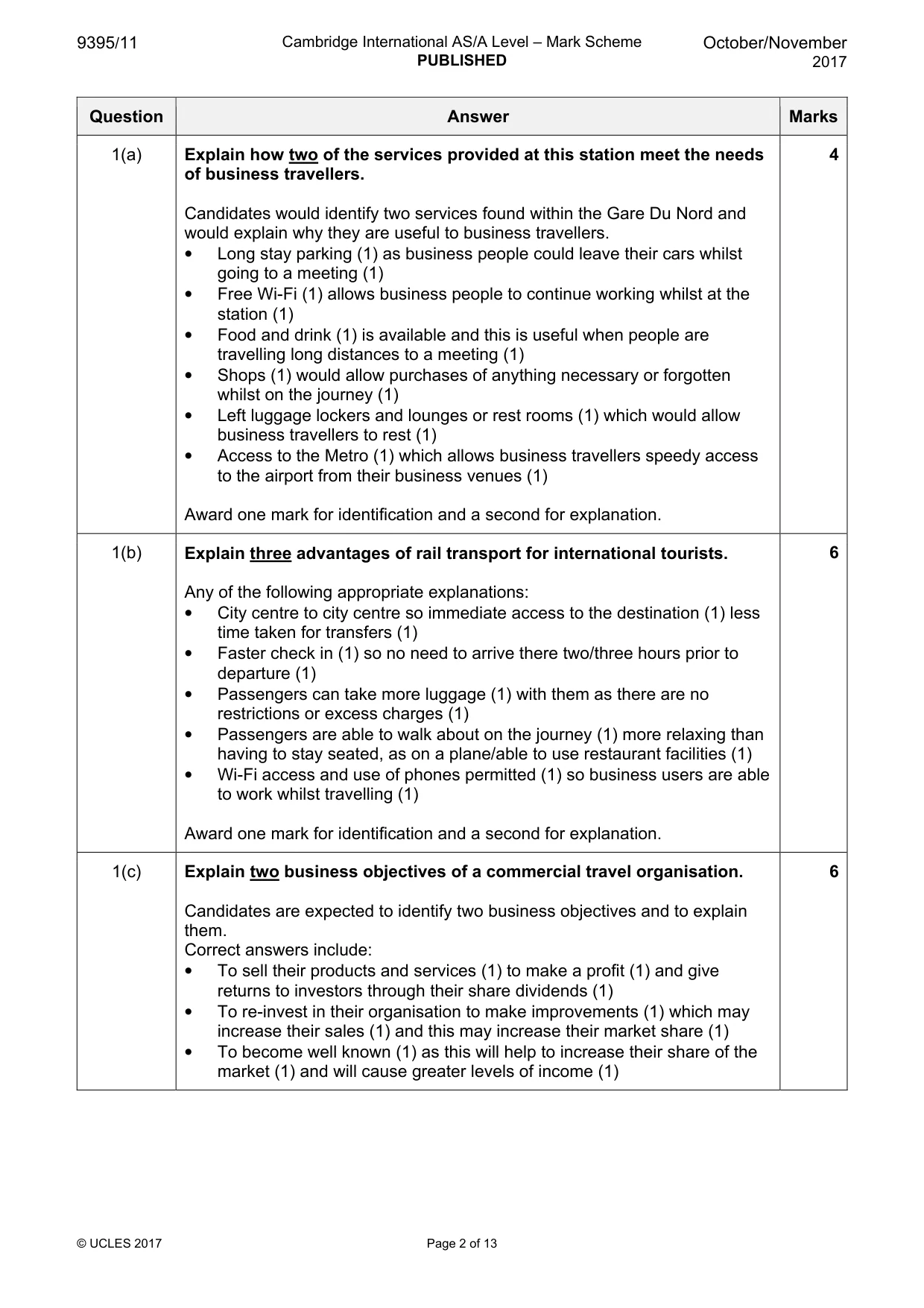
9395/11 Cambridge International AS/A Level – Mark Scheme PUBLISHED October/November 2017 © UCLES 2017 Page 2 of 13 Question Answer Marks 1(a) Explain how two of the services provided at this station meet the needs of business travellers. Candidates would identify two services found within the Gare Du Nord and would explain why they are useful to business travellers. • Long stay parking (1) as business people could leave their cars whilst going to a meeting (1) • Free Wi-Fi (1) allows business people to continue working whilst at the station (1) • Food and drink (1) is available and this is useful when people are travelling long distances to a meeting (1) • Shops (1) would allow purchases of anything necessary or forgotten whilst on the journey (1) • Left luggage lockers and lounges or rest rooms (1) which would allow business travellers to rest (1) • Access to the Metro (1) which allows business travellers speedy access to the airport from their business venues (1) Award one mark for identification and a second for explanation. 4 1(b) Explain three advantages of rail transport for international tourists. Any of the following appropriate explanations: • City centre to city centre so immediate access to the destination (1) less time taken for transfers (1) • Faster check in (1) so no need to arrive there two/three hours prior to departure (1) • Passengers can take more luggage (1) with them as there are no restrictions or excess charges (1) • Passengers are able to walk about on the journey (1) more relaxing than having to stay seated, as on a plane/able to use restaurant facilities (1) • Wi-Fi access and use of phones permitted (1) so business users are able to work whilst travelling (1) Award one mark for identification and a second for explanation. 6 1(c) Explain two business objectives of a commercial travel organisation. Candidates are expected to identify two business objectives and to explain them. Correct answers include: • To sell their products and services (1) to make a profit (1) and give returns to investors through their share dividends (1) • To re-invest in their organisation to make improvements (1) which may increase their sales (1) and this may increase their market share (1) • To become well known (1) as this will help to increase their share of the market (1) and will cause greater levels of income (1) 6
Mark scheme, page 3
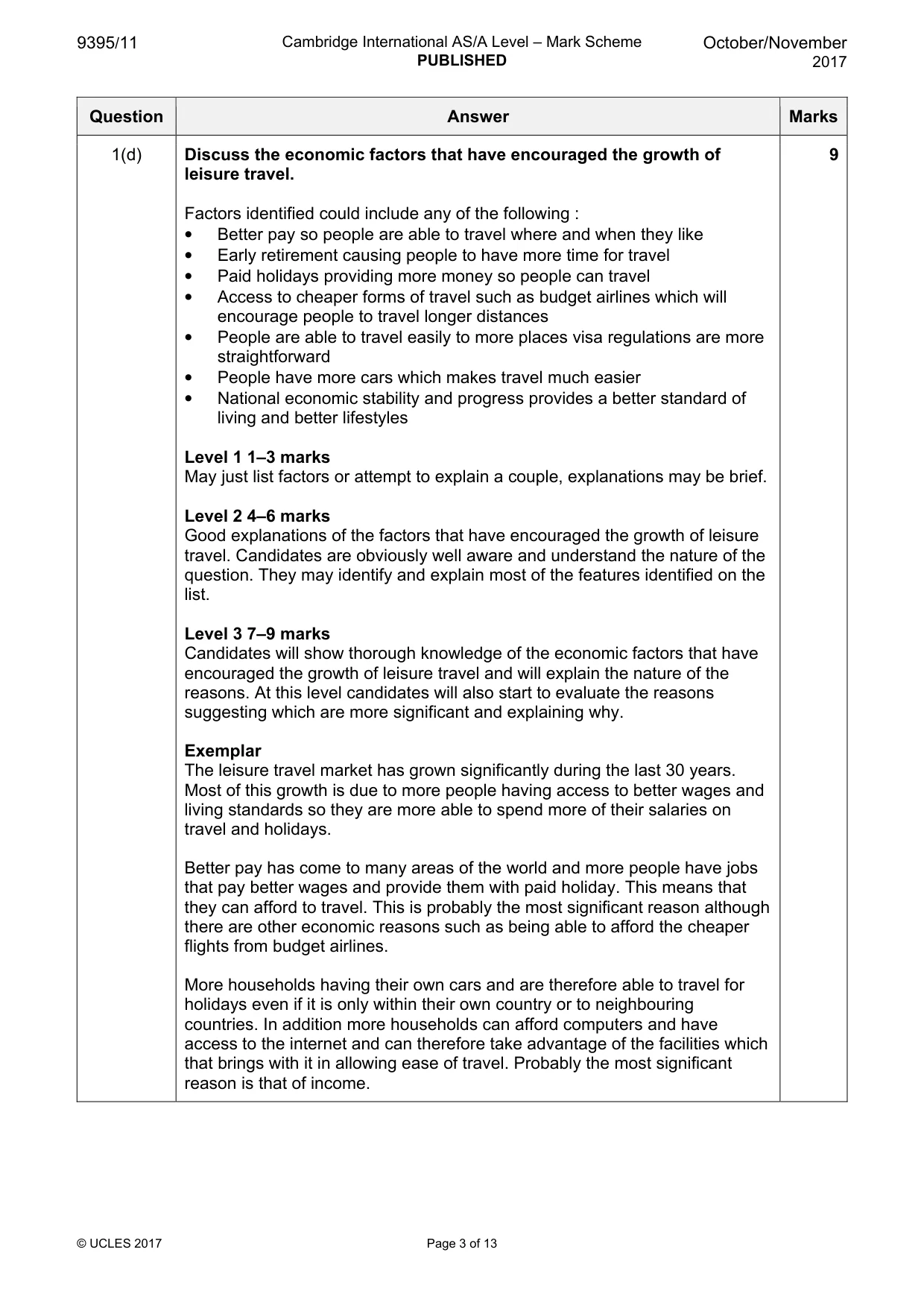
9395/11 Cambridge International AS/A Level – Mark Scheme PUBLISHED October/November 2017 © UCLES 2017 Page 3 of 13 Question Answer Marks 1(d) Discuss the economic factors that have encouraged the growth of leisure travel. Factors identified could include any of the following : • Better pay so people are able to travel where and when they like • Early retirement causing people to have more time for travel • Paid holidays providing more money so people can travel • Access to cheaper forms of travel such as budget airlines which will encourage people to travel longer distances • People are able to travel easily to more places visa regulations are more straightforward • People have more cars which makes travel much easier • National economic stability and progress provides a better standard of living and better lifestyles Level 1 1–3 marks May just list factors or attempt to explain a couple, explanations may be brief. Level 2 4–6 marks Good explanations of the factors that have encouraged the growth of leisure travel. Candidates are obviously well aware and understand the nature of the question. They may identify and explain most of the features identified on the list. Level 3 7–9 marks Candidates will show thorough knowledge of the economic factors that have encouraged the growth of leisure travel and will explain the nature of the reasons. At this level candidates will also start to evaluate the reasons suggesting which are more significant and explaining why. Exemplar The leisure travel market has grown significantly during the last 30 years. Most of this growth is due to more people having access to better wages and living standards so they are more able to spend more of their salaries on travel and holidays. Better pay has come to many areas of the world and more people have jobs that pay better wages and provide them with paid holiday. This means that they can afford to travel. This is probably the most significant reason although there are other economic reasons such as being able to afford the cheaper flights from budget airlines. More households having their own cars and are therefore able to travel for holidays even if it is only within their own country or to neighbouring countries. In addition more households can afford computers and have access to the internet and can therefore take advantage of the facilities which that brings with it in allowing ease of travel. Probably the most significant reason is that of income. 9
Mark scheme, page 4
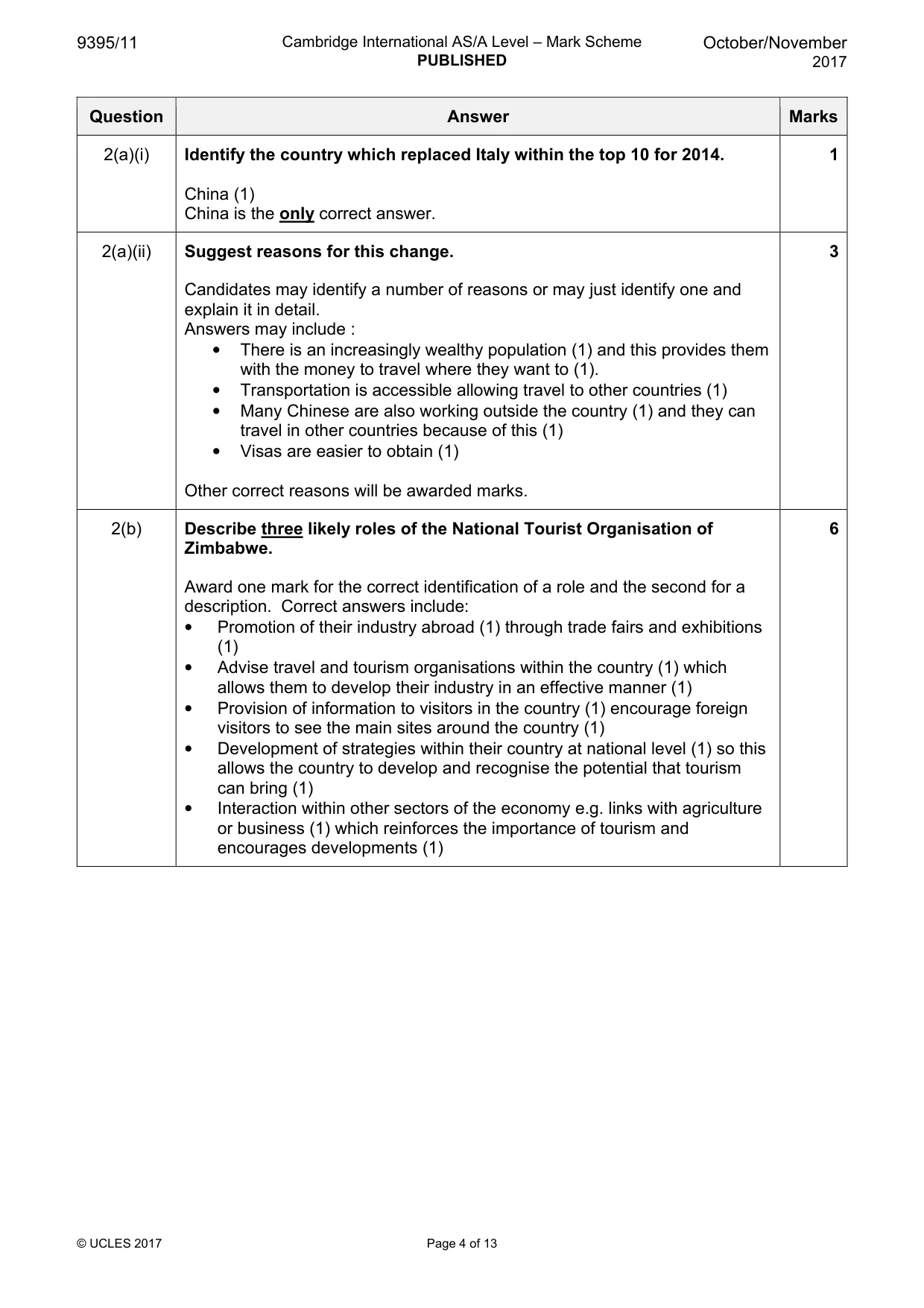
9395/11 Cambridge International AS/A Level – Mark Scheme PUBLISHED October/November 2017 © UCLES 2017 Page 4 of 13 Question Answer Marks 2(a)(i) Identify the country which replaced Italy within the top 10 for 2014. China (1) China is the only correct answer. 1 2(a)(ii) Suggest reasons for this change. Candidates may identify a number of reasons or may just identify one and explain it in detail. Answers may include : • There is an increasingly wealthy population (1) and this provides them with the money to travel where they want to (1). • Transportation is accessible allowing travel to other countries (1) • Many Chinese are also working outside the country (1) and they can travel in other countries because of this (1) • Visas are easier to obtain (1) Other correct reasons will be awarded marks. 3 2(b) Describe three likely roles of the National Tourist Organisation of Zimbabwe. Award one mark for the correct identification of a role and the second for a description. Correct answers include: • Promotion of their industry abroad (1) through trade fairs and exhibitions (1) • Advise travel and tourism organisations within the country (1) which allows them to develop their industry in an effective manner (1) • Provision of information to visitors in the country (1) encourage foreign visitors to see the main sites around the country (1) • Development of strategies within their country at national level (1) so this allows the country to develop and recognise the potential that tourism can bring (1) • Interaction within other sectors of the economy e.g. links with agriculture or business (1) which reinforces the importance of tourism and encourages developments (1) 6
Mark scheme, page 5
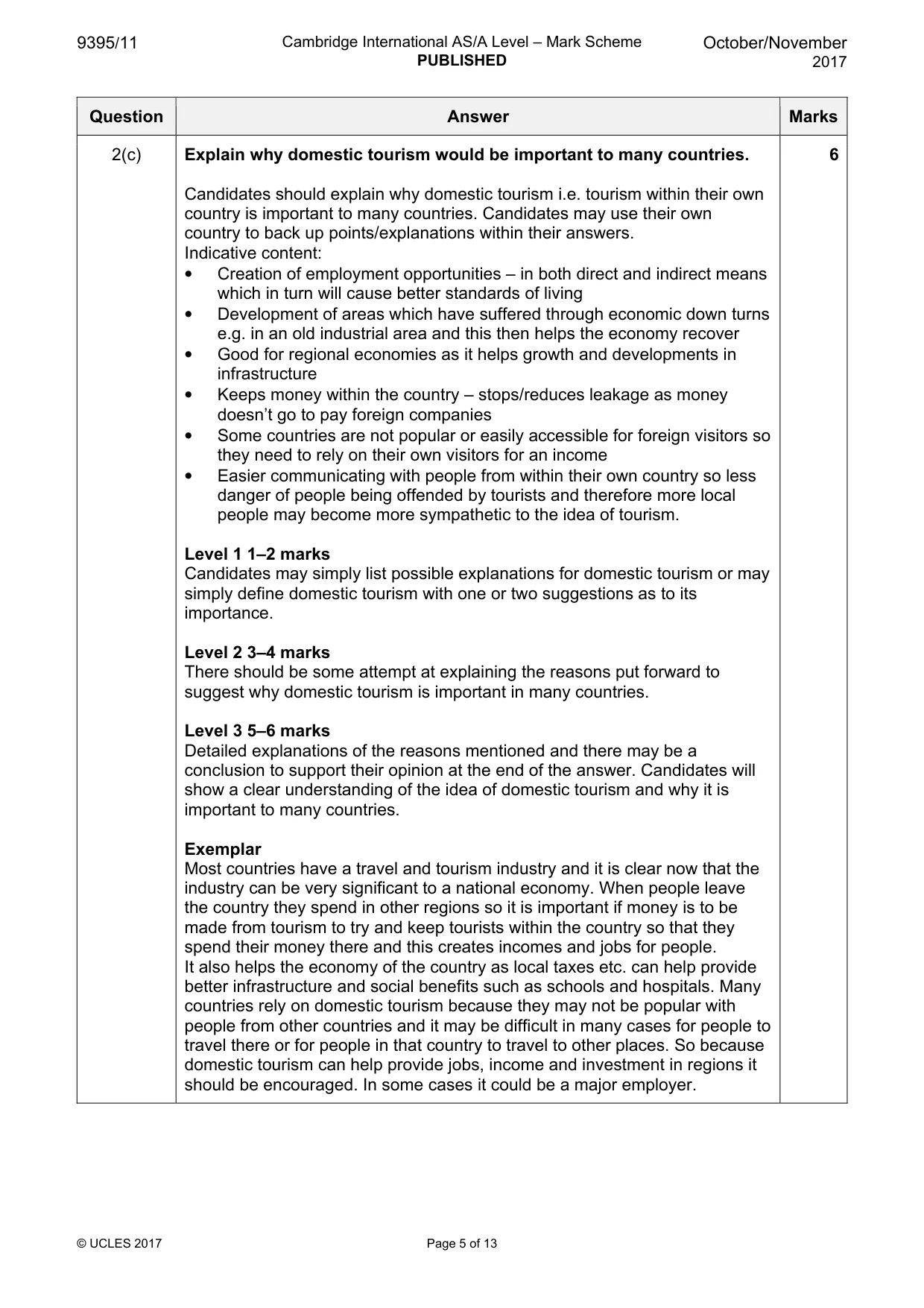
9395/11 Cambridge International AS/A Level – Mark Scheme PUBLISHED October/November 2017 © UCLES 2017 Page 5 of 13 Question Answer Marks 2(c) Explain why domestic tourism would be important to many countries. Candidates should explain why domestic tourism i.e. tourism within their own country is important to many countries. Candidates may use their own country to back up points/explanations within their answers. Indicative content: • Creation of employment opportunities – in both direct and indirect means which in turn will cause better standards of living • Development of areas which have suffered through economic down turns e.g. in an old industrial area and this then helps the economy recover • Good for regional economies as it helps growth and developments in infrastructure • Keeps money within the country – stops/reduces leakage as money doesn’t go to pay foreign companies • Some countries are not popular or easily accessible for foreign visitors so they need to rely on their own visitors for an income • Easier communicating with people from within their own country so less danger of people being offended by tourists and therefore more local people may become more sympathetic to the idea of tourism. Level 1 1–2 marks Candidates may simply list possible explanations for domestic tourism or may simply define domestic tourism with one or two suggestions as to its importance. Level 2 3–4 marks There should be some attempt at explaining the reasons put forward to suggest why domestic tourism is important in many countries. Level 3 5–6 marks Detailed explanations of the reasons mentioned and there may be a conclusion to support their opinion at the end of the answer. Candidates will show a clear understanding of the idea of domestic tourism and why it is important to many countries. Exemplar Most countries have a travel and tourism industry and it is clear now that the industry can be very significant to a national economy. When people leave the country they spend in other regions so it is important if money is to be made from tourism to try and keep tourists within the country so that they spend their money there and this creates incomes and jobs for people. It also helps the economy of the country as local taxes etc. can help provide better infrastructure and social benefits such as schools and hospitals. Many countries rely on domestic tourism because they may not be popular with people from other countries and it may be difficult in many cases for people to travel there or for people in that country to travel to other places. So because domestic tourism can help provide jobs, income and investment in regions it should be encouraged. In some cases it could be a major employer. 6
Mark scheme, page 6
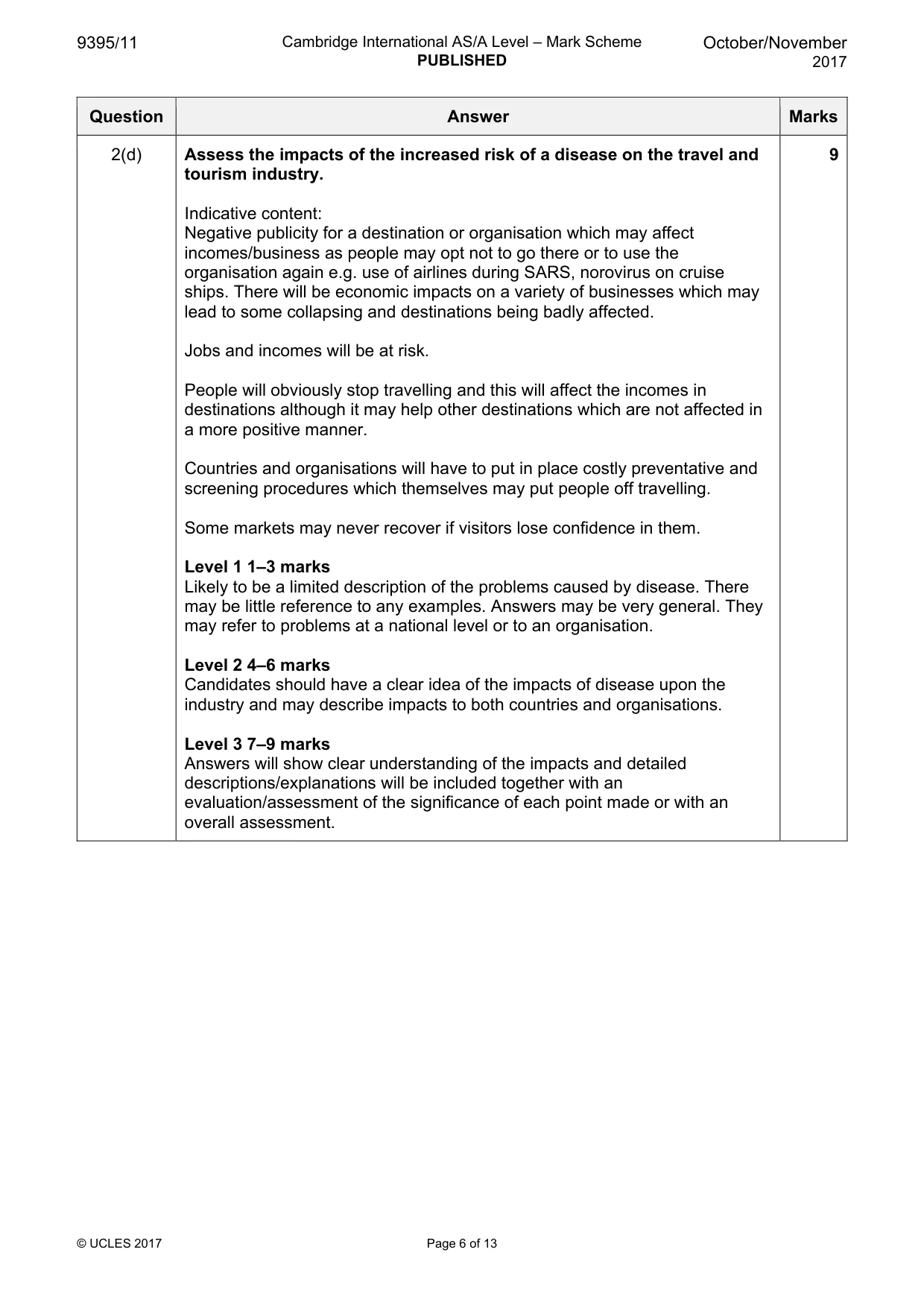
9395/11 Cambridge International AS/A Level – Mark Scheme PUBLISHED October/November 2017 © UCLES 2017 Page 6 of 13 Question Answer Marks 2(d) Assess the impacts of the increased risk of a disease on the travel and tourism industry. Indicative content: Negative publicity for a destination or organisation which may affect incomes/business as people may opt not to go there or to use the organisation again e.g. use of airlines during SARS, norovirus on cruise ships. There will be economic impacts on a variety of businesses which may lead to some collapsing and destinations being badly affected. Jobs and incomes will be at risk. People will obviously stop travelling and this will affect the incomes in destinations although it may help other destinations which are not affected in a more positive manner. Countries and organisations will have to put in place costly preventative and screening procedures which themselves may put people off travelling. Some markets may never recover if visitors lose confidence in them. Level 1 1–3 marks Likely to be a limited description of the problems caused by disease. There may be little reference to any examples. Answers may be very general. They may refer to problems at a national level or to an organisation. Level 2 4–6 marks Candidates should have a clear idea of the impacts of disease upon the industry and may describe impacts to both countries and organisations. Level 3 7–9 marks Answers will show clear understanding of the impacts and detailed descriptions/explanations will be included together with an evaluation/assessment of the significance of each point made or with an overall assessment. 9
Mark scheme, page 7
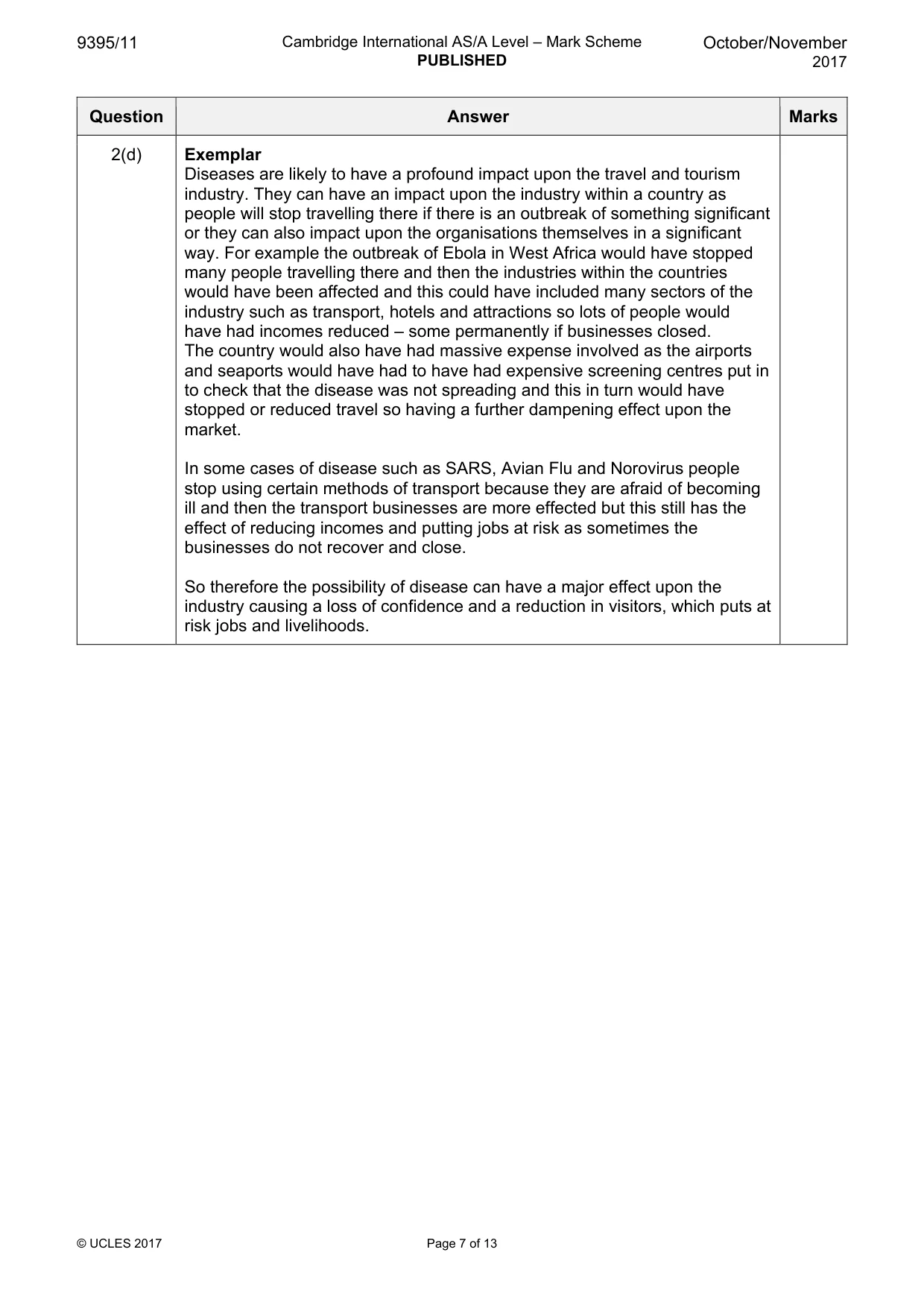
9395/11 Cambridge International AS/A Level – Mark Scheme PUBLISHED October/November 2017 © UCLES 2017 Page 7 of 13 Question Answer Marks 2(d) Exemplar Diseases are likely to have a profound impact upon the travel and tourism industry. They can have an impact upon the industry within a country as people will stop travelling there if there is an outbreak of something significant or they can also impact upon the organisations themselves in a significant way. For example the outbreak of Ebola in West Africa would have stopped many people travelling there and then the industries within the countries would have been affected and this could have included many sectors of the industry such as transport, hotels and attractions so lots of people would have had incomes reduced – some permanently if businesses closed. The country would also have had massive expense involved as the airports and seaports would have had to have had expensive screening centres put in to check that the disease was not spreading and this in turn would have stopped or reduced travel so having a further dampening effect upon the market. In some cases of disease such as SARS, Avian Flu and Norovirus people stop using certain methods of transport because they are afraid of becoming ill and then the transport businesses are more effected but this still has the effect of reducing incomes and putting jobs at risk as sometimes the businesses do not recover and close. So therefore the possibility of disease can have a major effect upon the industry causing a loss of confidence and a reduction in visitors, which puts at risk jobs and livelihoods.
Mark scheme, page 8
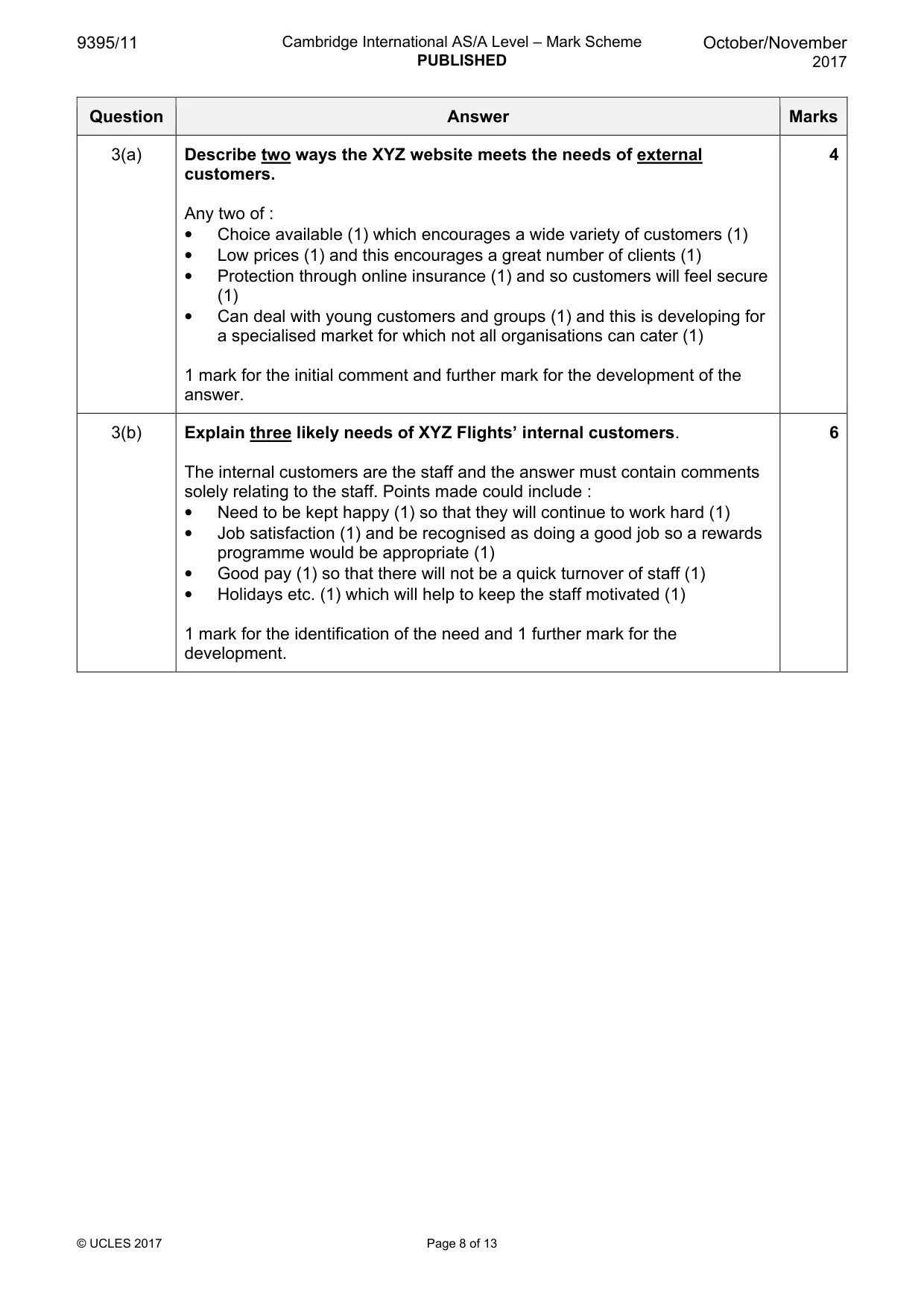
9395/11 Cambridge International AS/A Level – Mark Scheme PUBLISHED October/November 2017 © UCLES 2017 Page 8 of 13 Question Answer Marks 3(a) Describe two ways the XYZ website meets the needs of external customers. Any two of : • Choice available (1) which encourages a wide variety of customers (1) • Low prices (1) and this encourages a great number of clients (1) • Protection through online insurance (1) and so customers will feel secure (1) • Can deal with young customers and groups (1) and this is developing for a specialised market for which not all organisations can cater (1) 1 mark for the initial comment and further mark for the development of the answer. 4 3(b) Explain three likely needs of XYZ Flights’ internal customers. The internal customers are the staff and the answer must contain comments solely relating to the staff. Points made could include : • Need to be kept happy (1) so that they will continue to work hard (1) • Job satisfaction (1) and be recognised as doing a good job so a rewards programme would be appropriate (1) • Good pay (1) so that there will not be a quick turnover of staff (1) • Holidays etc. (1) which will help to keep the staff motivated (1) 1 mark for the identification of the need and 1 further mark for the development. 6
Mark scheme, page 9
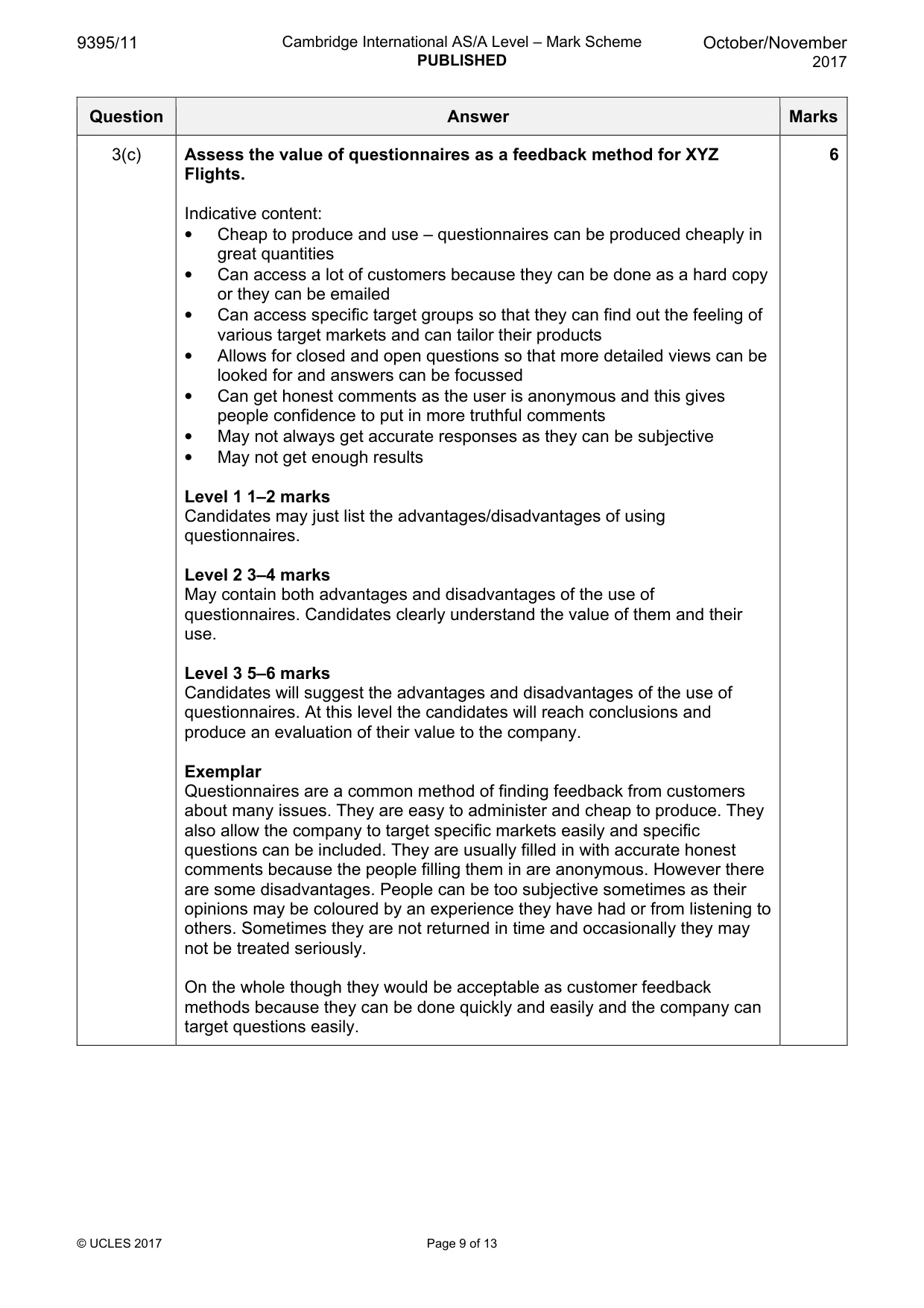
9395/11 Cambridge International AS/A Level – Mark Scheme PUBLISHED October/November 2017 © UCLES 2017 Page 9 of 13 Question Answer Marks 3(c) Assess the value of questionnaires as a feedback method for XYZ Flights. Indicative content: • Cheap to produce and use – questionnaires can be produced cheaply in great quantities • Can access a lot of customers because they can be done as a hard copy or they can be emailed • Can access specific target groups so that they can find out the feeling of various target markets and can tailor their products • Allows for closed and open questions so that more detailed views can be looked for and answers can be focussed • Can get honest comments as the user is anonymous and this gives people confidence to put in more truthful comments • May not always get accurate responses as they can be subjective • May not get enough results Level 1 1–2 marks Candidates may just list the advantages/disadvantages of using questionnaires. Level 2 3–4 marks May contain both advantages and disadvantages of the use of questionnaires. Candidates clearly understand the value of them and their use. Level 3 5–6 marks Candidates will suggest the advantages and disadvantages of the use of questionnaires. At this level the candidates will reach conclusions and produce an evaluation of their value to the company. Exemplar Questionnaires are a common method of finding feedback from customers about many issues. They are easy to administer and cheap to produce. They also allow the company to target specific markets easily and specific questions can be included. They are usually filled in with accurate honest comments because the people filling them in are anonymous. However there are some disadvantages. People can be too subjective sometimes as their opinions may be coloured by an experience they have had or from listening to others. Sometimes they are not returned in time and occasionally they may not be treated seriously. On the whole though they would be acceptable as customer feedback methods because they can be done quickly and easily and the company can target questions easily. 6
Mark scheme, page 10
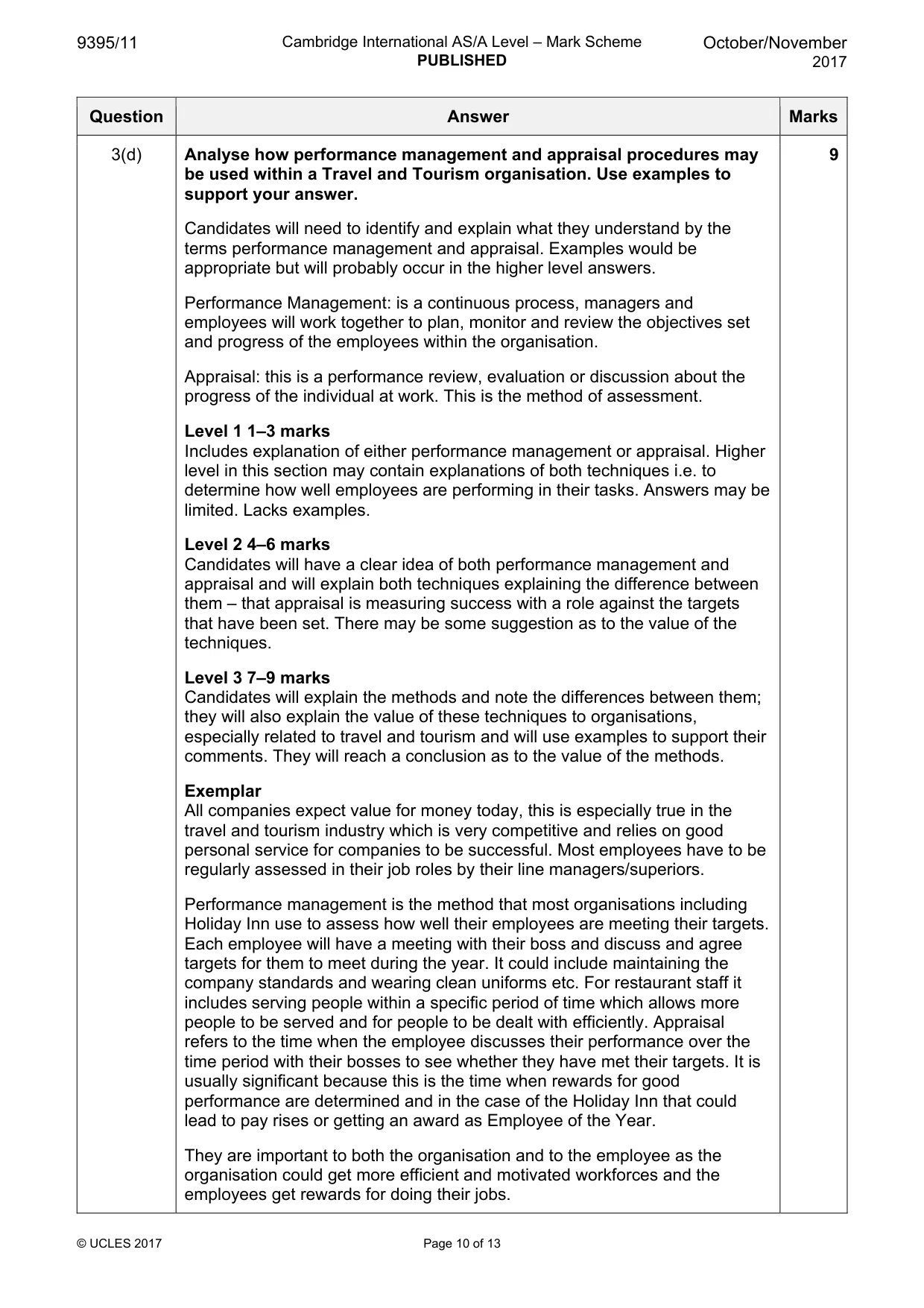
9395/11 Cambridge International AS/A Level – Mark Scheme PUBLISHED October/November 2017 © UCLES 2017 Page 10 of 13 Question Answer Marks 3(d) Analyse how performance management and appraisal procedures may be used within a Travel and Tourism organisation. Use examples to support your answer. Candidates will need to identify and explain what they understand by the terms performance management and appraisal. Examples would be appropriate but will probably occur in the higher level answers. Performance Management: is a continuous process, managers and employees will work together to plan, monitor and review the objectives set and progress of the employees within the organisation. Appraisal: this is a performance review, evaluation or discussion about the progress of the individual at work. This is the method of assessment. Level 1 1–3 marks Includes explanation of either performance management or appraisal. Higher level in this section may contain explanations of both techniques i.e. to determine how well employees are performing in their tasks. Answers may be limited. Lacks examples. Level 2 4–6 marks Candidates will have a clear idea of both performance management and appraisal and will explain both techniques explaining the difference between them – that appraisal is measuring success with a role against the targets that have been set. There may be some suggestion as to the value of the techniques. Level 3 7–9 marks Candidates will explain the methods and note the differences between them; they will also explain the value of these techniques to organisations, especially related to travel and tourism and will use examples to support their comments. They will reach a conclusion as to the value of the methods. Exemplar All companies expect value for money today, this is especially true in the travel and tourism industry which is very competitive and relies on good personal service for companies to be successful. Most employees have to be regularly assessed in their job roles by their line managers/superiors. Performance management is the method that most organisations including Holiday Inn use to assess how well their employees are meeting their targets. Each employee will have a meeting with their boss and discuss and agree targets for them to meet during the year. It could include maintaining the company standards and wearing clean uniforms etc. For restaurant staff it includes serving people within a specific period of time which allows more people to be served and for people to be dealt with efficiently. Appraisal refers to the time when the employee discusses their performance over the time period with their bosses to see whether they have met their targets. It is usually significant because this is the time when rewards for good performance are determined and in the case of the Holiday Inn that could lead to pay rises or getting an award as Employee of the Year. They are important to both the organisation and to the employee as the organisation could get more efficient and motivated workforces and the employees get rewards for doing their jobs. 9
Mark scheme, page 11
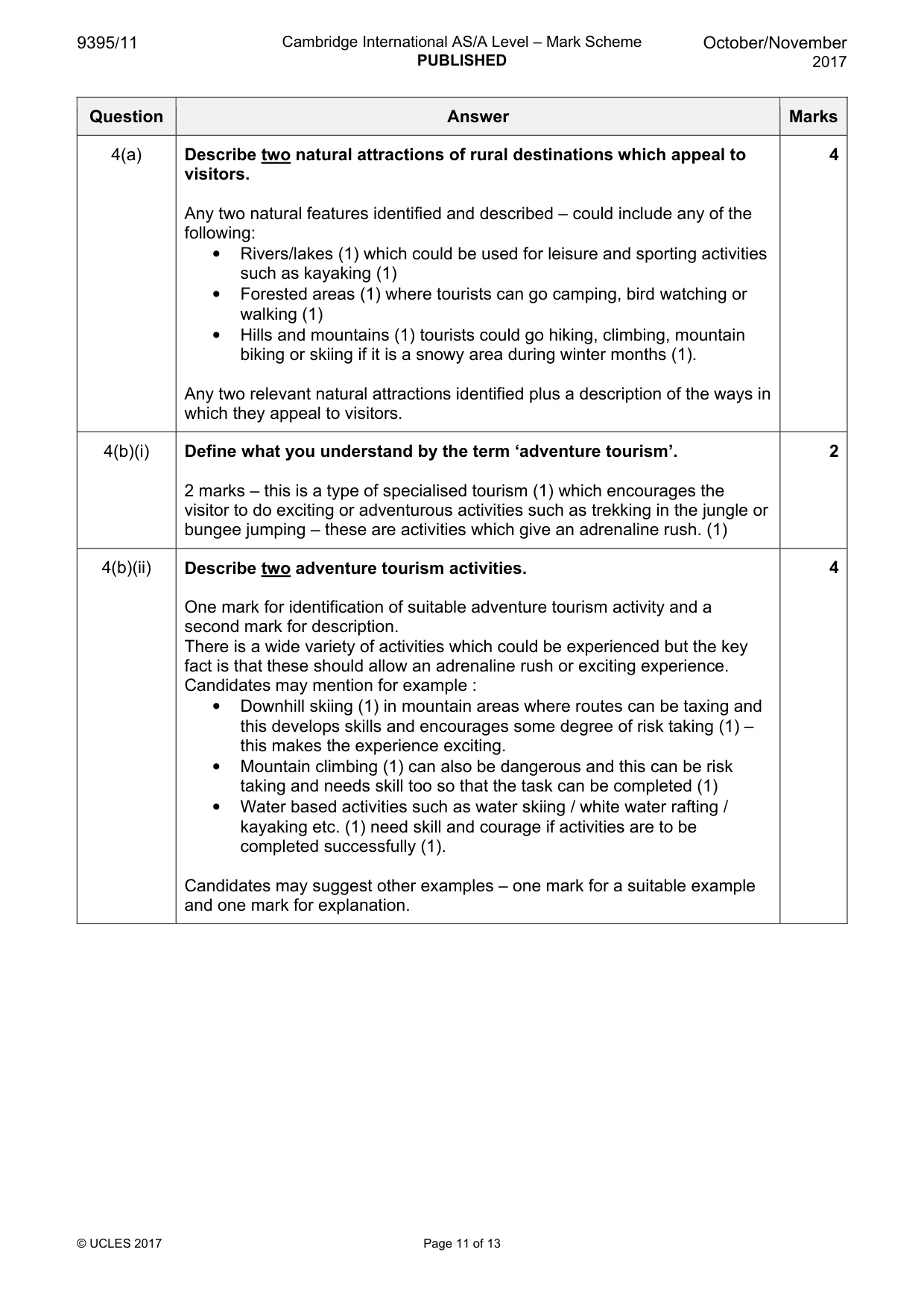
9395/11 Cambridge International AS/A Level – Mark Scheme PUBLISHED October/November 2017 © UCLES 2017 Page 11 of 13 Question Answer Marks 4(a) Describe two natural attractions of rural destinations which appeal to visitors. Any two natural features identified and described – could include any of the following: • Rivers/lakes (1) which could be used for leisure and sporting activities such as kayaking (1) • Forested areas (1) where tourists can go camping, bird watching or walking (1) • Hills and mountains (1) tourists could go hiking, climbing, mountain biking or skiing if it is a snowy area during winter months (1). Any two relevant natural attractions identified plus a description of the ways in which they appeal to visitors. 4 4(b)(i) Define what you understand by the term ‘adventure tourism’. 2 marks – this is a type of specialised tourism (1) which encourages the visitor to do exciting or adventurous activities such as trekking in the jungle or bungee jumping – these are activities which give an adrenaline rush. (1) 2 4(b)(ii) Describe two adventure tourism activities. One mark for identification of suitable adventure tourism activity and a second mark for description. There is a wide variety of activities which could be experienced but the key fact is that these should allow an adrenaline rush or exciting experience. Candidates may mention for example : • Downhill skiing (1) in mountain areas where routes can be taxing and this develops skills and encourages some degree of risk taking (1) – this makes the experience exciting. • Mountain climbing (1) can also be dangerous and this can be risk taking and needs skill too so that the task can be completed (1) • Water based activities such as water skiing / white water rafting / kayaking etc. (1) need skill and courage if activities are to be completed successfully (1). Candidates may suggest other examples – one mark for a suitable example and one mark for explanation. 4
Mark scheme, page 12
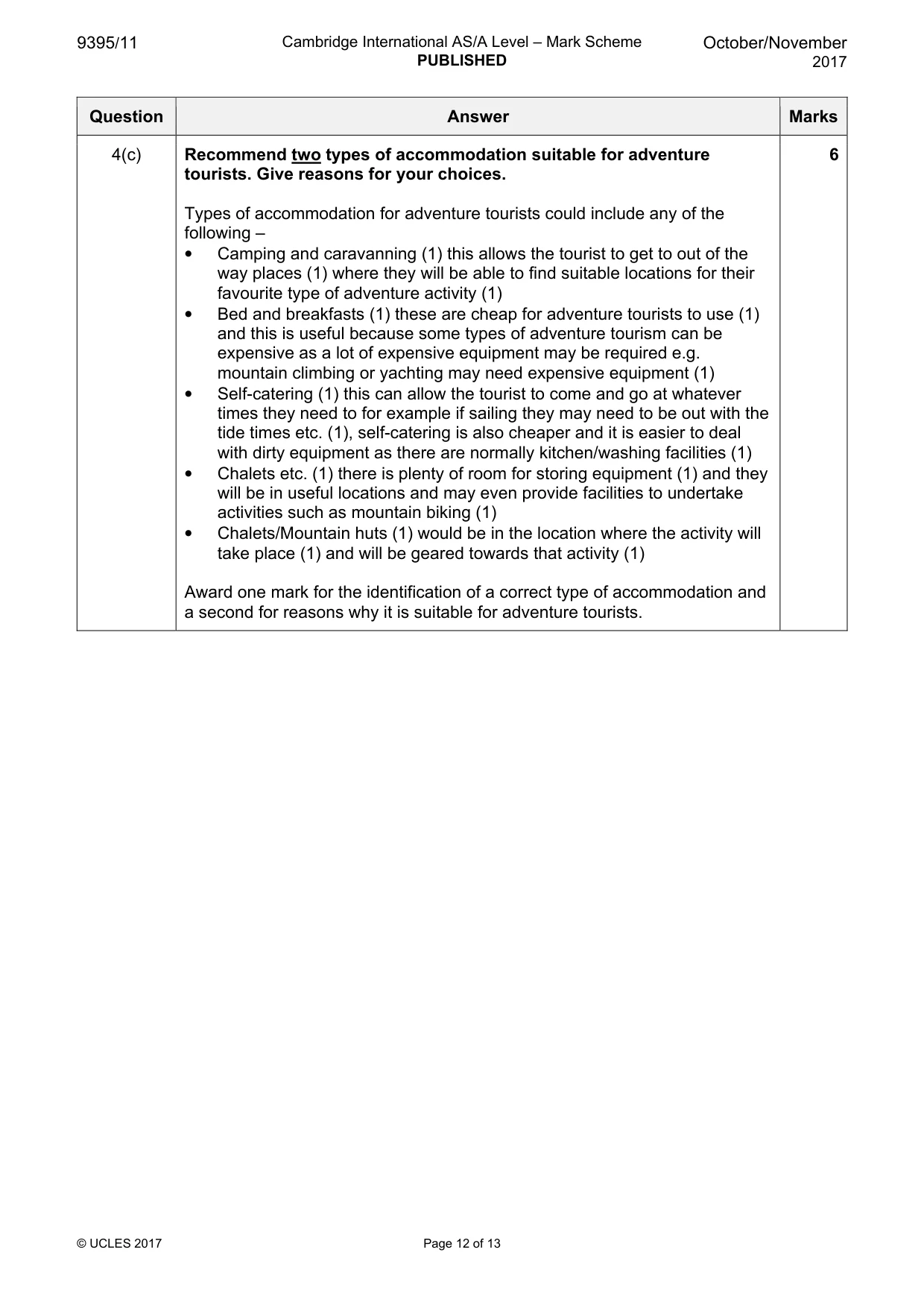
9395/11 Cambridge International AS/A Level – Mark Scheme PUBLISHED October/November 2017 © UCLES 2017 Page 12 of 13 Question Answer Marks 4(c) Recommend two types of accommodation suitable for adventure tourists. Give reasons for your choices. Types of accommodation for adventure tourists could include any of the following – • Camping and caravanning (1) this allows the tourist to get to out of the way places (1) where they will be able to find suitable locations for their favourite type of adventure activity (1) • Bed and breakfasts (1) these are cheap for adventure tourists to use (1) and this is useful because some types of adventure tourism can be expensive as a lot of expensive equipment may be required e.g. mountain climbing or yachting may need expensive equipment (1) • Self-catering (1) this can allow the tourist to come and go at whatever times they need to for example if sailing they may need to be out with the tide times etc. (1), self-catering is also cheaper and it is easier to deal with dirty equipment as there are normally kitchen/washing facilities (1) • Chalets etc. (1) there is plenty of room for storing equipment (1) and they will be in useful locations and may even provide facilities to undertake activities such as mountain biking (1) • Chalets/Mountain huts (1) would be in the location where the activity will take place (1) and will be geared towards that activity (1) Award one mark for the identification of a correct type of accommodation and a second for reasons why it is suitable for adventure tourists. 6
Mark scheme, page 13
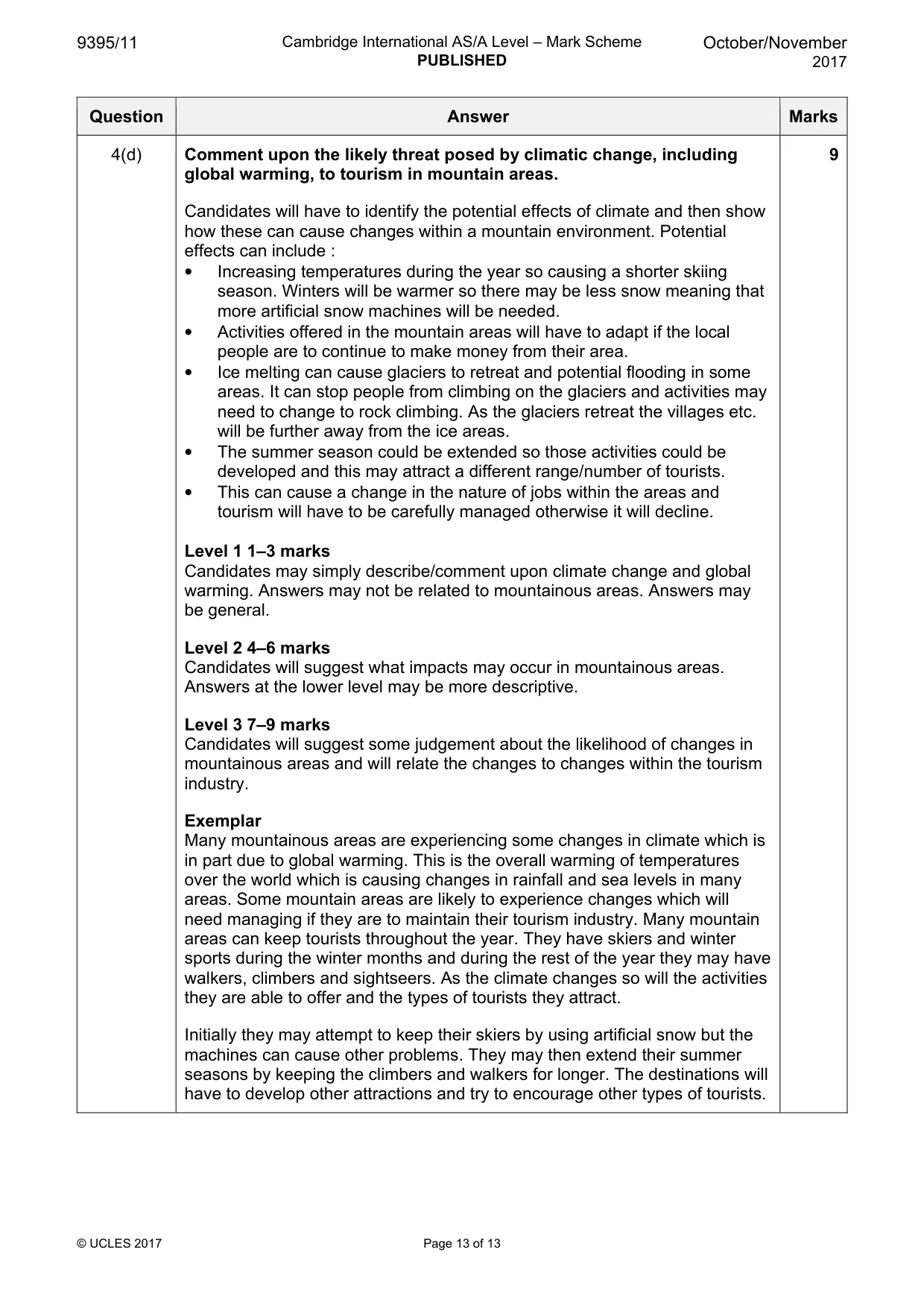
9395/11 Cambridge International AS/A Level – Mark Scheme PUBLISHED October/November 2017 © UCLES 2017 Page 13 of 13 Question Answer Marks 4(d) Comment upon the likely threat posed by climatic change, including global warming, to tourism in mountain areas. Candidates will have to identify the potential effects of climate and then show how these can cause changes within a mountain environment. Potential effects can include : • Increasing temperatures during the year so causing a shorter skiing season. Winters will be warmer so there may be less snow meaning that more artificial snow machines will be needed. • Activities offered in the mountain areas will have to adapt if the local people are to continue to make money from their area. • Ice melting can cause glaciers to retreat and potential flooding in some areas. It can stop people from climbing on the glaciers and activities may need to change to rock climbing. As the glaciers retreat the villages etc. will be further away from the ice areas. • The summer season could be extended so those activities could be developed and this may attract a different range/number of tourists. • This can cause a change in the nature of jobs within the areas and tourism will have to be carefully managed otherwise it will decline. Level 1 1–3 marks Candidates may simply describe/comment upon climate change and global warming. Answers may not be related to mountainous areas. Answers may be general. Level 2 4–6 marks Candidates will suggest what impacts may occur in mountainous areas. Answers at the lower level may be more descriptive. Level 3 7–9 marks Candidates will suggest some judgement about the likelihood of changes in mountainous areas and will relate the changes to changes within the tourism industry. Exemplar Many mountainous areas are experiencing some changes in climate which is in part due to global warming. This is the overall warming of temperatures over the world which is causing changes in rainfall and sea levels in many areas. Some mountain areas are likely to experience changes which will need managing if they are to maintain their tourism industry. Many mountain areas can keep tourists throughout the year. They have skiers and winter sports during the winter months and during the rest of the year they may have walkers, climbers and sightseers. As the climate changes so will the activities they are able to offer and the types of tourists they attract. Initially they may attempt to keep their skiers by using artificial snow but the machines can cause other problems. They may then extend their summer seasons by keeping the climbers and walkers for longer. The destinations will have to develop other attractions and try to encourage other types of tourists. 9
What you needed in this session
Cambridge’s own grade thresholds for 2017 Oct/Nov, Paper 1 · Variant 1. A higher threshold means an easier paper — the bar moves with how the cohort did.