Cambridge A Level Travel and Tourism 9395 — 2017 May/June Paper 3 · Variant 3
9395/33/M/J/17 · 50 marks · ≈56 min
The question paper and its mark scheme, free to read here and free to download. This is Cambridge’s own paper, exactly as it was sat.
Question paper8 pages





Mark scheme11 pages
Answers below. Sit the paper first if you are practising.
Paper as text
Question paper, page 1
This document consists of 7 printed pages, 1 blank page and 1 Insert. DC (KN) 144793 © UCLES 2017 [Turn over Cambridge International Examinations Cambridge International Advanced Subsidiary and Advanced Level * 4 7 6 0 0 7 7 5 5 5 * TRAVEL AND TOURISM 9395/33 Paper 3 Destination Marketing May/June 2017 1 hour 30 minutes Candidates answer on the Question Paper. No Additional Materials are required. READ THESE INSTRUCTIONS FIRST Write your Centre number, candidate number and name on all the work you hand in. Write in dark blue or black pen. You may use an HB pencil for any diagrams or graphs. Do not use staples, paper clips, glue or correction fluid. DO NOT WRITE IN ANY BARCODES. Answer all questions. All the Figures referred to in the questions are contained in the Insert. The number of marks is given in brackets [ ] at the end of each question or part question.
Question paper, page 2
2 9395/33/M/J/17 © UCLES 2017 Question 1 Refer to Fig. 1 (Insert), information about Punjab Heritage and Tourism Promotion Board (PHTPB). Punjab is a state in the north west of India. (a) Describe two forms of market segmentation that PHTPB may use to identify its target customers. 1 … … … … 2 … … … …[4]
Question paper, page 3
3 9395/33/M/J/17 © UCLES 2017 [Turn over (b) Discuss how PHTPB might create its destination brand identity. … … … … … … … … … … … … … … … … … …[9]
Question paper, page 4
4 9395/33/M/J/17 © UCLES 2017 (c) Evaluate the importance to PHTPB of using Key Performance Indicators (KPIs) to monitor the effectiveness of its destination brand. … … … … … … … … … … … … … … … … … … … … … … … …[12] [Total: 25]
Question paper, page 5
5 9395/33/M/J/17 © UCLES 2017 [Turn over Question 2 Refer to Fig. 2 (Insert), information about the ‘Adventure on Tenerife’ marketing campaign. Tenerife is one of the Canary Islands. (a) Explain two ways the ‘Adventure on Tenerife’ campaign uses product positioning. 1 … … … … 2 … … … …[4]
Question paper, page 6
6 9395/33/M/J/17 © UCLES 2017 (b) Assess the likely benefits of the communication methods used to raise awareness of the ‘Adventure on Tenerife’ campaign. … … … … … … … … … … … … … … … … … …[9]
Question paper, page 7
7 9395/33/M/J/17 © UCLES 2017 (c) Evaluate how effective the characteristics of the ‘Adventure on Tenerife’ destination brand may be. … … … … … … … … … … … … … … … … … … … … … … …[12] [Total: 25]
Question paper, page 8
8 9395/33/M/J/17 © UCLES 2017 Permission to reproduce items where third-party owned material protected by copyright is included has been sought and cleared where possible. Every reasonable effort has been made by the publisher (UCLES) to trace copyright holders, but if any items requiring clearance have unwittingly been included, the publisher will be pleased to make amends at the earliest possible opportunity. To avoid the issue of disclosure of answer-related information to candidates, all copyright acknowledgements are reproduced online in the Cambridge International Examinations Copyright Acknowledgements Booklet. This is produced for each series of examinations and is freely available to download at www.cie.org.uk after the live examination series. Cambridge International Examinations is part of the Cambridge Assessment Group. Cambridge Assessment is the brand name of University of Cambridge Local Examinations Syndicate (UCLES), which is itself a department of the University of Cambridge. BLANK PAGE
Mark scheme, page 1
® IGCSE is a registered trademark. This document consists of 11 printed pages. © UCLES 2017 [Turn over Cambridge International Examinations Cambridge International Advanced Level TRAVEL & TOURISM 9395/33 Paper 3 Destination Marketing May/June 2017 MARK SCHEME Maximum Mark: 100 Published This mark scheme is published as an aid to teachers and candidates, to indicate the requirements of the examination. It shows the basis on which Examiners were instructed to award marks. It does not indicate the details of the discussions that took place at an Examiners’ meeting before marking began, which would have considered the acceptability of alternative answers. Mark schemes should be read in conjunction with the question paper and the Principal Examiner Report for Teachers. Cambridge will not enter into discussions about these mark schemes. Cambridge is publishing the mark schemes for the May/June 2017 series for most Cambridge IGCSE®, Cambridge International A and AS Level and Cambridge Pre-U components, and some Cambridge O Level components.
Mark scheme, page 2
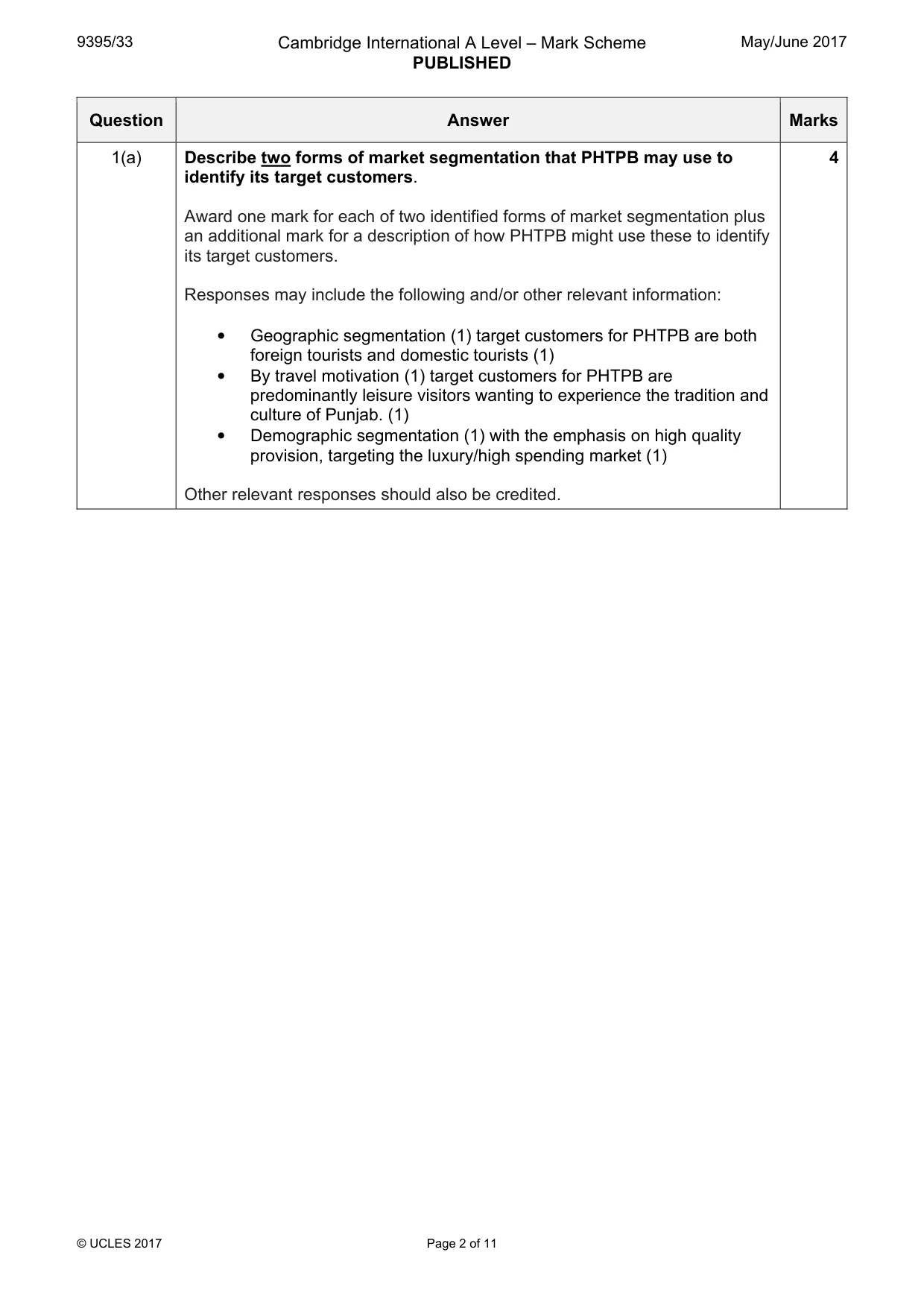
9395/33 Cambridge International A Level – Mark Scheme PUBLISHED May/June 2017 © UCLES 2017 Page 2 of 11 Question Answer Marks 1(a) Describe two forms of market segmentation that PHTPB may use to identify its target customers. Award one mark for each of two identified forms of market segmentation plus an additional mark for a description of how PHTPB might use these to identify its target customers. Responses may include the following and/or other relevant information: • Geographic segmentation (1) target customers for PHTPB are both foreign tourists and domestic tourists (1) • By travel motivation (1) target customers for PHTPB are predominantly leisure visitors wanting to experience the tradition and culture of Punjab. (1) • Demographic segmentation (1) with the emphasis on high quality provision, targeting the luxury/high spending market (1) Other relevant responses should also be credited. 4
Mark scheme, page 3
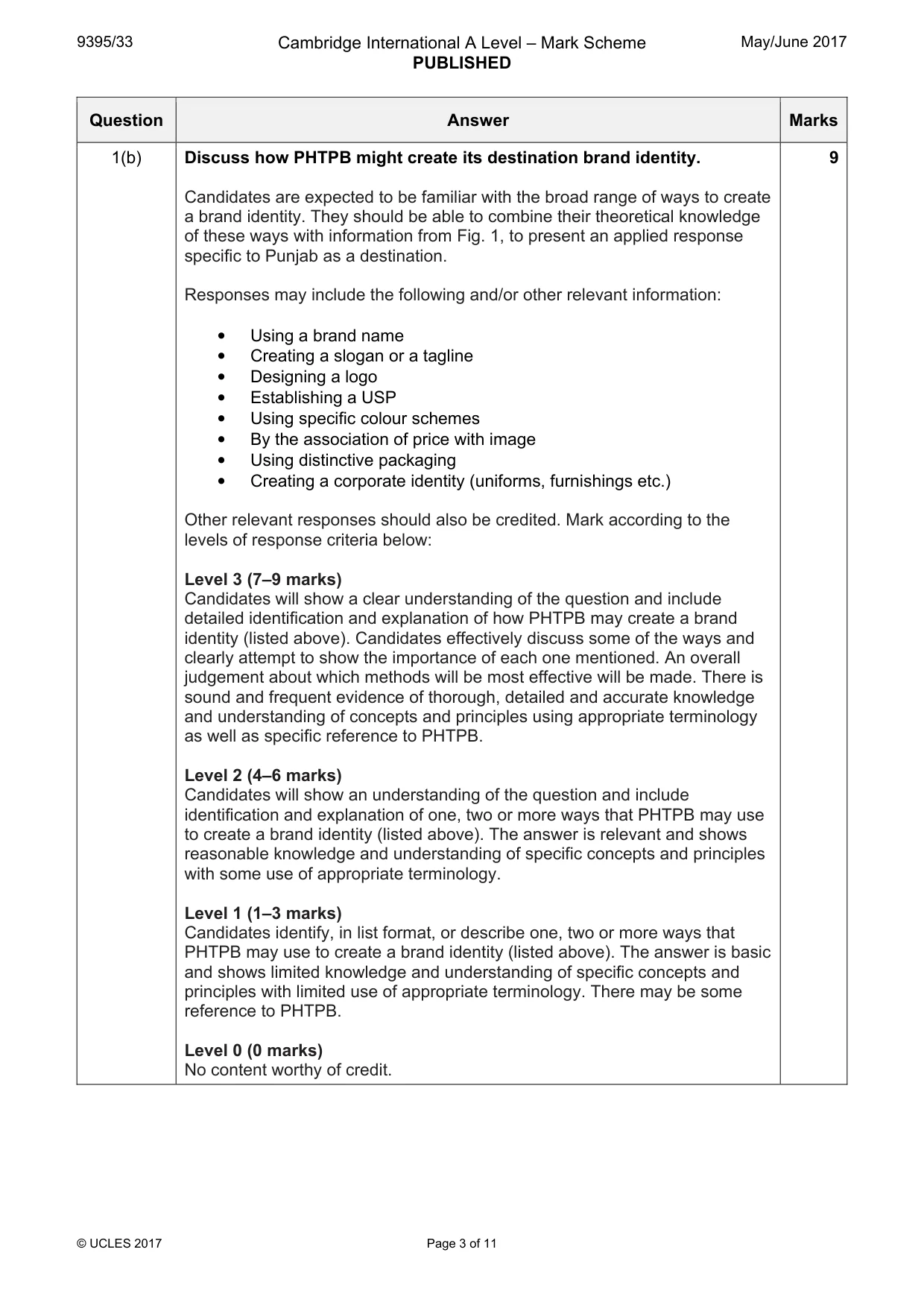
9395/33 Cambridge International A Level – Mark Scheme PUBLISHED May/June 2017 © UCLES 2017 Page 3 of 11 Question Answer Marks 1(b) Discuss how PHTPB might create its destination brand identity. Candidates are expected to be familiar with the broad range of ways to create a brand identity. They should be able to combine their theoretical knowledge of these ways with information from Fig. 1, to present an applied response specific to Punjab as a destination. Responses may include the following and/or other relevant information: • Using a brand name • Creating a slogan or a tagline • Designing a logo • Establishing a USP • Using specific colour schemes • By the association of price with image • Using distinctive packaging • Creating a corporate identity (uniforms, furnishings etc.) Other relevant responses should also be credited. Mark according to the levels of response criteria below: Level 3 (7–9 marks) Candidates will show a clear understanding of the question and include detailed identification and explanation of how PHTPB may create a brand identity (listed above). Candidates effectively discuss some of the ways and clearly attempt to show the importance of each one mentioned. An overall judgement about which methods will be most effective will be made. There is sound and frequent evidence of thorough, detailed and accurate knowledge and understanding of concepts and principles using appropriate terminology as well as specific reference to PHTPB. Level 2 (4–6 marks) Candidates will show an understanding of the question and include identification and explanation of one, two or more ways that PHTPB may use to create a brand identity (listed above). The answer is relevant and shows reasonable knowledge and understanding of specific concepts and principles with some use of appropriate terminology. Level 1 (1–3 marks) Candidates identify, in list format, or describe one, two or more ways that PHTPB may use to create a brand identity (listed above). The answer is basic and shows limited knowledge and understanding of specific concepts and principles with limited use of appropriate terminology. There may be some reference to PHTPB. Level 0 (0 marks) No content worthy of credit. 9
Mark scheme, page 4
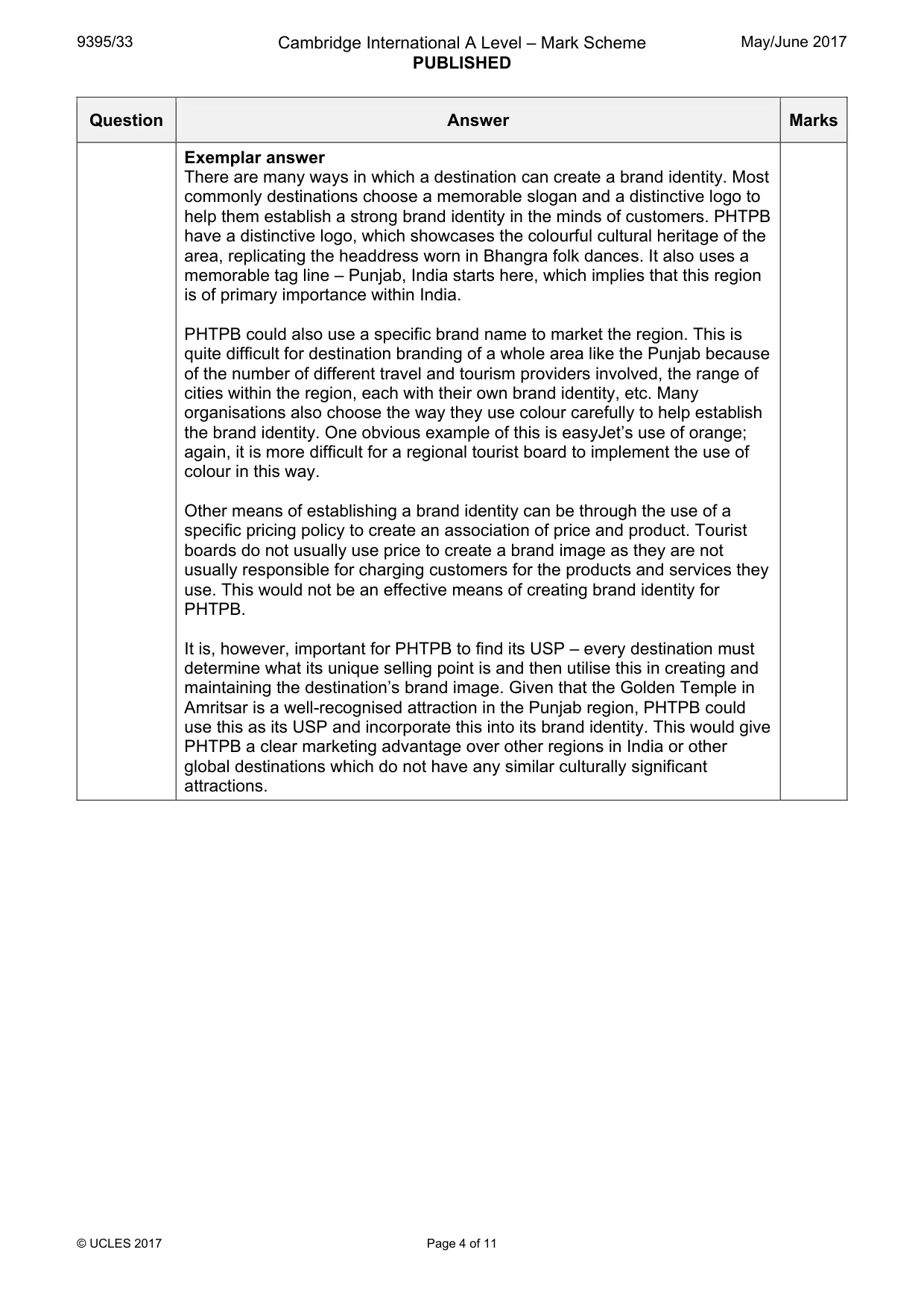
9395/33 Cambridge International A Level – Mark Scheme PUBLISHED May/June 2017 © UCLES 2017 Page 4 of 11 Question Answer Marks Exemplar answer There are many ways in which a destination can create a brand identity. Most commonly destinations choose a memorable slogan and a distinctive logo to help them establish a strong brand identity in the minds of customers. PHTPB have a distinctive logo, which showcases the colourful cultural heritage of the area, replicating the headdress worn in Bhangra folk dances. It also uses a memorable tag line – Punjab, India starts here, which implies that this region is of primary importance within India. PHTPB could also use a specific brand name to market the region. This is quite difficult for destination branding of a whole area like the Punjab because of the number of different travel and tourism providers involved, the range of cities within the region, each with their own brand identity, etc. Many organisations also choose the way they use colour carefully to help establish the brand identity. One obvious example of this is easyJet’s use of orange; again, it is more difficult for a regional tourist board to implement the use of colour in this way. Other means of establishing a brand identity can be through the use of a specific pricing policy to create an association of price and product. Tourist boards do not usually use price to create a brand image as they are not usually responsible for charging customers for the products and services they use. This would not be an effective means of creating brand identity for PHTPB. It is, however, important for PHTPB to find its USP – every destination must determine what its unique selling point is and then utilise this in creating and maintaining the destination’s brand image. Given that the Golden Temple in Amritsar is a well-recognised attraction in the Punjab region, PHTPB could use this as its USP and incorporate this into its brand identity. This would give PHTPB a clear marketing advantage over other regions in India or other global destinations which do not have any similar culturally significant attractions.
Mark scheme, page 5
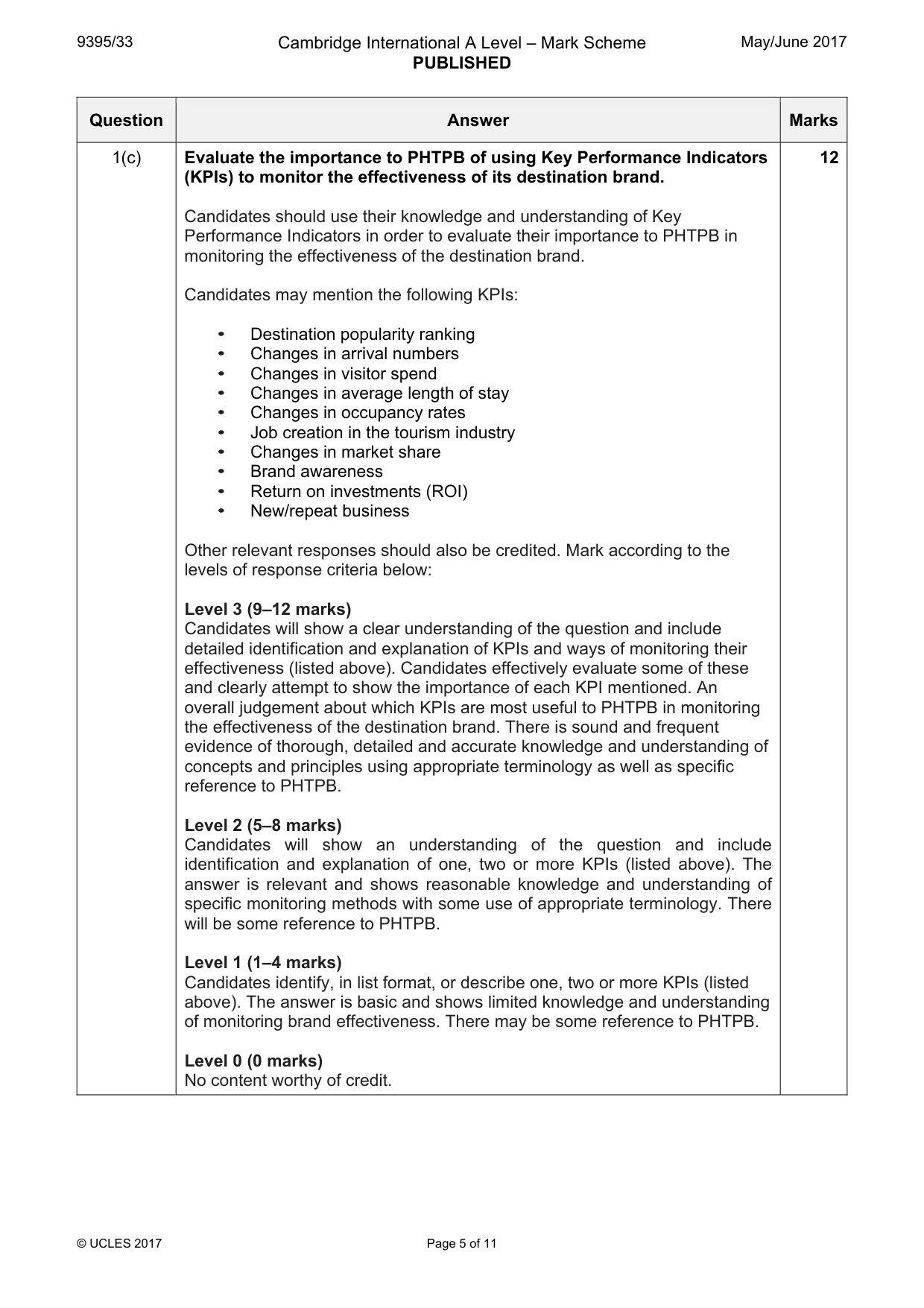
9395/33 Cambridge International A Level – Mark Scheme PUBLISHED May/June 2017 © UCLES 2017 Page 5 of 11 Question Answer Marks 1(c) Evaluate the importance to PHTPB of using Key Performance Indicators (KPIs) to monitor the effectiveness of its destination brand. Candidates should use their knowledge and understanding of Key Performance Indicators in order to evaluate their importance to PHTPB in monitoring the effectiveness of the destination brand. Candidates may mention the following KPIs: • Destination popularity ranking • Changes in arrival numbers • Changes in visitor spend • Changes in average length of stay • Changes in occupancy rates • Job creation in the tourism industry • Changes in market share • Brand awareness • Return on investments (ROI) • New/repeat business Other relevant responses should also be credited. Mark according to the levels of response criteria below: Level 3 (9–12 marks) Candidates will show a clear understanding of the question and include detailed identification and explanation of KPIs and ways of monitoring their effectiveness (listed above). Candidates effectively evaluate some of these and clearly attempt to show the importance of each KPI mentioned. An overall judgement about which KPIs are most useful to PHTPB in monitoring the effectiveness of the destination brand. There is sound and frequent evidence of thorough, detailed and accurate knowledge and understanding of concepts and principles using appropriate terminology as well as specific reference to PHTPB. Level 2 (5–8 marks) Candidates will show an understanding of the question and include identification and explanation of one, two or more KPIs (listed above). The answer is relevant and shows reasonable knowledge and understanding of specific monitoring methods with some use of appropriate terminology. There will be some reference to PHTPB. Level 1 (1–4 marks) Candidates identify, in list format, or describe one, two or more KPIs (listed above). The answer is basic and shows limited knowledge and understanding of monitoring brand effectiveness. There may be some reference to PHTPB. Level 0 (0 marks) No content worthy of credit. 12
Mark scheme, page 6
9395/33 Cambridge International A Level – Mark Scheme PUBLISHED May/June 2017 © UCLES 2017 Page 6 of 11 Question Answer Marks Exemplar answer It is important that a destination which has worked hard to establish a brand identity for itself then monitors the effectiveness of that brand in attracting visitors in the long term. The way in which tourism authorities can monitor the effectiveness of their brand is through the use of Key Performance Indicators or KPIs. A KPI is a measure of relative success. Organisations often set themselves SMART targets – the outcomes of these are used as an indicator of successful outcomes. In terms of a destination brand, KPIs always tend to link to the number of visitors to an area, the income they generate, and the economic benefits that this brings to the local economy. They are often data specific and this makes monitoring a relatively easy task as statistical trends can be analysed and compared with previous years or alternative destinations. A destination will have keen interest in monitoring the number of arrivals it has from different source markets; this can affect future destination marketing in order to try to increase the number of visitors from a particular source market. A destination will also keep a close eye on the number of tourism related jobs created in an area – both direct and indirect employment are important to the local population as this contributes to the overall standard of living in the area. Tourist authorities are also keen to analyse KPIs such as average rate of occupancy and average visitor spend as these show how successful the destination is performing and whether it is contributing more to the local economy over time. A destination’s ranking amongst other destinations is in my opinion one of the most important KPIs. If a destination moves up the Top 100 destinations, it shows that the destination brand is growing in popularity and that visitors feel they are gaining value for money from their visit. If a destination loses place in the rankings, this indicates that the destination may need to consider rebranding.
Mark scheme, page 7
9395/33 Cambridge International A Level – Mark Scheme PUBLISHED May/June 2017 © UCLES 2017 Page 7 of 11 Question Answer Marks 2(a) Explain two ways the ‘Adventure on Tenerife’ uses product positioning. Award one mark for each of two identified ways in which ‘Adventure on Tenerife’ uses product positioning plus an additional mark for an explanation of each. Responses may include the following and/or other relevant information: • Visitor perception of the destination through image/reputation (1) European perception of the ‘sun, sand, sea’ image/reputation (1) • Relationship of destination to competitors through differentiation strategy (1) making Tenerife stand out from other ‘sun, sand, sea’ destinations – using ‘adventure’ focus (1) • The importance of a Unique Selling Point (USP) (1) focusing on all the other options for tourists such as its architecture, cultural events, natural attractions. Sporting opportunities etc. (1) • Communication and presentation of clear and attractive image/position (1) Launch of the campaign at the New York Times Travel Show and using multi-channel marketing to ensure the message was widespread (1) Other relevant responses should also be credited. 4
Mark scheme, page 8
9395/33 Cambridge International A Level – Mark Scheme PUBLISHED May/June 2017 © UCLES 2017 Page 8 of 11 Question Answer Marks 2(b) Assess the likely benefits of the communication methods used to raise awareness of the ‘Adventure on Tenerife’ campaign. Candidates are expected to be aware of communication methods used to raise awareness of a destination’s brand identity. They should be able to combine their theoretical knowledge of these methods with information from Fig. 2, to present an applied response specific to Tenerife as a destination. Responses may include the following and/or other relevant information: • Websites, especially that of the NTO (adventureontenerife.com) • Publicity materials • Use of social media (Facebook, Twitter and Instagram alerts) • Email marketing • Public relations (internet conferencing) (trade shows) • Advertising (digital advertisements via Orbitz) (print adverts in trade magazines) • Sales promotion • Word of mouth • Signage • Destination environment Other relevant responses should also be credited. Mark according to the levels of response criteria below: Level 3 (7–9 marks) Candidates will show a clear understanding of the question and include detailed identification and explanation of particular benefits for destinations using specific communication methods (listed above). Candidates effectively assess some of these benefits and clearly attempt to show the importance of each one mentioned. There is sound and frequent evidence of thorough, detailed and accurate knowledge and understanding of concepts and principles using appropriate terminology as well as specific reference to Tenerife. Level 2 (4–6 marks) Candidates will show an understanding of the question and include identification and explanation of one, two or more benefits for destinations and/or of different communication methods (listed above). The answer is relevant and shows reasonable knowledge and understanding of concepts and principles with some use of appropriate terminology. There will be some reference to Tenerife. Level 1 (1–3 marks) Candidates identify, in list format, or describe one, two or more benefits for destinations and/or different communication methods (listed above). The answer is basic and shows limited knowledge and understanding of concepts and principles with limited use of appropriate terminology. There may be some reference to Tenerife. Level 0 (0 marks) No content worthy of credit. 9
Mark scheme, page 9
9395/33 Cambridge International A Level – Mark Scheme PUBLISHED May/June 2017 © UCLES 2017 Page 9 of 11 Question Answer Marks Exemplar answer The Adventure on Tenerife campaign uses a variety of communication methods in order to raise awareness of the destination. Using a range of different communication methods is a good idea as it broadens the destination’s access to a wide customer base. Nowadays most people turn to the internet as the main source of marketing information. Therefore it is essential that the ‘Adventure on’ campaign is widely promoted through the NTO’s website as this is the first place people will probably look. The NTO can also make positive use of social media, setting up a Facebook page, a Twitter account and a YouTube page to showcase the destination. This way, the tourism authorities can create a large base of potential visitors through their followers and subscribers and will have very easy access to communicating with these via mobile technology. This will be by far the most effective and cost efficient method of raising awareness of the destination. Other methods of communicating with customers may also be used, including more traditional methods, such as using printed publicity materials or advertisements, but these are more expensive and there is less guarantee that these will reach the target market. Some organisations also benefit from word of mouth recommendations; reviews and online feedback tools, such as TripAdvisor, have formalised and harnessed this type of communication method to digital media to ensure word of mouth recommendations reach more of the potential customer base.
Mark scheme, page 10
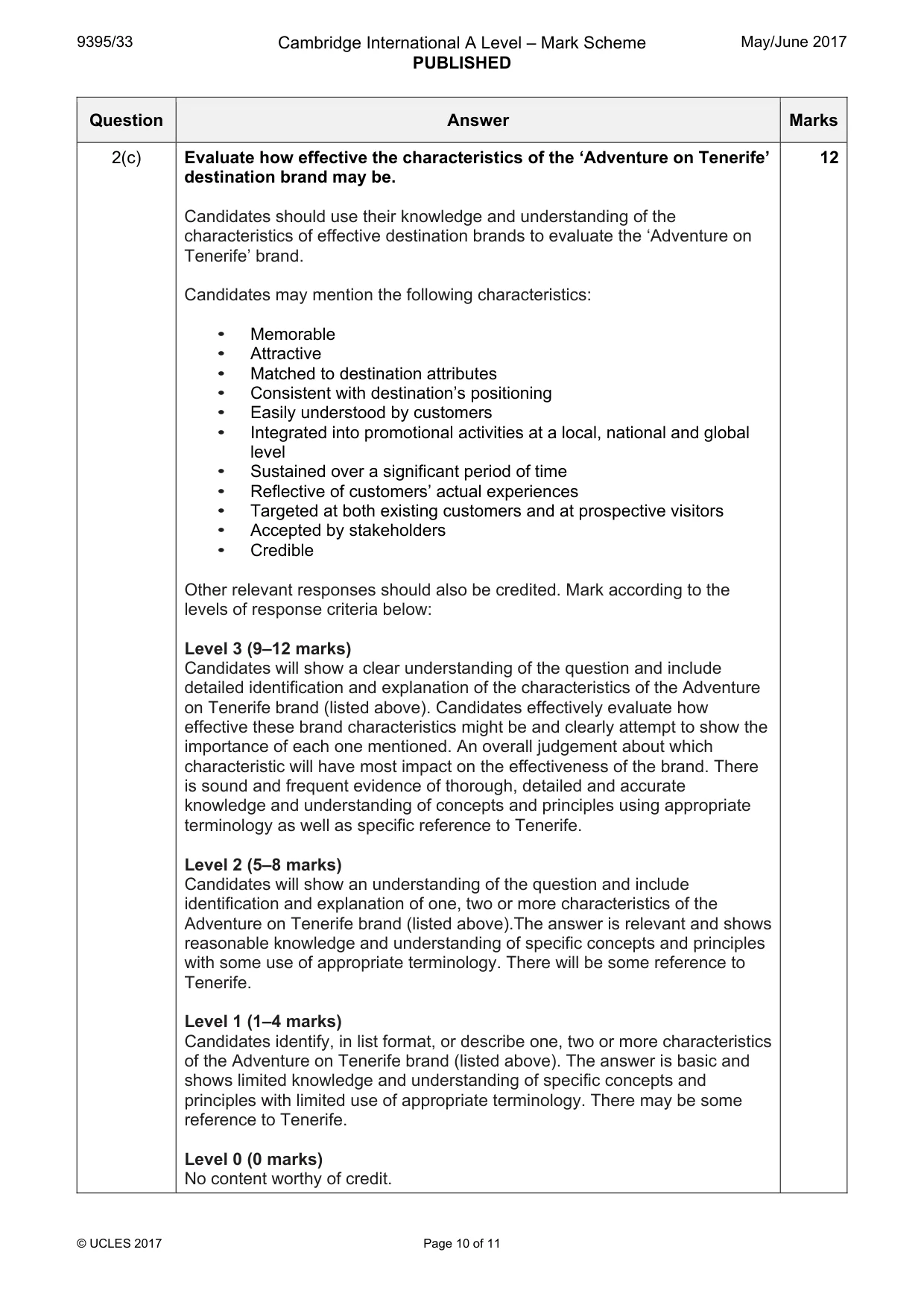
9395/33 Cambridge International A Level – Mark Scheme PUBLISHED May/June 2017 © UCLES 2017 Page 10 of 11 Question Answer Marks 2(c) Evaluate how effective the characteristics of the ‘Adventure on Tenerife’ destination brand may be. Candidates should use their knowledge and understanding of the characteristics of effective destination brands to evaluate the ‘Adventure on Tenerife’ brand. Candidates may mention the following characteristics: • Memorable • Attractive • Matched to destination attributes • Consistent with destination’s positioning • Easily understood by customers • Integrated into promotional activities at a local, national and global level • Sustained over a significant period of time • Reflective of customers’ actual experiences • Targeted at both existing customers and at prospective visitors • Accepted by stakeholders • Credible Other relevant responses should also be credited. Mark according to the levels of response criteria below: Level 3 (9–12 marks) Candidates will show a clear understanding of the question and include detailed identification and explanation of the characteristics of the Adventure on Tenerife brand (listed above). Candidates effectively evaluate how effective these brand characteristics might be and clearly attempt to show the importance of each one mentioned. An overall judgement about which characteristic will have most impact on the effectiveness of the brand. There is sound and frequent evidence of thorough, detailed and accurate knowledge and understanding of concepts and principles using appropriate terminology as well as specific reference to Tenerife. Level 2 (5–8 marks) Candidates will show an understanding of the question and include identification and explanation of one, two or more characteristics of the Adventure on Tenerife brand (listed above).The answer is relevant and shows reasonable knowledge and understanding of specific concepts and principles with some use of appropriate terminology. There will be some reference to Tenerife. Level 1 (1–4 marks) Candidates identify, in list format, or describe one, two or more characteristics of the Adventure on Tenerife brand (listed above). The answer is basic and shows limited knowledge and understanding of specific concepts and principles with limited use of appropriate terminology. There may be some reference to Tenerife. Level 0 (0 marks) No content worthy of credit. 12
Mark scheme, page 11
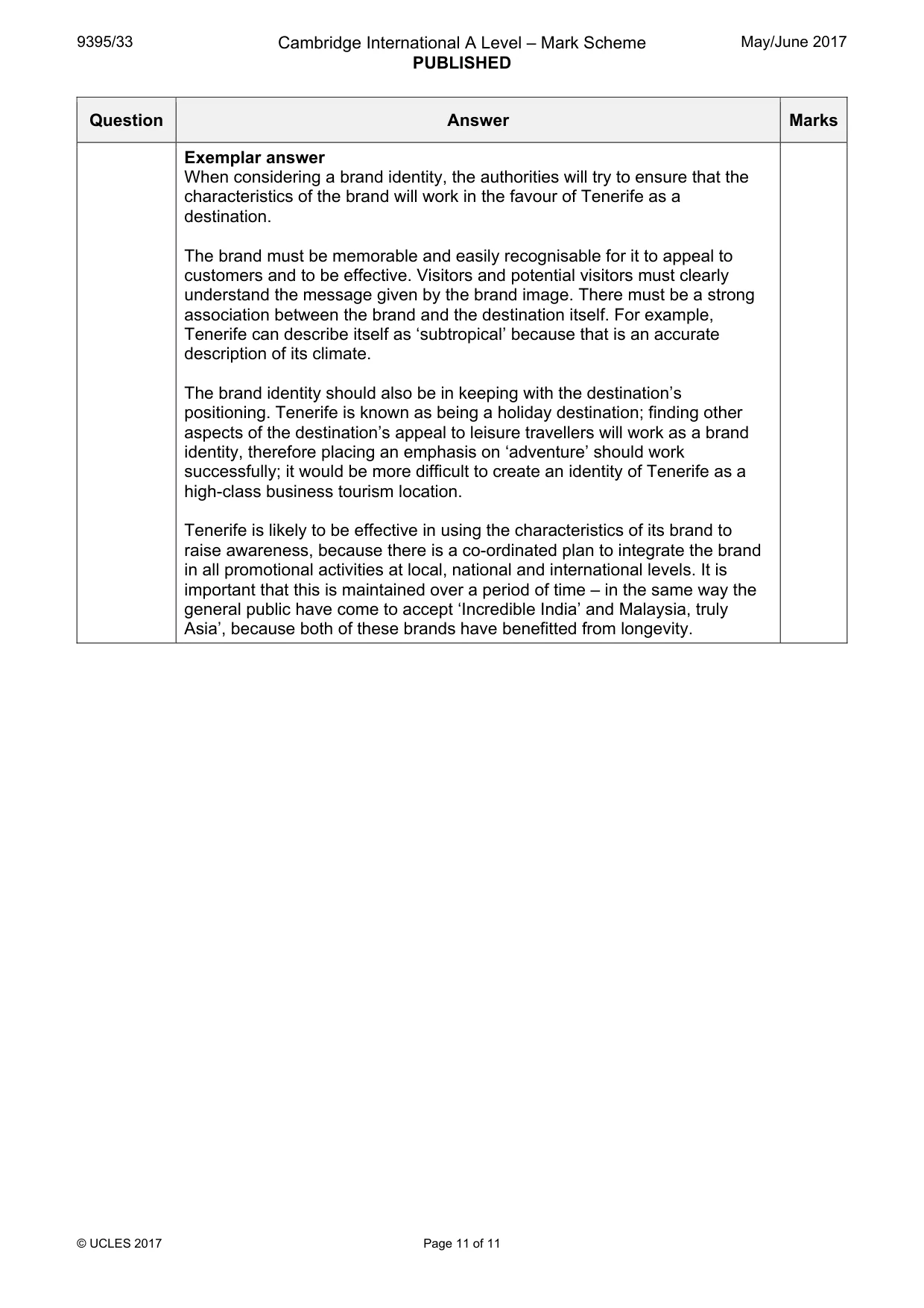
9395/33 Cambridge International A Level – Mark Scheme PUBLISHED May/June 2017 © UCLES 2017 Page 11 of 11 Question Answer Marks Exemplar answer When considering a brand identity, the authorities will try to ensure that the characteristics of the brand will work in the favour of Tenerife as a destination. The brand must be memorable and easily recognisable for it to appeal to customers and to be effective. Visitors and potential visitors must clearly understand the message given by the brand image. There must be a strong association between the brand and the destination itself. For example, Tenerife can describe itself as ‘subtropical’ because that is an accurate description of its climate. The brand identity should also be in keeping with the destination’s positioning. Tenerife is known as being a holiday destination; finding other aspects of the destination’s appeal to leisure travellers will work as a brand identity, therefore placing an emphasis on ‘adventure’ should work successfully; it would be more difficult to create an identity of Tenerife as a high-class business tourism location. Tenerife is likely to be effective in using the characteristics of its brand to raise awareness, because there is a co-ordinated plan to integrate the brand in all promotional activities at local, national and international levels. It is important that this is maintained over a period of time – in the same way the general public have come to accept ‘Incredible India’ and Malaysia, truly Asia’, because both of these brands have benefitted from longevity.
What you needed in this session
Cambridge’s own grade thresholds for 2017 May/June, Paper 3 · Variant 3. A higher threshold means an easier paper — the bar moves with how the cohort did.