Cambridge A Level Travel and Tourism 9395 — 2016 Oct/Nov Paper 4 · Variant 3
9395/43/O/N/16
The question paper and its mark scheme, free to read here and free to download. This is Cambridge’s own paper, exactly as it was sat.
Question paper8 pages







Mark scheme5 pages
Answers below. Sit the paper first if you are practising.
Paper as text
Question paper, page 1
This document consists of 7 printed pages, 1 blank page and 1 Insert. DC (CW) 114508/1 © UCLES 2016 [Turn over Cambridge International Examinations Cambridge International Advanced Subsidiary and Advanced Level * 3 2 4 7 0 4 7 5 6 3 * TRAVEL AND TOURISM 9395/43 Paper 4 Specialised Tourism October/November 2016 1 hour 30 minutes Candidates answer on the Question Paper. No Additional Materials are required. READ THESE INSTRUCTIONS FIRST Write your Centre number, candidate number and name on all the work you hand in. Write in dark blue or black pen. You may use an HB pencil for any diagrams or graphs. Do not use staples, paper clips, glue or correction fluid. DO NOT WRITE IN ANY BARCODES. Answer all questions. All the Figures referred to in the questions are contained in the Insert. The number of marks is given in brackets [ ] at the end of each question or part question.
Question paper, page 2
2 9395/43/O/N/16 © UCLES 2016 Question 1 Refer to Fig. 1 (Insert), information about tourism in the Polar regions. (a) Using Fig. 1 (Insert) explain two reasons for the growth of tourism in the Polar regions. 1 … … … … 2 … … … …[4]
Question paper, page 3
3 9395/43/O/N/16 © UCLES 2016 [Turn over (b) Discuss the likely ways in which governments and NGOs might be able to influence tourism activities in the Polar regions. … … … … … … … … … … … … … … … … … …[9]
Question paper, page 4
4 9395/43/O/N/16 © UCLES 2016 (c) Evaluate the likely environmental impacts of tourism activities in the Polar regions. … … … … … … … … … … … … … … … … … … … … … … … …[12] [Total: 25]
Question paper, page 5
5 9395/43/O/N/16 © UCLES 2016 [Turn over Question 2 Refer to Fig. 2 (Insert), information about tourism in Guatemala. (a) Explain two objectives of ecotourism. 1 … … … … 2 … … … …[4]
Question paper, page 6
6 9395/43/O/N/16 © UCLES 2016 (b) Assess the positive and negative economic impacts that increased levels of adventure tourism might have on the local Atitlan Lake community. … … … … … … … … … … … … … … … … … …[9]
Question paper, page 7
7 9395/43/O/N/16 © UCLES 2016 (c) Evaluate the methods that could be used to help preserve the cultural heritage of Guatemala. … … … … … … … … … … … … … … … … … … … … … … … …[12] [Total: 25]
Question paper, page 8
8 9395/43/O/N/16 © UCLES 2016 BLANK PAGE Permission to reproduce items where third-party owned material protected by copyright is included has been sought and cleared where possible. Every reasonable effort has been made by the publisher (UCLES) to trace copyright holders, but if any items requiring clearance have unwittingly been included, the publisher will be pleased to make amends at the earliest possible opportunity. To avoid the issue of disclosure of answer-related information to candidates, all copyright acknowledgements are reproduced online in the Cambridge International Examinations Copyright Acknowledgements Booklet. This is produced for each series of examinations and is freely available to download at www.cie.org.uk after the live examination series. Cambridge International Examinations is part of the Cambridge Assessment Group. Cambridge Assessment is the brand name of University of Cambridge Local Examinations Syndicate (UCLES), which is itself a department of the University of Cambridge.
Mark scheme, page 1
® IGCSE is the registered trademark of Cambridge International Examinations. This document consists of 5 printed pages. © UCLES 2016 [Turn over Cambridge International Examinations Cambridge International Advanced Subsidiary and Advanced Level TRAVEL AND TOURISM 9395/43 Paper 4 Specialised Tourism October/November 2016 MARK SCHEME Maximum Mark: 50 Published This mark scheme is published as an aid to teachers and candidates, to indicate the requirements of the examination. It shows the basis on which Examiners were instructed to award marks. It does not indicate the details of the discussions that took place at an Examiners’ meeting before marking began, which would have considered the acceptability of alternative answers. Mark schemes should be read in conjunction with the question paper and the Principal Examiner Report for Teachers. Cambridge will not enter into discussions about these mark schemes. Cambridge is publishing the mark schemes for the October/November 2016 series for most Cambridge IGCSE®, Cambridge International A and AS Level components and some Cambridge O Level components.
Mark scheme, page 2
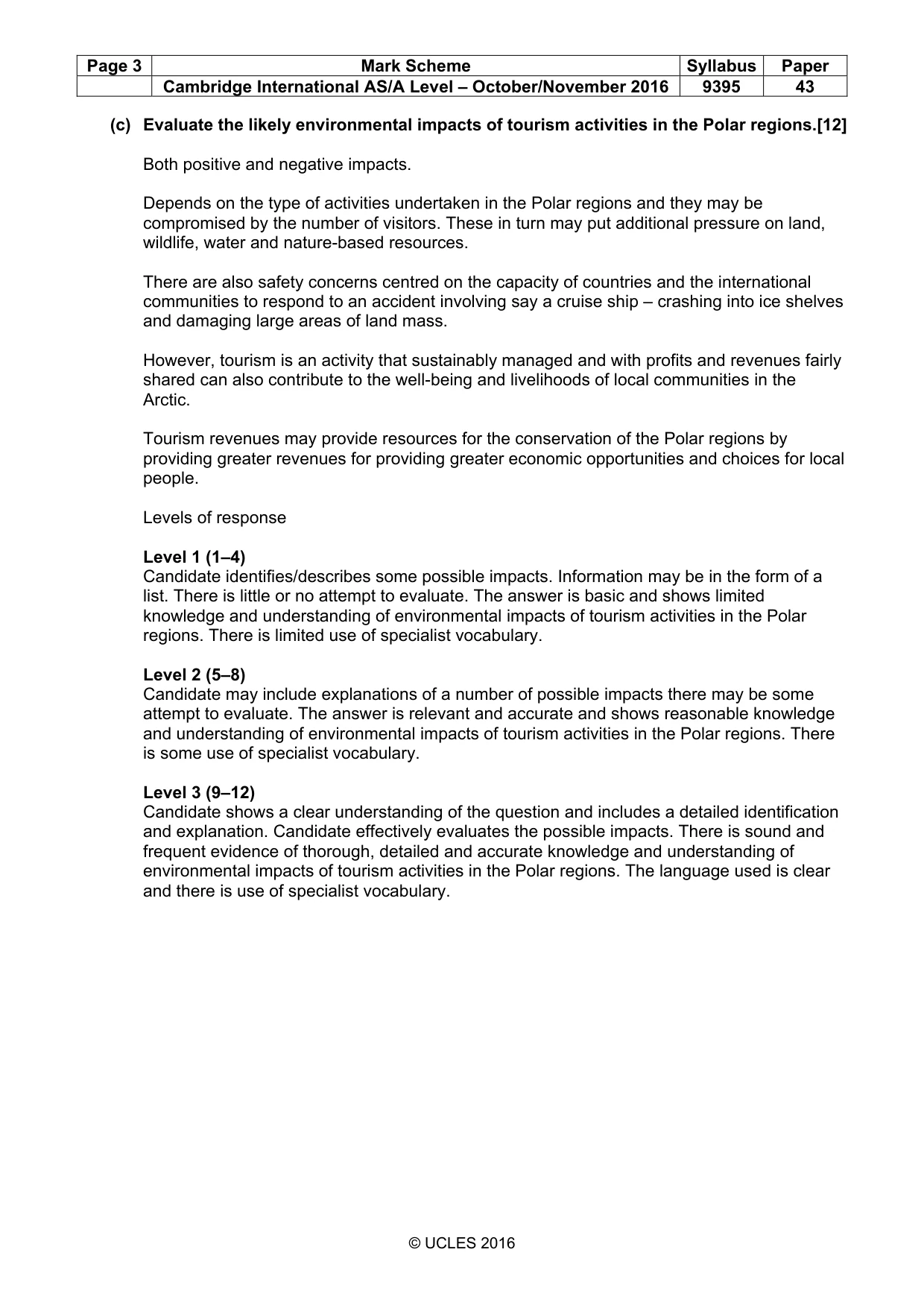
Page 2 Mark Scheme Syllabus Paper Cambridge International AS/A Level – October/November 2016 9395 43 © UCLES 2016 1 (a) Using Fig. 1 (insert) explain two reasons for the growth of tourism in the Polar regions. [4] Today improving transport technologies such as ships, (1) growing popularity for visiting new and different or extreme areas (1) Increasing wealth and leisure time for many of the population in developed and increasingly developing economies and a rising interest among consumers for ‘new experiences’ (1) allows greater mobility to enjoy more unique destinations (1) A moderating climate, and intensive tourism promotion are all contributing to the growth of tourism in the Polar regions.(1) cruise ships now including the destination on their itineraries (1) (b) Discuss the likely ways in which governments and NGOs might be able to influence tourism activities in the Polar regions. [9] Governments, and Non-Government Organizations (NGOs) want to determine the vulnerability of the polar environment to tourism impacts, probably by doing an environmental audit They will wish to mitigate these impacts and design and implement appropriate management responses. Perhaps by issuing guidelines to tour operators, code of conduct or similar to operators and tourists, particularly cruise ship passengers and trip organisers. Education programmes linked to promotional activities about the importance of the area The success of management responses depends on their relevance to the environmental, cultural, economic, and political conditions that uniquely characterise the Polar regions. These may include: Enforcing laws Making charges/introduction of fees Reduction of numbers allowed to visit Levels of response Level 1 (1–3) Candidate identifies/describes some possible ways. Information may be in the form of a list of ways. There is little or no attempt to discuss. The answer is basic and shows limited knowledge and understanding of government and NGO action. There is limited use of specialist vocabulary. Level 2 (4–6) Candidate describes a number of possible ways. May begin to discuss with some success. The answer is relevant and accurate and shows reasonable knowledge of government and NGO action. There is an understanding of concepts and principles with some use of specialist vocabulary. Level 3 (7–9) Candidate shows a clear understanding of the question. Candidate effectively discusses the possible ways. There is sound and frequent evidence of thorough, detailed and accurate knowledge and understanding of government and NGO actions and how they might be able to influence tourism activities in the Polar regions. Specialist vocabulary is used.
Mark scheme, page 3
Page 3 Mark Scheme Syllabus Paper Cambridge International AS/A Level – October/November 2016 9395 43 © UCLES 2016 (c) Evaluate the likely environmental impacts of tourism activities in the Polar regions.[12] Both positive and negative impacts. Depends on the type of activities undertaken in the Polar regions and they may be compromised by the number of visitors. These in turn may put additional pressure on land, wildlife, water and nature-based resources. There are also safety concerns centred on the capacity of countries and the international communities to respond to an accident involving say a cruise ship – crashing into ice shelves and damaging large areas of land mass. However, tourism is an activity that sustainably managed and with profits and revenues fairly shared can also contribute to the well-being and livelihoods of local communities in the Arctic. Tourism revenues may provide resources for the conservation of the Polar regions by providing greater revenues for providing greater economic opportunities and choices for local people. Levels of response Level 1 (1–4) Candidate identifies/describes some possible impacts. Information may be in the form of a list. There is little or no attempt to evaluate. The answer is basic and shows limited knowledge and understanding of environmental impacts of tourism activities in the Polar regions. There is limited use of specialist vocabulary. Level 2 (5–8) Candidate may include explanations of a number of possible impacts there may be some attempt to evaluate. The answer is relevant and accurate and shows reasonable knowledge and understanding of environmental impacts of tourism activities in the Polar regions. There is some use of specialist vocabulary. Level 3 (9–12) Candidate shows a clear understanding of the question and includes a detailed identification and explanation. Candidate effectively evaluates the possible impacts. There is sound and frequent evidence of thorough, detailed and accurate knowledge and understanding of environmental impacts of tourism activities in the Polar regions. The language used is clear and there is use of specialist vocabulary.
Mark scheme, page 4
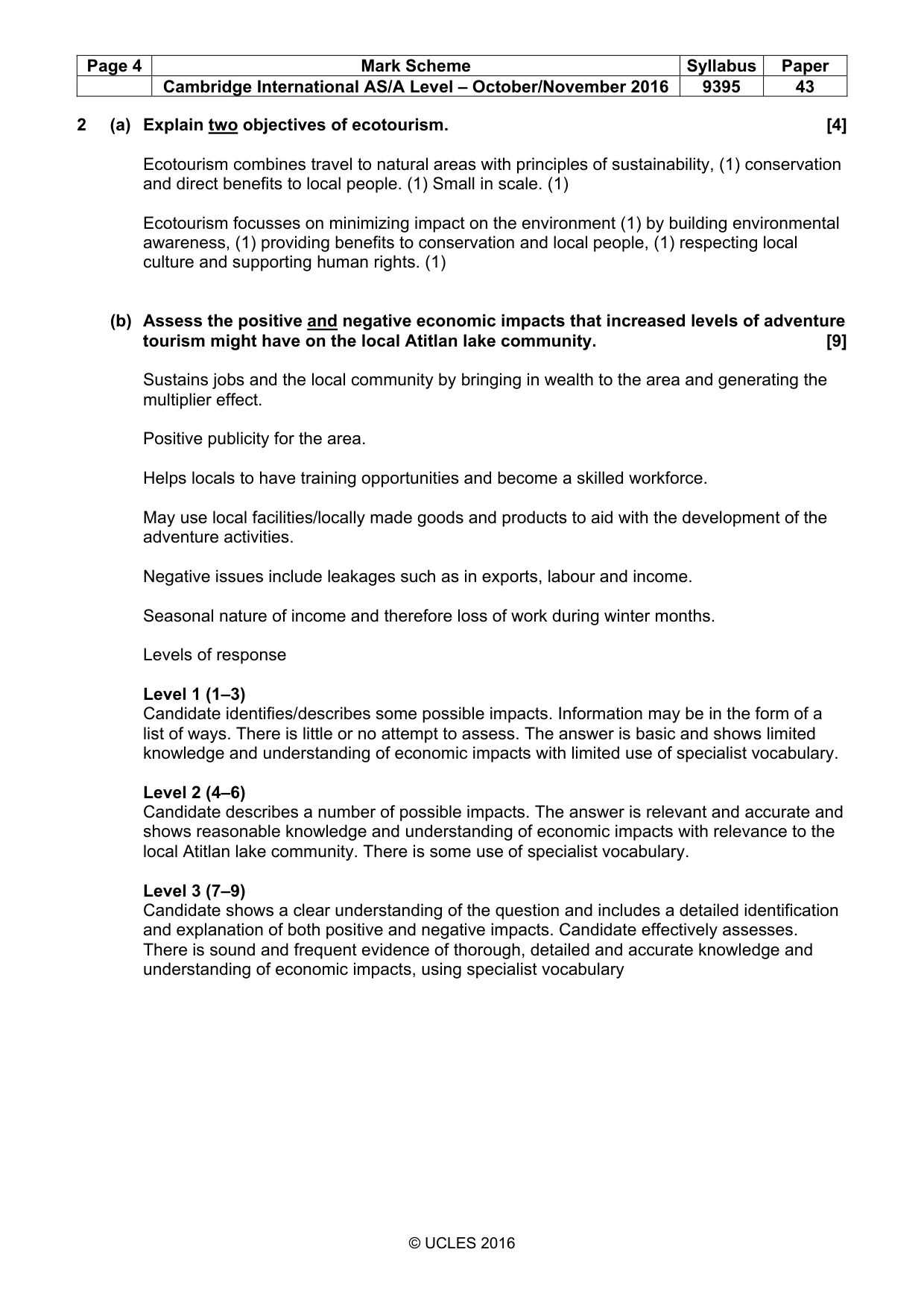
Page 4 Mark Scheme Syllabus Paper Cambridge International AS/A Level – October/November 2016 9395 43 © UCLES 2016 2 (a) Explain two objectives of ecotourism. [4] Ecotourism combines travel to natural areas with principles of sustainability, (1) conservation and direct benefits to local people. (1) Small in scale. (1) Ecotourism focusses on minimizing impact on the environment (1) by building environmental awareness, (1) providing benefits to conservation and local people, (1) respecting local culture and supporting human rights. (1) (b) Assess the positive and negative economic impacts that increased levels of adventure tourism might have on the local Atitlan lake community. [9] Sustains jobs and the local community by bringing in wealth to the area and generating the multiplier effect. Positive publicity for the area. Helps locals to have training opportunities and become a skilled workforce. May use local facilities/locally made goods and products to aid with the development of the adventure activities. Negative issues include leakages such as in exports, labour and income. Seasonal nature of income and therefore loss of work during winter months. Levels of response Level 1 (1–3) Candidate identifies/describes some possible impacts. Information may be in the form of a list of ways. There is little or no attempt to assess. The answer is basic and shows limited knowledge and understanding of economic impacts with limited use of specialist vocabulary. Level 2 (4–6) Candidate describes a number of possible impacts. The answer is relevant and accurate and shows reasonable knowledge and understanding of economic impacts with relevance to the local Atitlan lake community. There is some use of specialist vocabulary. Level 3 (7–9) Candidate shows a clear understanding of the question and includes a detailed identification and explanation of both positive and negative impacts. Candidate effectively assesses. There is sound and frequent evidence of thorough, detailed and accurate knowledge and understanding of economic impacts, using specialist vocabulary
Mark scheme, page 5
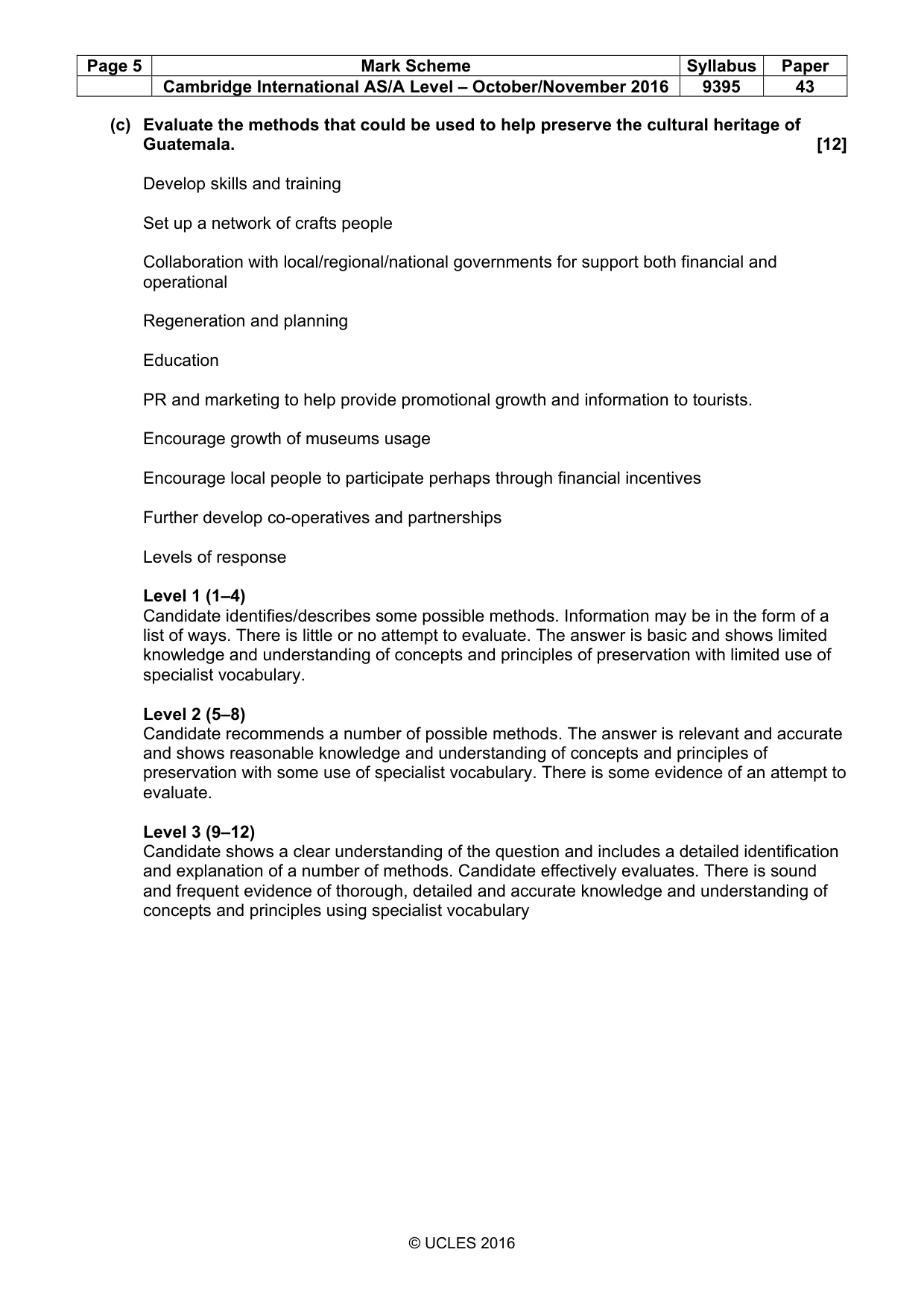
Page 5 Mark Scheme Syllabus Paper Cambridge International AS/A Level – October/November 2016 9395 43 © UCLES 2016 (c) Evaluate the methods that could be used to help preserve the cultural heritage of Guatemala. [12] Develop skills and training Set up a network of crafts people Collaboration with local/regional/national governments for support both financial and operational Regeneration and planning Education PR and marketing to help provide promotional growth and information to tourists. Encourage growth of museums usage Encourage local people to participate perhaps through financial incentives Further develop co-operatives and partnerships Levels of response Level 1 (1–4) Candidate identifies/describes some possible methods. Information may be in the form of a list of ways. There is little or no attempt to evaluate. The answer is basic and shows limited knowledge and understanding of concepts and principles of preservation with limited use of specialist vocabulary. Level 2 (5–8) Candidate recommends a number of possible methods. The answer is relevant and accurate and shows reasonable knowledge and understanding of concepts and principles of preservation with some use of specialist vocabulary. There is some evidence of an attempt to evaluate. Level 3 (9–12) Candidate shows a clear understanding of the question and includes a detailed identification and explanation of a number of methods. Candidate effectively evaluates. There is sound and frequent evidence of thorough, detailed and accurate knowledge and understanding of concepts and principles using specialist vocabulary