Cambridge A Level Travel and Tourism 9395 — 2016 Oct/Nov Paper 4 · Variant 2
9395/42/O/N/16
The question paper and its mark scheme, free to read here and free to download. This is Cambridge’s own paper, exactly as it was sat.
Question paper8 pages






Mark scheme5 pages
Answers below. Sit the paper first if you are practising.
Paper as text
Question paper, page 1
This document consists of 7 printed pages, 1 blank page and 1 Insert. DC (AL) 131802 © UCLES 2016 [Turn over Cambridge International Examinations Cambridge International Advanced Subsidiary and Advanced Level * 9 3 8 5 2 9 9 1 7 4 * TRAVEL AND TOURISM 9395/42 Paper 4 Specialised Tourism October/November 2016 1 hour 30 minutes Candidates answer on the Question Paper. No Additional Materials are required. READ THESE INSTRUCTIONS FIRST Write your Centre number, candidate number and name on all the work you hand in. Write in dark blue or black pen. Do not use staples, paper clips, glue or correction fluid. You may use an HB pencil for any diagrams or graphs. DO NOT WRITE IN ANY BARCODES. Answer all questions. All the Figures referred to in the questions are contained in the Insert. The number of marks is given in brackets [ ] at the end of each question or part question.
Question paper, page 2
2 9395/42/O/N/16 © UCLES 2016 Question 1 Refer to Fig. 1 (Insert), information about Benicàssim and its music festival in Spain. (a) Using Fig. 1 (Insert) explain two likely negative economic impacts of the music festival on the local community of Benicàssim. 1 … … … … 2 … … … …[4]
Question paper, page 3
3 9395/42/O/N/16 © UCLES 2016 [Turn over (b) Discuss the importance of retaining cultural events in destinations such as Benicàssim. … … … … … … … … … … … … … … … … … …[9]
Question paper, page 4
4 9395/42/O/N/16 © UCLES 2016 (c) Evaluate the likely negative environmental impacts that a large music festival might bring. … … … … … … … … … … … … … … … … … … … … … … … …[12]
Question paper, page 5
5 9395/42/O/N/16 © UCLES 2016 [Turn over Question 2 Refer to Fig. 2 (Insert), information about ecotourism in Thailand. (a) Using Fig. 2 (Insert) explain two ways in which tourists in Thailand are able to be eco-friendly. 1 … … … … 2 … … … …[4]
Question paper, page 6
6 9395/42/O/N/16 © UCLES 2016 (b) Discuss the importance to the Thai tourism industry of having support from NGOs. … … … … … … … … … … … … … … … … … …[9]
Question paper, page 7
7 9395/42/O/N/16 © UCLES 2016 (c) Evaluate the ways in which ecotourism principles may conflict with economic interests in destinations such as Thailand. … … … … … … … … … … … … … … … … … … … … … … … …[12]
Question paper, page 8
8 9395/42/O/N/16 © UCLES 2016 Permission to reproduce items where third-party owned material protected by copyright is included has been sought and cleared where possible. Every reasonable effort has been made by the publisher (UCLES) to trace copyright holders, but if any items requiring clearance have unwittingly been included, the publisher will be pleased to make amends at the earliest possible opportunity. To avoid the issue of disclosure of answer-related information to candidates, all copyright acknowledgements are reproduced online in the Cambridge International Examinations Copyright Acknowledgements Booklet. This is produced for each series of examinations and is freely available to download at www.cie.org.uk after the live examination series. Cambridge International Examinations is part of the Cambridge Assessment Group. Cambridge Assessment is the brand name of University of Cambridge Local Examinations Syndicate (UCLES), which is itself a department of the University of Cambridge. bLANk pAgE
Mark scheme, page 1
® IGCSE is the registered trademark of Cambridge International Examinations. This document consists of 5 printed pages. © UCLES 2016 [Turn over Cambridge International Examinations Cambridge International Advanced Subsidiary and Advanced Level TRAVEL AND TOURISM 9395/42 Paper 4 Specialised Tourism October/November 2016 MARK SCHEME Maximum Mark: 50 Published This mark scheme is published as an aid to teachers and candidates, to indicate the requirements of the examination. It shows the basis on which Examiners were instructed to award marks. It does not indicate the details of the discussions that took place at an Examiners’ meeting before marking began, which would have considered the acceptability of alternative answers. Mark schemes should be read in conjunction with the question paper and the Principal Examiner Report for Teachers. Cambridge will not enter into discussions about these mark schemes. Cambridge is publishing the mark schemes for the October/November 2016 series for most Cambridge IGCSE®, Cambridge International A and AS Level components and some Cambridge O Level components.
Mark scheme, page 2
Page 2 Mark Scheme Syllabus Paper Cambridge International AS/A Level – October/November 2016 9395 42 © UCLES 2016 1 (a) Using Fig. 1 (Insert) explain two likely negative economic impacts of the music festival on the local community of Benicàssim. [4] Many job roles will be out-sourced by companies from outside of the area [1] local people will not directly benefit as jobs and wages will not be retained. [1] Jobs are seasonal as this is an annual event [1] and training for future job opportunities may be limited due to the time frame of the festival. [1] Work will be low skilled [1] and therefore low paid. [1] Wealth to the area will be limited due to the short length of the festival and night-time [1] the multiplier effect will be reduced and opportunities for jobs and income lessened. [1] Leakage may occur [1] when organisations bring their own staff or goods [1] the local people will not benefit [1] High prices may be set for the tourists [1] this disadvantages the local people who will have to pay higher prices too [1] Only credit negative economic impacts. (b) Discuss the importance of retaining cultural events in destinations such as Benicàssim. [9] • Culture is important and is often the reason why many tourists want to visit people and places. • Cultural events help to show diversity and cultural characteristics of an area and this will encourage visitors both domestic and overseas. • Sustaining pride of an area and civic responsibility helps local people to feel part of their community and this helps with financial and social cohesion. • Events also help to safe-guard local traditions and cultural aspects of importance, such as food, drink, dress, language, etc. • Education opportunity for future generations to benefit and enjoy. • Mixing of cultures helps to foster greater understanding of different lifestyles. • Can reduce demonstration effect. Award L1 only if economic impacts are given. Discuss: Build an argument and present more than one side of evidence with supporting evidence. Creates a written debate, create a balanced answer. Levels of response Level 1 (1–3) Candidate identifies/describes some possible reasons. Information may be in the form of a list of ways. There is little or no attempt to discuss. The answer is basic and shows limited knowledge and understanding of the importance of culture. There is limited use of specialist vocabulary.
Mark scheme, page 3
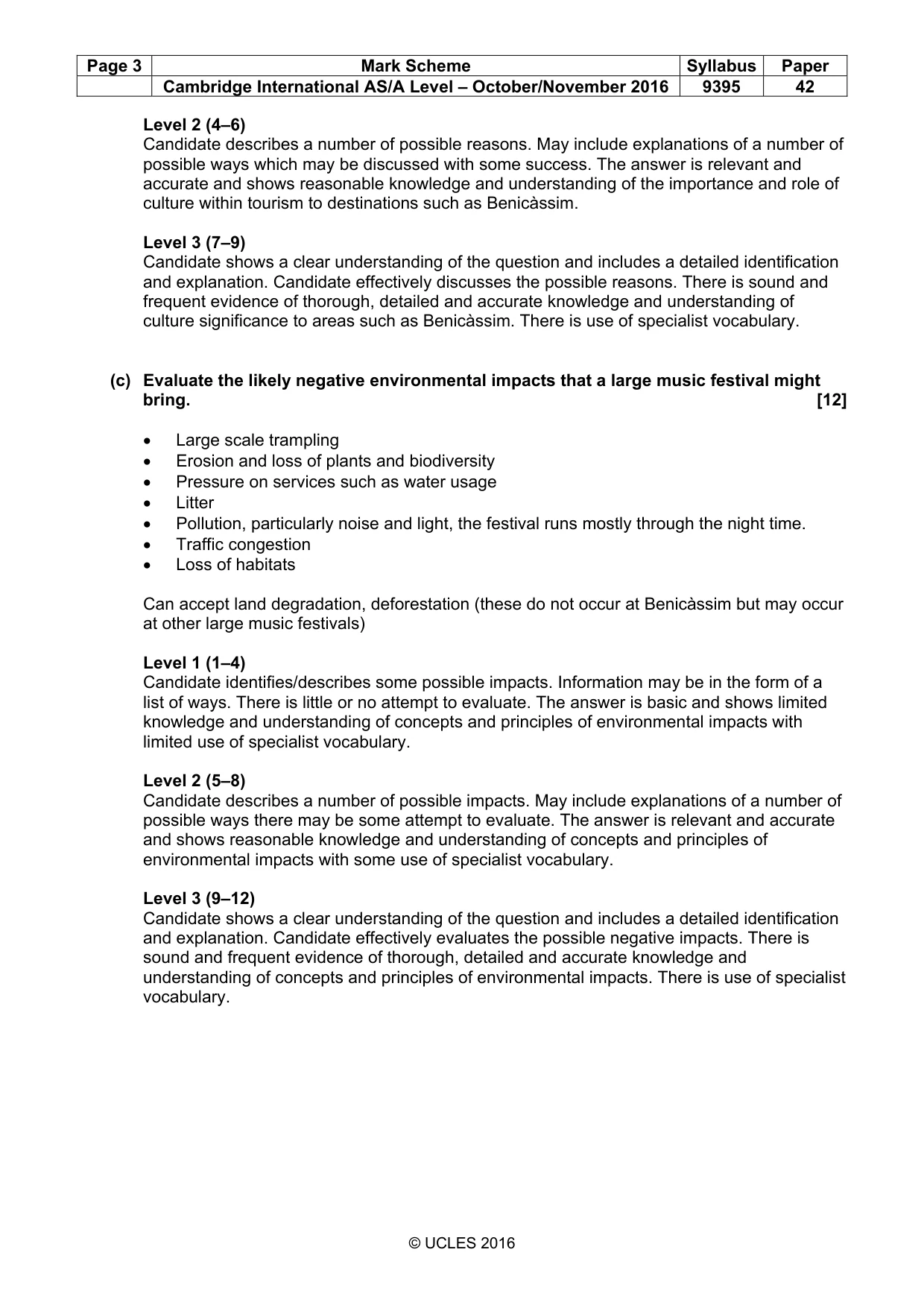
Page 3 Mark Scheme Syllabus Paper Cambridge International AS/A Level – October/November 2016 9395 42 © UCLES 2016 Level 2 (4–6) Candidate describes a number of possible reasons. May include explanations of a number of possible ways which may be discussed with some success. The answer is relevant and accurate and shows reasonable knowledge and understanding of the importance and role of culture within tourism to destinations such as Benicàssim. Level 3 (7–9) Candidate shows a clear understanding of the question and includes a detailed identification and explanation. Candidate effectively discusses the possible reasons. There is sound and frequent evidence of thorough, detailed and accurate knowledge and understanding of culture significance to areas such as Benicàssim. There is use of specialist vocabulary. (c) Evaluate the likely negative environmental impacts that a large music festival might bring. [12] • Large scale trampling • Erosion and loss of plants and biodiversity • Pressure on services such as water usage • Litter • Pollution, particularly noise and light, the festival runs mostly through the night time. • Traffic congestion • Loss of habitats Can accept land degradation, deforestation (these do not occur at Benicàssim but may occur at other large music festivals) Level 1 (1–4) Candidate identifies/describes some possible impacts. Information may be in the form of a list of ways. There is little or no attempt to evaluate. The answer is basic and shows limited knowledge and understanding of concepts and principles of environmental impacts with limited use of specialist vocabulary. Level 2 (5–8) Candidate describes a number of possible impacts. May include explanations of a number of possible ways there may be some attempt to evaluate. The answer is relevant and accurate and shows reasonable knowledge and understanding of concepts and principles of environmental impacts with some use of specialist vocabulary. Level 3 (9–12) Candidate shows a clear understanding of the question and includes a detailed identification and explanation. Candidate effectively evaluates the possible negative impacts. There is sound and frequent evidence of thorough, detailed and accurate knowledge and understanding of concepts and principles of environmental impacts. There is use of specialist vocabulary.
Mark scheme, page 4
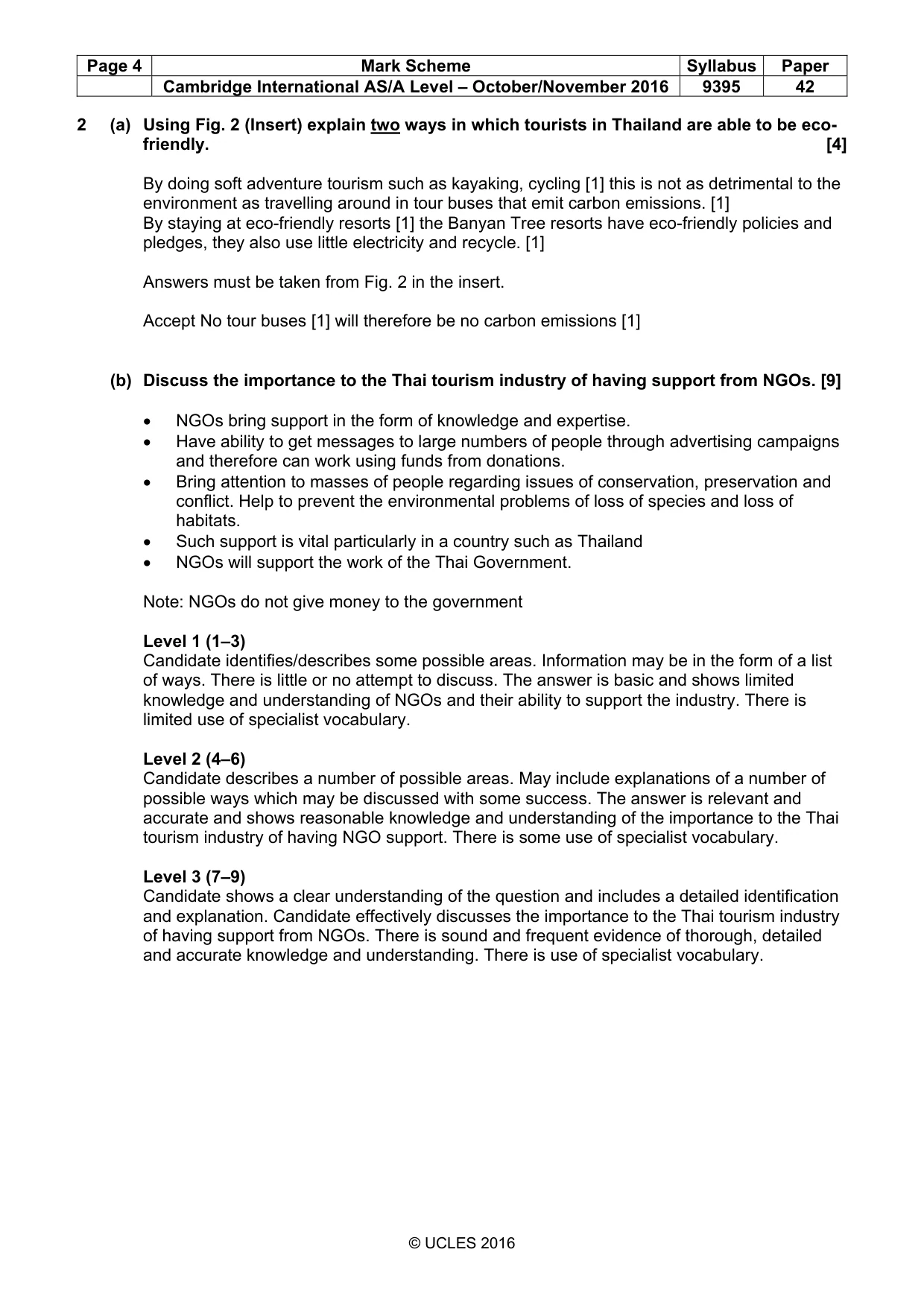
Page 4 Mark Scheme Syllabus Paper Cambridge International AS/A Level – October/November 2016 9395 42 © UCLES 2016 2 (a) Using Fig. 2 (Insert) explain two ways in which tourists in Thailand are able to be eco- friendly. [4] By doing soft adventure tourism such as kayaking, cycling [1] this is not as detrimental to the environment as travelling around in tour buses that emit carbon emissions. [1] By staying at eco-friendly resorts [1] the Banyan Tree resorts have eco-friendly policies and pledges, they also use little electricity and recycle. [1] Answers must be taken from Fig. 2 in the insert. Accept No tour buses [1] will therefore be no carbon emissions [1] (b) Discuss the importance to the Thai tourism industry of having support from NGOs. [9] • NGOs bring support in the form of knowledge and expertise. • Have ability to get messages to large numbers of people through advertising campaigns and therefore can work using funds from donations. • Bring attention to masses of people regarding issues of conservation, preservation and conflict. Help to prevent the environmental problems of loss of species and loss of habitats. • Such support is vital particularly in a country such as Thailand • NGOs will support the work of the Thai Government. Note: NGOs do not give money to the government Level 1 (1–3) Candidate identifies/describes some possible areas. Information may be in the form of a list of ways. There is little or no attempt to discuss. The answer is basic and shows limited knowledge and understanding of NGOs and their ability to support the industry. There is limited use of specialist vocabulary. Level 2 (4–6) Candidate describes a number of possible areas. May include explanations of a number of possible ways which may be discussed with some success. The answer is relevant and accurate and shows reasonable knowledge and understanding of the importance to the Thai tourism industry of having NGO support. There is some use of specialist vocabulary. Level 3 (7–9) Candidate shows a clear understanding of the question and includes a detailed identification and explanation. Candidate effectively discusses the importance to the Thai tourism industry of having support from NGOs. There is sound and frequent evidence of thorough, detailed and accurate knowledge and understanding. There is use of specialist vocabulary.
Mark scheme, page 5
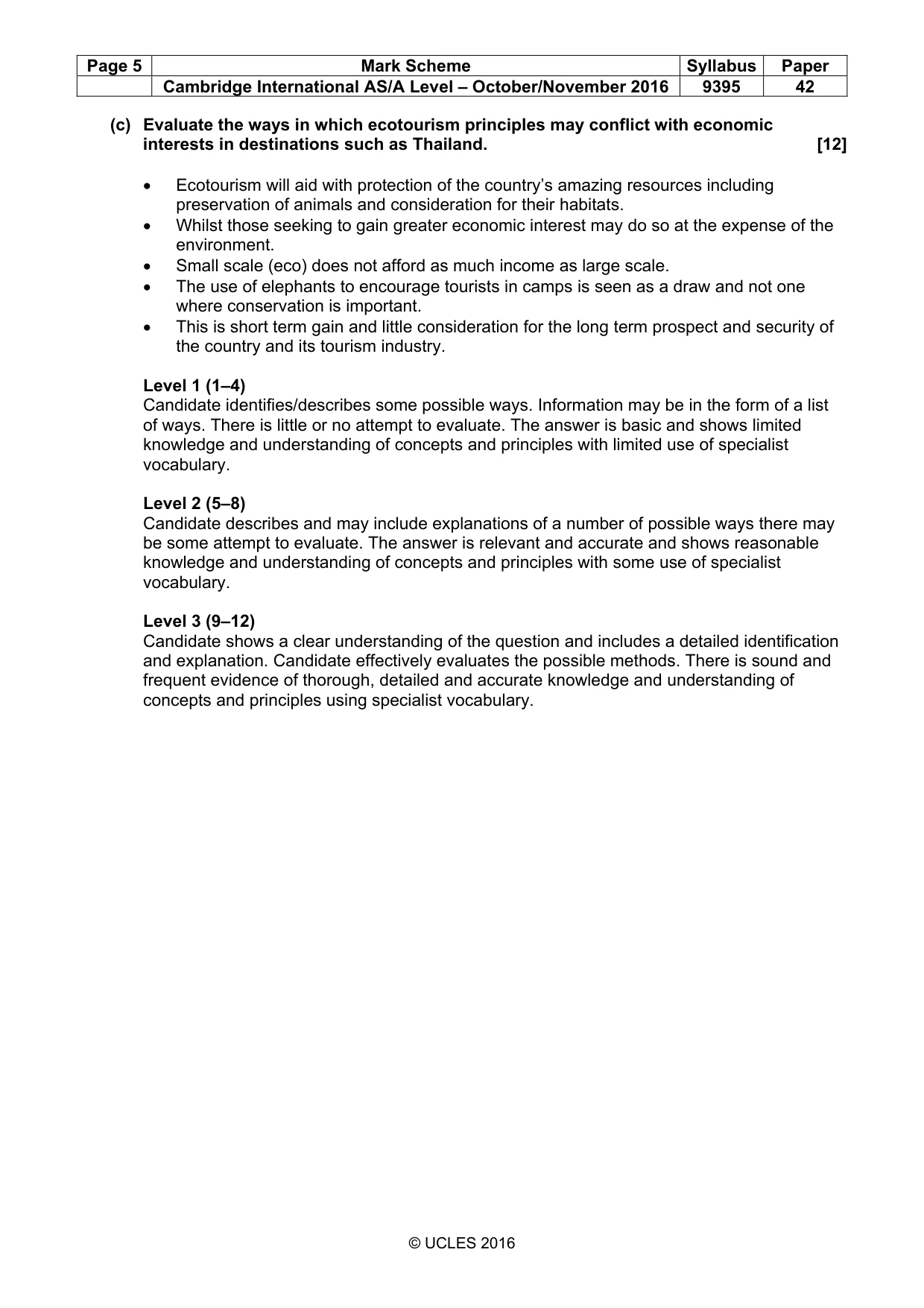
Page 5 Mark Scheme Syllabus Paper Cambridge International AS/A Level – October/November 2016 9395 42 © UCLES 2016 (c) Evaluate the ways in which ecotourism principles may conflict with economic interests in destinations such as Thailand. [12] • Ecotourism will aid with protection of the country’s amazing resources including preservation of animals and consideration for their habitats. • Whilst those seeking to gain greater economic interest may do so at the expense of the environment. • Small scale (eco) does not afford as much income as large scale. • The use of elephants to encourage tourists in camps is seen as a draw and not one where conservation is important. • This is short term gain and little consideration for the long term prospect and security of the country and its tourism industry. Level 1 (1–4) Candidate identifies/describes some possible ways. Information may be in the form of a list of ways. There is little or no attempt to evaluate. The answer is basic and shows limited knowledge and understanding of concepts and principles with limited use of specialist vocabulary. Level 2 (5–8) Candidate describes and may include explanations of a number of possible ways there may be some attempt to evaluate. The answer is relevant and accurate and shows reasonable knowledge and understanding of concepts and principles with some use of specialist vocabulary. Level 3 (9–12) Candidate shows a clear understanding of the question and includes a detailed identification and explanation. Candidate effectively evaluates the possible methods. There is sound and frequent evidence of thorough, detailed and accurate knowledge and understanding of concepts and principles using specialist vocabulary.