Cambridge A Level Travel and Tourism 9395 — 2015 May/June Paper 4 · Variant 1
9395/41/M/J/15 · 50 marks · ≈56 min
The question paper and its mark scheme, free to read here and free to download. This is Cambridge’s own paper, exactly as it was sat.
Question paper8 pages

Mark scheme4 pages
Answers below. Sit the paper first if you are practising.
Paper as text
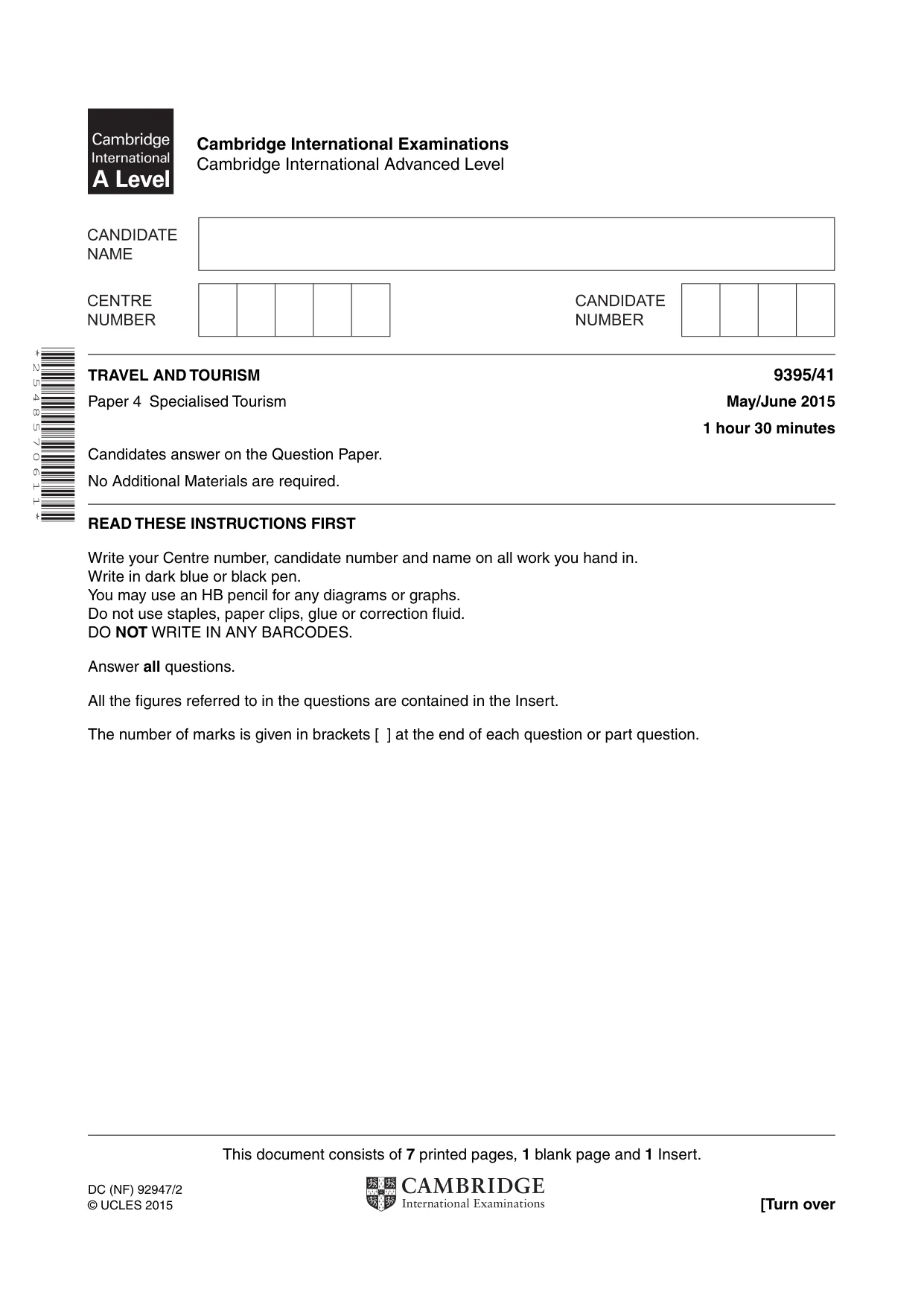
Question paper, page 1
This document consists of 7 printed pages, 1 blank page and 1 Insert. DC (NF) 92947/2 © UCLES 2015 [Turn over Cambridge International Examinations Cambridge International Advanced Level * 2 5 4 8 5 7 0 6 1 1 * TRAVEL AND TOURISM 9395/41 Paper 4 Specialised Tourism May/June 2015 1 hour 30 minutes Candidates answer on the Question Paper. No Additional Materials are required. READ THESE INSTRUCTIONS FIRST Write your Centre number, candidate number and name on all work you hand in. Write in dark blue or black pen. You may use an HB pencil for any diagrams or graphs. Do not use staples, paper clips, glue or correction fluid. DO NOT WRITE IN ANY BARCODES. Answer all questions. All the figures referred to in the questions are contained in the Insert. The number of marks is given in brackets [ ] at the end of each question or part question.
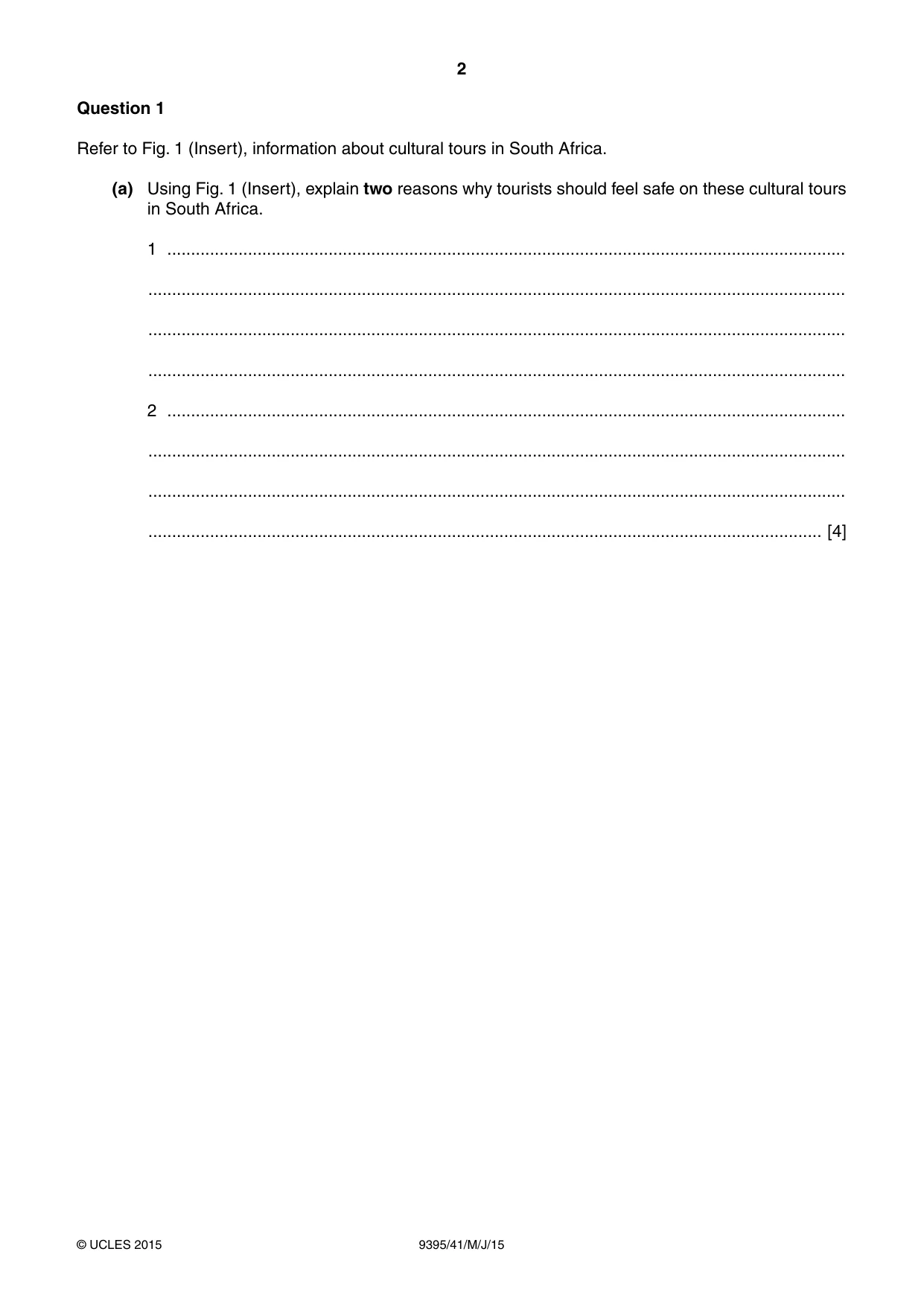
Question paper, page 2
2 9395/41/M/J/15 © UCLES 2015 Question 1 Refer to Fig. 1 (Insert), information about cultural tours in South Africa. (a) Using Fig. 1 (Insert), explain two reasons why tourists should feel safe on these cultural tours in South Africa. 1 … … … … 2 … … … … [4]
Question paper, page 3
3 9395/41/M/J/15 © UCLES 2015 [Turn over (b) Explain fully how cultural tours may help to preserve the heritage and culture in destinations such as South Africa. … … … … … … … … … … … … … … … … … … … … … … … … … … … [9]
Question paper, page 4
4 9395/41/M/J/15 © UCLES 2015 (c) Discuss the extent to which a large increase in tourism might destroy the authenticity of destinations such as South Africa. … … … … … … … … … … … … … … … … … … … … … … … … … … [12] [Total: 25]
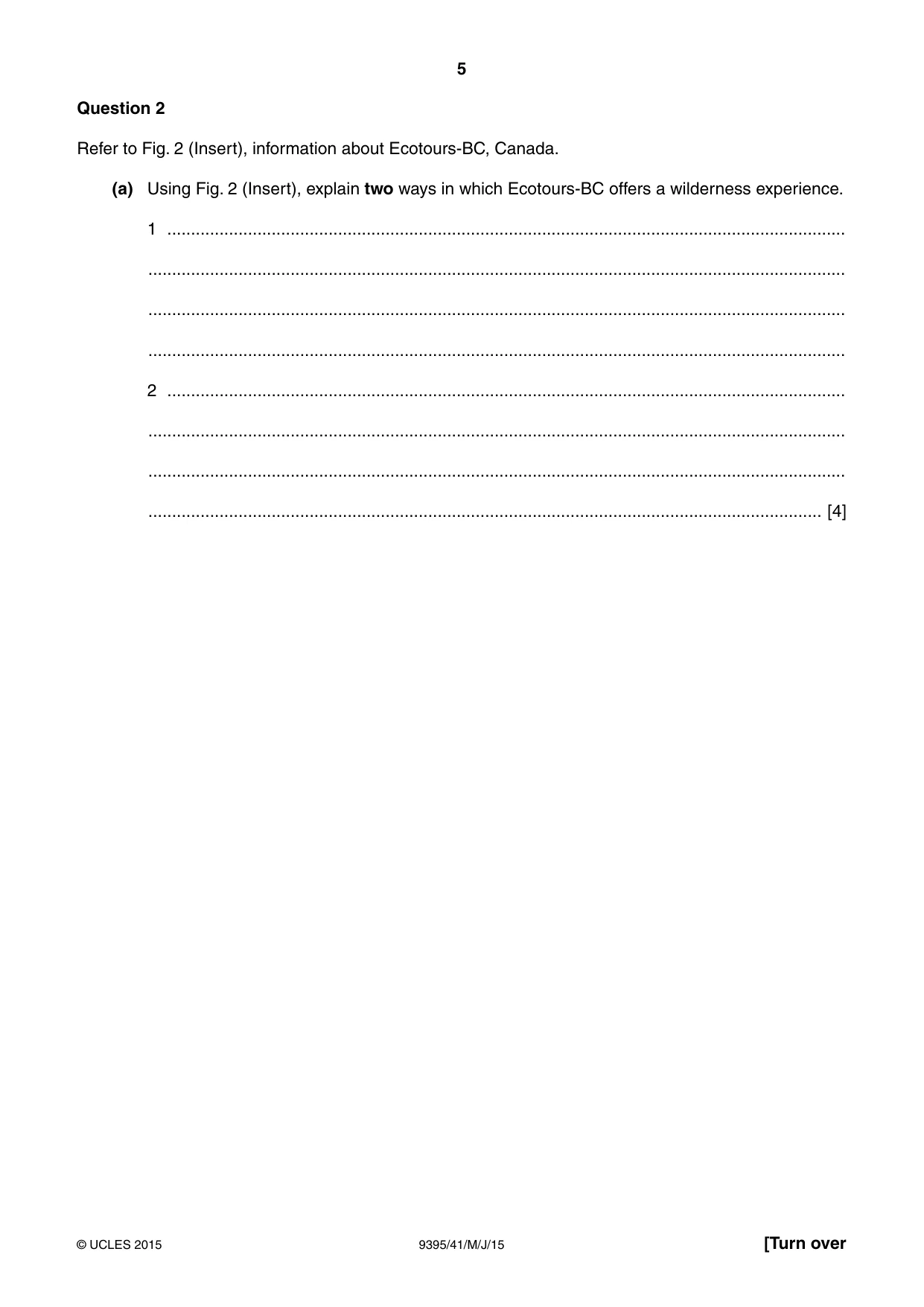
Question paper, page 5
5 9395/41/M/J/15 © UCLES 2015 [Turn over Question 2 Refer to Fig. 2 (Insert), information about Ecotours-BC, Canada. (a) Using Fig. 2 (Insert), explain two ways in which Ecotours-BC offers a wilderness experience. 1 … … … … 2 … … … … [4]
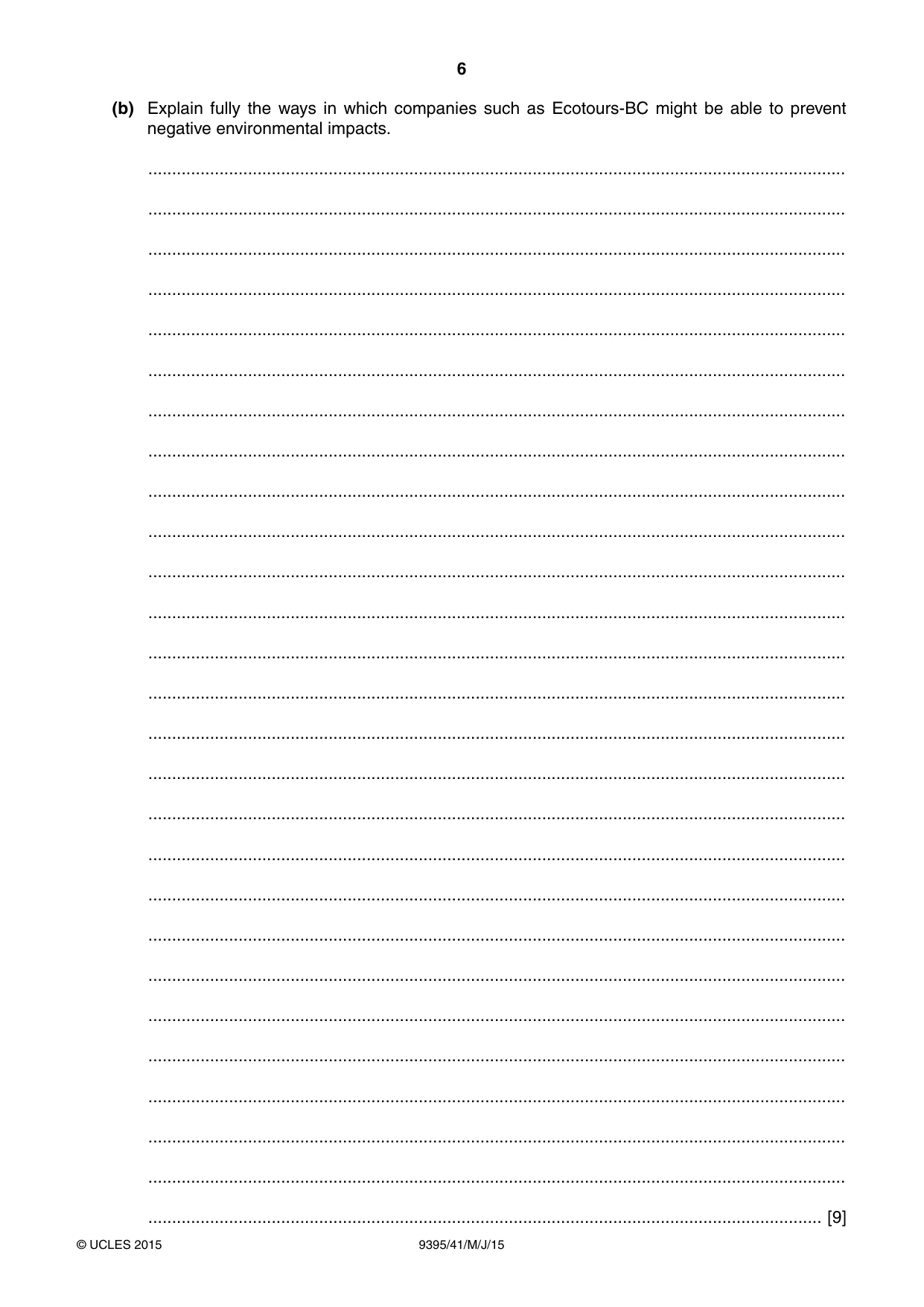
Question paper, page 6
6 9395/41/M/J/15 © UCLES 2015 (b) Explain fully the ways in which companies such as Ecotours-BC might be able to prevent negative environmental impacts. … … … … … … … … … … … … … … … … … … … … … … … … … … … [9]
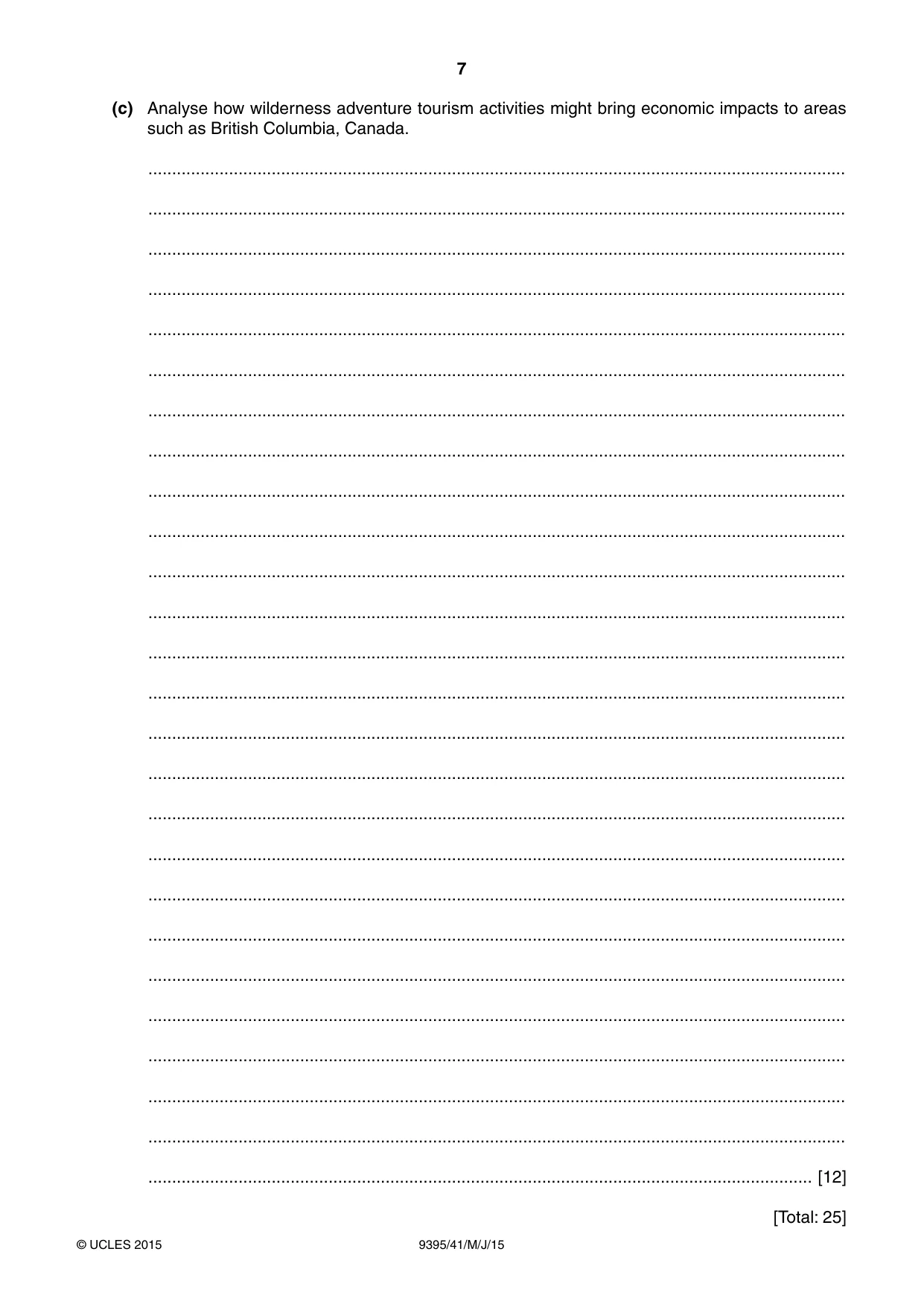
Question paper, page 7
7 9395/41/M/J/15 © UCLES 2015 (c) Analyse how wilderness adventure tourism activities might bring economic impacts to areas such as British Columbia, Canada. … … … … … … … … … … … … … … … … … … … … … … … … … … [12] [Total: 25]
Question paper, page 8
8 9395/41/M/J/15 © UCLES 2015 Permission to reproduce items where third-party owned material protected by copyright is included has been sought and cleared where possible. Every reasonable effort has been made by the publisher (UCLES) to trace copyright holders, but if any items requiring clearance have unwittingly been included, the publisher will be pleased to make amends at the earliest possible opportunity. To avoid the issue of disclosure of answer-related information to candidates, all copyright acknowledgements are reproduced online in the Cambridge International Examinations Copyright Acknowledgements Booklet. This is produced for each series of examinations and is freely available to download at www.cie.org.uk after the live examination series. Cambridge International Examinations is part of the Cambridge Assessment Group. Cambridge Assessment is the brand name of University of Cambridge Local Examinations Syndicate (UCLES), which is itself a department of the University of Cambridge. BLANK PAGE
Mark scheme, page 1
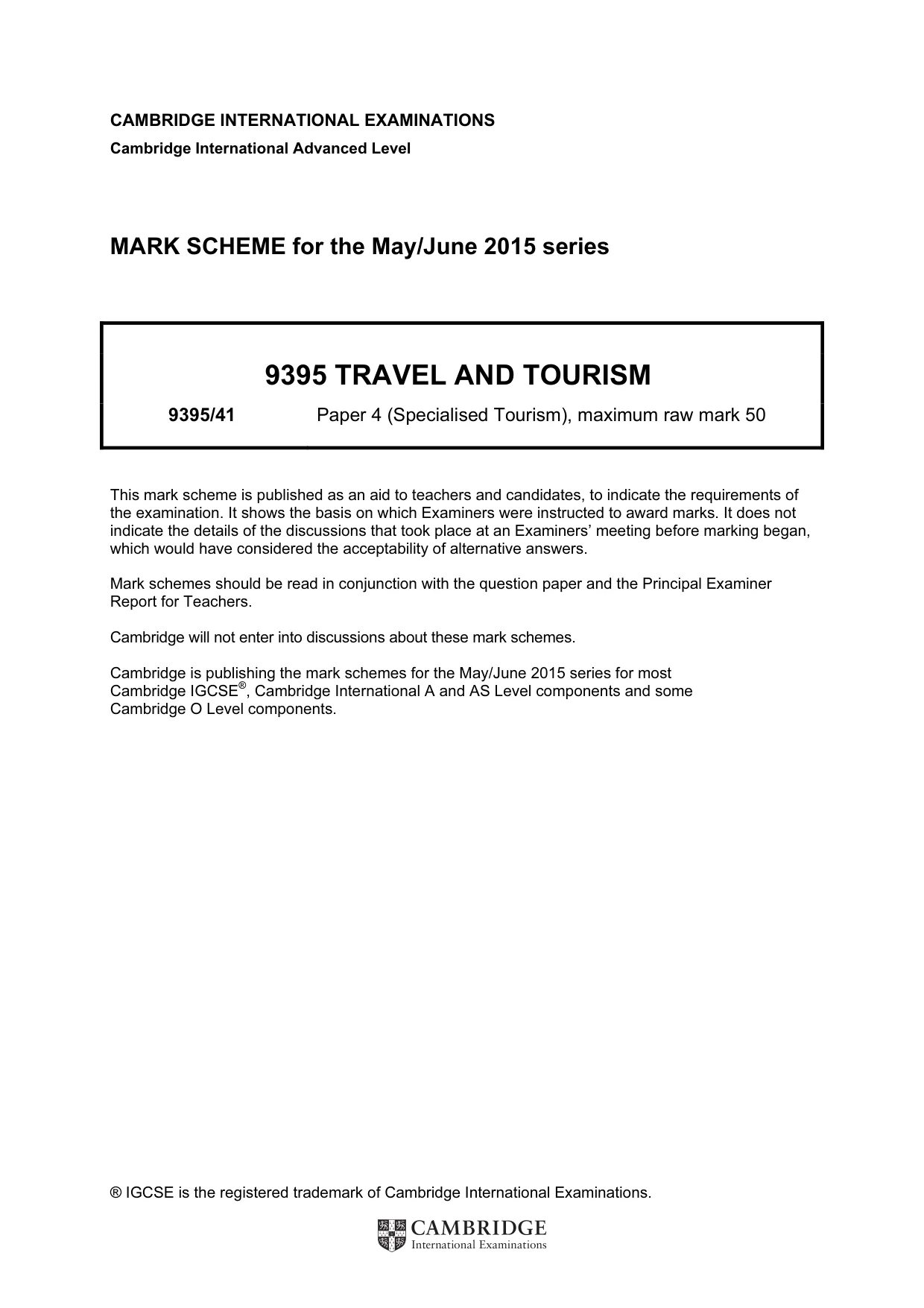
® IGCSE is the registered trademark of Cambridge International Examinations. CAMBRIDGE INTERNATIONAL EXAMINATIONS Cambridge International Advanced Level MARK SCHEME for the May/June 2015 series 9395 TRAVEL AND TOURISM 9395/41 Paper 4 (Specialised Tourism), maximum raw mark 50 This mark scheme is published as an aid to teachers and candidates, to indicate the requirements of the examination. It shows the basis on which Examiners were instructed to award marks. It does not indicate the details of the discussions that took place at an Examiners’ meeting before marking began, which would have considered the acceptability of alternative answers. Mark schemes should be read in conjunction with the question paper and the Principal Examiner Report for Teachers. Cambridge will not enter into discussions about these mark schemes. Cambridge is publishing the mark schemes for the May/June 2015 series for most Cambridge IGCSE®, Cambridge International A and AS Level components and some Cambridge O Level components.
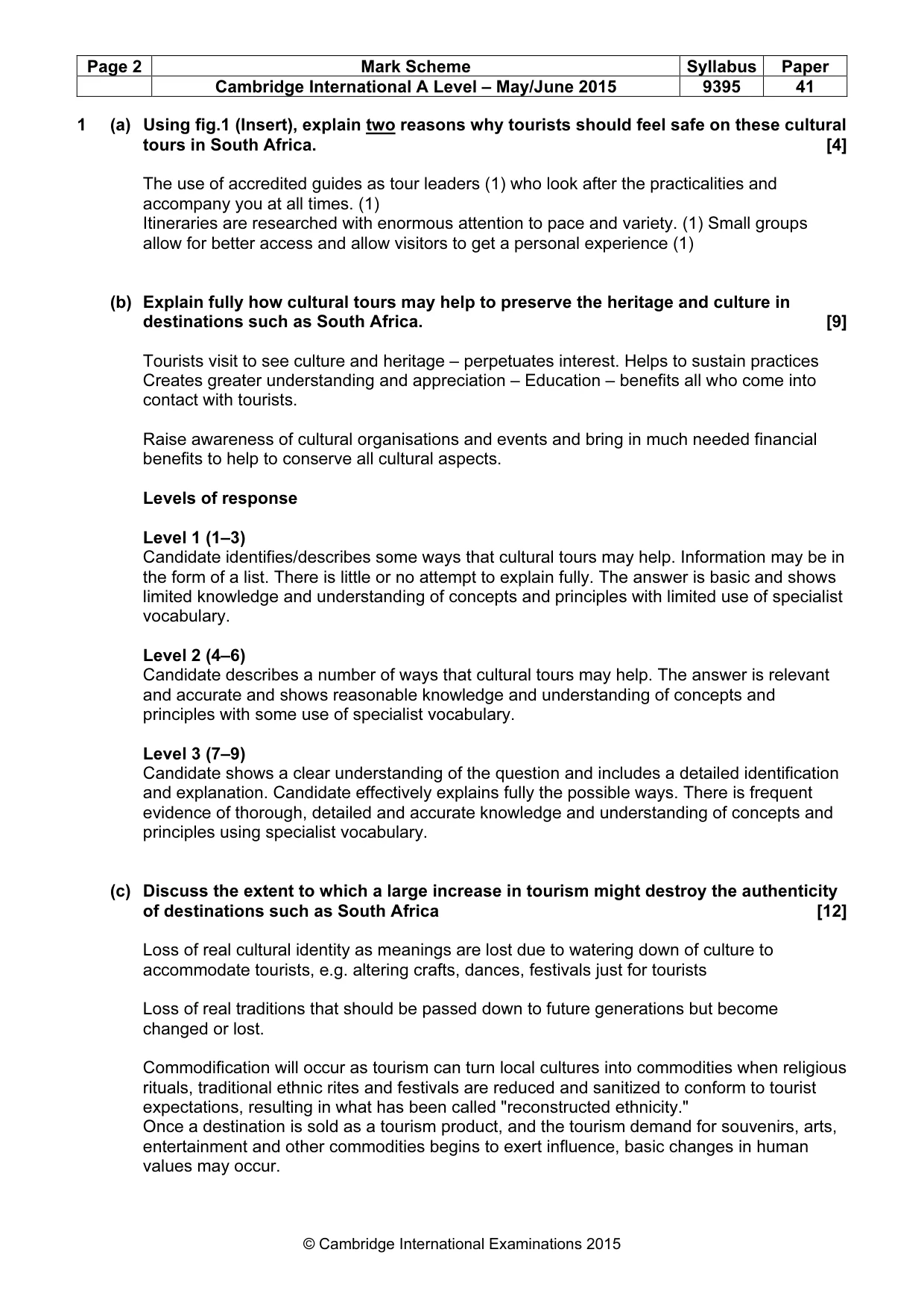
Mark scheme, page 2
Page 2 Mark Scheme Syllabus Paper Cambridge International A Level – May/June 2015 9395 41 © Cambridge International Examinations 2015 1 (a) Using fig.1 (Insert), explain two reasons why tourists should feel safe on these cultural tours in South Africa. [4] The use of accredited guides as tour leaders (1) who look after the practicalities and accompany you at all times. (1) Itineraries are researched with enormous attention to pace and variety. (1) Small groups allow for better access and allow visitors to get a personal experience (1) (b) Explain fully how cultural tours may help to preserve the heritage and culture in destinations such as South Africa. [9] Tourists visit to see culture and heritage – perpetuates interest. Helps to sustain practices Creates greater understanding and appreciation – Education – benefits all who come into contact with tourists. Raise awareness of cultural organisations and events and bring in much needed financial benefits to help to conserve all cultural aspects. Levels of response Level 1 (1–3) Candidate identifies/describes some ways that cultural tours may help. Information may be in the form of a list. There is little or no attempt to explain fully. The answer is basic and shows limited knowledge and understanding of concepts and principles with limited use of specialist vocabulary. Level 2 (4–6) Candidate describes a number of ways that cultural tours may help. The answer is relevant and accurate and shows reasonable knowledge and understanding of concepts and principles with some use of specialist vocabulary. Level 3 (7–9) Candidate shows a clear understanding of the question and includes a detailed identification and explanation. Candidate effectively explains fully the possible ways. There is frequent evidence of thorough, detailed and accurate knowledge and understanding of concepts and principles using specialist vocabulary. (c) Discuss the extent to which a large increase in tourism might destroy the authenticity of destinations such as South Africa [12] Loss of real cultural identity as meanings are lost due to watering down of culture to accommodate tourists, e.g. altering crafts, dances, festivals just for tourists Loss of real traditions that should be passed down to future generations but become changed or lost. Commodification will occur as tourism can turn local cultures into commodities when religious rituals, traditional ethnic rites and festivals are reduced and sanitized to conform to tourist expectations, resulting in what has been called "reconstructed ethnicity." Once a destination is sold as a tourism product, and the tourism demand for souvenirs, arts, entertainment and other commodities begins to exert influence, basic changes in human values may occur.
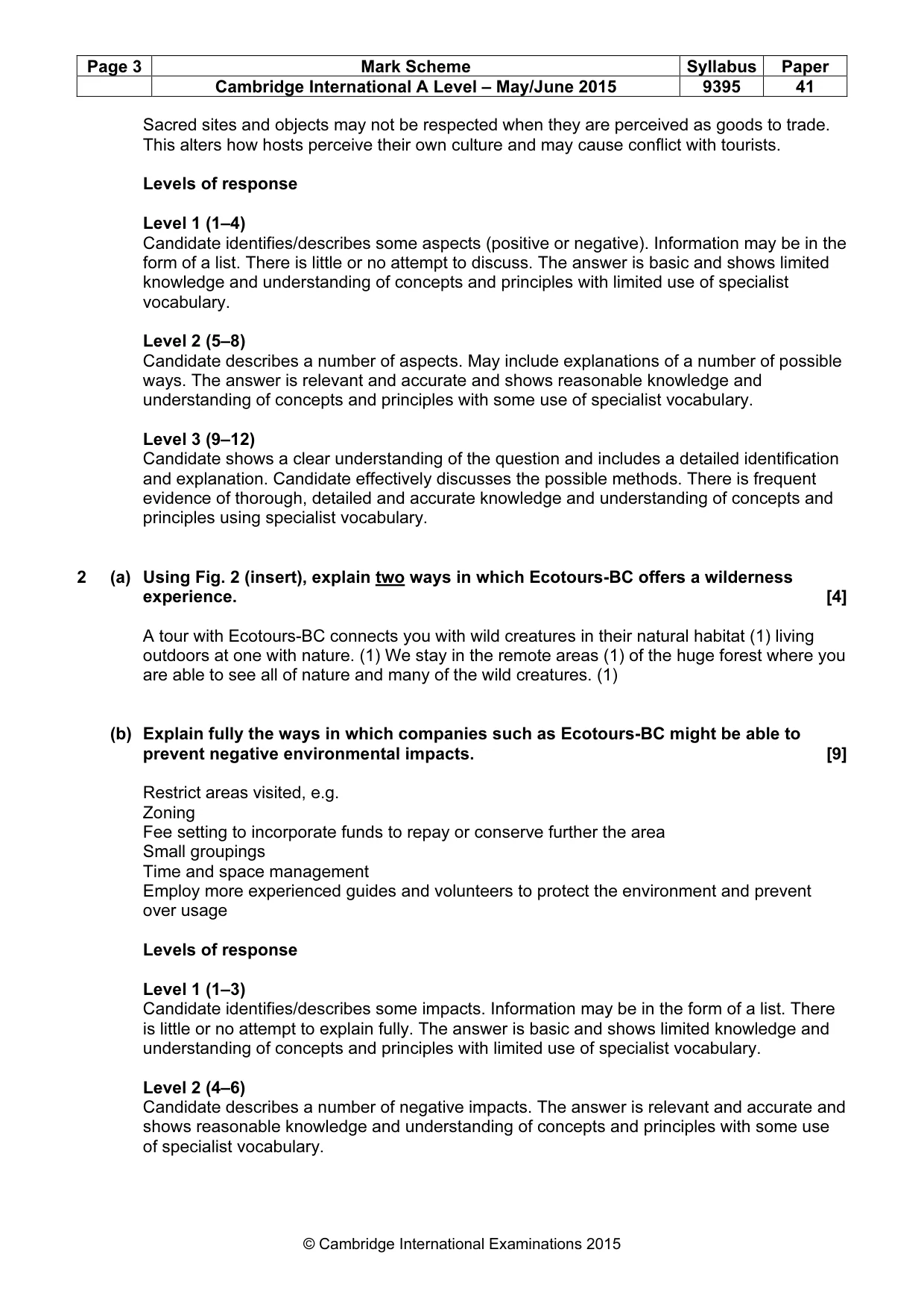
Mark scheme, page 3
Page 3 Mark Scheme Syllabus Paper Cambridge International A Level – May/June 2015 9395 41 © Cambridge International Examinations 2015 Sacred sites and objects may not be respected when they are perceived as goods to trade. This alters how hosts perceive their own culture and may cause conflict with tourists. Levels of response Level 1 (1–4) Candidate identifies/describes some aspects (positive or negative). Information may be in the form of a list. There is little or no attempt to discuss. The answer is basic and shows limited knowledge and understanding of concepts and principles with limited use of specialist vocabulary. Level 2 (5–8) Candidate describes a number of aspects. May include explanations of a number of possible ways. The answer is relevant and accurate and shows reasonable knowledge and understanding of concepts and principles with some use of specialist vocabulary. Level 3 (9–12) Candidate shows a clear understanding of the question and includes a detailed identification and explanation. Candidate effectively discusses the possible methods. There is frequent evidence of thorough, detailed and accurate knowledge and understanding of concepts and principles using specialist vocabulary. 2 (a) Using Fig. 2 (insert), explain two ways in which Ecotours-BC offers a wilderness experience. [4] A tour with Ecotours-BC connects you with wild creatures in their natural habitat (1) living outdoors at one with nature. (1) We stay in the remote areas (1) of the huge forest where you are able to see all of nature and many of the wild creatures. (1) (b) Explain fully the ways in which companies such as Ecotours-BC might be able to prevent negative environmental impacts. [9] Restrict areas visited, e.g. Zoning Fee setting to incorporate funds to repay or conserve further the area Small groupings Time and space management Employ more experienced guides and volunteers to protect the environment and prevent over usage Levels of response Level 1 (1–3) Candidate identifies/describes some impacts. Information may be in the form of a list. There is little or no attempt to explain fully. The answer is basic and shows limited knowledge and understanding of concepts and principles with limited use of specialist vocabulary. Level 2 (4–6) Candidate describes a number of negative impacts. The answer is relevant and accurate and shows reasonable knowledge and understanding of concepts and principles with some use of specialist vocabulary.
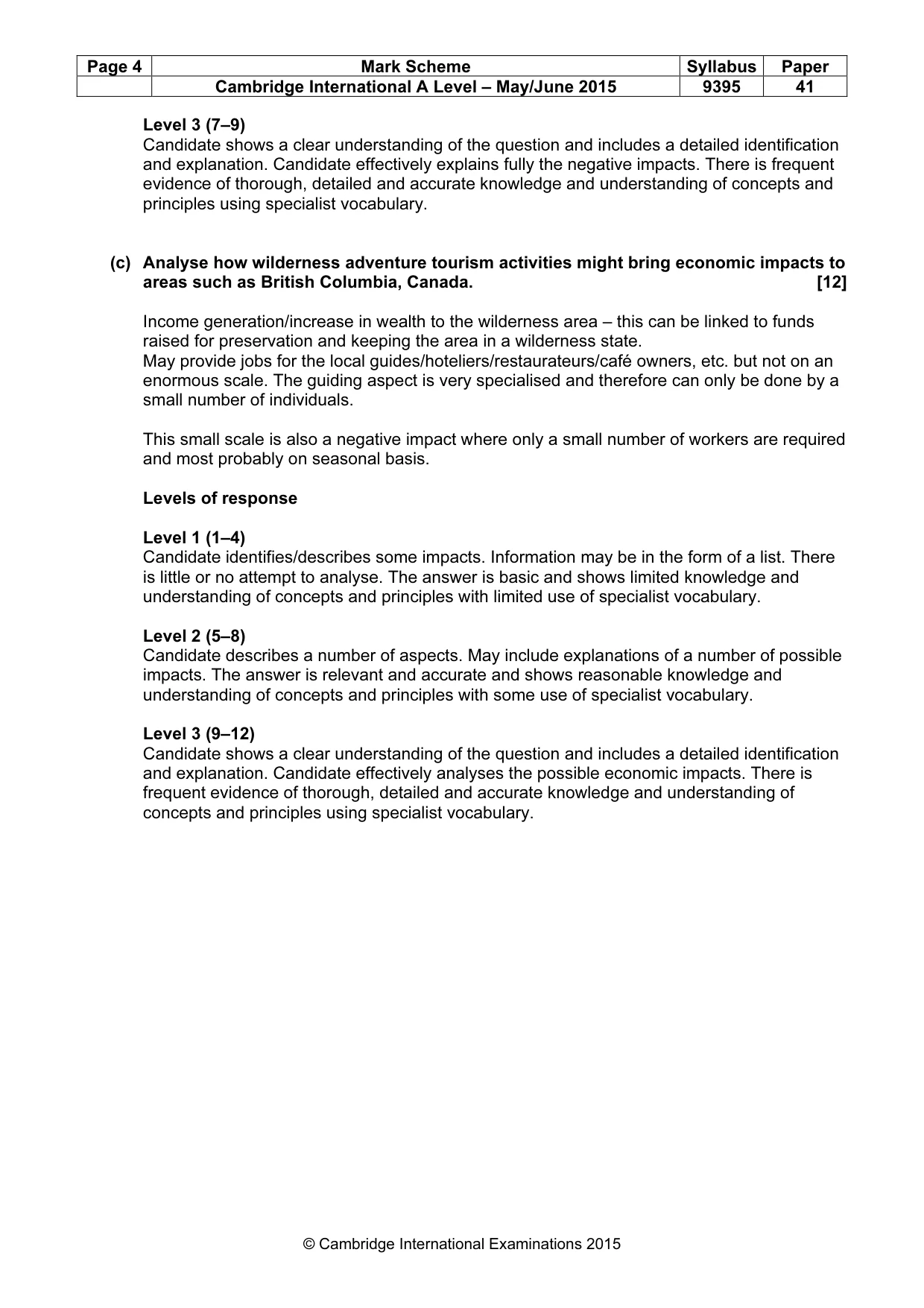
Mark scheme, page 4
Page 4 Mark Scheme Syllabus Paper Cambridge International A Level – May/June 2015 9395 41 © Cambridge International Examinations 2015 Level 3 (7–9) Candidate shows a clear understanding of the question and includes a detailed identification and explanation. Candidate effectively explains fully the negative impacts. There is frequent evidence of thorough, detailed and accurate knowledge and understanding of concepts and principles using specialist vocabulary. (c) Analyse how wilderness adventure tourism activities might bring economic impacts to areas such as British Columbia, Canada. [12] Income generation/increase in wealth to the wilderness area – this can be linked to funds raised for preservation and keeping the area in a wilderness state. May provide jobs for the local guides/hoteliers/restaurateurs/café owners, etc. but not on an enormous scale. The guiding aspect is very specialised and therefore can only be done by a small number of individuals. This small scale is also a negative impact where only a small number of workers are required and most probably on seasonal basis. Levels of response Level 1 (1–4) Candidate identifies/describes some impacts. Information may be in the form of a list. There is little or no attempt to analyse. The answer is basic and shows limited knowledge and understanding of concepts and principles with limited use of specialist vocabulary. Level 2 (5–8) Candidate describes a number of aspects. May include explanations of a number of possible impacts. The answer is relevant and accurate and shows reasonable knowledge and understanding of concepts and principles with some use of specialist vocabulary. Level 3 (9–12) Candidate shows a clear understanding of the question and includes a detailed identification and explanation. Candidate effectively analyses the possible economic impacts. There is frequent evidence of thorough, detailed and accurate knowledge and understanding of concepts and principles using specialist vocabulary.
What you needed in this session
Cambridge’s own grade thresholds for 2015 May/June, Paper 4 · Variant 1. A higher threshold means an easier paper — the bar moves with how the cohort did.