Cambridge A Level Travel and Tourism 9395 — 2014 Oct/Nov Paper 4 · Variant 3
9395/43/O/N/14 · 50 marks · ≈56 min
The question paper and its mark scheme, free to read here and free to download. This is Cambridge’s own paper, exactly as it was sat.
Question paper8 pages

Mark scheme5 pages
Answers below. Sit the paper first if you are practising.

Paper as text
Question paper, page 1
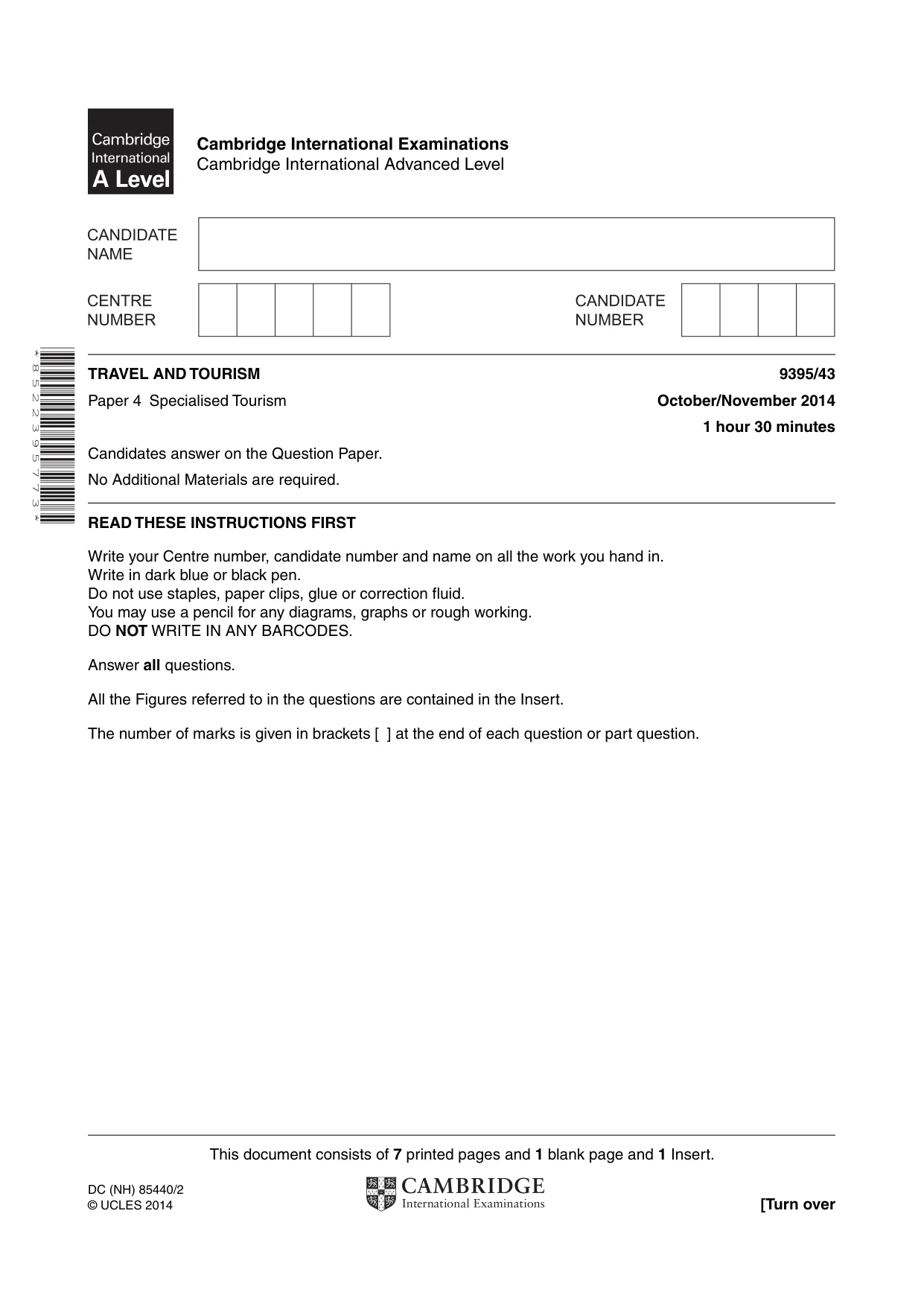
This document consists of 7 printed pages and 1 blank page and 1 Insert. DC (NH) 85440/2 © UCLES 2014 [Turn over * 8 5 2 2 3 9 5 7 7 3 * TRAVEL AND TOURISM 9395/43 Paper 4 Specialised Tourism October/November 2014 1 hour 30 minutes Candidates answer on the Question Paper. No Additional Materials are required. READ THESE INSTRUCTIONS FIRST Write your Centre number, candidate number and name on all the work you hand in. Write in dark blue or black pen. Do not use staples, paper clips, glue or correction fluid. You may use a pencil for any diagrams, graphs or rough working. DO NOT WRITE IN ANY BARCODES. Answer all questions. All the Figures referred to in the questions are contained in the Insert. The number of marks is given in brackets [ ] at the end of each question or part question. Cambridge International Examinations Cambridge International Advanced Level
Question paper, page 2
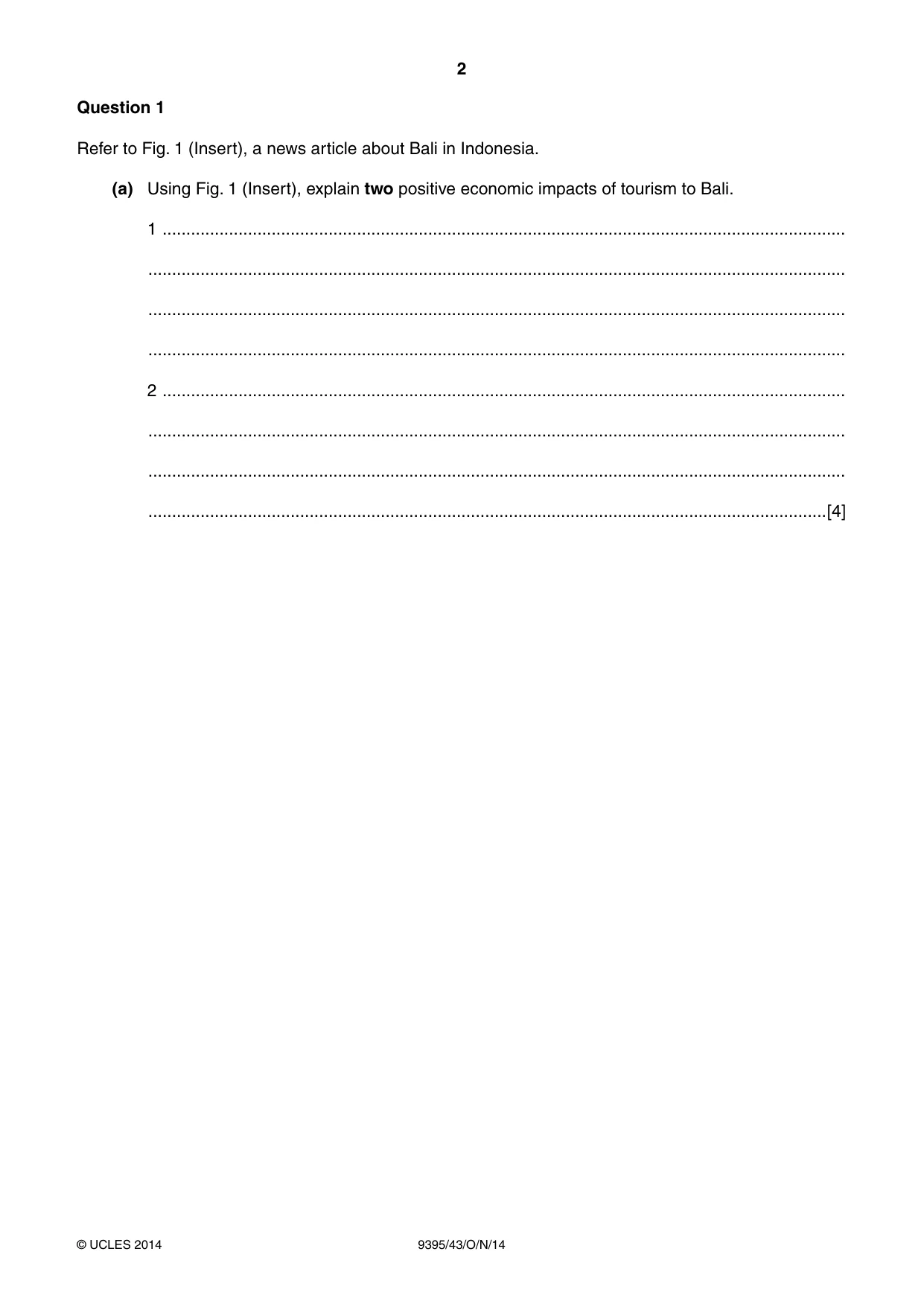
2 9395/43/O/N/14 © UCLES 2014 Question 1 Refer to Fig. 1 (Insert), a news article about Bali in Indonesia. (a) Using Fig. 1 (Insert), explain two positive economic impacts of tourism to Bali. 1 … … … … 2 … … … …[4]
Question paper, page 3
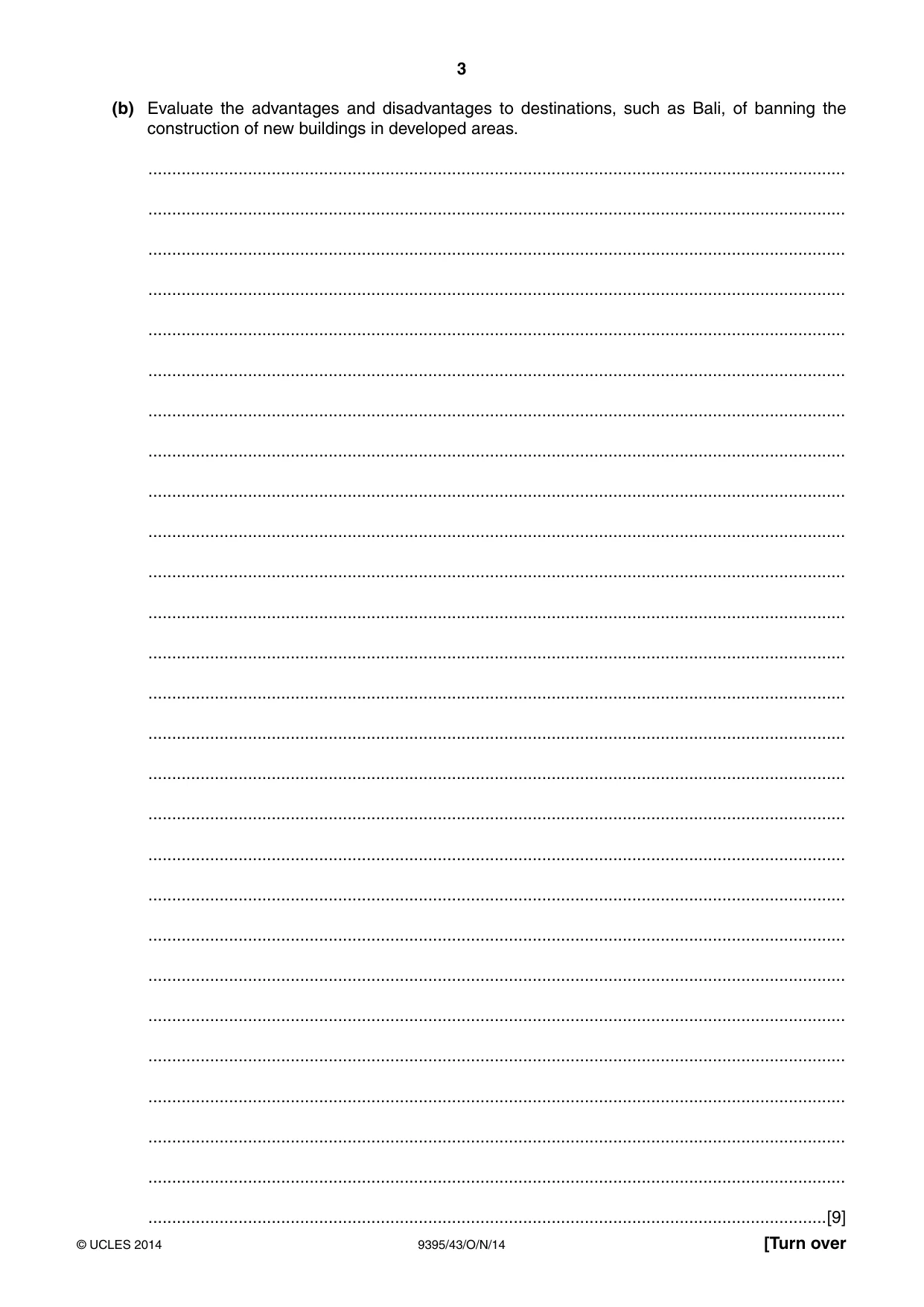
3 9395/43/O/N/14 © UCLES 2014 [Turn over (b) Evaluate the advantages and disadvantages to destinations, such as Bali, of banning the construction of new buildings in developed areas. … … … … … … … … … … … … … … … … … … … … … … … … … … …[9]
Question paper, page 4
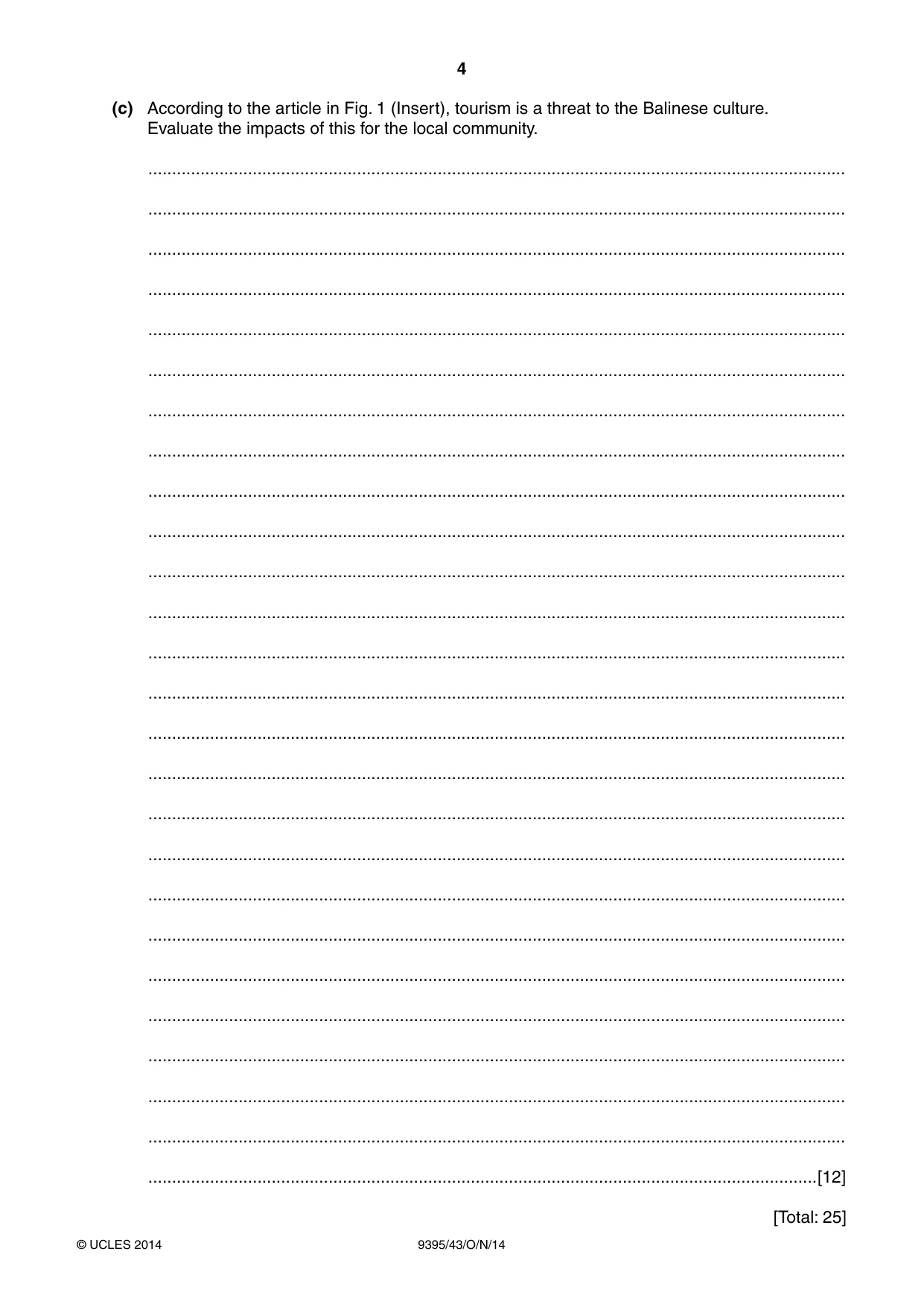
4 9395/43/O/N/14 © UCLES 2014 (c) According to the article in Fig. 1 (Insert), tourism is a threat to the Balinese culture. Evaluate the impacts of this for the local community. … … … … … … … … … … … … … … … … … … … … … … … … … …[12] [Total: 25]
Question paper, page 5
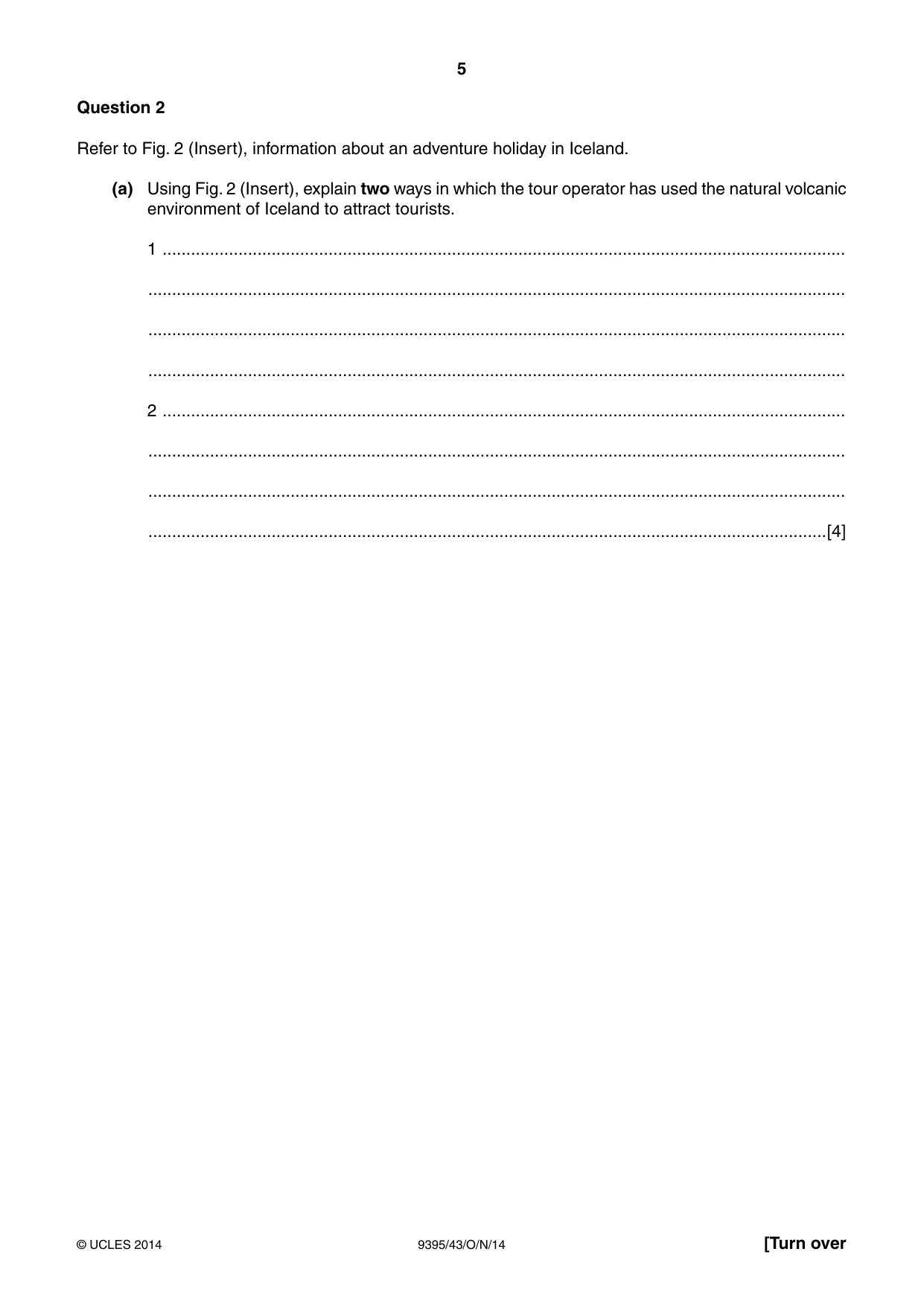
5 9395/43/O/N/14 © UCLES 2014 [Turn over Question 2 Refer to Fig. 2 (Insert), information about an adventure holiday in Iceland. (a) Using Fig. 2 (Insert), explain two ways in which the tour operator has used the natural volcanic environment of Iceland to attract tourists. 1 … … … … 2 … … … …[4]
Question paper, page 6
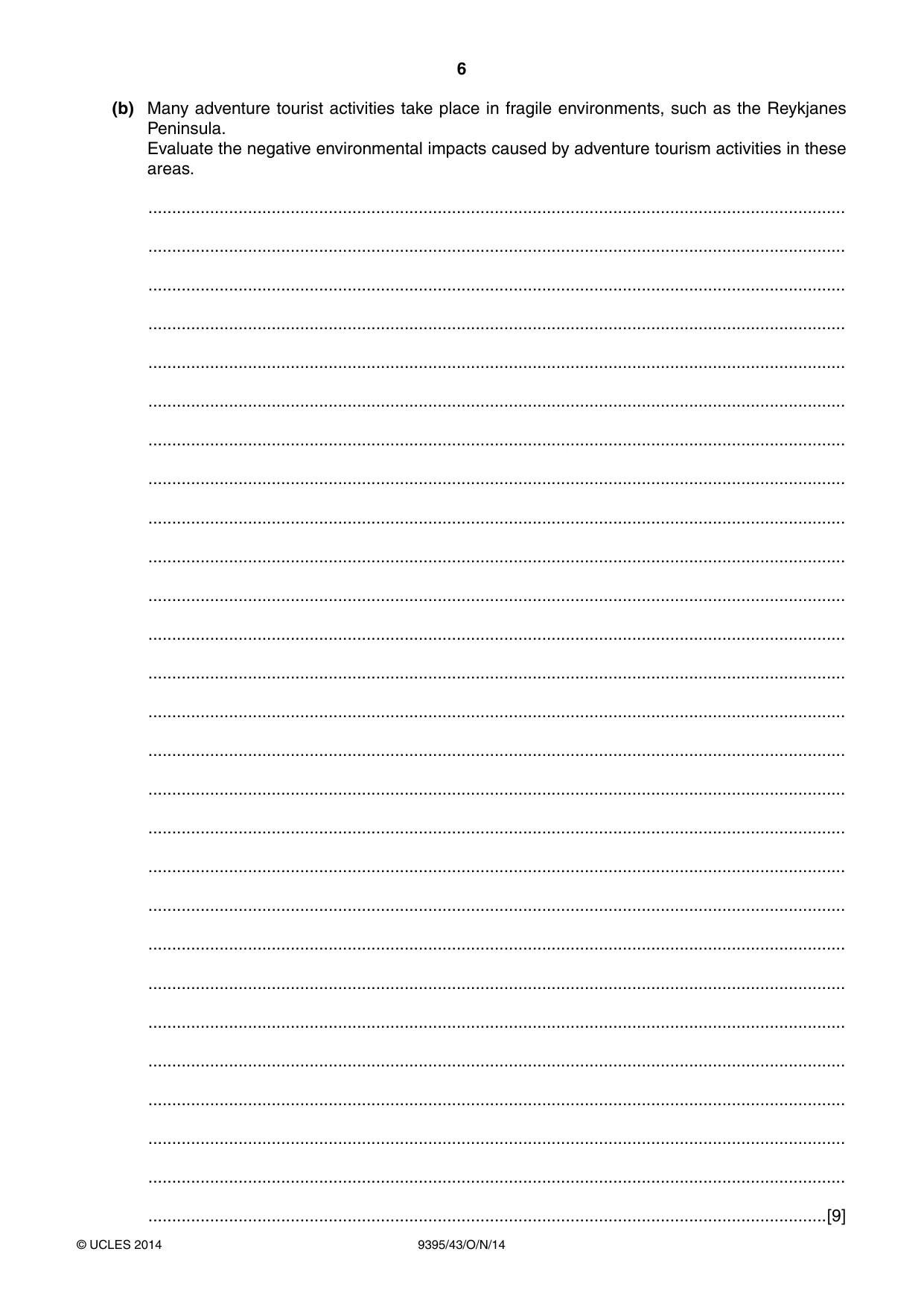
6 9395/43/O/N/14 © UCLES 2014 (b) Many adventure tourist activities take place in fragile environments, such as the Reykjanes Peninsula. Evaluate the negative environmental impacts caused by adventure tourism activities in these areas. … … … … … … … … … … … … … … … … … … … … … … … … … … …[9]
Question paper, page 7
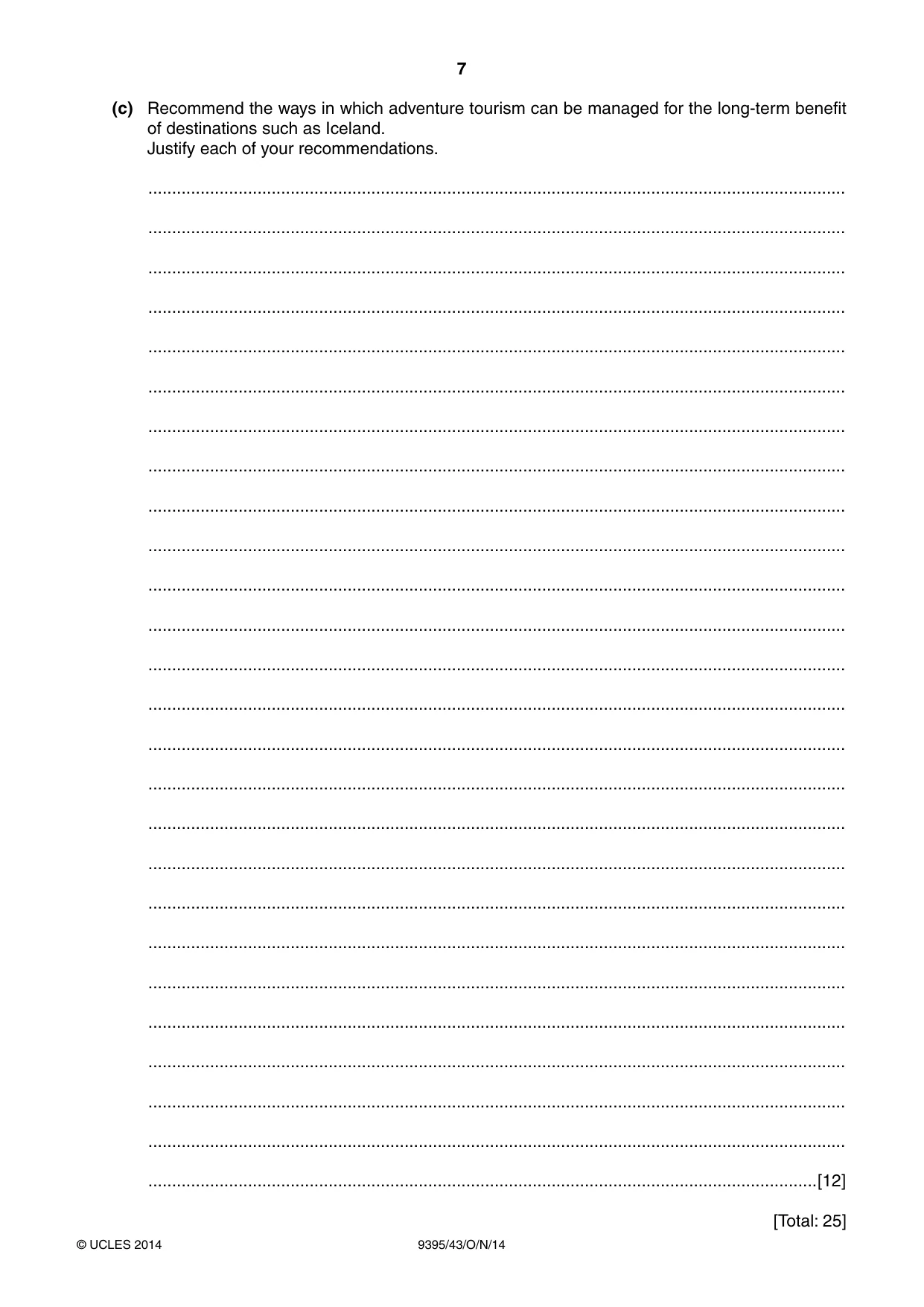
7 9395/43/O/N/14 © UCLES 2014 (c) Recommend the ways in which adventure tourism can be managed for the long-term benefit of destinations such as Iceland. Justify each of your recommendations. … … … … … … … … … … … … … … … … … … … … … … … … … …[12] [Total: 25]
Question paper, page 8
8 9395/43/O/N/14 © UCLES 2014 Permission to reproduce items where third-party owned material protected by copyright is included has been sought and cleared where possible. Every reasonable effort has been made by the publisher (UCLES) to trace copyright holders, but if any items requiring clearance have unwittingly been included, the publisher will be pleased to make amends at the earliest possible opportunity. Cambridge International Examinations is part of the Cambridge Assessment Group. Cambridge Assessment is the brand name of University of Cambridge Local Examinations Syndicate (UCLES), which is itself a department of the University of Cambridge. BLANK PAGE
Mark scheme, page 1
® IGCSE is the registered trademark of Cambridge International Examinations. CAMBRIDGE INTERNATIONAL EXAMINATIONS Cambridge International Advanced Subsidiary and Advanced Level MARK SCHEME for the October/November 2014 series 9395 TRAVEL AND TOURISM 9395/43 Paper 4 (Specialised Tourism), maximum raw mark 50 This mark scheme is published as an aid to teachers and candidates, to indicate the requirements of the examination. It shows the basis on which Examiners were instructed to award marks. It does not indicate the details of the discussions that took place at an Examiners’ meeting before marking began, which would have considered the acceptability of alternative answers. Mark schemes should be read in conjunction with the question paper and the Principal Examiner Report for Teachers. Cambridge will not enter into discussions about these mark schemes. Cambridge is publishing the mark schemes for the October/November 2014 series for most Cambridge IGCSE®, Cambridge International A and AS Level components and some Cambridge O Level components.
Mark scheme, page 2
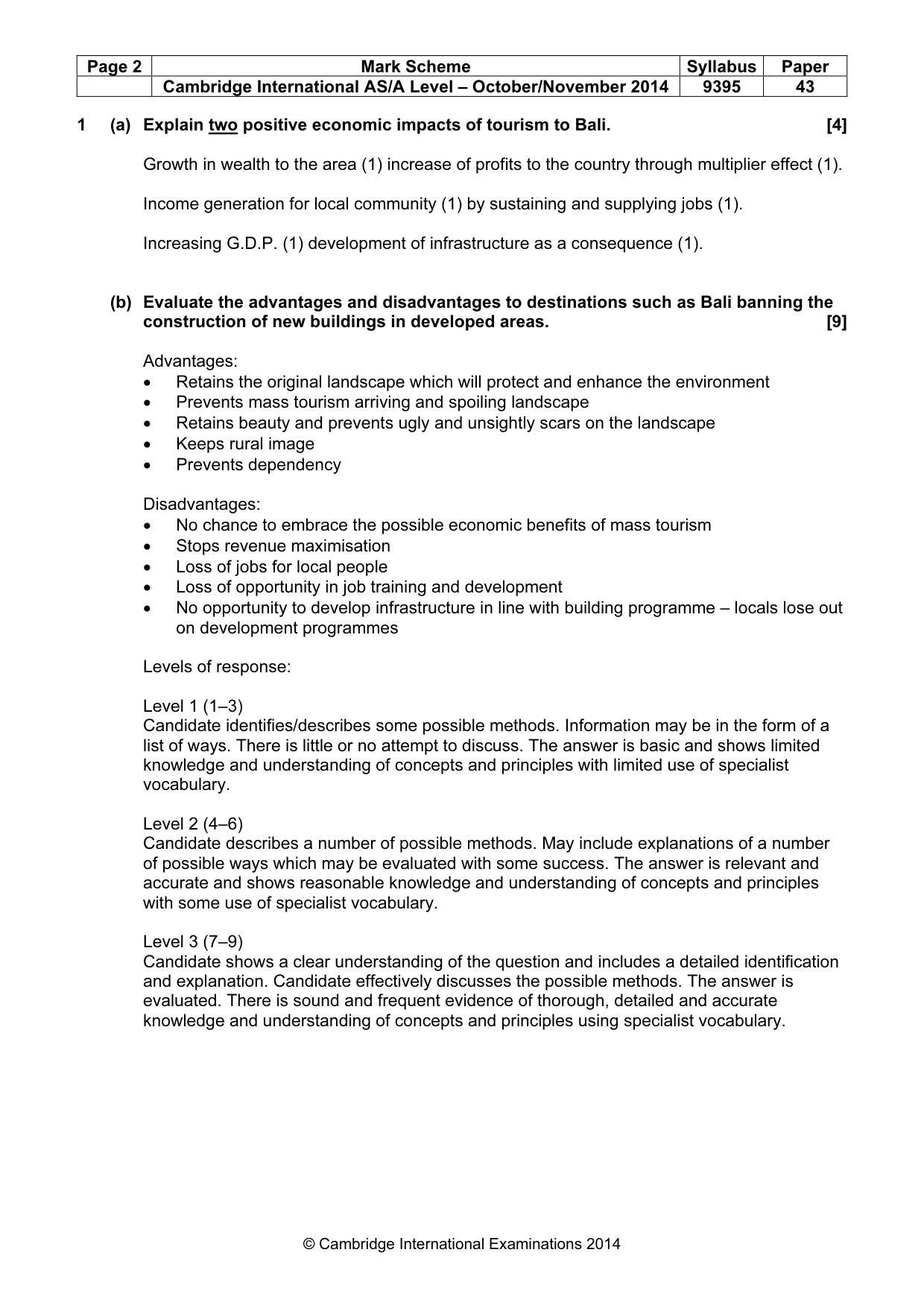
Page 2 Mark Scheme Syllabus Paper Cambridge International AS/A Level – October/November 2014 9395 43 © Cambridge International Examinations 2014 1 (a) Explain two positive economic impacts of tourism to Bali. [4] Growth in wealth to the area (1) increase of profits to the country through multiplier effect (1). Income generation for local community (1) by sustaining and supplying jobs (1). Increasing G.D.P. (1) development of infrastructure as a consequence (1). (b) Evaluate the advantages and disadvantages to destinations such as Bali banning the construction of new buildings in developed areas. [9] Advantages: • Retains the original landscape which will protect and enhance the environment • Prevents mass tourism arriving and spoiling landscape • Retains beauty and prevents ugly and unsightly scars on the landscape • Keeps rural image • Prevents dependency Disadvantages: • No chance to embrace the possible economic benefits of mass tourism • Stops revenue maximisation • Loss of jobs for local people • Loss of opportunity in job training and development • No opportunity to develop infrastructure in line with building programme – locals lose out on development programmes Levels of response: Level 1 (1–3) Candidate identifies/describes some possible methods. Information may be in the form of a list of ways. There is little or no attempt to discuss. The answer is basic and shows limited knowledge and understanding of concepts and principles with limited use of specialist vocabulary. Level 2 (4–6) Candidate describes a number of possible methods. May include explanations of a number of possible ways which may be evaluated with some success. The answer is relevant and accurate and shows reasonable knowledge and understanding of concepts and principles with some use of specialist vocabulary. Level 3 (7–9) Candidate shows a clear understanding of the question and includes a detailed identification and explanation. Candidate effectively discusses the possible methods. The answer is evaluated. There is sound and frequent evidence of thorough, detailed and accurate knowledge and understanding of concepts and principles using specialist vocabulary.
Mark scheme, page 3
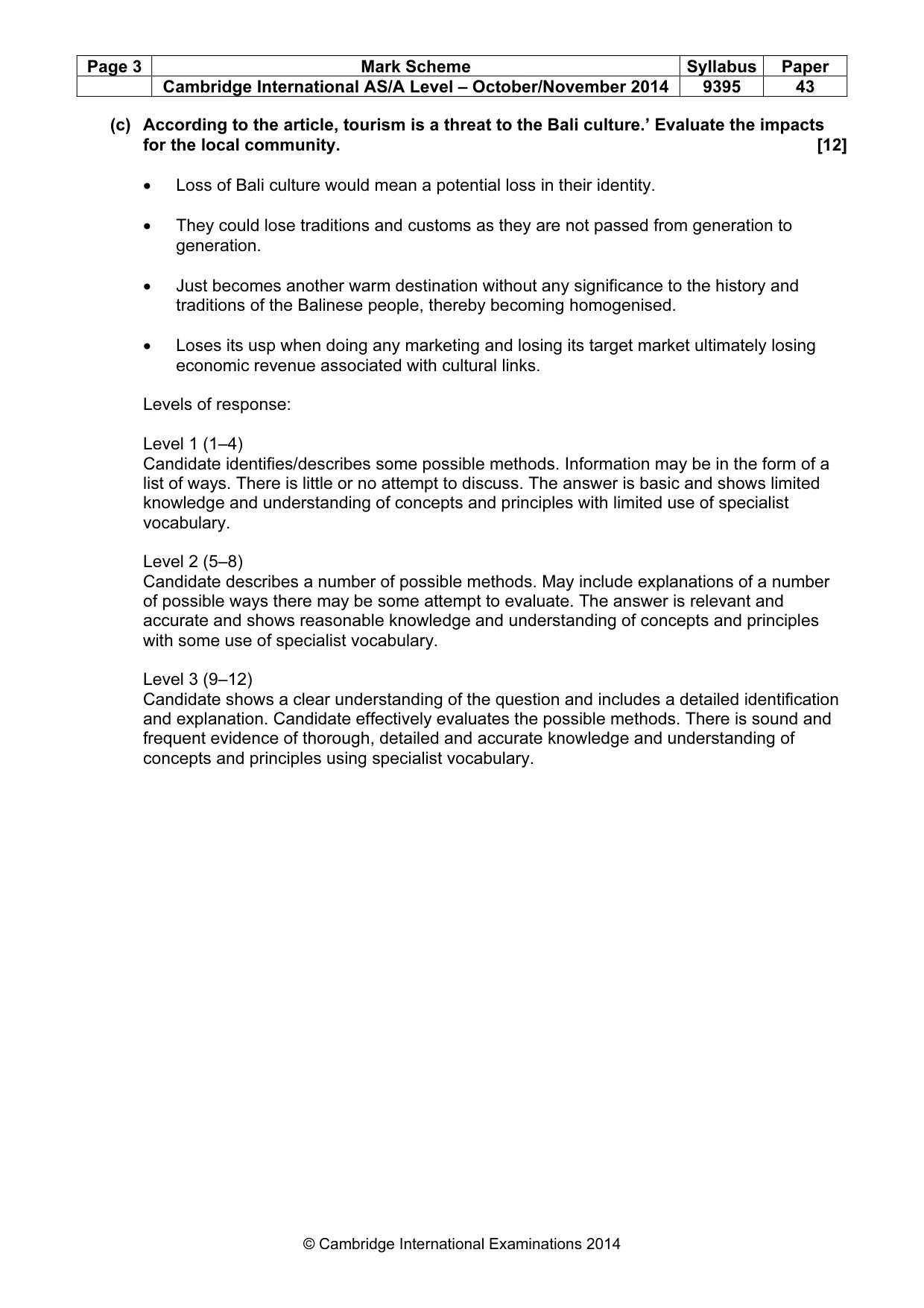
Page 3 Mark Scheme Syllabus Paper Cambridge International AS/A Level – October/November 2014 9395 43 © Cambridge International Examinations 2014 (c) According to the article, tourism is a threat to the Bali culture.’ Evaluate the impacts for the local community. [12] • Loss of Bali culture would mean a potential loss in their identity. • They could lose traditions and customs as they are not passed from generation to generation. • Just becomes another warm destination without any significance to the history and traditions of the Balinese people, thereby becoming homogenised. • Loses its usp when doing any marketing and losing its target market ultimately losing economic revenue associated with cultural links. Levels of response: Level 1 (1–4) Candidate identifies/describes some possible methods. Information may be in the form of a list of ways. There is little or no attempt to discuss. The answer is basic and shows limited knowledge and understanding of concepts and principles with limited use of specialist vocabulary. Level 2 (5–8) Candidate describes a number of possible methods. May include explanations of a number of possible ways there may be some attempt to evaluate. The answer is relevant and accurate and shows reasonable knowledge and understanding of concepts and principles with some use of specialist vocabulary. Level 3 (9–12) Candidate shows a clear understanding of the question and includes a detailed identification and explanation. Candidate effectively evaluates the possible methods. There is sound and frequent evidence of thorough, detailed and accurate knowledge and understanding of concepts and principles using specialist vocabulary.
Mark scheme, page 4
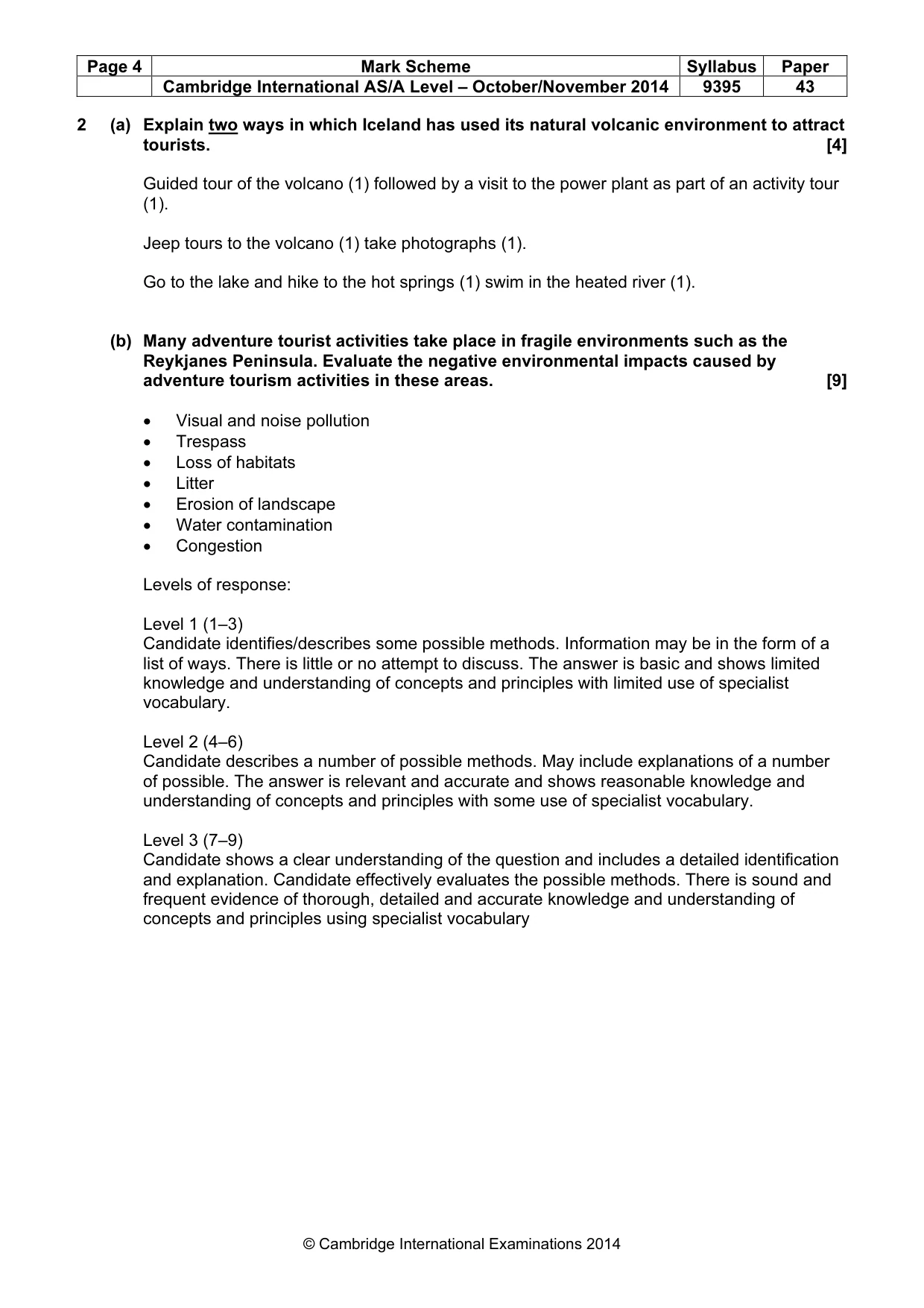
Page 4 Mark Scheme Syllabus Paper Cambridge International AS/A Level – October/November 2014 9395 43 © Cambridge International Examinations 2014 2 (a) Explain two ways in which Iceland has used its natural volcanic environment to attract tourists. [4] Guided tour of the volcano (1) followed by a visit to the power plant as part of an activity tour (1). Jeep tours to the volcano (1) take photographs (1). Go to the lake and hike to the hot springs (1) swim in the heated river (1). (b) Many adventure tourist activities take place in fragile environments such as the Reykjanes Peninsula. Evaluate the negative environmental impacts caused by adventure tourism activities in these areas. [9] • Visual and noise pollution • Trespass • Loss of habitats • Litter • Erosion of landscape • Water contamination • Congestion Levels of response: Level 1 (1–3) Candidate identifies/describes some possible methods. Information may be in the form of a list of ways. There is little or no attempt to discuss. The answer is basic and shows limited knowledge and understanding of concepts and principles with limited use of specialist vocabulary. Level 2 (4–6) Candidate describes a number of possible methods. May include explanations of a number of possible. The answer is relevant and accurate and shows reasonable knowledge and understanding of concepts and principles with some use of specialist vocabulary. Level 3 (7–9) Candidate shows a clear understanding of the question and includes a detailed identification and explanation. Candidate effectively evaluates the possible methods. There is sound and frequent evidence of thorough, detailed and accurate knowledge and understanding of concepts and principles using specialist vocabulary
Mark scheme, page 5
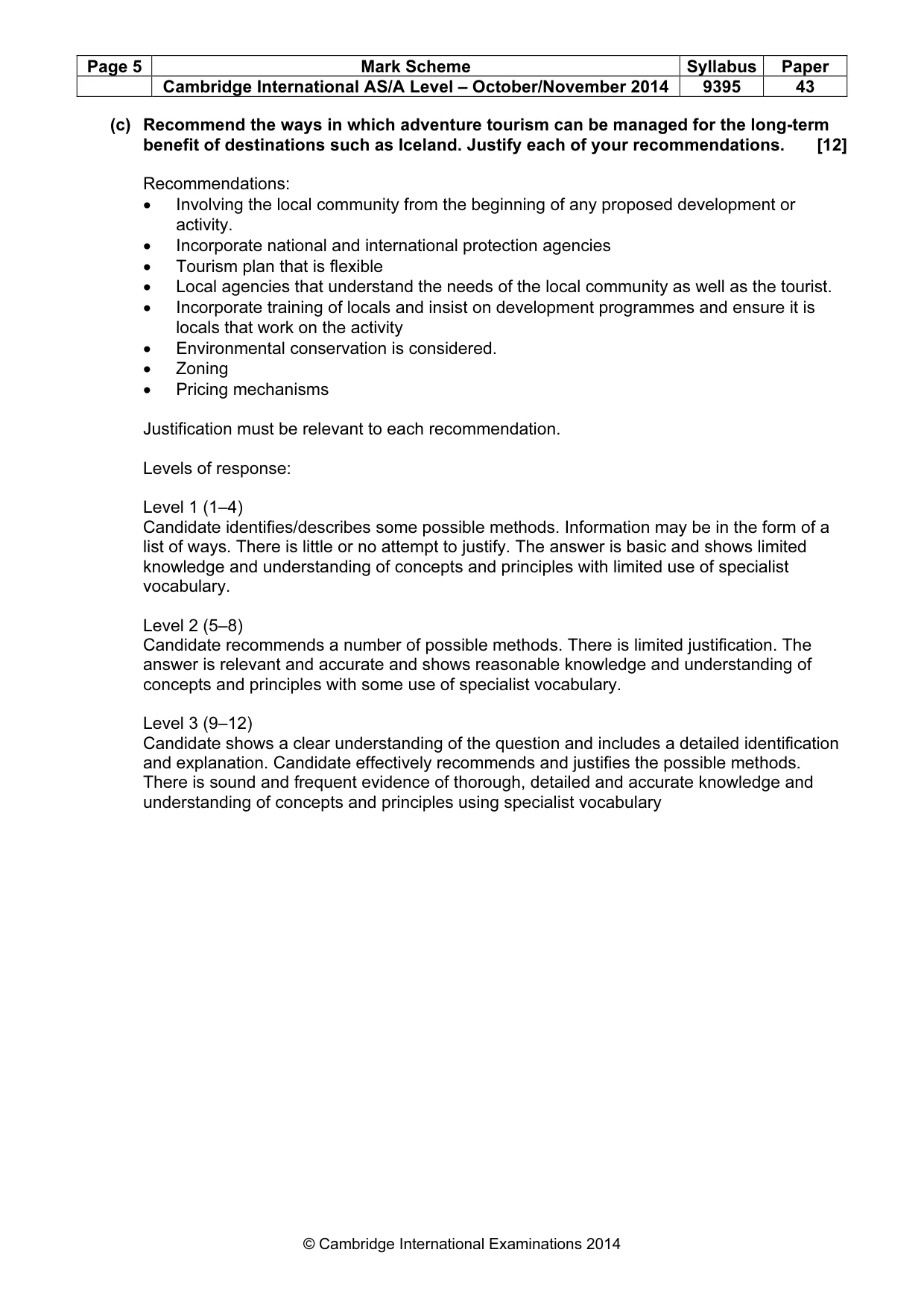
Page 5 Mark Scheme Syllabus Paper Cambridge International AS/A Level – October/November 2014 9395 43 © Cambridge International Examinations 2014 (c) Recommend the ways in which adventure tourism can be managed for the long-term benefit of destinations such as Iceland. Justify each of your recommendations. [12] Recommendations: • Involving the local community from the beginning of any proposed development or activity. • Incorporate national and international protection agencies • Tourism plan that is flexible • Local agencies that understand the needs of the local community as well as the tourist. • Incorporate training of locals and insist on development programmes and ensure it is locals that work on the activity • Environmental conservation is considered. • Zoning • Pricing mechanisms Justification must be relevant to each recommendation. Levels of response: Level 1 (1–4) Candidate identifies/describes some possible methods. Information may be in the form of a list of ways. There is little or no attempt to justify. The answer is basic and shows limited knowledge and understanding of concepts and principles with limited use of specialist vocabulary. Level 2 (5–8) Candidate recommends a number of possible methods. There is limited justification. The answer is relevant and accurate and shows reasonable knowledge and understanding of concepts and principles with some use of specialist vocabulary. Level 3 (9–12) Candidate shows a clear understanding of the question and includes a detailed identification and explanation. Candidate effectively recommends and justifies the possible methods. There is sound and frequent evidence of thorough, detailed and accurate knowledge and understanding of concepts and principles using specialist vocabulary
What you needed in this session
Cambridge’s own grade thresholds for 2014 Oct/Nov, Paper 4 · Variant 3. A higher threshold means an easier paper — the bar moves with how the cohort did.