Cambridge A Level Travel and Tourism 9395 — 2014 Oct/Nov Paper 4 · Variant 2
9395/42/O/N/14 · 50 marks · ≈56 min
The question paper and its mark scheme, free to read here and free to download. This is Cambridge’s own paper, exactly as it was sat.
Question paper8 pages
Mark scheme5 pages
Answers below. Sit the paper first if you are practising.
Paper as text
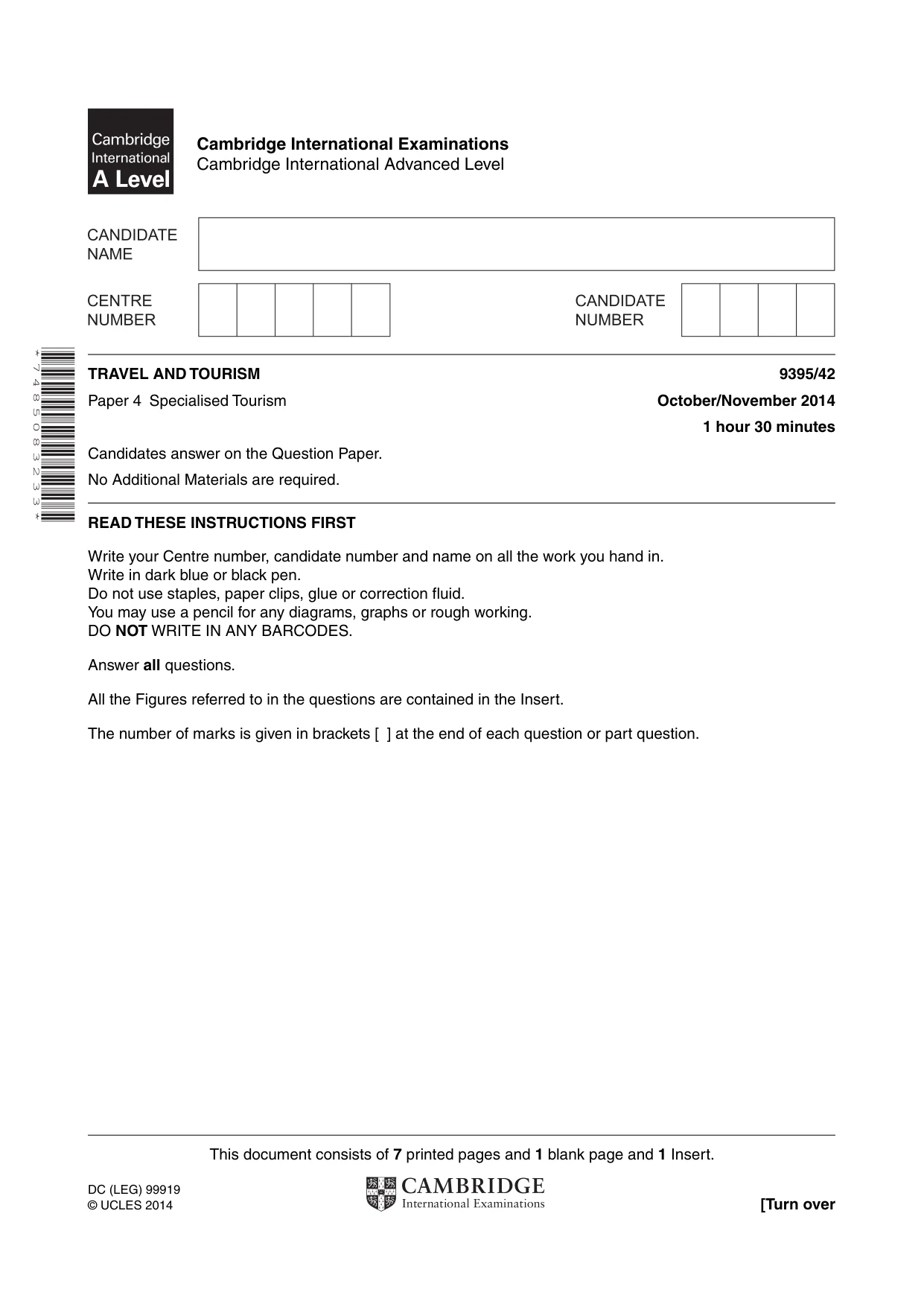
Question paper, page 1
This document consists of 7 printed pages and 1 blank page and 1 Insert. DC (LEG) 99919 © UCLES 2014 [Turn over * 7 4 8 5 0 8 3 2 3 3 * TRAVEL AND TOURISM 9395/42 Paper 4 Specialised Tourism October/November 2014 1 hour 30 minutes Candidates answer on the Question Paper. No Additional Materials are required. READ THESE INSTRUCTIONS FIRST Write your Centre number, candidate number and name on all the work you hand in. Write in dark blue or black pen. Do not use staples, paper clips, glue or correction fluid. You may use a pencil for any diagrams, graphs or rough working. DO NOT WRITE IN ANY BARCODES. Answer all questions. All the Figures referred to in the questions are contained in the Insert. The number of marks is given in brackets [ ] at the end of each question or part question. Cambridge International Examinations Cambridge International Advanced Level
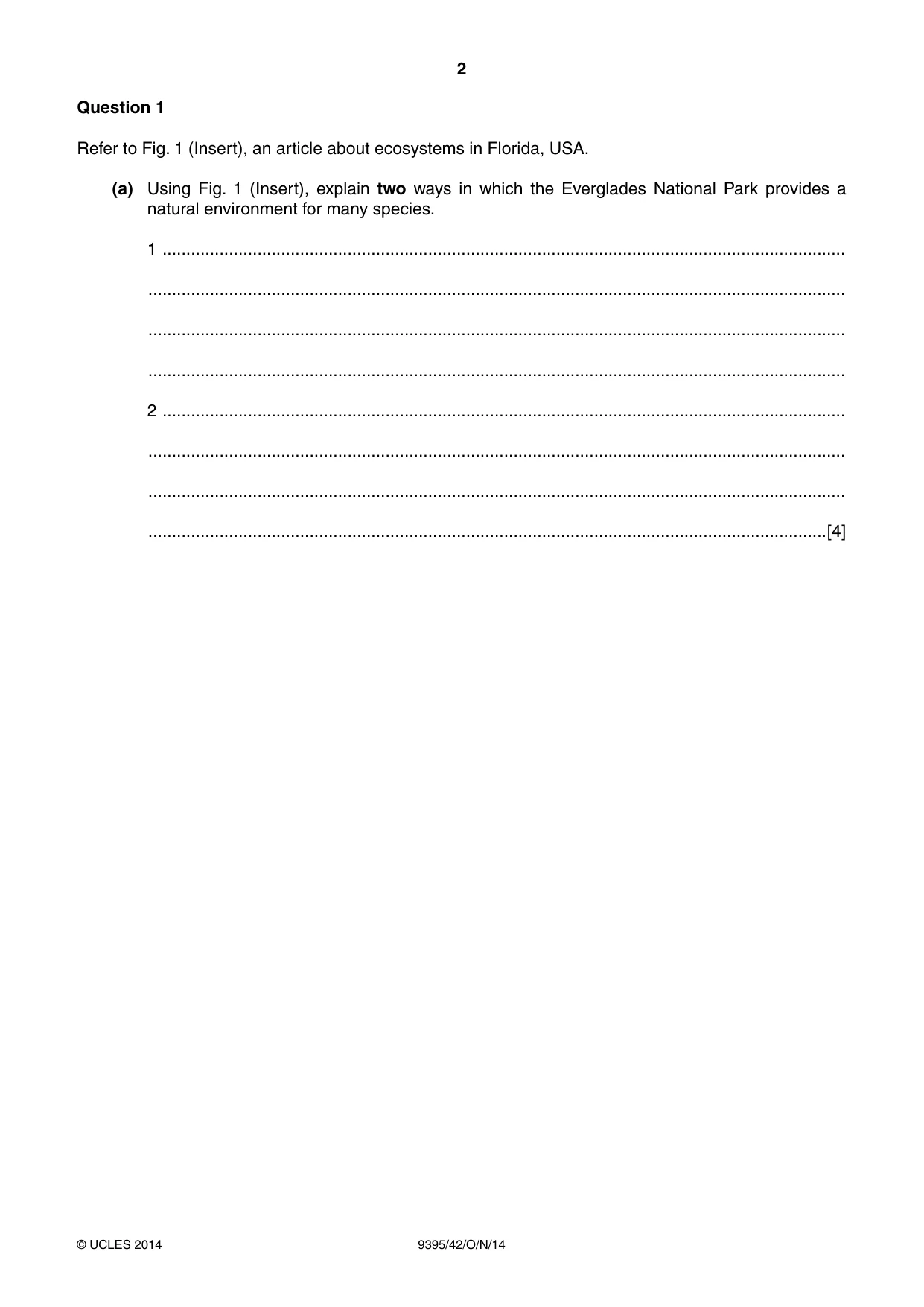
Question paper, page 2
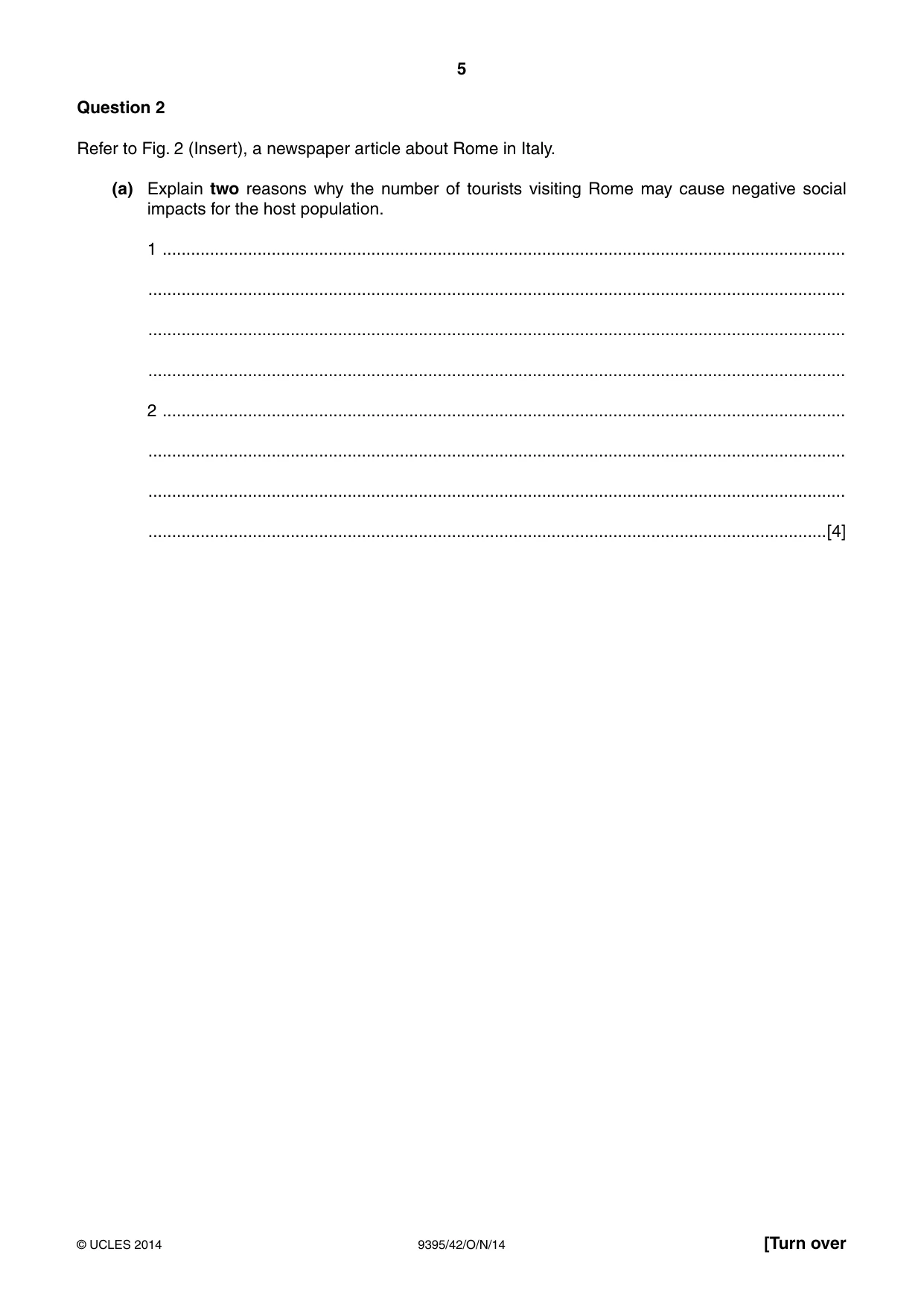
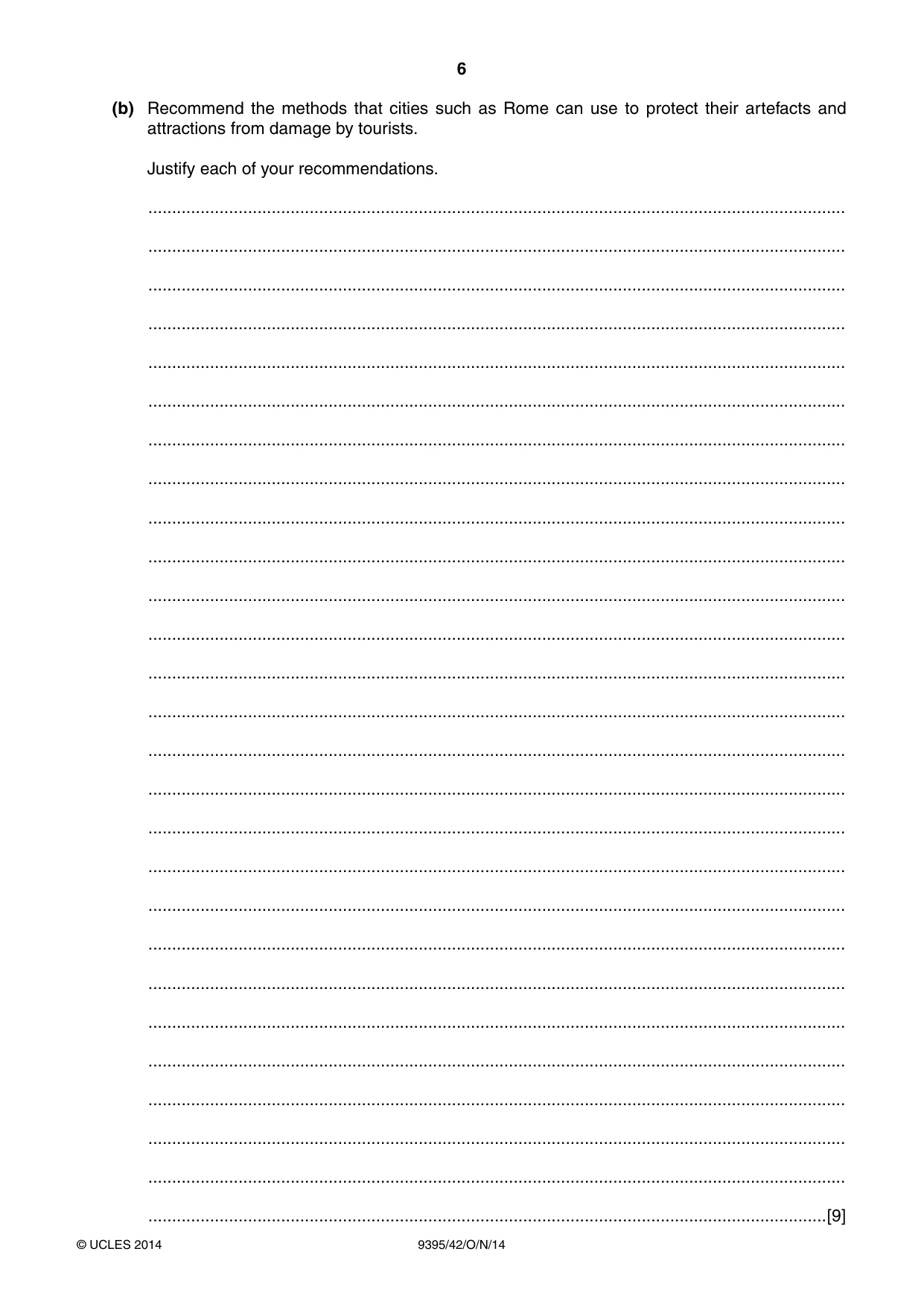
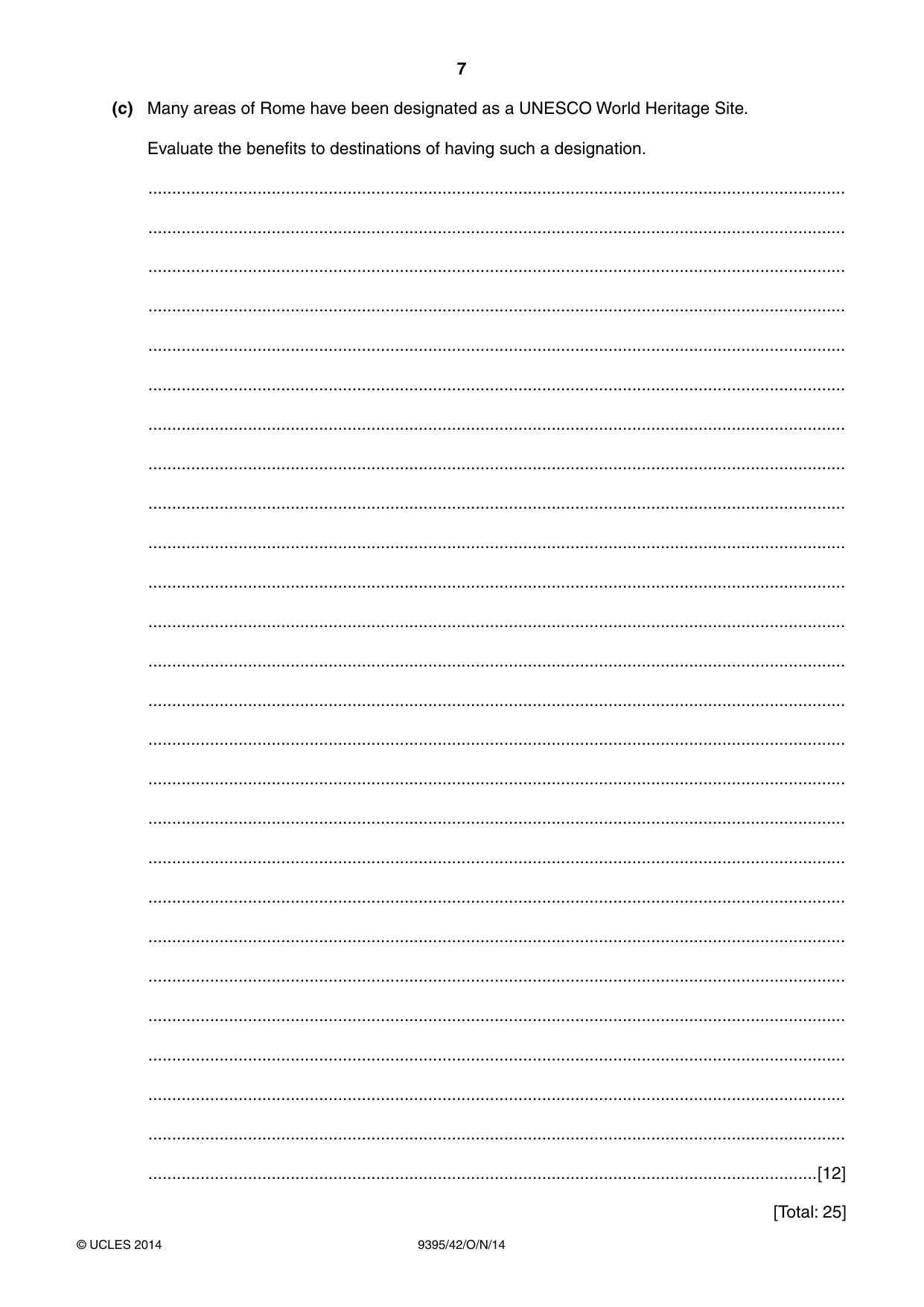
2 9395/42/O/N/14 © UCLES 2014 Question 1 Refer to Fig. 1 (Insert), an article about ecosystems in Florida, USA. (a) Using Fig. 1 (Insert), explain two ways in which the Everglades National Park provides a natural environment for many species. 1 … … … … 2 … … … …[4]
Question paper, page 3
3 9395/42/O/N/14 © UCLES 2014 [Turn over (b) Evaluate the economic benefits for a named area which you have studied where ecotourism is important. Named area … … … … … … … … … … … … … … … … … … … … … … … … … … …[9]
Question paper, page 4
4 9395/42/O/N/14 © UCLES 2014 (c) Assess the methods that authorities in areas such as South Florida may use to prevent the negative environmental impacts caused by tourism. … … … … … … … … … … … … … … … … … … … … … … … … … …[12] [Total: 25]
Question paper, page 5
5 9395/42/O/N/14 © UCLES 2014 [Turn over Question 2 Refer to Fig. 2 (Insert), a newspaper article about Rome in Italy. (a) Explain two reasons why the number of tourists visiting Rome may cause negative social impacts for the host population. 1 … … … … 2 … … … …[4]
Question paper, page 6
6 9395/42/O/N/14 © UCLES 2014 (b) Recommend the methods that cities such as Rome can use to protect their artefacts and attractions from damage by tourists. Justify each of your recommendations. … … … … … … … … … … … … … … … … … … … … … … … … … … …[9]
Question paper, page 7
7 9395/42/O/N/14 © UCLES 2014 (c) Many areas of Rome have been designated as a UNESCO World Heritage Site. Evaluate the benefits to destinations of having such a designation. … … … … … … … … … … … … … … … … … … … … … … … … … …[12] [Total: 25]
Question paper, page 8
8 9395/42/O/N/14 © UCLES 2014 Permission to reproduce items where third-party owned material protected by copyright is included has been sought and cleared where possible. Every reasonable effort has been made by the publisher (UCLES) to trace copyright holders, but if any items requiring clearance have unwittingly been included, the publisher will be pleased to make amends at the earliest possible opportunity. Cambridge International Examinations is part of the Cambridge Assessment Group. Cambridge Assessment is the brand name of University of Cambridge Local Examinations Syndicate (UCLES), which is itself a department of the University of Cambridge. BLANK PAGE
Mark scheme, page 1
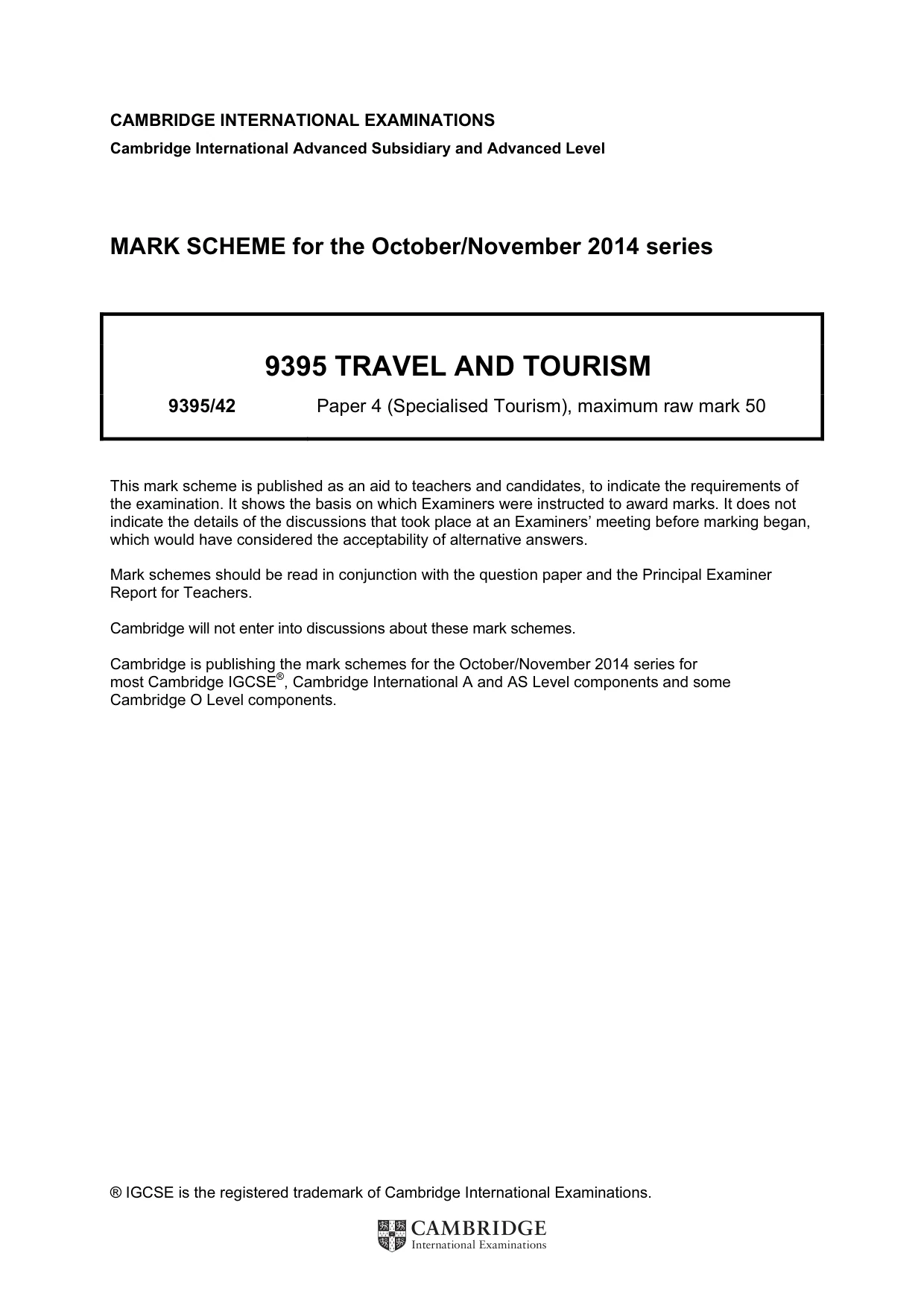
® IGCSE is the registered trademark of Cambridge International Examinations. CAMBRIDGE INTERNATIONAL EXAMINATIONS Cambridge International Advanced Subsidiary and Advanced Level MARK SCHEME for the October/November 2014 series 9395 TRAVEL AND TOURISM 9395/42 Paper 4 (Specialised Tourism), maximum raw mark 50 This mark scheme is published as an aid to teachers and candidates, to indicate the requirements of the examination. It shows the basis on which Examiners were instructed to award marks. It does not indicate the details of the discussions that took place at an Examiners’ meeting before marking began, which would have considered the acceptability of alternative answers. Mark schemes should be read in conjunction with the question paper and the Principal Examiner Report for Teachers. Cambridge will not enter into discussions about these mark schemes. Cambridge is publishing the mark schemes for the October/November 2014 series for most Cambridge IGCSE®, Cambridge International A and AS Level components and some Cambridge O Level components.
Mark scheme, page 2
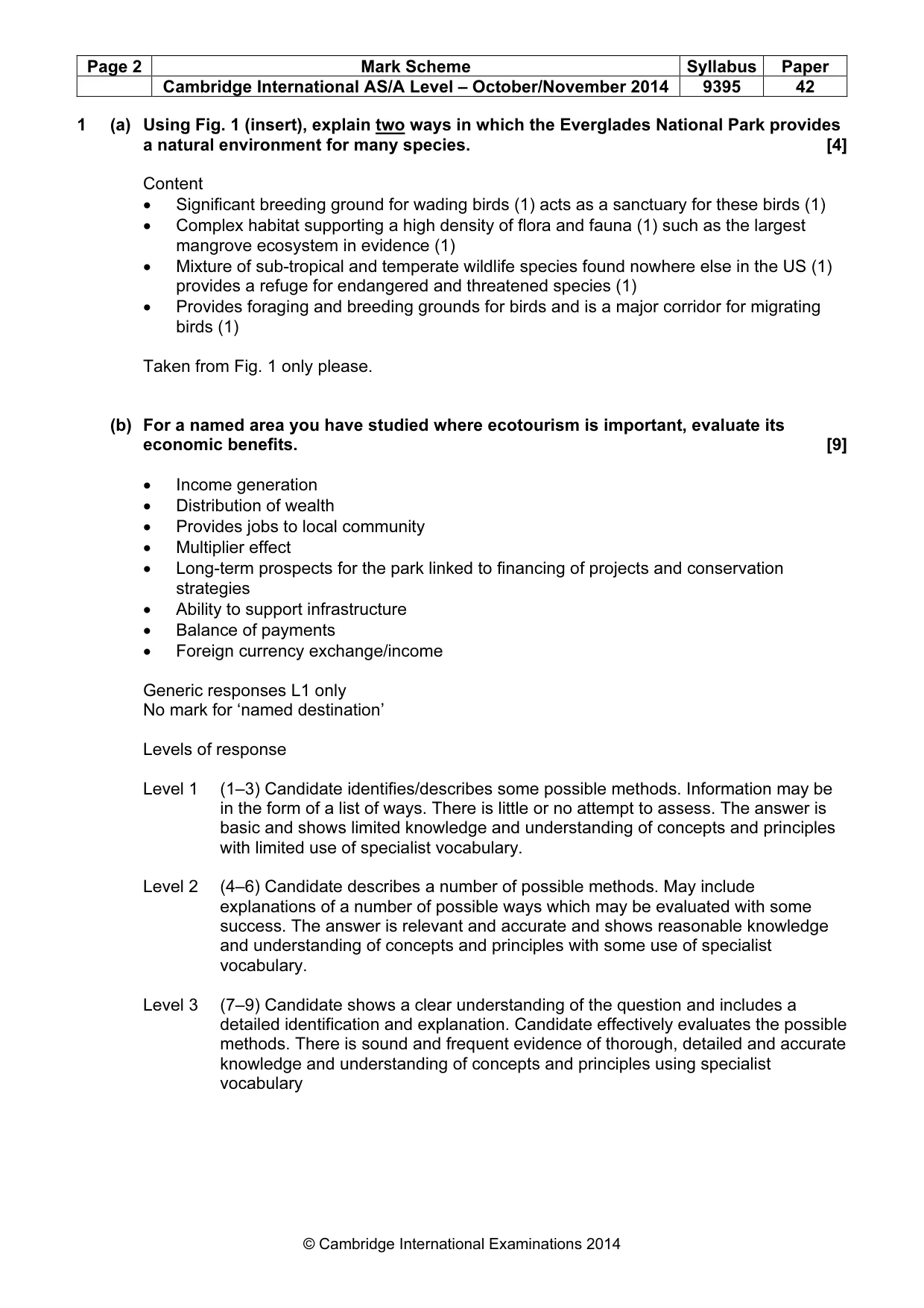
Page 2 Mark Scheme Syllabus Paper Cambridge International AS/A Level – October/November 2014 9395 42 © Cambridge International Examinations 2014 1 (a) Using Fig. 1 (insert), explain two ways in which the Everglades National Park provides a natural environment for many species. [4] Content • Significant breeding ground for wading birds (1) acts as a sanctuary for these birds (1) • Complex habitat supporting a high density of flora and fauna (1) such as the largest mangrove ecosystem in evidence (1) • Mixture of sub-tropical and temperate wildlife species found nowhere else in the US (1) provides a refuge for endangered and threatened species (1) • Provides foraging and breeding grounds for birds and is a major corridor for migrating birds (1) Taken from Fig. 1 only please. (b) For a named area you have studied where ecotourism is important, evaluate its economic benefits. [9] • Income generation • Distribution of wealth • Provides jobs to local community • Multiplier effect • Long-term prospects for the park linked to financing of projects and conservation strategies • Ability to support infrastructure • Balance of payments • Foreign currency exchange/income Generic responses L1 only No mark for ‘named destination’ Levels of response Level 1 (1–3) Candidate identifies/describes some possible methods. Information may be in the form of a list of ways. There is little or no attempt to assess. The answer is basic and shows limited knowledge and understanding of concepts and principles with limited use of specialist vocabulary. Level 2 (4–6) Candidate describes a number of possible methods. May include explanations of a number of possible ways which may be evaluated with some success. The answer is relevant and accurate and shows reasonable knowledge and understanding of concepts and principles with some use of specialist vocabulary. Level 3 (7–9) Candidate shows a clear understanding of the question and includes a detailed identification and explanation. Candidate effectively evaluates the possible methods. There is sound and frequent evidence of thorough, detailed and accurate knowledge and understanding of concepts and principles using specialist vocabulary
Mark scheme, page 3
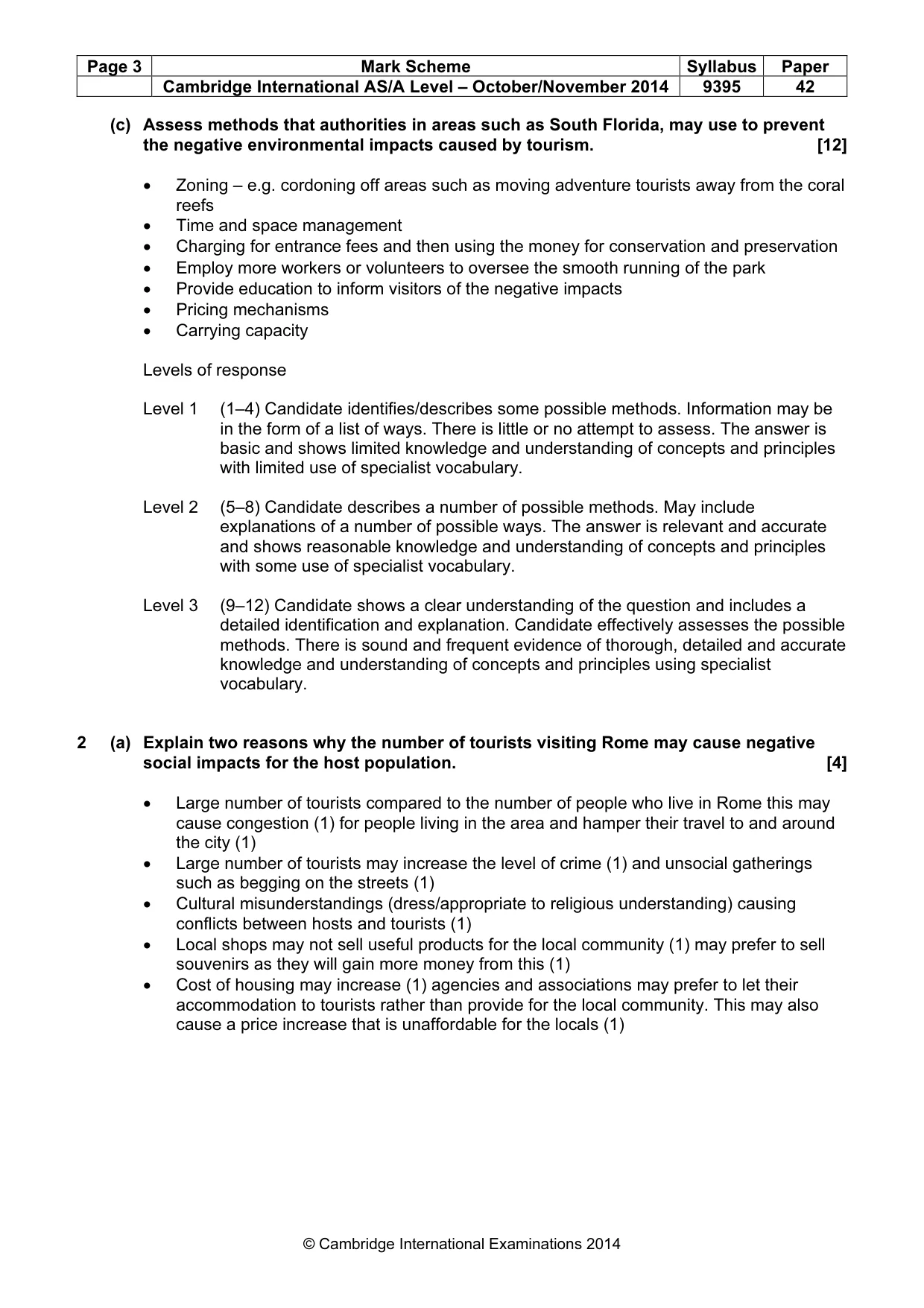
Page 3 Mark Scheme Syllabus Paper Cambridge International AS/A Level – October/November 2014 9395 42 © Cambridge International Examinations 2014 (c) Assess methods that authorities in areas such as South Florida, may use to prevent the negative environmental impacts caused by tourism. [12] • Zoning – e.g. cordoning off areas such as moving adventure tourists away from the coral reefs • Time and space management • Charging for entrance fees and then using the money for conservation and preservation • Employ more workers or volunteers to oversee the smooth running of the park • Provide education to inform visitors of the negative impacts • Pricing mechanisms • Carrying capacity Levels of response Level 1 (1–4) Candidate identifies/describes some possible methods. Information may be in the form of a list of ways. There is little or no attempt to assess. The answer is basic and shows limited knowledge and understanding of concepts and principles with limited use of specialist vocabulary. Level 2 (5–8) Candidate describes a number of possible methods. May include explanations of a number of possible ways. The answer is relevant and accurate and shows reasonable knowledge and understanding of concepts and principles with some use of specialist vocabulary. Level 3 (9–12) Candidate shows a clear understanding of the question and includes a detailed identification and explanation. Candidate effectively assesses the possible methods. There is sound and frequent evidence of thorough, detailed and accurate knowledge and understanding of concepts and principles using specialist vocabulary. 2 (a) Explain two reasons why the number of tourists visiting Rome may cause negative social impacts for the host population. [4] • Large number of tourists compared to the number of people who live in Rome this may cause congestion (1) for people living in the area and hamper their travel to and around the city (1) • Large number of tourists may increase the level of crime (1) and unsocial gatherings such as begging on the streets (1) • Cultural misunderstandings (dress/appropriate to religious understanding) causing conflicts between hosts and tourists (1) • Local shops may not sell useful products for the local community (1) may prefer to sell souvenirs as they will gain more money from this (1) • Cost of housing may increase (1) agencies and associations may prefer to let their accommodation to tourists rather than provide for the local community. This may also cause a price increase that is unaffordable for the locals (1)
Mark scheme, page 4
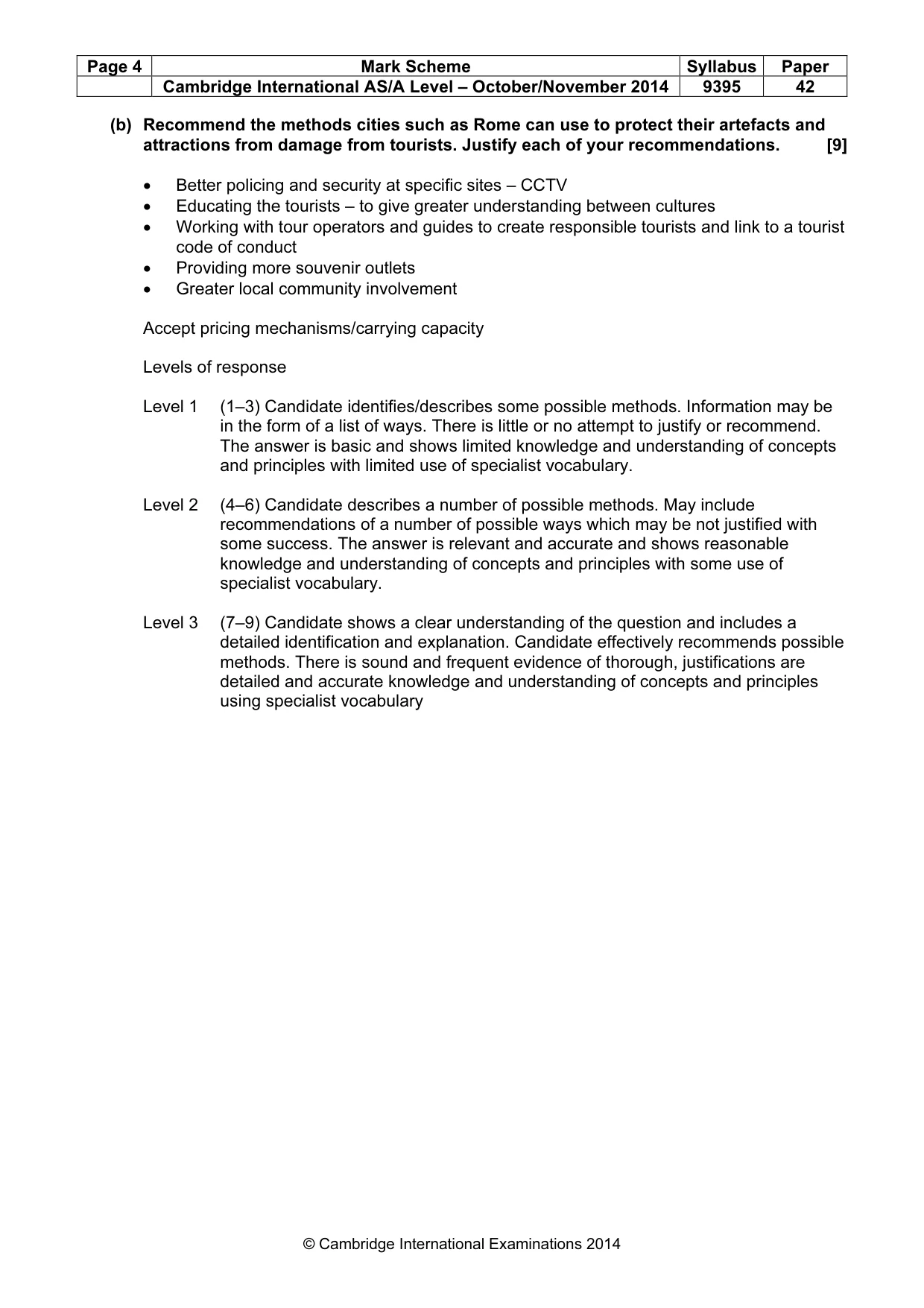
Page 4 Mark Scheme Syllabus Paper Cambridge International AS/A Level – October/November 2014 9395 42 © Cambridge International Examinations 2014 (b) Recommend the methods cities such as Rome can use to protect their artefacts and attractions from damage from tourists. Justify each of your recommendations. [9] • Better policing and security at specific sites – CCTV • Educating the tourists – to give greater understanding between cultures • Working with tour operators and guides to create responsible tourists and link to a tourist code of conduct • Providing more souvenir outlets • Greater local community involvement Accept pricing mechanisms/carrying capacity Levels of response Level 1 (1–3) Candidate identifies/describes some possible methods. Information may be in the form of a list of ways. There is little or no attempt to justify or recommend. The answer is basic and shows limited knowledge and understanding of concepts and principles with limited use of specialist vocabulary. Level 2 (4–6) Candidate describes a number of possible methods. May include recommendations of a number of possible ways which may be not justified with some success. The answer is relevant and accurate and shows reasonable knowledge and understanding of concepts and principles with some use of specialist vocabulary. Level 3 (7–9) Candidate shows a clear understanding of the question and includes a detailed identification and explanation. Candidate effectively recommends possible methods. There is sound and frequent evidence of thorough, justifications are detailed and accurate knowledge and understanding of concepts and principles using specialist vocabulary
Mark scheme, page 5
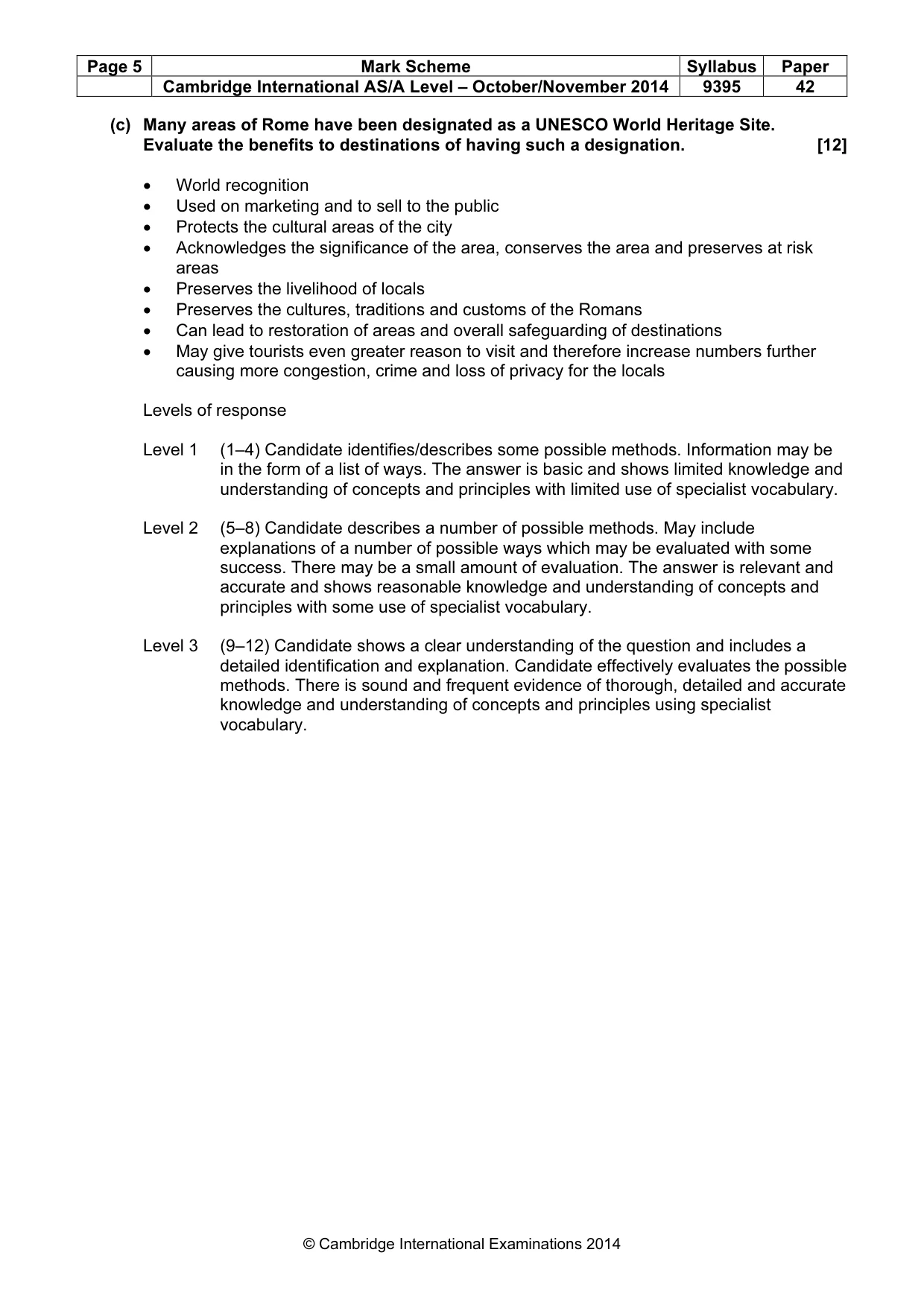
Page 5 Mark Scheme Syllabus Paper Cambridge International AS/A Level – October/November 2014 9395 42 © Cambridge International Examinations 2014 (c) Many areas of Rome have been designated as a UNESCO World Heritage Site. Evaluate the benefits to destinations of having such a designation. [12] • World recognition • Used on marketing and to sell to the public • Protects the cultural areas of the city • Acknowledges the significance of the area, conserves the area and preserves at risk areas • Preserves the livelihood of locals • Preserves the cultures, traditions and customs of the Romans • Can lead to restoration of areas and overall safeguarding of destinations • May give tourists even greater reason to visit and therefore increase numbers further causing more congestion, crime and loss of privacy for the locals Levels of response Level 1 (1–4) Candidate identifies/describes some possible methods. Information may be in the form of a list of ways. The answer is basic and shows limited knowledge and understanding of concepts and principles with limited use of specialist vocabulary. Level 2 (5–8) Candidate describes a number of possible methods. May include explanations of a number of possible ways which may be evaluated with some success. There may be a small amount of evaluation. The answer is relevant and accurate and shows reasonable knowledge and understanding of concepts and principles with some use of specialist vocabulary. Level 3 (9–12) Candidate shows a clear understanding of the question and includes a detailed identification and explanation. Candidate effectively evaluates the possible methods. There is sound and frequent evidence of thorough, detailed and accurate knowledge and understanding of concepts and principles using specialist vocabulary.
What you needed in this session
Cambridge’s own grade thresholds for 2014 Oct/Nov, Paper 4 · Variant 2. A higher threshold means an easier paper — the bar moves with how the cohort did.