Cambridge A Level Travel and Tourism 9395 — 2014 May/June Paper 4 · Variant 1
9395/41/M/J/14 · 50 marks · ≈56 min
The question paper and its mark scheme, free to read here and free to download. This is Cambridge’s own paper, exactly as it was sat.
Question paper8 pages
Mark scheme5 pages
Answers below. Sit the paper first if you are practising.
Paper as text
Question paper, page 1
This document consists of 7 printed pages, 1 blank page and 1 Insert. DC (KN) 81045/4 © UCLES 2014 [Turn over Cambridge International Examinations Cambridge International Advanced Level * 6 0 1 0 8 3 2 1 6 7 * TRAVEL AND TOURISM 9395/41 Paper 4 Specialised Tourism May/June 2014 1 hour 30 minutes Candidates answer on the Question Paper. No Additional Materials are required. READ THESE INSTRUCTIONS FIRST Write your Centre number, candidate number and name on all the work you hand in. Write in dark blue or black pen. You may use an HB pencil for any diagrams or graphs. Do not use staples, paper clips, glue or correction fluid. DO NOT WRITE IN ANY BARCODES. Answer all questions. All the Figures referred to in the questions are contained in the Insert. The number of marks is given in brackets [ ] at the end of each question or part question.
Question paper, page 2
2 9395/41/M/J/14 © UCLES 2014 Question 1 Refer to Fig. 1 (Insert), information about the Taj Mahal in India. (a) Using Fig. 1 (Insert), identify two threats to the Taj Mahal. 1 … … … … 2 … … … …[4]
Question paper, page 3
3 9395/41/M/J/14 © UCLES 2014 [Turn over (b) The area around the Taj Mahal is a tourist attraction and an important religious site. Analyse the reasons why it is important that tourists behave responsibly at sites such as the Taj Mahal. … … … … … … … … … … … … … … … … … … … … … … … … … …[9]
Question paper, page 4
4 9395/41/M/J/14 © UCLES 2014 (c) Evaluate the ways in which important cultural buildings, such as the Taj Mahal, can be protected from possible negative impacts. … … … … … … … … … … … … … … … … … … … … … … … … … … …[12] [Total: 25]
Question paper, page 5
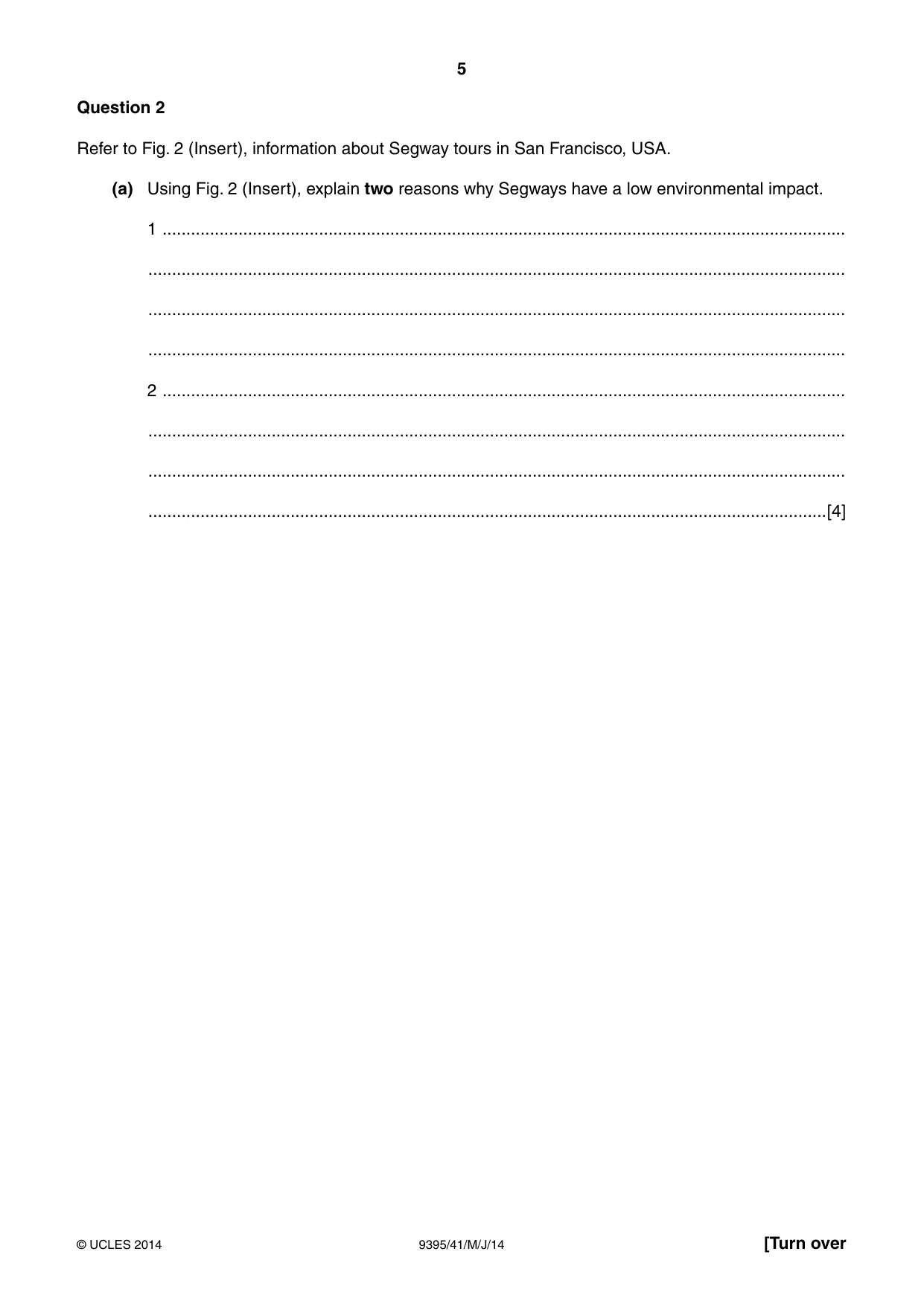
5 9395/41/M/J/14 © UCLES 2014 [Turn over Question 2 Refer to Fig. 2 (Insert), information about Segway tours in San Francisco, USA. (a) Using Fig. 2 (Insert), explain two reasons why Segways have a low environmental impact. 1 … … … … 2 … … … …[4]
Question paper, page 6
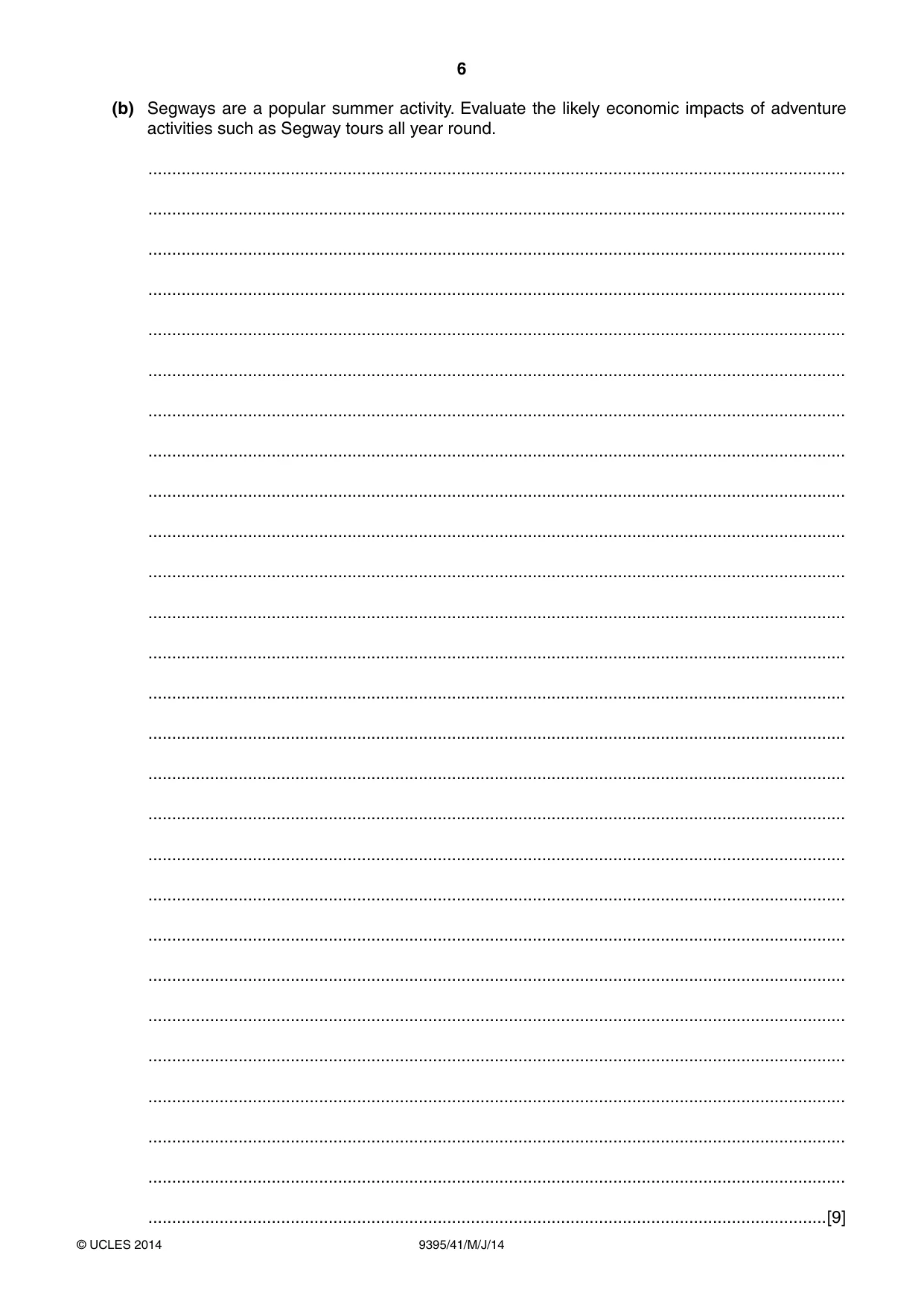
6 9395/41/M/J/14 © UCLES 2014 (b) Segways are a popular summer activity. Evaluate the likely economic impacts of adventure activities such as Segway tours all year round. … … … … … … … … … … … … … … … … … … … … … … … … … … …[9]
Question paper, page 7
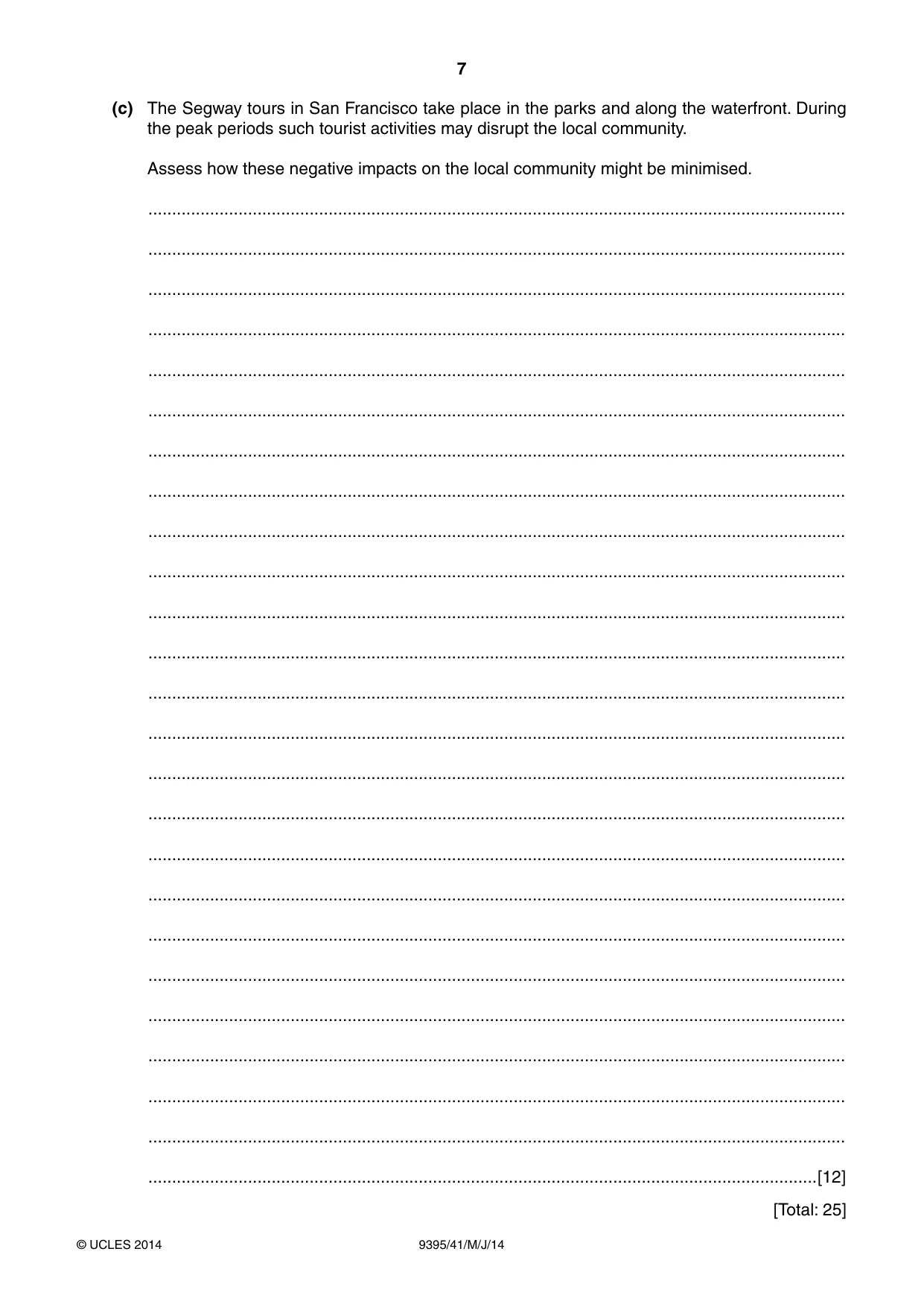
7 9395/41/M/J/14 © UCLES 2014 (c) The Segway tours in San Francisco take place in the parks and along the waterfront. During the peak periods such tourist activities may disrupt the local community. Assess how these negative impacts on the local community might be minimised. … … … … … … … … … … … … … … … … … … … … … … … … …[12] [Total: 25]
Question paper, page 8
8 9395/41/M/J/14 © UCLES 2014 Permission to reproduce items where third-party owned material protected by copyright is included has been sought and cleared where possible. Every reasonable effort has been made by the publisher (UCLES) to trace copyright holders, but if any items requiring clearance have unwittingly been included, the publisher will be pleased to make amends at the earliest possible opportunity. Cambridge International Examinations is part of the Cambridge Assessment Group. Cambridge Assessment is the brand name of University of Cambridge Local Examinations Syndicate (UCLES), which is itself a department of the University of Cambridge. BLANK PAGE
Mark scheme, page 1
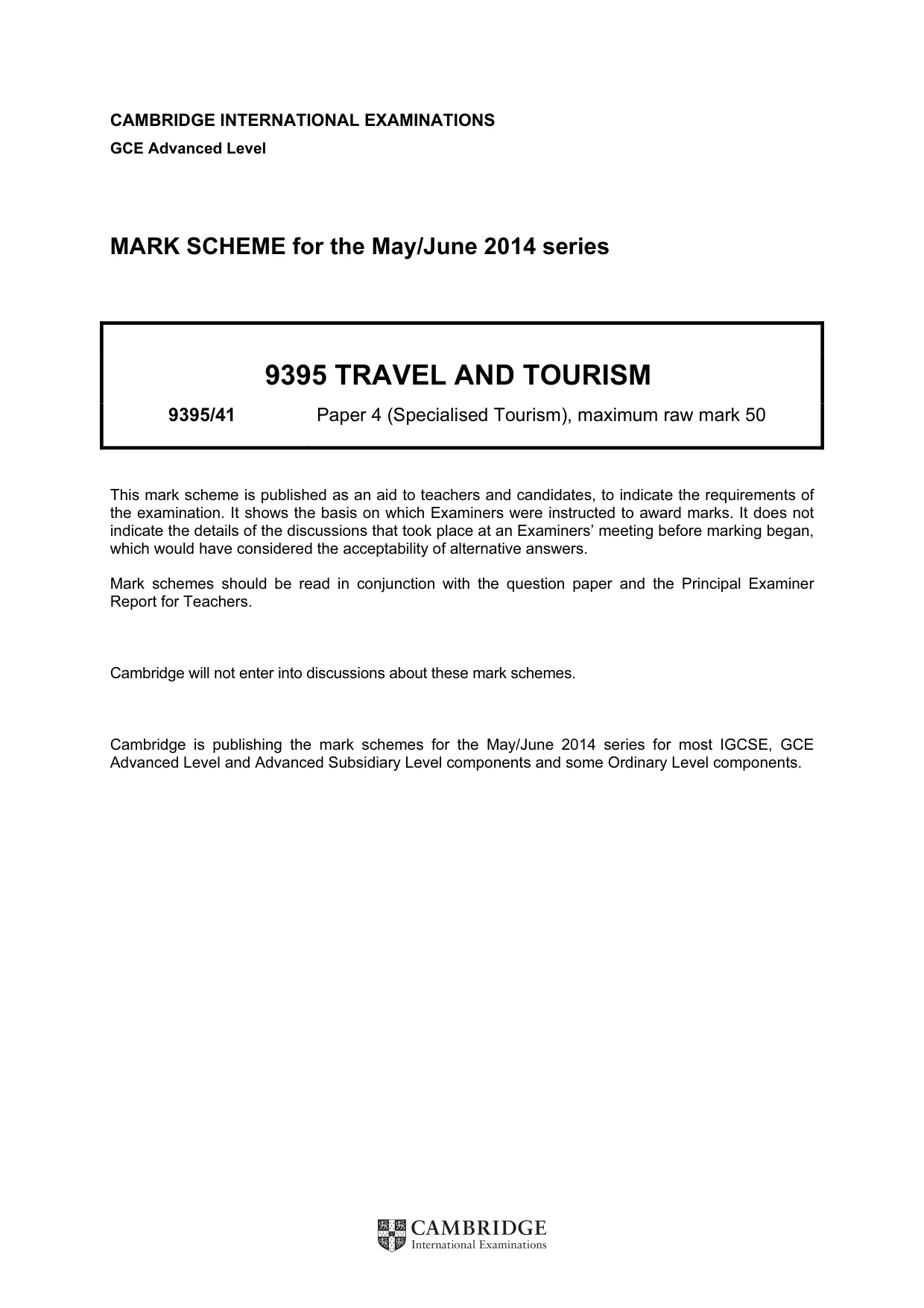
CAMBRIDGE INTERNATIONAL EXAMINATIONS GCE Advanced Level MARK SCHEME for the May/June 2014 series 9395 TRAVEL AND TOURISM 9395/41 Paper 4 (Specialised Tourism), maximum raw mark 50 This mark scheme is published as an aid to teachers and candidates, to indicate the requirements of the examination. It shows the basis on which Examiners were instructed to award marks. It does not indicate the details of the discussions that took place at an Examiners’ meeting before marking began, which would have considered the acceptability of alternative answers. Mark schemes should be read in conjunction with the question paper and the Principal Examiner Report for Teachers. Cambridge will not enter into discussions about these mark schemes. Cambridge is publishing the mark schemes for the May/June 2014 series for most IGCSE, GCE Advanced Level and Advanced Subsidiary Level components and some Ordinary Level components.
Mark scheme, page 2
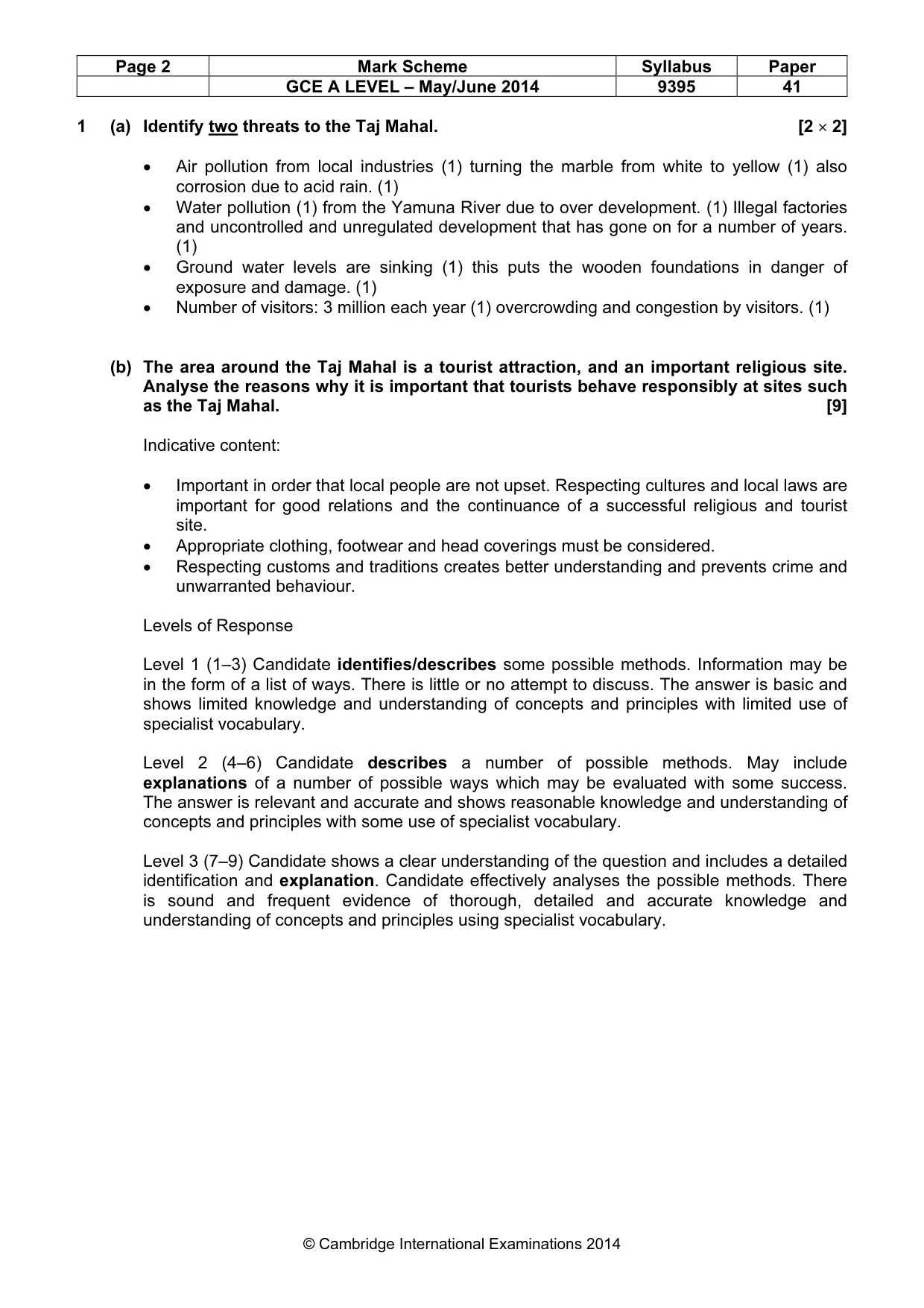
Page 2 Mark Scheme Syllabus Paper GCE A LEVEL – May/June 2014 9395 41 © Cambridge International Examinations 2014 1 (a) Identify two threats to the Taj Mahal. [2 × 2] • Air pollution from local industries (1) turning the marble from white to yellow (1) also corrosion due to acid rain. (1) • Water pollution (1) from the Yamuna River due to over development. (1) Illegal factories and uncontrolled and unregulated development that has gone on for a number of years. (1) • Ground water levels are sinking (1) this puts the wooden foundations in danger of exposure and damage. (1) • Number of visitors: 3 million each year (1) overcrowding and congestion by visitors. (1) (b) The area around the Taj Mahal is a tourist attraction, and an important religious site. Analyse the reasons why it is important that tourists behave responsibly at sites such as the Taj Mahal. [9] Indicative content: • Important in order that local people are not upset. Respecting cultures and local laws are important for good relations and the continuance of a successful religious and tourist site. • Appropriate clothing, footwear and head coverings must be considered. • Respecting customs and traditions creates better understanding and prevents crime and unwarranted behaviour. Levels of Response Level 1 (1–3) Candidate identifies/describes some possible methods. Information may be in the form of a list of ways. There is little or no attempt to discuss. The answer is basic and shows limited knowledge and understanding of concepts and principles with limited use of specialist vocabulary. Level 2 (4–6) Candidate describes a number of possible methods. May include explanations of a number of possible ways which may be evaluated with some success. The answer is relevant and accurate and shows reasonable knowledge and understanding of concepts and principles with some use of specialist vocabulary. Level 3 (7–9) Candidate shows a clear understanding of the question and includes a detailed identification and explanation. Candidate effectively analyses the possible methods. There is sound and frequent evidence of thorough, detailed and accurate knowledge and understanding of concepts and principles using specialist vocabulary.
Mark scheme, page 3
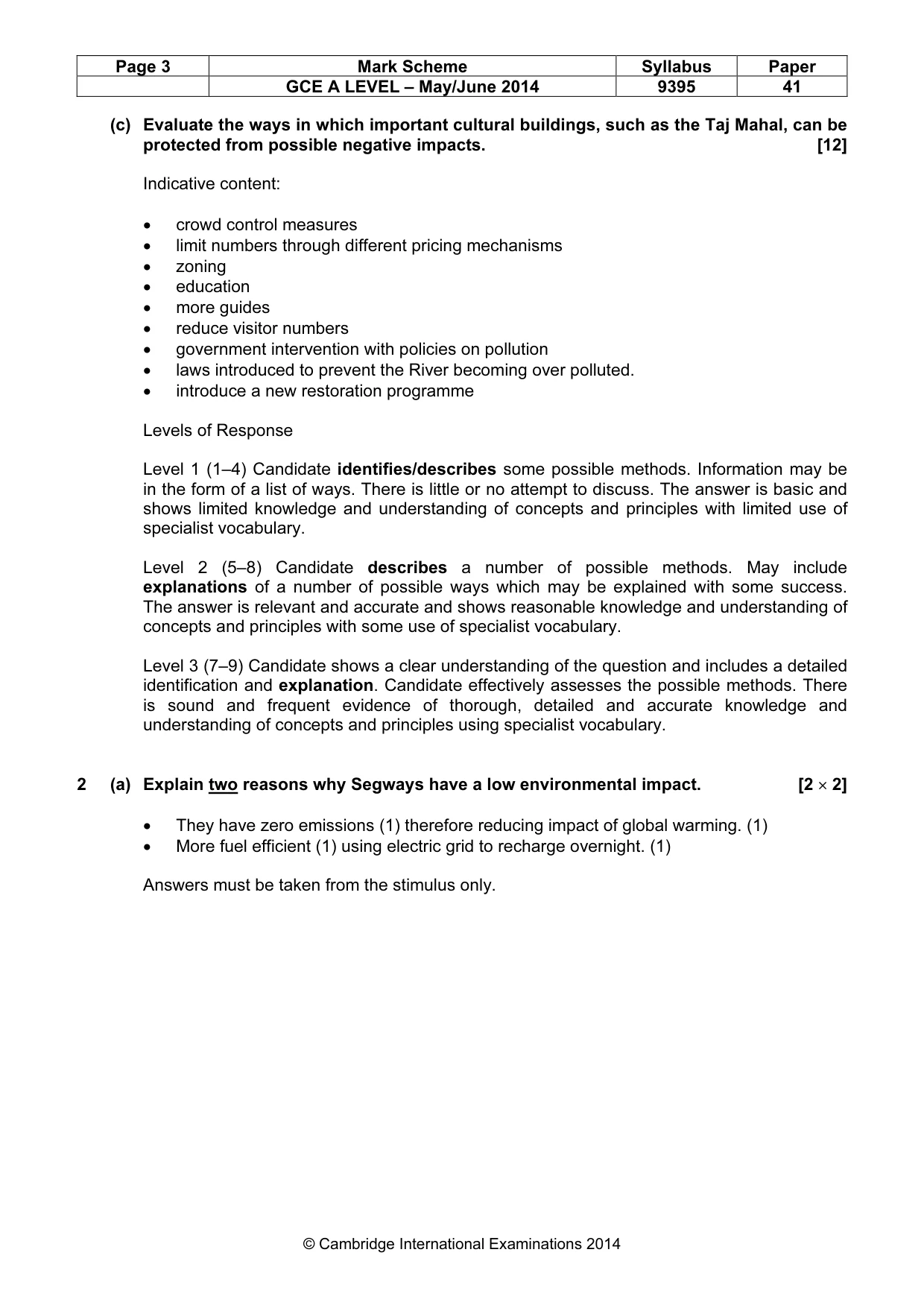
Page 3 Mark Scheme Syllabus Paper GCE A LEVEL – May/June 2014 9395 41 © Cambridge International Examinations 2014 (c) Evaluate the ways in which important cultural buildings, such as the Taj Mahal, can be protected from possible negative impacts. [12] Indicative content: • crowd control measures • limit numbers through different pricing mechanisms • zoning • education • more guides • reduce visitor numbers • government intervention with policies on pollution • laws introduced to prevent the River becoming over polluted. • introduce a new restoration programme Levels of Response Level 1 (1–4) Candidate identifies/describes some possible methods. Information may be in the form of a list of ways. There is little or no attempt to discuss. The answer is basic and shows limited knowledge and understanding of concepts and principles with limited use of specialist vocabulary. Level 2 (5–8) Candidate describes a number of possible methods. May include explanations of a number of possible ways which may be explained with some success. The answer is relevant and accurate and shows reasonable knowledge and understanding of concepts and principles with some use of specialist vocabulary. Level 3 (7–9) Candidate shows a clear understanding of the question and includes a detailed identification and explanation. Candidate effectively assesses the possible methods. There is sound and frequent evidence of thorough, detailed and accurate knowledge and understanding of concepts and principles using specialist vocabulary. 2 (a) Explain two reasons why Segways have a low environmental impact. [2 × 2] • They have zero emissions (1) therefore reducing impact of global warming. (1) • More fuel efficient (1) using electric grid to recharge overnight. (1) Answers must be taken from the stimulus only.
Mark scheme, page 4
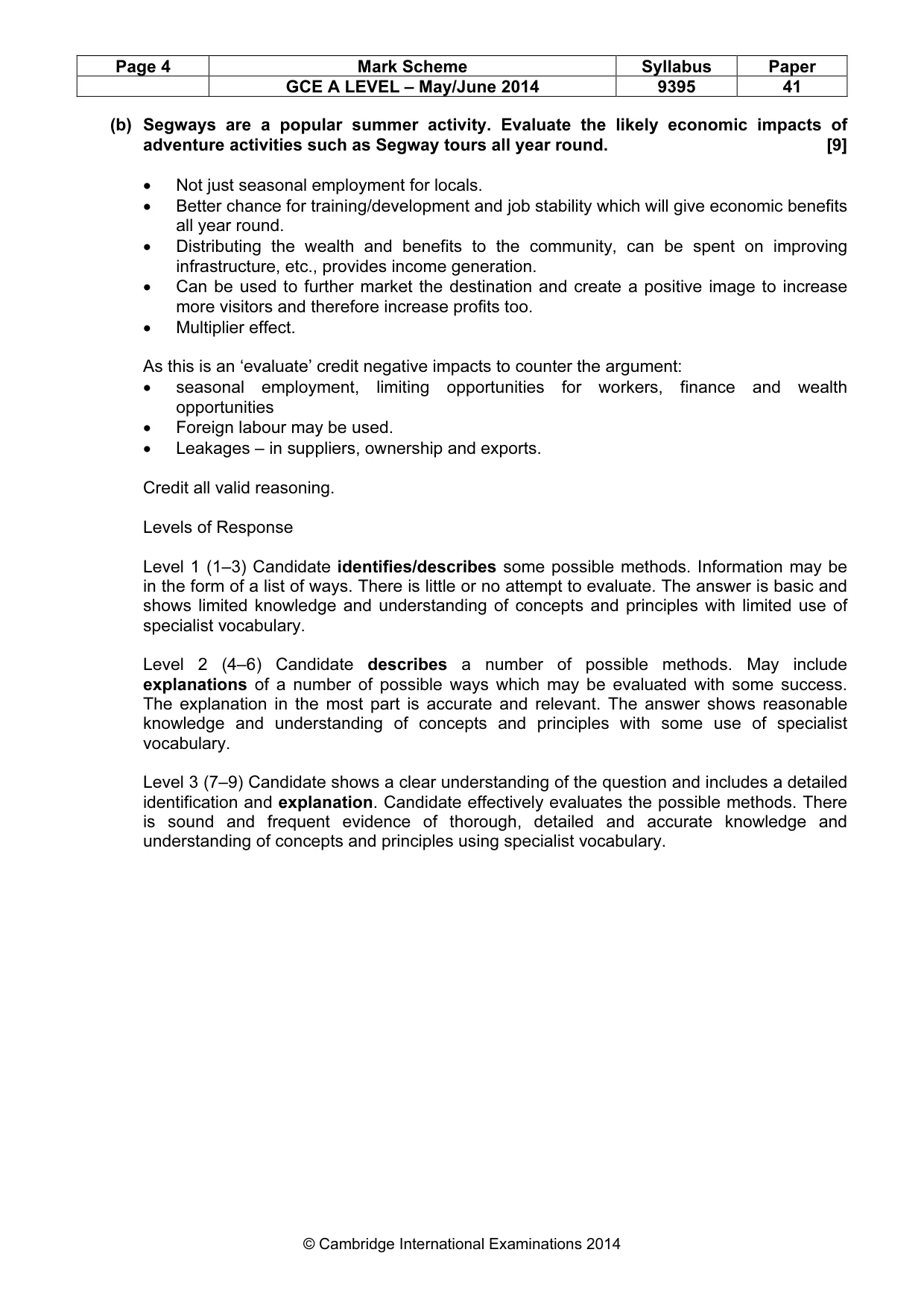
Page 4 Mark Scheme Syllabus Paper GCE A LEVEL – May/June 2014 9395 41 © Cambridge International Examinations 2014 (b) Segways are a popular summer activity. Evaluate the likely economic impacts of adventure activities such as Segway tours all year round. [9] • Not just seasonal employment for locals. • Better chance for training/development and job stability which will give economic benefits all year round. • Distributing the wealth and benefits to the community, can be spent on improving infrastructure, etc., provides income generation. • Can be used to further market the destination and create a positive image to increase more visitors and therefore increase profits too. • Multiplier effect. As this is an ‘evaluate’ credit negative impacts to counter the argument: • seasonal employment, limiting opportunities for workers, finance and wealth opportunities • Foreign labour may be used. • Leakages – in suppliers, ownership and exports. Credit all valid reasoning. Levels of Response Level 1 (1–3) Candidate identifies/describes some possible methods. Information may be in the form of a list of ways. There is little or no attempt to evaluate. The answer is basic and shows limited knowledge and understanding of concepts and principles with limited use of specialist vocabulary. Level 2 (4–6) Candidate describes a number of possible methods. May include explanations of a number of possible ways which may be evaluated with some success. The explanation in the most part is accurate and relevant. The answer shows reasonable knowledge and understanding of concepts and principles with some use of specialist vocabulary. Level 3 (7–9) Candidate shows a clear understanding of the question and includes a detailed identification and explanation. Candidate effectively evaluates the possible methods. There is sound and frequent evidence of thorough, detailed and accurate knowledge and understanding of concepts and principles using specialist vocabulary.
Mark scheme, page 5
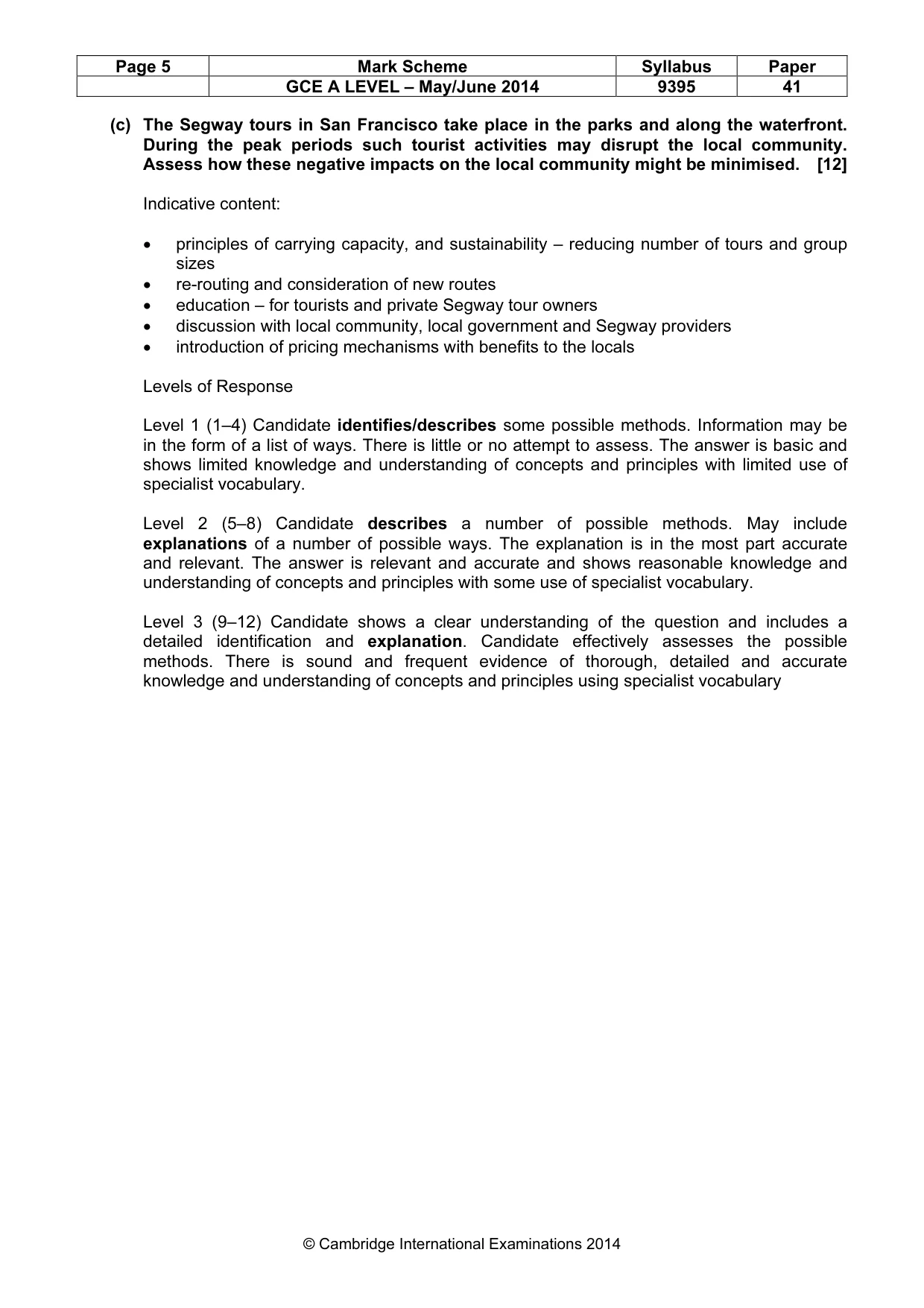
Page 5 Mark Scheme Syllabus Paper GCE A LEVEL – May/June 2014 9395 41 © Cambridge International Examinations 2014 (c) The Segway tours in San Francisco take place in the parks and along the waterfront. During the peak periods such tourist activities may disrupt the local community. Assess how these negative impacts on the local community might be minimised. [12] Indicative content: • principles of carrying capacity, and sustainability – reducing number of tours and group sizes • re-routing and consideration of new routes • education – for tourists and private Segway tour owners • discussion with local community, local government and Segway providers • introduction of pricing mechanisms with benefits to the locals Levels of Response Level 1 (1–4) Candidate identifies/describes some possible methods. Information may be in the form of a list of ways. There is little or no attempt to assess. The answer is basic and shows limited knowledge and understanding of concepts and principles with limited use of specialist vocabulary. Level 2 (5–8) Candidate describes a number of possible methods. May include explanations of a number of possible ways. The explanation is in the most part accurate and relevant. The answer is relevant and accurate and shows reasonable knowledge and understanding of concepts and principles with some use of specialist vocabulary. Level 3 (9–12) Candidate shows a clear understanding of the question and includes a detailed identification and explanation. Candidate effectively assesses the possible methods. There is sound and frequent evidence of thorough, detailed and accurate knowledge and understanding of concepts and principles using specialist vocabulary
What you needed in this session
Cambridge’s own grade thresholds for 2014 May/June, Paper 4 · Variant 1. A higher threshold means an easier paper — the bar moves with how the cohort did.