Cambridge A Level Travel and Tourism 9395 — 2014 May/June Paper 3 · Variant 3
9395/33/M/J/14 · 100 marks · ≈113 min
The question paper and its mark scheme, free to read here and free to download. This is Cambridge’s own paper, exactly as it was sat.
Question paper16 pages









Mark scheme8 pages
Answers below. Sit the paper first if you are practising.
Paper as text
Question paper, page 1
This document consists of 13 printed pages, 3 blank pages and 1 insert. DC (AC) 93359/1 © UCLES 2014 [Turn over Cambridge International Examinations Cambridge International Advanced Level * 7 0 5 4 0 0 0 9 3 1 * TRAVEL AND TOURISM 9395/33 Paper 3 International Business & Leisure Travel Services May/June 2014 1 hour 30 minutes Candidates answer on the Question Paper. No Additional Materials are required. READ THESE INSTRUCTIONS FIRST Write your Centre number, candidate number and name on all the work you hand in. Write in dark blue or black pen. You may use an HB pencil for any diagrams or graphs. Do not use staples, paper clips, glue or correction fluid. DO NOT WRITE IN ANY BARCODES. Answer all questions. All the Figures referred to in the questions are contained in the Insert. The number of marks is given in brackets [ ] at the end of each question or part question.
Question paper, page 2
2 © UCLES 2014 9395/33/M/J/14 Question 1 Refer to Fig. 1 (Insert), information about Nanjing in China, the host city of the second summer Youth Olympic Games in 2014. (a) (i) Identify from Fig. 1 (Insert) two likely reasons why the city of Nanjing was chosen to host the Youth Olympic Games. 1 … … 2 … …[2] (ii) State two different types of tourist that may be attracted to Nanjing as a result of the city hosting the Games. 1 … 2 …[2] (b) Using Fig. 1 (Insert), explain three ways in which Nanjing is accessible to tourists. 1 … … … … 2 … … … … 3 … … … …[6]
Question paper, page 3
3 © UCLES 2014 [Turn over 9395/33/M/J/14 (c) Explain fully two likely benefits to travel and tourism organisations in Nanjing of hosting the Games. 1 … … … … … … 2 … … … … … …[6]
Question paper, page 4
4 9395/33/M/J/14 © UCLES 2014 (d) Evaluate the advantages and disadvantages for tourists of having a large number of licensed tour guides available in Nanjing. … … … … … … … … … … … … … … … … … … … … … … … … … …[9] [Total: 25]
Question paper, page 5
5 9395/33/M/J/14 © UCLES 2014 [Turn over Question 2 Refer to Fig. 2 (Insert), information about the comparability of airline charges. (a) (i) Identify from Fig. 2 (Insert) two examples of additional fees which may not be included in the advertised ticket price. 1 … … 2 … …[2] (ii) Identify from Fig. 2 (Insert) two different sources of information customers may use to find out about airline service charges and fees. 1 … … 2 … …[2] (b) Using Fig. 2 (Insert), explain three reasons why many of those involved in air travel want to give passengers more information about prices for optional airline services. 1 … … … … 2 … … … … 3 … … … …[6]
Question paper, page 6
6 9395/33/M/J/14 © UCLES 2014 (c) Explain fully two ways in which scheduled airlines try to overcome competition from other airlines offering similar products. 1 … … … … … … 2 … … … … … …[6]
Question paper, page 7
7 9395/33/M/J/14 © UCLES 2014 [Turn over (d) Airlines claim that updating their computer technology to provide more information about additional fees will be complex and expensive. Justify the reasons for airlines making this claim. … … … … … … … … … … … … … … … … … … … … … … … … …[9] [Total: 25]
Question paper, page 8
8 9395/33/M/J/14 © UCLES 2014 Question 3 Refer to Fig. 3 (Insert), information from the company brochure for the International Motor Coach Group (IMG), a network of coach companies which operates in North America. (a) (i) Identify from Fig. 3 (Insert) four facilities offered on board an IMG coach. 1 … 2 … 3 … 4 …[4] (ii) Other than on-board facilities, explain three reasons for the appeal of travelling with an IMG coach company. 1 … … … … 2 … … … … 3 … … … …[6]
Question paper, page 9
9 9395/33/M/J/14 © UCLES 2014 [Turn over (b) Explain fully two ways in which passengers are likely to benefit from IMG tour operators working with other principals to put together holiday packages. 1 … … … … … … 2 … … … … … …[6]
Question paper, page 10
10 9395/33/M/J/14 © UCLES 2014 (c) Compare and contrast coach travel with other means of transport for business travellers. … … … … … … … … … … … … … … … … … … … … … … … … … …[9] [Total: 25]
Question paper, page 11
11 9395/33/M/J/14 © UCLES 2014 [Turn over Question 4 Refer to Fig. 4 (Insert), an advertisement for the Swiss Chocolate Train, a leisure excursion. (a) Describe, using two examples from Fig. 4 (Insert), what is meant by the term tourism product. 1 … … … … 2 … … … …[4] (b) Explain three likely reasons for the appeal of a one-day leisure excursion, such as the Swiss Chocolate Train. 1 … … … … 2 … … … … 3 … … … …[6]
Question paper, page 12
12 9395/33/M/J/14 © UCLES 2014 (c) Explain fully two likely reasons why the Swiss Chocolate Train operates a restricted schedule. 1 … … … … … … 2 … … … … … …[6]
Question paper, page 13
13 9395/33/M/J/14 © UCLES 2014 [Turn over (d) The Swiss Chocolate Train has a fixed pricing policy. Evaluate the advantages and disadvantages to travel providers of using fixed pricing policies. … … … … … … … … … … … … … … … … … … … … … … … … … …[9] [Total: 25]
Question paper, page 14
14 9395/33/M/J/14 © UCLES 2014 BLANK PAGE
Question paper, page 15
15 9395/33/M/J/14 © UCLES 2014 BLANK PAGE
Question paper, page 16
16 9395/33/M/J/14 © UCLES 2014 Permission to reproduce items where third-party owned material protected by copyright is included has been sought and cleared where possible. Every reasonable effort has been made by the publisher (UCLES) to trace copyright holders, but if any items requiring clearance have unwittingly been included, the publisher will be pleased to make amends at the earliest possible opportunity. Cambridge International Examinations is part of the Cambridge Assessment Group. Cambridge Assessment is the brand name of University of Cambridge Local Examinations Syndicate (UCLES), which is itself a department of the University of Cambridge. BLANK PAGE
Mark scheme, page 1
CAMBRIDGE INTERNATIONAL EXAMINATIONS GCE Advanced Level MARK SCHEME for the May/June 2014 series 9395 TRAVEL AND TOURISM 9395/33 Paper 3 (International Business & Leisure Travel Services), maximum raw mark 100 This mark scheme is published as an aid to teachers and candidates, to indicate the requirements of the examination. It shows the basis on which Examiners were instructed to award marks. It does not indicate the details of the discussions that took place at an Examiners’ meeting before marking began, which would have considered the acceptability of alternative answers. Mark schemes should be read in conjunction with the question paper and the Principal Examiner Report for Teachers. Cambridge will not enter into discussions about these mark schemes. Cambridge is publishing the mark schemes for the May/June 2014 series for most IGCSE, GCE Advanced Level and Advanced Subsidiary Level components and some Ordinary Level components.
Mark scheme, page 2
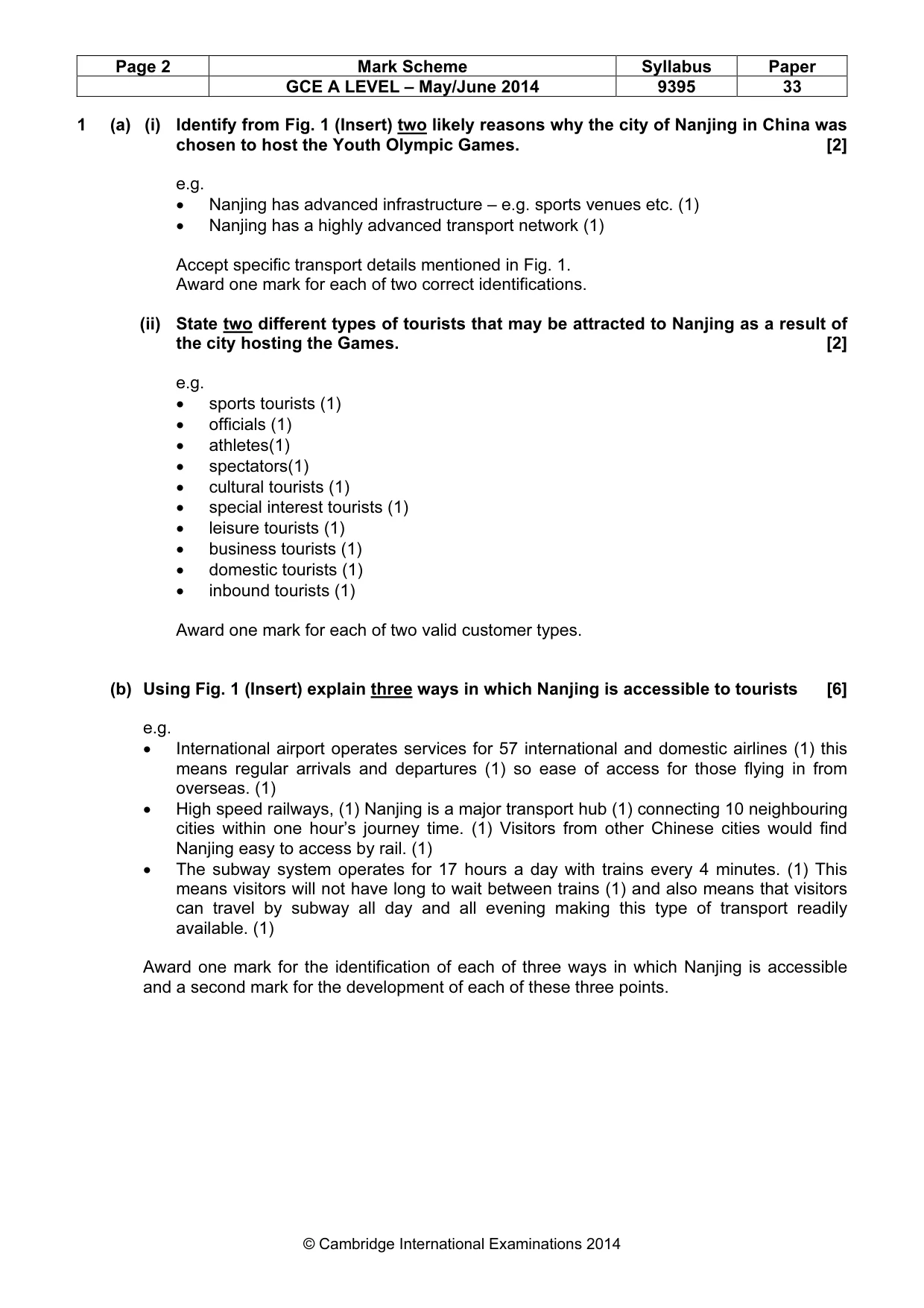
Page 2 Mark Scheme Syllabus Paper GCE A LEVEL – May/June 2014 9395 33 © Cambridge International Examinations 2014 1 (a) (i) Identify from Fig. 1 (Insert) two likely reasons why the city of Nanjing in China was chosen to host the Youth Olympic Games. [2] e.g. • Nanjing has advanced infrastructure – e.g. sports venues etc. (1) • Nanjing has a highly advanced transport network (1) Accept specific transport details mentioned in Fig. 1. Award one mark for each of two correct identifications. (ii) State two different types of tourists that may be attracted to Nanjing as a result of the city hosting the Games. [2] e.g. • sports tourists (1) • officials (1) • athletes(1) • spectators(1) • cultural tourists (1) • special interest tourists (1) • leisure tourists (1) • business tourists (1) • domestic tourists (1) • inbound tourists (1) Award one mark for each of two valid customer types. (b) Using Fig. 1 (Insert) explain three ways in which Nanjing is accessible to tourists [6] e.g. • International airport operates services for 57 international and domestic airlines (1) this means regular arrivals and departures (1) so ease of access for those flying in from overseas. (1) • High speed railways, (1) Nanjing is a major transport hub (1) connecting 10 neighbouring cities within one hour’s journey time. (1) Visitors from other Chinese cities would find Nanjing easy to access by rail. (1) • The subway system operates for 17 hours a day with trains every 4 minutes. (1) This means visitors will not have long to wait between trains (1) and also means that visitors can travel by subway all day and all evening making this type of transport readily available. (1) Award one mark for the identification of each of three ways in which Nanjing is accessible and a second mark for the development of each of these three points.
Mark scheme, page 3
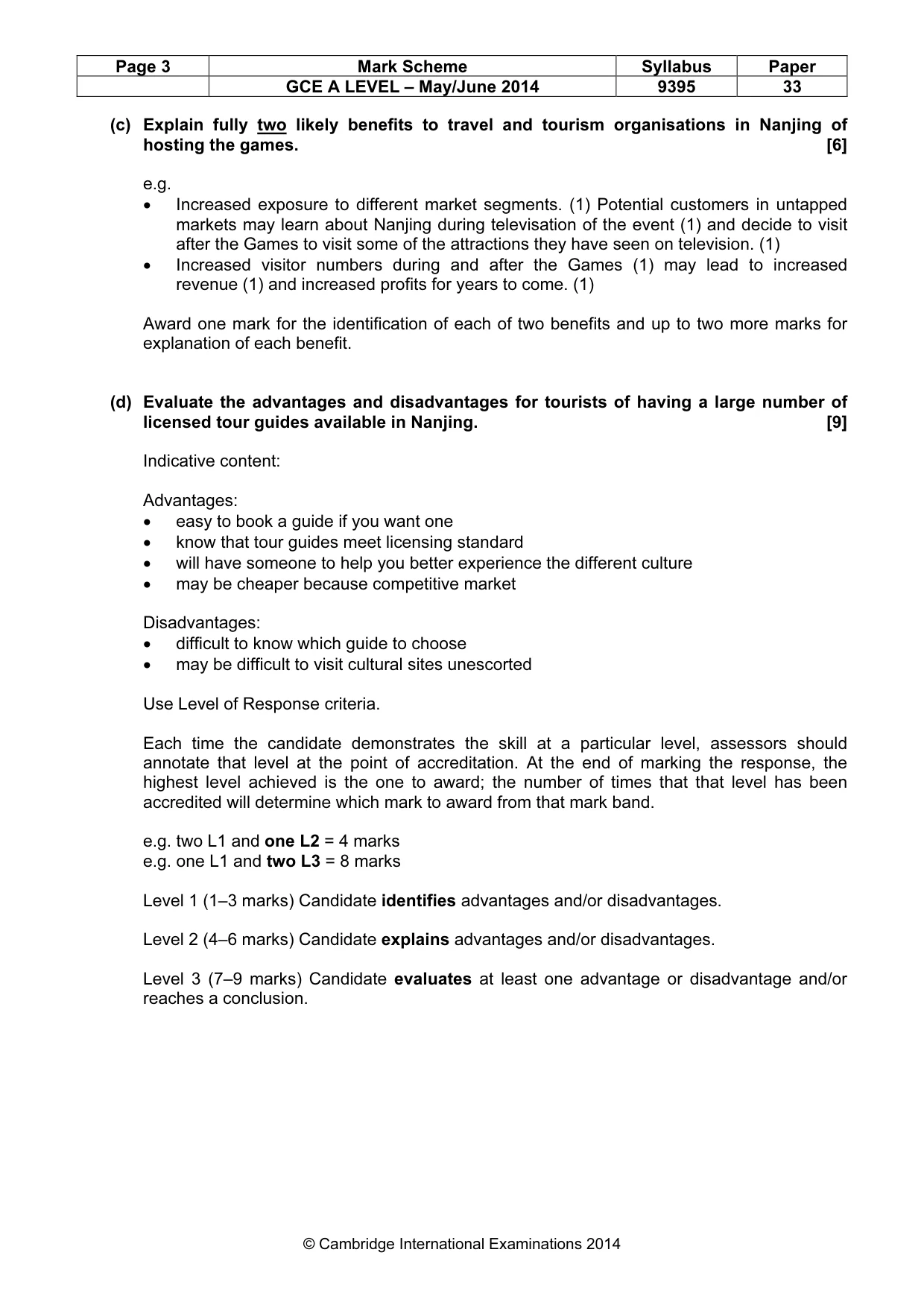
Page 3 Mark Scheme Syllabus Paper GCE A LEVEL – May/June 2014 9395 33 © Cambridge International Examinations 2014 (c) Explain fully two likely benefits to travel and tourism organisations in Nanjing of hosting the games. [6] e.g. • Increased exposure to different market segments. (1) Potential customers in untapped markets may learn about Nanjing during televisation of the event (1) and decide to visit after the Games to visit some of the attractions they have seen on television. (1) • Increased visitor numbers during and after the Games (1) may lead to increased revenue (1) and increased profits for years to come. (1) Award one mark for the identification of each of two benefits and up to two more marks for explanation of each benefit. (d) Evaluate the advantages and disadvantages for tourists of having a large number of licensed tour guides available in Nanjing. [9] Indicative content: Advantages: • easy to book a guide if you want one • know that tour guides meet licensing standard • will have someone to help you better experience the different culture • may be cheaper because competitive market Disadvantages: • difficult to know which guide to choose • may be difficult to visit cultural sites unescorted Use Level of Response criteria. Each time the candidate demonstrates the skill at a particular level, assessors should annotate that level at the point of accreditation. At the end of marking the response, the highest level achieved is the one to award; the number of times that that level has been accredited will determine which mark to award from that mark band. e.g. two L1 and one L2 = 4 marks e.g. one L1 and two L3 = 8 marks Level 1 (1–3 marks) Candidate identifies advantages and/or disadvantages. Level 2 (4–6 marks) Candidate explains advantages and/or disadvantages. Level 3 (7–9 marks) Candidate evaluates at least one advantage or disadvantage and/or reaches a conclusion.
Mark scheme, page 4
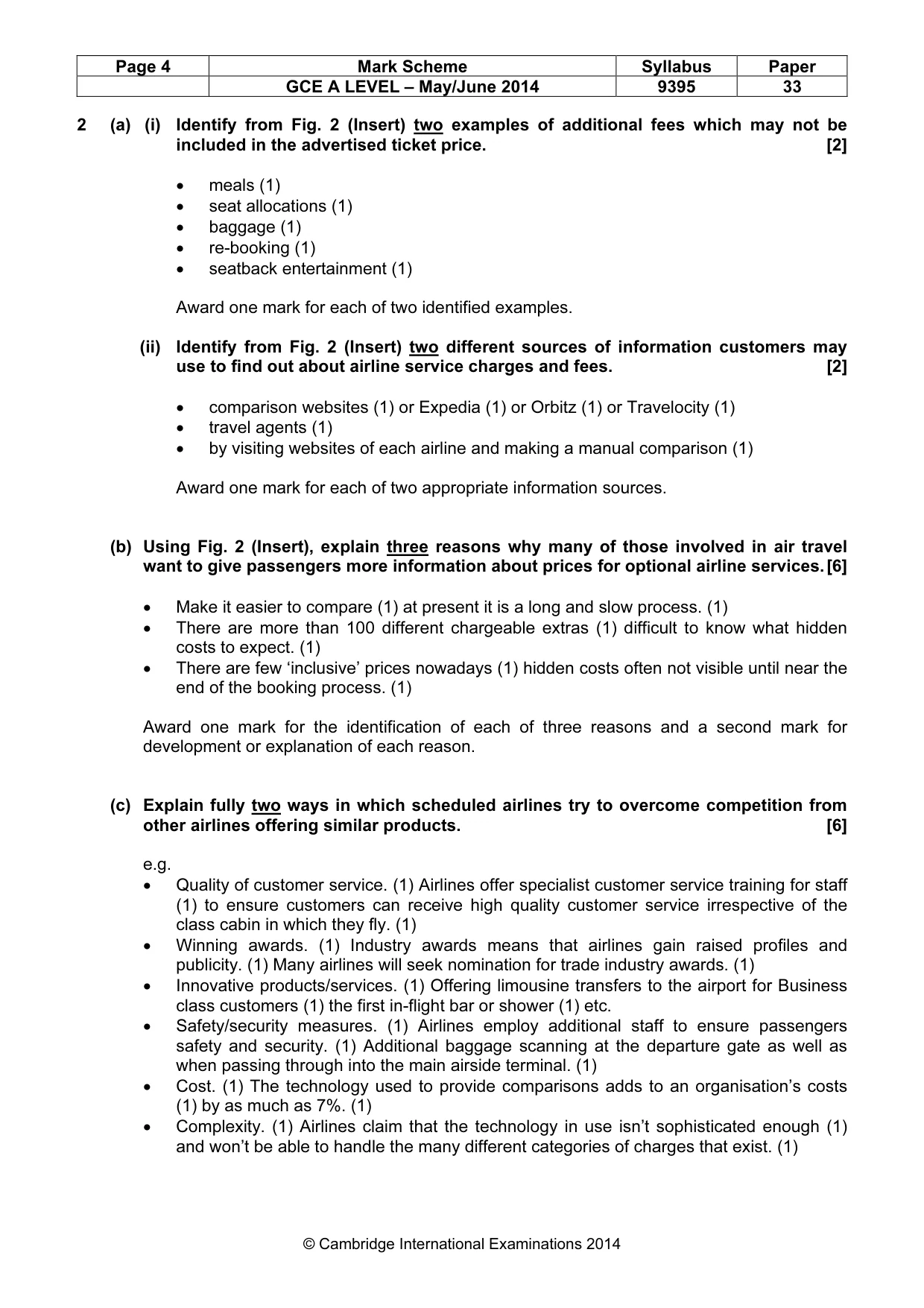
Page 4 Mark Scheme Syllabus Paper GCE A LEVEL – May/June 2014 9395 33 © Cambridge International Examinations 2014 2 (a) (i) Identify from Fig. 2 (Insert) two examples of additional fees which may not be included in the advertised ticket price. [2] • meals (1) • seat allocations (1) • baggage (1) • re-booking (1) • seatback entertainment (1) Award one mark for each of two identified examples. (ii) Identify from Fig. 2 (Insert) two different sources of information customers may use to find out about airline service charges and fees. [2] • comparison websites (1) or Expedia (1) or Orbitz (1) or Travelocity (1) • travel agents (1) • by visiting websites of each airline and making a manual comparison (1) Award one mark for each of two appropriate information sources. (b) Using Fig. 2 (Insert), explain three reasons why many of those involved in air travel want to give passengers more information about prices for optional airline services. [6] • Make it easier to compare (1) at present it is a long and slow process. (1) • There are more than 100 different chargeable extras (1) difficult to know what hidden costs to expect. (1) • There are few ‘inclusive’ prices nowadays (1) hidden costs often not visible until near the end of the booking process. (1) Award one mark for the identification of each of three reasons and a second mark for development or explanation of each reason. (c) Explain fully two ways in which scheduled airlines try to overcome competition from other airlines offering similar products. [6] e.g. • Quality of customer service. (1) Airlines offer specialist customer service training for staff (1) to ensure customers can receive high quality customer service irrespective of the class cabin in which they fly. (1) • Winning awards. (1) Industry awards means that airlines gain raised profiles and publicity. (1) Many airlines will seek nomination for trade industry awards. (1) • Innovative products/services. (1) Offering limousine transfers to the airport for Business class customers (1) the first in-flight bar or shower (1) etc. • Safety/security measures. (1) Airlines employ additional staff to ensure passengers safety and security. (1) Additional baggage scanning at the departure gate as well as when passing through into the main airside terminal. (1) • Cost. (1) The technology used to provide comparisons adds to an organisation’s costs (1) by as much as 7%. (1) • Complexity. (1) Airlines claim that the technology in use isn’t sophisticated enough (1) and won’t be able to handle the many different categories of charges that exist. (1)
Mark scheme, page 5
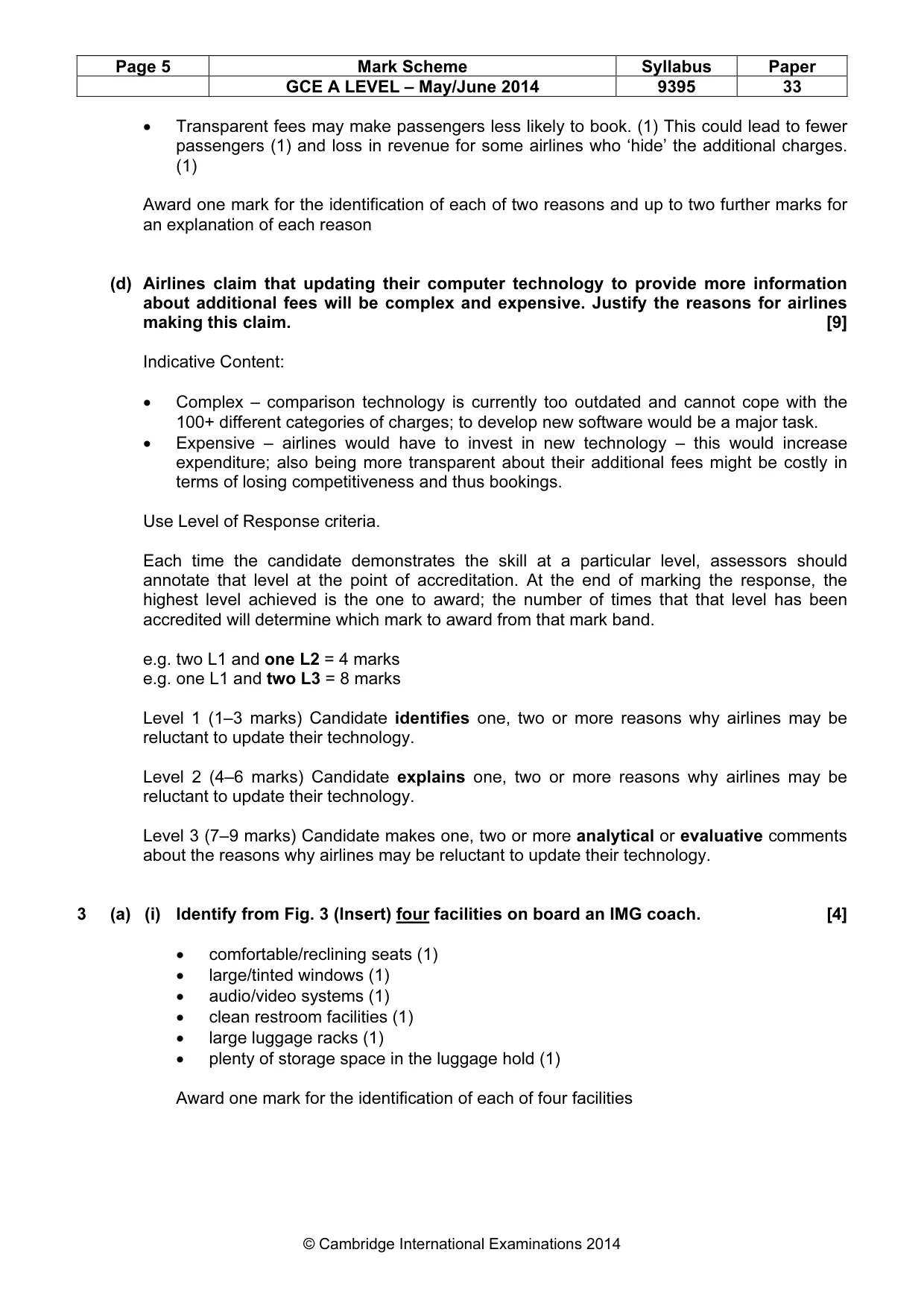
Page 5 Mark Scheme Syllabus Paper GCE A LEVEL – May/June 2014 9395 33 © Cambridge International Examinations 2014 • Transparent fees may make passengers less likely to book. (1) This could lead to fewer passengers (1) and loss in revenue for some airlines who ‘hide’ the additional charges. (1) Award one mark for the identification of each of two reasons and up to two further marks for an explanation of each reason (d) Airlines claim that updating their computer technology to provide more information about additional fees will be complex and expensive. Justify the reasons for airlines making this claim. [9] Indicative Content: • Complex – comparison technology is currently too outdated and cannot cope with the 100+ different categories of charges; to develop new software would be a major task. • Expensive – airlines would have to invest in new technology – this would increase expenditure; also being more transparent about their additional fees might be costly in terms of losing competitiveness and thus bookings. Use Level of Response criteria. Each time the candidate demonstrates the skill at a particular level, assessors should annotate that level at the point of accreditation. At the end of marking the response, the highest level achieved is the one to award; the number of times that that level has been accredited will determine which mark to award from that mark band. e.g. two L1 and one L2 = 4 marks e.g. one L1 and two L3 = 8 marks Level 1 (1–3 marks) Candidate identifies one, two or more reasons why airlines may be reluctant to update their technology. Level 2 (4–6 marks) Candidate explains one, two or more reasons why airlines may be reluctant to update their technology. Level 3 (7–9 marks) Candidate makes one, two or more analytical or evaluative comments about the reasons why airlines may be reluctant to update their technology. 3 (a) (i) Identify from Fig. 3 (Insert) four facilities on board an IMG coach. [4] • comfortable/reclining seats (1) • large/tinted windows (1) • audio/video systems (1) • clean restroom facilities (1) • large luggage racks (1) • plenty of storage space in the luggage hold (1) Award one mark for the identification of each of four facilities
Mark scheme, page 6
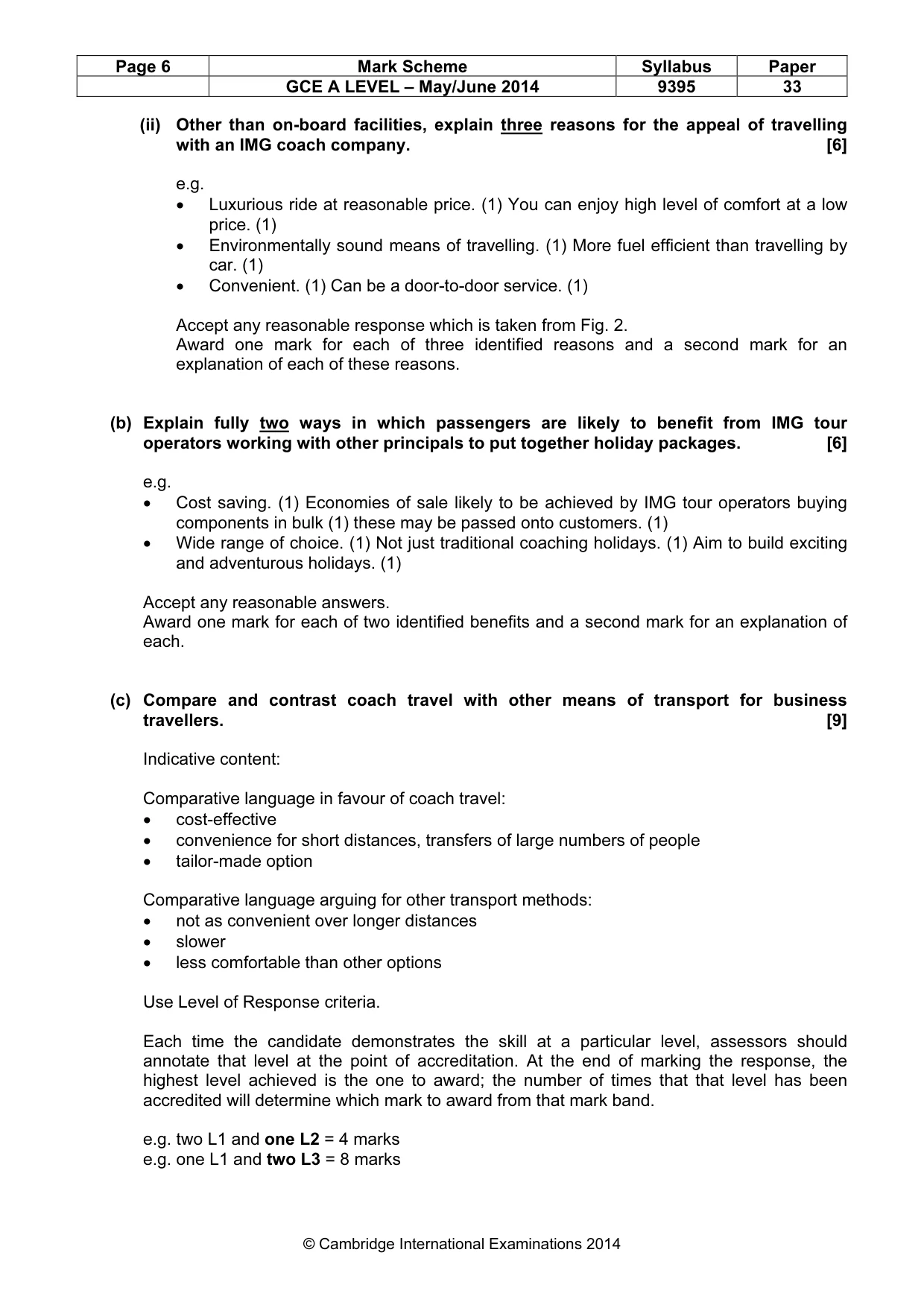
Page 6 Mark Scheme Syllabus Paper GCE A LEVEL – May/June 2014 9395 33 © Cambridge International Examinations 2014 (ii) Other than on-board facilities, explain three reasons for the appeal of travelling with an IMG coach company. [6] e.g. • Luxurious ride at reasonable price. (1) You can enjoy high level of comfort at a low price. (1) • Environmentally sound means of travelling. (1) More fuel efficient than travelling by car. (1) • Convenient. (1) Can be a door-to-door service. (1) Accept any reasonable response which is taken from Fig. 2. Award one mark for each of three identified reasons and a second mark for an explanation of each of these reasons. (b) Explain fully two ways in which passengers are likely to benefit from IMG tour operators working with other principals to put together holiday packages. [6] e.g. • Cost saving. (1) Economies of sale likely to be achieved by IMG tour operators buying components in bulk (1) these may be passed onto customers. (1) • Wide range of choice. (1) Not just traditional coaching holidays. (1) Aim to build exciting and adventurous holidays. (1) Accept any reasonable answers. Award one mark for each of two identified benefits and a second mark for an explanation of each. (c) Compare and contrast coach travel with other means of transport for business travellers. [9] Indicative content: Comparative language in favour of coach travel: • cost-effective • convenience for short distances, transfers of large numbers of people • tailor-made option Comparative language arguing for other transport methods: • not as convenient over longer distances • slower • less comfortable than other options Use Level of Response criteria. Each time the candidate demonstrates the skill at a particular level, assessors should annotate that level at the point of accreditation. At the end of marking the response, the highest level achieved is the one to award; the number of times that that level has been accredited will determine which mark to award from that mark band. e.g. two L1 and one L2 = 4 marks e.g. one L1 and two L3 = 8 marks
Mark scheme, page 7
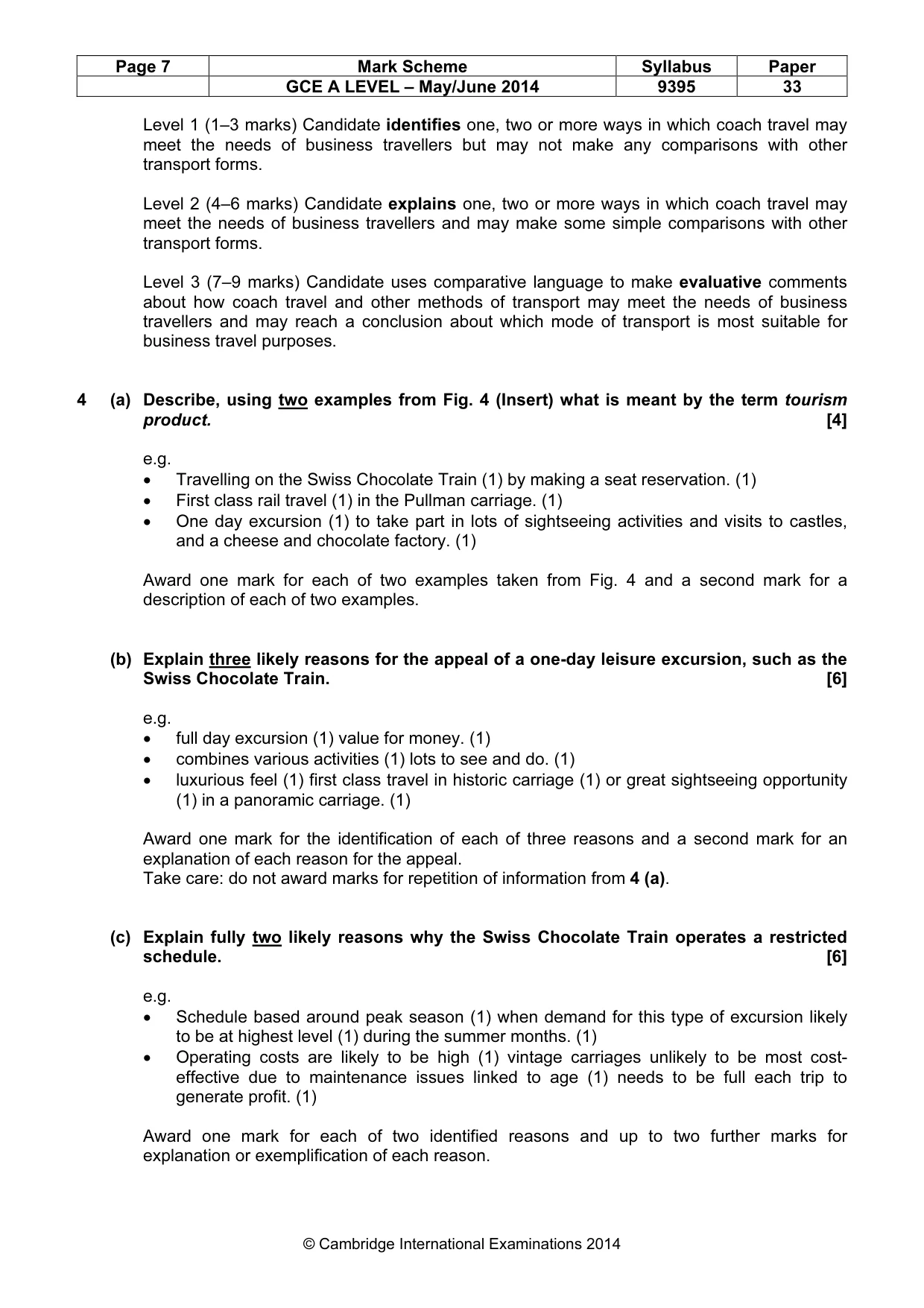
Page 7 Mark Scheme Syllabus Paper GCE A LEVEL – May/June 2014 9395 33 © Cambridge International Examinations 2014 Level 1 (1–3 marks) Candidate identifies one, two or more ways in which coach travel may meet the needs of business travellers but may not make any comparisons with other transport forms. Level 2 (4–6 marks) Candidate explains one, two or more ways in which coach travel may meet the needs of business travellers and may make some simple comparisons with other transport forms. Level 3 (7–9 marks) Candidate uses comparative language to make evaluative comments about how coach travel and other methods of transport may meet the needs of business travellers and may reach a conclusion about which mode of transport is most suitable for business travel purposes. 4 (a) Describe, using two examples from Fig. 4 (Insert) what is meant by the term tourism product. [4] e.g. • Travelling on the Swiss Chocolate Train (1) by making a seat reservation. (1) • First class rail travel (1) in the Pullman carriage. (1) • One day excursion (1) to take part in lots of sightseeing activities and visits to castles, and a cheese and chocolate factory. (1) Award one mark for each of two examples taken from Fig. 4 and a second mark for a description of each of two examples. (b) Explain three likely reasons for the appeal of a one-day leisure excursion, such as the Swiss Chocolate Train. [6] e.g. • full day excursion (1) value for money. (1) • combines various activities (1) lots to see and do. (1) • luxurious feel (1) first class travel in historic carriage (1) or great sightseeing opportunity (1) in a panoramic carriage. (1) Award one mark for the identification of each of three reasons and a second mark for an explanation of each reason for the appeal. Take care: do not award marks for repetition of information from 4 (a). (c) Explain fully two likely reasons why the Swiss Chocolate Train operates a restricted schedule. [6] e.g. • Schedule based around peak season (1) when demand for this type of excursion likely to be at highest level (1) during the summer months. (1) • Operating costs are likely to be high (1) vintage carriages unlikely to be most cost- effective due to maintenance issues linked to age (1) needs to be full each trip to generate profit. (1) Award one mark for each of two identified reasons and up to two further marks for explanation or exemplification of each reason.
Mark scheme, page 8
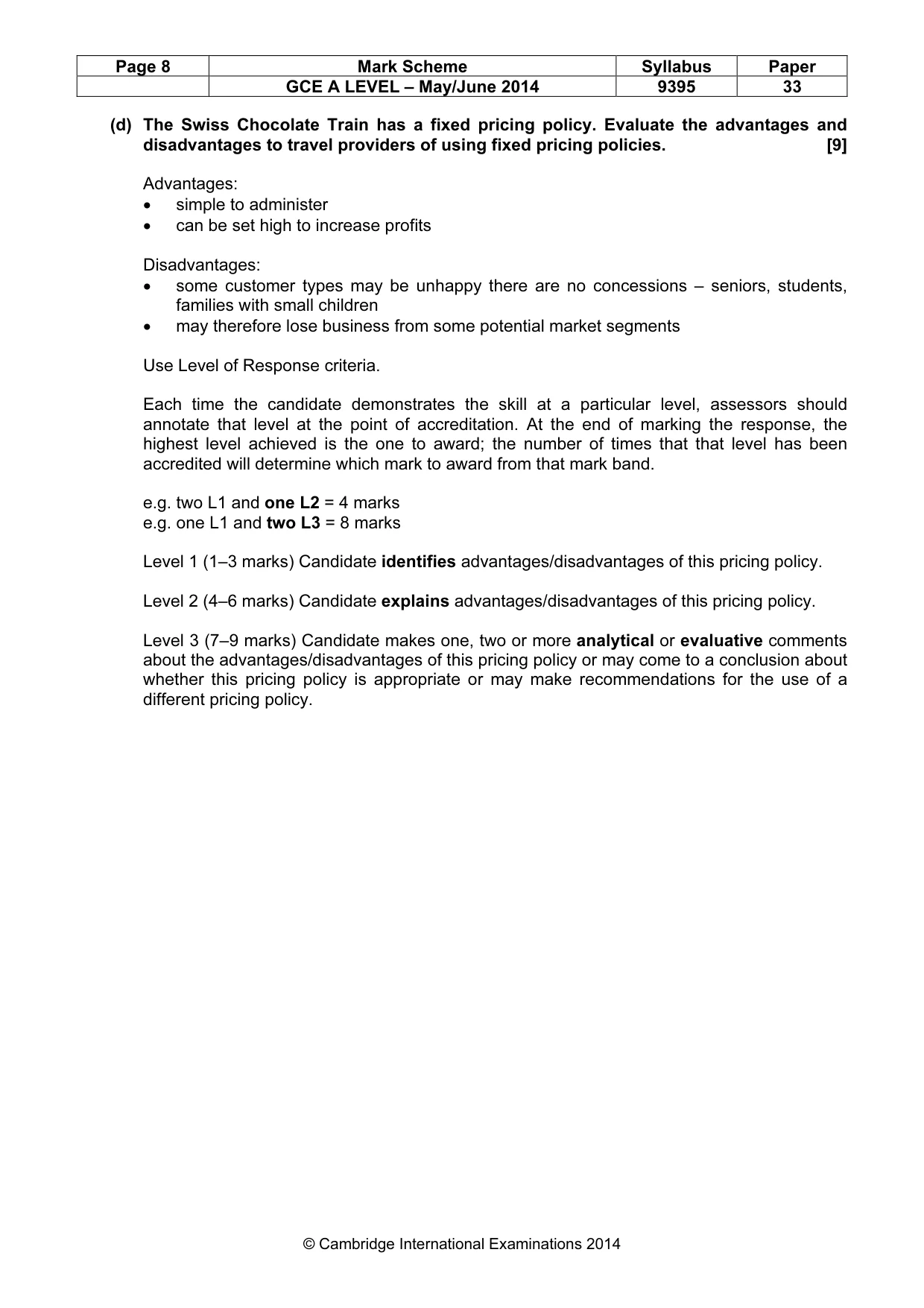
Page 8 Mark Scheme Syllabus Paper GCE A LEVEL – May/June 2014 9395 33 © Cambridge International Examinations 2014 (d) The Swiss Chocolate Train has a fixed pricing policy. Evaluate the advantages and disadvantages to travel providers of using fixed pricing policies. [9] Advantages: • simple to administer • can be set high to increase profits Disadvantages: • some customer types may be unhappy there are no concessions – seniors, students, families with small children • may therefore lose business from some potential market segments Use Level of Response criteria. Each time the candidate demonstrates the skill at a particular level, assessors should annotate that level at the point of accreditation. At the end of marking the response, the highest level achieved is the one to award; the number of times that that level has been accredited will determine which mark to award from that mark band. e.g. two L1 and one L2 = 4 marks e.g. one L1 and two L3 = 8 marks Level 1 (1–3 marks) Candidate identifies advantages/disadvantages of this pricing policy. Level 2 (4–6 marks) Candidate explains advantages/disadvantages of this pricing policy. Level 3 (7–9 marks) Candidate makes one, two or more analytical or evaluative comments about the advantages/disadvantages of this pricing policy or may come to a conclusion about whether this pricing policy is appropriate or may make recommendations for the use of a different pricing policy.
What you needed in this session
Cambridge’s own grade thresholds for 2014 May/June, Paper 3 · Variant 3. A higher threshold means an easier paper — the bar moves with how the cohort did.