Cambridge A Level Travel and Tourism 9395 — 2013 Oct/Nov Paper 4 · Variant 3
9395/43/O/N/13 · 50 marks · ≈56 min
The question paper and its mark scheme, free to read here and free to download. This is Cambridge’s own paper, exactly as it was sat.
Question paper8 pages

Mark scheme5 pages
Answers below. Sit the paper first if you are practising.
Paper as text
Question paper, page 1
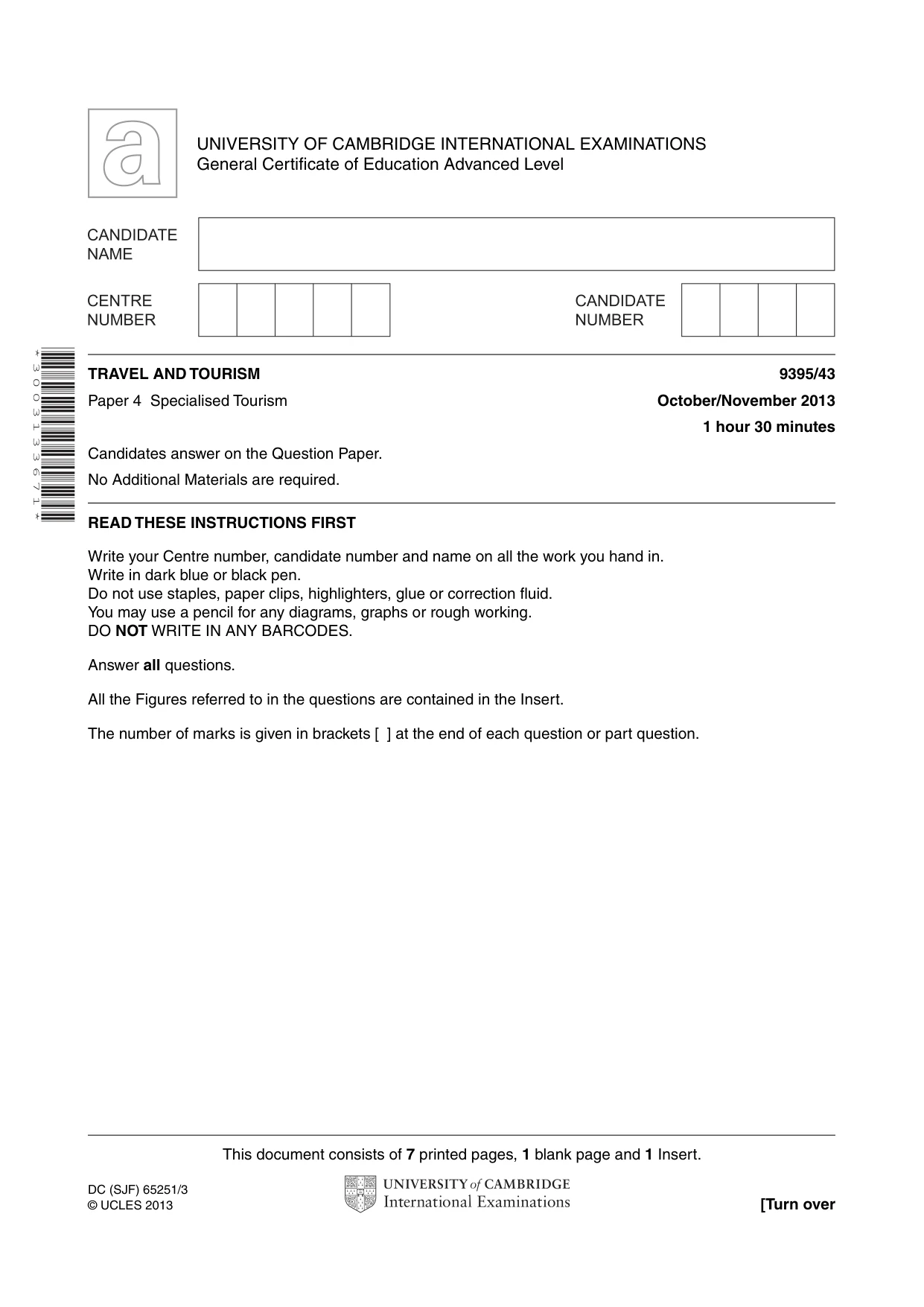
This document consists of 7 printed pages, 1 blank page and 1 Insert. DC (SJF) 65251/3 © UCLES 2013 [Turn over UNIVERSITY OF CAMBRIDGE INTERNATIONAL EXAMINATIONS General Certificate of Education Advanced Level * 3 0 0 3 1 3 3 6 7 1 * TRAVEL AND TOURISM 9395/43 Paper 4 Specialised Tourism October/November 2013 1 hour 30 minutes Candidates answer on the Question Paper. No Additional Materials are required. READ THESE INSTRUCTIONS FIRST Write your Centre number, candidate number and name on all the work you hand in. Write in dark blue or black pen. Do not use staples, paper clips, highlighters, glue or correction fluid. You may use a pencil for any diagrams, graphs or rough working. DO NOT WRITE IN ANY BARCODES. Answer all questions. All the Figures referred to in the questions are contained in the Insert. The number of marks is given in brackets [ ] at the end of each question or part question.
Question paper, page 2
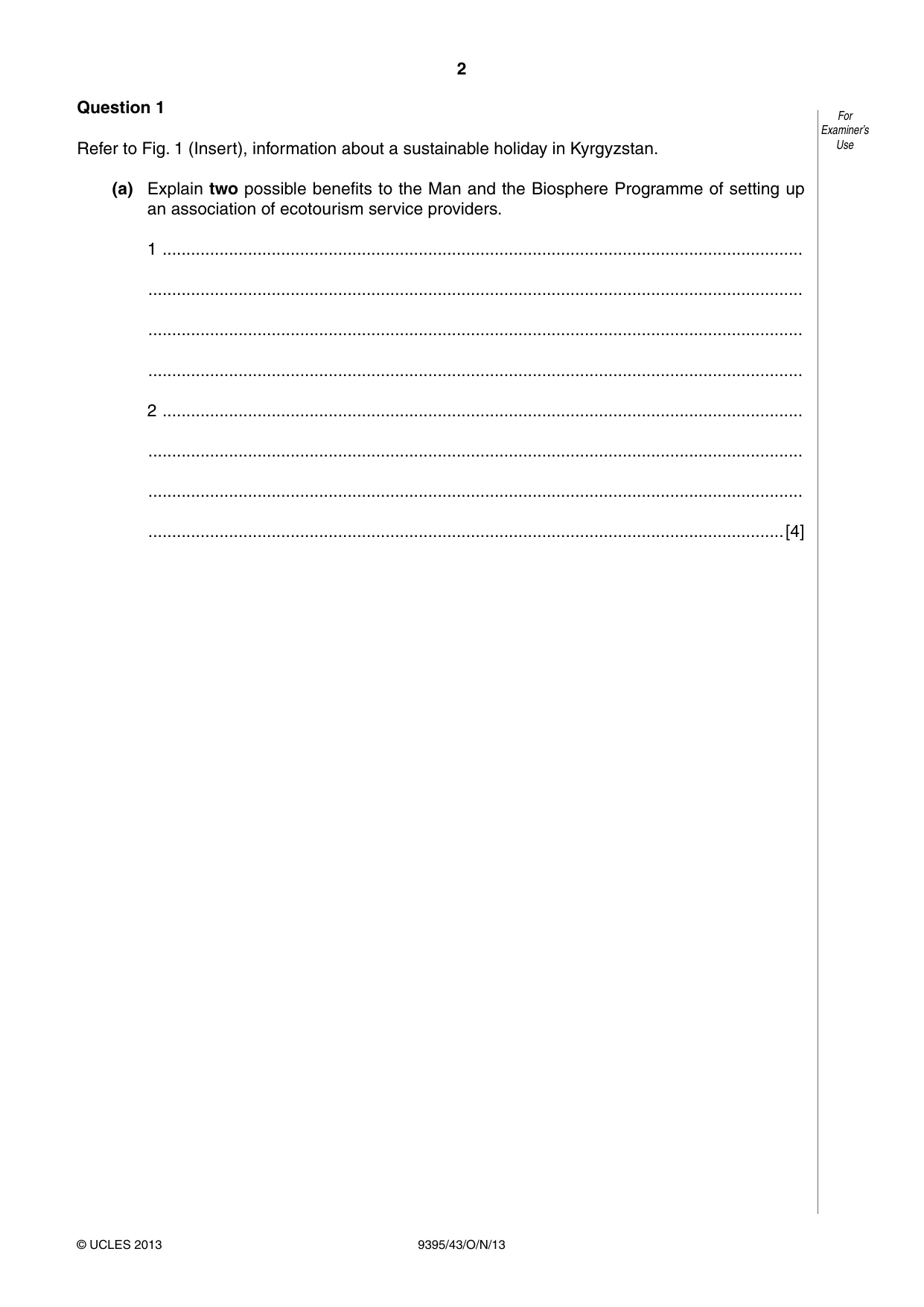
2 9395/43/O/N/13 © UCLES 2013 For Examiner’s Use Question 1 Refer to Fig. 1 (Insert), information about a sustainable holiday in Kyrgyzstan. (a) Explain two possible benefits to the Man and the Biosphere Programme of setting up an association of ecotourism service providers. 1 … … … … 2 … … … …[4]
Question paper, page 3
3 9395/43/O/N/13 © UCLES 2013 [Turn over For Examiner’s Use (b) Tourism in Kyrgyzstan is increasing. Evaluate the ways in which local tourism providers might benefit from a growth in tourism to this area. … … … … … … … … … … … … … … … … … … … … … … … … … … …[9]
Question paper, page 4
4 9395/43/O/N/13 © UCLES 2013 For Examiner’s Use (c) The adventure activities in Kyrgyzstan will be taking place in unspoilt countryside. Assess the potential environmental impacts that might arise as a result of these activities. … … … … … … … … … … … … … … … … … … … … … … … … … …[12] [Total: 25]
Question paper, page 5
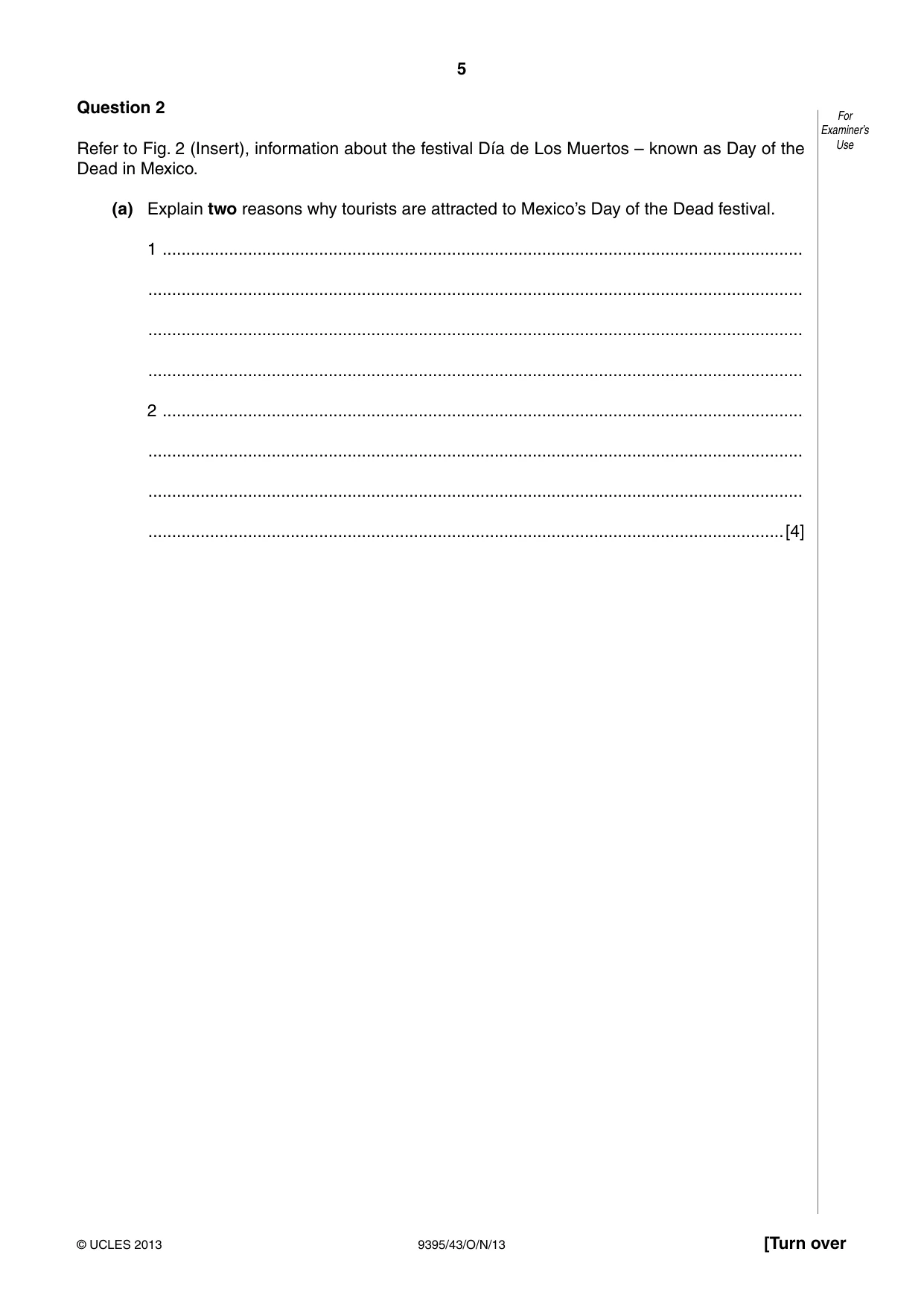
5 9395/43/O/N/13 © UCLES 2013 [Turn over For Examiner’s Use Question 2 Refer to Fig. 2 (Insert), information about the festival Día de Los Muertos – known as Day of the Dead in Mexico. (a) Explain two reasons why tourists are attracted to Mexico’s Day of the Dead festival. 1 … … … … 2 … … … …[4]
Question paper, page 6
6 9395/43/O/N/13 © UCLES 2013 For Examiner’s Use (b) Assess the likely benefits to the host population of preserving cultural activities, such as Mexico’s Day of the Dead festival. … … … … … … … … … … … … … … … … … … … … … … … … … … …[9]
Question paper, page 7
7 9395/43/O/N/13 © UCLES 2013 For Examiner’s Use (c) Many tourists visit Mexico to witness the Day of the Dead festival during November. Evaluate the problems that this may cause the host population. … … … … … … … … … … … … … … … … … … … … … … … … … …[12] [Total: 25]
Question paper, page 8
8 9395/43/O/N/13 © UCLES 2013 Permission to reproduce items where third-party owned material protected by copyright is included has been sought and cleared where possible. Every reasonable effort has been made by the publisher (UCLES) to trace copyright holders, but if any items requiring clearance have unwittingly been included, the publisher will be pleased to make amends at the earliest possible opportunity. University of Cambridge International Examinations is part of the Cambridge Assessment Group. Cambridge Assessment is the brand name of University of Cambridge Local Examinations Syndicate (UCLES), which is itself a department of the University of Cambridge. BLANK PAGE
Mark scheme, page 1
CAMBRIDGE INTERNATIONAL EXAMINATIONS GCE Advanced Subsidiary Level and GCE Advanced Level MARK SCHEME for the October/November 2013 series 9395 TRAVEL AND TOURISM 9395/43 Paper 4 (Specialised Tourism), maximum raw mark 50 This mark scheme is published as an aid to teachers and candidates, to indicate the requirements of the examination. It shows the basis on which Examiners were instructed to award marks. It does not indicate the details of the discussions that took place at an Examiners’ meeting before marking began, which would have considered the acceptability of alternative answers. Mark schemes should be read in conjunction with the question paper and the Principal Examiner Report for Teachers. Cambridge will not enter into discussions about these mark schemes. Cambridge is publishing the mark schemes for the October/November 2013 series for most IGCSE, GCE Advanced Level and Advanced Subsidiary Level components and some Ordinary Level components.
Mark scheme, page 2
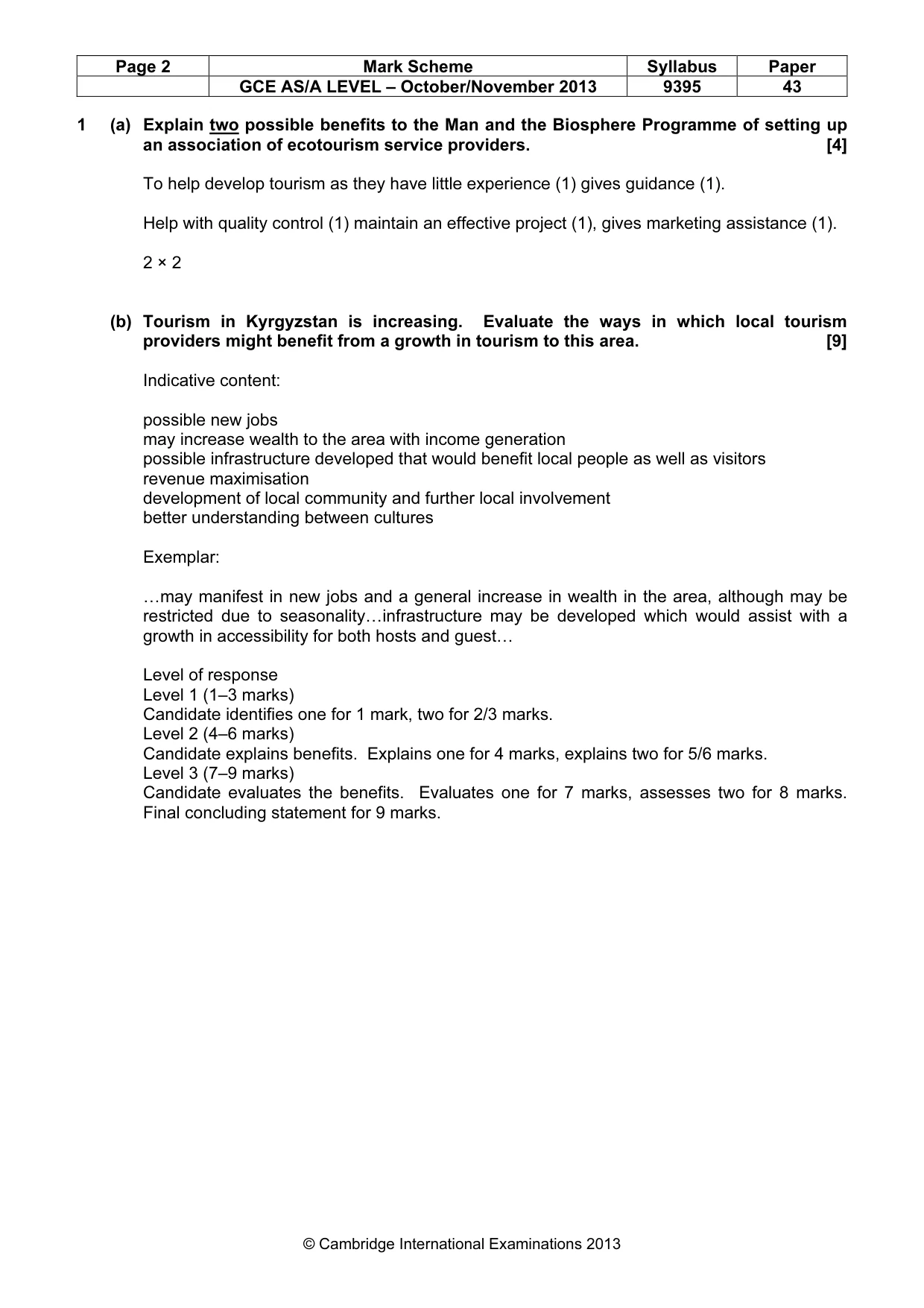
Page 2 Mark Scheme Syllabus Paper GCE AS/A LEVEL – October/November 2013 9395 43 © Cambridge International Examinations 2013 1 (a) Explain two possible benefits to the Man and the Biosphere Programme of setting up an association of ecotourism service providers. [4] To help develop tourism as they have little experience (1) gives guidance (1). Help with quality control (1) maintain an effective project (1), gives marketing assistance (1). 2 × 2 (b) Tourism in Kyrgyzstan is increasing. Evaluate the ways in which local tourism providers might benefit from a growth in tourism to this area. [9] Indicative content: possible new jobs may increase wealth to the area with income generation possible infrastructure developed that would benefit local people as well as visitors revenue maximisation development of local community and further local involvement better understanding between cultures Exemplar: …may manifest in new jobs and a general increase in wealth in the area, although may be restricted due to seasonality…infrastructure may be developed which would assist with a growth in accessibility for both hosts and guest… Level of response Level 1 (1–3 marks) Candidate identifies one for 1 mark, two for 2/3 marks. Level 2 (4–6 marks) Candidate explains benefits. Explains one for 4 marks, explains two for 5/6 marks. Level 3 (7–9 marks) Candidate evaluates the benefits. Evaluates one for 7 marks, assesses two for 8 marks. Final concluding statement for 9 marks.
Mark scheme, page 3
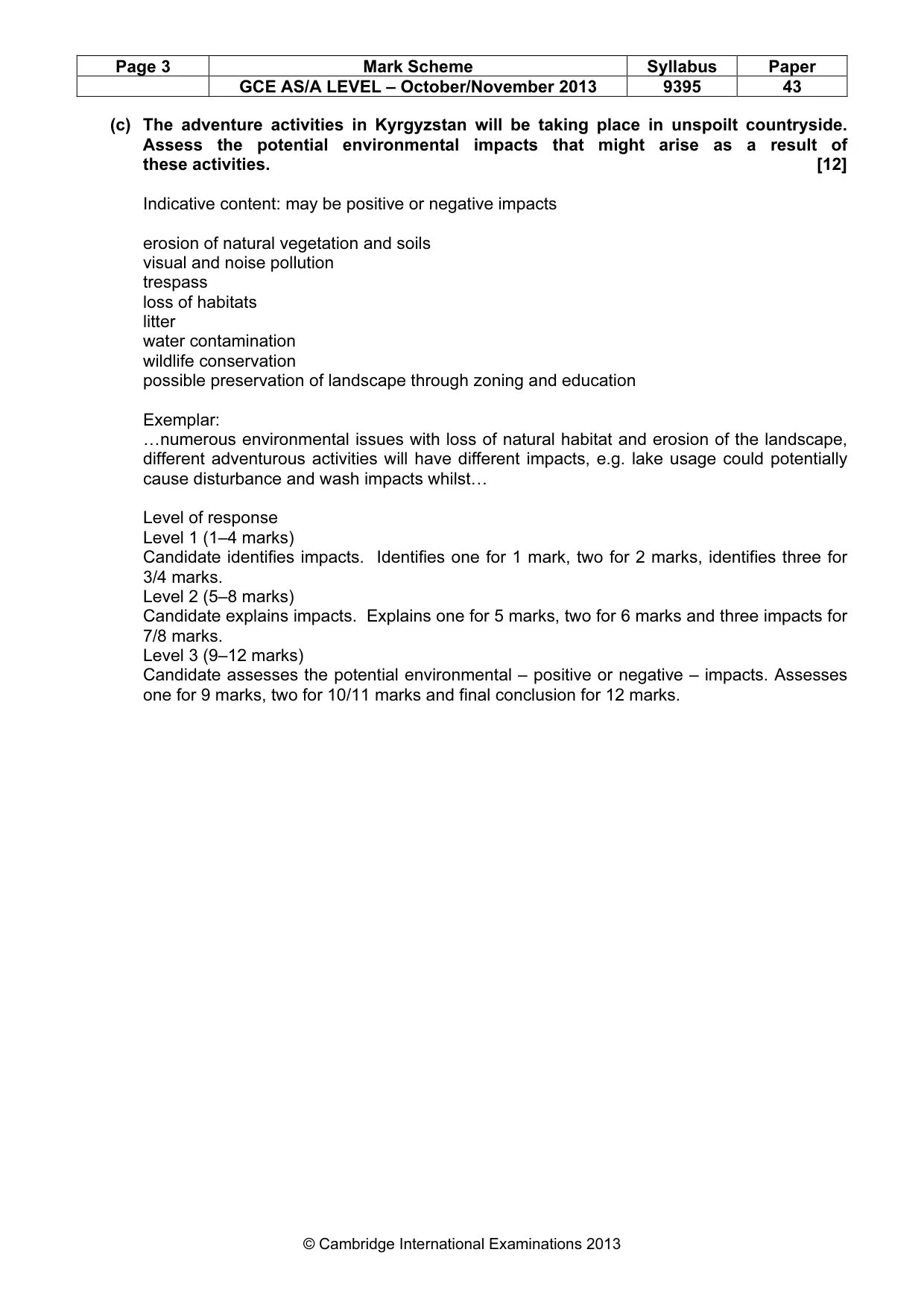
Page 3 Mark Scheme Syllabus Paper GCE AS/A LEVEL – October/November 2013 9395 43 © Cambridge International Examinations 2013 (c) The adventure activities in Kyrgyzstan will be taking place in unspoilt countryside. Assess the potential environmental impacts that might arise as a result of these activities. [12] Indicative content: may be positive or negative impacts erosion of natural vegetation and soils visual and noise pollution trespass loss of habitats litter water contamination wildlife conservation possible preservation of landscape through zoning and education Exemplar: …numerous environmental issues with loss of natural habitat and erosion of the landscape, different adventurous activities will have different impacts, e.g. lake usage could potentially cause disturbance and wash impacts whilst… Level of response Level 1 (1–4 marks) Candidate identifies impacts. Identifies one for 1 mark, two for 2 marks, identifies three for 3/4 marks. Level 2 (5–8 marks) Candidate explains impacts. Explains one for 5 marks, two for 6 marks and three impacts for 7/8 marks. Level 3 (9–12 marks) Candidate assesses the potential environmental – positive or negative – impacts. Assesses one for 9 marks, two for 10/11 marks and final conclusion for 12 marks.
Mark scheme, page 4
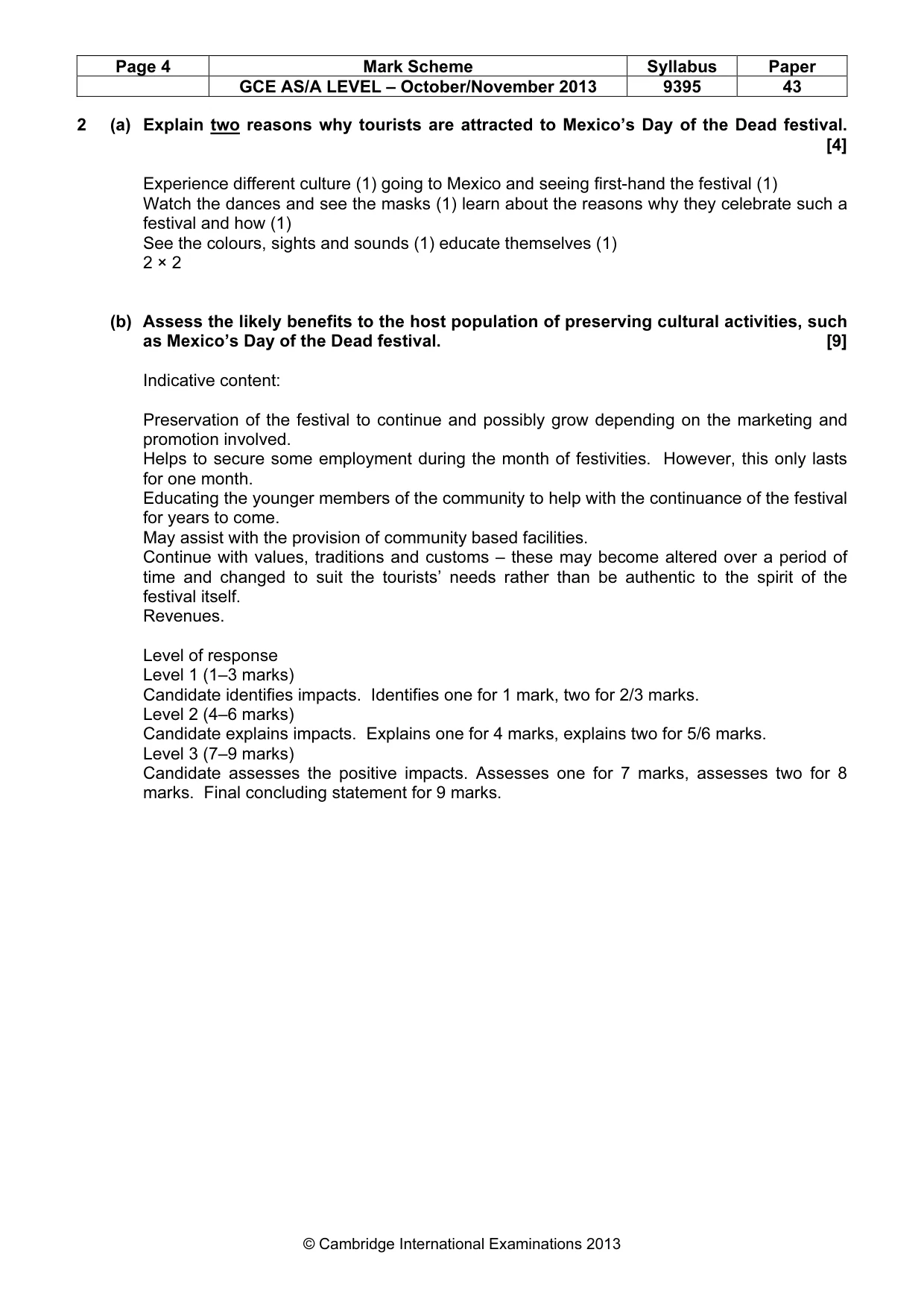
Page 4 Mark Scheme Syllabus Paper GCE AS/A LEVEL – October/November 2013 9395 43 © Cambridge International Examinations 2013 2 (a) Explain two reasons why tourists are attracted to Mexico’s Day of the Dead festival. [4] Experience different culture (1) going to Mexico and seeing first-hand the festival (1) Watch the dances and see the masks (1) learn about the reasons why they celebrate such a festival and how (1) See the colours, sights and sounds (1) educate themselves (1) 2 × 2 (b) Assess the likely benefits to the host population of preserving cultural activities, such as Mexico’s Day of the Dead festival. [9] Indicative content: Preservation of the festival to continue and possibly grow depending on the marketing and promotion involved. Helps to secure some employment during the month of festivities. However, this only lasts for one month. Educating the younger members of the community to help with the continuance of the festival for years to come. May assist with the provision of community based facilities. Continue with values, traditions and customs – these may become altered over a period of time and changed to suit the tourists’ needs rather than be authentic to the spirit of the festival itself. Revenues. Level of response Level 1 (1–3 marks) Candidate identifies impacts. Identifies one for 1 mark, two for 2/3 marks. Level 2 (4–6 marks) Candidate explains impacts. Explains one for 4 marks, explains two for 5/6 marks. Level 3 (7–9 marks) Candidate assesses the positive impacts. Assesses one for 7 marks, assesses two for 8 marks. Final concluding statement for 9 marks.
Mark scheme, page 5
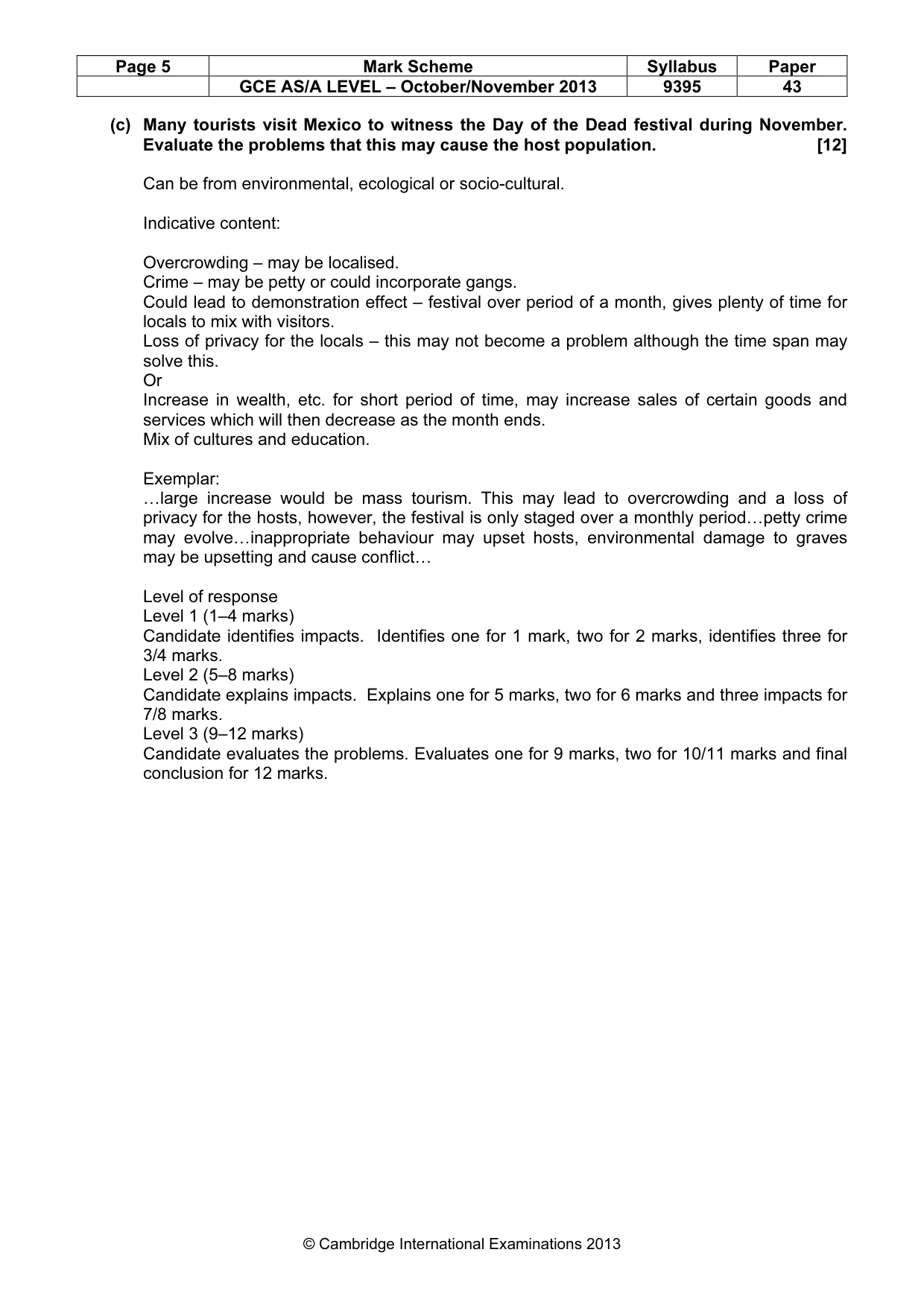
Page 5 Mark Scheme Syllabus Paper GCE AS/A LEVEL – October/November 2013 9395 43 © Cambridge International Examinations 2013 (c) Many tourists visit Mexico to witness the Day of the Dead festival during November. Evaluate the problems that this may cause the host population. [12] Can be from environmental, ecological or socio-cultural. Indicative content: Overcrowding – may be localised. Crime – may be petty or could incorporate gangs. Could lead to demonstration effect – festival over period of a month, gives plenty of time for locals to mix with visitors. Loss of privacy for the locals – this may not become a problem although the time span may solve this. Or Increase in wealth, etc. for short period of time, may increase sales of certain goods and services which will then decrease as the month ends. Mix of cultures and education. Exemplar: …large increase would be mass tourism. This may lead to overcrowding and a loss of privacy for the hosts, however, the festival is only staged over a monthly period…petty crime may evolve…inappropriate behaviour may upset hosts, environmental damage to graves may be upsetting and cause conflict… Level of response Level 1 (1–4 marks) Candidate identifies impacts. Identifies one for 1 mark, two for 2 marks, identifies three for 3/4 marks. Level 2 (5–8 marks) Candidate explains impacts. Explains one for 5 marks, two for 6 marks and three impacts for 7/8 marks. Level 3 (9–12 marks) Candidate evaluates the problems. Evaluates one for 9 marks, two for 10/11 marks and final conclusion for 12 marks.
What you needed in this session
Cambridge’s own grade thresholds for 2013 Oct/Nov, Paper 4 · Variant 3. A higher threshold means an easier paper — the bar moves with how the cohort did.